


Abstract
Our aim was to investigate the feasibility of using limestone waste resulting from stone processing for the manufacturing of fired clay bricks. Waste materials were considered as a partial replacement for clays to reduce the exploitation of natural resources and as a response to the climate neutrality commitments. The samples were prepared to have a waste content of up to 15% and were fired at a temperature of 900 °C. The chemical and mineralogical composition and the physical analysis of raw materials were investigated by using SEM–EDS and XRD diffraction. The result showed an increase in CaO in the clay mixture due to the presence of limestone, which reduced the shrinkage of the products’ compressive strength, up to 55% for samples with a higher content of limestone (15 wt.%), and influenced the samples’ color by making them lighter than the reference sample.
1. Introduction
The quarry and processing of natural stone yearly generate a high quantity of waste, which can be recycled in construction materials to sustain circularity and economic growth. Waste resulting from the processing of stone as formed, cladding, floor-paving elements represents up to half of the volume of the extracted material [1]. This has a significant economic and environmental impact, as well as a huge potential in recovering the construction industry [2,3] as a circular economy measure.
Studies conducted in recent years by academic and scientific researchers have highlighted the potential of using recycled limestone waste as a binder [3,4,5,6,7] or aggregate in cementitious materials [3,8,9,10], or as a filler in bituminous concrete [11], glass fiber [12], or production of ceramic materials [13,14,15]. The limited studies performed thus far on clay bricks with the addition of limestone waste have increased the interest in studying the potential of local waste recovery in the production of ceramic materials. Substituting recycled limestone waste in the clay matrix may contribute to the preservation of natural resources and reduction in waste disposal. Waste materials’ circularity resulting from the construction industry is essential in the transition toward a circular economy. The waste hierarchy “reduce–reuse–recycle” [16,17] was considered a sustainable action plan [18,19,20] to reduce the environmental impact, provide new jobs, and limit the taxes associated with pollution, including CO2 emissions certificates. Recovery of waste materials for manufacturing of new products should be managed by considering the waste stream, recycling process (collection, distribution, sorting, grinding, transportation), and investment costs required for a supply chain.
The quality of units is a very important parameter. Therefore, the maximum percentages of waste that can be incorporated into clay matrix must be established in accordance with the raw materials’ characteristics and green- or fired-product properties. Limestone waste may be used as a fluxing material to reduce the clay plasticity or as a pore former, enhancing the thermal characteristics of ceramic materials by increasing their porosity. The recovery potential of other waste materials rich in calcite as an admixture in the mass of clay materials has also been investigated [21,22,23].
Limestone is a material rich in calcium carbonate and can contain magnesium carbonate [24], which has been used in the past as masonry stone units for the construction of residential, cultural, and administrative buildings. Now, its use as a unit in masonry buildings is limited to ecological constructions, mainly wall cladding or floor paving. Limestone is locally available and may be used as a primary or secondary raw material (resulting from stone processing or quarries activities) for manufacturing new materials.
During the firing process, the limestone decomposition must be complete to ensure brick quality. According to [25], carbonates with particle sizes larger than 5 mm may have negative effects if used as additives in a clay matrix. The CaO grains in the presence of water may favor the appearance of portlandite [26], followed by an increase in volume [25] and a decrease in material properties.
In that respect, this paper presents our findings from experiments on fired-clay materials having a composition of up to 15% limestone waste. The aim of the present investigation was to evaluate the feasibility of the use of limestone waste as a resource for manufacturing of fired bricks. Characterization of the samples was performed in terms of mineralogical, physical, and mechanical properties.
The paper is structured in four sections. In the second section, the materials and methods used in the experimental study for investigations of raw materials and green and fired samples, are presented. In the third section, the results obtained are highlighted, and some observations and remarks are discussed to support the findings. Conclusions and further research are drawn at the end of this paper based on the results.
2. Materials and Methods
The raw materials were treated (dried at a temperature of 90 °C and ground), and their density was determined by pycnometry, resulting in the following values: 2.38 g/cm3 clays and 2.44 g/cm3 limestone. Based on material densities, the specimens were prepared as admixtures of clays and limestone waste resulting from stone processing activities, in different percentages by weight. The limestone content in the clay matrix was 0% (reference sample C0), 5% (sample C1), 10% (sample C2), and 15% (sample C3). The specimens were cylindrically shaped with an 18 mm diameter. Then, they were dry-pressed at 39 MPa by using a hydraulic press and fired at a temperature of 900 °C/2 h [27,28].
Scanning electron microscopy and energy dispersive X-ray spectroscopy analysis (Jeol 5600 LV microscope) were used to investigate the limestone and fired samples. For each value presented in the paper, a minimum of 5 different measurements were conducted and averaged. The density of a sample was determined by dividing the sample’s mass by the calculated volume. Because it had a regular shape, the sample’s volume was calculated from linear measurements made with 0.1 mm accuracy. Linear shrinkage was calculated as the ratio of the sample’s diameter shrinkage divided by the initial diameter, and is presented as a percentage; the linear measurements were conducted again with 0.1 mm accuracy. Similarly, the mass loss was calculated by dividing the measured weight loss from the sample’s initial mass. The values are given as a percentage. The sample’s color was taken from the sample images. Phase identification was conducted using X-ray diffraction (Equinox D3000 diffractometer), using Co-kα radiation. Phase composition was estimated from the X-ray diffraction patterns based of the height of the most intense peak for each compound. The compressive strength of the specimens was determined on cylindrical specimens with a diameter of 18 mm and an aspect ratio of 1 by using a Controls Advantest 9 hydraulic press. The load rate we used was 0.2 MPa s−1, and the accuracy of the pressure recording was 0.01 MPa.
3. Results and Discussion
3.1. Raw Materials
The SEM images at different magnification and X-ray diffraction pattern are presented in Figure 1. The SEM images (Figure 1a,b) highlight an agglomerated powder with a wide size range starting from ~1 to 100 µm.
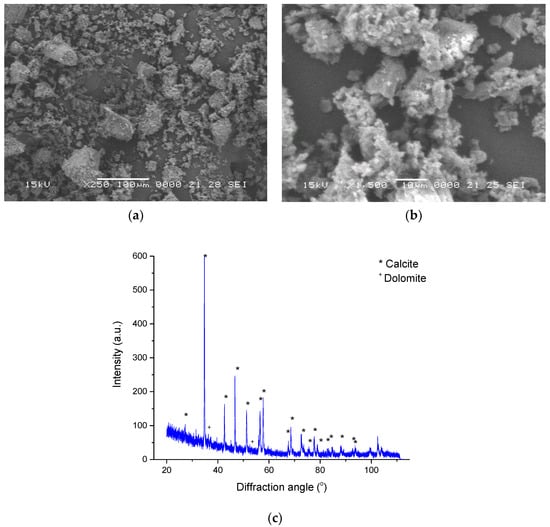
Figure 1.
SEM images of limestone at low (a) and higher (b) magnification; X-ray diffraction pattern of the used powder (c).
The X-ray diffraction pattern (Figure 1c) shows that limestone waste mostly contained calcite and some traces of dolomite. An X-ray diffraction peak shift was observed due to the differences in ionic radii between the main element (calcium) and the other coexisting elements.
The limestone waste was analyzed by using the EDX microprobe, and the main metals are evidenced in Table 1.

Table 1.
Elemental metal composition of limestone (wt.%).
The analysis showed that limestone mainly consisted of calcium carbonate (CaCO3) and traces of dolomite (MgCO3), which may have contributed to the increase in the specimen’s porosity during firing and decrease in its density. It is noteworthy that 44 wt.% of CaCO3 and 52 wt.% of MgCO3 were emitted into the atmosphere in the form of CO2, an unwanted greenhouse gas, during the firing.
3.2. Brick Sample
As in reference [25], in samples with limestone content (more highlighted in samples C2 and C3), the presence of unreacted CaO grains was observed (Figure 2b). This can generate decay of materials in the presence of water and lead to the transformation of calcium oxide (CaO) into portlandite (Ca(OH)2).
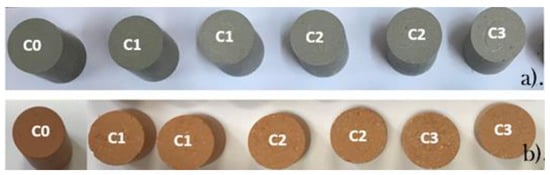
Figure 2.
Green (a) and fired samples (b).
A higher temperature may be required for sealing CaO particles in a clay matrix to avoid this undesirable phenomenon, which increases the energy demand, the product cost, and pollution. Other issues have been highlighted [29,30], clearly showing a higher release of CO2 from raw materials rich in carbonate.
The lower content of Fe2O3 in samples with a higher content of limestone influenced the sample’s texture and color (Figure 2). We found that the color of a sample with the addition of limestone waste (C1–C3) was influenced by the increase in waste content, because it was lighter than the reference sample (C0).
For the description of the color changes due to the presence of limestone waste, the most employed color space (the RGB color space) was used. The RGB color space is based on the mixture of three primary, reference colors: red, green, and blue (R, G, and B). They form the base vectors of a three-dimensional orthogonal (color)–vector space, where the origin represents black because any color can be viewed as a mixture of the three. The three components are determined by the measured intensities of visible light in the long-wave (red), middle-wave (green), and short-wave (blue) area. As shown in Figure 3, which represents the samples color in the RGB space, increases in the green and blue components were recorded, so the color was lighter than that of the reference sample.
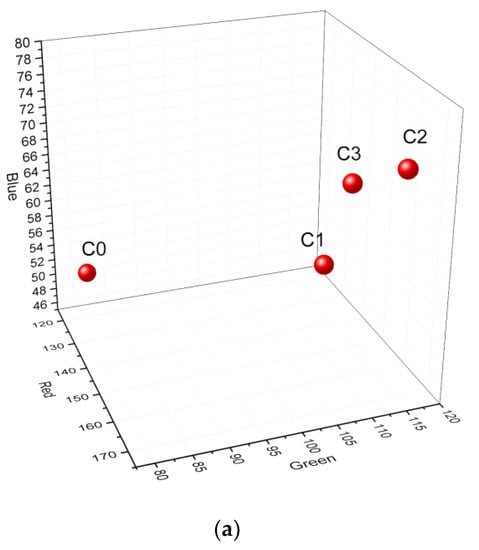
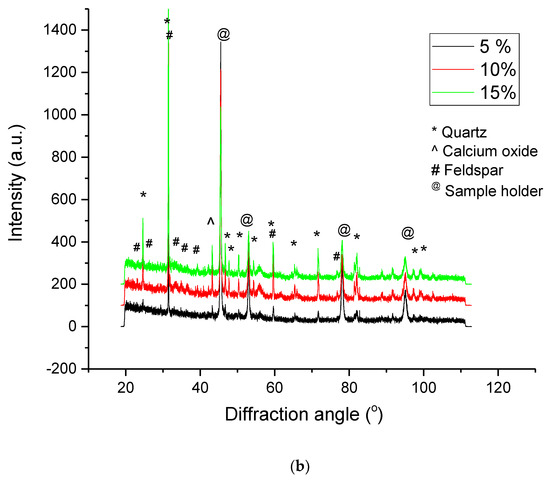
Figure 3.
Representation of the samples color in the RGB space (a) and X-ray diffraction pattern (b).
Regarding fired clay materials, the main oxides that influenced the samples color were alumina, iron oxide, calcium, and magnesium oxide. As we showed, adding the limestone into the clay matrix increased the calcium and magnesium oxide contents, while other oxides appeared to remain constant. The main components identified by X-ray diffraction were quartz (around 80%), feldspar, and calcium oxide (Table 2). Minor components (not marked in Figure 3b to avoid being illegible) were hematite, gehlenite, and muscovite.
Table 2.
Estimated concentration of present minerals.
From Table 1, one can conclude that some part of the calcium oxide remained as a free mineral present in the fired samples in the form of white spots (see Figure 2b). Some of it reacted with aluminum oxide and quartz to form at lower content gehlenite or at higher CaO content with Ca-containing minerals of the feldspar group. Based on the work of R. Kreimeyer [31], the increased CaO and MgO contents of more than 10% caused the iron oxide (responsible for the usual brown color) to be partially consumed by the formation of different compounds such as dicalcium ferrite, gehlenite, or pyroxene. From these minerals, only the gehlenite was identified in the samples with more than 10% limestone waste. This effect, the lightening of the brown color, is clearly evidenced in Figure 3, where the colors of samples C2 and C3 are far from that of the reference sample; a strong increase in the blue (short-wave) and green (middle-wave) intensities is clear. For sample C1, an increase in the green component is visible. This slight color modification compared with the reference sample was mainly due to the presence of free, white CaO particles, visible in Figure 2b.
Using the EDX analysis, we found three main elements whose oxide could be responsible for the color change: aluminum, calcium, and iron. The calcium was observed as individual grains in accordance with the previous observations, as presented in Figure 2 (the white dots) and further evidenced in Figure 4, and its effect was visible in the present case. The alumina and iron ratio was relatively constant for the fired samples; however the absolute value of the iron concentration steadily decreased with the increase in the limestone addition (from ~5.5 to 4.1 wt.%).
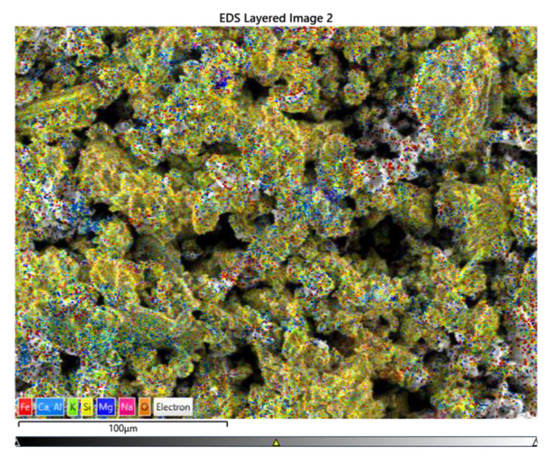
Figure 4.
Sample EDS distribution maps (for sample C2).
The masses of the green and fired samples are shown in the Figure 5. Up to 17% mass loss on firing was measured in the sample with highest content of limestone (C3), which occurred due to the thermal decomposition of inorganic substances of raw materials.
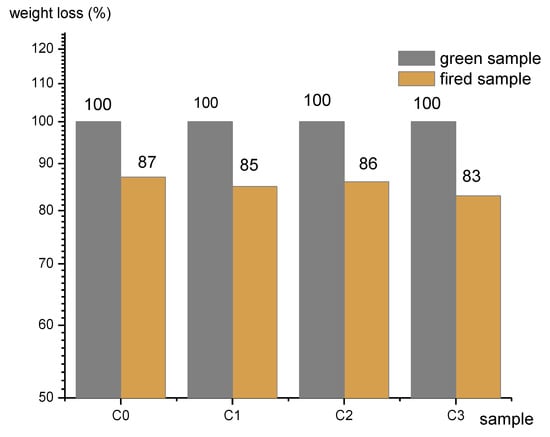
Figure 5.
Weight of green and fired clay samples.
During the decomposition of carbonates, clays and limestone were transformed into CaO and CO2 for calcite, while the MgCO3 was transformed into MgO and CO2; both reactions require elevated temperature. The samples’ mesoporous structure [32] increased the samples’ porosities. At a lower temperature, the water was released into atmosphere due to dehydration and dehydroxylation of clay materials. CaO may react with SiO2, resulting in wollastonite, which may contribute to reduction in shrinkage [30].
The variation in the linear dimension with the limestone content is presented in Figure 6.
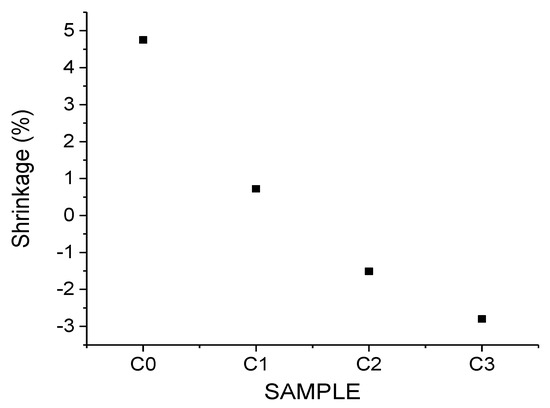
Figure 6.
Variation of linear dimension with the limestone content.
According to [33,34], shrinkage takes place due to the loss of chemically bound water during the drying and firing stage of the product because of the reduction in porosity during sintering and the expansion caused by the voids generated during the burning of organic matter and other pore formers.
The shrinkage (percent), determined as the ratio between the sample’s diameter measured before and after sintering, highlighted a decrease to 0.7% in sample C1 and a further expansion to 1.5% for sample C2 and 2.8% in sample C3. This suggested that the decrease in shrinkage depended on the increase in limestone content and was an exponential decay. Similar trends were highlighted by authors [25] in a different study.
The densities determined for green and fired samples are presented in Figure 7. It is shown that the green samples’ densities had insignificant increases of 1.03% (sample C2) and 0.52% (sample C1), as well as a decrease of 0.52% (sample C3) compared with the reference sample (sample C0). After firing, the density of the samples decreases from 12% in the reference sample and up to 17% in sample C3. It may also be observed that the sample density of fired bricks with the highest percent of limestone waste (C3) experienced a decrease of about 6% compared with the control sample (C0). Because the densities of the raw materials were close, their decreases are attributed solely to the increase in porosity by carbonate decomposition.
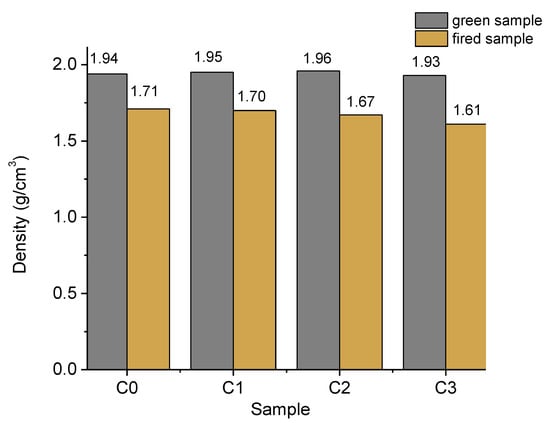
Figure 7.
Density of green and fired samples (g/cm3).
The samples with limestone as an admixture (C1–C3) were materials with high density (>1 g/cm3), normally being proper for masonry, and are protected against water with cladding materials if the firing temperature is lower than 1000 °C.
The compressive strength of the fired clay samples is shown in Figure 8.
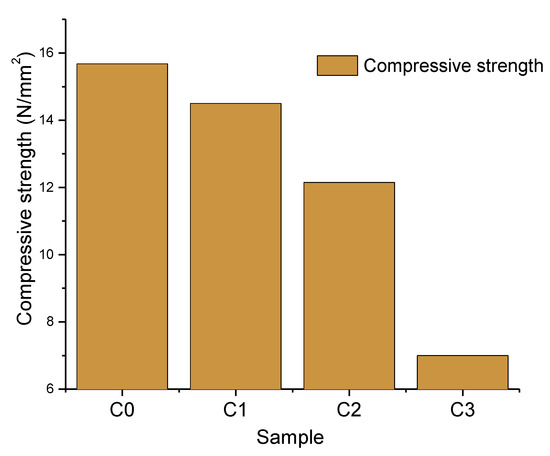
Figure 8.
Compressive strength of samples.
Figure 8 shows that mechanical strength of the samples was reduced by up to 55% from 15.7 to 7 N/mm2, such as sample C3, compared with the standard sample. Based on the results obtained, sample C3 is recommended for the production of solid units for exploitation in dry environments. Increasing the firing temperature to 1100 °C, the compressive strength of samples was reduced up to 8% in the reference samples and 9% in sample C2. By incorporating different wastes, we deviated from optimal composition, so a decrease in the mechanical properties may be expected.
To improve the mechanical characteristics of materials with limestone as an admixture, further research can be performed based on these results. Future investigation should envision the environmental impact of the materials by partially or totally considering the uptake of the CO2.
In order to compare the magnitude of the reduction in the compressive strength, the slope of the linear regression of the data presented in Figure 9 [28,35,36,37,38,39] was compared with the data in the literature of other commonly used waste. The positive slope indicated that the waste increased the compressive strength. As can be observed, only the fly ash had a positive effect on the compressive strength. The limestone waste had the largest negative effect. We suggest that the maximum amount of limestone waste to be used in combination with the high CO2 emissions is around 5%.
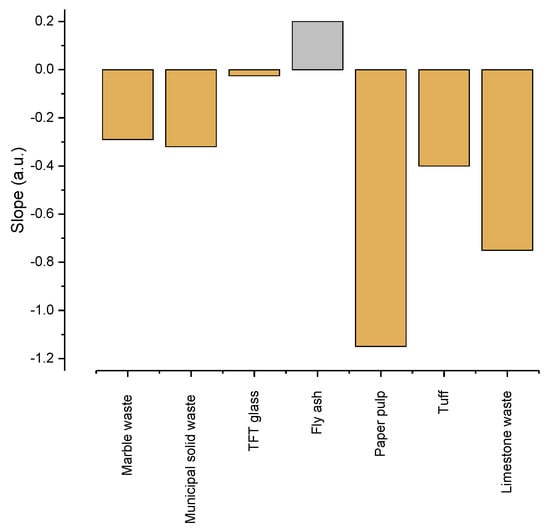
Figure 9.
Linear decrease in compressive strength as function of used waste (marble waste [35]; municipal solid waste [36]; TFT glass [37]; fly ash [38]; gypsum waste [39]; tuff [28]; limestone waste—present work).
3.3. Advantages and Disadvantages of Reusing Limestone Waste as Admixture in Clay Materials
The durability of materials is one of the most important parameters to ensure the maintenance of a product in economy for many years after manufacturing, considering that waste prevention is a priority in the Waste Framework Directive [17]. Usually, clay materials have a high lifecycle compared with other building materials if they are properly used and maintained in construction. After building demolition or dismantling, the clay materials may be reused in other construction if their parameters are adequate, or they may be recycled as a binder or aggregate for new material productions.
Some opportunities for and threats of using the limestone waste as an admixture in the clay matrix are summarized in Table 3.
Table 3.
Advantages and disadvantages of using limestone in the clay materials.
It is well-known that to determine the environmental impact of a manufacturing process of ceramic materials, the carbon emissions generated during exploitation of materials, technological flux (firing and drying), and decomposition of organic raw materials must be considered [40]. In the analyzed samples, the content of CaO was increased due to the addition of the limestone waste.
We propose that the contribution of limestone waste as a pore-forming agent may counterbalance the impact upon environment. This may contribute to manufacturing products with improved thermal properties and lower density.
4. Conclusions and Further Research Development
The results obtained on clay materials with admixture of limestone waste highlighted the following:
- -
- The limestone waste increased the carbonate content and CO2 release due to their decomposition, contributed to the waste circularity, and may improve the thermal performance of products;
- -
- The compressive strength of the samples with limestone waste was lower than that of the reference samples, with up to 55% (sample C3);
- -
- The sample density was reduced only by 17% for the sample with highest limestone content, so it can be recommended for use in dry environments; to avoid their damage, the color of the samples lightened as the limestone waste content increased.
A holistic approach at the macrolevel is necessary in making decision regarding the stream flux and opportunity in waste recovery. Selective collection and treatment programs are needed in each country and cities with relevant action plans established for waste management based on “reuse–recycle–recovery”.
Author Contributions
Conceptualization, N.C. and G.T.; methodology G.T. and N.C.; investigation, N.C., G.T., A.-A.B., H.C., A.C., M.V. and T.F.M.; writing—original draft preparation, N.C., G.T., A.-A.B., H.C., M.V. and T.F.M.; writing—review and editing, N.C., G.T., A.-A.B., H.C. and A.C.; visualization, N.C., G.T., A.-A.B., H.C., A.C., M.V. and T.F.M. All authors have read and agreed to the published version of the manuscript.
Funding
This research received no external funding.
Conflicts of Interest
The authors declare no conflict of interest.
References
- Mosaferi, M.; Dianat, I.; Khatibi, M.S.; Mansour Nemati, S.; Mohammad, E.; Ahmad Asl, H. Review of environmental aspects and waste management of stone cutting and fabrication industries. J. Mater. Cycles Waste Manag. 2014, 16, 721–730. [Google Scholar] [CrossRef]
- Alzboon, K.K.; Mahasneh, N.K. Effect of Using Stone Cutting Waste on the Compression Strength and Slump Characteristics of Concrete. Int. J. Environ. Sci. Eng. 2009, 1, 4. [Google Scholar]
- Chouhan, H.S.; Kalla, P.; Nagar, R.; Gautam, P.K. Influence of dimensional stone waste on mechanical and durability properties of mortar: A review. Constr. Build. Mater. 2019, 227, 116662. [Google Scholar] [CrossRef]
- Hilal, N.N.; Mohammed, A.S.; Ali, T.K.M. Properties of Eco-Friendly Concrete Contained Limestone and Ceramic Tiles Waste Exposed to High Temperature. Arab J. Sci. Eng. 2020, 45, 4387–4404. [Google Scholar] [CrossRef]
- Du, Y.; Yang, W.; Ge, Y.; Wang, S.; Liu, P. Thermal conductivity of cement paste containing waste glass powder, metakaolin and limestone filler as supplementary cementitious material. J. Clean. Prod. 2021, 287, 125018. [Google Scholar] [CrossRef]
- Proske, T.; Rezvani, M.; Palm, S.; Müller, C.; Graubner, C.-A. Concretes made of efficient multi-composite cements with slag and limestone. Cem. Concr. Compos. 2018, 89, 107–119. [Google Scholar] [CrossRef]
- Díaz, Y.C.; Berriel, S.S.; Heierli, U.; Favier, A.R.; Sánchez Machado, I.R.; Scrivener, K.L.; Hernández, J.F.M.; Habert, G. Limestone calcined clay cement as a low-carbon solution to meet expanding cement demand in emerging economies. Dev. Eng. 2017, 2, 82–91. [Google Scholar] [CrossRef]
- Chouhan, H.S.; Kalla, P.; Nagar, R.; Gautam, P.K. Gainful utilization of dimensional limestone waste as fine aggregate in cement mortar mixes. Constr. Build. Mater. 2019, 221, 363–374. [Google Scholar] [CrossRef]
- Chouhan, H.S.; Kalla, P.; Nagar, R.; Gautam, P.K.; Arora, A.N. Investigating use of dimensional limestone slurry waste as fine aggregate in mortar. Environ. Dev. Sustain. 2020, 22, 2223–2245. [Google Scholar] [CrossRef]
- Kępniak, M.; Woyciechowski, P.; Łukowski, P.; Kuziak, J.; Kobyłka, R. The Durability of Concrete Modified by Waste Limestone Powder in the Chemically Aggressive Environment. Materials 2019, 12, 1693. [Google Scholar] [CrossRef] [Green Version]
- Choudhary, J.; Kumar, B.; Gupta, A. Feasible utilization of waste limestone sludge as filler in bituminous concrete. Constr. Build. Mater. 2020, 239, 117781. [Google Scholar] [CrossRef]
- Kim, Y.; Kim, M.; Sohn, J.; Park, H. Applicability of gold tailings, waste limestone, red mud, and ferronickel slag for producing glass fibers. J. Clean. Prod. 2018, 203, 957–965. [Google Scholar] [CrossRef]
- Barros, M.M.; de Oliveira, M.F.L.; Ribeiro, R.C.d.C.; Bastos, D.C.; de Oliveira, M.G. Ecological bricks from dimension stone waste and polyester resin. Constr. Build. Mater. 2020, 232, 117252. [Google Scholar] [CrossRef]
- Kłosek-Wawrzyn, E.; Bugaj, A. Research on the possibility of using sludges from washing dolomite and limestone aggregates in the building ceramics technology. Gospod. Surowcami Miner. Mineral. Resour. Manag. 2018, 34, 65–82. [Google Scholar] [CrossRef]
- Sembiring, M. Utilizing Limestone Waste Factory Cement Using Fiber Palm Oil Fiber as Power Forming mush on Light Brick. J. Phys. Conf. Ser. 2018, 1116, 032030. [Google Scholar] [CrossRef]
- Corona, B.; Shen, L.; Reike, D.; Carreón, J.R.; Worrell, E. Towards sustainable development through the circular economy—A review and critical assessment on current circularity metrics. Resour. Conserv. Recycl. 2019, 151, 104498. [Google Scholar] [CrossRef]
- Directive 2008/98/EC of the European Parliament and of the Council of 19 November 2008 on Waste and Repealing Certain Directives. Available online: http://data.europa.eu/eli/dir/2008/98/2018-07-05 (accessed on 2 May 2022).
- European Commission. A Clean Planet for all. A European Long-Term Strategic Vision for a Prosperous, Modern, Competitive and Climate Neutral Economy. 2018. Available online: https://eur-lex.europa.eu/legal-content/EN/TXT/PDF/?uri=CELEX:52018DC0773&from=EN (accessed on 2 May 2022).
- European Comission. Communication from the Commission to the European Parliament, the Council, the European Economic and Social Committee and the Committee of the Regions Towards a Circular Economy: A Zero Waste Programme for Europe. 2014. Available online: https://eur-lex.europa.eu/legal-content/EN/TXT/?uri=celex%3A52014DC0398 (accessed on 2 May 2022).
- European Commission. The European Green Deal. COM/2019/640 Final. 2019. Available online: https://eur-lex.europa.eu/legal-content/EN/TXT/?uri=CELEX:52019DC0640%0Ahttps://ec.europa.eu/info/strategy/priorities-2019-2024/european-green-deal_en (accessed on 2 May 2022).
- Sutcu, M.; Alptekin, H.; Erdogmus, E.; Er, Y.; Gencel, O. Characteristics of fired clay bricks with waste marble powder addition as building materials. Constr. Build. Mater. 2015, 82, 1–8. [Google Scholar] [CrossRef]
- Thakur, A.K.; Pappu, A.; Thakur, V.K. Resource efficiency impact on marble waste recycling towards sustainable green construction materials. Curr. Opin. Green Sustain. Chem. 2018, 13, 91–101. [Google Scholar] [CrossRef]
- Doğan-Sağlamtimur, N.; Bilgil, A.; Szechyńska-Hebda, M.; Parzych, S.; Hebda, M. Eco-Friendly Fired Brick Produced from Industrial Ash and Natural Clay: A Study of Waste Reuse. Materials 2021, 14, 877. [Google Scholar] [CrossRef]
- Balog, A.-A.; Cobirzan, N.; Mosonyi, E. Analysis of limestones from heritage buildings as damage diagnostics. Rom. Rep. Phys. 2016, 68, 353–361. [Google Scholar]
- Kłosek-Wawrzyn, E.; Murzyn, P.; Wons, W. Analysis of the possibility of limestone sludge usage in the production of clay masonry units. In Proceedings of the Sixteenth International Waste Management and Landfill Symposium, Sardinia, Italy, 2–6 October 2017; CISA Publisher: Padova, Italy; pp. 1–13. [Google Scholar]
- Kłosek-Wawrzyn, E.; Małolepszy, J.; Murzyn, P. Sintering Behavior of Kaolin with Calcite. Procedia Eng. 2013, 57, 572–582. [Google Scholar] [CrossRef] [Green Version]
- Thalmaier, G.; Cobîrzan, N.; Balog, A.-A.; Constantinescu, H.; Streza, M.; Nasui, M.; Neamtu, B.V. Influence of sawdust particle size on fired clay brick properties. Mater. Construcc. 2020, 70, e215. [Google Scholar] [CrossRef]
- Cobîrzan, N.; Thalmaier, G.; Balog, A.-A.; Constantinescu, H.; Ceclan, A.; Nasui, M. Volcanic Tuff as Secondary Raw Material in the Production of Clay Bricks. Materials 2021, 14, 6872. [Google Scholar] [CrossRef] [PubMed]
- González, I.; Galán, E.; Miras, A.; Vázquez, M.A. CO2 emissions derived from raw materials used in brick factories. Applications to Andalusia (Southern Spain). Appl. Clay Sci. 2011, 52, 193–198. [Google Scholar] [CrossRef]
- Muñoz, P.; Morales, M.P.; Letelier, V.; Mendívil, M.A. Fired clay bricks made by adding wastes: Assessment of the impact on physical, mechanical, and thermal properties. Constr. Build. Mater. 2016, 125, 241–252. [Google Scholar] [CrossRef]
- Kreimeyer, R. Some Notes on the Firing Colour of Clay Bricks. Appl. Clay Sci. 1987, 2, 175–183. [Google Scholar] [CrossRef]
- Rodriguez-Navarro, C.; Ruiz-Agudo, E.; Luque, A.; Rodriguez-Navarro, A.B.; Ortega-Huertas, M. Thermal decomposition of calcite: Mechanisms of formation and textural evolution of CaO nanocrystals. Am. Mineral. 2009, 94, 578–593. [Google Scholar] [CrossRef]
- Karaman, S.; Ersahin, S.; Gunal, H. Firing temperature and firing time influence on mechanical and physical properties of clay bricks. J. Sci. Ind. Res. 2006, 65, 153–159. [Google Scholar]
- Ullah, S.M.; Hasan, M.; Ahmad, S.I.; Ahmed, T. Performance of industrial sludge-amended bricks manufactured in conventional kilns. J. Mater. Cycles Waste Manag. 2020, 22, 1932–1942. [Google Scholar] [CrossRef]
- Sufian, M.; Ullah, S.; Ostrowski, K.A.; Ahmad, A.; Zia, A.; Sliwa-Wieczorek, K.; Siddiq, M.; Awan, A.A. An Experimental and Empirical Study on the Use of Waste Marble Powder in Construction Material. Materials 2021, 14, 3829. [Google Scholar] [CrossRef]
- Singh, A.; Chandel, M.K. Valorization of fine fraction from legacy waste as fired bricks: A step towards circular economy. J. Clean. Prod. 2022, 331, 129918. [Google Scholar] [CrossRef]
- Lin, K.-L. The effect of heating temperature of thin film transistor-liquid crystal display (TFT-LCD) optical waste glass as a partial substitute partial for clay in eco-brick. J. Clean. Prod. 2007, 15, 1755–1759. [Google Scholar] [CrossRef]
- Lin, K.-L. Feasibility study of using brick made from municipal solid waste incinerator fly ash slag. J. Hazard. Mater. 2006, B137, 1810–1816. [Google Scholar] [CrossRef]
- Hamid, N.J.A.; Kadir, A.A.; Hashar, N.N.H.; Pietrusiewicz, P.; Nabiałek, M.; Wnuk, I.; Gucwa, M.; Palutkiewicz, P.; Hashim, A.A.; Sarani, N.A.; et al. Influence of Gypsum Waste Utilization on Properties and Leachability of Fired Clay Brick. Materials 2021, 14, 2800. [Google Scholar] [CrossRef]
- Cobîrzan, N.; Muntean, R.; Thalmaier, G.; Felseghi, R.-A. Recycling of Mining Waste in the Production of Masonry Units. Materials 2022, 15, 594. [Google Scholar] [CrossRef] [PubMed]
Publisher’s Note: MDPI stays neutral with regard to jurisdictional claims in published maps and institutional affiliations. |
© 2022 by the authors. Licensee MDPI, Basel, Switzerland. This article is an open access article distributed under the terms and conditions of the Creative Commons Attribution (CC BY) license (https://creativecommons.org/licenses/by/4.0/).