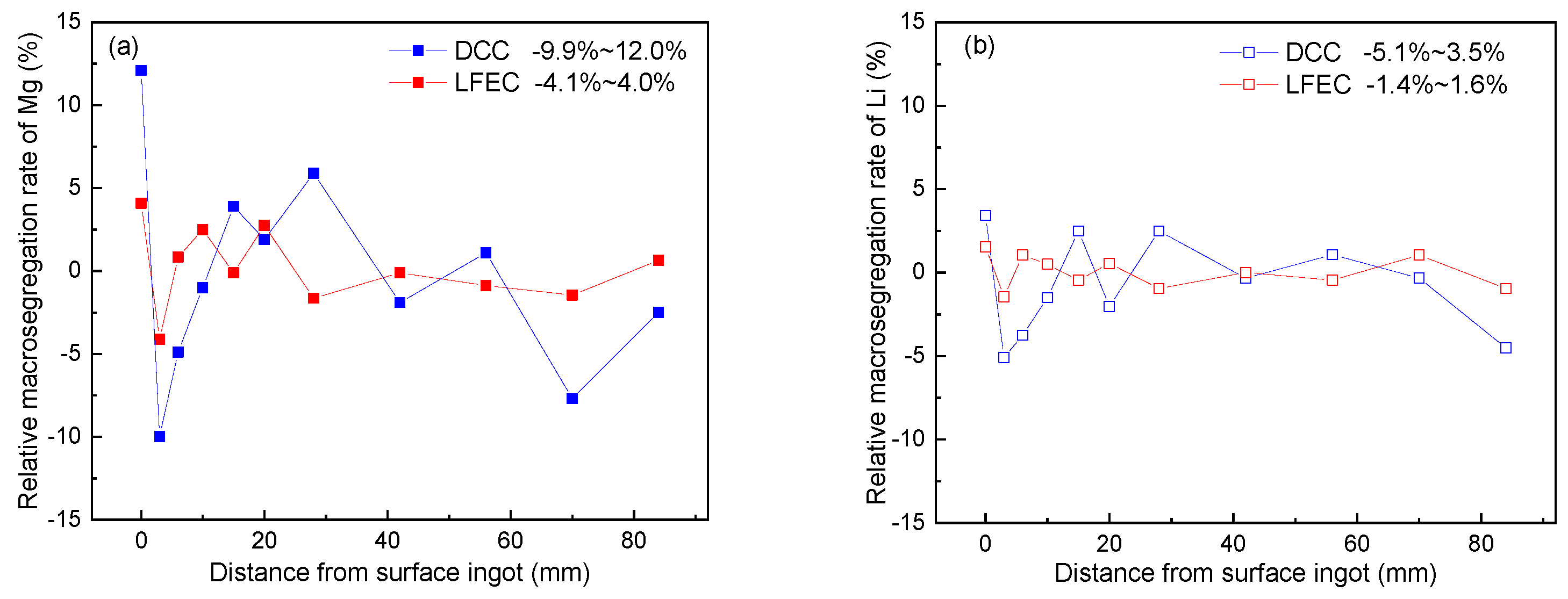
Correction: Wang, F., et al. Effect of Low-Frequency Electromagnetic Casting on Micro-Structure and Macro-Segregation of 5A90 Alloy Ingots. Materials 2020, 13, 2720




Reference
- Wang, F.; Wang, X.; Cui, J. Effect of Low-Frequency Electromagnetic Casting on Micro-Structure and Macro-Segregation of 5A90 Alloy Ingots. Materials 2020, 13, 2720. [Google Scholar] [CrossRef]

Publisher’s Note: MDPI stays neutral with regard to jurisdictional claims in published maps and institutional affiliations. |
© 2021 by the authors. Licensee MDPI, Basel, Switzerland. This article is an open access article distributed under the terms and conditions of the Creative Commons Attribution (CC BY) license (http://creativecommons.org/licenses/by/4.0/).
Share and Cite
Wang, F.; Wang, X.; Cui, J. Correction: Wang, F., et al. Effect of Low-Frequency Electromagnetic Casting on Micro-Structure and Macro-Segregation of 5A90 Alloy Ingots. Materials 2020, 13, 2720. Materials 2021, 14, 572. https://doi.org/10.3390/ma14030572
Wang F, Wang X, Cui J. Correction: Wang, F., et al. Effect of Low-Frequency Electromagnetic Casting on Micro-Structure and Macro-Segregation of 5A90 Alloy Ingots. Materials 2020, 13, 2720. Materials. 2021; 14(3):572. https://doi.org/10.3390/ma14030572
Chicago/Turabian StyleWang, Fuyue, Xiangjie Wang, and Jianzhong Cui. 2021. "Correction: Wang, F., et al. Effect of Low-Frequency Electromagnetic Casting on Micro-Structure and Macro-Segregation of 5A90 Alloy Ingots. Materials 2020, 13, 2720" Materials 14, no. 3: 572. https://doi.org/10.3390/ma14030572
APA StyleWang, F., Wang, X., & Cui, J. (2021). Correction: Wang, F., et al. Effect of Low-Frequency Electromagnetic Casting on Micro-Structure and Macro-Segregation of 5A90 Alloy Ingots. Materials 2020, 13, 2720. Materials, 14(3), 572. https://doi.org/10.3390/ma14030572