Is Fracture Toughness of PUR Foams a Material Property? A Statistical Approach





Abstract
1. Introduction
2. Materials and Methods
3. Experimental Results
4. Discussion: A Statistical Approach
- Column Estimate—the estimation values of the parameters (estimations using least square method).
- Column Std. Erros—the statistical standard deviation of the parameters.
- Column t-value—the value of t test, which it is used to verify the null hypothesis H0: a = 0, respectively H0: b = 0, the expression of this test is estimated value / standard deviation.
- Column Pr(>|t|)—the probability to not reject the null hypothesis. It is obvious that some null value of the parameters (accept the null hypothesis) are not desirable because this means that the predictor is not significant, so a value small as possible is good to accept the proposed model.
- Residual standard error—the sum of values between the observed (measured) value and the value predicted by model (it is desirable to be small as possible), degrees of freedom is the number of observations minus the number of parameters.
- Multiple R-squared—the coefficient of determination 1-(Residual sum of squares/Total sum of squares), (Residual sum of squares is the sum of square distance between the observed values and the values predicted by model, total sum of squares is the sum of square distance between the observed values and the statistical (arithmetical) mean of observations), it is obvious that this value should be large as possible;
- Adjusted R-squared is a correction expression of the coefficient of determination (because this coefficient tends to increase with increasing number of parameters (i.e., predictors).
- F-statistic—the value of F-test to verify the null hypothesis H0 a = b = 0 (both parameters are zero).
- p-value is the probability to not reject the null hypothesis, of course, a low value as possible it useful to accept the model.
5. Conclusions
Author Contributions
Funding
Conflicts of Interest
References
- Wang, H.; Li, T.-T.; Wu, L.; Lou, C.-W.; Huang, S.-Y. Multifunctional, Polyurethane-Based Foam Composites Reinforced by a Fabric Structure: Preparation, Mechanical, Acoustic, and EMI Shielding Properties. Materials 2018, 11, 2085. [Google Scholar] [CrossRef] [PubMed]
- Linul, E.; Marşavina, L.; Vălean, C.; Bănică, R. Static and dynamic mode I fracture toughness of rigid PUR foams under room and cryogenic temperatures. Eng. Fract. Mech. 2020, 225, 106274. [Google Scholar] [CrossRef]
- Horak, Z.; Dvorak, K.; Zarybnicka, L.; Vojackova, H.; Dvorakova, J.; Vilimek, M. Experimental Measurements of Mechanical Properties of PUR Foam Used for Testing Medical Devices and Instruments Depending on Temperature, Density and Strain Rate. Materials 2020, 13, 4560. [Google Scholar] [CrossRef] [PubMed]
- Thiyagasundaram, P.; Wang, J.; Sankar, B.V.; Arakere, N.K. Fracture toughness of foams with tetrakaidecahedral unit cells using finite element based micromechanics. Eng. Fract. Mech. 2011, 78, 1277–1288. [Google Scholar] [CrossRef]
- Ashby, M.F. Materials Selection in Mechanical Design. Mater. Des. 2011, 72–76. [Google Scholar] [CrossRef]
- Arencón, D.; Antunes, M.; Martínez, A.; Velasco, J.I. Study of the fracture behavior of flexible polypropylene foams using the Essential Work of Fracture (EWF). Polym. Test. 2012, 31, 217–225. [Google Scholar] [CrossRef]
- ASTM International. Standard Test Methods for Plane-Strain Fracture Toughness and Strain Energy Release Rate of Plastic materials; ASTM International: Conshohocken, PA, USA,, 2014. [Google Scholar]
- McIntyre, A.; Anderton, G.E. Fracture properties of a rigid PU foam over a range of densities. Polymer 1979, 20, 247–253. [Google Scholar] [CrossRef]
- Kabir, E.; Saha, M.; Jeelani, S. Tensile and fracture behavior of polymer foams. Mater. Sci. Eng. A 2006, 429, 225–235. [Google Scholar] [CrossRef]
- Viana, G.M.; Carlsson, L.A. Mechanical properties and fracture characterisation of cross-linked PVC foams. J. Sandw. Struct. Mater. 2002, 4, 91–113. [Google Scholar] [CrossRef]
- Andersons, J.; Cabulis, U.; Stiebra, L.; Spārniņš, E.; Kirpluks, M. Modeling the mode I fracture toughness of anisotropic low-density rigid PUR and PIR foams. Int. J. Fract. 2017, 205, 111–118. [Google Scholar] [CrossRef]
- Jelitto, H.; Schneider, G.A. Fracture toughness of porous materials - Experimental methods and data. Data Brief. 2019, 23, 103709. [Google Scholar] [CrossRef] [PubMed]
- Marsavina, L.; Linul, E. Fracture toughness of rigid polymeric foams: A review. Fatigue Fract. Eng. Mater. Struct. 2020, 43, 2483–2514. [Google Scholar] [CrossRef]
- Linul, E.; Vălean, C.; Linul, P.-A. Compressive Behavior of Aluminum Microfibers Reinforced Semi-Rigid Polyurethane Foams. Polymers 2018, 10, 1298. [Google Scholar] [CrossRef] [PubMed]
- Park, K.-B.; Kim, H.-T.; Her, N.-Y.; Lee, J.M. Variation of Mechanical Characteristics of Polyurethane Foam: Effect of Test Method. Materials 2019, 12, 2672. [Google Scholar] [CrossRef]
- Marsavina, L. Fracture Mechanics of Foams. In Cellular and Porous Materials in Structures and Processes; Altenbach, H., Ochsner, A., Eds.; Springer: Wien, Austria, 2010; Volume 521, pp. 1–46. [Google Scholar]
- Marşavina, L.; Constantinescu, D.M. Failure and Damage in Cellular Materials; Altenbach, H., Sadowski, T., Eds.; Springer: Wien, Austria, 2015; Volume 560, pp. 119–190. [Google Scholar]
- Fowlkes, C.W. Fracture toughness tests of a rigid polyurethane foam. Int. J. Fract. 1974, 10, 99–108. [Google Scholar] [CrossRef]
- Marsavina, L.; Linul, E. Fracture toughness of polyurethane foams. Experiments versus micromechanical models. In Proceedings of the 18th European Conference on Fracture, Dresden, Germany, 30 August–3 September 2010; pp. 1–8. [Google Scholar]
- Poapongsakorn, P.; Carlsson, L.A. Fracture toughness of closed-cell PVC foam: Effects of loading configuration and cell size. Compos. Struct. 2013, 102, 1–8. [Google Scholar] [CrossRef]
- Maiti, S.; Ashby, M.; Gibson, L. Fracture toughness of brittle cellular solids. Scr. Met. 1984, 18, 213–217. [Google Scholar] [CrossRef]
- Green, D. Fabrication and Mechanical Properties of Lightweight Ceramics Produced by Sintering of Hollow Spheres. J. Am. Ceram. Soc. 1985, 68, 403–409. [Google Scholar] [CrossRef]
- Choi, S.; Sankar, B. A micromechanical method to predict the fracture toughness of cellular materials. Int. J. Solids Struct. 2005, 42, 1797–1817. [Google Scholar] [CrossRef]
- Murakami, Y.; Keer, L.M. Stress Intensity Factors Handbook, Vol. 3. J. Appl. Mech. 1993, 60, 1063. [Google Scholar] [CrossRef]
- Apostol, D.A.; Stuparu, F.; Constantinescu, D.M.; Marsavina, L.; Linul, E. Crack Length Influence on Stress Intensity Factors for the Asymmetric Four-point Bending Testing of a Polyurethane Foam. Mater. Plast. 2016, 53, 280–282. [Google Scholar]
- Marsavina, L.; Constantinescu, D.M.; Linul, E.; Voiconi, T.; Apostol, D.A. Shear and mode II fracture of PUR foams. Eng. Fail. Anal. 2015, 58, 465–476. [Google Scholar] [CrossRef]
- Marsavina, L.; Constantinescu, D.M.; Linul, E.; Apostol, D.A.; Voiconi, T.; Sadowski, T. Refinements on fracture toughness of PUR foams. Eng. Fract. Mech. 2014, 129, 54–66. [Google Scholar] [CrossRef]
- Aliha, M.R.M.; Linul, E.; Bahmani, A.; Marsavina, L. Experimental and theoretical fracture toughness investigation of PUR foams under mixed mode I+III loading. Polym. Test. 2018, 67, 75–83. [Google Scholar] [CrossRef]
- Andersons, J.; Kirpluks, M.; Cabulis, U. Reinforcement Efficiency of Cellulose Microfibers for the Tensile Stiffness and Strength of Rigid Low-Density Polyurethane Foams. Materials 2020, 13, 2725. [Google Scholar] [CrossRef]
- Linul, E.; Şerban, D.A.; Marşavina, L. Influence of Cell Topology on Mode I Fracture Toughness of Cellular Structures. Phys. Mesomech. 2018, 21, 178–186. [Google Scholar] [CrossRef]
- Zarr, R.R.; Pintar, A.L. Standard Reference Materials: SRM 1453, Expanded Polystyrene Board, for Thermal Conductivity from 281 K to 313 K; NIST Special Publication: Gaithersburg, MD, USA, 2012; p. 175. [Google Scholar]
- Kulinskaya, E.; Morgenthaler, S.; Staudte, R.G. Meta analysis: A Guide to Calibrating and Combining Statistical Evidence; John Wiley & Sons Ltd: Chichester, UK, 2008; pp. 85–104. [Google Scholar]
- Guido, S. General Package for Meta-Analysis; Springer: Berlin/Heidelberg, Germany, 10 February 2020; pp. 76–88. [Google Scholar]

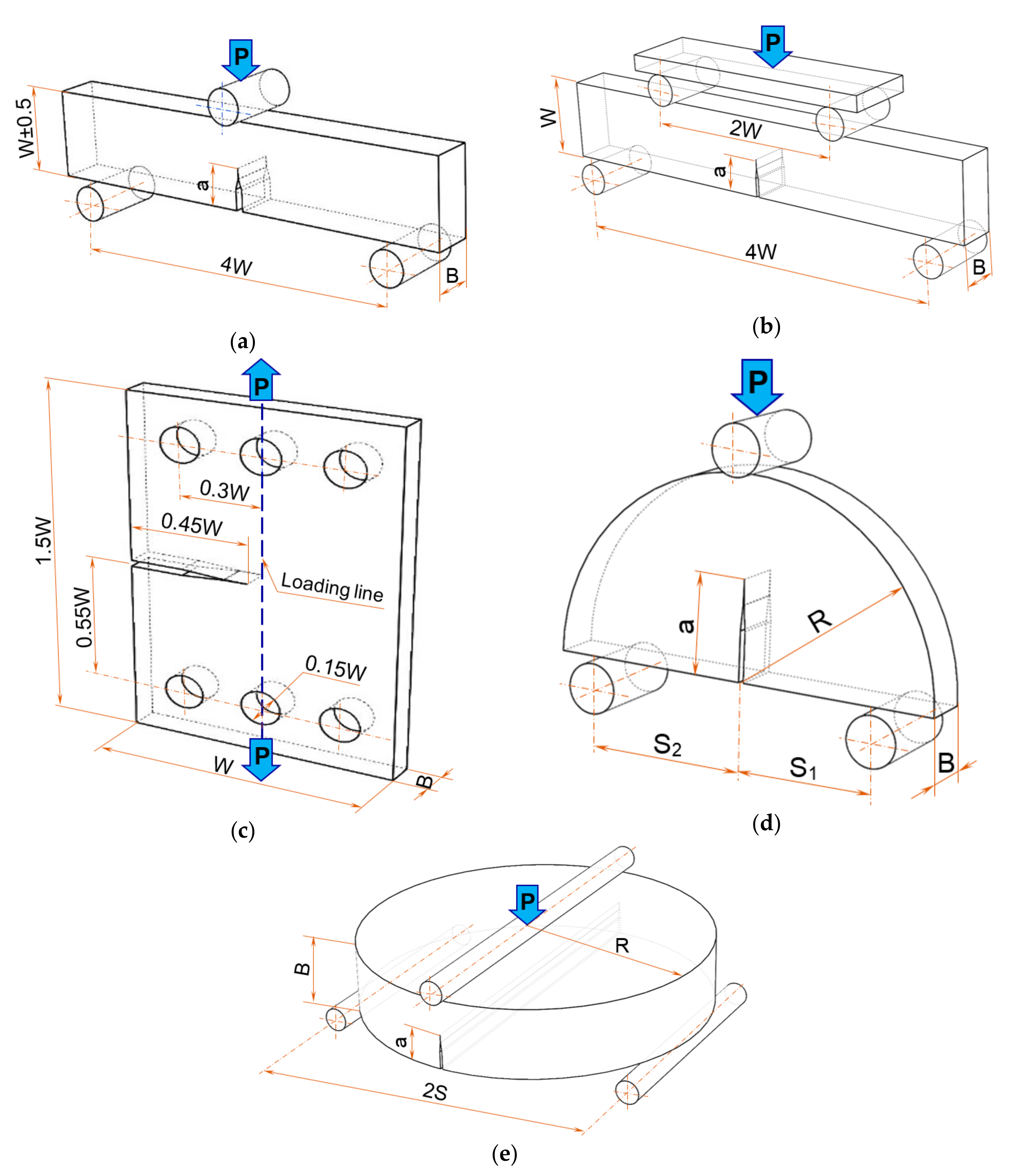

| Specimen Type | Calculation of KIC | Reference |
|---|---|---|
| SENB loaded in 3PB | [7] | |
| SENB loaded in 4PB | [24,25] | |
| SEC | [26] | |
| SCB | [27] | |
| ENBD | [28] |
| Specimen Type | Loading Direction | Loading Speed [mm/min] | Fracture Toughness [MPa·m0.5] | |||||
|---|---|---|---|---|---|---|---|---|
| 1 | 2 | 3 | 4 | 5 | Average | |||
| SENB-TPB | Flow | 2 | 0.072 | 0.074 | 0.075 | 0.068 | – | 0.072 |
| SENB-TPB | Rise | 2 | 0.070 | 0.082 | 0.078 | 0.076 | – | 0.076 |
| SENB-FPB | Flow | 2 | 0.072 | 0.071 | 0.070 | 0.073 | 0.071 | 0.071 |
| SEC | Flow | 2 | 0.083 | 0.090 | 0.079 | 0.100 | – | 0.088 |
| SCB | Flow | 2 | 0.084 | 0.088 | 0.090 | – | – | 0.087 |
| SCB | Flow | 50 | 0.074 | 0.105 | 0.095 | – | – | 0.091 |
| SCB | Rise | 2 | 0.109 | 0.099 | 0.116 | 0.102 | – | 0.106 |
| SCB | Rise | 50 | 0.089 | 0.095 | – | – | – | 0.092 |
| ENDB | Rise | 2 | 0.094 | 0.093 | 0.087 | – | – | 0.091 |
| Specimen Type | Loading Direction | Loading Speed [mm/min] | Fracture Toughness [MPa·m0.5] | ||||||
|---|---|---|---|---|---|---|---|---|---|
| 1 | 2 | 3 | 4 | 5 | 6 | Average | |||
| SENB-TPB | Flow | 2 | 0.102 | 0.105 | 0.099 | 0.107 | 0.119 | 0.124 | 0.109 |
| SENB-TPB | Rise | 2 | 0.110 | 0.111 | 0.109 | 0.111 | 0.128 | 0.125 | 0.116 |
| SENB-FPB | Flow | 2 | 0.091 | 0.092 | 0.099 | 0.093 | 0.102 | – | 0.095 |
| SEC | Flow | 2 | 0.124 | 0.100 | 0.128 | 0.106 | 0.084 | – | 0.109 |
| SCB | Flow | 2 | 0.135 | 0.134 | 0.129 | 0.129 | – | – | 0.132 |
| SCB | Flow | 50 | 0.128 | 0.136 | – | – | – | – | 0.132 |
| SCB | Rise | 2 | 0.139 | 0.138 | 0.151 | 0.145 | – | – | 0.143 |
| SCB | Rise | 50 | 0.128 | 0.136 | – | – | – | – | 0.132 |
| ENDB | Rise | 2 | 0.108 | 0.117 | 0.113 | – | – | – | 0.113 |
| Specimen Type | Loading Direction | Loading Speed [mm/min] | Fracture Toughness [MPa·m0.5] | |||||
|---|---|---|---|---|---|---|---|---|
| 1 | 2 | 3 | 4 | 5 | Average | |||
| SENB-TPB | Flow | 2 | 0.325 | 0.343 | 0.373 | 0.330 | 0.327 | 0.340 |
| SENB-FPB | Flow | 2 | 0.362 | 0.362 | 0.321 | 0.345 | 0.349 | 0.348 |
| SEC | Flow | 2 | 0.432 | 0.284 | 0.320 | 0.311 | – | 0.337 |
| SCB | Flow | 2 | 0.356 | 0.384 | 0.377 | – | – | 0.372 |
| ENDB | Rise | 2 | 0.343 | 0.347 | 0.342 | – | – | 0.344 |
| Variable | X1 | X2 | X3 | X4 | X5 | Y |
|---|---|---|---|---|---|---|
| X1 | 1.00000000 | 0.3034885 | −0.03203788 | −0.3367175 | −0.7642309 | 0.0396120 |
| X2 | 0.30348849 | 1.0000000 | −0.23335505 | −0.1021899 | −0.6698430 | −0.1988581 |
| X3 | −0.03203788 | −0.2333551 | 1.00000000 | 0.1993570 | 0.1841807 | 0.9853670 |
| X4 | −0.33671751 | −0.1021899 | 0.19935697 | 1.0000000 | 0.2661637 | 0.1681640 |
| X5 | −0.76423093 | −0.6698430 | 0.18418069 | 0.2661637 | 1.0000000 | 0.1289626 |
| Y | 0.03961200 | −0.1988581 | 0.98536705 | 0.1681640 | 0.1289626 | 1.0000000 |
| Estimate | Std. Error | t Value | Pr (>|t|) | |
|---|---|---|---|---|
| a | −5.895e−02 | 0.984e−03 | −6.561 | 1.69e−06 *** |
| b | 1.337e−03 | 5.045e−05 | 26.492 | <2e−16 *** |
| Residual Standard Error: 0.01836 on 21 Degrees of Freedom | ||||
| Multiple R-Squared: 0.9709, Adjusted R-Squared: 0.9696 | ||||
| F-Statistic: 701.8 on 1 and 21 DF, p-Value: < 2.2e−16 | ||||
| Estimate | Std. Error | t Value | Pr (>|t|) | |
|---|---|---|---|---|
| a | 5.229e−02 | 3.70e−03 | 13.17 | 1.29e−11 *** |
| c | 3.283e−06 | 8.939e−08 | 36.73 | <2e−16 *** |
| Residual Standard Error: 0.01334 on 21 Degrees of Freedom | ||||
| Multiple R-Squared: 0.9847, Adjusted R-Squared: 0.9839 | ||||
| F-Statistic: 1349 on 1 and 21 DF, p-Value: < 2.2e−16 | ||||
| Estimate | Std. Error | t Value | Pr (>|t|) | |
|---|---|---|---|---|
| b | 6.066e−04 | 5.165e−05 | 11.744 | 1.08e−10 *** |
| c | 1.831e−06 | 2.071e−07 | 8.845 | 1.59e−08 *** |
| Residual Standard Error: 0.01475 on 21 Degrees of Freedom | ||||
| Multiple R-Squared: 0.9943, Adjusted R-Squared: 0.9938 | ||||
| F-Statistic: 1842 on 1 and 21 DF, p-Value: < 2.2e−16 | ||||
| Estimate | Std. Error | t Value | Pr (>|t|) | |
|---|---|---|---|---|
| a | −8.41281 | 0.34679 | −24.26 | <2e−16 *** |
| b | 1.28048 | 0.06927 | 18.48 | 1.8e−14 *** |
| Residual standard error: 0.1363 on 21 Degrees of Freedom | ||||
| Multiple R-Squared: 0.9421, Adjusted R-Squared: 0.9393 | ||||
| F-Statistic: 341,7 on 1 and 21 DF, p-Value: 1.801e−14 | ||||
| Estimate | Std. Error | t Value | Pr (>|t|) | |
|---|---|---|---|---|
| a | 1.430e−04 | 3.721e−05 | 3.844 | 0.000943 *** |
| b | 1.366e + 00 | 4.723e−02 | 28.924 | <2e−16 *** |
| Residual Standard Error: 0.01565 on 21 Degrees of Freedom | ||||
| Number of Iterations to Convergence: 7 | ||||
| Achieved Convergence Tolerance: 5.974e−07 | ||||
| Estimate | Std. Error | t Value | Pr (>|t|) | |
|---|---|---|---|---|
| a | 2.370e−13 | 5.853e−03 | 0.405 | 0.69 |
| b | 1.416e−04 | 4.488e−06 | 31.544 | <2e−16 *** |
| Residual Standard Error: 0.01549 on 21 Degrees of Freedom | ||||
| Multiple R-Squared: 0.9793, Adjusted R-Squared: 0.9783 | ||||
| F-Statistic: 995 on 1 and 21 DF, p-Value: < 2.2e−16 | ||||
| Estimate | Std. Error | t Value | Pr (>|t|) | |
|---|---|---|---|---|
| B | 1.431e−04 | 2.428e−06 | 58.93 | <2e−15 *** |
| Residual Standard Error: 0.01519 on 21 Degrees of Freedom | ||||
| Multiple R-Squared: 0.9937, Adjusted R-Squared: 0.9934 | ||||
| F-Statistic: 3472 on 1 and 21 DF, p-Value: < 2.2e−16 | ||||
| Number of Studies Combined: k = 9 | ||||
|---|---|---|---|---|
| SMD | 95%-CI | z | p-Value | |
| Fixed Effect Model | 3.0705 | [1.9954; 4.1455] | 5.60 | <0.0001 |
| Random Effects Model | 3.7582 | [2.1870; 5.3294] | 4.69 | <0.0001 |
| Quantifying Heterogeneity: | ||||
| tau2 = 1.9157; H = 1.27 [1.00; 1.87]; I2 = 37.5% [0.0%; 71.3%] | ||||
| Test of Heterogeneity: | ||||
| Q | DF | p-Value | ||
| 12.80 | 8 | 0.1187 | ||
| Details on Meta-Analytical Method: | ||||
| Inverse Variance Method DerSimonian-Laird Estimator for tau2 Hedges’ g (bias-Corrected Standardized Mean Difference) | ||||
| Number of Studies Combined: k = 3 | ||||
|---|---|---|---|---|
| SMD | 95%-CI | z | p-Value | |
| Fixed Effect Model | 0.2373 | [−0.6350; 1.1095] | 0.53 | 0.5940 |
| Random Effects Model | 0.2373 | [−0.6350; 1.1095] | 0.53 | 0.5940 |
| Quantifying Heterogeneity: | ||||
| tau2 = 0; H = 1.00 [1.00; 1.00]; I2 = 0.0% [0.0%; 0.0%] | ||||
| Test of Heterogeneity: | ||||
| Q | DF | p-Value | ||
| 0.05 | 2 | 0.9743 | ||
| Details on Meta-Analytical Method: | ||||
| Inverse Variance Method DerSimonian-Laird Estimator for tau2 Hedges’ g (bias-Corrected Standardized Mean Difference) | ||||
Publisher’s Note: MDPI stays neutral with regard to jurisdictional claims in published maps and institutional affiliations. |
© 2020 by the authors. Licensee MDPI, Basel, Switzerland. This article is an open access article distributed under the terms and conditions of the Creative Commons Attribution (CC BY) license (http://creativecommons.org/licenses/by/4.0/).
Share and Cite
Pugna, A.; Negrea, R.; Linul, E.; Marsavina, L. Is Fracture Toughness of PUR Foams a Material Property? A Statistical Approach. Materials 2020, 13, 4868. https://doi.org/10.3390/ma13214868
Pugna A, Negrea R, Linul E, Marsavina L. Is Fracture Toughness of PUR Foams a Material Property? A Statistical Approach. Materials. 2020; 13(21):4868. https://doi.org/10.3390/ma13214868
Chicago/Turabian StylePugna, Adrian, Romeo Negrea, Emanoil Linul, and Liviu Marsavina. 2020. "Is Fracture Toughness of PUR Foams a Material Property? A Statistical Approach" Materials 13, no. 21: 4868. https://doi.org/10.3390/ma13214868
APA StylePugna, A., Negrea, R., Linul, E., & Marsavina, L. (2020). Is Fracture Toughness of PUR Foams a Material Property? A Statistical Approach. Materials, 13(21), 4868. https://doi.org/10.3390/ma13214868