Abstract
The strength and deformation characteristics of artificial frozen soils are quite sensitive to temperature, confining pressure, and water content. To investigate these effects, a series of triaxial compressive tests on frozen Harbin silty clay were conducted at temperatures of −5 °C, −10 °C, and −15 °C under different confining pressures and water contents. From the stress–strain curves under lower water content and confining pressure, strain–softening behavior was observed. The modified Duncan–Chang (MDC) model was employed to describe the constitutive relations of artificial frozen silty clay while considering the strain–softening effects. After introducing statistical damage (SD) theory, an SD constitutive model with the failure strain as a random variable was proposed, which is able to overcome the drawbacks of the MDC model. The predicted SD model results are found to be consistent with the experimental results.
1. Introduction
Artificial ground freezing (AGF), which is widely applied in tunnel construction, coal mining, foundations, and other underground construction, is an economical and effective method with the advantages of suitability, non–pollution, waterproofness [1,2,3,4]. Studies on the strength and deformation characteristics of artificial frozen soils have been a crucial research focus because of the complicated performance of frozen soils, which is significantly influenced by temperature, confining pressure, and water content. Therefore, various experiments have been conducted to reveal the mechanical properties of frozen soils [5,6,7,8,9,10]; likewise, considerable effort has been made toward understanding the relationship between load and deformation in constitutive models of frozen soils. Within the framework of continuum mechanics, a series of constitutive models, such as nonlinear elastic, elasto-plastic, and viscoelastic–plastic models, were proposed by different researchers from different viewpoints. Beginning in the early 1930s, Tsytovich [11] pioneered the exploration of the constitutive relations of frozen sand at various stress rates and temperatures through a series of uniaxial experiments. Later, additional competing constitutive models based on experimental results or theoretical analyses were proposed [12,13,14,15,16,17,18,19,20].
Frozen soil is a special soil–water system because of the presence of ice inclusions, which cause it (especially its mechanical properties) to be highly susceptible to temperature, confining pressure, and water content. The influences of these factors are not independent, but are coupled with each other [21]. Therefore, the effect of these factors on the strength of frozen soil has been widely studied by scholars [22,23,24,25,26]. Wu [27] pointed out that there exists a peak strength value of frozen soil for varying moisture content. The strength of frozen soil continues to increase until the water content approaches saturation, then decreases with a further increase in water content and tends toward ice strength. Wu [28] found that the relation between uniaxial compressive strength and temperature of frozen soil was a power function. Ma [29] conducted a series of triaxial experiments and explained that the reason why strength of frozen soil decreases with confining pressure was that ice melting happened at stress concentration points. Although there are plenty of research achievements regarding the strength of frozen soil, almost all research is limited to a single or double factor analysis.
The Duncan–Chang (DC) model, which has several parameters with definite physical meaning, is widely applied in theoretical calculation and engineering guidance. However, strain–softening of frozen soil can be observed under lower water content and confining pressure when deformed beyond a certain limit, which cannot be described effectively by a nonlinear elastic DC model. Much work has been carried out to investigate the strain–softening phenomena based on the DC model. A representative modified DC (MDC) model, called a “dromedary curve model,” was proposed by Shen [30]. However, describing the constitutive relations when the frozen soil exhibits inconspicuous strain–softening behavior remains a challenge. Recently, new constitutive models have been presented to overcome the drawbacks mentioned above by introducing the statistical continuum damage mechanics theory [31,32,33,34,35], which can better describe the constitutive relations of frozen soil. However, few relevant theoretical investigations have been conducted on the mechanical properties of artificial frozen silty clay subjected to different temperatures, water contents, and confining pressures.
To investigate the mechanical properties of frozen silty clay, an MDC model that describes constitutive relations while considering strain–softening effect was employed. Furthermore, a new statistical damage (SD) constitutive model that regards the failure strain as a random variable was proposed. The parameters employed in these two models are all determined by triaxial experiment results. Finally, the proposed model was further applied to predict the stress–strain curves under some typical experimental conditions performed by other scholars, in order to verify its adaptability. Compared with previous models, this approach is more convenient and easier to apply for engineering design.
2. Experimental Conditions
2.1. Experimental Material
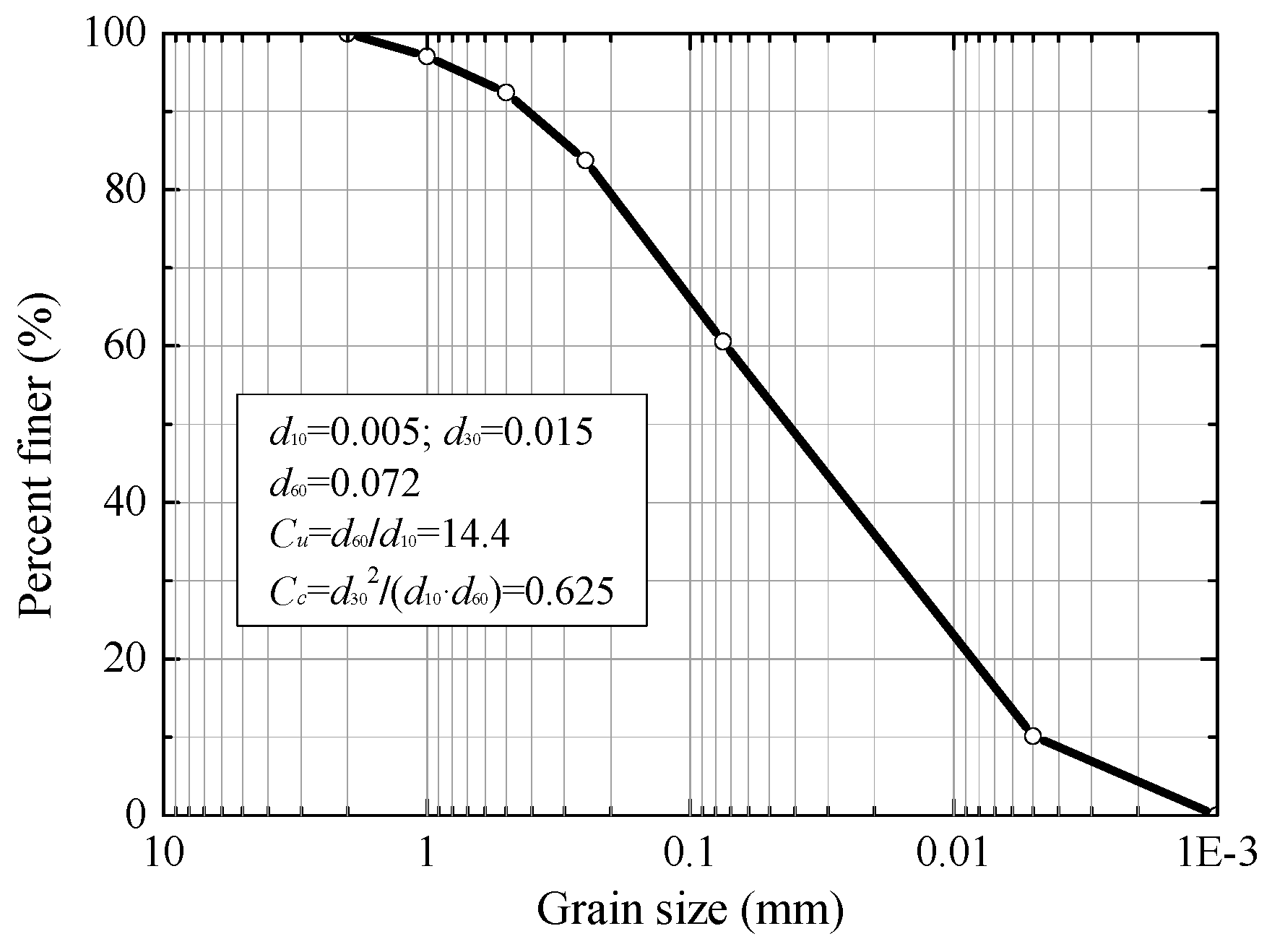
Typical silty clay was collected in Harbin, the grain size distribution of which is shown in Figure 1. The clay’s liquid and plastic limits were 32.8% and 19%, respectively. Testing samples with a dry density of 1640 kg/m3 were made from this silty clay.
Figure 1.
Grain-size distribution of silty clay.
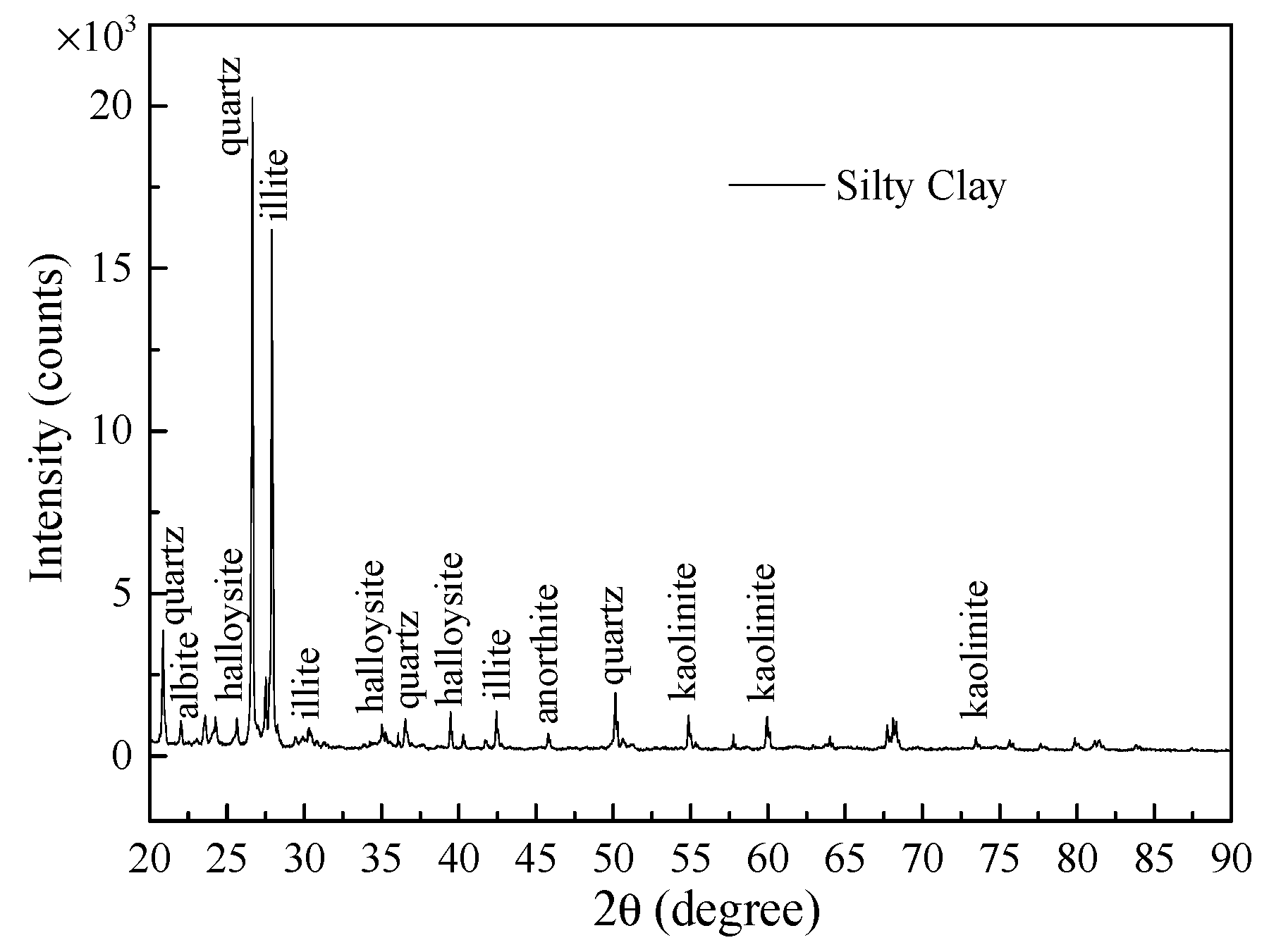
To make sure the mineralogical characterization of fine-grained soils, X-ray diffractometer (X’PERT, Netherlands) is commonly applied to obtain its spectrum. The sample is passed through a 75-microns IS sieve and the powder sample is oven-dried at 110 °C for 24 h. Soil specimen is placed on the X-ray diffractometer, and the readings are recorded for 2θ angle from 20° to 90°, and at an angular speed of 2°/min with a step size of 0.02. The XRD pattern obtained from the powder samples of silty clay is shown in Figure 2. The major crystalline minerals present in silty clay are kaolinite, illite, halloysite, and quartz from the analysis. And the relative mineral contents of silty clay are shown in Table 1.
Figure 2.
X-ray diffraction spectrum for silty clay.
Table 1.
Relative mineral contents of silty clay.
2.2. Sample Preparation and Test Apparatus
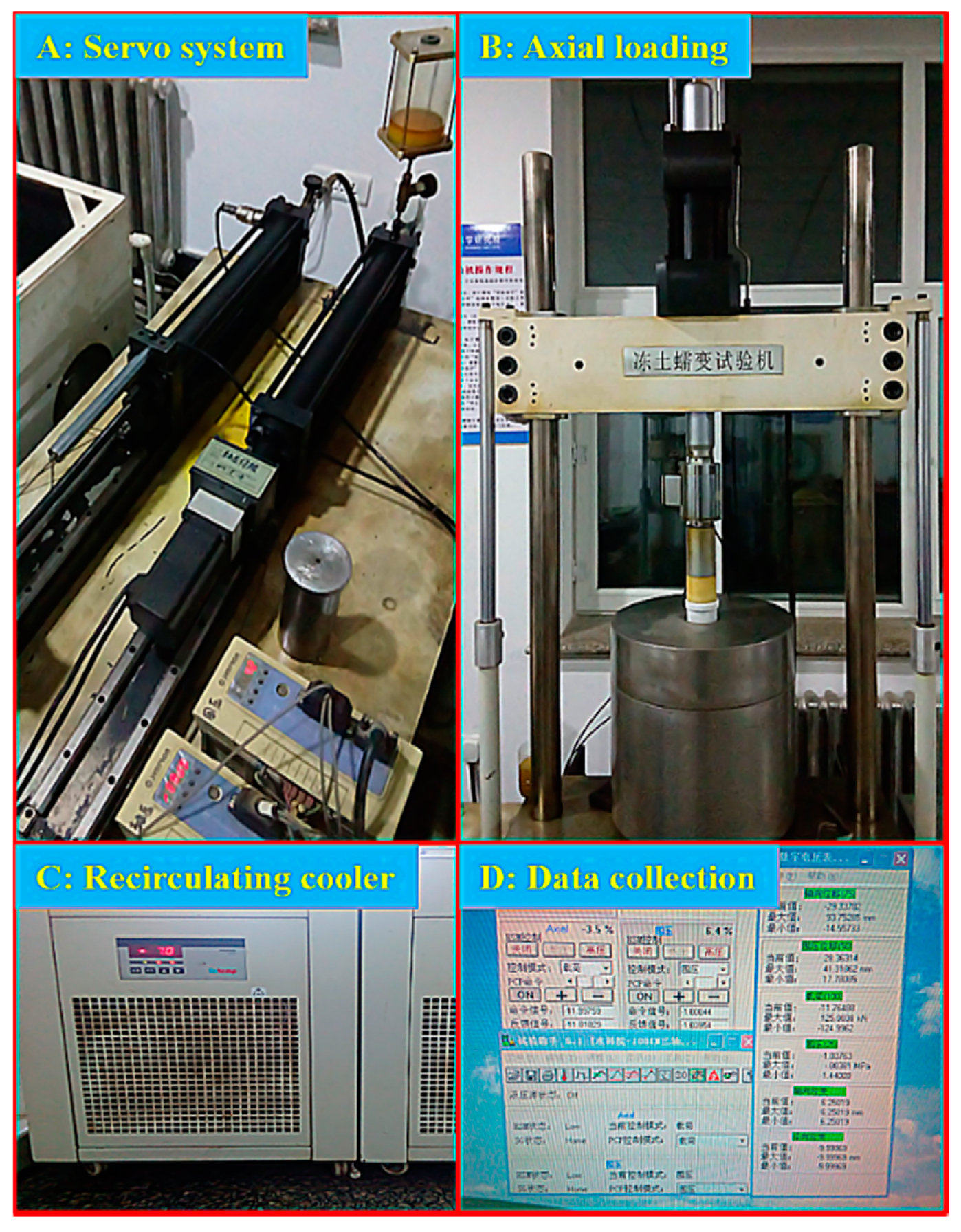
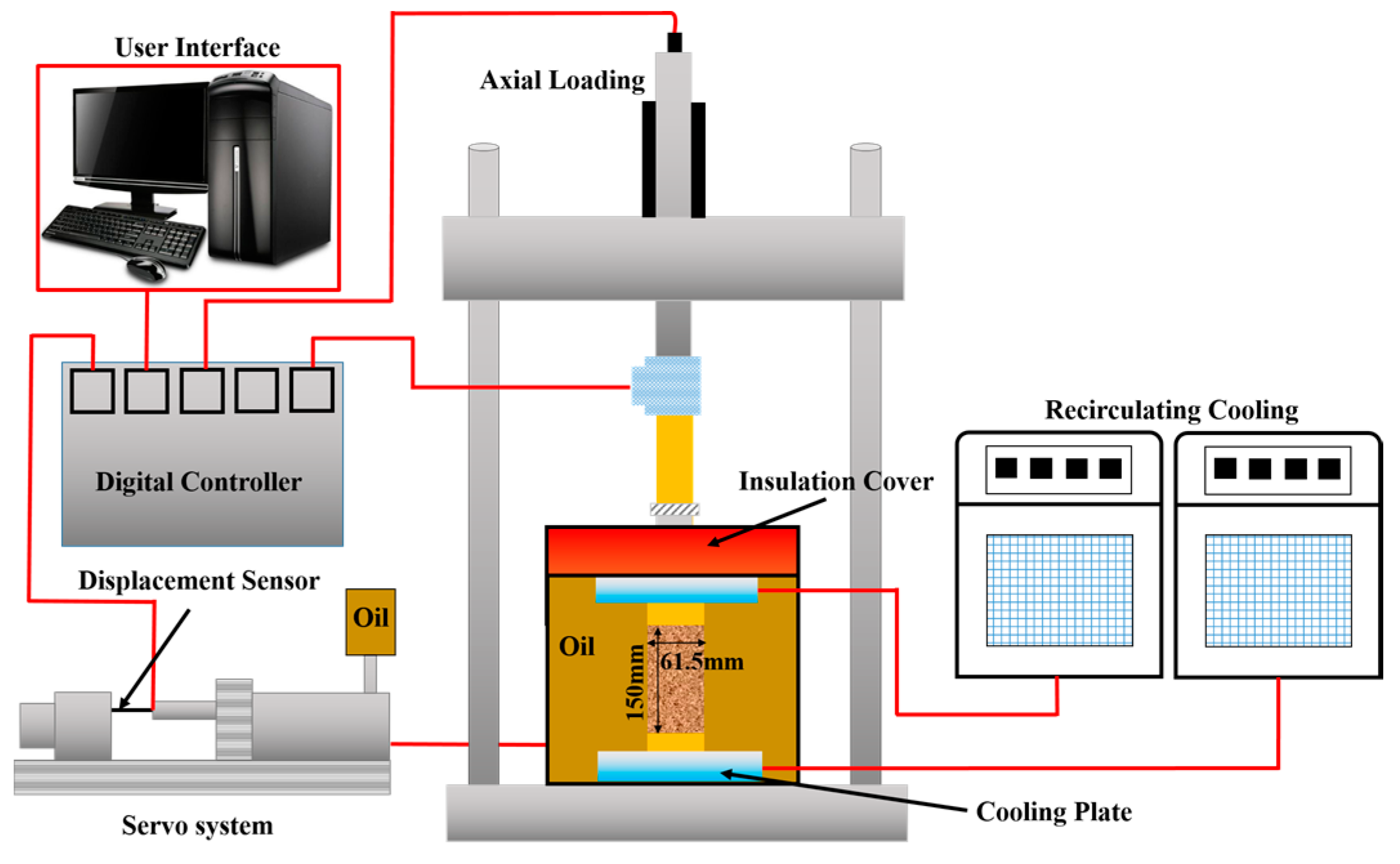
The testing samples were prepared according to the following procedure: (1) the soil was crushed and passed through a 2-mm sieve after drying for 1 day at 115 °C; (2) the target water content was added to the silty clay and sealed for 12 h to ensure that the water content was uniform throughout the samples; (3) the samples were compacted into a three-piece split mold with a diameter of 6.18 cm and a height of 15 cm; (4) the samples were then refrigerated at approximately −35 °C for 48 h to prevent the formation of ice lenses caused by water migration; (5) the three–piece split mold was removed, and the samples were immediately covered with plastic wrap to prevent moisture evaporation; and (6) the samples were preserved in a thermostat for 24 h to achieve the experimental temperature. Twenty-seven effective samples were utilized in triaxial compressive tests to investigate the mechanical properties of frozen silty clay under different temperatures (−5 °C, −10 °C, and −15 °C), confining pressures (0.1, 0.3, and 1.0 MPa) and water contents (17%, 20%, and 23%). The tests were executed in a frozen soil creep apparatus, shown in Figure 3. The schematic diagram of the triaxial shear apparatus is shown in Figure 4. The confining pressure could be adjusted by changing the oil content in the cylinder, ranging from 0 to 25 MPa. The maximum axial force and loading displacement reached 100 kN and 75 mm, respectively. Moreover, a strain-control mode was applied to keep the shear strain rate at 1.2 mm/min.
Figure 3.
Triaxial shear apparatus for frozen soil.
Figure 4.
Schematic diagram of the triaxial shear apparatus.
2.3. Experimental Results and Analysis
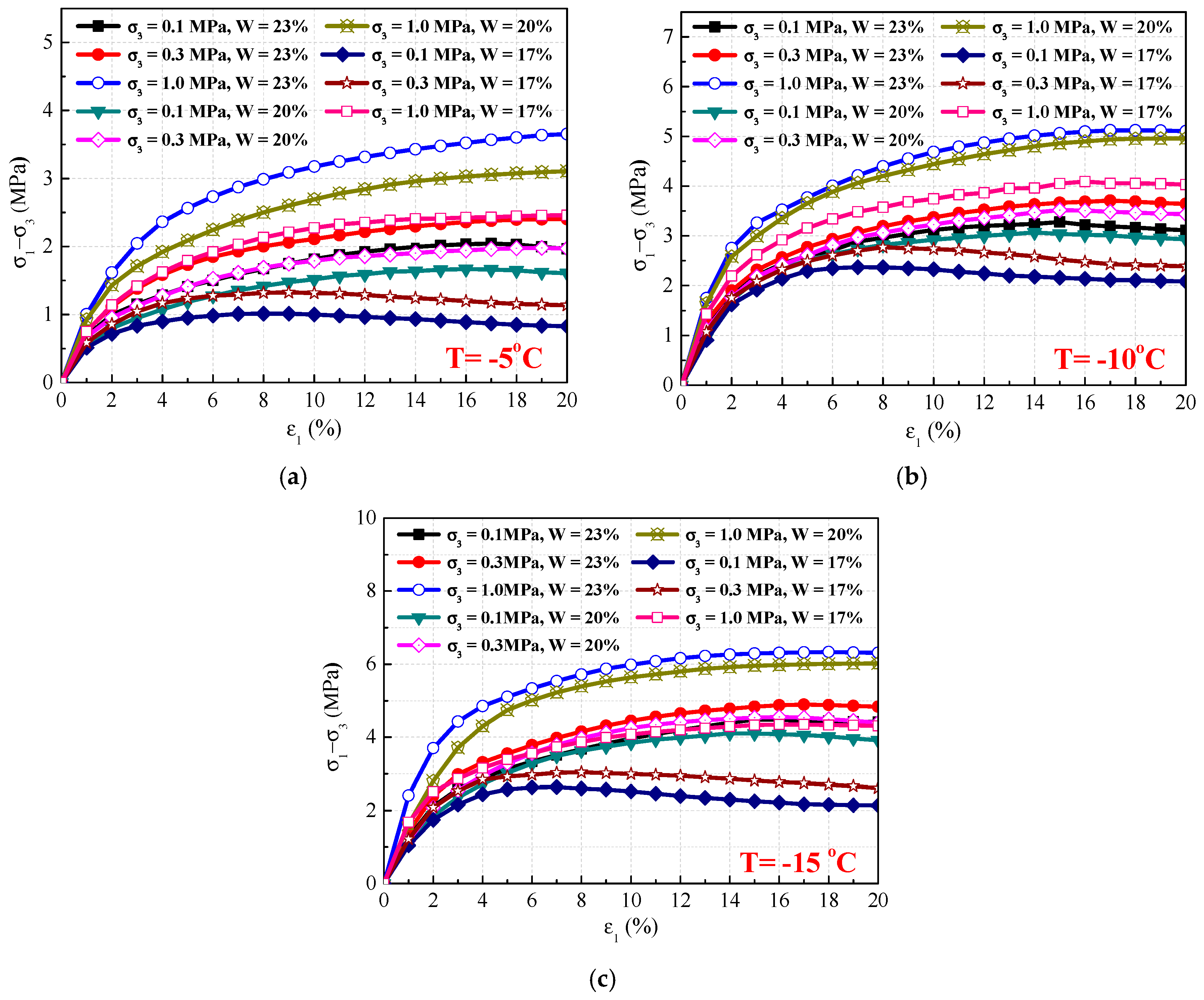
Stress–strain curves of the frozen silty clay under different temperatures are shown in Figure 5. Note that the stress–strain curves mainly include three stages: an initial linear elastic stage, a plastic deformation stage, and a strain-softening stage. In the initial elastic stage, the stress–strain curves approached a linear relation. As the axial loading continued, the rate of stress increase became smaller than in the elastic stage, indicating that plastic deformation appeared in the sample. When the strain exceeded 5%, the stress reached more than 60% of the peak strength. With a further increase in strain, strain–softening was observed under lower water contents and confining pressures after reaching a peak strength. However, the stress–strain curves demonstrated a strain–hardening phenomenon under higher water contents, because of cementation effects caused by ice.
Figure 5.
Stress–strain (σ1–σ3 and ε1) curves of frozen silty clay under different temperatures. (a) T = −5 °C; (b) T = −10 °C; (c) T = −15 °C.
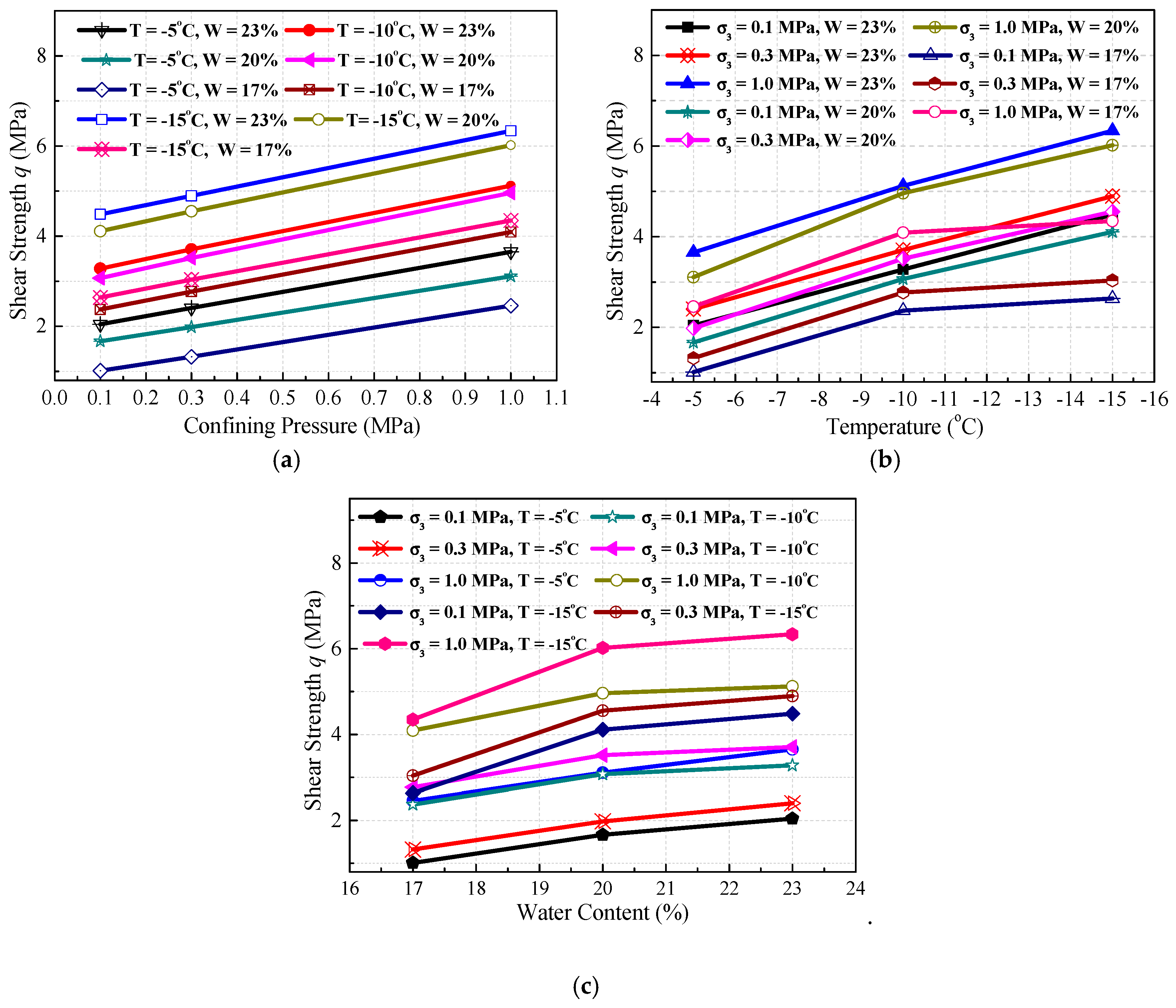
Figure 6a illustrates the variation of shear strength (q) with confining pressures. As shown in Figure 6a, the shear strength increases linearly with the increase of confining pressure because the increase of confining pressure results in a reduction in the amount of microcracks and an improvement in the integrity of frozen samples. Figure 6b shows the variation of shear strength with temperature. As can be seen, shear strength increases with decreasing temperature, the variation of which can be divided into two stages. The first stage starts from −5 °C to −10 °C, in which the shear strength increases more significantly than that in the second stage. This variation is possibly caused by the changing of ice content, which is less pronounced in the second stage less than that in the first stage because of the unfrozen water content decreases exponentially with the decrease of temperature. The shear strength is determined by the cementation effect of ice inclusions. Figure 6c sketches the variation of shear strength with water content. It can be seen that the shear strength increases with the increase of water content, exhibiting the same variation tendency as seen in Figure 6b. This phenomenon can be explained by the fact that the cementation effect of ice inclusions enhances when the water content increases. However, ice inclusions will become dominant in the frozen soil with a further increase of water content, causing an increase in sliding surface and decreased frictional resistance of soil particles.
Figure 6.
Shear strength varying with confining pressure (a), temperature (b), and water content (c).
3. MDC Model for Frozen Silty Clay
3.1. Constitutive Model and Parameter Determination
A constitutive model, which can reflect a material’s macroscopic properties, is critical for reasonably determining its mechanical characteristics for geotechnical engineering. The DC model is widely applied in theoretical calculation and practical engineering because some of its parameters have defined physical meaning. Nevertheless, it cannot describe the strain–softening phenomenon in the constitutive model. Herein, an MDC model proposed by Shen [30] was applied to build a constitutive relation of frozen silty clay, expressed as:
where σ1−σ3 is deviatoric stress; εa denotes axial strain; and a, b, and c are the fitting parameters.
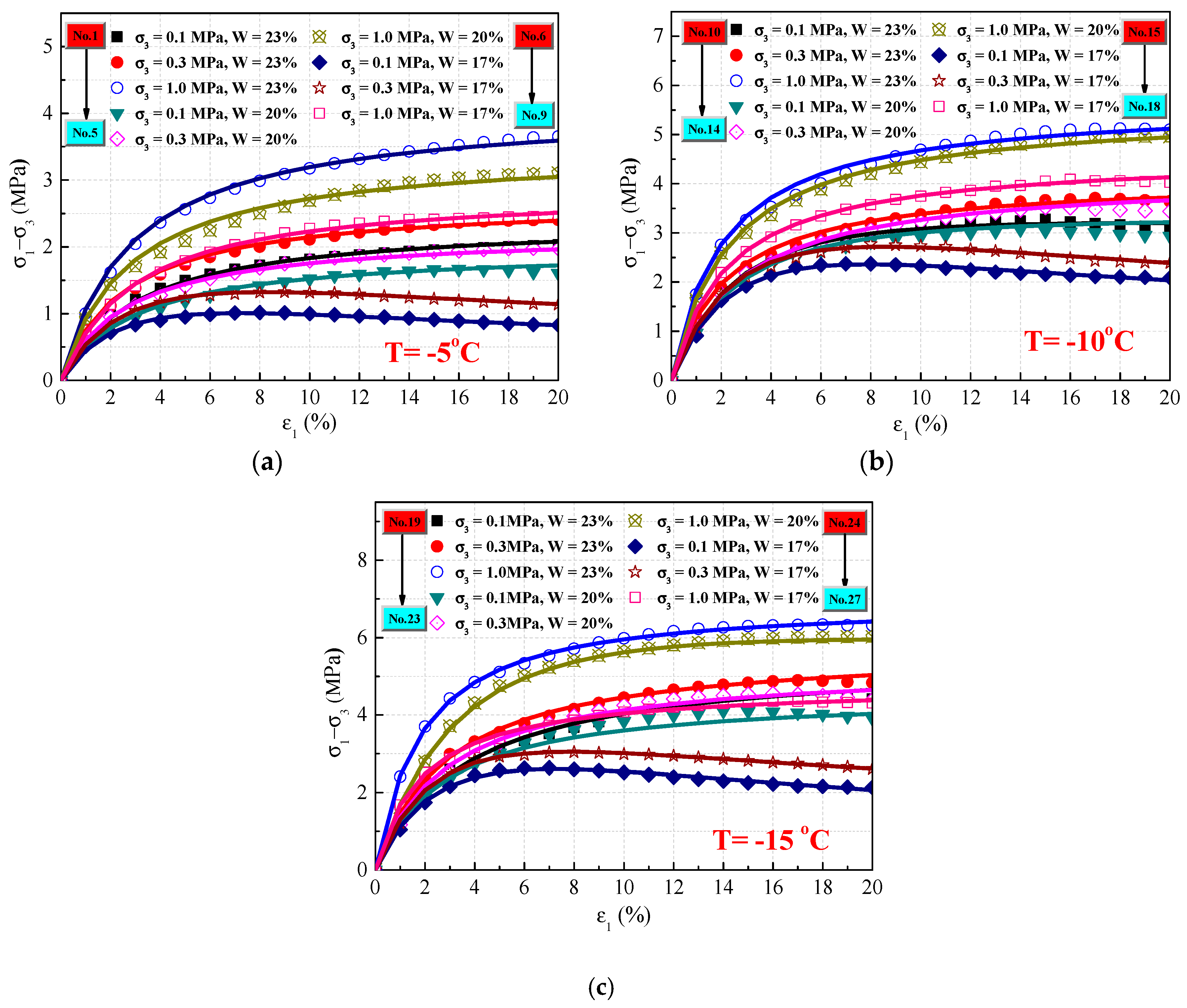
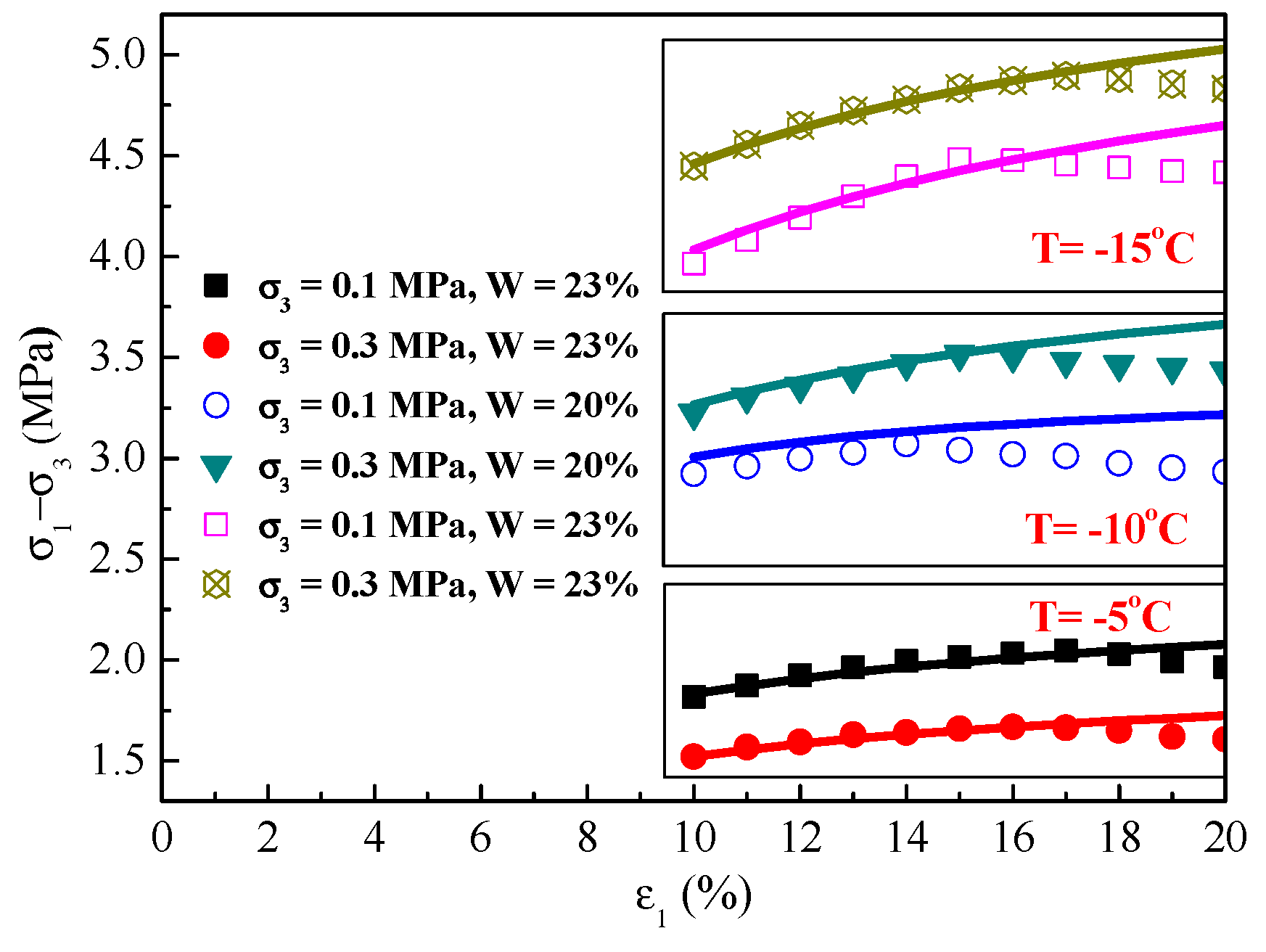
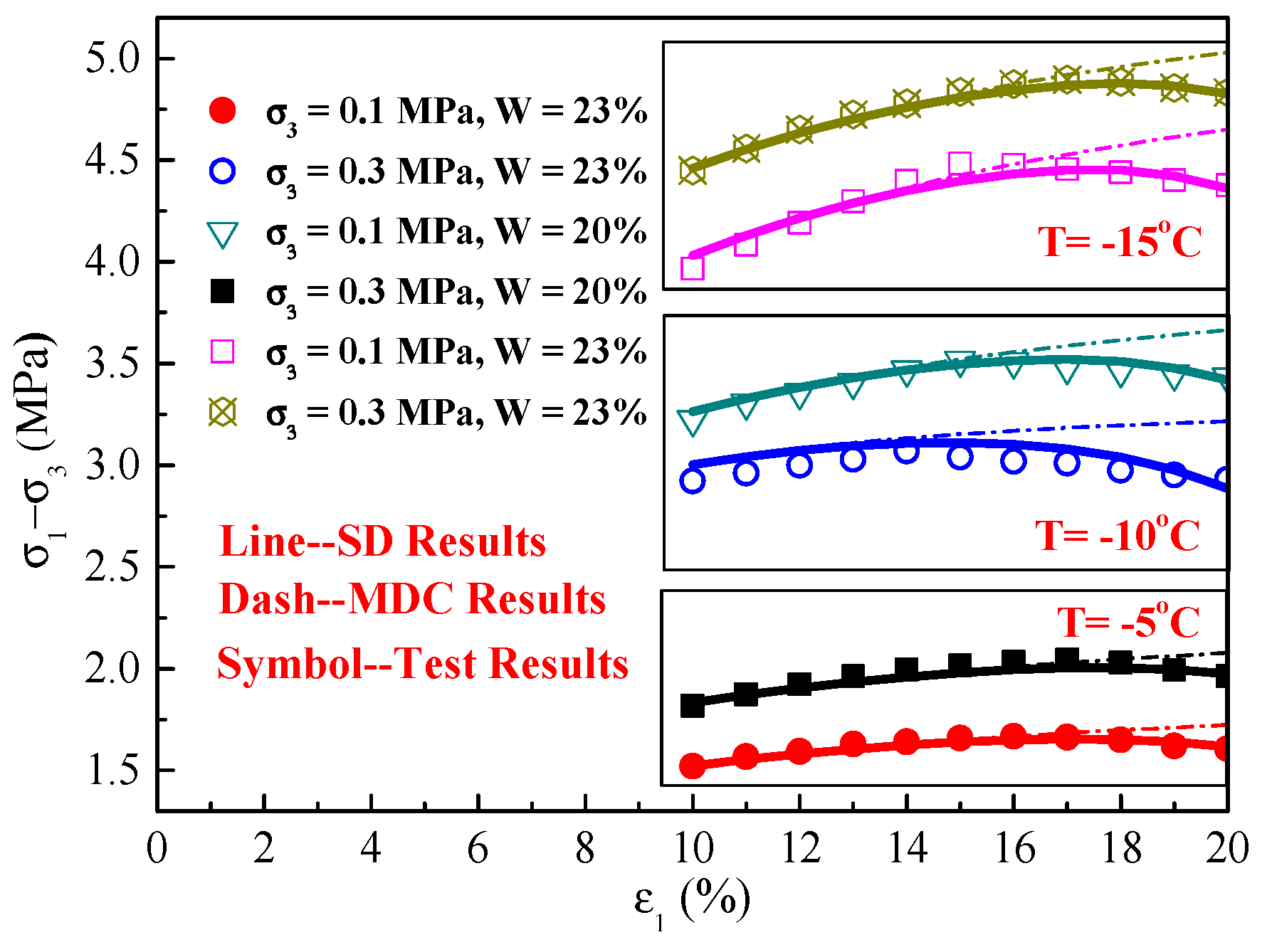
The fitting parameters and predicted curves of this MDC model under various experimental conditions are shown in Table 2 and Figure 7. The predicted results of the MDC model agree with the reported test results very well under normal conditions. However, these results are not suitable for describing the constitutive relations when the frozen soil exhibits inconspicuous strain-softening, as shown in Figure 8, which is an inset of Figure 7.
Table 2.
Computational parameters of the modified Duncan–Chang (MDC) model.
Figure 7.
Comparison of the experimental (symbols) and predicted (lines) stress–strain curves of the MDC model. (a) T = −5 °C; (b) T = −10 °C; (c) T = −15 °C.
Figure 8.
Inset of stress–strain curves between experimental (symbols) and predicted (lines) results of the MDC model.
In conventional triaxial compressive tests, dσ2 = dσ3 = 0. Therefore, the tangent modulus Et of frozen soil can be expressed as:
During the early loading stage, the sample mostly deforms elastically; the initial elastic modulus Ei of frozen soil can be written as follows:
The frozen soil’s residual or ultimate strength can be deduced based on Equation (1) as the strain approaches infinity when the frozen soil exhibits strain-softening or strain-hardening behavior, respectively, which can be expressed as:
Based on triaxial compressive experiment results conducted under different temperatures, confining pressures, and water contents, parameter a, which is related to initial elastic modulus Ei, and parameters b and c, which are related to the residual and ultimate strengths, respectively, can be determined by regressing experimental results.
3.2. STRAIN-Softening Criterion of the MDC Model
For strain-softening materials, there exists a maximal stress destruction point on the stress–strain curves, and shear strength can be observed in Figure 5. Then, the initial strain softening is determined by calculating the derivative of the deviatoric stress and setting it to zero:
where εrs is the initial softening strain.
By substituting Equation (5) into Equation (1), the strain-softening criterion of the MDC model can be expressed as:
where δe is a positive error correction term that depends on the experimental results and q represents the maximum deviatoric stress corresponding to the initial softening strain.
The predicted model is adequate for a 95% confidence interval, so the length of the confidence interval for parameters b and c can be described as:
where δb and δc are the lengths of the confidence intervals of parameters b and c, respectively; σb and σc denote the standard deviations of b and c, respectively; α represents the significance level; Z is a random variable that satisfies the normal distribution; and n is the number of samples.
Therefore, the length of the confidence interval of b–c can be given as follows:
where δt is the length of the confidence interval of b–c.
When the condition δe ≤ 0.5δt is satisfied, Equation (8) can serve as the strain-softening criterion for artificially frozen soil. To validate this criterion, the fitting results and experimental values for the strain softening curves are listed in Table 3. Note that δe ≤ 0.5δt is satisfied when the frozen soil exhibits obvious strain-softening during a triaxial compression experiment. Calculated initial softening strain εrs and experimental initial softening strain εre are also compared in Table 3, showing that εrs is always within the range of εre. However, frozen soil with inconspicuous strain-softening behavior cannot be described using this criterion and the εrs value obtained by applying this criterion is unreasonable.
Table 3.
Criterion for strain-softening curves.
4. SD Model for Frozen Soil
4.1. SD Constitutive Model
To overcome the limitations of the previous model, an SD model with the failure strain as a random variable, based on the MDC model, was applied. Based on the Lemaître principle of equivalence strain [36], strain εa on the damaged material caused by macroscopic stress σ is equivalent to strain εb on the undamaged material caused by effective stress σʹ. Hence, according to the MDC model, the damage constitutive model for frozen soil can be expressed as:
where D is a damage variable within the range 0–1. Then, substituting Equation (9) into Equation (10), the damage constitutive model based on MDC can be expressed as:
The SD theory is a powerful tool for describing the stress–strain relations of frozen soil caused by the random distribution of fissures and cavities. The shear strength and axial strain are always regarded as random variables in an SD model. Li [31] pointed out that using the failure strain as a random variable is somewhat unreasonable, as its physical concept is ambiguous in classical plastic theory. However, the failure strain as a random variable is more simply applied without detriment to accuracy when establishing a constitutive model.
The normal, lognormal, and Weibull distributions are mainstream approaches to fitting probabilistic distributions of failure strain in frozen soil under various experimental conditions. Lai [34] reported that a Weibull distribution can better describe the probabilistic distribution of failure strain than other methods; the probability density function of a Weibull distribution can be obtained as follows:
where m and F0 are Weibull parameters.
When the strain reaches a certain level, the number of damaged elements can be expressed as
where N denotes the number of all elements and N (εa) is the number of damaged elements.
Here, damage variable D in the SD mechanics needs to be redefined as:
Substituting Equation (13) into Equation (14), the damage variable D can be rewritten as:
Ultimately, by substituting Equation (15) into Equation (11), the SD constitutive model can be obtained as follows:
Compared with the SD and MDC models, the initial elastic model should be consistent and parameters b and c should be the same as in these two models for the sake of convenient transformation. To validate the SD constitutive model, typical experimental results with inconspicuous strain-softening behavior were applied. The fitting parameters are shown in Table 4. Moreover, the stress–strain curves from the experimental and predicted results are compared in Figure 9. Besides, the correlation coefficient of the SD model has a slight improvement compared with the previous model, which means that the SD model was considerably more accurate in describing inconspicuous strain-softening behavior in frozen soil than the MDC model.
Table 4.
Computational parameters of the statistical damage (SD) model.
Figure 9.
Comparison of experimental and predicted stress–strain curve results.
In the SD model, m and F0 are scale and shape parameters, respectively, dependent on the position of the initial softening strain. The parameters m and F0 can be calculated using a nonlinear regression method, from the experimental results of the triaxial compression. In practice, many problems can be attributed to the optimization of nonlinear least squares. Herein, the Gauss–Newton algorithm is applied to estimate the parameters m and F0. It is based on the implemented first derivatives of the components of the vector function. In special cases it can give quadratic convergence as the Newton method does for general optimization.
For any choice of x = [m, F0], the residuals can be computed:
where parameter A is the predicted result by the MDC model.
The residuals fi(x) in this method can be replaced by using first-order approximation of Taylor expansion.
The objective function F(x) is a quadratic sum of several functions fi(x), which can be formulated as:
By calculating the derivative of Equation (19) and setting it to zero, the iteration form of the Gauss–Newton method can be expressed as:
Considering a set of experimental data points, (εa1, (σ1-σ3)1), (εa2, (σ1-σ3)2), …, (εan, (σ1-σ3)n), the parameters m and F0 can be obtained using the following procedure:
- Set the initial value of x = [m, F0] and threshold ε;
- Calculate fi(x) and obtain the vector fk;
- Calculate fi’(x) and obtain the Jacobian matrix Jk;
- Calculate xk+1 by using the iteration form of the Gauss-Newton method;
- Judge the condition ‖xk+1 − xk‖ < ε, if it is not satisfied, repeat step (2) until the condition is satisfied.
After the parameters m and F0 are obtained under different experimental conditions, an empirical formula for the particular experimental sample can be adopted to quantify the relationship between the two parameters (m and F0) and three variables (temperature, water content, and confining pressure).
4.2. Strain-Softening Criterion of the SD Model
The initial softening strain is obtained by calculating the derivative of the deviatoric stress in Equation (16) and setting it to zero, as in Section 3.2.
Here, reference strain εrep is introduced and assigned a value of 17 because the SD model is used to describe inconspicuous strain-softening behavior. The reference strain can also be assigned other values, as long as the ratio of strain to reference strain is close to 1. In this experiment, because the interval of the initial softening strain is between 15 and 18, the ratio of strain to reference strain can be controlled within a range of 0.88 to 1.05.
By setting C = −a (b + c) and D = bc, Equation (25) can be solved as
Because parameter E is far smaller than K, it can be ignored. By taking the log of both sides of Equation (26) and introducing the reference strain again, the initial softening strain can be obtained as:
The calculated and experimental initial softening strains are also shown in Table 4. The calculated initial softening strain is always within the range of the experimental results and there is a good agreement between the experimental and predicted results of the SD model, except for a small bias in one test case. This bias is possibly caused by the reference strain being assigned a value of 17, which can produce errors under certain experimental conditions. Overall, only an approximation method to predict the initial softening strain is provided in this paper.
4.3. Model Verification and Analysis
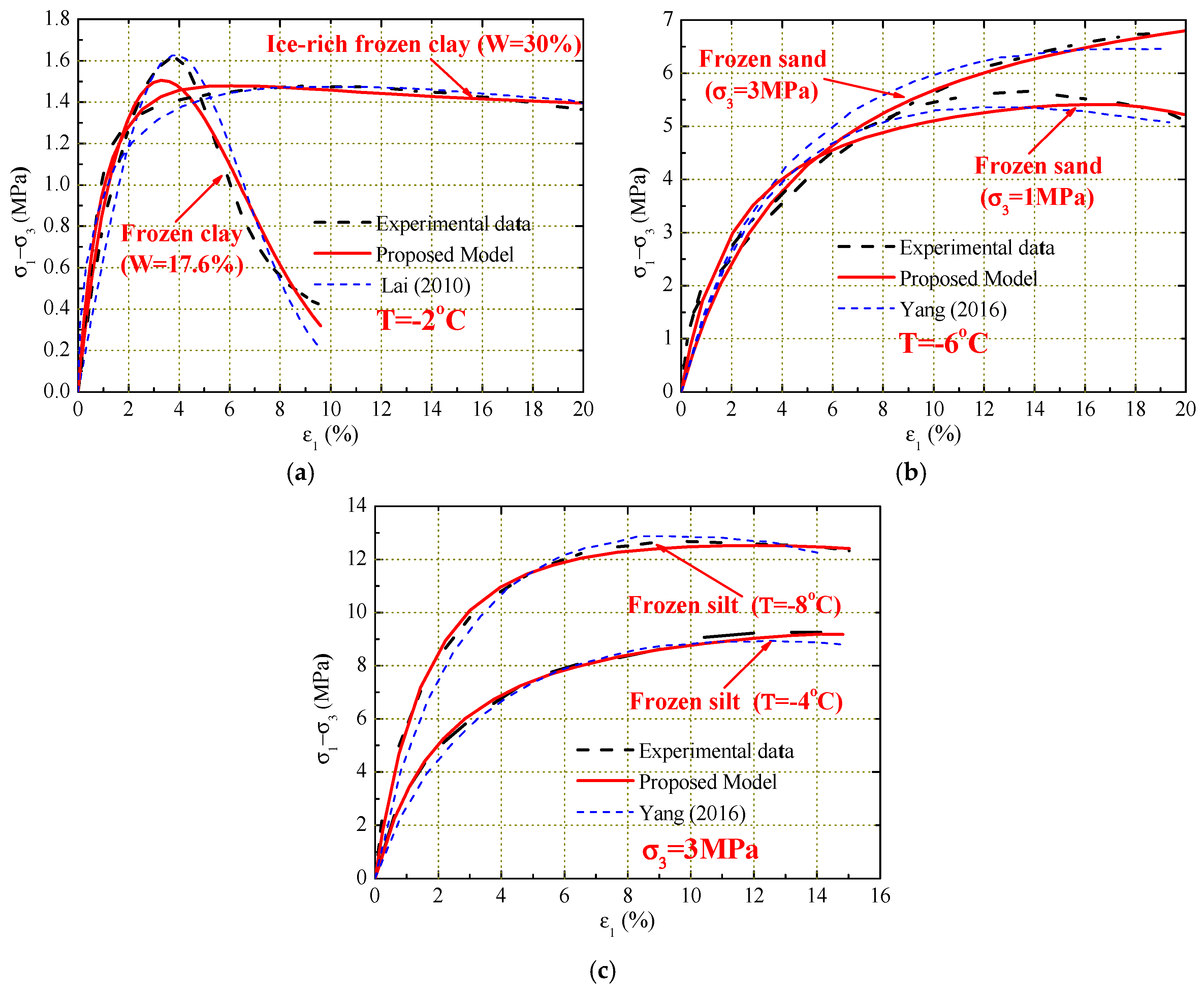
In order to verify the feasibility and adaptability of the model, comparisons of stress–strain curves between experimental results obtained by other researchers and predicted results in this study are performed. According to the experimental results in the studies by Lai [5] and Yang [37], the unknown parameters need to be determined first and then the procedure should be applied to predict the stress–strain curves for some typical experimental conditions. Figure 10 displays the comparisons of experimental and predicted stress–strain curves for frozen clay, sand, and silt. It can be seen that the procedure gives relatively good prediction of the experimental stress–strain curves for various frozen soils under different water contents, confining pressures, and temperatures. Although there is a large difference between experimental and predicted results at the condition of water content of 17.6% compared with the model proposed by Lai [5], other predictions are slightly better and more convenient than the original models. Particularly, when the stress reaches its peak point, the experimental and predicted curves overlap. The mechanical properties of frozen soil under different water contents, confining pressures, and temperatures are found to be correctly described by the proposed model.
Figure 10.
Comparison of the experimental and predicted stress–strain curves. (a) water content; (b) confining pressure; (c) temperature.
5. Conclusions
A series of triaxial compression tests were conducted to investigate the mechanical properties of the frozen silty clay at –5 °C, –10 °C, and –15 °C, under different confining pressures and water contents. An MDC model that considers strain-softening effects was further applied to predict the triaxial strength and deformation characteristics of frozen silty clay. Finally, beginning with SD theory, a constitutive model of frozen soil under triaxial compression was established and confirmed by experimental outcomes. Based on this study, the following conclusions can be drawn:
(1) The experimental results show that the mechanical properties of frozen silty clay are very sensitive to temperature, confining pressure, and water content. The stress–strain curves exhibit strain-softening under lower confining pressures and water contents. Moreover, frozen silty clay under lower temperatures and higher confining pressures and water contents shows greater shear strength in triaxial compression experiments.
(2) The MDC model is employed to describe the constitutive relation of frozen silty clay, while considering strain–softening effects. The results predicted by the MDC model are in agreement with the experimental results under conditions of strain-hardening and clear strain-softening. Furthermore, the strain–softening criterion of the MDC model was presented and found that the calculated initial softening strain is always within the range of the experimental initial softening strain when the frozen soil exhibits conspicuous strain–softening behavior.
(3) In this paper, an SD constitutive model was proposed with the failure strain as a random variable. Compared with results predicted by the MDC model, the agreement between prediction results from the SD and test results leave room for improvement, particularly for cases of inconspicuous softening. A softening-strain criterion based on the SD model was also introduced and it was found that the calculated initial softening strain is always within the range of the experimental initial softening strain when the frozen soil exhibits inconspicuous strain–softening behavior.
(4) The comparison of stress–strain curves between the experimental results by other researchers and results calculated in this study showed that the proposed model can correctly predict the deformation behavior. Moreover, the model is more convenient and easier to apply for engineering design, and provides a good reference for predicting the mechanical properties of frozen soil.
Author Contributions
Funding acquisition, J.C.; investigation, C.M.; methodology, Z.L.
Funding
This work was supported by the National Natural Science Foundation of China [grant number 51478146].
Conflicts of Interest
The authors declare no conflict of interest.
Notation List
| Symbol | Description |
| σ1−σ3 | Deviatoric stress |
| εa | Axial strain |
| a | Parameter related to initial elastic modulus |
| b | Parameter related to residual and ultimate strengths |
| c | Parameter related to residual and ultimate strengths |
| Et | Tangent modulus |
| Ei | Initial elastic modulus |
| εrs | Calculated initial softening strain |
| q | Shear strength |
| δe | Positive error correction term |
| δb | Length of the confidence interval for parameter b |
| δc | Length of the confidence interval for parameter c |
| α | Significance level |
| Z | Random variable that satisfies normal distribution |
| n | Number of samples |
| σb | Standard deviation of parameter b |
| σc | Standard deviation of parameter c |
| δt | Length of the confidence interval of b-c |
| εre | Experimental initial softening strain |
| σ1ʹ-σ3ʹ | Effective deviatoric stress |
| D | Damage variable |
| N | Total number of elements |
| N(εa) | Number of damaged elements |
| f(εa) | Probability density function of the Weibull distribution |
| m | Scale parameter of the Weibull distribution |
| F0 | Shape parameter of the Weibull distribution |
| fi(x) | Residuals between test and simulation results |
| x | Parameter set |
| xk | Parameter value at k-th iteration |
| A | Predicted results calculated by the MDC model |
| gi(x) | First order Taylor expansion of fi(x) |
| F(x) | Objective function |
| Jk | Jacobian matrix |
| ε | Error threshold |
| εrep | Reference strain |
References
- Li, S.Y.; Lai, Y.M.; Zhang, M.Y.; Zhang, S.J. Minimum ground pre-freezing time before excavation of Guangzhou subway tunnel. Cold Reg. Sci. Technol. 2006, 46, 181–191. [Google Scholar] [CrossRef]
- Zhou, M.M.; Meschke, G. A three-phase thermo-hydro-mechanical finite element model for freezing soils. Int. J. Numer. Anal. Meth. Geomech. 2013, 37, 3173–3193. [Google Scholar] [CrossRef]
- Zhou, J.; Tang, Y.Q. Centrifuge experimental study of thaw settlement characteristics of mucky clay after artificial ground freezing. Eng. Geol. 2015, 190, 98–108. [Google Scholar] [CrossRef]
- Marwan, A.; Zhou, M.M.; Abdelrehim, M.Z.; Meschke, G. Optimization of artificial ground freezing in tunneling in the presence of seepage flow. Comput. Geotech. 2016, 75, 112–125. [Google Scholar] [CrossRef]
- Lai, Y.M.; Li, S.Y.; Qi, J.L.; Gao, Z.H.; Chang, X.X. Strength distributions of warm frozen clay and its stochastic damage constitutive model. Cold Reg. Sci. Technol. 2008, 53, 200–215. [Google Scholar] [CrossRef]
- Yang, Y.G.; Lai, Y.M.; Chang, X.X. Laboratory and theoretical investigations on the deformation and strength behaviors of artificial frozen soil. Cold Reg. Sci. Technol. 2010, 64, 39–45. [Google Scholar] [CrossRef]
- Lai, Y.M.; Xu, X.T.; Yu, W.B.; Qi, J.L. An experimental investigation of the mechanical behavior and a hyperplastic constitutive model of frozen loess. Int. J. Eng. Sci. 2014, 84, 29–53. [Google Scholar] [CrossRef]
- Zhu, Z.W.; Kang, G.Z.; Ma, Y.; Xie, Q.J.; Zhang, D.; Ning, J.G. Temperature damage and constitutive model of frozen soil under dynamic loading. Mech. Mater. 2016, 102, 108–116. [Google Scholar] [CrossRef]
- Xu, X.T.; Wang, Y.B.; Yin, Z.H.; Zhang, H.W. Effect of temperature and strain rate on mechanical characteristics and constitutive model of frozen Helin loess. Cold Reg. Sci. Technol. 2017, 136, 44–51. [Google Scholar] [CrossRef]
- Lu, J.G.; Zhang, M.Y.; Zhang, X.Y.; Pei, W.S.; Bi, J. Experimental study on the freezing–thawing deformation of a silty clay. Cold Reg. Sci. Technol. 2018, 151, 19–27. [Google Scholar] [CrossRef]
- Tsytovich, N.A.; Sumgin, M.I. Fundamentals of the Mechanics of Frozen Ground; Union of Soviet Socialist Republics, USSR Academy of Sciences Press: Moscow, Russia, 1937. [Google Scholar]
- Andersen, G.R.; Swan, C.W.; Ladd, C.C.; Germaine, J.T. Small-strain behavior of frozen sand in triaxial compression. Can. Geotech. J. 1995, 32, 428–451. [Google Scholar] [CrossRef]
- Ma, W.; Wu, Z.W.; Zhang, L.X.; Chang, X.X. Analyses of process on the strength decrease in frozen soils under high confining pressures. Cold Reg. Sci. Technol. 1999, 29, 1–7. [Google Scholar] [CrossRef]
- Arenson, L.U.; Springman, S.M. Triaxial constant stress and constant strain rate tests on ice-rich permafrost samples. Can. Geotech. J. 2005, 42, 412–430. [Google Scholar] [CrossRef]
- Lai, Y.M.; Jin, L.; Chang, X.X. Yield criterion and elasto-plastic damage constitutive model for frozen sandy soil. Int. J. Plast. 2009, 25, 1177–1205. [Google Scholar] [CrossRef]
- Roustaei, M.; Eslami, A.; Ghazavi, M. Effects of freeze–thaw cycles on a fiber reinforced fine grained soil in relation to geotechnical parameters. Cold Reg. Sci. Technol. 2015, 120, 127–137. [Google Scholar] [CrossRef]
- Yang, Z.H.; Still, B.; Ge, X.X. Mechanical properties of seasonally frozen and permafrost soils at high strain rate. Cold Reg. Sci. Technol. 2015, 113, 12–19. [Google Scholar] [CrossRef]
- Xu, G.F.; Wu, W.; Qi, J.L. An extended hyperplastic constitutive model for frozen sand. Soils Found. 2016, 56, 704–711. [Google Scholar] [CrossRef]
- Ma, L.; Qi, J.L.; Yu, F.; Yao, X.L. Experimental study on variability in mechanical properties of a frozen sand as determined in triaxial compression tests. Acta Geotech. 2016, 11, 61–70. [Google Scholar] [CrossRef]
- Hou, F.; Lai, Y.M.; Liu, E.L.; Liu, X.Y. A creep constitutive model for frozen soils with different contents of coarse grains. Cold Reg. Sci. Technol. 2018, 145, 119–126. [Google Scholar] [CrossRef]
- Lai, Y.M.; Xu, X.T.; Dong, Y.H.; Li, S.Y. Present situation and prospect of mechanical research on frozen soils in China. Cold Reg. Sci. Technol. 2013, 87, 6–18. [Google Scholar] [CrossRef]
- Lai, Y.M.; Zhang, Y.; Zhang, S.J.; Jin, L.; Chang, X.X. Experimental study of strength of frozen sandy soil under different water contents and temperatures. Rock Soil Mech. 2009, 30, 3665–3670. (In Chinese) [Google Scholar]
- Chen, Y.L.; Wang, M.; Xu, S.; Chang, L.Q.; Yin, Z.Z. Tensile and compressive strength tests on artificial frozen soft clay in Shanghai. Chin. J. Geotech. Eng. 2009, 31, 1046–1051. (In Chinese) [Google Scholar]
- Xu, X.T.; Lai, Y.M.; Dong, Y.H.; Qi, J.L. Laboratory investigation on strength and deformation characteristics of ice-saturated frozen sandy soil. Cold Reg. Sci. Technol. 2011, 69, 98–104. [Google Scholar] [CrossRef]
- Zhao, X.D.; Zhou, G.Q.; Wang, J.Z. Deformation and strength behaviors of frozen clay with thermal gradient under uniaxial compression. Tunn. Undergr. Space Technol. 2013, 38, 550–558. [Google Scholar] [CrossRef]
- Zhang, D.; Liu, E.L.; Liu, Y.X.; Zhang, G.; Song, B.T. A new strength criterion for frozen soils considering the influence of temperature and coarse-grained contents. Cold Reg. Sci. Technol. 2017, 143, 1–12. [Google Scholar] [CrossRef]
- Wu, Z.W.; Zhang, J.Y.; Zhu, Y.L. Strength and Failure Characteristics of Frozen Soil. J. Glaciol. Geocryol. 1983, 275–280. (In Chinese) [Google Scholar]
- Wu, Z.W.; Ma, W.; Zhang, C.Q.; Shen, Z.Y. Strength characteristics of frozen sandy soil. J. Glaciol. Geocryol. 1994, 16, 15–20. (In Chinese) [Google Scholar]
- Ma, W.; Wu, Z.W.; Sheng, Y. Effect of confining pressure on strength behavior of frozen soil. Chin. J. Geotech. Eng. 1995, 17, 7–11. (In Chinese) [Google Scholar]
- Shen, Z.J. A nonlinear dilatant stress-strain model for soil and rock material. Hydro. Sci. Eng. 1986, 4, 1–14. (In Chinese) [Google Scholar]
- Li, S.Y.; Lai, Y.M.; Zhang, S.J.; Liu, D.R. An improved statistical damage constitutive model for warm frozen clay based on Mohr–Coulomb criterion. Cold Reg. Sci. Technol. 2009, 57, 154–159. [Google Scholar] [CrossRef]
- Cao, W.G.; Zhao, H.; Li, X.; Zhang, Y.J. Statistical damage model with strain softening and hardening for rocks under the influence of voids and volume changes. Can. Geotech. J. 2010, 47, 857–871. [Google Scholar] [CrossRef]
- Yang, Y.G.; Lai, Y.M.; Chang, X.X. Experimental and theoretical studies on the creep behavior of warm ice-rich frozen sand. Cold Reg. Sci. Technol. 2010, 63, 61–67. [Google Scholar] [CrossRef]
- Lai, Y.M.; Li, J.B.; Li, Q.Z. Study on damage statistical constitutive model and stochastic simulation for warm ice-rich frozen silt. Cold Reg. Sci. Technol. 2012, 71, 102–110. [Google Scholar] [CrossRef]
- Fu, H.L.; Zhang, J.B.; Huang, Z.; Shi, Y.; Chen, W. A statistical model for predicting the triaxial compressive strength of transversely isotropic rocks subjected to freeze–thaw cycling. Cold Reg. Sci. Technol. 2018, 145, 237–248. [Google Scholar] [CrossRef]
- Lemaitre, J.; Chaboche, J.L. Mechanics of Solid Materials; Cambridge University Press: Cambridge, UK, 1990. [Google Scholar]
- Yang, Y.G.; Gao, F.; Lai, Y.M.; Cheng, H.M. Experimental and theoretical investigations on the mechanical behavior of frozen silt. Cold Reg. Sci. Technol. 2016, 130, 59–65. [Google Scholar]
© 2019 by the authors. Licensee MDPI, Basel, Switzerland. This article is an open access article distributed under the terms and conditions of the Creative Commons Attribution (CC BY) license (http://creativecommons.org/licenses/by/4.0/).