Electrospinning of Ethylene Vinyl Acetate/Poly(Lactic Acid) Blends on a Water Surface



Abstract
1. Introduction
2. Materials and Methods
2.1. Materials
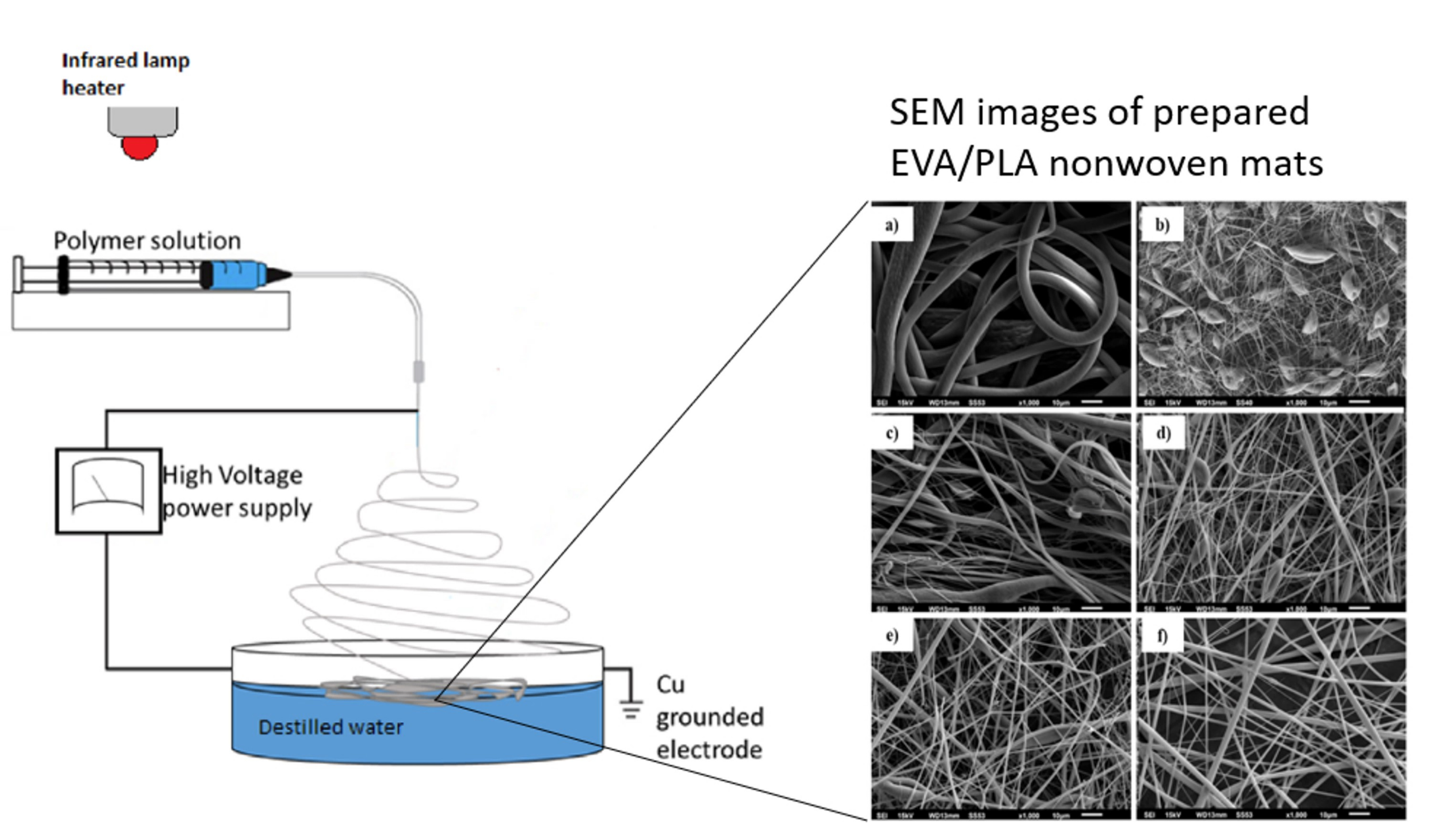
2.2. Preparation of Electrospun Fibers
2.3. Characterization of Prepared Fibers
3. Results and Discussion
4. Conclusions
Author Contributions
Funding
Acknowledgments
Conflicts of Interest
References
- Henderson, A.M. Ethylene-vinyl acetate (EVA) copolymers: A general review. IEEE Electr. Insul. Mag. 1993, 9, 30–38. [Google Scholar] [CrossRef]
- Martínez-García, A.; Reche, A.S.; Martín-Martínez, J.M. Improved adhesion of EVAs with different vinyl acetate contents treated with sulphuric acid. J. Adhes. Sci. Technol. 2004, 18, 967–982. [Google Scholar] [CrossRef] [Scilit]
- Kalachandra, S.; Lin, D.M.; Stejskal, E.O.; Prakki, A.; Offenbacher, S. Drug release from cast films of ethylene vinyl acetate (EVA) copolymer: Stability of drugs by 1H NMR and solid state 13C CP/MAS NMR. J. Mater. Sci. Mater. Med. 2005, 16, 597–605. [Google Scholar] [CrossRef] [Scilit] [PubMed]
- Guo, Q.; Guo, S.; Wang, Z. A type of esophageal stent coating composed of one 5-fluorouracil-containing EVA layer and one drug-free protective layer: In vitro release, permeation and mechanical properties. J. Control. Release 2007, 118, 318–324. [Google Scholar] [CrossRef] [Scilit] [PubMed]
- Garlotta, D. A literature review of poly(lactic acid). J. Polym. Environ. 2001, 9, 63–84. [Google Scholar] [CrossRef] [Scilit]
- Groot, W.; van Krieken, J.; Sliekersl, O.; de Vos, S. Production and purification of lactic acid and lactide. In Poly(Lactic Acid): Synthesis, Structures, Properties, Processing, and Applications; John Wiley & Sons, Inc.: Hoboken, NJ, USA, 2010; pp. 1–18. ISBN 9780470649848. [Google Scholar]
- Ma, P.; Hristova-Bogaerds, D.G.; Goossens, J.G.P.; Spoelstra, A.B.; Zhang, Y.; Lemstra, P.J. Toughening of poly(lactic acid) by ethylene-co-vinyl acetate copolymer with different vinyl acetate contents. Eur. Polym. J. 2012, 48, 146–154. [Google Scholar] [CrossRef] [Scilit]
- Arrieta, M.P.; Samper, M.D.; Aldas, M.; López, J. On the use of PLA-PHB blends for sustainable food packaging applications. Materials 2017, 10, 1008. [Google Scholar] [CrossRef] [Scilit] [PubMed]
- Mittal, V.; Akhtar, T.; Matsko, N. Mechanical, thermal, rheological and morphological properties of binary and ternary blends of PLA, TPS and PCL. Macromol. Mater. Eng. 2015, 300, 423–435. [Google Scholar] [CrossRef] [Scilit]
- Xu, P.; Ma, P.; Hoch, M.; Arnoldi, E.; Cai, X.; Dong, W.; Chen, M. Transparent blown films from poly(lactide) and poly(ethylene-co-vinyl acetate) compounds: Structure and property. Polym. Degrad. Stab. 2016, 129, 328–337. [Google Scholar] [CrossRef] [Scilit]
- Moura, I.; Botelho, G.; Machado, A.V. Characterization of EVA/PLA blends when exposed to different environments. J. Polym. Environ. 2014, 22, 148–157. [Google Scholar] [CrossRef] [Scilit]
- Singla, R.K.; Zafar, M.T.; Maiti, S.N.; Ghosh, A.K. Physical blends of PLA with high vinyl acetate containing EVA and their rheological, thermo-mechanical and morphological responses. Polym. Test. 2017, 63, 398–406. [Google Scholar] [CrossRef] [Scilit]
- Li, D.; Xia, Y. Electrospinning of nanofibers: Reinventing the wheel? Adv. Mater. 2004, 16, 1151–1170. [Google Scholar] [CrossRef] [Scilit]
- González, E.; Shepherd, L.; Saunders, L.; Frey, M. Surface functional poly(lactic acid) electrospun nanofibers for biosensor applications. Materials (Basel) 2016, 9, 47. [Google Scholar] [CrossRef] [Scilit] [PubMed]
- Liu, Y.; Chen, S.; Zussman, E.; Korach, C.S.; Zhao, W.; Rafailovich, M. Diameter-dependent modulus and melting behavior in electrospun semicrystalline polymer fibers. Macromolecules 2011, 44, 4439–4444. [Google Scholar] [CrossRef] [Scilit]
- Kenawy, E.R.; Bowlin, G.L.; Mansfield, K.; Layman, J.; Simpson, D.G.; Sanders, E.H.; Wnek, G.E. Release of tetracycline hydrochloride from electrospun poly(ethylene-co-vinylacetate), poly(lactic acid), and a blend. J. Control. Release 2002, 81, 57–64. [Google Scholar] [CrossRef] [Scilit]
- Alhusein, N.; de Bank, P.A.; Blagbrough, I.S.; Bolhuis, A. Killing bacteria within biofilms by sustained release of tetracycline from triple-layered electrospun micro/nanofibre matrices of polycaprolactone and poly(ethylene-co-vinyl acetate). Drug Deliv. Transl. Res. 2013, 3, 531–541. [Google Scholar] [CrossRef] [Scilit] [PubMed]
- Sanders, E.H.; Kloefkorn, R.; Bowlin, G.L.; Simpson, D.G.; Wnek, G.E. Two-phase electrospinning from a single electrified jet: Microencapsulation of aqueous reservoirs in poly(ethylene-co-vinyl acetate) fibers. Macromolecules 2003, 36, 3803–3805. [Google Scholar] [CrossRef] [Scilit]
- Liu, Y.; Li, C.; Chen, S.; Wachtel, E.; Koga, T.; Sokolov, J.C.; Rafailovich, M.H. Electrospinning of poly(ethylene- co -vinyl acetate)/clay nanocomposite fibers. J. Polym. Sci. Part B Polym. Phys. 2009, 47, 2501–2508. [Google Scholar] [CrossRef] [Scilit]
- Lewkowitz-Shpuntoff, H.M.; Wen, M.C.; Singh, A.; Brenner, N.; Gambino, R.; Pernodet, N.; Isseroff, R.; Rafailovich, M.; Sokolov, J. The effect of organo clay and adsorbed FeO3nanoparticles on cells cultured on Ethylene Vinyl Acetate substrates and fibers. Biomaterials 2009, 30, 8–18. [Google Scholar] [CrossRef] [Scilit] [PubMed]
- Casasola, R.; Thomas, N.L.; Trybala, A.; Georgiadou, S. Electrospun poly lactic acid (PLA) fibres: Effect of different solvent systems on fibre morphology and diameter. Polymer 2014, 55, 4728–4737. [Google Scholar] [CrossRef] [Scilit]
- Givens, S.R.; Gardner, K.H.; Rabolt, J.F.; Chase, D.B.; Givens, S.R.; Gardner, K.H.; Rabolt, J.F.; Chase, D.B. High-temperature electrospinning of polyethylene microfibers from solution. Macromolecules 2007, 40, 608–610. [Google Scholar] [CrossRef] [Scilit]
- Czaniková, K.; Krupa, I.; Ilčíková, M.; Kasák, P.; Chorvát, D.; Valentin, M.; Šlouf, M.; Mosnáček, J.; Mičušík, M.; Omastová, M. Photo-actuating materials based on elastomers and modified carbon nanotubes. J. Nanophotonics 2012, 6, 063522. [Google Scholar] [CrossRef] [Scilit]
- Qian, J.W.; Qi, G.R.; Cheng, R.S. Association of ethylene-vinyl acetate copolymer in dilute solutions—I. Solvent, concentration and annealing temperature effect. Eur. Polym. J. 1997, 33, 1263–1265. [Google Scholar] [CrossRef] [Scilit]
- Smallwood, I.M. Handbook of Organic Solvent Properties; Butterworth-Heinemann: Oxford, UK, 2012; ISBN 0080523781. [Google Scholar]
- Wannatong, L.; Sirivat, A.; Supaphol, P. Effects of solvents on electrospun polymeric fibers: Preliminary study on polystyrene. Polym. Int. 2004, 53, 1851–1859. [Google Scholar] [CrossRef] [Scilit]
- SHIMADZU (Shimadzu Corporation) ATR Precautions. Available online: http://www.shimadzu.com/an/ftir/support/ftirtalk/letter2/atr2.html (accessed on 30 October 2017).
- Moura, I.; Machado, A.V.; Nogueira, R.; Bounor-Legare, V. Synthesis of biodegradable copolymers based on ethylene vinyl acetate and polylactic acid. Mater. Sci. Forum 2010, 636–637, 819–824. [Google Scholar] [CrossRef] [Scilit]
- Beamson, G.; Briggs, D. High Resolution XPS of Organic Polymers.The Scienta ESCA300 Database; Wiley: Chichester, NY, USA, 1992; ISBN 0-471-93592-1. [Google Scholar]
- Sangeetha, V.H.; Valapa, R.B.; Nayak, S.K.; Varghese, T.O. Investigation on the influence of EVA content on the mechanical and thermal characteristics of poly(lactic acid) blends. J. Polym. Environ. 2018, 26, 1–14. [Google Scholar] [CrossRef] [Scilit]
- Zeng, J.; Chen, X.; Liang, Q.; Xu, X.; Jing, X. Enzymatic degradation of poly(l-lactide) and poly(ε-caprolactone) Electrospun Fibers. Macromol. Biosci. 2004, 4, 1118–1125. [Google Scholar] [CrossRef] [Scilit] [PubMed]
- Maurin, M.B.; Dittert, L.W.; Hussain, A.A. Thermogravimetric analysis of ethylene-vinyl acetate copolymers with Fourier transform infrared analysis of the pyrolysis products. Thermochim. Acta 1991, 186, 97–102. [Google Scholar] [CrossRef] [Scilit]
- Costache, M.C.; Jiang, D.D.; Wilkie, C.A. Thermal degradation of ethylene–vinyl acetate coplymer nanocomposites. Polymer 2005, 46, 6947–6958. [Google Scholar] [CrossRef] [Scilit]
- Riva, A.; Zanetti, M.; Braglia, M.; Camino, G.; Falqui, L. Thermal degradation and rheological behaviour of EVA/montmorillonite nanocomposites. Polym. Degrad. Stab. 2002, 77, 299–304. [Google Scholar] [CrossRef] [Scilit]





| Sample | Surface Chemical Composition [at.%] | ||
|---|---|---|---|
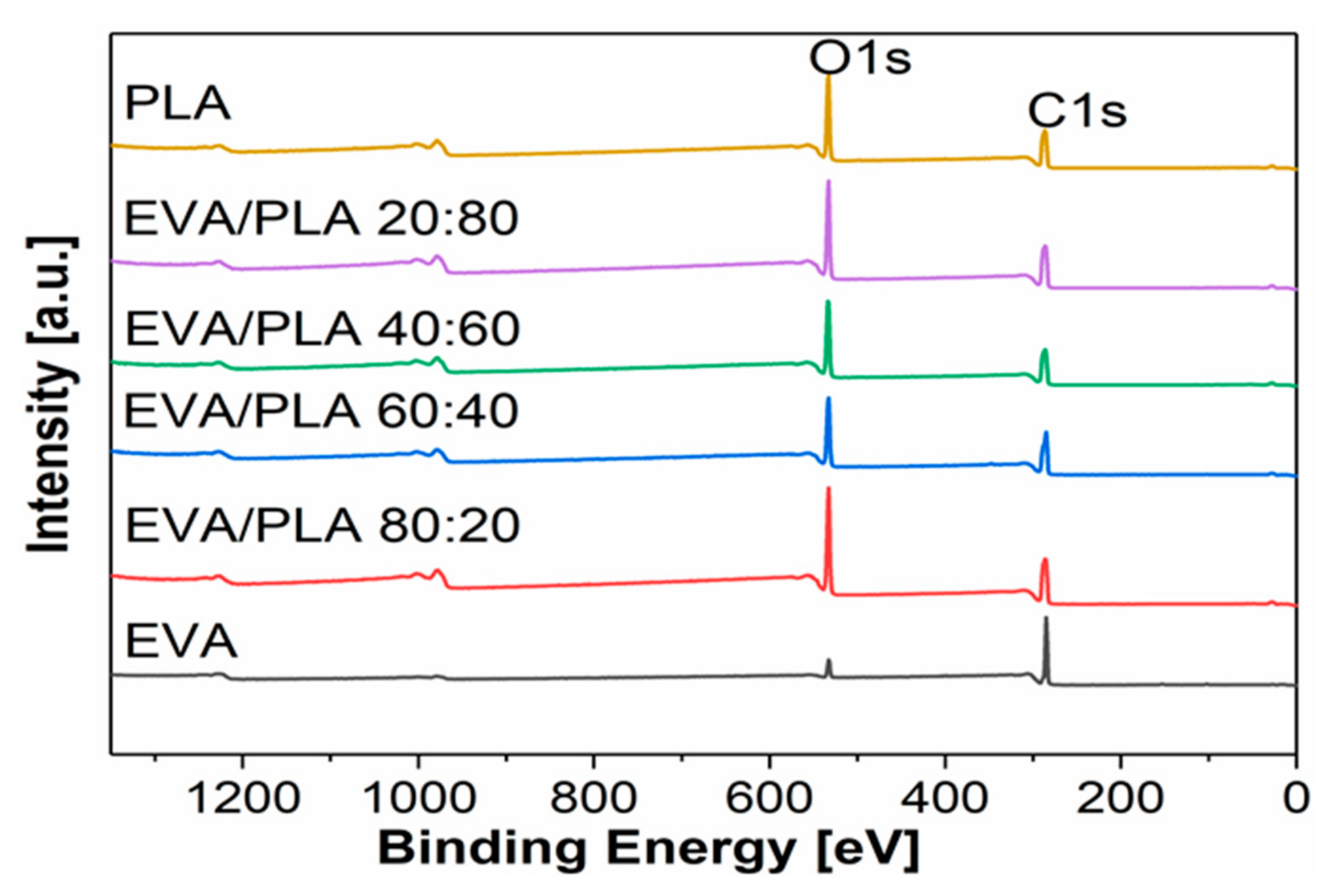
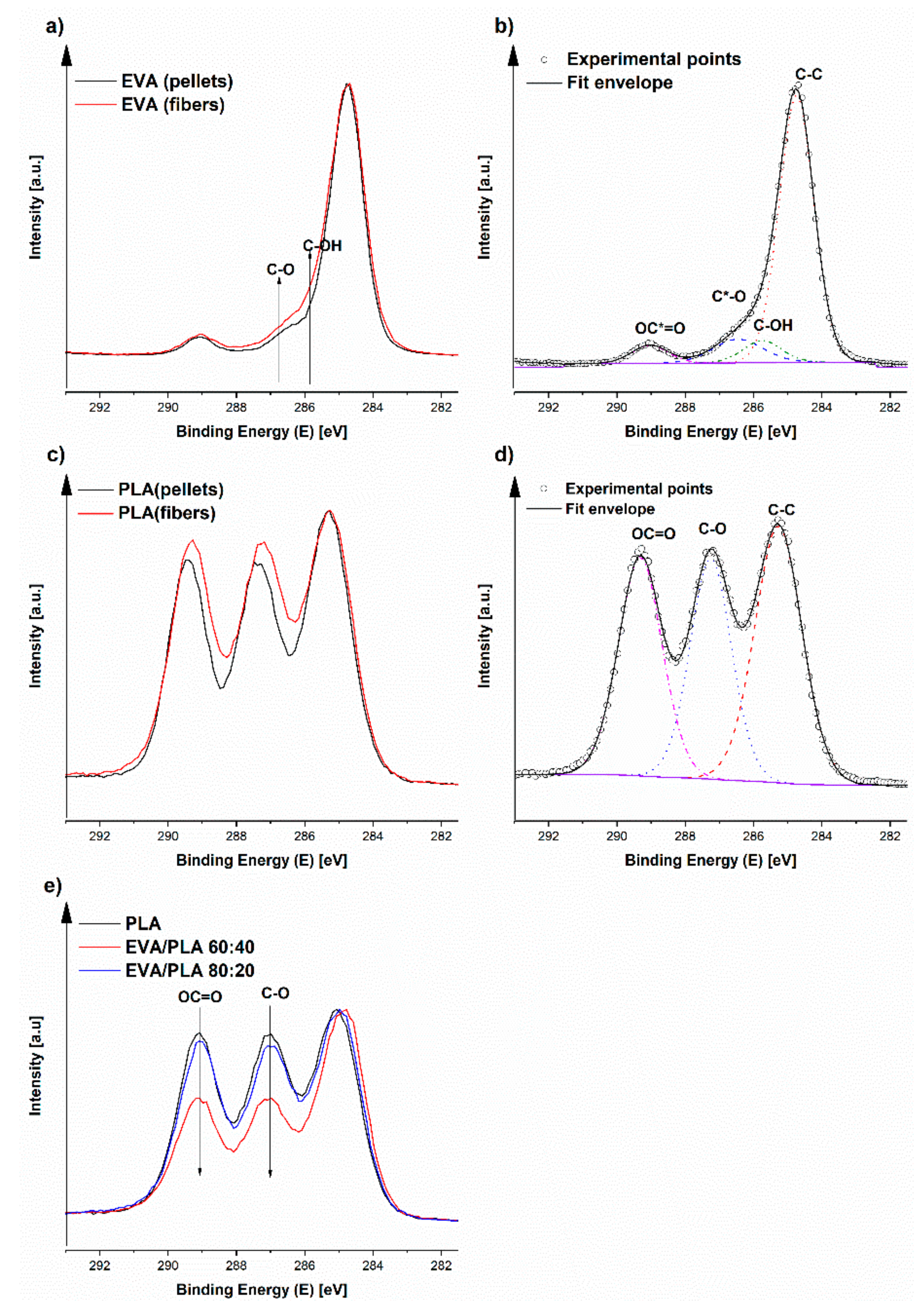
| C1s C-C//C-OH//C-O//C=O//OC=O (284.8//285.7//286.3//286.9//289.2) | O1s C=O//C-O (532.1/533.4) | N1s NC=O (399.5) | |
| EVA (pellets) | 90.1 84.6//-//8.2//2.0//5.2 | 9.9 49.5//50.5 | — |
| EVA | 87.5 77.3//7.1//9.9//-//5.6 | 12.4 50.9//49.1 | 0.1 100.0 |
| EVA/PLA 80:20 | 63.1 39.4//-//29.2//-//31.5 | 36.9 39.4//60.6 | — |
| EVA/PLA 60:40 | 63.9 47.5//-//26.3//-//26.4 | 35.7 45.0//55.0 | 0.3 100.0 |
| EVA/PLA 40:60 | 63.8 38.3//-//25.6//-//36.1 | 36.0 26.3//73.7 | 0.2 100.0 |
| EVA/PLA 20:80 | 63.6 39.2//-//29.0//-//31.8 | 36.3 45.0//55.0 | 0.1 100.0 |
| PLA | 62.7 39.3//-//29.6//-//31.1 | 37.0 38.8//61.2 | 0.3 100.0 |
| PLA (pellets) | 63.0 41.6//-//29.4//-//28.9 | 37.0 44.7//55.3 | — |
| Sample | Tg [°C] | Tcc [°C] | Tm [°C] |
|---|---|---|---|
| EVA | - | - | 66.4 ± 0.4 |
| EVA/PLA 80:20 | 66.2 ± 0.3 | 92.8 ± 1.5 | 148.1 ± 0.3 |
| EVA/PLA 60:40 | 63.7 ± 0.1 | 110.0 ± 1.0 | 147.3 ± 0.1 |
| EVA/PLA 40:60 | 63.7 ± 1.0 | 111.1 ± 1.7 | 147.8 ± 0.1 |
| EVA/PLA 20:80 | 62.5 ± 0.3 | 107.0 ± 1.0 | 148.2 ± 0.4 |
| PLA | 62.0 ± 0.4 | 109.8 ± 1.0 | 146.8 ± 0.6 |
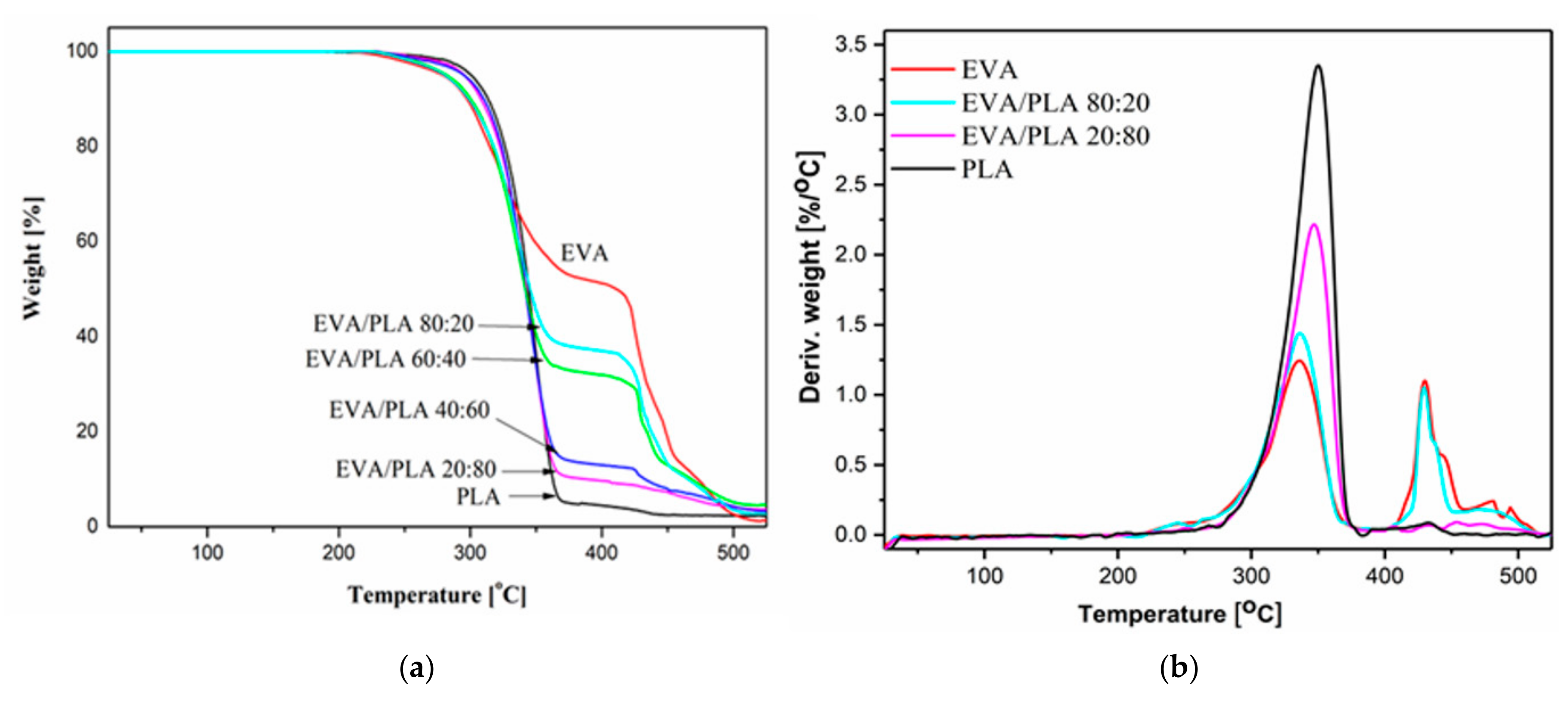
| Sample | T10% [°C] | T50% [°C] | First Degradation Step | Second Degradation Step | ||||
|---|---|---|---|---|---|---|---|---|
| T1onset [°C] | T1max [°C] | T1f [°C] | T2onset [°C] | T2max [°C] | T2f [°C] | |||
| EVA | 297.8 ± 0.9 | 411.8 ± 1.0 | 259.8 ± 0.6 | 334.5 ± 0.8 | 387.6 ± 1.0 | 405.6 ± 2.5 | 431.2 ± 1.5 | 457.4 ± 0.7 |
| EVA/PLA 80:20 | 301.2 ± 0.4 | 345.2 ± 0.7 | 264.0 ± 1.1 | 322.0 ± 2.0 | 387.1 ± 2.2 | 411.0 ± 0.7 | 428.2 ± 1.8 | 453.3 ± 3.0 |
| EVA/PLA 60:40 | 304.0 ± 1.0 | 343.0 ± 0.2 | 273.9 ± 0.2 | 341.2 ± 0.4 | 388.9 ± 1.9 | 414.5 ± 1.0 | 425.9 ± 0.7 | 440.8 ± 0.8 |
| EVA/PLA 40:60 | 312.8 ± 0.7 | 343.2 ± 0.5 | 274.3 ± 0.7 | 342.2 ± 1.2 | 386.7 ± 1.2 | 416.7 ± 1.5 | 426.7 ± 2.1 | 442.1 ± 1.3 |
| EVA/PLA 20:80 | 313.3 ± 0.6 | 343.3 ± 0.7 | 274.2 ± 0.9 | 345.0 ± 0.4 | 392.6 ± 0.8 | - | - | - |
| PLA | 315.9 ± 0.2 | 344.4 ± 0.4 | 275.7 ± 0.8 | 351.4 ± 0.3 | 384.7 ± 1.4 | - | - | - |
© 2018 by the authors. Licensee MDPI, Basel, Switzerland. This article is an open access article distributed under the terms and conditions of the Creative Commons Attribution (CC BY) license (http://creativecommons.org/licenses/by/4.0/).
Share and Cite
Číková, E.; Kuliček, J.; Janigová, I.; Omastová, M. Electrospinning of Ethylene Vinyl Acetate/Poly(Lactic Acid) Blends on a Water Surface. Materials 2018, 11, 1737. https://doi.org/10.3390/ma11091737
Číková E, Kuliček J, Janigová I, Omastová M. Electrospinning of Ethylene Vinyl Acetate/Poly(Lactic Acid) Blends on a Water Surface. Materials. 2018; 11(9):1737. https://doi.org/10.3390/ma11091737
Chicago/Turabian StyleČíková, Eliška, Jaroslav Kuliček, Ivica Janigová, and Mária Omastová. 2018. "Electrospinning of Ethylene Vinyl Acetate/Poly(Lactic Acid) Blends on a Water Surface" Materials 11, no. 9: 1737. https://doi.org/10.3390/ma11091737
APA StyleČíková, E., Kuliček, J., Janigová, I., & Omastová, M. (2018). Electrospinning of Ethylene Vinyl Acetate/Poly(Lactic Acid) Blends on a Water Surface. Materials, 11(9), 1737. https://doi.org/10.3390/ma11091737