1. Introduction
The transition from the current energy distribution network towards a more sustainable and efficient one by means of the smart grid is expected to result in dramatic changes for energy markets in the short to medium term. It must be considered that the amount of world inhabitants living in cities has not surpassed people living in the countryside until recent years [
1]. In addition to that, Earth’s human population has become more abundant than ever, measuring more than 7170 million inhabitants as of July 2014 [
2]. As can be figured out, this huge quantity of human lives demands an equally challenging quantity of energy to ensure the fulfilment of the usual duties of their daily life. Therefore, electricity demand is expected to grow at the same rate as the number of human beings on Earth increases, and since the Earth has profuse, yet limited, resources, it becomes of major importance to rationalize the use of energy, as well as trying out renewable energies that will provide electricity to consume with a lower impact on the planet.
A way to help the achievement of this goal is using the smart grid. It has been claimed by Gellings to provide power systems with intelligence by means of “the use of sensors, communications, computational ability and control in some form to enhance the overall functionality of the electric power delivery system” [
3]. The underlying idea is that with the usage of information and communication technologies, this new power grid will offer a way to: (1) deliver additional energy into the power network, thus increasing the amount of energy that can be utilized; and (2) consume electricity in a more efficient way, as there will be more awareness about its cost. The inclusion of renewable energy sources (RESs) from the end user side implies a pivotal change: electricity consumers are also able to produce electricity now, hence turning them into “prosumers” with a different role in the whole power grid system. As can be observed in
Table 1, significant changes are expected with the widespread use of the smart grid.
Table 1.
Comparison between features with and without the smart grid.
Table 1.
Comparison between features with and without the smart grid.
| Environment | Without Smart Grid | With Smart Grid |
|---|
| Data | Offline, scarce data | Online, abundant data (big data) |
| One-way stream | Two-way interchange |
| Business models | Producers and consumers | Prosumers |
| Static business models | Dynamic business models |
| Energy | Focus on fossil-based, non-renewable energies | Focus on renewable energies |
| Centralized energy production | Distributed energy production |
| Information and communication technologies | Weak preventive mechanisms | Strong preventive mechanisms |
| Little use of information and communication technologies | Widespread use of information and communication technologies |
| Infrastructure with scarce intelligence | Information inference and decision making features |
| Agents | Reduced amount of participating agents | Potentially huge amount of participating agents |
Not only does the power grid of the future promise to be a dramatic technological, environmental and economic upgrade of its earlier counterpart, but it will be also a more pervasive technology influencing the common life of users. With this new environment, there are several new services that can be provided and that will constitute a basis for expanding business models where the smart grid plays a major role. For instance, there are three that can be regarded as of significant prominence:
Demand response (DR): DR is a collection of policies that has as a target flattening energy consumption during different times of the day, aiming especially to lower energy demand at peak hours. Since these are the most critical working times for a power station, incentives are offered to the end users that will reduce their electricity consumption during those particular moments. End users will get economic compensation for equipping devices to work as load controllers (since any piece of equipment consuming electricity will be regarded as a load). As claimed by the U.S. Federal Energy Regulation Commission, demand response is linked to: (1) changes made by end users in terms of their regular power consumption (basically due to modifications in the price of electricity during a period of time); (2) encouragement on payments tailored to induce lower energy consumption during high wholesale market prices; or (3) as a way to assist the system when its reliability is compromised [
4].
Demand side management (DSM): This is another set of policies focused on rationalizing and lowering differences in energy usage peaks. Usually, smart grids encourage the introduction of DSM to allow demand to follow the energy supply pace. DSM is a well-known instrument developed to shift loads from peak periods to other time periods where power demand is lower. Although it is somewhat similar to demand response, DSM is not quite the same concept: DR tackles energy consumption with very little time in advance and is used as a punctual, temporary solution, while DSM is more about a long-term strategy that evaluates methods to save energy and energy planning in general, as, for example, storing energy during off-peak hours and releasing it during peak hours to reduce strain on the power network [
5].
Electricity loads: This term, as introduced before, implies any sort of hardware device that will consume electricity. Consequently, they must be borne in mind when designing the infrastructure for the smart grid. As electricity becomes more widely available, electricity loads become more varied (plug-in hybrid electric vehicles, etc.).
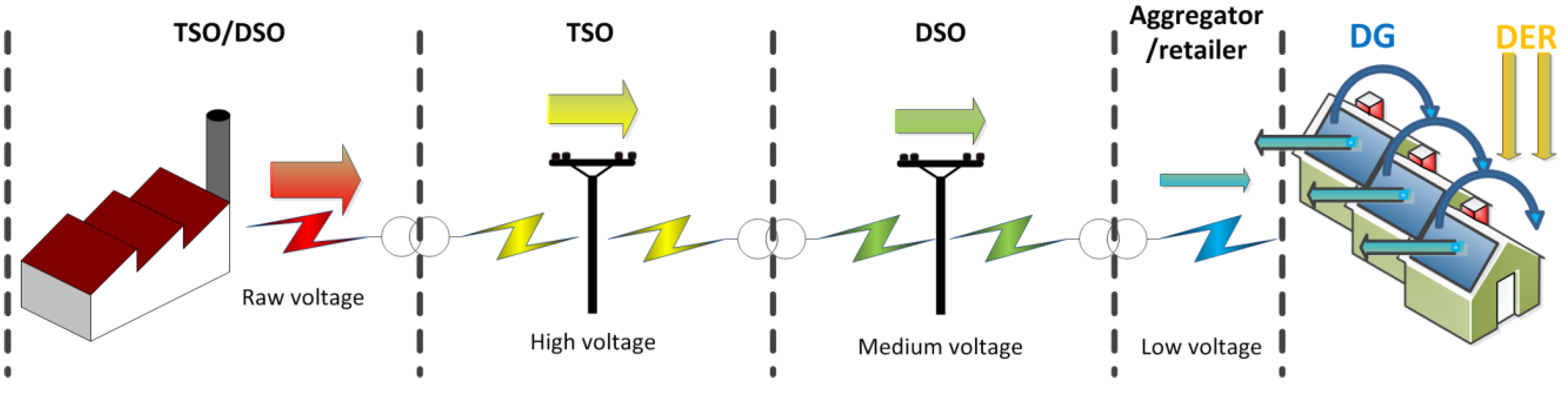
Furthermore, it must be highlighted that despite minor differences in each country due to their local circumstances, the power grid is operated the same way almost everywhere. In order to find out what business models could arise when deploying the smart grid, it is advisable to understand which entities compose the value chain related to electricity production, distribution and consumption.
Power generation: This must be understood as turning raw energy resources into electricity. The major share of the produced energy is at high-scale power plants, either reliant on fossil fuels or nuclear energy. The infrastructure used for this power generation is owned by a relatively small group of companies.
Transmission system operator (TSO): This is the entity responsible for providing the power grid infrastructure used to transmit electricity, usually covering sections where high voltage power is needed. Transmission can be defined here as high tension electricity transfer by using a power network that covers long distances. Additionally, the TSO will be in charge of the offer/demand balance involving electricity in a certain area. Nowadays, the transmission system is designed to deliver electricity from central production locations to a huge number of clients.
Distributed system operator (DSO): This is responsible for all of the features related to end user connectivity to the power network. In a smart grid scenario where consumers have been converted into prosumers and there are more energy generation places connected to the power grid, energy and information flows will be bidirectional. This new situation will create a need for increased flexibility in the distribution network.
Aggregator/retailer: This entity controls low voltage power that is transferred to the usual places where it is consumed. It is in charge of purchasing electricity, its metering and billing functionalities.
End consumer/prosumer: This last link in the electricity value chain is easily the most important creator of value within the smart grid. Prosumers will be given a more active role than mere energy consumers and, due to their number and their flexibility, are likely to become major actors in new business model generation.
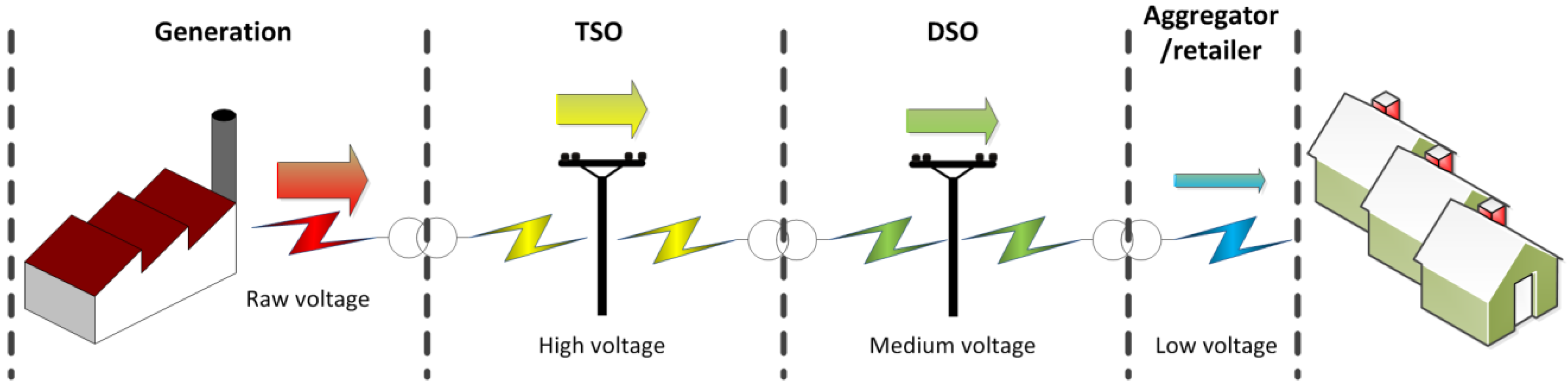
All of these considerations have been depicted in
Figure 1. The power plants use natural resources of different origin (coal, petroleum,
etc.) and process them by using internal machinery—for example, turbines and generators—thus obtaining raw electricity that is transformed into high voltage electricity to be transported through high voltage lines. Eventually, it is turned into medium and low voltage electricity that, in the end, is transferred to small-sized scenarios (typically, dwellings, department stores or public buildings).
Figure 1.
Regular electricity production, distribution and consumption value chain. TSO: transmission system operator; DSO: distributed system operator.
Figure 1.
Regular electricity production, distribution and consumption value chain. TSO: transmission system operator; DSO: distributed system operator.
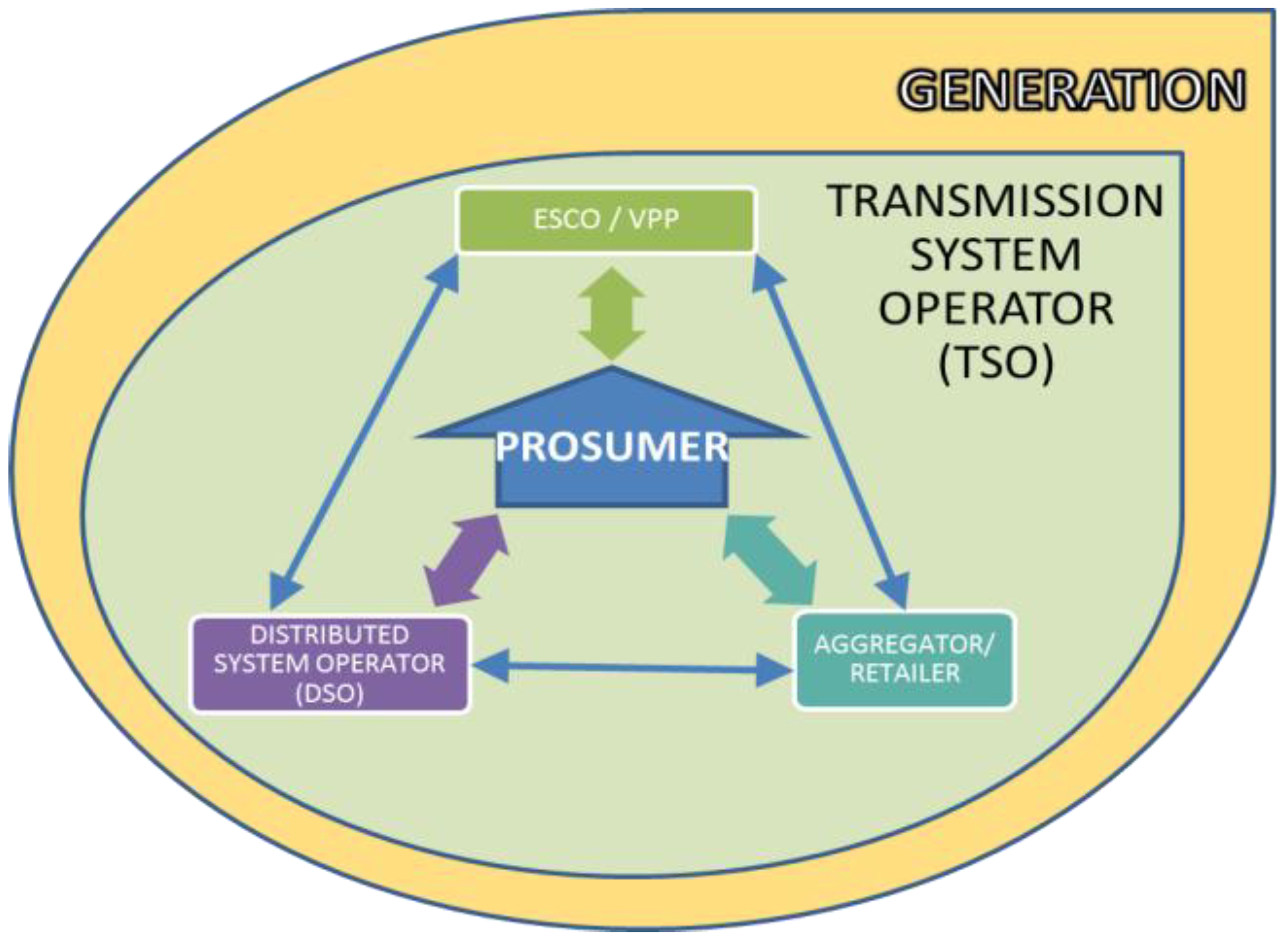
While many already existing parties will remain in a smart grid-based scenario with the same services that they had before, there will be some other elements offering additional ones. The most obvious would be the distributed generation (DG) of energy that will take place by using distributed energy resources (DERs) and renewable energy sources (RES)—like solar power or wind power—that will be used to the prosumer’s advantage, as shown in
Figure 2.
Figure 2.
Electricity production, distribution and consumption value chain with a prosumer. DG: distributed generation; DER: distributed energy resources.
Figure 2.
Electricity production, distribution and consumption value chain with a prosumer. DG: distributed generation; DER: distributed energy resources.
The utility that prosumers can get from electricity consumption/generation can be quantified in terms of economic benefit and comfort. Basically, their individual attitude will determine the power injected or withdrawn to the grid, as prosumers will not necessarily strive for the global welfare of the system; for instance, non-cooperative prosumers could be driven by their own utilities and influenced by their social environment. In this respect, efficient market-based operation and control are needed for emerging distribution systems with a large population of autonomous, self-interested prosumers, so as to obtain both coordinated participant behaviors and optimized global performance. As for emerging electricity distribution systems, the overall system performance is related to the interactions among macro-players (regulators, DSOs, retailers) and micro-players (prosumers) with different global or individual motivations and utilities. Usually, the global utilities pursued by the macro-player in terms of environmental control, energetic efficiency or technical feasibility of the power network can be pursued providing proper price signals to the micro-players and devising strategies expected to align global goals with individual utilities.
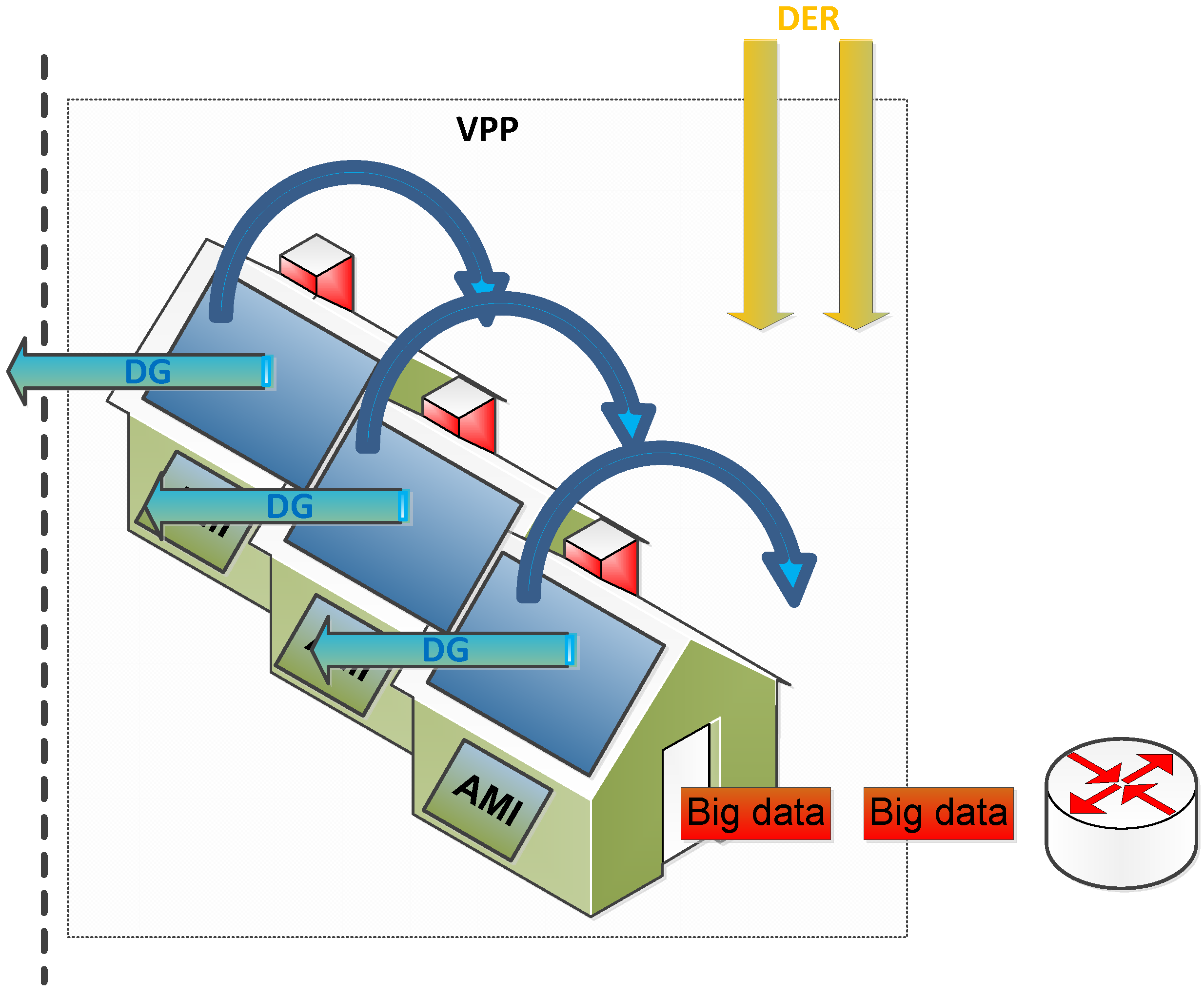
The prosumer part of the grid could become the most enriched one due to the added information and technology features. However, the upgraded features of the end user side come at the cost of requiring more technology in order to make them usable. Thus, an advanced metering infrastructure (AMI) will be required to control how electricity is being produced and consumed. AMI provides data that can be used, too, either for local statistics or trading purposes, resulting in an environment where big data can be deemed as another additional component prone to providing services. Finally, it must be considered that a cluster made up of several buildings producing energy can also be regarded as a virtual power plant or VPP, as represented in
Figure 3. Applications and services can be expanded from the consumer point of view, being able to actively participate in the trade and consumption of energy resources, as well as using them in a more efficient, environment-friendly manner.
Figure 3.
Close-up view of the prosumer scenario with a Virtual Power Plant (VPP). AMI: Advanced Metering Infrastructure.
Figure 3.
Close-up view of the prosumer scenario with a Virtual Power Plant (VPP). AMI: Advanced Metering Infrastructure.
The enhancement, rather than replacement, of the current power grid model in order to become the one represented by the smart grid will require the addition of new hardware (AMI, RES infrastructures, DG infrastructures, network infrastructures) and software (big data, ICT) elements that will result in brand new services, generating new markets and jobs. It is here where new business opportunities exploited either by using traditional business models or by finding out new ones will spring up. Not only are large DSOs or TSOs bound to be part of the new scenario, but small- and medium-sized enterprises (SMEs) will also be able to have their own share in it. While the evolution of the smart grid (both in information and communication technologies and power-related infrastructure) progresses, continuous research activities on technology, business models and prosumer perception and behavior is needed as a way of informing about the existence of new products, services and opportunities in it.
The main objective of this paper is to apply the business model concept to the smart grid. Emerging business opportunities around the smart grid regarding prosumers, along with their strengths and weaknesses, will be presented. These findings can foresee the future perspectives for the next few years and offer insights for policy makers and actors in the energy system. As a general concept, it is considered that prosumers will strongly participate in many of the business models of the future, going as far as being the actors at the very center of these business models in some cases. From our point of view, the main research challenges being presented are: the status of business models for prosumers in the smart grid so far, and given its state, whether there are proposals that could be put forward so as to improve the overall
status quo. Consequently, the main contributions of the paper are:
A review on the most prominent proposals related to business models for prosumers in the smart grid has been made. In order to do so, the literature has been studied to find out the most complete proposals regarding this topic and a way to classify the latter according to three non-functional requirements, namely focusing on the prosumer’s side, focusing on the business model description and the generation of added value.
A study on prosumers and their role in the smart grid has been put forward. The role of the prosumers in the electricity value chain is thoroughly explained in this paper.
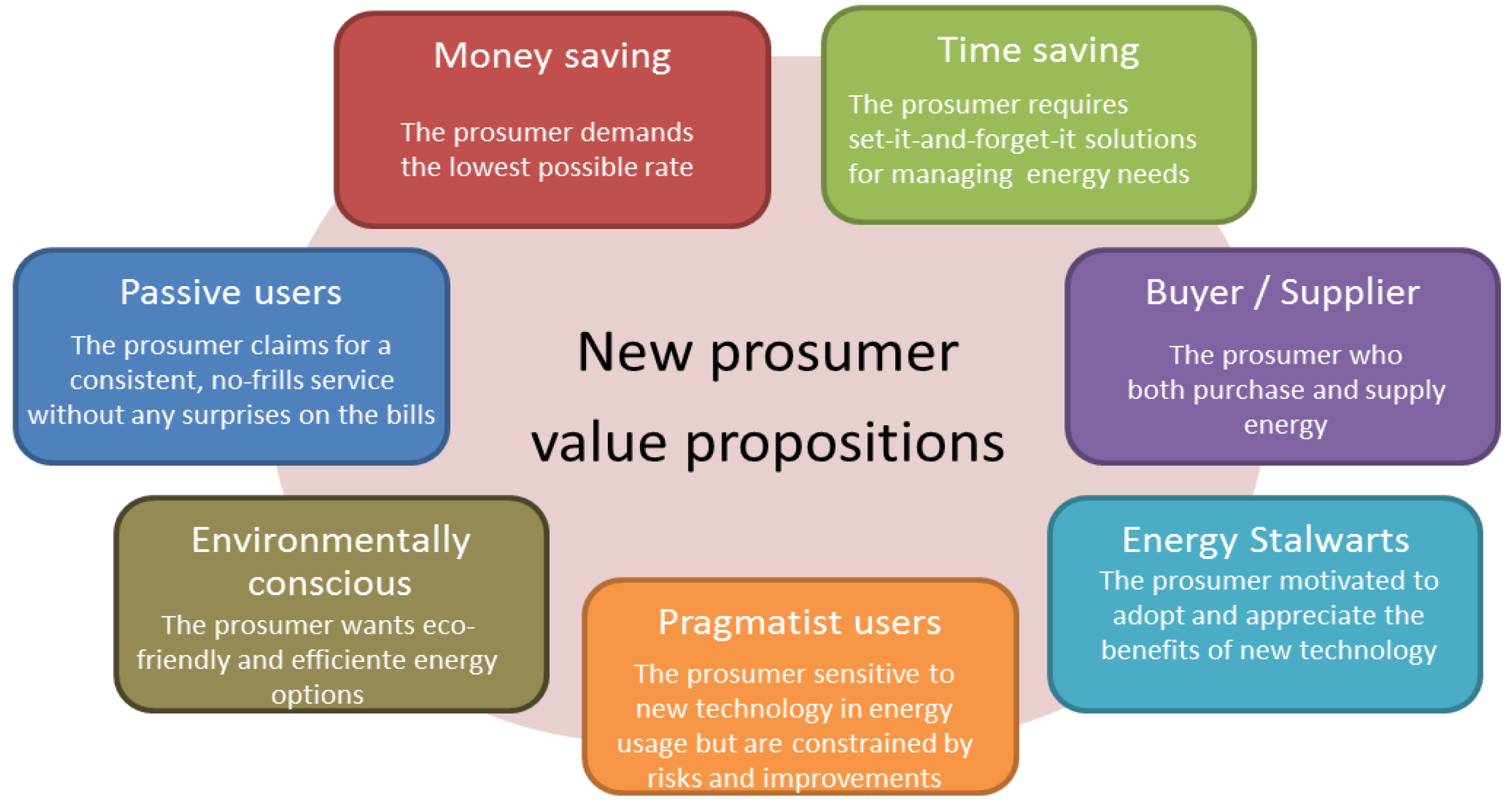
Proposals for prosumers business models. From the obtained results and considerations made before, business model proposals for prosumers are formulated. In this case, new prosumers value propositions are described, and some particular examples are provided.
This paper has been organized as follows: an introduction on the most significant stakeholders of the smart grid and the concept of prosumers has already been exposed. The next section deals with the related works done in the smart grid area considering business models that imply actions taken by prosumers to a greater or a lesser extent.
Section 3 copes with the challenges that are faced by prosumers in the smart grid, taking into account the reviewed proposals of the previous section.
Section 4 describes what must be expected from a business model, whereas
Section 5 describes the role assumed by the prosumers in the new electricity value chain created as a result of smart grid deployment. Several business models for prosumers are put forward in
Section 6. Finally, conclusions and an approach to future works have been added as the last sections.
2. Related Works
It can be presumed that the location where most of the changes of the smart grid take place compared to the regular power grid is on the former consumer’s side, since they have become prosumers who are able to establish a bidirectional model of energy generation and consumption. In this way, this study of related works is focused on business models for the smart grid, where prosumers are taking part as a major actor of them. In order to make a more accurate study of the state of the art in terms of business models for prosumers, there are several non-functional requirements that must be taken into account. Thus, three of them have been chosen as critical for reviewing the existing proposals:
Focus on the prosumer’s side: As the scope of this paper is dealing with the prosumer possibilities to obtain a profit by participating in the smart grid, it is only natural that this feature is taken into account.
Focus on the business model description: It is inevitable to provide a description, so as to have a good grasp on what the proposal is about, for it is necessary to know the way in which it is structured.
Added value generation: How value is generated is a characteristic that can make a difference between proposals, as crystal clear information about how prosumers take a prominent role in the smart grid market is required.
With these requirements, an accurate way to review the presented proposals can be determined. Therefore, a table that describes the criteria chosen to assess each of the studied proposals has been elaborated. A three-grade scale has been built, with high, medium or low levels as values, depending on the degree of fulfillment of the proposals when taking into account the non-functional requirements. The table is depicted here as
Table 2.
Table 2.
Non-functional requirements assessment.
Table 2.
Non-functional requirements assessment.
| Focus on Prosumer’s Side | Description |
|---|
| Grade | High | The proposal has been conceived around the prosumers. Detailed information about their behavior is provided. |
| Medium | The proposal includes prosumers as a non-leading entity in a bigger scenario or as an afterthought. |
| Low | The proposal offers next to no information about prosumers. |
| Focus on Business Model Description | Description |
| Grade | High | The proposal provides profuse information about the business model where prosumers are involved (diagrams, flowcharts, descriptions, etc.). |
| Medium | The proposal offers information that is barely enough to understand the business model in which prosumers are taking part (high-level description, etc.). |
| Low | Scarce information is given about the business model for prosumers (if any). |
| Added Value Generation | Description |
| Grade | High | Value generation is comprehensible and realistic, as described in the proposal. Plenty of information about how the value is generated has been depicted. |
| Medium | Only high-level details regarding prosumers added value generation are provided by the proposal. |
| Low | Very few data are offered by the proposal regarding added value generation for prosumers. |
It must be noted, though, that what is being specifically assessed here is to what extent proposals are meeting the non-functional requirements defined before, rather than subjectively regarding these proposals as “good” or “bad”. Keeping this detail in mind, the most compelling proposals are the ones described in the following subsections.
2.2. Smart Grid Prosumer Grouping on Forecasting Accuracy
Da Silva
et al. [
7] offer their own work dealing with grouping prosumers for forecasting services, which somewhat resembles the previously described proposal. However, the authors stress in this work the importance of performing accurate forecasts for local electricity markets, or rather, energy communities, as a way to offer a service that could become the cornerstone of a business model about energy consumption forecasting. From the authors’ perspective, local electricity markets are a desirable model for electricity production and consumption, because of their “software management control” facilities and efficient resource allocation and pricing. Under this business model, forecasting must take part as a service integrated in prosumer virtual power plants (pVPPs) able to minimize the possibility of forecasting being inaccurate when it uses only one or a few dwellings in its predictions. Retailer costs are the ones used as the starting point for market trading, so the goal will be obtaining a price below them. The authors describe how loose forecasting can result when a lack of efficiency in energy trade from the prosumers’ side appears when using different forecasting algorithms. Moreover, the authors depict data obtained from simulations that strengthen their point of achieving more efficient energy purchasing and consumption by having the prosumers acting as a group rather than a set of aggregated individuals.
Focus on prosumer’s side: high. The concept of providing business applications for a prosumer is of critical importance for the proposal presented by the authors.
Focus on business model description: low. While real market models are used to describe the proposal (such as NOBEL—Neighbourhood Oriented Brokerage Electricity and monitoring system—based on the European Energy Exchange [
8]), it is not explained how they will become integrated into the smart grid, nor is the procedure for the end user to become a profitable prosumer.
Added value generation: low. Aside from a more optimized energy proposal, the exact features that the business model is using are not thoroughly described; the overall business model is hinted at instead of being specifically described. Besides, the proposal presented here seems to be oriented toward having prosumers saving energy costs rather than trading their produced energy.
2.3. Future Smart Grid Prosumer Services
Karnouskos [
9] expresses his vision about how services will be used to the prosumers’ advantage in the future. The author mentions the promising future of services for prosumers in the smart grid, highlighting that it behaves as a system of systems working under a bidirectional information exchange between energy production centers and prosumers at the other end of the communication. The author puts forward several examples of smart grid energy services that should be considered: (1) timely energy monitoring, with information about energy consumption habits that may or may not be shared with other third parties, and of major usefulness for automated decision procedures; (2) timely control/management to monitor the lifecycle of different subsystems and devices; (3) energy brokering, strongly related to energy trading in online market places, or at least, user reaction to energy provided price signals; (4) general real-time analytics and value added services, which need the available transferred information, so as to perform more sophisticated functionalities (for instance, real-time analytics); (5) community management services used to guide common interests for a group of prosumers; and (6) energy application stores, where users will be able to install energy related applications for mobile or mobile-like devices. In addition to that, the author stresses the importance of system interoperability, which, according to his point of view, is not given enough care in current developments, associating the efforts that must be done in this field with the ones involving the Internet of Things or the Internet of Services.
Focus on prosumer’s side: high. The author’s purpose of the presented piece of work is putting the prosumers at the center of future developments.
Focus on business model description: low. Although several examples are described and a number of ideas are suggested to get a grasp on how they would work, very little detailed information is provided.
Added value generation: low. The description that is provided about the services expected to be obtained is not enough to justify in a precise manner where the value generation is.
2.4. Prosumer-Based Smart Grid Architecture for a Flat, Sustainable Electricity Industry
Grijalva and Umer Tariq [
10] put forward their own proposal aimed at achieving an electricity consumption curve that is as flat as possible, without any brusque peaks that may cause instabilities to the whole power grid system. The authors use the National Institute of Standards and Technology (NIST) model as a reference for their own vision of the smart grid, adding concepts from distributed systems and service oriented architectures for prosumers. Their proposal divides the usual characteristics a prosumer must rely on into a four-layered architecture. These layers are: a device layer for the physical connectivity of the electrical components, a local control layer to control hardware parts, like a battery charger or a transformer, a system control layer for control requirements (system restoration, economic and secure operation,
etc.) and a market layer in order to make choices depending on the prosumers’ available resources regarding economic objectives. This latter feature is the one most remarkable from the perspective of a business model; the authors claim it is able to use a system control data and financial, economic-based applications as risk management, price and load forecasting or reserve co-optimization. Additionally, the authors suggest ways to employ these services via interfaces that will grant access to each of the layers of this architecture, offering tagged messages about what the exchanged information should look like.
Focus on prosumer’s side: high. The solution proposed by the authors involves prosumers as the main actor of the system, along with their energy needs.
Focus on business model description: low. The description is sound in terms of energy savings and the procedures that are used to provide it, but it struggles to find a way to describe how this achievement will be commercialized as a solution for an end user.
Added value generation: medium. Significant technical details are given about how the information regarding market data and services is used to control the system. However, there is not a defined exploitation plan dealing with the most specific requirements for prosumers’ profitability. Furthermore, the proposal is mostly focused on energy saving instead of conceiving of the prosumers as actors with a trade impact.
2.5. Decentralized Control of Large-Scale Storage-Based Renewable Energy Systems
Decentralized electricity storage for smart grids could be a source of revenues for prosumers producing more energy than what they consume and to keep it stored until either it must be used or sold to another customer. Kato
et al. [
11] put forward their own research work on this topic. Its aim is achieving an optimal energy distribution able to have a significant, almost complete, independence from the previously existing power grid. In order to do so, energy collected in a distributed manner from different locations responsible for electricity storage and utilization is used. The authors refer to these locations as clusters. They comprise a number of photovoltaic units, electrical appliances, a router devoted to power management and a battery for energy storage purposes. By having several clusters cooperating with each other, a local energy network can be obtained, which, in turn, supports inter-cluster energy transfer and makes possible the effective usage of renewable energy under this distributed scenario. Optimal power distribution is dealt with using a mixed integer programming model; many features typical of energy storage are taken into account here, such as incoming power flow or the fact that batteries are not ideal energy storage devices (charges and discharges end up in some energy loss). Finally, the authors show results confirming that the objective values that were chosen are improved for an increasing number of clusters. A greater set of clusters also improves the charge speed and efficiency (clusters are enabled to interchange power among them).
Focus on prosumer’s side: medium. Clusters fit in well with the concept of prosumers and their associated DERs, but are not explicitly mentioned in the proposal.
Focus on business model description: low. This work is valuable in terms of describing a solution for distributed energy storage in a manner that prosumers may obtain revenues, but it offers no information about how to exploit it in a profitable way.
Added value generation: low. Clearly, possibilities for the technology used can be inferred from the proposal, but there is not an explicit mention about how to use it to add value to the overall system by means of a prosumer-focused business model.
2.6. Advanced Metering Infrastructure in the Context of Smart Grids
Popovic and Cackovic [
12] offer an accurate study of advanced metering infrastructure that is interested in the area of knowledge involving prosumers, for they are the ones that are most likely to have some AMI equipment to rely on. In this piece of work, the importance of machine-to-machine (M2M) communications is highlighted: the authors consider it to be a building block for the smart grid and a way to enhance flexible performance management. Furthermore, the authors go on by saying that the lack of standardization of the different smart metering devices is somewhat hampering their development and service usability. A layered architecture, including a middleware layer (that, at the same time, includes other components) is suggested as an example of how smart metering capabilities can be organized. This layer aims to provide a way to abstract the heterogeneity of hardware-based components, so that the upper, application-based layers could be presented with a homogeneous-looking set of facilities. All of the other layers are used for self-explanatory functionalities: the meter data management layer for data aggregation and management; an integration bus, a combination of different mobile and/or fixed networks for a lower communications stage; and the smart meters themselves at the lowest layer. Smart metering is also regarded as a stepping stone for more complex services (demand side management is mentioned as one of those). The prosumer-side is mentioned as being supported by smart metering for energy caching and storage facilities, as well as energy exportation.
Focus on prosumer’s side: high. The prosumer side is mentioned in the proposal as the one using advanced metering infrastructure the most.
Focus on business model description: medium. Business possibilities are indeed suggested, but as a not detailed enough side goal. AMI is used just in a supportive role here.
Added value generation: medium. While a detailed description is provided by the proposal involving AMI (and therefore, added value can be inferred from the information to an extent), value generation is not mentioned as something to be obtained at the prosumer side.
2.7. Smart Metering and Decentralized Electricity Storage for Smart Grids: The Importance of Positive Externalities
Römer
et al. [
13] provide a study on the possibilities that both advanced metering infrastructure and decentralized energy storage (DES) offer. The authors provide the concept of a symbiotic-like relationship between advanced metering infrastructure and decentralized energy storage, as both are usually located at the prosumer side of the smart grid and are core components for RES usage. They claim that a system depending on renewable energy sources for its performance is prone to offer intermittent outputs due to their unreliability (for instance, wind and solar power), so AMI can be used as a way to expand demand elasticity. DES comes in handy for: (1) dissociation between energy generation and consumption; and (2) storage of surplus power that may be produced by renewable energies. As suggested by the title, the authors highlight the importance of positive externalities, that is to say, actions that have a positive outcome for other actors of one system, to spread these components of the smart grid. In order to further prove their point, they have interviewed eight people heavily involved in smart grid activities (a team leader of a DES system development, a scientist specialized in technology assessment and energy markets,
etc.). As for the findings in positive externalities obtained by the authors, smart metering at the prosumer’s side is welcomed and expected to grow in acceptance in the future. However, data obtained from the smart meters must be processed to have some value created; standardization efforts should be encouraged, too. DES development is more challenging: not only is its diffusion lower than expected, but also, technology likely to be used for this task is regarded as underdeveloped. In the end, monetary incentives are mentioned as desirable for further DES installations.
Focus on prosumer’s side: high. AMI and DES look like typical applications that imply prosumer usage, as it is through their actions that AMI is required and energy is stored.
Focus on business model description: low. Business possibilities are not described in a detailed manner, and examples are described as representative of Germany, rather than any other place, regardless of the remark made by the authors claiming that these results may be applied elsewhere.
Added value generation: high. It is a matter of great concern, as exposed in the paper, for the cost and benefits for the involved parties are especially taken into account.
2.8. Sensing-Delay Trade-Off for Communication in Cognitive Radio-Enabled Smart Grid
Another area of study regarding prosumers and their behavior in the smart grid to get a good idea about the viability of business models for the former is trade-off balances. Commonly, trade-off will refer to making up with one feature a system that is lacking another one. As an example, the more services used to enrich data transfers (security mechanisms, semantic data treatment), the more refined a system with an improved treatment of information is. Yet, these advantages do not come for free: performance or speed in those data transfers may be lowered with the addition of these characteristics. One proposal that copes with delays that may take place when the radio interface is charged with sensor-related data is presented by Deng et al. [
14]. The authors introduce the issue by mentioning that the main objective of their work is improving reliability and communication timeliness by means of sensing time optimization. Cognitive radio communications (CogHAN) are used to present the issues related with sensing delays. The trade-off study goes deeper by calculating how channels are accessed for meter data transmission, as well as channel switching probability and how the longer the sensing time used, the more likely the system is to switch from one channel to another, thus impacting the whole system delay. In addition to that, the authors put forward a solution to this issue by formulating a theoretical analysis to begin with and running a simulation to check the performance of the analysis afterwards.
Focus on prosumer’s side: low. Prosumers are not mentioned in the proposal; if anything, they appear as regular consumers.
Focus on business model description: low. The main motivation of the authors is providing a solution for a trade-off due to sensing delays, rather than offering a business perspective for profitability purposes.
Added value generation: medium. The authors make clear the issue they tackle, but this proposal does not mention it as a way to add value to the power grid from a profitability-related perspective.
2.9. Malicious Data Attacks on the Smart Grid
Another issue involving trade-offs among different functionalities of the smart grid copes with security and, specifically, malicious attacks on the smart grid. According to Kosut
et al. [
15], there are two different regimes of attacks that must be borne in mind: strong attacks (a significant number of smart meters are attacked, and the network state is rendered unobservable) and weak attacks (only a small number of smart meters are controller by the attacker). In this piece of work, the trade-off between maximizing estimation error at a control center and minimizing the detection probability must be considered by the adversary willing to attack the system. On the one hand, according to the authors, when strong attacks manage to become unobservable, network observability and/or AC power flow are targets prone to be affected by them, as an unobservable network is unaware that it is even being attacked at all, or AC power flow can be utilized as a small version of a DC attack model. On the other hand, the weak attack regime is often detectable, so methods noticing it become appealing. A Bayesian framework (able to prove that the attacker must increase the energy of the attack, thus increasing the probability of being detected), a statistical model (used to formulate the detection problem at a control center) and a likelihood radio detector are described here. Additionally, the authors put forward a study on optimal attack formulations and attacks on electricity markets.
Focus on prosumer’s side: low. The trade-off study involves techniques from a security perspective, but does not include prosumers or an advanced metering infrastructure used by prosumers.
Focus on business model description: low. Despite the fact that malicious data attacks are of critical importance for businesses, it is a perspective that has not been reviewed by the authors.
Added value generation: low. Again, the benefit of a study on security threats and attacks is most valuable, but there are no explicit mentions about adding value to a deployed smart grid.
2.10. Research Projects about Prosumers as Part of the Smart Grid
In addition to the presented proposals, there are numerous research projects that are aware of the development of the smart grid. In fact, their number is so significant that there is a web portal sponsored by the European Commission’s Joint Research Centre devoted to smart grid research developments in Europe directed at dissemination and social communication duties [
16]. The primary goal of all of these research projects is the enhancement of the regular power grid and the generation of a cluster of ancillary services around it. Consortiums are created among partners with similar interests, but somewhat differing knowledge; it must be taken into account that the smart grid is a subject of research involving both information and communication technologies and the power grid, so there will be heterogeneous stakeholders willing to take part in it. Here, several examples are portrayed to have a general idea of the most prominent smart grid-themed research projects. For example, the e-GOTHAM (Sustainable-Smart Grid Open System for the Aggregated Control, Monitoring and Management of Energy) project attempts to “implement a new aggregated energy demand model (based on the microgrid concept) to effectively integrate renewable energies sources, increase management efficiency, reduce carbon emissions, raise energy consumption awareness and stimulate the development of a leading-edge market for energy-efficient technologies.” [
17]. Apart from the traditional goals foreseeable from a smart grid project, e-GOTHAM intends to implement a middleware layer for additional services and devices integration onto a system. Another example of a progressing research project involving the smart grid is GRID4EU (Large-Scale Demonstrator of Advanced Smart Grid Solutions with wide Replication and Scalability Potential for EUROPE) [
18]. This project is focused on creating a smart grid with a wide range of features (electric vehicle development, energy storage, grid automation, renewable energy integration, load reduction,
etc.) expected to be the most common ones available once the smart grid has become dominant as the power distribution infrastructure. One more example of the benefits that the smart grid can provide are the main goals of a research project called MeRegio [
19]. This project aims to “use energy intelligently, increase energy-efficiency and reduce CO2 emissions”. Therefore, an awareness of energy consumption habits is introduced as an effort to extend the durability of the available energy resources. Finally, the I3RES (ICT-based intelligent integration of Renewable Energy Sources) project has as its goal creating management tools for the smart grid that will allow the integration of existing information, network management and energy forecasting algorithms, along with data mining and artificial intelligence features [
20].
In a nutshell, these research projects point to the importance of providing attractive business models for the smart grid, since if there are no prominent economic advantages to shift towards the smart grid, very few end users will adopt it and turn into prosumers.
2.11. Other Proposals for Prosumer Business Models in the Smart Grid
Finally, there are some other proposals that, although not exclusively considering the prosumer side, involve features that come in handy for them. For example, Lee
et al. [
21] describe a proposal that is split into four different layers: the physical power layer, the data transport and control layer and the application layer. The architecture division is the one that could be foreseen, as it divides the functionalities from the ones that are more hardware-focused into the ones more related to what a non-technology proficient user could utilize. Stress is put on the application layer, rather than the other ones; the possible applications are diverse (smart charging of different loads, business and customer care, energy trading). However, the other levels do not seem as developed as the uppermost layer. Additionally, Arnautovic
et al. [
22] deal with how to use a smart grid from a business perspective, so after enumerating the four different components of a business (customer value, proposition, profit formula, key resources and key processes), they suggest an example based on a particular case of business exploitation (energy billing). Unfortunately, not many details are provided on how to implement such a model. Furthermore, more business models are analyzed by Vos [
23], who claims that there are possible opportunities in direct load control for residential customers or commercial and industrial offerings. However, not many details are provided by the author.
Judging from the results of the study that has been undertaken, it seems that although there is a large collection of proposals, they fall short in providing enough information about how the prosumer gets a significant advantage by managing electricity in a bi-directional way as part of the role assumed in the smart grid.
4. The Business Model Concept
A business model can be defined as the tool that companies use to deliver value to customers, entitle customers to pay for value and convert those payments into profit [
24]. A business model establishes the content, structure and governance of transactions designed to create value through the exploitation of business opportunities [
25]. Despite the growing importance of the concept of the business model, there is not an established definition about it generally accepted in the scientific literature [
26]. The business model definition and conceptualization from [
27], named business model canvas, has been chosen for this work because it provides a consistent and reliable framework that has been extensively tested and recently applied in the areas of the smart grid and energy management [
28,
29,
30,
31]. Business model canvas is used as an analytical framework, due to the fact that energy transformation is primarily concerned with questions of value creation and value capture for prosumers [
29]. According to [
32] and [
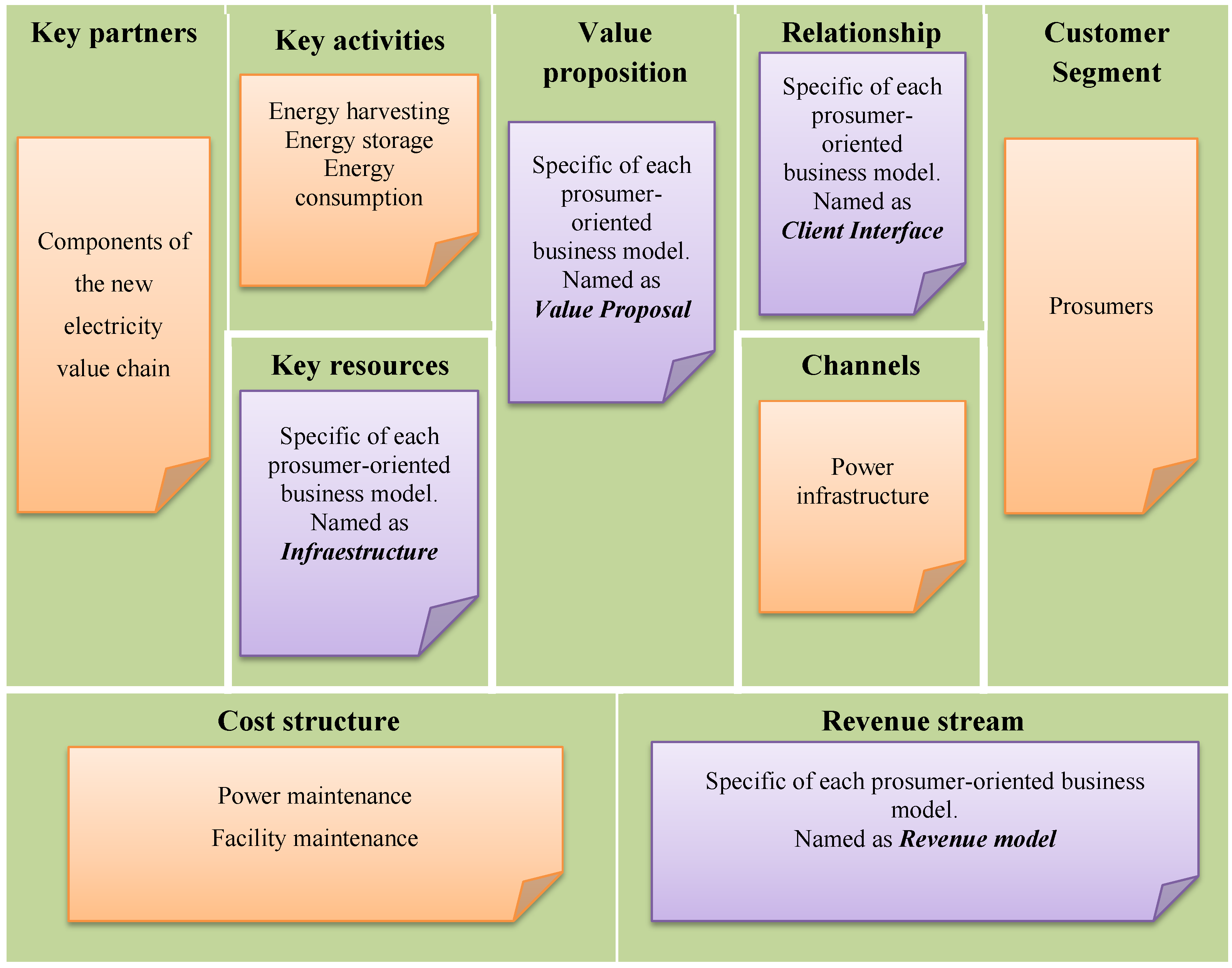
27], business model canvas is characterized by the following parameters:
Customer segments: Groups of people or organizations a company aims to reach and serve.
Value propositions: Products and services that create value for a specific customer segment.
Channels: Company’s means of communication with its customer segments.
Customer relationships: Types of relationships a company establishes and maintains with specific customer segments.
Revenue streams: Revenue a company generates from each customer segment.
Key resources: Assets required to offer and deliver the aforementioned elements.
Key activities: Activities involved in offering and delivering the aforementioned elements.
Key partners: Network of suppliers and partners supporting the business model execution.
Cost structure: Costs incurred when operating a business model.
As for the emerging business models with smart grid prosumers, some of the elements described before are common to all smart grids; prosumer-oriented ones and some others are specific to each one, as explained later in
Section 6. Although the elements of the business model canvas are interrelated,
Figure 4 provides a precise description to facilitate their understanding.
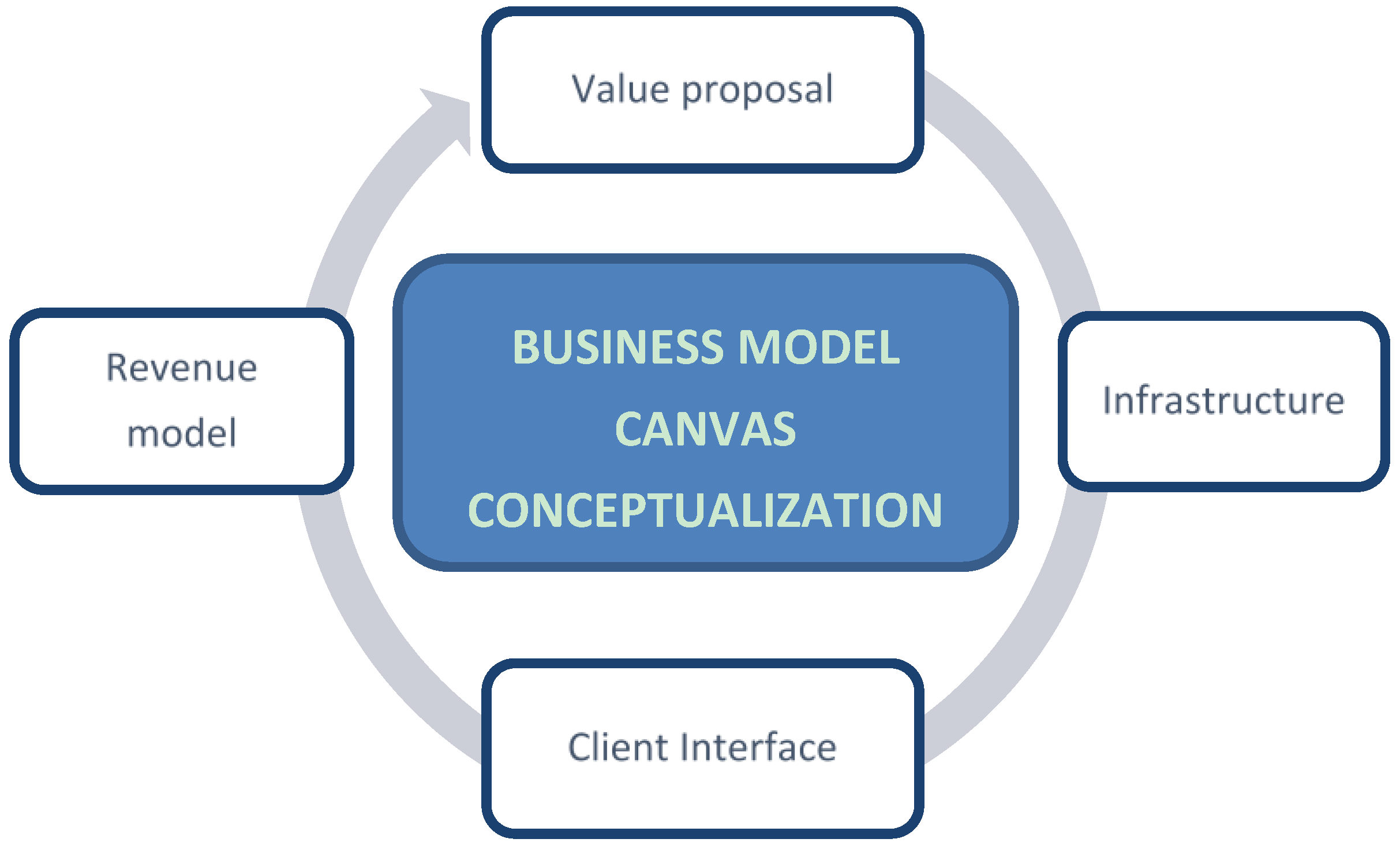
Hence, there are four elements in the business model as the main distinctive concepts for emerging prosumer-oriented business models in the smart grid. Osterwalder and Pigneur’s business model conceptualization of four basic elements [
26] offers two main advantages. First, the concept has been extensively tested in practical scenarios, and it is easy to apply [
29]. Second, it has already been implemented in the field of smart grids as an analytic tool (as described in [
28,
33,
34,
35,
36]). In a more graphical way, the conceptualization of the business model canvas defined here behaves as four different features cooperating with each other, so as to guarantee a complete degree of interaction, as depicted in
Figure 5.
Figure 4.
Elements of the business model canvas.
Figure 4.
Elements of the business model canvas.
Figure 5.
Conceptualization of business model canvas.
Figure 5.
Conceptualization of business model canvas.
Several different authors agree on the importance of the business model concept for management and analysis in research and practice [
37,
38,
39,
40], as this concept allows both evaluation and market and company comparison in a structured way [
31]. The concept of business model can be used as a means to classify and build categories or blueprints that will help to understand business phenomena. As a management tool, this idea of business comes in handy for managers to design, implement, operate, change and control their own businesses [
41,
42].
7. Conclusions and Future Works
In this paper, a thorough description of the main components of a smart grid has been offered, along with the new goods and services expected from the emergence and extension of the smart grid and a depiction of the most prominent related works that have been done so far. After the main challenges for prosumer business models have been tackled, a detailed explanation on what can be expected from a prosumer, both as a concept and in terms of business models, has been described, too. Prosumers are likely to become the major actor in the development of the smart grid and are no less than the part of the energy market value chain with the greatest potential of business creation based on the services in which they can take part. Then, different examples of business models have been put forward as a way to prove that businesses based on a prosumer integrated in a smart grid are feasible and hint at a compelling future when the smart grid has become the predominant kind of power grid system. The value proposition of each of the prosumer-oriented business models generates new business opportunities; the evolution and transformation of the economic agents of the electricity market that should not be overlooked. The viability of businesses devoted to electricity consumers turned into prosumers is proven, both to save energy costs and to obtain a profit by trading with the surplus of energy created by using distributed energy resources. Besides, the new prosumer value propositions provided are done so in a realistic manner, bearing in mind the different features that can be expected by the different parties involved in the smart grid and the prosumers themselves. It is remarkable that rather than porting regular business models to the environment of the smart grid, business models have been created from scratch, as there is not a directly portable model for the features presented here.
There are several works expected to be performed in the future. The proposed business models have been designed as having regular home dwellers, but they could be expanded to other scenarios, such as facilities, department stores or country farms. As long as there are distributed, renewable energy sources to be employed to the end user’s advantage, there will be an opportunity for a consumer to take a more active role in the smart grid. In addition to that, synergies among business models that focus on different elements of the smart grid (aggregators, DSOs, TSOs, etc.) may be studied, as well, in order to extend the usability of the presented business models for prosumers.
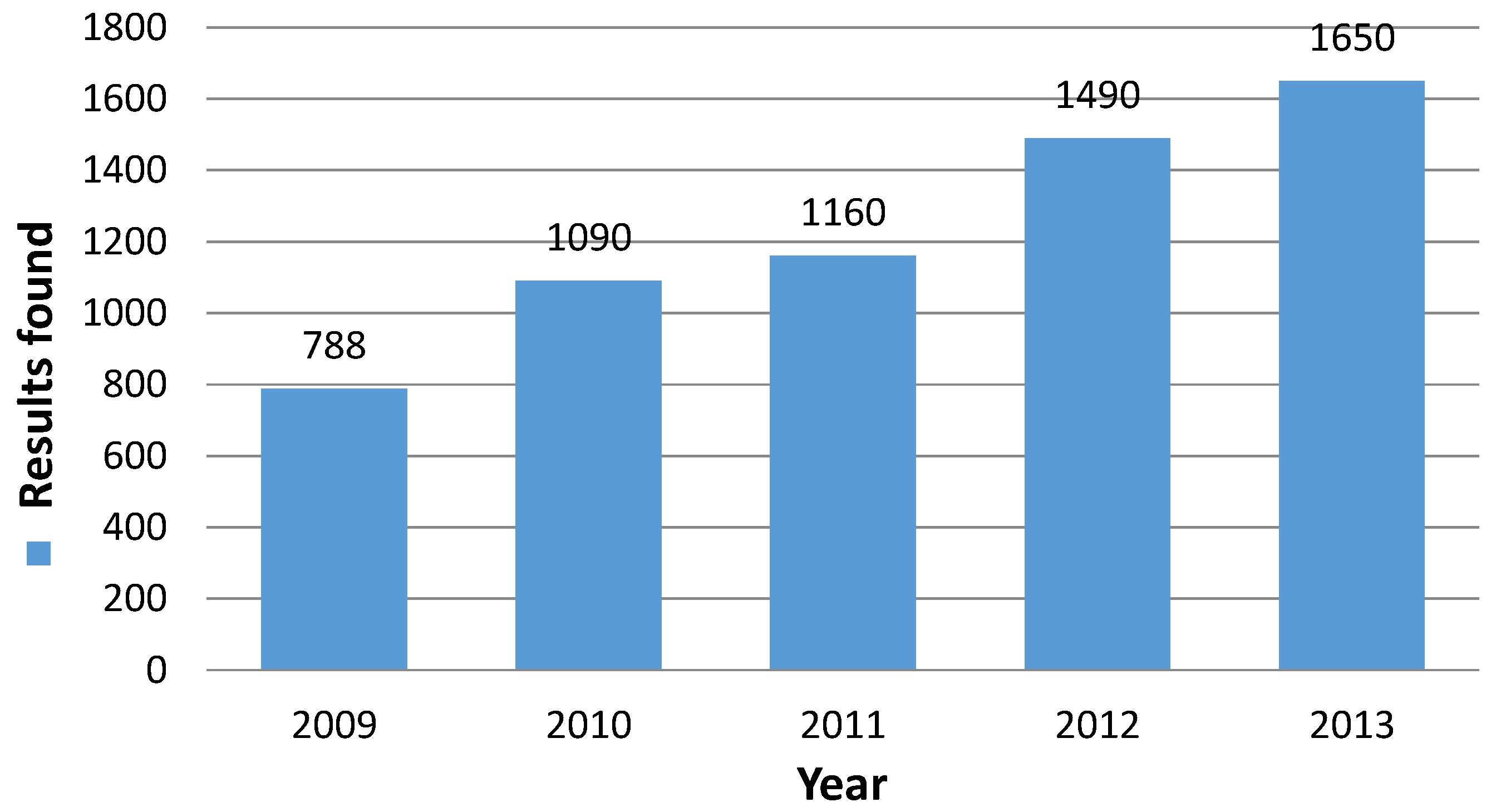
As an outlook for future works, despite the fact that business models for prosumers involved in the smart grid are yet to be fully implemented and to become widespread, the number of research works where prosumer business models are involved is on the rise. If a Google Scholar search with the phrase “prosumers business” is performed and the results are filtered for each of the last complete five years, a growing number of results is obtained, as shown in
Figure 8 [
64,
65,
66,
67,
68].
These figures should come as no surprise, as the technology, procedures and motivation for prosumer business development are already present, so these becoming significant as a way to obtain energy-related revenues or to reduce energy costs for former end users is a matter of time.
Figure 8.
Number of results for a “prosumer business” Academic Google search.
Figure 8.
Number of results for a “prosumer business” Academic Google search.



 ,
,