Data-Driven Tools and Methods for Low-Carbon Industrial Parks: A Scoping Review of Industrial Symbiosis and Carbon Capture with Practitioner Insights


Abstract
1. Introduction
2. Materials and Methods
2.1. Literature Review Protocol
- (1)
- Topical relevance. The study must address industrial symbiosis in industrial or commercial parks and must report a tool, method, or data-driven approach that supports analysis, design, optimization, decision making, assessment, or implementation. Studies focusing on industrial sustainability without an explicit industrial symbiosis focus in an industrial or commercial park context were excluded.
- (2)
- Evidence type. Empirical studies were included (quantitative, qualitative, or mixed methods). Studies were excluded if they lacked original research content relevant to tools or methods, including editorials, opinion pieces, non-peer-reviewed reports, and abstract-only records.
- (3)
- Publication constraints. Peer-reviewed journal articles and conference papers written in English were included. Publications in other languages were excluded.
2.2. Survey Design and Data Collection
- Respondent profile, capturing affiliation, position, expertise, years of experience, and role in relation to the tool or method.
- Basic information on tools and methods, including functionality, scope, licensing, and technology readiness level.
- Functions and purpose, covering analytical, modeling, simulation, optimization, and control capabilities.
- Application and implementation, addressing deployment contexts, operational scale, and managed resource types.
- Development and evolution, focusing on adaptability, future development plans, and stakeholder involvement.
- Familiarity and perception of industrial sustainability practices, including perceived benefits, barriers, and organizational priorities.
- Alignment between tool functionality and industrial symbiosis and carbon capture objectives.
- Barriers related to data availability, confidentiality, regulation, cost, and interoperability.
- Perceived contributions to resource efficiency and carbon reduction.
- Opportunities for tool enhancement and supporting policy mechanisms.
3. Results
3.1. Literature Review Results
3.1.1. Evolution of Industrial Symbiosis Research
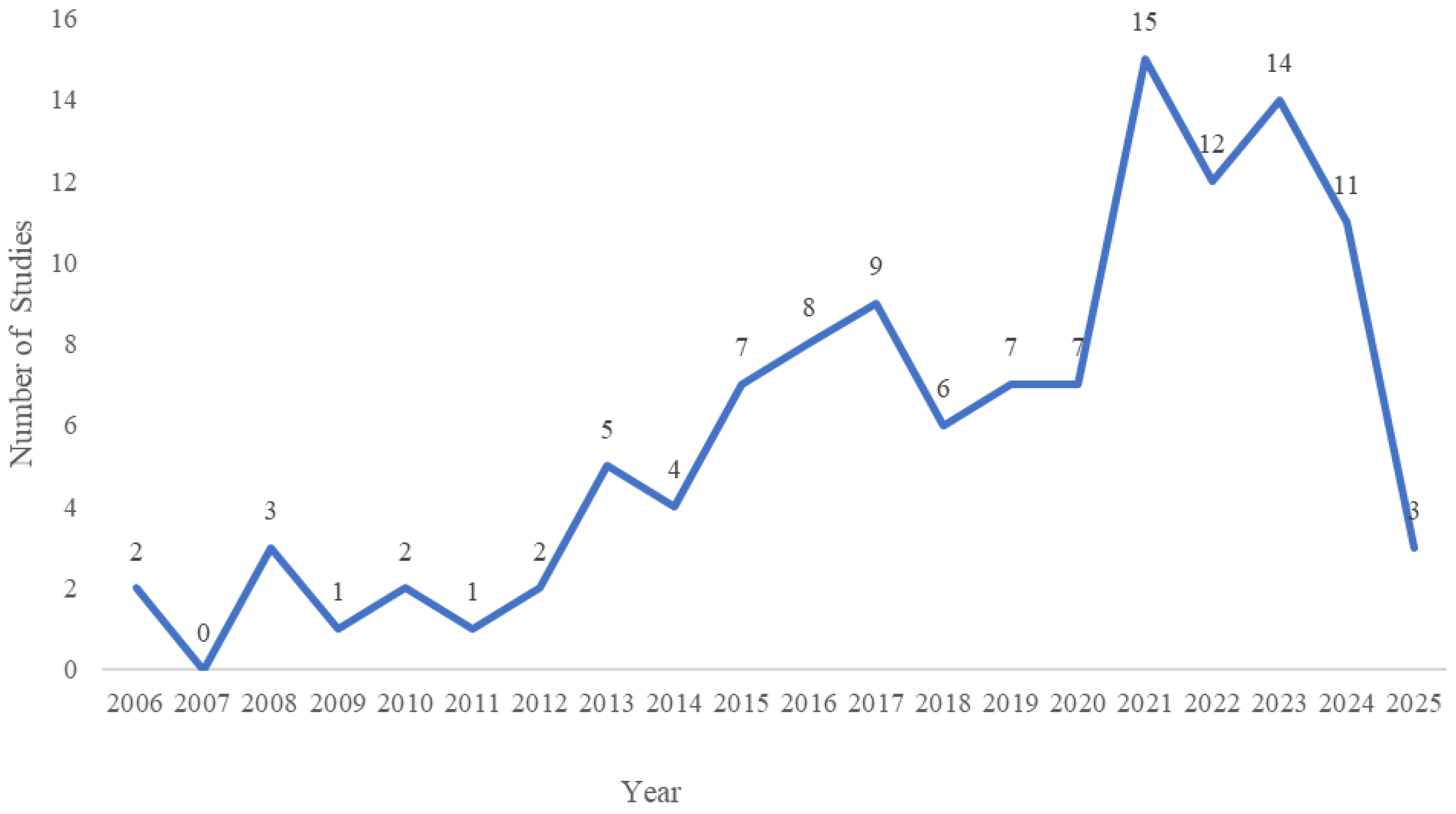
- Publication Trends
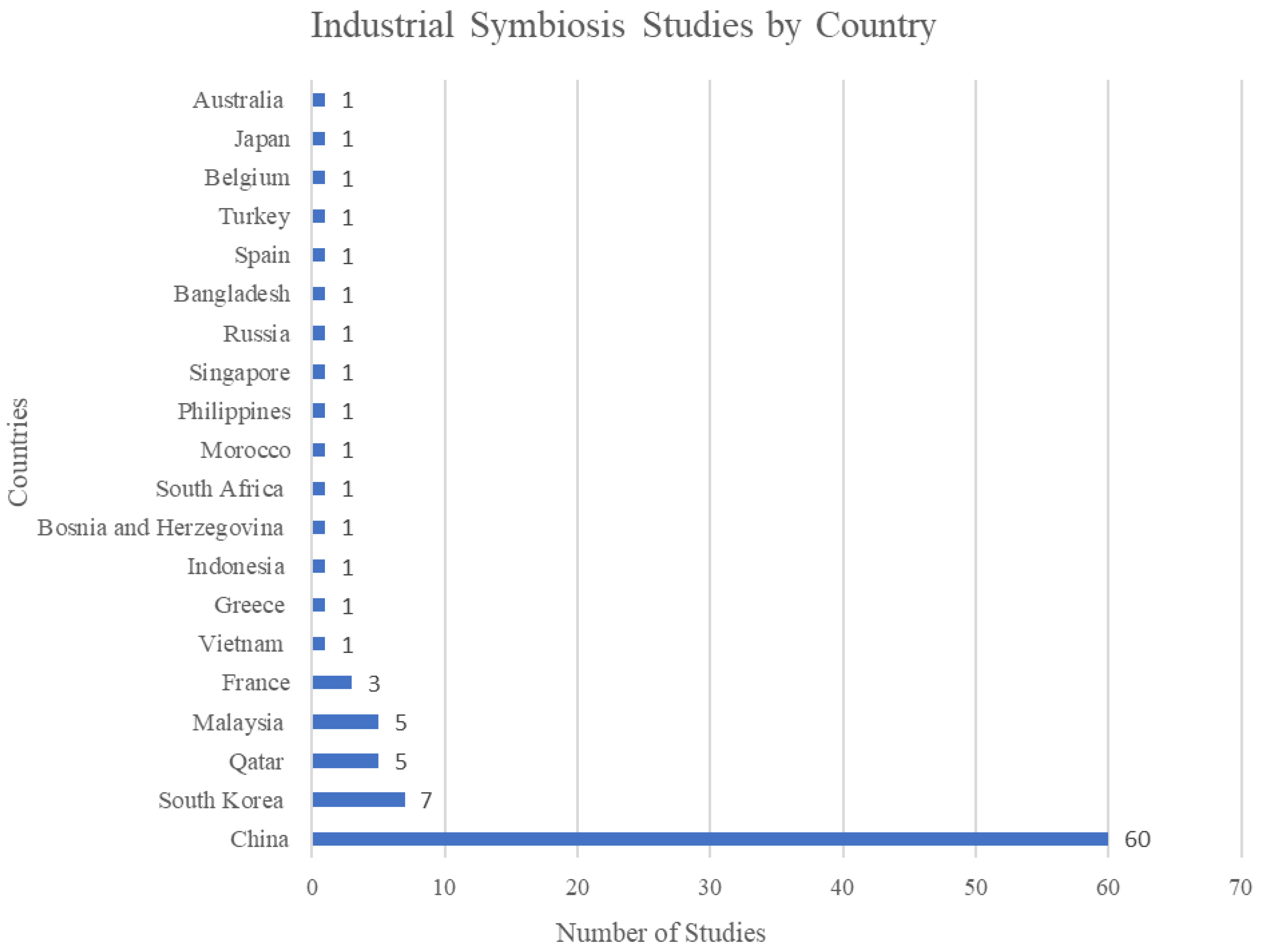
- Geographic Distribution
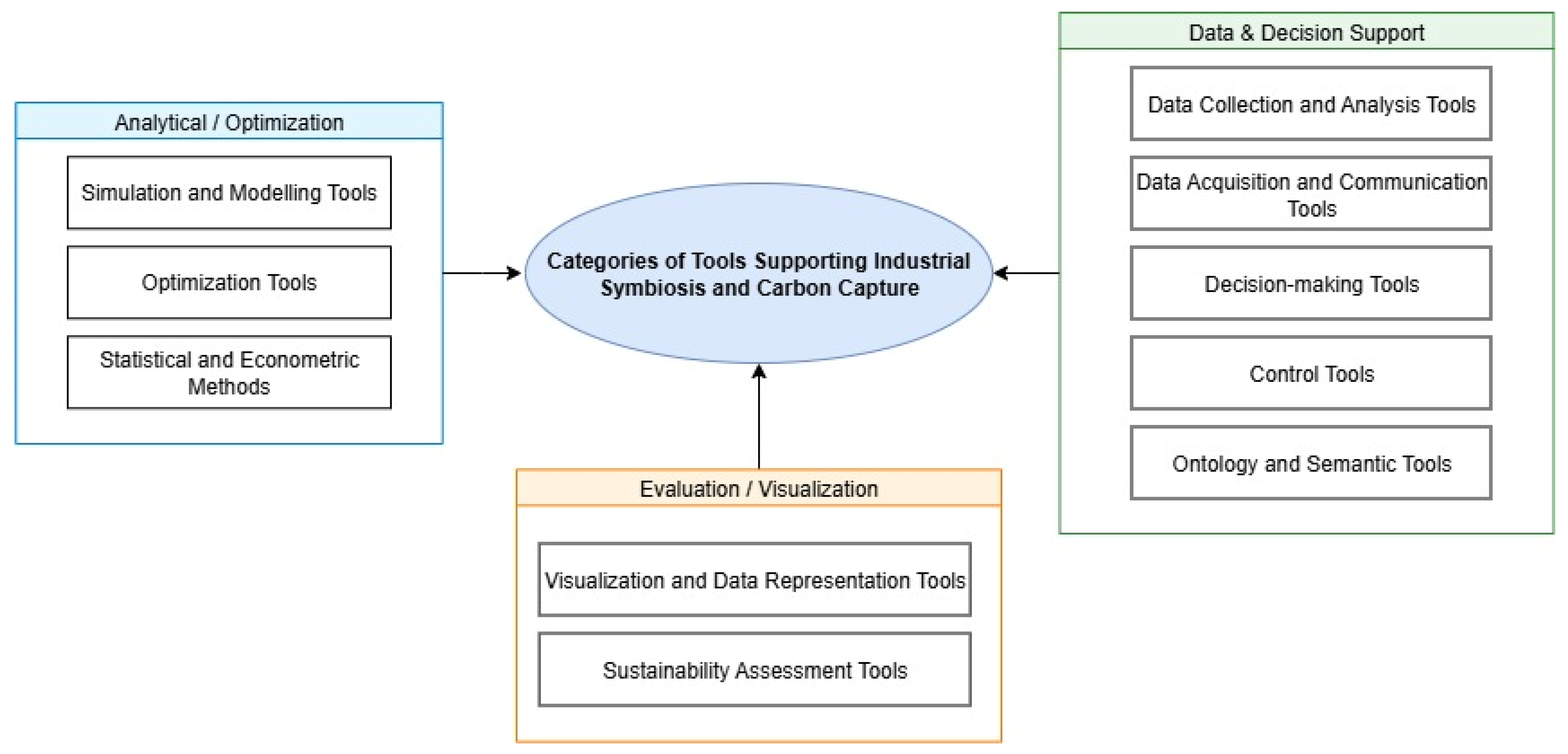
3.1.2. Classification of Tools and Methods Supporting Industrial Symbiosis
- Simulation and Modeling Tools
- Statistical and Econometric Methods
- Optimization Tools
- Data Collection and Analysis Tools
- Decision-Making Tools
- Data Acquisition and Communication Tools
- Control Tools
- Visualization and Data Representation Tools
- Ontology and Semantic Tools
- Sustainability Assessment Tools
- Additional Methods and Tools
3.1.3. Implementation Contexts in Industrial Symbiosis
- Eco-Industrial Parks
- Industrial Parks
- Other Industrial Sectors
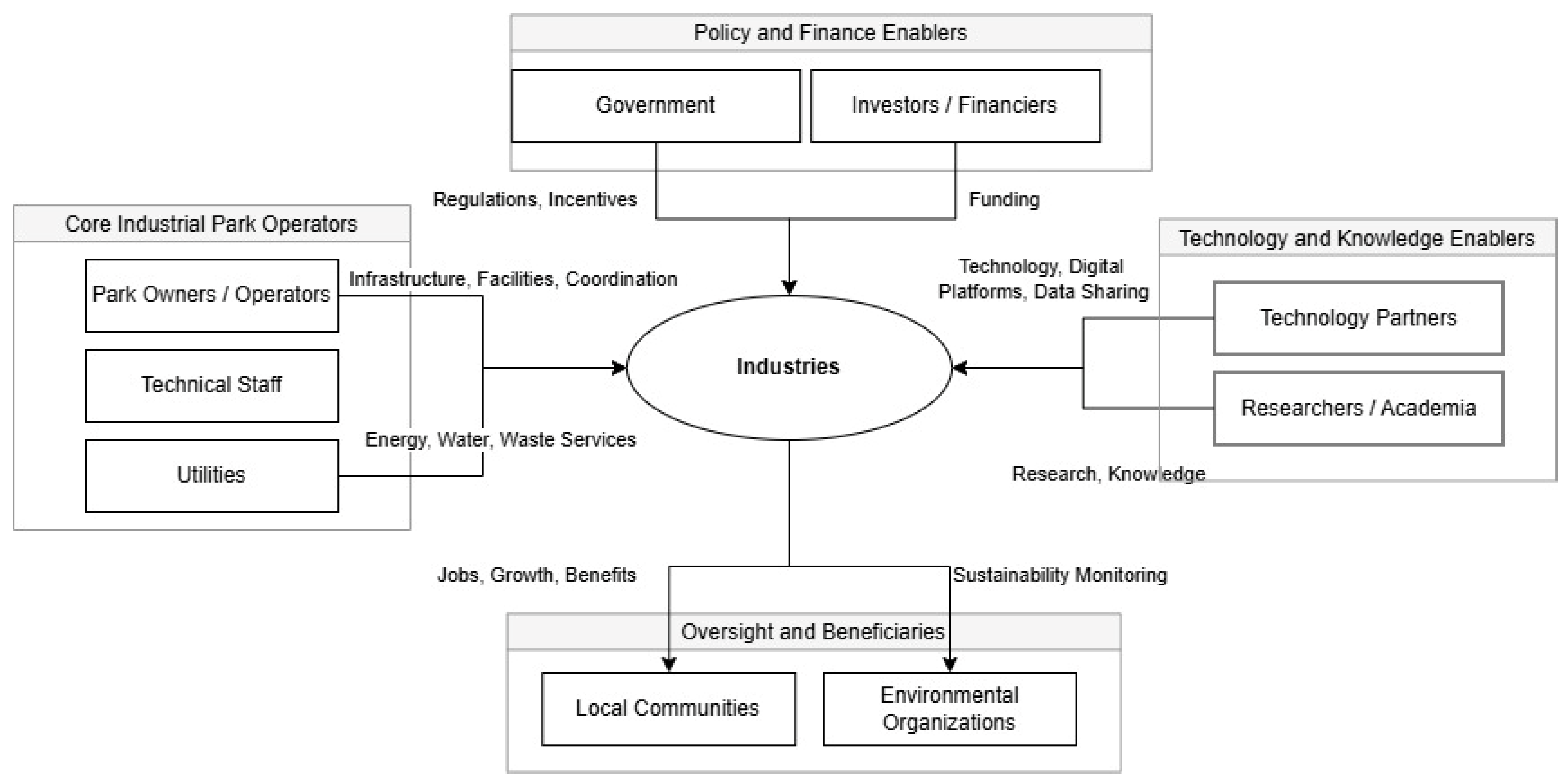
3.1.4. Key Stakeholders in Industrial and Eco-Industrial Parks
3.2. Survey Results
3.2.1. Practitioner Background and Perceptions of Industrial Symbiosis and Carbon Capture

| Category | Expertise Areas | Years of Experience | Involvement with Tools |
|---|---|---|---|
| Software and Systems | Software Engineering (2 respondents) | <5 years | Main developers |
| System Innovation for Transformative Change | >10 years | Heavy user | |
| Energy and Processes | Hydrogen, CCU, Industrial Energy Transformation | 5–10 years | Some experience |
| Energy Optimization, Process Integration | >10 years | Some experience | |
| Carbon Capture and Storage | Carbon Capture and Storage, Energy Systems, Economics | <5 years | Heavy user |
| Methanation, CCU, Carbon Capture | >10 years | Main developer | |
| Sustainability and Industrial Symbiosis | Industrial Symbiosis, Renewables in Processes | <5 years | Some experience |
| Respondent ID | Familiarity with CC | Importance of CC | Benefits of CC | Familiarity with IS | Importance of IS | Benefits of IS | Barriers to IS | Case |
|---|---|---|---|---|---|---|---|---|
| 1 | Somewhat familiar | Unknown | Carbon credits/pricing; Compliance | Unsure | Unknown | Cost savings; Revenue from by-products | Lack of knowledge/awareness | – |
| 2 | Somewhat familiar | Unknown | Credits/pricing; Compliance; Market reputation; Tax incentives; Subsidies | High | High | Cost savings; By-products; Shared resources; Tax incentives; Subsidies | Technological limitations | Kalundborg Symbiosis |
| 3 | Very familiar | Not relevant | Subsidies; Market reputation; Grants | Not relevant | Not relevant | Grants; Technical assistance; Shared resources; By-products | Government research institute context | – |
| 4 | Very familiar | High | Credits/pricing; Compliance; Grants; Technical assistance | High | High | Cost savings; By-products; Shared resources; Technical assistance | Technological limitations; Lack of awareness | – |
| 5 | Very familiar | High | Credits/pricing; Compliance; Market reputation; Grants | High | High | By-products; Cost savings; Shared resources; Grants | Lack of awareness; High initial costs | – |
| 6 | Somewhat familiar | Not relevant | Credits/pricing; Compliance; Tax incentives | Not relevant | Not relevant | Cost savings; Shared resources; Technical assistance | High initial costs | ICEIS project |
| 7 | Very familiar | Very high | Credits/pricing; Compliance; Operational efficiency; Reputation; Tax/Subsidies… | Unsure | Unknown | Cost savings; By-products; Shared resources; Tax, Subsidies; Grants… | Not specified | – |
| 8 | Somewhat familiar | Moderate | Credits/pricing; Compliance; Market reputation; Tax incentives; Subsidies | High | High | Cost savings; By-products; Shared resources; Tax incentives; Tech. assist. | High costs; Lack of awareness; Insufficient network | Conceptual studies only |
3.2.2. Tools and Methods Overview
3.3. Application and Implementation Contexts
4. Discussion
4.1. Comparison Between Surveyed Tools and Literature
4.1.1. Tool Maturity Versus Adoption Feasibility
4.1.2. Diffusion Gaps and Accessibility Constraints
4.1.3. Functional Coverage and Integration Gaps Across Industrial Symbiosis and Carbon Capture
4.1.4. Hybrid Toolchains and Design Trade-Offs for Industrial Symbiosis and Carbon Capture
4.1.5. Synthesis of Literature–Practice Gaps
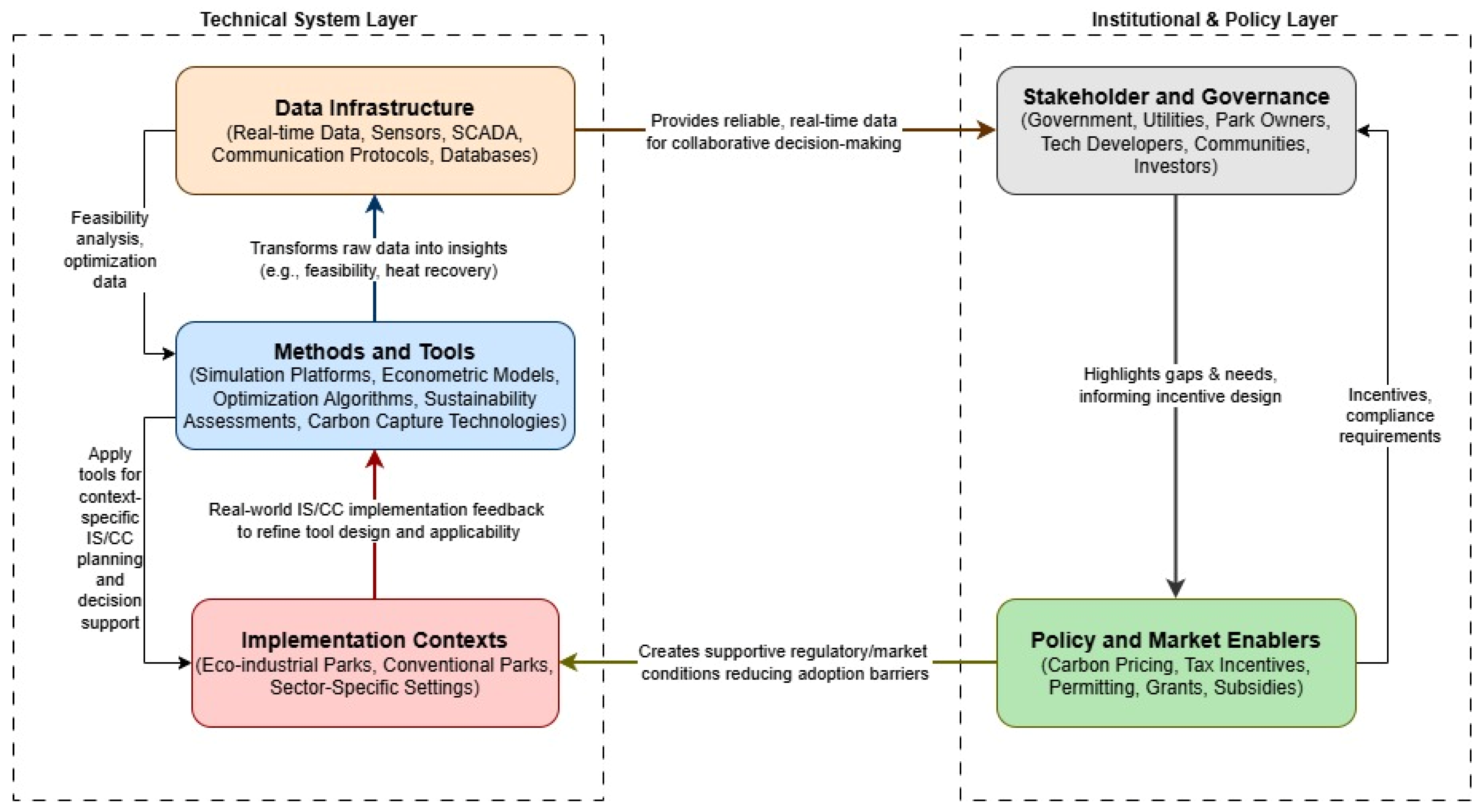
4.2. Conceptual Framework-Integrated Pathway for Industrial Symbiosis and Carbon Capture
- Methods and Tools
- Data Infrastructure
- Stakeholder and Governance Mechanisms
- Policy and Market Enablers
- Implementation Contexts
4.3. Future Directions and Recommendations
- Strengthening Data Governance and Interoperability
- Expanding Public–Private Partnerships and Funding Mechanisms
- Advancing Socio-Technical and Longitudinal Research
- Leveraging AI and Real-Time Data Analytics for Smart Industrial Symbiosis
- Strengthening Policy Support and Market Incentives
5. Conclusions
Supplementary Materials
Author Contributions
Funding
Data Availability Statement
Acknowledgments
Conflicts of Interest
Abbreviations
| ACL | Agent Communication Language |
| ACTA | Automated Composite Table Algorithm |
| AI | Artificial Intelligence |
| AMPSO | Adaptive Modified Particle Swarm Optimization |
| BESS | Battery Energy Storage Systems |
| CC | Carbon Capture |
| CCD | Coupling-Coordination Degree |
| CCS | Carbon Capture and Storage |
| CCU | Carbon Capture and Utilization |
| CCUS | Carbon Capture, Utilization, and Storage |
| CI | Confidence Interval |
| CO2 | Carbon Dioxide |
| CP | Constraint Programming |
| CPS | Cyber-Physical Systems |
| DC | Direct Current |
| DDF-DEA | Directional Distance Function Data Envelopment Analysis |
| DEA | Data Envelopment Analysis |
| DID | Difference-in-Differences |
| DPL | Digsilent Programming Language |
| ECR | Energy Conversion Systems |
| EIP | Eco-Industrial Park |
| EIPs | Eco-Industrial Parks |
| EnMS | Energy Management Systems |
| EUDs | Energy Utilization Diagrams |
| EV | Electric Vehicle |
| EWFC | Energy–Water–Food–Carbon |
| FISTA | Fast Iterative Shrinkage-Thresholding Algorithm |
| GA | Genetic Algorithm(s) |
| GCCs | Grand Composite Curves |
| GHG | Greenhouse Gas |
| GIS | Geographic Information System(s) |
| GRG | Generalized Reduced Gradient |
| GTL | Gas-to-Liquids |
| GUI | Graphical User Interface |
| HMI | Human–Machine Interfaces |
| IEA | International Energy Agency |
| IETS | Industrial Energy-Related Technologies and Systems |
| IGA | Improved Genetic Algorithm |
| IS | Industrial Symbiosis |
| ISI | Inherent Safety Index |
| LCA | Life Cycle Assessment |
| LCA-SE | Life-Cycle-Based Synergy Evaluation |
| LEAP | Long-range Energy Alternatives Planning |
| LMDI | Logarithmic Mean Divisia Index |
| LP | Linear Programming |
| MAS | Multi-Agent Systems |
| MCDM | Multi-Criteria Decision Making |
| MFA | Material Flow Analysis |
| MILP | Mixed-Integer Linear Programming |
| MINLP | Mixed-Integer Nonlinear Programming |
| MLR | Multiple Linear Regression |
| MPC | Model Predictive Control |
| NADs | Network Allocation Diagrams |
| NLP | Nonlinear Programming |
| NPV | Net Present Value |
| NSGA-II | Non-dominated Sorting Genetic Algorithm II |
| PPPs | Public–Private Partnerships |
| PRISMA | Preferred Reporting Items for Systematic Reviews and Meta-Analyses |
| PRISMA-ScR | PRISMA Extension for Scoping Reviews |
| PSO | Particle Swarm Optimization |
| PV | Photovoltaic |
| RDF | Resource Description Framework |
| RTDS | Real-Time Digital Simulator |
| SCADA | Supervisory Control and Data Acquisition |
| SDGs | Sustainable Development Goals |
| SHAP | Shapley Additive Explanations |
| SIA | Social Impact Assessment |
| SMEs | Small and Medium-Sized Enterprises |
| SNA | Social Network Analysis |
| SNG | Synthetic Natural Gas |
| SO2 | Sulfur Dioxide |
| SPARQL | SPARQL Protocol and RDF Query Language |
| SSSPs | Site Source–Sink Profiles |
| SWROIM | Sustainability Weighted Return on Investment Metric |
| TG/DTA | Thermo-Gravimetric and Differential Thermal Analysis |
| TOU | Time-of-Use |
| TRL | Technology Readiness Level |
| TSA | Total Site Analysis |
| UA | Upper Austria |
| XRD | X-ray Powder Diffraction |
Appendix A
| Ref. | Article Title | Publication Year | Publication Type |
|---|---|---|---|
| [133] | Emergy evaluation of combined heat and power plant eco-industrial park (CHP plant EIP) | 2006 | Journal Article |
| [6] | Industrial Symbiosis as an Integrated Business/Environment Management Process: The Case of Ulsan Industrial Complex | 2006 | Conference Proceedings |
| [112] | A regional synergy approach to energy recovery: The case of the Kwinana industrial area, Western Australia | 2008 | Journal Article |
| [38] | System study of combined cooling, heating and power system for eco-industrial parks | 2008 | Conference Proceedings |
| [41] | Case study of energy systems with gas turbine cogeneration technology for an eco-industrial park | 2008 | Journal Article |
| [108] | Applying heat integration total site based pinch technology to a large industrial area in Japan to further improve performance of highly efficient process plants | 2009 | Journal Article |
| [54] | Optimization of a waste heat utilization network in an eco-industrial park | 2010 | Journal Article |
| [134] | MW-rated power electronics for sustainable and low carbon industrial revolution | 2010 | Conference Proceedings |
| [43] | Eco Industrial Parks for Water and Heat Management | 2011 | Book |
| [95] | Regional energy-related carbon emission characteristics and potential mitigation in eco-industrial parks in South Korea: Logarithmic mean Divisia index analysis based on the Kaya identity | 2012 | Journal Article |
| [71] | Holistic carbon planning for industrial parks: A waste-to-resources process integration approach | 2012 | Journal Article |
| [84] | Energy management and dynamic optimisation of eco-industrial parks | 2013 | Conference Proceedings |
| [103] | Modeling and optimization of material/energy flow exchanges in an eco-industrial park | 2013 | Conference Proceedings |
| [29] | Optimal energy distribution for eco-industrial park in extreme arid areas of Xinjaing based on the statistics method | 2013 | Conference Proceedings |
| [85] | An architecture for a microgrid-based eco industrial park using a Multi-Agent System | 2013 | Conference Proceedings |
| [16] | Analysis of low-carbon industrial symbiosis technology for carbon mitigation in a Chinese iron/steel industrial park: A case study with carbon flow analysis | 2013 | Journal Article |
| [99] | Two-step accelerated mineral carbonation and decomposition analysis for the reduction of CO2 emission in the eco-industrial parks | 2014 | Journal Article |
| [81] | Methods for assessing the energy-saving efficiency of industrial symbiosis in industrial parks | 2014 | Journal Article |
| [135] | Integration of renewable energy sources in industrial parks: Medicool european demonstration project | 2014 | Journal Article |
| [136] | GRID4EU-Nice Grid project: How to facilitate the integration of Distributed Energy Resources into the local grid? | 2014 | Conference Proceedings |
| [102] | Systematic allocation of cost savings among energy systems in an eco-industrial park | 2015 | Journal Article |
| [106] | Feasibility of heat recovery for district heating based on Cloud Computing Industrial Park | 2015 | Conference Proceedings |
| [21] | Efficient hybrid renewable energy system for industrial sector with on-grid time management | 2015 | Conference Proceedings |
| [76] | Research on Regional Energy Planning Practice in Industrial Park Mode-Taking the Civil-Military Integration Industrial Park of Mianyang as an Example | 2015 | Conference Proceedings |
| [31] | Comprehensive functions of eco-industrial park in conserving energy and improving ecology | 2015 | Conference Proceedings |
| [30] | Ecological Network Analysis for Carbon Metabolism of Eco-industrial Parks: A Case Study of a Typical Eco-industrial Park in Beijing | 2015 | Journal Article |
| [80] | Fuzzy optimization of a waste-to-energy network system in an eco-industrial park | 2015 | Journal Article |
| [14] | On the systematic carbon integration of industrial parks for climate footprint reduction | 2016 | Journal Article |
| [83] | An optimization-based negotiation framework for energy systems in an eco-industrial park | 2016 | Journal Article |
| [104] | Assessing the performance of carbon dioxide emission reduction of commercialized eco-industrial park projects in South Korea | 2016 | Journal Article |
| [137] | Greenhouse Gas Mitigation in Chinese Eco-Industrial Parks by Targeting Energy Infrastructure: A Vintage Stock Model | 2016 | Journal Article |
| [107] | Planning of hybrid power system for local industrial park in extreme arid and power shortage area | 2016 | Conference Proceedings |
| [77] | Model of eco-industrial park development as a tool for fostering energy efficient economy | 2016 | Conference Proceedings |
| [39] | A novel methodology for the design of waste heat recovery network in eco-industrial park using techno-economic analysis and multi-objective optimization | 2016 | Journal Article |
| [92] | Towards intelligent thermal energy management of eco-industrial park through ontology-based approach | 2016 | Conference Proceedings |
| [10] | Carbon dioxide reduction incentive for eco-industrial parks using bilevel fuzzy programming | 2017 | Conference Proceedings |
| [98] | Eco-efficiency assessment of coal-fired combined heat and power plants in Chinese eco-industrial parks | 2017 | Journal Article |
| [15] | Carbon dioxide and heat integration of industrial parks | 2017 | Journal Article |
| [111] | On the simultaneous integration of heat and carbon dioxide in industrial parks | 2017 | Journal Article |
| [23] | Regional energy planning—An example of Suzhou Industrial Park | 2017 | Conference Proceedings |
| [66] | Coordinated heat and power dispatch of industrial park microgrid considering distributed heating and indoor comfort constraint | 2017 | Conference Proceedings |
| [138] | P2P trading strategies in an industrial park distribution network market under regulated electricity tariff | 2017 | Conference Proceedings |
| [101] | Embodied carbon emission analysis of eco-industrial park based on input-output analysis and ecological network analysis | 2017 | Conference Proceedings |
| [91] | Knowledge management of eco-industrial park for efficient energy utilization through ontology-based approach | 2017 | Journal Article |
| [58] | Challenges of value creation in Eco-Industrial Parks (EIPs): A stakeholder perspective for optimizing energy exchanges | 2018 | Journal Article |
| [110] | Industrial Fish Wastewater Treatment by Electrocoagulation Processes Powered by Solar Energy | 2018 | Conference Proceedings |
| [89] | Exploring Greenhouse Gas-Mitigation Strategies in Chinese Eco-Industrial Parks by Targeting Energy Infrastructure Stocks | 2018 | Journal Article |
| [88] | Co-benefit potential of industrial and urban symbiosis using waste heat from industrial park in Ulsan, Korea | 2018 | Journal Article |
| [64] | Industrial Park Energy Trading and Management Based on Game Theory | 2018 | Conference Proceedings |
| [53] | Multi-level energy integration between units, plants and sites for natural gas industrial parks | 2018 | Journal Article |
| [9] | Renewable energy in eco-industrial parks and urban-industrial symbiosis: A literature review and a conceptual synthesis | 2019 | Journal Article |
| [109] | Economic Evaluation of Micro-Grid System in Commercial Parks Based on Echelon Utilization Batteries | 2019 | Journal Article |
| [55] | Site wide heat integration in eco-industrial parks considering variable operating conditions | 2019 | Journal Article |
| [46] | Modelling the technical influence of randomly distributed solar PV uptake on electrical distribution networks | 2019 | Conference Proceedings |
| [139] | Clean Energy Configuration and Application for Mingzhu Industrial Park | 2019 | Conference Proceedings |
| [7] | Life cycle assessment of reduction of environmental impacts via industrial symbiosis in an energy-intensive industrial park in China | 2019 | Journal Article |
| [87] | Smart solutions shape for sustainable low-carbon future: A review on smart cities and industrial parks in China | 2019 | Journal Article |
| [28] | A model for renewable energy symbiosis networks in eco-industrial parks | 2020 | Conference Proceedings |
| [45] | Research on Economic Dispatching and Collaborative Optimization of Industrial Park Micro-grid with Solar-Battery-Charge | 2020 | Conference Proceedings |
| [12] | Application of AC/DC Hybrid System in Industrial Park Scenario | 2020 | Conference Proceedings |
| [52] | Evaluating the environmental benefit of energy symbiosis networks in eco-industrial parks | 2020 | Conference Proceedings |
| [5] | Optimal Design of Eco-Industrial Parks with coupled energy networks addressing Complexity bottleneck through an Interdependence analysis | 2020 | Journal Article |
| [25] | Toward a Global Green Smart Microgrid: An Industrial Park in China | 2020 | Journal Article |
| [62] | Integrated energy coordinated control system of industrial park and its application | 2020 | Conference Proceedings |
| [60] | Synthesis of Sustainable Carbon Negative Eco-Industrial Parks | 2021 | Journal Article |
| [78] | Power quality improvement of small hydropower plant located in the industrial area | 2021 | Conference Proceedings |
| [22] | Power Capacity Planning on Integrated Multi-Energy System of the Industrial Park | 2021 | Conference Proceedings |
| [40] | Sustainable energy-water-food nexus integration and optimisation in eco-industrial parks | 2021 | Journal Article |
| [44] | State of Charge Optimization-based Smart Charging of Aggregate Electric Vehicles from Distributed Renewable Energy Sources | 2021 | Conference Proceedings |
| [65] | Research and Simulation of Dual-level Optimal Scheduling of Industrial Park Microgrid Considering Flexible Load | 2021 | Conference Proceedings |
| [93] | A New Strategy for Collective Energy Self-consumption in the Eco-Industrial Park: Mathematical Modeling and Economic Evaluation | 2021 | Conference Proceedings |
| [17] | Research on Planning and Operation of Distributed Integrated Energy System in Industrial Park | 2021 | Conference Proceedings |
| [57] | Multi-objective Optimization of an Integrated Energy-Water-Waste Nexus for Eco-Industrial Park | 2021 | Journal Article |
| [56] | Distributed Demand Response of the Integrated Energy System in an Industrial Park | 2021 | Conference Proceedings |
| [100] | Intelligent Energy Planning and Design of Industrial Park under New Power System | 2021 | Conference Proceedings |
| [13] | Distribution LMP-Based Demand Management in Industrial Park via a Bi-Level Programming Approach | 2021 | Journal Article |
| [140] | Optimal Sizing of Hybrid Energy Storage in Industrial Park Integrated Energy System | 2021 | Conference Proceedings |
| [61] | Optimal Operation Of Battery Energy Storage System In Industrial Park | 2021 | Conference Proceedings |
| [27] | Fast Distributed Stochastic Scheduling for A Multi-Energy Industrial Park | 2021 | Conference Proceedings |
| [50] | Does China’s National Demonstration Eco-Industrial Park Reduce Carbon Dioxide and Sulfur Dioxide-A Study Based on the Upgrading and Transformation Process | 2022 | Journal Article |
| [96] | Research on efficiency measurement of information industry chain integration based on multiple structures and its application in carbon management industrial park | 2022 | Journal Article |
| [105] | Application of Photovoltaic Products in Carbon Reduction in Shanghai Industrial Park | 2022 | Conference Proceedings |
| [37] | Industrial park heat integration considering centralized and distributed waste heat recovery cycle systems | 2022 | Journal Article |
| [113] | Performance Assessment of an Eco-Industrial Park: a Strategic Tool to Help Recovering Energy and Industrial Waste | 2022 | Journal Article |
| [4] | Optimising renewable energy at the eco-industrial park: A mathematical modelling approach | 2022 | Journal Article |
| [49] | Contributing to carbon peak: Estimating the causal impact of eco-industrial parks on low-carbon development in China | 2022 | Journal Article |
| [48] | Carbon emission reduction effects of eco-industrial park policy in China | 2022 | Journal Article |
| [86] | Renewable Energy Potential Mapping of Industrial Area in Central Java | 2022 | Conference Proceedings |
| [67] | Optimal Configuration of Hybrid Energy Storage System Catered for Low-Carbon Smart Industrial Park | 2022 | Conference Proceedings |
| [79] | Research on the Scenario Design and Business Model Analysis of Source-Grid-Load-Storage Collaboration for Zero-Carbon Big Data Industrial Park | 2022 | Conference Proceedings |
| [70] | Economic optimization operation strategy for industrial park integrated energy system | 2022 | Conference Proceedings |
| [63] | A study on the energy storage scenarios design and the business model analysis for a zero-carbon big data industrial park from the perspective of source-grid-load-storage collaboration | 2023 | Journal Article |
| [24] | Market integration analysis of heat recovery under the EMB3Rs platform: An industrial park case in Greece | 2023 | Conference Proceedings |
| [94] | Carbon Emission Prediction and the Reduction Pathway in Industrial Parks: A Scenario Analysis Based on the Integration of the LEAP Model with LMDI Decomposition | 2023 | Journal Article |
| [2] | Sustainable energy-water-food nexus integration and carbon management in eco-industrial parks | 2023 | Journal Article |
| [3] | Global Energy Integration for Industrial Parks Incorporating Centralized Trigeneration and Interplant HEN | 2023 | Journal Article |
| [26] | Research on Optimal Dispatching Method of Integrated Energy Network in Agricultural Industrial Park Considering Demand Response | 2023 | Conference Proceedings |
| [1] | System Architecture Design of Heat-Electricity Energy Internet for a High Energy Consumption Industrial Park in Chongqing | 2023 | Conference Proceedings |
| [8] | Coordination optimization of hydrogen-based multi-energy system with multiple storages for industrial park | 2023 | Journal Article |
| [36] | High-value Chemicals Production via Eco-industrial Park: Heat Integration, Safety, and Environmental Analysis | 2023 | Journal Article |
| [59] | Peer-to-Peer Trading for Multi-Utility Energy Systems in Eco- Industrial Park | 2023 | Journal Article |
| [20] | The possibility of applying combined heat and power microgrid model for industrial parks. A case study for Dong Nam industrial park in Vietnam | 2023 | Conference Proceedings |
| [47] | Nonlinear Effects of Eco-Industrial Parks on Sulfur Dioxide and Carbon Dioxide Emissions—Estimation Based on Nonlinear DID | 2023 | Journal Article |
| [90] | An integrated framework for industrial symbiosis performance evaluation in an energy-intensive industrial park in China | 2023 | Journal Article |
| [69] | Energy Storage Configuration Optimization Method for Industrial Park Microgrid Based on Demand Side Response | 2023 | Conference Proceedings |
| [34] | Green development and co-benefits analysis of a typical chemical industrial park under pollution and carbon reduction and zero-waste city policies | 2024 | Journal Article |
| [114] | Symbiosis: A Web-Based Decision Support Tool for Achieving Symbiosis in Industrial Parks | 2024 | Conference Paper |
| [42] | Towards mega-scale decarbonized industrial park (Mega-DIP): Generative AI-driven techno-economic and environmental assessment of renewable and sustainable energy utilization in petrochemical industry | 2024 | Journal Article |
| [51] | Does Industrial Symbiosis Improve Carbon Emission Efficiency? Evidence from Chinese National Demonstration Eco-Industrial Parks | 2024 | Journal Article |
| [74] | An automated approach for carbon integration in industrial park | 2024 | Journal Article |
| [73] | Realizing synergy between pollution reduction and carbon mitigation in industrial parks: From model development to tool application | 2024 | Journal Article |
| [33] | Synergetic effect evaluation of pollution and carbon emissions in an industrial park: An environmental impact perspective | 2024 | Journal Article |
| [82] | Enhancing the waste heat utilization of industrial park: A heat pump-centric network integration approach for multiple heat sources and users | 2024 | Journal Article |
| [32] | Mixed Energy and Production Scheduling in an Eco-Industrial Park | 2024 | Conference Paper |
| [127] | Integrated optimization modelling framework for low-carbon and green regional transitions through resource-based industrial symbiosis | 2024 | Journal Article |
| [72] | A Study of Practical Cases Regarding the Synergy of Electricity and Heat in Industrial Parks | 2024 | Conference Proceedings |
| [68] | Achieving synergy between pollution reduction and carbon mitigation in the eco-industrial park: a multi-objective optimization framework | 2025 | Journal Article |
| [75] | Optimisation Framework of Multi-Energy Peer-to-Peer Trading with Hybrid Market Models in Eco-industrial Parks | 2025 | Journal Article |
| [97] | Evaluation of carbon emission reduction potential of industrial symbiosis in industrial parks | 2025 | Journal Article |
References
- Kuang, H.; Zhang, Z.; Zhong, H.; Ma, Y.; Zhong, Y. System Architecture Design of Heat-Electricity Energy Internet for a High Energy Consumption Industrial Park in Chongqing. In 2023 5th Asia Energy and Electrical Engineering Symposium (AEEES), Chengdu, China, 23–26 March 2023; IEEE: Piscataway, NJ, USA, 2023; pp. 1330–1334. [Google Scholar]
- Fouladi, J.; AlNouss, A.; Al-Ansari, T. Sustainable energy-water-food nexus integration and carbon management in eco-industrial parks. J. Clean. Prod. 2023, 418, 138071. [Google Scholar] [CrossRef] [Scilit]
- Gu, X.; Ji, F.; Liu, L.; Du, J. Global Energy Integration for Industrial Parks Incorporating Centralized Trigeneration and Interplant HEN. Ind. Eng. Chem. Res. 2023, 62, 17805–17823. [Google Scholar] [CrossRef] [Scilit]
- Misrol, M.A.; Wan Alwi, S.R.; Lim, J.S.; Manan, Z.A. Optimising renewable energy at the eco-industrial park: A mathematical modelling approach. Energy 2022, 261, 125345. [Google Scholar] [CrossRef] [Scilit]
- Mousqué, F.; Boix, M.; Montastruc, L.; Domenech, S.; Négny, S. Optimal Design of Eco-Industrial Parks with coupled energy networks addressing Complexity bottleneck through an Interdependence analysis. Comput. Chem. Eng. 2020, 138, 106859. [Google Scholar] [CrossRef] [Scilit]
- Won, J.Y.; Kim, J.H.; Lee, S.Y.; Park, H.S. Industrial Symbiosis as an Integrated Business/Environment Management Process: The Case of Ulsan Industrial Complex. In 2006 International Forum on Strategic Technology, Ulsan, Republic of Korea, 18–20 October 2006; IEEE: Piscataway, NJ, USA, 2006; pp. 423–428. [Google Scholar]
- Wang, S.S.; Lu, C.Y.; Gao, Y.; Wang, K.; Zhang, R.Q. Life cycle assessment of reduction of environmental impacts via industrial symbiosis in an energy-intensive industrial park in China. J. Clean. Prod. 2019, 241, 118358. [Google Scholar] [CrossRef] [Scilit]
- Liu, K.; Xu, Z.B.; Gao, F.; Wu, J.; Guan, X.H. Coordination optimization of hydrogen-based multi-energy system with multiple storages for industrial park. IET Gener. Transm. Distrib. 2023, 17, 1190–1203. [Google Scholar] [CrossRef] [Scilit]
- Butturi, M.A.; Lolli, F.; Sellitto, M.A.; Balugani, E.; Gamberini, R.; Rimini, B. Renewable energy in eco-industrial parks and urban-industrial symbiosis: A literature review and a conceptual synthesis. Appl. Energy 2019, 255, 113825. [Google Scholar] [CrossRef] [Scilit]
- Aguilar, K.D.T.; Ubando, A.T.; Culaba, A.B.; Aviso, K.B.; Tan, R.G.R.; Chiu, A.S.F. Carbon dioxide reduction incentive for eco-industrial parks using bilevel fuzzy programming. In HNICEM 2017—9th International Conference on Humanoid, Nanotechnology, Information Technology, Communication and Control, Environment and Management, Manila, Philippines, 1–3 December 2017; IEEE: Piscataway, NJ, USA, 2017; pp. 1–6. [Google Scholar]
- Lawal, M.; Wan Alwi, S.R.; Manan, Z.A.; Ho, W.S. Industrial symbiosis tools—A review. J. Clean. Prod. 2021, 280, 124327. [Google Scholar] [CrossRef] [Scilit]
- He, J.; Zhou, J.; Zheng, F.; Xia, Y.; Yuan, W. Application of AC/DC Hybrid System in Industrial Park Scenario. In 2020 Asia Energy and Electrical Engineering Symposium (AEEES), Chengdu, China, 29–31 May 2020; IEEE: Piscataway, NJ, USA, 2020; pp. 978–982. [Google Scholar]
- Wei, J.; Zhang, Y.; Wang, J.; Wu, L. Distribution LMP-Based Demand Management in Industrial Park via a Bi-Level Programming Approach. IEEE Trans. Sustain. Energy 2021, 12, 1695–1706. [Google Scholar] [CrossRef] [Scilit]
- Al-Mohannadi, D.M.; Linke, P. On the systematic carbon integration of industrial parks for climate footprint reduction. J. Clean. Prod. 2016, 112, 4053–4064. [Google Scholar] [CrossRef] [Scilit]
- Hassiba, R.J.; Al-Mohannadi, D.M.; Linke, P. Carbon dioxide and heat integration of industrial parks. J. Clean. Prod. 2017, 155, 47–56. [Google Scholar] [CrossRef] [Scilit]
- Zhang, H.; Dong, L.; Li, H.Q.; Fujita, T.; Ohnishi, S.; Tang, Q. Analysis of low-carbon industrial symbiosis technology for carbon mitigation in a Chinese iron/steel industrial park: A case study with carbon flow analysis. Energy Policy 2013, 61, 1400–1411. [Google Scholar] [CrossRef] [Scilit]
- Kaisong, D.; Dian-Gang, H.; Shaoyu, L.; Xiping, M.; Yingshuo, C. Research on Planning and Operation of Distributed Integrated Energy System in Industrial Park. In 2021 China International Conference on Electricity Distribution (CICED), Shanghai, China, 7–9 April 2021; IEEE: Piscataway, NJ, USA, 2021; pp. 859–862. [Google Scholar]
- Page, M.J.; McKenzie, J.E.; Bossuyt, P.M.; Boutron, I.; Hoffmann, T.C.; Mulrow, C.D.; Shamseer, L.; Tetzlaff, J.M.; Akl, E.A.; Brennan, S.E.; et al. The PRISMA 2020 statement: An updated guideline for reporting systematic reviews. BMJ 2021, 372, n71. [Google Scholar] [CrossRef] [Scilit] [PubMed]
- Creswell, J.W.; Creswell, J.D. Research Design: Qualitative, Quantitative, and Mixed Methods Approaches; Sage Publications: Thousand Oaks, CA, USA, 2017. [Google Scholar]
- Tran, Q.T.; Roose, L.; Nguyen, N.Q.; Van, B.D.; Zizzo, G.; Sanseverino, E.R. The possibility of applying combined heat and power microgrid model for industrial parks. A case study for Dong Nam industrial park in Vietnam. In 2023 IEEE/IAS 59th Industrial and Commercial Power Systems Technical Conference (I&CPS), Las Vegas, NV, USA, 21–25 May 2023; IEEE: Piscataway, NJ, USA, 2023; pp. 1–5. [Google Scholar]
- Hasan, M.; Tanvir, A.A.; Siddiquee, S.M.S.; Zubair, A. Efficient hybrid renewable energy system for industrial sector with on-grid time management. In 2015 3rd International Conference on Green Energy and Technology (ICGET), Dhaka, Bangladesh, 11 September 2015; IEEE: Piscataway, NJ, USA, 2015; pp. 1–6. [Google Scholar]
- Chen, H.; Yao, D.; Lin, Y.; Wu, G.; Ni, S.; Li, H. Power Capacity Planning on Integrated Multi-Energy System of the Industrial Park. In 2021 IEEE 5th Conference on Energy Internet and Energy System Integration (EI2), Taiyuan, China, 22–24 October 2021; IEEE: Piscataway, NJ, USA, 2021; pp. 1076–1081. [Google Scholar]
- Huo, M.; Huang, X.; Xu, Y.; Li, W. Regional energy planning—An example of Suzhou Industrial Park. In 2017 IEEE Conference on Energy Internet and Energy System Integration (EI2), Beijing, China, 26–28 November 2017; IEEE: Piscataway, NJ, USA, 2017; pp. 1–5. [Google Scholar]
- Faria, A.S.; Soares, T.; Goumas, G.; Abotzios, A.; Cunha, J.M.; Silva, M. Market integration analysis of heat recovery under the EMB3Rs platform: An industrial park case in Greece. In 2nd International Workshop on Open Source Modelling and Simulation of Energy Systems (OSMSES), Aachen, Germany, 27–29 March 2023; IEEE: Piscataway, NJ, USA, 2023. [Google Scholar]
- Qu, M.; Ding, T.; Huang, L.; Wu, X. Toward a Global Green Smart Microgrid: An Industrial Park in China. IEEE Electrif. Mag. 2020, 8, 55–69. [Google Scholar] [CrossRef] [Scilit]
- He, H.; Chen, X.; Wang, Q.; Zhao, Y.; Wang, S. Research on Optimal Dispatching Method of Integrated Energy Network in Agricultural Industrial Park Considering Demand Response. In 2023 IEEE 2nd International Conference on Electrical Engineering, Big Data and Algorithms (EEBDA), Changchun, China, 24–26 February 2023; IEEE: Piscataway, NJ, USA, 2023; pp. 184–188. [Google Scholar]
- Zhu, D.; Yang, B.; Wang, Z.; Ma, C.; Ma, K.; Zhu, S. Fast Distributed Stochastic Scheduling for A Multi-Energy Industrial Park. In 2021 4th IEEE International Conference on Industrial Cyber-Physical Systems (ICPS), Victoria, BC, Canada, 10–12 May 2021; IEEE: Piscataway, NJ, USA, 2021; pp. 885–890. [Google Scholar]
- Butturi, M.A.; Sellitto, M.A.; Lolli, F.; Balugani, E.; Neri, A. A model for renewable energy symbiosis networks in eco-industrial parks. IFAC-Pap. 2020, 53, 13137–13142. [Google Scholar] [CrossRef] [Scilit]
- Litifu, Z. Optimal energy distribution for eco-industrial park in extreme arid areas of Xinjaing based on the statistics method. In International Conference on Advanced Mechatronic Systems, ICAMechS, Luoyang, China, 25–27 September 2013; IEEE: Piscataway, NJ, USA, 2013; pp. 191–196. [Google Scholar]
- Lu, Y.; Chen, B.; Feng, K.S.; Hubacek, K. Ecological Network Analysis for Carbon Metabolism of Eco-industrial Parks: A Case Study of a Typical Eco-industrial Park in Beijing. Environ. Sci. Technol. 2015, 49, 7254–7264. [Google Scholar] [CrossRef] [Scilit]
- Litifu, Z.; Nagasaka, K. Comprehensive functions of eco-industrial park in conserving energy and improving ecology. In International Conference on Advanced Mechatronic Systems, ICAMechS, Beijing, China, 22–24 August 2015; IEEE: Piscataway, NJ, USA, 2015; pp. 267–272. [Google Scholar]
- Xie, S.; Zhang, T.; Rose, O.; Uhlig, T.; Vollack, B. Mixed Energy and Production Scheduling in an Eco-Industrial Park. In 2024 Winter Simulation Conference (WSC), Orlando, FL, USA, 15–18 December 2024; IEEE: Piscataway, NJ, USA, 2024; pp. 810–821. [Google Scholar]
- Wang, Y.; Zhang, X.; Zhu, L.; Wang, X.; Zhou, L.; Yu, X. Synergetic effect evaluation of pollution and carbon emissions in an industrial park: An environmental impact perspective. J. Clean. Prod. 2024, 467, 142891. [Google Scholar] [CrossRef] [Scilit]
- Du, W.; Shi, X.; Liu, H.; Dai, Y.; Zan, X.; Si, Z.; Cheng, J. Green development and co-benefits analysis of a typical chemical industrial park under pollution and carbon reduction and zero-waste city policies. Sci. Total Environ. 2024, 956, 177182. [Google Scholar] [CrossRef] [Scilit]
- Yuan, Y.; Wang, F.; Sun, L.; Liu, W.; Du, C.; Wang, C.; Yao, Y. Promote the decarbonization pathways of eco-industrial parks by considering their CO2 emissions structures and characters. J. Clean. Prod. 2024, 450, 141989. [Google Scholar] [CrossRef] [Scilit]
- Rodriguez, M.D.; Arrieta, B.; Leones-Cerpa, J.; Sánchez-Tuirán, E.; Ojeda, K.A. High-value Chemicals Production via Eco-industrial Park: Heat Integration, Safety, and Environmental Analysis. J. Sustain. Dev. Energy Water Environ. Syst.—JSDEWES 2023, 11, 1–14. [Google Scholar] [CrossRef] [Scilit]
- Ji, F.; Dong, Y.C.; Sun, X.J.; Liu, L.L.; Du, J. Industrial park heat integration considering centralized and distributed waste heat recovery cycle systems. Appl. Energy 2022, 318, 119207. [Google Scholar] [CrossRef] [Scilit]
- Gao, L.; Wu, H.; Jin, H.; Yang, M. System study of combined cooling, heating and power system for eco-industrial parks. Int. J. Energy Res. 2008, 32, 1107–1118. [Google Scholar] [CrossRef] [Scilit]
- Zhang, C.; Zhou, L.; Chhabra, P.; Garud, S.S.; Aditya, K.; Romagnoli, A.; Comodi, G.; Dal Magro, F.; Meneghetti, A.; Kraft, M. A novel methodology for the design of waste heat recovery network in eco-industrial park using techno-economic analysis and multi-objective optimization. Appl. Energy 2016, 184, 88–102. [Google Scholar] [CrossRef] [Scilit]
- Fouladi, J.; AlNouss, A.; Al-Ansari, T. Sustainable energy-water-food nexus integration and optimisation in eco-industrial parks. Comput. Chem. Eng. 2021, 146, 107229. [Google Scholar] [CrossRef] [Scilit]
- Starfelt, F.; Yan, J.Y. Case study of energy systems with gas turbine cogeneration technology for an eco-industrial park. Int. J. Energy Res. 2008, 32, 1128–1135. [Google Scholar] [CrossRef] [Scilit]
- Heo, S.; Byun, J.; Ifaei, P.; Ko, J.; Ha, B.; Hwangbo, S.; Yoo, C. Towards mega-scale decarbonized industrial park (Mega-DIP): Generative AI-driven techno-economic and environmental assessment of renewable and sustainable energy utilization in petrochemical industry. Renew. Sustain. Energy Rev. 2024, 189, 113933. [Google Scholar] [CrossRef] [Scilit]
- Boix, M.; Montastruc, L.; Pibouleau, L.; Azzaro-Pantel, C.; Domenech, S. Eco Industrial Parks for Water and Heat Management; Elsevier: Amsterdam, The Netherlands, 2011; Volume 29, pp. 1175–1179. [Google Scholar]
- Franco, F.L.; Ricco, M.; Mandrioli, R.; Paternost, R.F.P.; Grandi, G. State of Charge Optimization-based Smart Charging of Aggregate Electric Vehicles from Distributed Renewable Energy Sources. In 2021 IEEE 15th International Conference on Compatibility, Power Electronics and Power Engineering (CPE-POWERENG), Florence, Italy, 14–16 July 2021; IEEE: Piscataway, NJ, USA, 2021; pp. 1–6. [Google Scholar]
- Fuxing, Z.; Yonghua, G.; Honglei, M.; Yiqing, L.; Zhaoyu, Z.; Juan, L. Research on Economic Dispatching and Collaborative Optimization of Industrial Park Micro-grid with Solar-Battery-Charge. In 2020 International Conference on Smart Grid and Clean Energy Technologies (ICSGCE), Kuching, Malaysia, 4–7 October 2020; IEEE: Piscataway, NJ, USA, 2020; pp. 10–15. [Google Scholar]
- Steyn, A.F.; Rix, A.J. Modelling the technical influence of randomly distributed solar PV uptake on electrical distribution networks. In 2019 International Conference on Clean Electrical Power (ICCEP), Otranto, Italy, 2–4 July 2019; IEEE: Piscataway, NJ, USA, 2019; pp. 690–698. [Google Scholar]
- Xu, Q.; Cao, K.; Dai, J.; Zhu, Y.; Dai, Y. Nonlinear Effects of Eco-Industrial Parks on Sulfur Dioxide and Carbon Dioxide Emissions—Estimation Based on Nonlinear DID. Sustainability 2023, 15, 1988. [Google Scholar] [CrossRef] [Scilit]
- Qian, L.; Xu, X.L.; Sun, Y.; Zhou, Y.J. Carbon emission reduction effects of eco-industrial park policy in China. Energy 2022, 261, 125315. [Google Scholar] [CrossRef] [Scilit]
- Nie, X.; Wu, J.; Wang, H.; Li, W.; Huang, C.; Li, L. Contributing to carbon peak: Estimating the causal impact of eco-industrial parks on low-carbon development in China. J. Ind. Ecol. 2022, 26, 1578–1593. [Google Scholar] [CrossRef] [Scilit]
- Cao, K.R.; Jin, L.Q.; Zhu, Y.Y.; Nie, Z.L.; Li, H. Does China’s National Demonstration Eco-Industrial Park Reduce Carbon Dioxide and Sulfur Dioxide-A Study Based on the Upgrading and Transformation Process. Int. J. Environ. Res. Public Health 2022, 19, 12957. [Google Scholar] [CrossRef] [Scilit]
- Ji, Y.; Shao, Z.; Wang, R. Does Industrial Symbiosis Improve Carbon Emission Efficiency? Evidence from Chinese National Demonstration Eco-Industrial Parks. Sustainability 2024, 16, 828. [Google Scholar] [CrossRef] [Scilit]
- Marinelli, S.; Butturi, M.A.; Rimini, B.; Gamberini, R.; Marinello, S. Evaluating the environmental benefit of energy symbiosis networks in eco-industrial parks. IFAC-Pap. 2020, 53, 13082–13087. [Google Scholar] [CrossRef] [Scilit]
- Zhang, B.J.; Tang, Q.Q.; Zhao, Y.; Chen, Y.Q.; Chen, Q.L.; Floudas, C.A. Multi-level energy integration between units, plants and sites for natural gas industrial parks. Renew. Sustain. Energy Rev. 2018, 88, 1–15. [Google Scholar] [CrossRef] [Scilit]
- Chae, S.H.; Kim, S.H.; Yoon, S.G.; Park, S. Optimization of a waste heat utilization network in an eco-industrial park. Appl. Energy 2010, 87, 1978–1988. [Google Scholar] [CrossRef] [Scilit]
- Kachacha, C.; Farhat, A.; Zoughaib, A.; Tran, C.T. Site wide heat integration in eco-industrial parks considering variable operating conditions. Comput. Chem. Eng. 2019, 126, 304–320. [Google Scholar] [CrossRef] [Scilit]
- Shi, P.; Hua, Y.; Zhang, L.; Nan, B.; Zhu, M.; Dong, S. Distributed Demand Response of the Integrated Energy System in an Industrial Park. In 2021 IEEE 5th Conference on Energy Internet and Energy System Integration (EI2), Taiyuan, China, 22–24 October 2021; IEEE: Piscataway, NJ, USA, 2021; pp. 3947–3952. [Google Scholar]
- Misrol, M.A.; Alwi, S.R.W.; Lim, J.S.; Manan, Z.A. Multi-objective Optimization of an Integrated Energy-Water-Waste Nexus for Eco-Industrial Park. Chem. Eng. Trans. 2021, 89, 349–354. [Google Scholar] [CrossRef]
- Afshari, H.; Farel, R.; Peng, Q. Challenges of value creation in Eco-Industrial Parks (EIPs): A stakeholder perspective for optimizing energy exchanges. Resour. Conserv. Recycl. 2018, 139, 315–325. [Google Scholar] [CrossRef] [Scilit]
- Tan, K.W.; Liew, P.Y.; Gan, C.L.; Woon, K.S.; Rozali, N.E.M.; Ho, W.S. Peer-to-Peer Trading for Multi-Utility Energy Systems in Eco- Industrial Park. Chem. Eng. Trans. 2023, 103, 823–828. [Google Scholar] [CrossRef]
- Abraham, E.J.; Ramadan, F.; Al-Mohannadi, D.M. Synthesis of Sustainable Carbon Negative Eco-Industrial Parks. Front. Energy Res. 2021, 9, 689474. [Google Scholar] [CrossRef] [Scilit]
- Zhou, K.; Zhang, Z.; Lu, X. Optimal Operation Of Battery Energy Storage System In Industrial Park. In 2021 IEEE 5th Conference on Energy Internet and Energy System Integration (EI2), Taiyuan, China, 22–24 October 2021; IEEE: Piscataway, NJ, USA, 2021; pp. 1894–1898. [Google Scholar]
- Zeng, S.; Liu, Y.; Wang, L.; Li, X.; Xu, H.; Xu, C.; Dong, S. Integrated energy coordinated control system of industrial park and its application. In 2020 IEEE 4th Conference on Energy Internet and Energy System Integration: Connecting the Grids Towards a Low-Carbon High-Efficiency Energy System, EI2, Wuhan, China, 30 October–1 November 2020; IEEE: Piscataway, NJ, USA, 2020; pp. 541–546. [Google Scholar]
- Fang, Y.; Fan, R.X.; Liu, Z.H. A study on the energy storage scenarios design and the business model analysis for a zero-carbon big data industrial park from the perspective of source-grid-load-storage collaboration. Energy Rep. 2023, 9, 2054–2068. [Google Scholar] [CrossRef] [Scilit]
- Mu, Z.; Zheng, Y.; Dai, Y. Industrial Park Energy Trading and Management Based on Game Theory. In 2018 2nd IEEE Conference on Energy Internet and Energy System Integration (EI2), Beijing, China, 20–22 October 2018; IEEE: Piscataway, NJ, USA, 2018; pp. 1–5. [Google Scholar]
- Ge, S.; Yu, F. Research and Simulation of Dual-level Optimal Scheduling of Industrial Park Microgrid Considering Flexible Load. In 2021 8th International Forum on Electrical Engineering and Automation (IFEEA), Xi’an, China, 3–5 September 2021; IEEE: Piscataway, NJ, USA, 2021; pp. 193–198. [Google Scholar]
- Jiajia, H.; Mengze, Y.; Hong, L.; Yiran, W. Coordinated heat and power dispatch of industrial park microgrid considering distributed heating and indoor comfort constraint. In 2017 IEEE Conference on Energy Internet and Energy System Integration (EI2), Beijing, China, 26–28 November 2017; IEEE: Piscataway, NJ, USA, 2017; pp. 1–6. [Google Scholar]
- Yifan, S.; Lin, W.; Cenyu, Y.; Ye, Z.; Yi, J.; Weijie, D. Optimal Configuration of Hybrid Energy Storage System Catered for Low-Carbon Smart Industrial Park. In 2022 12th International Conference on Power and Energy Systems (ICPES), Guangzhou, China, 23–25 December 2022; IEEE: Piscataway, NJ, USA, 2022; pp. 938–943. [Google Scholar]
- Du, C.; Yuan, Y.; Sun, L.; Fujii, M.; Song, W.; Yao, Y.; Ren, J. Achieving synergy between pollution reduction and carbon mitigation in the eco-industrial park: A multi-objective optimization framework. J. Environ. Manag. 2025, 390, 126257. [Google Scholar] [CrossRef] [Scilit] [PubMed]
- Yang, X.; Zhao, L.; Lu, S.; Zhou, F.; Zhao, Y. Energy Storage Configuration Optimization Method for Industrial Park Microgrid Based on Demand Side Response. In 2023 3rd International Conference on Energy Engineering and Power Systems (EEPS), Dali, China, 28–30 July 2023; IEEE: Piscataway, NJ, USA, 2023; pp. 968–971. [Google Scholar]
- Zhong, Y.; Ji, L. Economic optimization operation strategy for industrial park integrated energy system. In CIRED 2022 Shanghai Workshop, Online, 21–22 September 2022; IEEE: Piscataway, NJ, USA, 2022; pp. 48–54. [Google Scholar]
- Munir, S.M.; Abdul Manan, Z.; Wan Alwi, S.R. Holistic carbon planning for industrial parks: A waste-to-resources process integration approach. J. Clean. Prod. 2012, 33, 74–85. [Google Scholar] [CrossRef] [Scilit]
- Zhong, Z.; Zhang, J.; Wang, J.; Li, X.; Yang, S.; Gai, Z.; Liu, B.; Zhao, Z.; Li, Z. A Study of Practical Cases Regarding the Synergy of Electricity and Heat in Industrial Parks. In 2024 11th International Forum on Electrical Engineering and Automation (IFEEA), Shenzhen, China 22–24 November 2024; IEEE: Piscataway, NJ, USA, 2024; pp. 641–646. [Google Scholar]
- Lyu, Y.; Chen, L.; Tian, J.; Liu, R.; Zhou, Q. Realizing synergy between pollution reduction and carbon mitigation in industrial parks: From model development to tool application. J. Clean. Prod. 2024, 446, 141197. [Google Scholar] [CrossRef] [Scilit]
- Li, Z.; Ge, Z.; Wang, C.; Zhang, D.; Foo, D.C.Y.; Liu, G.; Shi, L. An automated approach for carbon integration in industrial park. Process Saf. Environ. Prot. 2024, 190, 677–687. [Google Scholar] [CrossRef] [Scilit]
- Kamarudzaman, N.S.H.; Liew, P.Y.; Tan, K.W.; Woon, K.S.; Norruwaida, J. Optimisation Framework of Multi-Energy Peer-to-Peer Trading with Hybrid Market Models in Eco-industrial Parks. Chem. Eng. Trans. 2025, 120, 193–198. [Google Scholar] [CrossRef]
- Liang, S.; Han, Y.B.; Ding, L.L.; Wang, G.Q.; Zhu, H.J. Research on Regional Energy Planning Practice in Industrial Park Mode-Taking the Civil-Military Integration Industrial Park of Mianyang as an Example. In International Symposium on Material, Energy and Environment Engineering (ISM3E), Changsha, China, 28–29 November 2015; Atlantis Press: Paris, France, 2015; pp. 446–449. [Google Scholar]
- Tikhanov, E.; Krivorotov, V.; Kalina, A.; Erypalov, S. Model of eco-industrial park development as a tool for fostering energy efficient economy. In E3S Web of Conferences; EDP Sciences: Les Ulis, France, 2016. [Google Scholar]
- Čerkez, A.; Smaka, S.; Hanjalić, S.; Helać, V.; Hanjalić, M. Power quality improvement of small hydropower plant located in the industrial area. In 2021 Selected Issues of Electrical Engineering and Electronics (WZEE), Rzeszow, Poland, 13–15 September 2021; IEEE: Piscataway, NJ, USA, 2021; pp. 1–6. [Google Scholar]
- Yue, Y.L.; Ding, J.M.; Chen, D.; Fan, R.X.; Fang, Y.; Liu, Z.H. Research on the Scenario Design and Business Model Analysis of Source-Grid-Load-Storage Collaboration for Zero-Carbon Big Data Industrial Park. In 12th International Conference on Power and Energy Systems (ICPES), Guangzhou, China, 23–25 December 2022; IEEE: Piscataway, NJ, USA, 2022; pp. 710–714. [Google Scholar]
- Taskhiri, M.S.; Behera, S.K.; Tan, R.R.; Park, H.S. Fuzzy optimization of a waste-to-energy network system in an eco-industrial park. J. Mater. Cycles Waste Manag. 2015, 17, 476–489. [Google Scholar] [CrossRef] [Scilit]
- Li, W.; Cui, Z.; Han, F. Methods for assessing the energy-saving efficiency of industrial symbiosis in industrial parks. Environ. Sci. Pollut. Res. 2014, 22, 275–285. [Google Scholar] [CrossRef] [Scilit]
- Wu, W.; Du, Y.; Qian, H.; Fan, H.; Jiang, Z.; Zhang, X.; Huang, S. Enhancing the waste heat utilization of industrial park: A heat pump-centric network integration approach for multiple heat sources and users. Energy Convers. Manag. 2024, 306, 118306. [Google Scholar] [CrossRef] [Scilit]
- Andiappan, V.; Tan, R.R.; Ng, D.K.S. An optimization-based negotiation framework for energy systems in an eco-industrial park. J. Clean. Prod. 2016, 129, 496–507. [Google Scholar] [CrossRef] [Scilit]
- Deckmyn, C.; Vandoorn, T.L.; Vandevelde, L.; Desmet Lemcko, J.; Van Eetvelde, G.; Timmerman, J. Energy management and dynamic optimisation of eco-industrial parks. In Universities Power Engineering Conference, Dublin, Ireland, 2–5 September 2013; IEEE: Piscataway, NJ, USA, 2013. [Google Scholar]
- Mert, B.; Aradag, U.; Uludag, S.; Unver, H.O. An architecture for a microgrid-based eco industrial park using a Multi-Agent System. In 4th International Conference on Power Engineering, Energy and Electrical Drives, Istanbul, Turkey, 13–17 May 2013; IEEE: Piscataway, NJ, USA, 2013; pp. 1658–1664. [Google Scholar]
- Winata, E.; Novitasari, D.; Sari, W.P. Renewable Energy Potential Mapping of Industrial Area in Central Java. In 2022 International Conference on Technology and Policy in Energy and Electric Power (ICT-PEP), Jakarta, Indonesia, 18–20 October 2022; IEEE: Piscataway, NJ, USA, 2022; pp. 322–326. [Google Scholar]
- Wang, Y.; Ren, H.; Dong, L.; Park, H.S.; Zhang, Y.; Xu, Y. Smart solutions shape for sustainable low-carbon future: A review on smart cities and industrial parks in China. Technol. Forecast. Soc. Change 2019, 144, 103–117. [Google Scholar] [CrossRef] [Scilit]
- Kim, H.W.; Dong, L.; Choi, A.E.S.; Fujii, M.; Fujita, T.; Park, H.S. Co-benefit potential of industrial and urban symbiosis using waste heat from industrial park in Ulsan, Korea. Resour. Conserv. Recycl. 2018, 135, 225–234. [Google Scholar] [CrossRef] [Scilit]
- Guo, Y.; Tian, J.; Chertow, M.; Chen, L. Exploring Greenhouse Gas-Mitigation Strategies in Chinese Eco-Industrial Parks by Targeting Energy Infrastructure Stocks. J. Ind. Ecol. 2018, 22, 106–120. [Google Scholar] [CrossRef] [Scilit]
- Xue, X.X.; Wang, S.S.; Chun, T.; Xin, H.J.; Xue, R.Y.; Tian, X.L.; Zhang, R.Q. An integrated framework for industrial symbiosis performance evaluation in an energy-intensive industrial park in China. Environ. Sci. Pollut. Res. 2023, 30, 42056–42074. [Google Scholar] [CrossRef] [Scilit] [PubMed]
- Zhang, C.; Romagnoli, A.; Zhou, L.; Kraft, M. Knowledge management of eco-industrial park for efficient energy utilization through ontology-based approach. Appl. Energy 2017, 204, 1412–1421. [Google Scholar] [CrossRef] [Scilit]
- Zhang, C.; Zhou, L.; Pan, M.; Romagnoli, A.; Kraft, M. Towards intelligent thermal energy management of eco-industrial park through ontology-based approach. In 8th International Conference on Applied Energy (ICAE), Beijing, China, 8–11 October 2016; IEEE: Piscataway, NJ, USA; pp. 3295–3300.
- Gribiss, H.; Aghelinejad, M.; Yalaoui, F. A New Strategy for Collective Energy Self-consumption in the Eco-Industrial Park: Mathematical Modeling and Economic Evaluation. In 8th International Conference on Metaheuristics and Nature Inspired Computing (META), Marrakech, Morocco, 5–8 April 2021; IEEE: Piscataway, NJ, USA; pp. 212–225.
- Feng, D.; Xu, W.; Gao, X.; Yang, Y.; Feng, S.; Yang, X.; Li, H. Carbon Emission Prediction and the Reduction Pathway in Industrial Parks: A Scenario Analysis Based on the Integration of the LEAP Model with LMDI Decomposition. Energies 2023, 16, 7356. [Google Scholar] [CrossRef] [Scilit]
- Jung, S.; An, K.J.; Dodbiba, G.; Fujita, T. Regional energy-related carbon emission characteristics and potential mitigation in eco-industrial parks in South Korea: Logarithmic mean Divisia index analysis based on the Kaya identity. Energy 2012, 46, 231–241. [Google Scholar] [CrossRef] [Scilit]
- Dong, W.; Wang, T. Research on efficiency measurement of information industry chain integration based on multiple structures and its application in carbon management industrial park. Int. J. Low-Carbon Technol. 2022, 17, 421–429. [Google Scholar] [CrossRef] [Scilit]
- Zhang, J.; Qiao, Q.; Liu, J. Evaluation of carbon emission reduction potential of industrial symbiosis in industrial parks. Clean Technol. Environ. Policy 2025, 27, 5287–5301. [Google Scholar] [CrossRef] [Scilit]
- Guo, Y.; Liu, W.; Tian, J.; He, R.; Chen, L. Eco-efficiency assessment of coal-fired combined heat and power plants in Chinese eco-industrial parks. J. Clean. Prod. 2017, 168, 963–972. [Google Scholar] [CrossRef] [Scilit]
- Jung, S.; Wang, L.P.; Dodbiba, G.; Fujita, T. Two-step accelerated mineral carbonation and decomposition analysis for the reduction of CO2 emission in the eco-industrial parks. J. Environ. Sci. 2014, 26, 1411–1422. [Google Scholar] [CrossRef] [Scilit]
- Su, H.; Wei, Z.; Zhao, M. Intelligent Energy Planning and Design of Industrial Park under New Power System. In 2021 11th International Conference on Power and Energy Systems (ICPES), Shanghai, China, 18–20 December 2021; IEEE: Piscataway, NJ, USA, 2021; pp. 745–749. [Google Scholar]
- Yang, W.; Wang, S.; Chen, B. Embodied carbon emission analysis of eco-industrial park based on input-output analysis and ecological network analysis. Energy Procedia 2017, 142, 3102–3107. [Google Scholar] [CrossRef] [Scilit]
- Andiappan, V.; Tan, R.R.; Ng, D.K.S. Systematic allocation of cost savings among energy systems in an eco-industrial park. Chem. Eng. Trans. 2015, 45, 1657–1662. [Google Scholar] [CrossRef] [Scilit]
- Gu, C.; Leveneur, S.; Estel, L.; Yassine, A. Modeling and optimization of material/energy flow exchanges in an eco-industrial park. Energy Procedia 2013, 36, 243–252. [Google Scholar] [CrossRef] [Scilit]
- Ban, Y.U.; Jeong, J.H.; Jeong, S.K. Assessing the performance of carbon dioxide emission reduction of commercialized eco-industrial park projects in South Korea. J. Clean. Prod. 2016, 114, 124–131. [Google Scholar] [CrossRef] [Scilit]
- Fan, Y.; Wang, H.; Mi, K.; Yang, Z.; Fang, J.; Liu, Z.; Si, W. Application of Photovoltaic Products in Carbon Reduction in Shanghai Industrial Park. In 2022 4th International Conference on Electrical Engineering and Control Technologies (CEECT), Shanghai, China, 16–18 December 2022; IEEE: Piscataway, NJ, USA, 2022; pp. 01–05. [Google Scholar]
- Feng, H.; Jun, L.; Jie, Z.; Baleynaud, J. Feasibility of heat recovery for district heating based on Cloud Computing Industrial Park. In 2015 International Conference on Renewable Energy Research and Applications (ICRERA), Palermo, Italy, 22–25 November 2015; IEEE: Piscataway, NJ, USA, 2015; pp. 287–291. [Google Scholar]
- Litifu, Z.; Nagasaka, K. Planning of hybrid power system for local industrial park in extreme arid and power shortage area. In 2016 IEEE Power and Energy Society General Meeting (PESGM), Boston, MA, USA, 17–21 July 2016; IEEE: Piscataway, NJ, USA, 2016; pp. 1–5. [Google Scholar]
- Matsuda, K.; Hirochi, Y.; Tatsumi, H.; Shire, T. Applying heat integration total site based pinch technology to a large industrial area in Japan to further improve performance of highly efficient process plants. Energy 2009, 34, 1687–1692. [Google Scholar] [CrossRef] [Scilit]
- Han, X.H.; Wang, F.; Chen, M. Economic Evaluation of Micro-Grid System in Commercial Parks Based on Echelon Utilization Batteries. IEEE Access 2019, 7, 65624–65634. [Google Scholar] [CrossRef] [Scilit]
- Elaouani, H.; Jaafari, K.; Benkhouja, K.; Elbada, N.; Haffad, H. Industrial Fish Wastewater Treatment by Electrocoagulation Processes Powered by Solar Energy. In 2018 Renewable Energies, Power Systems & Green Inclusive Economy (REPS-GIE), Casablanca, Morocco, 23–24 April 2018; IEEE: Piscataway, NJ, USA, 2018; pp. 1–6. [Google Scholar]
- Hassiba, R.J.; Linke, P. On the simultaneous integration of heat and carbon dioxide in industrial parks. Appl. Therm. Eng. 2017, 127, 81–94. [Google Scholar] [CrossRef] [Scilit]
- Beers, D.v.; Biswas, W.K. A regional synergy approach to energy recovery: The case of the Kwinana industrial area, Western Australia. Energy Convers. Manag. 2008, 49, 3051–3062. [Google Scholar] [CrossRef] [Scilit]
- Koch, C.M.; Tomasin, L.; Lolli, F.; Butturi, M.A.; Sellitto, M.A. Performance Assessment of an Eco-Industrial Park: A Strategic Tool to Help Recovering Energy and Industrial Waste. Chem. Eng. Trans. 2022, 91, 481–486. [Google Scholar] [CrossRef]
- Gärdström, H.F.; Schwarz, H.; Jørgensen, B.N.; Ma, Z.G. Symbiosis: A Web-Based Decision Support Tool for Achieving Symbiosis in Industrial Parks. In Energy Informatics: 4th Energy Informatics Academy Conference, EI.A 2024, Kuta, Bali, Indonesia, 23–25 October 2024; Proceedings, Part I; Springer: Cham, Switzerland, 2024; pp. 21–36. [Google Scholar]
- He, S.; Shi, S.; Li, M.; Lin, Z.; Lu, Y.; Li, H. Model of safety investment optimization in chemical industrial parks based on system dynamics. Reliab. Eng. Syst. Saf. 2025, 256, 110761. [Google Scholar] [CrossRef] [Scilit]
- Valentine, S.V. Kalundborg Symbiosis: Fostering progressive innovation in environmental networks. J. Clean. Prod. 2016, 118, 65–77. [Google Scholar] [CrossRef] [Scilit]
- Krom, P.; Piscicelli, L.; Frenken, K. Digital platforms for industrial symbiosis. J. Innov. Econ. Manag. 2022, 39, 215–240. [Google Scholar] [CrossRef] [Scilit]
- Svendsen, N.L.; Kaarsberg, S.C.; Watson, D. Policies Supporting Industrial Symbiosis in The Baltic Sea Region; PlanMiljø: Veksø, Denmark, 2020. [Google Scholar]
- Symbiosis Center Denmark. Guide for Industrial Symbiosis Facilitators; Symbiosis Center Denmark: Kalundborg, Denmark, 2021. [Google Scholar]
- Spekkink, W. Industrial Symbiosis as a Social Process; Erasmus University Rotterdam: Rotterdam, The Netherlands, 2016. [Google Scholar]
- Schot, J.; Geels, F.W. Strategic niche management and sustainable innovation journeys: Theory, findings, research agenda, and policy. Technol. Anal. Strateg. Manag. 2008, 20, 537–554. [Google Scholar] [CrossRef] [Scilit]
- Domenech, T.; Davies, M. Structure and morphology of industrial symbiosis networks: The case of Kalundborg. Procedia-Soc. Behav. Sci. 2011, 10, 79–89. [Google Scholar] [CrossRef] [Scilit]
- Aparisi, T.D. Industrial symbiosis–a bottom-up business response to nexus challenges. In The SAGE Handbook of Nature: Three Volume Set; SAGE Publications Ltd.: London, UK, 2018; pp. 1263–1286. [Google Scholar]
- Grant, G.B.; Seager, T.P.; Massard, G.; Nies, L. Information and communication technology for industrial symbiosis. J. Ind. Ecol. 2010, 14, 740–753. [Google Scholar] [CrossRef] [Scilit]
- Lütje, A.; Wohlgemuth, V. Requirements Engineering for an Industrial Symbiosis Tool for Industrial Parks Covering System Analysis, Transformation Simulation and Goal Setting. Adm. Sci. 2020, 10, 10. [Google Scholar] [CrossRef] [Scilit]
- Pimenow, S.; Pimenowa, O.; Prus, P. Challenges of Artificial Intelligence Development in the Context of Energy Consumption and Impact on Climate Change. Energies 2024, 17, 5965. [Google Scholar] [CrossRef] [Scilit]
- Xie, X.; Fu, H.; Zhu, Q.; Hu, S. Integrated optimization modelling framework for low-carbon and green regional transitions through resource-based industrial symbiosis. Nat. Commun. 2024, 15, 3842. [Google Scholar] [CrossRef] [Scilit]
- Onyeaka, H.; Tamasiga, P.; Nwauzoma, U.M.; Miri, T.; Juliet, U.C.; Nwaiwu, O.; Akinsemolu, A.A. Using Artificial Intelligence to Tackle Food Waste and Enhance the Circular Economy: Maximising Resource Efficiency and Minimising Environmental Impact: A Review. Sustainability 2023, 15, 10482. [Google Scholar] [CrossRef] [Scilit]
- International Energy Agency (IEA). Investment Tax Credit for Carbon Capture, Utilization and Storage (CCUS). Available online: https://www.iea.org/policies/13346-investment-tax-credit-for-carbon-capture-utilization-and-storage-ccus (accessed on 24 February 2025).
- Lybæk, R.; Christensen, T.B.; Thomsen, T.P. Enhancing policies for deployment of Industrial symbiosis–What are the obstacles, drivers and future way forward? J. Clean. Prod. 2021, 280, 124351. [Google Scholar] [CrossRef] [Scilit]
- Henriques, J.D.; Azevedo, J.; Dias, R.; Estrela, M.; Ascenço, C.; Vladimirova, D.; Miller, K. Implementing industrial symbiosis incentives: An applied assessment framework for risk mitigation. Circ. Econ. Sustain. 2022, 2, 669–692. [Google Scholar] [CrossRef] [Scilit]
- Tricco, A.C.; Lillie, E.; Zarin, W.; O’Brien, K.K.; Colquhoun, H.; Levac, D.; Moher, D.; Peters, M.D.J.; Horsley, T.; Weeks, L.; et al. PRISMA Extension for Scoping Reviews (PRISMAScR): Checklist and Explanation. Ann. Intern. Med. 2018, 169, 467–473. [Google Scholar] [CrossRef] [Scilit]
- Wang, L.M.; Ni, W.D.; Li, Z. Emergy evaluation of combined heat and power plant eco-industrial park (CHP plant EIP). Resour. Conserv. Recycl. 2006, 48, 56–70. [Google Scholar] [CrossRef] [Scilit]
- Yoshino, T.; Amboh, T.; Kawakami, N. MW-rated power electronics for sustainable and low carbon industrial revolution. In 2010 IEEE International Symposium on Industrial Electronics, Bari, Italy, 4–7 July 2010; IEEE: Piscataway, NJ, USA, 2010; pp. 3811–3816. [Google Scholar]
- Molina-García, A.; García-Egeaand, T.; Moreno, M. Integration of renewable energy sources in industrial parks: Medicool european demonstration project. Renew. Energy Power Qual. J. 2014, 1, 571–574. [Google Scholar] [CrossRef] [Scilit]
- Verdier, R.G. GRID4EU-Nice Grid project: How to facilitate the integration of Distributed Energy Resources into the local grid? In 2014 Saudi Arabia Smart Grid Conference (SASG), Jeddah, Saudi Arabia, 14–17 December 2014; IEEE: Piscataway, NJ, USA, 2014; pp. 1–3. [Google Scholar]
- Guo, Y.; Tian, J.; Chertow, M.; Chen, L. Greenhouse Gas Mitigation in Chinese Eco-Industrial Parks by Targeting Energy Infrastructure: A Vintage Stock Model. Environ. Sci. Technol. 2016, 50, 11403–11413. [Google Scholar] [CrossRef] [Scilit]
- Yan, X.; Lin, J.; Hu, Z.; Song, Y. P2P trading strategies in an industrial park distribution network market under regulated electricity tariff. In 2017 IEEE Conference on Energy Internet and Energy System Integration (EI2), Beijing, China, 26–28 November 2017; IEEE: Piscataway, NJ, USA, 2017; pp. 1–5. [Google Scholar]
- Wang, L.; Li, J.; Li, S.; Wang, L.; Yin, J.; Xia, W.; Liang, P. Clean Energy Configuration and Application for Mingzhu Industrial Park. In 2019 4th International Conference on Electromechanical Control Technology and Transportation (ICECTT), Guilin, China, 26–28 April 2019; IEEE: Piscataway, NJ, USA, 2019; pp. 365–369. [Google Scholar]
- Xu, T.; Cai, S.; Wu, Y.; Meng, H.; Liu, Z.; Guo, L. Optimal Sizing of Hybrid Energy Storage in Industrial Park Integrated Energy System. In 2021 IEEE 5th Conference on Energy Internet and Energy System Integration (EI2), Taiyuan, China, 22–24 October 2021; IEEE: Piscataway, NJ, USA, 2021; pp. 1692–1697. [Google Scholar]


| Criteria | Inclusion | Exclusion |
|---|---|---|
| Study Focus | Studies on enhancing energy efficiency and sustainability in industrial parks via IS | Studies that do not focus on implementing industrial symbiosis in industrial parks to promote energy efficiency and sustainability |
| Study Design | Empirical studies, including quantitative, qualitative, and mixed methods, related to optimizing industrial parks | Research lacking primary data or original research on industrial symbiosis |
| Publication Type | Peer-reviewed articles and conference papers pertaining to industrial parks, energy efficiency | Non-peer-reviewed articles (e.g., editorials, opinion pieces), abstract-only records |
| Language | Publications written in English | Publications in languages other than English |
| Category | Sub-Category | Details |
|---|---|---|
| Study Characteristics | Publication Details | Author(s), year of publication, journal/conference |
| Type of Study | Classification of studies as review or primary research | |
| Geographical Context | Country or region where the study was conducted or focused | |
| Focus of the Study | Areas of Application | Types of industries or settings (e.g., eco-industrial parks, energy-intensive parks) |
| Approaches/Strategies | Proposed approaches for addressing the objectives (e.g., scenario-based optimization) | |
| Tools/Technologies | Analysis, simulation, and optimization tools (e.g., MATLAB, HOMER) | |
| Relevant Stakeholders | Policymakers, industries, energy providers, and technology developers | |
| Key Findings | Main Results | Principal outcomes, conclusions, recommendations |
| Research Gaps | Underexplored areas and future directions | |
| Methodological Details | Research Designs | Case studies, experiments, or surveys |
| Analytical Frameworks | Mathematical models, LCA, MFA, or agent-based simulations |
| Questionnaire Section | Focus of the Section and Key Information Collected |
|---|---|
| Introduction | Industrial symbiosis and carbon capture are pivotal for enhancing efficiency and sustainability in industrial operations. Industrial symbiosis involves the collaborative use of resources among industries to optimize material and energy flows, while carbon capture focuses on technologies to capture and store CO2 emissions from industrial processes. This survey is part of the IEA IETS Task 21 initiative and aims to explore the practices and perceived effectiveness of various tools and approaches used in industrial symbiosis and carbon capture within industrial parks. Your insights will help us understand the current state of these practices and inform future research and policy development. The survey is divided into six parts. |
| Basic information on respondents | Name, affiliation, position, email, expertise, years of experience, and how they familiarize themselves with the tool/method. |
| Basic information about the tool/method | Name of the tool/method, short description of the tool/method, weblink for the tool/method, related publications/documentation, technology readiness level (TRL) of the method/tool, regions where the tool/method has been tested or used, any similar method/tool, advantages of the tool/method, especially compared to similar methods/tools, shortcomings of the tool/method, especially compared to similar methods/tools. |
| Functions and purpose of the tool/method | Main functions of the tool/method, any specific requirements or inputs needed for using the tool/method, main results or outcomes achieved by using the tool/method, any specific methods or theories applied in the tool/method, any data/dataset needed as input for using the tool/method, the tool/method data generation capabilities (if any), the tool/method adaptability for use in different industrial sectors, any plans to further develop the functions of the tool/method, Who benefits from the results/outcomes of the tool/method. |
| Application of the tool/method | Types of industrial parks the tool/method can be used in, scale the tool/method covers, elements the tool/method covers, measurable improvements in sustainability metrics the implementation of this tool/method led to (if any), plans to further extend the application of the tool/method. |
| Development and implementation of the tool/method | Developers of the tool/method, users of the tool/method, information providers or the need to be involved in using the tool/method, challenges (technical, economic, social, regulatory, etc.) in developing, using, and implementing the tool/method. |
| Familiarity and perception of industrial sustainability practices | Familiarity with the concept of industrial symbiosis and carbon capture, perceive belief on what industrial symbiosis and carbon capture brings to companies, level of importance on achieving industrial symbiosis and carbon capture, perceive as the main barriers to adopting industrial symbiosis practices in organization, any other tools/methods you believe should be explored for industrial symbiosis and carbon capture, future trends or developments in the field of industrial symbiosis and carbon capture, any case studies or examples of successful implementation of industrial symbiosis or carbon capture to share. |
| Method/Software Platform | Function | Example Application | Relevance to Industrial Symbiosis (IS)/Carbon Capture (CC) |
|---|---|---|---|
| HOMER | Energy system simulation | Microgrids, energy planning | Supports planning of hybrid IS systems and emission reduction |
| EnergyPLAN | Energy planning and modeling | Microgrids, waste heat recovery | Optimizes park-level energy and waste-heat symbiosis |
| EMB3Rs | Waste heat recovery simulation | Industrial energy optimization | Facilitates industrial energy exchanges and IS integration |
| Aspen Plus | Simulates industrial/energy processes | Biorefinery scenarios, ECR optimization, chemical processes | Models energy/material flows in IS; potential to embed CC pathways |
| Aspen HYSYS | Process design and monitoring | GTL, ammonia, mass, and energy balances | Simulates process-level energy flows, supporting IS resource optimization |
| ProSimTM | Thermal efficiency and recovery analysis | Thermal efficiency, heat recovery | Assesses recovery options relevant to cross-company IS |
| AVEVA PRO/II | Steady-state process simulation | ALPG system performance | Optimizes steady-state performance; applicable to IS utilities |
| MATLAB | Dynamic simulation and optimization | Power flow, GRG algorithm, park-level microgrids | Supports IS microgrid design and testing carbon-reduction strategies |
| Vensim | System dynamics simulation | Dynamic system behavior over time | Analyses feedback and long-term IS development dynamics |
| Monte Carlo Simulation | Uncertainty modeling | Probabilistic outcomes, system behavior | Captures variability in IS systems and CC scenarios |
| RTDS Simulation Platform | Real-time grid simulation | Power system validation | Validates IS-integrated grid control with carbon implications |
| Digsilent PowerFactory | Grid modeling and analysis | Power system operation, uncertainty handling | Models IS-integrated grid networks and renewable flows |
| AnyLogic | Simulation environment | Mixed energy–production scheduling in eco-industrial parks | EIP eco-industrial park-level energy–production validation |
| SimaPro (ReCiPe) | LCA-based simulation tool | Pollution–carbon synergy evaluation in an industrial park | Environmental impact and synergy modeling |
| LEAP | Scenario-based energy and emission modeling | Zhejiang and Shandong eco-industrial parks | Decarbonization pathways |
| Method/Software Platform | Function | Example Application | Relevance to Carbon Capture (CC)/Eco-Industrial Parks (EIPs) |
|---|---|---|---|
| Econometric software | Supports statistical and econometric analysis | Regression and model validation in EIP studies | Supports evaluation of EIP policy impacts on emissions |
| Multiple Linear Regression (MLR) | Model relationships between variables | Incorporating climate change data into energy analyses | Helps quantify links between industrial activity, climate factors, and emissions |
| Welch’s T-test (95% CI) | Validates models | Applied in CC-VRES validation | Confirms reliability of emission reduction results |
| Linearity Tests | Assesses variable relationships for models | Assessing need for nonlinear modeling | Ensures correct choice of statistical models for emissions data |
| J-Tests | Verify econometric model appropriateness | Regression models in EIP performance studies | Identifies statistically valid links between policies and emission outcomes |
| Significance Tests | Test’s reliability of estimated coefficients | Regression models in EIP performance studies | Identifies statistically valid links between policies and emission outcomes |
| Difference-in-Differences (multi-period, staggered, spatial variants) | Evaluates causal and spillover effects of EIP policies on emissions and efficiency | Multi-period DID: long-term CO2 reduction in EIPs; Staggered DID: phased adoption of EIP policies; Spatial DID: spillover effects across cities; NDEP policy evaluation across 282 Chinese cities (DID + Spatial DID) | Provides robust evidence of EIP policy effectiveness, spatial spillovers, and emission-reduction outcomes |
| Tobit regression (with DDF-DEA) | Econometric analysis of bounded efficiency scores | Green-development efficiency; Zero-Waste City and synergy determinants in a chemical industrial park | Links policy/structure factors to efficiency outcomes |
| Method/Software Platform | Function | Example of Applications | Relevance to Industrial Symbiosis (IS)/Carbon Capture (CC) |
|---|---|---|---|
| LP/MILP | Optimize energy, resources, costs | Sustainable clusters, heat recovery, hybrid power | Widely used in eco-industrial parks; supports emission cuts via symbiosis |
| MINLP | Model nonlinear energy–resource systems | Trigeneration, heat exchangers, EWFC networks | Reduces hot utility; relevant for CC–energy integration |
| Solvers (GAMS, CPLEX, BARON, AIMMS, LINGO, What’sBest) | Platforms for MILP/MINLP | System design, CO2, and cost integration | Enable model implementation in IS/CC |
| Multi-Agent EMS and Bi-level Optimization | Distributed and hierarchical decision-making | BESS in microgrids, shared scheduling | Balance industrial and CC goals in eco-industrial parks |
| Heuristic and Metaheuristic Methods (PSO, GA, NSGA-II, AMPSO, IGA) | Find near-optimal solutions | Microgrid planning, storage, and demand response | Flexible when exact models not feasible |
| Stochastic and Decomposition-Based Optimization | Manage uncertainty, improve efficiency | Stochastic prog., dual decomp., FISTA | Strengthen IS/CC robustness under variability |
| Pricing and Scheduling Models | Optimize power use and operations | TOU tariffs, peak–valley pricing, sizing energy islands | Cut costs and support low-carbon operations |
| Total Site Analysis (TSA) and Pinch Analysis | Improve park-wide efficiency | Heat integration, waste-to-resource | Reduce fuel use and emissions for CC |
| Park-level Integrated Energy Systems | Coordinate energy at eco-industrial park scale | System-wide planning | Basis for sustainable CC at park level |
| IBM ILOG CPLEX (Constraint Programming) | CP/Discrete optimization for schedule–resource coordination | Energy–production co-scheduling in an eco-industrial park (WSC 2024) | Aligns production with onsite energy → IS efficiency and emissions cuts |
| Gurobi (MILP Solver) | Large-scale MILP for integrated energy design and operation | Electricity–heat co-optimization with PV/wind/CO2 HP and storage (IFEEA 2024) | Designs low-carbon IES layouts in eco-industrial parks (symbiosis across utilities) |
| Excel Solver | Multi-objective optimization in spreadsheet environment | Industrial-structure adjustment under pollutant/CO2 constraints (JCP 2024) | Helps derive SCMPR pathways at park level (IS + decarbonization) |
| ACTA (Automated Composite Table Algorithm) | Targeting + network synthesis for resource allocation | CO2 allocation network and fresh-CO2 minimization in a chemical eco-industrial park (PSEP 2024) | Directly supports carbon symbiosis/utilization across plants |
| Method/Tool | Function | Example of Applications | Relevance to Industrial Symbiosis (IS)/Carbon Capture (CC) |
|---|---|---|---|
| Surveys and Interviews | Capture both quantitative and qualitative data | Collecting data on energy consumption, environmental performance, and operational efficiency | Identifying resource and energy patterns for IS |
| Literature Review | Collect and synthesize existing information | Gathering knowledge on energy and operational efficiency | Supports understanding of industrial processes and symbiotic opportunities |
| Least Squares Regression | Quantifies load-curve impacts | Modeling energy demand patterns | Evaluating energy flows for IS |
| Correlation and Regression Analysis | Map relationships between variables | Studying link between policies and competitiveness | Informing policy-driven IS strategies |
| Sensor-Based Monitoring | Real-time data collection | Measuring energy and material flows | Enables continuous improvement in eco-industrial strategies |
| EV Data Logging | Collect operational data from electric vehicles | Tracking energy use in industrial processes | Supports real-time optimization in IS |
| SCADA Measurements | Automated monitoring of processes | Real-time tracking of energy or material flows | Facilitate continuous improvement in eco-industrial strategies |
| Industrial Data Collection and Preprocessing | Collects and harmonizes FDLI-level data across industries | Pollution–carbon synergy modeling in an eco-industrial park (SCMPR tool) | Provides empirical inputs to support IS optimization under dual-carbon goals |
| Method/Software Platform | Function | Example of Application | Relevance to Industrial Symbiosis (IS)/Carbon Capture (CC) |
|---|---|---|---|
| Performance Metrics | Assess optimization effectiveness | Energy costs, storage, emissions, and scheduled-job ratio | Quantifies gains from IS-oriented coordination in parks |
| Sensitivity Analysis | Test impact of parameter changes | Varying heat-to-electric storage investment ratio and tracking capacity/NPV response | Identify critical decision factors |
| Scenario Analysis | Explore varying assumptions | Load-ratio scenarios and external-waste-heat scenarios (park-wide); decarbonization pathway scenarios at eco-industrial park scale | Guide eco-industrial planning |
| Game Theory | Model stakeholder strategies | Resource-sharing interactions | Enable fair, cooperative strategies |
| Cooperative Game Theory (Maali’s Method) | Determine fair cost allocations | Allocating cost savings fairly among multiple companies | Encourages equitable collaboration in IS |
| WAR GUI | Assess environmental impact | Evaluating potential environmental risks of processes | Supports sustainable decisions |
| Inherent Safety Index (ISI) Calculation | Measure process safety | Industrial operation risks | Ensure safe IS frameworks |
| Steam System Composite Curves | Analyze steam generation and recovery | Optimizing steam systems | Improves energy efficiency |
| Method/Software Platform | Function | Example of Application | Relevance to Industrial Symbiosis (IS)/Carbon Capture (CC) |
|---|---|---|---|
| GIS/ArcGIS | Map spatial data and analyze distribution | Mapping energy potential, eco-industrial park layouts | Optimizes eco-industrial park design and resource allocation |
| e!Sankeys | Visualize resource flows | Depicting carbon flow diagrams | Illustrate resource/carbon flows for optimization |
| Maps/Network Maps | Represent locations and infrastructure | Showing eco-industrial park locations, energy infrastructure | Supports planning and management of industrial networks |
| Network Diagrams | Illustrate interconnections between sectors | Mapping sectoral interconnections | Clarify IS linkages |
| Grassman/Energy Utilization Diagrams (EUDs) | Analyze energy and exergy flows | Energy/exergy tracking | Identify efficiency/recovery options |
| GCCs/SSSPs | Visualize heat integration | Heat integration for Total Site Analysis (TSA) | Optimize heat recovery and integration |
| GEPHI | Visualize networks | Symbiosis network mapping | Reveal network structures and relationships |
| Network Allocation Diagrams (NADs) | Optimize allocation | Carbon distribution optimization | Ensure fair, efficient allocation |
| Sankey/Energy-flow diagrams | Visualize multi-energy conversions and transfers | Park-level energy-flow depiction for baseline vs. optimized waste-heat integration | Clarifies cross-process exchanges and recovery benefits in IS |
| Method/Software Platform | Function | Example of Application | Relevance to Industrial Symbiosis (IS)/Carbon Capture (CC) |
|---|---|---|---|
| Protégé | Create, visualize, and edit ontologies | Developing domain and application ontologies for eco-industrial parks | Enables structured representation of processes and resource flows |
| Apache Jena Fuseki | Publish and store ontologies locally | Hosting ontologies for eco-industrial systems | Provides accessible ontology databases for eco-industrial park knowledge management |
| SPARQL/RDF Query Language | Retrieves data efficiently from ontology databases | Querying RDF-formatted ontologies for energy and resource information | Facilitates data-driven decision-making in IS |
| Agent Communication Language (ACL) | Facilitates communication between agents in decentralized systems | Information exchange in decentralized Energy Management Systems (EnMS) | Supports coordination and interaction among multiple industrial agents |
| Method/Software Platform | Function | Example of Application | Relevance to Industrial Symbiosis (IS)/Carbon Capture (CC) |
|---|---|---|---|
| Life Cycle Assessment (LCA) | Evaluates the impact of supply chains and IS | Comparing IS systems to non-symbiotic baselines; life-cycle-based synergy evaluation (LCA-SE) to quantify pollution–carbon synergy in industrial parks | Evaluates environmental benefits and potential carbon reductions |
| Material Flow Analysis (MFA) | Map material flows and identify IS opportunities | Measuring resource savings and waste reduction | Supports resource efficiency and circularity |
| Social Impact Assessment (SIA) | Evaluate social consequences of industrial decisions | Assessing job creation and community health impacts | Ensures social sustainability in eco-industrial park |
| Sustainability Metrics (e.g., SWROIM) | Assess performance | Evaluating sustainability performance of industrial entities | Provides integrated sustainability assessment |
| Logarithmic Mean Divisia Index (LMDI) | Decompose changes in carbon emissions | Analyzing sources of carbon emission changes | Supports understanding of emission dynamics in IS networks |
| Data Envelopment Analysis (DEA) | Measure efficiency | Assessing operational efficiency in industrial parks; DDF-DEA combined with Tobit regression to analyze green-development efficiency and policy determinants | Identifies performance gaps and best practices |
| Ward’s Hierarchical Clustering | Group similar industrial parks | Analyzing eco-efficiency patterns across parks | Supports benchmarking and comparative analysis |
| Social Network Analysis (SNA) | Identify key nodes and vulnerabilities | Mapping IS network interactions | Enhances resilience and connectivity in IS networks |
| Remote Sensing | Detect renewable energy potential | Identifying wind and solar resources | Supports planning for renewable integration and carbon reduction |
| Steam System Composite Curves | Visualize steam generation, consumption, and recovery | Optimizing steam networks in industrial parks | Improves energy efficiency and resource recovery |
| Specialized Software (SimaPro, Slack-Based DEA) | Enhance precision in modeling and analysis | LCA modeling and eco-efficiency analysis | Enables detailed sustainability and carbon-related assessments |
| Decoupling and Coordination Models (Tapio, CCD) | Track decoupling and coordination status | Applied to park-level analysis of pollution–carbon–economy co-benefits | Monitors progress towards synchronized IS and carbon goals |
| Method/Software Platform | Function | Example of Application | Relevance to Industrial Symbiosis (IS)/Carbon Capture (CC) |
|---|---|---|---|
| Java-based Applets | Provide user interfaces for interacting with systems | Interacting with systems like JPS | Enhance accessibility and interaction in IS |
| Sensor and Actuator Networks | Collect real-time data and implement decisions | Process monitoring and automation | Support real-time optimization |
| Digsilent Programming Language (DPL) | Develop custom algorithms for simulation | Automating energy or process simulations | Enable tailored modeling |
| GIS Tools (ArcGIS) | Obtain geographic insights | Mapping plants and resources | Support spatial planning and resource allocation |
| Thermo-Gravimetric/Differential Thermal Analysis (TG/DTA) | Measure material properties | Measuring CO2 content in fly ash | Assess carbon/material changes |
| X-ray Powder Diffraction (XRD) | Identify mineral transformations | By-product analysis | Support material efficiency |
| Energy System Models (Gas turbine combined systems, Thermodynamic equations: Peng-Robinson, Steam Table, Redlich–Kwong) | Assess energy efficiency and fluid properties | Energy system performance in eco-industrial parks | Optimize energy use and emissions |
| Central Database | Store and process data | Industrial park database | Facilitate coordinated data management and analysis |
| Big Cloud Moving Smart Technologies | Advanced data storage and analysis | Processing large-scale industrial data | Enhance data-driven decisions in IS |
| IoT Management Platform (via Power Optical Fiber and 5G) | Enable real-time monitoring and control | Managing microgrid operations | Improve system coordination |
| Human–Machine Interfaces (HMI) | Monitor and control system performance | Operator supervision of microgrids | Improve operational management and response |
| IoT Management Platform (via Power Optical Fiber and 5G) | Enable real-time monitoring and control | Managing microgrid operations | Support operational efficiency and energy system coordination |
| Human–Machine Interfaces (HMI) | Monitor and control system performance | Operator supervision of microgrids | Improve operational management |
| Multi-Criteria Decision Making (MCDM) | Evaluate trade-offs among solutions | Resource allocation decisions | Guide optimal choices |
| Adversarial Autoencoders (AAE) and SHAP explanations | Analyze and reduce data dimensionality | Energy model interpretability | Improve decision support |
| Tool | Main Purpose | Strengths | Limitations | TRL | Usage Context/Tested Regions |
|---|---|---|---|---|---|
| Symbiosis Tool | Visualize flows, support IS matchmaking | Simple, web-based, collaborative | Limited modeling | 4–6 | Denmark (IS projects) |
| System Dynamics | Model feedback loops and system interactions | Captures complexity, supports scenarios | Requires expertise | 9 | Global (policy, planning) |
| Zukunftsbild Oberösterreich | Regional resource flow visualization | Integrates multiple components | High data needs | 6 | Upper Austria (regional planning) |
| Aspen Plus | Process simulation (material and energy flows) | Detailed insights, widely used | Specialist skills required | 9 | Global (industry and academia) |
| Total Site Heat Integration | Cross-plant energy optimization | Site-wide efficiency | Data-intensive | N/A | Industrial parks/clusters |
| Catalytic Methanation | CO2-to-SNG conversion | Innovative, flexible | Not yet scaled | 5 | Austria (pilot projects) |
| Fact Sheets | Document inputs/outputs | Simple, entry-level | Low detail, varied quality | Not specified | Multiple EU sites (early IS) |
| Tool Name | Adaptation Across Sectors (Yes/No) | Explanation or Key Constraints | Application Scale and Elements Covered | Developers (and Main Users) | Development Challenges |
|---|---|---|---|---|---|
| Symbiosis Tool | Maybe | Expanding to multiple flow types and improved optimization | Industrial parks (general, specialized), addresses electricity, heat, water; synergy from process to entire park | Research institutions; used by park operators, facility owners | Difficulty in data collection; limited proven case studies |
| System Dynamics | Yes | Generic but models are often context-specific | Whole-park symbiosis; synergy with external systems; addresses technical and decision-making integration | Tech/service providers, research institutions | Low initial interest from companies (complex system thinking) |
| Zukunftsbild Oberösterreich (Vision UA) | Yes | Encourages diverse sectors, not tied to a single industry | Covers entire park’s symbiosis with external networks (electricity/district heating); addresses electricity, heat, carbon, material | Research institutions | Reluctance to share data; preference for quick fixes over systemic changes |
| Aspen Plus/Process Modeling | Yes | Widely used in chemical and energy-intensive industries | Broad park-level or multi-process modeling for electricity, heat, carbon, materials | Not clearly stated; often research and park operators | Data quality issues, specialized training requirements |
| Total Site Heat Integration | Yes | Sector-independent, general methodology | Typically addresses heat flows at process and park scale, synergy among multiple plants | Research institutions; used by park operators and facility owners | Requires thermo-economic modeling and advanced technical expertise |
| Catalytic Methanation | Yes | Works with CO2-rich off-gases if free of catalyst poisons | Scales from individual industrial process to synergy with external networks; addresses electricity, carbon, water | Research institutions and technology providers; used by operators | Uncertainties in upscaling; pilot-level demonstration |
| Technology Fact Sheet/Process Fact Sheet | Yes | Universal format for different processes/technologies | Industrial park or single-process coverage; addresses electricity, heat, carbon, water, materials | Research institutions; used by facility owners, operators | Low industry engagement; confidentiality concerns |
| Tool/Methods | Utilization Challenges in Using the Tool | Implementation Challenges |
|---|---|---|
| Symbiosis | Difficulty obtaining reliable data; limited case studies | Adjusting schedules; convincing operators of tool-derived changes |
| System Dynamics | Complexity in system thinking; low initial interest | Unclear |
| Zukunftsbild Oberösterreich | Lack of standardization; not ready for independent use | Actors prefer quick solutions rather than systemic transformations |
| Aspen Plus/Process modeling | Data quality issues; results largely illustrative | Data-driven but may not yield immediately actionable conclusions |
| Total Site Heat Integration | Requires thermo-economic model; advanced technical knowledge | Not indicated |
| Catalytic Methanation | Scale-up assumptions are uncertain | Dependent on the reliability of model parameters |
| Fact Sheet/Process Sheet | Low industry engagement; confidentiality concerns | Not indicated |
| Tool/Method | Tool Type (Function) | TRL in the Literature | TRL in Survey | Barriers (Literature) | Barriers (Survey) |
|---|---|---|---|---|---|
| Aspen Plus | Process simulation | 9 | 9 | Requires expertise and detailed input data | Illustrative outputs not easily actionable |
| Symbiosis Tool | Visualization/analysis | Not discussed | 4–6 | — | Limited modeling; low industry engagement |
| System Dynamics | System-level modeling | 9 | 9 | Complex setup, domain expertise needed | Low initial interest; hard to implement |
| Zukunftsbild Oberösterreich | Resource flow visualization | Not available | 6 | Data-intensive; limited uptake in studies | Not standardized; preference for quick fixes |
| Total Site Heat Integration | Pinch-based optimization | Mentioned (TSA) | N/A | Requires advanced technical data | Not reported |
| Catalytic Methanation | Carbon capture technology modeling | 5–6 | 5 | Upscaling uncertainty | Pilot stage; stability of parameters required |
| Technology Fact Sheet | Data logging/screening | Not assigned | Not assigned | Generic; lacks analytical capacity | Confidentiality; inconsistent quality |
| Dimension | From: Literature Perspective | Gap and Magnitude | To: Practice Perspective |
|---|---|---|---|
| Technology Readiness and Complexity | Emphasis on advanced simulators, high TRL, and optimization-heavy tools | Large: Research maturity outpaces adoption; tools are complex, costly, and require specialized expertise | Mixed TRL adoption with cost and expertise barriers |
| Usability and Engagement | Capabilities prioritized; limited focus on ease-of-use | Moderate–Large: Tools stress advanced features, but practitioners need simple, transparent, user-friendly solutions | Preference for simple, intuitive tools |
| Data Requirements and Governance | Assumes robust, standardized datasets | Large: Literature expects open, reliable data, while practice faces confidentiality issues and inconsistent standards | Confidentiality issues; inconsistent data standards |
| Policy and Implementation Drivers | Strong focus on policy frameworks and pricing mechanisms | Moderate: Policy seen as main enabler in research, but practice prioritizes short-term feasibility and cost | Policy signals weaker; operational feasibility dominates |
Disclaimer/Publisher’s Note: The statements, opinions and data contained in all publications are solely those of the individual author(s) and contributor(s) and not of MDPI and/or the editor(s). MDPI and/or the editor(s) disclaim responsibility for any injury to people or property resulting from any ideas, methods, instructions or products referred to in the content. |
© 2026 by the authors. Licensee MDPI, Basel, Switzerland. This article is an open access article distributed under the terms and conditions of the Creative Commons Attribution (CC BY) license.
Share and Cite
Ma, Z.G.; Billanes, J.D.; Jørgensen, B.N. Data-Driven Tools and Methods for Low-Carbon Industrial Parks: A Scoping Review of Industrial Symbiosis and Carbon Capture with Practitioner Insights. Energies 2026, 19, 755. https://doi.org/10.3390/en19030755
Ma ZG, Billanes JD, Jørgensen BN. Data-Driven Tools and Methods for Low-Carbon Industrial Parks: A Scoping Review of Industrial Symbiosis and Carbon Capture with Practitioner Insights. Energies. 2026; 19(3):755. https://doi.org/10.3390/en19030755
Chicago/Turabian StyleMa, Zheng Grace, Joy Dalmacio Billanes, and Bo Nørregaard Jørgensen. 2026. "Data-Driven Tools and Methods for Low-Carbon Industrial Parks: A Scoping Review of Industrial Symbiosis and Carbon Capture with Practitioner Insights" Energies 19, no. 3: 755. https://doi.org/10.3390/en19030755
APA StyleMa, Z. G., Billanes, J. D., & Jørgensen, B. N. (2026). Data-Driven Tools and Methods for Low-Carbon Industrial Parks: A Scoping Review of Industrial Symbiosis and Carbon Capture with Practitioner Insights. Energies, 19(3), 755. https://doi.org/10.3390/en19030755