


Abstract
Smart Grids (SG) represent a key element in the energy transition, facilitating the integration of renewable and conventional energy sources through the use of advanced digital technologies. This study analyzes the main research trends related to SG, energy efficiency, and the role of Artificial Intelligence (AI) and the Internet of Things (IoT) in smart energy management. Following the PRISMA protocol, 179 relevant academic articles indexed in the Scopus database were selected and analyzed using VOSviewer software, version 1.6.20, to identify the main thematic clusters. The results reveal a converging research focus on energy flow optimization, renewable energy integration, and the adoption of digital technologies—including cybersecurity solutions—to ensure grid efficiency, security, and resilience. The study confirms that digitalization acts as a key enabler for building a more sustainable and reliable energy system, aligned with the objectives of the European Union and the United Nations 2030 Agenda. The contribution of this work lies in its integrated approach to the analysis of digital technologies, linking the themes of efficiency, resilience, and infrastructure security, in order to provide valuable insights for future research and sustainable energy policy development.
1. Introduction
Energy is a fundamental element for economic and social development, influencing both quality of life and the competitiveness of modern economies [1,2]. In recent decades, the increasing energy demand, coupled with the need to reduce greenhouse gas emissions and the growing focus on sustainability, has made the transition toward more efficient and resilient production and consumption models imperative [1,3,4]. This transformation is driven by technological innovation and the implementation of energy policies aimed at decarbonization. The rising energy demand and the urgent need to mitigate greenhouse gas emissions necessitate a radical transformation of energy infrastructures [5]. In this context, SGs represents a pivotal evolution, enabling the optimization of energy production, distribution, and consumption through the deployment of digital technologies and advanced management systems [6,7].
Figure 1 presents the reductions in greenhouse gas emissions compared to 1990 levels within the European Union for the period 2019–2023 [8].
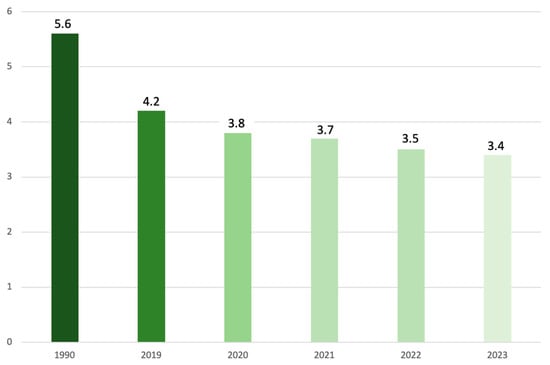
Figure 1.
Reduction in greenhouse gas emissions in the European Union (2019–2023) in million tons of CO2 equivalent. Source: [8].
Furthermore, energy efficiency has become a central pillar in this evolution, not only to minimize consumption but also to ensure the optimization of resources throughout the energy value chain. Technologies such as predictive analytics, real-time data processing, and decentralized control systems contribute to the reduction of transmission losses and enable more sustainable grid operation [6,7,8]. The integration of renewable sources, such as wind and solar energy, with traditional energy sources presents a complex challenge that requires innovative solutions to ensure the balance between energy supply and demand [9]. In 2022, renewable energy accounted for 23% of the European Union′s total energy consumption [10]. By 2024, renewable energy production surpassed fossil fuel-based energy in terms of contribution [11]. Solar energy generated 11% of the EU’s electricity, exceeding coal for the first time, which contributed 10% [12]. Table 1 presents the contribution percentages of different energy sources to the EU’s electricity consumption in 2024.

Table 1.
Contribution of energy sources to electricity consumption in the EU (2024). Source: [8].
A key component of this transformation is the adoption of Artificial Intelligence (AI) and the Internet of Things (IoT), which facilitate real-time monitoring, predictive maintenance, and adaptive demand response strategies [5]. These technologies empower the grid to become more autonomous, intelligent, and capable of self-regulation, aligning supply with fluctuating demand while improving overall system reliability [6].
Cybersecurity also plays a decisive role in this digital transition. As energy infrastructures become increasingly connected and reliant on digital systems, they are exposed to higher risks of cyber threats. Ensuring the effectiveness of cybersecurity frameworks is essential to protect critical assets and guarantee the continuity and safety of energy supply. Measures such as encryption protocols, intrusion detection systems, and AI-based threat analysis are becoming integral components of smart energy systems.
One aspect of SGs is the reduction of energy waste through the use of monitoring tools, predictive analytics, and automation [13]. The application of AI, IoT, and blockchain enhances system efficiency by minimizing energy transmission and distribution losses [13]. In 2023, emissions related to energy generation in the EU decreased by 18%, primarily due to increased renewable energy production and the adoption of advanced energy management technologies [14]. The European Union has established a clear regulatory framework to support the energy transition and emission reduction efforts [15].
The SDGs serve as a strategic guide to addressing these challenges, with a particular focus on SDG 7 (Affordable and Clean Energy), which promotes equitable access to modern, reliable, and sustainable energy services [16], SDG 9 (Industry, Innovation, and Infrastructure), which encourages the development of resilient infrastructure and the adoption of innovative technologies [17], and SDG 13 (Climate Action), which emphasizes the urgency of measures to combat climate change, an objective pursued by the EU through the European Green Deal and Fit for 55, aiming to reduce emissions by 55% by 2030 [18]. The three analyzed SDGs are illustrated in Figure 2.

Figure 2.
SDGs 7, 9, and 13: Drivers of Energy Transition and Innovation. Our elaboration.
This manuscript is structured to guide the reader through a clear progression of content. It includes a literature-based Introduction, a detailed Methodology section grounded in PRISMA and bibliometric analysis, followed by the Results and Discussion sections, which present and interpret the findings, and concludes with a summary of key insights and study limitations. This structure is designed to ensure methodological transparency and thematic coherence across all sections of the paper.
This study aims to analyze European distribution networks in relation to the SDGs and EU energy plans, highlighting the role of digital technologies in smart energy management.
2. Methodology
The methodology adopted in this study consists of two main phases: systematic literature selection and bibliometric analysis.
In the first phase, a PRISMA-based approach was employed to identify and filter the most relevant academic literature on SG, the integration of renewable energy sources, and the role of digital technologies in energy management [19]. The selection was conducted using the Scopus database, applying rigorous inclusion and exclusion criteria to ensure the relevance and scientific quality of the analyzed documents [20].
The Scopus database has been used as a source of articles for review [21].
Scopus is among the most comprehensive information resources globally, covering many disciplines and providing scholars with high-quality and reliable academic information, and has gradually become the main source of data for bibliometric analysis and systematic literature review [22].
In the second phase, a bibliometric analysis was performed using VOSviewer software to map the key research trends in the field [23]. The integration of these two phases, along with the analysis of the 20 most cited articles, provided a systematic and updated overview of research dynamics related to SGs and the energy transition.
2.1. Systematic Literature Selection and Inclusion Criteria
To ensure a systematic and reproducible analysis of the scientific literature on SGs and the integration of energy sources, an approach based on the principles of the PRISMA methodology was adopted [19]. The research was conducted using the Scopus database with an advanced search string (“smart grid” OR “intelligent grid” OR “smart energy network”) AND (“renewable energy” OR “solar energy” OR “wind energy” OR “hydropower” OR “non-renewable energy”) AND (“energy efficiency” OR “energy waste reduction” OR “grid optimization”) AND (“digital technology” OR “artificial intelligence” OR “IoT” OR “blockchain” OR “big data”).
This string was carefully designed to include the most relevant synonyms and semantically related keywords commonly used in the literature on smart grids and digital energy technologies. The use of Boolean operators (OR, AND) allowed for the inclusion of a wide range of terms while maintaining a coherent and targeted scope. For this reason, a single, comprehensive string was considered sufficient to capture the breadth of existing studies in the field.
The initial query returned a total of 256 documents. To ensure temporal relevance, a publication date filter was applied (2015–2025), reducing the set to 249 documents. Only peer-reviewed scientific articles and conference papers were retained, leading to a refined set of 188 documents [24]. Subsequently, documents were filtered based on disciplinary relevance, focusing on areas such as engineering, computer science, energy, decision sciences, environmental science, and materials science. Studies outside these domains—particularly those focused on purely sociological, economic, or philosophical frameworks—were excluded as they fell outside the technological and infrastructural scope of the present research. The final corpus consisted of 179 documents considered suitable for analysis.
The selection process is illustrated in the PRISMA flow diagram in Figure 3. The diagram follows the standard four-phase structure of PRISMA—Identification, Screening, Eligibility, and Inclusion—providing a transparent overview of how the dataset was progressively refined. In the Identification phase, documents were retrieved using a clearly defined Boolean search string. In the Screening phase, non-peer-reviewed content was excluded. The Eligibility step involved manual screening based on relevance to the research fields. Finally, in the Inclusion phase, only articles meeting all methodological and thematic criteria were selected for analysis [25,26].
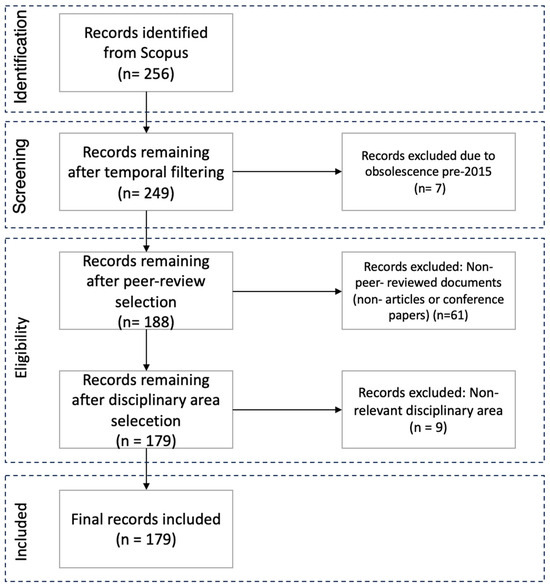
Figure 3.
PRISMA flow diagram for document selection. The diagram summarizes the four phases (Identification, Screening, Eligibility, and Inclusion) and shows the number of records excluded at each step. Our elaboration.
This stepwise filtering process ensured methodological rigor and reproducibility, aligning with the best practices of systematic review protocols. It also guaranteed that the final dataset was both current and aligned with the research objective, enabling a robust bibliometric and thematic analysis.
2.2. Bibliometric Analysis
From a bibliometric perspective, VOSviewer is a software widely used in bibliometric analysis for the visualization and analysis of bibliographies and datasets containing bibliographic information, such as title, author, and keywords [27,28].
Thanks to its versatility, it allows for the identification of trends, impacts, and thematic evolutions through the analysis of citation recurrence [29]. In the landscape of scientific research, VOSviewer establishes itself as an essential tool for the representation of bibliometric data, facilitating the identification of research opportunities in specific sectors and the recognition of the most frequently cited sources [30,31].
The software focuses on analysis at an aggregated level, particularly in the field of cluster analysis [30]. It has been employed to examine and represent connections between keywords, applying the VOS clustering method to the frequency of occurrences and assigning a distinctive color to each group [32].
The interpretation of this methodology assumes that the circle sizes reflect the frequency of keyword usage, while the colors represent the different clusters [33]. It is important to note that the x and y axes do not have a specific meaning; therefore, the generated maps can be freely rotated or flipped without altering their informational content [34].
The analyzed data were extracted from Scopus in CSV format to ensure compatibility with VOSviewer. Subsequently, a map based on bibliographic results was created using both author keywords and indexed keywords. To ensure a meaningful representation, a filter was applied, considering only keywords with a minimum of three occurrences.
This methodology made it possible to highlight the most relevant concepts in the field of study, providing a clear and detailed vision of emerging terms in the scientific literature.
3. Results
The bibliometric analysis conducted using VOSviewer generated the visualization shown in Figure 4.
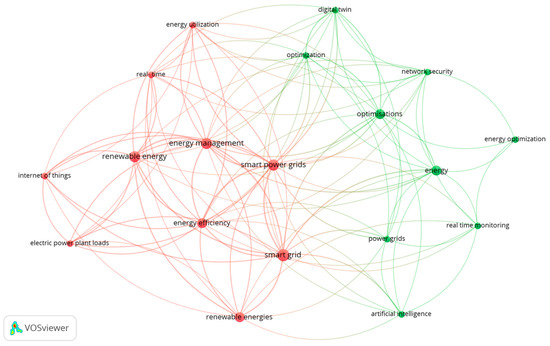
Figure 4.
Bibliometric keyword analysis of articles and conference papers. Our elaboration.
In the VOSviewer visualization, concepts and keyword connections are organized into two main clusters, distinguishable by color.
The red cluster, located on the left and central part of the map, is strongly focused on energy management and SGs. The main keywords in this group include smart power grids, energy management, renewable energy, and IoT, indicating a focus on energy transition, renewable energy integration, and the role of digitalization in optimizing energy flows. This cluster also highlights the link between real-time monitoring and energy efficiency, suggesting the increasing use of technologies for dynamic network control.
On the other hand, the green cluster, positioned on the right side of the map, is more focused on optimization, security, and advanced technologies for energy management. Concepts such as optimization, digital twin, network security, and artificial intelligence emerge here, reflecting a growing emphasis on AI-based tools and digital simulation to enhance grid resilience. The importance of cybersecurity is evident, with network security directly linked to energy management, demonstrating the crucial role of protecting digitalized infrastructures.
Visually, the red cluster is denser and more concentrated in the center-left, with many internal connections between renewable energy management concepts and system efficiency. The green cluster, more distributed on the right side, highlights a research trend oriented towards digital simulation, optimization, and the security of modern power grids.
The interconnection between the two clusters suggests that digitalization and smart grid optimization are key elements for enhancing the efficiency and sustainability of renewable energy integration in the global power system.
The bibliographic analysis then examined the 20 most cited articles, shown in Table 2, which revealed the state-of-the-art of the research topic.
Table 2.
State-of-the-art analysis. Our elaboration.
The analysis of the 20 most cited articles in the field of digitalization of energy grids and the transition towards sustainable models highlights the central role of technologies in the management of energy resources and the optimization of renewable energy integration.
Ali and Choi [37] illustrate how AI has become a key component for SG, improving the prediction of demand and supply, supporting the distributed management of energy resources, and enhancing cybersecurity mechanisms. In addition, recent developments in reinforcement learning applied to grid-following converters show promising results in improving system adaptability and stability. For instance, Zeng et al. (2025) [55] proposed a multi-objective controller using Easy Transfer Reinforcement Learning, which significantly reduces training effort while maintaining control performance and robustness across varying grid conditions [55]. The Internet of Energy (IoE), explored by Strielkowski et al. [45], represents an emerging paradigm that enables peer-to-peer energy exchange, the optimization of electric vehicle charging, and a more efficient distribution of renewable sources, favoring the decentralization of energy markets. On the data processing front, the study by Minh et al. [44] highlights how Edge Computing improves the operational efficiency of SG, reducing latency in monitoring systems and allowing for more flexible management of storage resources.
To address the variability of renewable sources, Meenal et al. [46] demonstrate that the use of predictive models based on machine learning and deep learning helps reduce uncertainties related to intermittent generation, optimizing network planning and management. Building on this trend, recent approaches have combined deep reinforcement learning with physics-informed models to improve the control of power converters in smart grids. For instance, Zeng et al. (2024) [56] developed a method for optimizing Input-Series Output-Parallel Dual Active Bridge (ISOP-DAB) converters, enhancing energy transfer efficiency and system stability in complex decentralized energy networks [56].
In parallel, the adoption of IoT and big data technologies in smart cities, described by Bibri and Krogstie [42], reveals the importance of integrating smart meters, smart buildings, and SGs to improve energy efficiency and reduce environmental impact. The evolution of SGs also intersects with the issue of sustainability and infrastructure security: according to Kumari et al. [38], the combination of blockchain and AI can enhance microgrid management, ensuring greater transparency in energy markets and increasing the resilience of electrical networks.
Finally, the importance of weather forecasting for improving the reliability of renewable energy networks is emphasized by Meenal et al. [46], who demonstrate how advanced predictive algorithms can mitigate the effects of the intermittency of solar and wind generation. The analysis of these studies highlights that the energy transition and the digitalization of networks are closely interconnected processes, where the adoption of solutions based on AI, IoT, Edge Computing, and blockchain represents the key to ensuring more resilient, efficient, and sustainable electrical grids. Compared to existing literature, this study stands out for its integrated approach, which jointly examines technological trajectories related to energy efficiency, digitalization, and infrastructure security. The combination of bibliometric analysis and thematic cluster interpretation makes it possible to highlight not only the areas of highest scientific intensity, but also the emerging interconnections between advanced management tools and network protection strategies. In particular, the emphasis on the relationship between AI, IoT, blockchain, and cybersecurity represents an original contribution aimed at promoting a systemic vision for the development of smart grids.
4. Discussion and Conclusions
The analysis conducted in this study has highlighted how SGs represent a key element for the energy transition, facilitating the integration of renewable sources with traditional energy systems [1,2]. The combination of advanced technologies allows for a significant improvement in the efficiency of energy production, distribution, and consumption [37,38]. The adoption of these digital solutions not only optimizes the use of resources but also enables the reduction of greenhouse gas emissions, contributing to the sustainability goals defined by the European Union and the SDGs of the United Nations [15].
The bibliometric analysis has identified two main research streams: the first, centered on energy management and SG, highlights the crucial role of digitalization in optimizing energy flows [40]; the second, focused on optimization, security, and advanced technologies, demonstrates how the integration of digital simulation tools and cybersecurity is essential to ensuring the resilience of energy infrastructures [48].
The dimension of energy efficiency has emerged as a key priority, not only from a technological standpoint but also as a strategic goal for policy and market design. The use of AI-driven forecasting models, combined with real-time IoT-based monitoring systems, enables smart grids to dynamically adapt to load variations, prevent energy waste, and reduce peak loads [44,57].
Moreover, the discussions on Artificial Intelligence (AI) and the Internet of Things (IoT) should be reinforced by recognizing their foundational role in automating energy management, improving decision-making, and creating self-healing networks. AI supports advanced forecasting, predictive maintenance, and optimization algorithms, while IoT ensures real-time communication between grid components, sensors, and user devices, forming a synergistic digital ecosystem for energy resilience [38,40,55].
Cybersecurity emerges as another cornerstone of smart grid effectiveness. The increasing reliance on connected devices and cloud platforms exposes the grid to new vulnerabilities. Therefore, the development and implementation of robust cybersecurity frameworks—capable of threat detection, anomaly resolution, and system recovery—are essential to ensure the integrity, availability, and confidentiality of energy data and services. Recent advances in AI-based cybersecurity are promising, offering adaptive responses to emerging threats and contributing to overall grid stability [45,56].
The growing interconnection between these two areas suggests that digitalization and network protection are complementary and essential aspects for a sustainable energy system. The results emerging from the literature review show that AI-based solutions are among the most studied and implemented, thanks to their ability to improve demand and supply forecasting, optimize the distributed management of resources, and strengthen network security [46].
Furthermore, blockchain is emerging as a promising option to ensure transparency and reliability in decentralized energy markets, supporting the development of peer-to-peer energy exchange models [38]. At the same time, Edge Computing offers new opportunities to reduce latency in monitoring and control operations of SG, improving the operational efficiency of the system [42]. A summary is given in Table 3.
Table 3.
Summary of constructs. Our elaboration.
A fundamental aspect emerging from our analysis concerns the importance of weather forecasting in managing renewable energy sources [46]. The use of advanced predictive algorithms based on machine learning and deep learning helps mitigate uncertainties related to the variability of solar and wind energy, improving grid planning and balance [48]. This approach fits into a broader dynamic energy management framework, where the system’s adaptability becomes increasingly crucial.
While this study highlights the growing convergence between energy efficiency, renewable integration, and digital technologies in the evolution of SG, several challenges still remain, requiring further technological and regulatory developments. Cybersecurity of SGs represents one of the main critical issues, considering the growing risk of cyberattacks on digitalized energy infrastructures [56]. Scalability and interoperability of different digital technologies require greater standardization to ensure a smooth and effective transition [43]. Moreover, the economic sustainability of the proposed solutions must be carefully evaluated to prevent the high implementation costs from limiting the large-scale adoption of innovative technologies [41,57].
This study highlights how the digitalization of energy grids serves as a fundamental lever for the transition toward a more efficient, resilient, and sustainable energy system. The integration of AI, IoT, blockchain, and Edge Computing not only enhances resource management but also opens new perspectives for the creation of decentralized and more equitable energy models.
5. Limitations of the Study
While this study offers a comprehensive bibliometric and thematic analysis of the role of digital technologies in smart grid development and the energy transition, several limitations should be acknowledged. First, the literature review is based solely on documents indexed in the Scopus database. Although Scopus is a widely recognized and reliable academic source, this choice may have led to the exclusion of relevant studies published in other databases such as Web of Science or IEEE Xplore. Second, the selection criteria focused primarily on technical and scientific disciplines (e.g., engineering, energy, computer science), potentially underrepresenting interdisciplinary perspectives from social sciences or public policy, which are crucial for understanding the broader implications of smart grid implementation.
Moreover, the study provides a static snapshot of the current research landscape, which may not fully reflect the fast-paced evolution of technologies such as AI, IoT, and blockchain. Emerging innovations and newly published research might not yet be adequately represented. Another limitation lies in the lack of empirical validation: while the study maps conceptual trends and technological trajectories, it does not assess how these solutions are applied in real-world energy infrastructures or their actual impact on grid performance, resilience, and sustainability.
Future research should integrate empirical case studies, cross-disciplinary frameworks, and longitudinal data to enrich the understanding of how digital technologies interact with regulatory, social, and economic contexts in shaping the energy transition.
Future research should integrate empirical case studies and longitudinal data to enrich the understanding of how digital technologies interact with regulatory, social, and economic contexts in shaping the energy transition.
Author Contributions
Conceptualization, R.C. and P.C.; methodology, R.C., R.R., C.A. and P.C.; software, R.C., R.R. and C.A.; validation, R.C., R.R., C.A. and P.C.; formal analysis, R.C.; resources, R.C.; data curation, R.C.; writing—original draft preparation, R.C.; writing—review and editing, R.C., R.R., C.A. and P.C.; visualization, R.R., C.A. and P.C.; supervision, P.C.; project administration, P.C. All authors have read and agreed to the published version of the manuscript.
Funding
This research received no external funding.
Data Availability Statement
The original contributions presented in this study are included in the article. Further inquiries can be directed to the corresponding author.
Conflicts of Interest
The authors declare no conflicts of interest.
Abbreviations
| AI | Artificial Intelligence |
| IoT | Internet of Things |
| SDGs | Sustainable Development Goals |
| SGs | Smart Grids |
References
- Jaiswal, K.K.; Chowdhury, C.R.; Yadav, D.; Verma, R.; Dutta, S.; Jaiswal, K.S.; Karuppasamy, K.S.K. Renewable and sustainable clean energy development and impact on social, economic, and environmental health. Energy Nexus 2022, 7, 100118. [Google Scholar] [CrossRef]
- Jie, H.; Khan, I.; Alharthi, M.; Zafar, M.W.; Saeed, A. Sustainable energy policy, socio-economic development, and ecological footprint: The economic significance of natural resources, population growth, and industrial development. Util. Policy 2023, 81, 101490. [Google Scholar] [CrossRef]
- Paramati, S.R.; Shahzad, U.; Doğan, B. The role of environmental technology for energy demand and energy efficiency: Evidence from OECD countries. Renew. Sustain. Energy Rev. 2022, 153, 111735. [Google Scholar] [CrossRef]
- Pablo-Romero, M.P.; Sánchez-Braza, A.; Galyan, A. Renewable energy use for electricity generation in transition economies: Evolution, targets and promotion policies. Renew. Sustain. Energy Rev. 2021, 138, 110481. [Google Scholar] [CrossRef]
- Erhueh, O.V.; Nwakile, C.; Akano, O.A.; Esiri, A.E.; Hanson, E. Digital transformation in energy asset management: Lessons for building the future of energy infrastructure. Glob. J. Res. Sci. Technol. 2024, 2, 10–37. [Google Scholar] [CrossRef]
- Dehdarian, A.; Tucci, C.L. A complex network approach for analyzing early evolution of smart grid innovations in Europe. Appl. Energy 2021, 298, 117143. [Google Scholar] [CrossRef]
- Hua, W.; Chen, Y.; Qadrdan, M.; Jiang, J.; Sun, H.; Wu, J. Applications of blockchain and artificial intelligence technologies for enabling prosumers in smart grids: A review. Renew. Sustain. Energy Rev. 2022, 161, 112308. [Google Scholar] [CrossRef]
- Liargovas, P.; Papageorgiou, C. Environmental Policy: Progress, Challenges and Future Directions. In The European Integration, Volume 2: Institutions and Policies; Springer Nature: Cham, Switzerland, 2024; pp. 405–428. [Google Scholar]
- Khan, K.; Su, C.W.; Rehman, A.U.; Ullah, R. Is technological innovation a driver of renewable energy? Technol. Soc. 2022, 70, 102044. [Google Scholar] [CrossRef]
- Abbruzzese, M.; Infante, D.; Smirnova, J. The diffusion of renewable energy production in European countries: The role of incentives. Econ. Innov. New Technol. 2025, 34, 70–93. [Google Scholar] [CrossRef]
- Deshmukh, M.K.G.; Sameeroddin, M.; Abdul, D.; Sattar, M.A. Renewable energy in the 21st century: A review. Mater. Today Proc. 2023, 80, 1756–1759. [Google Scholar] [CrossRef]
- Hassan, Q.; Viktor, P.; Al-Musawi, T.J.; Ali, B.M.; Algburi, S.; Alzoubi, H.M.; Al-Jiboory, A.K.; Sameen, A.Z.; Jaszczur, M. The renewable energy role in the global energy Transformations. Renew. Energy Focus 2024, 48, 100545. [Google Scholar] [CrossRef]
- Mazhar, T.; Irfan, H.M.; Haq, I.; Ullah, I.; Ashraf, M.; Shloul, T.A.; Elkamchouchi, D.H. Analysis of challenges and solutions of IoT in smart grids using AI and machine learning techniques: A review. Electronics 2023, 12, 242. [Google Scholar] [CrossRef]
- Bianco, V.; Cascetta, F.; Nardini, S. Analysis of the carbon emissions trend in European Union. A decomposition and decoupling approach. Sci. Total Environ. 2024, 909, 168528. [Google Scholar] [CrossRef] [PubMed]
- Hainsch, K.; Löffler, K.; Burandt, T.; Auer, H.; Del Granado, P.C.; Pisciella, P.; Zwickl-Bernhard, S. Energy transition scenarios: What policies, societal attitudes, and technology developments will realize the EU Green Deal? Energy 2022, 239, 122067. [Google Scholar] [CrossRef]
- Walesiak, M.; Dehnel, G. Progress on SDG 7 achieved by EU countries in relation to the target year 2030: A multidimensional indicator analysis using dynamic relative taxonomy. PLoS ONE 2024, 19, e0297856. [Google Scholar] [CrossRef]
- Skare, M.; Gavurova, B.; Rigelsky, M. Quantification of the impact of innovations in industry and infrastructure for sustainable circular economy production and consumption. J. Innov. Knowl. 2024, 9, 100456. [Google Scholar] [CrossRef]
- Sardianou, E.; Nikou, V.; Kostakis, I. Harmonizing sustainability goals: Empirical insights into climate change mitigation and circular economy strategies in selected European countries with SDG13 framework. Sustainability 2024, 16, 296. [Google Scholar] [CrossRef]
- Greener, S. Evaluating literature with bibliometrics. Interact. Learn. Environ. 2022, 30, 1168–1169. [Google Scholar] [CrossRef]
- Pranckutė, R. Web of Science (WoS) and Scopus: The titans of bibliographic information in today’s academic world. Publications 2021, 9, 12. [Google Scholar] [CrossRef]
- Kraus, S.; Breier, M.; Lim, W.M.; Dabić, M.; Kumar, S.; Kanbach, D.; Mukherjee, D.; Corvello, V.; Piñeiro-Chousa, J.; Liguori, E.; et al. Literature reviews as independent studies: Guidelines for academic practice. Rev. Manag. Sci. 2022, 16, 2577–2595. [Google Scholar] [CrossRef]
- Zhang, K.; Liang, Q.M. Recent progress of cooperation on climate mitigation: A bibliometric analysis. J. Clean. Prod. 2020, 277, 123495. [Google Scholar] [CrossRef]
- Kumar, R.; Saxena, S.; Kumar, V.; Prabha, V.; Kumar, R.; Kukreti, A. Service innovation research: A bibliometric analysis using VOSviewer. Compet. Rev. Int. Bus. J. 2024, 34, 736–760. [Google Scholar] [CrossRef]
- Weber, E.J.; Katz, P.P.; Waeckerle, J.F.; Callaham, M.L. Author perception of peer review: Impact of review quality and acceptance on satisfaction. JAMA 2002, 287, 2790–2793. [Google Scholar] [CrossRef]
- Page, M.J.; Moher, D.; Bossuyt, P.M.; Boutron, I.; Hoffmann, T.C.; Mulrow, C.D.; McKenzie, J.E. PRISMA 2020 explanation and elaboration: Updated guidance and exemplars for reporting systematic reviews. BMJ 2021, 372, n160. [Google Scholar] [CrossRef]
- Arya, S.; Kaji, A.H.; Boermeester, M.A. PRISMA reporting guidelines for meta-analyses and systematic reviews. JAMA Surg. 2021, 156, 789–790. [Google Scholar] [CrossRef]
- Al Husaeni, D.F.; Nandiyanto, A.B.D. Bibliometric using Vosviewer with Publish or Perish (using google scholar data): From step-by-step processing for users to the practical examples in the analysis of digital learning articles in pre and post COVID-19 pandemic. ASEAN J. Sci. Eng. 2022, 2, 19–46. [Google Scholar] [CrossRef]
- Orduña-Malea, E.; Costas, R. Link-based approach to study scientific software usage: The case of VOSviewer. Scientometrics 2021, 126, 8153–8186. [Google Scholar] [CrossRef]
- De la Salgado-Cruz, M.P.; Salgado-Cruz, J.; García-Hernández, A.B.; Calderón-Domínguez, G.; Gómez-Viquez, H.; Oliver-Espinoza, R.; Fernández-Martínez, M.C.; Yáñez-Fernández, J. Chitosan as a coating for biocontrol in postharvest products: A bibliometric review. Membranes 2021, 11, 421. [Google Scholar] [CrossRef]
- Wang, X.; Xu, Z.; Škare, M. A bibliometric analysis of economic research-ekonomska istrazivanja (2007–2019). Econ. Res. Ekon. Istraživanja 2020, 33, 865–886. [Google Scholar] [CrossRef]
- Nandiyanto, A.B.D.; Biddinika, M.K.; Triawan, F. How bibliographic dataset portrays decreasing number of scientific publications from Indonesia. Indones. J. Sci. Technol. 2020, 5, 154–175. [Google Scholar] [CrossRef]
- Eck, N.; Waltman, L. Citation-based clustering of publications using CitNetExplorer and VOSviewer. Scientometrics 2017, 111, 1053–1070. [Google Scholar] [PubMed]
- Van Eck, N.J.; Waltman, L.; Dekker, R.; Van Den Berg, J. A comparison of two techniques for bibliometric mapping: Multidimensional scaling and VOS. J. Am. Soc. Inf. Sci. Technol. 2010, 61, 2405–2416. [Google Scholar] [CrossRef]
- Khalil, G.M.; Crawford, C.A.G. A bibliometric analysis of US-based research on the behavioral risk factor surveillance system. Am. J. Prev. Med. 2015, 48, 50–57. [Google Scholar] [CrossRef] [PubMed]
- Mengelkamp, E.; Gärttner, J.; Rock, K.; Kessler, S.; Orsini, L.; Weinhardt, C. Designing microgrid energy markets: A case study: The Brooklyn Microgrid. Appl. Energy 2018, 210, 870–880. [Google Scholar] [CrossRef]
- Shi, Z.; Yao, W.; Li, Z.; Zeng, L.; Zhao, Y.; Zhang, R.; Tang, Y.; Wen, J. Artificial intelligence techniques for stability analysis and control in smart grids: Methodologies, applications, challenges and future directions. Appl. Energy 2020, 278, 115733. [Google Scholar] [CrossRef]
- Ali, S.S.; Choi, B.J. State-of-the-art artificial intelligence techniques for distributed smart grids: A review. Electronics 2020, 9, 1030. [Google Scholar] [CrossRef]
- Kumari, A.; Gupta, R.; Tanwar, S.; Kumar, N. Blockchain and AI amalgamation for energy cloud management: Challenges, solutions, and future directions. J. Parallel Distrib. Comput. 2020, 143, 148–166. [Google Scholar] [CrossRef]
- Chiu, T.-C.; Shih, Y.-Y.; Pang, A.-C.; Pai, C.-W. Optimized day-ahead pricing with renewable energy demand-side management for smart grids. IEEE Internet Things J. 2017, 4, 374–383. [Google Scholar] [CrossRef]
- Yang, Q.; Wang, H. Privacy-preserving transactive energy management for IoT-aided smart homes via blockchain. IEEE Internet Things J. 2021, 8, 11463–11475. [Google Scholar] [CrossRef]
- Revesz, A.; Jones, P.; Dunham, C.; Davies, G.; Marques, C.; Matabuena, R.; Scott, J.; Maidment, G. Developing novel 5th generation district energy networks. Energy 2020, 201, 117389. [Google Scholar] [CrossRef]
- Bibri, S.E.; Krogstie, J. Environmentally data-driven smart sustainable cities: Applied innovative solutions for energy efficiency, pollution reduction, and urban metabolism. Energy Inform. 2020, 3, 29. [Google Scholar] [CrossRef]
- Tabaa, M.; Monteiro, F.; Bensag, H.; Dandache, A. Green Industrial Internet of Things from a smart industry perspective. Energy Rep. 2020, 6, 430–446. [Google Scholar] [CrossRef]
- Minh, Q.N.; Nguyen, V.-H.; Quy, V.K.; Ngoc, L.A.; Chehri, A.; Jeon, G. Edge computing for IoT-enabled smart grid: The future of energy. Energies 2022, 15, 6140. [Google Scholar] [CrossRef]
- Choi, C.; Esposito, C.; Wang, H.; Liu, Z.; Choi, J. Intelligent power equipment management based on distributed context-aware inference in smart cities. IEEE Commun. Mag. 2018, 56, 212–217. [Google Scholar] [CrossRef]
- Meenal, R.; Binu, D.; Ramya, K.C.; Michael, P.A.; Vinoth Kumar, K.; Rajasekaran, E.; Sangeetha, B. Weather forecasting for renewable energy system: A review. Arch. Comput. Methods Eng. 2022, 29, 2875–2891. [Google Scholar] [CrossRef]
- Çelik, D.; Meral, M.E.; Waseem, M. Investigation and analysis of effective approaches, opportunities, bottlenecks and future potential capabilities for digitalization of energy systems and sustainable development goals. Electr. Power Syst. Res. 2022, 211, 108251. [Google Scholar] [CrossRef]
- Liu, Z.; Wang, D.; Wang, J.; Wang, X.; Li, H. A blockchain-enabled secure power trading mechanism for smart grid employing wireless networks. IEEE Access 2020, 8, 177745–177756. [Google Scholar] [CrossRef]
- Strielkowski, W.; Streimikiene, D.; Fomina, A.; Semenova, E. Internet of Energy (IoE) and high-renewables electricity system market design. Energies 2019, 12, 4790. [Google Scholar] [CrossRef]
- Geetha, B.T.; Santhosh Kumar, P.; Sathya Bama, B.; Neelakandan, S.; Dutta, C.; Vijendra Babu, D. Green energy aware and cluster-based communication for future load prediction in IoT. Sustain. Energy Technol. Assess. 2022, 52, 102244. [Google Scholar] [CrossRef]
- Rochd, A.; Benazzouz, A.; Ait Abdelmoula, I.; Raihani, A.; Ghennioui, A.; Naimi, Z.; Ikken, B. Design and implementation of an AI-based & IoT-enabled home energy management system: A case study in Benguerir—Morocco. Energy Rep. 2021, 7, 699–719. [Google Scholar] [CrossRef]
- Umar, A.; Kumar, D.; Ghose, T. Blockchain-based decentralized energy intra-trading with battery storage flexibility in a community microgrid system. Appl. Energy 2022, 322, 119544. [Google Scholar] [CrossRef]
- Ahuja, K.; Khosla, A. Network selection criterion for ubiquitous communication provisioning in smart cities for smart energy system. J. Netw. Comput. Appl. 2019, 127, 82–91. [Google Scholar] [CrossRef]
- Ali, S.; Ur Rehman, A.; Wadud, Z.; Khan, I.; Murawwat, S.; Hafeez, G.; Albogamy, F.R.; Khan, S.; Samuel, O. Demand response program for efficient demand-side management in smart grid considering renewable energy sources. IEEE Access 2022, 10, 53832–53853. [Google Scholar] [CrossRef]
- Zeng, Y.; Jiang, S.; Konstantinou, G.; Pou, J.; Zou, G.; Zhang, X. Multi-Objective Controller Design for Grid-Following Converters with Easy Transfer Reinforcement Learning. IEEE Trans. Power Electron. 2025, 40, 6566–6577. [Google Scholar] [CrossRef]
- Zeng, Y.; Xiao, Z.; Liu, Q.; Liang, G.; Rodriguez, E.; Zou, G.; Zhang, X.; Pou, J. Physics-informed deep transfer reinforcement learning method for the input-series output-parallel dual active bridge-based auxiliary power modules in electrical aircraft. IEEE Trans. Transp. Electrif. 2024, 11, 6629–6639. [Google Scholar] [CrossRef]
- Bellini, F.; Campana, P.; Censi, R.; Di Renzo, M.; Tarola, A.M. Energy communities in the transition to renewable sources: Innovative models of energy self-sufficiency through organic waste. Energies 2024, 17, 3789. [Google Scholar] [CrossRef]
Disclaimer/Publisher’s Note: The statements, opinions and data contained in all publications are solely those of the individual author(s) and contributor(s) and not of MDPI and/or the editor(s). MDPI and/or the editor(s) disclaim responsibility for any injury to people or property resulting from any ideas, methods, instructions or products referred to in the content. |
© 2025 by the authors. Licensee MDPI, Basel, Switzerland. This article is an open access article distributed under the terms and conditions of the Creative Commons Attribution (CC BY) license (https://creativecommons.org/licenses/by/4.0/).