Article

Transformer Iron Core Temperature Field Calculation Based on Finite Element Analysis

by
Ziyang Chen
*,
Zhenggang He
and
Shuhong Wang
School of Electrical Engineering, Xi’an Jiaotong University, No. 28 Xianning West Road, Xi’an 710049, China
*
Author to whom correspondence should be addressed.
Energies 2025, 18(24), 6537; https://doi.org/10.3390/en18246537
Submission received: 24 November 2025 / Revised: 11 December 2025 / Accepted: 12 December 2025 / Published: 13 December 2025
(This article belongs to the Special Issue Advancements in Power Transformers)

Abstract

Temperature anomaly is a common fault in power transformers; therefore, achieving a fast and accurate calculation of the transformer temperature field is of great significance. This paper primarily introduces the methodology and self-programmed calculation for realizing the temperature field analysis of a single-phase, two-limb transformer iron core. First, the finite element equation for the three-dimensional steady-state temperature field is derived to provide the basis for the self-programmed Finite Element Method (FEM) calculation. Subsequently, the Finite Element Method (FEM) calculation of the single-phase, two-limb transformer iron core temperature field was implemented using the self-programmed code, and the results were compared with the COMSOL calculation results. The comparison showed that the error at each node was within 0.5 K. Compared to COMSOL, the computation time was reduced by 46.89%, and the memory usage was reduced by 82.37%. Finally, a temperature rise test was designed for the single-phase, two-limb transformer. Compared with the experimental data, the maximum error is within 3 K, which further confirms the accuracy of the program.

1. Introduction

As the most important transmission and distribution equipment in the power system, the normal operation of the transformer plays a crucial role in ensuring the safety and economic operation of the power supply system [1,2]. Currently, transformer manufacturing technology is progressing toward large capacity, high voltage levels, intelligence, and environmental friendliness. However, research concerning the energy consumption and reliability of transformers remains a critical issue attracting significant attention from both academia and the industry [3]. Power transformers generate heat during operation. If this heat cannot be dissipated in a timely manner, the transformer’s temperature will rise. Studies have shown that for a mineral oil transformer, every 6–10 °C increase in temperature can lead to a halving of the transformer’s service life [4]. Therefore, accurate calculation and analysis of the transformer temperature field are of great significance for ensuring the safe operation and extending the service life of transformers.
Currently, the rapid and accurate calculation of the power transformer temperature field faces numerous challenges. On one hand, the complex physical structure of the transformer, which involves various materials and boundary conditions, results in the discrete equation set formed by the fluid-thermal coupling problem possessing characteristics such as high order, non-linearity, and strong coupling, making the solution difficult [5]. On the other hand, the transformer operation involves deep coupling of electromagnetic-thermal-mechanical multi-physics fields, and its temperature field distribution changes correspondingly with different operating years and conditions. The main methods for calculating the steady-state temperature field of a transformer can be categorized into three groups: the Empirical Formula Method, the Equivalent Thermal Circuit Method, and the Numerical Calculation Method. The implementation of the Empirical Method relies on technical guidance documents such as the IEC 60076-7 standard [6], the IEEE C57.91 guide [7], and the GB/T 1094.7 standard [8], along with a summary of extensive experimental data and practical operational experience. Lü Pengfei et al. utilized K-type thermocouples for transient temperature measurement, achieving accurate and effective results [9]. However, these thermocouple-based sensors suffer from the drawback of being susceptible to external electromagnetic interference [10]. Ma Hongzhong et al. employed electrical tests and infrared thermography to analyze the nature and causes of overheating faults in power transformers and to identify the fault locations [11]. Infrared thermography [12] is a non-contact temperature measurement technique that is convenient for manual operation. The British scholar Perver A first proposed the distributed optical fiber sensor [13]. Distributed optical fiber temperature sensing technology [14] compensates for the deficiencies of traditional temperature measurement methods in numerous application scenarios. The Equivalent Thermal Circuit Method, based on the electro-thermal analogy proposed by G. Swift et al. [15,16], models heat transfer as a network model [17]. This method offers improved accuracy compared to the empirical method and boasts a faster calculation speed. Huang Xiaorui established a distributed thermal circuit model for the outside of high-voltage windings, which can calculate the temperature of a single winding disc, facilitating the location of hotspot temperatures in transformer windings [18]. Chen Si et al. established a simplified thermal model using anisotropic equivalent thermal conductivity and equivalent density and specific heat capacity. This approach increased the speed of temperature field simulation while maintaining accuracy [19]. Wen Weizhen applied the Equivalent Thermal Network Method to calculate the steady-state temperature rise in a Permanent Magnet Synchronous Motor (PMSM), establishing a 52-node equivalent thermal network model based on the motor’s actual physical structure [20]. The Finite Element Method is an important technique for solving the transformer temperature field [21]. Torriano et al. [22] used a Finite Volume Method to simulate transformer windings, considering a single copper conductor disc model. To reduce costs, they improved and verified a two-dimensional simulation strategy [23]. Chereches N C et al. focused on forced oil circulation transformers, investigating the relationship between oil flow rate and winding temperature rise [24]. Delgado F et al. analyzed the transformer temperature field using different cooling insulating oils [25]. FEM offers the advantages of strong applicability and high calculation accuracy, allowing the calculation of the entire temperature field information by selecting appropriate boundary and initial conditions [26]. However, the Finite Element Method requires high computational hardware resources and suffers from issues like long computation time and lack of convergence. In power distribution systems, oil-immersed transformers remain the dominant type, and their cooling efficiency and environmental impact are likewise hot research topics. As demands for environmental sustainability and fire safety increase, the shortcomings of conventional mineral oil—such as its limited resources, low biodegradability, and low flash point—are becoming increasingly prominent. This has prompted researchers to conduct extensive reviews and comparisons of alternative insulating liquids, such as synthetic ester oil and natural ester oil, to evaluate their environmental friendliness, thermal performance, and long-term operational reliability [27]. Bartlomiej Melka et al. utilized a coupled electromagnetic-thermal-fluid model to assess the effectiveness of distribution transformers using biodegradable ester oil as a coolant, comparing its cooling performance with that of conventional mineral oil under various climatic conditions. The results indicated that ester oil can be considered equally efficient as a coolant compared to mineral oil [28].
In summary, this paper proposes a self-programmed calculation method for the transformer iron core temperature field based on Finite Element Analysis (FEA). We first elaborate on the basic principles, implementation path, program design, and calculation workflow for the transformer iron core temperature field calculation using the FEM. A temperature field calculation program was self-programmed and developed specifically for a single-phase, two-limb transformer (converting 380 V to 220 V). The program computes the temperature field distribution of the transformer iron core, presenting optimized methods for determining the thermal conductivity and convective heat transfer coefficient. To verify the program’s effectiveness, a temperature rise experimental platform was further established. This platform uses thermocouples as temperature measurement tools, capable of accurately recording the transformer’s temperature variation under specific operating conditions in real-time. By comparing and analyzing the experimental data with the program’s calculation results, the validity of the program is verified. The rapid and accurate calculation of the transformer temperature field can provide vital technical support for the design, manufacturing, and operation of transformers.

2. Derivation of the Finite Element Equation for the Three-Dimensional Steady-State Temperature Field

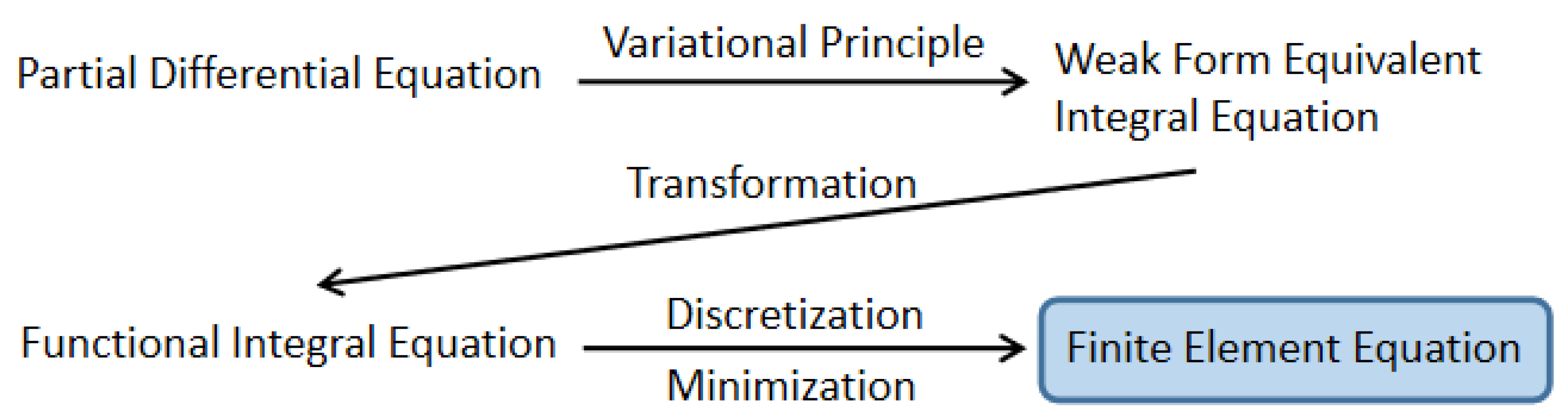
In the study of the transformer temperature field, because the change in temperature is a physical process that is relatively slower compared to the electromagnetic changes, and excessively high temperatures can lead to the destruction of the transformer’s insulation structure and subsequently cause damage to the transformer, the transient change in the temperature is generally not the primary concern. Instead, it is only necessary to calculate the temperature field distribution when the transformer reaches its final steady-state operation. Therefore, the finite element equation for the three-dimensional steady-state temperature field is derived below. The law of heat transfer variation obeys two major equations: the law of energy conservation and Fourier’s law. The basic derivation approach is illustrated in Figure 1.
The derivation of the finite element equation for the three-dimensional steady-state temperature field should begin with the temperature field control equation. The temperature T(x,y,z) within the region under study is a function of the spatial coordinates, thus constituting the temperature field. The spatial distribution of temperature satisfies Fourier’s Law of Heat Conduction and can be described by the following partial differential equation:
x k x T x + y k y T y + z k z T z + Q = ρ c T t
where ρ —Material density/kg·m−3; k i Thermal conductivity coefficient along the i direction/W·m−1·K−1; Q—Heat source power/W·m−3.
There are three types of heat transfer boundary conditions, The first type of BC (S1), Prescribed Temperature Boundary:
T = T 1                   on   S 1
where T 1 —Specified temperature on S 1 .
The second type of BC (S2): Prescribed Heat Flux Boundary:
k x T x l x + k y T y l y + k z T z l z + q = 0       on   S 2
where l x , l y , l z —The three components of the unit outward normal vector on the boundary; q —The prescribed heat flux on S 2 /W·m−2.
The third type of BC (S3): Convective Heat Transfer Boundary:
k x T x l x + k y T y l y + k z T z l z + h ( T T ) = 0       on   S 3
where h —The heat transfer coefficient on S 3 /W·m−2·K−1; T —The ambient medium temperature outside the region under study. The boundary of the studied region Ω is Ω = S 1 + S 2 + S 3 .
To solve this differential equation using a numerical method, we employ the variational principle to transform it into the equivalent integral weak form. By applying the weighted residual method and the Gauss Divergence Theorem (the detailed derivation process is provided in Appendix A) to the control equation, the minimal form of the functional can ultimately be obtained and subsequently discretized into the following classic matrix form of the Finite Element Equation:
K T = F
where [K] is the Global Stiffness Matrix, [T] is the Nodal Temperature Vector, and [F] is the Global Load Vector. The stiffness matrix is given by:
k e = V e B e T D e B e d V + S 3 e h N e T N e d S
It can be seen that the stiffness matrix is composed of two parts, where the first term represents the heat conduction term and the second term represents the convective heat transfer term. The load vector is:
F e = V e Q e N e T d V S 2 e q e N e T d S + S 3 e h T N e T d S
It can be observed that the load vector is influenced by the heat generated by the heat source, the prescribed heat flux on the boundary, and the intensity of convective heat transfer on the boundary.

3. Self-Programmed Calculation of Transformer Iron Core Temperature Field

3.1. Transformer Model Establishment and Parameter Settings

The designed transformer is a single-phase, two-limb transformer stepping down 380 V to 220 V Based on the actual structure of the transformer, reasonable simplifications and equivalent modeling are performed: the iron core is equivalent to a cylindrical structure, and the windings are equivalent to concentric tubular structures. Convective heat transfer is used to account for the heat exchange between the iron core surface and the external air. The transformer’s laminated structure leads to anisotropy in its heat transfer performance: the thermal conductivity coefficient is larger along the direction of the silicon steel sheets and smaller perpendicular to them. The convective heat transfer coefficient is affected by factors such as the surface roughness of the medium, heat dissipation conditions, and the temperature difference between the media. To accurately describe the temperature variations resulting from different heat dissipation conditions across the various parts of the iron core, the core model is divided into 6 regions: Upper Yoke, Left Limb, Right Limb, Left Joint, Right Joint, and Lower Yoke.
Regarding the simulation parameter settings in the model, some material parameters were provided by the transformer manufacturer. Missing parameters, such as the convective heat transfer coefficient, were determined through trial calculations by referencing public literature and empirical formulas. Specifically, the thermal properties along the direction of the silicon steel sheets are considered uniform, taking the same thermal conductivity coefficient. The properties perpendicular to the silicon steel sheets are considered poor and anisotropic. Moreover, because the clamping force is smaller, the deformation is larger, and air gaps are present at the joints and yokes compared to the core limbs, the thermal conductivity in this perpendicular direction is considered smaller.
Thermal conductivity coefficients for the core limbs:
k 1 = k 1 x x k 1 x y k 1 x z k 1 y x k 1 y y k 1 y z k 1 z x k 1 z y k 1 z z = 20 2.2 20
Thermal conductivity coefficients for the yokes and joints:
k 2 = k 2 x x k 2 x y k 2 x z k 2 y x k 2 y y k 2 y z k 2 z x k 2 z y k 2 z z = 20 1.3 20
In the heat dissipation process of the transformer, convective heat dissipation occurs on the surfaces where the transformer iron core contacts the air. When a fluid flows at a certain velocity and there is a temperature difference with the contacting solid surface, heat is transferred from one region to another through this flowing medium. This manner of heat transfer is known as thermal convection. Thermal convection is an important form of heat exchange that combines the macroscopic motion of the fluid and the microscopic thermal motion of the molecules to achieve effective heat transfer. During thermal convection, heat is transferred not only through the molecular thermal motion of the fluid (i.e., heat conduction) but is also carried along by the macroscopic flow of the fluid, thereby enabling long-distance heat transmission. Its mathematical expression is:
q = h ( T h T c )
where h —Surface convective heat transfer coefficient/W·m−2·K−1; T h and T c —Temperatures of the two heat transfer regions/K.
Thermal convection is ubiquitous in transformers. The phenomenon of thermal convection exists between the solid components inside the transformer, such as the iron core and windings, and the insulating oil, as well as between the transformer tank/casing and the surrounding ambient air. The convective heat transfer coefficient is a physical quantity that describes the rate of heat transfer between the fluid and the surface of the solution domain. The Nusselt number (Nu) is generally introduced to solve for the convective heat transfer coefficient [29]. Its mathematical expression is:
N u = h c L k
where L—/m; h c —Surface Convective Heat Transfer Coefficient/W·m−2·K−1; k—Thermal Conductivity of the Substance/W·m−1·K−1.
The object of study in this paper is a dry-type transformer operating under natural air convection. The Nusselt numbers for the vertical and horizontal directions, Nuv and Nuh, respectively, are given by Equations (12) and (13) [30].
N u h = 0.27 R a 1 / 4
N u v = 0.825 + 0.387 R a 1 / 6 1 + ( 0.429 / P r ) 9 / 16 8 / 27 2
R a = G r , P r = g β θ L 3 η k
P r = η c p k
where θ —Temperature difference between the wall and the external fluid/K; Pr—Prandtl number, which, along with the Grashof number, is used in natural convection fluid dynamics; β —Fluid expansion coefficient; g—Gravitational acceleration/m·s−2; Gr—Grashof number.
Based on Equations (12)–(15), the calculation formula for the convective heat transfer coefficient hc can be derived as follows:
h c = C k L c ρ μ k g β L 3 Δ t v 2 n
where C, n—Constants; k—Material Thermal Conductivity; c p —Specific Heat Capacity; μ —Medium Viscosity; g—Gravitational Constant; β —Thermal Expansion Coefficient; v—Kinematic Viscosity; L—Characteristic Length; Δ t —Characteristic Temperature Rise.
The calculated heat transfer coefficient for the core limbs is 7.6 W/(m2·K), the coefficient for the joints is 14 W/(m2·K), and the coefficient for the yokes is 11 W/(m2·K), It is concluded that the heat exchange with the air is more sufficient at the yokes and joints compared to the core limbs.
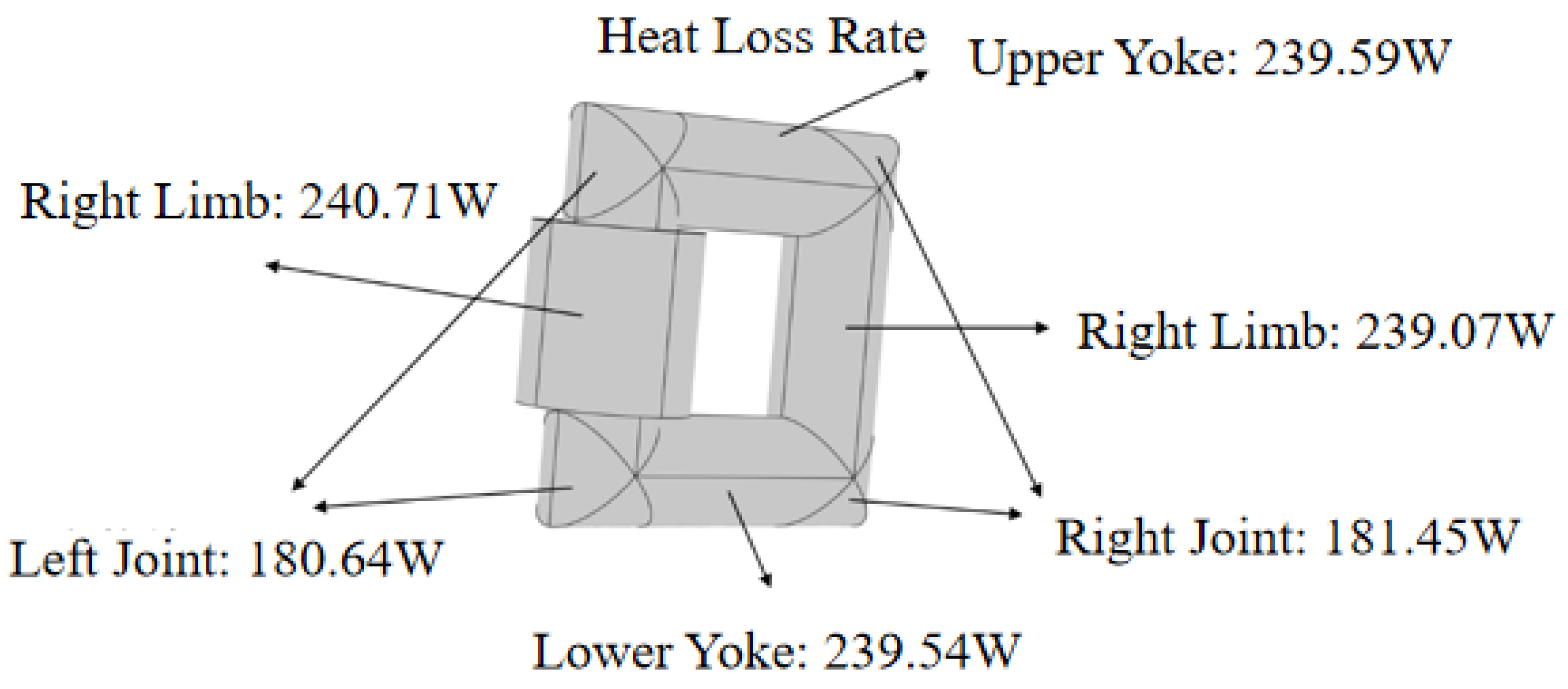
Based on the loss data obtained from the magnetic field simulation, a loss analysis was performed. The designed no-load loss for the transformer used in this experiment is 1335 W. The simulation calculation yielded an iron core no-load loss of 1321 W, resulting in a relative error of 1.05%, which is small. Based on the error calculation for each component, the loss value of each part is determined and added to the temperature field simulation as a heat source, as shown in Figure 2.
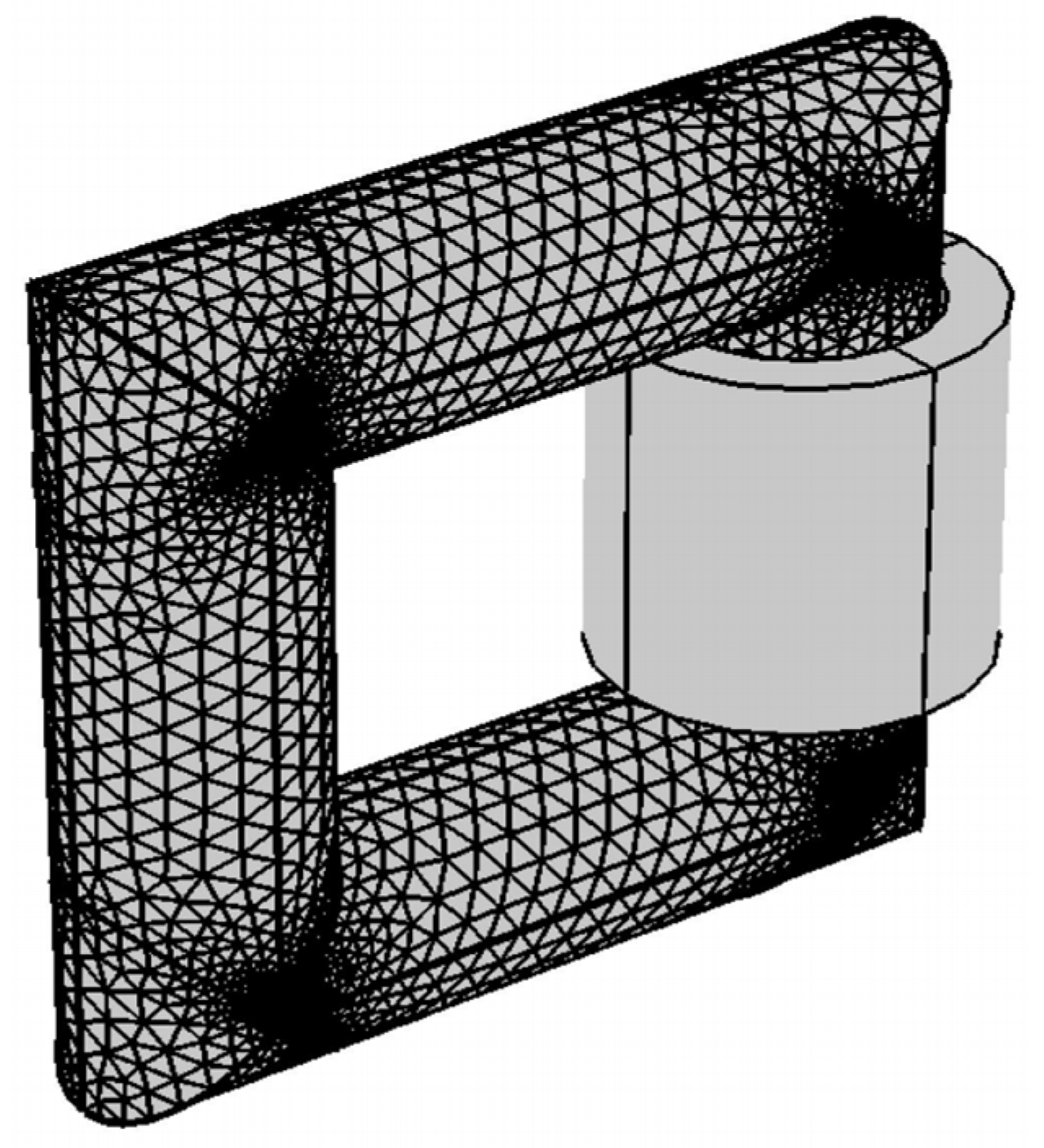
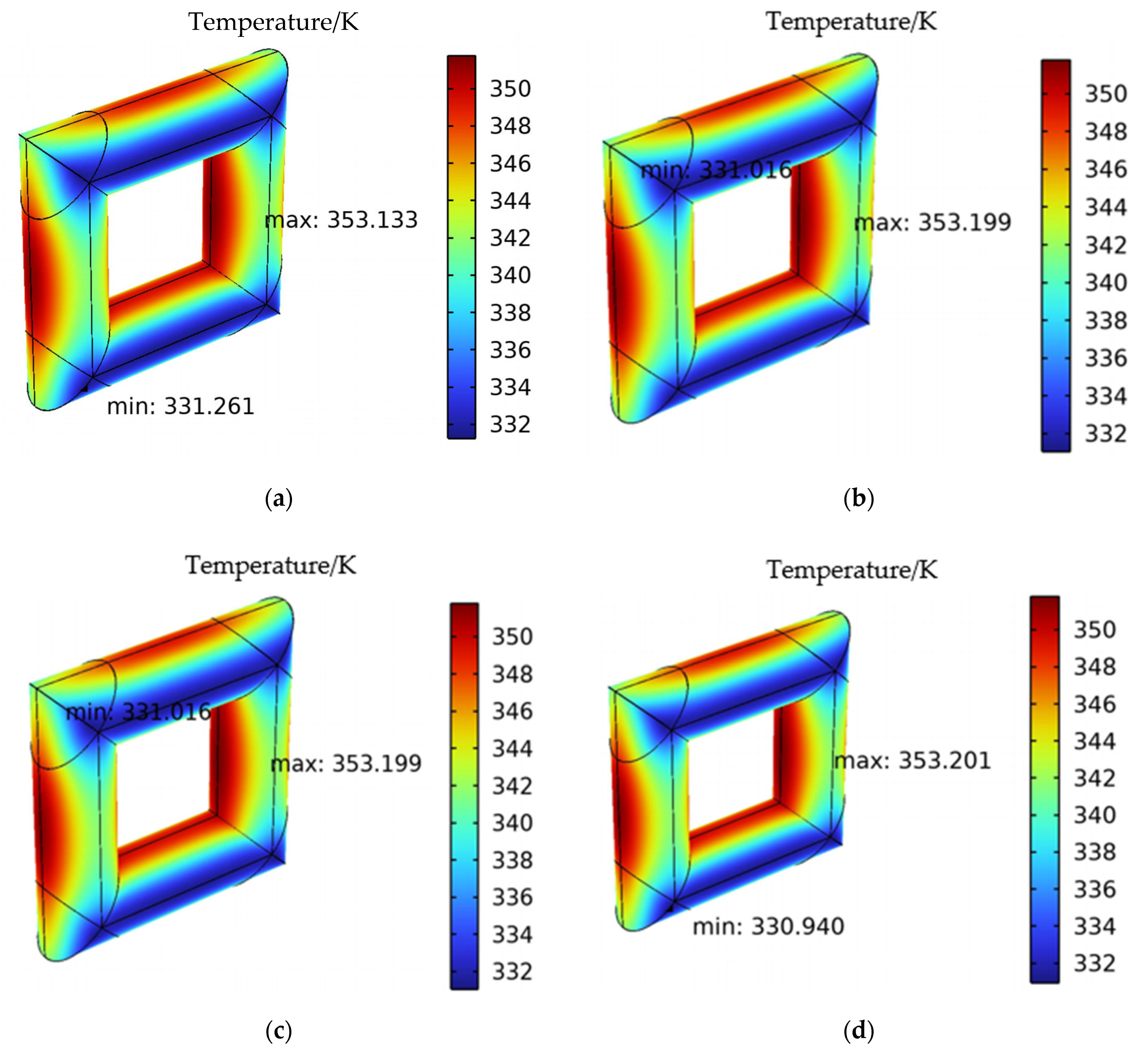
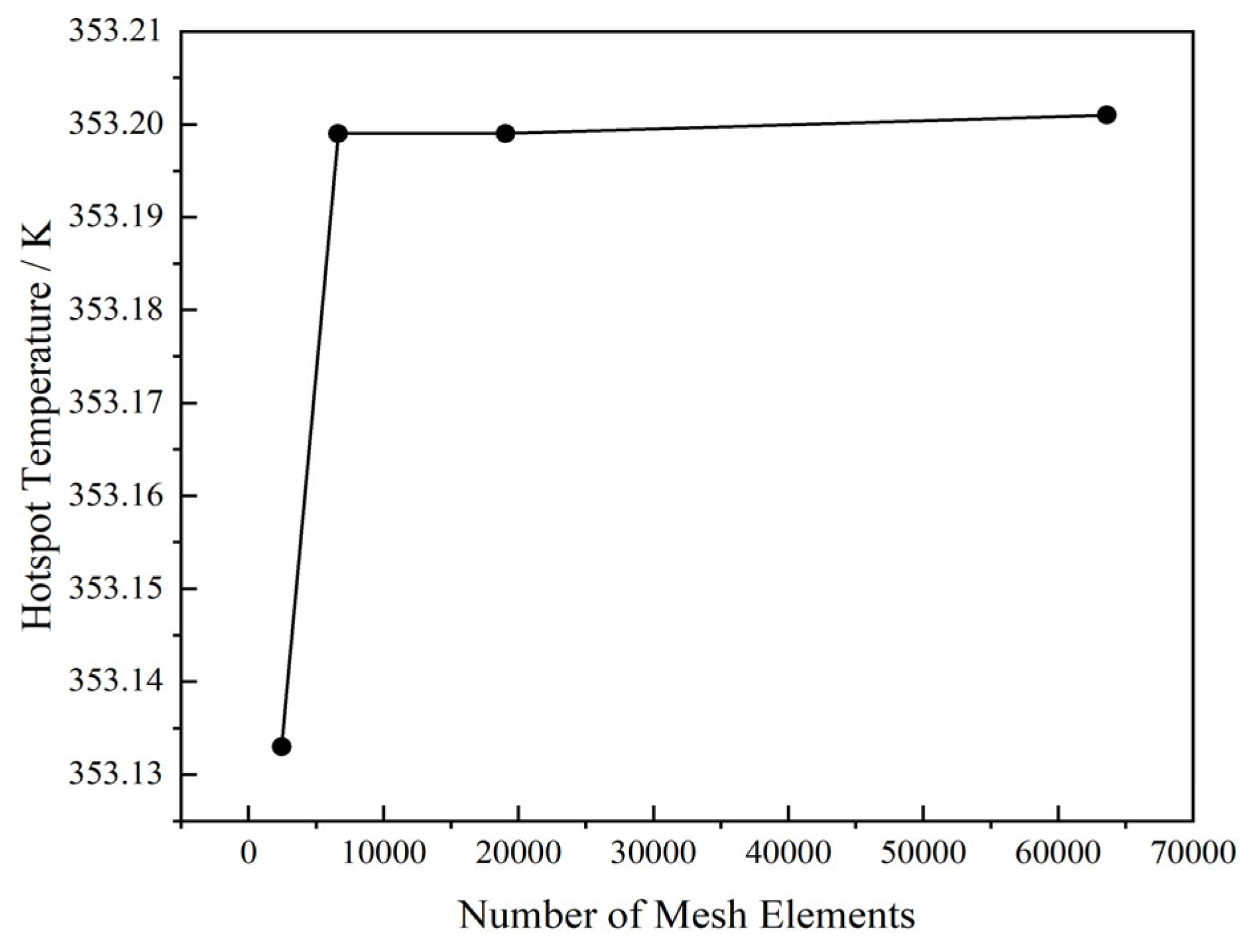
The model uses tetrahedral elements for meshing. To accurately calculate convective heat transfer on the boundary, the boundary mesh is matched with the volume mesh using triangular edge elements. The number of boundary layers is set to four. These boundary elements are specifically used for the integral calculation of the convective heat transfer term in the load vector F of the Finite Element Equation. Figure 3 shows the meshing result with 63,604 tetrahedral elements, 11,846 boundary elements, and 12,696 nodes. We first performed the temperature field simulation using COMSOL Multiphysics 6.3 and then compared the simulation results with the subsequent self-programmed calculation results. Prior to the simulation, a mesh independence study must be conducted. The model was tested using 2463, 6642, 19,051, and 63,604 tetrahedral elements, respectively, with the hotspot temperature of the iron core as the subject of the test. Figure 4 shows the temperature field simulation results for 2463, 6642, 19,051, and 63,604 tetrahedral elements, respectively.
The variation in the hotspot temperature with respect to the mesh refinement is shown in Figure 5.
From Figure 4 and Figure 5, it can be seen that the simulated temperature distribution results obtained using different mesh discretizations are fundamentally consistent. The error between the hotspot temperature and the overall temperature is within 0.1 K, which meets the requirement for acceptable engineering accuracy. Therefore, we conclude that the simulation results are no longer dependent on the degree of mesh refinement. We adopted the mesh discretization with 12,696 coordinate points and 63,604 elements for the subsequent self-programmed calculation and compared it with the COMSOL calculation result (i.e., Figure 4d).

3.2. Implementation of the Finite Element Calculation Program for the Temperature Field

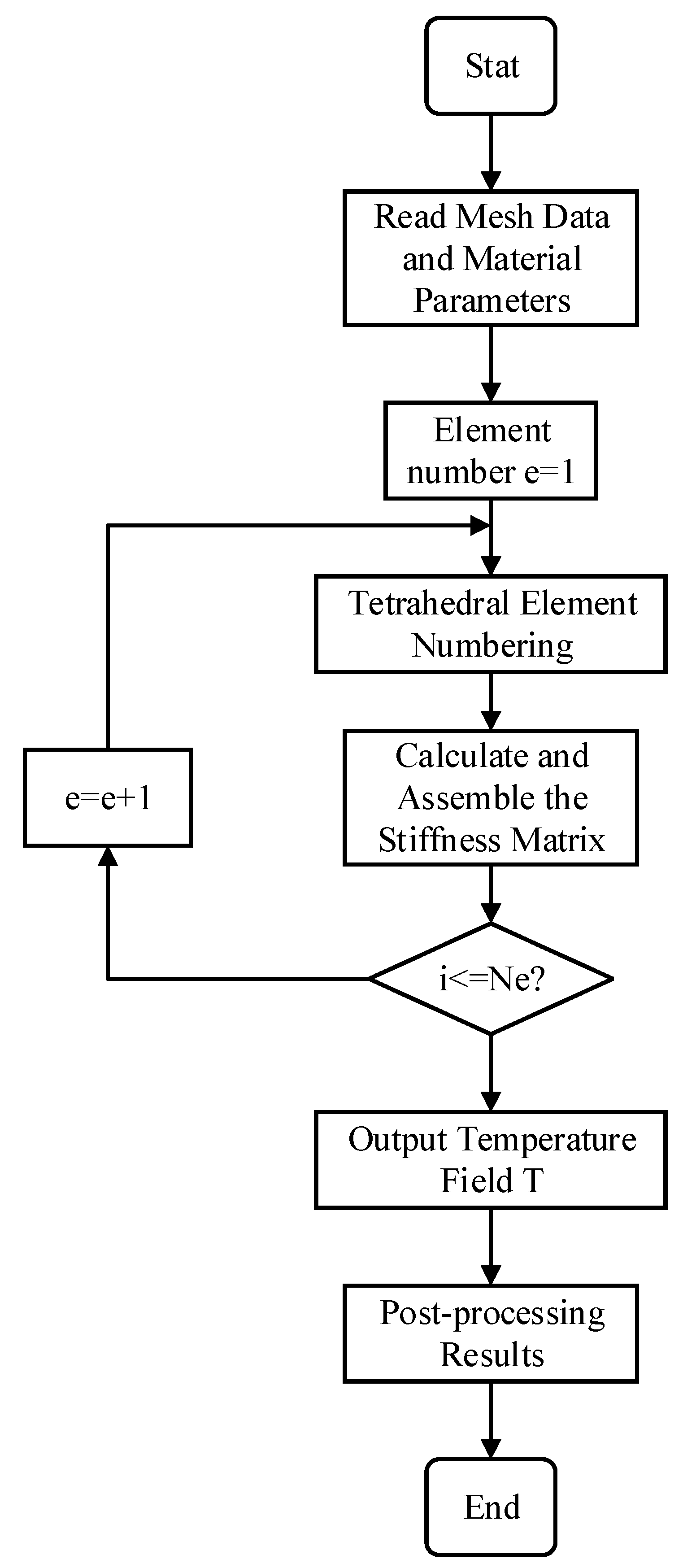
The Finite Element Calculation Program for the temperature field was implemented based on C++, and its calculation flowchart is shown in Figure 6.
(1)
Data Input
The data input is implemented through text file input. The data required externally for the Finite Element calculation of the temperature field includes: Mesh Information, Thermal and Convective Heat Transfer Coefficients, Heat Source Information and Ambient Temperature, and Iteration Tolerance.
Mesh Information refers to the tetrahedral mesh obtained after the discretization of the finite element model. This data needs to be input externally and includes three constants: the number of nodes, the number of tetrahedral elements, and the number of boundary elements. It also includes: node coordinates (coordinate information in Cartesian coordinates), element composition (node index information constituting each tetrahedral element), element index (domain index corresponding to the tetrahedral element), boundary composition (node index information constituting each boundary element), and boundary index (boundary surface index corresponding to the boundary element).
Material thermal conductivity and convective heat transfer coefficient information must be integrated with the mesh data. This input includes: the thermal conductivity coefficients for each domain (comprising two text files: the thermal conductivity values and the thermal conductivity domain index) and the convective heat transfer coefficients for each boundary (comprising two text files: the convective heat transfer values and the convective heat transfer boundary index).
Heat Source and Initial Temperature information is derived from the results of the magnetic field calculation. The heat source for each part is the loss density value from the magnetic field analysis, and the initial temperature is the prescribed ambient temperature. Iteration tolerance refers to the predefined condition for exiting the iteration loop in the Conjugate Gradient method.
(2)
Finite Element Calculation
The assembly of the stiffness matrix utilizes sparse storage to save memory space while improving access efficiency. This paper employs the Coordinate List (COO) format, also known as the triplet method, for storage. The triplet method stores a sparse matrix by only recording the non-zero elements and their positional information. The triplet method represents each non-zero element in the form of (row, col, value), where row and col denote the row and column indices of the element in the matrix, respectively, and value represents the element’s value. Based on this implementation, functions for element access, addition, and multiplication of sparse matrices were developed.
The core challenge in developing the finite element calculation program is solving the large-scale sparse matrix. Direct methods, such as Gaussian elimination and LU decomposition, are the most traditional solution techniques and can achieve the exact solution of algebraic equations. However, as the complexity of engineering problems increases, the scale of the finite element model grows sharply, leading to a significant increase in the dimension of the generated sparse matrix. In this context, direct methods face the dilemma of a dramatic increase in storage requirements and an exponential growth in computational complexity, making them difficult to implement in the solution of large-scale engineering problems. Therefore, an iterative method should be selected for the solution. Iterative methods significantly reduce the storage requirements, and since each iteration operates only on the matrix and vector, computational time is greatly saved. Furthermore, selecting an appropriate method can satisfy the engineering requirements for solution accuracy. The convergence of the most commonly used Conjugate Gradient (CG) method is highly dependent on the condition number of the coefficient matrix, leading to slow convergence or non-convergence when the matrix is ill-conditioned. This paper introduces the Preconditioned Conjugate Gradient (PCG) method to enhance the convergence performance of the iteration.
The principle of the Preconditioned Conjugate Gradient method is to perform an equivalent transformation on the original system of equations, thereby improving the condition number characteristics of the coefficient matrix and consequently boosting the algorithm’s convergence performance. The original system of equations is transformed as follows:
M 1 A x = M 1 b
where M is a symmetric positive definite matrix chosen such that the condition number of M−1A is small. The resulting transformed equation can thus enhance iteration efficiency while guaranteeing favorable convergence.
First, an initial component x 0 R n is selected, and we set:
r 0 = b A x 0 z 0 = M 1 r 0 p 0 = z 0
Then, the Conjugate Gradient (CG) iterative operations are performed:
α k = r k , z k A p k , p k x k + 1 = x k + α k p k r k + 1 = r k α k A p k z k + 1 = M 1 r k + 1 β k = r k + 1 , z k + 1 r k , z k p k + 1 = z k + 1 + β k p k
where α —The step length factor; r—The negative gradient vector of the function; x—The assumed optimal vector; p—The direction vector; r k , z k —The vector inner product.
When the residual rk+1 satisfies the set iteration tolerance, the iteration terminates, yielding a calculation result that meets the required solution accuracy.
It is clear that the construction strategy for the preconditioning matrix M in the Preconditioned Conjugate Gradient (PCG) method directly determines the convergence efficiency and numerical accuracy of the equation solver. Currently, mainstream construction methods for the preconditioner fall into three typical categories: the Jacobi preconditioner (based on diagonal approximation), the SSOR preconditioner (based on successive over-relaxation), and the Incomplete Cholesky (IC) decomposition preconditioner. Among these, the Jacobi preconditioner shows significant advantages in parallel computing scenarios due to its simple structure and ability to fully preserve the sparsity characteristics of the original coefficient matrix. The SSOR preconditioner can optimize the condition number to the order of the square root of the original matrix through the adjustment of a relaxation factor, but it requires the introduction of an extra tuning parameter and compromises the matrix sparsity. Although the Incomplete Cholesky decomposition method is highly efficient for small- to medium-scale problems, its iterative cost for sequential decomposition increases exponentially as the matrix dimension grows, and its full-matrix dependency makes parallel implementation significantly difficult. Considering these factors comprehensively, this paper ultimately selects the Jacobi preconditioner scheme.
Assuming the sparse matrix A to be solved is:
A = A 11 A 1 k A k 1 A k k
Based on the diagonal approximation, M can be taken as
M = d i a g A 11 , , A k k
Applying the Conjugate Gradient (CG) iteration after preconditioning with the M-matrix can significantly increase the iteration efficiency.

3.3. Calculation and Visualization of Transformer Iron Core Temperature Field

The program outputs the temperature values at each node in the form of a text file. For visualization, the QT software framework was employed, utilizing the VTK programming library. This setup realized the 3D visualization of the model data, completed the data processing and color rendering for the scalar contour map, and is capable of intuitively displaying the distribution results of the temperature field to the user.
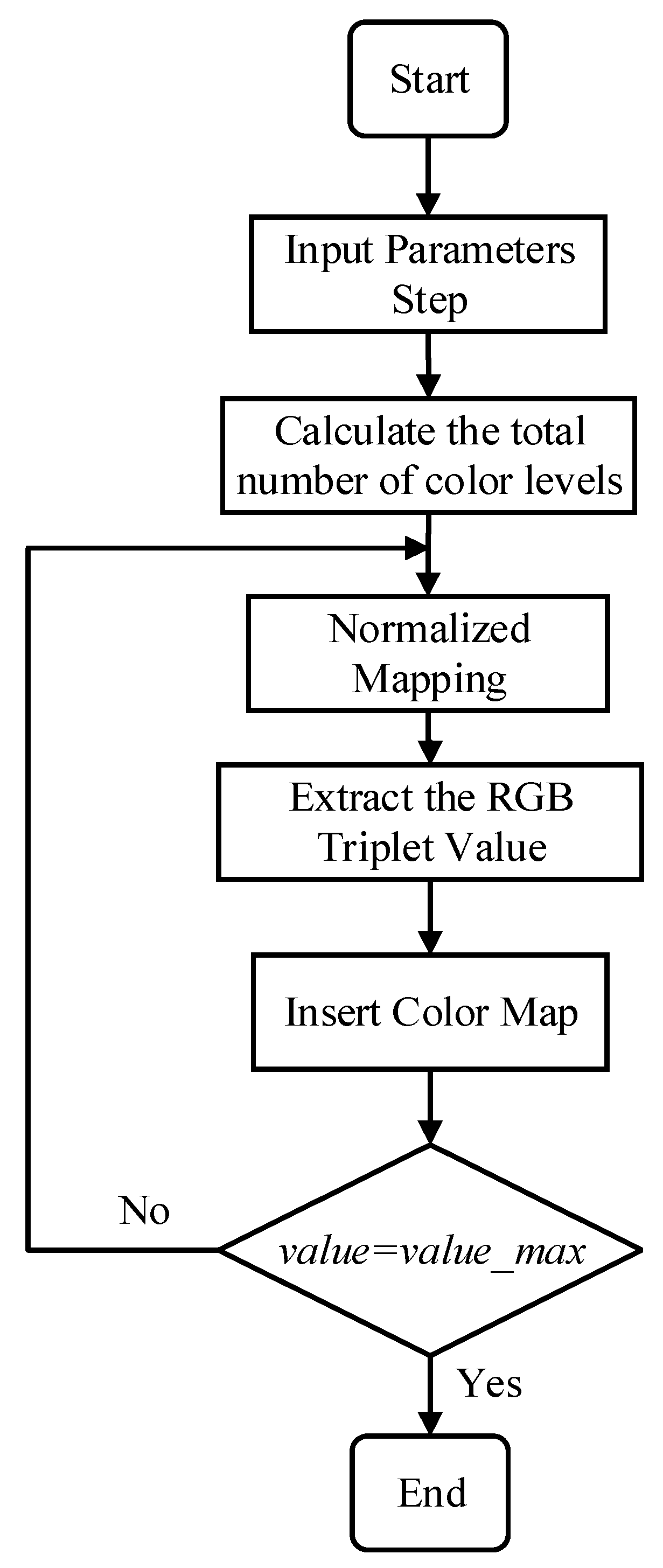
The core element in achieving visualization is the design of the color mapping algorithm. In this paper, the jet colormap is selected for rendering the contour map. The essence of the Jet algorithm is to establish a mapping from the range of the field quantity values to the CIE 1931 color space. The procedure for calculating the color from the field quantity range is shown in Figure 7.
The input data required for Jet color mapping includes the user-defined step size, and the maximum (value_max) and minimum (value_min) values of the desired color range. The color mapping of the contour map is implemented according to the following steps:
(1)
Firstly, an appropriate step size is selected based on the required color range to be displayed. A smaller step size results in a more accurate contour map rendering but correspondingly requires more computational resources.
(2)
Based on the selected step size, the total number of color scales (total_number) for the color bar is calculated using the following Formula (15):
t o t a l s c a l e _ n u m b e r = v a l u e _ m a x - v a l u e _ m i n s t e p + 1
(3)
The colors are then normalized. The color values are mapped to the range [0, 1] using Formula (16).
i n d e x = 0                                                                                                               ( v a l u e < v a l u e _ m i n ) i n d e x = v a l u e - v a l u e _ m i n v a l u e _ m a x - v a l u e _ m i n × t o t a l s c a l e _ n u m b e r i n d e x = t o t a l s c a l e _ n u m b e r                                                 ( v a l u e > v a l u e _ m a x )
(4)
The total number of color scales for the color bar is calculated based on the step size. Subsequently, a cyclic iteration mechanism is used to sequentially extract the corresponding RGB triplet values at step intervals, starting from the minimum value of the color domain. These values are progressively filled into the color bar data structure until the entire value range is covered.
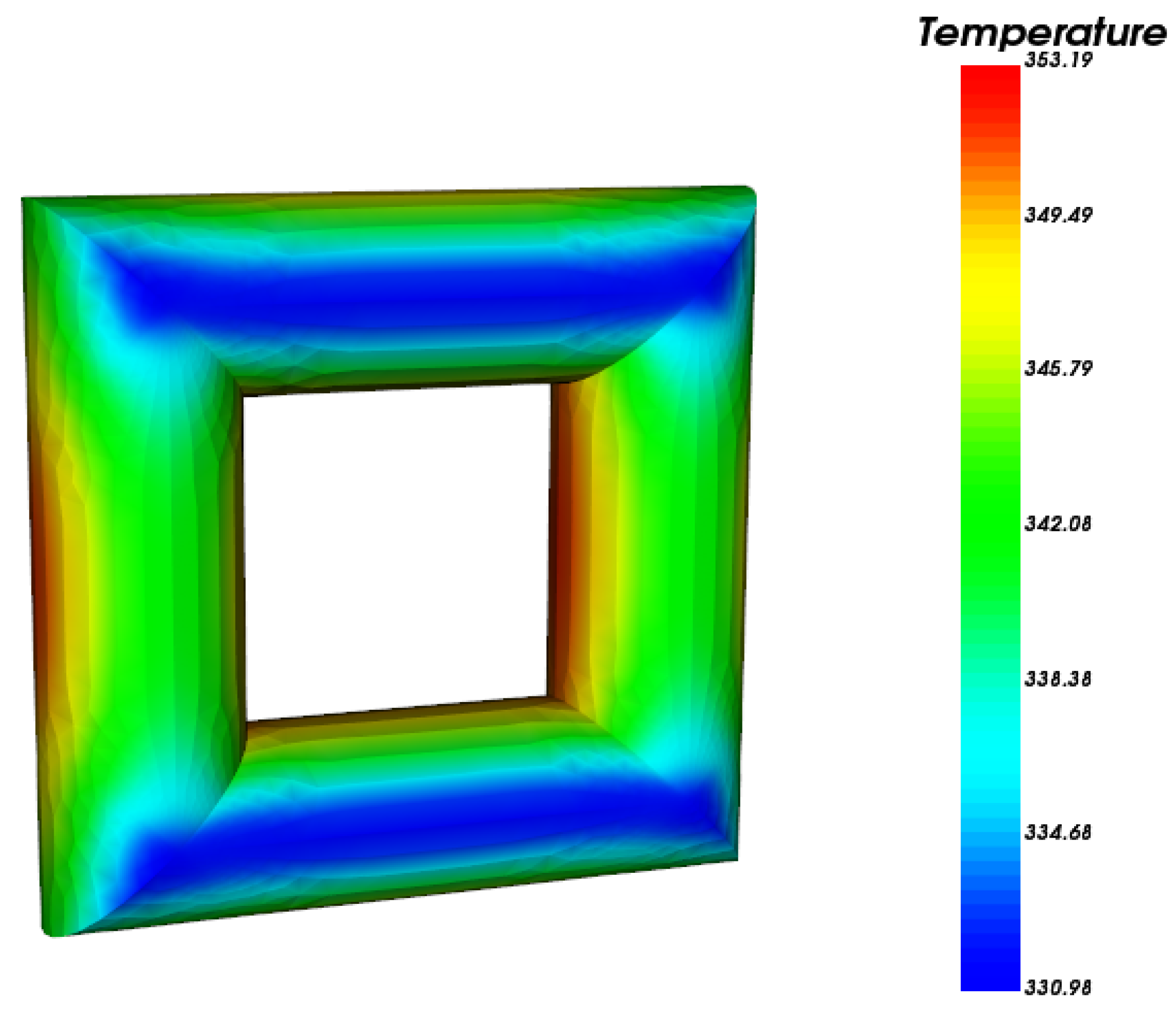
Figure 8 shows the calculation results from the self-developed program, displaying the temperature field distribution of the transformer iron core under no-load operation. Where the number of tetrahedral elements in the mesh discretization is 63,604, and the number of nodes is 12,696. (This corresponds to Figure 4d of the COMSOL calculation results.)
As can be seen from the figure, the center temperature of the core limbs and yokes is greater than their surface temperature. The hotspot location is situated at the center of the core limb because the geometric center is far from the cooling surface, resulting in a longer heat dissipation path and low thermal conductivity perpendicular to the lamination direction. The phenomenon of similar temperatures observed between the top yoke and the bottom yoke is a combined result of the specific structure and thermal boundary conditions: Top Yoke Cooling Advantage: Although hot air rises, the top yoke possesses the most open upper cooling surface, which allows heat to be efficiently dissipated to the environment via radiation and free convection. This high dissipation efficiency offsets the influence of the rising hot air it is exposed to Bottom Yoke Cooling Limitation: The bottom surface of the lower yoke is typically close to the support structure, resulting in relatively limited heat dissipation efficiency.
To verify the accuracy of the self-programmed calculation results, as well as the required computation time and resources, ten nodes were selected. The temperature values calculated by the self-programmed program were compared with those calculated by the COMSOL software in Section 3.1, as shown in Table 1. The comparison of the time and resources consumed is shown in Table 2.
As seen from the tables, the absolute error between the self-programmed calculation results and the COMSOL software results is within 0.5 K, demonstrating excellent consistency. Compared to the simulation time consumed by the COMSOL commercial software 5 min 19 s, the self-programmed program developed in this study only requires 1 min 52 s to complete the calculation, representing a 46.89% reduction in computation time. Regarding memory resource consumption, the self-programmed program only occupies 436.8 MB of memory, while the COMSOL solver occupies 2.42 GB, demonstrating an 82.37% reduction in memory usage. The results indicate that the self-programmed thermal field program significantly improves computational efficiency while maintaining the required calculation accuracy, thus substantially reducing the demand for hardware resources. In terms of versatility, commercial software often requires complex re-modeling and parameter setup procedures when calculating transformers with different structural parameters. Our self-developed program exhibits high parametric adaptability: it can rapidly accommodate new transformer models by simply modifying the material parameters, geometric parameters, and boundary conditions in the program’s input files.

4. Validation of Transformer Prototype Temperature Rise Test

To validate the accuracy of the self-developed program in calculating the transformer iron core temperature field, an experimental platform was set up. Temperature measurement points were arranged inside the transformer iron core to conduct temperature measurements.

4.1. Experimental Principles and Apparatus

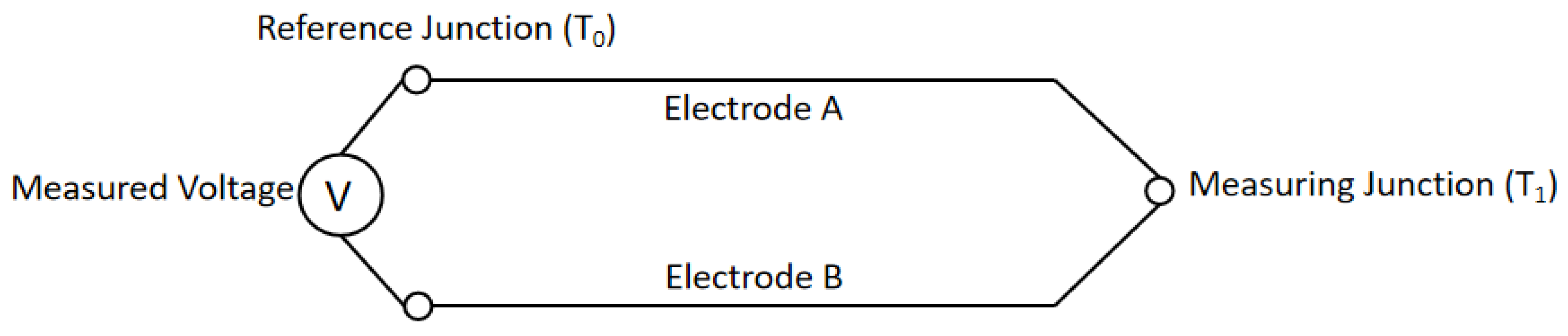
In the temperature rise test, temperature measurements inside the transformer iron core are primarily realized by utilizing thermocouple wires. As a commonly used temperature sensing element, its operating principle is based on the Seebeck effect. When two conductors of different compositions are connected at their ends to form a closed circuit, a thermoelectric current will be generated within the circuit if there is a temperature difference between the two junctions. A thermocouple can directly measure temperature and convert the measured temperature signal into a thermoelectromotive force signal, which is then further converted into the actual temperature value of the measured medium by means of an electrical instrument.
Its working principle is shown in Figure 9. A and B are two dissimilar conductors forming a closed circuit. When the two ends of these two conductors are connected and subjected to different temperatures, an electromotive force, known as the thermo-EMF, is generated. The resulting electromotive force is composed of the contact electromotive force and the temperature difference electromotive force of the conductors. At this point, one junction is referred to as the measuring junction or hot junction, with temperature T1; the other junction is called the reference junction or cold junction, with temperature T0.
In a closed circuit, the specific numerical value of the thermo-EMF primarily depends on the type of conductor materials forming the thermocouple and the temperature conditions at the two junctions, and is independent of the thermocouple’s shape characteristics or dimensional specifications. Given a determined pair of conductor materials, the thermo-EMF can be uniquely expressed by the temperatures T1 and T0 at the two junctions. In the practical application of thermocouple temperature measurement, since the temperature of the cold junction (i.e., the reference junction) can be maintained relatively constant, the resulting thermo-EMF depends solely on the temperature of the hot junction (i.e., the measuring junction). Based on this principle, temperature measurement can be achieved simply by measuring the magnitude of the thermo-EMF. The experimental equipment used in the test is shown in Table 3.

4.2. Experimental Design

Single-Phase Two-Limb Transformer
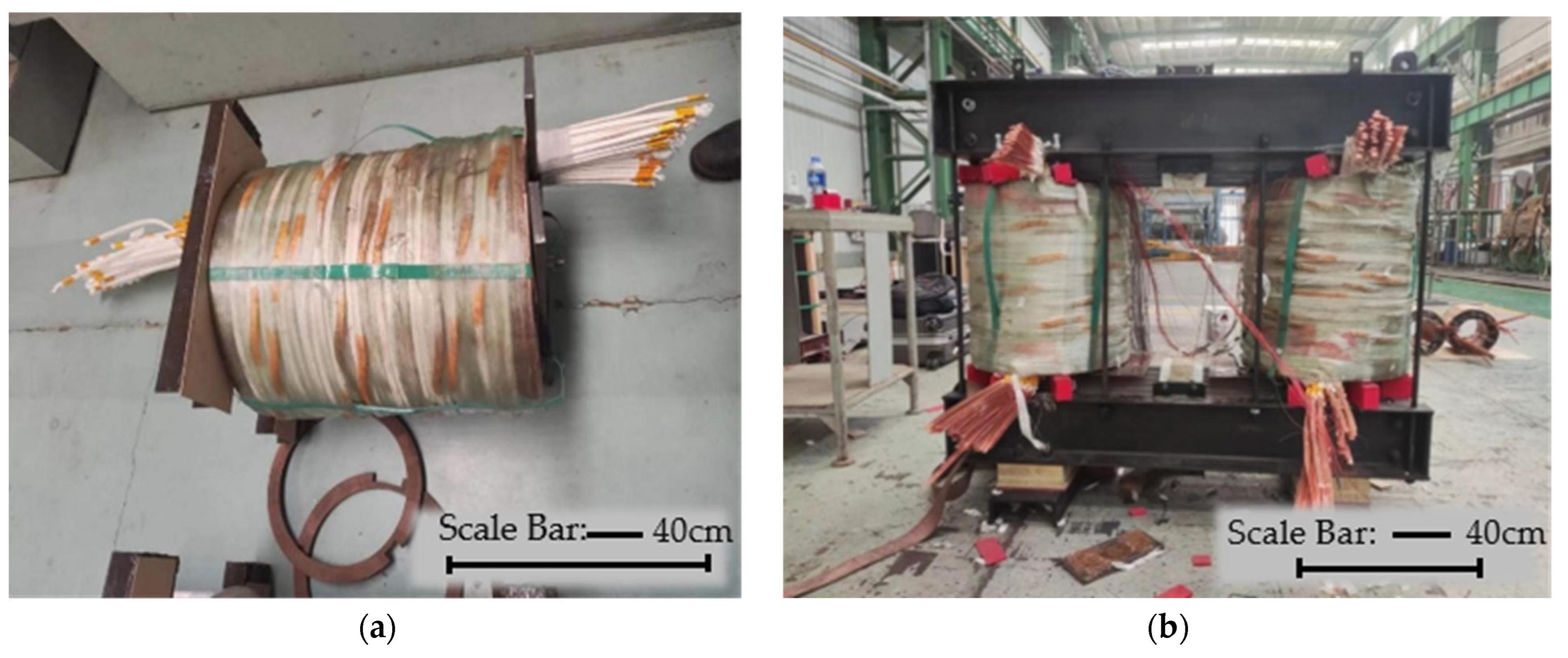
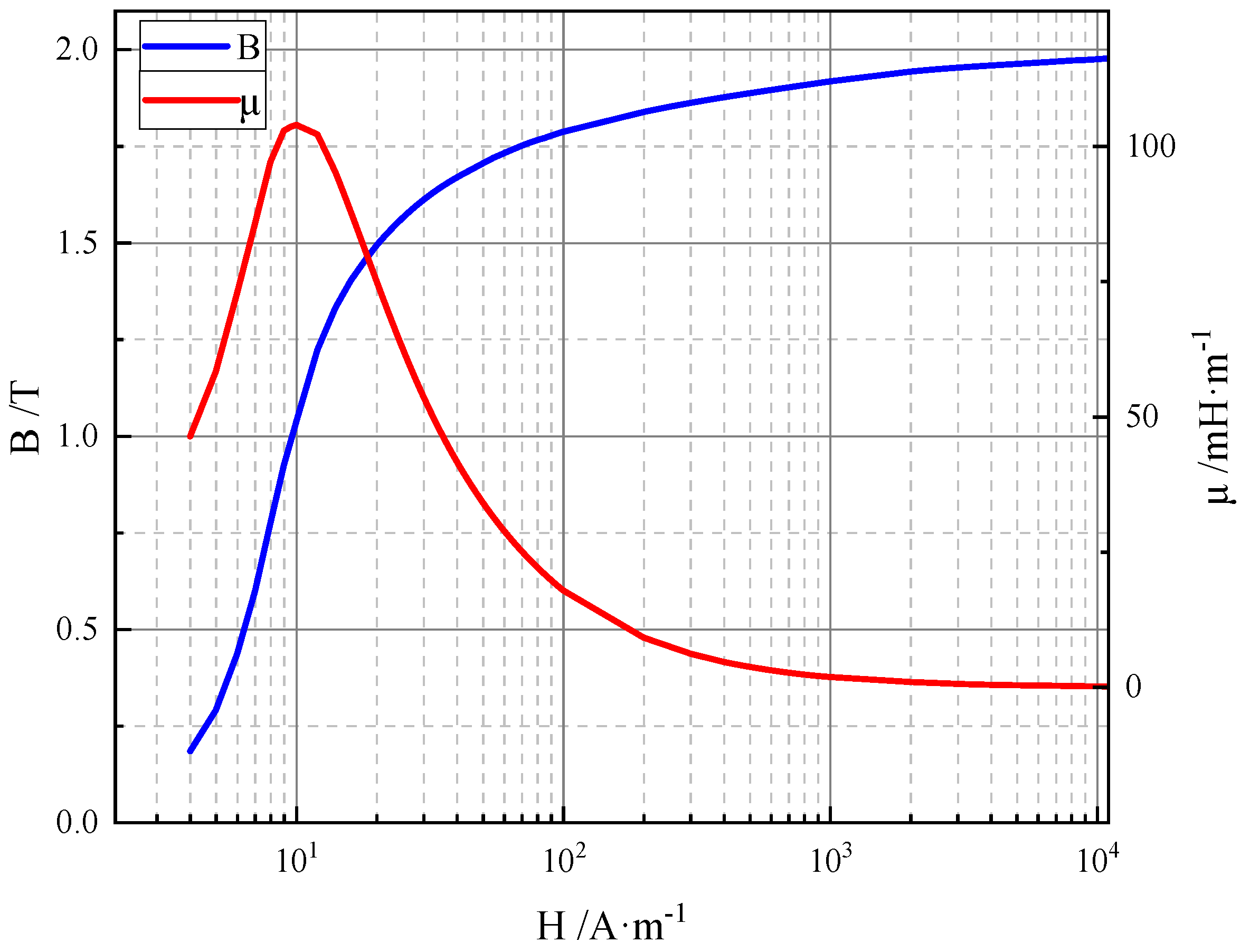
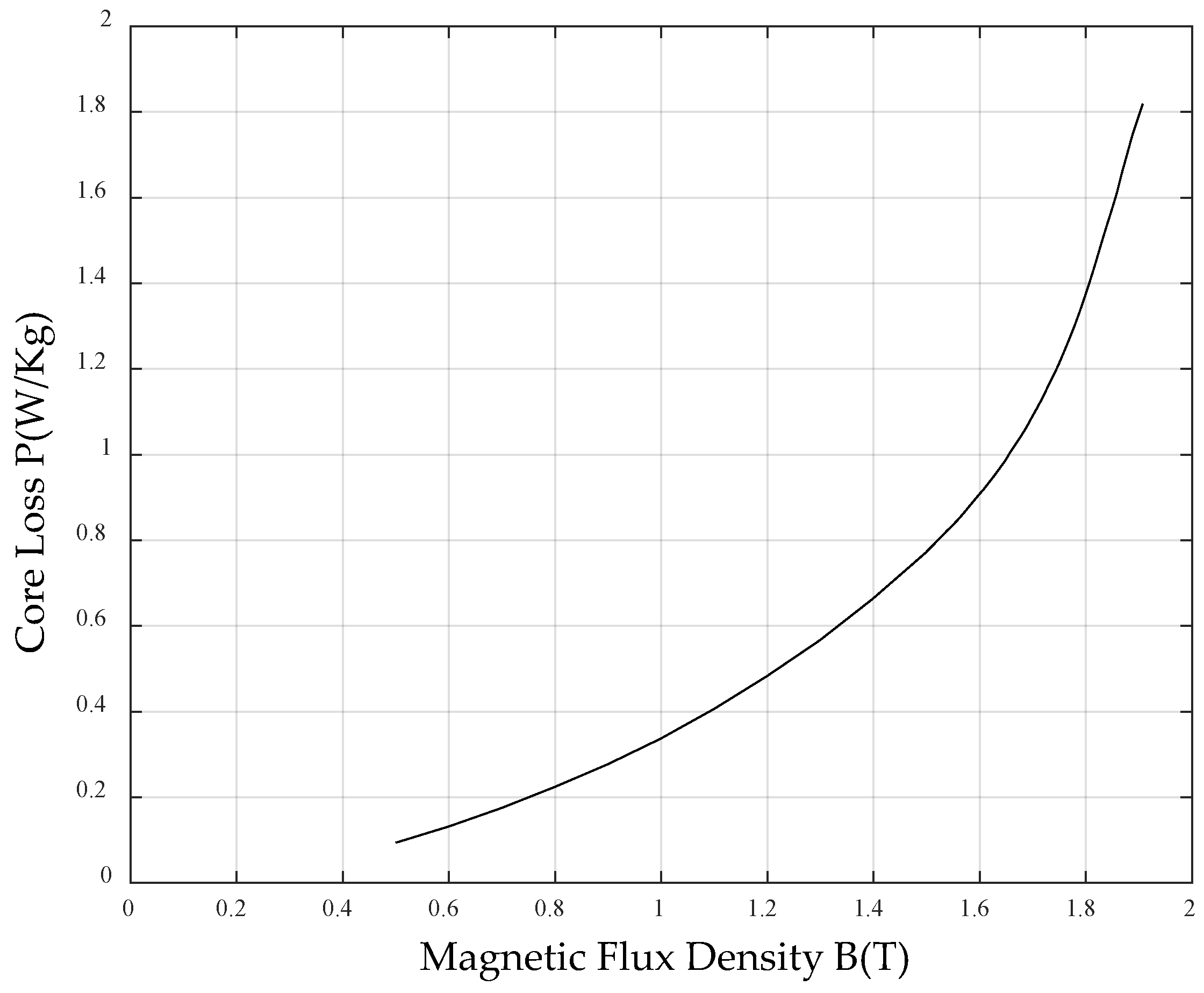
The designed transformer is a single-phase two-limb transformer with a rating of 380 V to 220 V. The physical object of the transformer is shown in Figure 10. The core laminations are made of 27QG120 type silicon steel sheets. The magnetization curve and the B-P curve for this type of silicon steel sheet are shown in Figure 11 and Figure 12, respectively.
(2)
Thermocouple Placement
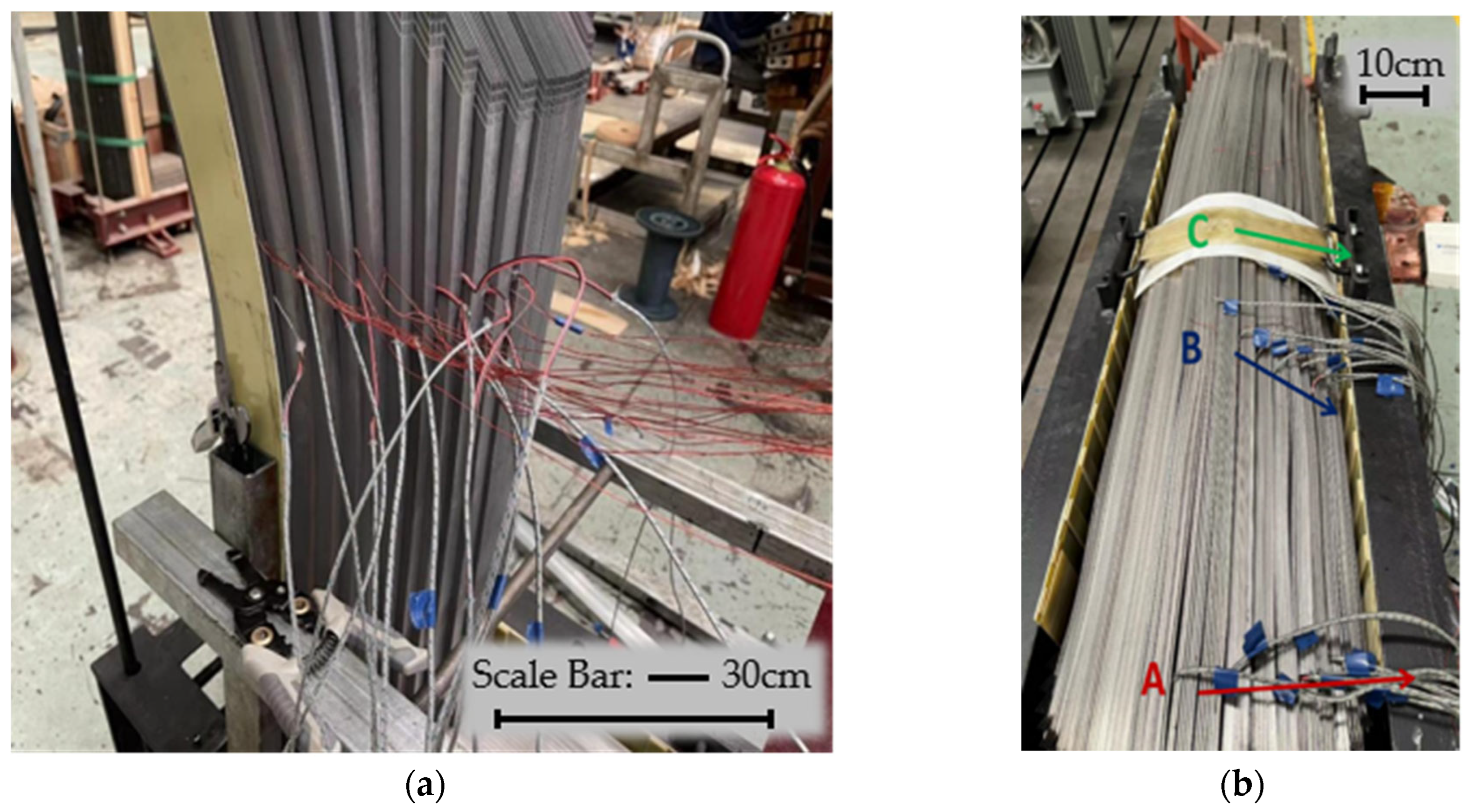
Thermocouple Placement For measuring the iron core temperature field, thermocouples were pre-installed on the surface of the iron core. Considering that the iron core exhibits a non-uniform temperature distribution with significant spatial gradients (specifically the temperature difference between the core center and surface), the measurement results are sensitive to the sensor positioning. To eliminate measurement errors caused by positioning deviations, the temperature inside the laminations was measured using the pre-embedding method, where thermocouples were embedded during the process of stacking the laminations. This method ensures that the thermocouples are securely fixed at the precise geometric coordinates, guaranteeing strict correspondence with the simulation nodes.
A total of 16 thermocouple probes (1–16) were placed in two rows in the iron core leg region, arranged uniformly and staggered axially within the 1st, 2nd, 3rd, 4th, 5th, 6th, 7th, 8th, and 9th layers of laminations. The lower row was dedicated to measuring the temperature at the center of the iron core leg, and the upper row measured the temperature at the surface of the iron core leg. A total of 18 thermocouple probes were placed in two rows in the yoke region, with each probe placed at the center of a pole. One row was located at the center of the yoke (C1–C9), and the other row was placed at the one-quarter position of the yoke (B1–B9). A total of 10 thermocouple probes (A1–A10) were placed in one row at the iron core joints. Additionally, two thermocouple probes (D1–D2) were placed near the iron core using a wooden support frame to measure the ambient temperature around the transformer. The installation positions of the temperature measurement wires are shown in Figure 13. During the experiment, it was found that wires in Group B, wires 4, 9, A2, A4, C6, and C7 failed. These sensors exhibited obvious fault signatures, such as open-circuit readings or values that were physically inconsistent with adjacent measurement points (e.g., showing no temperature rise or erratic fluctuations). Consequently, this portion of invalid data was excluded during data acquisition and analysis to ensure accuracy.
A total of 46 K-type thermocouples were used for the experiment. These K-type thermocouples were connected to temperature acquisition cards, which then transmitted the data via the RS485 interface to a converter before being connected to a computer for real-time monitoring and recording of temperature change information. The thermocouples transmitted the collected thermal current information in real-time to three temperature acquisition cards, which were then connected directly to the computer via a communication converter.
The temperature rise test measurements were primarily conducted in accordance with two standards: GB1094.2-1996 [31] and GB 6450 [32]. The temperature rise test curve exhibits a high rate of change in the initial period, followed by a decreasing rate that gradually stabilizes. Therefore, during measurement point collection, the time interval was smaller during the first 1 to 2 h (selected to be 5 to 10 min) and then increased to 20 min after the first 1 to 2 h. According to the national standard (GB), the criterion for judging temperature rise stability for dry-type transformers is when the temperature change is less than 2 K over a period of one hour.

4.3. Experimental Results

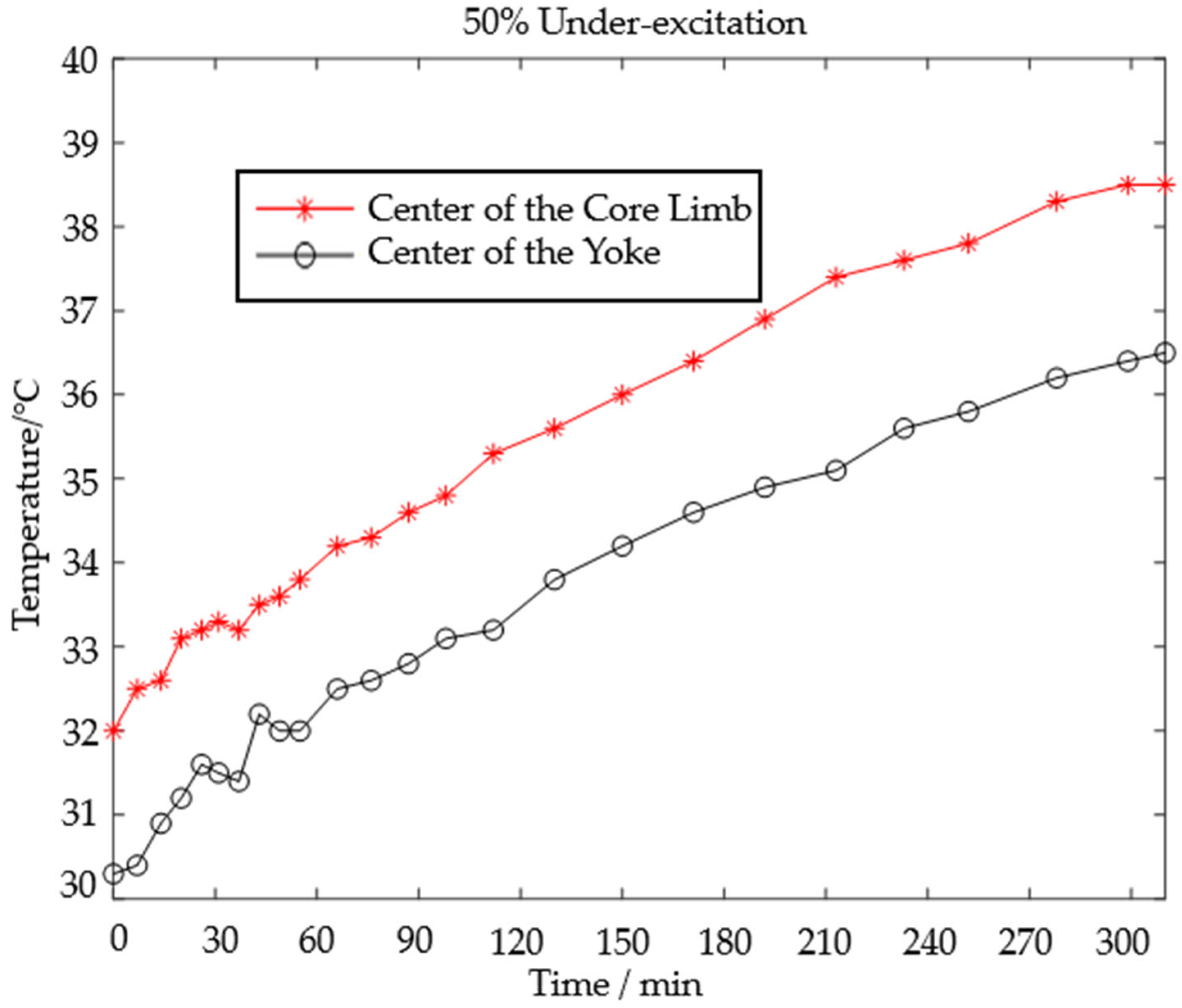
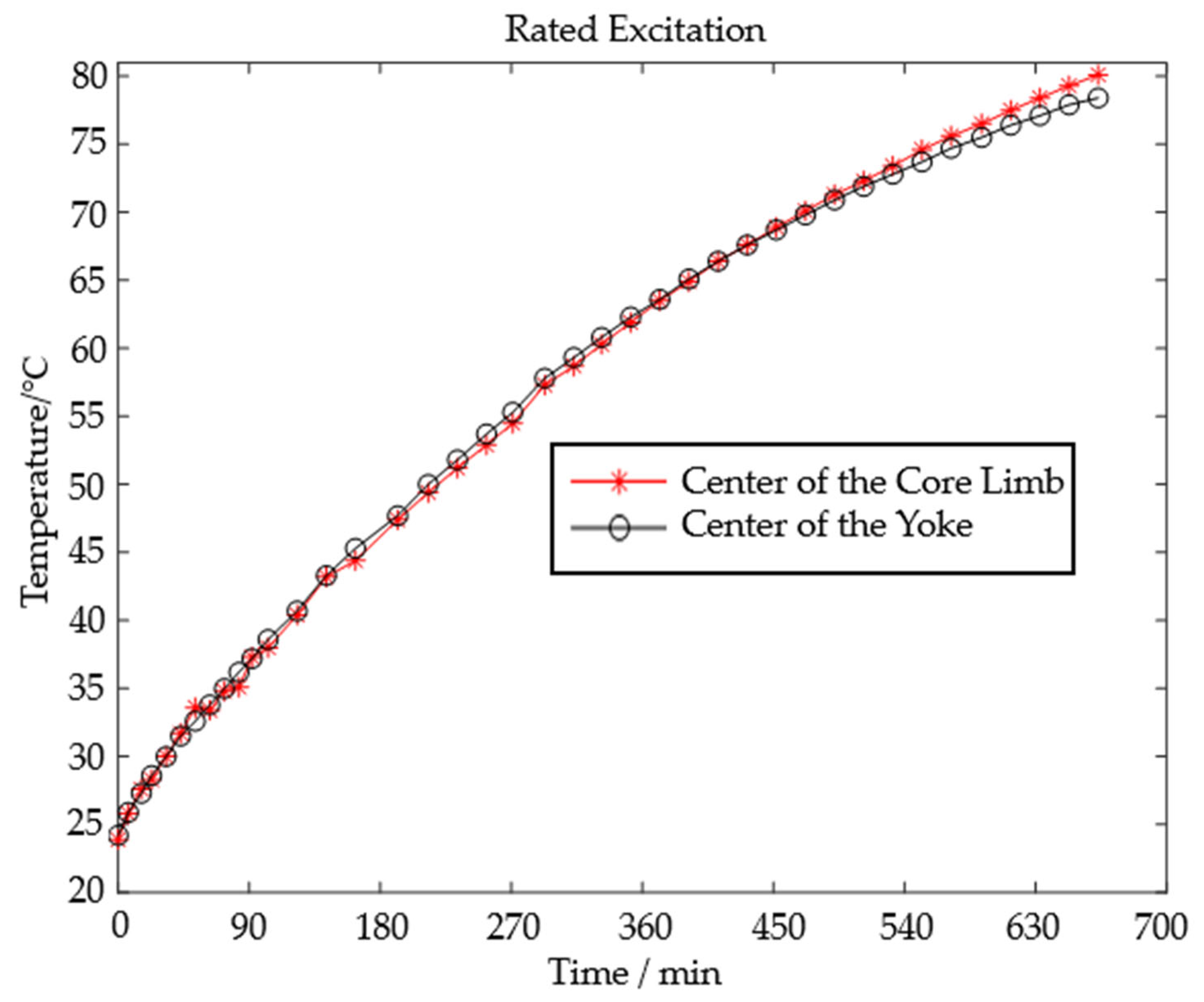
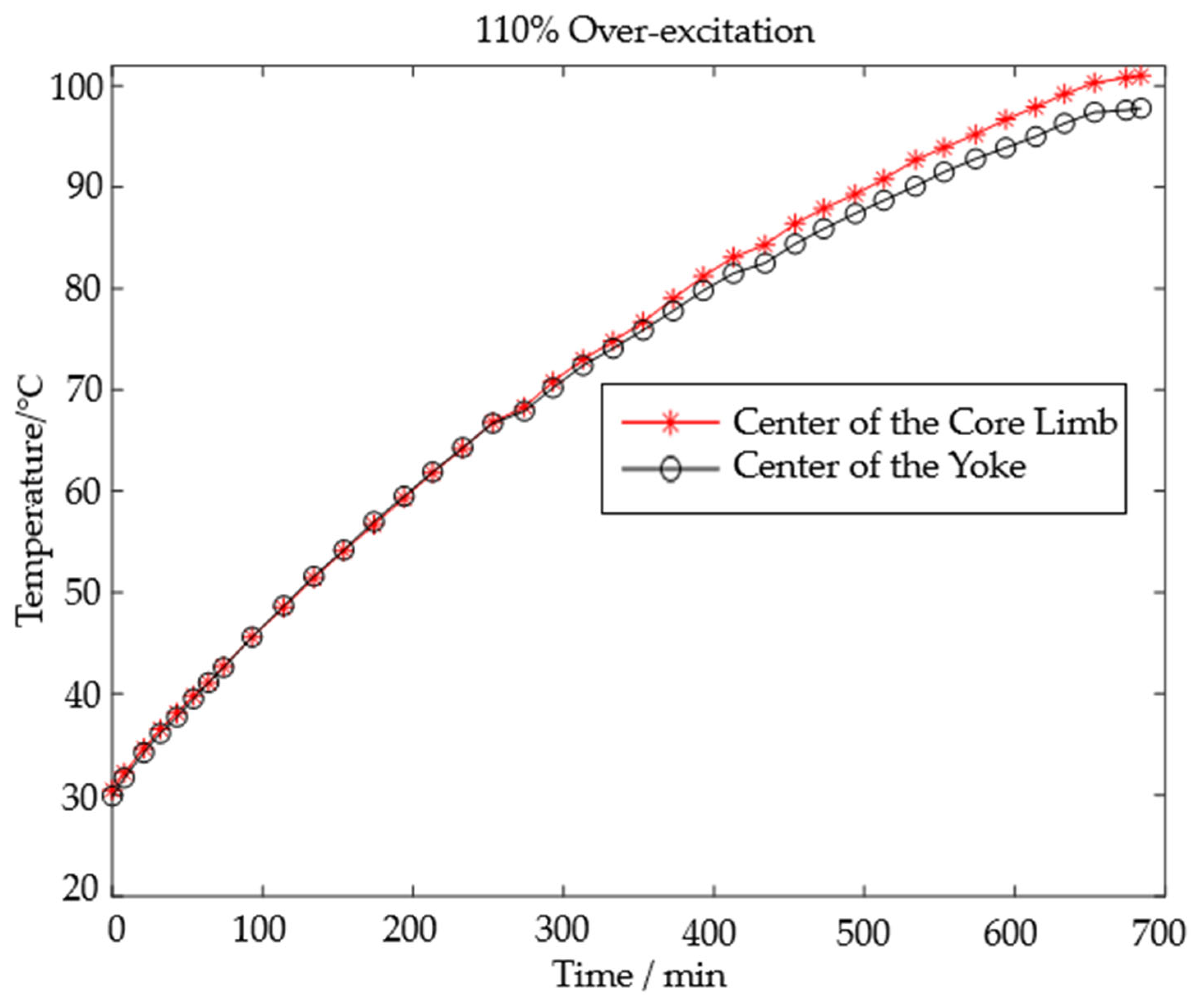
The temperature field measurement experiment involved three sets of no-load tests under different excitation conditions: 50% under-excitation no-load, rated excitation no-load, and 110% over-excitation no-load states. The under-excitation temperature rise test lasted for 310 min, the rated excitation temperature rise test lasted for 673 min, and the over-excitation temperature rise test lasted for 684 min. Figure 14, Figure 15 and Figure 16 show the temperature change curves for the iron core leg center and the yoke center, where the red curve represents the iron core leg center and the black curve represents the yoke center.
It should be noted that due to the soldering of the copper bars prior to the experiment, the transformer was dried for 24 h. Consequently, there was residual heat within the iron core at the start of the no-load under-excitation temperature rise test. Therefore, the starting temperatures shown in Figure 12 are different, which does not affect the final temperature rise value.
Based on the experimental results, the experimental temperature rise for the iron core leg center (1) was 16.1 °C and for the yoke center (C1) was 14.1 °C under the 50% under-excitation condition. Under the rated excitation condition, the experimental temperature rise for the iron core leg center (1) was 54.0 °C and for the yoke center (C1) was 52.3 °C. Under the 110% over-excitation condition, the experimental temperature rise for the iron core leg center (1) was 73.4 °C and for the yoke center (C1) was 70.2 °C. The experiment captured the temperature changes for every measurement point during the three temperature rise processes. The specific data will be presented in the subsequent data comparison section and will not be listed repeatedly here.
Analyzing the experimental data from the transformer temperature rise test results, the following conclusions can be drawn:
(1)
The temperature rise increases as the high-voltage side input voltage increases under under-excitation, rated, and over-excitation conditions.
(2)
In the no-load test, the temperature rise exhibits a trend of rapid increase followed by a slower rate, gradually stabilizing. The thermal hot spot temperature of the iron core appears at the center of the iron core leg.
(3)
Under rated conditions, the temperature rise at the center of the iron core is approximately 6 °C higher than that on the surface.
(4)
The maximum temperature rise occurs at the maximum pole of the iron core, and the iron core leg center and the yoke center are the two locations with the most generated heat.

4.4. Comparison of Self-Developed Program Results and Experimental Data

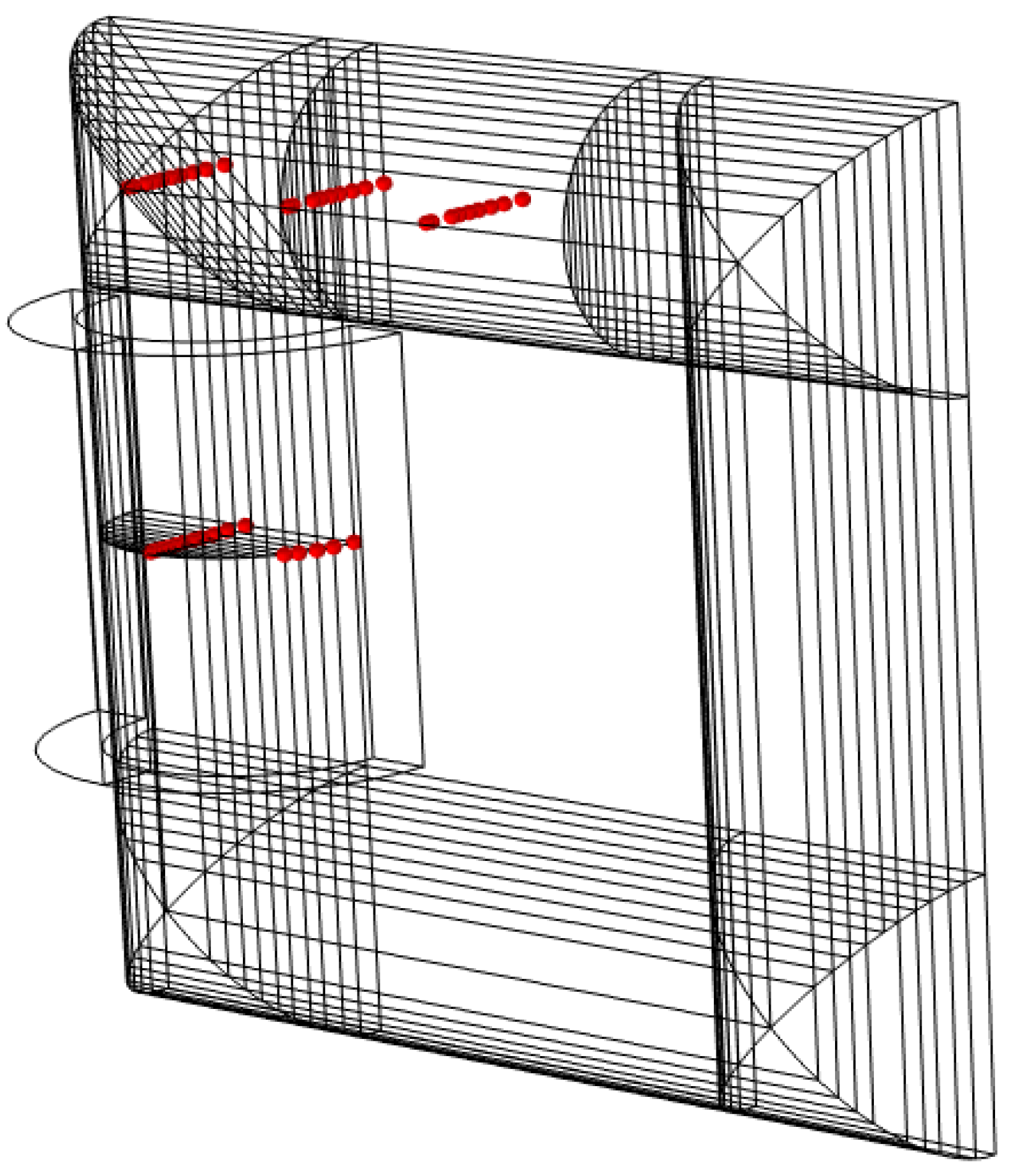
Due to the structural symmetry of the transformer, the temperature field of the transformer can be measured by placing a relatively small number of thermocouple measurement points. Figure 17 illustrates the schematic locations of the temperature measurement points on the model: two sets of temperature wires were placed on the upper yoke, one set of temperature wires each were placed inside and on the surface of the core leg, and one set of temperature wires were placed at the iron core lamination joints.
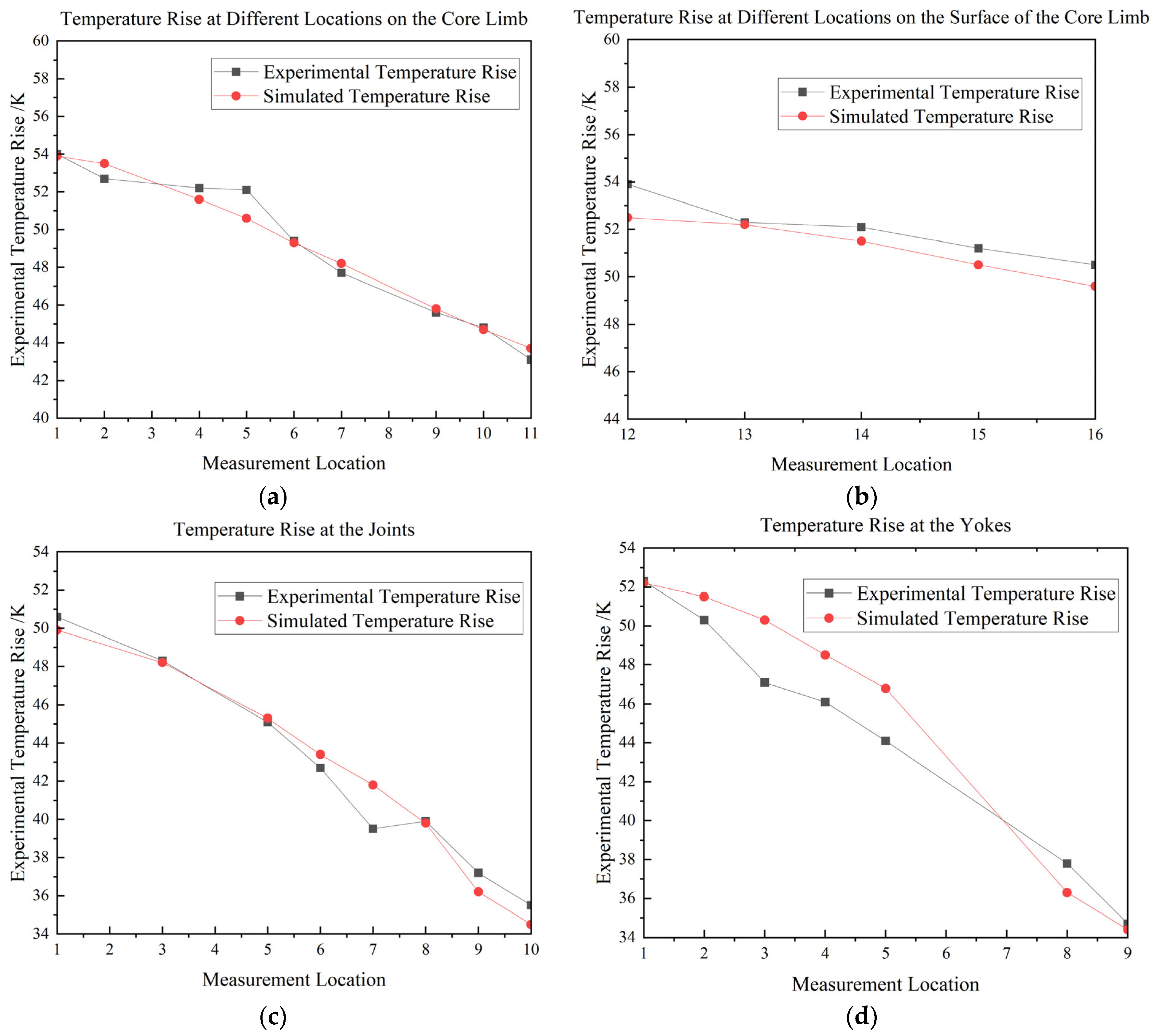
By comparing the experimental measurement data with the simulation model, the temperature distribution trend is consistent with the experimental results. Specific points were selected on the transformer core leg and yoke, respectively, and the temperature rise at these points was compared, with the results shown in Table 4. It can be seen that only the measurement point C3 has an absolute error greater than 3 °C; the experimental values and simulation values for most measurement points agree very well. To provide a more intuitive analysis of the experimental results, a comparison chart showing the experimental and simulated values at various locations is presented in Figure 18.
The experimental hot spot temperature is located at the center of the iron core leg, with a temperature rise of 54.0 °C; the simulated hot spot temperature is also at the center of the iron core leg, with a temperature rise of 53.9 °C. This demonstrates that the results from the self-developed program are consistent with the experimental results, with small errors, verifying that the self-developed Finite Element calculation program accurately calculates the temperature field.

5. Conclusions

This chapter primarily focused on the fundamental principles, implementation roadmap, program development, and calculation procedure for the transformer iron core temperature field calculation based on the Finite Element Method. It involved performing the temperature field calculation for a 380 V to 220 V single-phase two-limb transformer using the self-developed program, and setting up a temperature rise experimental platform using thermocouple measurement to validate the effectiveness of the program. The specific research contents of this paper are summarized as follows:
(1)
The basic principles of the three-dimensional steady-state temperature field were introduced. Starting from the temperature field governing equations, the Finite Element equations applicable to transformer temperature field calculation were derived, providing support for the subsequent program implementation.
(2)
A C++ based Finite Element Method (FEM) program for temperature field calculation was completed, integrating data post-processing and visualization display. The temperature field calculation for a single-phase, two-limb transformer was car-ried out using the self-developed program and compared with COMSOL calcula-tion results. The calculation results were fundamentally consistent, while the computation time and memory usage were reduced by 46.89% and 82.37%, re-spectively.
(3)
A transformer temperature rise experimental platform was established. A single-phase two-limb dry-type transformer was designed and manufactured, and a temperature rise measurement experiment based on thermocouple sensing was designed. This experiment measured the internal temperature field of the transformer iron core under no-load operation, and the comparison between the program calculation results and the experimental measured data further validated the effectiveness of the self-developed temperature field calculation program.

Author Contributions

Conceptualization, Z.C., Z.H. and S.W.; Methodology, Z.C., Z.H. and S.W.; Software, Z.C. and Z.H.; Validation, Z.C. and Z.H.; Formal analysis, Z.C. and Z.H.; Investigation, Z.C.; Resources, S.W.; Data curation, Z.C.; Writing—original draft, Z.C.; Writing—review & editing, Z.C. and S.W.; Visualization, Z.C. and Z.H.; Supervision, S.W.; Project administration, S.W.; Funding acquisition, S.W. All authors have read and agreed to the published version of the manuscript.

Funding

This research was supported by the National Key Research and Development Program of China (No. 2021YFB2401700).

Data Availability Statement

The original contributions presented in this study are included in the article. Further inquiries can be directed to the corresponding author.

Acknowledgments

The authors gratefully acknowledge the support of the School of Electric Power Engineering at Xi’an Jiaotong University.

Conflicts of Interest

The authors declare no conflict of interest.

Appendix A

Derivation of the Finite Element Equation for the Three-Dimensional Steady-State Temperature Field

The derivation of the finite element equation for the three-dimensional steady-state temperature field should begin with the temperature field control equation. The temperature T(x,y,z) within the region under study is a function of the spatial coordinates, thus constituting the temperature field. The spatial distribution of temperature satisfies Fourier’s Law of Heat Conduction and can be described by the following partial differential equation:
x k x T x + y k y T y + z k z T z + Q = ρ c T t
where ρ —Material density/kg·m−3; k i —Thermal conductivity coefficient along the i direction/W·m−1·K−1; Q—Heat source power/W·m−3.
To solve this differential equation using a numerical method, we employ the weak form of the differential equation. This involves converting the differential equation into an integral equation, which lowers the requirement for the continuity and regularity of the solution, thus facilitating the derivation operations. The variational principle can be transformed into finding a function that minimizes a functional, and this functional is the integral form equivalent of the differential equation. Here, the variational principle is used for the derivation. Thus, the control equation and boundary conditions can be derived through the variational principle into the following equivalent integral form:
Ω δ T x k x T x + y k y T y + z k z T z + Q d Ω S 2 δ T k x T x l x + k y T y l y + k z T z l z + q d S S 3 δ T k x T x l x + k y T y l y + k z T z l z + h ( T T ) d S
Here, δ T represents a small variation in temperature. Since the temperature variation is zero on the First Type Boundary Condition, this term is excluded in Equation (A2). After obtaining the weak form of the differential equation, to perform subsequent solving using the Finite Element Method, it is necessary to discretize the equation and introduce the corresponding shape functions. This process ultimately yields the following classic matrix form:
Ω δ I ( T ) d Ω
To facilitate the subsequent derivation, the product rule is introduced here, which is used to calculate the derivative of the product of two differentiable functions. For two functions, g and h, both of which are differentiable functions of x, the derivative of their product gh with respect to x is given by:
g h x = g x h + g h x
Then, by applying the product rule of differentiation, the following equality can be obtained:
x k x δ T T x = k x δ T x T x + δ T x k x T x
Here is the translation for the sentence introducing the rearrangement of Equation (A5):
δ T x k x T x = x k x δ T T x δ T x k x T x
This allows us to rewrite the first integral term in Equation (A2) as
Ω δ T x k x T x + y k y T y + z k z T z + Q d Ω V x k x δ T T x + y k y δ T T y + z k z δ T T z d V V δ T x k x T x + δ T y k y T y + δ T z k z T z d V + V δ T Q d V
To further simplify the equation by converting the volume integral into a surface integral on the boundary, the Divergence Theorem must be introduced. The Divergence Theorem states that the total sum of the sources and sinks of a vector field within a volume is equal to the flux of that vector field through the boundary of that volume. Its mathematical expression is:
V F d V = S F d S
where F is a vector field. It reveals the inherent connection between the local properties (divergence) and the global properties (flux) of the vector field within its domain. By applying the Divergence Theorem, the first integral term can be transformed into a surface integral on the boundary, as expressed by:
V x k x δ T T x + y k y δ T T y + z k z δ T T z d V = S k x δ T T x + k y δ T T y + k z δ T T z d S
At this point, the Second Type and Third Type Boundary Conditions can be transformed as
S 2 δ T ( q ) d S = S 2 δ ( T q ) d S
S 3 δ T [ h ( T T ) ] d S = S 3 δ [ h 2 ( T T ) 2 ] d S
For the second integral term in Equation (A2), the following equality is used for simplification:
k x δ T x T x = δ [ 1 2 k x T x 2 ]
Then, this volume integral can be rewritten as
V δ T x k x T x + δ T y k y T y + δ T z k z T z d V = V δ 1 2 k x T x 2 + 1 2 k y T y 2 + 1 2 k z T z 2 d V
Similarly, the third integral term in Equation (A2) can also be rewritten as
V δ T Q d Ω = V δ T Q d Ω
Through the transformations described above, the variational operator can be moved outside the integral sign, and the expression can be simplified. The original integral can then be transformed into the following form:
V δ 1 2 k x T x 2 + 1 2 k y T y 2 + 1 2 k z T z 2 T Q d V S 2 δ ( T q ) d S S 3 δ [ h 2 ( T T ) 2 ] d S
Then, the functional integral equation for this problem is obtained as
I = V 1 2 k x T x 2 + k y T y 2 + k z T z 2 2 T Q d V + s 2 T q d S + s 3 h 2 ( T T ) 2 d S
The resulting functional integral equation can be expressed in matrix form as follows:
I = V 1 2 g T D g 2 T Q d V + s 2 T q d S + s 3 h 2 ( T 2 2 T T + T 2 ) d S
where the introduced matrix [ g ] is analogous to the geometric matrix in stress–strain problems, and it is the vector composed of the temperature derivatives with respect to the coordinate directions. The matrix [ D ] is analogous to the elastic matrix in stress–strain problems. This matrix describes the anisotropy of the material’s thermal conductivity. In this study, to account for the difference in heat transfer capability due to the laminated structure of the iron core, the values on the main diagonal of the matrix are taken as the thermal conductivity coefficients of the material in their respective directions. Its mathematical expression is as follows:
g = T x T y T z , D = k x k y k z
To obtain the temperature expression within each element, we introduce the shape function matrix [N] for the element. This matrix allows for the expression of the field quantity value at any point within the element, based on the field quantity values at a finite number of interpolation nodes. To perform the strain calculation on the element we need to derive the derivative matrix [B] based on the shape function matrix. Thus, after discretizing the functional integral, the temperature at any point within an element of the studied region can be expressed as
T = N T , g = B T
For a tetrahedral element, the following applies:
T x , y , z = N i N j N m N n T i T j T m T n
T x T y T z = N i x N j x N m x N n x N i y N j y N m y N n y N i z N j z N m z N n z T i T j T m T n
The discretized functional integral expression is as follows:
I = e T e T V e 1 2 B e T D e B e d V + S 3 e h 2 N e T N e d S T e + e V e Q e N e d V + S 2 e q e N e d S S 3 e h T N e d S T e + e S 3 e h 2 T 2 d S
By taking the partial derivative with respect to the temperature vector and finding the minimum value of the functional equation, the Finite Element equation is obtained in the following form:
I T = e V e B e T D e B e d V + S 3 e h N e T N e d S T e + e V e Q e N e T d V S 2 e q e N e T d S + S 3 e h T N e T d S = e k e T e F e = 0
By assembling the equations for each element node, we define the following global matrices:
K = e k e , F = e F e
Then, the Finite Element equation in the following form can be obtained:
K T = F

References

  1. Ministry of Industry and Information Technology General Office; State Administration for Market Regulation General Office; National Energy Administration Comprehensive Department. Transformer Energy Efficiency Improvement Plan (2021–2023); Ministry of Industry and Information Technology General Office: Beijing, China; State Administration for Market Regulation General Office: Beijing, China; National Energy Administration Comprehensive Department: Beijing, China, 2020.
  2. Zhang, Y.Y.; Liao, R.J.; Yang, L.J.; Meng, F.J.; Li, J.Z.; Cheng, H.C. Optimal Power Transformer Overhaul Scheduling Considering Reliability and Economy. Trans. China Electrotech. Soc. 2014, 29, 191–200. [Google Scholar]
  3. Baoding Tianwei Baobian Electric Co., Ltd. Power Transformer Handbook; China Machine Press: Beijing, China, 2014. [Google Scholar]
  4. Darveniza, M.; Saha, T.; Hill, D.; Le, D.J.T.; Le, T.K. Investigations into Effective Methods for Assessing the Condition of Insulation in Aged Power Transformers. IEEE Trans. Power Deliv. 1998, 13, 1214–1223. [Google Scholar] [CrossRef]
  5. Yang, F.; Wu, T.; Hao, H.X.; Liu, Y.J. Fast Update Method of Reduced-Order Model for Transformer Winding Temperature Field Based on Matrix Low-Rank Decomposition. Trans. China Electrotech. Soc. 2025, 40, 1–17. [Google Scholar]
  6. IEC 60076; Power Transformers—Part 7: Loading Guide for Mineral-Oil-Immersed Power Transformers. IEC: Geneva, Switzerland, 2018.
  7. IEEE Std. C57.91-2011-IEEE; Guide for Loading Mineral-Oil-Immersed Transformers. IEEE: New York, NY, USA, 2011.
  8. GB/T 1094.7-2008; Power Transformers—Part 7: Loading Guide for Oil-Immersed Power Transformers. The National Standards of the People’s Republic of China: Beijing, China, 2008.
  9. Lv, P.F.; Pei, D.X.; Shen, D.W. Study on Transient Temperature Measurement Technique Based on K-type Thermocouple. J. Sens. Technol. 2014, 27, 775–780. [Google Scholar]
  10. Wang, X.Y. Transformer Fault and Monitoring; China Machine Press: Beijing, China, 2004; pp. 33–35. [Google Scholar]
  11. Ma, H.Z.; Li, Z. Overheating Fault of Power Transformer and its Comprehensive Diagnosis. High Volt. Eng. 2005, 4, 9–11. [Google Scholar]
  12. Zheng, Z.P.; Zeng, H.S.; Ding, C.J.; Wang, J.Q. Infrared Thermography and Its Application. Infrared Technol. 2003, 25, 96–98. [Google Scholar]
  13. Pervez, A. Multibit Optical Sensor Networking. In Proceedings of the Fiber Optic Sensors: Engineering & Applications, Hague, The Netherlands, 14–15 March 1991; International Society for Optics and Photonics: Bellingham, WA, USA, 1991. [Google Scholar]
  14. Sun, X.G.; Li, Y.H. Review of Infrared Thermal Imager Temperature Measurement Technology. Laser Infrared 2008, 2, 101–104. [Google Scholar]
  15. Swift, G.; Molinski, T.S.; Lehn, W. A Fundamental Approach to Transformer Thermal Modeling. I. Theory and Equivalent Circuit. IEEE Trans. Power Deliv. 2001, 16, 171–175. [Google Scholar] [CrossRef]
  16. Swift, G.; Molinski, T.S.; Bray, R.; Stigant, D.G. A Fundamental Approach to Transformer Thermal Modeling. II. Field Verification. IEEE Trans. Power Deliv. 2001, 16, 176–180. [Google Scholar] [CrossRef]
  17. Susa, D.; Nordman, H. A Simple Model for Calculating Transformer Hot-Spot Temperature. IEEE Trans. Power Deliv. 2009, 24, 1257–1265. [Google Scholar] [CrossRef]
  18. Huang, X.R. Study on Winding Temperature Distribution of Transformer Based on Thermal Circuit Model. Master’s Thesis, Hebei University of Technology, Tianjin, China, 2021. [Google Scholar]
  19. Chen, S.; Sheng, G.H.; Zhang, L.J.; Ma, T.; Guo, X. Fast Simulation Method for Temperature Field Distribution of Dry-Type Transformer Based on Winding Equivalent Thermal Parameters. High Volt. Eng. 2025, 51, 97–109. [Google Scholar]
  20. Wen, W.Z. Temperature Field Analysis of Double Redundancy Permanent Magnet Synchronous Motor Based on Equivalent Thermal Network Method. Master’s Thesis, Tianjin University, Tianjin, China, 2018. [Google Scholar]
  21. Zheng, Z. Two-Dimensional Fluid-Thermal Coupled Field Analysis and Verification of Oil-Immersed Transformer Winding Based on Finite Element Method. Master’s Thesis, North China Electric Power University, Beijing, China, 2020. [Google Scholar]
  22. Torriano, F.; Chaaban, M.; Picher, P. Numerical study of parameters affecting the temperature distribution in a disc-type transformer winding. Appl. Therm. Eng. 2010, 30, 2034–2044. [Google Scholar] [CrossRef]
  23. Torriano, F.; Picher, P.; Chaaban, M. Numerical investigation of 3D flow and thermal effects in a disc-type transformer winding. Appl. Therm. Eng. 2012, 40, 121–131. [Google Scholar] [CrossRef]
  24. El Wakil, N.; Chereches, N.C.; Padet, J. Numerical study of heat transfer and fluid flow in a power transformer. Int. J. Therm. Sci. 2006, 45, 615–626. [Google Scholar] [CrossRef]
  25. Santisteban, A.; Delgado, F.; Ortiz, A.; Barranco, A.V.F.; Gómez, J.C.D.S.; Garcia, P.L.R.P. Numerical analysis of the hot-spot temperature of a power transformer with alternative dielectric liquids. IEEE Trans. Dielectr. Electr. Insul. 2017, 24, 3226–3235. [Google Scholar] [CrossRef]
  26. Zhang, Y.B. Research on Magnetic Field and Temperature Field Characteristics of Transformer Based on Field-Circuit Coupling and Thermal-Fluid-Solid Coupled Modeling. Master’s Thesis, South China University of Technology, Guangzhou, China, 2017. [Google Scholar]
  27. Melka, B.; Stebel, M.; Bodys, J.; Kubiczek, K.; Lasek, P.; Rodriguez, G.R.; Garelli, L.; Haida, M.; Palacz, M.; Nowak, A.J.; et al. Effective Cooling of a Distribution Transformer Using Biodegradable Oils at Different Climate Conditions. IEEE Trans. Dielectr. Electr. Insul. 2023, 30, 1557–1565. [Google Scholar] [CrossRef]
  28. Fernando, T.; Lewin, P.; Cao, K.; Tuan, L.A.; Zhou, J.; Darmawan, N.; Chen, J.; Wang, C.; Zhu, X.; Li, Z. Review of insulating liquids for power transformers. IET Gener. Transm. Distrib. 2014, 8, 374–383. [Google Scholar]
  29. Li, Y.J.; Yan, X.X.; Zhang, C.G.; Chen, Y.F.; Ying, W.L. Transformer loss calculation and hotspot prediction based on magnetic-thermal-fluid coupling model. Trans. China Electrotech. Soc. 2020, 35, 4483–4491. [Google Scholar]
  30. Liao, C.; Ruan, J.; Liu, C.; Wen, W.; Du, Z. 3-D coupled electromagnetic- fluid-thermal analysis of oil-immersed triangular wound core transformer. IEEE Trans. Magn. 2014, 50, 8401904. [Google Scholar] [CrossRef]
  31. GB 1094.2-1996; Power Transformers Part 2: Temperature-Rise. China Standards Press: Beijing, China, 1997.
  32. GB/T 6451-2015; Oil-Immersed Power Transformer Technical Parameters and Requirements. China Standards Press: Beijing, China, 2015.
Figure 1. Derivation flow of the finite element equation.
Energies 18 06537 g001
Figure 2. Heat source setting for the temperature field calculation.
Energies 18 06537 g002
Figure 3. Finite element mesh generation for the temperature field.
Energies 18 06537 g003
Figure 4. Figure of the Temperature Field Simulation Results. (a) The Number of Mesh Elements is 2463. (b) The Number of Mesh Elements is 6642. (c) The Number of Mesh Elements is 19051. (d) The Number of Mesh Elements is 63604.
Energies 18 06537 g004
Figure 5. Variation in hotspot temperature with mesh refinement.
Energies 18 06537 g005
Figure 6. Schematic diagram of the temperature field calculation program flow.
Energies 18 06537 g006
Figure 7. Jet color map algorithm.
Energies 18 06537 g007
Figure 8. Figure of the temperature field self-programmed calculation results.
Energies 18 06537 g008
Figure 9. Schematic diagram of thermocouple temperature measurement principle.
Energies 18 06537 g009
Figure 10. Physical diagram of the transformer. (a) Coil winding. (b) Transformer assembly diagram.
Energies 18 06537 g010
Figure 11. Magnetization curve.
Energies 18 06537 g011
Figure 12. Loss curve.
Energies 18 06537 g012
Figure 13. Schematic diagram of temperature sensor installation locations. (a) Thermocouple placement locations on the core limbs. (b) Thermocouple placement locations on the yokes and joints.
Energies 18 06537 g013
Figure 14. Temperature rise curves for the center of the core limbs and the center of the yokes under under-excitation.
Energies 18 06537 g014
Figure 15. Temperature rise curves for the center of the core limbs and the center of the yokes under rated excitation.
Energies 18 06537 g015
Figure 16. Temperature rise curves for the center of the core limbs and the center of the yokes under over-excitation.
Energies 18 06537 g016
Figure 17. Schematic of measurement points in the model.
Energies 18 06537 g017
Figure 18. Comparison chart of experimental and simulated results at each measurement point. (a) Results of Temperature Sensors 1 to 11. (b) Results of Temperature Sensors 12 to 16. (c) Results of Temperature Sensor Group A. (d) Results of Temperature Sensor Group C.
Energies 18 06537 g018
Table 1. Comparison between self-programmed calculation results and COMSOL results.
LocationCOMSOL Calculation Results/KSelf-Programmed Calculation Results/KAbsolute Error/K
1341.82342.110.29
2334.13334.150.02
3351.29351.24−0.05
4350.10350.450.35
5345.61345.890.28
6339.09338.91−0.18
7342.14342.11−0.03
8335.51335.620.11
9337.75337.820.07
10349.80350.120.32
Table 2. Comparison of computation time and memory usage.
Solution MethodComputation TimeMemory Usage
COMSOL Multiphysics5 min 19 s2.42 GB
Self-programmed Solution1 min 52 s436.8 MB
Table 3. Temperature rise test experimental equipment.
Experimental EquipmentQuantity
Single-phase, two-limb Transformer1 unit
Computer1 unit
DM6210-07R0T0S0A16 Data Acquisition Card4 units
K-type Compensated Thermocouple Wire400 m
Temperature Data Acquisition Card Accessory Set1 set
Table 4. Comparison of experimental results and self-programmed temperature rise results.
LocationExperimental Temperature Rise/°CSimulated Temperature Rise/°CAbsolute Error/°C
15453.9−0.1
252.753.50.8
452.251.6−0.6
552.150.6−1.5
649.449.3−0.1
747.748.20.5
945.645.80.2
1044.844.7−0.1
1143.143.70.6
1253.952.5−1.4
1352.352.2−0.1
1452.151.5−0.6
1551.250.5−0.7
1650.549.6−0.9
A150.649.9−0.7
A348.348.2−0.1
A545.145.30.2
A642.743.40.7
A739.541.82.3
A839.939.8−0.1
A937.236.2−1.0
A1035.534.5−1.0
C152.352.2−0.1
C250.351.51.2
C347.150.33.2
C446.148.52.4
C544.146.82.7
C837.836.3−1.5
C934.734.4−0.3
Disclaimer/Publisher’s Note: The statements, opinions and data contained in all publications are solely those of the individual author(s) and contributor(s) and not of MDPI and/or the editor(s). MDPI and/or the editor(s) disclaim responsibility for any injury to people or property resulting from any ideas, methods, instructions or products referred to in the content.