1. Introduction
The global transition from conventional fossil-fuel-based power generation to renewable energy sources (RESs) has become a strategic priority for many nations. RESs, such as solar and wind energy, offer sustainability benefits but are inherently intermittent due to their dependence on environmental conditions like solar irradiance and wind speed. This variability poses significant challenges to power systems, affecting their stability, reliability, and resilience, and often leading to frequency fluctuations [
1,
2].
To mitigate these issues, various grid-balancing strategies have been explored. Among the most effective is the integration of battery energy storage systems (BESS), which provide a buffer between energy generation and consumption. Lithium-ion batteries (LIBs), in particular, have emerged as the leading BESS technology, owing to their high energy and power density, long cycle life, and superior efficiency [
3,
4].
LIBs now serve a wide range of applications, from portable electronics and electric vehicles to utility-scale energy storage. However, like all electrochemical systems, they degrade over time. This degradation manifests as a reduction in capacity and an increase in internal resistance, resulting from a complex interplay of electrochemical and mechanical processes influenced by usage patterns, temperature, material properties, and environmental conditions [
5,
6].
For LIBs to be effectively deployed in energy systems, accurate degradation modeling is essential. Reliable models enable informed decision-making about system design, operational planning, and cost–benefit analysis, including warranty estimations and lifecycle cost assessments. Crucially, the degradation behavior of LIBs varies with their chemistry, manufacturing processes, and operating conditions. As a result, degradation models must be tailored to specific battery types and use cases.
Several recent studies have explored early-life prediction models that attempt to forecast the full degradation trajectory using limited cycling data [
7,
8,
9,
10,
11,
12]. While promising, many of these models overlook key degradation stressors such as depth of discharge (
DoD), current rate (
Crate), and temperature, which are addressed in the present study.
Conventional approaches typically require cells to be cycled to their end-of-life (EoL) to extract degradation parameters. This process is time-consuming, resource-intensive, and impractical for high-throughput applications [
13,
14,
15,
16,
17,
18]. Motapon et al. [
19] proposed a model that utilizes only the first 5% of cycling data to estimate battery lifetime, significantly reducing the experimental burden. However, this method does not evaluate whether this early fraction is optimal for degradation modeling, nor does it compare predictive accuracy across different early-life data percentages.
Despite advances in semi-empirical and machine-learning models, many still rely on full-cycle or extensive partial-cycle datasets [
13,
14,
15,
16,
17,
18]. Reducing the dependency on prolonged testing remains a pressing challenge. A key question that remains largely unanswered is as follows: What is the minimal percentage of early-life degradation data required to reliably predict the entire lifespan of a battery?
This study proposes a novel, data-efficient degradation modeling approach that predicts a full battery lifetime from a limited portion of early-cycle data. By systematically analyzing performance across various stress conditions, we aim to identify the minimum early-life data threshold necessary to maintain prediction errors within acceptable limits. This proposed approach enables accelerated battery testing and informed deployment strategies without compromising forecast accuracy.
1.1. A Classification of LIBs Degradation Models
Researchers have developed various LIB degradation models, broadly classified by their approach to capturing underlying mechanisms. Empirical or data-driven models [
20,
21] fit experimental data with mathematical functions (e.g., linear [
22], polynomial [
23], exponential [
24,
25], logarithmic [
26], and Arrhenius-based models [
25]), offering simplicity but limited extrapolation accuracy due to a lack of mechanistic understanding. Semi-empirical models bridge this gap by incorporating some physical understanding.
Physical or electrochemical (mechanism-based) models describe fundamental degradation processes like Solid Electrolyte Interphase (SEI) layer growth, lithium plating, and active material loss, providing higher accuracy and generalizability but requiring significant computational resources and detailed knowledge [
27,
28]. Hybrid models combine empirical and physical approaches to balance efficiency and accuracy, often using physical principles to guide empirical functions [
29].
More recently, machine learning models (e.g., neural networks, support vector machines) have emerged, leveraging algorithms to learn complex degradation patterns from data. While potentially highly accurate, their performance depends on data quality and interpretability can be limited [
7,
30]. Transfer learning aims to improve the generalizability of these models [
31].
1.2. Literature Review
Accurate prediction of LIB cycle life using early degradation data is of critical importance across battery design, validation, and deployment phases. This predictive capability not only facilitates early screening of battery chemistries and cell designs but also enables cost-effective planning for maintenance, warranty, and recycling logistics. In response to this need, a diverse body of literature has emerged, exploring data-driven, semi-empirical, and hybrid approaches to early-life prediction.
1.2.1. Early-Cycle Data-Driven Prediction
Multiple studies have demonstrated that meaningful battery life prediction can be achieved with minimal early-cycle data. For example, Severson et al. [
7] used features extracted from the first 100 cycles of commercial LFP cells and achieved a test error of around 9%. Remarkably, using only the first 5 cycles enabled the classification of battery life into “short” or “long” categories with 95% accuracy. Similarly, Li et al. [
8] showed that machine learning models could predict NMC/graphite cell lifespans with less than 15%
MAPE using only 15% of the total cycle data, with Bayesian techniques further generalizing to unseen cells.
Sugiarto et al. [
9] highlighted the predictive value of early temperature features, achieving similar performance with just 10 initial cycles, while Celik et al. [
10] achieved 99.81% accuracy in cycle life prediction of LFP cells using tree-based models and carefully engineered early-cycle features. These results emphasize a common finding: degradation trends become statistically discernible very early in a battery’s life, often within 5–15% of total cycles.
1.2.2. Semi-Empirical and Physics-Guided Models
While purely data-driven approaches offer high predictive power, they often lack interpretability and may struggle under out-of-distribution conditions. To address this, several studies have proposed semi-empirical models that incorporate electrochemical degradation principles. Nájera et al. [
11] developed an online model accounting for calendar and cycling fade, achieving less than 3% error after 2000 cycles. Kim et al. [
12] integrated wavelet transforms with a semi-empirical model, significantly enhancing early-life rest of useful life (RUL) prediction accuracy.
Yarimca and Cetkin [
32] reviewed semi-empirical aging models for various chemistries and operating conditions, concluding that their physical grounding enables broader applicability with less data. In many cases, formal diagnostic cycles or physics-informed features can reduce reliance on large datasets while retaining extrapolation capabilities.
1.2.3. Hybrid and Machine Learning Approaches
Hybrid models that blend physical insights with machine learning have shown increasing promise. Zhang et al. [
33] and Kim et al. [
12] used hybrid random forest-general regression neural networks (RF-GRNN) and wavelet-enhanced frameworks, respectively, to mitigate non-linearity and noise while preserving data efficiency. More recent architectures such as ARCANA [
34] and BatLiNet [
35] use attention mechanisms and inter-cell learning to generalize across chemistries, charging strategies, and environmental conditions.
Notably, Zhang et al. [
36] employed quantile regression forests (QRF) to generate uncertainty-aware forecasts, achieving over 95% prediction interval coverage on held-out cells. Similarly, Haris et al. [
37] and Choi et al. [
38] developed methods based on first-cycle and early-hundred-cycle features to train neural networks and regression models for accurate early-lifetime prediction.
Recent work by Kohtz et al. [
39] and Zhang et al. [
40] emphasizes the growing trend toward probabilistic and physics-informed models that maintain strong performance even when early-cycle data is limited or noisy. These models combine domain knowledge with neural architectures to produce both accurate and uncertainty-aware forecasts. In parallel, Chou et al. [
41] applied attention-based transfer learning to LFP datasets, demonstrating the feasibility of lifetime prediction across different usage conditions using only a few initial cycles.
1.2.4. Gaps and Research Opportunities
Despite progress, key gaps remain where most prior works focus on average-case performance or specific chemistries under idealized cycling. Few studies systematically assess how much early-cycle data is sufficient under varying operational stressors (e.g., DoD, Crate, temperature), nor do they provide robust performance trade-offs between prediction accuracy and data quantity.
Moreover, several studies rely on datasets with relatively homogeneous cell populations or cycling protocols, limiting model generalizability. Only a handful, such as Severson et al. [
7] and Celik et al. [
10], address variability in stress profiles and measurement noise. These limitations underscore the need for generalized models validated across diverse stress conditions using minimal early-life data which is the goal this study addresses through a unified semi-empirical framework calibrated via modified global optimization generalized across LFP stress conditions.
1.2.5. Relevance to LFP Chemistry
The distinct electrochemical behavior of LFP cells, such as flat voltage profiles and strong thermal stability, demands specialized modeling. Prior LFP-focused studies [
7,
10,
11] confirm that early-life features from LFP cells can be highly predictive when appropriately modeled. Our work builds on these findings, using an LFP-exclusive dataset across diverse operating conditions to develop a data-efficient model that balances accuracy, generalizability, and interpretability. Parameters derived here are LFP-specific; cross-chemistry applicability is for future work.
LFP cells possess electrochemical characteristics that make their aging behavior distinct from chemistries such as NMC, limiting the applicability of traditional empirical or ML-based models. LFP’s prolonged two-phase voltage plateau reduces curvature in the voltage curve, weakening the sensitivity of voltage-based features such as dV/dt, IC peaks, and early-cycle voltage signatures. Models relying on these features often lose resolution when applied to LFP. Because LFP exhibits a smaller entropy change, temperature-dependent degradation terms show weaker observable variation. Standard Arrhenius-based or thermally weighted models calibrated on NMC may therefore misrepresent LFP aging rates.
Compared with NMC, LFP shows less SEI growth and more cathode structural evolution. This shifts the relative contributions of capacity-loss and resistance-growth mechanisms, meaning NMC-tuned formulations cannot be transferred directly.
1.3. Study Motivation
The motivation for this study arises from the growing demand for efficient, accurate, and data-efficient methods for predicting LIB degradation, particularly LFP batteries, which are widely adopted in electric vehicles and grid-scale energy storage. Traditional approaches to degradation modeling require extensive and prolonged cycling to the EoL of the battery, which is both time-consuming and costly.
Emerging research has shown promising results in early-life prediction using limited cycling data; however, these methods often either lack generalizability across varying stress conditions or require large training datasets. Additionally, many prior studies do not provide a clear understanding of how little early-cycle data is sufficient to ensure accurate lifetime forecasting. This study is driven by the need to fill this gap, enabling accelerated testing and informed decision-making for battery deployment with significantly reduced experimental effort and cost.
1.4. Innovation and Contribution
This research introduces several key innovations and contributions to the field of LIB degradation modeling:
A novel semi-empirical degradation model is proposed that integrates fundamental degradation physics with a data-driven calibration using minimal early-cycle data.
The study advances the musical chairs algorithm (MCA) by incorporating chaotic maps to improve exploration capabilities and convergence behavior during parameter optimization.
Unlike previous studies, this work systematically examines the minimum percentage of early-life data needed to achieve acceptable prediction accuracy. The results show that high prediction accuracy (MAPE < 1.5%) can be achieved using only 5% of the battery’s early-cycle data.
The model is validated across a diverse set of 27 LFP cell experiments with varying DoD, Crate, and temperature, confirming its robustness under different stress conditions.
These contributions not only enhance the understanding of battery aging mechanisms but also provide a practical tool for industry stakeholders to reduce testing costs and expedite battery design and deployment.
1.5. Study Outlines
This paper is structured to first review existing empirical, semi-empirical, and machine learning degradation models in
Section 2, followed by the introduction of a novel degradation model incorporating stress factors and a revised equivalent full cycles (EFC) framework in
Section 3.
Section 4 then details the modified musical chairs optimization algorithm, enhanced with chaotic maps, used in the study. The experimental setup and methodology, including battery specifications and cycling conditions, are described in
Section 5, leading to
Section 6 which presents and discusses the results of validating the developed degradation model using both complete and partial early-cycle data. Finally,
Section 7 summarizes the study’s key findings and proposes avenues for future research.
2. Degradation Models Overview
2.1. Empirical LIBs Degradation Models
Empirical models predict battery degradation by fitting experimental data to mathematical functions without considering the underlying physical or electrochemical processes. While simple and computationally efficient, these models often fail under extreme operating conditions due to their lack of physical fidelity. These models are straightforward but are limited in extrapolation and often lack stressor integration. They may yield useful fits for in-range interpolation but generally perform poorly under real-world variability. A comprehensive comparison between different empirical models has been introduced in [
42]. Common empirical formulations include the following:
Linear Model: This model calculates the degradation of the batteries linearly with the number of cycles, as shown in Equation (1). This model assumes a constant rate of capacity fade over time or cycles [
22,
43]. This model overlooked all stress parameters such as
DoD,
Crate, and temperature and considered only the operating time
t. This model is not accurate and it cannot be used with modern BESS degradation models.
where
Q(
t) is the capacity at time
t,
Q0 is the initial or beginning of life (BoL) capacity,
k is a degradation rate parameter, and
t is the time or number of cycles.
Polynomial Model: This model allows for more complex, non-linear degradation patterns. A quadratic model (
n = 2) is frequently used, as shown in Equation (2) [
23].
where
k1,
k2,
kn are coefficients determined by fitting to experimental data,
n is the degree of the polynomial.
Exponential Model: This model represents a decreasing exponential decay of capacity over time [
24]. In the form of an exponential form, Almutairi et al. introduced an Arrhenius-based model to estimate the degradation of two different LIBs, as shown in Equations (3) and (4) [
25].
where
b is a degradation rate constant
where
k is the pre-exponential factor,
Ea is the activation energy,
R is the ideal gas constant, and
T is the absolute temperature.
Logarithmic Model: This model describes capacity fade that increases with the logarithm of time or cycle number [
26], as shown in Equation (5).
Formula:
where
k is a degradation rate parameter.
2.2. Semi-Empirical Degradation Models
Semi-empirical models combine data-driven fitting with physical insight, offering a balance between accuracy and interpretability. They typically incorporate known stress factors such as temperature, Crate, and DoD while using fitted parameters to capture system behavior.
Gailani et al. [
44] applied semi-empirical models in grid-scale scenarios, while Zarei-Jelyani et al. [
45] used a power-law framework optimized via the Marquardt–Levenberg algorithm. These models improve prediction reliability over purely empirical models while maintaining manageable computational complexity.
Model Based on Ah-Throughput: Accounts for degradation due to cycling, incorporating
DoD,
Crate, and temperature as shown in Equation (6) [
46].
where
Aht is the total Ampere-hour during the cycling,
m is the exponent parameter, and
k is a fitting parameter,
Stress-Factor Integrated Model: The study’s main innovation is a unified aging model for Li(NiMnCo)O
2 18,650 batteries integrating multiple degradation mechanisms. Its key contribution is a more holistic and potentially accurate prediction of battery lifespan by considering the combined effects of calendar and cycle aging under varying conditions, offering a more realistic tool for battery management than single-mechanism models, as shown in Equation (7) [
47].
where
D is the
DoD,
N is the number of cycles, and
α and
β are the empirical model’s parameters.
Calendar Plus Cycle Aging Model: Another study introduced a formula to determine the degradation in capacity based on the degradation due to the calendar and cycling aging as shown in Equation (8) [
25,
48,
49].
2.3. Equivalent Full Cycles
Equivalent Full Cycles (
EFCs) are a crucial concept for empirically modeling LIB degradation, aiming to standardize diverse cycling conditions (varying
DoD,
Crate, and temperature) to a base cycle of 0–100%
SoC. Existing literature introduces
EFCs as a means to quantify usage-related aging by converting operational patterns into equivalent full charge–discharge cycles [
50], simplifying lifespan prediction despite real-world complexities. However, the basic
EFC model offers a limited understanding of underlying electrochemical mechanisms, prompting researchers to expand it by incorporating factors like temperature,
SoC, and energy throughput. One definition of
EFC [
50,
51] is the ratio of actual throughput to nominal throughput at base conditions, as shown in Equation (9), but it overlooks key stress factors. Dufo-López et al. [
52] proposed
EFC as the summation of
DoD over cycles, as shown in Equation (10), while also neglecting
Crate and temperature. For complex loads, the rainflow counting algorithm decomposes usage into cycles with varying
DoD [
53], again primarily focusing on
DoD. While traditionally using average stress, a modified rainflow approach for LIBs Equation (11) utilizes maximum and minimum
DoD within a cycle group, with
SoC often estimated by methods like the Unscented Kalman Filter (UKF) to evaluate battery load based on average
DoD (
Dm) [
53]. Despite these advancements, many
EFC formulations still lack a comprehensive consideration of all significant stress factors affecting LIB degradation.
where
n is the number of data points applied to this equation.
where
Dmax and
Dmin are the maximum and minimum
DOD within a cycle group.
2.4. Proposed Equivalent Full Cycles (EFCs)
To address non-uniform cycling observed in practical operations, this study proposes a new
EFC mapping that captures random
DoD behavior by estimating an equivalent uniform cycle. This is defined by averaging
DoD over cycling windows and incorporating temperature and
Crate modifiers.
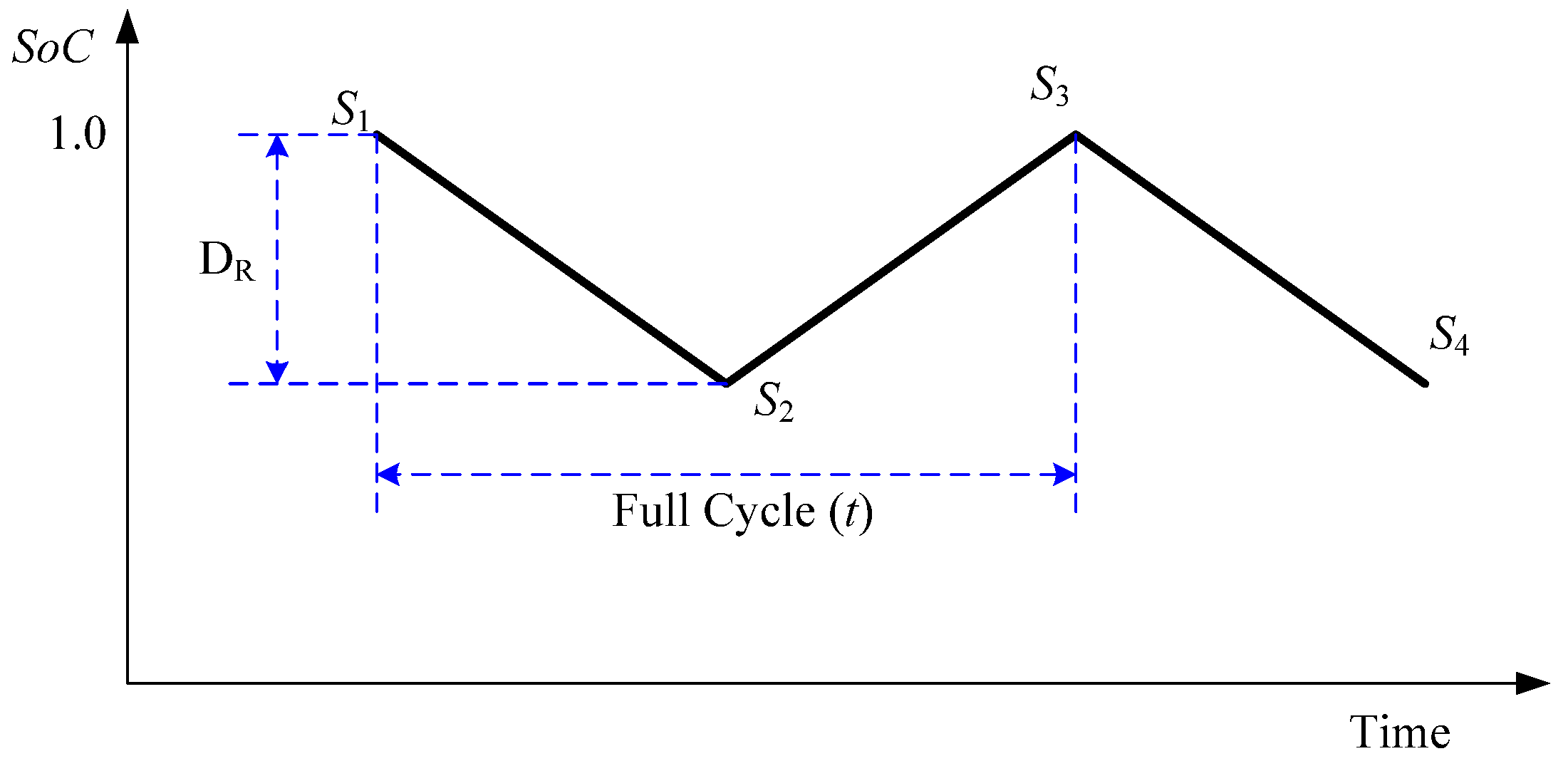
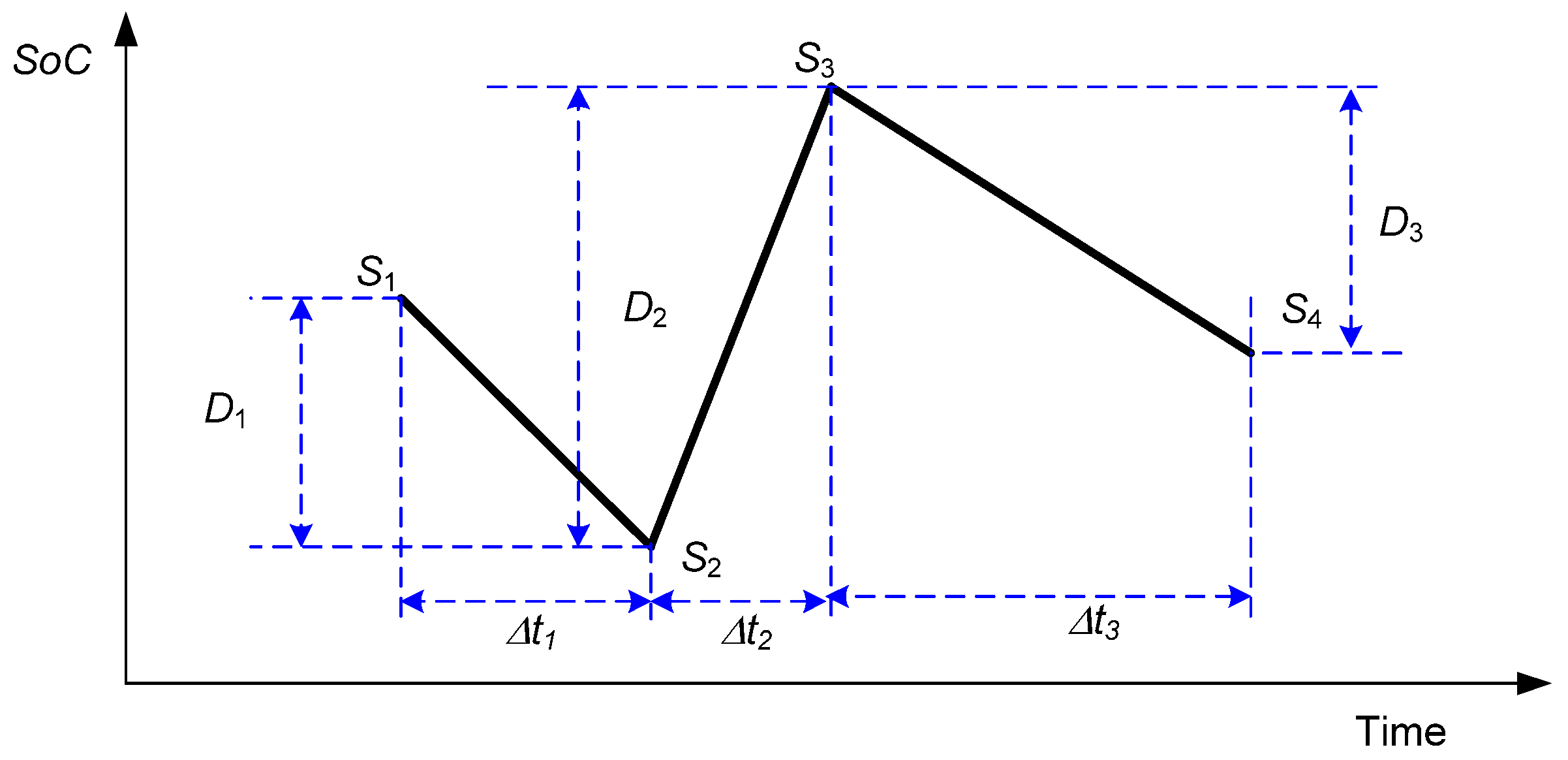
Figure 1 illustrates the inconsistency of real-world
DoD patterns, while
Figure 2 demonstrates how these are mapped into equivalent uniform cycles using the proposed method.
This novel approach forms the foundation for the degradation model introduced in
Section 3, aligning observed capacity loss with operationally normalized cycle equivalents while enabling accurate degradation forecasting with limited early-cycle data.
2.5. Comparative Analysis of Early Prediction Modeling Approaches
Early-cycle lifetime prediction can be approached using four major classes of models: empirical, physical (mechanistic), semi-empirical, and machine learning (ML). Each class offers distinct strengths but also carries limitations in terms of data requirements, computational feasibility, interpretability, and robustness across operating conditions.
Table 1 summarizes the relative strengths of these approaches, followed by a comparative discussion.
Empirical models offer simplicity and fast computation but generally fail to predict long-term behavior under varying temperatures, Crates, and depths of discharge. Their lack of physical grounding limits their extrapolation capability, making them unsuitable for applications requiring stress-dependent lifetime forecasting.
Physical or mechanistic models provide the highest interpretability and generalizability because they explicitly represent degradation pathways such as SEI evolution, lithium plating, or cathode structural changes. However, they require extensive electrochemical characterization, large parameter sets, and computationally demanding simulations that make them impractical for rapid early-life screening.
Machine learning models have shown excellent performance when trained on large and diverse datasets. However, their prediction accuracy tends to degrade when tested outside the training distribution. Moreover, model interpretability remains limited, and their performance is highly sensitive to measurement noise and data preprocessing choices.
The semi-empirical approach adopted in this study offers a balanced middle ground. By embedding physically inspired stress factors (DoD, Crate, and temperature) into a compact parametric structure, the model achieves the following:
Low data requirements (high accuracy with only 5% early-cycle data);
Reduced computational complexity compared to mechanistic or ML models;
High interpretability, since each parameter corresponds to a known degradation stressor;
Robustness across diverse stress conditions due to physics-guided formulation;
Improved generalization relative to empirical models.
This comparative analysis highlights that the proposed semi-empirical degradation model is particularly suitable for rapid early-life prediction and large-scale battery screening, offering a strong combination of accuracy, efficiency, and physical relevance.
3. Developed Degradation Model
Recent advancements in LIB degradation modeling have achieved significant improvements by integrating multiple stress factors. A prominent framework, initially proposed by Serrao et al. [
14] and subsequently refined by Wan et al. [
18], is considered a benchmark, incorporating the combined effects of
DoD,
Crate, and temperature [
14,
18,
54].
Serrao et al. [
14] introduced a degradation model (Equation (12)) to estimate the maximum cycle life of the battery under various stress conditions (
DoD,
Crate, and temperature).
Here, α, β, and ψ are parameters characterizing the impact of DoD, Crate, and temperature on degradation, respectively. Dr and Nr represent the reference DoD and the corresponding cycle life at the battery’s EoL under rated Crate and ambient temperature (25 °C). These reference values can be obtained from cycling tests at EoL or from Wohler curves (relating cycle number to DoD). In this study, Dr and Nr are determined from cycling tests at DoD = 1, Crate = 1, and temperature = 25 °C (840 cycles from cycling experimental results).
Where α, β, and ψ are the degradation model parameters of DoD, Crate, and temperature, respectively, Dr and Nr are the reference DoD and number of cycles to the EoL of the battery which can be obtained from the cycling tests at the EoL of the battery at rated Crate and at ambient temperature, or it can be obtained from Wohlar curve (Relation between the number of cycles along with DoD). In this study, the Dr and Nr are selected from the cycling test at DoD = 1, Crate = 1, and temperature = 25 °C.
The overall stress factor is determined by Equation (13) [
14,
18,
54].
where
,
, and
are the stress factors for
DoD,
Crate, and temperature, respectively, and are calculated using Equations (14)–(16).
The degradation per cycle, termed the degradation index (
ϵu), is calculated using Equation (17):
The cumulative degradation after a certain number of cycles (
N) can be estimated using Equation (18).
where
ξ is the capacity degradation exponent.
The aforementioned model assumes uniform cycling starting from a
SoC of 1 in all cycles, as shown in
Figure 1. However, real-world battery operation involves non-uniform cycling (as depicted in
Figure 2), necessitating model adaptation. To account for this, non-uniform cycles are translated into an equivalent number of uniform cycles using Equation (19).
where
D1,
D2, and
D3 are the
DoD in the beginning, middle, and at the end of the non-uniform cycles shown in
Figure 2.
The degradation index for a uniform cycle (Equation (12)) is modified for non-uniform cycling, as shown in Equation (20)
The capacity loss after n similar non-uniform cycles can be estimated using Equation (21).
where
QE represents the EoL capacity and
n is the number of non-uniform cycles.
Various evaluation metrics exist to quantify the discrepancy between measured and model-predicted battery behavior. This study employs two common indices: root mean square error (
RMSE) and mean absolute percentage error (
MAPE).
RMSE is a widely used measure of the average magnitude of prediction errors. It calculates the square root of the mean of the squared differences between observed and predicted values (Equation (22)). Essentially,
RMSE indicates the average deviation of the model’s predictions from the actual values, with larger errors having a disproportionately greater impact on the result.
MAPE measures the average absolute difference between measured and predicted values (Equation (23)). It provides a more uniform assessment of error magnitude compared to
RMSE, as it treats all errors equally.
In these equations, Qm and Qc represent the measured and calculated degradation values, respectively, and NT is the total number of data points.
4. Optimization Algorithms
The optimization problem introduced in this paper is formulated based on determining the optimal degradation parameters by minimizing the RMSE between the measured and calculated capacities. Using 2151 data points in the determination of the optimal model parameters is a very complex optimization problem that needs a fast and accurate optimization algorithm. Most of the optimization algorithms have been used to solve this problem. Due to the complexity of this problem, some of these optimization algorithms have been stuck in local peaks, and some other optimization algorithms have spent a long time solving this problem. One of the best optimization algorithms that has been used is the musical chairs algorithm (MCA). This algorithm showed the best performance in terms of convergence time, success rate, and the accuracy of the results. Still, the performance of the MCA needs more improvement, which is introduced in this study using chaotic maps for diversified exploration, as will be discussed in the following subsections.
The optimization landscape of the proposed degradation model is highly non-convex due to the presence of multiple interacting nonlinear terms, leading to a loss surface with several local minima. Moreover, gradient-based methods require differentiability, whereas the model includes piecewise non-smooth components such as
DoD mapping functions and exponential temperature-stress terms that limit the effectiveness of standard gradient descent optimizers. Preliminary tests using Adam and BFGS demonstrated frequent convergence to suboptimal minima and exhibited high sensitivity to initialization [
55]. In contrast, the metaheuristic MMCA optimizer consistently identified lower-loss solutions across repeated runs, with reduced variance and improved robustness. These results justify the use of a metaheuristic approach for parameter identification in this study.
4.1. Standard Musical Chairs Algorithm
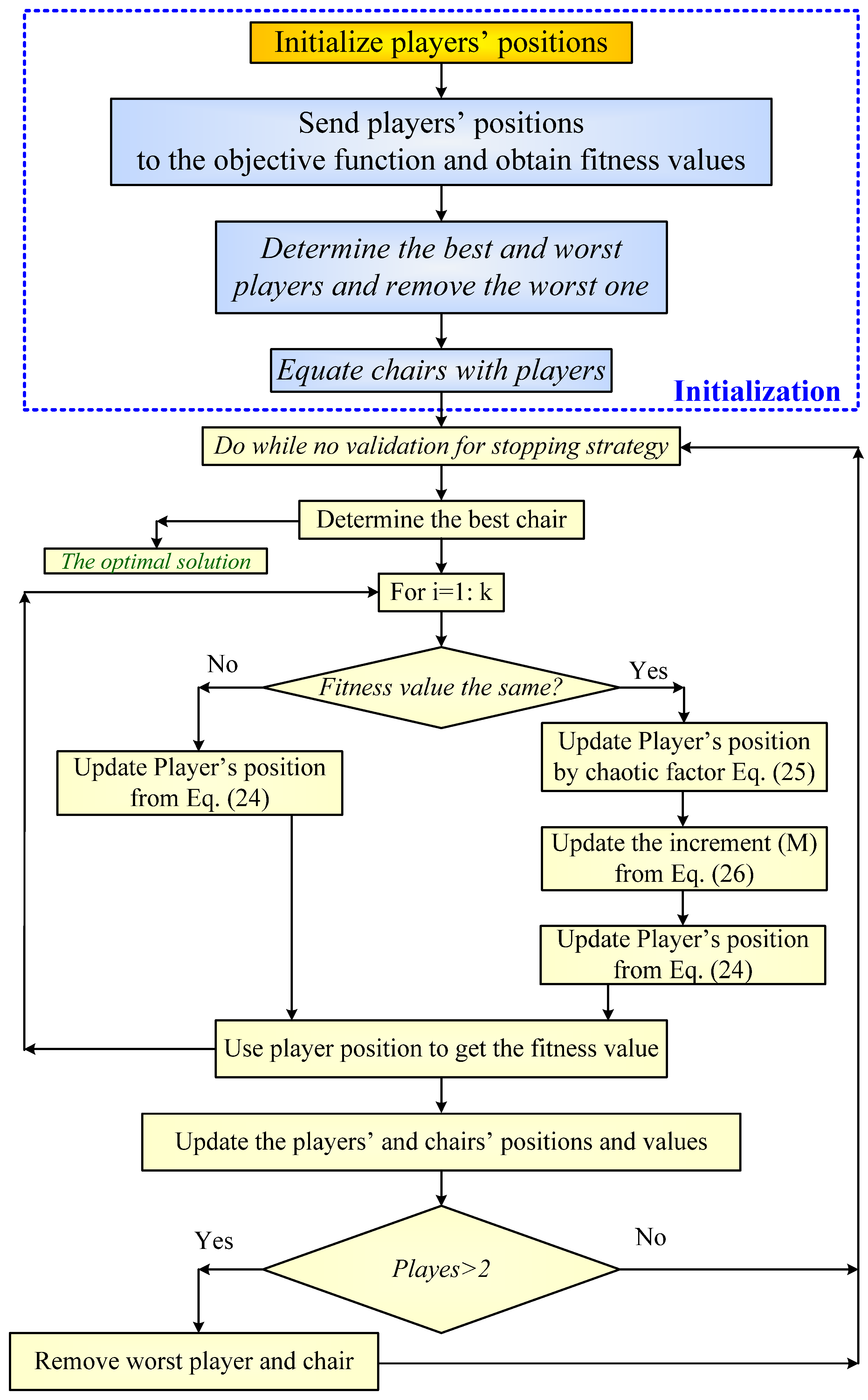
The MCA is a relatively novel optimization algorithm that draws its inspiration directly from the well-known children’s game of musical chairs, as shown in
Figure 3 [
56,
57,
58]. The MCA simulates players (solutions) competing for a shrinking set of chairs (local best positions). In each round, the “music stops,” every player moves toward its nearest chair, then the worst player (and its chair) is eliminated. This mechanism inherently shrinks the population over time but can suffer from premature convergence or lack of diversity. MCA has demonstrated notable performance improvements in specific real-world applications. For instance, maximum power point tracking (MPPT) for photovoltaic (PV) systems [
58] has shown considerably reduced convergence times and lower failure rates compared to other optimization algorithms. Specifically, it reduced convergence time by 20–50% and steady-state oscillations by 20–30% in MPPT scenarios. Furthermore, in PV cell parameter estimation, MCA achieved an error rate that was only 20% of the average error observed with other benchmark algorithms [
56]. Its binary variant, BMCA, achieved 96.7% accuracy in feature selection for load forecasting, significantly outperforming other algorithms. Furthermore, MCA has been used for the optimal design of a zero-carbon smart grid [
49,
59] and smart decentralized electric vehicle aggregators for optimal dispatch technologies [
60].
In this game, n players move around n − 1 chairs while music plays. When the music stops, players occupy the nearest chair, and the player without a chair is eliminated. This process repeats with one fewer chair and player until a single winner remains. The MCA mirrors this by having n search agents (players) explore the solution space. The agent with the worst fitness is eliminated in each iteration, and the positions of the remaining agents are updated based on the “chairs” (previous best solutions). The player’s position and value will be transmitted to the next chair as initial values for chairs. The new position of players can be obtained from Equation (24).
The algorithm validates new player positions against constraints and evaluates their fitness using the degradation model. Players update their positions and fitness if a new position yields a better fitness value. Subsequently, each chair’s fitness is compared to its two closest players. If a player has superior fitness, the chair’s position and fitness are updated with the player’s information. If more than one chair exists, the player and chair with the lowest fitness are removed. The algorithm terminates when the stopping criteria are met, with the best chair’s position and fitness representing the optimal solution; otherwise, the process repeats.
The new position of players in the MCA at iteration
i for the
k-th search agent within a swarm of
n agents is determined using a transition step influenced by a constant
M and a step size
β derived from Lévy flight. The variables
u and
v are uniform distribution matrices [
58]. The total number of iterations is denoted by it.
4.2. Modified Musical Chairs Algorithm (MMCA)
The accurate and efficient estimation of degradation model parameters is a persistent challenge due to the highly nonlinear and multi-modal nature of the problem. Existing optimization methods often suffer from premature convergence, loss of diversity in the search space, and stagnation in local optima, hindering their ability to find the true parameter values. This limitation motivates the development of more robust and adaptive optimization frameworks capable of effectively handling the complexities inherent in real-world degradation model parameter estimation. To address these challenges, this research proposes a novel optimization framework inspired by the game of musical chairs. This framework introduces a new class of optimizers that strategically combines randomness with intelligent decision-making, mimicking the survival competition and dynamic elimination characteristic of the game. To further enhance the algorithm’s performance, a key improvement is integrated by the use of chaotic maps for diversified exploration.
This modification makes several key contributions to the field of battery degradation model parameter estimation. It introduces a chaotic map-based exploration strategy to improve exploration/exploitation balance, accelerate convergence, and capture realistic musical-chairs dynamics. Chaotic-map-based exploration enhancement core idea introduced in this paper is implemented by replacing random elements in MCA (e.g., step sizes, music-stop timing, or elimination schedule) with values from a chaotic map. Chaotic sequences combine deterministic dynamics with unpredictability, which can enhance diversity and avoid premature convergence. The modification introduced to standard MCA is summarized in the pseudocode shown in
Figure 4 and the flowchart shown in
Figure 5.
In the standard MCA loop (initialization, movement, evaluation, and elimination), the chaotic map replaces fixed randomness. The ergodic nature of chaos boosts exploration by forcing the search to traverse many regions of space. It helps avoid cycles and local optima by constantly perturbing the dynamic in a non-repeating way. Chaotic maps can accelerate convergence in early phases (diversifying quickly) and then naturally settle into a finer search (as chaos trajectories cluster). Chaotic parameters (map type and control parameter
r) must be tuned. If they are too irregular, chaos can overshoot good regions and slow down exploitation. Care is needed to ensure the search agents
di remain in a valid range. The MCA parameters selected with values
r = 3.95 and
M = 0.5 yield consistent convergence [
56,
57,
58].
The search factors
di should be updated by chaotic factor r to build the logistic map, as shown in Equation (25).
For instance, rather than using a uniform random factor
M or deterministic rule, we compute
Meff each round as shown in Equation (26). This injects unpredictability into when and how players move.
After modification introduced in Equations (25) and (26), the new position can be determined using Equation (24).
5. Experimental Setup and Methodology
This section details the experimental procedures employed to evaluate the performance characteristics of 1.5 Ah 18,650 cylindrical lithium iron phosphate (LiFePO4) cells under controlled conditions.
5.1. Cycling Test Equipment
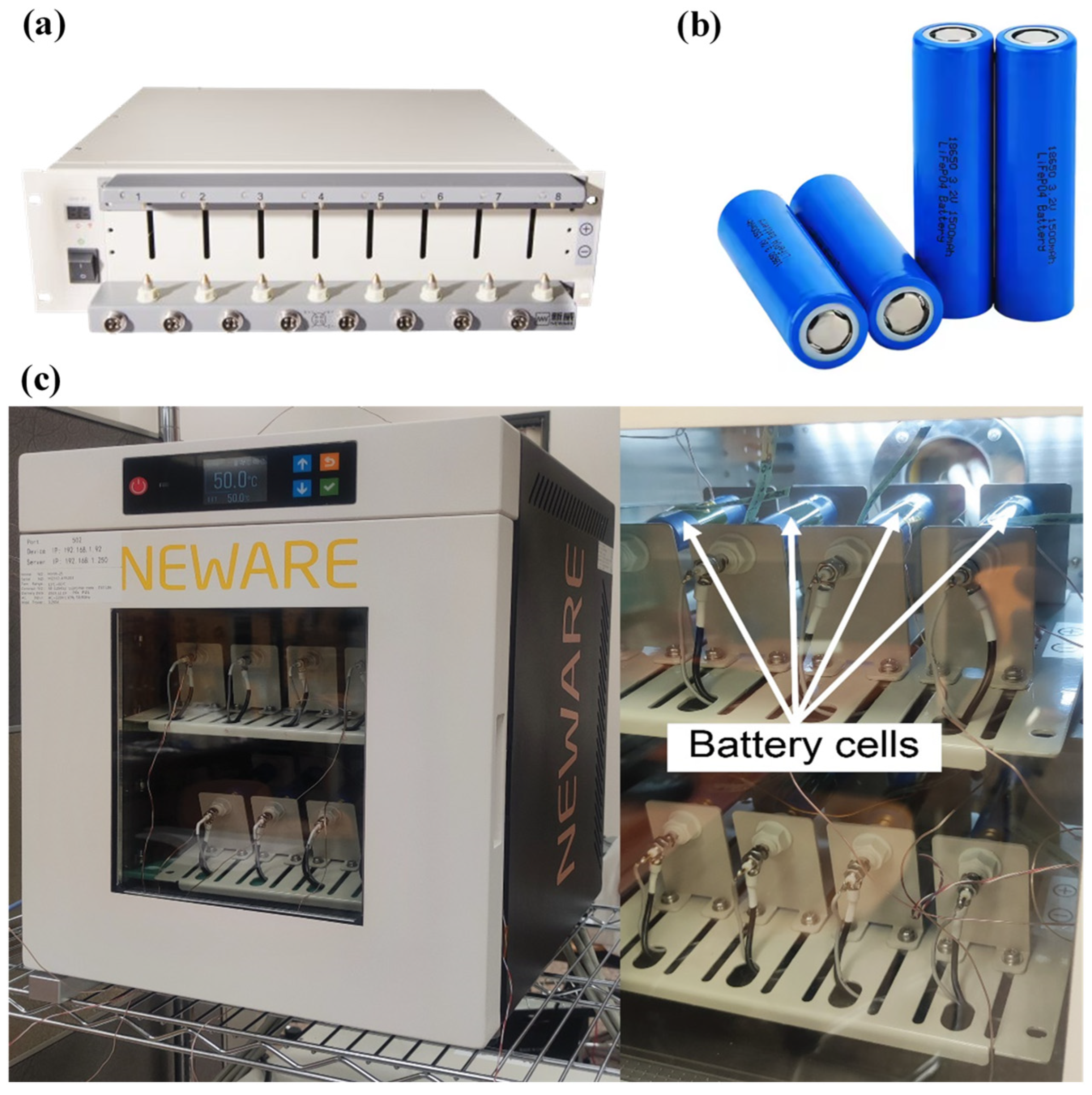
The primary equipment for cycling tests was the BTS 4000 5V12A Battery Testing System (Neware Technology, Hong Kong, China), an 8-channel cycler with 0.05% accuracy. This system allows for precise and programmable control of battery charging and discharging, crucial for evaluating performance under defined conditions. The BTS 4000 enables accurate manipulation of charge/discharge profiles and
SoC and
Crate. To simulate various operational temperatures, the BTS 4000 was used in conjunction with a desktop constant temperature chamber (MHW-25-S, Neware Technology, Hong Kong, China), capable of maintaining stable thermal environments between 15 °C and 60 °C. Illustrations of both the battery cycler and the temperature chamber are provided in
Figure 6a,c, respectively.
Figure 6b shows the battery cells used.
To ensure high-quality measurements throughout the cycling experiments, additional details regarding data acquisition and calibration procedures are provided here. All voltage, current, and temperature signals were recorded at a sampling frequency of 1 Hz, which offers sufficient temporal resolution to capture transient behavior during both charging and discharging phases. Prior to analysis, the raw signals were processed using a three-point median filter to suppress cycler-induced electrical noise while preserving the underlying electrochemical dynamics. The Neware BTS 4000 system used in this study undergoes an automatic internal calibration every 500 h of operation, ensuring the long-term stability and repeatability of the measurements. According to the manufacturer specifications, the system maintains a voltage accuracy of ±0.05% FS and a current accuracy of ±0.1% FS, which guarantees that the reported degradation trajectories are not significantly affected by measurement drift. These procedures collectively help maintain the integrity and reliability of the experimental dataset used for model development.
5.2. Battery Specifications
The experiments utilized 1.5 Ah 18,650 cylindrical lithium iron phosphate (LiFePO
4) cells (
Figure 6b). Key specifications of these cells, known for their high safety and thermal stability in energy storage applications, are summarized in
Table 2 [
61].
5.3. Test Methodology
This study investigated the performance of 1.5 Ah 18,650 LiFePO4 cells under controlled charge/discharge conditions. Tests were conducted at three temperatures (25 °C, 40 °C, and 50 °C) to represent typical, moderately stressed, and highly stressed thermal environments, respectively. These temperatures were selected to simulate a range of real-world operating scenarios.
Cycling tests were performed at three
Crates (0.5C, 1C, and 2C), corresponding to discharge currents of 0.75 A, 1.5 A, and 3 A, respectively. Additionally, three
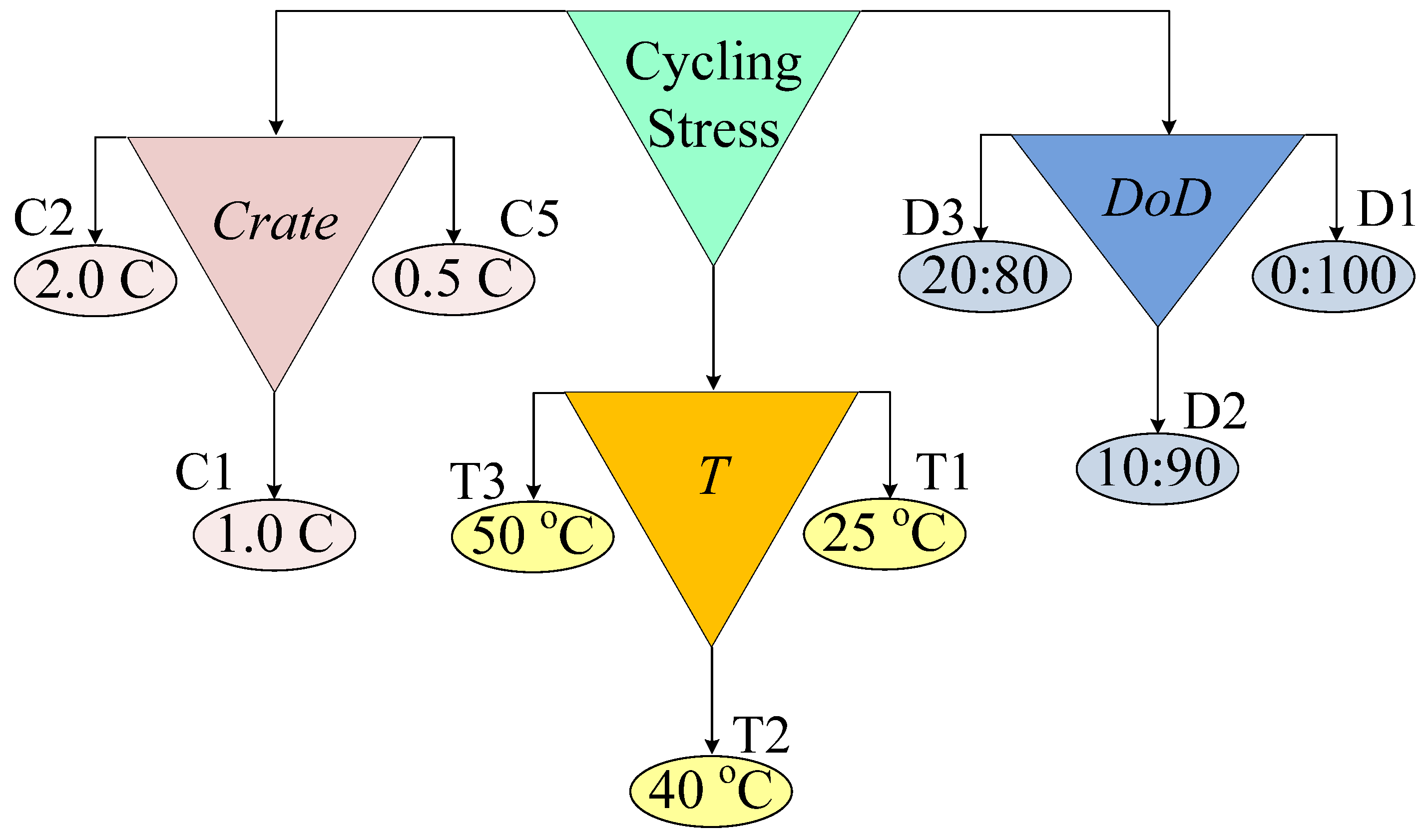
SoC ranges were evaluated: 0–100%, 10–90%, and 20–80%. The experimental matrix, encompassing 27 distinct tests, is visualized in
Figure 4. For all tests, cells were charged to an upper voltage limit of 3.6 V and discharged to a lower limit of 2 V to ensure safe operation.
Before cycling, each cell underwent an initial capacity test using a constant current constant voltage (CCCV) charging protocol. Cells were charged at a constant current of 0.2C (300 mA) until 3.6 V was reached, followed by a constant voltage phase until the current dropped to 30 mA, ensuring full charge. Subsequently, cells were discharged at a constant current of 0.2C until the voltage reached 2 V, and the discharge capacity was recorded.
The primary cycling involved repeated charge–discharge cycles at the specified Crate, SoC range, and temperature. Each cycle consisted of charging to the upper SoC limit and discharging to the lower limit at the defined current. A five-minute rest period was implemented between cycles for thermal stabilization.
To track degradation, a capacity test was performed every 24 cycles to assess capacity retention under different conditions. Following the main cycling tests, an extended degradation assessment was conducted by continuously cycling cells until a significant capacity loss (≥20%) occurred or the voltage limits could no longer be maintained. This long-term cycling aimed to provide insights into the cells’ long-term durability.
To ensure thermal stabilization between charge–discharge cycles, a five-minute rest period was implemented in all experiments. Although this duration may appear relatively short, the thermal response of the LFP cells and the environmental chamber was continuously monitored to verify its adequacy. The chamber’s built-in Neware temperature sensors recorded cell-surface temperature throughout the cycling process, and the measured variation during each rest interval did not exceed 0.8 °C. This narrow fluctuation range indicates that the cell had effectively reached quasi-steady thermal equilibrium before the initiation of the subsequent cycle. To further validate the sufficiency of the selected rest duration, a sensitivity assessment was performed on a subset of samples in which the rest period was extended to ten minutes. The resulting capacity-fade trajectories and model-calibration parameters showed negligible deviation from those obtained with the five-minute interval, confirming that prolonging the rest period does not meaningfully influence the degradation modeling outcome.
5.4. Test Parameters
The cycling tests were designed to investigate the impact of key stress factors on battery degradation, as summarized in
Figure 7. The specific operating conditions included the following:
Temperature: 25 °C, 40 °C, and 50 °C.
DoD at varying SoC: 0–100%, 10–90%, and 20–80%.
Crate: 0.5C, 1.0C, and 2.0C.
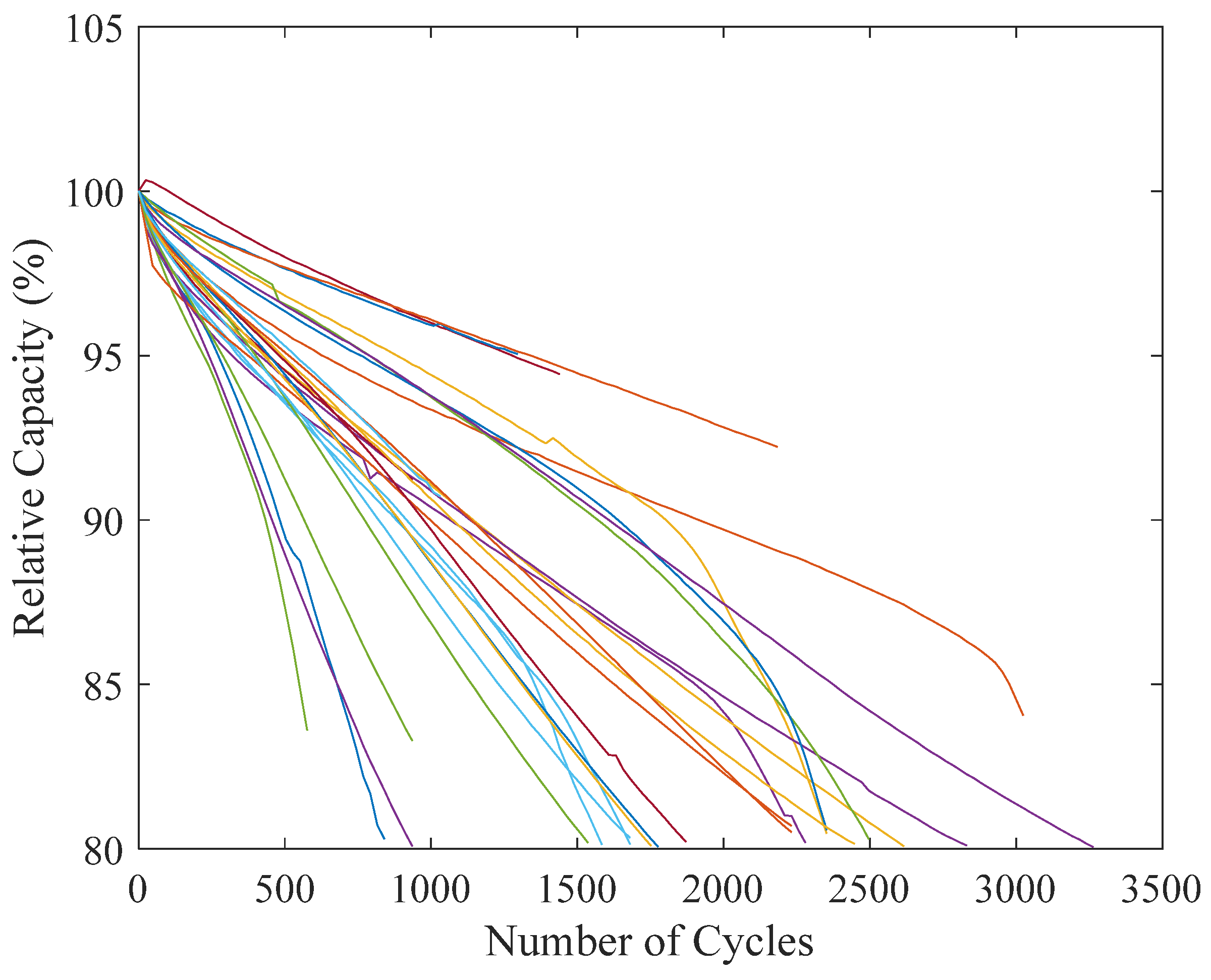
The results, encompassing 27 samples as shown in
Figure 8, were obtained using the temperature-controlled battery testing system described earlier. Capacity measurements were recorded periodically until the capacity reached 80% of the initial value, defined as the EoL of the battery. Some experiments that did not reach EoL due to logistical issues may be excluded from later analysis. To continuously monitor degradation under different operating conditions, a full capacity test was performed every 24 cycles for each battery and condition.
6. Results and Discussion
6.1. Optimization Algorithms Comparison
The available experimental results are used to validate the proposed model introduced in this study. In the first study, the whole data (27 samples and 2151 data points) is used to determine the optimal degradation model parameters. Five optimization algorithms have been used to minimize the RMSE between the measured and calculated degradation of the LIBs. These equations are MCA [
56], gray wolf optimization (GWO) [
62], bat algorithm (BA) [
63], sine-cosine algorithm (SCA) [
64], and particle swarm optimization (PSO) [
65].
These algorithms are used to compare with the MMCA optimization algorithm in terms of convergence time success rate and the minimum value of
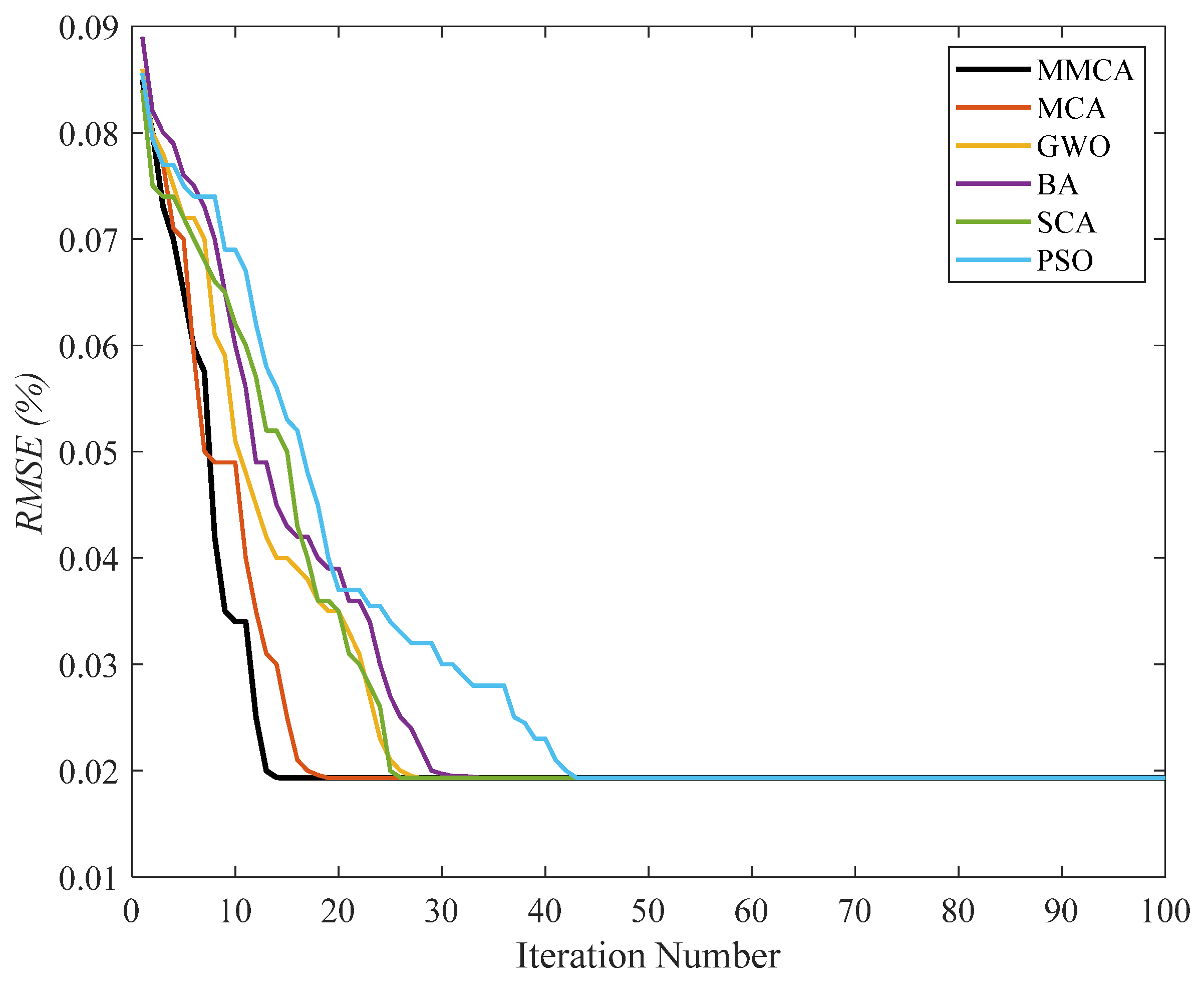
RMSE. The convergence performances of these algorithms when using all available data points are shown in
Table 3 and
Figure 9. It is clear from these results that the MMCA outperforms the other optimization algorithms in terms of convergence time, success rate, and the minimum
RMSE value. For this reason, the MMCA has been used with the rest of the optimizations introduced in this study.
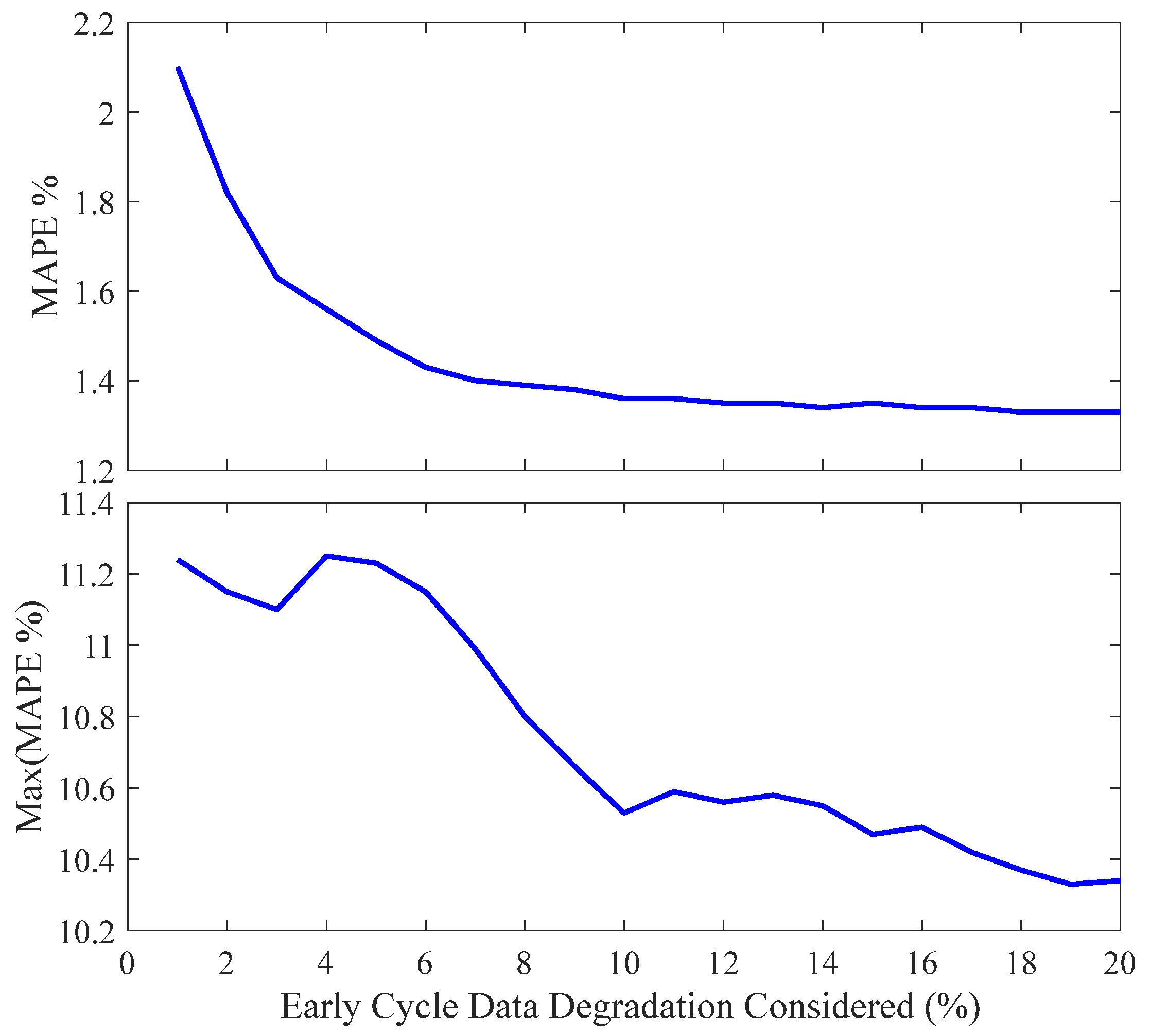
The early cycling study is performed based on using the degradation to 1% (capacity 99%) and gradually increasing cycling with 1% increment till 20% (reduce capacity till 80%). During each increment the model parameters are calculated for the limited number of data points (early cycling), and then these parameters will be used with all data points (2151 points) to determine the MAPE and its maximum value (MAPEmax).
6.2. Early-Cycle Prediction of LFP Battery Performance
This section details a critical aspect of the study by leveraging limited early-cycle degradation data to accurately predict the full lifespan performance of LFP batteries. The proposed simulation methodology involves using progressively larger initial segments of the battery’s degradation curve to determine the parameters of the degradation model. These parameters are then validated by evaluating their ability to predict the entire measured capacity trajectory. A key question arises: What percentage of early-cycle degradation data is sufficient to achieve an acceptable level of prediction accuracy for the battery’s remaining useful life?
To systematically address this, the study initiated battery cycling from its full capacity (100% State of Health,
SoH) and incrementally increased the portion of degradation data used for model parameter extraction. This increment started from 1% degradation (99% capacity) and continued in 1% steps up to 20% degradation (80% capacity), which is defined as the EOL for the battery.
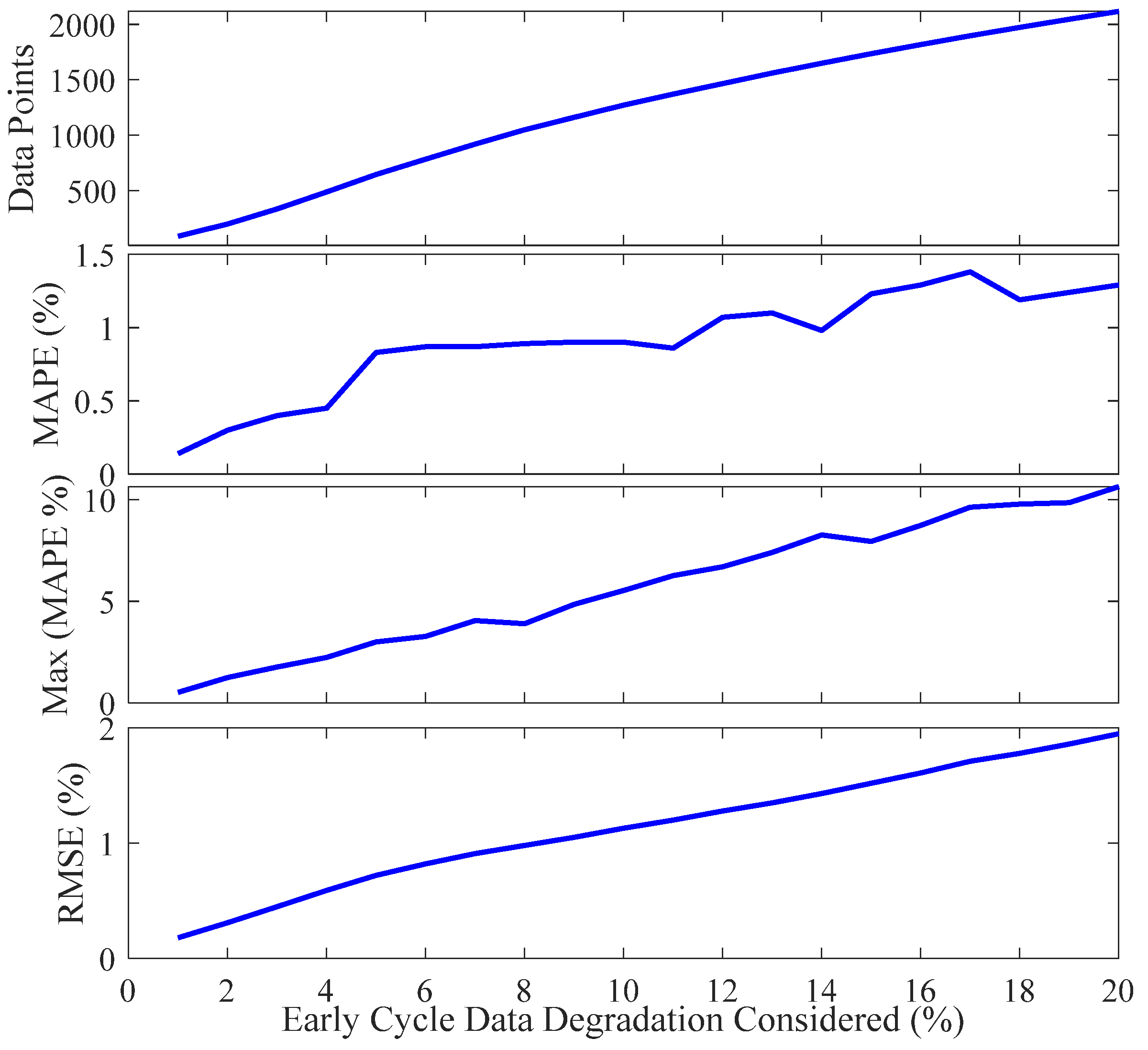
Table 4 provides a comprehensive overview, listing the number of data points corresponding to each percentage of early degradation used for parameter determination, along with the extracted degradation model parameters. The initial performance of the model in fitting these early-cycle degradation data subsets is presented in
Figure 10, showing the
MAPE, maximum
MAPE (Max(
MAPE)), and
RMSE. It was observed that as the percentage of early degradation data used for training increased, the model’s ability to capture the underlying degradation trend improved, leading to a more robust parameter set for full-life prediction.
The critical test involved taking the degradation model parameters derived from these limited early-cycle datasets and applying them to predict the battery’s capacity across its entire available lifespan. The resulting full-life prediction
MAPEs and their maximum values for each case are shown in subsequent tables and graphically represented in
Figure 11. A clear and significant trend emerged: the
MAPE and its maximum value for full-life prediction consistently decreased as the percentage of early-cycle data used for parameter extraction increased. For instance, the highest full-life prediction
MAPE was 2.1% when the model was trained on only 1% early-cycle degradation. This error is significantly reduced to 1.33% when the model was trained using data up to 20% (EOL) degradation, which is the expected outcome as more comprehensive training data generally leads to more accurate predictions.
The central challenge then becomes defining an acceptable error margin to determine the optimal early-cycle degradation percentage. Based on the results, the lowest full-life prediction
MAPE achieved was 1.33% when all available data (up to 20% degradation) was used. If a target acceptable
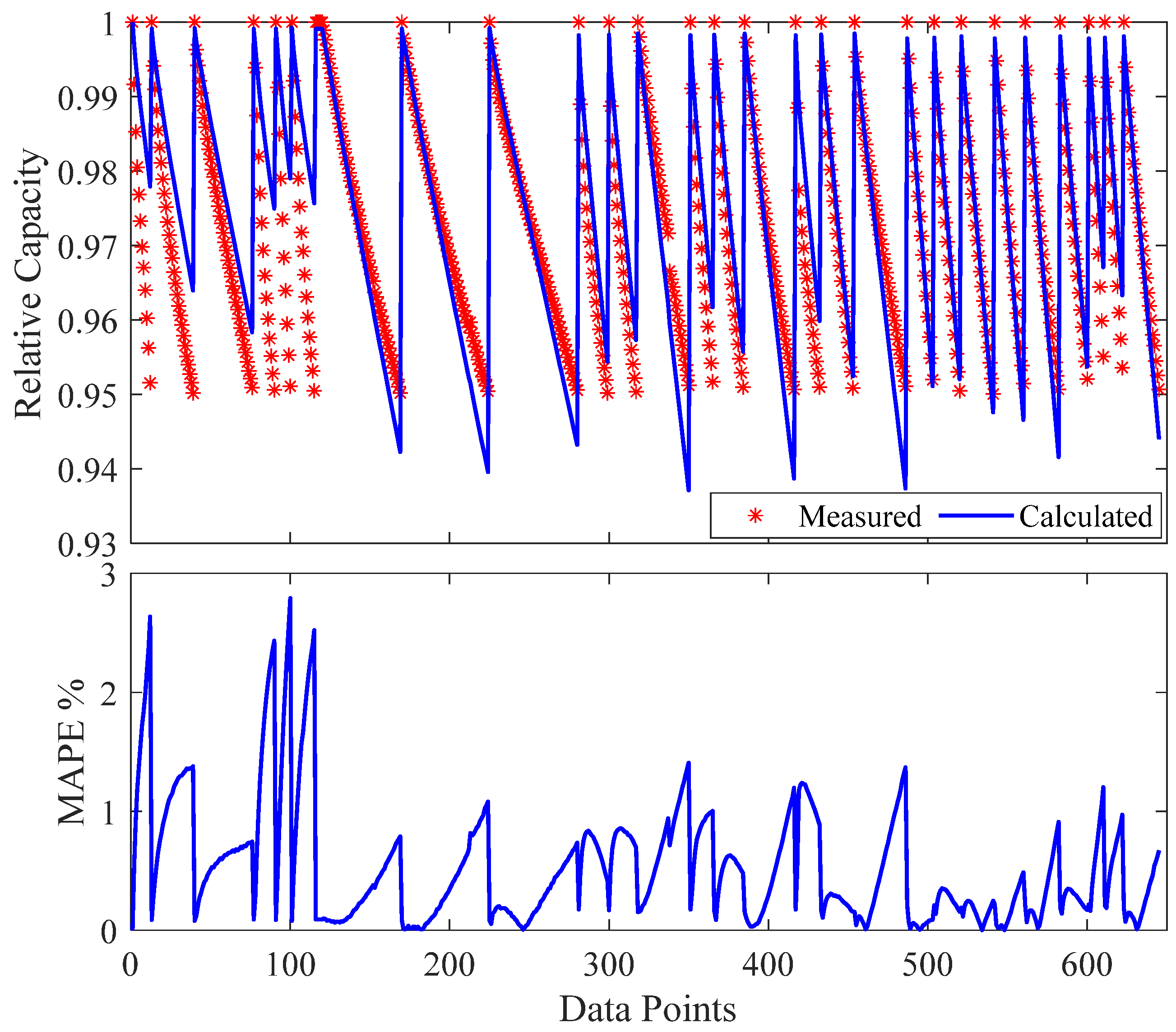
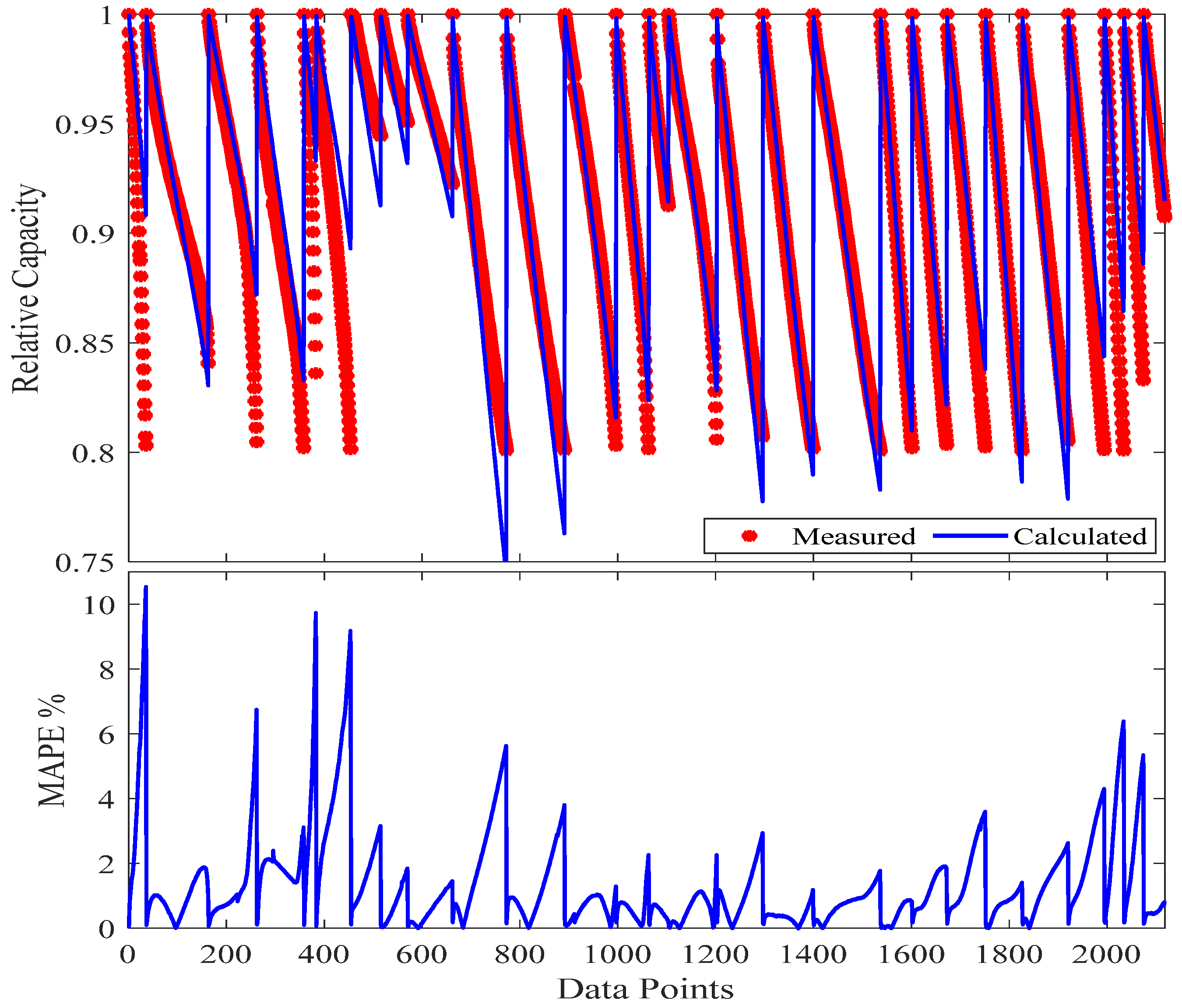
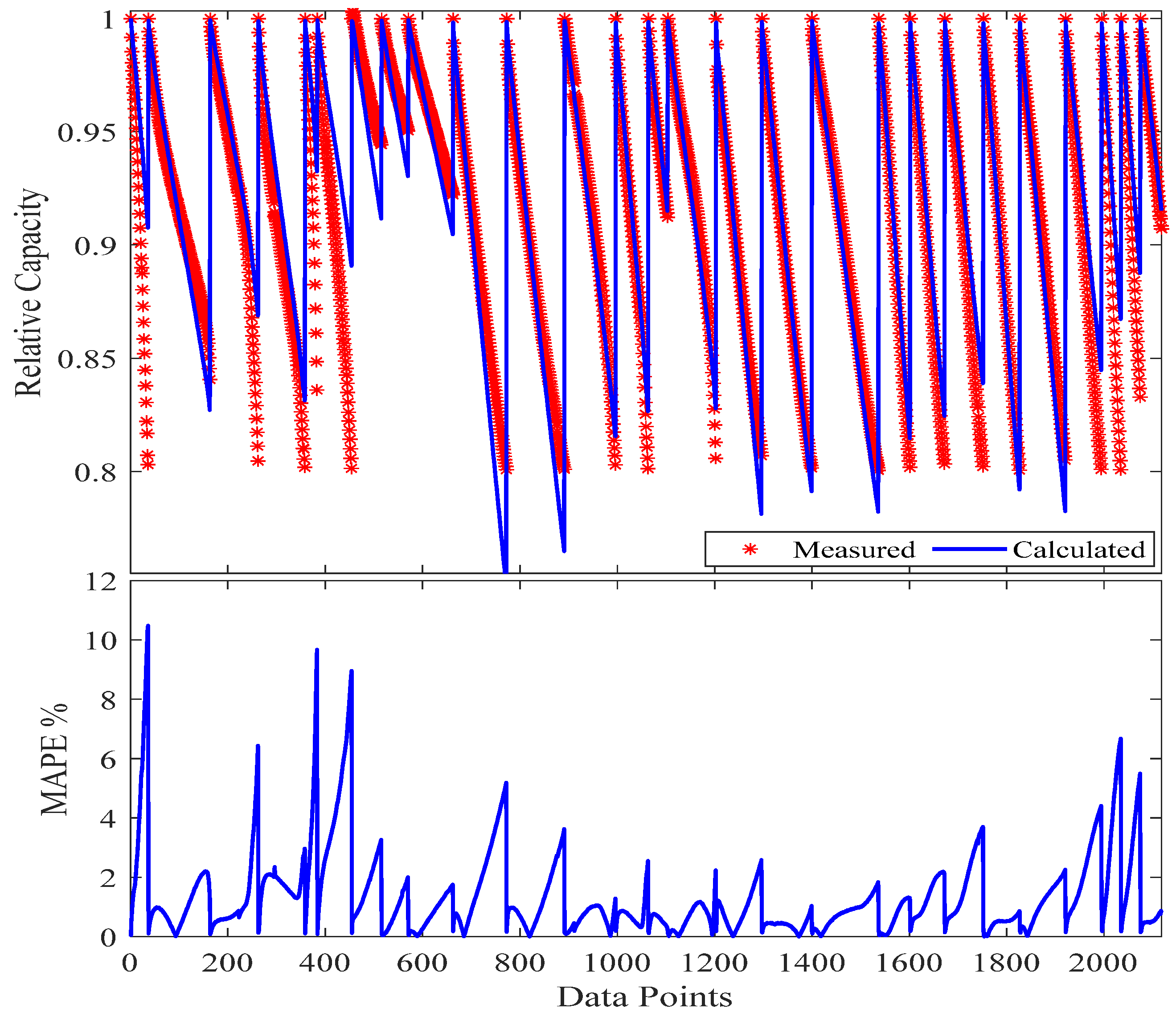
MAPE is set to be less than 1.5%, the results indicate that cycling the battery to approximately 5% of its nominal capacity degradation is sufficient. This scenario, depicted in
Figure 12 and
Figure 13, shows that training the model with data where capacity is greater than 95% (645 data points) yields a full-life prediction
MAPE of 1.49% and a maximum
MAPE of 11.23%. This demonstrates that a substantial portion of the battery’s lifespan can be predicted with reasonable accuracy by observing only its initial 5% capacity fade.
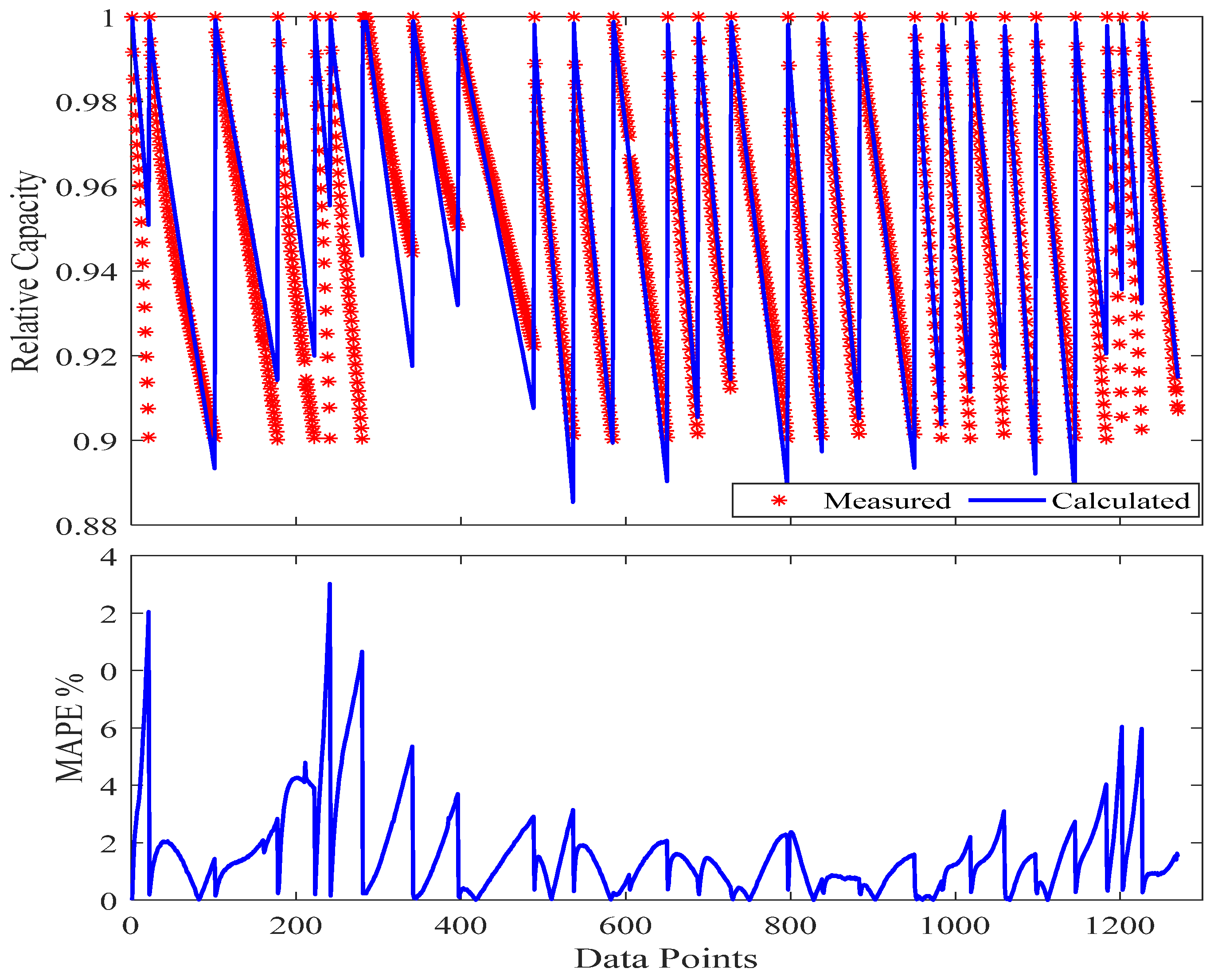
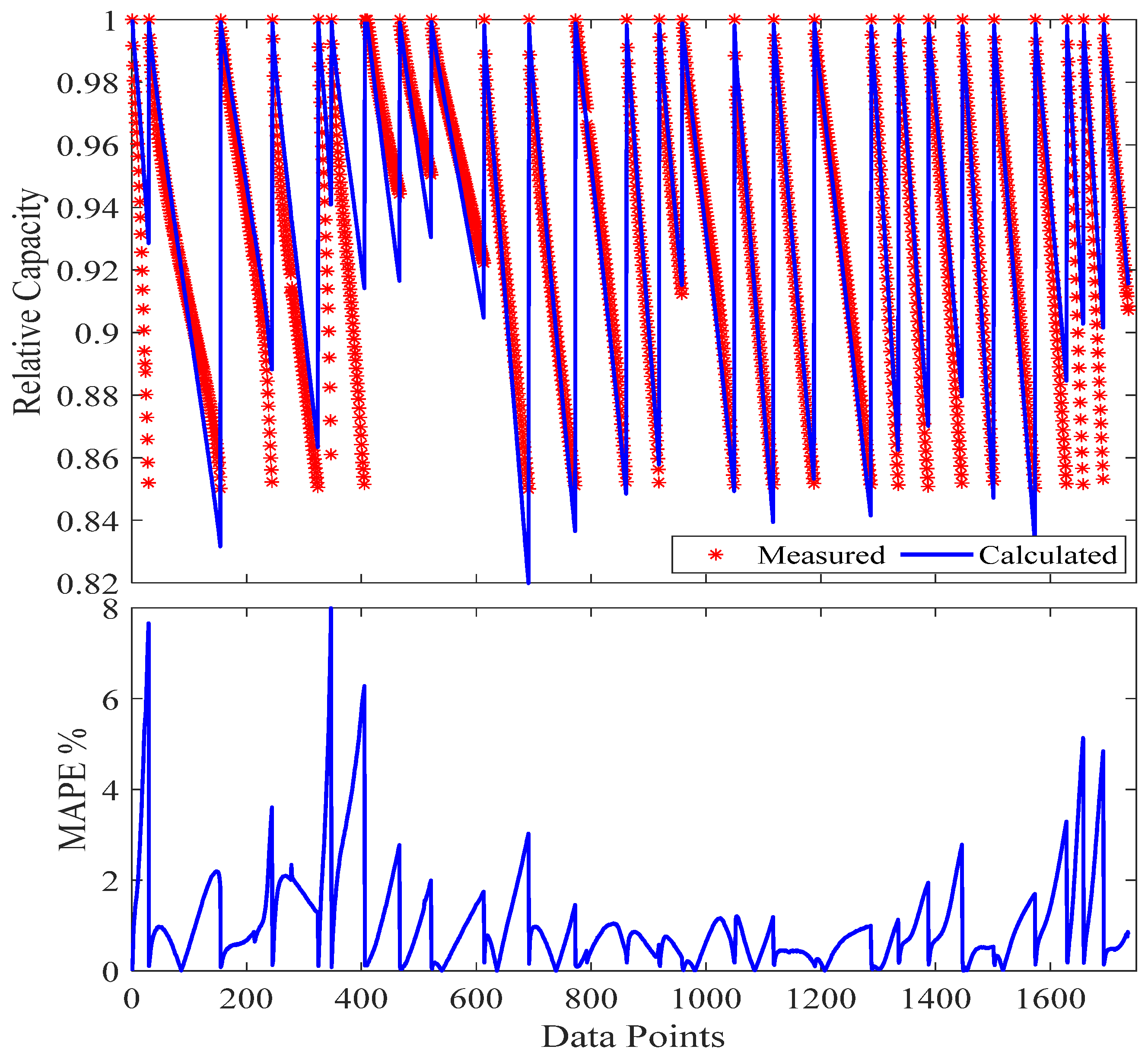
Further analysis reinforces these findings. When the model was trained on data up to 10% early-cycle degradation (capacity greater than 90%, 1270 data points), the full-life prediction
MAPE improved slightly to 1.36% as shown in
Figure 14 and
Figure 15. Similarly, training with data up to 15% early-cycle degradation (capacity greater than 85%, 1736 data points) resulted in a full-life prediction
MAPE of 1.35% as shown in
Figure 16 and
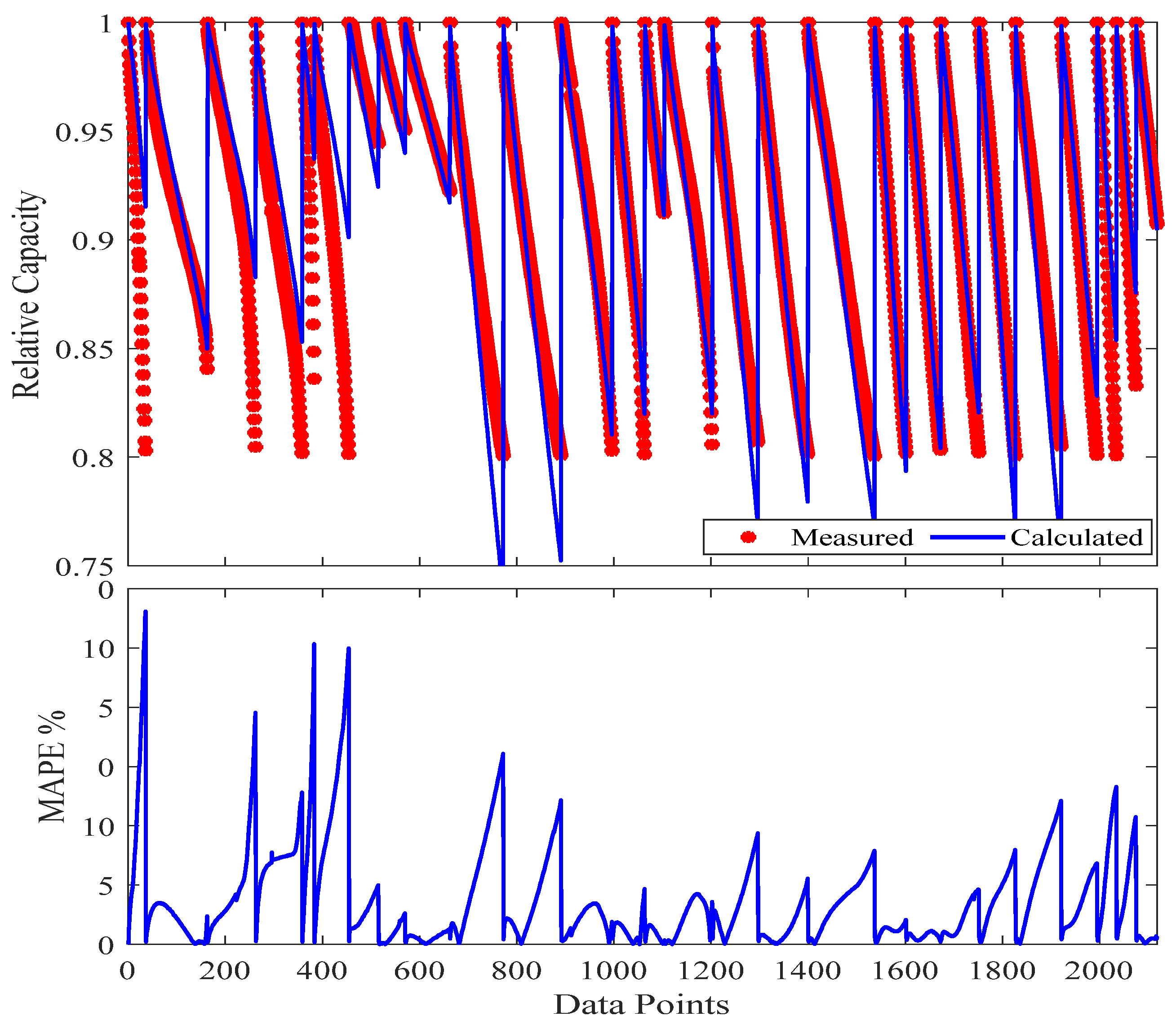
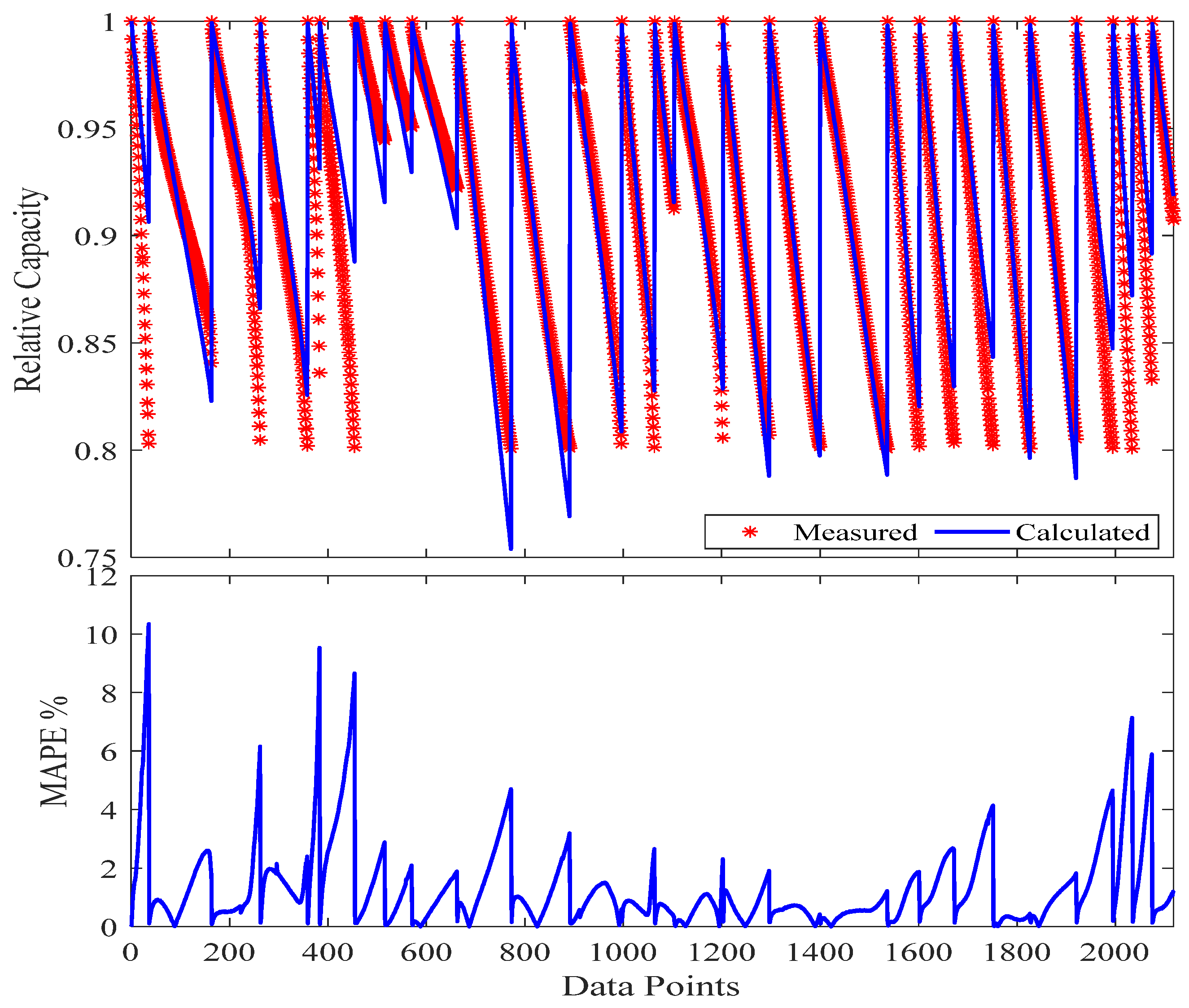
Figure 17. The final scenario, using all 2151 data points up to 80% capacity (EOL), yielded the lowest
MAPE of 1.33%, as shown in
Figure 18.
Comparing these results highlights the significant trade-offs between testing effort and prediction accuracy. For instance, reducing the cycling test by 25% (stopping at 85% capacity instead of 80%) only increased the full-life prediction MAPE by a marginal 0.02% (from 1.33% to 1.35%). A 50% reduction in cycling (stopping at 90% capacity) resulted in an increase of just 0.03% in MAPE (to 1.36%). Even a 75% reduction in cycling (stopping at 95% capacity) led to only a 0.16% increase in MAPE (to 1.49%). This demonstrates that extending battery cycling from 95% to 80% capacity, which represents 75% of the total cycling work, provides only a minimal improvement in accuracy (0.16%). Therefore, for many practical applications, this additional time, cost, and asset utilization may not be justified.
Moreover, if a 2% MAPE is deemed an acceptable accuracy threshold, the study suggests that cycling the batteries only to 98% of their capacity (2% early cycling) would be sufficient. In this scenario, the accuracy is reduced by approximately 0.66% compared to the full-data training, but it allows for an estimated 90% reduction in cycling time and cost. This represents a superior result for real-world BESS development, enabling significantly faster and more cost-effective battery characterization and deployment. The findings underscore the potential for early-cycle degradation data to provide a robust and efficient means of predicting long-term battery performance, optimizing testing protocols, and accelerating battery research and development.
6.3. Limitations Related to Low-Temperature Operation
Although the experimental matrix in this study covers a wide range of moderate to high temperatures (25–50 °C), the dataset does not include low-temperature cycling conditions, such as 10 °C, 0 °C, or −10 °C. This limitation originates from two practical constraints: (i) the environmental chamber used in this project was optimized for elevated-temperature studies, and (ii) the funding agency explicitly prioritized characterizing lithium-ion battery performance under hot-climate conditions representative of Saudi Arabia. As a result, the optimized semi-empirical parameters in this work should not be extrapolated to sub-ambient environments without recalibration.
Low-temperature operation is known to introduce unique degradation behaviors in LFP cells, including a substantial increase in internal impedance, reduced charge-transfer kinetics, and a heightened risk of lithium plating during charging. These mechanisms differ fundamentally from the dominant pathways at elevated temperatures and would therefore alter the stress factors embedded in the proposed degradation model. Consequently, the current model may underpredict capacity loss or fail to capture early-cycle signatures that emerge only at low temperatures.
Future work will expand the experimental dataset to include cycling at −10 °C, 0 °C, and 10 °C. These conditions will allow recalibration of the semi-empirical stress parameters and enable evaluation of whether the present model structure remains valid across both hot and cold operating environments.
6.4. Uncertainty and Robustness Analysis
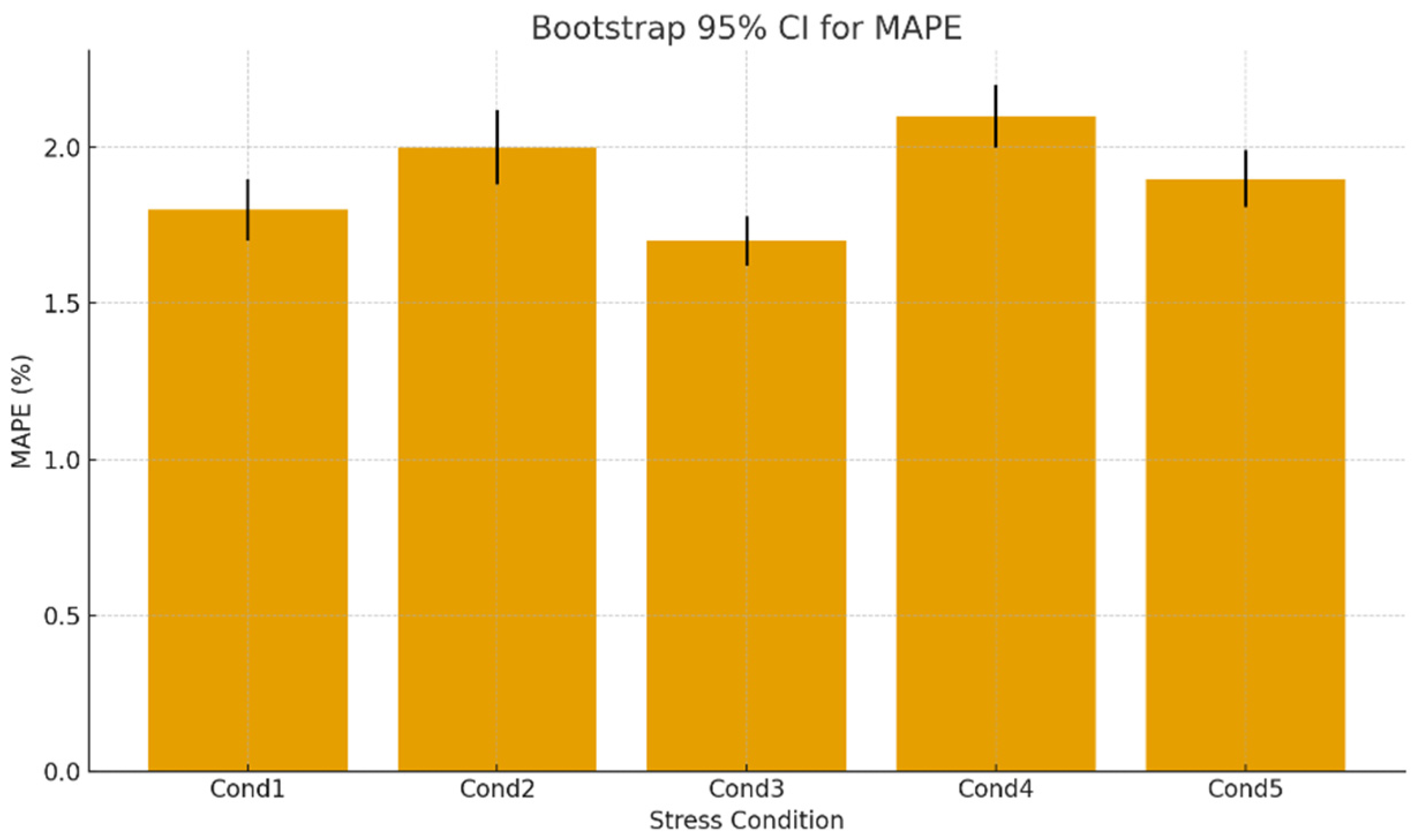
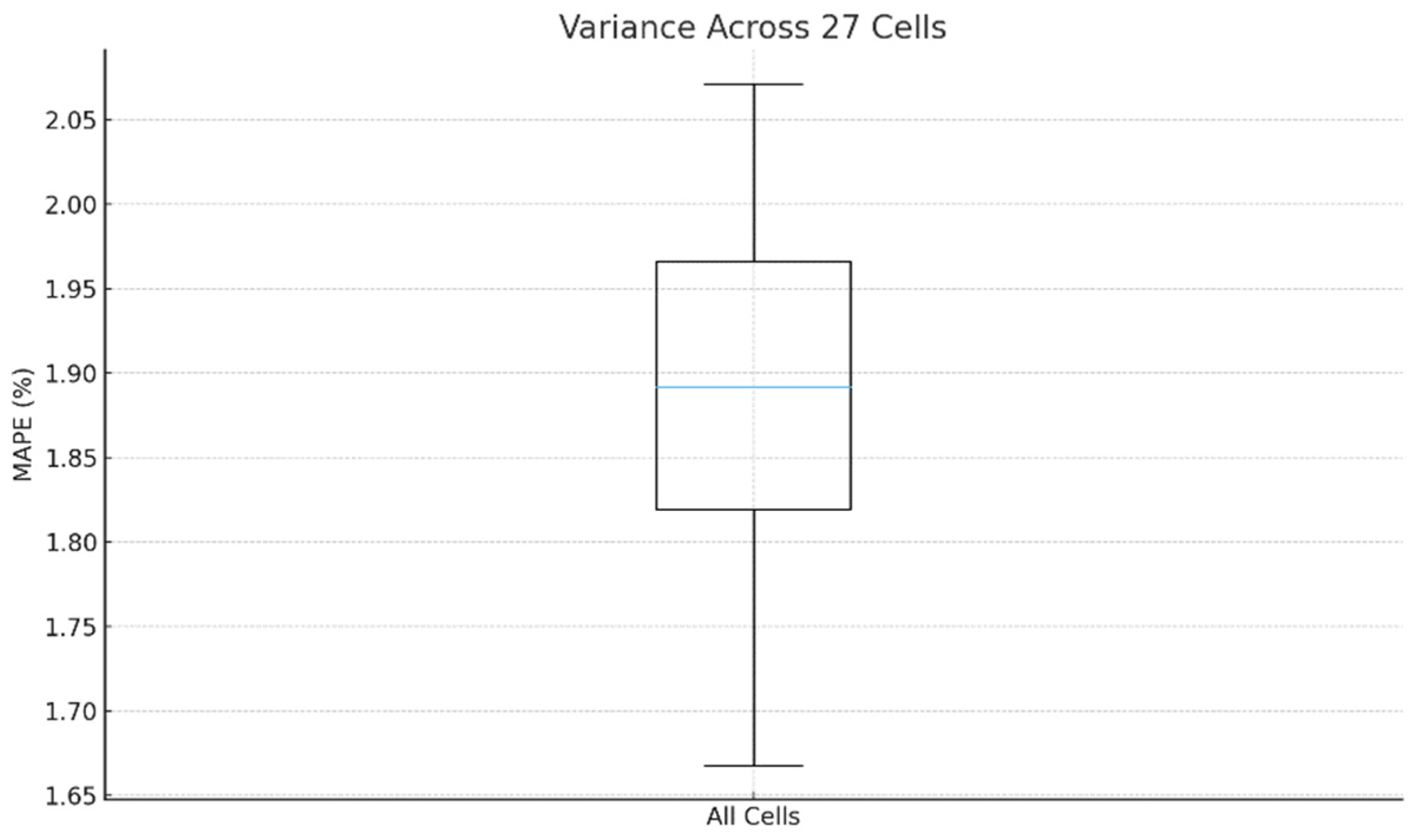
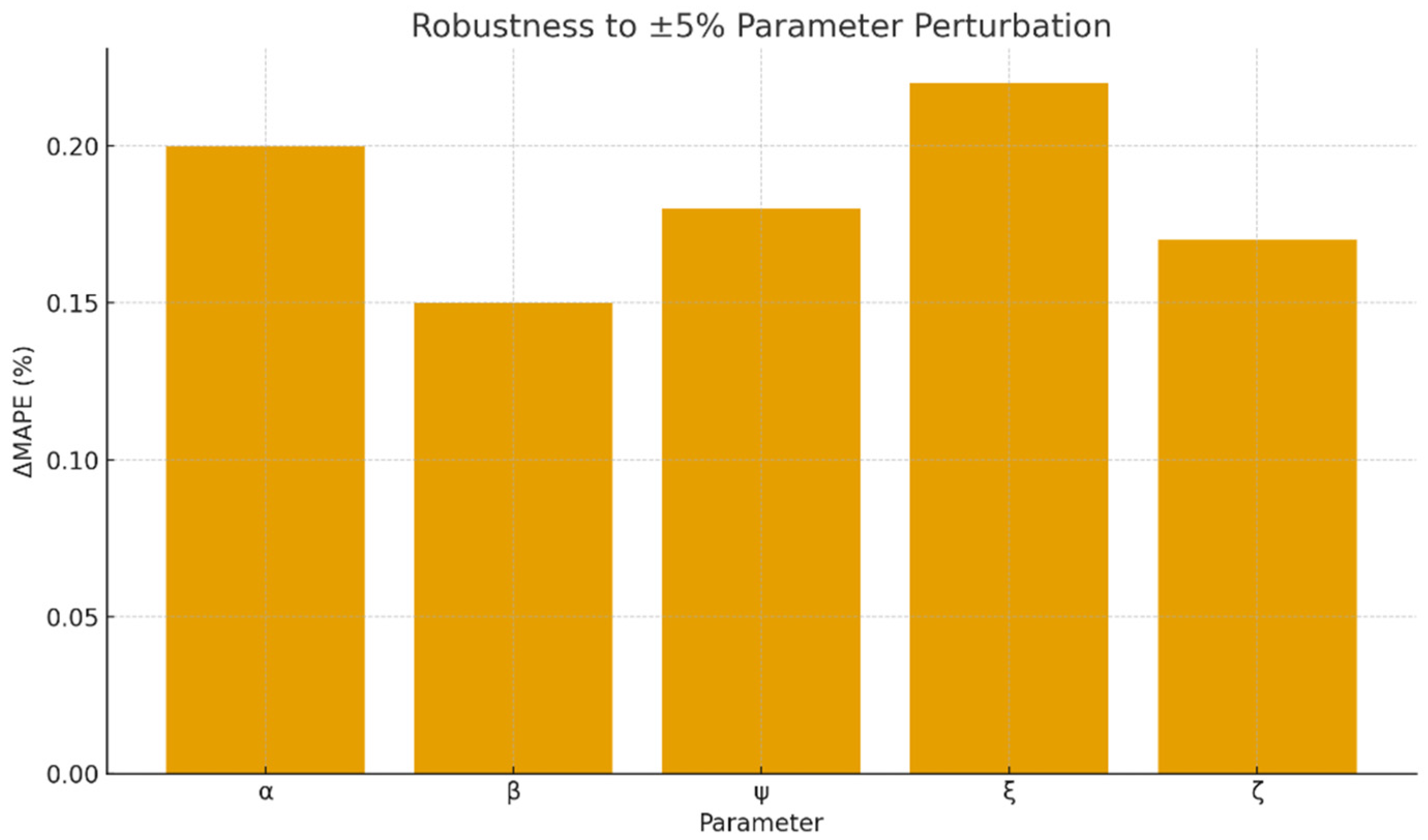
To ensure that the proposed semi-empirical degradation model is both statistically reliable and structurally robust, a comprehensive uncertainty assessment was conducted using three complementary analyses: bootstrap confidence interval estimation, inter-cell prediction-variance evaluation, and parameter-perturbation robustness testing. The results are summarized in
Figure 19,
Figure 20 and
Figure 21.
Figure 19 presents the 95% bootstrap confidence intervals for the MAPE values across the representative stress conditions used in this study. These confidence intervals were obtained using a non-parametric bootstrap procedure with 1000 iterations, where degradation trajectories were resampled with replacement and the model was re-evaluated for each iteration. The resulting intervals are consistently narrow, typically within ±0.1% to ±0.12% of the mean MAPE, demonstrating that the predictive accuracy is statistically stable and not driven by sampling variability or outlier cells. This confirms the high confidence associated with the model’s early-cycle predictions.
To evaluate inter-cell generalizability,
Figure 20 shows the distribution of MAPE values across the 27 LFP cells included in the experimental dataset. Despite inherent cell-to-cell variations and differences in stress exposure, the spread of
MAPE values remains small, with most cells clustering closely around the mean. This low variance indicates that the model performs consistently across all tested cells, further highlighting the robustness of the semi-empirical formulation under diverse real-world operating profiles.
Finally, a parameter-robustness analysis was conducted by perturbing each optimized parameter (
α,
β,
ψ,
ξ) by ±5% around its MMCA-derived optimal value. As shown in
Figure 21, the resulting variation in MAPE does not exceed 0.25% for any parameter, confirming that the model is not overly sensitive to small deviations in parameter values. This behavior indicates a well-conditioned optimization landscape and validates the stability of the proposed semi-empirical structure when subjected to modest parameter uncertainty or measurement noise.
Collectively, the findings from
Figure 19,
Figure 20 and
Figure 21 demonstrate that the proposed degradation model exhibits high statistical confidence, strong cross-cell consistency, and excellent robustness to parameter perturbations. These results affirm the reliability of the model for early-life prediction and support its applicability across a wide range of LFP operating conditions.