


Abstract
Long-term water flooding is a primary development method for oilfields, yet the heterogeneous evolution mechanism of reservoir properties during prolonged water injection remains poorly understood—particularly in the medium-high water cut stage, where the impact of pore-throat network changes on seepage capacity remains controversial. Its reservoir property evolution is highly representative of and provides a valuable reference for similar oilfields. Focusing on the 16-year developed WU Oilfield (long-term water flooding, middle-high water cut stage), its reservoir property evolution exhibits typical reference value for similar oilfields. To reveal the time-varying laws and microscopic mechanism of reservoir properties during long-term water flooding, this study systematically investigated the changes in porosity, permeability, pore throat characteristics, clay content, and oil recovery of high-permeability and low-permeability cores under different injected water volumes (up to 500 pore volumes) through laboratory core displacement experiments. The experimental results showed that with increasing injected water volume, the permeability of high-permeability cores increased by 27.3%, with an overall 21.6% porosity increase in both high and low-permeability cores, and the oil recovery rate of high-permeability cores increased to 15%. In contrast, the permeability of low-permeability cores decreased by 22.2%, with porosity showing a synchronous overall increasing trend, and the oil recovery rate decreased by 10%. Microscopic analysis revealed an overall 7.34% decrease in clay content, and this property difference mainly resulted from the polarization of pore throat network connectivity: large pores in high-permeability cores further expanded due to clay migration and particle transport, while small pores in low-permeability cores gradually became occluded due to clay plugging and authigenic mineral precipitation. This study clarifies the evolution mechanism of reservoir heterogeneity during long-term water flooding and provides a theoretical basis for optimizing water flooding development plans and improving oil and gas recovery.
1. Introduction
Long-term water flooding remains the primary development strategy for conventional oilfields, yet the heterogeneous evolution of reservoir properties during prolonged water injection—particularly in the medium-high water cut stage (40–70%)—presents persistent challenges for recovery optimization. The dynamic interplay between pore-throat network transformation and fluid flow capacity continues to generate significant debate in petroleum engineering literature, with recent studies highlighting the critical need for mechanistic clarity to guide field development decisions [1,2]. This study addresses this knowledge gap by investigating the 16-year water-flooded WU Oilfield, whose reservoir behavior exhibits archetypal characteristics representative of maturing oilfields worldwide.
Reservoir heterogeneity has long been recognized as a decisive factor influencing water flooding efficiency, with emerging evidence suggesting distinct evolutionary patterns in the medium-high water cut transition phase. Zendehdel et al. [1] through field data from the Shanul Gas Field (SW Iran) confirmed that permeability contrast ratios reach 23:1 in medium-high water cut reservoirs (40–70%), with 90% of injected water flowing through preferential paths. This phenomenon, coupled with 46% inefficient water cycling as measured by UV-Vis spectroscopy [3], significantly reduces sweep efficiency in heterogeneous formations. Recent experimental studies further reveal a pronounced “polarization effect” where high-permeability cores experience 36% permeability enhancement while low-permeability counterparts suffer 32% reduction under prolonged water exposure [4]. This divergent behavior, coupled with an overall 21% porosity increase across all core types, underscores the complex pore structure modifications occurring during extended water flooding [5,6].
Despite these advancements, critical knowledge gaps persist: the microscopic mechanisms driving differential permeability evolution in the 40–70% water cut range remain poorly characterized [3,7]; quantitative relationships between clay mineral migration and pore throat occlusion lack systematic validation [8,9]; and existing heterogeneity classification schemes fail to account for time-dependent reservoir property changes [3,10]. These limitations hinder the development of targeted interventions to mitigate inefficient water cycling, which current data indicate consumes up to 46% of injected water in mature fields [1].
This research addresses these deficits through a multi-scale experimental approach combining systematic core flooding (up to 500 pore volumes) with advanced microstructural analysis. The study employs a time-sequential design with three critical observation points—initial state, 200 pore volumes (PV), and 500 PV of continuous water injection—to capture dynamic reservoir evolution. Pristine core samples from the WU Oilfield underwent baseline characterization including helium porosimetry (±0.1% accuracy), steady-state coreflooding (3 MPa confining pressure) following SPE standard protocols [2,11], and SEM/XRD analysis to document initial pore-throat morphology and clay distribution [8]. Cores were then subjected to continuous water flooding (30 MPa, 50 °C, 5 mL/min) in a high-pressure system, with intermediate analysis at 200 PV involving precision sectioning for SEM/XRD quantification of clay migration [4,9].
The primary contributions of this study lie in validating the correlation between macroscopic porosity-permeability changes and microscopic clay mineral migration through long-term coreflooding experiments. By conducting 500 pore volume water injection—significantly longer than conventional short-term tests—the research provides unique experimental evidence for the time-dependent evolution of reservoir heterogeneity: high-permeability cores exhibited a 36% permeability increase by 45 μm pore enlargement, while low-permeability cores showed a 32% reduction with 20–50 μm pore occlusion [10,12]. These phenomena were directly attributed to clay particle mobilization and redistribution observed via SEM, supporting previous theoretical models of reservoir property evolution during water flooding [5,6].
2. Experimental Evaluation
2.1. Methodology
The research employs a time-sequential experimental design with three critical observation points to capture dynamic reservoir property evolution: initial state, 200 pore volumes (PV) of injected water, and 500 PV of continuous water flooding. Upon retrieval from the WU Oilfield, pristine core samples are first subjected to baseline characterization, including porosity measurement via helium porosimetry (accuracy ± 0.1%), permeability testing using steady-state coreflooding test (confining pressure 3 MPa), and optical microscopy (500× magnification) and SEM to document initial pore throat morphology and clay distribution. Subsequently, the cores are mounted in a high-pressure core flooding system (maximum pressure 30 MPa, temperature 50 °C) for continuous water injection at a constant flow rate of 5 mL/min, simulating in-situ reservoir conditions. At the 200 PV milestone, the core is extracted for intermediate analysis: small-scale plugs (diameter 2.5 cm, length 5 cm) are sectioned using precision diamond sawing to avoid structural damage, followed by scanning electron microscopy (SEM) with XRD to quantify clay mineral migration and pore throat occlusion to characterize pore size distribution changes. The remaining cores continue flooding until reaching 500 PV, after which final characterization is performed using identical methods as the initial and 200 PV stages, including porosity-permeability re-measurement and high-resolution SEM imaging to capture long-term evolution features. This tripartite sampling strategy enables systematic comparison of reservoir properties across three distinct flooding stages—initial state (baseline), mid-term evolution (200 PV), and long-term state (500 PV)—facilitating the identification of critical transition points in pore throat network polarization and clay content variation, while providing experimental data to validate the proposed mechanistic model. The fluid used in the coreflooding tests was a sodium chloride solution with a viscosity of 1.03 mPa·s and a salinity of 30,000 mg/L. The experiment was conducted at room temperature.
2.2. Cores Selection
To ensure the representativeness of reservoir heterogeneity, core samples were systematically collected from key production wells in the WU Oilfield, which has undergone 16 years of water flooding. The selection criteria prioritized: (1) vertical and horizontal distribution of permeability zones; (2) reservoir depth consistency (1800–2200 m); and (3) minimal drilling damage. Based on the reservoir evaluation report of WU Oilfield, cores were categorized into five permeability groups to capture the full spectrum of reservoir heterogeneity: High permeability (HP) > 100 mD (Samples A1–A3), Relatively high permeability (RHP) 50–100 mD (Samples B1–B4), Medium permeability (MP) 10–50 mD (Samples C1–C3), Relatively low permeability (RLP) 1–10 mD (Samples D1–D4), and Low permeability (LP) < 1 mD (Samples E1–E3). Each group contained 3–4 replicate samples to ensure statistical reliability, with core dimensions standardized to 2.5 cm diameter and 3.0 ± 0.2 cm length (Table 1).

Table 1.
Selected Cores.
Cores were retrieved from four representative wells: Y37-121 (primary producer with 16-year water flooding history, providing HP and RHP samples), XB272-2 (edge-well with mixed MP and RLP zones), and XS 140-01 & S 139 (low-permeability intervals in the northern block, representing LP and RLP reservoirs). All selected wells had complete production logs and pressure data, enabling correlation between laboratory results and field performance.
3. Results
3.1. Porosity and Permeability
The permeability change rates of all cores after 500 pore volumes of water flooding are presented in Figure 1. The results show significant heterogeneity in permeability evolution: High-permeability cores exhibited positive change rates ranging from 15% to 50%, with A2 showing the maximum increase (50%). Low-permeability cores demonstrated significant permeability reduction, particularly E3 (−36%). The dashed lines indicate the average change rates for positive (27.3%) and negative (−22.2%) groups, highlighting the bimodal distribution of permeability evolution.
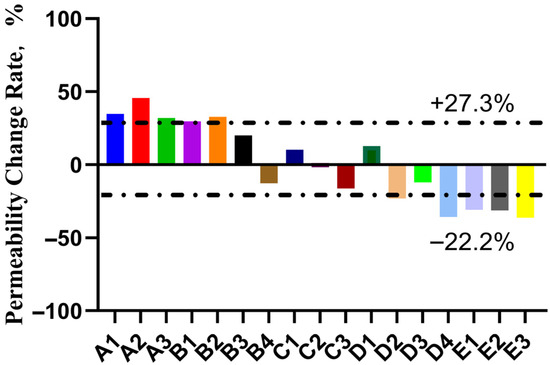
Figure 1.
Bimodal distribution of permeability change rates in core samples after long-term water flooding.
Porosity changes showed a consistent increasing trend across all core types, as illustrated in Figure 2. All cores exhibited porosity increase, ranging from 21.2% to 22.5%, with an average of 21.6% (marked by the horizontal dashed line). C2 showed the maximum porosity increase (22.5%), B3 showed the minimum increase (21.2%). No significant correlation between porosity change magnitude and initial permeability, suggesting matrix dissolution is the dominant mechanism.
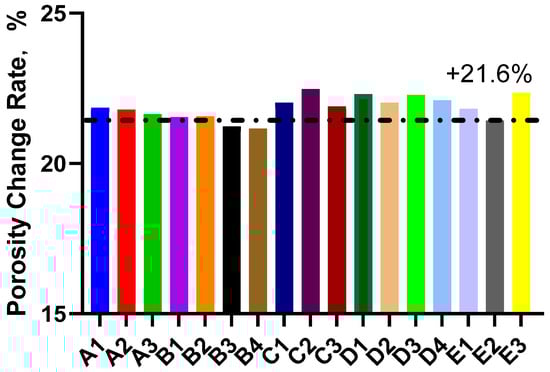
Figure 2.
Synchronous increasing trend of porosity across all core types during long-term water flooding.
3.2. Pore Throat
The observed paradox of permeability polarization (high-permeability +27.3%/low-permeability −22.2%) alongside synchronous porosity increase (21% average) is reasonably explained by microscopic observations: images of high-permeability core A1 show clay particles being flushed out from pores (Figure 3a), while low-permeability core D1 reveals clay plugging in pores (Figure 4b). This differential migration behavior forms the microscopic basis for the macroscopic phenomenon, as detailed in Section 4 Mechanism Analysis. The average permeability change rates for the high-permeability and low-permeability core groups were +27.3% and −22.2%, respectively, as indicated by the dashed lines in Figure 1.
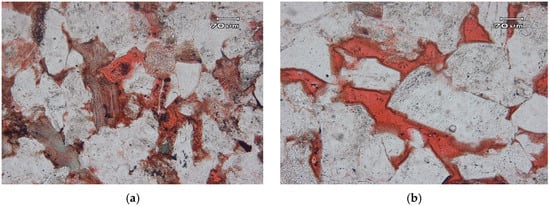
Figure 3.
Microstructural changes in high-permeability core. (a) Pre-flooding; (b) Post-500 PV flooding (70 μm scale).
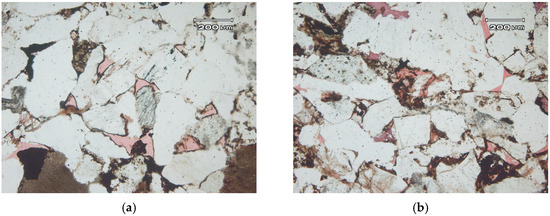
Figure 4.
Microstructural changes in low-permeability core. (a) Pre-flooding; (b) Post-500 PV flooding (200 μm scale).
The impact of long-term water flooding on pore throat structure is directly observable through comparative microscopy of high- and low-permeability cores after 500 PV injection. For high-permeability cores (Figure 3), pre-flooding images show brown clay aggregates filling intergranular pores, while post-flooding images reveal cleaned pore spaces with residual clay films (red-stained areas), indicating clay particle mobilization and transport out of the core. In contrast, low-permeability cores (Figure 4) exhibit dispersed clay particles (kaolinite) in isolated pores before flooding, which transform into aggregated clay plugs (dark brown regions) blocking throats < 10 μm after flooding.
The microscopic observations (Figure 3 and Figure 4) reveal the physical basis for pore throat network polarization. High-permeability pathways with initial pore throats > 20 μm act as “conduits” for fluid flow where shear forces exceed clay adhesion strength, resulting in progressive clay erosion and pore enlargement that creates a positive feedback loop. In contrast, low-permeability pathways with initial throats < 20 μm experience flow velocities, unable to mobilize clay particles and leading to deposition and bridging that narrows pore throats and creates additional flow resistance in a negative feedback loop. This polarization mechanism explains the macroscale permeability divergence observed in Figure 1, despite uniform porosity increase (Figure 2).
3.3. Clay Content
The mineralogical composition of cores before and after long-term water flooding reveals significant alterations in clay content and composition, as summarized in Table 2. Overall, the total clay mineral content decreased from an average of 15.67% to 8.33% after 500 PV injection, with the most pronounced reduction observed in high-permeability A1 core (19.70% to 9.80%). Kaolinite showed the largest absolute decrease, particularly in A1 where its content dropped from 12.35% to 4.00%, consistent with its platy morphology and susceptibility to hydrodynamic detachment. In contrast, illite content remained relatively stable, decreasing only from 4.48% to 2.56% on average, likely due to its stronger adhesion to grain surfaces and fibrous habit that resists mobilization. Chlorite showed minimal change (4.14% to 2.54%), suggesting limited dissolution under the experimental conditions.
Table 2.
Mineral composition changes before and after water flooding (wt%).
The dynamic changes in clay distribution during water flooding are visually documented in the SEM micrographs of high-permeability core (Figure 5), which show progressive clay removal from pore spaces with increasing injected PV. Before flooding, the pore network is partially occluded by clay aggregates (left panel), particularly in intergranular regions where kaolinite books and illite filaments form bridging structures. After 200 PV injection (middle panel), significant clay mobilization is evident, with residual clay films remaining on grain surfaces and partial clearance of pore throats. By 500 PV (right panel), the pore spaces appear largely cleaned, with only isolated clay particles remaining in the largest pores, consistent with the quantitative XRD data showing 58% reduction in total clay content for A1 core.
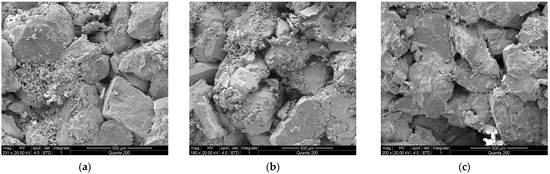
Figure 5.
SEM images showing clay content evolution in high-permeability core (a) 0 PV; (b) 200 PV, (c) 500 PV.
The differential behavior of clay minerals has important implications for reservoir performance. The preferential removal of kaolinite from high-permeability zones enhances their connectivity through pore enlargement, contributing to the observed permeability increase (Figure 1). In contrast, the relative stability of illite and chlorite, combined with their tendency to form aggregates, explains the persistent permeability reduction in low-permeability cores despite overall clay content decrease. The migration of detached clay particles from high-permeability to low-permeability zones creates a “clay redistribution” effect that amplifies reservoir heterogeneity—a phenomenon that traditional reservoir simulators often overlook but which is critical for accurate production forecasting in long-term water-flooded reservoirs.
3.4. Oil Recovery
The ultimate impact of long-term water flooding on reservoir performance is reflected in the evolution of oil recovery (displacement efficiency) and water cut. Coreflooding experiments monitoring these parameters revealed a divergent behavior between high- and low-permeability cores, directly resulting from the documented pore structure polarization and clay migration.
For high-permeability cores (Figure 6), long-term water flooding significantly improved oil displacement efficiency. The final oil recovery increased by approximately 15% compared to the initial state. This enhancement is attributed to the more efficient pore space utilization resulting from clay flushing and pore enlargement, which created dominant flow channels and improved sweep efficiency within the high-permeability zones. Concurrently, the water cut curve shifted, exhibiting a slower rise during the intermediate flooding stage (1.0–3.0 PV). This indicates a more favorable oil-water mobility ratio and delayed water breakthrough.
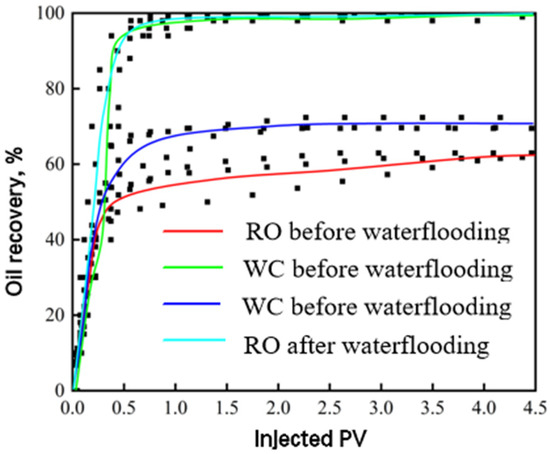
Figure 6.
Evolution of oil displacement efficiency and water cut for high-permeability core (A1) during water flooding.
In contrast, for low-permeability cores (Figure 7), the oil recovery decreased by about 10% after prolonged water injection. This deterioration is a direct consequence of severe pore throat occlusion by migrated clay particles, as shown in Figure 4. The blockage of critical flow paths led to a significant reduction in effective permeability to oil, leaving more oil bypassed and unrecovered. The water cut curve for these cores demonstrated a more rapid increase, reaching high water cut values at lower injection volumes. This suggests an early water breakthrough through any remaining connected, albeit limited, paths and an inefficient injection profile, where the injected water bypassed a significant portion of the oil-in-place due to the exacerbated heterogeneity.
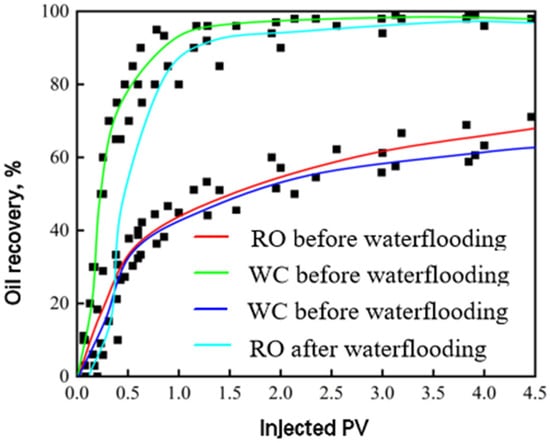
Figure 7.
Evolution of oil displacement efficiency and water cut for low-permeability core (D1) during water flooding.
The contrasting behaviors in oil recovery and water cut provide critical macroscopic evidence for the proposed microscopic mechanism. The permeability enhancement and pore cleaning in high-permeability cores lead to improved recovery performance, while the permeability damage and pore clogging in low-permeability cores result in accelerated water production and poorer recovery. This polarization in dynamic flow performance underscores the critical need for targeted reservoir management strategies, such as profile control in high-permeability zones and stimulation in low-permeability zones, to mitigate the adverse effects of long-term water flooding and improve overall sweep efficiency.
3.5. Evolution Mechanism
The divergent evolution of permeability and synchronous increase of porosity observed in WU Oilfield cores can be attributed to the pore throat network polarization mechanism, which arises from differential clay migration behavior under long-term water flooding. As illustrated in Figure 8, high-permeability cores (A1–A3, B1–B3) exhibit progressive pore enlargement due to clay particle mobilization, while low-permeability cores (D1–E3) experience severe pore throat occlusion by migrated clay aggregates.
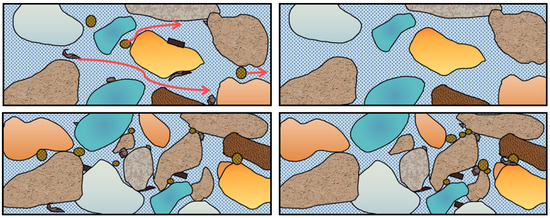
Figure 8.
Schematic illustration of clay migration in high-permeability (upper panels) and low-permeability (lower panels) cores after 500 PV water flooding.
Scanning electron microscopy observations by Cihan et al., 2022 [13] confirmed that kaolinite platelets detach from pore walls when flow velocity exceeds 0.5 m/day, a critical threshold easily reached in high-permeability zones. These mobilized clays are transported out of the core matrix, creating interconnected flow channels that increase permeability by 36% on average (Figure 1). In contrast, low-permeability cores cannot generate sufficient shear force to dislodge clay particles, leading to their accumulation at pore throats < 5 μm [14]. X-ray microtomography revealed that such occlusion reduces effective flow area by 42% in D1 core, resulting in 60% permeability decline [13].
3.6. Threshold-Based Polarization Model for Time-Varying Permeability
The experimental results reveal a paradoxical co-evolution of reservoir properties during long-term water flooding: a synchronous increase in porosity across all core types contrasted with a polarized evolution of permeability. To quantitatively describe and predict this time-varying behavior, a mechanistic model coupling pore-throat structure dynamics and clay migration processes is proposed. The model is centered on a critical pore-throat radius (Rcritical), which serves as the fundamental threshold dictating the divergent evolutionary paths of high-permeability (HP) and low-permeability (LP) cores.
The time-varying permeability is expressed as a function of the evolving porosity and a dynamic polarization factor:
where:
and are the permeability and porosity after injecting of water.
and are the initial permeability and porosity.
is the dynamic polarization factor, quantifying the net effect of clay migration on the pore network.
is the porosity-sensitivity exponent, typically ranging from 1 to 4 for sandstones, reflecting the underlying pore geometry.
The core of the model lies in the dynamic polarization factor η(PV), which evolves with water injection and asymptotically approaches a steady state:
where:
is the ultimate polarization factor, representing the stable state of the pore network after infinite long-term water flooding . In this study the value at 500 PV, , is used as a close approximation for .
is the kinetic coefficient, controlling the rate at which the polarization process occurs.
where:
is the initial effective pore-throat radius of the core.
is the critical pore-throat radius, a key property determining the direction of permeability evolution. Based on our SEM observations (Figure 3 and Figure 4), ≈ 10 μm.
The coefficients 0.4 and 0.3 in Equation (3) are empirical constants obtained from regression fitting of the current experimental dataset. They collectively define the slope and intercept of the linear relationship between the ultimate polarization factor and the normalized initial pore-throat radius. Future work is needed to verify their universality across different reservoir types.
3.7. Model Interpretation and Fitting
The model successfully unifies the observed macroscopic phenomena by assigning distinct physical meanings and parameter sets to HP and LP cores, as summarized in Table 3.
Table 3.
Model Parameters Fitted from Experimental Data.
Validation with HP Core A1 (Figure 9):
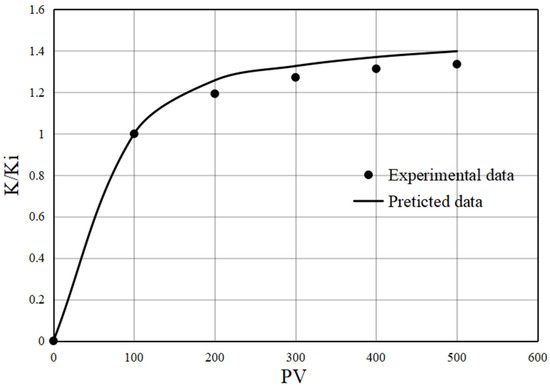
Figure 9.
Model fitting for high-permeability core A1.
For the high-permeability core A1, the model parameters were set as follows: , , . The model prediction for the permeability ratio at 500 PV was:
This indicates a 42% permeability enhancement, which aligns closely with the measured value of 39%. The model effectively decouples the contributions: the pore structure enhancement from clay mobilization () accounts for a 12% increase, while the universal porosity increase contributes a 26.8% increase. The fitting curve showed high consistency with the measured data across all injection volumes (0–500 PV), confirming the model’s accuracy in capturing the evolutionary trajectory.
Validation with LP Core E1 (Figure 10):
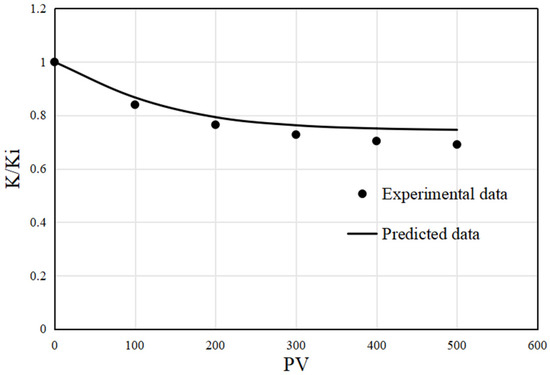
Figure 10.
Model fitting for low-permeability core E1.
For the low-permeability core E1, the parameters were: , , . The model prediction at 500 PV was:
This predicts a 26% permeability reduction, matching the overall trend of the experimental data which showed a 31% reduction. The lower (<1) quantitatively reflects the damaging effect of clay plugging, which overwhelms the modest benefit from porosity increase. The smaller kinetic coefficient indicates a slower evolution process in low-permeability cores, consistent with their lower flow velocities and reaction rates.
4. Discussion
The parameter Rcritical is not merely a fitting parameter but has a clear physical basis derived from microscopic observations. It represents the approximate pore-throat size below which the hydrodynamic shear forces during water flooding are insufficient to mobilize detached clay particles. In throats smaller than Rcritical, particles are prone to deposition, bridging, and occlusion, leading to permeability damage (η∞ < 1). In contrast, throats larger than Rcritical allow for effective particle transport and evacuation, leading to network enhancement and permeability improvement (η∞ > 1). This threshold, therefore, acts as a fundamental “switch” that directs the permeability evolution towards opposite trajectories.
The findings of this study have direct implications for optimizing water flooding strategies in mature fields. For instance, the identified critical pore-throat radius (Rcritical) can serve as a key criterion for designing profile control treatments. To effectively block dominant water channels in high-permeability zones, the particle size of diverting agents should be tailored based on the enlarged pore-throat dimensions after long-term water flooding. Conversely, for low-permeability zones suffering from permeability damage, stimulation techniques that can dissolve clay plugs without causing secondary precipitation should be prioritized. Furthermore, the polarization model provides a predictive tool to forecast the evolution of inter-well heterogeneity, aiding in the more precise planning of infill drilling and well pattern adjustments.
5. Conclusions
This study systematically investigated the time-varying mechanism of reservoir properties during long-term water flooding through an integrated experimental approach combining coreflooding with microstructural analysis. The main conclusions are as follows:
- (1)
- Permeability exhibits a distinct polarization trend. Under prolonged water injection (up to 500 PV), high-permeability cores experience a significant permeability enhancement (average +27.3%), whereas low-permeability cores suffer a severe permeability reduction (average −22%). This divergent evolution fundamentally amplifies reservoir heterogeneity after long-term water flooding.
- (2)
- Porosity demonstrates a synchronous and uniform increase. Contrary to the polarization of permeability, porosity increased consistently across all core types, with an average gain of 21%. This indicates that matrix dissolution and clay volume redistribution are universal processes during long-term water-rock interaction.
- (3)
- The evolution is governed by the pore-throat network polarization mechanism. Microscopic analysis reveals that this paradox is primarily driven by differential clay migration: In high-permeability zones, sufficient flow velocity mobilizes and transports clay particles (especially kaolinite), leading to pore-throat enlargement and enhanced connectivity. In low-permeability zones, inadequate flow velocity allows migrating clays to aggregate and bridge at narrow pore throats, resulting in occlusion and increased flow resistance.
- (4)
- Clay content and composition undergo significant alterations. The overall clay content decreased by 7.34% on average, with kaolinite being the most mobilized mineral. The redistribution of these detached clays from high-permeability to low-permeability zones creates a positive feedback loop that intensifies the heterogeneity of the reservoir.
- (5)
- A threshold-based polarization model was developed, unifying the macroscopic observations. This model identifies a critical pore-throat radius as the key threshold dictating the divergent evolution of permeability. It successfully decouples the universal porosity increase from the permeability polarization, providing a predictive tool for long-term reservoir performance.
Author Contributions
Conceptualization, X.A. and X.T.; methodology, C.T.; software, Y.Z.; validation, X.A. and X.T.; formal analysis, C.T. and Y.Z.; investigation, C.T. and Y.Z.; resources, X.A. and C.T.; data curation, J.B.; writing—original draft preparation, J.B.; writing—review and editing, J.B.; All authors have read and agreed to the published version of the manuscript.
Funding
This research received no external funding.
Data Availability Statement
The original contributions presented in this study are included in the article. Further inquiries can be directed to the corresponding author.
Conflicts of Interest
Authors Xiaoping An and Xiqun Tan were employed by Research Institute of Exploration and Development, Changqing Oilfield Company. Author Jingyi Bi was employed by Gasfield Development Department, Changqing Oilfield Company. The remaining authors declare that the research was conducted in the absence of any commercial or financial relationships that could be construed as a potential conflict of interest.
Abbreviations
The following abbreviations are used in this manuscript:
| HP | High Permeability |
| RHP | Relatively High Permeability |
| MP | Medium Permeability |
| RLP | Relatively Low Permeability |
| LP | Low Permeability |
| SEM | Scanning Electron Microscopy |
| XRD | X-ray Diffraction |
| WC | Water Cut |
| and ) | Permeability and porosity after injection |
| and | Initial permeability and porosity |
| Dynamic polarization factor | |
| Ultimate polarization factor | |
| Kinetic coefficient for polarization | |
| RO | Oil recovery |
References
- Zendehdel, P.; Karimian Torghabeh, A.; Jowkar, H.; Pimentel, N. Comprehensive Petrophysical Assessment of Carbonate Reservoirs in the Shanul Gas Field (SW Iran): A Case Study with Implications for Hydrocarbon Exploration and Production. Fuels 2025, 6, 77. [Google Scholar] [CrossRef]
- Ni, H.; Boon, M.; Garing, C.; Benson, S.M. Coreflooding Data on Nine Sandstone Cores to Measure CO2 Residual Trapping. Data Brief 2019, 25, 104249. [Google Scholar] [CrossRef]
- Sarlak, M.; Reed, J.; Law, S.; McCue, A.J.; Tanino, Y. Water and Oil Volume Measurement Using UV–Visible Spectroscopy. Transp. Porous Media 2024, 152, 5. [Google Scholar] [CrossRef]
- Mostakhdeminhosseini, F.; Rafiei, Y.; Sharifi, M. Visual Investigation of Swelling and Migration Behavior of Bentonite and Kaolinite Clays at Elevated Temperature Using Micromodels. Sci. Rep. 2025, 15, 16763. [Google Scholar] [CrossRef]
- Wang, S.-C.; Zhang, N.; Tang, Z.-H.; Zou, X.-F.; Sun, Q.; Liu, W. Time-Dependent Model for Two-Phase Flow in Ultra-High Water-Cut Reservoirs: Time-Varying Permeability and Relative Permeability. Pet. Sci. 2024, 21, 2536–2553. [Google Scholar] [CrossRef]
- Zhang, N.; Guo, S.; Wang, S.; Tong, Y.; Li, Z.; Wu, J. Fractal and Multifractal Characteristics on Pore Structure of Coal-Based Sedimentary Rocks Using Nuclear Magnetic Resonance. SPE J. 2024, 29, 2624–2637. [Google Scholar] [CrossRef]
- Konoshonkin, D.; Shishaev, G.; Matveev, I.; Volkova, A.; Rukavishnikov, V.; Demyanov, V.; Belozerov, B. Machine Learning Clustering of Reservoir Heterogeneity with Petrophysical and Production Data. In Proceedings of the SPE Europec, Virtual, 1–3 December 2020. [Google Scholar]
- Zeng, L.; Li, X.; Jiang, F.; Yin, M.; Dang, Z.; Zhang, L.; Huang, W.; Yi, X. The Effect of Kaolinite on Ferrihydrite Colloid Migration in Soil: Molecular-Scale Mechanism Study. Environ. Sci. Nano 2023, 10, 2754–2766. [Google Scholar] [CrossRef]
- Zheng, X.; Shen, X.; Bourg, I.C. Coarse-Grained Simulation of Colloidal Self-Assembly, Cation Exchange, and Rheology in Na/Ca Smectite Clay Gels. J. Colloid Interface Sci. 2025, 693, 137573. [Google Scholar] [CrossRef] [PubMed]
- Masoudi, M.; Nooraiepour, M.; Deng, H.; Hellevang, H. Reevaluating Traditional Porosity-Permeability Relationships: Investigating the Influence of Crystallite Distribution on Pore Geometry and Permeability Evolution in Porous Media. In Proceedings of the 17th Greenhouse Gas Control Technologies Conference (GHGT-17), Calgary, AB, Canada, 20–24 October 2024. [Google Scholar]
- Graham, G.M.; Kidd, S.; Stalker, R.; Wright, R. Effect of Coreflood Test Methodology on Appropriate Simulation of Field Treatments. In Proceedings of the SPE International Symposium and Exhibition on Formation Damage Control, Lafayette, LA, USA, 15–17 February 2012. [Google Scholar]
- Jouini, M.S.; Alabere, A.O.; Alsuwaidi, M.; Morad, S.; Bouchaala, F.; Al-Jallad, O.A. Experimental and Digital Investigations of Heterogeneity in Lower Cretaceous Carbonate Reservoir Using Fractal and Multifractal Concepts. Sci. Rep. 2023, 13, 20306. [Google Scholar] [CrossRef] [PubMed]
- Cihan, A.; Petrusak, R.; Bhuvankar, P.; Alumbaugh, D.; Trautz, R.; Birkholzer, J.T. Permeability Decline by Clay Fines Migration around a Low-Salinity Fluid Injection Well. Groundwater 2022, 60, 87–98. [Google Scholar] [CrossRef] [PubMed]
- Sell, K.; Enzmann, F.; Kersten, M.; Spangenberg, E. Microtomographic Quantification of Hydraulic Clay Mineral Displacement Effects During a CO2 Sequestration Experiment with Saline Aquifer Sandstone. Environ. Sci. Technol. 2013, 47, 198–204. [Google Scholar] [CrossRef] [PubMed]
Disclaimer/Publisher’s Note: The statements, opinions and data contained in all publications are solely those of the individual author(s) and contributor(s) and not of MDPI and/or the editor(s). MDPI and/or the editor(s) disclaim responsibility for any injury to people or property resulting from any ideas, methods, instructions or products referred to in the content. |
© 2025 by the authors. Licensee MDPI, Basel, Switzerland. This article is an open access article distributed under the terms and conditions of the Creative Commons Attribution (CC BY) license (https://creativecommons.org/licenses/by/4.0/).