Nonlinear Pressure Fluctuation Management for Ejector-Based Hydrogen Recirculation System in Large-Power Vehicular PEMFCs


Abstract
1. Introduction
- (1)
- Precise regulation of anode pressure is critical, since uncontrolled pressure fluctuations can induce mechanical stress accumulation, ultimately leading to structural failure in proton exchange membranes. However, existing studies predominantly concentrate on pressure management in conventional hydrogen recirculation systems utilizing circulating pumps, while insufficient attention has been paid to ejector-based systems despite their growing adoption in recent applications.
- (2)
- Despite the widespread adoption of ejector-based recirculation in PEMFC systems, the anode pressure oscillations and nonlinear characteristics under variable load conditions remain poorly understood, highlighting a critical research gap. The conventional Proportional-Integral-Derivative (PID) strategy, despite its prevalence, exhibits significant limitations in handling nonlinear dynamics induced by intricate system mechanisms and rapid transient responses. Consequently, the development of advanced management strategies is imperative to address these limitations.
2. Ejector-Based Hydrogen Recirculation System Model
- (1)
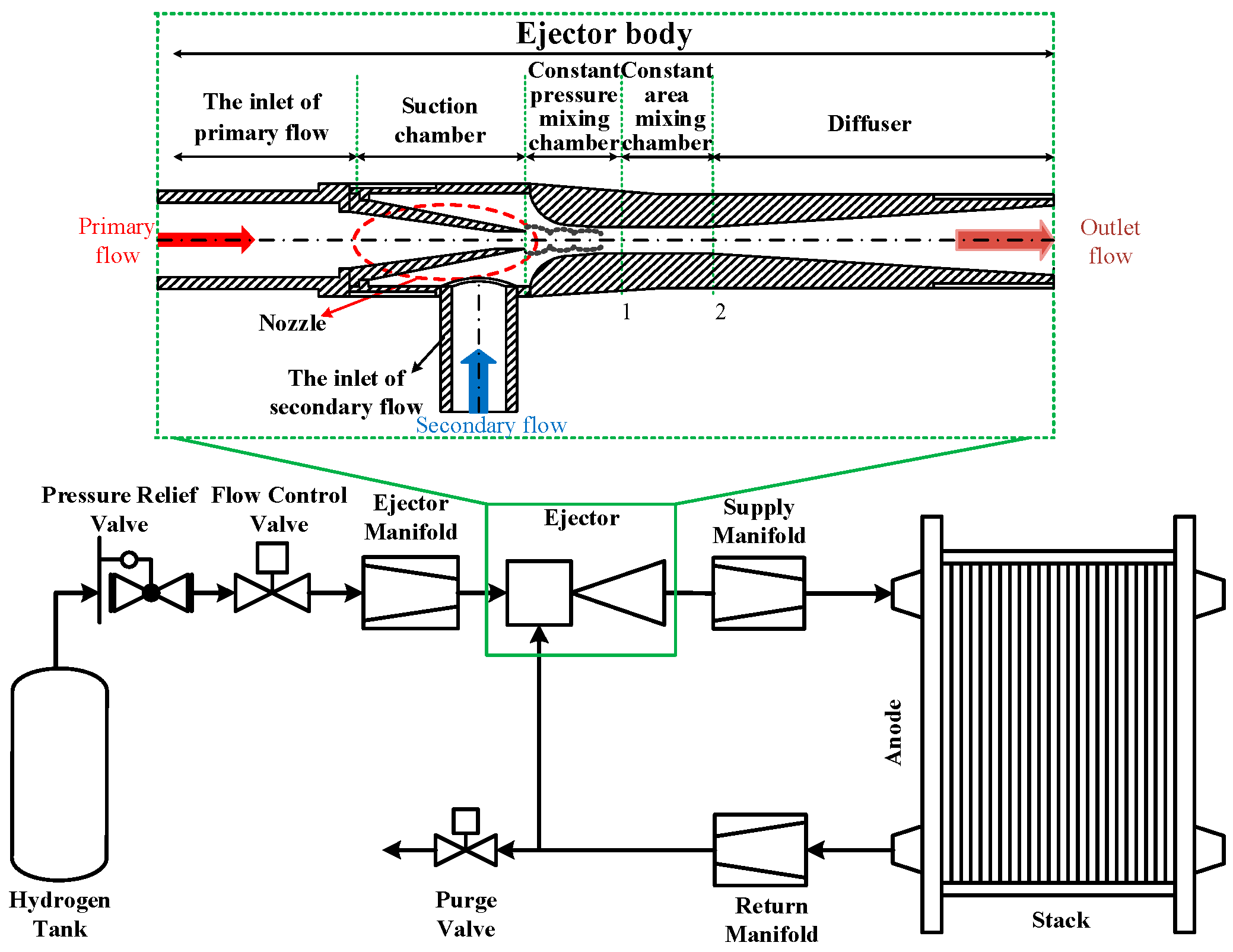
- All volumes are assumed to use the ideal gas law;
- (2)
- The interior of anode flow channel and manifolds are isothermal;
- (3)
- No liquid water is generated;
- (4)
- The spatial variations are neglected;
- (5)
- The working fluids within the ejector are considered stable compressible fluids;
- (6)
- The inner surface of the ejector wall is regarded as adiabatic.
2.1. Ejector Model and Design
2.2. Manifolds Model
2.3. Anode Flow Channel Model
2.4. Control Valve Model
3. Adaptive Model Predictive Control Scheme Design
3.1. Adaptive Linearized Model
3.2. Adaptive Model Predictive Controller
4. Simulation and Experiment Results Analysis
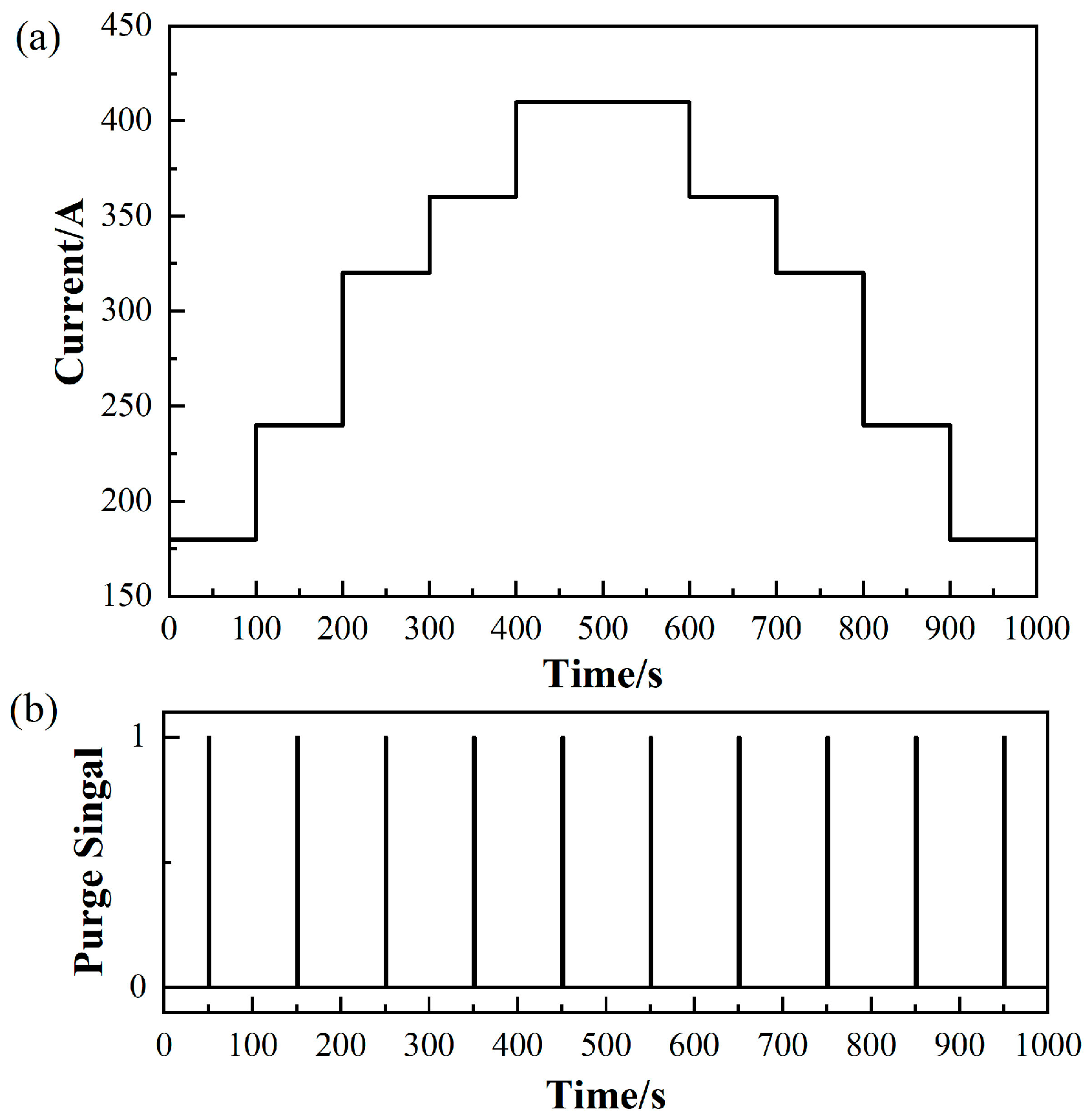
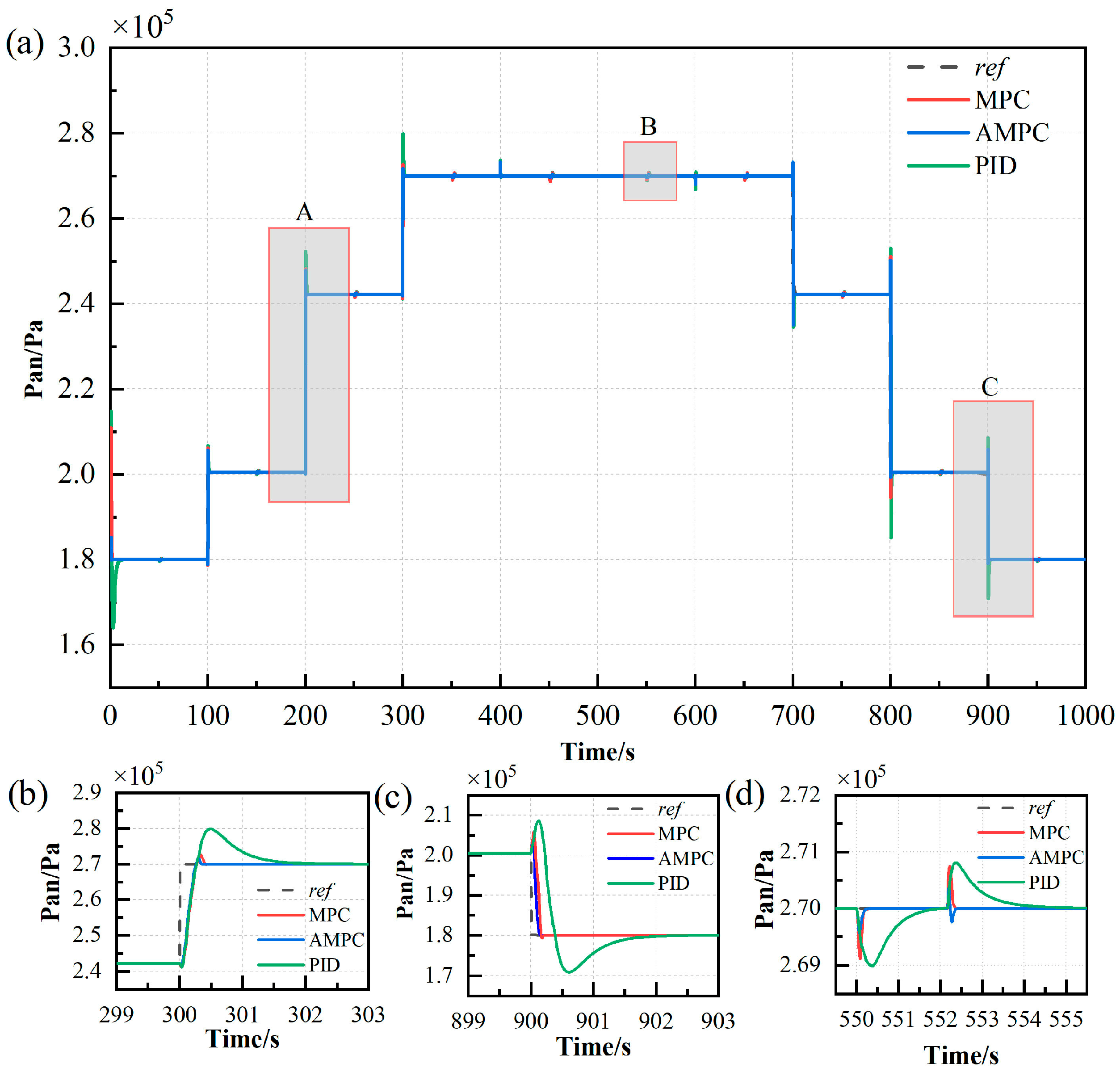
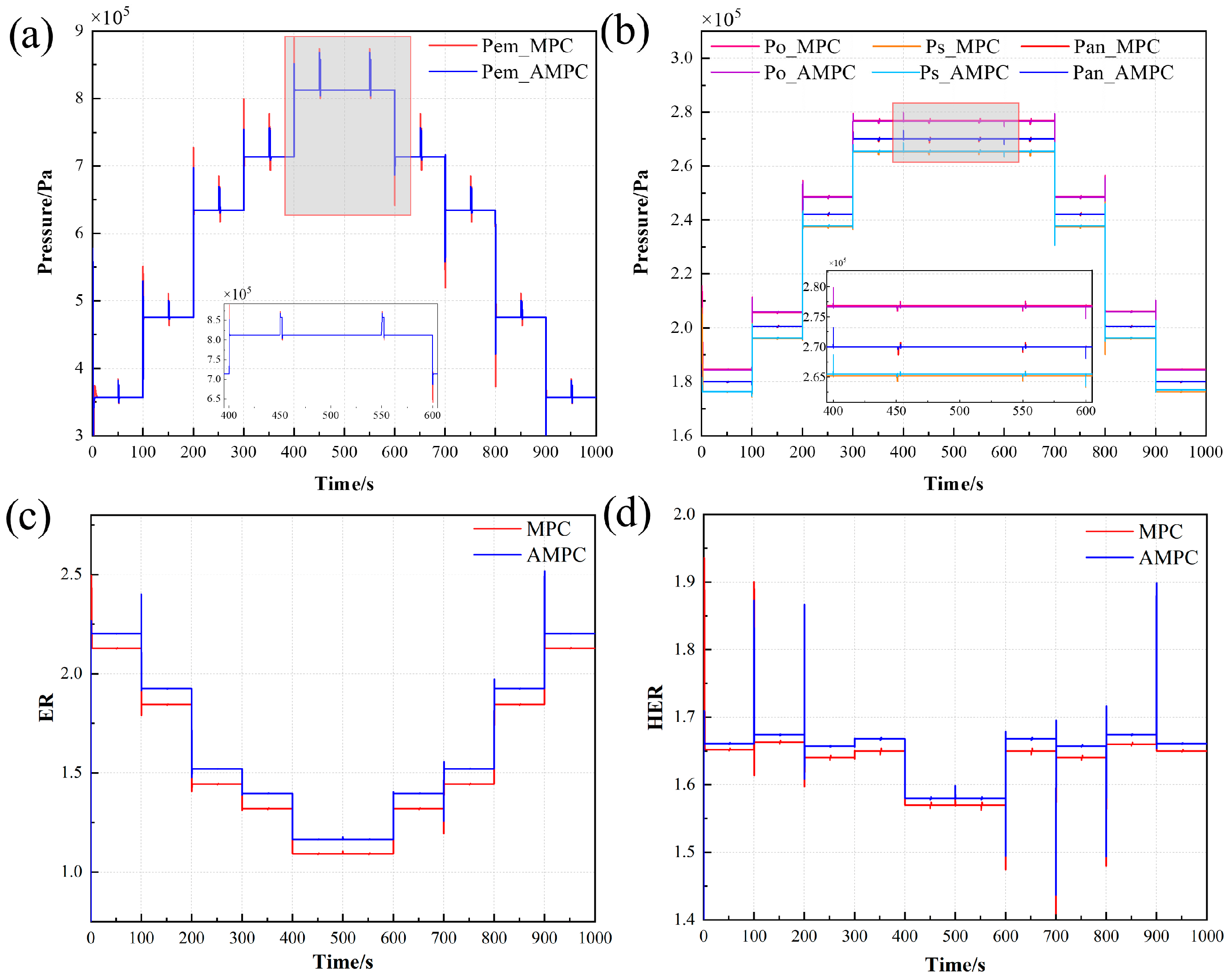
4.1. Simulation Results and Discussion
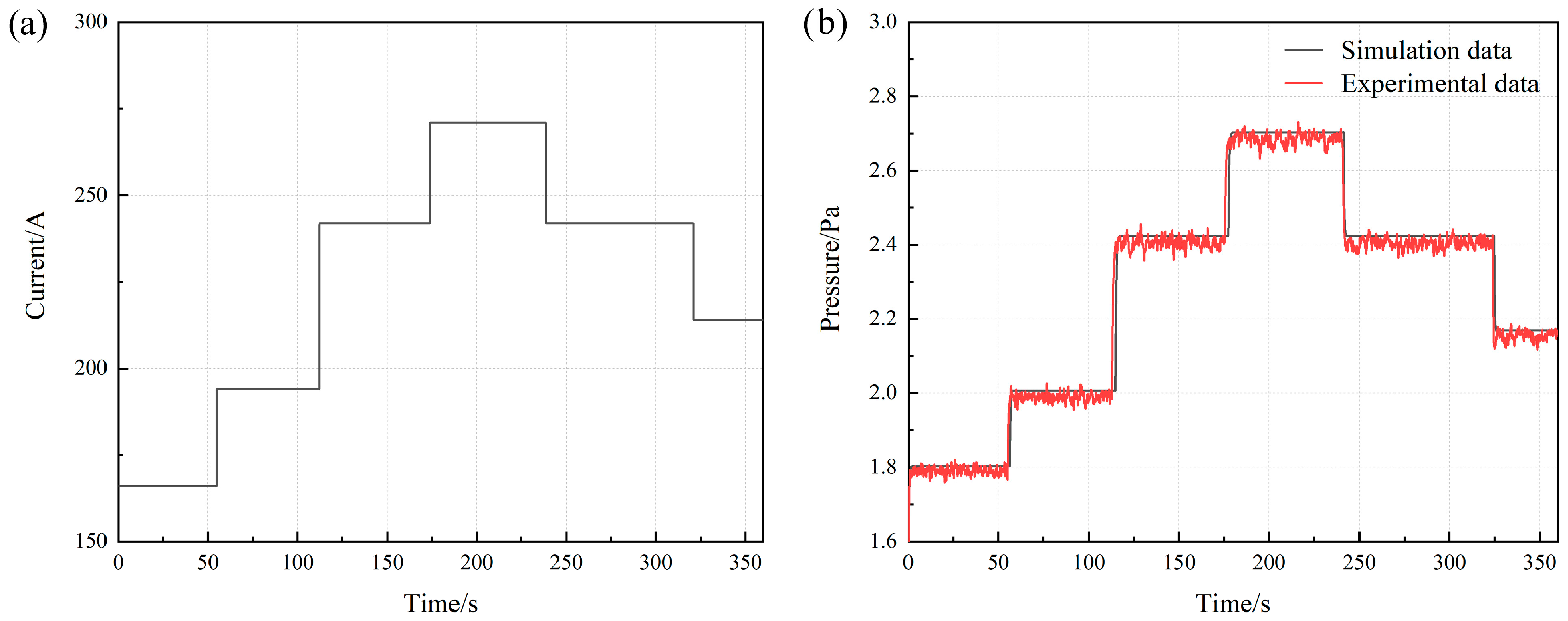
4.2. Experiment Results and Discussion
5. Conclusions
Author Contributions
Funding
Data Availability Statement
Conflicts of Interest
Abbreviations
| Nomenclature | Subscripts | ||
| Specific heat ratio of the gas | ej | Ejector | |
| Gas constant | p | Primary flow of ejector | |
| Radius | s | Secondary flow of ejector | |
| Faraday’s constant | out | Outlet flow of ejector | |
| Mass flow rate | em | Ejector manifold | |
| Number of cells in the stack | sm | Supply manifold | |
| Molar mass | rm | Return manifold | |
| Pressure | an | Anode flow channel | |
| Temperature | ca | Cathode flow channel | |
| Volume | sat | Saturated pressure | |
| Cross-sectional area of the nozzle | diff | Vapor permeated from cathode to anode | |
| Active area of the membrane | rec | Reacted | |
| Weight matrix | con | Consumed | |
| Isentropic coefficient | MRE | Mean relative error | |
| Mass fraction | MAE | Mean absolute error | |
| Membrane thickness | RMSE | Root mean square error | |
References
- Cai, F.; Cai, S.; Tu, Z. Proton exchange membrane fuel cell (PEMFC) operation in high current density (HCD): Problem, progress and perspective. Energy Convers. Manag. 2024, 307, 118348. [Google Scholar] [CrossRef]
- Li, X.; Ye, T.; Meng, X.; He, D.; Li, L.; Song, K.; Jiang, J.; Sun, C. Advances in the Application of Sulfonated Poly(Ether Ether Ketone) (SPEEK) and Its Organic Composite Membranes for Proton Exchange Membrane Fuel Cells (PEMFCs). Polymers 2024, 16, 2840. [Google Scholar] [CrossRef] [PubMed]
- Lin, Y.; Lee, M.; Hung, Y. A thermal management control using particle swarm optimization for hybrid electric energy system of electric vehicles. Results Eng. 2024, 21, 101717. [Google Scholar] [CrossRef]
- Tan, J.; Ismail, R.; Jadin, M. Dynamic model and robust control for the PEM fuel cell systems. Results Eng. 2024, 22, 102247. [Google Scholar] [CrossRef]
- Tri, D.; Vu, H.; Woo, J.; Kim, Y.; Yu, S. Optimization of the ejector parameters for anodic recirculation systems in high-performance dual-stack proton-exchange membrane fuel cells. Energy Convers. Manag. 2023, 296, 117712. [Google Scholar]
- Quan, S.; Wang, Y.; Xiao, X.; He, H.; Sun, F. Feedback linearization-based MIMO model predictive control with defined pseudo-reference for hydrogen regulation of automotive fuel cells. Appl. Energy 2021, 293, 116919. [Google Scholar] [CrossRef]
- Daud, W.; Rosli, R.; Majlan, E.; Hamid, S.; Mohamed, R.; Husaini, T. PEM fuel cell system control: A review. Renew. Energy 2017, 113, 620–638. [Google Scholar] [CrossRef]
- Han, J.; Feng, J.; Chen, P.; Liu, Y.; Peng, X. A review of key components of hydrogen recirculation subsystem for fuel cell vehicles. Energy Convers. Manag.-X 2022, 15, 100265. [Google Scholar] [CrossRef]
- Wang, K.; Wang, L.; Gao, R. An extended mechanism model of gaseous ejectors. Energy 2023, 264, 126094. [Google Scholar] [CrossRef]
- Wang, X.; Xu, S.; Xing, C. Numerical and experimental investigation on an ejector designed for an 80 kW polymer electrolyte membrane fuel cell stack. J. Power Sources 2019, 415, 25–32. [Google Scholar] [CrossRef]
- Nikiforow, K.; Koski, P.; Karimäki, H.; Ihonen, J.; Alopaeus, V. Designing a hydrogen gas ejector for 5 kW stationary PEMFC system–CFD-modeling and experimental validation. Int. J. Hydrogen Energy 2016, 41, 14952–14970. [Google Scholar] [CrossRef]
- Wang, X.; Lu, Y.; Zhang, B.; Liu, J.; Xu, S. Experimental analysis of an ejector for anode recirculation in a 10 kW polymer electrolyte membrane fuel cell system. Int. J. Hydrogen Energy 2022, 47, 1925–1939. [Google Scholar] [CrossRef]
- Kim, M.; Sohn, Y.; Cho, C.; Lee, W.; Kim, C. Customized design for the ejector to recirculate a humidified hydrogen fuel in a submarine PEMFC. J. Power Sources 2008, 176, 529–533. [Google Scholar] [CrossRef]
- Du, Z.; Liu, Q.; Wang, X.; Wang, L. Performance investigation on a coaxial-nozzle ejector for PEMFC hydrogen recirculation system. Int. J. Hydrogen Energy 2021, 46, 38026–38039. [Google Scholar] [CrossRef]
- Yang, Z.; Wang, K.; Xu, Y.; Li, D.; Chen, G.; Lv, P.; Zhang, B. Proton-exchange membrane fuel cells with ejector-type anodic recirculation systems. Int. J. Hydrogen Energy 2024, 96, 408–418. [Google Scholar] [CrossRef]
- Yin, X.; Wang, X.; Wang, L.; Qin, B.; Liu, H.; Jia, L.; Cai, W. Cooperative control of air and fuel feeding for PEM fuel cell with ejector-driven recirculation. Appl. Therm. Eng. 2021, 199, 117590. [Google Scholar] [CrossRef]
- Ebadighajari, A.; DeVaal, J.; Golnaraghi, F. Multivariable control of hydrogen concentration and fuel over-pressure in a polymer electrolyte membrane fuel cell with anode recirculation. In Proceedings of the 2016 American Control Conference, Boston, MA, USA, 6–8 July 2016; pp. 4428–4433. [Google Scholar]
- Zeng, T.; Zhang, C.; Zhou, A.; Wu, Q.; Deng, C.; Chan, S.; Chen, J.; Foley, A. Enhancing reactant mass transfer inside fuel cells to improve dynamic performance via intelligent hydrogen pressure control. Energy 2021, 230, 120620. [Google Scholar] [CrossRef]
- Ye, X.; Zhang, T.; Chen, H.; Cao, J.; Chen, J. Fuzzy control of hydrogen pressure in fuel cell system. Int. J. Hydrogen Energy 2019, 44, 8460–8466. [Google Scholar] [CrossRef]
- Wei, H.; Du, C.; Li, X.; Shi, C.; Zhang, J. Research on anode pressure control and dynamic performance of proton-exchange membrane fuel cell system for vehicular application. Fuel 2024, 358, 130219. [Google Scholar] [CrossRef]
- Yuan, H.; Dai, H.; Wu, W.; Xie, J.; Shen, J.; Wei, X. A fuzzy logic PI control with feedforward compensation for hydrogen pressure in vehicular fuel cell system. Int. J. Hydrogen Energy 2021, 46, 5714–5728. [Google Scholar] [CrossRef]
- He, J.; Choe, S.; Hong, C. Analysis and control of a hybrid fuel delivery system for a polymer electrolyte membrane fuel cell. J. Power Sources 2008, 185, 973–984. [Google Scholar] [CrossRef]
- Bao, C.; Ouyang, M.; Yi, B. Modeling and control of air stream and hydrogen flow with recirculation in a PEM fuel cell system—I. Control-oriented modeling. Int. J. Hydrogen Energy 2006, 31, 1879–1896. [Google Scholar] [CrossRef]
- Bao, C.; Ouyang, M.; Yi, B. Modeling and control of air stream and hydrogen flow with recirculation in a PEM fuel cell system II: Linear and adaptive nonlinear control. Int. J. Hydrogen Energy 2006, 31, 1897–1913. [Google Scholar] [CrossRef]
- Li, H.; Sun, C.; Li, J.; Mei, J.; Jiang, J.; Fan, F.; Yang, W.; Zhuo, R.; Song, K. Self-Tuning Oxygen Excess Ratio Control for Proton Exchange Membrane Fuel Cells Under Dynamic Conditions. Processes 2024, 12, 2807. [Google Scholar] [CrossRef]
- Zhu, Y.; Li, Y. New theoretical model for convergent nozzle ejector in the proton exchange membrane fuel cell system. J. Power Sources 2009, 191, 510–519. [Google Scholar] [CrossRef]
- Zhu, Y.; Zou, J.; Li, S.; Peng, C.; Xie, Y. Nonlinear model predictive control of PEMFC anode hydrogen circulation system based on dynamic coupling analysis. Int. J. Hydrogen Energy 2023, 48, 2385–2400. [Google Scholar] [CrossRef]
- Wu, H.; Liu, Z.; Han, B.; Li, Y. Numerical investigation of the influences of mixing chamber geometries on steam ejector performance. Desalination 2014, 353, 15–20. [Google Scholar] [CrossRef]
- Elbel, S.; Lawrence, N. Review of recent developments in advanced ejector technology. Int. J. Refrig. 2016, 62, 1–18. [Google Scholar] [CrossRef]
- Besagni, G.; Mereu, R.; Inzoli, F. Ejector refrigeration: A comprehensive review. Renew. Sust. Energy Rev. 2016, 53, 373–407. [Google Scholar] [CrossRef]
- Song, Y.; Wang, X.; Wang, L.; Pan, F.; Chen, W.; Xi, F. A twin-nozzle ejector for hydrogen recirculation in wide power operation of polymer electrolyte membrane fuel cell system. Appl. Energy 2021, 300, 117442. [Google Scholar] [CrossRef]
- Song, Y.; Wang, C.; Wang, L.; Wang, X.; Jia, L. Design criterion of critical mode ejector for PEMFC hydrogen supply and recycle system. Appl. Energy 2025, 377, 124566. [Google Scholar] [CrossRef]
- Zhang, J.; Tan, Z.; Fan, C.; Tan, J.; Luo, G.; Lu, W.; Liang, Z.; Xu, C.; He, Y.; Wang, X.; et al. Research on anode inlet pressure control strategy of PEMFC through hardware-in-the-loop test. Energy Convers. Manag.-X 2025, 26, 100983. [Google Scholar] [CrossRef]
- Karnik, A.; Stefanopoulou, A.; Sun, J. Water equilibria and management using a two-volume model of a polymer electrolyte fuel cell. J. Power Sources 2007, 164, 590–605. [Google Scholar] [CrossRef]



| Structure Parameters of Ejector | Values | Units |
|---|---|---|
| Diameter of nozzle | 2.24 | mm |
| Length of nozzle convergence section | 13.00 | mm |
| Diameter of constant-area mixing chamber | 7.08 | mm |
| Nozzle exit position | 13.10 | mm |
| Length of constant-area mixing chamber | 50.00 | mm |
| Length of diffuser chamber | 52.00 | mm |
| Diffusion angle | 7.02 | ° |
| Current (A) | Primary Mass Flow Rate (g/s) | Primary Flow Temperature (K) | Secondary Flow Pressure (kPa) | Secondary Flow Temperature (K) |
|---|---|---|---|---|
| 180 | 1.264 | 298 | 176 | 343 |
| 240 | 1.303 | 196 | ||
| 320 | 1.382 | 237 | ||
| 360 | 1.422 | 265 | ||
| 410 | 1.473 | 276 |
| Parameters | Values | Parameters | Values |
|---|---|---|---|
| 460 | / | 0.004 | |
| / | 298 | / | 96485 |
| / | 343 | / | 8.314 |
| / | 343 | 1.4 | |
| / | 343 | 6 × 10⁻⁴ | |
| / | 0.004 | 5 × 10⁻⁴ | |
| / | 0.005 | / | 400 |
| / | 0.004 | / | 1.275 × 10⁻² |
| Adaptive Logic: Implementation and Enhancement |
|---|
| Step 1: Initialization, baseline mode, = 20, = 2, = 0.01, = 1.0, = 1.0 |
| Step 2: Set = 0.1, = 0.05, = 0.15, = 10 |
| Step 3: For k = 0: 1: n_cycle |
| Step 4: Measure the current system output. Compute the optimal control sequence by solving the cost function with the current model and weights |
| Step 5: Apply the first element of the obtained optimal control sequence to the system |
| Step 6: if k % == 0, then |
| if > , then new_model = RecursiveLeastSquares (current_model, variables, ) |
| else if > , then = *(1+), = /(1+) |
| else = *(1+), = /(1+) |
| Step 7: Return to Step 3 |
| AMPC | MPC | PID | |
|---|---|---|---|
| MRE/kPa | 2 × 10⁻⁷ | 4 × 10⁻⁷ | 9.6 × 10⁻⁷ |
| MAE/kPa | 0.044 | 0.081 | 0.191 |
| RMSE/kPa | 1.041 | 1.423 | 1.958 |
Disclaimer/Publisher’s Note: The statements, opinions and data contained in all publications are solely those of the individual author(s) and contributor(s) and not of MDPI and/or the editor(s). MDPI and/or the editor(s) disclaim responsibility for any injury to people or property resulting from any ideas, methods, instructions or products referred to in the content. |
© 2025 by the authors. Licensee MDPI, Basel, Switzerland. This article is an open access article distributed under the terms and conditions of the Creative Commons Attribution (CC BY) license (https://creativecommons.org/licenses/by/4.0/).
Share and Cite
Xu, H.; Wang, L.; Wang, C.; Wang, X. Nonlinear Pressure Fluctuation Management for Ejector-Based Hydrogen Recirculation System in Large-Power Vehicular PEMFCs. Energies 2025, 18, 6381. https://doi.org/10.3390/en18246381
Xu H, Wang L, Wang C, Wang X. Nonlinear Pressure Fluctuation Management for Ejector-Based Hydrogen Recirculation System in Large-Power Vehicular PEMFCs. Energies. 2025; 18(24):6381. https://doi.org/10.3390/en18246381
Chicago/Turabian StyleXu, Haojin, Lei Wang, Chen Wang, and Xinli Wang. 2025. "Nonlinear Pressure Fluctuation Management for Ejector-Based Hydrogen Recirculation System in Large-Power Vehicular PEMFCs" Energies 18, no. 24: 6381. https://doi.org/10.3390/en18246381
APA StyleXu, H., Wang, L., Wang, C., & Wang, X. (2025). Nonlinear Pressure Fluctuation Management for Ejector-Based Hydrogen Recirculation System in Large-Power Vehicular PEMFCs. Energies, 18(24), 6381. https://doi.org/10.3390/en18246381