


Abstract
Modern electrical power systems are characterized by a high rate of transient processes, the use of digital monitoring and control systems, and the accumulation of a large amount of technological information. The active integration of renewable energy sources contributes to reducing the inertia of power systems and changing the nature of transient processes. As a result, the effectiveness of emergency control systems decreases. Traditional emergency control systems operate based on the numerical analysis of power system dynamic models. This allows for finding the optimal set of preventive commands (solutions) in the form of disconnections of generating units, consumers, transmission lines, and other primary grid equipment. Thus, the steady-state or transient stability of a power system is provided. After the active integration of renewable sources into power systems, traditional emergency control algorithms became ineffective due to the time delay in finding the optimal set of control actions. Currently, machine learning algorithms are being developed that provide high performance and adaptability. This paper contains a meta-analysis of modern emergency control algorithms for power systems based on machine learning and synchronized phasor measurement data. It describes algorithms for determining disturbances in the power system, selecting control actions to maintain transient and steady-state stability, stability in voltage level, and limiting frequency. This study examines 53 studies piled on the development of a methodology for analyzing the stability of power systems based on ML algorithms. The analysis of the research is carried out in terms of accuracy, computational latency, and data used in training and testing. The most frequently used textual mathematical models of power systems are determined, and the most suitable ML algorithms for use in the operational control circuit of power systems in real time are determined. This paper also provides an analysis of the advantages and disadvantages of existing algorithms, as well as identifies areas for further research.
1. Introduction
Emergency control of electrical power systems (EC EPS) is a crucial element in ensuring reliable power supply to consumers and promptly preventing the consequences of emerging situations [1]. EC is classified into two types: local and centralized. Local EC is employed for protecting a small energy district or individual equipment from overcurrent, unacceptable voltage oscillations, loss of transient (TS) or static small signal (SSS) in the generating equipment of a selected power plant [2], and EPS separation [3] in case of stability loss, with frequency-based balancing of the allocated power district [4]. Local EC algorithms are widely used in practice and have demonstrated high efficiency throughout their operational period. However, they often overlook the impact of control actions (CA) on the EPS. EPS is a connected structure characterized by dynamic properties with a high degree of uncertainty during transients [5]. In such conditions, ensuring stability in a separate EPS fragment can lead to a loss of stability over remote connections. To prevent such phenomena, centralized emergency control is utilized, providing stability for the EPS [6]. Modern EPS is undergoing changes related to the basic principles of building EC systems, driven by several factors:
- Significant digitalization of the production, transmission, and distribution processes of electricity [7];
- Implementation of digital monitoring and management systems of EPS [8];
- Integration of a significant number of renewable energy sources (RES) [9,10,11];
- Accumulation of a significant amount of data describing the transient processes in EPS [12];
- Installation of flexible AC transmission devices (FACTS) [13];
- Using power storage devices [14];
- Tightening of the rules for the operation of the electricity market, which leads to an increase in active power flows [15].
Such changes directly affect the accuracy and reliability of the specification as follows [16,17]:
- The integration of RES in EPS leads to an increase in the rate of transients due to a decrease in the total inertia of EPS;
- An increase in the probability of loss of ESP stability due to an increase in active power flows through the elements of the electrical network;
- The high level of digitalization makes it necessary to consider the digital security of critical EPS sustainability infrastructures.
Currently, there are instances of inefficient operation of EC EPS due to insufficient speed and adaptability, as well as vulnerability to cyber-attacks [18,19,20,21]. On the other hand, the availability of large amounts of data and a developed infrastructure capable of receiving telemetry information about the status of EPS, transmitting commands for the implementation of CAs from a centralized control center, along with numerous systems for the mathematical analysis of processes occurring in EPS, enable the implementation of EC algorithms based on machine learning (ML) [22,23,24]. These algorithms are characterized by significant speed [25], adaptability, and self-learning capabilities. Unlike deterministic approaches to analyzing the mathematical model of EPS based on numerical methods, often used to determine the optimal volume of CA, ML algorithms operate with minimal time delay.
ML algorithms are used to solve the following tasks:
- Assessment of the technical condition of equipment [26,27];
- Determination of the disturbance type [28,29];
- EPS stability Analysis [30,31,32,33];
- Forecasting EPS load schedules [34,35,36,37,38];
- Forecasting RES power generation [39,40,41,42,43].
However, due to the high complexity of implementation, the use of ML for the EC is quite limited. From the point of view of ensuring EPS stability, ML algorithms allow for a certain set of features to calculate the optimal set of effects aimed at changing the state of the electrical network elements or changing the settings of control devices to preserve TS, SSS, and voltage stability. The main feature of using ML algorithms for EPS EC is related to the preparation and processing of data for training and test samples. The accuracy and adaptability of the trained ML algorithm directly depend on the quality, completeness, and representativeness of the data. Therefore, special attention is paid to the issue of the data used in the examined studies.
The objective of this paper is a meta-analysis of research focused on developing Emergency Control of Electrical Power Systems (EC EPS) algorithms using ML methods and data from synchronized phasor measurement units (PMUs). It examines the use of ML algorithms for selecting CAs to maintain TS, SSS, and voltage stability, and to ensure required frequency levels. Additionally, infrastructure solutions that enable the implementation of ML algorithms in real EPS are also considered. The scientific novelty of this work lies in identifying the advantages and disadvantages of existing EC EPS algorithms based on ML methods, as well as pinpointing directions for future research. The motivation of this article is to fill the gap in the systematization and analysis of research aimed at developing EPS EC methods to maintain TS, SSS, and voltage stability, and to ensure the required frequency level based on ML algorithms.
2. Existing Algorithms for Emergency Control of Power Systems
Figure 1 presents a general diagram of the Emergency Control of Electrical Power Systems (EC EPS) algorithm with settings defined in the offline mode [44]. To gather information on the flow of active and reactive powers, and the current loads of electrical network elements, as well as frequency and voltage values, current and voltage transformers are utilized. Measured continuous values of EPS performance parameters are converted into discrete, time-synchronized vector representations in Phasor Measurement Unit (PMU) devices [45]. Subsequently, these discrete synchrophasor values are fed into the disturbance detector block, which, based on the type of incident, sends a signal to the settings block, the structure of which is detailed in Figure 2.
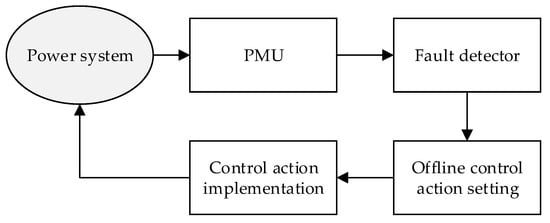
Figure 1.
General diagram of the EC EPS algorithm with settings defined in the “offline” mode.
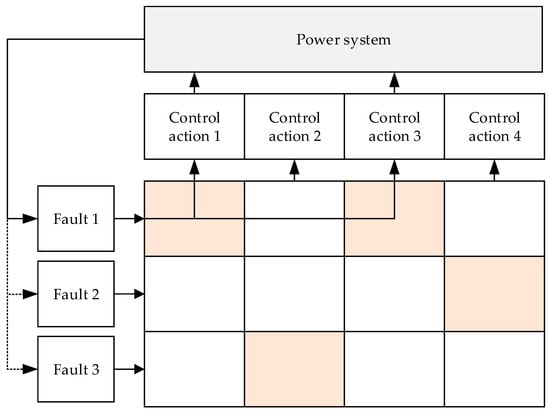
Figure 2.
Block structure control action setting.
The CAs settings block is a matrix structure that establishes the correlation between the type of disturbance and the necessary volume of CA to ensure the stability of the protected electrical power systems (EPS). Figure 2 shows the existing EPS EC implementation model. In this model, signals of the beginning of an accident (Fault 1, Fault 2, Fault 3) are transmitted via communication channels from substations or power plants to a single control center. The signal of the beginning of an accident is understood as a signal of disconnection of the power line, SG, and operation of the relay protection device. According to a predetermined logic, signals for the implementation of CAs are issued for each considered signal of the beginning of an accident. The signal data are also transmitted via communication channels at a power plant or substation. In Figure 2, potential disturbances are listed vertically, which may include emergency shutdowns of power lines and short circuits. The available EC EPS options are displayed horizontally: shutdown of synchronous generators, load shedding, unloading of synchronous generators, etc. To configure the EC EPS algorithm, it is essential to determine the linkage between the detected disturbance and the required control actions. In Figure 2, this correlation is indicated by color. The figure also exemplifies how Fault 1 is addressed by transmitting signals to implement CA 1 and CA 2. In Figure 2, the non-zero cells of the matrix are highlighted, defining the correspondence between Fault and CA.
The primary distinction between the Emergency Control of Electrical Power Systems (EC EPS) algorithm in offline and online modes lies in the approach to creating a correspondence matrix (implemented in the control action settings block) that links the type of disturbance with the required volume of CAs. In the offline mode, the creation of a correspondence matrix is typically conducted once a year for a pre-prepared mathematical model of the EPS, and the calculation of optimal CA volumes is manually performed by specialists managing the operational control of the protected EPS. A significant drawback of this approach in tuning the EC EPS algorithm is its limited adaptability and accuracy. Additionally, the parameters of the mathematical model of the EPS used may vary considerably from the actual parameters due to the impact of external factors on the elements of the electrical network [46,47]:
- Heating of conductors affects active resistance;
- Fogs and atmospheric pollution affect the level of corona on the surfaces of conductors;
- Insulation aging affects active and reactive resistance;
- Wind speed affects the carrying capacity of the conductor.
To increase the accuracy and adaptability of EC EPS, an algorithm is used in which the formation of a correspondence matrix between the type of disturbance and the volume of CA is performed in the “online” mode. The structure of the EC EPS algorithm in the online mode is shown in Figure 3. In Figure 3, the blocks involved in the cyclic calculation are highlighted with a fill.
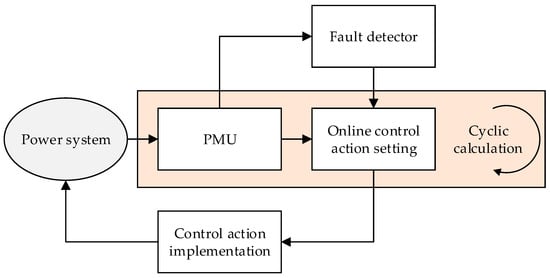
Figure 3.
General diagram of the EC EPS algorithm with settings defined in the “online” mode.
The primary distinction between the Emergency Control of Electrical Power Systems (EC EPS) algorithm in the “online” and “offline” modes is the calculation of the optimal volume of CA with cyclicality. Figure 3 illustrates a segment of the cyclic updating of telemetry data and the updating of the correspondence matrix between the type of disturbance and the volume of CA. This method of implementing the EC EPS algorithm allows for the consideration of external factors, significantly enhancing accuracy and adaptability. A major challenge of the EC EPS algorithm in the “online” mode is the predetermined list of accidents for which EPS stability is ensured through the implementation of CA. To overcome this limitation, a CA selection algorithm can be employed at the rate of the transient process (post fault) [48]. This algorithm is fully adaptive, utilizing information about the current disturbance and current EPS parameters. Table 1 provides an analysis of existing EC EPS algorithms.

Table 1.
Analysis of EC EPS algorithms.
All existing Emergency Control of Electrical Power Systems (EC EPS) algorithms exhibit specific advantages and disadvantages. The highest adaptability is found in algorithms based on the “post fault” principle, while the lowest is in those implemented on the “offline” principle. The most stringent requirements for algorithm speed in EC EPS modes are associated with the “post fault” principle. Currently, to enhance the speed of algorithms operating on the “online” principle, parallel computing systems are actively utilized. Figure 4 depicts a diagram of the implementation of parallel calculations in the CA algorithm of EC EPS following the “online” principle. For parallel computations, two types of servers are employed: an operational server and a calculation servers. The operational server generates a mathematical model of the protected EPS, links the objects of the calculation model to measurements, assesses the state, maintains a retrospective of calculations, and transfers the calculation results to remote emergency control controllers that execute the logic of the matrix correlation between disturbances and the calculated optimal set of CAs. Calculations are parallelized based on the disturbances considered. A management agent, which monitors the availability and load of the calculation servers, is used to distribute emergency disturbances among them. The emergency disturbance number serves as an input parameter for the calculation server; after the computation, the control agent relays the results of determining the optimal CA to the operational server [49,50].
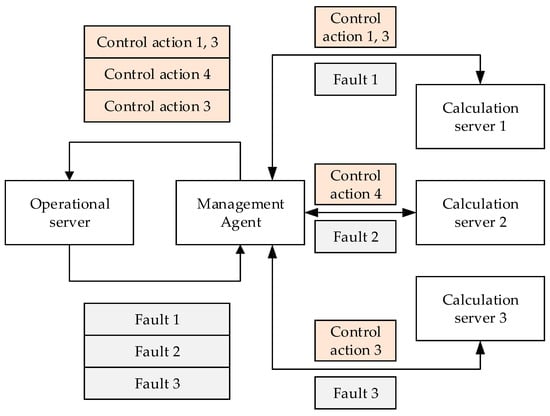
Figure 4.
Scheme for implementing parallel computing for the EC EPS algorithm in online mode.
Despite the advanced system for parallelizing calculations of CAs impacts, its efficiency is constrained by the performance of the algorithm used for determining the optimal EPS control law. Currently, these algorithms are predominantly implemented based on the deterministic principle of analyzing a system of algebraic differential equations that describe the dynamic model of the protected EPS. The efficacy of this approach is considerably limited. Moreover, the parallelization system itself is a significant bottleneck in the EC EPS chain. Although the operational server and management agent are configured as a failover cluster, there still exists a non-zero probability of system failure, which could result in a loss of EPS protection capabilities.
Consequently, implementing Emergency Control of Electrical Power Systems (EC EPS) algorithms based on the “post fault” principle using deterministic approaches proves challenging. Currently, the most appropriate method for implementing algorithms on the “post fault” principle is the utilization of ML algorithms. These algorithms offer high performance without the necessity of employing a parallel calculation system within the EPS operational control loop. ML algorithms are capable of determining the type of disturbance, selecting the optimal set of control actions (CAs) to ensure SSS, TS, voltage stability, and maintaining acceptable voltage levels and frequency [51].
Traditional EPS EC methods are based on the analysis of algebraic differential systems of equations describing the dynamic EPS model. This approach has several disadvantages associated with significant time delays necessary for the numerical solution of differential equations, considering EPS elements with unknown replacement circuit partners. On the other hand, ML algorithms have high performance, and the ability to implement the principle of “model-free control”, in which only measurements are used for the operation of the algorithm.
3. Determination of the Disturbance Type
The task of identifying the type of disturbance in EPS falls under the domain of digital signal processing (DSP) of instantaneous current and voltage values [52]. Common disturbances monitored in EPS Emergency Control (EC) algorithms include outages of electrical network elements (such as lines, transformers, and bus systems), short circuits (SC), and outages of loads and synchronous generators (SG). Figure 5 illustrates the classification of disturbances in EPS.
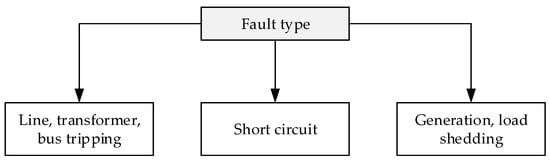
Figure 5.
Main types of disturbances in EPS.
To determine the fault detection type (FD), methods that incorporate the following ML algorithms are used:
- Support vector machine (SVM) [53,54,55];
- Multi-class support vector machine s (MMC-SVM) [56];
- K-nearest neighbors (KNN) [57];
- Probabilistic neural network (PNN) [58];
- Artificial neural networks (ANN) [59];
- Convolutional adversarial neural network (CANN) [60,61];
- Chebyshev neural network (ChNN) [62];
- Decision trees (DT) [63];
- Rule-based decision tree (RBDT) [64];
- Fuzzy logic (FL) [65];
- Deep learning (DL) [66,67];
- Pattern recognition (PR) [68].
The following DSP methods are used in combination with ML algorithms:
- Discrete wavelet transform (DWT) [56];
- Discrete Fourier transform (DFT) [63];
- Hilbert–Huang transform (HHT) [66].
Figure 6 shows the main ML algorithms to determine the type of disturbance in the EPS.
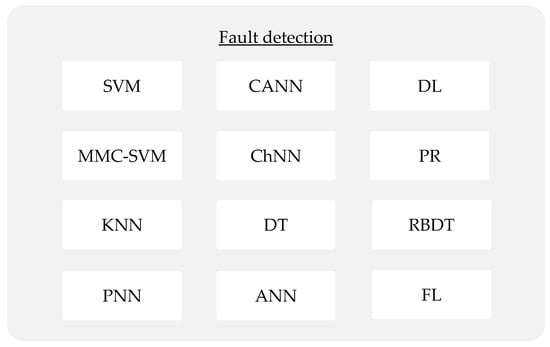
Figure 6.
Algorithms for identifying the type of disturbance in EPS based on ML algorithms.
In the study in [53], the SVM algorithm is employed to identify and classify disturbances in EPS. This algorithm analyzes the instantaneous values of currents and voltages over a sliding window with a duration of a quarter of a power frequency period. Initial data for the analysis are derived from measurements in both time and frequency domains at the end of the power line under examination. A dataset consisting of 25,168 disturbances was utilized to train and test the model. The signal sampling rate was set to 32 samples per industrial frequency cycle. The trained model achieved an average accuracy of 99.89%. The study also conducts a comparative analysis of SVM models with other models such as DT, random forest (RF), KNN, and ANN.
The authors in [54] introduced a method for identifying disturbance types for power quality analysis using the SVM combined with the fusion of time domain descriptors (FTDD) algorithm for feature selection. The classification criteria include the normal mode, transient process, harmonic distortion, voltage sag, voltage surge, and voltage interruption. The methodology was tested with real data from a power quality analyzer based on the Arduino controller. The dataset comprised 500 scenarios, equally divided between training and testing. The model’s accuracy was compared with standard DSP algorithms at various signal noise levels, achieving 99.11% accuracy with SVM + FTDD across all noise levels.
In [55], a methodology using SVM combined with DWT was developed to identify the type and location of disturbances on overhead and cable power lines. Tested on a 230 kV power transmission line model, the methodology considered 2448 scenarios of various disturbance types and locations. The average accuracy for disturbance identification was 98.8%, with a location determination error of less than 3%.
Research [56] explored the use of the MMC-SVM algorithm applied to root mean square voltage measurements at EPS nodes. The algorithm’s first stage identifies the occurrence of a disturbance, while the second stage recognizes its type. Data included transient processes with SC on power lines, load nodes, and substations without power take-offs. White noise ranging from 10 to 90 dB was added to the data for testing. Classification accuracy without noise was 97.16%, but adding noise reduced accuracy by an average of 7%. The study in [57] proposed a method for identifying disturbance types in distribution networks, notable for requiring minimal data in the training set. The method was compared to ANN and DT algorithms, achieving an accuracy of 89.15%, significantly higher than the 24.09% and 43.43% accuracies of the ANN and DT algorithms, respectively. The study also examined the impact of signal sampling frequency on classification accuracy, finding that increasing the frequency from 960 Hz to 3840 Hz improved accuracy by 16.86%.
The authors of [58] proposed a method for identifying the type of disturbance based on the PNN algorithm using DWT to the original signals. The technique proposed by the authors consists of converting a signal from the time domain to the frequency domain and then using the frequency spectrum as input data to the PNN. The structure of a PNN network is as follows: input layer, sample layer, summation layer, and output layer. To test the proposed methodology, the simplest EPS model is used, consisting of two catches, SG, load, and power line. Different types of SCs in different parts of the transmission line were considered disturbances. The authors claim that the accuracy of the proposed method reaches 100%.
An example of using ANN to determine the type of disturbance is given in [59]. Testing was performed on the simplest EPS model, consisting of two nodes and a power line. The ANN structure consists of three layers; a more detailed description of the model is not provided. The initial data sampling frequency was 10 kHz; the authors determined that reducing the sampling frequency to 3.4 kHz does not lead to a decrease in classification accuracy but helps to increase performance.
The study in [60] considers the analysis of disturbances that arose in the EPS Association of Southeast Asian Nations. To identify the type of disturbance, the authors used the CANN algorithm. The work does not provide an analysis of accuracy and time delays. The study in [61] also uses the CANN algorithm to identify the type of disturbance in distribution networks. Information provided by Duke Energy was used as input data. The following features of the initial dataset were used: power line number, weather conditions, season, hour of day, number of the damaged phase, and number of protection devices in operation. The accuracy of the CANN model was compared with the linear regression (LR) model. The average accuracy of the CANN algorithm was 85.94%. The authors consider the problems of lack of information and imbalance of data on disturbances in distribution networks. In [62], the authors considered the problem of identifying the type of disturbance on a power transmission line with longitudinal compensation based on the ChNN algorithm. The ChNN model has a flat single-layer structure, the Chebyshev polygon is used as a functional extension. ChNN is trained using the recursive least squares method. Instantaneous phase current signals with a sampling frequency of 4 kHz are used as input data for ChNN. The proposed model is compared with the SVM, FL, and DT algorithms. The average accuracy of the proposed model was 99.43%, which exceeds all considered models.
To identify the type of disturbance, the study in [63] uses the DT algorithm. Current and voltage signals from both ends of the protected power line are used as initial data. The DFT algorithm is used to extract features from the source data. Testing was performed considering varying degrees of noise in the source data. When testing the proposed algorithm for identifying the type of disturbance, 100% accuracy was achieved. In [64], the RBDT algorithm was used to identify the type of disturbance. To generate the initial data for identification, the HHT algorithm was used, which allows the use of 1st and 2nd modes of the signal. The authors claim that the proposed algorithm is effective in detecting and classifying various types of EPS faults. The work [65] proposed a combined approach of using FL and DWT to identify the type of damage. For testing, a two-node EPS model with a power line equipped with a longitudinal compensation device was used. The proposed approach has been tested for disturbances of various types.
To identify faults in electrical distribution networks with an isolated neutral, the work [66] uses a combined method that combines the DL and HHT algorithms. Current and voltage signals are used as initial data. To identify the type of disturbance, a time-frequency image is used, which is supplied as input to the DL algorithm. The ANN used consists of five layers with a sigmoid activation function in each layer. Testing was performed on digital and physical EPS models. The average accuracy of the proposed model was 99.99%. In [67], the DL algorithm is also used to identify the top of the disturbance. Testing was performed on the simplest EPS model, consisting of two nodes and one branch. To form a matrix of signal energy coefficients, the DWT algorithm is used. It is important to note that DL algorithms use a graphical representation of the signals under consideration as input information. The accuracy when testing the algorithm was 98.00%. The authors in [68] use the PR method to identify the type of disturbance. Testing was performed on IEEE9 and IEEE39 EPS models. The measurements obtained from the PMU are used as input data.
A total of 16 articles were reviewed on the topic of identifying the type of disturbance based on ML algorithms. Table 2 provides a numerical analysis of the reviewed works.
Table 2.
Analysis of the reviewed articles devoted to identifying the type of disturbance in EPS.
ML-based disturbance type identification in EPS is a popular research topic, as supported by a significant number of papers and approaches. A general promising direction for the development of the topic of disturbance type identification is real-time testing with determination of algorithm delays and possible optimization, allowing the use of disturbance type identification algorithms for the EPS EC problem.
4. Ensuring Small Signal Stability
One of the main tasks of ensuring the reliability of big EPS (BEPS) is monitoring and managing the magnitude of active power flows along long power transmission lines connecting remote energy regions. The determining phenomenon limiting exchange flows between EPSs is SSS. This problem is effectively solved by limiting active power flows and using EC devices. To provide ML-based SSS, the following algorithms are used:
- Extreme gradient boosting (XGBoost) [69];
- Long short-term memory networks (LSTM) [70];
- ANN [71];
- DL [72];
- KNN [73];
- Particle swarm optimization k-nearest neighbors (PSO-KNN) [74];
- Generalized regression neural network (GRNN) [75].
Figure 7 shows the considered ML algorithms to determine the CA for SSS preservation.
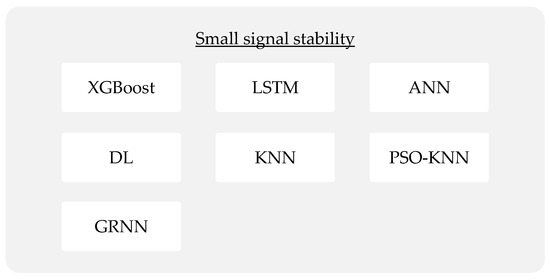
Figure 7.
CA selection algorithms for saving SSS based on ML algorithms.
In [69], a method for selecting the optimal CA volume for preserving SSS based on the XGBoost algorithm and analysis of the total damping coefficient EPS is proposed. To select CA, the following system of equations are used:
where ΔPi—change in active power of SG with number i, —minimum active power of SG with number i, —maximum active power of SG with number i, Pi0—initial active power of SG with number i, k0—damping coefficient of SG with number i, Δk—change in the damping coefficient EPS when implementing CA, klim—minimum value of the damping coefficient EPS, and Ci—influence coefficient of changes in power SG with the number i on the total damping coefficient EPS.
The proposed methodology was tested on IEEE9 and IEEE39 models. To form a data sample, numerical modeling was used with a change in the total load of the EPS model from 70% to 130% with a corresponding change in the active powers SG. Minimum values for total EPS damping coefficients were also determined. During testing, the accuracy of the proposed method was determined to be 99.2% and 97.1% for the IEEE9 and IEEE39 models, respectively.
The authors of the study in [70] proposed a universal technique for selecting CAs at a real-time pace for preserving SSS and TS based on the LSTM algorithm. The scientific novelty of the proposed method is the real-time prediction of the damping coefficient EPS, and local and intersystem oscillatory modes. The following EPS mathematical models were used for testing: IEEE39, IEEE68, IEEE145. The delay of the proposed method was less than 1.5 periods of power frequency.
The study in [71] aims to develop an SSS EPS provisioning system based on the ANN algorithm. The system considers single outages of power lines, load changes, and single outages of generators. A numerical example shows the high efficiency of the proposed system.
In [72], the authors propose an EPS stabilizer structure based on the DL algorithm. The proposed stabilizer is designed to provide SSS in the presence of wind generation in the EPS. The EPS mathematical model was used for testing. It consists of a wind generation source and a power transmission line.
The paper in [73] presents a technique for estimating SSS based on the KNN algorithm. A platform is proposed for SSS analysis, the block diagram of which is shown in Figure 8.
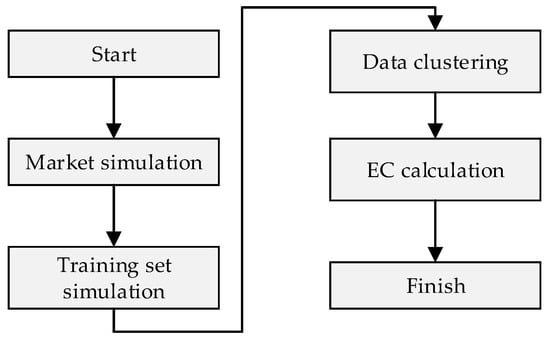
Figure 8.
Block diagram of the SSS analysis platform given in [73].
The authors of [73] indicate the CA selection as a direction for platform development to ensure the required frequency level in isolated EPS. For the numerical study, the IEEE59 model was used, in which 8760 scenarios were calculated with subsequence CAs selection. The work shows the effectiveness of the proposed method.
The study in [74] served as a continuation of [73], focusing on developing an accelerated method for analyzing SSS. For this purpose, the authors utilized a platform they developed, which encompasses scenario calculation, modeling of EPS operations within the electricity market, and SSS analysis. A modified version of the IEEE59 model was employed for numerical simulations. The PSO-KNN algorithm was applied for feature selection and clustering.
In [75], the analysis of SSS introduces the concept of a reference point (RP), which is used to identify the region of EPS operating modes within a given SSS margin. A specially developed clustering algorithm, based on the analysis of negative Euclidean distance, is employed to delineate this area. For real-time SSS analysis, calculations are conducted on a sliding window, involving operations such as determining the location of the operating point within the stability region. When the operating point exceeds the stability region, the GRNN algorithm is utilized to identify the optimal set of control actions (CAs). The method was tested on the IEEE9 and IEEE118 models, demonstrating an accuracy of over 94%.
In Section 4, articles on CA selection methods for providing SSS EPS based on ML algorithms were reviewed. Table 3 shows a numerical analysis of the considered works.
Table 3.
Analysis of reviewed articles devoted to the definition of CA for maintaining SSS EPS.
Testing of the considered algorithms aimed at determining CA for saving SSS EPS was performed on mathematical models IEEE9, IEEE39, IEEE59, IEEE68, IEEE118, and IEEE145. For these models, problems of outliers and noise in the data are not considered. These problems are typical for real EPS. Also, in the works under review, insufficient attention is paid to the issue of using the developed algorithms in real time.
5. Providing Transient Stability
The increase in RES number, which is observed in modern EPS, significantly complicates the issue of maintaining TS due to a significant increase in the speed of transient processes. Therefore, the issue of maintaining TS has received more discussion in research compared to SSS.
To provide TS based on ML methods, the following algorithms are used:
- ANN [76];
- FL [77];
- Mixed-integer linear programming (MILP) [78];
- Deep belief network (DBN) [79];
- Core vector machine (CVM) [80];
- Convolutional neural network (CNN) [81];
- Stacked denoising autoencoder (SDAE) [82];
- Twin convolutional support vector machine (TCSVM) [83];
- Extreme learning machine (ELM) [84];
- XGBoost [85];
- Mahalanobis kernel regression (MKR) [86].
Figure 9 shows the considered ML algorithms determining the CA for TS.
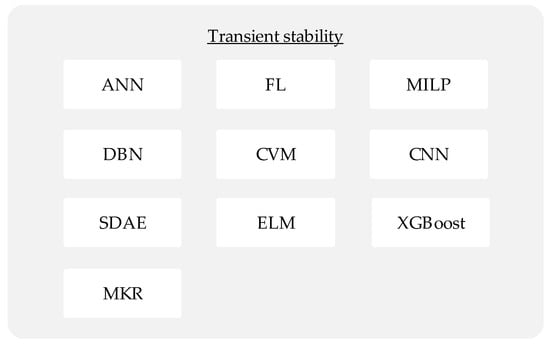
Figure 9.
CA selection algorithms for TS are based on ML algorithms.
A notable characteristic of modern BEPS is the extensive use of converters and high-voltage converter equipment. In [76], the control of converters is suggested as a means to maintain EPS TS. For the numerical experiment, a mathematical model of an EPS comprising two nodes, a transmission line, and an inverter was utilized. The ANN algorithm was employed for selecting the CAs.
The authors in [77] proposed a CA selection model for TS EPS based on the FL algorithm, which is described by the following expression:
where xi—input variables, and —fuzzy sets that constitute Rm, m = 1, 2 … M.
For the numerical experiment, a Real-Time Digital Simulator (RTDS) was used, in which a two-machine EPS model was implemented. The accuracy of the proposed algorithm was more than 92%.
To select a CA for TS EPS, the authors of [78] proposed an algorithm based on MILP. Testing was performed using mathematical models IEEE9 and the 74-bus Nordic test system. For the IEEE9 model, a data sample of 2000 scenarios was generated, and the average CA selection accuracy was 99.48%, with a time delay of 450 ms. For the 74-bus Nordic test system model, the average accuracy was 97.42%.
The authors of the study in [79] proposed a technique for selecting CAs for TS EPS based on DBN. The methodology consists of two parts: offline and online. For the offline part, synthetic transient modeling, feature selection, data preparation, and DBN model training are performed. In the online part, real data entering the input layer of the trained model is used for analysis. The paper compares the proposed method with CNN, KNN, RF, and multilayer perceptron (MLP) algorithms. As a result of the comparison, it was found that the DBN algorithm allows us to obtain the smallest CA selection error among those considered.
One of the SVM algorithm limitations is the assumption of the possibility of linear separation of classes in the data sample. To analyze classes with nonlinear separation, the work [80] uses the CVM algorithm, which allows the use of a nonlinear kernel function. To synthesize the data sample, the authors propose to use three sources: historical data, data from PMU, and data from traditional measurement sources. The IEEE39 model is used for testing. To form a data sample, 10 load levels were considered in each node: 80–125%. At the same time, the total data sample size was 5.310. The average accuracy for the IEEE39 model was 93.04%. Also, the proposed methodology was tested on real data. Data from the North–Central–East China (NCE) and Eastern Interconnection (EI) EPS of the United States were reviewed. The characteristics of the data samples and the obtained CA selection accuracies for real data are given in Table 8.
To select the optimal set of CAs to preserve TS, the authors in [81] used the CNN algorithm. The authors proposed a unique graphical technique for describing the transient process, which is resistant to noise in the data, which consists of applying the DFT algorithm to the signals of voltage, phase, frequency change, and active and reactive power of each SG of the EPS under consideration. As a result, the authors obtain a description of the transient process in the form of a graphical representation.
Further, the resulting graphical image is used as input to the CNN algorithm. Testing of the proposed methodology is performed on the IEEE39 model and real data obtained from the Guangdong Power Grid (GPG). Characteristics of data samples and the obtained CA selection accuracies for real data are given in Table 8.
In [82], the SDAE algorithm is used to analyze TS. The proposed TS analysis technique consists of the following steps:
- Creating an autoencoder with noise reduction;
- The use of adaptive synthetic sampling;
- The synthesized data are decoded into the original space;
- Using a classifier based on the SDAE algorithm.
Testing was performed on IEEE39 and South Carolina 500-Bus System models. For the IEEE39 model, the accuracy was 98.78%; for the South Carolina 500-Bus System model, an accuracy of 98.10% was achieved. The authors highlight the use of data from PMU and consider changes in EPS topology as directions for future research.
In [83], the TCSVM algorithm is used to analyze TS. To analyze TS, the following structure of individual modules is used:
- Data generation module;
- Feature selection module;
- Module for predicting the trajectory of the transition process.
For the numerical experiment, the following EPS models were used: the Brazilian 7-Bus equivalent model, IEEE68, the two-area system, SAVNW, and IEEE24.
The authors in [84] used the ELM algorithm in combination with an equivalent one-machine infinite bus (OMIB) to analyze TS. The proposed method is based on data application only, without using the EPS model. For testing, a modified IEEE39 model was used with the addition of wind generation at six nodes of the EPS model. The following features were used for the ELM algorithm: angular position and speed of SG rotors, output active power SG, angular position and speed of wind generator rotors, voltage amplitudes, and phases in the nodes of the EPS model.
In [85], the XGBoost algorithm is used in combination with Factorization Machine (FM) to analyze TS. The paper presents the concept of automatic feature selection. For TS analysis, a combination of XGBoost and FM algorithms is used as follows: the data obtained from the PMU is the input to the XGBoost algorithm, which transforms the time series into a space–time matrix, which is the input to the FM algorithm. IEEE39, IEEE68, and IEEE140 models are used for testing. The authors compare the developed methodology with the RF, SVM, DT, and MLP algorithms. An analysis was made of the influence of noise in the source data on the reliability of the algorithm.
The authors of the study in [86] present a technique to analyze TS based on the MKR algorithm. The proposed technique is intended for use in real time. Testing is performed on the IEEE39 model.
In this section, 11 articles devoted to methods for selecting CAs to provide TS EPS based on ML algorithms were reviewed. Table 4 shows a numerical analysis of the reviewed works.
Table 4.
Analysis of reviewed articles devoted to determining CA for TS EPS.
A common problem with the considered algorithms is the insufficient elaboration of the use of data from real EPS, as well as testing the algorithms applied by using RTDS.
6. Providing Voltage Stability
Maintaining required voltage levels is a challenge common to both BEPS and isolated EPS. Oscillatory instabilities in voltage levels can trigger avalanche-like processes, leading to widespread consumer outages. To address this issue, various algorithms based on ML methods are employed to ensure VS:
- Deep reinforcement learning (DRL) [87];
- Emotional deep neural network (EDNN) [88];
- Back propagation neural network (BPNN) [89];
- ANN [90];
- Spatio-Temporal Graph Convolutional Network—Double Deep Q-Network (STGCN-DDQN) [91];
- DT [92];
- SVM [93];
- Artificial emotional reinforcement learning (AERL) [94].
Figure 10 shows the considered ML algorithms to determine the CA for VS.
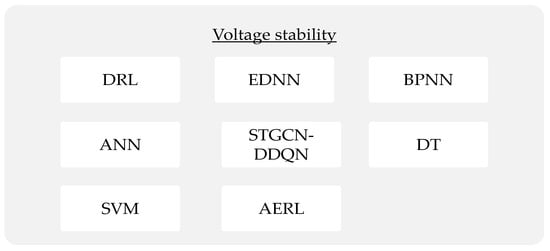
Figure 10.
CA selection algorithms for saving VS-based ML algorithms.
In [87], the DRL algorithm is used to provide VS. An important feature of the DRL-based VS analysis technique proposed by the authors is the consideration of noise in the source data. For testing, the IEEE8500 model is used. The volume of the training sample was 500 modes. The average accuracy of the proposed method is 94.92%.
The main challenge of ANN is the ability to classify features with nonlinear separation. To overcome this problem, the authors of the study in [88] used the EDNN algorithm, which contains a different number of neurons in each layer, which makes it possible to model the nonlinear separation of classes in a data sample. The numerical experiment demonstrated the high accuracy of the proposed method.
In [89], the authors used the BPNN algorithm to save VS. The application of this algorithm is used to analyze the voltage stability region and select preventive EPS control measures. The proposed methodology was tested using the IEEE118 mathematical model. The data sample size was 5000 scenarios. The accuracy of the algorithm for the simulated data was 99.99%.
The authors of [90] considered the problem of preserving VS in isolated EPS. For the numerical experiment, the simplest IEEE4 model was used. For the developed model, an accuracy of 98.73% was shown.
In the study in [91], a DL algorithm is used to preserve VS. To determine the optimal CA volume, the authors use the voltage recovery criterion:
where V1, V2, V3, and Vmax—voltage requirements at different stages of the transient process and the upper voltage limit accordingly, t1 and t2—time moments separating different stages of the transient process, and Tf—observation period. The Nordic Benchmark System model was used for testing; the data sample size was 18,000 scenarios. The study provides an analysis of the possibility of using the developed methodology in real time.
The authors of [92] used the DT algorithm to analyze VS; to reduce the size of the data sample, they used the multi-objective biogeography-based optimization (MOBBO) algorithm. Real Iranian EPS data were used for testing. The data sample size was 1898, the average accuracy was 95.40%.
The study in [93] proposed a methodology for estimating VS based on the SVM algorithm and data coming from the PMU. Testing was performed on the IEEE39 model. The developed VS analysis technique is aimed at application in real time. The accuracy of the proposed method reaches 99.99%.
The study in [94] presented a technique for analyzing VS based on the AERL algorithm. Optimization of stress levels in EPS is performed based on the minimization of the following objective function:
where µ1, µ2, µ3—weight components of electricity production costs (), active power losses (Ploss), and steady voltage values (Vd).
The proposed methodology was tested using mathematical models IEEE57, IEEE118, and IEEE300. During numerical experiments, the authors demonstrated the high efficiency of the proposed method.
The section reviewed eight articles devoted to methods for selecting CAs to provide VS EPS based on ML algorithms. Table 5 shows a numerical analysis of the reviewed works.
Table 5.
Analysis of reviewed articles devoted to determining CA for VS EPS.
A common problem of the above-mentioned algorithms is insufficient consideration of using data from real EPS.
7. Providing Acceptable Frequency Levels
To solve the frequency control (FC) problem based on ML methods, the following algorithms are used:
- RF [95];
- DL [96];
- Convolutional neural network—long short-term memory (CNN-LSTM) [97];
- FL [98];
- CNN [99];
- SVM [100];
- Reinforcement learning (RL) [101];
- Particle swarm optimization (PSO) [102];
- Big bang big crunch (BBBC) [103];
- Genetic algorithm (GA) [104];
- Dueling Deep Q-Learning (DQN) [105].
Figure 11 shows the considered ML algorithms to determine CA for FC.
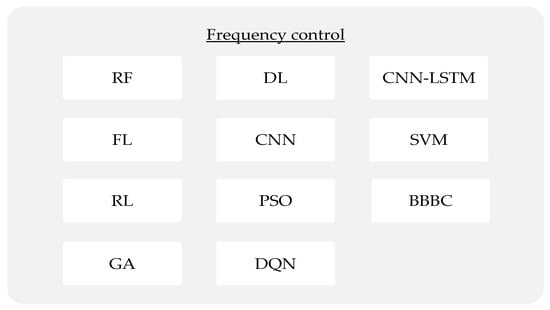
Figure 11.
CA selection algorithms for FC are based on ML algorithms.
The authors of [95] used the RF algorithm to solve the FC problem. A high-voltage direct current (HVDC) system was used to control the frequency. As a test model, two fragments of real EPS connected with an HVDC device were used. The total data sample size was 200 scenarios. The average accuracy of the method was 98.91%. The study in [96] presented an FC technique based on the DL algorithm. The authors provided a detailed mathematical description of the FC problem. Testing was performed on the IEEE39 model. The work [97] provided a large study of the FC problem based on the CNN-LSTM algorithm. As input data for the CNN-LSTM algorithm the active powers of each SG, the active power imbalances of each SG, the voltage amplitude in each node, the voltage phase in each node, and the active power of each load were used. To use the CNN-LSTM algorithm, the input data were transformed into a weighted matrix structure, which is formed using tensor calculation. To reduce the number of features, the authors consistently use the following algorithms: Principal Component Analysis, Linear Discriminant Analysis, and t-distributed stochastic neighbor embedding (t-SNE). Testing was performed using IEEE39 and ACTIVSg500 models. To control the frequency in EPS, the authors of [98] proposed a controller based on the FL algorithm. A simplified dynamic model and an IEEE39 model were used as a test model. The authors suggested using the developed method in real time. In the study in [99], a CNN algorithm was used to control the frequency, which consisted of the following layers: input layer (representation of the input data as a tensor), convolutional layer, subsampling layer, and fully connected layer. The IEEE39 model was used for testing. In [100], the SVM algorithm was used to solve the FC problem. Testing was performed on IEEE39 and NRPG 246 models. In works [101,102,103,104,105], the RL, PSO, BBBC, GA, and DQN algorithms were used to solve the FC problem. In this section, 11 articles devoted to methods for selecting CAs for FC EPS based on ML algorithms were considered. Table 6 provides a numerical analysis of the reviewed works.
Table 6.
Analysis of reviewed articles devoted to determining CA for maintaining TS EPS.
A common problem with the above-considered algorithms is the insufficient study of using data from real EPS.
8. Directions for Future Research
Table 7 provides directions for future research.
Table 7.
Directions for the development of EC EPS algorithms.
General directions for the development of EC EPS algorithms include increased attention to the use of data from PMU [105,106,107,108,109], the development of universal analysis algorithms SSS, TS, VS, and FC [110], the use of real-time modeling systems, development of adaptive local automation devices [111].
Table 8 shows the characteristics of each method proposed in the reviewed works. In Table 8, the following notations are used: DataSetSize—data sampling volume; Delay—algorithm delay for identifying one class.
Table 8.
EC EPS algorithm analyses.
9. Conclusions
A modern EPS has several features directly impacting the accuracy and adaptability of EC for preserving SSS, TS, and VS. These features are due to a decrease in total inertia, increased stochasticity in electricity generation and consumption processes, and a rise in the number of digital EPS monitoring and control devices.
To enhance the accuracy and adaptability of EC in EPS, ML algorithms are extensively used. These algorithms cater to a variety of tasks: identifying the type of disturbance, and selecting CAs for maintaining SSS, TS, VS, and FC. This paper presents an overview of ML algorithms for application in EPS EC.
The following conclusions are drawn from the above review:
- The most common class of algorithms used to select optimal CAs is DL. These algorithms make it possible to identify hidden correlations in the source data, while they do not assume a linear separation of classes in the data sample.
- To test the proposed methods for using ML algorithms for EPS EC, mathematical models are most often used. The most commonly used model is IEEE39.
- Most works provide a detailed description of the data sample but do not provide recommendations regarding the minimum number of scenarios that must be considered when training the model. In the reviewed works, the data sample size varies from 100 to 56,000.
- In the reviewed works, there is no description of the requirements for the homogeneity and representativeness of the source data.
- The authors of most of the reviewed studies determine the magnitude of the classification delay; however, there is virtually no information on real-time testing.
- In a minority of cases, the authors use real data for testing, which is characterized by the presence of noise, emissions, and omissions.
- When using data from PMU, methods combining ML and DSP algorithms are widely used.
In the practical implementation of ML algorithms for EPS management, the following difficulties can be identified: the problem of forming a representative training sample, the ambiguity of the procedure for determining an acceptable ML algorithm, and possible problems of ensuring cybersecurity and interpretability of CAs selection results. Therefore, the following directions for future research can be identified (they are listed in order of priority):
- Development of universal methods for analyzing SSS, TS, and VS.
- Testing algorithms on data obtained from real EPS. Development of algorithms for processing noise and outliers in the source data.
- Testing and adaptation of algorithms for real-time operation with determination of acceptable delays and sampling rates of source signals.
- Active use of data obtained from PMU.
- Development of infrastructure solutions for integrating ML algorithms into existing EPS EC business processes.
- Study of cybersecurity problems of using ML algorithms in the operational control loop of EPS. This task is the subject of extensive research and involves the analysis of possible risk factors for measuring systems, EPS management, data storage, and processing.
- Definition of requirements for the composition of data sampling features for EPS EC, minimum volume, completeness, and representativeness of the dataset.
- Analysis of microgrid EC methods with a significant proportion of RES, electricity consumers, distributed generation, and consumers with price-dependent consumption [112,113,114,115].
From the above analysis, it can be concluded that the most flexible ML algorithms are algorithms that simulate the functioning of biological neural networks (ANN, CANN, ChNN, CNN) providing the required level of flexibility and accuracy in the conditions of the dynamic nature of EPS. These algorithms identify hidden correlations in the data, ensure reliable operation in conditions of noise and emissions in the data, and also have high performance, which is essential for EPS management. These algorithms can effectively solve all the problems considered in this paper.
Based on the conducted meta-analysis, there were no shortcomings in the considered ML algorithms. The main difficulty in developing the methods of EPS EC based on ML algorithms relates to the formation of a data sample, as well as to the testing of trained algorithms in real time and on real data.
The integration of ML algorithms into existing EPS management business processes is not difficult, because existing solutions can be used in terms of changes and data collection of established and transient processes, and existing communication channels can be used to transmit signals to the implementation of CAs. New tasks in the practical implementation of ML algorithms in the operational EPS control loop are the organization of ML algorithms training, testing, administration, cybersecurity, and reliability.
Author Contributions
All authors have made valuable contributions to this paper. Conceptualization, M.S. (Mihail Senyuk) and S.B.; methodology, A.P. and I.O.; software, M.S. (Mihail Senyuk) and M.S. (Murodbek Safaraliev); validation, V.K., A.S. and S.B.; formal analysis, F.K., A.P. and M.S. (Mihail Senyuk); investigation, A.P., I.O., M.S. (Mihail Senyuk), V.K., A.S., S.B. and F.K.; writing—original draft preparation, M.S. (Mihail Senyuk), M.S. (Murodbek Safaraliev), A.P., S.B., I.O. and A.S.; writing—review and editing, M.S. (Mihail Senyuk) and M.S. (Murodbek Safaraliev); supervision, F.K., M.S. (Murodbek Safaraliev) and S.B. All authors have read and agreed to the published version of the manuscript.
Funding
The reported study was supported by Russian Science Foundation, research project № 23-79-01024.
Data Availability Statement
Not applicable.
Conflicts of Interest
The authors declare no conflict of interest.
Abbreviations
| AERL | Artificial emotional reinforcement learning |
| ACTIVSg500 | SouthCarolina 500-Bus System |
| ANN | Artificial neural networks |
| BBBC | Big bang big crunch |
| BEPS | Bulk electrical power system |
| BPNN | Back propagation neural network |
| CA | Control action |
| CANN | Convolutional adversarial neural network |
| ChNN | Chebyshev neural network |
| CNN | Convolutional neural network |
| CNN-LSTM | Convolutional neural network—long short-term memory |
| CVM | Core vector machine |
| DBN | Deep belief network |
| DFT | Discrete Fourier transform |
| DL | Deep learning |
| DQN | Dueling Deep Q-Learning |
| DRL | Deep reinforcement learning |
| DSP | Digital signal processing |
| DT | Decision trees |
| DWT | Discrete wavelet transform |
| EC | Emergency control |
| EDNN | Emotional deep neural network |
| EI | Eastern Interconnection |
| EI&WECC | Reduced equivalent North American grid |
| ELM | Extreme learning machine |
| EPS | Electrical power system |
| FC | Frequency control |
| FD | Fault detection |
| FL | Fuzzy logic |
| FM | Factorization machine |
| FTDD | Fusion of time domain descriptors |
| GA | Genetic algorithm |
| GPG | Guangdong Power Grid |
| GRNN | Generalized regression neural network |
| HHT | Hilbert–Huang transform |
| HVDC | High-voltage direct current |
| IEEE | Institute of electrical and electronics engineers |
| KNN | K-nearest neighbors |
| LR | Linear regression |
| LSTM | Long short-term memory networks |
| MILP | Mixed-integer linear programming |
| MKR | Mahalanobis kernel regression |
| ML | Machine learning |
| MLP | Multilayer perceptron |
| MMC-SVM | Multi-class support vector machines |
| MOBBO | Multi-objective biogeography-based optimization |
| NCE | North—Central—East China power system |
| NRPG | Northern Regional Power Grid 246-bus system |
| OMIB | One machine infinite bus |
| PMU | Phasor measurement unit |
| PNN | Probabilistic neural network |
| PR | Pattern recognition |
| PSO | Particle swarm optimization |
| PSO-KNN | Particle swarm optimization k-nearest neighbors |
| RBDT | Rule-based decision tree |
| RES | Renewable sources of energy |
| RL | Reinforcement learning |
| RP | Reference point |
| RTDS | Real-Time Simulator |
| SC | Short circuit |
| SDAE | Stacked denoising autoencoder |
| SG | Synchronous generator |
| SSS | Small signal stability |
| STGCN-DDQN | Spatio-Temporal Graph Convolutional Network—Double Deep Q-Network |
| SVM | Support vector machine |
| TCSVM | Twin convolutional support vector machine |
| TS | Transient stability |
| t-SNE | t-distributed stochastic neighbor embedding |
| XGBoost | Extreme gradient boosting |
References
- Makarov, Y.V.; Reshetov, V.I.; Stroev, A.; Voropai, I. Blackout Prevention in the United States, Europe, and Russia. Proc. IEEE 2005, 93, 1942–1955. [Google Scholar] [CrossRef]
- Ge, X.; Qian, J.; Fu, Y.; Lee, W.-J.; Mi, Y. Transient Stability Evaluation Criterion of Multi-Wind Farms Integrated Power System. IEEE Trans. Power Syst. 2022, 37, 3137–3140. [Google Scholar] [CrossRef]
- Liu, H.; Su, J.; Qi, J.; Wang, N.; Li, C. Decentralized Voltage and Power Control of Multi-Machine Power Systems with Global Asymptotic Stability. IEEE Access 2019, 7, 14273–14282. [Google Scholar] [CrossRef]
- Alves, E.; Bergna-Diaz, G.; Brandao, D.; Tedeschi, E. Sufficient Conditions for Robust Frequency Stability of AC Power Systems. IEEE Trans. Power Syst. 2021, 36, 2684–2692. [Google Scholar] [CrossRef]
- Xue, A.; Zhang, J.; Zhang, L.; Sun, Y.; Cui, J.; Wang, J. Transient Frequency Stability Emergency Control for the Power System Interconnected with Offshore Wind Power Through VSC-HVDC. IEEE Access 2020, 8, 53133–53140. [Google Scholar] [CrossRef]
- Chen, Y.; Mazhari, S.M.; Chung, C.Y.; Faried, S.O.; Pal, B.C. Rotor Angle Stability Prediction of Power Systems with High Wind Power Penetration Using a Stability Index Vector. IEEE Trans. Power Syst. 2020, 35, 4632–4643. [Google Scholar] [CrossRef]
- Wu, Q.-H.; Lin, Y.; Hong, C.; Su, Y.; Wen, T.; Liu, Y. Transient Stability Analysis of Large-scale Power Systems: A Survey. CSEE J. Power Energy Syst. 2023, 9, 1284–1300. [Google Scholar] [CrossRef]
- Sun, J.; Xu, M.; Cespedes, M.; Kauffman, M. Data Center Power System Stability—Part I: Power Supply Impedance Modeling. CSEE J. Power Energy Syst. 2022, 8, 403–419. [Google Scholar] [CrossRef]
- Strunz, K.; Almunem, K.; Wulkow, C.; Kuschke, M.; Valescudero, M.; Guillaud, X. Enabling 100% Renewable Power Systems Through Power Electronic Grid-Forming Converter and Control: System Integration for Security, Stability, and Application to Europe. Proc. IEEE 2023, 111, 891–915. [Google Scholar] [CrossRef]
- Rakhshani, E.; Gusain, D.; Sewdien, V.; Torres, J.L.R.; Van Der Meijden, M.A.M.M. A Key Performance Indicator to Assess the Frequency Stability of Wind Generation Dominated Power System. IEEE Access 2019, 7, 130957–130969. [Google Scholar] [CrossRef]
- Yuan, H.; Xu, Y. Preventive-Corrective Coordinated Transient Stability Dispatch of Power Systems with Uncertain Wind Power. IEEE Trans. Power Syst. 2020, 35, 3616–3626. [Google Scholar] [CrossRef]
- Ge, H.; Guo, Q.; Sun, H.; Wang, B.; Zhang, B.; Liu, J.; Yang, Y.; Qian, F. An Improved Real-Time Short-Term Voltage Stability Monitoring Method Based on Phase Rectification. IEEE Trans. Power Syst. 2018, 33, 1068–1070. [Google Scholar] [CrossRef]
- Cai, L.-J.; Erlich, I. Simultaneous coordinated tuning of PSS and FACTS damping controllers in large power systems. IEEE Trans. Power Syst. 2005, 20, 294–300. [Google Scholar] [CrossRef]
- Abomazid, A.M.; El-Taweel, N.A.; Farag, H.E.Z. Optimal Energy Management of Hydrogen Energy Facility Using Integrated Battery Energy Storage and Solar Photovoltaic Systems. IEEE Trans. Sustain. Energy 2022, 13, 1457–1468. [Google Scholar] [CrossRef]
- Toubeau, J.-F.; Bottieau, J.; De Grève, Z.; Vallée, F.; Bruninx, K. Data-Driven Scheduling of Energy Storage in Day-Ahead Energy and Reserve Markets with Probabilistic Guarantees on Real-Time Delivery. IEEE Trans. Power Syst. 2021, 36, 2815–2828. [Google Scholar] [CrossRef]
- Zhang, N.; Jia, H.; Hou, Q.; Zhang, Z.; Xia, T.; Cai, X.; Wang, J. Data-Driven Security and Stability Rule in High Renewable Penetrated Power System Operation. Proc. IEEE 2023, 111, 788–805. [Google Scholar] [CrossRef]
- Landera, Y.G.; Zevallos, O.C.; Neves, F.A.S.; Neto, R.C.; Prada, R.B. Control of PV Systems for Multimachine Power System Stability Improvement. IEEE Access 2022, 10, 45061–45072. [Google Scholar] [CrossRef]
- Lau, P.; Wang, L.; Liu, Z.; Wei, W.; Ten, C.-W. A Coalitional Cyber-Insurance Design Considering Power System Reliability and Cyber Vulnerability. IEEE Trans. Power Syst. 2021, 36, 5512–5524. [Google Scholar] [CrossRef]
- Ten, C.-W.; Liu, C.-C.; Manimaran, G. Vulnerability Assessment of Cybersecurity for SCADA Systems. IEEE Trans. Power Syst. 2008, 23, 1836–1846. [Google Scholar] [CrossRef]
- Ten, C.-W.; Manimaran, G.; Liu, C.-C. Cybersecurity for Critical Infrastructures: Attack and Defense Modeling. IEEE Trans. Syst. Man Cybern. Part A Syst. Hum. 2010, 40, 853–865. [Google Scholar] [CrossRef]
- Chenine, M.; Ullberg, J.; Nordström, L.; Wu, Y.; Ericsson, G.N. A Framework for Wide-Area Monitoring and Control Systems Interoperability and Cybersecurity Analysis. IEEE Trans. Power Deliv. 2014, 29, 633–641. [Google Scholar] [CrossRef]
- Alimi, O.A.; Ouahada, K.; Abu-Mahfouz, A.M. A Review of Machine Learning Approaches to Power System Security and Stability. IEEE Access 2020, 8, 113512–113531. [Google Scholar] [CrossRef]
- Rudin, C.; Waltz, D.; Anderson, R.N.; Boulanger, A.; Salleb-Aouissi, A.; Chow, M.; Dutta, H.; Gross, P.N.; Huang, B.; Ierome, S.; et al. Machine Learning for the New York City Power Grid. IEEE Trans. Pattern Anal. Mach. Intell. 2012, 34, 328–345. [Google Scholar] [CrossRef] [PubMed]
- Wu, Q.H.; Bose, A.; Singh, C.; Chow, J.H.; Mu, G.; Sun, Y.; Liu, Z.; Li, Z.; Liu, Y. Control and Stability of Large-scale Power System with Highly Distributed Renewable Energy Generation: Viewpoints from Six Aspects. CSEE J. Power Energy Syst. 2023, 9, 8–14. [Google Scholar] [CrossRef]
- Zhang, T.; Sun, M.; Cremer, J.L.; Zhang, N.; Strbac, G.; Kang, C. A Confidence-Aware Machine Learning Framework for Dynamic Security Assessment. IEEE Trans. Power Syst. 2021, 36, 3907–3920. [Google Scholar] [CrossRef]
- Khalyasmaa, A.I.; Senyuk, M.D.; Eroshenko, S.A. Analysis of the State of High-Voltage Current Transformers Based on Gradient Boosting on Decision Trees. IEEE Trans. Power Deliv. 2021, 36, 2154–2163. [Google Scholar] [CrossRef]
- Khalyasmaa, A.I.; Senyuk, M.D.; Eroshenko, S.A. High-Voltage Circuit Breakers Technical State Patterns Recognition Based on Machine Learning Methods. IEEE Trans. Power Deliv. 2019, 34, 1747–1756. [Google Scholar] [CrossRef]
- Tağluk, M.E.; Mamiş, M.S.; Arkan, M.; Ertuğrul, Ö.F. Detecting fault type and fault location in power transmission lines by extreme learning machines. In Proceedings of the 2015 23rd Signal Processing and Communications Applications Conference (SIU), Malatya, Turkey, 16–19 May 2015; pp. 1090–1093. [Google Scholar] [CrossRef]
- Said, A.; Hashima, S.; Fouda, M.M.; Saad, M.H. Deep Learning-Based Fault Classification and Location for Underground Power Cable of Nuclear Facilities. IEEE Access 2022, 10, 70126–70142. [Google Scholar] [CrossRef]
- Dharmapala, K.D.; Rajapakse, A.; Narendra, K.; Zhang, Y. Machine Learning Based Real-Time Monitoring of Long-Term Voltage Stability Using Voltage Stability Indices. IEEE Access 2020, 8, 222544–222555. [Google Scholar] [CrossRef]
- Ren, C.; Xu, Y.; Zhang, Y.; Zhang, R. A Hybrid Randomized Learning System for Temporal-Adaptive Voltage Stability Assessment of Power Systems. IEEE Trans. Ind. Inform. 2020, 16, 3672–3684. [Google Scholar] [CrossRef]
- Chen, Y.; Mazhari, S.M.; Chung, C.Y.; Faried, S.O. A Preventive Dispatching Method for High Wind Power-Integrated Electrical Systems Considering Probabilistic Transient Stability Constraints. IEEE Open Access J. Power Energy 2021, 8, 472–483. [Google Scholar] [CrossRef]
- Ernst, D.; Glavic, M.; Wehenkel, L. Power systems stability control: Reinforcement learning framework. IEEE Trans. Power Syst. 2004, 19, 427–435. [Google Scholar] [CrossRef]
- Kong, W.; Dong, Z.Y.; Hill, D.J.; Luo, F.; Xu, Y. Short-Term Residential Load Forecasting Based on Resident Behaviour Learning. IEEE Trans. Power Syst. 2018, 33, 1087–1088. [Google Scholar] [CrossRef]
- Jawad, M.; Nadeem, M.S.A.; Shim, S.-O.; Khan, I.R.; Shaheen, A.; Habib, N.; Hussain, L.; Aziz, W. Machine Learning Based Cost Effective Electricity Load Forecasting Model Using Correlated Meteorological Parameters. IEEE Access 2020, 8, 146847–146864. [Google Scholar] [CrossRef]
- Feng, C.; Sun, M.; Zhang, J. Reinforced Deterministic and Probabilistic Load Forecasting via Q -Learning Dynamic Model Selection. IEEE Trans. Smart Grid 2020, 11, 1377–1386. [Google Scholar] [CrossRef]
- Cui, M.; Wang, J.; Yue, M. Machine Learning-Based Anomaly Detection for Load Forecasting Under Cyberattacks. IEEE Trans. Smart Grid 2019, 10, 5724–5734. [Google Scholar] [CrossRef]
- Zainab, A.; Syed, D.; Ghrayeb, A.; Abu-Rub, H.; Refaat, S.S.; Houchati, M.; Bouhali, O.; Lopez, S.B. A Multiprocessing-Based Sensitivity Analysis of Machine Learning Algorithms for Load Forecasting of Electric Power Distribution System. IEEE Access 2021, 9, 31684–31694. [Google Scholar] [CrossRef]
- Camal, S.; Michiorri, A.; Kariniotakis, G. Reliable Provision of Ancillary Services from Aggregated Variable Renewable Energy Sources Through Forecasting of Extreme Quantiles. IEEE Trans. Power Syst. 2023, 38, 3070–3084. [Google Scholar] [CrossRef]
- Shibl, M.M.; Ismail, L.S.; Massoud, A.M. An Intelligent Two-Stage Energy Dispatch Management System for Hybrid Power Plants: Impact of Machine Learning Deployment. IEEE Access 2023, 11, 13091–13102. [Google Scholar] [CrossRef]
- Briggs, C.; Fan, Z.; Andras, P. Federated Learning for Short-Term Residential Load Forecasting. IEEE Open Access J. Power Energy 2022, 9, 573–583. [Google Scholar] [CrossRef]
- Gaboitaolelwe, J.; Zungeru, A.M.; Yahya, A.; Lebekwe, C.K.; Vinod, D.N.; Salau, A.O. Machine Learning Based Solar Photovoltaic Power Forecasting: A Review and Comparison. IEEE Access 2023, 11, 40820–40845. [Google Scholar] [CrossRef]
- Mehedi, I.M.; Bassi, H.; Rawa, M.J.; Ajour, M.; Abusorrah, A.; Vellingiri, M.T.; Salam, Z.; Abdullah, M.P.B. Intelligent Machine Learning with Evolutionary Algorithm Based Short Term Load Forecasting in Power Systems. IEEE Access 2021, 9, 100113–100124. [Google Scholar] [CrossRef]
- Ruiz-Vega, D.; Messina, A.R.; Pavella, M. Online assessment and control of transient oscillations damping. IEEE Trans. Power Syst. 2004, 19, 1038–1047. [Google Scholar] [CrossRef]
- Beryozkina, S.; Senyuk, M.; Berdin, A.; Dmitrieva, A.; Dmitriev, S.; Erokhin, P. The Accelerate Estimation Method of Power System Parameters in Static and Dynamic Processes. IEEE Access 2022, 10, 61522–61529. [Google Scholar] [CrossRef]
- Yang, J.-Z.; Liu, C.-W.; Wu, W.-G. A Hybrid Method for the Estimation of Power System Low-Frequency Oscillation Parameters. IEEE Trans. Power Syst. 2007, 22, 2115–2123. [Google Scholar] [CrossRef]
- Dehghani, M.; Nikravesh, S.K.Y. State-Space Model Parameter Identification in Large-Scale Power Systems. IEEE Trans. Power Syst. 2008, 23, 1449–1457. [Google Scholar] [CrossRef]
- Ruiz-Vega, D.; Pavella, M. A comprehensive approach to transient stability control. I. Near optimal preventive control. IEEE Trans. Power Syst. 2003, 18, 1446–1453. [Google Scholar] [CrossRef]
- Lin, J.; Tong, X.; Wang, X.; Wang, W. Parallel simulation for the transient stability of power system. In Proceedings of the 2008 Third International Conference on Electric Utility Deregulation and Restructuring and Power Technologies, Nanjing, China, 6–9 April 2008; pp. 1325–1329. [Google Scholar] [CrossRef]
- Cui, H.; Li, F.; Fang, X. Effective Parallelism for Equation and Jacobian Evaluation in Large-Scale Power Flow Calculation. IEEE Trans. Power Syst. 2021, 36, 4872–4875. [Google Scholar] [CrossRef]
- Zhang, N.; Qian, H.; He, Y.; Li, L.; Sun, C. A Data-Driven Method for Power System Transient Instability Mode Identification Based on Knowledge Discovery and XGBoost Algorithm. IEEE Access 2021, 9, 154172–154182. [Google Scholar] [CrossRef]
- Senyuk, M.; Beryozkina, S.; Gubin, P.; Dmitrieva, A.; Kamalov, F.; Safaraliev, M.; Zicmane, I. Fast Algorithms for Estimating the Disturbance Inception Time in Power Systems Based on Time Series of Instantaneous Values of Current and Voltage with a High Sampling Rate. Mathematics 2022, 10, 3949. [Google Scholar] [CrossRef]
- Venkata, P.; Pandya, V.; Vala, K.; Sant, A.V. Support vector machine for fast fault detection and classification in modern power systems using quarter cycle data. Energy Rep. 2022, 8 (Suppl. 16), 92–98. [Google Scholar] [CrossRef]
- Singh, O.J.; Winston, D.P.; Babu, B.C.; Kalyani, S.; Kumar, B.P.; Saravanan, M.; Christabel, S.C. Robust detection of real-time power quality disturbances under noisy condition using FTDD features. Automatika 2019, 60, 11–18. [Google Scholar] [CrossRef]
- Livani, H.; Evrenosoglu, C.Y. A Machine Learning and Wavelet-Based Fault Location Method for Hybrid Transmission Lines. IEEE Trans. Smart Grid 2014, 5, 51–59. [Google Scholar] [CrossRef]
- Mohammadi, F.; Nazri, G.-A.; Saif, M. A Fast Fault Detection and Identification Approach in Power Distribution Systems. In Proceedings of the 2019 International Conference on Power Generation Systems and Renewable Energy Technologies (PGSRET), Istanbul, Turkey, 26–27 August 2019; pp. 1–4. [Google Scholar] [CrossRef]
- Jiang, X.; Stephen, B.; McArthur, S. Automated Distribution Network Fault Cause Identification with Advanced Similarity Metrics. IEEE Trans. Power Deliv. 2021, 36, 785–793. [Google Scholar] [CrossRef]
- Kashyap, K.H.; Shenoy, U.J. Classification of power system faults using wavelet transforms and probabilistic neural networks. In Proceedings of the 2003 International Symposium on Circuits and Systems, 2003, ISCAS’03, Bangkok, Thailand, 25–28 May 2003; 2003; p. III. [Google Scholar] [CrossRef]
- Shiddieqy, H.A.; Hariadi, F.I.; Adiono, T. Effect of Sampling Variation in Accuracy for Fault Transmission Line Classification Application Based on Convolutional Neural Network. In Proceedings of the 2018 International Symposium on Electronics and Smart Devices (ISESD), Bandung, Indonesia, 23–24 October 2018; pp. 1–3. [Google Scholar] [CrossRef]
- Chan, S.; Oktavianti, I.; Puspita, V.; Nopphawan, P. Convolutional Adversarial Neural Network (CANN) for Fault Diagnosis within a Power System: Addressing the Challenge of Event Correlation for Diagnosis by Power Disturbance Monitoring Equipment in a Smart Grid. In Proceedings of the 2019 International Conference on Information and Communications Technology (ICOIACT), Yogyakarta, Indonesia, 24–25 July 2019; pp. 596–601. [Google Scholar] [CrossRef]
- Xu, L.; Chow, M.-Y. A classification approach for power distribution systems fault cause identification. IEEE Trans. Power Syst. 2006, 21, 53–60. [Google Scholar] [CrossRef]
- Vyas, B.Y.; Das, B.; Maheshwari, R.P. Improved Fault Classification in Series Compensated Transmission Line: Comparative Evaluation of Chebyshev Neural Network Training Algorithms. IEEE Trans. Neural Netw. Learn. Syst. 2016, 27, 1631–1642. [Google Scholar] [CrossRef] [PubMed]
- Jena, M.K.; Tripathy, L.N.; Samantray, S.R. Intelligent relaying of UPFC based transmission lines using decision tree. In Proceedings of the 2013 1st International Conference on Emerging Trends and Applications in Computer Science, Shillong, India, 13–14 September 2013; pp. 224–229. [Google Scholar] [CrossRef]
- Singh, B.; Mahela, O.P.; Manglani, T. Detection and Classification of Transmission Line Faults Using Empirical Mode Decomposition and Rule Based Decision Tree Based Algorithm. In Proceedings of the 2018 IEEE 8th Power India International Conference (PIICON), Kurukshetra, India, 10–12 December 2018; pp. 1–6. [Google Scholar] [CrossRef]
- Pradhan, A.K.; Routray, A.; Pati, S.; Pradhan, D.K. Wavelet fuzzy combined approach for fault classification of a series-compensated transmission line. IEEE Trans. Power Deliv. 2004, 19, 1612–1618. [Google Scholar] [CrossRef]
- Guo, M.-F.; Yang, N.-C.; Chen, W.-F. Deep-Learning-Based Fault Classification Using Hilbert–Huang Transform and Convolutional Neural Network in Power Distribution Systems. IEEE Sens. J. 2019, 19, 6905–6913. [Google Scholar] [CrossRef]
- Fahim, S.R.; Sarker, S.K.; Muyeen, S.; Das, S.K.; Kamwa, I. A deep learning based intelligent approach in detection and classification of transmission line faults. Int. J. Electr. Power Energy Syst. 2021, 133, 107102. [Google Scholar] [CrossRef]
- Zhang, Y.-G.; Wang, Z.; Zhang, J.-F.; Ma, J. Fault localization in electrical power systems: A pattern recognition approach. Int. J. Electr. Power Energy Syst. 2011, 33, 791–798. [Google Scholar] [CrossRef]
- Yang, Y.; Zhang, X.; Yang, L. Data-driven power system small-signal stability assessment and correction control model based onXGBoost. Energy Rep. 2022, 8, 710–717. [Google Scholar] [CrossRef]
- Azman, S.K.; Isbeih, Y.J.; Moursi, M.S.E.; Elbassioni, K. A Unified Online Deep Learning Prediction Model for Small Signal and Transient Stability. IEEE Trans. Power Syst. 2020, 35, 4585–4598. [Google Scholar] [CrossRef]
- Bento, M.E.C. Contingency Assessment of an ANN-based Method for Monitoring Load Margin of Power Systems. In Proceedings of the 2022 IEEE International Conference on Automation/XXV Congress of the Chilean Association of Automatic Control (ICA-ACCA), Curicó, Chile, 24–28 October 2022; pp. 1–5. [Google Scholar] [CrossRef]
- Kosuru, R.; Chen, P.; Liu, S. A Reinforcement Learning based Power System Stabilizer for a Grid Connected Wind Energy Conversion System. In Proceedings of the 2020 IEEE Electric Power and Energy Conference (EPEC), Edmonton, AB, Canada, 9–10 November 2020; pp. 1–5. [Google Scholar] [CrossRef]
- Liu, R.; Verbič, G.; Ma, J. A machine learning approach for fast future grid small-signal stability scanning. In Proceedings of the 2016 IEEE International Conference on Power System Technology (POWERCON), Wollongong, NSW, Australia, 28 September–1 October 2016; pp. 1–6. [Google Scholar] [CrossRef]
- Liu, R.; Verbič, G.; Ma, J.; Hill, D.J. Fast Stability Scanning for Future Grid Scenario Analysis. IEEE Trans. Power Syst. 2018, 33, 514–524. [Google Scholar] [CrossRef]
- Cun, X.; Chen, X.; Geng, G.; Jiang, Q. Online Tracking of Small-Signal Stability Rightmost Eigenvalue Based on Reference Point. IEEE Access 2023, 11, 40469–40478. [Google Scholar] [CrossRef]
- Sepehr, A.; Gomis-Bellmunt, O.; Pouresmaeil, E. Employing Machine Learning for Enhancing Transient Stability of Power Synchronization Control during Fault Conditions in Weak Grids. IEEE Trans. Smart Grid 2022, 13, 2121–2131. [Google Scholar] [CrossRef]
- Zhu, G.; Nie, L.; Zhou, M.; Zhang, X.; Sun, L.; Zhong, C. Adaptive Fuzzy Dynamic Surface Control for Multi-Machine Power System Based on Composite Learning Method and Disturbance Observer. IEEE Access 2020, 8, 163163–163175. [Google Scholar] [CrossRef]
- Naderi, S.; Javadi, M.; Mazhari, M.; Chung, C.Y. A Machine Learning-Based Framework for Fast Prediction of Wide-Area Remedial Control Actions in Interconnected Power Systems. IEEE Trans. Power Syst. 2023, 38, 242–255. [Google Scholar] [CrossRef]
- Qiang, Z.; Wu, J.; Li, B.; Zhang, R.; Qin, L. Emergency control strategy of power system transient instability based on DBN. IOP Conf. Ser. Earth Environ. Sci. 2021, 645, 012016. [Google Scholar] [CrossRef]
- Wang, B.; Fang, B.; Wang, Y.; Liu, H.; Liu, Y. Power System Transient Stability Assessment Based on Big Data and the Core Vector Machine. IEEE Trans. Smart Grid 2016, 7, 2561–2570. [Google Scholar] [CrossRef]
- Zhu, L.; Hill, D.J.; Lu, C. Hierarchical Deep Learning Machine for Power System Online Transient Stability Prediction. IEEE Trans. Power Syst. 2020, 35, 2399–2411. [Google Scholar] [CrossRef]
- Tan, B.; Yang, J.; Tang, Y.; Jiang, S.; Xie, P.; Yuan, W. A Deep Imbalanced Learning Framework for Transient Stability Assessment of Power System. IEEE Access 2019, 7, 81759–81769. [Google Scholar] [CrossRef]
- Mosavi, A.B.; Amiri, A.; Hosseini, H. A Learning Framework for Size and Type Independent Transient Stability Prediction of Power System Using Twin Convolutional Support Vector Machine. IEEE Access 2018, 6, 69937–69947. [Google Scholar] [CrossRef]
- Yi, J.; Lin, W.; Hu, J.; Dai, J.; Zhou, X.; Tang, Y. An Integrated Model-Driven and Data-Driven Method for On-Line Prediction of Transient Stability of Power System with Wind Power Generation. IEEE Access 2020, 8, 83472–83482. [Google Scholar] [CrossRef]
- Li, N.; Li, B.; Gao, L. Transient Stability Assessment of Power System Based on XGBoost and Factorization Machine. IEEE Access 2020, 8, 28403–28414. [Google Scholar] [CrossRef]
- Liu, X.; Zhang, X.; Chen, L.; Xu, F.; Feng, C. Data-driven Transient Stability Assessment Model Considering Network Topology Changes via Mahalanobis Kernel Regression and Ensemble Learning. J. Mod. Power Syst. Clean Energy 2020, 8, 1080–1091. [Google Scholar] [CrossRef]
- Obert, J.; Trevizan, R.D.; Chavez, A. Noise-Immune Machine Learning and Autonomous Grid Control. IEEE Open Access J. Power Energy 2023, 10, 176–186. [Google Scholar] [CrossRef]
- Yin, L.; Zhang, C.; Wang, Y.; Gao, F.; Yu, J.; Cheng, L. Emotional Deep Learning Programming Controller for Automatic Voltage Control of Power Systems. IEEE Access 2021, 9, 31880–31891. [Google Scholar] [CrossRef]
- Wang, T.; Liu, Y.; Qiu, G.; Ding, L.; Wei, W.; Liu, J. Deep learning-driven evolutionary algorithm for power system voltage stability control. Energy Rep. 2022, 8, 319–324. [Google Scholar] [CrossRef]
- Abbass, M.J.; Lis, R.; Mushtaq, Z. Artificial Neural Network (ANN)-Based Voltage Stability Prediction of Test Microgrid Grid. IEEE Access 2023, 11, 58994–59001. [Google Scholar] [CrossRef]
- Zhu, L.; Luo, Y. Deep Feedback Learning Based Predictive Control for Power System Undervoltage Load Shedding. IEEE Trans. Power Syst. 2021, 36, 3349–3361. [Google Scholar] [CrossRef]
- Mohammadi, H.; Khademi, G.; Simon, D.; Dehghani, M. Multi-objective optimization of decision trees for power system voltage security assessment. In Proceedings of the 2016 Annual IEEE Systems Conference (SysCon), Orlando, FL, USA, 18–21 April 2016; pp. 1–6. [Google Scholar] [CrossRef]
- Yang, H.; Zhang, W.; Chen, J.; Wang, L. PMU-based voltage stability prediction using least square support vector machine with online learning. Electr. Power Syst. Res. 2018, 160, 234–242. [Google Scholar] [CrossRef]
- Yin, L.; Luo, S.; Wang, Y.; Gao, F.; Yu, J. Coordinated Complex-Valued Encoding Dragonfly Algorithm and Artificial Emotional Reinforcement Learning for Coordinated Secondary Voltage Control and Automatic Voltage Regulation in Multi-Generator Power Systems. IEEE Access 2020, 8, 180520–180533. [Google Scholar] [CrossRef]
- Sun, K.; Xiao, H.; Liu, S.; Liu, Y. Machine learning-based fast frequency response control for a VSC-HVDC system. CSEE J. Power Energy Syst. 2021, 7, 688–697. [Google Scholar] [CrossRef]
- Jiang, Y.; Cui, W.; Zhang, B.; Cortés, J. Stable Reinforcement Learning for Optimal Frequency Control: A Distributed Averaging-Based Integral Approach. IEEE Open J. Control. Syst. 2022, 1, 194–209. [Google Scholar] [CrossRef]
- Xie, J.; Sun, W. A Transfer and Deep Learning-Based Method for Online Frequency Stability Assessment and Control. IEEE Access 2021, 9, 75712–75721. [Google Scholar] [CrossRef]
- Shakibjoo, A.D.; Moradzadeh, M.; Din, S.U.; Mohammadzadeh, A.; Mosavi, A.H.; Vandevelde, L. Optimized Type-2 Fuzzy Frequency Control for Multi-Area Power Systems. IEEE Access 2022, 10, 6989–7002. [Google Scholar] [CrossRef]
- Lin, J.; Zhang, Y.; Wang, X.; Chen, Q. Post-disturbance dynamic frequency features prediction based on convolutional neural network. arXiv 2019, arXiv:1909.09323. [Google Scholar]
- Singh, A.K.; Fozdar, M. Event-driven frequency and voltage stability predictive assessment and unified load shedding. IET Gener. Transm. Distrib. 2019, 13, 4410–4420. [Google Scholar] [CrossRef]
- Mu, C.; Wang, K.; Ma, S.; Chong, Z.; Ni, Z. Adaptive composite frequency control of power systems using reinforcement learning. CAAI Trans. Intell. Technol. 2022, 7, 671–684. [Google Scholar] [CrossRef]
- Mu, C.; Tang, Y.; He, H. Improved Sliding Mode Design for Load Frequency Control of Power System Integrated an Adaptive Learning Strategy. IEEE Trans. Ind. Electron. 2017, 64, 6742–6751. [Google Scholar] [CrossRef]
- Kumar, N.; Malik, H.; Singh, A.; Alotaibi, M.A.; Nassar, M.E. Novel Neural Network-Based Load Frequency Control Scheme: A Case Study of Restructured Power System. IEEE Access 2021, 9, 162231–162242. [Google Scholar] [CrossRef]
- Kumar, N.; Tyagi, B.; Kumar, V. Multiarea deregulated automatic generation control scheme of power system using imperialist competitive algorithm based robust controller. IETE J. Res. 2018, 64, 528–537. [Google Scholar] [CrossRef]
- Wang, C.; Yu, H.; Chai, L.; Liu, H.; Zhu, B. Emergency Load Shedding Strategy for Microgrids Based on Dueling Deep Q-Learning. IEEE Access 2021, 9, 19707–19715. [Google Scholar] [CrossRef]
- Senyuk, M.; Beryozkina, S.; Berdin, A.; Moiseichenkov, A.; Safaraliev, M.; Zicmane, I. Testing of an Adaptive Algorithm for Estimating the Parameters of a Synchronous Generator Based on the Approximation of Electrical State Time Series. Mathematics 2022, 10, 4187. [Google Scholar] [CrossRef]
- Senyuk, M.; Safaraliev, M.; Kamalov, F.; Sulieman, H. Power System Transient Stability Assessment Based on Machine Learning Algorithms and Grid Topology. Mathematics 2023, 11, 525. [Google Scholar] [CrossRef]
- Pazderin, A.; Zicmane, I.; Senyuk, M.; Gubin, P.; Polyakov, I.; Mukhlynin, N.; Safaraliev, M.; Kamalov, F. Directions of Application of Phasor Measurement Units for Control and Monitoring of Modern Power Systems: A State-of-the-Art Review. Energies 2023, 16, 6203. [Google Scholar] [CrossRef]
- Senyuk, M.; Rajab, K.; Safaraliev, M.; Kamalov, F. Evaluation of the Fast Synchrophasors Estimation Algorithm Based on Physical Signals. Mathematics 2023, 11, 256. [Google Scholar] [CrossRef]
- Senyuk, M.; Safaraliev, M.; Pazderin, A.; Pichugova, O.; Zicmane, I.; Beryozkina, S. Methodology for Power Systems’ Emergency Control Based on Deep Learning and Synchronized Measurements. Mathematics 2023, 11, 4667. [Google Scholar] [CrossRef]
- Senyuk, M.; Safaraliev, M.; Gulakhmadov, A.; Ahyoev, J. Application of the Conditional Optimization Method for the Synthesis of the Law of Emergency Control of a Synchronous Generator Steam Turbine Operating in a Complex-Closed Configuration Power System. Mathematics 2022, 10, 3979. [Google Scholar] [CrossRef]
- Majidov, A.; Hafizov, S.; Isaev, T.; Nortozhiev, R.; Jessygrey, O.; Yuldashev, K. Development of a Micro-Power Systems Model for the Study of Price-Dependent Management Method. In Proceedings of the 2021 3rd International Youth Conference on Radio Electronics, Electrical and Power Engineering (REEPE), Moscow, Russia, 11–13 March 2021; pp. 1–6. [Google Scholar] [CrossRef]
- Khan, M.A.; Saleh, A.M.; Waseem, M.; Sajjad, I.A. Artificial Intelligence Enabled Demand Response: Prospects and Challenges in Smart Grid Environment. IEEE Access 2023, 11, 1477–1505. [Google Scholar] [CrossRef]
- Areg, K.; Khonji, M.; Chau, S.C.-K.; Elbassioni, K.; Zeineldin, H.; EL-Fouly, T.H.M.; Al-Durra, A. A Competitive Scheduling Algorithm for Online Demand Response in Islanded Microgrids. IEEE Trans. Power Syst. 2021, 36, 3430–3440. [Google Scholar] [CrossRef]
- Aguiar, N.; Dubey, A.; Gupta, V. Pricing Demand-Side Flexibility with Noisy Consumers: Mean-Variance Trade-Offs. IEEE Trans. Power Syst. 2023, 38, 1151–1161. [Google Scholar] [CrossRef]
Disclaimer/Publisher’s Note: The statements, opinions and data contained in all publications are solely those of the individual author(s) and contributor(s) and not of MDPI and/or the editor(s). MDPI and/or the editor(s) disclaim responsibility for any injury to people or property resulting from any ideas, methods, instructions or products referred to in the content. |
© 2024 by the authors. Licensee MDPI, Basel, Switzerland. This article is an open access article distributed under the terms and conditions of the Creative Commons Attribution (CC BY) license (https://creativecommons.org/licenses/by/4.0/).