Research on Real-Time Trading Mechanism of Photovoltaic Microgrid Based on the Consortium Blockchain

Abstract
1. Introduction
2. Related Work
2.1. Blockchain Technology Selection
- (1)
- Public Blockchain: Public blockchains rely on append-only data processing, resulting in immutable data storage [16]. Any node can participate in making transactions and is completely decentralized. The number of incoming and outgoing nodes makes it difficult to reach consensus, which affects the speed of transaction data processing;
- (2)
- Private Blockchain: Private blockchains have shorter consensus times and higher transaction processing rates due to few authorized participants. However, due to the closed nature of this system, it cannot interact with the grid in real time, and fewer network nodes are vulnerable to attacks by others to destroy gain control of the network, which is riskier;
- (3)
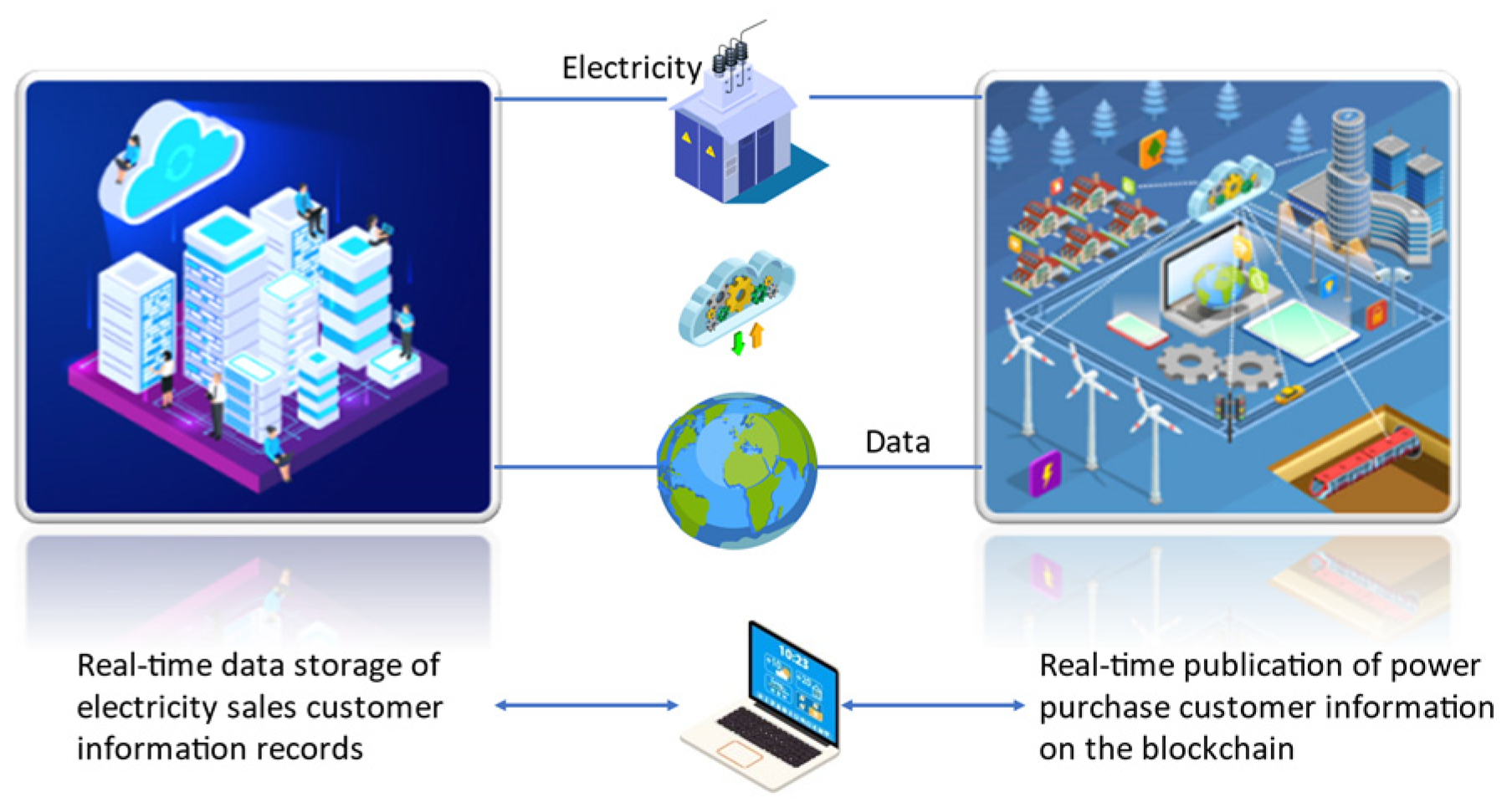
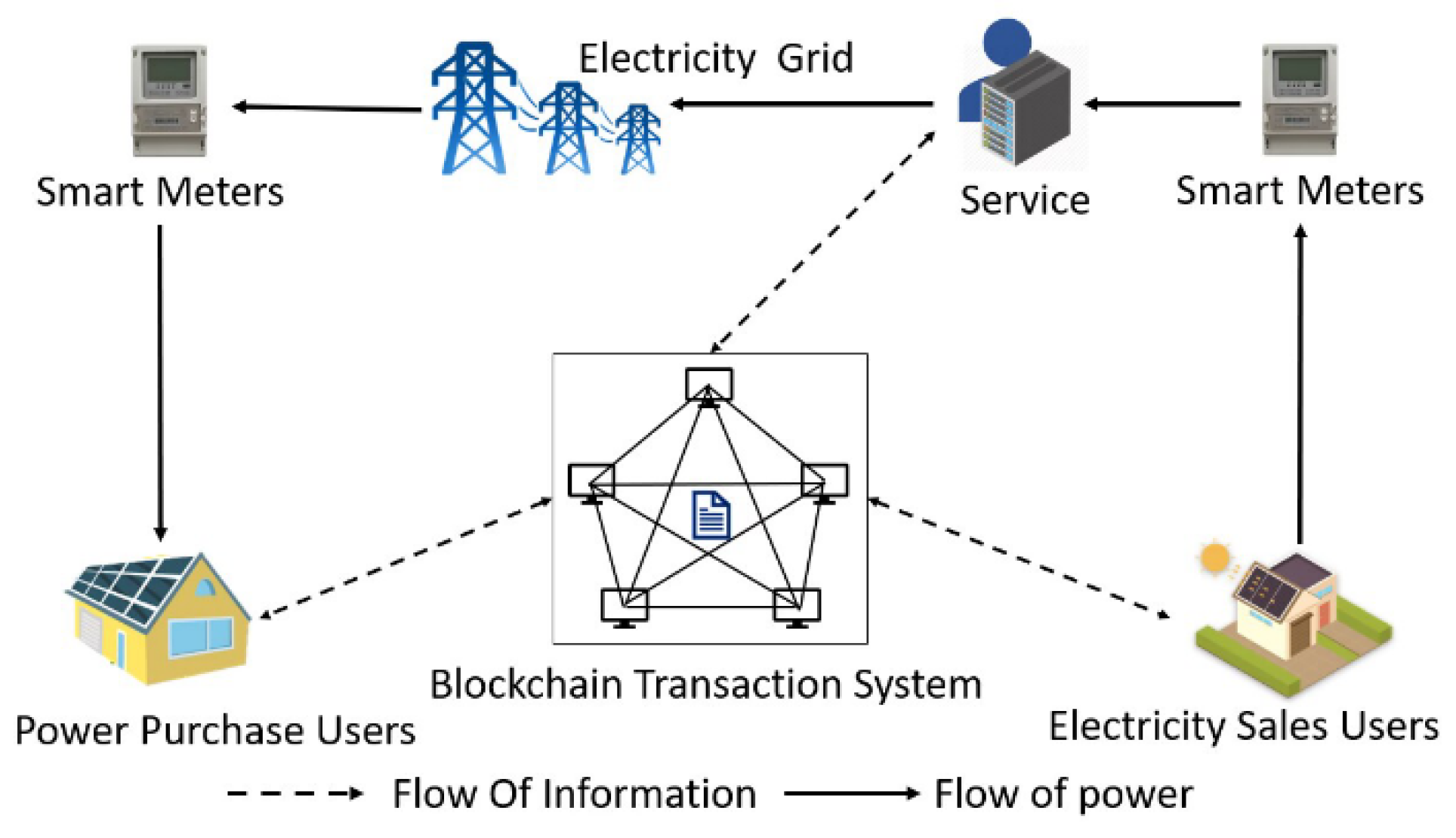
- Consortium Blockchain: Consortium blockchains combine the functionality of private and public blockchains [17]. It is a blockchain technology with authorized nodes that has both the privacy of a private chain and the decentralized features of a public chain [18,19], the transaction diagram is shown in Figure 1.
2.2. PV Microgrid Power Market
2.3. Application of Blockchain Technology in Microgrid
- (1)
- Decentralization: The decentralized nature of blockchain facilitates flexible transactions in the electricity market. Establishing a decentralized trading platform enhances transaction fairness and transparency, fostering effective benefits for distributed energy use and scheduling [24];
- (2)
- Safety: Blockchain ensures the security and immutability of electricity transaction information. Each transaction is recorded on the blockchain, preventing tampering or deletion and ensuring traceability for secure transactions [25];
- (3)
- Real-time: Blockchain enables real-time transaction processing and settlement, ensuring electricity transaction information is timestamped on the blockchain. In contrast to traditional trading models, blockchain-based electricity trading with smart contracts facilitates day-ahead and day-of energy scheduling [26];
- (4)
- Openness and transparency: Blockchain-based electricity trading is more open and transparent compared to traditional modes. Each transaction is recorded on the blockchain, and the information is publicly accessible, providing users with real-time insights into the market situation [27].
2.4. PV Microgrid Blockchain Ledger
- (1)
- User Information Update Contract: This contract enables the blockchain service provider to update users’ essential information, ensuring seamless transactions. It also assesses customer credit, suspending transactions for those with poor credit to maintain a healthy order in the electricity market;
- (2)
- User offer contract: In this contract, the customer can declare the desired transaction price and electricity and record the above data on the blockchain;
- (3)
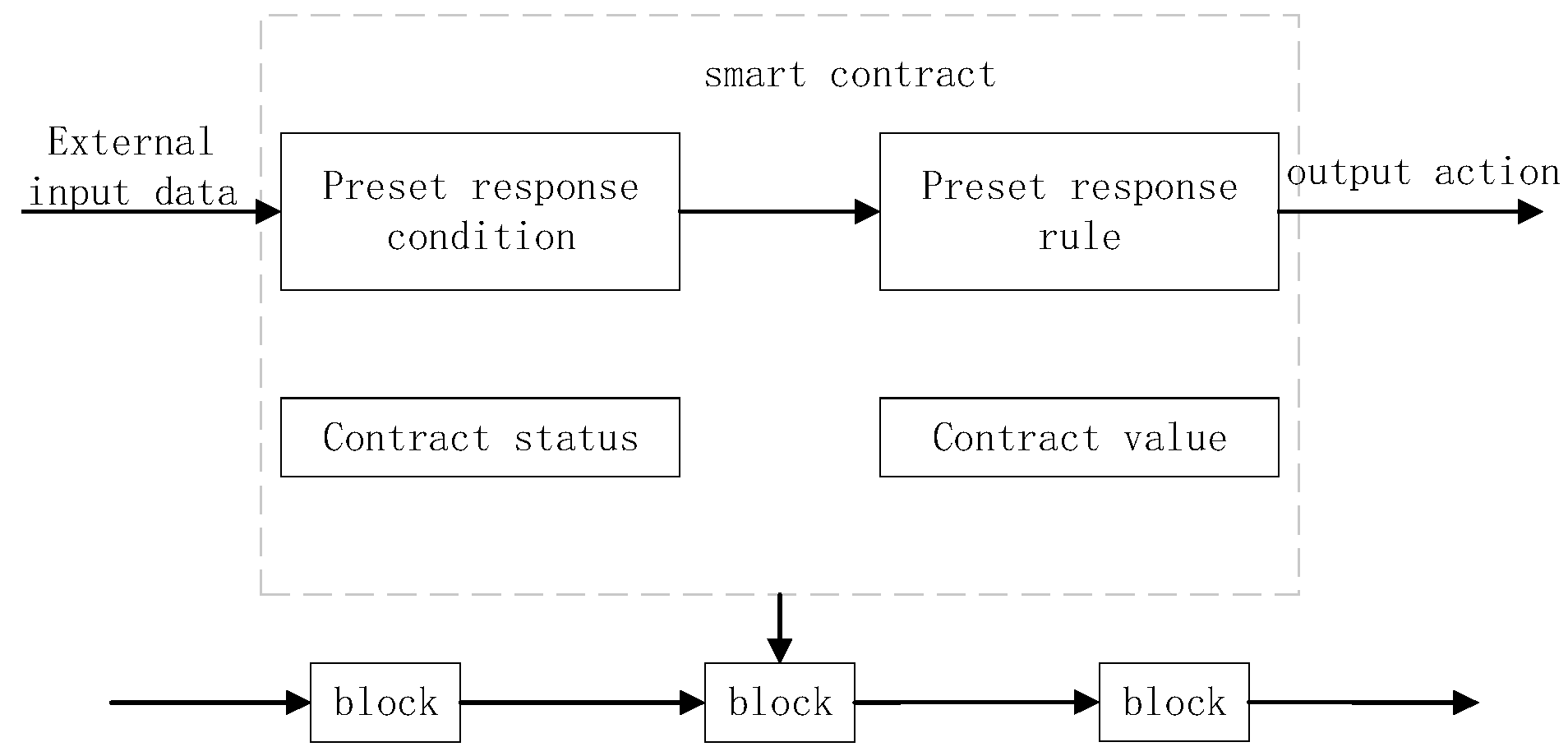
- User matching contracts: In this stage, the smart contract matches user transactions through a two-way auction mechanism with peer-to-peer trading to conclude the deal;
- (4)
- User Reputation Contract: Leveraging the tamper-evident blockchain, this contract evaluates user behavior to determine reputation. Users engaging in malicious actions may face penalties, including reputation point deductions or temporary bans from subsequent transactions;
- (5)
- Settle the contract: This contract serves to settle the final transaction behavior of each party in the system, concluding the transfer of electricity rights and related fees. Simultaneously, it addresses the settlement of reputation points, guaranteeing the effective enforcement of the penalty mechanism.
3. Real-Time Trading Model of PV Microgrid Based on Consortium Blockchain
3.1. Microgrid User State Model
- (1)
- With PV users, each with a different power generation. Using one hour as a trading session, The power generated by the customer in time interval, , is expressed as:
- (2)
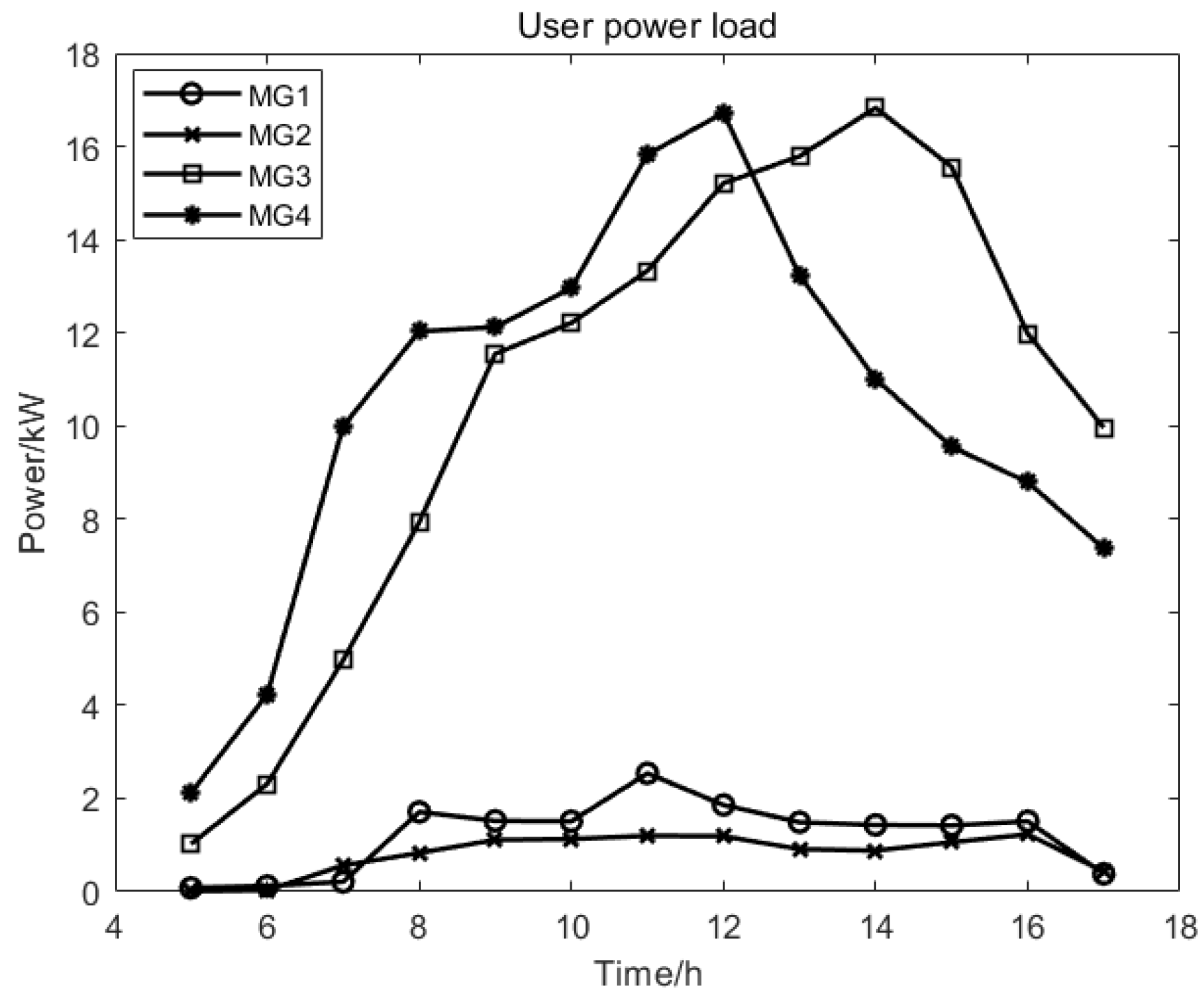
- For load systems, the power consumed by each user varies, and the load characteristics vary greatly. The electricity load for the customer can be expressed as:
- (3)
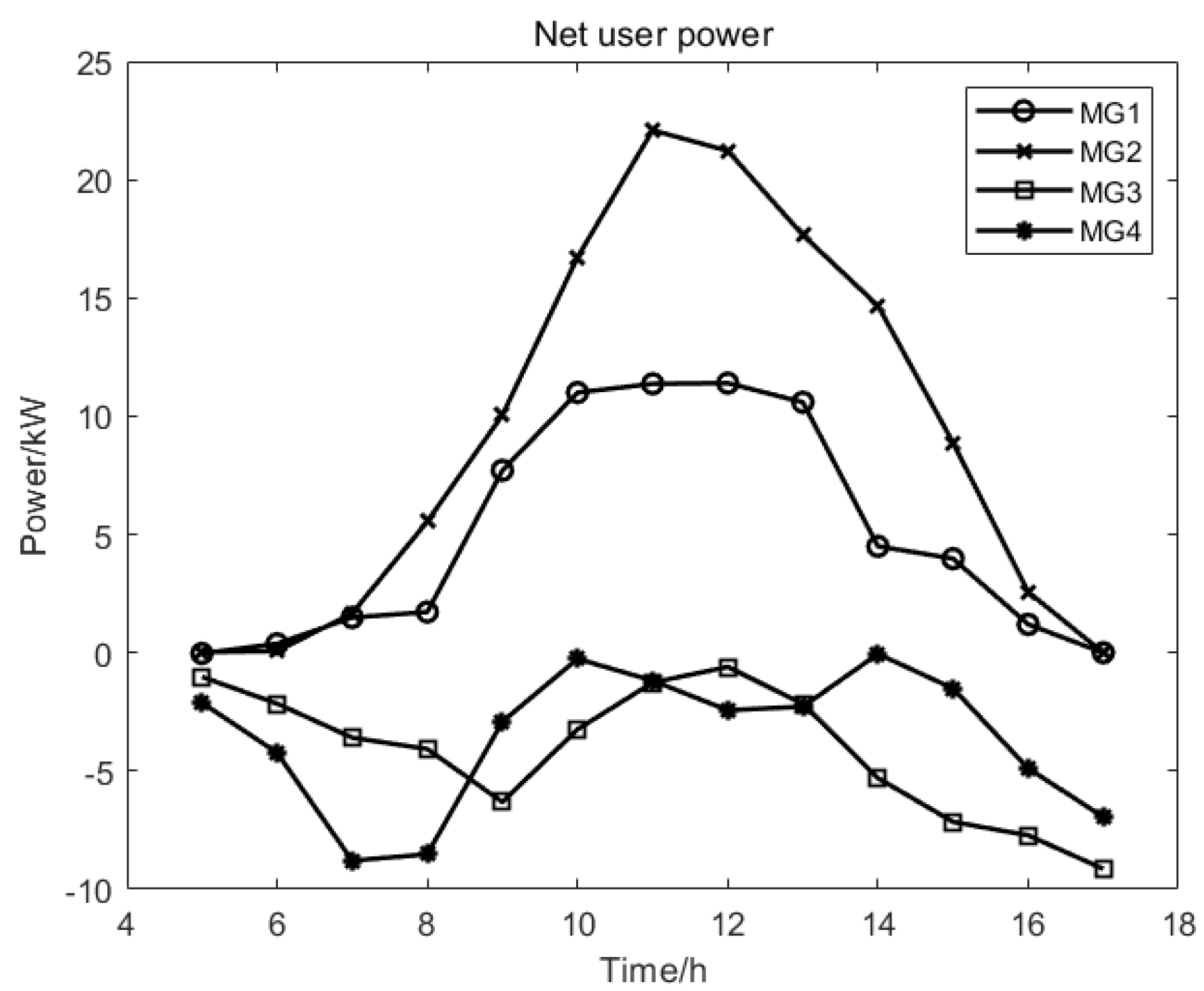
- For user , the net output power in a given time is expressed as:
- (4)
- In a given trading session , the total purchased power , and the total sold power for all customers are shown below.
3.2. Real-Time Interaction Benefit Model for Local Consumption
- (1)
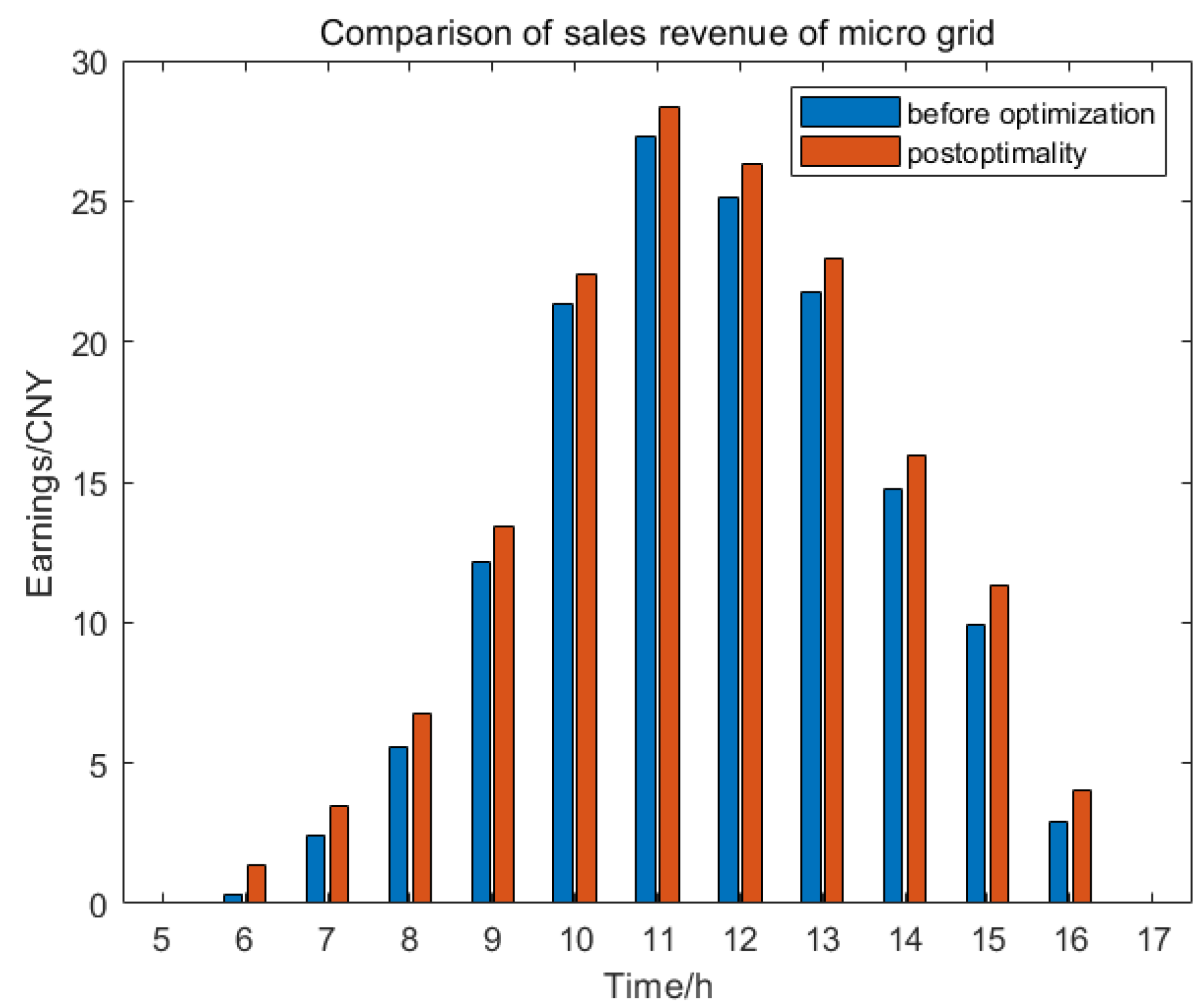
- When , the total power sold is greater than the total power purchased, when there is an oversupply and a buyer’s market. The PV output of the user is preferentially consumed by its own power, and the remaining power is traded through internal pricing and other users or sold to the large power grid. When setting the internal tariff, the customers will adjust their electricity consumption behavior in order to obtain higher returns. In order to measure the balance between power consumption and power sales of both parties, the user transaction benefit model is introduced, which can be expressed as:
- (2)
- When , the total power sold is equal to the total power purchased, and the microgrid users trade directly with each other without the need to trade with the grid, the internal transaction price is shown as follows:
- (3)
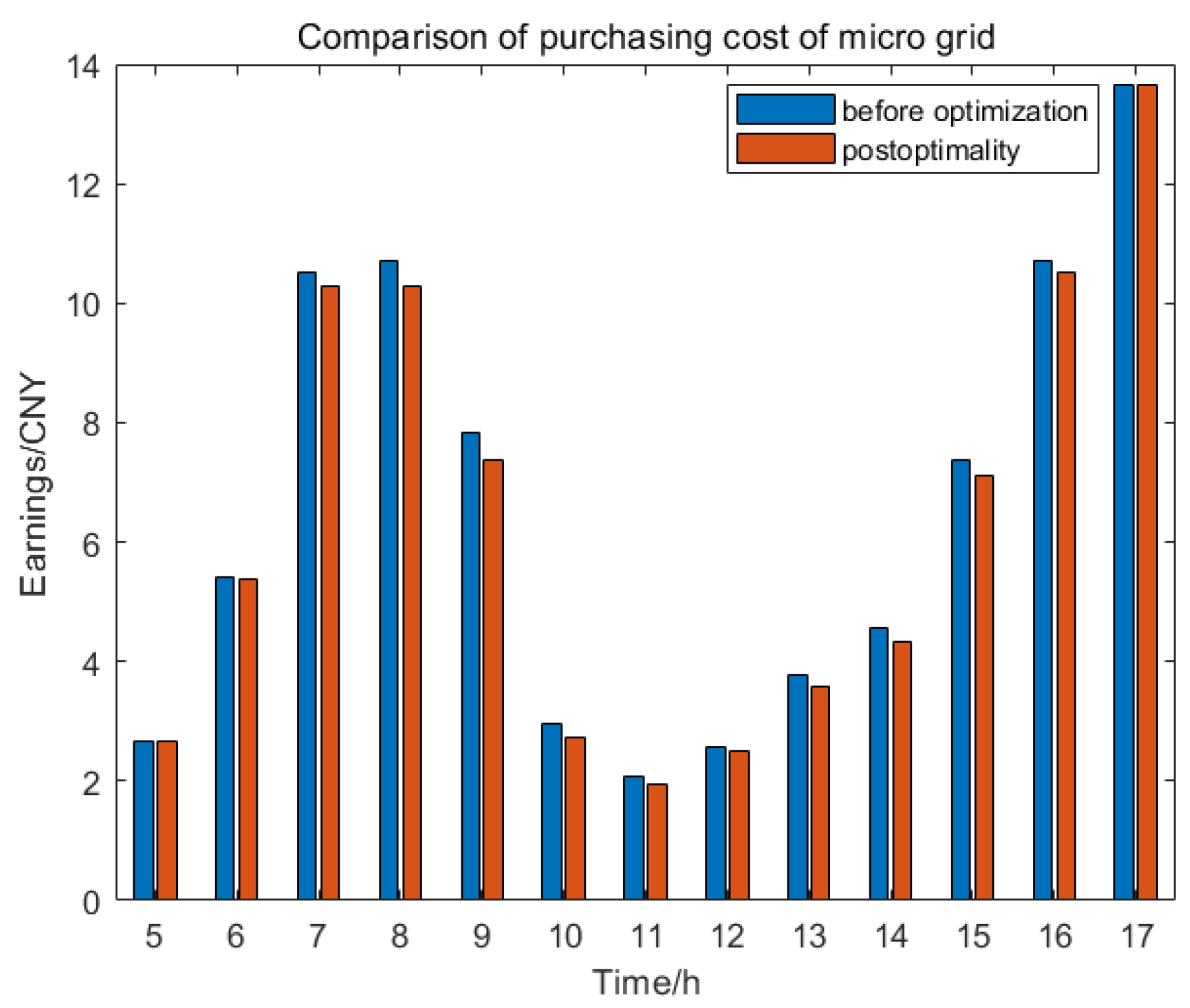
- When , the total power sold is less than the total power purchased. At this time the power market is in a state of oversupply, a seller’s market. Customers with insufficient PV capacity need to purchase electricity directly from the grid at price . For buyers, the purchase cost is expected to be the lowest, and the purchase cost of the buyer comes from the power purchase of the microgrid and the grid. Therefore, the buyer’s purchase cost is expressed as follows:
3.3. Constraint Condition
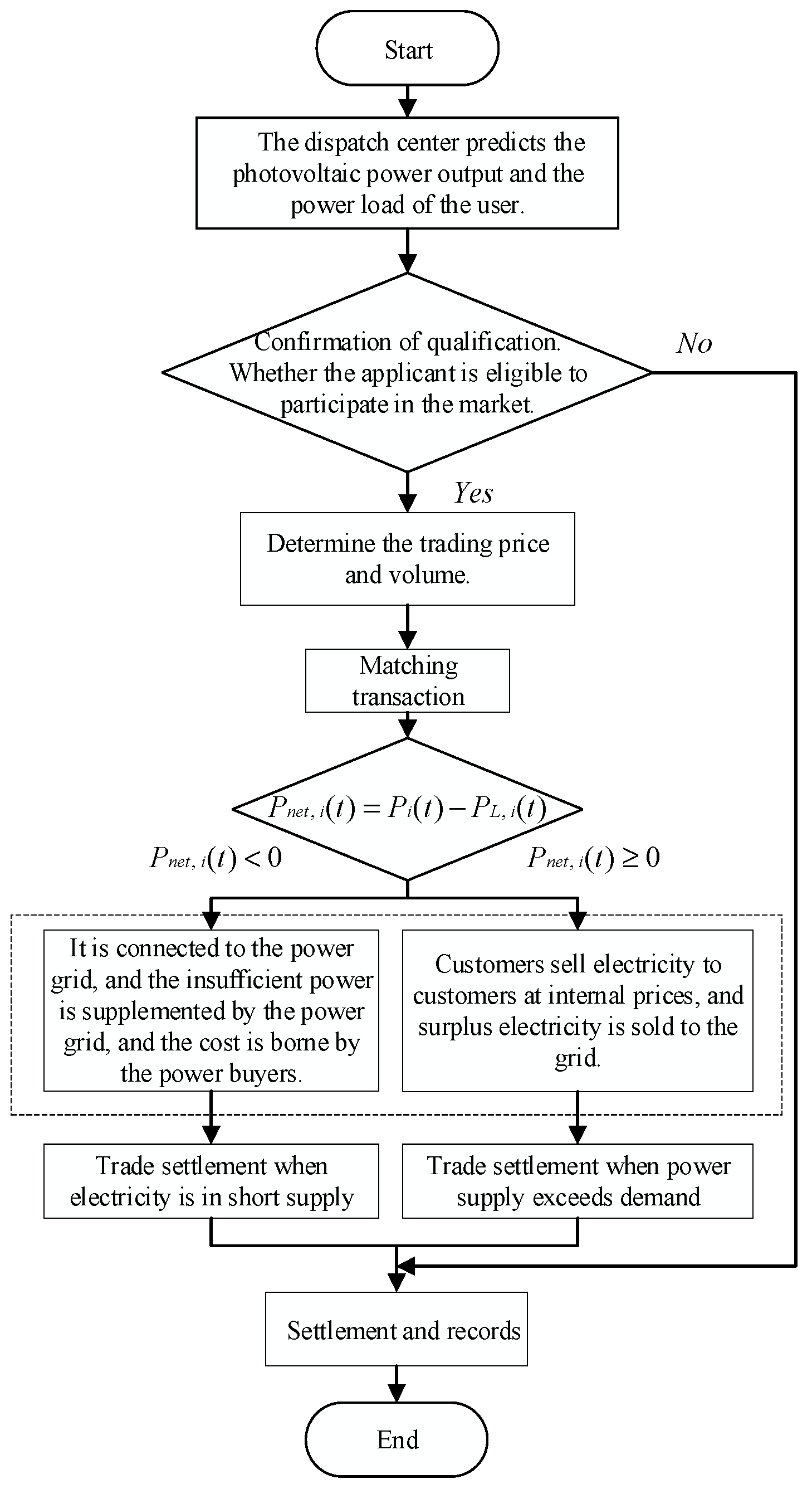
3.4. Trading Process
- (1)
- The user predicts the PV output power and user power load for the next phase based on the previous power generation data situation. Presenting supply and demand plans and giving relevant quotations, and matching transactions at eligible users;
- (2)
- Determining the transaction price and volume through the transaction model based on the successfully matched users;
- (3)
- According to the net output power of the user, it is divided into buyer’s market and seller’s market. For power sales users, excess power is sold to the purchasing user after there is surplus PV, sold to the grid. For power purchasers, if there is a shortage of power users, priority is given to internal tariff purchases from power purchasers, followed by power purchases from the grid;
- (4)
- Finally, transaction contracts are established via the blockchain, The trading mechanism of trading power and trading tariff is recorded into the system at the moment of real-time trading, which is accessible and cannot be tampered with. The specific transaction process is shown in Figure 4.
4. Example Analysis
4.1. Scenario Simulation
4.2. Analysis of Data
4.3. Comparison and Analysis of Results
5. Conclusions
- (1)
- The proposed PV microgrid trading model based on consortium blockchain is more efficient and secure than the grid trading under direct “surplus electricity online” and reduces the cost of electricity purchase for consumers and increases the benefit of electricity sales. For the buyer, the cost of purchasing electricity can be reduced by about 6%, and for the seller, the income from selling electricity is 1.5 times that of directly accessing the Internet. Therefore, in order to attain higher profit, sellers will adjust their power load;
- (2)
- The problem of local consumption of distributed generation can be solved in the power trading of microgrid market. After adopting the trading model, the local or nearby consumption of PV power has been improved, and the benefit of users has been enhanced. Preference for electricity purchases from electricity sellers in the microgrid. When the output power is insufficient, then the power shortage is purchased from the grid, while the impact of the microgrid on the grid can be reduced.
Author Contributions
Funding
Data Availability Statement
Conflicts of Interest
References
- China’s grid-connected installed capacity of PV power generation has exceeded 300 million kilowatts, ranking first in the world for seven consecutive years. China Environ. Superv. 2022, 6. Available online: https://kns.cnki.net/kcms2/article/abstract?v=j6HAoO1nZAxdkHtNyiCGte-bN4bUjih2Tcd0Xx6XGS5joS5-pXszEakP0gdWkfFTPh03XDBc6nJot3Ac3dHo3qVm-ycJ1TH-Digobym-PL4lo1cZag6HWpwr3avMqXymRCSeoNvHyF1Bi8L_3I2WWQ==&uniplatform=NZKPT&language=CHS (accessed on 14 November 2023).
- Lu, J.; Wang, Z.; Yang, Q.; Wang, J.; Lv, H.T.; Song, T.T. Research on game model of PV micro-grid trans action based on block chain. Electr. Meas. Instrum. 2020, 57, 80–86. [Google Scholar]
- Lucas, A.; Geneiatakis, D.; Soupionis, Y.; Nai-Fovino, I.; Kotsakis, E. Blockchain Technology Applied to Energy Demand Response Service Tracking and Data Sharing. Energies 2021, 14, 1881. [Google Scholar] [CrossRef] [Scilit]
- Zia, M.F.; Elbouchikhi, E.; Benbouzid, M. Microgrids energy management systems: A critical review on methods, solutions, and prospects. Appl. Energy 2018, 222, 1033–1055. [Google Scholar] [CrossRef] [Scilit]
- He, Q.; Wu, M.; Sun, P.; Guo, J.; Chen, L.; Jiang, L.; Zhang, Z. Research on a Charging Mechanism of Electric Vehicles for PV Nearby Consumption Strategy. Electronics 2022, 11, 3407. [Google Scholar] [CrossRef] [Scilit]
- Hua, W.; Jiang, J.; Sun, H.; Teng, F.; Strbac, G. Consumer-centric decarbonization framework using Stackelberg game and Blockchain. Appl. Energy 2022, 309, 118384. [Google Scholar] [CrossRef] [Scilit]
- Pei, F.; Cui, J.; Dong, C.; Wang, H.; Jiang, H.; He, C. The Research Field and Current State-of-art of Blockchain in Distributed Power Trading. Proc. CSEE 2021, 41, 1752–1771. [Google Scholar]
- Jinlei, Q.I.N.; Wenqiang, S.U.N.; Youchan, Z.H.U. Energy transaction method of microgrid based on blockchain. Electr. Power Autom. Equip. 2020, 40, 130–138. [Google Scholar]
- Zhang, S.; Pu, M.; Wang, B.; Dong, B. A Privacy Protection Scheme of Microgrid Direct Electricity Transaction Based on Consortium Blockchain and Continuous Double Auction. IEEE Access 2019, 7, 151746–151753. [Google Scholar] [CrossRef] [Scilit]
- Xue, W.Q.; Li, P.Q.; Wang, J.F.; Mu, L.; Gao, Y.; Meng, L. Design and Implementation of Household-use PV Multi-lateral Trading Platform Based on Blockchain. Proc. CSU-EPSA 2021, 33, 142–150. [Google Scholar]
- Jin, K.; Yang, J.; Chen, Z. Blockchain-based Transaction Model of Distributed PV Generation for Local Power Consumption. Electr. Power 2021, 54, 8–16. [Google Scholar]
- Chen, Z.; Yang, J.H.; Jin, K.Y.; Hou, B.; Wang, W.Z. Control strategy of time-shift facility agriculture load and PV local consumption based on energy blockchain. Electr. Power Autom. Equip. 2021, 41, 47–55. [Google Scholar]
- Xu, Z.; Wang, Y.; Dong, R.; Li, W. Research on multi-microgrid power transaction process based on blockchain Technology. Electr. Power Syst. Res. 2022, 213, 108649. [Google Scholar] [CrossRef] [Scilit]
- Siqin, Z.; Niu, D.; Li, M.; Gao, T.; Lu, Y.; Xu, X. Distributionally robust dis patching of multi-community integrated energy system considering energy sharing and profit allocation. Appl. Energy 2022, 321, 119202. [Google Scholar] [CrossRef] [Scilit]
- Dai, C.C.; Luan, H.J.; Yang, X.Y.; Guo, X.B.; Lu, Z.H.; Niu, B.F. Overview of Blockchain Technology. Comput. Sci. 2021, 48, 500–508. [Google Scholar]
- Yin, H.; Zhang, Z.; He, J.; Ma, L.; Zhu, L.; Li, M.; Khoussainov, B. Proof of Continuous Work for Reliable Data Storage Over Permissionless Blockchain. IEEE Internet Things J. 2022, 9, 7866–7875. [Google Scholar] [CrossRef] [Scilit]
- He, Y.; Xiong, W.; Yang, B.Y.; Zhang, R.; Cui, M.L.; Feng, T.T.; Sun, Y.E. Distributed Energy Transaction Model Based on the Alliance Blockchain in Case of China. J. Web Eng. 2021, 20, 359–385. [Google Scholar] [CrossRef] [Scilit]
- Panda, S.S.; Jena, D.; Mohanta, B.K.; Ramasubbareddy, S.; Daneshmand, M.; Gandomi, A.H. Authentication and Key Management in Distributed IoT Using Blockchain Technology. IEEE Internet Things J. 2021, 8, 12947–12954. [Google Scholar] [CrossRef] [Scilit]
- Wang, J.; Wang, S.; Zhang, Q.; Deng, Y. A two-layer consortium blockchain with transaction privacy protection based on sharding technology. J. Inf. Secur. Appl. 2023, 74, 103452. [Google Scholar] [CrossRef] [Scilit]
- Zhou, L.; Zhang, S.; Hou, F.; Zhang, L. Construction of carbon trading pattern based on blockchain. Sci. Soil Water Conserv. 2020, 18, 139–145. [Google Scholar]
- Yan, Z.; Li, J. Research on carbon emissions trading and monitoring mechanism based on blockchain technology. Enterp. Econ. 2020, 39, 31–37. [Google Scholar]
- He, Q.; Ai, Q. The application prospects of blockchain technology in virtual power plants. Electr. Appl. Energy Effic. Manag. Technol. 2017, 14–18. [Google Scholar] [CrossRef]
- Zeng, M.; Cheng, J.; Wang, Y.; Li, Y.; Yang, Y.; Dou, J. Primarily research for multi module cooperative autonomous mode of energy internet under blockchain framework. Electr. Eng. 2017, 37, 3672–3681. [Google Scholar]
- Yang, Q.; Wang, H.; Wang, T.; Zhang, S.; Wu, X.; Wang, H. Blockchain-based decentralized energy management platform for residential distributed energy resources in a virtual power plant. Appl. Energy 2021, 294, 117026. [Google Scholar] [CrossRef] [Scilit]
- Xu, Z.; Yang, D.; Li, W. Microgrid group trading model and solving algorithm based on blockchain. Energies 2019, 12, 1292. [Google Scholar] [CrossRef] [Scilit]
- Zhao, S.; Zhu, S.; Wu, Z.; Jaing, B. Cooperative energy dispatch of smart building cluster based on smart contracts. Int. J. Electr. Power Energy Syst. 2022, 138, 107896. [Google Scholar] [CrossRef] [Scilit]
- van Leeuwen, G.; AlSkaif, T.; Gibescu, M.; van Sark, W. An integrated blockchain-based energy management platform with bilateral trading for microgrid communities. Appl. Energy 2020, 263, 114613. [Google Scholar] [CrossRef] [Scilit]




| Time | Total Electricity Sold/(kw·h) | Total Power Purchased/(kw·h) | Microgrid Net Output/(kw·h) |
|---|---|---|---|
| 5 | 0 | −3.14 | −3.14 |
| 6 | 0.45 | −6.4 | −5.9 |
| 7 | 3.16 | −12 | −9.2 |
| 8 | 7.27 | −13 | −5.3 |
| 9 | 15.8 | −9.2 | 6.54 |
| 10 | 27.7 | −3.5 | 24.2 |
| 11 | 35.5 | −2.4 | 33 |
| 12 | 32.6 | −3 | 29.6 |
| 13 | 28.3 | 0 | 28.3 |
| 14 | 19.2 | −3.9 | 15.3 |
| 15 | 12.9 | −12 | 0.52 |
| 16 | 3.77 | −15 | −11 |
| 17 | 0 | −16 | −16 |
| Time | Internal Electricity Price (CNY) | Electricity Selling User | Power Purchasing User | ||
|---|---|---|---|---|---|
| MG1 | MG2 | MG3 | MG4 | ||
| 6 | 0.778 | 0.38 | 0.07 | −2.2 | −4.2 |
| 7 | 0.780 | 1.49 | 1.67 | −3.6 | −8.8 |
| 8 | 0.792 | 1.72 | 5.55 | −4.1 | −8.5 |
| 16 | 0.796 | 1.2 | 2.57 | −7.7 | −4.9 |
| Time | Internal Electricity Price (CNY) | Electricity Selling User | Power Purchasing User | ||
|---|---|---|---|---|---|
| MG1 | MG2 | MG3 | MG4 | ||
| 9 | 0.799 | 7.71 | 8.05 | −6.3 | −2.9 |
| 10 | 0.781 | 11 | 16.7 | −3.2 | −0.3 |
| 11 | 0.803 | 11.4 | 24.1 | −1.3 | −1.2 |
| 12 | 0.826 | 11.4 | 21.2 | −0.6 | −2.4 |
| 13 | 0.810 | 10.6 | 17.7 | −2.2 | −2.3 |
| 14 | 0.810 | 4.5 | 14.7 | −5.3 | 0 |
| 15 | 0.822 | 3.98 | 8.88 | −7.2 | −1.5 |
| 9 | 0.799 | 7.71 | 8.05 | −6.3 | −2.9 |
| 10 | 0.781 | 11 | 16.7 | −3.2 | −0.3 |
| 11 | 0.803 | 11.4 | 24.1 | −1.3 | −1.2 |
| Comparative Content | Without Blockchain | With Blockchain |
|---|---|---|
| Means of information interaction | Agency-centered | Blockchain ledger |
| Information reliability | Agent credit guarantee | Open and credible |
| Average electricity cost (CNY/(kw·h)) | 0.68 | 0.59 |
| Aggregate income (CNY) | 24,745.6 | 31,067.8 |
| Degree of new energy utilization | low | high |
Disclaimer/Publisher’s Note: The statements, opinions and data contained in all publications are solely those of the individual author(s) and contributor(s) and not of MDPI and/or the editor(s). MDPI and/or the editor(s) disclaim responsibility for any injury to people or property resulting from any ideas, methods, instructions or products referred to in the content. |
© 2023 by the authors. Licensee MDPI, Basel, Switzerland. This article is an open access article distributed under the terms and conditions of the Creative Commons Attribution (CC BY) license (https://creativecommons.org/licenses/by/4.0/).
Share and Cite
Wei, L.; Jian, W.; Fu, B.; Jiang, B. Research on Real-Time Trading Mechanism of Photovoltaic Microgrid Based on the Consortium Blockchain. Energies 2023, 16, 7691. https://doi.org/10.3390/en16237691
Wei L, Jian W, Fu B, Jiang B. Research on Real-Time Trading Mechanism of Photovoltaic Microgrid Based on the Consortium Blockchain. Energies. 2023; 16(23):7691. https://doi.org/10.3390/en16237691
Chicago/Turabian StyleWei, Liangjiang, Wei Jian, Baochuan Fu, and Baoping Jiang. 2023. "Research on Real-Time Trading Mechanism of Photovoltaic Microgrid Based on the Consortium Blockchain" Energies 16, no. 23: 7691. https://doi.org/10.3390/en16237691
APA StyleWei, L., Jian, W., Fu, B., & Jiang, B. (2023). Research on Real-Time Trading Mechanism of Photovoltaic Microgrid Based on the Consortium Blockchain. Energies, 16(23), 7691. https://doi.org/10.3390/en16237691