A Novel Hybrid Power-Grid Investment Optimization Model with Collaborative Consideration of Risk and Benefit


Abstract
1. Introduction
- (1)
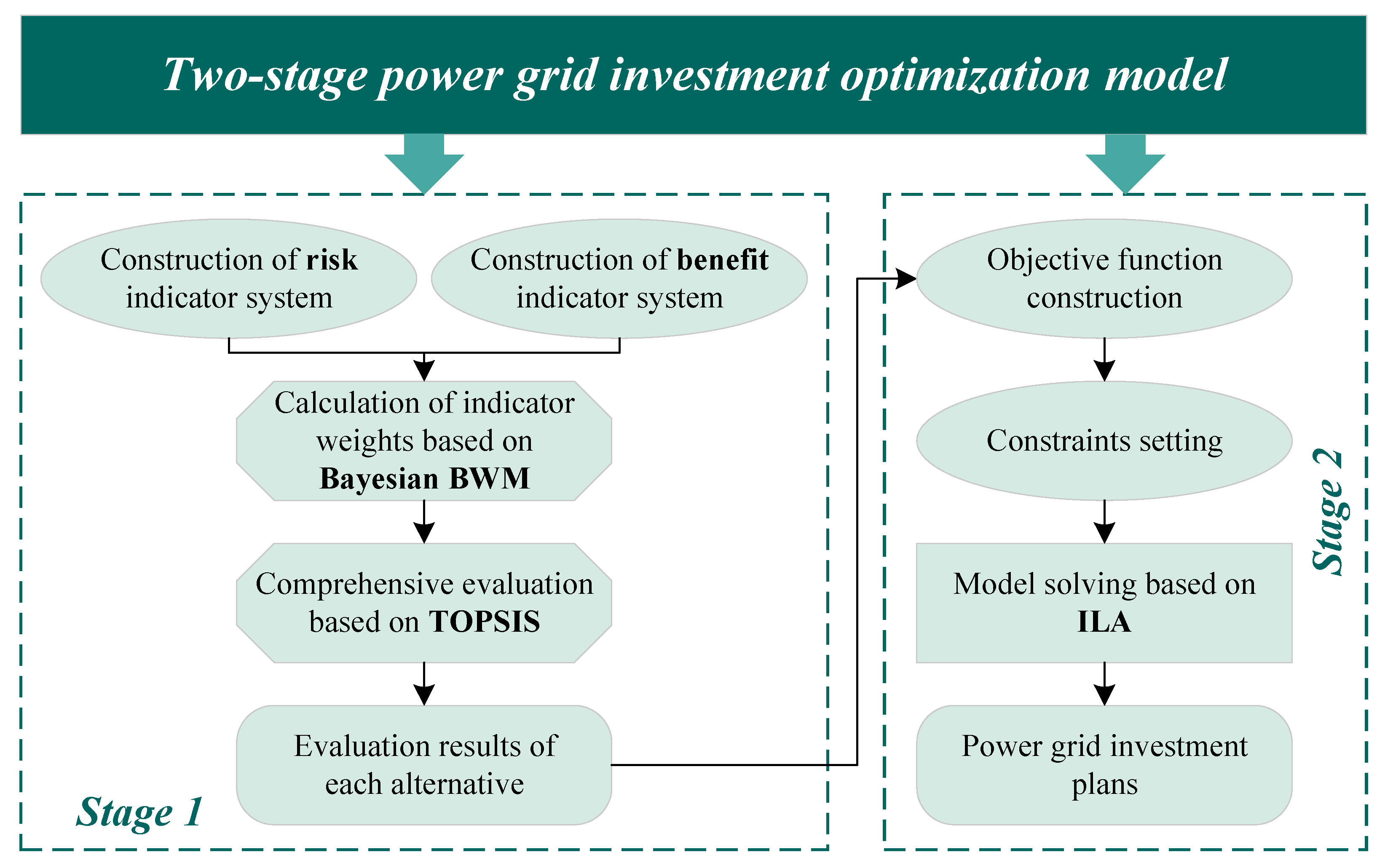
- A two-stage PGI optimization model is developed in this study by considering both risk and benefit factors simultaneously, which can help address the problem of inadequate evaluations of the investment risks and benefits in previous research. Through the sensitivity analysis of three elements, multiple investment portfolios are presented for different situations;
- (2)
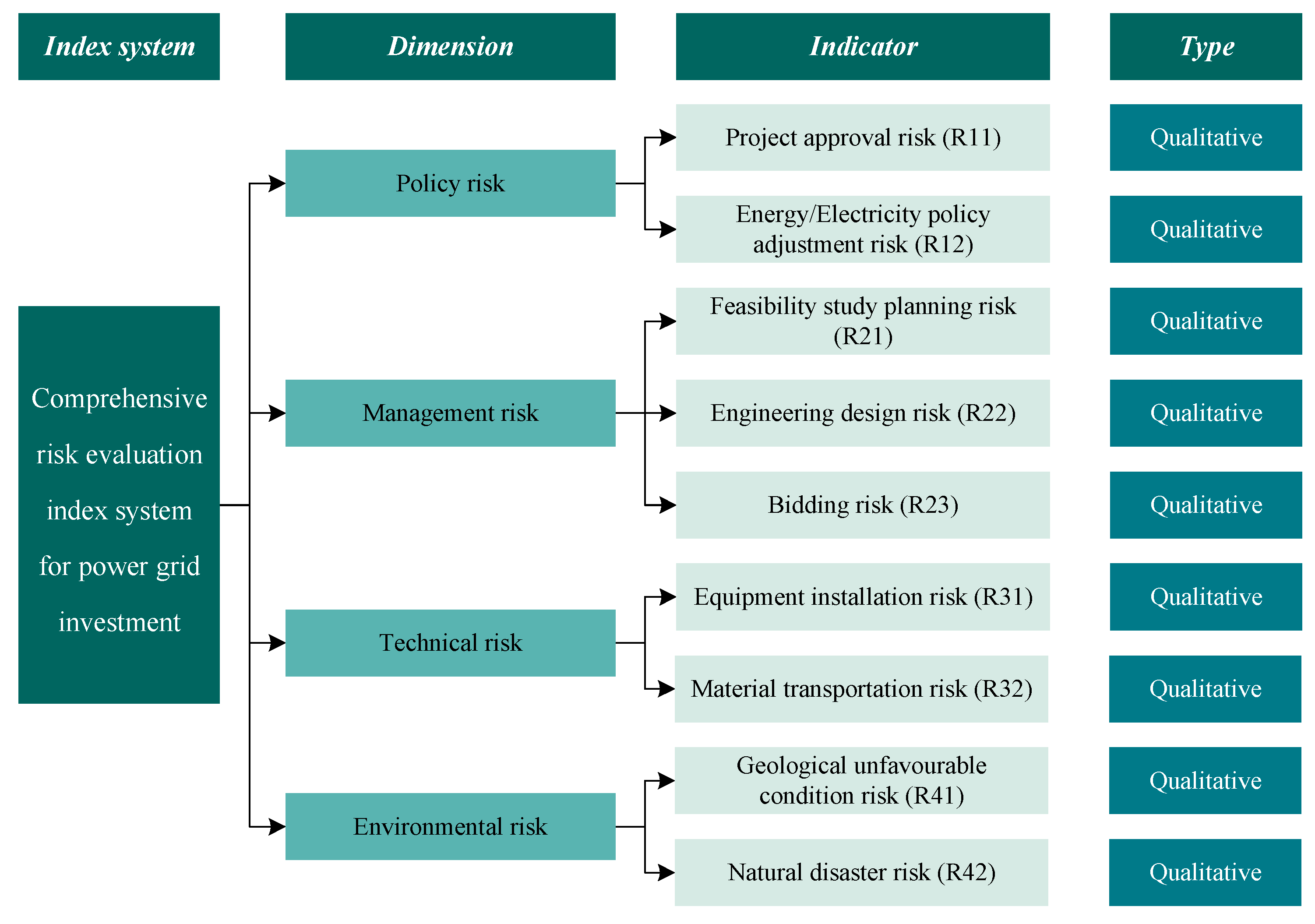
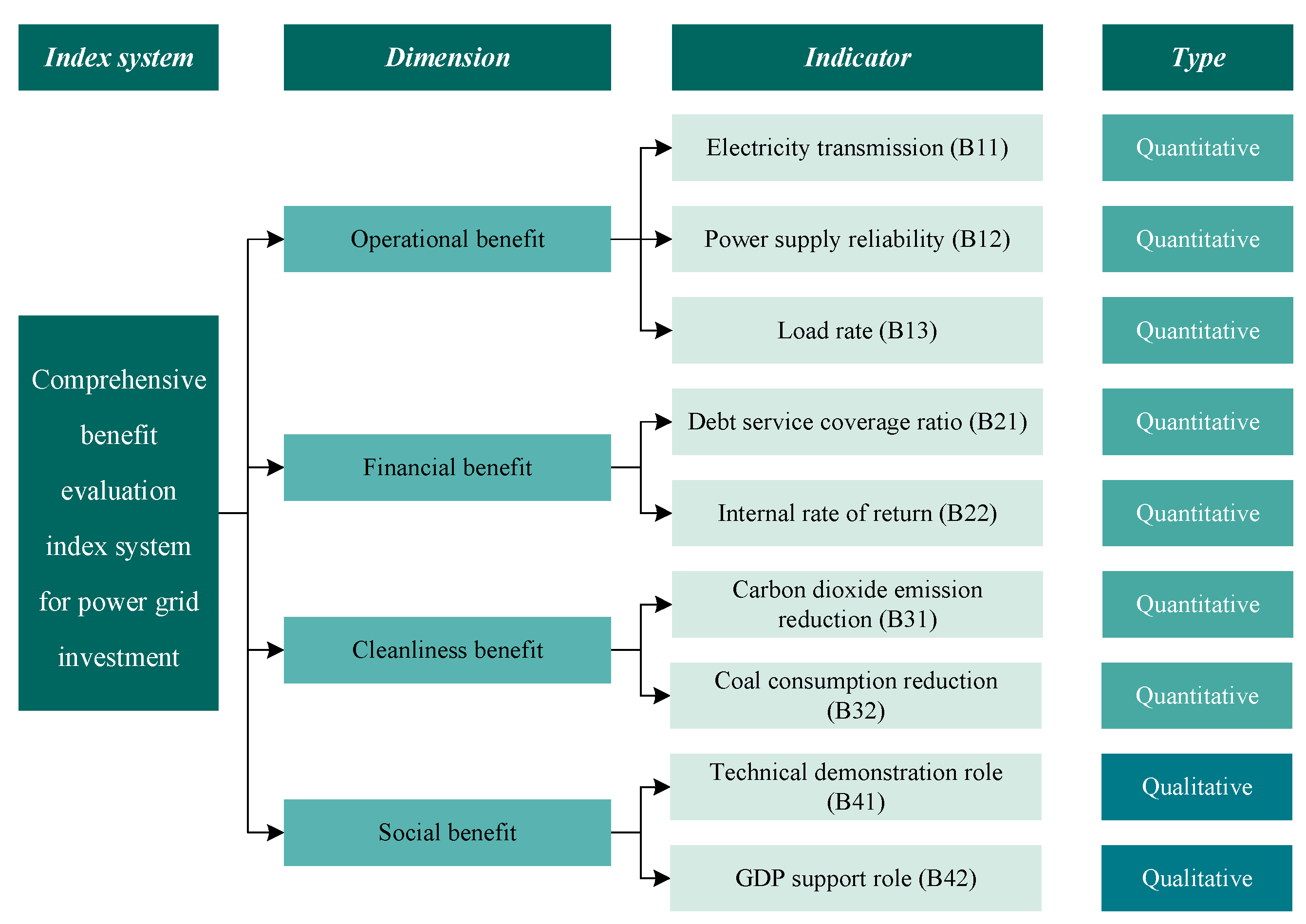
- Two comprehensive multidimensional evaluation index systems are constructed in this paper around the two key characteristics of risk and benefit in PGI projects. One is composed of policy, management, technical, and environmental risks, and the other is mainly constructed from the dimensions of operational, financial, cleanliness, and social benefits;
- (3)
- An enhanced Bayesian BWM model has been used in the initial step of the PGI risk and benefit assessment to produce more dependable indicator weights by introducing group decision-making. Moreover, the state-of-the-art incomprehensible but intelligible-in-time logic algorithm (ILA) with higher efficiency and accuracy is used to solve the optimization problem in the second stage of PGI optimization.
2. Evaluation Index System for Risks and Benefits of PGI
2.1. Comprehensive Risk Evaluation Index System for PGI
- (1)
- Policy Risk (R1)
- (2)
- Management risk (R2)
- (3)
- Technical risk (R3)
- (4)
- Environmental risk (R4)
2.2. Comprehensive Benefit Evaluation Index System for PGI
- (1)
- Operational benefit (B1)
- (2)
- Financial benefit (B2)
- (3)
- Cleanliness benefit (B3)
- (4)
- Social benefit (B4)
3. Methodology
3.1. MCDM Models for Comprehensive Evaluation of Power-Grid Projects
3.1.1. Bayesian BWM Model
- (1)
- Determine the best and worst indicators
- (2)
- Establish the best-to-others (BO) vector, others-to-worst (OW) vector, and multinomial probability distribution function
- (3)
- Calculate the occurrence probability of indicators (or events)
- (4)
- Determine the indicator weights
3.1.2. The TOPSIS Method
- (1)
- Calculate the distance between each alternative and the ideal/anti-ideal alternative.
- (2)
- Calculate the evaluation results of each alternative as follows:
3.2. PGI Optimization Model
3.2.1. Objective Function
3.2.2. Constraints
- (1)
- Investment amount constraints
- (2)
- Power demand constraints
- (3)
- Low-carbon constraints
3.2.3. ILA Solver
- ➢
- Groupwork stage
- (1)
- Determine the parameters for experts
- (2)
- Normalization
- (3)
- Determine the knowledge of each expert
- (4)
- Update the expert knowledge
- ➢
- Integration stage
- (1)
- Integrate all the groups
- (2)
- Re-determine the knowledge
- (3)
- Re-update the expert knowledge
- ➢
- Logic search stage
4. Empirical Analysis
4.1. Basic Information
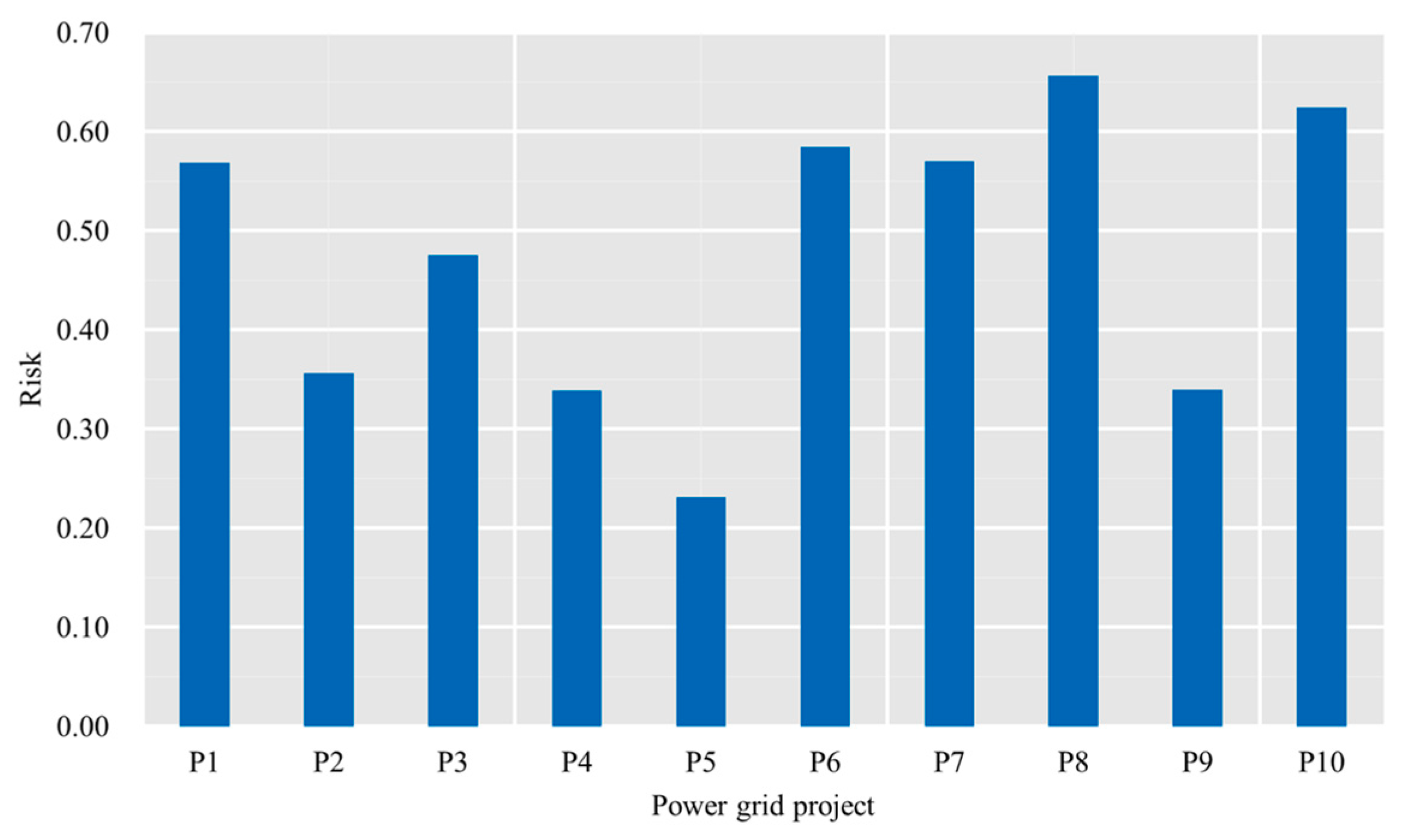
4.2. Comprehensive Risk Evaluation of Power-Grid Projects
4.2.1. Indicator Weight Determination
4.2.2. Comprehensive Evaluation of the Alternatives
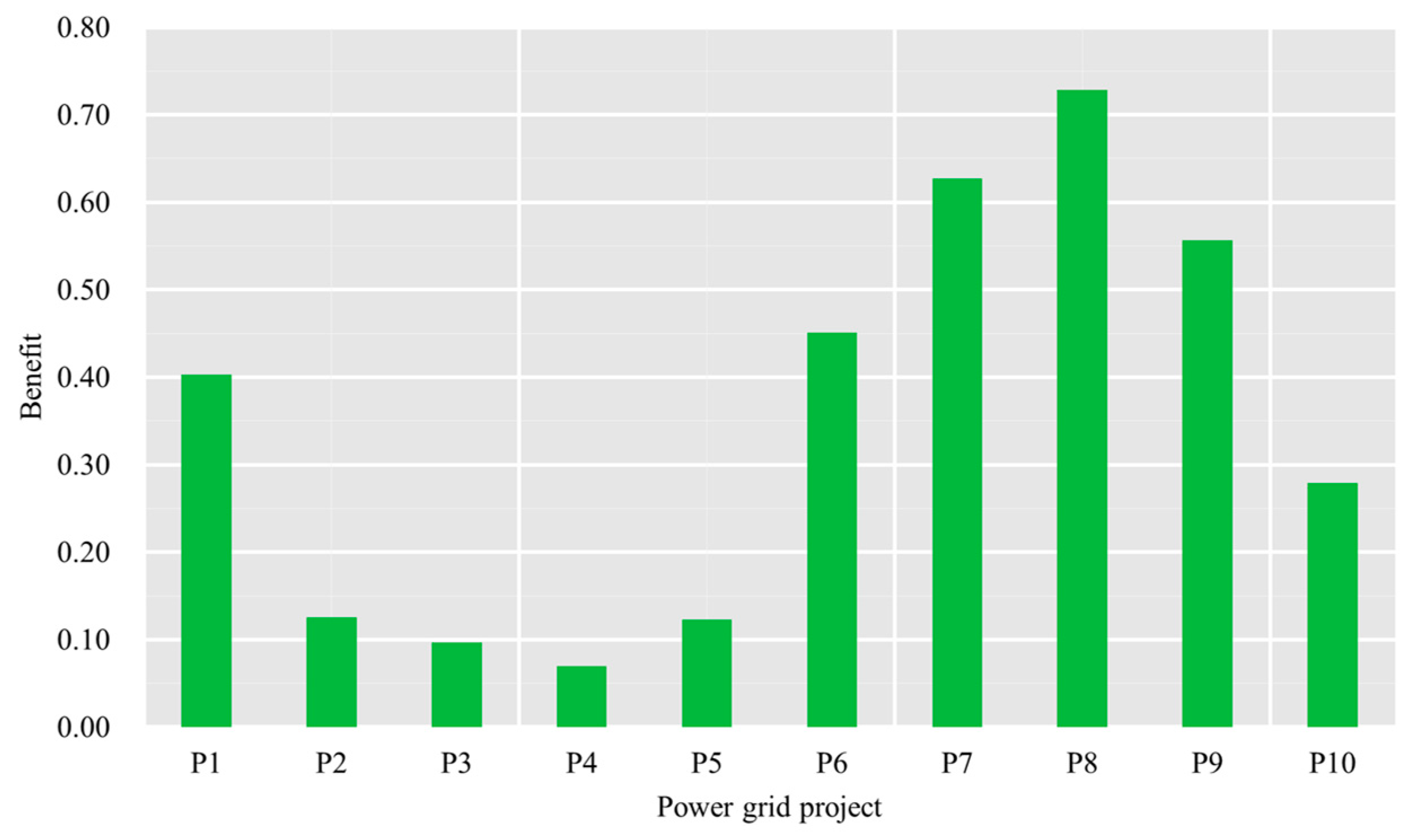
4.3. Comprehensive Benefit Evaluation of Power-Grid Projects
4.3.1. Indicator Weights Determination
4.3.2. Comprehensive Evaluation of the Alternatives
4.4. PGI Optimization Results
5. Discussion
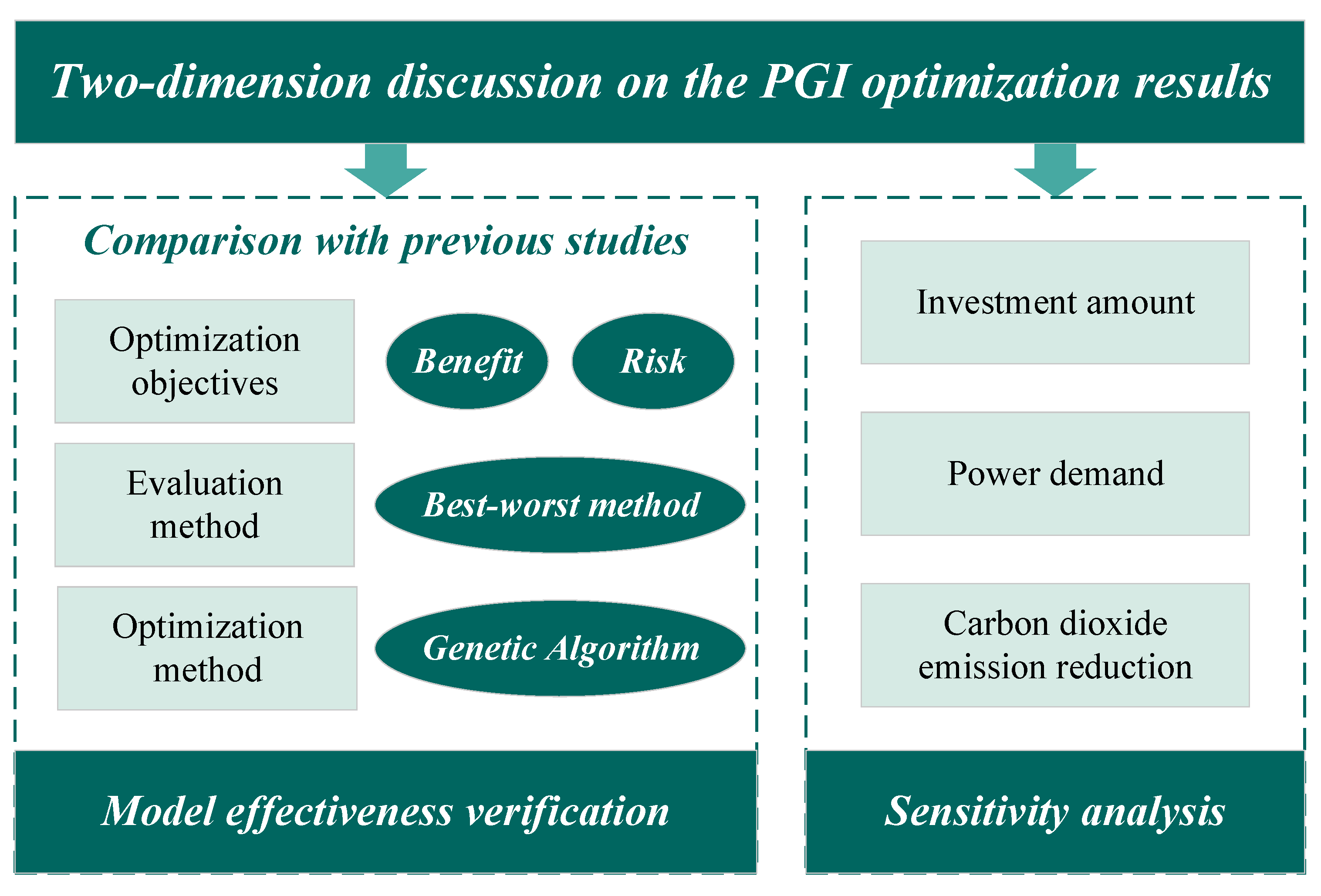
5.1. Model Effectiveness Verification
5.1.1. Model Effectiveness Verification on the Optimization Objectives
5.1.2. Model Effectiveness Verification on the Evaluation Method
5.1.3. Model Effectiveness Verification on the Optimization Method
5.2. Sensitivity Analysis
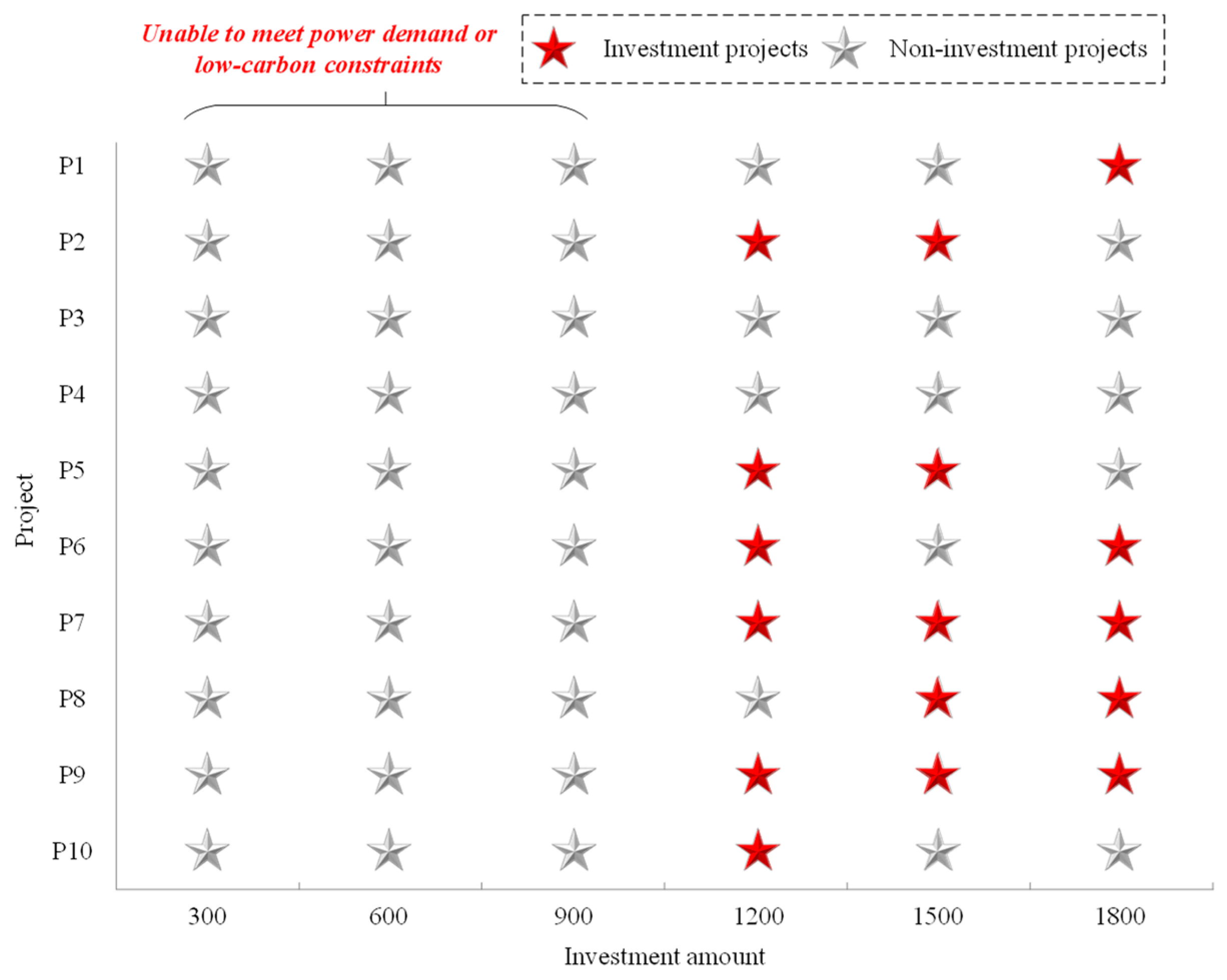
5.2.1. Sensitivity Analysis of Investment Amount
5.2.2. Sensitivity Analysis of Power Demand
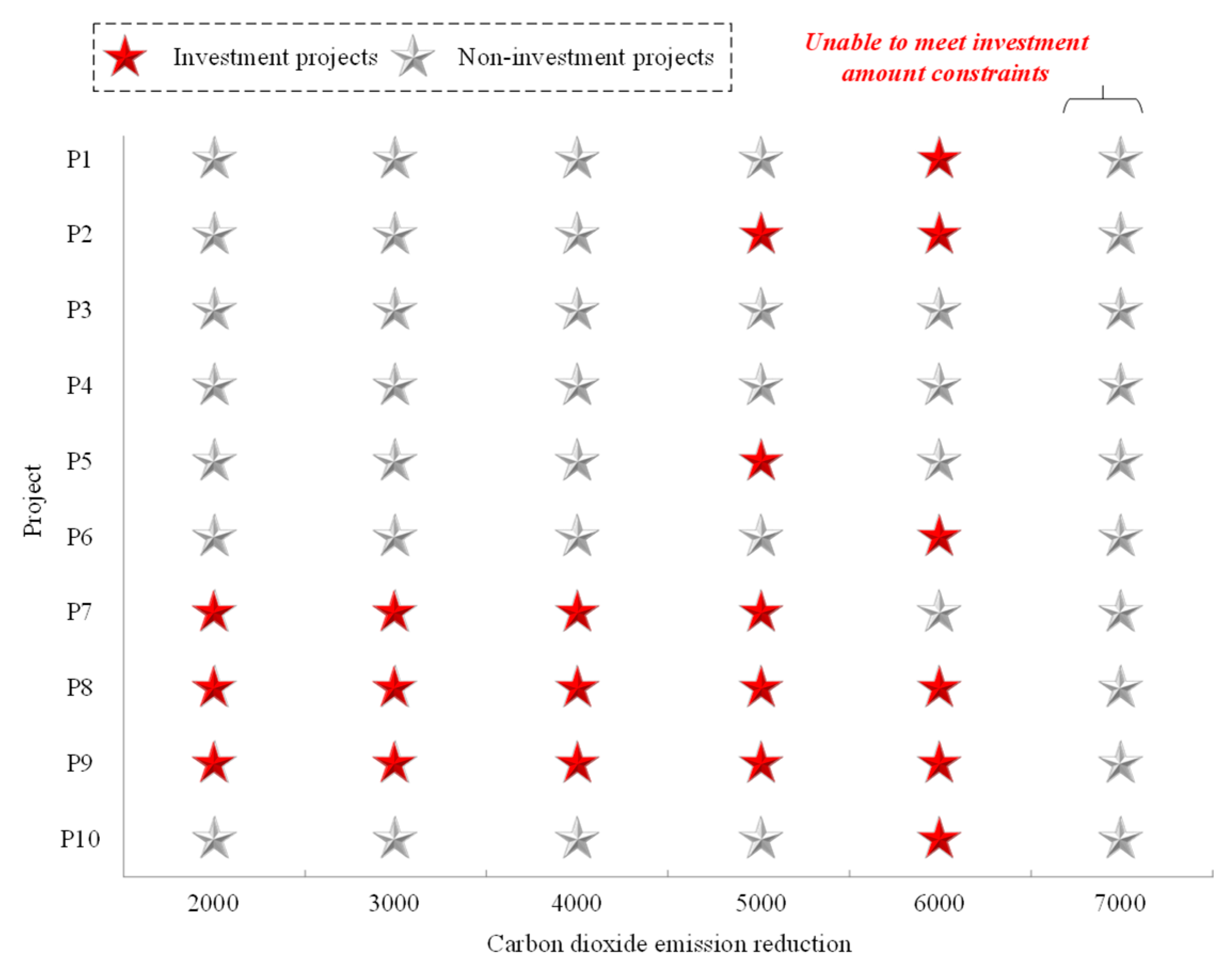
5.2.3. Sensitivity Analysis of Carbon Dioxide Emission Reduction
6. Conclusions and Future Directions
6.1. Conclusions and Suggestions
- (1)
- From the risk perspective, policy and management risks are the most important risk factors that power-grid enterprises should pay attention to when investing in new projects. The most significant factor that influences investment decisions is whether the project can be approved for construction without major issues;
- (2)
- From the benefit perspective, operational and financial benefits are the most important benefit factors that reflect the multidimensional values of the power-grid projects. The first benefit indicators that require attention are the transmission capacity and quality of the power supply. In contrast, investments in the electricity system are not primarily motivated by cleanliness or social benefits. However, power-grid enterprises should also consider these two factors to conduct responsible businesses;
- (3)
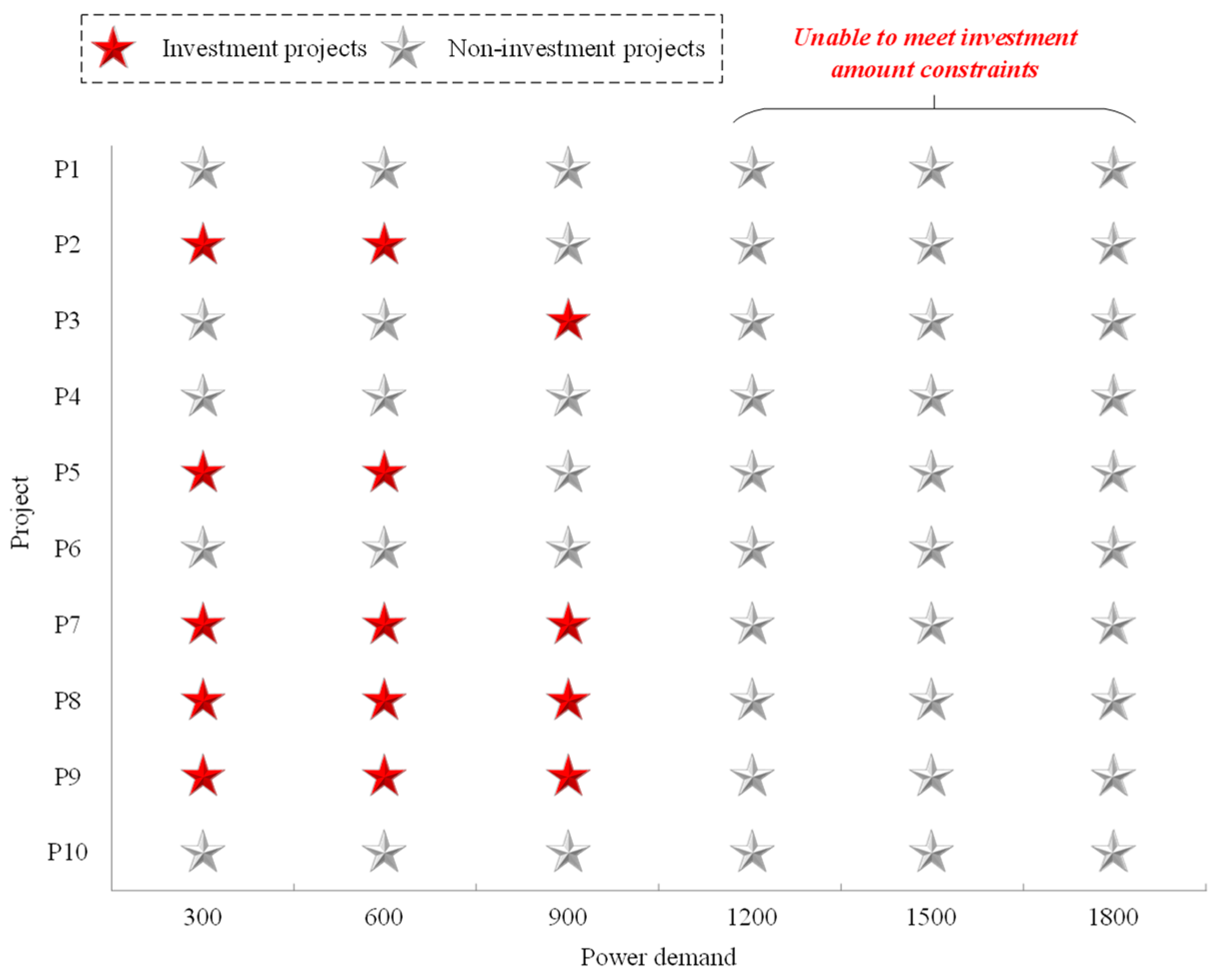
- After balancing the risks and benefits of each project, we suggest carefully considering the PGI objective of maximizing “benefit per unit risk” and constraints on the investment amount, power demand, and low-carbon requirements. According to our findings, the best investment portfolios under the benchmark scenario are P2, P5, P7, P8, and P9. In addition, when the constraint conditions change, P7, P8, and P9 projects with high benefit–risk ratios are typically still included in the ideal investment portfolio;
- (4)
- Compared with the previous studies that only consider the minimization of risks or the maximization of benefits, the investment portfolios proposed in this paper can enhance benefits by 37.27% and decrease risks by 89.86%, respectively, which proves the superiority of the newly proposed objective. In addition, the proposed Bayesian BWM approach and ILA method can provide more rational weighting results and better optimization results than the traditional BWM and GA algorithms, which also proves the model effectiveness of the proposed weighting and optimization method.
- (1)
- For investors, it is necessary to rapidly establish a closed-loop risk control mechanism and benefit improvement measures. On the one hand, power-grid enterprises must strengthen risk prevention and control, especially on policy risks. With the proposal of carbon neutrality goals, China is accelerating the low-carbon transformation of the power industry, forcing the clean development of PGI. Hence, decision-makers need to actively monitor macro policy dynamics and pay attention to whether projects under construction or to be built contradict policies. On the other hand, as another key factor in PGI, power-grid enterprises should regularly conduct a "look back" to evaluate whether the benefit of each project has met the expectations;
- (2)
- Power-grid enterprises must design dynamic investment planning adjustment mechanisms and focus on key factors that affect efficiency and benefit, such as the economic development level and the electricity consumption scale. Before conducting the risk and benefit evaluation of PGI projects, it is necessary to enhance the predicting accuracy of various external factors to obtain more reliable investment portfolios.
6.2. Limitations and Future Directions
Author Contributions
Funding
Data Availability Statement
Acknowledgments
Conflicts of Interest
References
- Hu, C.; Shen, Z.; Yu, H.; Xu, B. Uncertainty shocks and monetary policy: Evidence from the troika of China’s economy. Econ. Res.-Ekon. Istraživanja 2022, 35, 971–985. [Google Scholar] [CrossRef] [Scilit]
- Davidov, S.; Pantos, M. Stochastic assessment of investment efficiency in a power system. Energy 2017, 119, 1047–1056. [Google Scholar] [CrossRef] [Scilit]
- Niu, D.; Li, Y.; Dai, S.; Kang, H.; Xue, Z.; Jin, X.; Song, Y. Sustainability Evaluation of Power Grid Construction Projects Using Improved TOPSIS and Least Square Support Vector Machine with Modified Fly Optimization Algorithm. Sustainability 2018, 10, 231. [Google Scholar] [CrossRef] [Scilit]
- Pal, B.; Kumar, S.; Patan, E. Investment planning to minimize climate risk in agricultural production: An optimization model for a semi-arid region in India. Clim. Policy 2021, 23, 477–494. [Google Scholar]
- Kulkarni, S.; Francas, D. Capacity investment and the value of operational flexibility in manufacturing systems with product blending. Int. J. Prod. Res. 2018, 56, 3563–3589. [Google Scholar] [CrossRef] [Scilit]
- Cunico, M.; Flores, J.; Vecchietti, A. Investment in the energy sector: An optimization model that contemplates several uncertain parameters. Energy 2017, 138, 831–845. [Google Scholar] [CrossRef] [Scilit]
- Sha, Y.; Ma, Q.; Xu, C.; Tan, X.; Yan, J.; Zhang, Y. Research on the balance optimization of investment demand and investment capability of power grid enterprises. Energy Rep. 2023, 9, 943–950. [Google Scholar] [CrossRef] [Scilit]
- Gao, L.; Zhao, Z.; Li, C. An Investment Decision-Making Approach for Power Grid Projects: A Multi-Objective Optimization Model. Energies 2022, 15, 1112. [Google Scholar] [CrossRef] [Scilit]
- He, Y.; Jiao, J.; Chen, R.; Shu, H. The optimization of Chinese power grid investment based on transmission and distribution tariff policy: A system dynamics approach. Energy Policy 2018, 113, 112–122. [Google Scholar] [CrossRef] [Scilit]
- Xu, L.; Tang, S.; Deng, Y.; Yuan, Y. Sustainable operation-oriented investment risk evaluation and optimization for renewable energy project: A case study of wind power in China. Ann. Oper. Res. 2020, 290, 223–241. [Google Scholar]
- Sha, Y.; Li, W.; Yan, J.; Li, W.; Huang, X. Research on Investment Scale Calculation and Accurate Management of Power Grid Projects Based on Three-Level Strategy. IEEE Access 2021, 9, 67176–67185. [Google Scholar] [CrossRef] [Scilit]
- Li, Y.; Wang, J.; Gu, C.; Liu, J.; Li, Z. Investment optimization of grid-scale energy storage for supporting different wind power utilization levels. J. Mod. Power Syst. Clean Energy 2020, 7, 1721–1734. [Google Scholar] [CrossRef] [Scilit]
- Wang, Y.; Zhou, M.; Zhang, F.; Zhang, Y.; Ma, Y.; Dong, H.; Zhang, D.; Liu, L. Chinese grid investment based on transmission and distribution tariff policy: An optimal coordination between capacity and demand. Energy 2021, 219, 119589. [Google Scholar] [CrossRef] [Scilit]
- Wang, Y.; Li, R.; Dong, H.; Ma, Y.; Yang, J.; Zhang, F.; Zhu, J.; Li, S. Capacity planning and optimization of business park-level integrated energy system based on investment constraints. Energy 2020, 189, 116345. [Google Scholar] [CrossRef] [Scilit]
- Saldarriaga-Loaiza, J.; Saldarriaga-Zuluaga, S.; López-Lezama, J.; Villada-Duque, F.; Muñoz-Galeano, N. Optimal Structuring of Investments in Electricity Generation Projects in Colombia with Non-Conventional Energy Sources. Sustainability 2022, 14, 15123. [Google Scholar] [CrossRef] [Scilit]
- Gu, C.; Wang, J.; Yang, Q.; Wang, X. Assessing operational benefits of large-scale energy storage in power system: Comprehensive framework, quantitative analysis, and decoupling method. Int. J. Energy Res. 2021, 45, 10191–10207. [Google Scholar] [CrossRef] [Scilit]
- Chinmoy, L.; Iniyan, S.; Goic, R. Modeling wind power investments, policies and social benefits for deregulated electricity market—A review. Appl. Energy 2019, 242, 364–377. [Google Scholar] [CrossRef] [Scilit]
- Zhu, W.; Wang, C.; Wang, L.; Wu, X.; Yue, Q. Analysis of energy-saving and environmental benefits from power structure adjustment in China: A comparative study from 2020 to 2060. Sustain. Prod. Consum. 2022, 31, 750–761. [Google Scholar] [CrossRef] [Scilit]
- Xue, Q.; Wang, Z.; Zhang, Y. Environmental Benefit and Investment Value of Hydrogen-Based Wind-Energy Storage System. Front. Energy Res. 2021, 9, 629136. [Google Scholar] [CrossRef] [Scilit]
- Rehman, O.; Ali, Y.; Sabir, M. Risk assessment and mitigation for electric power sectors: A developing country’s perspective. Int. J. Crit. Infrastruct. Prot. 2022, 36, 100507. [Google Scholar] [CrossRef] [Scilit]
- Duan, Y.; Sun, Y.; Zhang, Y.; Fan, X.; Dong, Q.; Guo, S. Risk Evaluation of Electric Power Grid Investment in China Employing a Hybrid Novel MCDM Method. Mathematics 2021, 9, 473. [Google Scholar] [CrossRef] [Scilit]
- Zhao, H.; Guo, S.; Zhao, H. Comprehensive assessment for battery energy storage systems based on fuzzy-MCDM considering risk preferences. Energy 2019, 168, 450–461. [Google Scholar] [CrossRef] [Scilit]
- Maihemuti, S.; Wang, W.; Wu, J.; Wang, H. New energy power system operation security evaluation based on the SWOT analysis. Sci. Rep. 2022, 12, 12680. [Google Scholar] [CrossRef] [Scilit]
- Yuan, J.; Li, X.; Xu, C.; Zhao, C.; Liu, Y. Investment risk assessment of coal-fired power plants in countries along the Belt and Road initiative based on ANP-Entropy-TODIM method. Energy 2019, 176, 623–640. [Google Scholar] [CrossRef] [Scilit]
- Mohsen, O.; Fereshteh, N. An extended VIKOR method based on entropy measure for the failure modes risk assessment—A case study of the geothermal power plant (GPP). Saf. Sci. 2017, 92, 160–172. [Google Scholar] [CrossRef] [Scilit]
- Chisale, S.; Eliya, S.; Taulo, J. Optimization and design of hybrid power system using HOMER pro and integrated CRITIC-PROMETHEE II approaches. Green Technol. Sustain. 2023, 1, 100005. [Google Scholar] [CrossRef] [Scilit]
- Dong, J.; Liu, D.; Liu, Y.; Huo, H.; Dou, X.; Bao, A. Trading performance evaluation for traditional power generation group based on an integrated matter-element extension cloud model. Energy Rep. 2021, 7, 3074–3089. [Google Scholar] [CrossRef] [Scilit]
- You, P.; Liu, S.; Guo, S. A Hybrid Novel Fuzzy MCDM Method for Comprehensive Performance Evaluation of Pumped Storage Power Station in China. Mathematics 2021, 10, 71. [Google Scholar] [CrossRef] [Scilit]
- Kumar, R.; Singh, S.; Bilga, P.; Jatin; Singh, J.; Singh, S.; Scutaru, M.; Pruncu, C. Revealing the benefits of entropy weights method for multi-objective optimization in machining operations: A critical review. J. Mater. Res. Technol. 2021, 10, 1471–1492. [Google Scholar] [CrossRef] [Scilit]
- Diakoulaki, D.; Mavrotas, G.; Papayannakis, L. Determining objective weights in multiple criteria problems: The critic method. Comput. Oper. Res. 1995, 22, 763–770. [Google Scholar] [CrossRef] [Scilit]
- Lever, J.; Krzywinski, M.; Altman, N. Principal component analysis. Nat. Methods 2017, 14, 641–642. [Google Scholar] [CrossRef] [Scilit]
- Saaty, R. The analytic hierarchy process—What it is and how it is used. Math. Model. 1987, 9, 161–176. [Google Scholar] [CrossRef] [Scilit]
- Kheybari, S.; Rezaie, F.; Farazmand, H. Analytic network process: An overview of applications. Appl. Math. Comput. 2020, 367, 124780. [Google Scholar] [CrossRef] [Scilit]
- Rezaei, J. Best-worst multi-criteria decision-making method: Some properties and a linear model. Omega 2016, 64, 126–130. [Google Scholar] [CrossRef] [Scilit]
- Guo, S.; Zhao, H. Fuzzy best-worst multi-criteria decision-making method and its applications. Knowl.-Based Syst. 2017, 121, 23–31. [Google Scholar] [CrossRef] [Scilit]
- Yuan, Z.; Yang, Z.; Jin, L.; Zhou, G.; Zhang, Y.; Wang, H.; Wang, C.; Tu, Y. Technique for Order Preference by Similarity to an Ideal Solution-based comprehensive health assessment of composite insulators for overhead transmission lines. High Volt. 2023, 8, 149–157. [Google Scholar] [CrossRef] [Scilit]
- Stević, Ž.; Pamučar, D.; Puška, A.; Chatterjee, P. Sustainable supplier selection in healthcare industries using a new MCDM method: Measurement of alternatives and ranking according to COmpromise solution (MARCOS). Comput. Ind. Eng. 2020, 140, 106231. [Google Scholar] [CrossRef] [Scilit]
- Luthra, S.; Govindan, K.; Kannan, D.; Mangla, S.; Garg, C. An integrated framework for sustainable supplier selection and evaluation in supply chains. J. Clean. Prod. 2017, 140, 1686–1698. [Google Scholar] [CrossRef] [Scilit]
- Wang, Q.; Li, S.; He, G.; Li, R.; Wang, X. Evaluating sustainability of water-energy-food (WEF) nexus using an improved matter-element extension model: A case study of China. J. Clean. Prod. 2018, 202, 1087–1106. [Google Scholar] [CrossRef] [Scilit]
- Serrano-Gomez, L.; Munoz-Hernandez, J. Risk Influence Analysis Assessing the Profitability of Large Photovoltaic Plant Construction Projects. Sustainability 2020, 12, 9127. [Google Scholar] [CrossRef] [Scilit]
- Xie, Y.; Xia, D.; Ji, L.; Zhou, W.; Huang, G. An inexact cost-risk balanced model for regional energy structure adjustment management and resources environmental effect analysis-a case study of Shandong province, China. Energy 2017, 126, 374–391. [Google Scholar] [CrossRef] [Scilit]
- Arranz-Piera, P.; Kemausuor, F.; Darkwah, L.; Edjekumhene, I.; Cortés, J.; Velo, E. Mini-grid electricity service based on local agricultural residues: Feasibility study in rural Ghana. Energy 2018, 153, 443–454. [Google Scholar] [CrossRef] [Scilit]
- Jiang, Q.; Huang, R.; Huang, Y.; Chen, S.; He, Y.; Lan, L.; Liu, C. Application of BP Neural Network Based on Genetic Algorithm Optimization in Evaluation of Power Grid Investment Risk. IEEE Access 2019, 7, 154827–154835. [Google Scholar] [CrossRef] [Scilit]
- Peng, F.; Tao, J.; Zhang, H. Modeling for wind-thermal combined bidding considering bilateral tail information. Energy Rep. 2023, 9, 260–268. [Google Scholar] [CrossRef] [Scilit]
- Zhang, S.; Liu, L. A Mitigation Method Based on the Principle of GIC-Even Distribution in Whole Power Grids. IEEE Access 2020, 8, 65096–65103. [Google Scholar] [CrossRef] [Scilit]
- Rouse, J.; Garvey, S.; Cárdenas, B.; Hoskin, A.; Swinfen-Styles, L.; Xu, W. A case study investigation into the risk of fatigue in synchronous flywheel energy stores and ramifications for the design of inertia replacement systems. J. Energy Storage 2021, 39, 102651. [Google Scholar] [CrossRef] [Scilit]
- Wang, Y.; Yin, X.; Geng, F.; Jing, H.; Su, H.; Liu, R. Risk Assessment of Water Inrush in Karst Tunnels Based on the Efficacy Coefficient Method. Pol. J. Environ. Stud. 2017, 26, 1765–1775. [Google Scholar] [CrossRef] [Scilit]
- Mohagheghi, S. Reinforcement of energy delivery network against natural disaster events. Int. J. Disaster Risk Reduct. 2014, 10, 315–326. [Google Scholar] [CrossRef] [Scilit]
- Burgholzer, B.; Auer, H. Cost/benefit analysis of transmission grid expansion to enable further integration of renewable electricity generation in Austria. Renew. Energy 2016, 97, 189–196. [Google Scholar] [CrossRef] [Scilit]
- Li, H.; Li, B.; Luo, Z.; Li, H.; Zhao, Y.; Wang, T.; Sun, Y. Power Supply Reliability Enhancement for Low-Voltage Distribution Area With Power Quality Improvement Function. IEEE Access 2022, 10, 130619–130631. [Google Scholar] [CrossRef] [Scilit]
- Wang, J.; Xiao, L.; He, Y. Exploration of Operation Modes of a Thermal Power Unit across Two Power Grids. Electr. Power Compon. Syst. 2023, 51, 694–705. [Google Scholar] [CrossRef] [Scilit]
- Zhang, R.; Shimada, K.; Ni, M.; Shen, G.; Wong, J. Low or No subsidy? Proposing a regional power grid based wind power feed-in tariff benchmark price mechanism in China. Energy Policy 2020, 146, 111758. [Google Scholar] [CrossRef] [Scilit]
- Zhao, Y.; Su, Q.; Li, B.; Zhang, Y.; Wang, X.; Zhao, H.; Guo, S. Have those countries declaring “zero carbon” or “carbon neutral” climate goals achieved carbon emissions-economic growth decoupling? J. Clean. Prod. 2022, 363, 132450. [Google Scholar] [CrossRef] [Scilit]
- Li, J.; Sun, Z.; Lu, S. Assessment of carbon emission reduction contribution of Chinese power grid enterprises based on MCS-GA-ELM method. Environ. Sci. Pollut. Res. 2023, 30, 23422–23436. [Google Scholar] [CrossRef] [Scilit] [PubMed]
- Mohammadi, M.; Rezaei, J. Bayesian best-worst method: A probabilistic group decision making model. Omega 2020, 96, 102075. [Google Scholar] [CrossRef] [Scilit]
- Zhang, Z.; Lin, S.; Ye, Y.; Xu, Z.; Zhao, Y.; Zhao, H.; Sun, J. A Hybrid MCDM Model for Evaluating the Market-Oriented Business Regulatory Risk of Power Grid Enterprises Based on the Bayesian Best-Worst Method and MARCOS Approach. Energies 2022, 15, 2978. [Google Scholar] [CrossRef] [Scilit]
- Zhang, Y.; Zhao, H.; Li, B.; Zhao, Y.; Qi, Z. Research on credit rating and risk measurement of electricity retailers based on Bayesian Best Worst Method-Cloud Model and improved Credit Metrics model in China’s power market. Energy 2022, 252, 124088. [Google Scholar] [CrossRef] [Scilit]
- Shao, C.; Wei, B.; Liu, W.; Yang, Y.; Zhao, Y.; Wu, Z. Multi-Dimensional Value Evaluation of Energy Storage Systems in New Power System Based on Multi-Criteria Decision-Making. Processes 2023, 11, 1565. [Google Scholar] [CrossRef] [Scilit]
- Mirrashid, M.; Naderpour, H. Incomprehensible but Intelligible-in-time logics: Theory and optimization algorithm. Knowl.-Based Syst. 2023, 264, 110305. [Google Scholar] [CrossRef] [Scilit]
- Wang, Z.; Zheng, J.; Li, H. The Risk Evaluation Model of Mining Project Investment Based on Fuzzy Comprehensive Method. Appl. Mech. Mater. 2013, 295–298, 2928–2934. [Google Scholar] [CrossRef] [Scilit]
- Yang, J.; Xiang, Y.; Wang, Z.; Dai, J.; Wang, Y. Optimal Investment Decision of Distribution Network With Investment Ability and Project Correlation Constraints. Front. Energy Res. 2021, 9, 728834. [Google Scholar] [CrossRef] [Scilit]
- Wu, Q.; Liu, X.; Qin, J.; Zhou, L.; Mardani, A.; Deveci, M. An integrated multi-criteria decision-making and multi-objective optimization model for socially responsible portfolio selection. Technol. Forecast. Soc. Change 2022, 184, 121977. [Google Scholar] [CrossRef] [Scilit]
- Li, H.; Shi, N. Application of Genetic Optimization Algorithm in Financial Portfolio Problem. Comput. Intell. Neurosci. 2022, 2022, 5246309. [Google Scholar] [CrossRef] [Scilit] [PubMed]




| Reference | Consideration Factors | Solving Algorithm |
|---|---|---|
| Sha et al. [7] | Investment demand and investment amount | Quantum genetic algorithm |
| Gao et al. [8] | Construction cycle, investment amount, and resource deployment | Non-dominated sorting genetic algorithm |
| He et al. [9] | Investment demand and financial benefit | System dynamics |
| Xu et al. [10] | Investment risk and financial benefit | Net present value, investment payback time, and the internal return rate |
| Sha et al. [11] | Investment risk and investment amount | Multi-objective optimization precision investment method |
| Li et al. [12] | Investment cost | Benders decomposition algorithm |
| Type | Reference | Indicator Weighting Models | Comprehensive Evaluation Models | |||
|---|---|---|---|---|---|---|
| Objective | Subjective | Hybrid | Ranking | Rating | ||
| Risk | Rehman et al. [20] | √ | √ | |||
| Duan et al. [21] | √ | √ | ||||
| Zhao et al. [22] | √ | √ | ||||
| Maihemuti et al. [23] | √ | √ | ||||
| Yuan et al. [24] | √ | √ | ||||
| Mohsen and Fereshteh [25] | √ | √ | ||||
| Benefit | Chisale et al. [26] | √ | √ | |||
| Dong et al. [27] | √ | √ | ||||
| You et al. [28] | √ | √ | ||||
| Affiliation | Identity | Number |
|---|---|---|
| Government | Regulatory department practitioner | 1 |
| Enterprise | Employee of power-grid enterprise | 1 |
| Practitioner in the construction management department of power-grid projects | 1 | |
| University | Professors engaged in the field of electricity | 2 |
| Alternative | Risk Indicators | ||||||||
|---|---|---|---|---|---|---|---|---|---|
| R11 | R12 | R21 | R22 | R23 | R31 | R32 | R41 | R42 | |
| P1 | 7 | 6 | 5 | 6 | 2 | 3 | 2 | 3 | 2 |
| P2 | 3 | 5 | 4 | 3 | 3 | 4 | 5 | 5 | 5 |
| P3 | 4 | 5 | 6 | 2 | 3 | 4 | 5 | 5 | 6 |
| P4 | 4 | 4 | 4 | 3 | 3 | 5 | 4 | 5 | 5 |
| P5 | 3 | 4 | 4 | 3 | 3 | 4 | 4 | 4 | 5 |
| P6 | 7 | 6 | 5 | 5 | 2 | 4 | 2 | 3 | 3 |
| P7 | 7 | 7 | 6 | 4 | 2 | 4 | 1 | 3 | 2 |
| P8 | 6 | 3 | 7 | 7 | 5 | 6 | 7 | 2 | 4 |
| P9 | 2 | 2 | 6 | 5 | 4 | 3 | 4 | 6 | 6 |
| P10 | 8 | 7 | 5 | 5 | 2 | 3 | 2 | 3 | 2 |
| Alternative | Benefit indicators | ||||||||
| B11 | B12 | B13 | B21 | B22 | B31 | B32 | B41 | B42 | |
| P1 | 117.88 | 99.54% | 72.77% | 1.12 | 6.97% | 634.19 | 245.19 | 3 | 5 |
| P2 | 42.67 | 99.46% | 5.79% | 2.58 | 10.32% | 286.74 | 174.09 | 6 | 3 |
| P3 | 90.68 | 99.78% | 11.35% | 1.49 | 8.33% | 609.37 | 369.97 | 5 | 4 |
| P4 | 23.17 | 99.85% | 9.98% | 2.47 | 8.37% | 155.70 | 94.53 | 5 | 3 |
| P5 | 18.55 | 99.96% | 14.07% | 3.07 | 9.76% | 124.66 | 75.68 | 5 | 3 |
| P6 | 179.42 | 99.95% | 58.22% | 1.57 | 7.01% | 954.51 | 353.46 | 2 | 6 |
| P7 | 377.75 | 99.97% | 42.33% | 0.67 | 5.22% | 1537.44 | 396.64 | 4 | 8 |
| P8 | 292.54 | 99.96% | 18.02% | 4.33 | 6.48% | 1965.87 | 1193.56 | 8 | 7 |
| P9 | 165.86 | 99.98% | 69.34% | 1.23 | 7.15% | 1114.58 | 676.71 | 3 | 6 |
| P10 | 177.26 | 99.95% | 34.75% | 0.86 | 6.53% | 1091.23 | 418.33 | 2 | 6 |
| Expert | Best Indicator | Worst Indicator |
|---|---|---|
| 1 | R11 | R23 |
| 2 | R11 | R23 |
| 3 | R11 | R32 |
| 4 | R12 | R23 |
| 5 | R12 | R23 |
| Expert | Best Indicator | Worst Indicator |
|---|---|---|
| 1 | B11 | B41 |
| 2 | B12 | B41 |
| 3 | B11 | B41 |
| 4 | B13 | B41 |
| 5 | B13 | B41 |
| Variables | Value | Variables | Value |
|---|---|---|---|
| AMO1 | 143.81 | AMO8 | 713.80 |
| AMO2 | 13.01 | AMO9 | 182.11 |
| AMO3 | 27.66 | AMO10 | 217.35 |
| AMO4 | 19.79 | AMO0 | 1500 |
| AMO5 | 15.84 | D | 600 |
| AMO6 | 218.89 | CER0 | 5000 |
| AMO7 | 460.86 |
| Optimal Solution | Investment Projects | Non-Investment Projects |
|---|---|---|
| 1.0031 | P2, P5, P7, P8, P9 | P1, P3, P4, P6, P10 |
| Indicator | Value of Weights | Indicator | Value of Weights |
|---|---|---|---|
| R11 | 0.1955 | R31 | 0.0664 |
| R12 | 0.1891 | R32 | 0.0509 |
| R21 | 0.1560 | R41 | 0.0785 |
| R22 | 0.1271 | R42 | 0.0894 |
| R23 | 0.0472 |
| Indicator | Value of Weights | Indicator | Value of Weights |
|---|---|---|---|
| B11 | 0.1964 | B31 | 0.0855 |
| B12 | 0.1493 | B32 | 0.0641 |
| B13 | 0.1751 | B41 | 0.0445 |
| B21 | 0.0934 | B42 | 0.0532 |
| B22 | 0.1386 |
| Scenario | Investment Projects | Non-Investment Projects | Total Risk | Total Benefit |
|---|---|---|---|---|
| Scenario 0 (This paper) | P2, P5, P7, P8, P9 | P1, P3, P4, P6, P10 | 2.1542 | 2.1609 |
| Scenario 1a | P7, P8 | P1, P2, P3, P4, P5, P6, P9, P10 | 1.2269 | 1.3555 |
| Scenario 1b | P1, P2, P3, P4, P5, P6, P7, P9, P10 | P8 | 4.0900 | 2.7321 |
| Scenario | Experts | Value of Weights | ||||||||
|---|---|---|---|---|---|---|---|---|---|---|
| R11 | R12 | R21 | R22 | R23 | R31 | R32 | R41 | R42 | ||
| Scenario 2a | 1 | 0.3146 | 0.1915 | 0.1277 | 0.0958 | 0.0274 | 0.0547 | 0.0479 | 0.0638 | 0.0766 |
| 2 | 0.3146 | 0.1915 | 0.0958 | 0.1277 | 0.0274 | 0.0766 | 0.0479 | 0.0547 | 0.0638 | |
| 3 | 0.3146 | 0.1277 | 0.1915 | 0.0958 | 0.0547 | 0.0479 | 0.0274 | 0.0638 | 0.0766 | |
| 4 | 0.1915 | 0.3146 | 0.1277 | 0.0958 | 0.0274 | 0.0479 | 0.0547 | 0.0638 | 0.0766 | |
| 5 | 0.1277 | 0.3146 | 0.1915 | 0.0958 | 0.0274 | 0.0547 | 0.0479 | 0.0766 | 0.0638 | |
| Average | 0.2526 | 0.2280 | 0.1468 | 0.1022 | 0.0329 | 0.0564 | 0.0452 | 0.0645 | 0.0715 | |
| Scenario 0 (This paper) | / | 0.1955 | 0.1891 | 0.156 | 0.1271 | 0.0472 | 0.0664 | 0.0509 | 0.0785 | 0.0894 |
| Scenario | Experts | Value of Weights | ||||||||
|---|---|---|---|---|---|---|---|---|---|---|
| B11 | B12 | B13 | B21 | B22 | B31 | B32 | B41 | B42 | ||
| Scenario 2b | 1 | 0.3146 | 0.1277 | 0.1915 | 0.0766 | 0.0958 | 0.0638 | 0.0547 | 0.0274 | 0.0479 |
| 2 | 0.1915 | 0.3146 | 0.0958 | 0.0766 | 0.1277 | 0.0638 | 0.0547 | 0.0274 | 0.0479 | |
| 3 | 0.3146 | 0.1915 | 0.1277 | 0.0638 | 0.0958 | 0.0766 | 0.0547 | 0.0274 | 0.0479 | |
| 4 | 0.1915 | 0.0958 | 0.3146 | 0.0638 | 0.1277 | 0.0766 | 0.0547 | 0.0274 | 0.0479 | |
| 5 | 0.1915 | 0.0766 | 0.3146 | 0.0958 | 0.1277 | 0.0638 | 0.0547 | 0.0274 | 0.0479 | |
| Average | 0.2407 | 0.1612 | 0.2088 | 0.0753 | 0.1149 | 0.0689 | 0.0547 | 0.0274 | 0.0479 | |
| Scenario 0 (This paper) | / | 0.1964 | 0.1493 | 0.1751 | 0.0934 | 0.1386 | 0.0855 | 0.0641 | 0.0445 | 0.0532 |
| Indicator | ILA | GA |
|---|---|---|
| Optimal value | 1.0031 | 0.9135 |
| Investment portfolio | P2, P5, P7, P8, P9 | P6, P8, P9, P10 |
| Computing time(s) | 7.25 | 18.87 |
Disclaimer/Publisher’s Note: The statements, opinions and data contained in all publications are solely those of the individual author(s) and contributor(s) and not of MDPI and/or the editor(s). MDPI and/or the editor(s) disclaim responsibility for any injury to people or property resulting from any ideas, methods, instructions or products referred to in the content. |
© 2023 by the authors. Licensee MDPI, Basel, Switzerland. This article is an open access article distributed under the terms and conditions of the Creative Commons Attribution (CC BY) license (https://creativecommons.org/licenses/by/4.0/).
Share and Cite
Gao, C.; Wang, X.; Li, D.; Han, C.; You, W.; Zhao, Y. A Novel Hybrid Power-Grid Investment Optimization Model with Collaborative Consideration of Risk and Benefit. Energies 2023, 16, 7215. https://doi.org/10.3390/en16207215
Gao C, Wang X, Li D, Han C, You W, Zhao Y. A Novel Hybrid Power-Grid Investment Optimization Model with Collaborative Consideration of Risk and Benefit. Energies. 2023; 16(20):7215. https://doi.org/10.3390/en16207215
Chicago/Turabian StyleGao, Changzheng, Xiuna Wang, Dongwei Li, Chao Han, Weiyang You, and Yihang Zhao. 2023. "A Novel Hybrid Power-Grid Investment Optimization Model with Collaborative Consideration of Risk and Benefit" Energies 16, no. 20: 7215. https://doi.org/10.3390/en16207215
APA StyleGao, C., Wang, X., Li, D., Han, C., You, W., & Zhao, Y. (2023). A Novel Hybrid Power-Grid Investment Optimization Model with Collaborative Consideration of Risk and Benefit. Energies, 16(20), 7215. https://doi.org/10.3390/en16207215