Abstract
Effective aggregation and rational allocation of flexible resources are the fundamental methods for solving the problem of an insufficient flexibility adjustment ability of a power system. The flexible scheduling resources of a distribution system are often small in scale and distributed mostly by different stakeholders. A virtual power plant (VPP) gathers small resources to participate in the day-ahead electricity market, but, due to the scale and characteristics of a VPP’s internal flexible resources, it cannot reach the access threshold of a peak shaving market in some periods due to small differences. In order to solve the market bidding problem of a VPP limited by capacity, and to achieve economic goals, a virtual power plant operator (VPPO) not only needs to interact with internal subjects but also needs to interact with other subjects with flexible resources in the distribution network. In this study, an electric vehicle (EV) cluster is taken as the interactive object, and a day-ahead bidding strategy of a VPP with multi-level electric energy interaction is proposed. The VPP not only makes full-time game pricing for internal participants but also makes time-sharing bargaining with an EV operator. The validity and the rationality of the proposed strategy are verified by an example.
1. Introduction
Facing the severe challenges of increasing power demands, energy shortages, and environmental pollution, it is imperative to realize the sustainable transformation of an energy system [1,2]. It is difficult to ensure the safe and reliable operation of the system only by the power supply side of the traditional power system. Distributed energy resources (DER) and diversified demand-side resources can flexibly and friendly respond to adjustment requirements of the power system, with high energy efficiency for clean utilization. Moreover, they have good economic and social benefits [3,4,5]. However, they also have disadvantages of small capacity, scattered location, difficulty for participating in the electricity market alone, and difficult scheduling management [6]. As a new type of electricity market participant, the VPP can integrate ‘source-load-storage’ through a distributed power management system to achieve geographically dispersed small-capacity resource aggregation and coordinated optimization [7,8,9,10]. The VPP provides an effective solution for its large-scale grid-connected consumption and participation in market competition, which has gradually become one of the important platforms for DER and demand-side resources to participate in power system scheduling and market transactions [11,12,13].
In recent years, VPP pilot rules involved in the peak shaving market have been issued in North China [14], East China [15], Central China [16], and other places. In China, experiments and pilot projects have been gradually carried out in Jiangsu, northern Hebei, Shanghai, etc. [17]. In order to improve the overall economy and competitiveness of the VPP, the optimal scheduling of the VPP mainly uses advanced communication technology and control strategy to aggregate and coordinate the internal resources of the VPP in order to participate in the operation of the electricity market [18,19]. Therefore, the VPP has the characteristics of participating in electricity market transactions and power system scheduling externally, coordinating and optimizing each member internally [20,21]. Regarding the internal optimal scheduling of the VPP, the existing research focuses on the aggregation and coordinated scheduling of wind power, photovoltaic, energy storage, flexible load, and other resources in the VPP to stabilize the system fluctuation caused by the uncertainty of internal renewable energy output and to fully tap the potential of renewable energy power generation [22,23,24]. With regard to the bidding of the VPP in the electricity market, the VPP can participate as a whole in various electricity markets such as the spot market and the ancillary service market [25,26,27,28]. When the capacity of the VPP is small and the scale is limited, its quotation will not affect the market clearing plan. At this time, the VPP participates in the electricity market as a price receiver [19].
With the diversification of the main resources involved in the electricity market, when the aggregated members of the VPP belong to different stakeholders, there is a conflict of interest or correlation between the subjects. When the VPP realizes internal and external interaction, its interests should also be taken into account. At this time, the optimal scheduling of each subject within the VPP can be studied through game theory [20]. The Stackelberg leader–follower game is widely used in multi-agent VPP-bidding decision problems [29,30]. Yu et al. [26] proposed a master–slave game-based VPP internal electricity purchase and sale price formulation method in the spot market environment, which improved the economic benefits of each member. Sun et al. [20] proposed a three-tier interactive internal and external coordination bidding strategy for the VPPO. It participates in the energy market and the peak shaving market externally, and coordinates with each member internally. However, when the VPP is limited by capacity and characteristics of internal flexible resources, there will be a problem that it cannot participate in the bidding of the peak shaving market due to small differences in some periods. In order to solve the problem when facing the demand of the electricity market, the VPP tends to interact with other subjects that have flexible resources in the distribution network to participate in the market bidding.
At the same time, in order to alleviate the problem of energy shortage and environmental pollution, the number of electric vehicles in China has rapidly increased recently, which has brought about a significant increase in disorderly charging load and increased the difficulty of power grid regulation [31]. Regarding the charging behavior of electric vehicle clusters, most of the existing research focuses on the modeling of electric vehicles [32], the behavior habits of car owners [33], and the interaction with the power grid [34]. The modeling of electric vehicles includes the modeling of batteries, motors, and inverters [35,36]. In order to reduce operating costs, it is necessary to determine the optimal path of the fleet considering mileage, charging demand, and vehicle energy consumption [37,38]. Regarding the interaction between electric vehicles and the power grid, including the prediction of charging and discharging of electric vehicle power stations, analysis of the charging behavior of electric vehicles under the guidance of time-of-use electricity prices is necessary [39,40]. Under the guidance of time-of-use electricity price, the orderly charging of electric vehicle clusters will have a new peak load problem [31]. At the same time, this part of the peak load is a flexible resource, but the car owners who respond flexibly to the electricity price cannot use this part of the resource to participate in the peak shaving market to obtain greater benefits. And with the increasing number of electric vehicles, the large-scale flexibility resources in the electric vehicle cluster will not be effectively utilized. Table 1 shows the existing research contents of VPP and EV clusters, the differences, the existing problems, and the main contributions and innovations of this paper.
Table 1.
Literature review and the innovation of this article.
The existing research is based on the background that VPP and EV clusters coexist in the distribution network. The VPP will face market bidding problems due to limited internal resources, and EV clusters will have new peak load problems due to orderly charging. In order to solve the above problems, this paper considers the strategy of power interaction between the VPP and EV clusters. However, the limitations of the existing research are reflected in the fact that in the aspect of day-ahead optimal scheduling, the existing research focuses on the bidding strategy of participating in the electricity market, that is, the VPPO leads multi-agents to participate in various electricity markets and the orderly charging strategy of EV clusters in the energy market. It does not consider whether the flexible adjustable resources in EV clusters can play a greater role with the help of the VPP and does not involve the power interaction mode between the VPP and the EV cluster. It includes the formulation of transaction price, the definition of electric energy interaction range, the establishment and solution of transaction model, etc. In summary, the goal of this paper is to solve the above-mentioned problems. The innovation of this article is to propose a VPP day-ahead bidding strategy for multi-level power interactions, achieve full utilization of flexible resources, reduce the burden of power grid regulations, and improve the enthusiasm of market participants.
In this paper, the EV cluster is taken as the interactive object. In order to solve the market bidding problem faced by the limited resources of the VPP, through fully excavating flexible resources of the VPP and the EV cluster, a multi-level power interaction VPP day-ahead bidding strategy is proposed. The result shows that the strategy proposed in this paper realizes the mutual use of the ‘shoulder’ to participate in the bidding of the electricity market, fully taps the potential of flexible resources, mobilizes the enthusiasm of market participants, and achieves mutual benefits and win–win results.
2. VPP’s Day-Ahead Bidding Strategy and Problem Elaboration
2.1. VPPO’s Day-Ahead Bidding Strategy for Full-Time Game Pricing of Internal Subjects
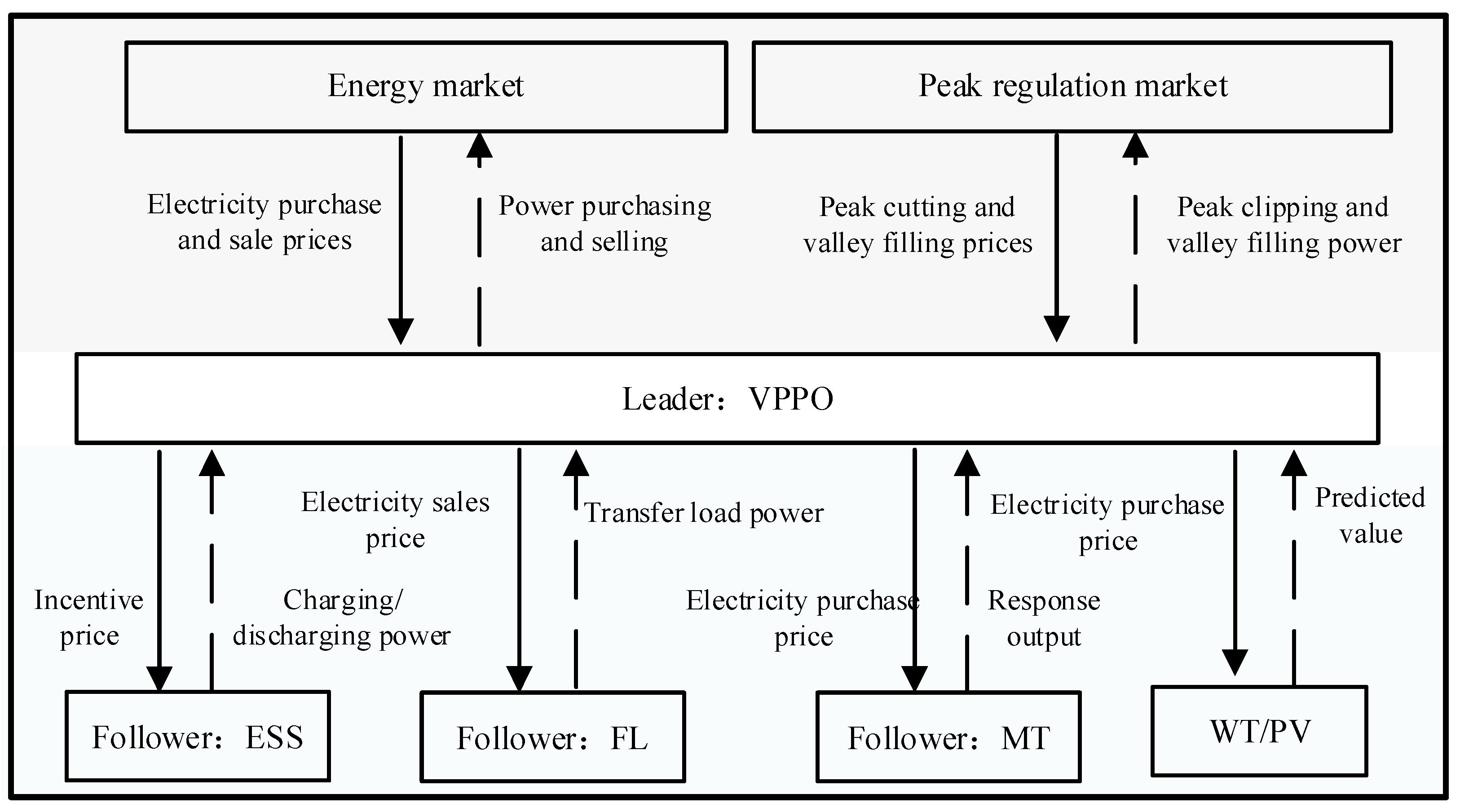
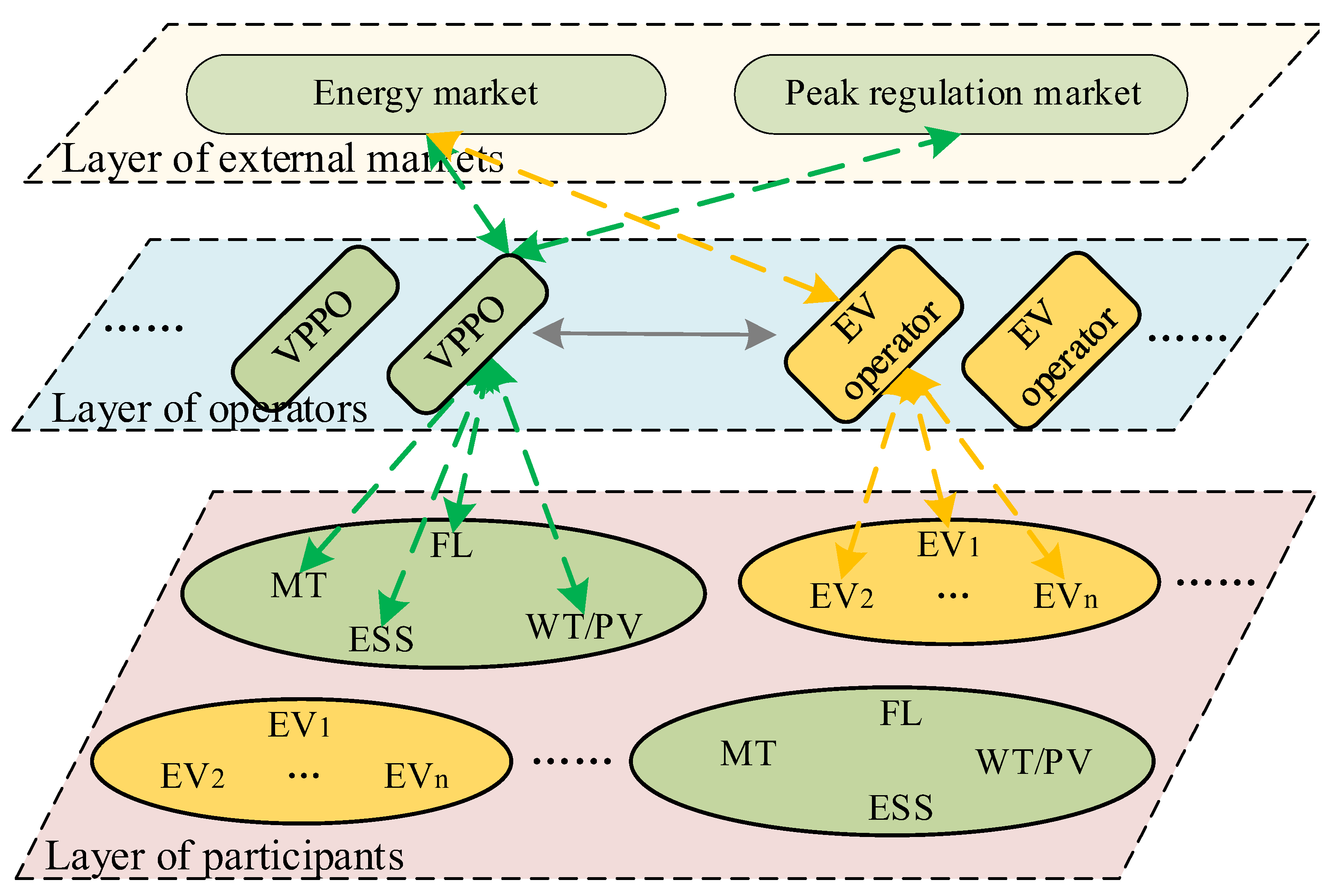
The VPP integrates microturbine (MT), energy storage (ESS), flexible load (FL), wind power (WT), and photovoltaic (PV) resources. Its overall operating framework is shown in Figure 1. The VPPO interacts with the internal subjects using the price–quantity master–slave game, where the VPPO is the leader and MT, FL, and ESS are followers, respectively. FL contains rigid load and transferable load. The uncertainty of renewable energy is reserved through MT and FL. At the same time, in order to make full use of ESS, the charging cost of ESS is borne by the VPPO, and its discharge is compensated by the VPPO. To realize the day-ahead bidding decision of the VPPO, leading internal multi-subjects participate in the energy market and peak shaving market.
Figure 1.
The day-ahead bidding strategy block diagram of VPP.
2.2. Problem Description
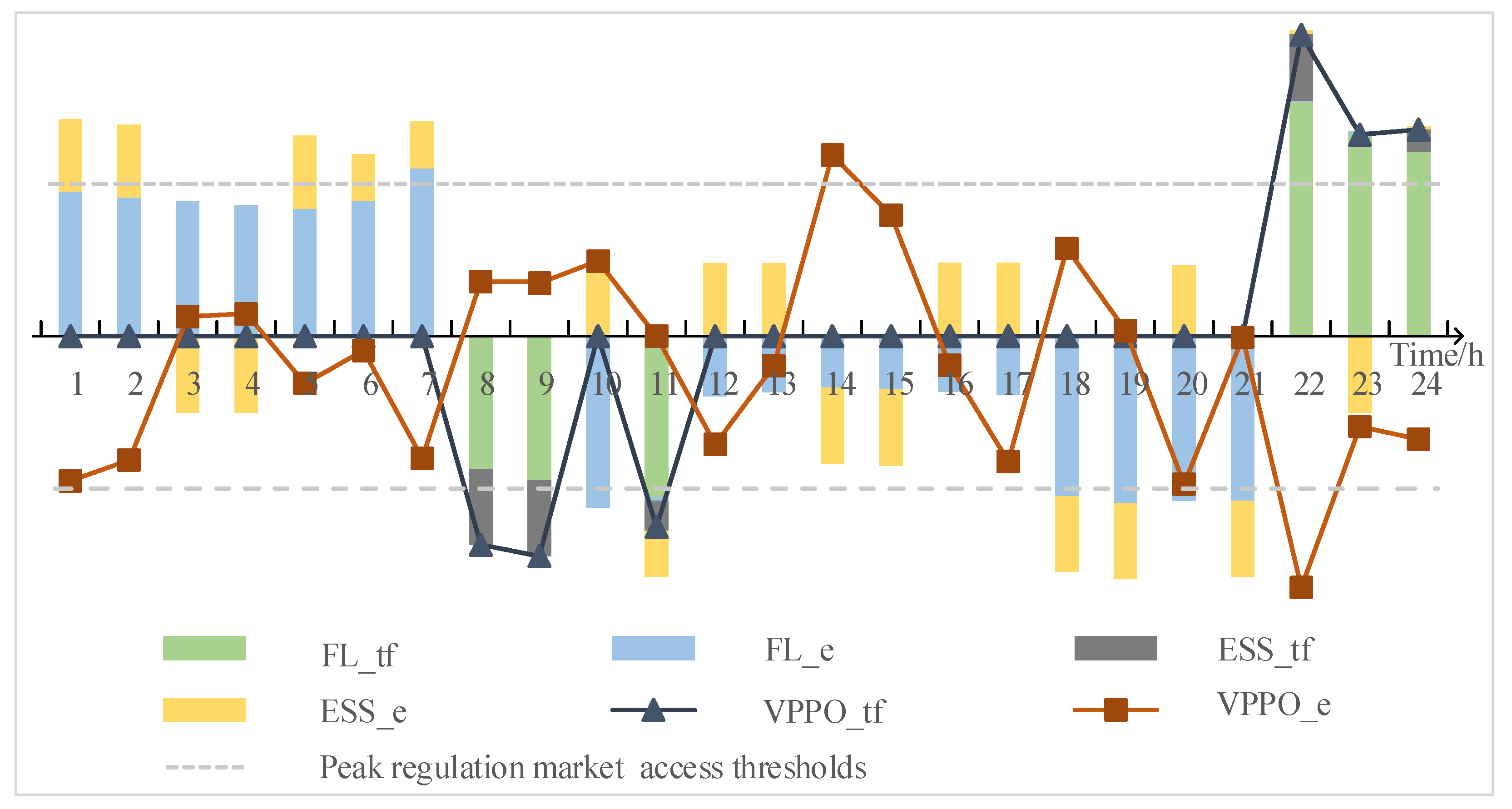
According to the above background and strategy, due to the limitation of the VPP’s internal flexible resources such as the limitation of internal ESS and FL capacity and characteristics, when the VPP participates in the peak shaving market bidding, due to the small differences in some periods there will be a problem that it cannot reach the threshold of peak shaving market access. Figure 2 shows some of the market bidding schemes of the VPP.
Figure 2.
Part of VPP’s day-ahead bidding plan.
Load-side regulation is used to cut the peak and fill the valley, aiming to optimize the rational allocation of power resources and promote balanced power consumption by changing the time and mode of power consumption. Controllable load types include interruptible load, transferable load, and shiftable load. Demand-side response includes price-based demand-side response and incentive-based demand-side response. Price-based demand-side response includes time-of-use price, peak price, real-time price, etc. Incentive-based demand side response includes direct load control, demand-side bidding, emergency demand-side response, interruptible load, and so on. Through the integration and coordination optimization of internal resources, the VPP enables the whole as a special power plant to participate in the electricity market, respond to the needs of the power grid, and achieve peak shaving and valley filling.
From Figure 2, it can be seen that in periods 1 and 2, due to the limitation of the VPP’s internal FL and ESS capacity and characteristics, the VPP did not reach the entry threshold of the peak load regulation market with the small differences, so it can only participate in the energy market bidding in the corresponding period. In order to solve this problem, the VPP tends to find other subjects with flexible resources in the distribution network, make up for the differences in participating in the peak shaving market, and give full play to the role of flexible resources. There are many kinds of subjects with flexible resources in the distribution system, and they participate in the electricity market as independent subjects. For example, load operators can provide transferable load, interruptible load, and shiftable load, which have advantages of stabilizing load fluctuation and reducing system peak–valley differences; integrated energy operators have advantages such as realizing the cascade utilization of multiple energy sources and promoting energy conservation and emission reduction. The vigorously developed EV clusters have been widely used in recent years; their overall orderly charging can be realized by price guidance.
2.3. Complementarity Analysis of a VPP and an EV Cluster
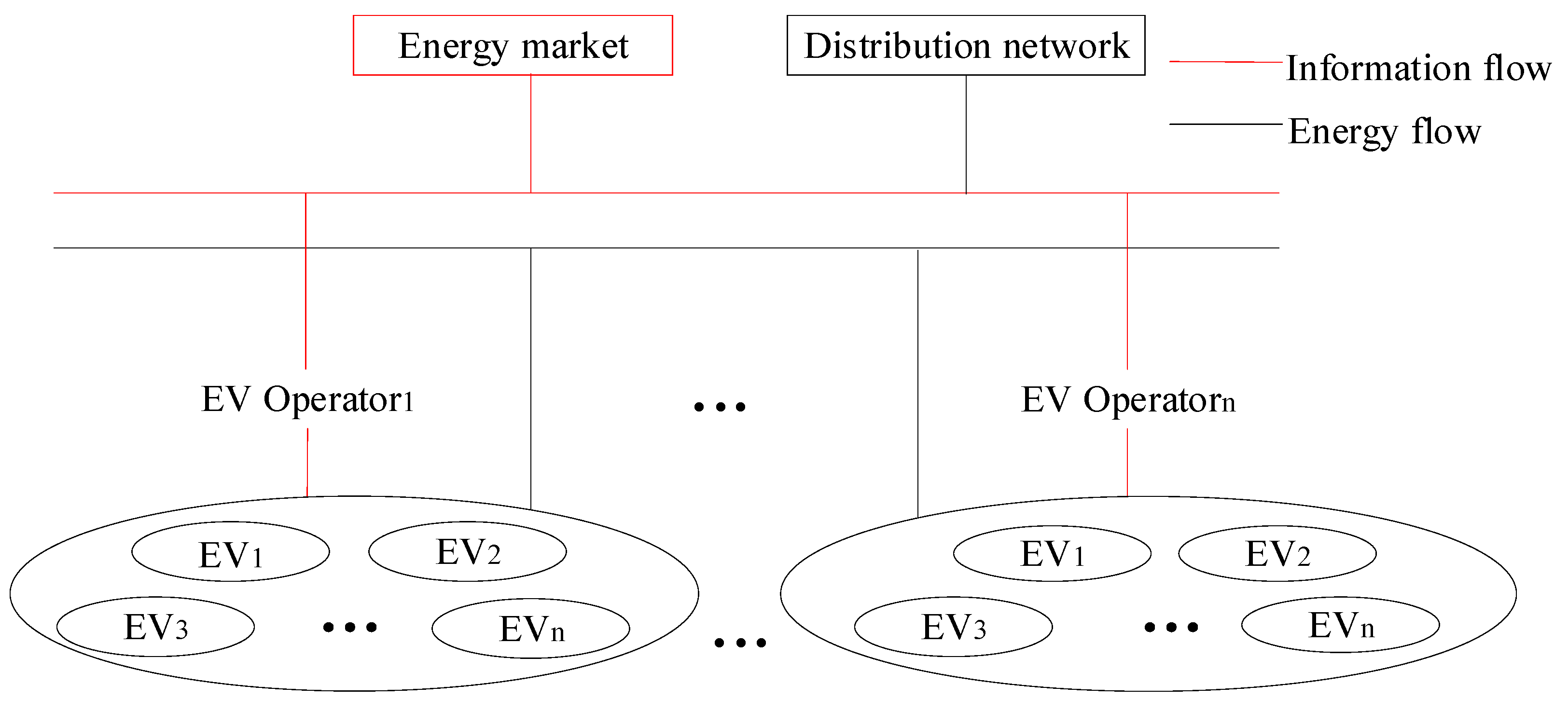
The travel space law and travel time law of EV clusters, as well as the charging power of a single user, are shown in [31]. The charging structure diagram of EV clusters in the energy market is shown in Figure 3. The EV operator is a collection of charging information for each user. The platform interacts with each user internally and presents the overall charging characteristics outwardly. Affected by the time-of-use price, some users in the EV cluster choose to charge in the low-price period to bear the lower purchase cost. The overall orderly charging of the cluster is realized finally.
Figure 3.
Charging structure diagram of EV clusters.
In EV clusters, the charging load of the owner who responds to the electricity price flexibly belongs to the flexible schedulable resources. However, the user cannot obtain the corresponding compensation by participating in the peak regulation market bidding alone and can only choose to shift the charging time to the low electricity price period to obtain a lower charging cost. To participate in the peak shaving market, it is necessary to use the ‘shoulders’ of other operators who can participate in the bidding. At the same time, due to the limitation of internal resources, the VPP will be unable to participate in the bidding of the peak shaving market due to small differences. It is necessary to aggregate other subjects with flexible resources in the distribution network and coordinate the allocation to participate in the market bidding.
The above reflects the complementary characteristics of time and space power between the VPP and the EV cluster. Therefore, if the VPP is further interacted with the EV cluster, the demand of the two can be fully faced, and it can effectively solve the bidding problem of peak shaving market caused by VPP resources’ constraint. At the same time, some EV users have opportunities to participate in the peak shaving market.
2.4. Materials and Methods
In the day-ahead bidding strategy of the VPP multi-level energy interaction, the VPP includes gas turbine MT, wind power WT, photovoltaic PV, energy storage ESS, and flexible load FL resources. Flexible load FL contains rigid load and transferable load. The VPPO is connected with the internal subjects through the ‘price-quantity’ master–slave game. The VPPO is the leader and the internal subjects are followers. The model is established to fully consider the interests of the internal subjects. For the EV cluster, the EV operator is the platform for EV users to participate in the electricity market transactions, so that the EV cluster presents the overall charging characteristics in the energy market. Each user is divided into two categories according to whether it responds to electricity prices. One is price-insensitive users and the other is price-sensitive users. The response characteristics of price-sensitive users are described in detail in Section 3.1. The mechanism of the VPP and EV clusters using time division bargaining for power interaction is shown in Section 3.2 and Section 3.3.
3. A VPPO and an EV Operator Time Division Bargaining Mechanism
The time division bargaining structure of a VPPO and an EV operator is shown in Figure 4. As a platform for users to participate in electricity market transactions, EV operators consider the responsiveness of price-sensitive users in the cluster based on consumer psychology. This responsiveness affects the range and time period of energy interaction between the VPP and the EV cluster, and further affects the price of time division bargaining between the two.
Figure 4.
A VPPO and an EV operator time division bargaining structure diagram.
The sub-period bargaining structure of the VPPO and EV operators is shown in Figure 4. The VPPO and EV clusters participate in the bidding decision making of the energy market and peak shaving market together; the VPPO adopts full-time game pricing for internal entities. Under the premise of knowing the basic information of external market and internal entities, when the VPPO uses price guidance to receive the response of internal entities, the VPPO coordinates power allocation, adjusts price according to the response of followers, and continues to transmit updated price information to followers. The followers adjust their reported response according to the received price, and this process is repeated until equilibrium is reached. The VPPO not only adopts full-time game pricing for internal subjects but also conducts time-sharing bargaining with flat-level EV operators. EV operators exchange information with each EV internally and present the overall characteristics of the cluster to charge in the energy market externally. As a platform for users to participate in electricity market transactions, EV operators consider the response characteristics of price-sensitive users in the cluster based on consumer psychology. This response characteristic affects the range and time period of energy interaction between the VPP and the EV cluster, and then affects the price of time-sharing bargaining between the two. Finally, the multi-level power interaction is used to realize the day-ahead bidding decision of the VPP and the EV cluster in the energy market and peak shaving market.
3.1. The Responsiveness of Electricity Price Sensitive Users Is Determined Based on Consumer Psychology
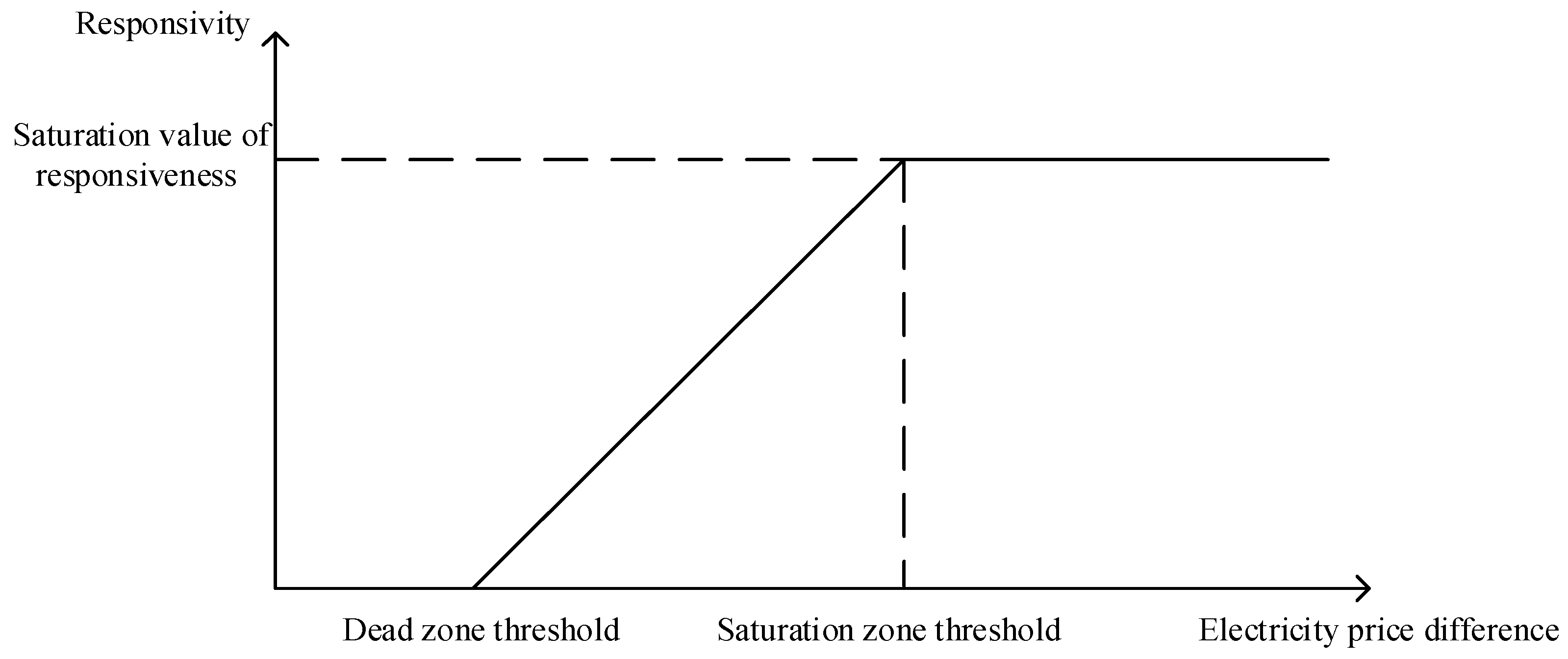
In this paper, EV users in the cluster are divided into two categories: price-insensitive users who start charging immediately when they reach the dwell time; price-sensitive users who tend to charge during low-price periods in order to reduce their own electricity purchase cost without affecting their travel plans. The responsiveness of price-sensitive users in the cluster can be simulated based on the principle of consumer psychology, as shown in Figure 5:
Figure 5.
Responsiveness model of EV users.
As expressed by piecewise linear function, in the insensitive area, the price difference has a difference threshold for the users’ stimulation, and the users basically have no response; in the linear region, the users’ responsiveness is positively correlated with the price difference; in the saturated zone, when the price difference reaches or exceeds a certain value, the users no longer respond. The response characteristics of price-sensitive users to price spreads are listed below:
where correspond to the responsiveness, response saturation value, dead zone threshold, and saturation zone threshold of EV users to electricity price difference. is the price difference. The objective function of the EV operator is as follows:
where is the electricity selling price of the energy market, the total charging power of the cluster is :
where is the charging power of the response part in the cluster and is the charging power of the remaining unresponsive part.
3.2. The Determination of the Power Interaction Time Interval between a VPP and an EV Cluster
is defined as the range of energy interaction between a VPP and an EV cluster. For the part of the cluster that does not realize the translation of the charging load, it does not participate in the energy interaction process with the VPP. This part of the charging load purchases electricity from the energy market according to the original plan, and the charging price is the price of purchasing electricity from the energy market. Therefore, the time period of energy interaction between the VPP and the EV cluster depends on the flexibility resources in the cluster. At this time, the electricity purchase cost of the EV operator is composed of two parts: one is the charging cost of the responsive part in the cluster , the other is the charging cost of the unresponsive part in the cluster :
where is the price of time-sharing bargaining between the VPPO and the EV operator, as shown in the following Section 3.3.
3.3. A VPPO and an EV Cluster Conduct Time-Sharing Bargaining
In order to ensure the rationality of the transaction, it is necessary to ensure that the VPP and the EV cluster can obtain greater benefits than their previous participation in the electricity market. Otherwise, both the VPP and the EV cluster will only choose to trade with external markets based on their own interests. Therefore, based on the existing multi-microgrid interactive pricing mechanism, this paper formulates the interactive price of the VPP and the EV cluster according to their supply and demand relationship as follows:
where correspond to the purchase and sale price of electricity in the energy market. is the power of electricity sold to the energy market in the t period determined by the initial VPPO. If the electricity is purchased from the energy market in the t period, the value is 0. is the proportional coefficient, which is related to the VPPO initial market bidding plan and flexible resources in the EV cluster. If , then is the selling price of the energy market; if , then is the value in the price of electricity purchased and sold in the energy market, and this value decreases with the increase in ; if , then is the electricity purchase price in the energy market.
4. Day-Ahead Bidding Model of VPP Multi-Level Power Interaction
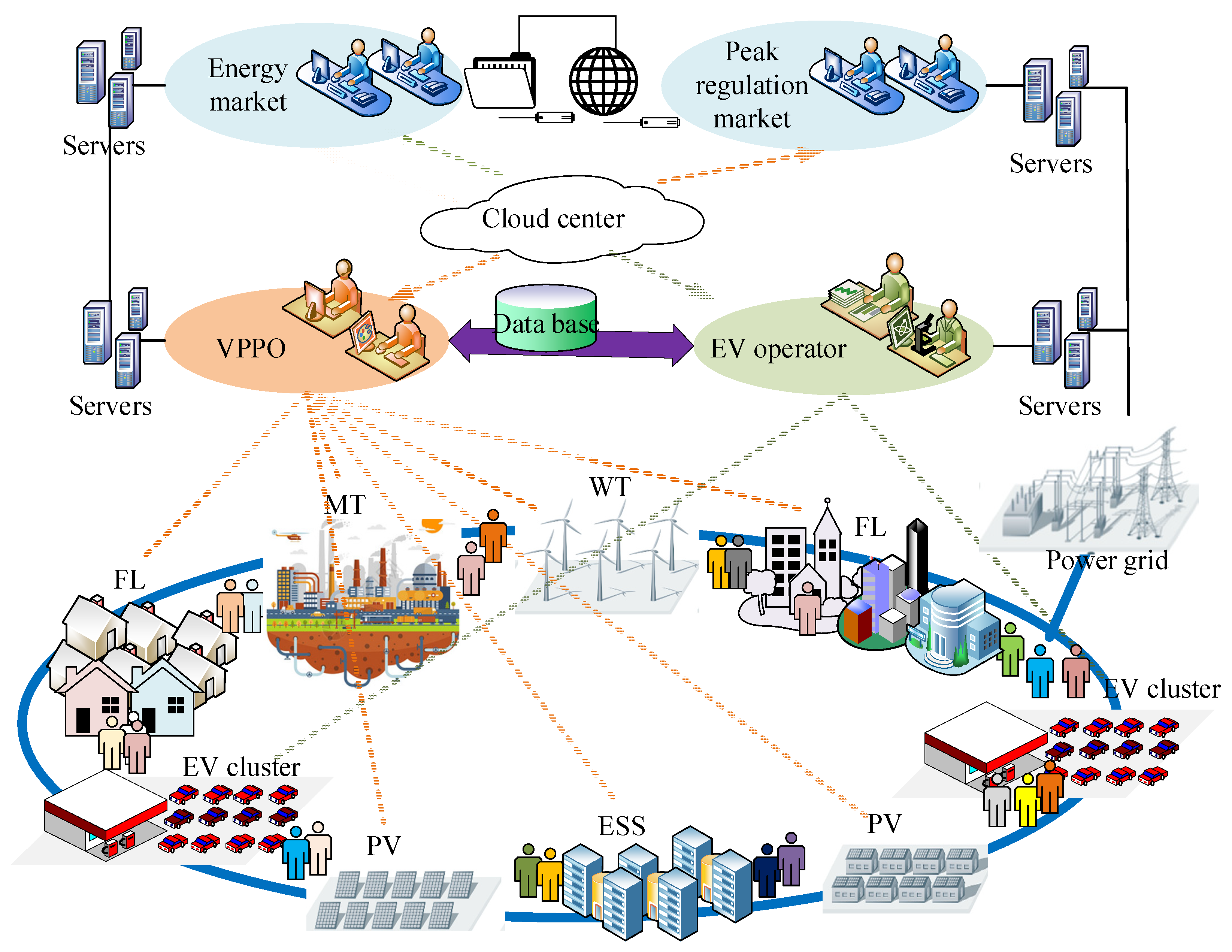
The overall block diagram of a VPP multi-level power interaction is shown in Figure 6. Considering the power interaction between a VPP and an EV cluster, the corresponding model is established.
Figure 6.
The overall block diagram of a VPP and an EV cluster power interaction.
4.1. VPPO’s Full-Time Game Pricing for Internal Participants
- Leader VPPO
According to the external market information and the supply and demand of the internal entities, the VPPO aims to maximize the comprehensive income, including the income obtained by the internal subjects and the income in the external electricity market, and formulates the price and market bidding plan corresponding to each subject. The goal is shown in Equation (7).
where are the purchase price of MT, the discharge incentive price of ESS, and the sale price of FL set by the VPPO in the nth iteration, respectively. are the bidding powers of the VPP in the electricity market. At the same time, the VPPO needs to meet power balance constraints, peaking constraints, price constraints, and bidding overall capacity constraints.
- 2.
- Follower MT
After receiving the electricity purchase price issued by the VPPO, MT responds to the VPPO with the goal of maximizing total revenue by integrating power generation cost, electricity sales revenue, reserve compensation, etc.
where is MT revenue and is MT output. At the same time, MT also needs to meet power constraints, climbing constraints, and standby constraints.
- 3.
- Follower FL
The VPPO sells electricity price to FL, and FL adjusts the power of the transferred load according to the goal of the lowest total cost:
where is the total cost of FL and is the transfer load power. FL also needs to meet the upper and lower limit constraints of transfer power, the total transfer constraint, and the reserve constraint.
- 4.
- Follower FL
ESS responds to charging or discharging power to the VPPO based on the maximum total revenue:
where is the total income of ESS. ESS also needs to meet the upper and lower limits of single-period charging or discharging power constraints, peak shaving market bidding power constraints, overall capacity constraints, and state of charge constraints.
The constraints of the VPPO and each subject are shown as follows:
where correspond to the purchase and sale price of electricity in the energy market; is the predicted value of WT/PV; is the initial load power; is the interaction power between the VPP and the energy market (if it is positive, it indicates that electricity is purchased from the energy market, and if it is negative, it indicates that electricity is sold to the energy market, and there can only be one state in a single period of time); are the bidding powers of ESS and transfer loads in the energy market and the peak load regulation market, respectively; are the bidding powers of VPP in the peak load regulation market; is 0–1 variable (if it is 0, it means that it is not allowed to participate in the peak load regulation market, and if it is 1, it is the opposite).
where are the extreme values of MT output; are the upper and lower reserves left by MT; are the maximum and minimum values of load transfer power; are the upper and lower reserves reserved by FL; correspond to the positive and negative deviations of WT and PV output; are the charging/discharging efficiencies of ESS, and there is only one state in a single period of time; is the state of charge of ESS; is the total amount of ESS. The overall structure of the master–slave game model of the VPPO and internal multi-agent price quantity is shown as follows:
where are the main participants in the master–slave game; , , , are the corresponding strategy sets; , , , are the respective utility functions.
4.2. VPPO’s Time-Sharing Bargaining for Flat-Level EV Operators
4.2.1. Objective Function
The VPPO coordinates flexibility resources within the VPP and the EV cluster, and the objective function is as follows:
where are the revenues of VPPO in the internal energy market and peak shaving market; respectively; is the revenue of selling electricity to the EV cluster; is the corresponding compensation for the flexible resources in the cluster to participate in the peak shaving market. The specific expressions of each part are as follows:
- Internal benefits of the VPPO
- 2.
- VPPO benefits in the energy market
- 3.
- VPPO benefits in the peak-shaving market
- 4.
- VPPO’s revenue from selling electricity to the EV cluster
- 5.
- The VPPO compensates EV users to participate in the peak shaving market
4.2.2. Constraints
- Power balance constraint
- 2.
- Constraints on the interaction power with the energy market
- 3.
- Overall capacity constraints
In order to avoid capacity conflict, it is necessary to set the overall capacity constraint of flexible resources in the VPP to participate in market bidding.
- 4.
- Peak shaving market access threshold constraints
The VPP should meet the access conditions of the peak regulation market when participating in the bidding of the peak regulation market.
The peak bidding power needs to meet the period requirements and upper limit constraints, and the bidding power in other periods is zero.
5. Model Solving Process
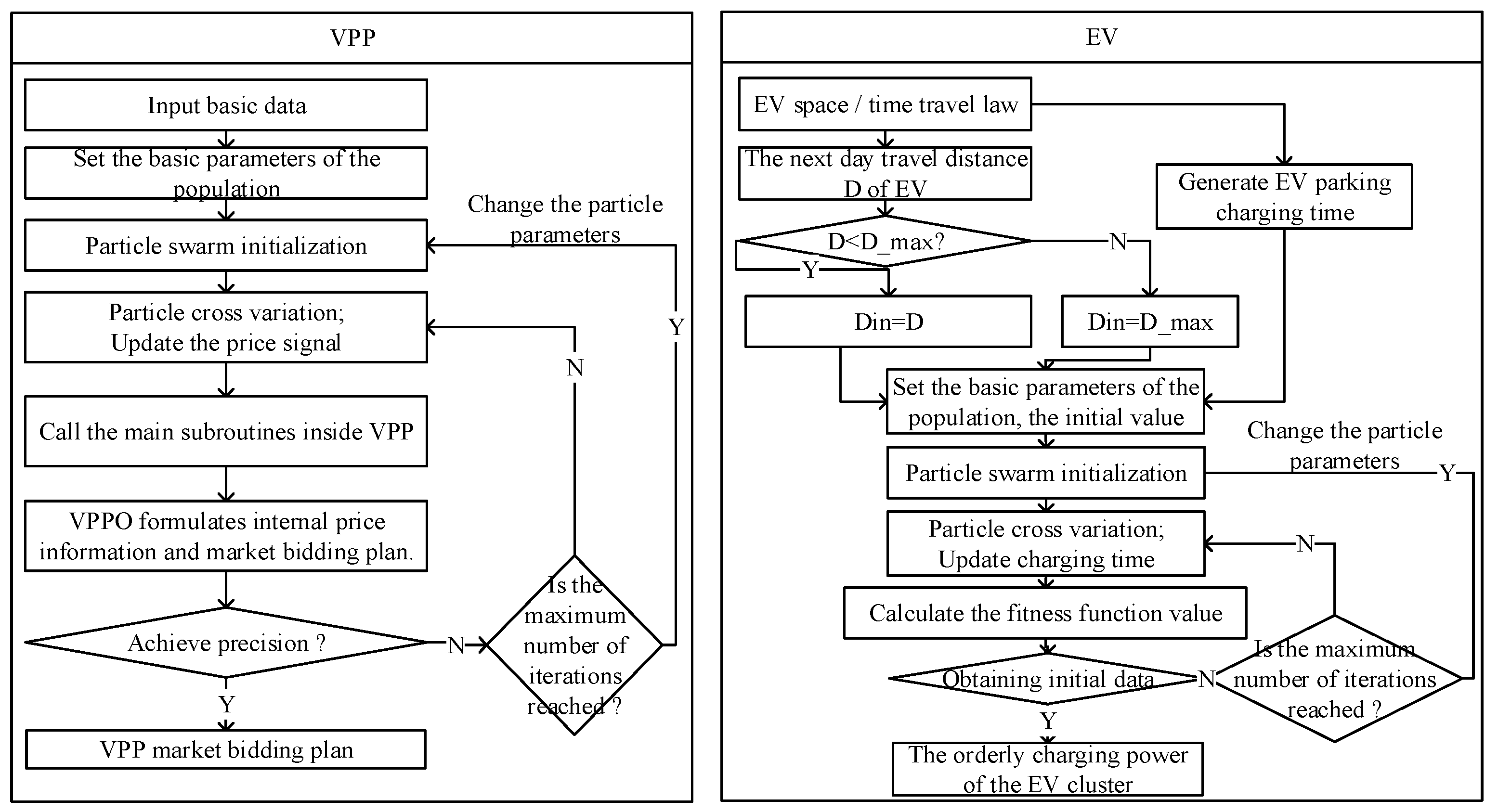
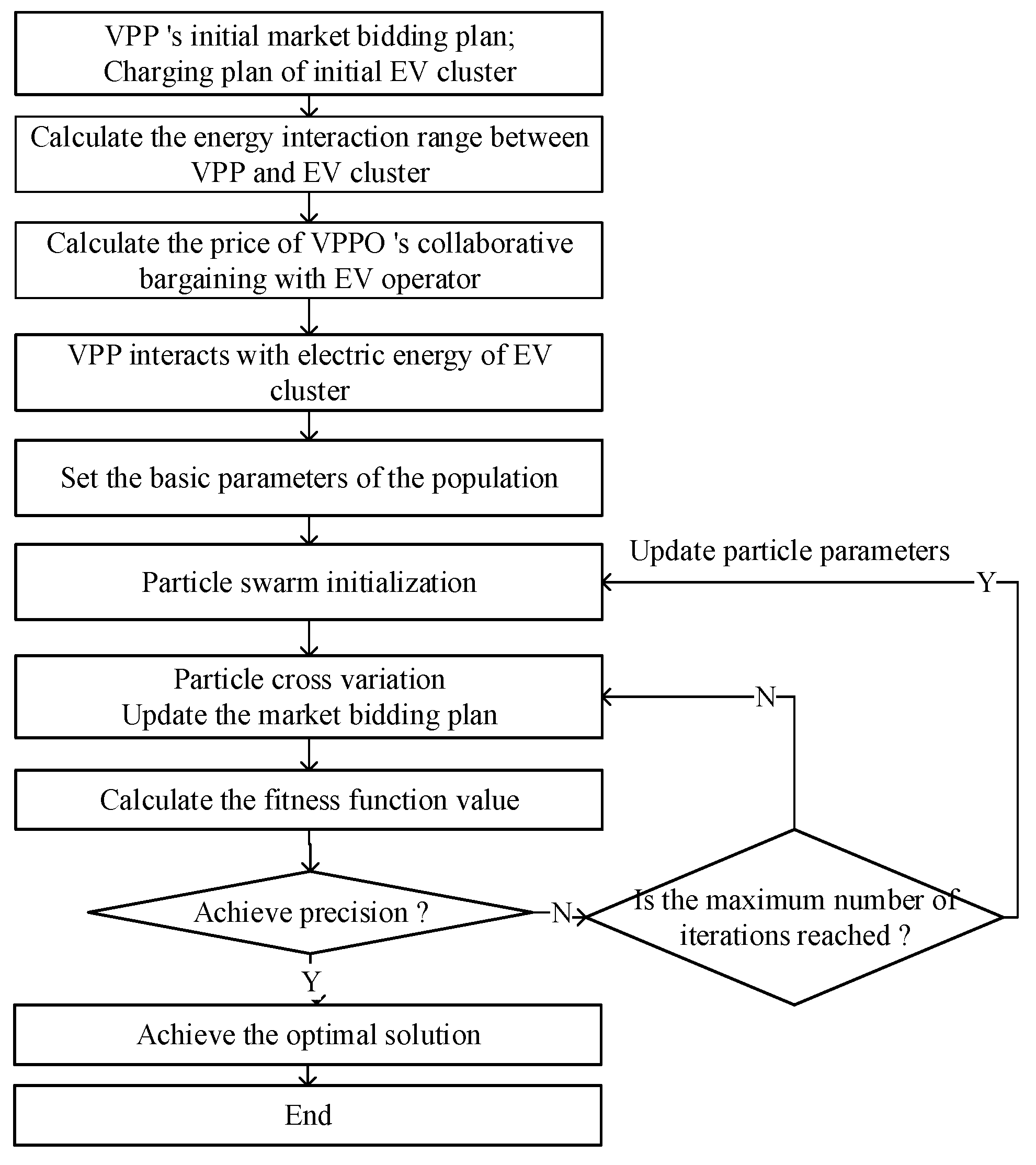
The overall model solving process is divided into two parts: one to calculate the initial data, as shown in Figure 7; the other to solve the VPP multi-level power interaction model, as shown in Figure 8.
Figure 7.
Obtaining initial data.
Figure 8.
The overall process solution diagram of the model.
In Figure 7, the initial data are calculated, including the initial VPP market bidding scheme and the initial orderly charging plan of the EV cluster in the energy market. When calculating the initial data of the VPP, a distributed equalization algorithm combining the particle swarm optimization algorithm and the interior point method is used to solve the problem. When calculating the orderly charging power of the initial EV cluster in the energy market, the particle swarm optimization algorithm is used to solve the problem.
In Figure 8, the power interaction range between the VPP and the EV cluster is solved, and the price of the two is calculated by time division bargaining. According to the established optimal scheduling model of the VPP multi-level power interaction, the particle swarm optimization algorithm is used to solve the problem. In order to achieve economic goals, the VPP and the EV cluster adjust their market bidding plans, respectively.
6. Example Analysis
6.1. Parameters and Scenario Settings
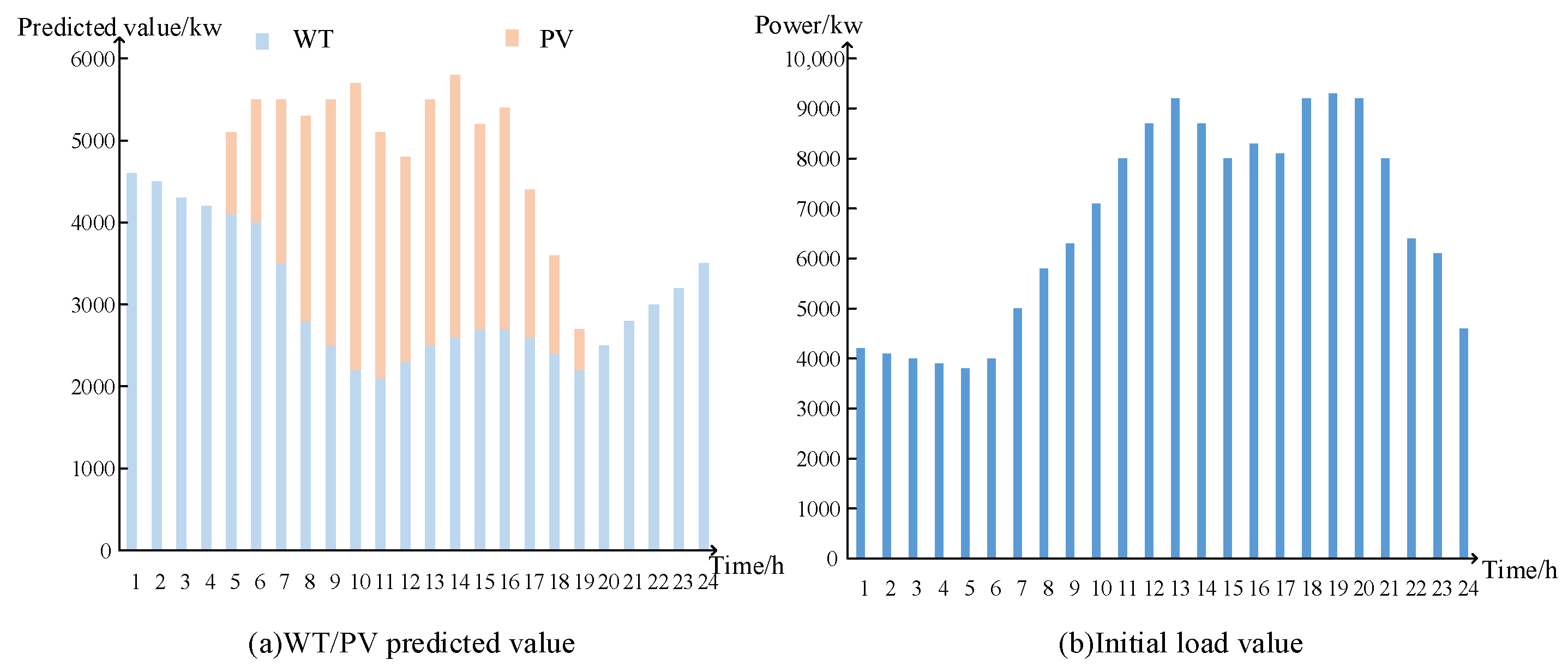
The prices of the electricity market are shown in Table 2. The basic parameters of each main subject inside the VPP are shown in Table 3. The WT/PV predicted value and the initial FL power are shown in Figure 9 and the upper limit of the day-ahead prediction error is 10%. The maximum and minimum adjustment of FL are 30% and 25% of the initial load, respectively.
Table 2.
External electricity market prices.
Table 3.
Basic parameters of MT and ESS.
Figure 9.
WT/PV predicted value and initial load value.
The parameters of the EV cluster are shown in [31], including the model of the simulated vehicle, battery capacity, user travel, and parking time rules, etc. Moreover, the price-sensitive user’s responsiveness saturation value is 0.9, the dead zone threshold of the price difference is 0.1, and the saturation zone thresholds of the peak valley and flat valley price differences are 0.9 and 1.4, respectively. The following seven scenarios are set for example analysis, as shown in Table 4.
Table 4.
Scenario settings.
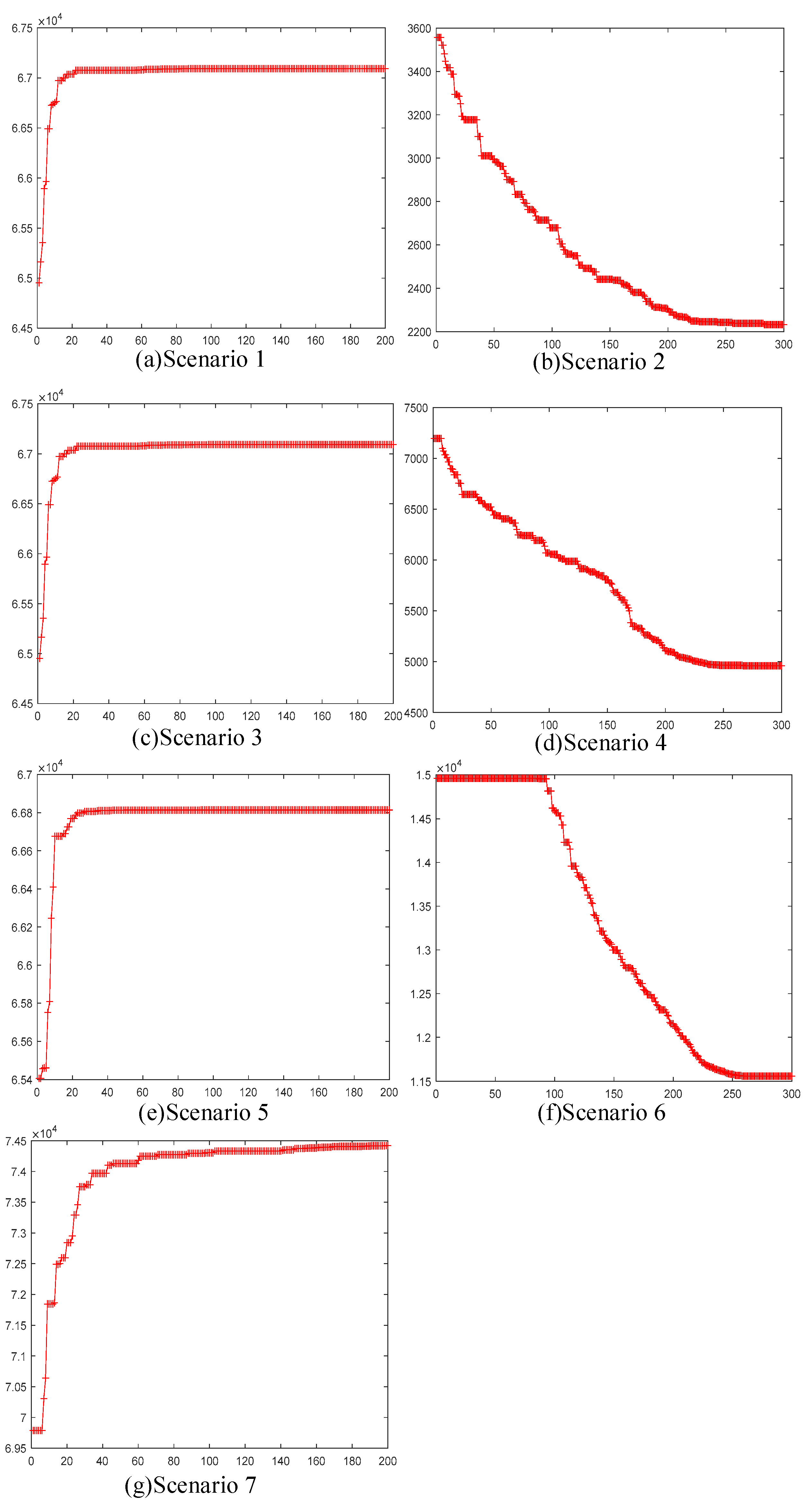
The iterative convergence of the above seven scenarios is shown in Figure 10. The iteration time of Scenarios 3, 5, and 7 under the strategy of this paper are 1.20 s, 1.18 s, and 1.19 s, respectively. The numerical results of each scenario are shown in Appendix A.
Figure 10.
Iterative results of each scenario.
6.2. Economic Benefit Analysis
The income in each scenario is shown in Table 5.
Table 5.
The income of each scenario.
In Table 5, for the VPPO, compared with Scenario 1, the total revenue of the VPPO in Scenarios 3, 5, and 7 increased by 17.9%, 19.8%, and 31.1%, respectively. For the EV cluster, the total cost of Scenarios 2 and 3, Scenarios 4 and 5, Scenarios 6 and 7 is reduced by 30.3%, 27.2%, and 26.3%, respectively. Therefore, compared with the VPP and the EV cluster participating in the electricity market separately, the strategy of this paper reduces the total cost of the EV cluster and increases the total revenue of the VPPO. The part composition of the total revenue of the VPPO and the total cost of the EV cluster are shown in Table 6 and Table 7.
Table 6.
Part of the composition of the VPPO total revenue.
Table 7.
The total cost composition of the EV cluster.
According to Table 6, the main factor affecting the total revenue of the VPPO is the revenue in the peaking market. According to Scenarios 3, 5, and 7, with the increase in the number of EVs, the revenue of this part is increasing, which increases by 129.6%, 144.1%, and 206.2% respectively, and the peaking compensation for flexible resources increases accordingly. Flexibility resources include energy storage, flexible load, and parts that interact with the EV cluster. Due to the increase in the EV charging load, the cost of the VPPO in the energy market increases. Due to the increase in the EV charging load interacting with the VPPO, the cost of the VPPO in the energy market increases. From Table 7, with the increase in the number of EVs, the peak regulation compensation obtained by the EV cluster increases.
6.3. Analysis of Market Bidding Results
6.3.1. Analysis of Market Bidding Results of the VPP
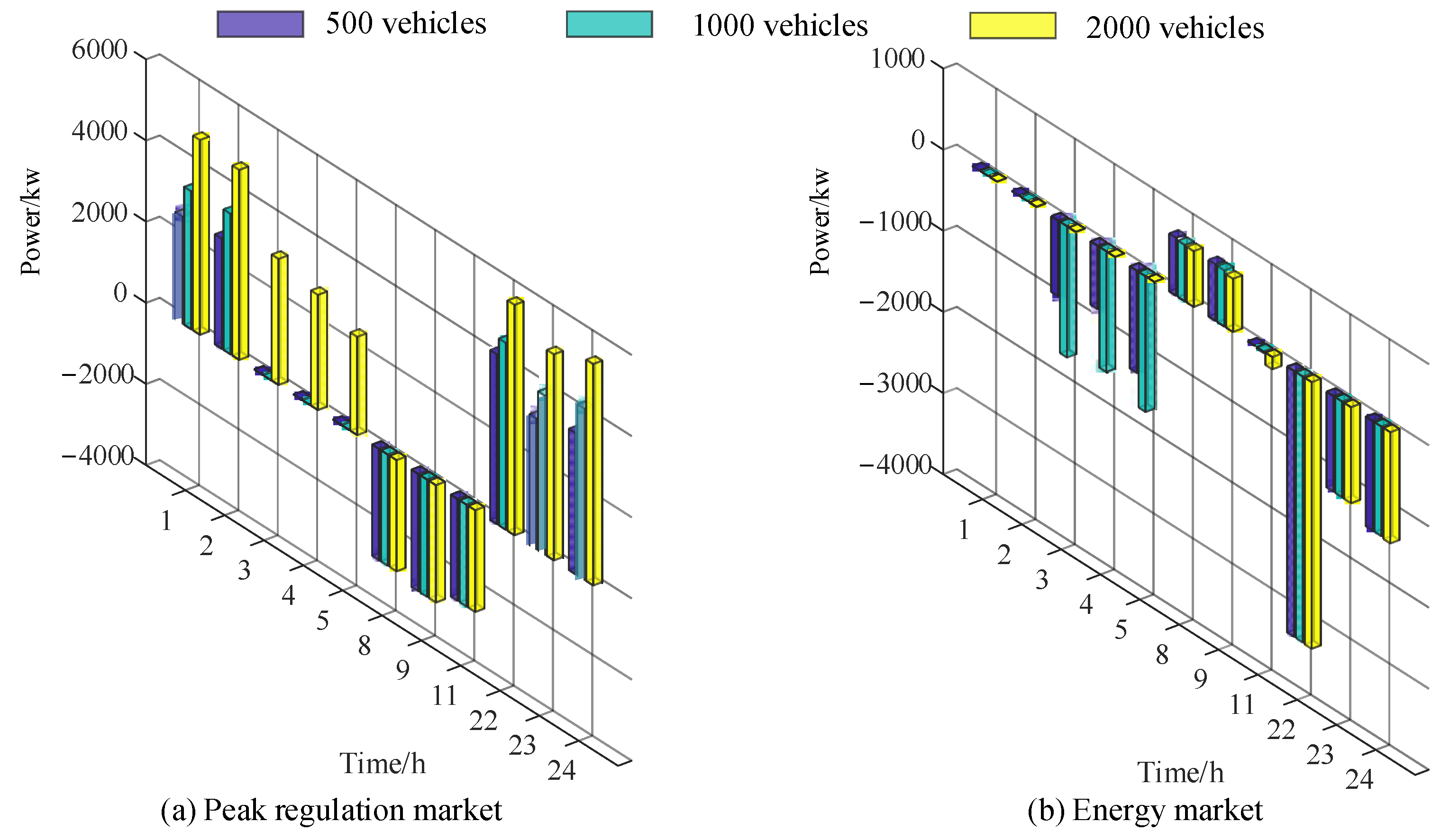
The bidding results of the VPP in the energy market are shown in Figure 11, and the bidding results of the VPP participating in the peak shaving market in the energy market and the peak shaving market are shown in Figure 12.
Figure 11.
Bidding results of the VPPO in the energy market.
Figure 12.
VPPO market bidding results (in peak period).
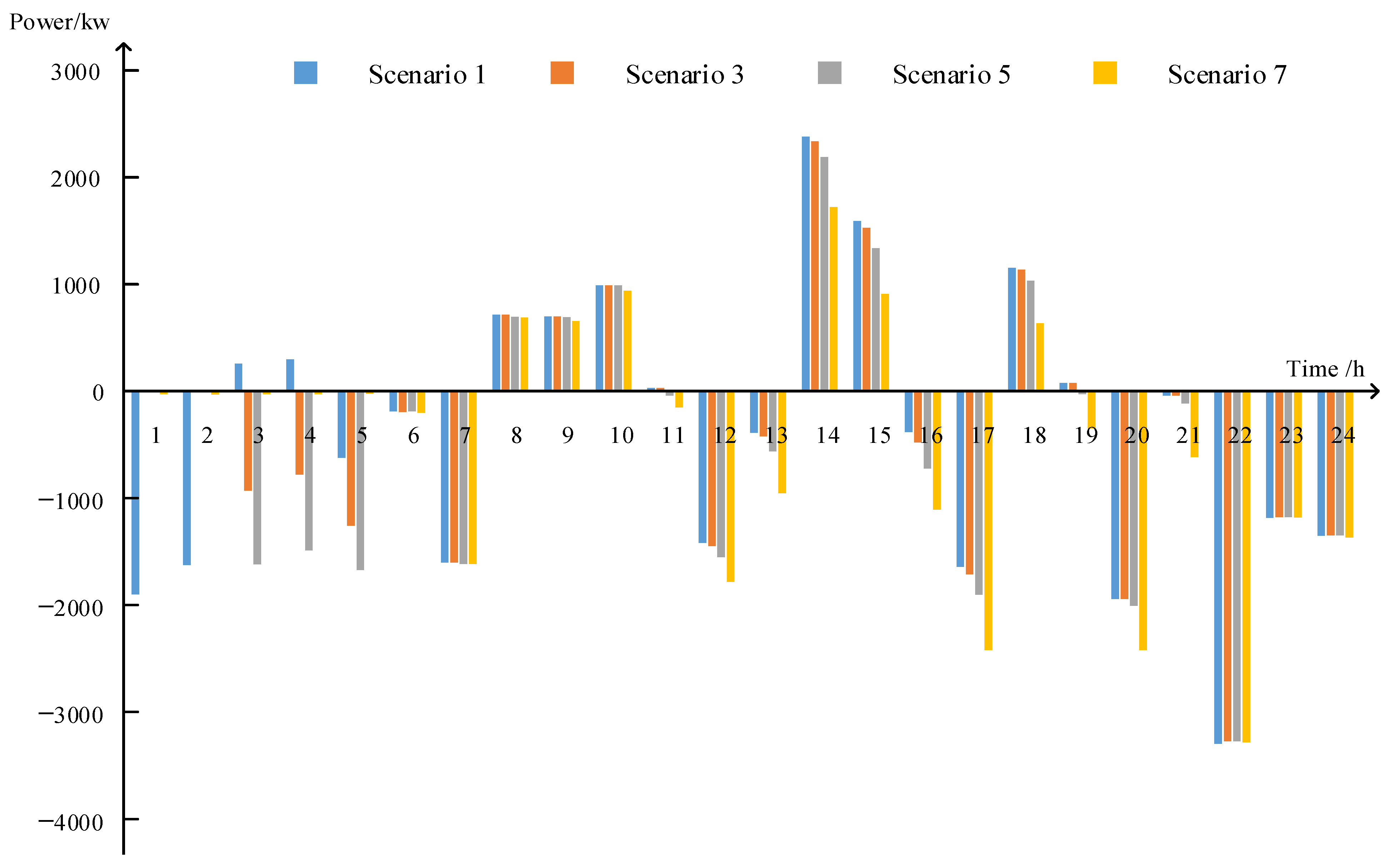
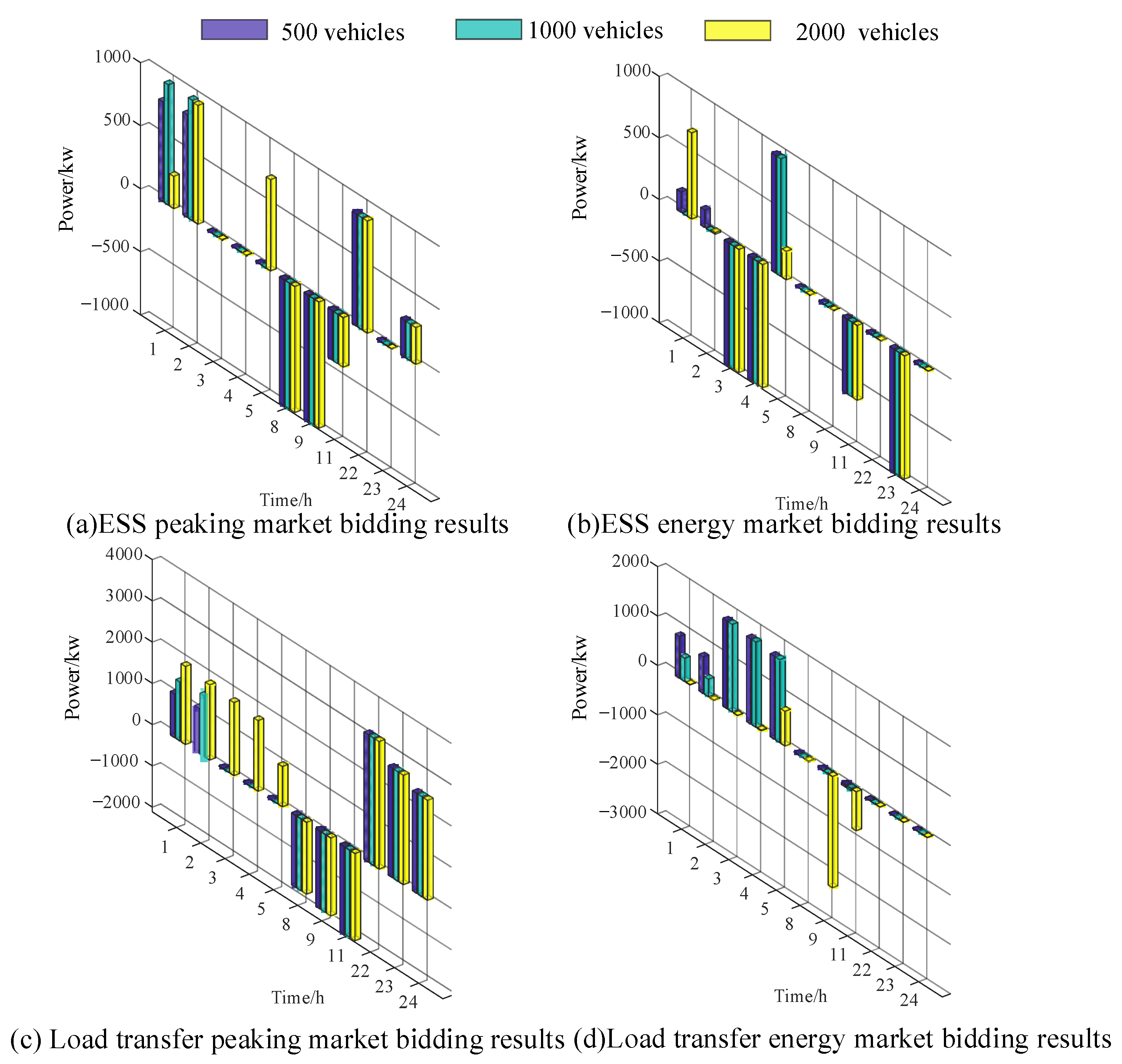
The results of market bidding for flexible resources in the VPP in Figure 12 are shown in Figure 13.
Figure 13.
Market bidding for flexibility resources.
From Figure 11 and Figure 12, the strategy of this paper is adopted to make the VPPO have more flexible resources available for overall deployment, and, with the increase in the number of EVs interacting with the VPP, the bidding part of the peak shaving market increases, such as in periods 1, 2, 22, 23, and 24. According to Figure 13, increasing the power interaction with the EV cluster can fully tap the potential of flexible resources, make up for the original deviation part of the VPP, and change the situation that the original time period cannot participate in the bidding of the peak shaving market, such as in periods 3, 4, and 5. At the same time, due to the constraints of the overall capacity, the bidding results of the VPP in the energy market will change accordingly.
6.3.2. Analysis of Market Bidding Results of the EV Cluster
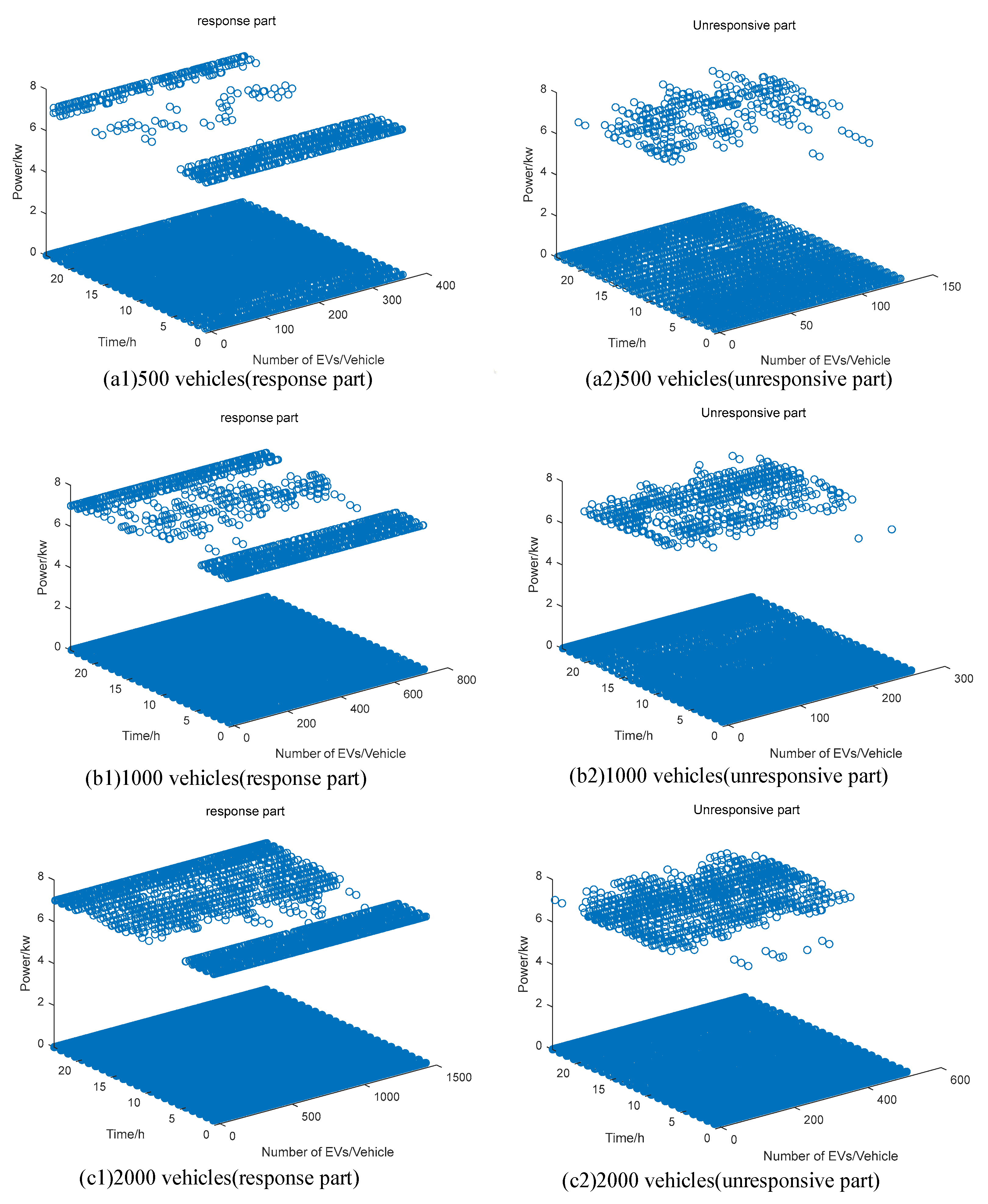
The charging power of each EV in the energy market under Scenarios 2, 4, and 6 is shown in Figure 14.
Figure 14.
The charging power of each EV in different scenarios.
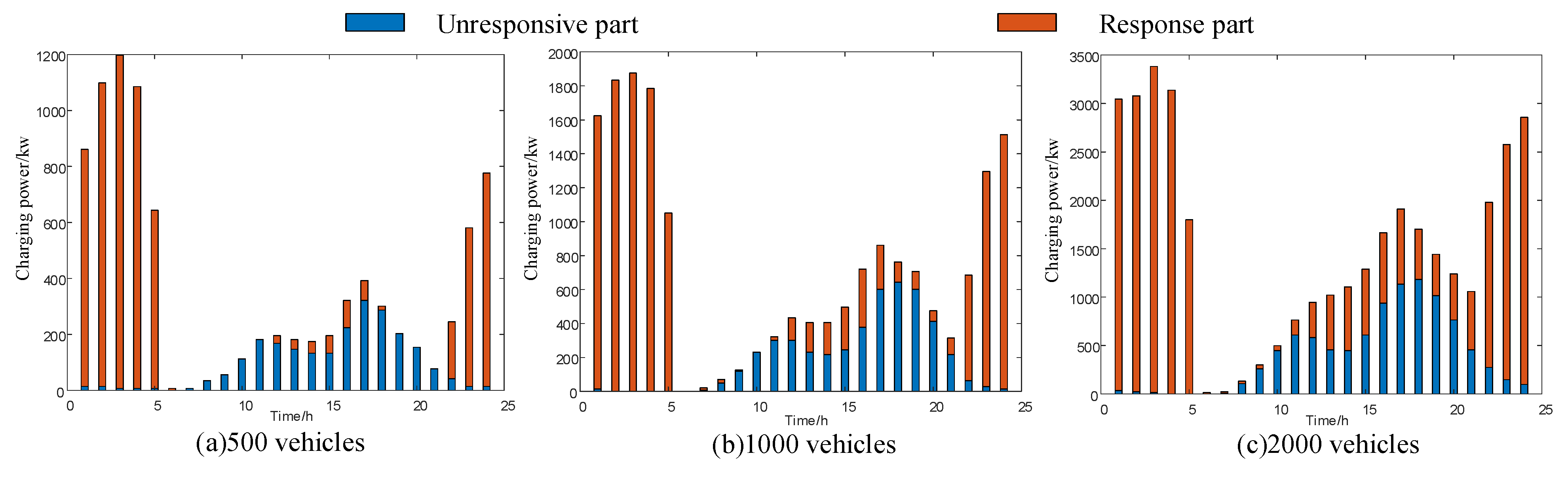
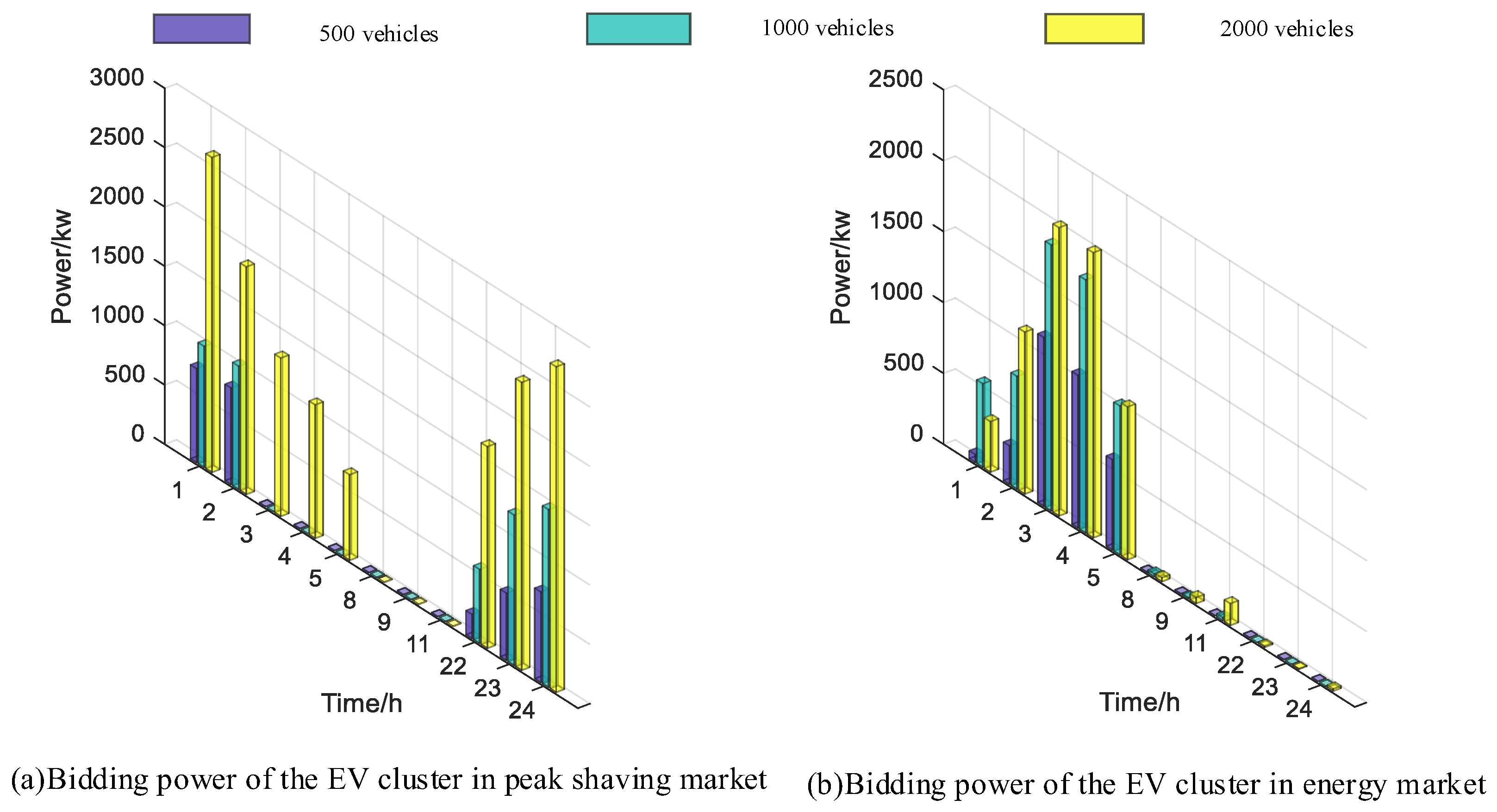
The overall charging power of the EV cluster is shown in Figure 15, and the market participation plan during the peak shaving market period is shown in Figure 16.
Figure 15.
Total charging power diagram of the EV cluster.
Figure 16.
The EV cluster bidding plan for power interaction with the VPPO.
According to Figure 14, the translation period of the EV cluster guided by the electricity price is mostly in the valley period, and the responsiveness is determined according to consumer psychology. The charging power of each user is superimposed to obtain the overall charging power, as shown in Figure 15. The charging power of EVs in the response part is concentrated in periods 1–4 and periods 22–24. According to Figure 16, for the EV cluster in periods 22, 23, and 24, the charging power of the cluster in the energy market is basically unchanged under a different number of EVs (although there is a significant difference in the bidding part of the peak shaving market) and increases with the increase in the number of EVs. It shows that, with the help of the ‘shoulder’ of the VPP, the strategy proposed by this paper can make the EV cluster participate in the peak shaving market, and effectively solves the problem of new peak load brought by the EV cluster from disorderly charging to orderly charging.
6.3.3. Analysis of the Role of Flexibility Resources
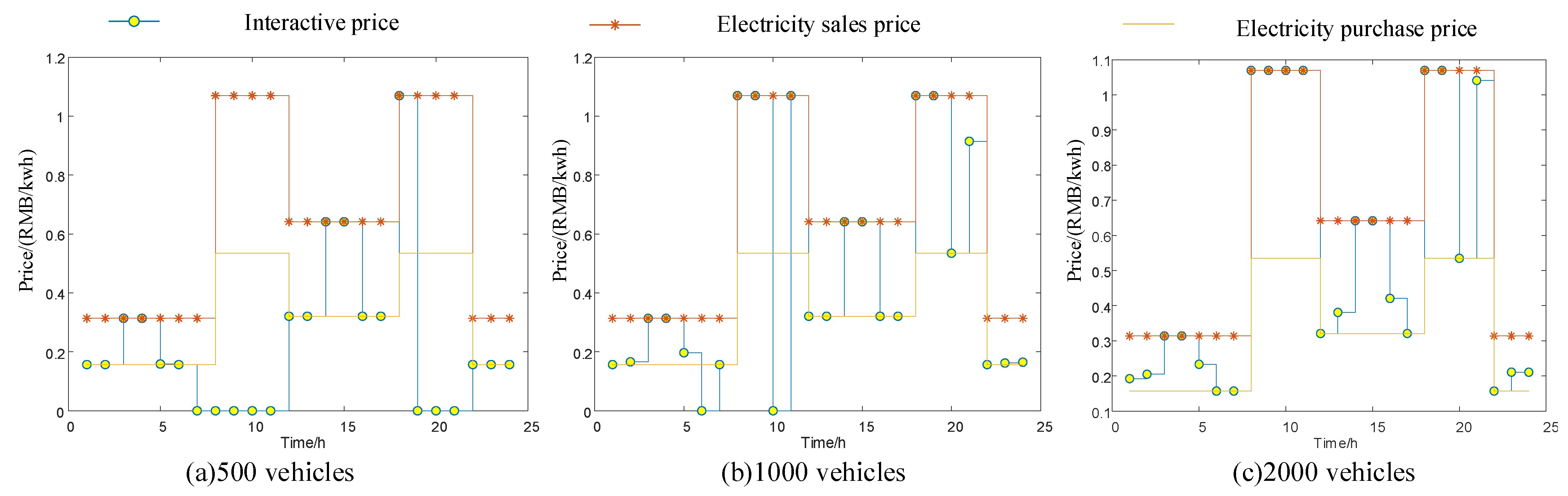
When the VPP interacts with the EV operator, the interaction price is shown in Figure 17.
Figure 17.
Interactive price between the VPPO and the EV operator.
In Figure 17, the price of the electric energy interaction between the VPP and the EV cluster is related to the proportional coefficient, that is, it is related to the charging power of the initial EV cluster and the bidding results of the VPPO. The price–quantity relationship of each subject in the VPP in Scenario 1 is shown in Figure 18.
Figure 18.
The price–quantity relationship diagram of each subject in the VPP in Scenario 1.
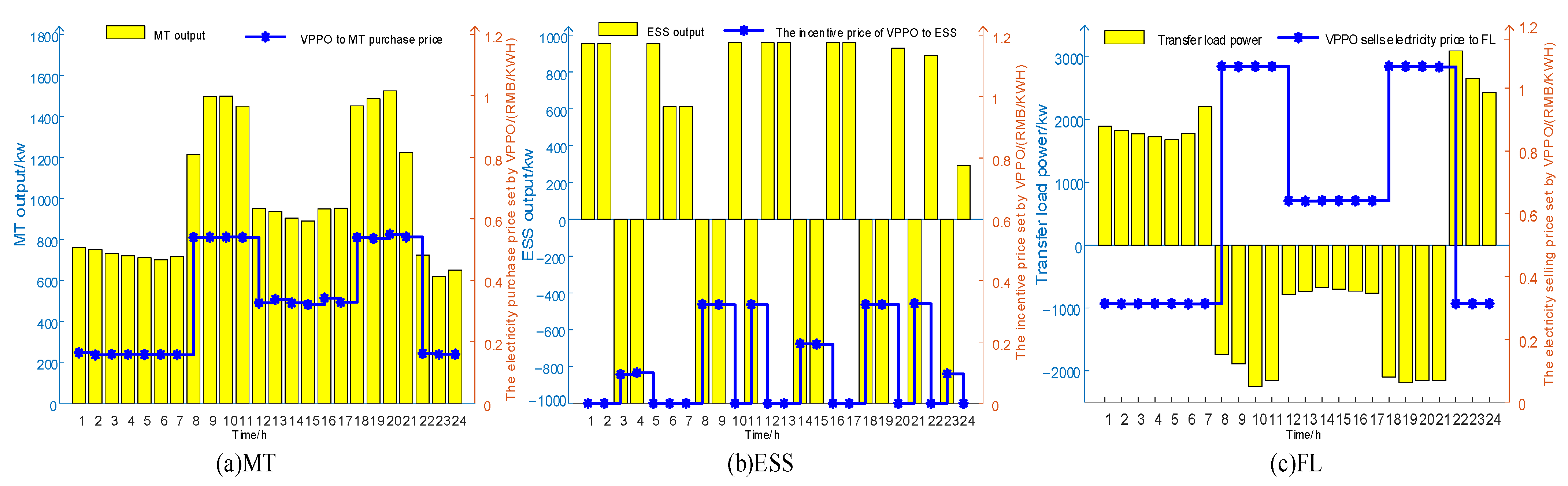
In Figure 18, in order to fully encourage ESS, ESS charging does not need to pay the cost, which is borne by the VPPO. When discharging, the VPPO gives corresponding discharge compensation. For FL, in order to minimize the sum of power purchase cost and satisfaction cost, the transfer load is negative in the peak period and positive in the valley period. At the same time, in order to meet the total transfer constraint, the transfer load power is negative in the normal period, and finally the load transfer in the peak and valley periods is realized. MT needs to consider its own power generation cost, electricity sales income, etc., and its output changes with the purchase price issued by the VPPO, which is basically in line with the price trend of peaks and valleys.
7. Conclusions
The existing distribution network system has a large number of distributed energy and demand-side resources, and the capacity is small, the location is scattered, difficult to manage, and cannot participate in the bidding of the power market alone. As an aggregation platform for various types of small capacity resources, virtual power plants can achieve coordinated and optimized management and can participate in the bidding of the power market as a whole, considering the interests of each participant. In order to fully tap the potential of flexible resources, improve their enthusiasm to participate in the market, and solve the problem of market bidding due to limited resources, the VPPO can be considered to bargain with other operators. Therefore, this paper proposes a multi-level power interaction strategy for the VPP. However, the interaction objects are not limited to EV operators but also include load aggregators, integrated energy system operators, etc. It is the future trend to bargain between the owners of various small capacity resources for energy interaction, which can achieve multiple win–win situations, and diversified energy interaction methods can promote the enthusiasm of the owners of small capacity resources, improve their economic benefits, and reduce the regulation and control pressure of the power grid in a low-cost and efficient way to promote the peak and valley load transfer process of the power grid, promote balanced electricity consumption, and achieve green economic development.
In this paper, a multi-level energy interaction VPP day-ahead bidding strategy is proposed and verified by an example. The following conclusions are drawn: For the VPP, the problem of market bidding with limited resources in the VPP is solved, and the economic benefits of the VPPO and internal subjects are improved. For the EV cluster, the flexible resources of the original translation part in the cluster have the opportunities to participate in the bidding of the peak shaving market, which not only reduces the cost of purchasing electricity but also the corresponding users can obtain compensation for participating in the peak shaving market, effectively solving the peak load problem of the EV cluster from disorderly charging to orderly charging. With the help of each other’s ‘shoulder’, they jointly achieve market bidding and make massive flexible resources actively participate in power grid regulation, reduce the burden of power grid regulation, and ensure the economic and stable operation of the power system. In the current multi-agent market environment, the strategy proposed in this paper has obvious advantages.
The limitations of this paper include the generalization of EV types and specific models, and the charging energy consumption of EVs is not considered. In future research, multi-type EVs can be considered, corresponding models can be established, charging and discharging processes can be taken into account, and energy loss can be considered, which will be closer to practical engineering applications. At the same time, the interaction object is not limited to the EV cluster but also can interact with the integrated energy system operators to achieve multi-level utilization of integrated energy. The strategy proposed in this paper has obvious advantages in the current multi-agent market environment.

Author Contributions
Conceptualization, H.S. and Y.D.; methodology, H.S., Y.D., and S.H.; software, Y.D.; validation, H.S., Y.D., and Z.G.; formal analysis, H.S. and Y.D.; investigation, H.S., Y.D., S.H., Z.W., and P.Y.; writing—original draft preparation, H.S. and Y.D.; writing—review and editing, H.S. and Y.D.; visualization, H.S. All authors have read and agreed to the published version of the manuscript.
Funding
This research received no external funding.
Data Availability Statement
The data presented in this study are available on request from the corresponding author.
Conflicts of Interest
The authors declare no conflict of interest.
Appendix A
Table A1.
Scenario 1.
Table A1.
Scenario 1.
| 760.00 | 4600 | 0 | 1896.73 | 954.41 | −1900.84 | 0 |
| 750.00 | 4500 | 0 | 1822.92 | 954.54 | −1627.46 | 0 |
| 730.00 | 4300 | 0 | 1772.72 | −1000.00 | 257.28 | 0 |
| 720.00 | 4200 | 0 | 1723.03 | −1000.00 | 296.97 | 0 |
| 710.00 | 4100 | 1000 | 1677.10 | 955.03 | −622.12 | 0 |
| 700.00 | 4000 | 1500 | 1777.54 | 610.85 | −188.39 | 0 |
| 715.10 | 3500 | 2000 | 2204.77 | 612.23 | −1601.89 | 0 |
| 1215.10 | 2800 | 2500 | −1740.00 | −1000.00 | 715.10 | −2740.0 |
| 1497.61 | 2500 | 3000 | −1890.00 | −1000.00 | 697.61 | −2890.0 |
| 1498.40 | 2200 | 3500 | −2250.00 | 961.14 | 987.26 | 0 |
| 1449.83 | 2100 | 3000 | −2160.00 | −1000.00 | 2.70 | −2507.1 |
| 949.83 | 2300 | 2500 | −788.00 | 959.12 | −1421.29 | 0 |
| 936.41 | 2500 | 3000 | −734.43 | 959.33 | −388.49 | 0 |
| 902.66 | 2600 | 3200 | −676.66 | −1000.00 | 2379.33 | 0 |
| 889.43 | 2700 | 2500 | −699.73 | −1000.00 | 1589.16 | 0 |
| 947.45 | 2700 | 2700 | −731.08 | 960.88 | −382.35 | 0 |
| 951.60 | 2600 | 1800 | −764.62 | 960.96 | −1644.73 | 0 |
| 1451.60 | 2400 | 1200 | −2100.00 | −1000.00 | 1151.60 | 0 |
| 1486.19 | 2200 | 500 | −2190.00 | −1000.00 | 76.19 | 0 |
| 1524.25 | 2500 | 0 | −2160.00 | 930.05 | −1945.80 | 0 |
| 1223.41 | 2800 | 0 | −2160.00 | −1000.00 | −16.59 | 0 |
| 723.41 | 3000 | 0 | 3091.65 | 889.61 | −3300.71 | 3957.14 |
| 620.00 | 3200 | 0 | 2652.26 | −1000.00 | −1185.51 | 2646.75 |
Table A2.
Scenario 2.
Table A2.
Scenario 2.
| 861 | 861 | 847 | 14 | 0.3139 |
| 1099 | 1099 | 1085 | 14 | 0.3139 |
| 1197 | 1197 | 1190 | 7 | 0.3139 |
| 1085 | 1085 | 1078 | 7 | 0.3139 |
| 644 | 644 | 637 | 7 | 0.3139 |
| 7 | 7 | 7 | 0 | 0.3139 |
| 7 | 7 | 0 | 7 | 0.3139 |
| 35 | 35 | 0 | 35 | 1.0697 |
| 56 | 56 | 0 | 56 | 1.0697 |
| 112 | 112 | 0 | 112 | 1.0697 |
| 182 | 182 | 0 | 182 | 1.0697 |
| 196 | 196 | 28 | 168 | 0.6418 |
| 182 | 182 | 35 | 147 | 0.6418 |
| 175 | 175 | 42 | 133 | 0.6418 |
| 196 | 196 | 63 | 133 | 0.6418 |
| 322 | 322 | 98 | 224 | 0.6418 |
| 392 | 392 | 70 | 322 | 0.6418 |
| 301 | 301 | 14 | 287 | 1.0697 |
| 203 | 203 | 0 | 203 | 1.0697 |
| 154 | 154 | 0 | 154 | 1.0697 |
| 77 | 77 | 0 | 77 | 1.0697 |
| 245 | 245 | 203 | 42 | 0.3139 |
| 581 | 581 | 567 | 14 | 0.3139 |
Table A3.
Scenario 3.
Table A3.
Scenario 3.
| 0 | 861 | 55.56 | 791.44 | 0.314 |
| 0 | 1099 | 271.26 | 813.74 | 0.314 |
| −932.72 | 1197 | 1190 | 0 | 0.191 |
| −781.02 | 1085 | 1078 | 0 | 0.190 |
| −1.259.12 | 644 | 637 | 0 | 0.314 |
| −195.39 | 7 | 7 | 0 | 0.157 |
| −1.601.89 | 7 | 0 | 0 | 0.000 |
| 715.10 | 35 | 0 | 0 | 0.000 |
| 697.61 | 56 | 0 | 0 | 0.000 |
| 987.26 | 112 | 0 | 0 | 0.000 |
| 2.70 | 182 | 0 | 0 | 1.070 |
| −1449.29 | 196 | 28 | 0 | 0.321 |
| −423.49 | 182 | 35 | 0 | 0.321 |
| 2337.32 | 175 | 42 | 0 | 0.642 |
| 1526.15 | 196 | 63 | 0 | 0.642 |
| −480.34 | 322 | 98 | 0 | 0.321 |
| −1714.73 | 392 | 70 | 0 | 0.321 |
| 1137.60 | 301 | 14 | 0 | 1.070 |
| 76.19 | 203 | 0 | 0 | 1.070 |
| −1945.80 | 154 | 0 | 0 | 0.535 |
| −16.59 | 77 | 0 | 0 | 0.535 |
| −3276.59 | 245 | 0 | 203.00 | 0.157 |
| −1180.00 | 581 | 0 | 567.00 | 0.157 |
Table A4.
Scenario 4.
Table A4.
Scenario 4.
| 63 | 1624 | 1610 | 14 | 0.3139 |
| 14 | 1834 | 1834 | 0 | 0.3139 |
| 0 | 1876 | 1876 | 0 | 0.3139 |
| 0 | 1785 | 1785 | 0 | 0.3139 |
| 0 | 1050 | 1050 | 0 | 0.3139 |
| 0 | 0 | 0 | 0 | 0.3139 |
| 42 | 21 | 14 | 7 | 0.3139 |
| 210 | 70 | 21 | 49 | 1.0697 |
| 406 | 126 | 7 | 119 | 1.0697 |
| 819 | 231 | 0 | 231 | 1.0697 |
| 1309 | 322 | 21 | 301 | 1.0697 |
| 1239 | 434 | 133 | 301 | 0.6418 |
| 973 | 406 | 175 | 231 | 0.6418 |
| 819 | 406 | 189 | 217 | 0.6418 |
| 1022 | 497 | 252 | 245 | 0.6418 |
| 1568 | 721 | 343 | 378 | 0.6418 |
| 2212 | 861 | 259 | 602 | 0.6418 |
| 2366 | 763 | 119 | 644 | 1.0697 |
| 1960 | 707 | 105 | 602 | 1.0697 |
| 1386 | 476 | 63 | 413 | 1.0697 |
| 847 | 315 | 98 | 217 | 1.0697 |
| 413 | 686 | 623 | 63 | 0.3139 |
| 224 | 1295 | 1267 | 28 | 0.3139 |
Table A5.
Scenario 5.
Table A5.
Scenario 5.
| 0 | 3401.14 | 589.77 | 1020.23 | 0.157 |
| 0 | 3461.46 | 795.57 | 1038.43 | 0.166 |
| −1618.72 | 0 | 1876 | 0 | 0.314 |
| −1488.03 | 0 | 1785 | 0 | 0.314 |
| −1672.12 | 0 | 1050 | 0 | 0.197 |
| −188.39 | 0 | 0 | 0 | 0.000 |
| −1615.89 | 0 | 14 | 0 | 0.157 |
| 694.10 | −2740.00 | 21 | 0 | 1.070 |
| 690.61 | −2890.00 | 7 | 0 | 1.070 |
| 987.26 | 0 | 0 | 0 | 0.000 |
| −18.30 | −2507.13 | 21 | 0 | 1.070 |
| −1554.29 | 0 | 133 | 0 | 0.321 |
| −563.49 | 0 | 175 | 0 | 0.321 |
| 2190.32 | 0 | 189 | 0 | 0.642 |
| 1337.16 | 0 | 252 | 0 | 0.642 |
| −725.34 | 0 | 343 | 0 | 0.321 |
| −1903.73 | 0 | 259 | 0 | 0.321 |
| 1032.60 | 0 | 119 | 0 | 1.070 |
| −28.81 | 0 | 105 | 0 | 1.070 |
| −2008.80 | 0 | 63 | 0 | 0.535 |
| −114.59 | 0 | 98 | 0 | 0.915 |
| −3276.59 | 4604.26 | 0 | 623.0 | 0.157 |
| −1180.0 | 3919.26 | 0 | 1267 | 0.162 |
Table A6.
Scenario 6.
Table A6.
Scenario 6.
| 154 | 3045 | 3010 | 35 | 0.3139 |
| 91 | 3080 | 3059 | 21 | 0.3139 |
| 56 | 3381 | 3367 | 14 | 0.3139 |
| 21 | 3136 | 3136 | 0 | 0.3139 |
| 21 | 1799 | 1799 | 0 | 0.3139 |
| 14 | 14 | 14 | 0 | 0.3139 |
| 98 | 21 | 14 | 7 | 0.3139 |
| 392 | 133 | 28 | 105 | 1.0697 |
| 994 | 301 | 42 | 259 | 1.0697 |
| 1750 | 497 | 49 | 448 | 1.0697 |
| 2471 | 763 | 154 | 609 | 1.0697 |
| 2520 | 945 | 364 | 581 | 0.6418 |
| 1981 | 1022 | 567 | 455 | 0.6418 |
| 1680 | 1106 | 658 | 448 | 0.6418 |
| 2163 | 1288 | 679 | 609 | 0.6418 |
| 3157 | 1666 | 728 | 938 | 0.6418 |
| 4186 | 1911 | 777 | 1134 | 0.6418 |
| 4515 | 1701 | 518 | 1183 | 1.0697 |
| 3815 | 1442 | 427 | 1015 | 1.0697 |
| 2926 | 1239 | 476 | 763 | 1.0697 |
| 1876 | 1057 | 602 | 455 | 1.0697 |
| 1106 | 1981 | 1708 | 273 | 0.3139 |
| 637 | 2576 | 2429 | 147 | 0.3139 |
Table A7.
Scenario 7.
Table A7.
Scenario 7.
| −1.29 | 4799.85 | 356.85 | 2653.15 | 0.192 |
| −5.41 | 4681.06 | 1142.30 | 1916.70 | 0.205 |
| −3.57 | 3106.15 | 2033.34 | 1333.66 | 0.314 |
| −2.09 | 2836.94 | 2011.39 | 1124.61 | 0.314 |
| −0.02 | 2421.10 | 1077.87 | 721.13 | 0.233 |
| −202.39 | 0 | 14 | 0 | 0.157 |
| −1615.89 | 0 | 14 | 0 | 0.157 |
| 687.10 | −2740.00 | 28 | 0 | 1.070 |
| 655.61 | −2890.00 | 42 | 0 | 1.070 |
| 938.26 | 0 | 49 | 0 | 1.070 |
| −151.30 | −2507.13 | 154 | 0 | 1.070 |
| −1785.29 | 0 | 364 | 0 | 0.321 |
| −955.49 | 0 | 567 | 0 | 0.381 |
| 1721.33 | 0 | 658 | 0 | 0.642 |
| 910.16 | 0 | 679 | 0 | 0.642 |
| −1110.35 | 0 | 728 | 0 | 0.421 |
| −2421.73 | 0 | 777 | 0 | 0.321 |
| 633.60 | 0 | 518 | 0 | 1.070 |
| −350.81 | 0 | 427 | 0 | 1.070 |
| −2421.80 | 0 | 476 | 0 | 0.535 |
| −618.59 | 0 | 602 | 0 | 1.041 |
| −3286.17 | 5679.68 | 9.17 | 1698.83 | 0.157 |
| −1183.32 | 5077.94 | 3.24 | 2425.76 | 0.211 |
References
- Kang, C.; Yao, L. Key scientific issues and theoretical research framework for power systems with high proportion of renewable energy. Autom. Electr. Power Syst. 2017, 41, 2–11. [Google Scholar]
- Baños, R.; Manzano-Agugliaro, F.; Montoya, F.G.; Gil, C.; Alcayde, A.; Gómez, J. Optimization methods applied to renewable and sustainable energy: A review. Renew. Sustain. Energy Rev. 2011, 15, 1753–1766. [Google Scholar] [CrossRef]
- Peng, F.; Hu, S.; Fan, X.; Sun, H.; Zhou, W.; Guo, F.; Song, W. Sequential coalition formation for wind-thermal combined bidding. Energy 2021, 236, 121475. [Google Scholar] [CrossRef]
- Riveros, J.Z.; Bruninx, K.; Poncelet, K.; D’haeseleer, W. Bidding strategies for virtual power plants considering CHPs and intermittent renewables. Energy Convers. Manag. 2015, 103, 408–418. [Google Scholar] [CrossRef]
- Alsaleh, M.; Abdul-Rahim, A.S. Bioenergy industry and the growth of the energy sector in the EU-28 region: Evidence from panel cointegration analysis. J. Renew. Sustain. Energy 2018, 10, 53–61. [Google Scholar] [CrossRef]
- Gao, Z.; Hu, S.; Sun, H.; Liu, J.; Zhi, Y.; Li, J. Dynamic State Estimation of New Energy Power Systems Considering Multi-Level False Data Identification Based on LSTM-CNN. IEEE Access 2021, 9, 142411–142424. [Google Scholar] [CrossRef]
- Li, Y.; Zhou, L.; Wang, D.; Gao, Z.; Wu, X. Virtual power plant economic dispatching considering user classification. Power Syst. Prot. Control 2022, 50, 121–130. [Google Scholar]
- Sarmiento-Vintimilla, J.C.; Torres, E.; Larruskain, D.M.; Pérez-Molina, M.J. Applications, Operational Architectures and Development of Virtual Power Plants as a Strategy to Facilitate the Integration of Distributed Energy Resources. Energies 2022, 15, 775. [Google Scholar] [CrossRef]
- Cao, J.; Zheng, Y.; Han, X.; Yang, D.; Yu, J.; Tomin, N.; Dehghanian, P. Two-stage optimization of a virtual power plant incorporating with demand response and energy complementation. Energy Rep. 2022, 8, 7374–7385. [Google Scholar] [CrossRef]
- Shafiekhani, M.; Ahmadi, A.; Homaee, O.; Shafie-khah, M.; Catalão, J.P.S. Optimal bidding strategy of a renewable-based virtual power plant including wind and solar units and dispatchable loads. Energy 2021, 239, 122379. [Google Scholar] [CrossRef]
- Yin, S.; Ai, Q.; Song, P.; Zhao, J.; Zuo, J.; Guo, Q. Research and Prospect of Hierarchical Interaction Mode and Trusted Transaction Framework for Virtual Power Plant. Autom. Electr. Power Syst. 2022, 46, 118–128. [Google Scholar]
- Alsaleh, M.; Abdul-Rahim, A.S. Bioenergy Intensity and Its Determinants in European Continental Countries: Evidence Using GMM Estimation. Resources 2019, 8, 43. [Google Scholar] [CrossRef]
- Royapoor, M.; Pazhoohesh, M.; Davison, P.J.; Patsios, C.; Walker, S. Building as a virtual power plant, magnitude and persistence of deferrable loads and human comfort implications. Energy Build. 2020, 213, 109794. [Google Scholar] [CrossRef]
- North China Supervision Bureau of National Energy Administration. North China Energy Regulatory Bureau on the Solicitation of ‘Third-Party Independent Entities to Participate in North China Electric Power Peaking Auxiliary Service Market Pilot Program (Draft)’ Views of the Letter. Available online: http://www.czguangfu.org/PolicyLaws/4661.html (accessed on 5 September 2021).
- East China Energy Regulatory Bureau. Shanghai Electric Power Peak Regulation Auxiliary Service Market Operation Rules (Trial). Available online: http://shoudian.bjx.com.cn/html/20200426/1066874.shtml (accessed on 5 September 2021).
- Central China Supervision Bureau of the National Energy Administration. New Market Players Participate in the Central China Power Peaking Auxiliary Service Market Rules (Trial). Available online: http://www.Chinapower.com.Cn/dww/zhxw/20211203/120694.html (accessed on 18 November 2021).
- Xu, F.; He, Y.; Li, J.; Pei, X.; Chen, J.; Chen, Q. Review of research on commercial mechanism for virtual power plant considering demand response. Power Demand Side Manag. 2017, 21, 2–6. [Google Scholar]
- Zhang, K.; Ding, G.; Wen, M.; Hui, H.; Ding, Y.; He, M.; Chu, J.; Xie, K.; Yu, C.; Zhang, L. Review of optimal dispatching technology and market mechanism design for virtual power plants. Integr. Intell. Energy 2022, 44, 60–72. [Google Scholar]
- Xie, H.; Yan, Q.; Li, Y.; Shi, Y.; Shen, Y. Distributed coordination optimization of multiple virtual power plants considering regional load characteristics in market. Electr. Power Autom. Equip. 2023, 43, 199–209. [Google Scholar]
- Sun, H.; Fan, X.; Hu, S.; Peng, F.; Liu, J.; Sun, C. Internal and external coordination bidding strategy of virtual power plant participating in day-ahead power market. Power Syst. Technol. 2022, 46, 1248–1262. [Google Scholar]
- Naval, N.; Yusta, J.M. Virtual power plant models and electricity markets—A review. Renew. Sustain. Energy Rev. 2021, 149, 111393. [Google Scholar] [CrossRef]
- Dabbagh, S.R.; Sheikh-El-Eslami, M.K. Risk-based profit allocation to DERs integrated with a virtual power plant using cooperative Game theory. Electr. Power Syst. Res. 2015, 121, 368–378. [Google Scholar] [CrossRef]
- Shayegan-Rad, A.; Badri, A.; Zangeneh, A. Day-ahead scheduling of virtual power plant in joint energy and regulation reserve markets under uncertainties. Energy 2017, 121, 114–125. [Google Scholar] [CrossRef]
- Liang, Z.; Alsafasfeh, Q.; Jin, T.; Pourbabak, H.; Su, W. Risk-constrained optimal energy management for virtual power plants considering correlated demand response. IEEE Trans. Smart Grid 2017, 10, 1577–1587. [Google Scholar] [CrossRef]
- Houhe, C.; Zixuan, W.; Rufeng, Z.; Tao, J.; Xue, L. Decentralized optimal dispatching modeling for wind power integrated power system with virtual power plant. Proc. CSEE 2019, 39, 2615–2625. [Google Scholar]
- Yu, S.; Wei, Z.; Sun, G.; Sun, Y.; Wang, D. A bidding model for a virtual power plant considering uncertainties. Autom. Electr. Power Syst. 2014, 38, 43–49. [Google Scholar]
- Ma, C.; Dong, C.; Lü, Z.; Duan, Q.; Wang, K.; Ai, X.; Li, Y. Short-term trading and optimal operation strategy for commercial virtual power plant considering uncertainties. Power Syst. Technol. 2016, 40, 1543–1549. [Google Scholar]
- Sanchez de la Nieta, A.; Contreras, J.; Catalão, J.P.S. Optimal Single Wind Hydro-Pump Storage Bidding in Day-Ahead Markets Including Bilateral Contracts. IEEE Trans. Sustain. Energy 2016, 7, 1284–1294. [Google Scholar] [CrossRef]
- Gao, X.; Cao, J.; Lu, R.; Guo, M.; Fei, P. Method for determining the internal price of virtual power plant based on stackelberg game theory. Power Demand Side Manag. 2021, 23, 8–14. [Google Scholar]
- Kuang, Y.; Wang, X.; Wang, J.; Peng, Q.; Zhao, H.; Wang, X. Virtual power plant energy sharing mechanism based on Stackelberg game. Power Syst. Technol. 2020, 44, 4556–4564. [Google Scholar]
- Zhang, W.; Xu, Q.; Chen, K.; Lin, H. External Characteristics of Electric Vehicle Virtual Power Plant Considering Electricity Price-sensitive User Behavior. High Volt. Eng. 2023, 49, 1372–1379. [Google Scholar]
- Li, Y.; Deng, H.F.; Xu, X.; Wang, W. Modelling and testing of in-wheel motor drive intelligent electric vehicles based on co-simulation with Carsim/Simulink. IET Intell. Transp. Syst. 2019, 13, 115–123. [Google Scholar] [CrossRef]
- Shao, C.; Li, X.; Qian, T.; Wang, X.; Wang, X. Simulation of EV Fast Charging Load Based on Traffic Equilibrium. Proc. CSEE 2021, 41, 1368–1376. [Google Scholar]
- Deng, R.; Xiang, Y.; Huang, Y.; Liu, Y.; Liu, J. Dispatchable Margin and Optimal Operation Strategy of Electric Vehicle Clusters in Coupled Transportation-distribution Network. Power Syst. Technol. 2021, 45, 4328–4337. [Google Scholar]
- Sahoo, B.; Routray, S.K.; Rout, P.K. Advanced speed and current control approach for dynamic electric car modelling. IET Electr. Syst. Transp. 2021, 11, 200–217. [Google Scholar] [CrossRef]
- Malozyomov, B.V.; Kukartsev, V.V.; Martyushev, N.V.; Kondratiev, V.V.; Klyuev, R.V.; Karlina, A.I. Improvement of Hybrid Electrode Material Synthesis for Energy Accumulators Based on Carbon Nanotubes and Porous Structures. Micromachines 2023, 14, 1288. [Google Scholar] [CrossRef] [PubMed]
- Tang, M.; Zhuang, W.; Li, B.; Liu, H.; Song, Z.; Yin, G. Energy-optimal routing for electric vehicles using deep reinforcement learning with transformer. Appl. Energy 2023, 350, 121711. [Google Scholar] [CrossRef]
- Díaz-Ramírez, J.; Zazueta-Nassif, S.; Galarza-Tamez, R.; Prato-Sánchez, D.; Huertas, J.I. Characterization of urban distribution networks with light electric freight vehicles. Transp. Res. Part D Transp. Environ. 2023, 119, 1361–9209. [Google Scholar] [CrossRef]
- Dong, H.; Yun, Y.; Wang, N.; Ma, M.; Chen, Z.; Huang, R. Two-stage dispatch optimization strategy for charging and discharging of electric vehicles based on double electricity price. Acta Energiae Solaris Sin. 2021, 42, 4328–4337. [Google Scholar]
- Adedeji, B.P. Electric vehicles survey and a multifunctional artificial neural network for predicting energy consumpt ion in allelectric vehicles. Results Eng. 2023, 19, 101283. [Google Scholar] [CrossRef]
Disclaimer/Publisher’s Note: The statements, opinions and data contained in all publications are solely those of the individual author(s) and contributor(s) and not of MDPI and/or the editor(s). MDPI and/or the editor(s) disclaim responsibility for any injury to people or property resulting from any ideas, methods, instructions or products referred to in the content. |
© 2023 by the authors. Licensee MDPI, Basel, Switzerland. This article is an open access article distributed under the terms and conditions of the Creative Commons Attribution (CC BY) license (https://creativecommons.org/licenses/by/4.0/).