You are currently viewing a new version of our website. To view the old version click .
Energies
  • Article
  • Open Access

14 April 2022

Analysis of the DC-Link Voltage Ripple for the Three-Phase Voltage Source Converter under Nonlinear Output Current
,
and
School of Electrical and Electronic Engineering, Chongqing University of Technology, Chongqing 400054, China
*
Author to whom correspondence should be addressed.
This article belongs to the Special Issue Portable Power Generation and Energy Harvesting with Advanced Electric Devices

Abstract

The dc-link voltage ripple plays an important role in dc capacitor design for three-phase voltage source converters (VSCs). However, the analytical models of the dc-link voltage ripple have rarely been reported for VSCs with nonlinear output current. This paper first derived the LOH voltages expressions in the dc-link. It reveals that each LOH component in ac current would induce two dc-link LOH voltages. Then the switching frequency harmonic voltages (SHVs) and their envelope expressions are formulated. Moreover, the proposed analytical models could be very much simplified when applied to special cases in the previous literature. Finally, an easy to design dc capacitor equation under nonlinear output current is also derived. Both simulation and experimental results validate the proposed method.

1. Introduction

Three-phase voltage source converters (VSCs) have been widely used in many industrial applications, such as uninterruptible power supply (UPS), active power filters (APFs), grid-tied inverters, etc., due to their flexible control and bidirectional energy flow. Therefore, the power stage of VSC, including the dc-link capacitor, needs to be designed carefully to realize high reliability and efficiency. The capacitor sizing aims at two issues: dc-link voltage ripple and capacitor power losses. As the power losses are related to dc-link current and capacitor equivalent series resistance (ESR), a lot of dc-link current analytical methods have been reported in [1,2,3,4,5,6]. Among them, Bierhoff et al. [1] derived the dc-link current spectrum of VSC under different modulation strategies. McGrath et al. [2] proposed a generalized method to determine the current harmonic spectrum of the dc-link for different VSC topologies. Sun et al. [3] derived the dc-link current spectrum expressions with considered the effect of the output ac current harmonics, which improves the accuracy of the dc-link current model. As the dc-link current spectrum needs complicated double Fourier integration, the RMS computational method is also widely used to analyze the dc-link current of VSC [4,5,6]. Moreover, a novel pulse width modulation strategy is proposed to reduce the dc-link current in [7] so that the dc capacitor power losses and temperature rise are suppressed.
On the other hand, the harmonic currents (including switching harmonics and its sideband components) in the dc-link are absorbed by the dc capacitor, resulting in the dc voltage ripple. Dahono et al. [8] derived and compared the RMS of dc-link current and voltage ripple with different modulation methods. Vujacic et al. [9,10] analyzed the time-domain waveform of the dc-link voltage ripple for the single-phase and three-phase VSC. Pei et al. [11] discussed the capacitor design method based on the dc-link voltage ripple. Furtherly, Vujacic et al. [12] established a general mathematical model of dc-link voltage ripple for two-level polyphase VSC and studied the influence of different phase numbers on the size of dc-link capacitors. Guo et al. [13] analyzed the dc-link voltage ripple of the three-phase VSC when considering the diode reverse recovery process. It is concluded that the voltage ripple error is only 2% when considering and not considering the diode reverse recovery process. So far, nearly all the dc-link voltage ripple study methods assume the sinusoidal output current [8,9,10,11,12,13]. Only a few papers discussed the dc-link voltage ripple under nonlinear ac output current. Kang et al. [14] analyzed the dc-link low order harmonic voltage under unbalanced ac output current (negative sequence, still at the fundamental frequency). It shows that the second harmonic voltage would occur when the ac current contains the fundamental negative sequence component. However, the switching harmonic voltages in dc-link are not discussed. Moreover, the analytical method cannot be used to analyze the dc-link voltage ripple for VSC under arbitrary low-order harmonic combinations in an ac current. Wang et al. [15,16] investigated the impacts of the LOH ac output currents on the dc-link current for single-phase H bridge inverter and three-phase VSC. Therein, the LOH and switching frequency harmonics RMS of the dc-link current are formulated individually. However, they also did not analyze the dc-link voltage. Yang et al. [17] divided the dc-link voltage ripple into LOH voltage and switching frequency harmonic voltage (SHV). In addition, they established its expressions for VSC under nonlinear output current. However, the dc-link SHV envelop expressions were not analyzed.
This paper is the extension of a conference paper [17] and shows a more detailed investigation of the dc-link voltage for VSCs under nonlinear output current. Therein, the dc-link SHV envelop expressions are successfully derived and verified by more simulation results. Moreover, the dc-link SHV models are formulated in a simpler way and show more experimental results. Moreover, the prior work [10,14] can be viewed as a special case of the proposed analytical method in this paper. This paper is organized as follows. In Section 2, the dc-link capacitor current models are established. Then, the general expressions of the dc-link LOH voltage and SHV are derived in Section 3. It is shown that each LOH in the ac current would induce two LOH voltages. Moreover, an easy to design dc-link capacitor equation under nonlinear output current is also derived. Finally, a thorough dc-link voltage ripple simulation and experimental results are performed under nonlinear output and validate the proposed computational methods.

4. Simulation and Experimental Results

To validate the proposed analytical method of the dc-link voltage ripple, both simulation and experiment are carried out under different LOH output current combinations.

4.1. Simulation Results

Circuit simulation of the VSC is performed by MATLAB/Simulink. Simulink parameters are: dc voltage is 400 V, the three-phase grid voltage is set at 240 V, and the switch frequency is 10 kHz. Therefore, the modulation index can be approximately calculated as 0.98. The LCL filter and dc-link capacitor parameters are listed in Table 2.
Table 2. System parameters.
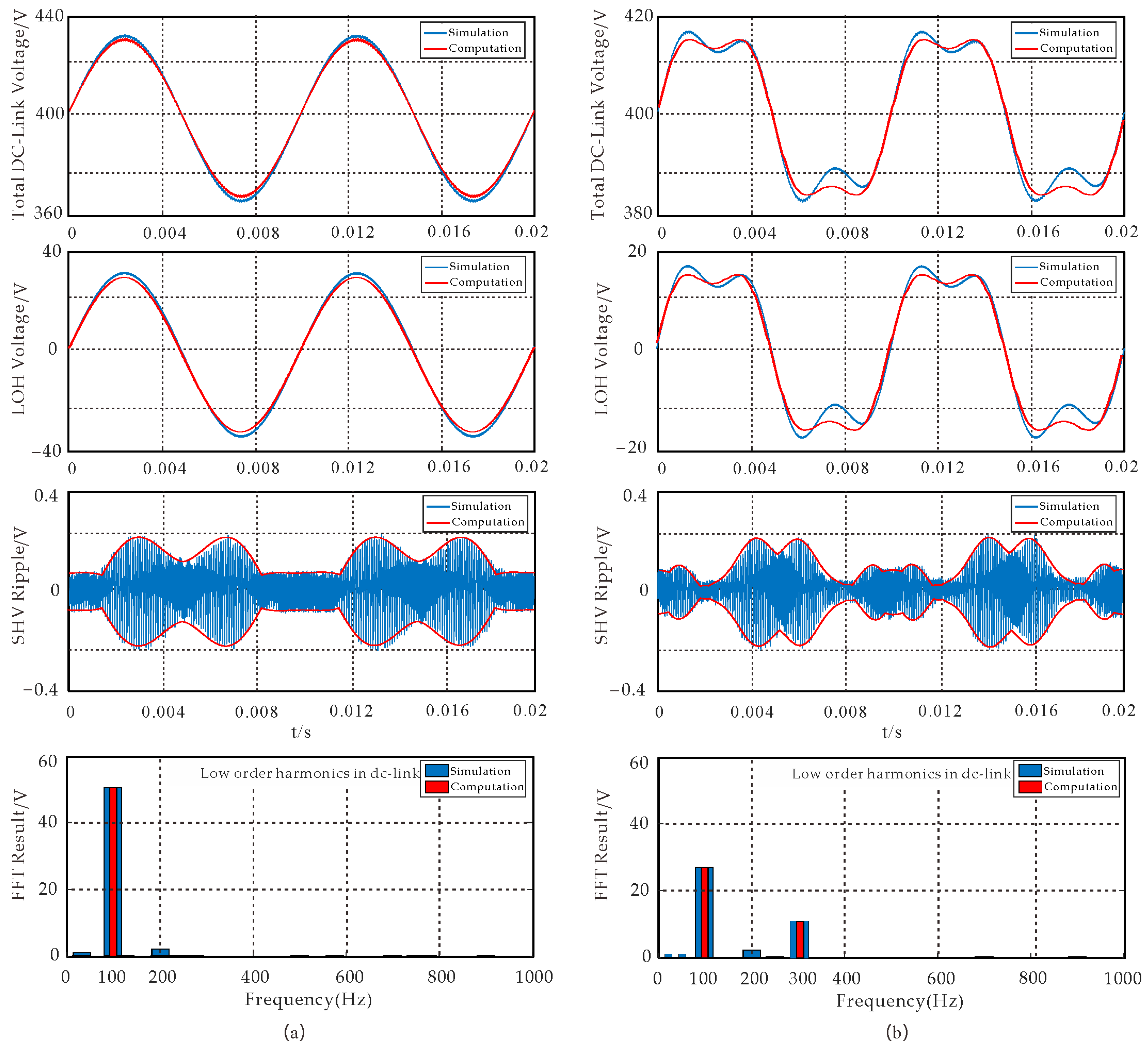
The following two groups of LOH ac currents were selected as the output: (1) I1 = 15A (φ1 = 0); (2) I1 = 10A (φ1 = 0), I5 = 10A (φ5 = 0). Figure 6 shows the simulation and computational results of the dc-link voltage ripple under the above two ac current conditions. From top to bottom are the total dc-link voltage the total dc-link voltage (including LOH voltage and SHV), the LOH voltage (second diagram), SHV ripple (third diagram), and FFT results of LOH voltage in dc-link. The computational results of LOH voltage and dc-link SHV envelop are calculated by (18) and (21), respectively. The theoretical total dc-link voltage ripple is calculated by summing the results of (18) and (19).
Figure 6. Simulation results of the total dc-link voltage ripple: (a) AC link currents contain −1st (15A, 0); (b) AC link currents contain −1st (10A, 0) and −5th (10A, 0).
Obviously, the simulation and computational results are matched well, which proves the correctness and effectiveness of the analytical method proposed in this paper. From Figure 6a, it can be seen that when the ac current contains the fundamental negative sequence component, the second harmonic voltage would occur in the dc-link. Similarly, Figure 6b shows that when the ac current contains both the fundamental negative sequence and the fifth negative sequence components, the secnd and sixth harmonic would occur in the dc-link. Moreover, since the integration time of SHV in the dc-link is much smaller than the LOH voltage integration time, the maximum value of the LOH voltage is much larger than the maximum value of SHV in the dc-link. Therefore, compared with the dc-link LOH voltage, the SHV in the dc-link can be ignored.

4.2. Experimental Results

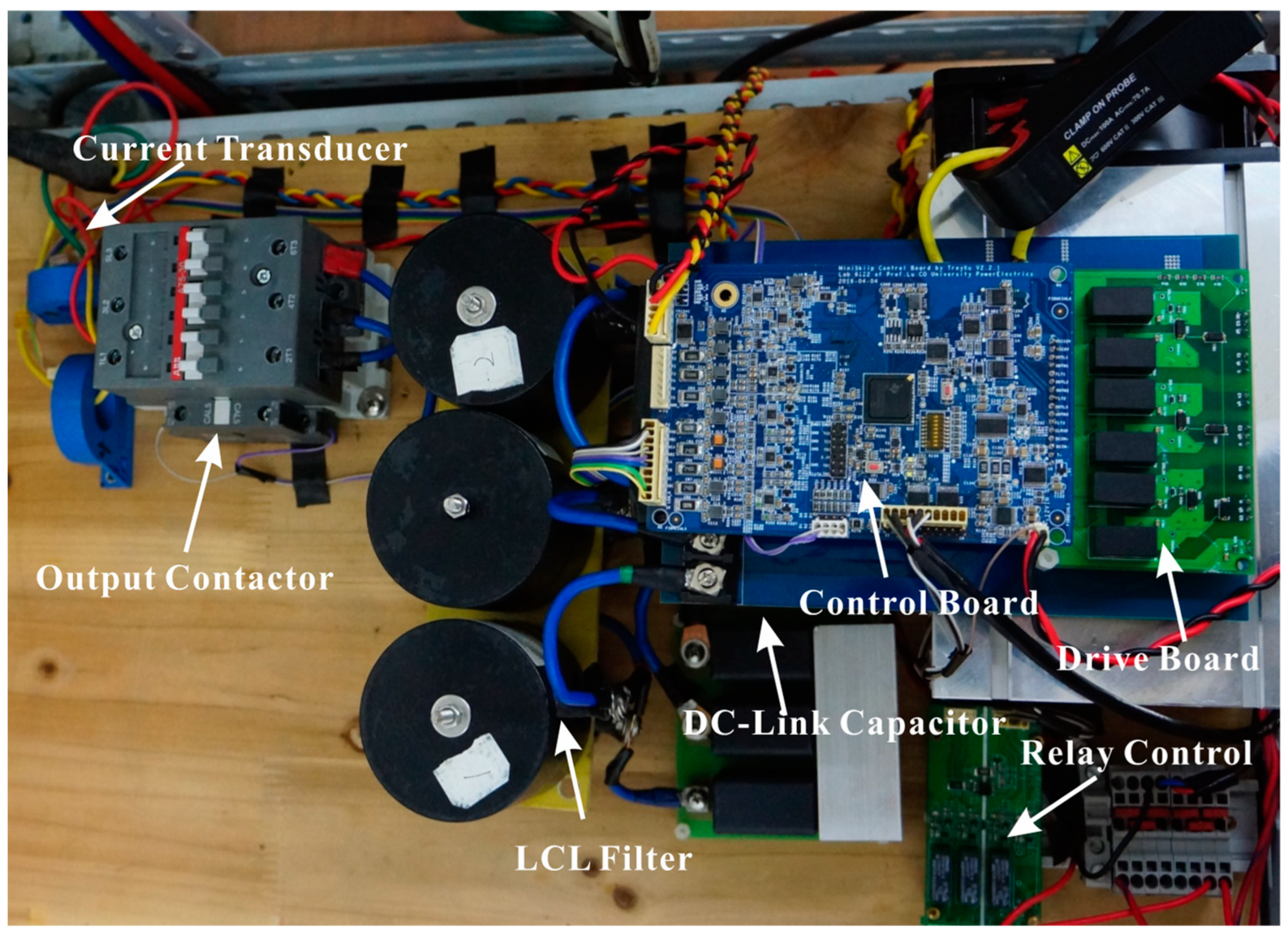
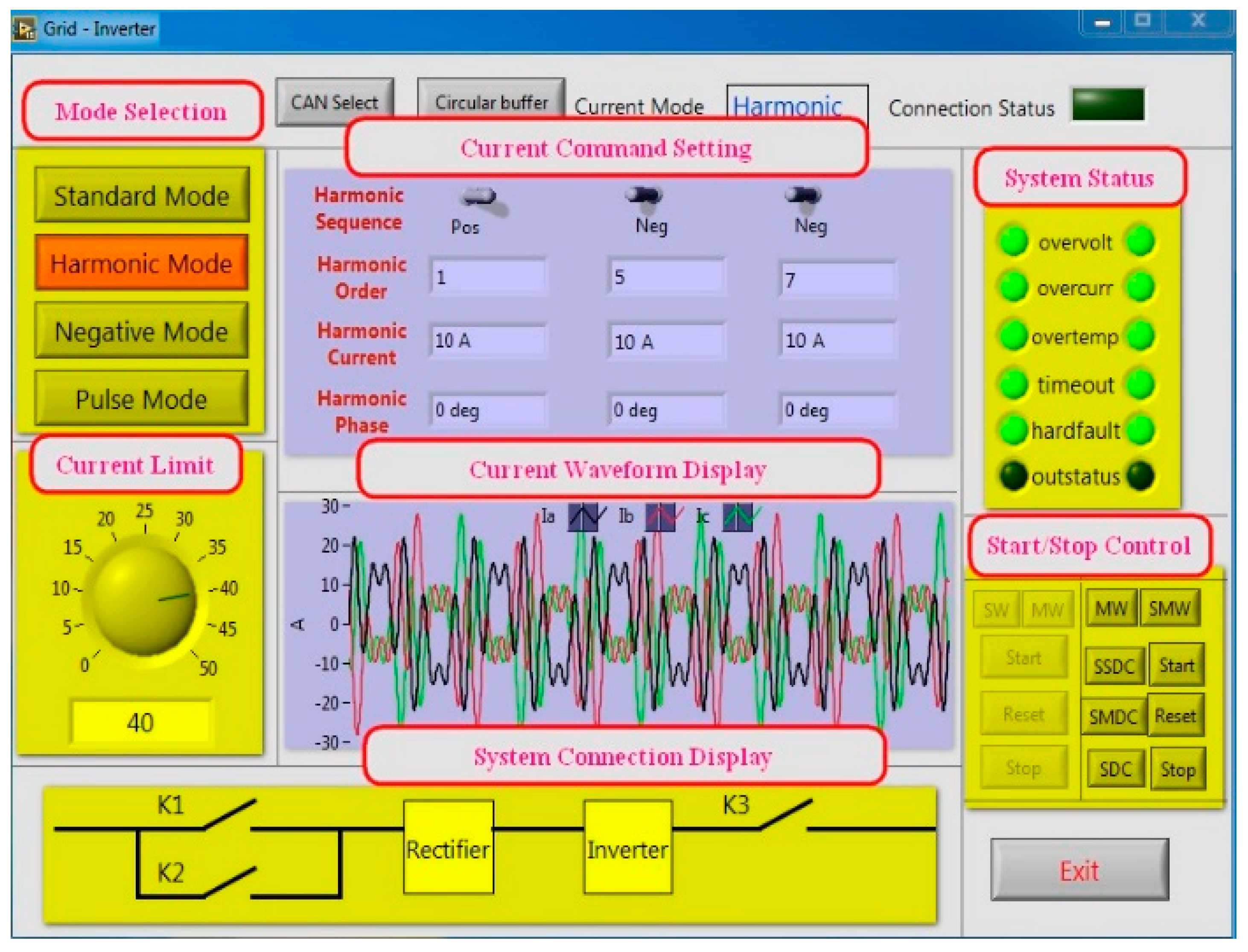
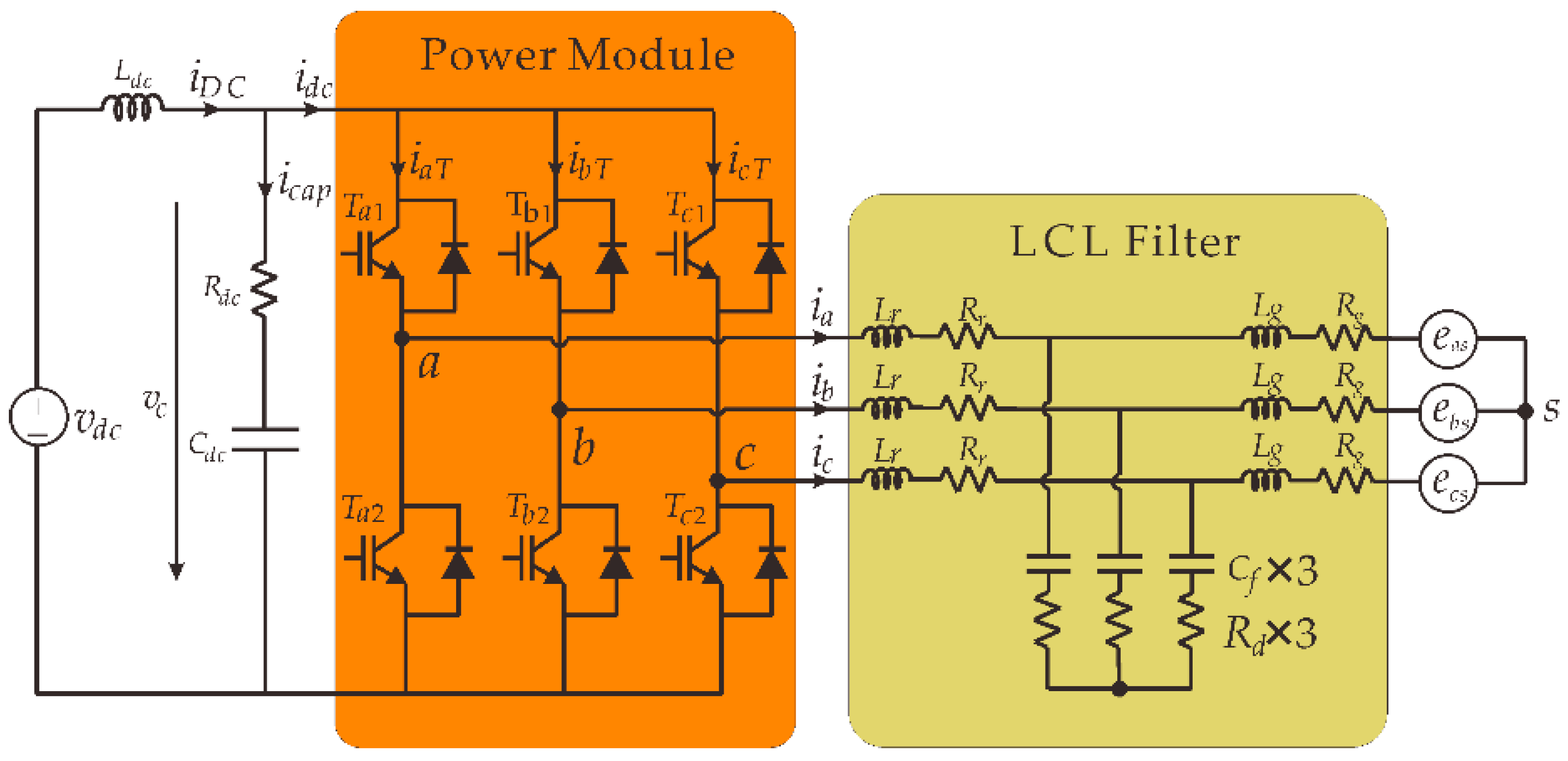
The experimental setup is shown in Figure 7. It should be pointed out that the power module in the experimental setup is mounted on a heatsink and covered by a drive board, so it can not be seen in Figure 7. The graphic user interface shown in Figure 8 is used to control the grid-tied inverter output current. The PI paralleled with multiple PR controllers in a d-q reference frame were used to inject the desired multiple LOH currents into the grid. Therefore, the dc-link voltage ripple can be easily evaluated under a specific ac current. The switching and sample frequency are 10kHz, and all the experimental parameters are consistent with the simulation.
Figure 7. The flexible three-phase grid-tied VSC prototype.
Figure 8. The graphical user interface for the experimental setup.
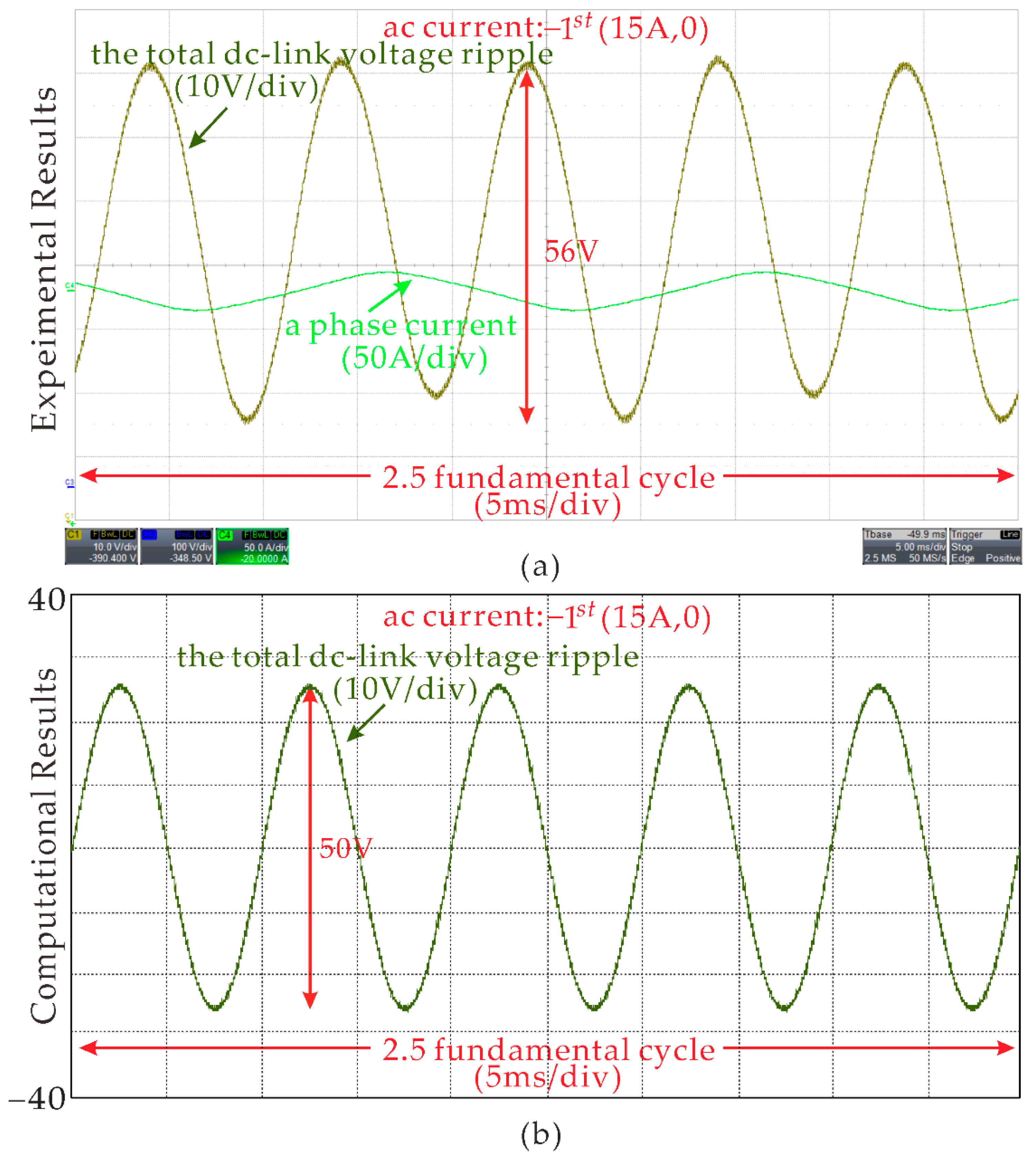
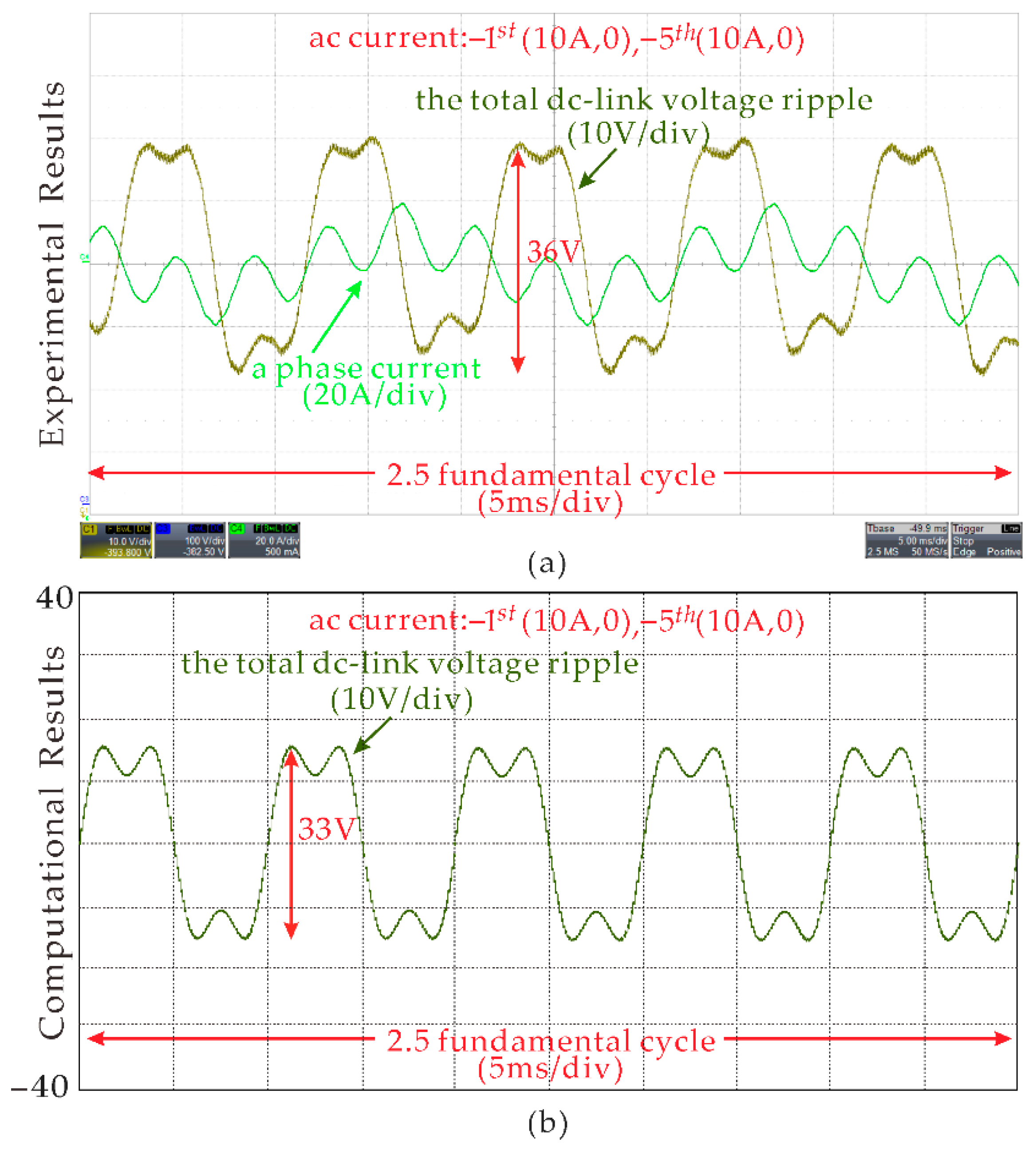
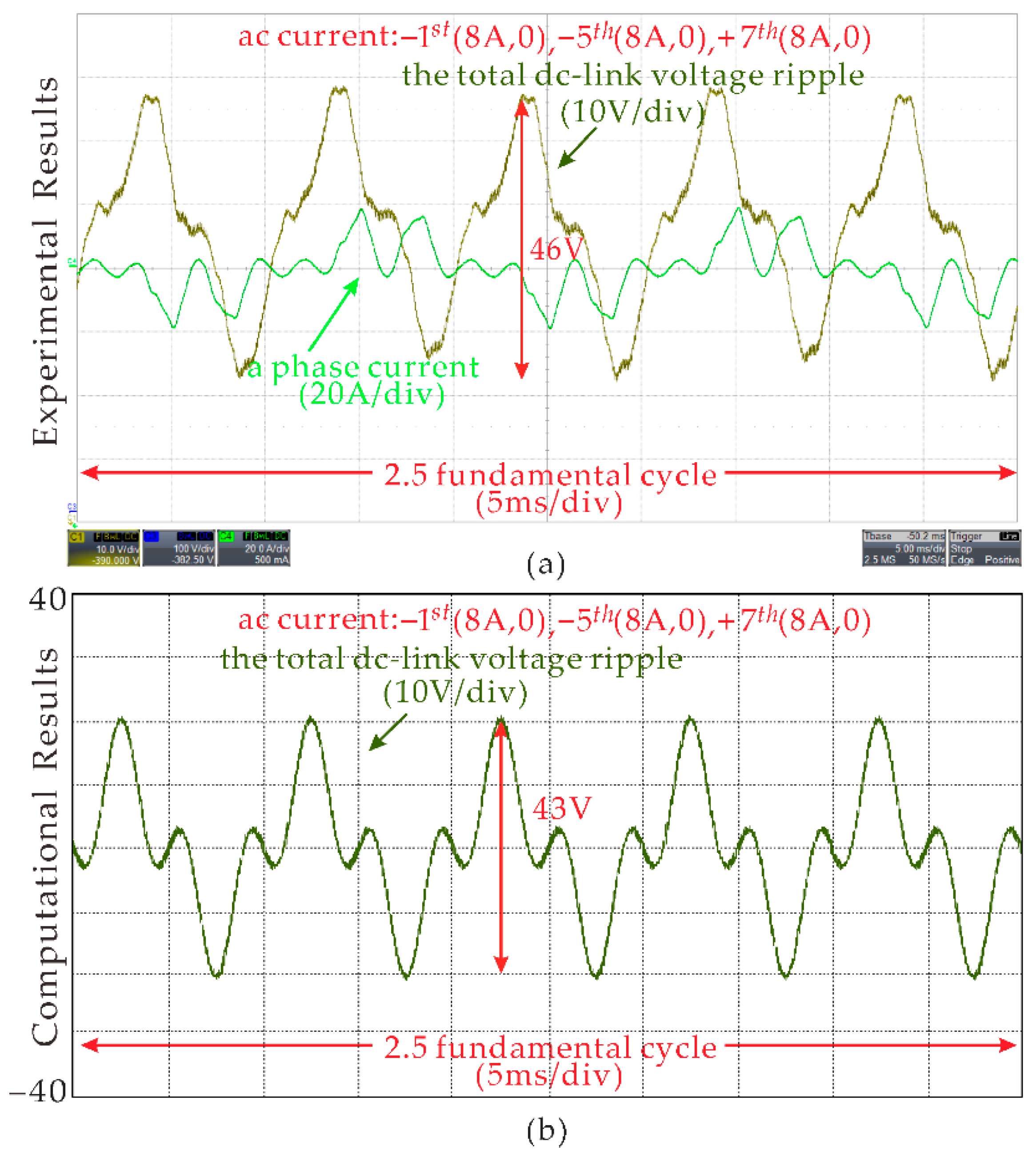
Figure 9a and Figure 10a show the experimental results of total dc-link voltage ripple when the ac currents consist of: (1) I1 = 15A (φ1 = 0); (2) I1 = 10A (φ1 = 0), I5 = 10A (φ5 = 0), respectively. The corresponding theoretical total dc-link voltages are shown in Figure 9b and Figure 10b, which are obtained by summing the results of (18) and (19). It should be noted that the output ac current conditions in Figure 9 and Figure 10 are the same as Figure 6. It is obvious that the computational, simulation, and experimental results are matched well. Figure 11 show the experimental and computational total dc-link voltage ripple results when ac current consist of I1 = 8A (φ1 = 0), I5 = 8A (φ5 = π), I7+ = 8A (φ7+ = 0). Again, they match well. It is interesting that the dc-link voltage ripple in Figure 10 increased significantly compared with Figure 9, due to the 6th harmonic voltages in dc-link produced by −5th and +7th harmonics in the ac current being reinforced by each other from (18).
Figure 9. Experimental and computational results of the dc-link voltage ripple when the ac currents contain −1st (10A, 0): (a) experimental results; (b) computational results.
Figure 10. Experimental and computational results of the dc-link voltage ripple when the ac currents contain −1st (10A, 0) and −5th (10A, 0): (a) experimental results; (b) computational results.
Figure 11. Experimental and computational results of the dc-link voltage ripple when the ac currents contain −1st (8A, 0), −5th (8A, π), and +7th (8A,0): (a) experimental results; (b) computational results.

5. Conclusions

This paper presents a general analytical model of the dc-link voltage ripple to facilitate the dc capacitor design for the three-phase VSCs under nonlinear output current. The dc-link voltage ripples are decomposed into LOH voltages and SHVs and formulated separately. It is interesting to discover that the dc-link LOH voltages would reinforce or cancel each other with different phase angles combinations in ac current. Moreover, the dc-link voltage ripple models in the previous literature could be easily obtained by applying specific cases to the proposed analytical models in this paper. Moreover, the maximum dc-link voltage ripple expression is also derived to accelerate dc capacitor design in the worst case. With the proposed method, the various unusual dc-link voltage ripple under arbitrary combinations of LOHs in the ac output current can be accurately evaluated in advance without amounts of simulations. The complete equation sets are demonstrated by both simulation and experimental results.

Author Contributions

Conceptualization, T.W.; methodology, T.W.; software, L.Y.; validation, L.Y.; formal analysis, L.Y.; investigation, S.L.; resources, S.L.; data curation, L.Y.; writing—original draft preparation, S.L.; writing—review and editing, T.W.; visualization, T.W.; supervision, S.L.; project administration, S.L.; funding acquisition, T.W. All authors have read and agreed to the published version of the manuscript.

Funding

This research was funded by the Natural Science Foundation of Chongqing, China, grant number cstc2021jcyj-msxmX0161, the Science and Technology Research Program of Chongqing Municipal Education Commission, China, grant number KJQN202001149, and Scientific Research Foundation of Chongqing University of Technology, China, grant number 2019ZD101.

Institutional Review Board Statement

Not applicable.

Data Availability Statement

Not applicable.

Conflicts of Interest

The authors declare no conflict of interest.

References

  1. Bierhoff, M.H.; Fuchs, F.W. DC-Link Harmonics of Three-Phase Voltage-Source Converters Influenced by the Pulse width-Modulation Strategy—An Analysis. IEEE Trans. Ind. Electron. 2008, 55, 2085–2092. [Google Scholar] [CrossRef]
  2. McGrath, B.P.; Holmes, D.G. A General Analytical Method for Calculating Inverter DC-Link Current Harmonics. IEEE Trans. Ind. Appl. 2009, 45, 1851–1859. [Google Scholar] [CrossRef]
  3. Sun, J.; Lin, C. Calculation and spectral analysis of DC-link current for three phase PWM inverter. In Proceedings of the International Symposium on Power Electronics (Ee), Novi Sad, Serbia, 27–30 October 2021. [Google Scholar]
  4. Renken, F. Analytical calculation of the dc-link capacitor current for pulsed three-phase inverters. In Proceedings of the 11th International Conference on Power Electronics and Motion Control, Riga, Latvia, 2–4 September 2004. [Google Scholar]
  5. Kolar, J.W.; Round, S.D. Analytical calculation of the RMS current stress on the DC-link capacitor of voltage-PWM converter systems. IEEE Trans. Ind. Appl. 2006, 153, 535–543. [Google Scholar] [CrossRef] [Green Version]
  6. Ming, L.; Ding, W.; Loh, P.C.; Xin, Z. A Direct Carrier-Based Modulation Scheme With Full Index Range for DC-Link Current Ripple Mitigation of a Current Source Converter. IEEE Trans. Ind. Electron. 2022, 69, 452–462. [Google Scholar] [CrossRef]
  7. Nishizawa, K.; Itoh, J.; Odaka, A.; Toba, A.; Umida, H.; Fujita, S. Current Stress Reduction for DC-Link Capacitors of Three-Phase VSI With Carrier-Based Continuous PWM. IEEE Trans. Ind. Appl. 2019, 55, 6061–6072. [Google Scholar] [CrossRef]
  8. Dahono, P.A.; Sato, Y.; Kataoka, T. Analysis and minimization of ripple components of input current and voltage of PWM inverters. IEEE Trans. Ind. Appl. 1996, 32, 945–950. [Google Scholar] [CrossRef]
  9. Vujacic, M.; Hammami, M.; Srndovic, M.; Grandi, G. Theoretical and Experimental Investigation of Switching Ripple in the DC-Link Voltage of Single-Phase H-Bridge PWM Inverters. Energies 2017, 10, 1189. [Google Scholar] [CrossRef]
  10. Vujacic, M.; Hammami, M.; Srndovic, M.; Grandi, G. Analysis of dc-Link Voltage Switching Ripple in Three-Phase PWM Inverters. Energies 2018, 11, 471. [Google Scholar] [CrossRef] [Green Version]
  11. Pei, X.; Chen, C.; Kang, Y. Analysis of Voltage Ripple and Design for DC-Link Capacitor in Three-Phase Voltage Source Inverters. Trans. Electrotech. Soc. 2014, 29, 254–269. [Google Scholar]
  12. Vujacic, M.; Dordevic, O.; Grandi, G. Evaluation of DC-Link Voltage Switching Ripple in Multiphase PWM Voltage Source Inverters. IEEE Trans. Power Electron. 2020, 35, 3478–3490. [Google Scholar] [CrossRef]
  13. Guo, J.; Ye, J.; Emadi, A. DC-Link Current and Voltage Ripple Analysis Considering Antiparallel Diode Reverse Recovery in Voltage Source Inverters. IEEE Trans. Power Electron. 2018, 33, 5171–5180. [Google Scholar] [CrossRef]
  14. Pei, X.; Zhou, W.; Kang, Y. Analysis and Calculation of DC-Link Current and Voltage Ripples for Three-Phase Inverter With Unbalanced Load. IEEE Trans. Power Electron. 2015, 30, 5401–5412. [Google Scholar] [CrossRef]
  15. Wang, T.; Lu, S. Analysis of the DC-Link Current for the Single-Phase H-Bridge Inverter Under Harmonic Output Currents. IEEE J. Emerg. Sel. Top. Power Electron. 2019, 7, 2170–2183. [Google Scholar] [CrossRef]
  16. Wang, T.; Lu, S. DC-Link Current Computational Methods for Three Phase Inverter with Low Order Harmonic Output Current. IET Power Electron. 2019, 12, 878–890. [Google Scholar] [CrossRef]
  17. Yang, L.; Wang, T.; Li, S.; Liang, K.F. Analysis of the DC-link voltage ripple for the three phase voltage ripple under low order harmonic output current. In Proceedings of the International Conference on High Voltage Direct Current (HVDC), XJTU, Xi’an, China, 6–9 November 2020. [Google Scholar]
Publisher’s Note: MDPI stays neutral with regard to jurisdictional claims in published maps and institutional affiliations.

Article Metrics

Citations

Article Access Statistics

Multiple requests from the same IP address are counted as one view.