


Abstract
The electric sector is one of the main emitters of greenhouse gases that lead to exacerbating global warming. There is a lack of consensus in the literature regarding renewable energy (RE) determinants and their impacts on the power sector. Using a panel fully modified OLS model, we examine the effect of research and development, the human development index, technological innovation, and other factors on the share of RE sources in electricity generation in six Association of Southeast Asian Nations (ASEAN) member countries from 2000 to 2018. We find that research and development, the human development index, and technological innovation have different effects on different RE sources. The human development index and research and development, for example, modify the composition of RE by shifting resources from conventional RE sources such as hydropower to newer, more technology-intensive ones such as solar, wind, and bioenergy sources. Our findings show that technological innovation, captured by a number of patent filings, has nonsignificant effects on RE sources deployment. Population growth and energy consumption increase the adoption of more advanced RE sources, and higher levels of CO2 emissions are associated with more deployment of solar and wind technologies but less adoption of hydropower and geothermal energy. Our results provide fresh insights for policymakers enacting RE policies worldwide, especially in the ASEAN region.
1. Introduction
Global warming is one of the most pressing issues worldwide, as the amount of greenhouse gas (GHG) emissions is increasing exponentially. It has become a hot political topic and has drawn considerable attention from scholars in various fields including environmental and natural resource economics. According to Griffiths [1], CO2 emissions (the main type of GHG emissions) have increased by nearly 45% in the past 130 years, reaching 415 ppm, an all-time high in human history. In addition, Chen and Lei [2] predict that CO2 emissions will increase by 40–110% from 2017 to 2030.
Concern for the environment, coupled with socioeconomic concerns and technology-driven cost reduction, has made renewable energy (RE) technologies such as geothermal, solar, hydropower, wind, biofuel, and biomass much more appealing in both developed and developing economies. In addition to reducing GHG emissions by replacing fossil fuels, RE technologies can provide energy to people with limited energy access in rural and remote areas, thereby buttressing the energy security of developing economies with such geographical conditions. Diversifying energy sources and reducing production costs could improve production efficiency and spur product development, in turn expanding the use of RE. That would help to decarbonize the economy and further boost the world’s appetite for RE and other clean energy sources [3]. Last, RE technologies are supported by the public [4,5], have the potential to create clean employment opportunities and provide social benefits [6,7], and assist countries to achieve their climate mitigation goals [8,9,10].
The existing empirical literature shows that various factors can affect the development of RE, including political, socioeconomic, country-specific, and technological innovation factors [11]. In theory, environmental innovation is the outcome of continuous investment in R&D [12,13], and it helps shift the economy to integrate RE sources [14]. Meanwhile, human capital can influence both the demand and supply sides of clean energy. It can affect technological progress [15,16] and reduce dirty energy consumption [17]. With advanced human capital and modern technologies, countries can transition toward more sustainable energy sources [18]. Regarding another factor, economic growth, there is no strong evidence that it influences the adoption of RE sources. Studies mainly find a positive relationship, though there are several studies that find either a negative or nonsignificant impact [19,20]. The idea is that countries with higher economic growth can afford RE deployment costs and provide incentives for so doing [19]. Likewise, there is no consensus on the impact of GHG emissions on RE. Some studies conclude that the level of GHG emissions—represented by CO2 emissions—could play an important role in pushing policymakers to promote RE, whereas others find the exact opposite. For example, some researchers claim that high CO2 emissions are a major factor in the adoption and consumption of RE sources [21,22,23,24] and drive innovation in RE technology [25], therefore encouraging countries to adopt RE sources. In contrast, others demonstrate that increased CO2 emissions limit the production of RE [19,26].
As pointed out by Aguirre and Ibikunle [19], most of the literature investigating the effect of technological development and other determinants on RE deployment is qualitative and less decisive. Further, most of the literature assesses the impact of determinants on RE in its aggregated form rather than dissecting it from its various sources [10]. Since different RE sources have different characteristics, such aggregation might lead to biased and incorrect results. Last, most of the literature examines the effects in developed countries.
Given the importance of the issue and the lack of consensus in the literature, the main objective of this paper is to examine the effects of economic and socioeconomic variables on the adoption of various electricity generation RE sources in six of the Association of Southeast Asian Nations (ASEAN) countries: Malaysia, Singapore, Thailand, Indonesia, Vietnam, and the Philippines. Our main research question, therefore, becomes what the impacts of selected economic and socioeconomic variables on RE sources in the power sector of ASEAN states are and whether these impacts differ by RE source. To answer these research questions, we use the newly developed statistical method known as the panel fully modified ordinary least square (FMOLS) model on ASEAN data from 2000 to 2018. Our findings demonstrate that R&D, the Human Development Index (HDI), and technological innovation (captured by the number of patent applications) have different effects on different RE sources. The HDI and R&D, for example, transform the composition of RE by shifting resources from conventional RE sources (e.g., hydropower) to newer ones (e.g., solar, wind, and bioenergy). Our findings show that technological innovation has nonsignificant effects on RE source installations. Energy usage and population growth increase the adoption of more advanced RE sources. Similar to HDI and R&D findings, we find that higher CO2 emissions are correlated with more utilization of wind and solar energy but less deployment of hydropower and geothermal energy.
We make several contributions to the literature on RE. First, this study is the first to review the factors contributing to power generation RE sources. Because RE sources may respond differently to the different factors, we separately consider all five major sources of RE electricity generation: solar, hydropower, wind, geothermal, and bioenergy. Aggregating the RE sources, as other studies do, may mask the dynamic relationships among the sources and yield misleading results. Second, the existing literature focuses mainly on economic and socioeconomic factors influencing the adoption of RE sources [11,19,25,27]. We broaden the focus to include, in addition to R&D, other dimensions of technological development, including the number of patent filings and the HDI. Previous studies only considered these factors implicitly in the country-specific component of their models. Finally, by using the newly developed statistical method known as FMOLS, we are able to address the bias and inconsistency of simple OLS models when applied to cointegrated panels, thereby providing more robust results.
2. Literature Review
2.1. Study Area: ASEAN Countries
In recent decades, the ASEAN has experienced economic growth of about 4% per year, among the fastest in the world. Rising incomes, along with population growth and urbanization, have led to increased energy consumption there. Energy consumption nearly doubled from 1995 to 2017, reflecting a 3.4% annual growth rate. Having observed this trend, the ten ASEAN member states aim to increase the ratio of RE to the total primary energy supply to 23% by 2025 [28], as established in the ASEAN Plan of Action for Energy Cooperation. In addition, The ASEAN countries are targeting a 35% share in installed generation nameplate capacity and a 32% energy intensity reduction from 2005 levels by 2025. As reported by the ASEAN Centre for Energy these countries were 1.5% shy of achieving the 35% by 2025 capacity goal in 2020 (Link: https://aseanenergy.org/asean-power-updates-2021/ (accessed on 6 June 2022)). Most recently, most of the ASEAN countries (besides the Philippines) aspire for net-zero emissions by 2050 to counter global warming (source: HIS Markit. Link: https://cleanenergynews.ihsmarkit.com/research-analysis/southeast-asia-to-renew-efforts-to-boost-renewable-capacity-in.html (accessed 6 on June 2022)).
In 2019, more than 78% of ASEAN countries’ electricity portfolio mix came from fossil fuel sources such as coal (43%), natural gas (33.6%), and oil (1.6%) (Figure 1). The remaining 22% was sourced from renewable energy sources, primarily hydropower (14.4%). Figure 1 depicts the ASEAN electricity mix in 2019.
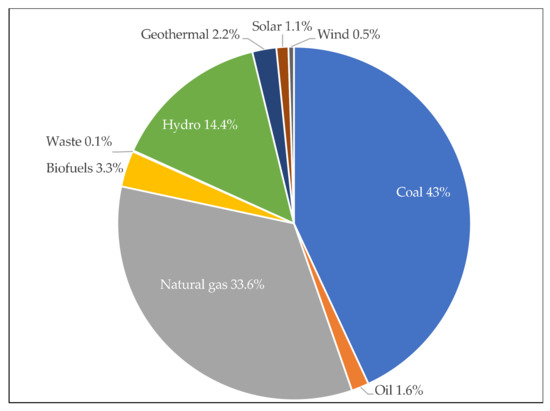
Figure 1.
ASEAN electricity generation mix in 2019. Note that numbers might not add up to 100% due to rounding. Source: International Energy Agency.
Each of the six countries has individual RE targets by a certain timeline. Their RE targets are either percentage-based or based on nameplate capacity. Indonesia, Malaysia, Thailand, and Vietnam have percentage-based targets, whereas the Philippines and Singapore have nameplate capacity-based goals. Table 1 summarizes these countries’ RE targets by their deadlines, as well as their Kyoto Protocol ratification status.

Table 1.
Renewable energy goals and Kyoto Protocol (KP) ratification status by ASEAN states.
2.2. Studies on the Effect of Determinants on RE
The energy literature on the factors of RE development is vast and continues to grow [30,31,32,33,34]. Most studies consider different economic and socioeconomic factors [11,19,22,25,33,35,36,37]. For the dependent variable, various measures and dimensions of RE have been considered, such as the share of RE capacity in total electricity supply, the share of RE in electricity production, installed wind capacity, and the aggregate newly installed capacity of different RE sources, to name a few.
The choice of explanatory variables is more diverse. Some researchers include a binary variable for the endorsement of the Kyoto Protocol and proxies for policies advocating RE development such as incentive taxes, investment incentives, and R&D incentive programs as explanatory variables. Others include price indexes of oil, coal, and natural gas; CO2 emissions; net energy imports; energy consumption; income (GDP per capita or GDP growth); primary energy intensity; foreign direct investment; education level; HDI; and number of patents filings.
Brunnschweiler [38] finds a positive impact of commercial bank credit on RE sources, particularly solar, wind, biomass, and geothermal. Marques et al. [37] discover that high energy consumption per capita increases RE deployment in all quantiles in the European Union countries. In contrast, Aguirre and Ibikunle [19] conclude that energy use is negatively correlated with RE use in their sample of 38 countries (i.e., the European Union countries, OECD countries, and BRICS countries), suggesting that countries might consume more fossil fuels and less RE under high pressure to ensure sufficient energy supply, as it would be more cost-effective at current prices. Different panels of countries, variables, and methodological approaches are identified as the reason for the divergence in the former two papers’ findings.
Valdés Lucas et al. [36] demonstrate that environmental sustainability (represented by signing the Kyoto Protocol), carbon intensity, energy intensity, the security of the energy supply (represented by net energy imports), electricity diversification, and energy source diversification contribute to the development of RE sources. They also demonstrate the importance of competitiveness (represented by the prices of natural gas, coal, and oil) and GDP per capita to RE development. Surprisingly, per capita income hampers RE development. Meanwhile, energy consumption per capita increases the production of energy from renewable resources.
Paramati et al. [39] report that foreign direct investment could provide the required capital for RE investment. In the same vein, Ang et al. [40] find that domestic finance to the private sector plays a critical role in financing decisions concerning RE-based power generation.
Papież et al. [33] apply the least-angle regression method to EU countries from 1995 to 2014 to identify factors that determine RE policy. They find that countries poor in nonrenewable resources were most likely to develop RE sources. They report that GDP per capita, the costs of consuming energy generated from nonrenewable resources, and the concentration of the energy supply also promoted RE sources. Da Silva et al. [11] suggest that economic development (represented by GDP per capita and energy consumption) led to RE development in sub-Saharan Africa, whereas population growth impeded it.
Amri [41] discusses the relationships of trade with nonrenewable and RE consumption using data from seventy-two countries and finds that trade and energy consumption have a “mutually reinforcing linear relationship” for both renewable and nonrenewable resources.
Belaïd and Zrelli [42] employ a PMG-panel ARDL model and investigate the causal linkages between nonrenewable and renewable electricity consumption, carbon emissions, and GDP for a panel of Mediterranean countries. The results reveal short-term bidirectional causality between both nonrenewable and renewable electricity consumption, CO2 emissions, and GDP.
Lin and Zhu [24] examine the factors driving RE innovation in China by using provincial data from 2000 to 2015. Exploiting significant differences in innovation across the provinces, they find that intensive CO2 emissions promoted RE innovation, implying that innovation responded to climate change concerns. They also show that both public and private R&D investments increased innovation. However, they observe no significant effect of the energy price on RE innovation. Assi et al. [26] conclude that CO2 emissions, real GDP per capita, and economic freedom led to reduced RE consumption in the ASEAN+3 group, whereas innovation led to increased RE consumption.
Przychodzen and Przychodzen [25] study the determinants of RE production for a panel of twenty-seven transitional economies. They find that rising government debt, unemployment, and economic growth stimulated RE generation. They also demonstrate that the implementation of the Kyoto Protocol caused a significant increase in the use of RE sources.
Koengkan [35] tests the effects of capital stock from the public, private, and public-private-partnership sources on investment in RE for eighteen Latin American and Caribbean countries from 1990 to 2016. Using the quantile moments method, they find that only the public-private and public capital stock increased installed RE capacity.
The review of the energy economics literature reveals that most of the existing literature is on advanced economies of developed countries, and little is known about emerging countries such as those of the ASEAN. Further, the lack of consensus in the literature surrounding the effect of the determinants on individual RE sources furthers the justification for this article. This article seeks to fill these shortcomings in the literature.
3. Materials and Methods
This study covers six ASEAN countries—Singapore, Thailand, Indonesia, the Philippines, Malaysia, and Vietnam—from 2000 to 2018. The choices of countries and the time period were dictated to a large extent by data limitations.
As mentioned in Section 2, many factors impact RE production and development. Early studies considered revenue and prices as the main determinants of RE consumption [21,34,38,43,44,45]. Later, researchers introduced environmental variables to examine the relationship between RE consumption and economic development. For example, Valdés Lucas et al. [36] identified energy consumption as the main factor affecting RE production and development. Lu [23] argued that CO2 emissions were one of the main factors pushing countries toward RE deployment. Nyiwul [44] added population to the determinants, Yao et al. [17] included human capital, and Johnstone et al. [46] integrated the number of patents. Following Marques et al. [22], Aguirre and Ibikunle [19], Valdés Lucas et al. [36], da Silva et al. [11], Papież et al. [33], Przychodzen and Przychodzen [25], and Johnstone et al. [46], we include some of the main drivers of RE diffusion as our explanatory variables: CO2 emissions (), total population (), energy use (), average OPEC oil price (, R&D expenditures (, HDI (, number of patent applications () as a proxy for technological innovation, and the implementation of the Kyoto Protocol (). All variables except for , which is a dummy variable, are transformed to logarithmic form, so the estimated coefficients represent elasticities.
The panel models employed in this study are given in Equations (1)–(4). For a robustness check, we consider, in addition to Model 1 (the base model), three specifications in which we add new explanatory variables: R&D expenditures ( in Model 2, HDI in Model 3, and the technological innovation in Model 4. Because collinearity between these three variables is probable, we did not incorporate all of them into a single model. The models are:
Here, and represent the ASEAN member country and year, respectively. is the parameter to be estimated, and is the error term. When applied to cointegrated panels, the OLS estimator is inconsistent and biased [47,48]. This realization led researchers to develop the panel FMOLS estimator, which provides asymptotically unbiased estimators. The FMOLS estimator has the advantage of generating consistent estimates of in relatively small samples while controlling for the possible endogeneity of the regressors and their consequent serial correlation, thereby permitting the fixed effects and the short-run dynamics to be heterogeneous among the panel members.
The FMOLS approach is a useful and empirically accepted method for hypothesis testing in the presence of cointegrating vectors within dynamic time series panels. The FMOLS methodology enables estimation wherein one can correct for considerable heterogeneity across individual subjects of the panel. This offers considerable advantages: (1) FMOLS enables the selective pooling of long-run information while (2) allowing for short-run dynamics and fixed-effects to remain heterogeneous throughout the individual subjects of the panel. Thus, with respect to potential spurious regression and cointegration in dynamic heterogeneous panels, the FMOLS approach provides asymptotically unbiased estimators as well as nuisance parameter free standard normal distributions. To that end, we must first consider the underlying assumptions of an unmodified OLS model and the necessary corrections to obtain the desired nonspurious asymptotic properties of a cointegrated system for a panel OLS from the FMOLS approach. Following Pedroni [47], let us consider a cointegrated system for a panel of countries i = 1,…, N with stationary vector error process that has asymptotic covariance matrix that follows.
here are assumed to cointegrate for each panel country with as the cointegrating vector if is integrated of order one, and enables the cointegration nexus to contain country specific fixed effects. As well, we generalize to be a k-dimension vector of independent variables not cointegrated with one another, and so separate where the first and second element consist of a scalar series and an k-dimension vector of the differences in independents, , respectively. By this, we can then construct the asymptotic covariance matrix,
where, is the scalar LR variance of the residual , is a (k × 1) vector that provides LR covariance between the residual and of each of the , and is the (k x k) LR covariance among . To establish asymptotic properties of estimators in both larger cross-sectional (N) and time-series (T) dimensions, we assume the invariance principle and the cross-sectional independence hypotheses that discuss the degree of dependency across both N, T dimensions, explained by Pedroni [47]. Finally, with this framework we can employ the FMOLS estimator for the coefficient β of a cointegrated panel given by,
here, ,, and is a lower triangular decomposition of as previously described and with the invariance and cross-sectional independence assumptions.
Data
Table 2 presents the definitions of the variables and sources of data. Our data primarily comes from five sources: World Development Indicators (WDI), United Nations Economic and Social Commission for Asia and the Pacific (ESCAP), United Nation Development Programme (UNDP), Organization of the Petroleum Exporting Countries (OPEC), and United Nations Framework Convention on Climate Change (UNFCCC). It is worth noting that HDI is a continuous variable that ranges from 0 to 1, and KYO is a dummy variable that takes the value of 1 for when country i has ratified the protocol before August of year t and zero otherwise.
Table 2.
Variables definition and data sources.
Table 2.
Variables definition and data sources.
| Variable | Definition | Source |
|---|---|---|
| = Share of renewable energy in electricity generation (%) | WDI | |
| Share of hydropower energy in electricity generation (%) | SDG | |
| Share of solar energy in electricity generation (%) | SDG | |
| Share of wind energy in electricity generation (%) | SDG | |
| = Share of bioenergy energy in electricity generation (%) | SDG | |
| = Share of geothermal energy in electricity generation (%) | SDG | |
| CO2 emissions (metric tons per capita) | WDI | |
| Total population (count) | WDI | |
| Energy use (kg of oil equivalent per capita) | WDI | |
| Average OPEC oil price (US dollars) | OPEC | |
| R&D expenditures (% of GDP) | WDI | |
| Human Development Index (index value–continuous) | UNDP | |
| Number of patent applications (count) | WDI | |
| KYO | KYO = Ratification of the Kyoto Protocol (dummy variable) | UNFCCC |
WDI: World Development Indicator; https://datacatalog.worldbank.org/dataset/world-development-indicators (accessed on 6 June 2022). UNFCCC: United Nations Framework Convention on Climate Change; http://unfccc.int (accessed on 6 June 2022). UNDP: United Nation Development Program; http://hdr.undp.org/en/composite/HDI (accessed on 6 June 2022). OPEC: Organization of the Petroleum Exporting Countries. https://www.opec.org/basket/basketDayArchives.xml (accessed on 6 June 2022). SDG: Asia-Pacific Sustainable Development Goals (SDG) Gateway of United Nations Economic and Social Commission for Asia and the Pacific (UNESCAP); https://data.unescap.org/ (accessed on 6 June 2022).
Table 3 summarizes descriptive statistics of the variables used in our analyses for the sample countries from 2000 to 2018. HYD, POP, OIP, and INO have median values greater than their average values, indicating negatively skewed distributions. The opposite holds for the remaining variables (i.e., positively skewed distributions).
Table 3.
Variables summary statistics from 2000 to 2018.
4. Empirical Results and Discussions
Given the sample size and the asymptotic properties of the tests, we employed a variety of diagnostic tests, including the Levin–Lin–Chu (LLC) test, the Fisher–ADF test, and the Im–Pesaran–Shin (IPS) test, to investigate the stationarity of the variables. The unit root test results are shown in Table 4; they indicate that all variables are integrated of order one.
Table 4.
Unit root test results.
Table 5 reports the results of Kao’s cointegration test, which investigates long-term cointegration. As can be seen, there is a strong cointegration between the variables in all the models. Table 5 also presents the long-run effects of the explanatory variables on RE production as obtained by the panel cointegrating estimators of FMOLS. We present findings both for RE as an aggregate of all electricity generation RE sources and for RE components: hydropower (HE), solar (SE), wind (WE), biofuels (BIO), and geothermal (GEO).
Table 5.
Long-run estimation results for equations 1–4 for different RE sources as dependent variables using panel FMOLS model, along with panel cointegrating test results by equation and RE source.
The results of Model 1 show that oil price has a significant negative impact on the share of RE in total electricity generation, contrary to our expectation. This implies that higher oil prices have not incentivized the countries under study to replace oil with clean energy sources. This finding is in line with some other studies. For example, Marques et al. [22] find a negative association between coal prices and the use of RE for non–European Union countries. da Silva et al. [11] present a similar result for sub-Saharan Africa. Two explanations have been put forward for the negative effect. First, according to Chang et al. [20], only high-income countries are capable of responding to high energy prices by bearing the high costs of RE technologies. In other words, an increase in energy prices spurs RE production only in countries that are rich enough. Second, van Ruijven & van Vuuren [49] argue that the lack of environmental regulations in developing and emerging economies could explain the negative effect because there are no environmental authorities pushing for a transition toward clean energy.
We should be cautious in interpreting the oil price effect for a few reasons. First, the price index records annual average prices, and therefore it could mask variations in the price within a given year. Second, coal (not oil) is the main source for electricity generation; therefore, a coal price index might have the expected sign. Third, the countries under study may have faced challenges in transitioning to RE sources because of (i) heavy irreversible investment in non-RE sources, (ii) the financial burden of transitioning to RE, and (iii) the limited room for responding to oil price changes in the short run.
The variables representing the demand side—population and energy consumption—show a positive and statistically significant sign. Growth of population and energy use seems to have forced the countries under study to plan to fulfill growing energy requirements through developing various resources, including clean energy sources.
The level of CO2 emissions has a negative and statistically significant sign, which is in line with the findings of da Silva et al. [11] and Marques et al. [22], and in contrast to those of Wang et al. [10]. This implies that greater pollution (represented by CO2 emissions) has not pushed the countries under study to act to diversify electricity generation energy sources and move toward cleaner energy. Part of the explanation may be that the share of clean energy in electricity production is still insignificant (see Figure 1). The effects of CO2 emissions on hydropower and geothermal energy in particular are also negative and significant, but the effects on solar and wind energy are positive and significant. This implies that higher levels of CO2 emissions in the assessed ASEAN countries have encouraged the adoption of newer RE technologies such as solar and wind rather than the older RE technologies (i.e., hydropower and geothermal).
A negative effect of adopting the Kyoto Protocol can be interpreted to mean that the adoption did not push the countries under study toward cleaner technologies. According to Table 5, the adoption of the Kyoto Protocol only significantly decreased the shares of hydropower energy and the aggregate RE in electricity generation. This can be partially explained by the high share of hydropower energy in total RE (nearly 66%). Solar energy, wind energy, bioenergy, and geothermal energy contributed approximately 5%, 2.3%, 15%, and 10% of electricity production in 2019 (see Figure 1).
The R&D, technological innovation, and HDI show nonsignificant and mixed results on aggregate RE in all models. The story changes when we assess these variables on dissected RE components. R&D significantly promoted newer clean energy sources, including solar, wind, and biofuels, but had the opposite (and significant) effect on conventional RE technologies such as hydropower and geothermal energy. This result is justifiable as geothermal and hydropower technologies are well-established, whereas the technology of solar and wind are still evolving. We find comparable results for the HDI variable. Our results show that higher HDI is associated with higher wind energy and bioenergy deployment and lower installation of hydropower. The HDI coefficients are nonsignificant for other sources of RE. The technological innovation seems to not spur or discourage the deployment of any of the RE sources in the ASEAN countries. The effects of R&D and technological innovation on aggregate RE may be nonsignificant because these variables correspond to the overall economy, not RE specifically. It may also be because the countries under study are consumers rather than producers of RE technologies.
5. Conclusions
Using a new data set and a newly developed statistical method (FMOLS), we analyzed the determinants of the share of RE in electricity generation in six ASEAN countries. Rather than only assessing the aggregated RE, one of the objectives of this study was to examine various RE technologies, including hydropower, wind, solar, biomass, and geothermal to answer our research questions. We found that CO2 emissions per capita reduced the share of RE in power generation but favored newer clean energy technologies such as solar and wind energy. Not to mention, air pollution from the power sector causes premature mortality and morbidity [7,50]. Thence, ASEAN countries are encouraged to adopt newer RE sources to combat climate change by mitigating CO2 emissions. Population growth and energy usage encouraged the adoption of RE for electricity generation in our panel of countries.
Rising oil prices discouraged the use of RE, a result that is in line with other studies on developing economies but in conflict with our theoretical prediction. The conflict could be explained by the inelasticity of demand for fossil fuels in the short term, in which case rising oil prices will spur the development of RE infrastructure in the long run. In the short term, the price increase only reduces the financial resources available to invest in RE sources in oil-importing countries.
The results on technological innovations (proxied by patent applications) and R&D are mixed, but R&D did boost solar, wind, and bioenergy resources. The results are not conclusive for many variables in the model in which all RE sources were combined. The independent variables show different impacts on different RE components. This also proves the point that RE sources should be disaggregated and assessed individually rather than aggregated into a single variable.
Our findings indicate that higher CO2 emissions, R&D, and HDI have only served to replace hydropower and geothermal energy with newer RE sources, including wind, solar, and bioenergy, rather than serving to develop all types of RE by replacing fossil fuels. This presents a policy challenge. Replacing one form of RE with another is redistributing the share of RE sources in the energy mix. Redistribution of the share of RE sources that are emission-free will have no impact on emission reduction. A global consensus and meaningful action are needed to replace fossil fuels with RE. The insignificant effect of innovation on some components of RE indicates the lack of scientific focus of countries and the proper management of the research sector to expand this type of energy. Only the R&D sector, which is more closely linked to the manufacturing sector, has probably moved to replace different types of RE due to possible economic benefits.
Our results show that various factors have different effects on different RE sources. The implications are that the one size fits all model can be misleading and that each RE source needs to be studied separately, corroborating one of the objectives of the current study.
One limitation of this research is the lack of energy prices such as coal and natural gas prices, two sources that produce more than three-quarters of ASEAN countries’ electricity (see Figure 1), in our analysis. Looking ahead to future research, including natural gas and coal price variations (as opposed to price levels) and exploiting data with a longer time horizon would likely better explain the effects of the selected determinants on the share of RE and its various sources in electricity generation. Future research can also bundle RE sources by their characteristics (such as whether RE sources have cooling technology or not [51]), incorporate spatial and time heterogeneity in the analyses [9,10,52,53], and include more related variables such as energy policy (mandatory versus voluntary), different types of emissions (e.g., SO2, NOx, CH4), ecological footprint, and foreign direct investment, among other variables.
Author Contributions
Data curation, M.S.K., R.G., M.K. and J.M.; Formal analysis, J.M. and M.K.; Funding acquisition, J.M. and L.B.; Methodology, J.M., M.S.K. and M.K.; Resources, J.M. and L.B.; Supervision, J.M.; Validation, M.K. and M.S.K.; Writing—original draft, M.K. and M.S.K.; Writing—review and editing, J.M. All authors have read and agreed to the published version of the manuscript.
Funding
This research received no external funding.
Institutional Review Board Statement
Not applicable.
Informed Consent Statement
Not applicable.
Data Availability Statement
Publicly available datasets were used in this study. Readers are directed to Table 2 for an overview of the key variables’ data sources.
Acknowledgments
J.M. acknowledges the help from his research assistant, Miguel Perez, in cleaning up the manuscript. We appreciate insightful comments received from three anonymous reviewers. We also acknowledge the Zeelamo Academy for providing a scientific platform to connect us with each other.
Conflicts of Interest
The authors declare no conflict of interest.
References
- Griffiths, J. There Is More CO2 in the Atmosphere Today Than Any Point Since the Evolution of Humans; CNN: Atlanta, GA, USA, 2019. [Google Scholar]
- Chen, W.; Lei, Y. The Impacts of Renewable Energy and Technological Innovation on Environment-Energy-Growth Nexus: New Evidence from a Panel Quantile Regression. Renew. Energy 2018, 123, 1–14. [Google Scholar] [CrossRef]
- Qamruzzaman, M.; Jianguo, W. The Asymmetric Relationship between Financial Development, Trade Openness, Foreign Capital Flows, and Renewable Energy Consumption: Fresh Evidence from Panel NARDL Investigation. Renew. Energy 2020, 159, 827–842. [Google Scholar] [CrossRef]
- Mamkhezri, J.; Thacher, J.A.; Chermak, J.M. Consumer Preferences for Solar Energy: A Choice Experiment Study. Energy J. 2020, 41, 57–184. [Google Scholar] [CrossRef]
- Mamkhezri, J.; Thacher, J.A.; Chermak, J.M.; Berrens, R.P. Does the Solemn Oath Lower WTP Responses in a Discrete Choice Experiment Application to Solar Energy? J. Environ. Econ. Policy 2020, 9, 447–473. [Google Scholar] [CrossRef]
- Mamkhezri, J. Market and Non-Market Valuation of Renewable Energy. Ph.D. Thesis, The University of New Mexico, Albuquerque, NM, USA, 2019. [Google Scholar]
- Mamkhezri, J.; Malczynski, L.A.; Chermak, J.M. Assessing the Economic and Environmental Impacts of Alternative Renewable Portfolio Standards: Winners and Losers. Energies 2021, 14, 3319. [Google Scholar] [CrossRef]
- Dai, H.; Mamkhezri, J.; Arshed, N.; Javaid, A.; Salem, S.; Khan, Y.A. Role of Energy Mix in Determining Climate Change Vulnerability in G7 Countries. Sustainability 2022, 14, 2161. [Google Scholar] [CrossRef]
- Mamkhezri, J.; Muhamad, G.M.; Khezri, M. Assessing the Spatial Effects of Economic Freedom on Forest-Products, Grazing-Land, and Cropland Footprints: The Case of Asia-Pacific Countries. J. Environ. Manag. 2022, 316, 115274. [Google Scholar] [CrossRef]
- Wang, J.; Mamkhezri, J.; Khezri, M.; Karimi, M.S.; Khan, Y.A. Insights from European Nations on the Spatial Impacts of Renewable Energy Sources on CO2 Emissions. Energy Rep. 2022, 8, 5620–5630. [Google Scholar] [CrossRef]
- Da Silva, P.P.; Cerqueira, P.A.; Ogbe, W. Determinants of Renewable Energy Growth in Sub-Saharan Africa: Evidence from Panel ARDL. Energy 2018, 156, 45–54. [Google Scholar] [CrossRef]
- Tian, X.; Kou, G.; Zhang, W. Geographic Distance, Venture Capital and Technological Performance: Evidence from Chinese Enterprises. Technol. Forecast. Soc. Chang. 2020, 158, 120155. [Google Scholar] [CrossRef]
- Yu, X.; Li, C.; Chen, H.; Ji, Z. Evaluate Air Pollution by Promethee Ranking in Yangtze River Delta of China. Int. J. Environ. Res. Public Health 2020, 17, 587. [Google Scholar] [CrossRef] [Green Version]
- Alvarez-Herranz, A.; Balsalobre-Lorente, D.; Shahbaz, M.; Cantos, J.M. Energy Innovation and Renewable Energy Consumption in the Correction of Air Pollution Levels. Energy Policy 2017, 105, 386–397. [Google Scholar] [CrossRef]
- Li, J.; Zhang, X.; Ali, S.; Khan, Z. Eco-Innovation and Energy Productivity: New Determinants of Renewable Energy Consumption. J. Environ. Manag. 2020, 271, 111028. [Google Scholar] [CrossRef]
- Zhang, G.; Zhang, P.; Zhang, Z.G.; Li, J. Impact of Environmental Regulations on Industrial Structure Upgrading: An Empirical Study on Beijing-Tianjin-Hebei Region in China. J. Clean. Prod. 2019, 238, 763–773. [Google Scholar] [CrossRef]
- Yao, Y.; Ivanovski, K.; Inekwe, J.; Smyth, R. Human Capital and Energy Consumption: Evidence from OECD Countries. Energy Econ. 2019, 84, 104534. [Google Scholar] [CrossRef]
- Lee, J.W.; Lee, H. Human Capital in the Long Run. J. Dev. Econ. 2016, 122, 147–169. [Google Scholar] [CrossRef]
- Aguirre, M.; Ibikunle, G. Determinants of Renewable Energy Growth: A Global Sample Analysis. Energy Policy 2014, 69, 374–384. [Google Scholar] [CrossRef] [Green Version]
- Chang, T.-H.; Huang, C.-M.; Lee, M.-C. Threshold Effect of the Economic Growth Rate on the Renewable Energy Development from a Change in Energy Price: Evidence from OECD Countries. Energy Policy 2009, 37, 5796–5802. [Google Scholar] [CrossRef]
- Sadorsky, P. Renewable Energy Consumption, CO2 Emissions and Oil Prices in the G7 Countries. Energy Econ. 2009, 31, 456–462. [Google Scholar] [CrossRef]
- Marques, A.C.; Fuinhas, J.A.; Pires Manso, J.R. Motivations Driving Renewable Energy in European Countries: A Panel Data Approach. Energy Policy 2010, 38, 6877–6885. [Google Scholar] [CrossRef]
- Lu, W.C. Renewable Energy, Carbon Emissions, and Economic Growth in 24 Asian Countries: Evidence from Panel Cointegration Analysis. Environ. Sci. Pollut. Res. 2017, 24, 26006–26015. [Google Scholar] [CrossRef]
- Lin, B.; Zhu, J. Determinants of Renewable Energy Technological Innovation in China under CO2 Emissions Constraint. J. Environ. Manag. 2019, 247, 662–671. [Google Scholar] [CrossRef]
- Przychodzen, W.; Przychodzen, J. Determinants of Renewable Energy Production in Transition Economies: A Panel Data Approach. Energy 2020, 191, 116583. [Google Scholar] [CrossRef]
- Assi, A.F.; Zhakanova Isiksal, A.; Tursoy, T. Renewable Energy Consumption, Financial Development, Environmental Pollution, and Innovations in the ASEAN + 3 Group: Evidence from (P-ARDL) Model. Renew. Energy 2021, 165, 689–700. [Google Scholar] [CrossRef]
- Cerdeira Bento, J.P.; Moutinho, V. CO2 Emissions, Non-Renewable and Renewable Electricity Production, Economic Growth, and International Trade in Italy. Renew. Sustain. Energy Rev. 2016, 55, 142–155. [Google Scholar] [CrossRef]
- IRENA. Renewable Energy Market Analysis; IRENA: Abu Dhabi, United Arab Emirates, 2018; pp. 1–110. [Google Scholar]
- Handayani, K.; Anugrah, P.; Goembira, F.; Overland, I.; Suryadi, B.; Swandaru, A. Moving beyond the NDCs: ASEAN Pathways to a Net-Zero Emissions Power Sector in 2050. Appl. Energy 2022, 311, 118580. [Google Scholar] [CrossRef]
- Biresselioglu, M.E.; Kilinc, D.; Onater-Isberk, E.; Yelkenci, T. Estimating the Political, Economic and Environmental Factors’ Impact on the Installed Wind Capacity Development: A System GMM Approach. Renew. Energy 2016, 96, 636–644. [Google Scholar] [CrossRef]
- Cadoret, I.; Padovano, F. The Political Drivers of Renewable Energies Policies. Energy Econ. 2016, 56, 261–269. [Google Scholar] [CrossRef]
- Kilinc-Ata, N. The Evaluation of Renewable Energy Policies across EU Countries and US States: An Econometric Approach. Energy Sustain. Dev. 2016, 31, 83–90. [Google Scholar] [CrossRef]
- Papież, M.; Śmiech, S.; Frodyma, K. Determinants of Renewable Energy Development in the EU Countries. A 20-Year Perspective. Renew. Sustain. Energy Rev. 2018, 91, 918–934. [Google Scholar] [CrossRef]
- Popp, D.; Hascic, I.; Medhi, N. Technology and the Diffusion of Renewable Energy. Energy Econ. 2011, 33, 648–662. [Google Scholar] [CrossRef]
- Koengkan, M. Capital Stock Development in Latin America and the Caribbean Region and Their Effect on Investment Expansion in Renewable Energy. J. Sustain. Financ. Investig. 2020, 12, 612–629. [Google Scholar] [CrossRef]
- Valdés Lucas, J.N.; Escribano Francés, G.; San Martín González, E. Energy Security and Renewable Energy Deployment in the EU: Liaisons Dangereuses or Virtuous Circle? Renew. Sustain. Energy Rev. 2016, 62, 1032–1046. [Google Scholar] [CrossRef]
- Marques, A.C.; Fuinhas, J.A.; Manso, J.P. A Quantile Approach to Identify Factors Promoting Renewable Energy in European Countries. Environ. Resour. Econ. 2011, 49, 351–366. [Google Scholar] [CrossRef]
- Brunnschweiler, C.N. Finance for Renewable Energy: An Empirical Analysis of Developing and Transition Economies. Environ. Dev. Econ. 2010, 15, 241–274. [Google Scholar] [CrossRef] [Green Version]
- Paramati, S.R.; Apergis, N.; Ummalla, M. Financing Clean Energy Projects through Domestic and Foreign Capital: The Role of Political Cooperation among the EU, the G20 and OECD Countries. Energy Econ. 2017, 61, 62–71. [Google Scholar] [CrossRef]
- Ang, G.; Burli, P.; Röttgers, D. The Empirics of Enabling Investment and Innovation in Renewable Energy; OECD Publishing: Paris, France, 2017. [Google Scholar]
- Amri, F. Intercourse across Economic Growth, Trade and Renewable Energy Consumption in Developing and Developed Countries. Renew. Sustain. Energy Rev. 2017, 69, 527–534. [Google Scholar] [CrossRef]
- Belaïd, F.; Zrelli, M.H. Renewable and Non-Renewable Electricity Consumption, Environmental Degradation and Economic Development: Evidence from Mediterranean Countries. Energy Policy 2019, 133, 110929. [Google Scholar] [CrossRef]
- Nicolini, M.; Tavoni, M. Are Renewable Energy Subsidies Effective? Evidence from Europe. Renew. Sustain. Energy Rev. 2017, 74, 412–423. [Google Scholar] [CrossRef]
- Nyiwul, L. Economic Performance, Environmental Concerns, and Renewable Energy Consumption: Drivers of Renewable Energy Development in Sub-Sahara Africa. Clean Technol. Environ. Policy 2017, 19, 437–450. [Google Scholar] [CrossRef]
- Romano, A.A.; Scandurra, G. Investments in Renewable Energy Sources in Countries Grouped by Income Level. Energy Sources Part B Econ. Plan. Policy 2016, 11, 929–935. [Google Scholar] [CrossRef]
- Johnstone, N.; Haščič, I.; Popp, D. Renewable Energy Policies and Technological Innovation: Evidence Based on Patent Counts. Environ. Resour. Econ. 2010, 45, 133–155. [Google Scholar] [CrossRef]
- Pedroni, P. Fully Modified OLS for Heterogeneous Cointegrated Panels. In Nonstationary Panels, Panel Cointe-Gration, and Dynamic Panels; Baltagi, B.H., Fomby, T.B., Carter Hill, R., Eds.; Advances in Econometrics; Emerald Group Publishing Limited: Bingley, UK, 2001; Volume 15, pp. 93–130. ISBN 978-1-84950-065-4. [Google Scholar]
- Pedroni, P. Purchasing Power Parity Tests in Cointegrated Panels. Rev. Econ. Stat. 2001, 83, 727–731. [Google Scholar] [CrossRef] [Green Version]
- Van Ruijven, B.; van Vuuren, D.P. Oil and Natural Gas Prices and Greenhouse Gas Emission Mitigation. Energy Policy 2009, 37, 4797–4808. [Google Scholar] [CrossRef]
- Mamkhezri, J.; Bohara, A.K.; Islas Camargo, A. Air Pollution and Daily Mortality in the Mexico City Metropolitan Area. Atmósfera 2020, 33, 249–267. [Google Scholar] [CrossRef]
- Mamkhezri, J.; Torell, G.L. Assessing the Impact of Exceptional Drought on Emissions and Electricity Generation: The Case of Texas. Energy J. 2022, 43, 461–470. [Google Scholar] [CrossRef]
- Mamkhezri, J.; Razzaghi, S.; Khezri, M.; Heshmati, A. Regional Effects of Maternal Mortality Determinants in Africa and the Middle East: How About Political Risks of Conflicts? Front. Public Health 2022, 10, 865903. [Google Scholar] [CrossRef]
- Al-Silefanee, R.R.; Mamkhezri, J.; Khezri, M.; Karimi, M.S.; Khan, Y.A. Effect of Islamic Financial Development on Carbon Emissions: A Spatial Econometric Analysis. Front. Environ. Sci. 2022, 10, 10322679. [Google Scholar] [CrossRef]
Publisher’s Note: MDPI stays neutral with regard to jurisdictional claims in published maps and institutional affiliations. |
© 2022 by the authors. Licensee MDPI, Basel, Switzerland. This article is an open access article distributed under the terms and conditions of the Creative Commons Attribution (CC BY) license (https://creativecommons.org/licenses/by/4.0/).