1. Introduction
Nuclear technology, a new powerhouse for human development, offers unlimited possibilities and space for energy explorations. However, various technical and social risks beyond peaceful use also result from such technology. For social risks, relevant systems, especially regarding legality, should be dominant in solutions to safety challenges as well as achievements, such as technological development, application scenarios and nuclear waste disposal.
Peaceful use covers many fields such as electricity generation, healthcare, agriculture and transportation. As it grows faster in an energy aspect, which is greatly influential to human production and life, there is an urgent need for legal policies and adequate administrative supervision to provide institutional support and legitimacy for corresponding technology applications. Here, the topic of commercial nuclear energy in this paper mainly refers to the nuclear industry and its further utilization such as nuclear heating, which are the main application scenarios of commercial nuclear reactors. The Atomic Energy Law(draft) defines commercial nuclear reactors as those ran for profit, such as electricity generation, heating, hydrogen production, desalination and radioisotope production, etc.
As of 2019, China has 47 nuclear power units in operation and 11 under construction, ranking third and first in the world, respectively. In addition, China has a complete nuclear fuel cycle system, including eighteen civilian nuclear fuel cycle facilities and two disposal sites of medium- and low-level radioactive solid wastes [
1]. In terms of nuclear power development, as of the end of December 2020, the total installed capacity of commercially operated nuclear power units in mainland China was 49.88 million kWh, generating 366.2 billion kWh or approximately 4.94% of total national electricity production. From 2016 to 2020, despite major incidents such as the Fukushima nuclear disaster, China’s nuclear industry continued to develop after a brief stagnation. Electricity generation increased by approximately 70% at the end of 2020 compared to that of 2016. In terms of commercial nuclear power, the total installed capacity, electricity generation and its share in national electricity from 2016 to 2020 are shown in
Table 1.
Currently, amid China’s energy reforms of price mechanisms and regulatory systems, the pros and cons of new energy industries such as nuclear, photovoltaic and wind types have been gradually recognized by public opinions and top-level designers. Moreover, commercial nuclear energy has fiercer competition with the new energy sector. To manage the safe and healthy development of the commercial nuclear industry, China’s legislative body, represented by the National People’s Congress, has developed substantial laws, administrative regulations and regulatory policies, together with administrative institutions such as the National Nuclear Safety Administration, to carry out comprehensive and detailed supervision over commercial use of nuclear energy, especially nuclear power plants. However, relevant laws and regulations have not kept pace with China’s nuclear developments to effectively solve the outstanding problems. Additionally, incoherence or even conflicts due to long intervals between different laws urgently need comprehensive theoretical reviews in this aspect. Through analyzing current constraints and potential safety, more efficient institutional support through methods such as statutory interpretation and amendments should be implemented.
2. Legal Developments of Commercial Nuclear Energy
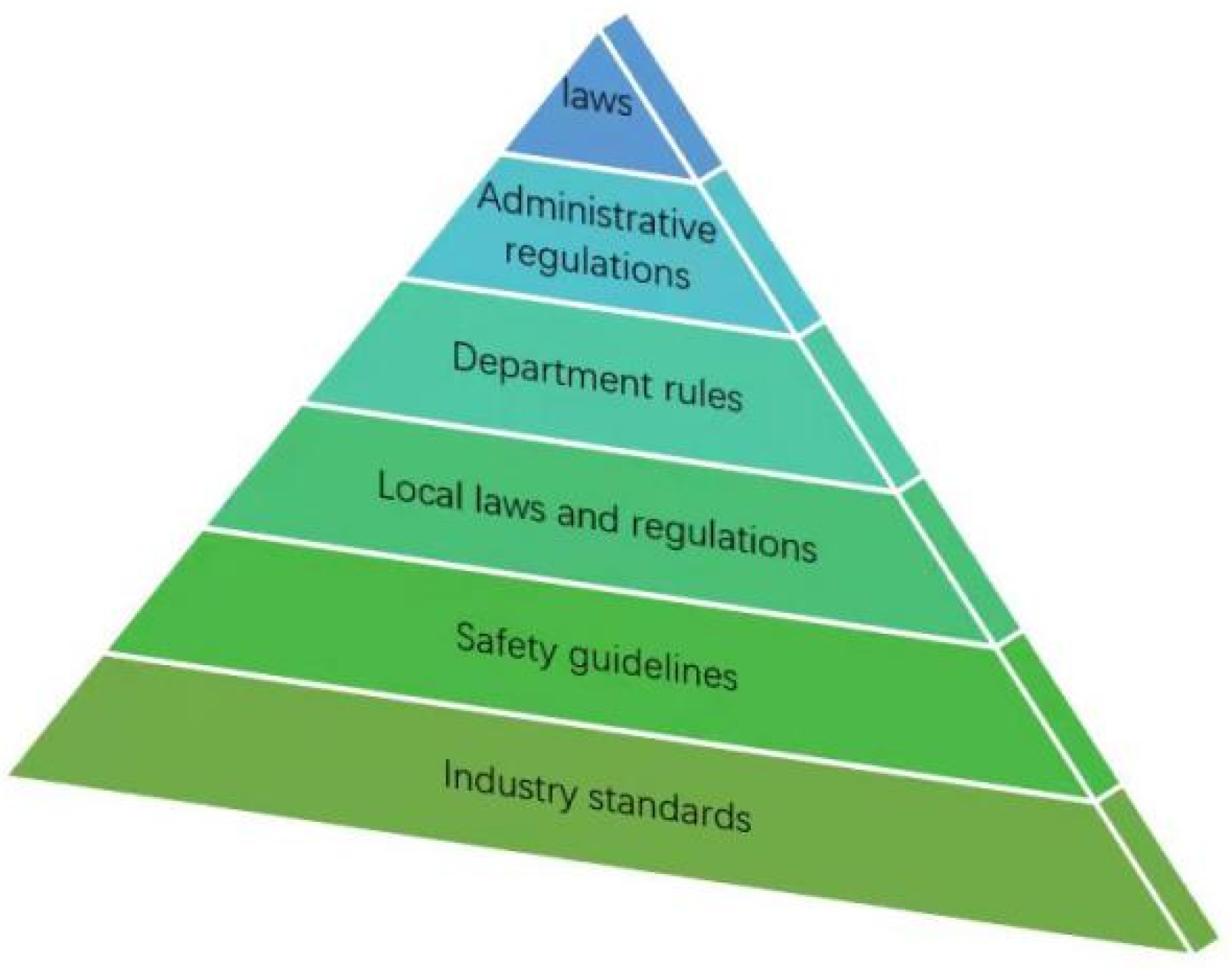
China has established a sound legal system for commercial nuclear energy with interconnected and complementary laws, administrative regulations, department rules, and safety guidelines (see
Figure 1). Despite nearly 40 years from the initial development, some early versions are still in effect today, such as
Radiation Health Protection Standards for Nuclear Power Plants issued by formerly Ministry of Health (now integrated into the National Health and Family Planning Commission) in 1984, demonstrating the high standard of these regulations. A brief review together with the normative analysis of the laws, regulations and other existing regulatory documents can clarify the core framework of the legal system for commercial nuclear energy in China.
2.1. Beginning Period of the Legal System of Commercial Nuclear Energy
In 1985, China’s first nuclear power plant, the first phase of the Qinshan Nuclear Power Plant, started construction, followed by the second and third phases and the Fangjiashan Nuclear Power Plant. Stronger institutional management of nuclear use and unified standards for nuclear safety were the early regulatory goals. In the 1990s, the strategic objectives of China’s nuclear safety include “establishing a nuclear safety supervision and management system in accordance with international nuclear safety standards along with supervision and management models, and implementing independent nuclear safety supervision”. Following international practice refers to meeting the safety supervision level of developed countries in nuclear energy use through legal means.
China’s early legal focuses were institutional organization, safe use and emergency response to nuclear accidents. In terms of institutional organization, the State Council established the National Nuclear Safety Administration in 1984 to review, supervise and manage nuclear safety of civil facilities. Currently, this authority is still dominant in China’s nuclear and radiation safety, particularly regulation and management of nuclear facilities and nuclear technology applications, as well as work such as emergency response to nuclear accidents. It was indeed a significant step to legalize and set legal procedures for China’s nuclear safety management through this authority. The National Nuclear Safety Administration was committed to nuclear safety examination and approval systems and nuclear safety review procedures at the early stage, and was influenced by regulatory guides developed by the United States’ NRC (Nuclear Regulatory Commission) and other nuclear power plants’ safety regulations such as ASME code. The introduction and implementation of these regulatory rules played an important role in introducing and building nuclear power plants in China in the 1990s.
Next, for safe use, the State Council enacted two of China’s earliest regulations on nuclear energy safety supervision, specifically Regulations on the Supervision and Administration of Civil Nuclear Facilities in 1986 and Regulations on Nuclear Material Control in 1987, which have been amended several times and still have legal effect as of today. These two regulations legalized nuclear material types under national control, assigned specific responsibilities to the supervision and management departments, and clarified penalties in case of violations. The former Ministry of Health issued Radiation Protection Standards for Nuclear Power Plants in 1984, and the National Nuclear Safety Administration issued Safety Regulations for Radioactive Waste from Nuclear Power Plants, Safety Regulations for the Operation of Nuclear Power Plants and Safety Regulations for the Management of Radioactive Waste from Nuclear Power Plants in 1991. These rules and regulations constituted the main content of the early legal system of China’s commercial nuclear energy.
Finally, in response to public emergencies such as the Chernobyl disaster, the State Council established the National Nuclear Accident Emergency Committee in 1991 and issued Regulations on Emergency Measures for Nuclear Accidents at Nuclear Power Plants in 1993. Then the State Council established the National Nuclear Accident Emergency Coordination Committee in 1993 to integrate various departments to deal with potential nuclear accidents. In addition, the former Ministry of Health issued Regulations on Medical Response to Nuclear Accidents in 1994, which preliminarily established corresponding nuclear emergencies.
2.2. Growth Period of the Legal System of Commercial Nuclear Energy
In 2003, Radioactive Pollution Prevention and Control Law was approved and implemented, marking the practically rule by law of nuclear as a sector law along with upgraded nuclear safety and nuclear regulation by law. This law incorporates the whole process from the development and utilization of nuclear fuel to the decommissioning and disposal of nuclear equipment into the legal framework, mainly on the disposal of decommissioned nuclear facilities, the supervision of radioactive sources, nuclear waste and radioactive mines. Moreover, it also regulates the environmental impact assessment of nuclear facilities, the combination of national supervisory monitoring and self-monitoring of nuclear facility operating units, and national financial support, greatly enhancing China’s legal system in nuclear safety. During this period, regulations such as Regulations on the Safety Management of Radioactive Material Transportation, Measures for the Administration of Radioactive Drugs, and Regulations on the Supervision and Administration of Civilian Nuclear Safety Equipment were introduced, which was another big step forward. In terms of emergency response, National Nuclear Emergency Response Plan was issued in 2006, and in 2009, the former Ministry of Health issued the Health Emergency Response Plan for Nuclear and Radiation Accidents, which clearly stipulates corresponding responsibilities, response procedures and restoration of order in the event of nuclear emergencies at different levels.
2.3. Maturity Period of the Legal System of Commercial Nuclear Energy
As of June 2016, China has 31 nuclear power units in operation and 23 nuclear power units under construction but without specific laws to integrate nuclear safety rules and regulations to clarify safety responsibilities, establish a nuclear safety regulatory system and define the functions between nuclear operations and nuclear supervision. Therefore, China started to research and develop relevant basic laws in 2016. The Nuclear Safety Law of the People’s Republic of China was approved in 2017 and then fully implemented on 1 January 2018, marking a more mature rule of law in commercial nuclear energy. During this period, Regulations on the Supervision and Administration of Civilian Nuclear Safety Equipment were revised, and the Ministry of Ecology and Environment researched and developed department rules such as Regulations on Safety Licensing Procedures for Nuclear Power Plants, Research Reactors, and Nuclear Fuel Cycle Facilities, and Regulations on Nuclear Safety Reporting for Nuclear Power Plant Operating Units. By the end of 2021, China had formed a legal system guided by Nuclear Safety Law, dominated by Radioactive Pollution Prevention and Control Law and nine administrative regulations and supported by more than 30 department rules and regulations with more than one thousand nuclear safety guidelines and technical documents, covering the complete industrial process from the development of radioactive mineral resources to nuclear waste disposal.
The fundamental and comprehensive Atomic Energy Law that regulates all activities of relevant research, development and peaceful use in China was on the agenda during this period. It would serve as a basic law in China’s commercial nuclear energy above all other related laws, regulations or departmental rules, thus ensuring greater authority and stability to protect the interests of construction, operation and safety of commercial nuclear facilities.
3. Key Areas of The Current Chinese Commercial Nuclear Energy Rule of Law System
From the history of the development of China’s commercial nuclear energy rule of law system, it is clear that relevant legislations on commercial nuclear energy becomes more “centralized”. Compared to the United States’ unified Atomic Energy Act in 1946, China’s regulatory legislations were based on actual situations, that is, China began its efforts on universally feasible legal documents until certain results had been made in nuclear industry, such as the Radioactive Pollution Prevention and Control Law and Nuclear Safety Law. Therefore, the developing supervision and regulation rules have three key focuses, namely institutional organization, nuclear safety licensing and radioactive waste disposal. Among these areas, current policies are intended to meet actual needs, but there is still some room for improvement.
3.1. Nuclear Safety Regulatory Institution System
After institutional reforms in 2018, China’s regulatory power of commercial nuclear energy was divided to three parts. Firstly, the China Atomic Energy Authority under the Ministry of Industry and Information Technology. It is the chief nuclear authority for researching and formulating policies, regulations, development plans and industry standards for peaceful nuclear utilization, verification, examination and approval of nuclear energy projects other than electricity generation, nuclear security and nuclear material management, review and management of nuclear import and export, as well as nuclear accident response and decommissioning of nuclear facilities. Secondly, the National Energy Administration for nuclear power projects. It is primarily responsible for drafting and implementing nuclear power development plans, projects and policies, as well as organizing emergency reposes to nuclear power plant accidents. Lastly, National Nuclear Safety Administration. Its subordinate departments cover the safety supervision and management of nuclear facilities, electricity generation and radiation sources. Apart from supervision and management of nuclear and radiation safety nationwide, this authority also formulates relevant policies, plans and standards, leads the work related to the coordination mechanism of nuclear safety, and participates in the emergency responses to nuclear accidents. It is also responsible for emergency responses to environmental disasters due to radiation, supervision and management of nuclear facilities, radioactive sources together with pollution prevention related to nuclear facilities, nuclear technology applications, electromagnetic radiation, development and utilization of radioactive mineral resources.
These authorities and specific functions have been recognized by China’s top legislative body, the National People’s Congress, which legalizes their due powers. In addition to technology development, the Chinese government also stresses scientific and independent nature of regulatory bodies to avoid overlapped duties or inaction to better ensure nuclear safety.
3.2. Nuclear Safety Licensing System
A nuclear safety license is a legal document for the applicant’s activities regarding nuclear safety (such as site selection, construction, debugging, operation, decommissioning of nuclear power plants, etc.) approved by the State Council’s supervision and management department of nuclear safety [
2]. The core objective of such a licensing system is to set industry access through administrative permission for more professional and technical nuclear safety activities together with greater efficiency of relevant risk prevention and control. The former Ministry of Health and Ministry of Nuclear Industry proposed
Announcement on Issuing the License for the Production and Operation of Radioactive Drugs in 1987, which was a substantial step despite inadequate relevance regarding nuclear energy. Since then, licensing systems for nuclear energy appeared, including individual qualifications for such as nuclear safety engineers or civilian nuclear facility operators along with licenses for legal persons to manufacture civilian nuclear safety equipment. All safety licenses are issued for four aspects, namely nuclear facilities, nuclear activities, nuclear substances and practitioners. As of February 2022, the administrative licenses issued by the National Nuclear Safety Administration totals 19 items. Such a licensing system contributes to both the “bottom line” for safe nuclear operation and upgrading nuclear technologies. Consider licensing for designing civilian nuclear safety equipment as an example, administrative licensing has greatly welcomed international companies from countries such as France, the United States and Germany to be designers of civilian nuclear safety equipment in China, jointly improving the technical level accordingly.
3.3. Legal System of Radioactive Nuclear Waste Disposal
There is still no consensus about how to define radioactive nuclear waste in the nuclear physics community, but as Nuclear Safety Law comes into effect, radioactive waste risks surely need legal explanations. Around the 1990s, the National Nuclear Safety Administration formulated regulatory documents such as Safety Regulations for Radioactive Waste Management in Nuclear Power Plants, to regulate relevant risks in a decentralized manner. In 2006, China gained accessed to the International Atomic Energy Agency’s Joint Convention on the Safety of Spent Fuel Management and on the Safety of Radioactive Waste Management. As China’s commercial nuclear industry grows, 2017 Nuclear Safety Law integrates radioactive waste disposal practices in different fields and clarifies radioactive wastes. According to Article 2, “Radioactive wastes refer to those generated from operating and decommissioning nuclear facilities, containing or contaminated with radiosondes, whose concentration or specific activity is higher than national standards for future uses.” In addition, this law also has a special section to build up the basic legal framework for nuclear waste disposal, providing legal references for issues such as the classification and disposal of radioactive waste, safety standards for radioactive waste disposal at a macro level, licensing for radioactive waste management, and termination of radioactive waste disposal settings. Moreover, the State Council also issued Regulations on the Safe Management of Radioactive Waste in this aspect. Under the guidance of various systems designed by Nuclear Safety Law, the National Nuclear Safety Administration and other relevant agencies have issued technical guidelines such as Minimization of Radioactive Waste at Nuclear Facilities. Certainly, the disposal of radioactive nuclear waste is crucial to China’s legal efforts in commercial nuclear energy, and the “permanent safety” principle clarified legally demonstrates the government’s high level of intent and strict supervision.
3.4. Legal System of Radioactive Nuclear Waste Disposal
Exploitation and utilization of nuclear materials are a natural part in nuclear regulation designs. In 1987, the State Council enacted Regulations on Nuclear Material Control, which clarifies nuclear materials such as uranium-235 and authorized the State Council to declare certain nuclear materials under control when necessary. At the same time, this regulation also initiated a licensing system for nuclear materials and clarified responsible safety supervision and management authority. Although remaining in effect, this version which was issued 35 years ago is no longer a perfect match for current regulatory needs. For example, Articles 7 and 8 stipulate that “the National Nuclear Safety Administration shall be responsible for the safety supervision of civilian nuclear materials” and “the Ministry of Nuclear Industry shall be responsible for the management of nuclear materials nationwide”. These articles do not clarify corresponding regulatory responsibilities, especially with disagreements among different authorities on specific issues. Additionally, there is no authority named the Ministry of Nuclear Industry, thus the Article 8 is invalid.
Furthermore, Nuclear Safety Law also narrows the scope of nuclear materials, deleting items such as Tritium, materials and products containing tritium or lithium-6. However, the former licensing system in Nuclear Safety Law, along with the license application process, conditions for license application, and license withdrawal in Regulation on Nuclear Material Control still remain effective. In addition, the National Nuclear Safety Administration enacted Implementing Rules of the Nuclear Material Control Regulations in 1990. In 2008, the Standing Committee of the National People’s Congress approved China’s access to the Convention on the Physical Protection of Nuclear Material led by International Atomic Energy Agency. Since then, a sound regulation system for nuclear materials has been in effect, in accordance with the definition of nuclear materials regulated by Nuclear Safety Law, so that the sale, transportation, use and disposal of nuclear materials all have legal references and greatly secured healthy growth in China’s commercial nuclear industry.
4. Existing Problems of Legal System for Commercial Nuclear Energy in China
Although China has made significant legal progress in nuclear energy regulation, there are still disparities between the legal system and the actual needs. Concerning the legal integrity, there is an inefficient legal system without fundamental atomic energy law in China’s nuclear industry; next, complicated organic systems result in relatively high costs; finally, inadequate supervision on regulatory bodies is a severe potential safety risk when deciding complex interests.
4.1. Inefficient Legal System
No Atomic Energy Law demonstrates an inefficient legal system in China’s commercial nuclear regulations. Actual situations are necessary to activate corresponding laws. In the early stage, China had no urgent need for a comprehensive atomic energy law that integrates nuclear technology developments and commercial nuclear regulations. However, this industry has grown larger and stronger, being a top nuclear power worldwide in the research and development of nuclear technologies and nuclear facility operation. By the end of 2020, China’s installed capacity of nuclear power units under construction topped globally, and a total of 48 commercial nuclear units were also ranked third only after the United States and France [
3]. However, China is the only major nuclear power without an atomic energy law in force. In 2021, this law has been on the legislative agenda of China’s top legislative body and is expected to be formally approved and implemented in 2022. Typically, relevant major issues must be coordinated and regulated accordingly. Firstly, functions and powers among concerned authorities; secondly, top-level design for nuclear energy exports and the Chinese version of
Nuclear Export Control List; and finally, more specified means and effectiveness of information disclosure and public communication on nuclear facilities. In response,
Atomic Energy Law (Draft) has these answers. For example, in terms of functions and powers, the National People’s Congress made corresponding efforts by designating the State Administration of Science, Technology and Industry for National Defense to be responsible for nuclear industry, National Nuclear Safety Administration for nuclear safety, and National Energy Administration for nuclear energy.
Another aspect of an inefficient legal system is inadequate legal guarantees, or policy adjustments which may have negative influence on nuclear development and utilization. Considering peak regulation as an example, less legal protections on nuclear power is not in line with the principle of economic benefits and interest of safe development of nuclear power. In February 2022, the National Development and Reform Commission and the National Energy Administration issued
Several Opinions on Improving the Systems, Mechanisms, Policies and Measures for Green and Low-carbon Energy Transition, which requires that photovoltaic power, wind power and other clean energy should be developed as much as possible. This policy certainly prioritizes new energy, but also definitely put more pressure on nuclear power concerning peak regulations. Currently, nuclear energy accounts for less than 5% of the total electricity in China, which is far lower than the average level in other global counterparts. The full-load operation of nuclear power plants makes little difference in the power grid. For technical safety, long-term low-power operation and frequent peak adjustments will reduce equipment reliability, damage fuel assembly or more [
4]. From an economic aspect, lower utilization rates of nuclear fuel and the subsequent higher costs on aspects such as spent fuel disposal significantly affect the economic efficiency of nuclear power [
5,
6]. The current policy system for nuclear power development tends to emphasize the “electricity generation” rather than the “nuclear” aspect. In light of foreign nuclear development, limited development scale and higher efficiency is also a possible solution [
7]. Priority should be given to nuclear electricity in basic laws towards higher generation efficiency and less processing pressure of spent nuclear fuel later. With these in mind, some Chinese scholars in the energy field have proposed to clarify nuclear power’s significance as a fundamental power source when formulating
Atomic Energy Law, other relevant laws and regulations as well as power development plans [
8,
9,
10,
11].
4.2. Complicated Organic Legal Framework for Nuclear Energy Regulation
In terms of regulating commercial nuclear utilization in China, joint efforts by three specialized institutions, namely the State Atomic Energy Agency, the National Energy Administration and the National Nuclear Safety Administration will result in certain functional overlap and confusion.
On the one hand, the relationship between specialized institutions and external institutions is complicated. Under the current system, to regulate nuclear power, enterprises should clarify the relationship between the specialized regulatory institutions and enterprise regulator State-owned Assets Supervision and Administration Commission, as well as with the macro-regulatory body of nuclear power development and investment, the National Development and the Reform Commission. For example, concerning nuclear development planning, the State Atomic Energy Agency and the National Energy Administration may have responsibility overlaps, in addition to the National Development and the Reform Commission’s moves for major development strategies and plans. In addition, nuclear industry management and nuclear safety regulation also involve cooperation and coordination with science and technology, public safety, transportation, land and public health departments. Such institutional coordination has led to cooperation in partial commercial nuclear sectors and no presence considering modest benefits or unclear responsibilities. The Chinese government proposed the atomic energy law plan in 1984, which was formally recognized by the National People’s Congress in 2013 but has not yet been enacted. One important reason is that many institutional reforms led to responsible authorities of nuclear industry and institutional costs from management by multiple parties. Therefore, updating traditional regulatory system is the key issue to be addressed by future Atomic Energy Law.
On the other hand, unclear functions and powers of three specialized regulators, for example, in development, management, and utilization of uranium resources, the responsibilities of National Energy Administration and National Atomic Energy Agency are not clear, and they both have certain planning and management powers. In Nuclear Safety Law, liability provisions on nuclear accidents are always for operators of nuclear facilities and their staff, with very few on the liability that shall be borne by regulatory institutions. In addition, for emergency response to nuclear accidents, the National Nuclear Emergency Plan does not clearly specify the responsibilities of different institutions. Meanwhile, after the institutional reform of State Council in 2018, there is still no legal basis for the responsible party to provide an emergency response to nuclear accidents. Therefore, there is an urgent need to amend the plan to further clarify authorities and responsibilities to better deal with potential nuclear accidents.
4.3. Inadequate Supervision and Restriction on Regulatory Authorities
The highly professional feature in nuclear energy leads to extremely high legislative costs, and legislators (such as the National People’s Congress) have high dependence on administrative authorities and industrial associations in the legislative process. Due to these reasons, the specialized authorities’ wide powers of both nuclear energy development and utilization and regulations are difficult to efficiently self-supervise. Therefore, supervision and restrictions over regulatory authorities are particularly important. For example, the National Atomic Energy Agency has both a General Affairs Division and a Development Planning Division which are involved in the development and utilization of nuclear energy, along with the Nuclear Emergency Response Division and Nuclear Safety Division, therefore a conflict of interest regarding safety and development is not impossible.
On the one hand, the judicial organ has limited reach in relevant administrative power. From a comparative law perspective, Japan’s nuclear power litigation develops a relatively mature model of judicial review over constructing and operating nuclear facilities. Lawsuits concerning nuclear power in Japan are common. Since the 1970s, civil and administrative lawsuits have been filed constantly, demanding the withdrawal of nuclear reactor setup permits, prohibition of construction or operation, as well as compensation for damaged health. Although there are only two rulings in favor of the plaintiff, the courts have developed a judicial framework for reviewing and restricting issues such as construction, site selection and licensing procedures of nuclear reactors based on established legal systems and professional judgments. The Ikata nuclear power lawsuit is the first administrative lawsuit in Japan to directly aim at the nuclear reactor permit, which lasted nearly 20 years from the local courts to the Japanese Supreme Court. The safety review over nuclear reactor facilities in that case involved judicial judgment on whether the highly professional nuclear power technology is safe and the site of nuclear reactors is scientific. Moreover, in the German judicial system, a special judicial review has gradually been formed around nuclear energy regulation. The Federal Administrative Court of Germany held that nuclear regulation under Article 7 of the German Atomic Energy Act embodies a risk prevention feature different from the danger prevention in traditional police law. While in China’s administrative legal system, although there are relatively mature nuclear regulations, and provisions such as Article 20 of the Nuclear Safety Law also entail room for judicial discretion, concerned administrative litigation is very rare. As a result, the judicial organs are unable to review and check the decisions by administrative authorities responsible for nuclear safety regulation. According to China’s administrative procedure law system, official documents issued by the Nuclear Safety Administration and other special regulators are inferior to regulations, which can be reviewed by court in specific administrative litigation cases. However, as few citizens filed administrative lawsuits, it is difficult to initiate the review and restrictions over these abstract documents.
On the other hand, the supervision by the National People’s Congress can hardly be efficient restraints on concerned administrative power. Such supervision is empowered by the Constitution for a democratic body to supervise the administrative and judicial organs.
Firstly, it is difficult to supervise China’s nuclear energy development plan and its investment budget. Nuclear energy utilization is often included in China’s five-year plans considering investment and technical complexity. For example, the 12th Five-year Plan for 2011 to 2015 approved 11 more nuclear power plant units, including Units 3 and 4 of the Tianwan Nuclear Power Plant, and development of new nuclear technologies, etc. The supervision by the National People’s Congress over the five-year plan is its focus, verifying the development plan and budget size proposed by the government. However, such supervision is the overall monitoring and final decision, rather than a detailed review, so the substantive steps in the nuclear plan and budget are often approved together with other issues as a “package”.
Secondly, highly professional features and a high inspection threshold hinders the National People’s Congress to conduct targeted law enforcement inspection and special work reports in nuclear energy utilization. Article 22 of Law on the Supervision of Standing Committees of People’s Congresses at Various Levels authorizes the standing committees to carry out a law enforcement inspection each year and inspect the implementation of partial laws and regulations. However, so far, the Standing Committee of the National People’s Congress and the standing committees of people’s congresses at various levels had very few relevant activities. The main reason is that highly professional content is difficult for members of the standing committees to access, thus delaying due law enforcement inspection and corresponding solutions. Meanwhile, work reports are also an important way for the National People’s Congress to supervise, especially for the nuclear energy field. However, the Standing Committee of the National People’s Congress has never heard of any special work report by the nuclear energy regulatory institutions such as the State Atomic Energy Agency. Partially, nuclear energy is still new to the general public in China and there is no adequate system and mechanism to disclose specific problems in nuclear energy regulation, resulting in a lack of attention from the institutions within the people’s congresses. On the other hand, nuclear energy enterprises are state-owned enterprises, so they prefer reporting to seniors, then negotiating and coordinating regulation issues within the government rather than with external organs of the people’s congresses to initiate the supervisory mechanism.
5. Relevant Foreign Legal Systems of Commercial Nuclear Energy and Their Implications for China
Nuclear power generation figures of China, U.S., Japan and South Korea from 2016 to 2020 are shown in
Table 2 below. According to this Figure, from 2016 to 2020, only China saw steady growth in nuclear power generation, with an upward trend after 2018 in South Korea along with increases and decreases in U.S. and Japan. However, the other three countries have a relatively complete legal systems of commercial nuclear energy, together with legal experience of nuclear safety and governance. Especially facing a near standstill after the Fukushima nuclear disaster, Japan’s legislative responses to ensure nuclear safety is particularly noteworthy.
5.1. U.S. Commercial Nuclear Energy Law
The number of operating nuclear power facilities in the U.S. (114) ranks first in the world, with an almost equal sum of that in France (58; ranks second) and Japan (55; ranks third) combined. Similar to China, the U.S. legal system of commercial nuclear energy has several phases. After World War II, the U.S. entered the first major phase from 1954 to 1992. In nearly 40 years, the U.S. basically determined relevant legal framework and major responsible authorities. In 1946, President Truman signed the Atomic Energy Act, which ushered in a new era of regulating nuclear energy development through legal tools to ensure safety. Substantial amendments of this Act were made in 1954 to permit private sector’s utilization of nuclear technologies and establishment of commercial nuclear facilities, but particularly, under strong government regulations. Additionally, due to such authorization to the private sector, the U.S. witnessed rapid development in commercial nuclear energy accordingly. Then in 1974, the Congress passed the Energy Reorganization Act to establish the key regulator Energy Reorganization Commission (NRC), which remains the most important agency of daily regulations and new licensing now. In 1978, the Nuclear Non-Proliferation Act was approved by the Congress, empowering the NRC to license and regulate exports of nuclear technologies and materials. In addition, disposal and regulation of nuclear wastes should refer to the Uranium Mill Tailings Radiation Control Act passed in 1978 and the Nuclear Waste Policy Act passed in 1982. The former of which was designed to establish legally effective cleanup standards and disposal plans for abandoned uranium mines to ensure they met environmental protection standards; and the latter (as well as its 1985 Amendment) provides the legal framework for determining federal and state responsibilities of handling low-level radioactive waste.
In 1992, the radiation protection standards of nuclear waste repository were promulgated in Section 801 of the Energy Policy Act. From then, until 2005, there was almost no significant nuclear energy legislation for 13 years. The aftermath of the 1979 Three Mile Island accident and the Chernobyl nuclear disaster halted American emerging nuclear facilities in the 1980s. However, the U.S. passed the Energy Policy Act in 2005, which has become the most significant nuclear energy legislation of the 21st century. This Act aims to stimulate and promote commercial nuclear development in the U.S. through methods such as more financing channels or tax incentives and exemptions to both business investors and nuclear power consumers.
5.2. Japan’s Commercial Nuclear Energy Law
As an Asia nuclear giant, Japan’s nuclear industry began in 1966, which accounts for around 30% of its total energy in the long run. As a typical country with the civil law system, Japan’s nuclear energy legal system is also an organic system consisting of the Atomic Energy Basic Act, single file laws, policies and regulations. First of all, the importance of the Atomic Energy Basic Act in regulating the entire nuclear industry is indisputable. Such act established the basic regulation framework, the Nuclear Regulation Authority and the Atomic Energy Commission, and granted its Congress the power to issue detailed rules based on provisions of the Basic Act. Secondly, the Reactor Regulation Act is a distinctive law in this aspect. One distinctive feature is that the refined and finalized reactor construction procedures and safety standards are specified in laws to ensure at least required minimum safety in constructing and operating nuclear reactors. Moreover, the Reactor Regulation Act contains detailed provisions regulating various aspects of reactor operation, from uranium mines smelting to nuclear waste disposal. Finally, the Nuclear Emergency Act was amended substantially in 2012 considering the Fukushima nuclear disaster. The amendment focused on the new design that in the event of a nuclear emergency, the Nuclear Regulation Authority (NRA) shall report directly to the prime minister and give an early warning. In addition, Japan’s nuclear legal system also has more sections including the Radiation Hazards Prevention Act and the Act on Final Disposal of High-Level Radioactive Waste.
5.3. South Korea’s Commercial Nuclear Energy Law
Neighboring to China, South Korea has a relatively high proportion of nuclear power contributing to the energy grid and a similar five-year long-term development plan regarding nuclear power. Therefore, its relevant legal system of nuclear energy can serve as references for further studies. Compared with other major players, South Korea is a late starter as they constructed their first nuclear power plant in 1971 and began operation in 1978. However, South Korea is also a pace-setter in legal efforts to boost nuclear development with the Atomic Energy Act in 1958, the Office of Atomic Energy in 1959 along with valid development plans since 1962.
Similar to China, South Korea has four legal levels according to effects in commercial nuclear power. The Atomic Energy Act has top priority. It serves as both an organic law to authorize the Nuclear Safety Commission as major nuclear safety regulator and a behavior law to design all details for the whole life cycle of nuclear utilization, licensing and planning. That is, no relevant laws shall conflict with the Atomic Energy Act. The next level refers to relevant laws on key issues and matters. For example, the Law on the Management of Radioactive Waste provides institutions and procedures for radioactive waste disposal, and the Law on Nuclear Damage Compensation covers issues such as determination of liabilities for damages caused by nuclear accidents, organs responsible for compensation and compensation procedures. There are plenty of such laws including the Nuclear Liability Act, the Act on Safeguards and Physical Protection of Nuclear Installations and Korea Institute of Nuclear Safety Act. Moreover, the lower two levels include regulations, technical standards and safety guidelines issued by the top nuclear authority, the Ministry of Science and Technology. These legal documents emphasize more on scientific and technical aspects rather than conflict of interests and balance of values to be resolved by a democratic parliament. In other words, there documents are mainly to provide further regulations on mechanisms and procedures of various laws that must be written in detail.
5.4. Comparison of Nuclear Laws in U.S., Japan, South Korea and China
5.4.1. Comparison with U.S.
One important lesson from the U.S. is to promote commercial nuclear leap through legal efforts. At the very beginning of emerging nuclear technologies in 1952, much of the technology were an official secret. However, the U.S. Atomic Energy Act had already authorized some private enterprises to develop commercial nuclear energy, laying the foundation for the U.S. to be the largest nuclear giant globally. In 2005, the Energy Policy Act had same effect, invigorating the stagnant U.S. nuclear industry. In contrast, China’s legal system often fails to lead nuclear development, but instead, remedy urgent problems facing developing nuclear technologies and nuclear power facilities. For example, in respect of the safe disposal of nuclear wastes, it was not until 2017 when China passed the Nuclear Safety Law to unify the core legal provisions such as standards for the disposal of different nuclear wastes and license management.
Since 2014, China’s State Council launched a plan to encourage private investments in nuclear equipment research and nuclear power services. However, compared with bold explorations of commercial nuclear power in the U.S. since the 1950s, China’s legislation is still blank. The American practices are precious lessons to equally protect private and state-owned capitals in providing nuclear power equipment and services, as well as in fully market-oriented nuclear-related sectors.
5.4.2. Comparison with Japan
Japan’s legal practices have two aspects that China can learn from. Firstly, high-level expertise. Apart from various professional agencies, Japan’s Atomic Energy Commission clarified quite a lot of technical support units through the Atomic Energy Basic Act and other laws, such as the Japan Atomic Energy Research Institute and the Nuclear Power Engineering Center (NUPEC). On the one hand, these professional supporting institutions are more acutely aware of the cutting-edge technologies in specific fields and can play the role of advisors in decision making. On the other hand, they are part of matters such as nuclear facilities’ site selections and nuclear safety evaluation, which indirectly recheck and restrict the evaluations by nuclear safety authorities.
Secondly, the new regulatory body. Learning from the Fukushima nuclear disaster, the amendment to the Nuclear Material and Reactor Regulation Act passed in 2012 has enabled nuclear safety agency to be separated from the nuclear development administration, setting up a new regulator, the Atomic Energy Safety Agency. The new regulatory agency has an independent decision-making power and takes charge of national nuclear safety affairs without being influence by other chief executives. It also integrates powers of other agencies in collecting and monitoring information related to nuclear safety, such as the power to monitor nuclear radiation. As an important measure to reflect on the Fukushima nuclear disaster, this is the latest legislative example in comparative law on the establishment of an independent regulatory agency to be in charge of nuclear energy safety, and can be a good reference for China’s legislation to upgrade the nuclear safety agency to be more independent and professional.
5.4.3. Comparison with South Korea
There are also two aspects from South Korea’s legal experience that would benefit China. Firstly, more emphasis on the organic law guarantee of nuclear energy development. The Atomic Energy Act grants a very high administrative level for the Nuclear Safety Commission, so that it can effectively coordinate the scientific and technological departments, energy departments, environmental protection departments, financial departments and other agencies to provide support for the research and development of nuclear technologies and nuclear facility construction. It is fair to say that South Korea’s highly developed nuclear power industry relies on an institutional guarantee provided by the Atomic Energy Act and joint efforts of agencies at the organizational level.
Secondly, with respect to compensations for nuclear accidents, South Korea designed extremely detailed systems and procedures to ensure that citizens can receive full compensations promptly after accidents. Relevant laws include the Law on Nuclear Damage Compensation, the Amendment to the Law on Nuclear Damage Compensation and the Law on Nuclear Damage Compensation Agreement. Specifically, the Law on Nuclear Damage Compensation establishes a high liability insurance limit, and the Law on Nuclear Damage Compensation Agreement specifies liabilities for compensation amounts beyond the insurance limit, further requiring shared liability by the government and concerned nuclear operators. The compensation mechanisms have remained to be optimized in China’s system, so South Korea’s experience shall serve as important references for China’s future legal moves in damage compensation law.
6. Suggestions on Improving the Rule of Law System for Commercial Nuclear Energy in China
To upgrade the legal system regarding commercial nuclear energy in China, a step-by-step legislative plan based on current laws should be adopted. It is believed that better-organized organic law of the regulatory system is not only decided by the legal system, but also depends on the balance and opinions from the political side. To this end, firstly, Atomic Energy Law is a key step towards more systematic commercial nuclear regulations; secondly, the crucial licensing system can be further updated for safer nuclear facilities through safety management licensing system; thirdly, more policy support to nuclear emergencies is likely to develop capability in risk prevention.
6.1. Legislative Suggestions on Perfecting the Rule of Law System for Commercial Nuclear Energy
Firstly, Atomic Energy Law should be enacted as soon as possible. As part of National People’s Congress’ legislative plan in 2022, this law serves as the top-level design of basic systems for nuclear safety, emergency response, nuclear security, damage compensation, nuclear import and export, nuclear mineral development, nuclear waste disposal, etc. More specifically, top priority should be given to clarified responsibilities among responsible regulators. Next, independence of the nuclear safety supervision department should be further emphasized, together with the relationship between this law and the Nuclear Safety Law in regulatory powers. In addition, revision work matters greatly among various legal sectors in commercial nuclear energy. As a basic law of nuclear energy, other laws, regulations and official documents should be consistent with the norms and goals of Atomic Energy Law. Any conflict should be resolved and revised in a timely manner. In this way, the lack of a legal system will no longer be a problem. For example, to deal with negative effects from policy changes, the Atomic Energy Law can specify nuclear priorities, to better coordinate with policy adjustments such as local peak regulation. Article 35 stipulates that: “The electricity shall follow unified policies and pricing at different levels.” For nuclear power companies, higher cost due to benchmark pricing weakened nuclear power’s competitiveness with traditional thermal, wind, hydro and photovoltaic power, or in market peak regulation. Only by prioritizing nuclear power through this law to be free from local peak regulation at will can ensure safe and stable nuclear facilities along with lower nuclear power costs.
Secondly, improvements in department regulations, such as on the disposal of low-and-medium-level radioactive waste from commercial nuclear facilities. Now, there are such disposal facilities at their peak in areas including the Gansu Province. As China ranks number one in the world for nuclear power facilities under construction, it is natural to generate above-mentioned radioactive wastes. However, on the contrary, no legal references are available in site selection for waste disposal, the management of existing sites and their closures, etc.
Third, updates in industry standards and guidelines. So far, China has more than 300 industry standards and management guidelines for commercial nuclear utilization, yet these are still insufficient to meet practical needs and are far behind other international examples. Back to the above-mentioned disposal issue, its quality standards, the qualification and licensing standards and safety standards etc., all require updates, in addition to some contentious aspects, such as the relevant technical standards for miniature commercial nuclear reactors and the exploration of radioactive mineral deposits. Revision and adjustments of relevant technical standards based on actual nuclear technology development are conducive to fully implement these standards.
6.2. Suggestions on Improving the Safety Management Licensing System for Commercial Nuclear Energy
The licensing system is core to the safety regulation of nuclear facilities. Similar to practices in many highly specialized fields such as medical and technical ones, the licensing system for commercial nuclear utilization should draw both effective experience from administrative reforms in recent years and lessons of nuclear accidents. Based on the general principles of administrative licensing, the direction is to give full play to professional administrative licensing organs and invest regulatory resources in highly potential risks. As for license types, Article 8 of Regulations on Supervision and Management of the Safety of Civil Nuclear Facilities stipulates that: “The State implements a licensing system for the safety of nuclear facilities. The National Nuclear Safety Administration is responsible for the formulation, approval and issuance of safety permits for nuclear facilities. The permits include that for nuclear facility construction and operation, license for nuclear facility operators and other documents required for approval.” According to this article, nuclear facility operation permit is necessary for relevant enterprises. Additionally, in accordance with Article 12 of Regulations on Supervision and Management of the Safety of Civil Nuclear Facilities, the permit for nuclear facility construction and operation can be issued only after the selected sites have been approved by concerned urban and rural development and environmental protection departments and the planning departments of the State Council or of the people’s governments of provinces, autonomous regions or municipalities directly under the Central Government, as well as approved by the National Nuclear Safety Administration. Therefore, site selection is crucial to construct and operate nuclear facilities. However, this regulation has no amendments since being issued in 1986, the experience from the nuclear accidents such as the Fukushima nuclear power plant disaster has not influenced China’s system design.
On the one hand, the reform to “streamline administration and delegate power, improve regulation, and upgrade services” regarding administrative licensing has achieved comparatively good performance. This reform aims to change the traditional excessive attention to licensing rather than regulations, mobilize the regulatory enthusiasm of licensing authorities, improve the efficiency of administrative licensing processing, and to invest the limited administrative resources into regulating citizens and legal persons’ operations after obtaining licenses. The nuclear facility regulations should also comply with the trend of this administrative reform, promoting licensing authorities to utilize detailed information obtained during examining such nuclear facilities to strictly supervise facility operations, especially when there are any circumstances inconsistent with the license application during the actual operation.
On the other hand, it is necessary to establish a permit for nuclear facility’s site selection and conduct dynamic appraisals. It is clear according to the Regulations on Supervision and Management of the Safety of Civil Nuclear Facilities that nuclear site selection is part of the licensing for nuclear facility operation. However, in light of the Fukushima nuclear disaster, if climate change and geological movement, or unconsidered risk factors when selecting sites, are not specified in separate site selection licenses, remedies will not be prepared. Typically, the Fukushima nuclear power plant was a bad choice without considerations of tsunamis. Therefore, the licensing for nuclear site selection should be a separate part specified in laws. In terms of comparative law, legislative examples of separate licensing nuclear site selection are common. Temporary site selection licensing exists in German nuclear law system, and the United States also separately designs site selection licensing. In addition, licensing regulations should conduct yearly assessments, fully considering all potential risks including climatic factors, surrounding environment, along with the transportation of nuclear fuel and nuclear waste. Moreover, more assessments should be conducted on risk sources that have not been considered at the time of issuance. In this way, a conclusion can be drawn on whether the current site can fully guarantee the safety of nuclear facilities. When necessary, nuclear facilities should be closed down by withdrawing the permit.
6.3. Suggestions on Improving the Legal System of Emergency Response to Nuclear Accidents
Certainly, emergency response is an important part in commercial nuclear regulations. However, the existing relevant laws, such as the Regulations on the Administration of Emergency Responses to Nuclear Accidents of Nuclear Power Plants, has been promulgated for more than 30 years with merely one amendment in 2011. For authorities, the responsible department of emergency management set up by the Chinese government in 2018 will be the core force in this aspect but without legal statements of this important reform. To deal with it, official documents should be updated to clarify duties of the Central Government and local governments, responsible bodies and supporting organizations, as well as governmental and public organizations led by Ministry of Emergency Management, further defining powers and procedures of emergency management in response to nuclear accidents.
The key is to classify nuclear emergencies and response accordingly. On the one hand, classification to emergency response should be developed. Within department capacity, resources should be allocated according to priority, and furthermore, to design principle, personnel and technical means scientifically, together with recovery targets. As such a classified emergency mechanism is relevant to concerned departments’ functions and overall efficiency, which plays an important role in nuclear emergency framework that cannot be changed arbitrarily. On the other hand, a specific class should include different types of nuclear accidents. As the nuclear industry grows rapidly, new technologies are developed and applied to the commercial stage, so specific classifications should make dynamic adjustments following the latest developments. For example, small and micro reactors have been rapidly developed in recent years, but their safety and reliability are still under further verification. Emergency response mechanisms for nuclear accidents should take new potential risks and risk sources into consideration in a timely manner, thus shifting attention to well-solved risks to current priorities for better solutions and higher efficiency.