A Bibliometric Review on Decision Approaches for Clean Energy Systems under Uncertainty

 ,
,  ,
, 
Abstract
:1. Introduction
- Fuzzy sets are key concepts that are used for modeling uncertainty in the decision process associated with CES.
- Most of the literature studies obtain data as rating information in the Likert-scale form and transform them into fuzzy values to generate decisions.
- The criteria for such applications are competing and conflicting with one another, and the estimation of their relative importance is considered a crucial stage in the existing framework.
- Utility function-based formulation and distance measure-based formulation are popular in ranking CESs and their associated options.
- Earlier literature reviews have also claimed that the assessment of CESs using multi-criteria decision making (MCDM) will grow due to the nature of the problem and the efficacy of the method.
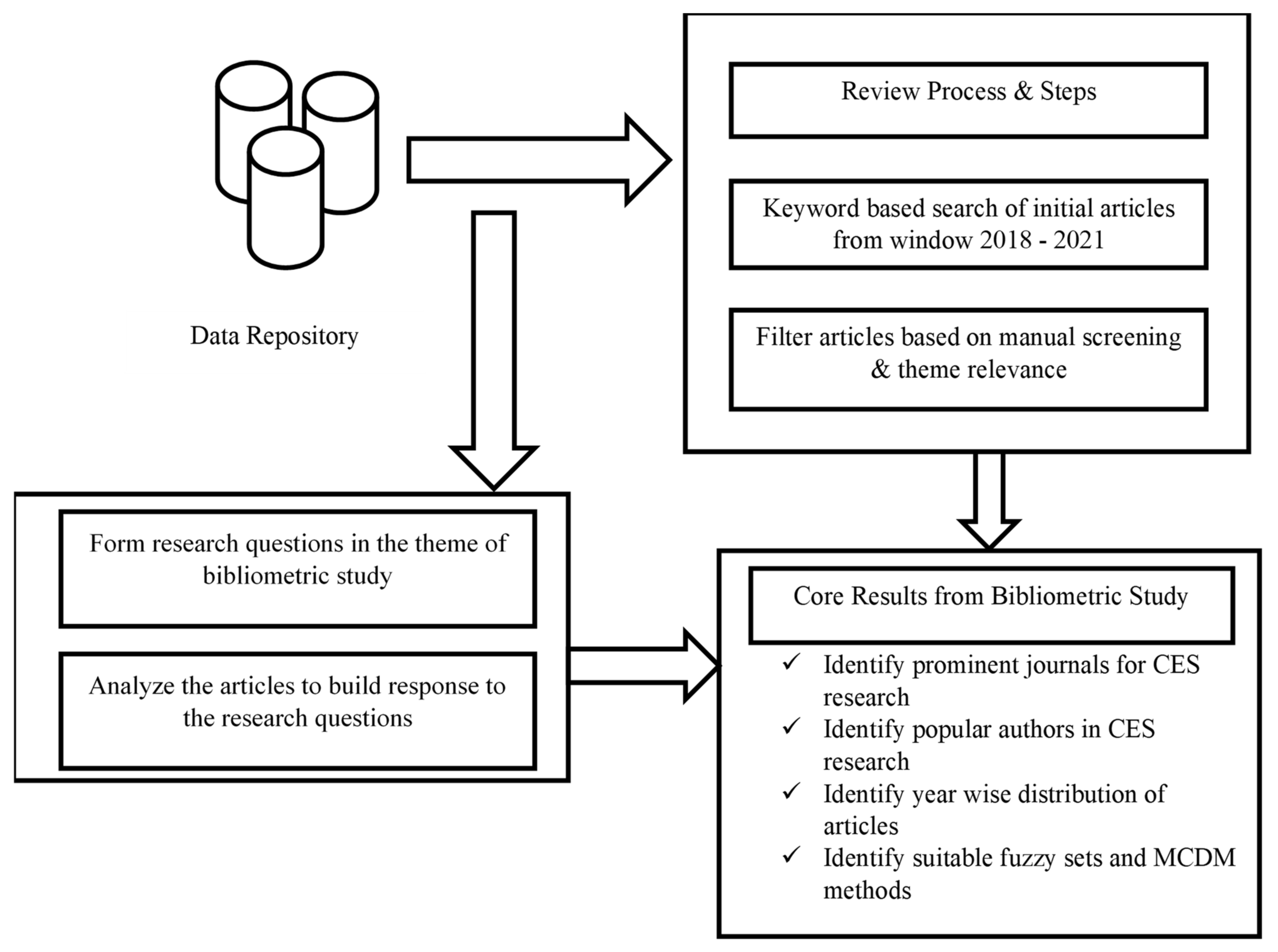
- Which countries prominently contributed to CES-related research based on the data collection by authors?
- Who are the prominent first authors in the CES assessment field based on the collected articles from 2018 to 2021?
- Which publisher and journal(s) dominate and attract articles in the theme of the review?
- What are the popular decision approaches used by researchers to assess CESs rationally?
- What fuzzy sets are prominently used by researchers for CES assessment?
- What are commonly adopted metrics to evaluate the superiority of the proposed decision framework in the current field of study?
- What are the prevalent application areas addressed by researchers in the CES field and what are the future challenges, and how does the future research intuitively look for the current field of study?
2. Decision Approaches and Fuzzy Sets for CES
2.1. Decision-Making Methods
2.2. Fuzzy Sets
3. Review Model
4. Results and Discussion
4.1. Response to RQs
4.2. Challenges in CES Evaluation for Future Research
- Another notable inference is that the authors commonly adopt AHP, VIKOR, and TOPSIS under fuzzy contexts (from Table 2) to gain rational decisions on the CES field. Variants of AHP are also commonly adopted. Researchers recently adopted integrated schemes where fuzzy set ideas are integrated with machine learning methods, which gained a lot of attention in the CES field. The net contribution from the review process is observed to be close to 50%.
- Furthermore, it can be inferred that the triangular fuzzy number is a popular fuzzy variant adopted by researchers as preference information in the CES field. The orthopair variants constitute around 32%, indicating the popularity of numeric decision making in the CES domain.
- Contributions from China and India to the field of CES are around 44%, with a prime focus on integrated decision approaches under the fuzzy context (from Table 4). The selection of apt energy sources for the demand satisfaction and location identification of plant construction are interesting applications that are explored by the countries’ researchers.
- Elsevier has dominated publication in the CES field, with popular journals, such as the Journal of Cleaner Production, Energy, and Renewable and Sustainable Reviews, that attract readership in the CES field (from Table 5). These journals follow a rigorous review process to ensure quality research is given to their readers.
- Certain research has started with linguistic decision models for the CES field, which could be further enhanced by bringing sophisticated linguistic models for data acquisition from agents involved in the CES domain.
- Human intervention causes biases and inaccuracies in the decision process. Therefore, models must be developed with less human intervention and an acceptable level of complexity.
- Research relating to the integration of machine learning concepts with decision models has begun in the CES domain. Further exploration is required to develop approaches to solve large-scale decision problems better, which is lacking at the present stage.
- Finally, researchers must work on creating usable products that aid policymakers in making choices in critical situations.
5. Conclusions
Author Contributions
Funding
Institutional Review Board Statement
Informed Consent Statement
Data Availability Statement
Conflicts of Interest
Appendix A

| Abbreviation | Expansion |
|---|---|
| AHP | Analytical Hierarchy Process |
| ANP | Analytic Network Process |
| PSO | Particle Swarm Optimization |
| MOO | Multi-Objective Optimization |
| VIKOR | VIsekriterijumska Optimizacija I Kompromisno Resenje |
| WSM | Weighted Sum Method |
| TOPSIS | Technique for Order of Preference by Similarity to Ideal Solution |
| MOPSO | Multi-Objective Particle Swarm Optimization |
| MAUT | Multi-Attribute Utility Theory |
| SVR | Support Vector Regression |
| MLR | Multiple Linear Regression |
| GA | Genetic Algorithm |
| RF | Random Forest |
| WASPAS | Weighted Aggregated Sum Product Assessment |
| INRM | Influential Network Relationship Map |
| MAGDM | Multi-Attribute Group Decision Making |
| MCGDM | Multi-Criteria Group Decision Making |
| MODA | Multi-Objective Decision Approaches |
| MGU | Maximum Group Utility |
| LSTM-CNN | Long Short Term Memory—Convolutional Neural Network |
| ARAS | Additive Ratio Assessment |
| SWARA | Stepwise Weight Assessment Ratio Analysis |
| CRITIC | Criteria Index Correlation |
| LBWA | Level Based Weight Assessment |
| IDOCRIW | Integrated Determination of Objective Criteria Weights |
| CODAS | Combinative Distance-based Assessment |
| EDAS | Evaluation Based on Distance from Average Solution |
| MOOSRA | Multi-Objective Optimization based on Simple Ratio Analysis |
| MOGA | Multi-Objective Genetic Algorithm |
| NSGA—II | Nondominated Sorting Genetic Algorithm II |
| MPC | Model Predictive Control |
| MULTIMOORA | Multiple Objective Optimization based on Ratio Analysis |
| DEMATEL | Decision-Making Trail and Evaluation Laboratory |
| PROMETHEE | Preference Ranking Organization Method for Enrichment of Evaluations |
| MARCOS | Measurement Alternatives and Ranking according to Copromise Solution |
| IDM | Investment Decision Making |
| MEE | Matter Element Extension |
| ECP | Expected Constraint Programming |
| SAW | Simple Additive Weighting |
| FA | Firefly Algorithm |
| EVAMIX | Evaluation of Mixed |
| DDSM | Data-Driven Screening Model |
| ELECTRE | Elimination Et Choix Traduisant la Realité (ELimination Et Choice Translating Reality) |
| ANN | Artificial Neural Network |
| MPPT | Maximum Power Point Tracking |
| SA | Simulated Annealing |
| BWM | Best-Worst Method |
| COPRAS | Complex Proportional Assessment |
| IRS | Ideal Referential Solution |
| GRA | Grey Relational Analysis |
| SW | Sum Weighted |
| FSM | Fuzzy Satisfaction Method |
| HFL | Hesitant Fuzzy Linguistic |
| IVF | Interval-Valued Fuzzy |
| TRI-FUZZY NUMBER | Triangular Fuzzy Number |
| TRAP-FUZZY NUMBER | Trapezoidal Fuzzy Number |
| PYTH-FUZZY NUMBER | Pythagorean Fuzzy Number |
| ANFIS | Adaptive Neural Fuzzy Inference System |
| I2TLIFN | Interval 2 Tuple Linguistic Fuzzy Number |
| SFAHNP | Stochastic Fuzzy Analytic Hierarchical Network Process |
| FUZZY-MAPM | Fuzzy Multi-Attribute Preference Model |
| FUZZY MOD | Fuzzy Multi-Objective Decision |
| FEA | Fuzzy Expert Approach |
| ICFHHA | Intuitionistic Cubic Fuzzy Hamacher Hybrid Averaging |
| ICFHOWA | Intuitionistic Cubic Fuzzy Hamacher Weighted Averaging |
| ICFS | Intuitionistic Cubic Fuzzy Set |
| LINEAR PROG | Linear Programming |
| TIFH | Trapezoidal Intuitionistic Fuzzy Number |
| FUCOM | Full Consistency Method |
| DEA | Data Envelopment Analysis |
| IQ-ROFPWMM | Interval Q-Rung Orthopair Weighted Power Muirhead Mean |
| A-SVN-DM | Aggregated Single-Valued Neutrosophic Decision Matrix |
| FAHP | Fuzzy AHP |
| CoCoSo | Combined Compromise Solution |
| CM | Compromise Measure (CM) |
| DEs | Decision experts |
| EWP | Exponentially Weighted Product |
| FS | Fuzzy Set |
| GHG | Greenhouse Gas |
| GUM | Group Utility Measure |
| IFS | Intuitionistic Fuzzy Set |
| IRM | Individual Regret Measure |
| LVs | Linguistic Values |
| MCDM | Multi-criteria Decision Making |
| NS | Neutrosophic Set |
| RES | Renewable Energy Source |
| SVNS | Single-Valued Neutrosophic Set |
| SVN | Single-Valued Neutrosophic |
| SVN-SWARA-CoCoSo | Single-Valued Neutrosophic-SWARA-CoCoSo |
| SVN-TOPSIS | Single-Valued Neutrosophic TOPSIS |
| SVN-VIKOR | Single-Valued Neutrosophic VIKOR |
| SVN-WASPAS | Single-Valued Neutrosophic WASPAS |
| SAW | Simple Additive Weighting |
| WEEE | Waste Electrical and Electronic Equipment |
| WSM | Weighted Sum Model |
| WPM | Weighted Product Model |
References
- Reddy, S.; Painuly, J.P. Diffusion of renewable energy technologies—Barriers and stakeholders’ perspectives. Renew. Energy 2004, 29, 1431–1447. [Google Scholar] [CrossRef]
- Ourbak, T.; Magnan, A.K. The Paris Agreement and climate change negotiations: Small Islands, big players. Reg. Environ. Chang. 2018, 18, 2201–2207. [Google Scholar] [CrossRef] [Green Version]
- Yoro, K.O.; Daramola, M.O. CO2 Emission Sources, Greenhouse Gases, and the Global Warming Effect; Elsevier Inc.: Amsterdam, The Netherlands, 2020; ISBN 9780128196571. [Google Scholar] [CrossRef]
- Ilbahar, E.; Cebi, S.; Kahraman, C. A state-of-the-art review on multi-attribute renewable energy decision making. Energy Strat. Rev. 2019, 25, 18–33. [Google Scholar] [CrossRef]
- Indragandhi, V.; Subramaniyaswamy, V.; Logesh, R. Resources, configurations, and soft computing techniques for power management and control of PV/wind hybrid system. Renew. Sustain. Energy Rev. 2017, 69, 129–143. [Google Scholar] [CrossRef]
- Liao, C.; Erbaugh, J.T.; Kelly, A.C.; Agrawal, A. Clean energy transitions and human well-being outcomes in Lower and Middle Income Countries: A systematic review. Renew. Sustain. Energy Rev. 2021, 145, 111063. [Google Scholar] [CrossRef]
- Pillai, I.R.; Banerjee, R. Renewable energy in India: Status and potential. Energy 2009, 34, 970–980. [Google Scholar] [CrossRef]
- Mardani, A.; Zavadskas, E.K.; Khalifah, Z.; Zakuan, N.; Jusoh, A.; Nor, K.M.; Khoshnoudi, M. A review of multi-criteria decision-making applications to solve energy management problems: Two decades from 1995 to 2015. Renew. Sustain. Energy Rev. 2017, 71, 216–256. [Google Scholar] [CrossRef]
- Kumar, A.; Sah, B.; Singh, A.R.; Deng, Y.; He, X.; Kumar, P.; Bansal, R. A review of multi criteria decision making (MCDM) towards sustainable renewable energy development. Renew. Sustain. Energy Rev. 2017, 69, 596–609. [Google Scholar] [CrossRef]
- Strantzali, E.; Aravossis, K. Decision making in renewable energy investments: A review. Renew. Sustain. Energy Rev. 2016, 55, 885–898. [Google Scholar] [CrossRef]
- Siksnelyte-Butkiene, I.; Zavadskas, E.K.; Streimikiene, D. Multi-criteria decision-making (MCDM) for the assessment of renewable energy technologies in a household: A review. Energies 2020, 13, 1164. [Google Scholar] [CrossRef] [Green Version]
- Olson, D. Comparison of weights in TOPSIS models. Math. Comput. Model. 2004, 40, 721–727. [Google Scholar] [CrossRef]
- Kao, C. Weight determination for consistently ranking alternatives in multiple criteria decision analysis. Appl. Math. Model. 2010, 34, 1779–1787. [Google Scholar] [CrossRef]
- Saaty, T.L. Decision making with the analytic hierarchy process. Int. J. Serv. Sci. 2008, 1, 83. [Google Scholar] [CrossRef] [Green Version]
- Saaty, T.L.; Vargas, L.G. The analytic network process. Decis. Mak. Anal. Netw. Process 2013, 195, 1–40. [Google Scholar] [CrossRef]
- Emrouznejad, A.; Marra, M. The state of the art development of AHP (1979–2017): A literature review with a social network analysis. Int. J. Prod. Res. 2017, 55, 6653–6675. [Google Scholar] [CrossRef] [Green Version]
- Russo, R.; Camanho, R. Criteria in AHP: A systematic review of literature. Procedia Comput. Sci. 2015, 55, 1123–1132. [Google Scholar] [CrossRef] [Green Version]
- Namdari, A.; Li, Z. A review of entropy measures for uncertainty quantification of stochastic processes. Adv. Mech. Eng. 2019, 11, 1–14. [Google Scholar] [CrossRef]
- Kumar, R.; Singh, S.; Bilga, P.S.; Jatin, K.; Singh, J.; Singh, S.; Scutaru, M.-L.; Pruncu, C.I. Revealing the benefits of entropy weights method for multi-objective optimization in machining operations: A critical review. J. Mater. Res. Technol. 2021, 10, 1471–1492. [Google Scholar] [CrossRef]
- Diakoulaki, D.; Mavrotas, G.; Papayannakis, L. Determining objective weights in multiple criteria problems: The critic method. Comput. Oper. Res. 1995, 22, 763–770. [Google Scholar] [CrossRef]
- Žižović, M.; Miljković, B.; Marinković, D. Objective methods for determining criteria weight coefficients: A modification of the CRITIC method. Decis. Mak. Appl. Manag. Eng. 2020, 3, 149–161. [Google Scholar] [CrossRef]
- Keršulienė, V.; Zavadskas, E.K.; Turskis, Z. Selection of rational dispute resolution method by applying new step-wise weight assessment ratio analysis (SWARA). J. Bus. Econ. Manag. 2010, 11, 243–258. [Google Scholar] [CrossRef]
- Mardani, A.; Nilashi, M.; Zakuan, N.; Loganathan, N.; Soheilirad, S.; Saman, M.Z.M.; Ibrahim, O. A systematic review and meta-Analysis of SWARA and WASPAS methods: Theory and applications with recent fuzzy developments. Appl. Soft Comput. 2017, 57, 265–292. [Google Scholar] [CrossRef] [Green Version]
- Zavadskas, E.K.; Turskis, Z.; Tamošaitienė, J. Multicriteria selection of project managers by applying grey criteria. Technol. Econ. Dev. Econ. 2008, 14, 462–477. [Google Scholar] [CrossRef]
- Chakraborty, S.; Zavadskas, E.K. Applications of WASPAS method in manufacturing decision making. Informatica 2014, 25, 1–20. [Google Scholar] [CrossRef] [Green Version]
- Stefano, N.M.; Filho, N.C.; Vergara, L.G.L.; Da Rocha, R.U.G. COPRAS (Complex proportional assessment): State of the art research and its applications. IEEE Lat. Am. Trans. 2015, 13, 3899–3906. [Google Scholar] [CrossRef]
- Opricovic, S.; Tzeng, G.-H. Compromise solution by MCDM methods: A comparative analysis of VIKOR and TOPSIS. Eur. J. Oper. Res. 2004, 156, 445–455. [Google Scholar] [CrossRef]
- Jigeesh, N.; Joseph, D.; Yadav, S.K. A review on industrial applications of TOPSIS approach. Int. J. Serv. Oper. Manag. 2018, 30, 23. [Google Scholar] [CrossRef]
- Behzadian, M.; Otaghsara, S.K.; Yazdani, M.; Ignatius, J. A state-of the-art survey of TOPSIS applications. Expert Syst. Appl. 2012, 39, 13051–13069. [Google Scholar] [CrossRef]
- Shukla, A.; Agarwal, P.; Rana, R.; Purohit, R. Applications of TOPSIS algorithm on various manufacturing processes: A Review. Mater. Today Proc. 2017, 4, 5320–5329. [Google Scholar] [CrossRef]
- Mardani, A.; Zavadskas, E.K.; Govindan, K.; Senin, A.A.; Jusoh, A. VIKOR technique: A systematic review of the state of the art literature on methodologies and applications. Sustainability 2016, 8, 37. [Google Scholar] [CrossRef] [Green Version]
- Gul, M.; Erkan, C.; Nezir, A.; Gumus, A.; Ali, G. A state of the art literature review of VIKOR and its fuzzy extensions on applications. Appl. Soft Comput. 2016, 46, 60–89. [Google Scholar] [CrossRef]
- Tomić, V.; Marinković, Z.; Janošević, D. PROMETHEE method implementation with multi-criteria decisions. Mech. Eng. 2011, 9, 193–202. [Google Scholar]
- Figueria, J.R.; Greco, S.; Roy, B. Electre methods with interaction between criteria: An extension of concordance index. Eur. J. Oper. Res. 2009, 199, 478–495. [Google Scholar] [CrossRef] [Green Version]
- Behzadian, M.; Kazemzadeh, R.; Albadvi, A.; Aghdasi, M. PROMETHEE: A comprehensive literature review on methodologies and applications. Eur. J. Oper. Res. 2010, 200, 198–215. [Google Scholar] [CrossRef]
- Govindan, K.; Jepsen, M.B. ELECTRE: A comprehensive literature review on methodologies and applications. Eur. J. Oper. Res. 2016, 250, 1–29. [Google Scholar] [CrossRef]
- Zadeh, L. A Fuzzy logic systems: Origin, concepts, and trends. Science 2004, 80, 16–18. [Google Scholar]
- Atanassov, K. Intuitionistic fuzzy sets. Fuzzy Sets Syst. 1986, 20, 87–96. [Google Scholar] [CrossRef]
- Yager, R.R. Pythagorean membership grades in multicriteria decision making. IEEE Trans. Fuzzy Syst. 2014, 22, 958–965. [Google Scholar] [CrossRef]
- Torra, V. Hesitant fuzzy sets. Int. J. Intell. Syst. 2010, 25, 529–539. [Google Scholar] [CrossRef]
- Xu, Z.; Zhao, N. Information fusion for intuitionistic fuzzy decision making: An overview. Inf. Fusion 2016, 28, 10–23. [Google Scholar] [CrossRef]
- Xu, Z. Intuitionistic fuzzy aggregation operators. IEEE Trans. Fuzzy Syst. 2007, 15, 1179–1187. [Google Scholar] [CrossRef]
- Peng, X.; Selvachandran, G. Pythagorean fuzzy set: State of the art and future directions. Artif. Intell. Rev. 2019, 52, 1873–1927. [Google Scholar] [CrossRef]
- Rodríguez, R.M.; Martínez, L.; Torra, V.; Xu, Z.S.; Herrera, F. Hesitant fuzzy sets: State of the art and future directions. Int. J. Intell. Syst. 2014, 29, 495–524. [Google Scholar] [CrossRef]
- Wu, B.; Yip, T.L.; Xie, L.; Wang, Y. A fuzzy-MADM based approach for site selection of offshore wind farm in busy waterways in China. Ocean Eng. 2018, 168, 121–132. [Google Scholar] [CrossRef]
- Wang, C.-N.; Huang, Y.-F.; Chai, Y.-C.; Nguyen, V.T. A multi-criteria decision making (MCDM) for renewable energy plants location selection in vietnam under a fuzzy environment. Appl. Sci. 2018, 8, 2069. [Google Scholar] [CrossRef] [Green Version]
- Büyüközkan, G.; Karabulut, H.Y.; Mukul, E. A novel renewable energy selection model for United Nations’ sustainable development goals. Energy 2018, 165, 290–302. [Google Scholar] [CrossRef]
- Promentilla, M.A.B.; Janairo, J.I.; Yu, D.E.C.; Pausta, C.M.J.; Beltran, A.B.; Huelgas-Orbecido, A.P.; Tapia, J.F.; Aviso, K.B.; Tan, R.R. A stochastic fuzzy multi-criteria decision-making model for optimal selection of clean technologies. J. Clean. Prod. 2018, 183, 1289–1299. [Google Scholar] [CrossRef]
- Lee, H.C.; Chang, C. Ter Comparative analysis of MCDM methods for ranking renewable energy sources in Taiwan. Renew. Sustain. Energy Rev. 2018, 92, 883–896. [Google Scholar] [CrossRef]
- Ghimire, L.P.; Kim, Y. An analysis on barriers to renewable energy development in the context of Nepal using AHP. Renew. Energy 2018, 129, 446–456. [Google Scholar] [CrossRef]
- Development, E.; Chatterjee, K.; Kar, S. A Multi criteria decision making for renewable energy selection using z numbers. Technol. Econ. Dev. Econ. 2018, 24, 739–764. [Google Scholar]
- Chen, L.; Ren, J. Multi-attribute sustainability evaluation of alternative aviation fuels based on fuzzy ANP and fuzzy grey relational analysis. J. Air Transp. Manag. 2018, 68, 176–186. [Google Scholar] [CrossRef]
- Boran, F.E. A new approach for evaluation of renewable energy resources: A case of Turkey. Energy Sources Part B Econ. Plan. Policy 2018, 13, 196–204. [Google Scholar] [CrossRef]
- Simsek, Y.; Watts, D.; Escobar, R. Sustainability evaluation of concentrated solar power (CSP) projects under clean development mechanism (CDM) by using multi criteria decision method (MCDM). Renew. Sustain. Energy Rev. 2018, 93, 421–438. [Google Scholar] [CrossRef]
- Sehatpour, M.-H.; Kazemi, A. Sustainable fuel portfolio optimization: Integrated fuzzy multi-objective programming and multi-criteria decision making. J. Clean. Prod. 2018, 176, 304–319. [Google Scholar] [CrossRef]
- Li, L.; Liu, P.; Li, Z.; Wang, X. A multi-objective optimization approach for selection of energy storage systems. Comput. Chem. Eng. 2018, 115, 213–225. [Google Scholar] [CrossRef]
- Alizadeh, R.; Soltanisehat, L.; Lund, P.D.; Zamanisabzi, H. Improving renewable energy policy planning and decision-making through a hybrid MCDM method. Energy Policy 2020, 137, 111174. [Google Scholar] [CrossRef]
- Liu, J.; Wei, Q.; Huang, J.; Zhou, W.; Yu, J. Collaboration strategy and optimization model of wind farm-hybrid energy storage system for mitigating wind curtailment. Energy Sci. Eng. 2019, 7, 3255–3273. [Google Scholar] [CrossRef]
- Rosso-Cerón, A.; Kafarov, V.; Latorre-Bayona, G.; Quijano-Hurtado, R. A novel hybrid approach based on fuzzy multi-criteria decision-making tools for assessing sustainable alternatives of power generation in San Andrés Island. Renew. Sustain. Energy Rev. 2019, 110, 159–173. [Google Scholar] [CrossRef]
- Tarybakhsh, M.R.; Sadeghi, M.T.; Assareh, M. Development of a data-driven fuzzy screening model for enhanced oil recovery methods using an adaptive weighting system. Can. J. Chem. Eng. 2019, 97, 3035–3051. [Google Scholar] [CrossRef]
- Mostafaeipour, A.; Sedeh, A.S. Investigation of solar energy utilization for production of hydrogen and sustainable chemical fertilizer: A case study. Int. J. Energy Res. 2019, 43, 8314–8336. [Google Scholar] [CrossRef]
- Deo, R.C.; Downs, N.J.; Adamowski, J.F.; Parisi, A.V. Adaptive neuro-fuzzy inference system integrated with solar zenith angle for forecasting sub-tropical photosynthetically active radiation. Food Energy Secur. 2018, 8, e00151. [Google Scholar] [CrossRef] [Green Version]
- Kumar, R.; Hynes, N.R.J.; Pruncu, C.I.; Sujana, J.A.J. Multi-objective optimization of green technology thermal drilling process using grey-fuzzy logic method. J. Clean. Prod. 2019, 236, 236. [Google Scholar] [CrossRef]
- Essien, E.; Ibrahim, H.; Mehrandezh, M.; Idem, R. Adaptive neuro-fuzzy inference system (ANFIS)-based model predictive control (MPC) for carbon dioxide reforming of methane (CDRM) in a plug flow tubular reactor for hydrogen production. Therm. Sci. Eng. Prog. 2019, 9, 148–161. [Google Scholar] [CrossRef]
- Rani, P.; Mishra, A.R.; Pardasani, K.R.; Mardani, A.; Liao, H.; Streimikiene, D. A novel VIKOR approach based on entropy and divergence measures of Pythagorean fuzzy sets to evaluate renewable energy technologies in India. J. Clean. Prod. 2019, 238, 117936. [Google Scholar] [CrossRef]
- Karunathilake, H.; Hewage, K.; Mérida, W.; Sadiq, R. Renewable energy selection for net-zero energy communities: Life cycle based decision making under uncertainty. Renew. Energy 2019, 130, 558–573. [Google Scholar] [CrossRef]
- Krishankumar, R.; Ravichandran, K.S.; Kar, S.; Cavallaro, F.; Zavadskas, E.K.; Mardani, A. Scientific decision framework for evaluation of renewable energy sources under Q-rung orthopair fuzzy set with partially known weight information. Sustainability 2019, 11, 4202. [Google Scholar] [CrossRef] [Green Version]
- Krishankumar, R.; Mishra, A.R.; Ravichandran, K.S.; Peng, X.; Zavadskas, E.K.; Cavallaro, F.; Mardani, A. A group decision framework for renewable energy source selection under interval-valued probabilistic linguistic term set. Energies 2020, 13, 986. [Google Scholar] [CrossRef] [Green Version]
- Rani, P.; Mishra, A.R.; Mardani, A.; Cavallaro, F.; Alrasheedi, M.; Alrashidi, A. A novel approach to extended fuzzy TOPSIS based on new divergence measures for renewable energy sources selection. J. Clean. Prod. 2020, 257, 120352. [Google Scholar] [CrossRef]
- Yousef, B.A.A.; Rezk, H.; Abdelkareem, M.A.; Olabi, A.G.; Nassef, A.M. Fuzzy modeling and particle swarm optimization for determining the optimal operating parameters to enhance the bio-methanol production from sugar cane bagasse. Int. J. Energy Res. 2020, 44, 8964–8973. [Google Scholar] [CrossRef]
- Asif, R.M.; Rehman, A.U.; Rehman, S.U.; Arshad, J.; Hamid, J.; Sadiq, M.T.; Tahir, S. Design and analysis of robust fuzzy logic maximum power point tracking based isolated photovoltaic energy system. Eng. Rep. 2020, 2, 2. [Google Scholar] [CrossRef]
- Abdullah, S.; Aslam, M. New multicriteria group decision support systems for small hydropower plant locations selection based on intuitionistic cubic fuzzy aggregation information. Int. J. Intell. Syst. 2020, 35, 983–1020. [Google Scholar] [CrossRef]
- Wu, Y.; Liu, F.; Huang, Y.; Xu, C.; Zhang, B.; Ke, Y.; Jia, W. A two-stage decision framework for inland nuclear power plant site selection based on GIS and type-2 fuzzy PROMETHEE II: Case study in China. Energy Sci. Eng. 2020, 8, 1941–1961. [Google Scholar] [CrossRef]
- Okokpujie, I.; Okonkwo, U.; Bolu, C.; Ohunakin, O.; Agboola, M.; Atayero, A. Implementation of multi-criteria decision method for selection of suitable material for development of horizontal wind turbine blade for sustainable energy generation. Heliyon 2020, 6, e03142. [Google Scholar] [CrossRef] [PubMed] [Green Version]
- Guðlaugsson, B.; Fazeli, R.; Gunnarsdóttir, I.; Davidsdottir, B.; Stefansson, G. Classification of stakeholders of sustainable energy development in Iceland: Utilizing a power-interest matrix and fuzzy logic theory. Energy Sustain. Dev. 2020, 57, 168–188. [Google Scholar] [CrossRef]
- Luo, C.; Ju, Y.; Gonzalez, E.D.R.S.; Dong, P.; Wang, A. The waste-to-energy incineration plant site selection based on hesitant fuzzy linguistic best-worst method ANP and double parameters TOPSIS approach: A case study in China. Energy 2020, 211, 118564. [Google Scholar] [CrossRef]
- Papanikolaou, M.; Pagone, E.; Salonitis, K.; Jolly, M. Sustainability-based evaluation of casting gating systems: A multi-criteria decision-making approach. Procedia Manuf. 2020, 43, 704–711. [Google Scholar] [CrossRef]
- Wang, Y.; Xu, L.; Solangi, Y.A. Strategic renewable energy resources selection for Pakistan: Based on SWOT-Fuzzy AHP approach. Sustain. Cities Soc. 2020, 52, 101861. [Google Scholar] [CrossRef]
- Kamari, M.L.; Isvand, H.; Nazari, M.A. Applications of multi-criteria decision-making (MCDM) methods in renewable energy development: A review. Renew. Energy Res. Appl. 2020, 1, 47–54. [Google Scholar]
- Alkan, Ö.; Albayrak, Ö.K. Ranking of renewable energy sources for regions in Turkey by fuzzy entropy based fuzzy COPRAS and fuzzy MULTIMOORA. Renew. Energy 2020, 162, 712–726. [Google Scholar] [CrossRef]
- Song, X.; Zhao, R.; De, G.; Wu, J.; Shen, H.; Tan, Z.; Liu, J. A fuzzy-based multi-objective robust optimization model for a regional hybrid energy system considering uncertainty. Energy Sci. Eng. 2020, 8, 926–943. [Google Scholar] [CrossRef]
- Hu, K.; Tan, Q.; Zhang, T.; Wang, S. Assessing technology portfolios of clean energy-driven desalination-irrigation systems with interval-valued intuitionistic fuzzy sets. Renew. Sustain. Energy Rev. 2020, 132, 109950. [Google Scholar] [CrossRef]
- Karaşan, A.; Gündoğdu, F.K.; Kahraman, C. Pythagorean fuzzy AHP method for the selection of the most appropriate clean energy technology. In Advances in Intelligent Systems and Computing; Springer: New York, NY, USA, 2020; Volume 1029, pp. 879–887. [Google Scholar]
- Ikram, M.; Zhang, Q.; Sroufe, R. Developing integrated management systems using an AHP-Fuzzy VIKOR approach. Bus. Strat. Environ. 2020, 29, 2265–2283. [Google Scholar] [CrossRef]
- Guleria, A.; Bajaj, R.K. A robust decision making approach for hydrogen power plant site selection utilizing (R, S)-norm pythagorean fuzzy information measures based on VIKOR and TOPSIS method. Int. J. Hydrogen Energy 2020, 45, 18802–18816. [Google Scholar] [CrossRef]
- Ahmadi, S.H.R.; Noorollahi, Y.; Ghanbari, S.; Ebrahimi, M.; Hosseini, H.; Foroozani, A.; Hajinezhad, A. Hybrid fuzzy decision making approach for wind-powered pumped storage power plant site selection: A case study. Sustain. Energy Technol. Assess. 2020, 42, 100838. [Google Scholar] [CrossRef]
- Li, Y.; He, Y.; Zhang, M. Prediction of Chinese energy structure based on convolutional neural network-long short-term memory (CNN-LSTM). Energy Sci. Eng. 2020, 8, 2680–2689. [Google Scholar] [CrossRef] [Green Version]
- Arriola, E.R.; Ubando, A.T.; Chen, W. A bibliometric review on the application of fuzzy optimization to sustainable energy technologies. Int. J. Energy Res. 2020, 22. [Google Scholar] [CrossRef]
- Albawab, M.; Ghenai, C.; Bettayeb, M.; Janajreh, I. Sustainability Performance index for ranking energy storage technologies using multi-criteria decision-making model and hybrid computational method. J. Energy Storage 2020, 32, 101820. [Google Scholar] [CrossRef]
- Wang, D.; Yu, J.; Liu, B.; Long, C.; Chen, P.; Chong, Z. Integrated energy efficiency evaluation of a multi-source multi-load desalination micro-energy network. Glob. Energy Interconnect. 2020, 3, 128–139. [Google Scholar] [CrossRef]
- Deveci, M.; Özcan, E.; John, R.; Covrig, C.-F.; Pamucar, D. A study on offshore wind farm siting criteria using a novel interval-valued fuzzy-rough based Delphi method. J. Environ. Manag. 2020, 270, 110916. [Google Scholar] [CrossRef] [PubMed]
- Aryanfar, A.; Gholami, A.; Pourgholi, M.; Shahroozi, S.; Zandi, M.; Khosravi, A. Multi-criteria photovoltaic potential assessment using fuzzy logic in decision-making: A case study of Iran. Sustain. Energy Technol. Assess. 2020, 42, 100877. [Google Scholar] [CrossRef]
- Rivera-Niquepa, J.D.; De Oliveira-De Jesus, P.M.; Castro-Galeano, J.C.; Hernández-Torres, D. Planning stand-alone electricity generation systems, a multiple objective optimization and fuzzy decision making approach. Heliyon 2020, 6, e03534. [Google Scholar] [CrossRef]
- Ali, T.; Chiu, Y.-R.; Aghaloo, K.; Nahian, A.J.; Ma, H. Prioritizing the existing power generation technologies in Bangladesh’s clean energy scheme using a hybrid multi-criteria decision making model. J. Clean. Prod. 2020, 267, 121901. [Google Scholar] [CrossRef]
- Afzal, A.; Ramis, M. Multi-objective optimization of thermal performance in battery system using genetic and particle swarm algorithm combined with fuzzy logics. J. Energy Storage 2020, 32, 101815. [Google Scholar] [CrossRef]
- Xu, D.; Ren, J.; Dong, L.; Yang, Y. Portfolio selection of renewable energy-powered desalination systems with sustainability perspective: A novel MADM-based framework under data uncertainties. J. Clean. Prod. 2020, 275, 124114. [Google Scholar] [CrossRef]
- Wu, Y.; Wu, C.; Zhou, J.; He, F.; Xu, C.; Zhang, B.; Zhang, T. An investment decision framework for photovoltaic power coupling hydrogen storage project based on a mixed evaluation method under intuitionistic fuzzy environment. J. Energy Storage 2020, 30, 101601. [Google Scholar] [CrossRef]
- Mangla, S.K.; Luthra, S.; Jakhar, S.; Gandhi, S.; Muduli, K.; Kumar, A. A step to clean energy—Sustainability in energy system management in an emerging economy context. J. Clean. Prod. 2020, 242, 118462. [Google Scholar] [CrossRef]
- Mokarram, M.; Mokarram, M.J.; Gitizadeh, M.; Niknam, T.; Aghaei, J. A novel optimal placing of solar farms utilizing multi-criteria decision-making (MCDA) and feature selection. J. Clean. Prod. 2020, 261, 121098. [Google Scholar] [CrossRef]
- Moradi, S.; Yousefi, H.; Noorollahi, Y.; Rosso, D. Multi-criteria decision support system for wind farm site selection and sensitivity analysis: Case study of Alborz Province, Iran. Energy Strat. Rev. 2020, 29, 100478. [Google Scholar] [CrossRef]
- Çolak, M.; Kaya, I. Multi-criteria evaluation of energy storage technologies based on hesitant fuzzy information: A case study for Turkey. J. Energy Storage 2020, 28, 101211. [Google Scholar] [CrossRef]
- Adedeji, P.A.; Akinlabi, S.A.; Madushele, N.; Olatunji, O.O. Neuro-fuzzy resource forecast in site suitability assessment for wind and solar energy: A mini review. J. Clean. Prod. 2020, 269, 122104. [Google Scholar] [CrossRef]
- Geng, S.; Lin, L.; Zhang, L.; Liu, X.; Huang, Z. Site selection framework of fishing photovoltaic hybrid project under interval-valued intuitionistic fuzzy environment. J. Clean. Prod. 2020, 252, 119774. [Google Scholar] [CrossRef]
- Alao, M.; Ayodele, T.; Ogunjuyigbe, A.; Popoola, O. Multi-criteria decision based waste to energy technology selection using entropy-weighted TOPSIS technique: The case study of Lagos, Nigeria. Energy 2020, 201, 117675. [Google Scholar] [CrossRef]
- Pamucar, D.; Iordache, M.; Deveci, M.; Schitea, D.; Iordache, I. A new hybrid fuzzy multi-criteria decision methodology model for prioritizing the alternatives of the hydrogen bus development: A case study from Romania. Int. J. Hydrog. Energy 2021, 46, 29616–29637. [Google Scholar] [CrossRef]
- Wu, Y.; Zhang, T.; Yi, L. An internal type-2 trapezoidal fuzzy sets-PROMETHEE-II based Investment decision framework of compressed air energy storage project in China under the perspective of different investors. J. Energy Storage 2020, 30, 101548. [Google Scholar] [CrossRef]
- Wu, Y.; Tao, Y.; Zhang, B.; Wang, S.; Xu, C.; Zhou, J. A decision framework of offshore wind power station site selection using a PROMETHEE method under intuitionistic fuzzy environment: A case in China. Ocean Coast. Manag. 2020, 184, 105016. [Google Scholar] [CrossRef]
- Cheng, F.; Lin, M.; Yuksel, S.; Dincer, H.; Kalkavan, H. A hybrid hesitant 2-tuple IVSF decision making approach to analyze PERT-Based critical paths of new service development process for renewable energy investment projects. IEEE Access 2021, 9, 3947–3969. [Google Scholar] [CrossRef]
- Tarife, R.P.; Nakanishi, Y.; Bondaug, J.V.S.; Irosido, R.V.; Tahud, A.P.; Estoperez, N.R. Optimization of electric transmission line routing for a renewable energy based micro-grid system using geographic information system (GIS) spatial analysis. In Proceedings of the 2020 9th International Conference on Renewable Energy Research and Application (ICRERA), Glasgow, UK, 27–30 September 2020; pp. 215–220. [Google Scholar]
- Feng, J. Wind farm site selection from the perspective of sustainability: A novel satisfaction degree-based fuzzy axiomatic design approach. Int. J. Energy Res. 2021, 45, 1097–1127. [Google Scholar] [CrossRef]
- Mrówczyńska, M.; Skiba, M.; Sztubecka, M.; Bazan-Krzywoszańska, A.; Kazak, J.; Gajownik, P. Scenarios as a tool supporting decisions in urban energy policy: The analysis using fuzzy logic, multi-criteria analysis and GIS tools. Renew. Sustain. Energy Rev. 2021, 137, 110598. [Google Scholar] [CrossRef]
- Kumar, A.; Kothari, R.; Sahu, S.K.; Kundalwal, S.I. Selection of phase-change material for thermal management of electronic devices using multi-attribute decision-making technique. Int. J. Energy Res. 2021, 45, 2023–2042. [Google Scholar] [CrossRef]
- Krishankumar, R.; Nimmagadda, S.S.; Rani, P.; Mishra, A.R.; Ravichandran, K.; Gandomi, A.H. Solving renewable energy source selection problems using a q-rung orthopair fuzzy-based integrated decision-making approach. J. Clean. Prod. 2021, 279, 123329. [Google Scholar] [CrossRef]
- Liu, H.; Shen, W.; He, X.; Zeng, B.; Liu, Y.; Zeng, M.; Zhao, C. Multi-scenario comprehensive benefit evaluation model of a multi-energy micro-grid based on the matter-element extension model. Energy Sci. Eng. 2021, 9, 402–416. [Google Scholar] [CrossRef]
- Ahmad, S.; Ouenniche, J.; Kolosz, B.W.; Greening, P.; Andresen, J.M.; Maroto-Valer, M.M.; Xu, B. A stakeholders’ participatory approach to multi-criteria assessment of sustainable aviation fuels production pathways. Int. J. Prod. Econ. 2021, 238, 108156. [Google Scholar] [CrossRef]
- Hashmi, N.; Jalil, S.A.; Javaid, S. Carbon footprint based multi-objective supplier selection problem with uncertain parameters and fuzzy linguistic preferences. Sustain. Oper. Comput. 2021, 2, 20–29. [Google Scholar] [CrossRef]
- Fetanat, A.; Tayebi, M.; Mofid, H. Water-energy-food security nexus based selection of energy recovery from wastewater treatment technologies: An extended decision making framework under intuitionistic fuzzy environment. Sustain. Energy Technol. Assess. 2021, 43, 100937. [Google Scholar] [CrossRef]
- Li, Y.-X.; Wu, Z.-X.; Dinçer, H.; Kalkavan, H.; Yüksel, S. Analyzing TRIZ-based strategic priorities of customer expectations for renewable energy investments with interval type-2 fuzzy modeling. Energy Rep. 2021, 7, 95–108. [Google Scholar] [CrossRef]
- Adedeji, P.A.; Akinlabi, S.A.; Madushele, N.; Olatunji, O.O. Hybrid neurofuzzy wind power forecast and wind turbine location for embedded generation. Int. J. Energy Res. 2021, 45, 413–428. [Google Scholar] [CrossRef]
- Malik, H.; Yadav, A.K. A novel hybrid approach based on relief algorithm and fuzzy reinforcement learning approach for predicting wind speed. Sustain. Energy Technol. Assess. 2021, 43, 100920. [Google Scholar] [CrossRef]
- Gulzar, M.M.; Sibtain, D.; Murtaza, A.F.; Murawwat, S.; Saadi, M.; Jameel, A. Adaptive fuzzy based optimized proportional-integral controller to mitigate the frequency oscillation of multi-area photovoltaic thermal system. Int. Trans. Electr. Energ Syst. 2021, 31, e12643. [Google Scholar] [CrossRef]
- Kotb, K.M.; Elkadeem, M.; Khalil, A.; Imam, S.M.; Hamada, M.A.; Sharshir, S.W.; Dán, A. A fuzzy decision-making model for optimal design of solar, wind, diesel-based RO desalination integrating flow-battery and pumped-hydro storage: Case study in Baltim, Egypt. Energy Convers. Manag. 2021, 235, 113962. [Google Scholar] [CrossRef]
- Lin, Z.; Liu, Y.; Xu, J.; Ma, J.; Liu, S.; Zhang, L.; Yu, M.; Jin, W.; Yang, L.; Lin, Z. Energy-saving rating of green Bed and Breakfast based on the fuzzy comprehensive evaluation. Energy Rep. 2021, 7, 197–203. [Google Scholar] [CrossRef]
- Wang, W.; Tian, G.; Zhang, T.; Jabarullahg, N.H.; Li, F.; Fathollahi-Fard, A.M.; Wang, D.; Li, Z. Scheme selection of design for disassembly (DFD) based on sustainability: A novel hybrid of interval 2-tuple linguistic intuitionistic fuzzy numbers and regret theory. J. Clean. Prod. 2021, 281, 124724. [Google Scholar] [CrossRef]
- Wang, R.; Li, X.; Li, C. Optimal selection of sustainable battery supplier for battery swapping station based on Triangular fuzzy entropy-MULTIMOORA method. J. Energy Storage 2021, 34, 102013. [Google Scholar] [CrossRef]
- Mei, M.; Chen, Z. Evaluation and selection of sustainable hydrogen production technology with hybrid uncertain sustainability indicators based on rough-fuzzy BWM-DEA. Renew. Energy 2021, 165, 716–730. [Google Scholar] [CrossRef]
- Yang, Z.; Chang, J. A multi-attribute decision-making-based site selection assessment algorithm for garbage disposal plant using interval q-rung orthopair fuzzy power Muirhead mean operator. Environ. Res. 2021, 193, 110385. [Google Scholar] [CrossRef]
- Clauberg, A.P.C.; De Mello, R.; Simioni, F.J.; Sehnem, S. System for assessing the sustainability conditions of small hydro plants by fuzzy logic. Sustain. Dev. 2020, 29, 300–317. [Google Scholar] [CrossRef]
- Yazır, D.; Şahin, B.; Yip, T.L. Selection of new design gas carriers by using fuzzy EVAMIX method. Asian J. Shipp. Logist. 2021, 37, 91–104. [Google Scholar] [CrossRef]
- Sun, F.; Yu, J. Improved energy performance evaluating and ranking approach for office buildings using Simple-normalization, Entropy-based TOPSIS and K-means method. Energy Rep. 2021, 7, 1560–1570. [Google Scholar] [CrossRef]
- Lo, H.-W.; Hsu, C.-C.; Chen, B.-C.; Liou, J.J. Building a grey-based multi-criteria decision-making model for offshore wind farm site selection. Sustain. Energy Technol. Assess. 2021, 43, 100935. [Google Scholar] [CrossRef]
- Mostafaeipour, A.; Dehshiri, S.S.H.; Almutairi, K.; Taher, R.; Issakhov, A.; Techato, K. A thorough analysis of renewable hydrogen projects development in Uzbekistan using MCDM methods. Int. J. Hydrog. Energy 2021, 46, 31174–31190. [Google Scholar] [CrossRef]
- Balezentis, T.; Siksnelyte-Butkiene, I.; Streimikiene, D. Stakeholder Involvement for sustainable energy development based on uncertain group decision making: Prioritizing the renewable energy heating technologies and the BWM-WASPAS-IN approach. Sustain. Cities Soc. 2021, 73, 103114. [Google Scholar] [CrossRef]
- Ghouchani, M.; Taji, M.; Cheheltani, A.S.; Chehr, M.S. Developing a perspective on the use of renewable energy in Iran. Technol. Forecast. Soc. Chang. 2021, 172, 121049. [Google Scholar] [CrossRef]
- Ullah, Z.; Elkadeem, M.; Kotb, K.M.; Taha, I.B.; Wang, S. Multi-criteria decision-making model for optimal planning of on/off grid hybrid solar, wind, hydro, biomass clean electricity supply. Renew. Energy 2021, 179, 885–910. [Google Scholar] [CrossRef]
- Ervural, B.C.; Zaim, S.; Demirel, O.F.; Aydin, Z.; Delen, D. An ANP and fuzzy TOPSIS-based SWOT analysis for Turkey’s energy planning. Renew. Sustain. Energy Rev. 2018, 82, 1538–1550. [Google Scholar] [CrossRef]
- Wang, C.-N.; Dang, T.-T.; Tibo, H.; Duong, D.-H. Assessing renewable energy production capabilities using DEA window and fuzzy TOPSIS model. Symmetry 2020, 13, 1–20. [Google Scholar]
- Liu, J.; Lv, J.; Dinçer, H.; Yüksel, S.; Karakuş, H. Selection of renewable energy alternatives for green blockchain investments: A hybrid IT2-based fuzzy modelling. Arch. Comput. Methods Eng. 2021, 28, 3687–3701. [Google Scholar] [CrossRef]
- Gökgöz, F.; Yalçın, E. Investigating the Environmental and Economic Performances of Energy Sector in OECD Countries Via MCDM Approaches Bt—Sustaining Tomorrow; Ting, D.S.-K., Vasel-Be-Hagh, A., Eds.; Springer International Publishing: Cham, Switzerland, 2021; pp. 65–92. [Google Scholar]
- Ulutaş, A.; Karaca, C. Selection of Renewable energy sources for sustainable development and an economic model proposal for countries. In Emerging Economic Models for Global Sustainability and Social Development; Christiansen, B., Sysoeva, I., Udovikina, A., Ketova, A., Eds.; IGI Global: Hershey, PA, USA, 2019; pp. 65–83. [Google Scholar] [CrossRef]
- Malemnganbi, R.; Shimray, B.A. A comprehensive multi criteria model to rank solar power plant sites using soft computing techniques. Des. Eng. 2021, 2021, 884–896. [Google Scholar]
- Ecer, F. A consolidated MCDM framework for performance assessment of battery electric vehicles based on ranking strategies. Renew. Sustain. Energy Rev. 2021, 143, 110916. [Google Scholar] [CrossRef]
- Ramos-Escudero, A.; García-Cascales, M.S.; Cuevas, J.M.; Sanner, B.; Urchueguía, J.F. Spatial analysis of indicators affecting the exploitation of shallow geothermal energy at European scale. Renew. Energy 2021, 167, 266–281. [Google Scholar] [CrossRef]
- Gkeka-Serpetsidaki, P.; Tsoutsos, T. Sustainable site selection of offshore wind farms using GIS-based multi-criteria decision analysis and analytical hierarchy process. Case study: Island of Crete (Greece). Low Carbon Energy Technol. Sustain. Energy Syst. 2021, 7, 329–342. [Google Scholar] [CrossRef]
- Kannan, D.; Moazzeni, S.; Darmian, S.M.; Afrasiabi, A. A hybrid approach based on MCDM methods and Monte Carlo simulation for sustainable evaluation of potential solar sites in east of Iran. J. Clean. Prod. 2021, 279, 122368. [Google Scholar] [CrossRef]
- Abdel-Basset, M.; Gamal, A.; Chakrabortty, R.K.; Ryan, M.J. Evaluation approach for sustainable renewable energy systems under uncertain environment: A case study. Renew. Energy 2021, 168, 1073–1095. [Google Scholar] [CrossRef]
- Xie, Y.; Zhou, Y.; Peng, Y.; Dincer, H.; Yuksel, S.; Xiang, P.A. An extended pythagorean fuzzy approach to group decision-making with incomplete preferences for analyzing balanced scorecard-based renewable energy investments. IEEE Access 2021, 9, 43020–43035. [Google Scholar] [CrossRef]
- Saraswat, S.; Digalwar, A.K. Evaluation of energy alternatives for sustainable development of energy sector in India: An integrated Shannon’s entropy fuzzy multi-criteria decision approach. Renew. Energy 2021, 171, 58–74. [Google Scholar] [CrossRef]
- Pan, X.; Wang, Y. Evaluation of renewable energy sources in China using an interval type-2 fuzzy large-scale group risk evaluation method. Appl. Soft Comput. 2021, 108, 107458. [Google Scholar] [CrossRef]
- Karaaslan, A.; Adar, T.; Delice, E.K. Regional evaluation of renewable energy sources in Turkey by new integrated AHP-MARCOS methodology: A real application. Int. J. Sustain. Energy 2021, 1–23. [Google Scholar] [CrossRef]
- Dang, R.; Li, X.; Li, C.; Xu, C. A MCDM framework for site selection of island photovoltaic charging station based on new criteria identification and a hybrid fuzzy approach. Sustain. Cities Soc. 2021, 74, 103230. [Google Scholar] [CrossRef]
- Qazi, A.; Bhowmik, C.; Hussain, F.; Yang, S.; Naseem, U.; Adebayo, A.-A.; Gumaei, A.; Al-Rakhami, M. Analyzing the public opinion as a guide for renewable-energy status in Malaysia: A case study. IEEE Trans. Eng. Manag. 2021, 1–15. [Google Scholar] [CrossRef]
- Karatop, B.; Taşkan, B.; Adar, E.; Kubat, C. Decision analysis related to the renewable energy investments in Turkey based on a Fuzzy AHP-EDAS-Fuzzy FMEA approach. Comput. Ind. Eng. 2021, 151, 106958. [Google Scholar] [CrossRef]
- Günen, M.A. Determination of the suitable sites for constructing solar photovoltaic (PV) power plants in Kayseri, Turkey using GIS-based ranking and AHP methods. Environ. Sci. Pollut. Res. 2021, 1–16. [Google Scholar] [CrossRef]
- Akçay, M.; Atak, M. Optimal site selection for a solar power plant in Turkey using a hybrid AHP-TOPSIS method. Celal Bayar Üniversitesi Fen Bilimleri Dergisi 2018, 14, 413–420. [Google Scholar] [CrossRef]
- Dominguez, C.; Orehounig, K.; Carmeliet, J. Understanding the path towards a clean energy transition and post-electrification patterns of rural households. Energy Sustain. Dev. 2021, 61, 46–64. [Google Scholar] [CrossRef]
- Lin, R.; Ren, J. Overview of Multi-Criteria Decision Analysis and Its Applications on Energy Systems BT—Energy Systems Evaluation; Ren, J., Ed.; Springer International Publishing: Cham, Switzerland, 2021; Volume 2, pp. 1–26. [Google Scholar]
- Shorabeh, S.N.; Argany, M.; Rabiei, J.; Firozjaei, H.K.; Nematollahi, O. Potential assessment of multi-renewable energy farms establishment using spatial multi-criteria decision analysis: A case study and mapping in Iran. J. Clean. Prod. 2021, 295, 126318. [Google Scholar] [CrossRef]
- Lopes, J.; Bresciani, A.; Carvalho, K.; Kulay, L.; Alves, R. Multi-criteria decision approach to select carbon dioxide and hydrogen sources as potential raw materials for the production of chemicals. Renew. Sustain. Energy Rev. 2021, 151, 111542. [Google Scholar] [CrossRef]
- Rahoma, I.; Obeidat, F. Future energy mix mapping for jordan using multi criteria decision analysis. In Proceedings of the 12th International Renewable Engineering Conference (IREC), Amman, Jordan, 14–15 April 2021; pp. 1–5. [Google Scholar]
- Ajanaku, B.A.; Strager, M.P.; Collins, A.R. GIS-based multi-criteria decision analysis of utility-scale wind farm site suitability in West Virginia. GeoJournal 2021, 1–23. [Google Scholar] [CrossRef]
- Zambrano-Asanza, S.; Quiros-Tortos, J.; Franco, J.F. Optimal site selection for photovoltaic power plants using a GIS-based multi-criteria decision making and spatial overlay with electric load. Renew. Sustain. Energy Rev. 2021, 143, 110853. [Google Scholar] [CrossRef]
- Ulewicz, R.; Siwiec, D.; Pacana, A.; Tutak, M.; Brodny, J. Multi-Criteria method for the selection of renewable energy sources in the polish industrial sector. Energies 2021, 14, 2386. [Google Scholar] [CrossRef]
- Crivellari, A.; Moreno, V.C.; Cozzani, V.; Dincer, I. Multi-criteria sustainability assessment of potential methanol production processes. J. Clean. Prod. 2021, 293, 126226. [Google Scholar] [CrossRef]
- Babatunde, O.; Denwigwe, I.; Oyebode, O.; Ighravwe, D.; Ohiaeri, A.; Babatunde, D. Assessing the use of hybrid renewable energy system with battery storage for power generation in a University in Nigeria. Environ. Sci. Pollut. Res. 2021, 1–20. [Google Scholar] [CrossRef]
- Prieto-Amparán, J.; Pinedo-Alvarez, A.; Morales-Nieto, C.; Valles-Aragón, M.; Álvarez-Holguín, A.; Villarreal-Guerrero, F. A regional GIS-assisted multi-criteria evaluation of site-suitability for the development of solar farms. Land 2021, 10, 217. [Google Scholar] [CrossRef]
- Tercan, E.; Eymen, A.; Urfalı, T.; Saracoglu, B.O. A sustainable framework for spatial planning of photovoltaic solar farms using GIS and multi-criteria assessment approach in Central Anatolia, Turkey. Land Use Policy 2021, 102, 105272. [Google Scholar] [CrossRef]
- Hwang, H.; Kim, S.; García Álvaro, G.; Kim, J. Global sensitivity analysis for assessing the economic feasibility of renewable energy systems for an off-grid electrified city. Energy 2021, 216, 119218. [Google Scholar] [CrossRef]
- Naegler, T.; Becker, L.; Buchgeister, J.; Hauser, W.; Hottenroth, H.; Junne, T.; Lehr, U.; Scheel, O.; Schmidt-Scheele, R.; Simon, S.; et al. Integrated Multidimensional sustainability assessment of energy system transformation pathways. Sustainability 2021, 13, 5217. [Google Scholar] [CrossRef]
- Sipa, M.; Gorzeń-Mitka, I. Assessment of the progress towards the management of renewable energy consumption in the innovativeness context—A country approach. Energies 2021, 14, 5064. [Google Scholar] [CrossRef]
- Lucheroni, C.; Mari, C. Internal hedging of intermittent renewable power generation and optimal portfolio selection. Ann. Oper. Res. 2019, 299, 873–893. [Google Scholar] [CrossRef]
- Castangia, M.; Aliberti, A.; Bottaccioli, L.; Macii, E.; Patti, E. A compound of feature selection techniques to improve solar radiation forecasting. Expert Syst. Appl. 2021, 178, 114979. [Google Scholar] [CrossRef]
- Bertolino, A.; Fürst, M.; Stagni, A.; Frassoldati, A.; Pelucchi, M.; Cavallotti, C.; Faravelli, T.; Parente, A. An evolutionary, data-driven approach for mechanism optimization: Theory and application to ammonia combustion. Combust. Flame 2021, 229, 111366. [Google Scholar] [CrossRef]
- Derbeli, M.; Napole, C.; Barambones, O. Machine learning approach for modeling and control of a commercial heliocentris FC50 PEM fuel cell system. Mathematics 2021, 9, 2068. [Google Scholar] [CrossRef]
- Idris, M.N.M.; Hashim, H.; Leduc, S.; Yowargana, P.; Kraxner, F.; Woon, K.S. Deploying Bioenergy for decarbonizing malaysian energy sectors and alleviating renewable energy poverty. Energy 2021, 232, 120967. [Google Scholar] [CrossRef]
- Alam, S.; Ahmad, M.; Othman, A.; Shaari, Z.; Masukujjaman, M. Factors affecting photovoltaic solar technology usage intention among households in Malaysia: Model integration and empirical validation. Sustainability 2021, 13, 1773. [Google Scholar] [CrossRef]
- Alberizzi, J.C.; Frigola, J.M.; Rossi, M.; Renzi, M. Optimal sizing of a hybrid renewable energy system: Importance of data selection with highly variable renewable energy sources. Energy Convers. Manag. 2020, 223, 113303. [Google Scholar] [CrossRef]
- Hernandez, E.M.; Guerras, L.S.; Martín, M. Optimal technology selection for the biogas upgrading to biomethane. J. Clean. Prod. 2020, 267, 122032. [Google Scholar] [CrossRef]
- Oregi, X.; Hernández, R.J.; Hernandez, P. Environmental and economic prioritization of building energy refurbishment strategies with life-cycle approach. Sustainability 2020, 12, 3914. [Google Scholar] [CrossRef]
- Supriya, M.; Sangeeta, K.; Patra, G.K. Comparison of AHP based and Fuzzy based mechanisms for ranking Cloud Computing services. In Proceedings of the International Conference on Computer, Control, Informatics and Its Applications: Emerging Trends in the Era of Internet of Things, IC3INA, Bandung, Indonesia, 5–7 October 2015; pp. 175–180. [Google Scholar] [CrossRef]
- Dinesh, S.; Rejikumar, G.; Sisodia, G.S. An empirical investigation into carpooling behaviour for sustainability. Transp. Res. Part F. Traffic Psychol. Behav. 2021, 77, 181–196. [Google Scholar] [CrossRef]
- Rani, P.; Mishra, A.R.; Krishankumar, R.; Ravichandran, K.; Kar, S. Multi-criteria food waste treatment method selection using single-valued neutrosophic-CRITIC-MULTIMOORA framework. Appl. Soft Comput. 2021, 111, 107657. [Google Scholar] [CrossRef]
- Rani, P.; Ali, J.; Krishankumar, R.; Mishra, A.; Cavallaro, F.; Ravichandran, K. An integrated single-valued neutrosophic combined resource selection problem. Energies 2021, 14, 4594. [Google Scholar] [CrossRef]

| Author | Year | 1 | 2 | 3 | 4 | 5 | 6 | 7 | 8 | Others |
|---|---|---|---|---|---|---|---|---|---|---|
| Wu et al. [45] | 2018 | ✓ | ||||||||
| Wang et al. [46] | 2018 | ✓ | ✓ | |||||||
| Büyüközkan et al. [47] | 2018 | ✓ | 65 | |||||||
| Promentilla et al. [48] | 2018 | ✓ | 66 | |||||||
| Lee et al. [49] | 2018 | ✓ | ✓ | ✓ | 54 | |||||
| Ghimire & Kim [50] | 2018 | ✓ | ||||||||
| Chatterjee & Kar [51] | 2018 | ✓ | ||||||||
| Chen & Ren [52] | 2018 | ✓ | ✓ | |||||||
| Boran [53] | 2018 | ✓ | ||||||||
| Simsek et al. [54] | 2018 | 10 | ||||||||
| Sehatpour et al. [55] | 2018 | 17 | ||||||||
| Li et al. [56] | 2018 | 30 | ||||||||
| Alizadeh et al. [57] | 2018 | ✓ | ||||||||
| Liu et al. [58] | 2019 | ✓ | 9 | |||||||
| Cerón et al. [59] | 2019 | 20 | ||||||||
| Tarybakhsh et al. [60] | 2019 | 11, 53, 67 | ||||||||
| Mostafaeipour & Sadeghi-Sedeh [61] | 2019 | ✓ | ✓ | ✓ | 48, 55 | |||||
| Deo et al. [62] | 2019 | 12, 14 17, 18 | ||||||||
| Kumar et al. [63] | 2019 | |||||||||
| Essien et al. [64] | 2019 | |||||||||
| Rani et al. [65] | 2019 | ✓ | ✓ | 45 | ||||||
| Karunathilake et al. [66] | 2019 | ✓ | ✓ | |||||||
| Krishankumar et al. [67] | 2019 | 65 | ||||||||
| Krishankumar et al. [68] | 2020 | ✓ | ||||||||
| Rani et al. [69] | 2020 | ✓ | ||||||||
| Yousef et al. [70] | 2020 | ✓ | 56 | |||||||
| Asif et al. [71] | 2020 | 57 | ||||||||
| Muneeza et al. [72] | 2020 | ✓ | ✓ | ✓ | 22 | |||||
| Wu et al. [73] | 2020 | 23 | ||||||||
| Okokpujie et al. [74] | 2020 | ✓ | ✓ | |||||||
| Guðlaugsson et al. [75] | 2020 | |||||||||
| Luo et al. [76] | 2020 | ✓ | ✓ | 61 | ||||||
| Papanikolaou et al. [77] | 2020 | ✓ | ||||||||
| Wang et al. [78] | 2020 | ✓ | ||||||||
| Kamari et al. [79] | 2020 | ✓ | 40, 65 | |||||||
| Alkan & Albayrak [80] | 2020 | |||||||||
| Song et al. [81] | 2020 | |||||||||
| Hu et al. [82] | 2020 | ✓ | ||||||||
| Karaşan et al. [83] | 2020 | ✓ | ||||||||
| Ikram et al. [84] | 2020 | ✓ | ✓ | ✓ | ||||||
| Guleria & Bajaj [85] | 2020 | ✓ | ✓ | ✓ | ||||||
| Ahmadi et al. [86] | 2020 | ✓ | ✓ | 25 | ||||||
| Li et al. [87] | 2020 | 26 | ||||||||
| Arriola et al. [88] | 2020 | ✓ | ✓ | 13, 17, 40, 59 | ||||||
| Albawab et al. [89] | 2020 | 27, 28 | ||||||||
| Wang et al. [90] | 2020 | ✓ | ✓ | 29 | ||||||
| Deveci et al. [91] | 2020 | ✓ | 19, 31, 61 | |||||||
| Aryanfar et al. [92] | 2020 | ✓ | 41 | |||||||
| Rivera-Niquepa et al. [93] | 2020 | 32 | ||||||||
| Ali et al. [94] | 2020 | 16, 33, 34, 35, 36 | ||||||||
| Afzal & Ramis [95] | 2020 | ✓ | ✓ | 13, 37, 38, 39 | ||||||
| Xu et al. [96] | 2020 | ✓ | ✓ | 41 | ||||||
| Wu et al. [97] | 2020 | 41, 55 | ||||||||
| Mangla et al. [98] | 2020 | ✓ | ✓ | 41 | ||||||
| Mokarram et al. [99] | 2020 | ✓ | ✓ | |||||||
| Moradi et al. [100] | 2020 | ✓ | ✓ | |||||||
| Çolak & Kaya [101] | 2020 | ✓ | ✓ | ✓ | ✓ | |||||
| Adedeji et al. [102] | 2020 | |||||||||
| Geng et al. [103] | 2020 | |||||||||
| Alao et al. [104] | 2020 | ✓ | ||||||||
| Pamucar et al. [105] | 2020 | 43, 61 | ||||||||
| Wu et al. [106] | 2020 | 23 | ||||||||
| Wu et al. [107] | 2020 | ✓ | 42 | |||||||
| Cheng et al. [108] | 2020 | ✓ | 41 | |||||||
| Tarife et al. [109] | 2020 | |||||||||
| Feng [110] | 2021 | ✓ | ||||||||
| Mrówczyńska et al. [111] | 2021 | ✓ | ||||||||
| Kumar et al. [112] | 2021 | ✓ | ✓ | |||||||
| Krishankumar et al. [113] | 2021 | 21, 55, 62 | ||||||||
| Liu et al. [114] | 2021 | ✓ | ✓ | 46 | ||||||
| Ahmad et al. [115] | 2021 | ✓ | ✓ | 23 | ||||||
| Hashmi et al. [116] | 2021 | ✓ | 17, 47 | |||||||
| Fetanat et al. [117] | 2021 | ✓ | 60 | |||||||
| Wu et al. [118] | 2021 | ✓ | 41 | |||||||
| Adedeji et al. [119] | 2021 | ✓ | 13 | |||||||
| Malik & Yadav [120] | 2021 | 63 | ||||||||
| Gulzar et al. [121] | 2021 | 13, 49 | ||||||||
| Kotb et al. [122] | 2021 | ✓ | ✓ | |||||||
| Lin et al. [123] | 2021 | |||||||||
| Wang et al. [124] | 2021 | 50 | ||||||||
| Wang et al. [125] | 2021 | ✓ | 40 | |||||||
| Mei & Chen [126] | 2021 | 41 | ||||||||
| Yang & Chang [127] | 2021 | 51 | ||||||||
| Clauberg et al. [128] | 2021 | |||||||||
| Yazır et al. [129] | 2021 | |||||||||
| Sun & Yu [130] | 2021 | ✓ | ✓ | 15, 52 | ||||||
| Huai et al. [131] | 2021 | 64 | ||||||||
| Mostafaeipour et al. [132] | 2021 | 35, 61 | ||||||||
| Balezentis et al. [133] | 2021 | 16, 61 | ||||||||
| Ghouchani et al. [134] | 2021 | 19 | ||||||||
| Ullah et al. [135] | 2021 | ✓ | ✓ | 35, 40 | ||||||
| Cayir Ervural et al. [136] | 2021 | ✓ | ✓ | |||||||
| Wang et al. [137] | 2021 | ✓ | 68 | |||||||
| Liu et al. [138] | 2021 | ✓ | 41 | |||||||
| Gökgöz & Yalçın [139] | 2021 | 10, 29, 64 | ||||||||
| Ulutaş & Karaca. [140] | 2021 | 29, 65 | ||||||||
| Malemnganbi & Shimray [141] | 2021 | ✓ | ||||||||
| Ecer [142] | 2021 | 27, 43, 65 | ||||||||
| Ramos-Escudero [143] | 2021 | ✓ | ||||||||
| Gkeka-Serpetsidaki & Tsoutsos [144] | 2021 | ✓ | ||||||||
| Kannan et al. [145] | 2021 | ✓ | 61, 64, 69 | |||||||
| Abdul-Basset et al. [146] | 2021 | ✓ | 35 | |||||||
| Xie et al. [147] | 2021 | 41 | ||||||||
| Saraswat & Digalwar [148] | 2021 | ✓ | ✓ | |||||||
| Pan & Wang [149] | 2021 | 58 | ||||||||
| Karaaslan et al. [150] | 2021 | ✓ | 43 | |||||||
| Dang et al. [151] | 2021 | ✓ | ||||||||
| Qazi et al. [152] | 2021 | ✓ | ||||||||
| Karatop et al. [153] | 2021 | ✓ | 35 | |||||||
| Günen [154] | 2021 | ✓ | ||||||||
| Akçay & Atak [155] | 2018 | ✓ | ✓ | |||||||
| Dominguez et al. [156] | 2021 | 77 | ||||||||
| Lin & Ren [157] | 2021 | |||||||||
| Shorabeh et al. [158] | 2021 | ✓ | ✓ | |||||||
| Lopes et al. [159] | 2021 | ✓ | ||||||||
| Rahoma & Obeidat [160] | 2021 | |||||||||
| Ajanaku et al. [161] | 2021 | ✓ | ||||||||
| Asanza et al. [162] | 2021 | ✓ | ||||||||
| Ulewicz et al. [163] | 2021 | ✓ | ✓ | |||||||
| Crivellari et al. [164] | 2021 | 69 | ||||||||
| Babatunde et al. [165] | 2021 | 35 | ||||||||
| Prieto-Amparán et al. [166] | 2021 | ✓ | ||||||||
| Tercan et al. [167] | 2021 | ✓ | ||||||||
| Hwang et al. [168] | 2021 | |||||||||
| Naegler et al. [169] | 2021 | ✓ | ||||||||
| Sipa [170] | 2021 | 40 | ||||||||
| Lucheroni et al. [171] | 2021 | 71 | ||||||||
| Castangia et al. [172] | 2021 | 26 | ||||||||
| Bertolino et al. [173] | 2021 | 72 | ||||||||
| Derbeli et al. [174] | 2021 | 56 | ||||||||
| Mohd et al. [175] | 2021 | 73 | ||||||||
| Alam et al. [176] | 2021 | 74 | ||||||||
| Alberizzi et al. [177] | 2021 | 20 | ||||||||
| Martin-Hernandez et al. [178] | 2021 | 75 | ||||||||
| Oregi et al. [179] | 2021 | 76 | ||||||||
| 1. AHP | 26. LSTM-CNN | 51. EVAMIX | ||||||||
| 2. ANP | 27. ARAS | 52. K-MEAN METHOD | ||||||||
| 3. PSO | 28. SWARA | 53. DDSM | ||||||||
| 4. MOO | 29. CRITIC | 54. ELECTRE | ||||||||
| 5. VIKOR | 30. AUGMENTED Є CONSTRAINT | 55. TODIM | ||||||||
| 6. WSM | 31. LBWA | 56. ANN | ||||||||
| 7. TOPSIS | 32. PARETO SET | 57. MPPT | ||||||||
| 8. ENTROPY METHOD | 33. IDOCRIW | 58. LSGDM | ||||||||
| 9. MOPSO | 34. CODAS | 59. SA | ||||||||
| 10. MAUT | 35. EDAS | 60. LINEAR ASSIGNMENT | ||||||||
| 11. SVR | 36. MOOSRA | 61. BWM | ||||||||
| 12. MLR | 37. MOGA | 62. GINI INDEX | ||||||||
| 13. GA | 38. NSGA—II | 63. FORECASTING | ||||||||
| 14. RF | 39. MPC | 64. GRA | ||||||||
| 15. NORMALIZATION METHOD | 40. MULTIMOORA | 65. COPRAS | ||||||||
| 16. WASPAS | 41. DEMATEL | 66. SFAHNP | ||||||||
| 17. GP | 42. PROMETHEE | 67. FINITE ELEMENT ANALYSIS | ||||||||
| 18. M5TREEMODEL | 43. MARCOS | 68. DEA | ||||||||
| 19. DELPHI METHOD | 44. IDM | 69. MONTE CARLO | ||||||||
| 20. MILM | 45. DIVERGE MEASURE | 70. LCP | ||||||||
| 21. MAGDM | 46. MEE | 71. Value at risk | ||||||||
| 22. MCGDM | 47. ECP | 72. Cumulative impact function; Evolutionary algorithm | ||||||||
| 23. PROMETHEE—II | 48. SAW | 73. BeWhere model 74. Technology acceptance model with theory of reason action | ||||||||
| 24. MINLP | 49. FA | 75. First principle/Superstructure model | ||||||||
| 25. GIS | 50. REGRET THEORY | 76. Life cycle assessment 77. Statistical analysis | ||||||||
| Method | Studies | Total | Percentage (%) |
|---|---|---|---|
| AHP | [45,46,47,48,50,61,66,74,75,76,80,81,87,88,89,95,98,107,108,109,110,111,118,121,141,144,147,148,150,153,154,155,161,162,163,166,167] | 38 | 30.4% |
| TOPSIS | [46,49,52,58,61,68,69,72,74,76,77,82,85,88,90,96,104,108,112,115,130,135,136,137,152,155,158,159,163] | 31 | 24.8% |
| VIKOR | [49,53,61,66,68,69,73,83,98,111,112,119,140,142,148] | 16 | 12.8% |
| ANP | [51,52,57,72,76,86,95,96,97,98,107,132,155] | 14 | 11.2% |
| Author | Year | 1 | 2 | 3 | 4 | 5 | 6 | 7 | 8 |
|---|---|---|---|---|---|---|---|---|---|
| Büyüközkan et al. [47] | 2018 | ✓ | |||||||
| Ghimire & Kim [50] | 2018 | ✓ | |||||||
| Sehatpour et al. [55] | 2018 | ✓ | |||||||
| Tarybakhsh et al. [60] | 2019 | ✓ | |||||||
| Deo et al. [62] | 2019 | ✓ | |||||||
| Kumar et al. [63] | 2019 | ✓ | |||||||
| Essien et al. [64] | 2019 | ✓ | |||||||
| Rani et al. [65] | 2019 | ✓ | |||||||
| Karunathilake et al. [66] | 2019 | ✓ | |||||||
| Krishankumar et al. [67] | 2019 | ✓ | ✓ | ||||||
| Krishankumar et al. [68] | 2020 | ✓ | |||||||
| Rani et al. [69] | 2020 | ✓ | |||||||
| Yousef et al. [70] | 2020 | ✓ | |||||||
| Asif et al. [71] | 2020 | ✓ | |||||||
| Wu et al. [73] | 2020 | ✓ | |||||||
| Guðlaugsson et al. [75] | 2020 | ✓ | |||||||
| Luo et al. [76] | 2020 | ✓ | |||||||
| Kamari et al. [79] | 2020 | ✓ | |||||||
| Alkan et al. [80] | 2020 | ✓ | |||||||
| Hu et al. [82] | 2020 | ✓ | ✓ | ||||||
| Karaşan et al. [83] | 2020 | ✓ | ✓ | ||||||
| Guleria & Bajaj [85] | 2020 | ✓ | |||||||
| Arriola et al. [88] | 2020 | ✓ | |||||||
| Deveci et al. [91] | 2020 | ✓ | ✓ | ||||||
| Aryanfar et al. [92] | 2020 | ✓ | |||||||
| Xu et al. [96] | 2020 | ✓ | |||||||
| Wu et al. [97] | 2020 | ✓ | |||||||
| Çolak & Kaya [101] | 2020 | ✓ | ✓ | ||||||
| Adedeji et al. [102] | 2020 | ✓ | |||||||
| Geng et al. [103] | 2020 | ✓ | ✓ | ||||||
| Pamucar et al. [105] | 2020 | ✓ | |||||||
| Wu et al. [106] | 2020 | ✓ | |||||||
| Cheng et al. [108] | 2020 | ✓ | ✓ | ||||||
| Feng [110] | 2021 | ✓ | |||||||
| Mrówczyńska et al. [111] | 2021 | ✓ | |||||||
| Krishankumar et al. [113] | 2021 | ✓ | |||||||
| Wu et al. [118] | 2021 | ✓ | |||||||
| Adedeji et al. [119] | 2021 | ✓ | |||||||
| Wang et al. [124] | 2021 | ✓ | |||||||
| Wang et al. [125] | 2021 | ✓ | |||||||
| Yang & Chang [127] | 2021 | ✓ | |||||||
| Clauberg et al. [128] | 2021 | ✓ | |||||||
| Yazır & Şahin [129] | 2021 | ✓ | |||||||
| Sun & Yu [130] | 2021 | ✓ | |||||||
| Mostafaeipour et al. [132] | 2021 | ✓ | |||||||
| Wang et al. [137] | 2021 | ✓ | |||||||
| Liu et al. [138] | 2021 | ✓ | |||||||
| Abdul-Basset et al. [146] | 2021 | ✓ | |||||||
| Xie et al. [147] | 2021 | ✓ | |||||||
| Pan & Wang [149] | 2021 | ✓ | |||||||
| Dang et al. [151] | 2021 | ✓ | |||||||
| Karatop et al. [153] | 2021 | ✓ | |||||||
| 1. hesitant fuzzy set variants | |||||||||
| 2. intuitionistic fuzzy set variants | |||||||||
| 3. classical fuzzy set variants | |||||||||
| 4. linguistic term set variants | |||||||||
| 5. q-rung orthopair fuzzy set | |||||||||
| 6. neutrosophic fuzzy set variants | |||||||||
| 7. Pythagorean fuzzy set variants | |||||||||
| 8. interval fuzzy set variants | |||||||||
| Country | Papers | Percentage |
|---|---|---|
| China | 30 | 22.4% |
| Turkey | 15 | 11.2% |
| India | 14 | 10.5% |
| Iran | 10 | 7.5% |
| Pakistan | 4 | 3% |
| Taiwan | 4 | 3% |
| Brazil | 3 | 2.2% |
| Nigeria | 3 | 2.2% |
| Poland | 3 | 2.2% |
| Australia | 2 | 1.5% |
| Canada | 2 | 1.5% |
| Colombia | 2 | 1.5% |
| Egypt | 1 | 0.7% |
| Germany | 1 | 0.7% |
| Singapore | 2 | 1.5% |
| South Africa | 2 | 1.5% |
| United Arab Emirates | 2 | 1.5% |
| United Kingdom | 2 | 1.5% |
| USA | 3 | 2.2% |
| Vietnam | 2 | 1.5% |
| Japan | 2 | 1.5% |
| Chile | 1 | |
| Denmark | 1 | |
| France | 1 | |
| Greece | 1 | |
| Hungary | 1 | |
| Iceland | 1 | |
| Italy | 5 | |
| Jordan | 1 | |
| Lithuanian | 1 | |
| Malaysia | 3 | |
| Mexico | 1 | |
| Philippines | 1 | |
| Serbia | 1 | |
| Spain | 4 | |
| Sri Lanka | 1 | |
| Uzbekistan | 1 | |
| South Korea | 1 | |
| Total | 134 | 100% |
| Author Names | Country (Affiliation) | Research Papers |
|---|---|---|
| Yunna Wu. | China | 4 |
| Raghunathan Krishankumar | India | 3 |
| Pratibha Rani | India | 2 |
| Mahya Ghouchani | Iran | 2 |
| Paul A. Adedeji | South Africa | 2 |
| Publisher | Journal Name | Count of Paper | Percentage |
|---|---|---|---|
| Academic Press Inc. | Environmental Research | 1 | |
| Journal of Environmental Management | 1 | ||
| Design Engineering | Others | 1 | |
| Elsevier | Applied Soft Computing | 1 | |
| Combustion and Flame Computer and Chemical Engineering | 1 1 | ||
| Computers & Industrial Engineering | 1 | ||
| Energy | 5 | 3.7% | |
| Energy Conversion and Management | 1 | 0.75% | |
| Energy for Sustainable Development | 1 | 0.75% | |
| Energy Policy | 2 | 1.5% | |
| Energy Reports | 3 | 2.2% | |
| Energy Strategy Reviews | 1 | 0.75% | |
| Experts Systems with Applications Heliyon | 1 2 | 0.75% 1.5% | |
| International Journal of Hydrogen Energy | 3 | 2.2% | |
| International Journal of Production Economics | 1 | 0.75% | |
| Journal of Air Transport Management | 1 | 0.75% | |
| Journal of Cleaner Production | 17 | 12.7% | |
| Journal of Energy Storage | 7 | 5.2% | |
| Land Use Policy | 1 | ||
| Ocean and Coastal Management | 1 | ||
| Ocean Engineering | 1 | ||
| Procedia Manufacturing | 1 | ||
| Renewable and sustainable energy Reviews | 9 | 6.7% | |
| Renewable Energy | 7 | 5.2% | |
| Sustainable Cities and Society | 3 | 2.2% | |
| Sustainable Energy Technologies and Assessments | 5 | 3.7% | |
| Sustainable Operations and Computers | 1 | ||
| Technological Forecasting & Social Change | 1 | ||
| Technological Forecasting and Social Change | 1 | ||
| Thermal Science and Engineering Progress | 1 | ||
| IEEE | Environmental Science and Pollution Research | 1 | |
| TRANSACTIONS ON ENGINEERING MANAGEMENT | 1 | ||
| Others | 1 | ||
| ICRERA | 1 | ||
| John Wiley and Sons Ltd. | Business Strategy and the Environment | 1 | |
| Canadian Journal of Chemical Engineering | 1 | ||
| Energy Science and Engineering | 4 | 3% | |
| Engineering Reports | 1 | 0.75% | |
| International Journal of Energy Research | 6 | 4.5% | |
| International Journal of Intelligent System | 1 | ||
| International Transactions on Electrical Energy Systems | 1 | ||
| Sustainable Development | 1 | ||
| KeAi Publishing Communications Ltd. | Global Energy Interconnection | 1 | |
| Korean Association of Shipping and Logistics, Inc. | Asian Journal of Shipping and Logistics | 1 | |
| MDPI | Applied Sciences (Switzerland) | 1 | |
| Energies | 3 | 2.2% | |
| Land | 1 | 1.5% | |
| Mathematics Sustainability | 1 5 | 3.7% | |
| Springer | Archives of Computational Methods in Engineering | 1 | |
| Energy Systems Evaluation | 1 | ||
| Environmental Science and Pollution Research | 1 | ||
| GeoJournal | 1 | ||
| Renewable Energy | 1 | ||
| Others | 1 | ||
| Celal Bayar University Journal of Science | 1 | ||
| Advances in Intelligent Systems and Computing Annals of Operations Research | 2(1 + 1) | ||
| Taylor & Francis | ENERGY SOURCES | 1 | |
| International Journal of Sustainable Energy | 1 | ||
| Wiley-Blackwell Publishing Ltd | Food and Energy Security | 1 | |
| Others | Low Carbon Energy Technologies in Sustainable Energy Systems | 1 | |
| Renewable Energy Research and Application | 1 | ||
| Technological and Economic Development of Economy | 1 | ||
| Others | 1 | ||
| Grand Total | 134 | 100% |
| Analysis Type | Studies | Total | Percentage |
|---|---|---|---|
| Sensitivity analysis | [52,76,82,89,94,98,100,101,103,106,122,124,131,133,149,155,160,165,166] | 14 | 17.234% |
| Comparative analysis | [47,49,58,72,76,99,101,103,105,106,113] | 12 | 14.815% |
| Total | 26 | 32.098% |
| Applications | Studies | Total | Percentage |
|---|---|---|---|
| Energy Facility Location | [45,46,72,73,76,85,86,91,100,102,103,107,110,119,127,128,129,137,139,140,147,148,151,152,159,163,169] | 27 | 21% |
| Energy Source Selection | [47,49,59,66,113,126,133,149,156,160] | 10 | 8% |
| Energy System Selection | [48,56,58,65,71,79,81,82,83,89,94,95,97,101,106,122,130,162] | 18 | 14% |
| Decision Analysis | [75,97,99,111,117,135,153,155,157,165,167,169] | 12 | 9% |
| Strategy Selection | [60,64,118,123,133] | 7 | 6% |
| Sustainability Evaluation | [52,54,77,88,89,92,96,110,115,124,125,126,128,131,132,136,141,142,143,145,154,159,161,166] | 24 | 19% |
| Forecasting | [62,87,102,119,120] | 5 | 4% |
| Process Optimization | [63,70,93,121] | 4 | 3% |
| Ranking | [80,89,105,130,138] | 5 | 4% |
| Miscellaneous | [61,74,84,90,112,114,144,146,150,168,170,171,172,173,174] | 15 | 12% |
| Renewable Energy | Studies | Total | Percentage |
|---|---|---|---|
| Wind Energy | [45,46,58,74,86,91,100,107,110,119,120,131,141,144,146] | 15 | 12% |
| Solar Energy | [54,61,71,92,99,103,106,138,141,164] | 10 | 8% |
| Hydrogen Energy | [85,97,105,106,126] | 5 | 4% |
| Nuclear | [73,118,121] | 3 | 2% |
| Hydro Energy | [72,128] | 2 | 2% |
Publisher’s Note: MDPI stays neutral with regard to jurisdictional claims in published maps and institutional affiliations. |
© 2021 by the authors. Licensee MDPI, Basel, Switzerland. This article is an open access article distributed under the terms and conditions of the Creative Commons Attribution (CC BY) license (https://creativecommons.org/licenses/by/4.0/).
Share and Cite
Pandey, A.K.; Krishankumar, R.; Pamucar, D.; Cavallaro, F.; Mardani, A.; Kar, S.; Ravichandran, K.S. A Bibliometric Review on Decision Approaches for Clean Energy Systems under Uncertainty. Energies 2021, 14, 6824. https://doi.org/10.3390/en14206824
Pandey AK, Krishankumar R, Pamucar D, Cavallaro F, Mardani A, Kar S, Ravichandran KS. A Bibliometric Review on Decision Approaches for Clean Energy Systems under Uncertainty. Energies. 2021; 14(20):6824. https://doi.org/10.3390/en14206824
Chicago/Turabian StylePandey, Alok K., R. Krishankumar, Dragan Pamucar, Fausto Cavallaro, Abbas Mardani, Samarjit Kar, and K. S. Ravichandran. 2021. "A Bibliometric Review on Decision Approaches for Clean Energy Systems under Uncertainty" Energies 14, no. 20: 6824. https://doi.org/10.3390/en14206824
APA StylePandey, A. K., Krishankumar, R., Pamucar, D., Cavallaro, F., Mardani, A., Kar, S., & Ravichandran, K. S. (2021). A Bibliometric Review on Decision Approaches for Clean Energy Systems under Uncertainty. Energies, 14(20), 6824. https://doi.org/10.3390/en14206824