Research Characteristics and Development Trend of Global Low-Carbon Power—Based on Bibliometric Analysis of 1983–2021


Abstract
:1. Introduction
2. Methods and Data Collection
2.1. Bibliometric Analysis
- Quantitative analysis of target documents, objective measurement of research influence, and visual presentation with the help of visual graphs;
- Realizing the comparative analysis of large data sets;
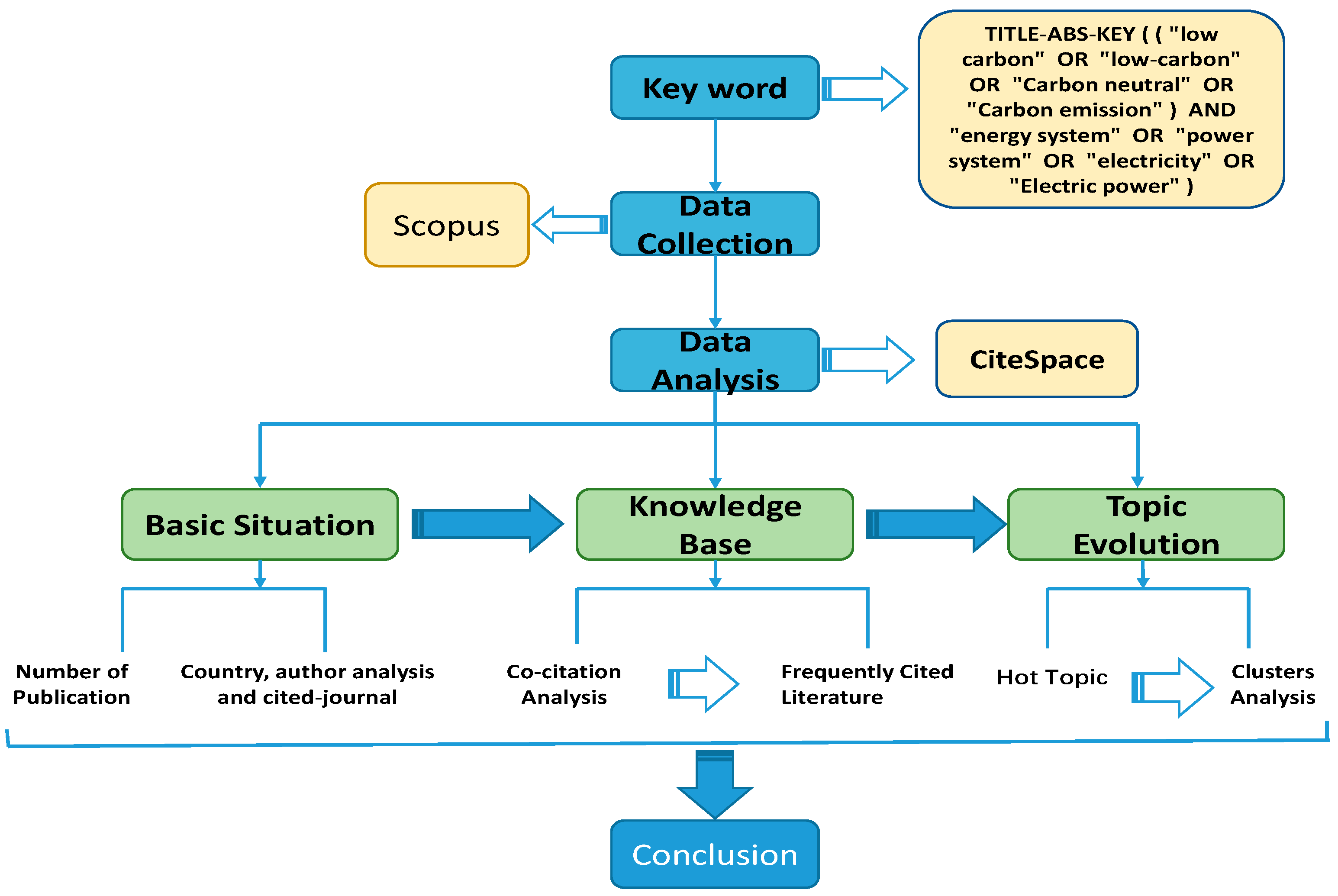
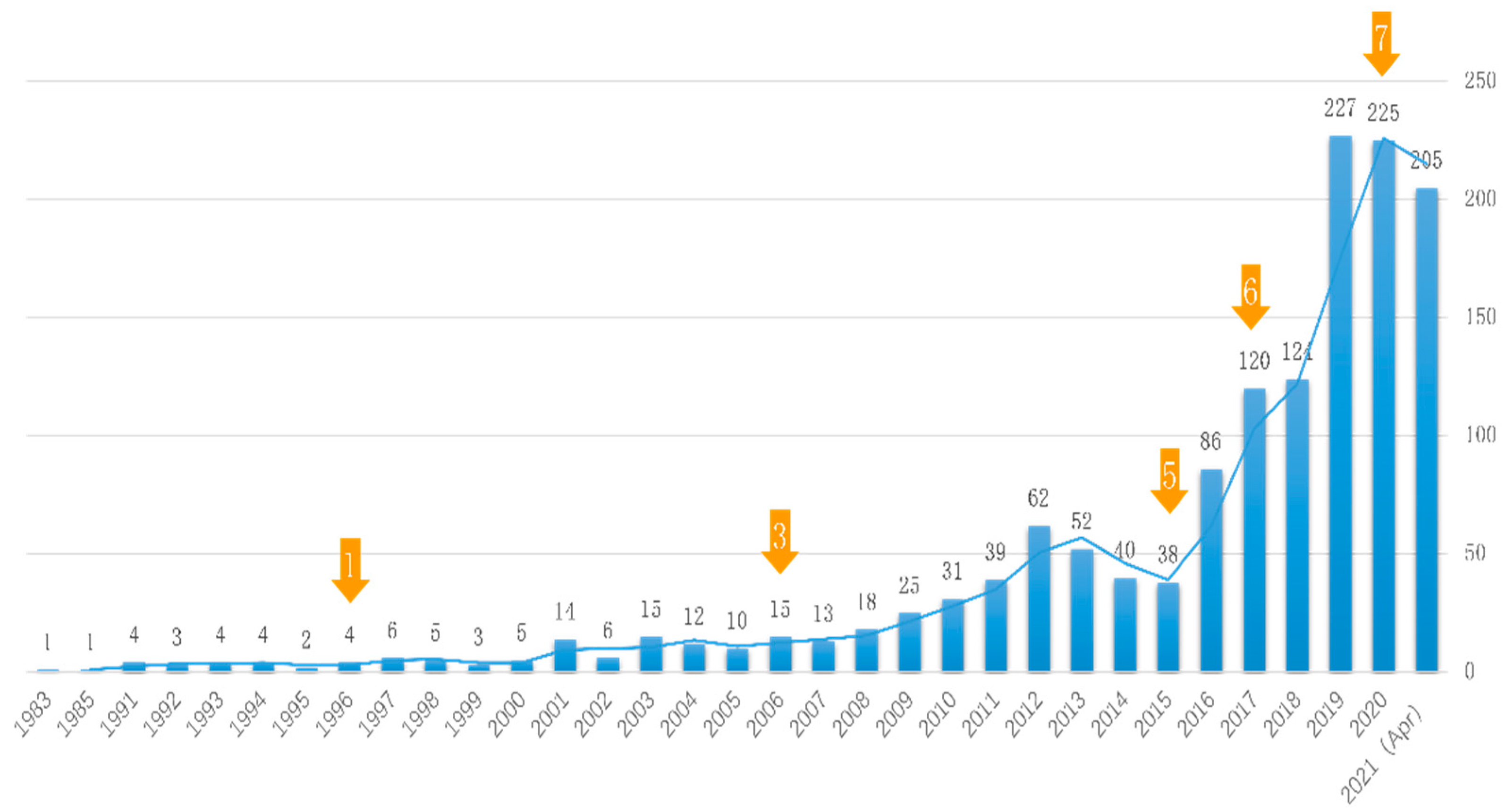
- Is research on low-carbon still growing? (Based on the number of published articles);
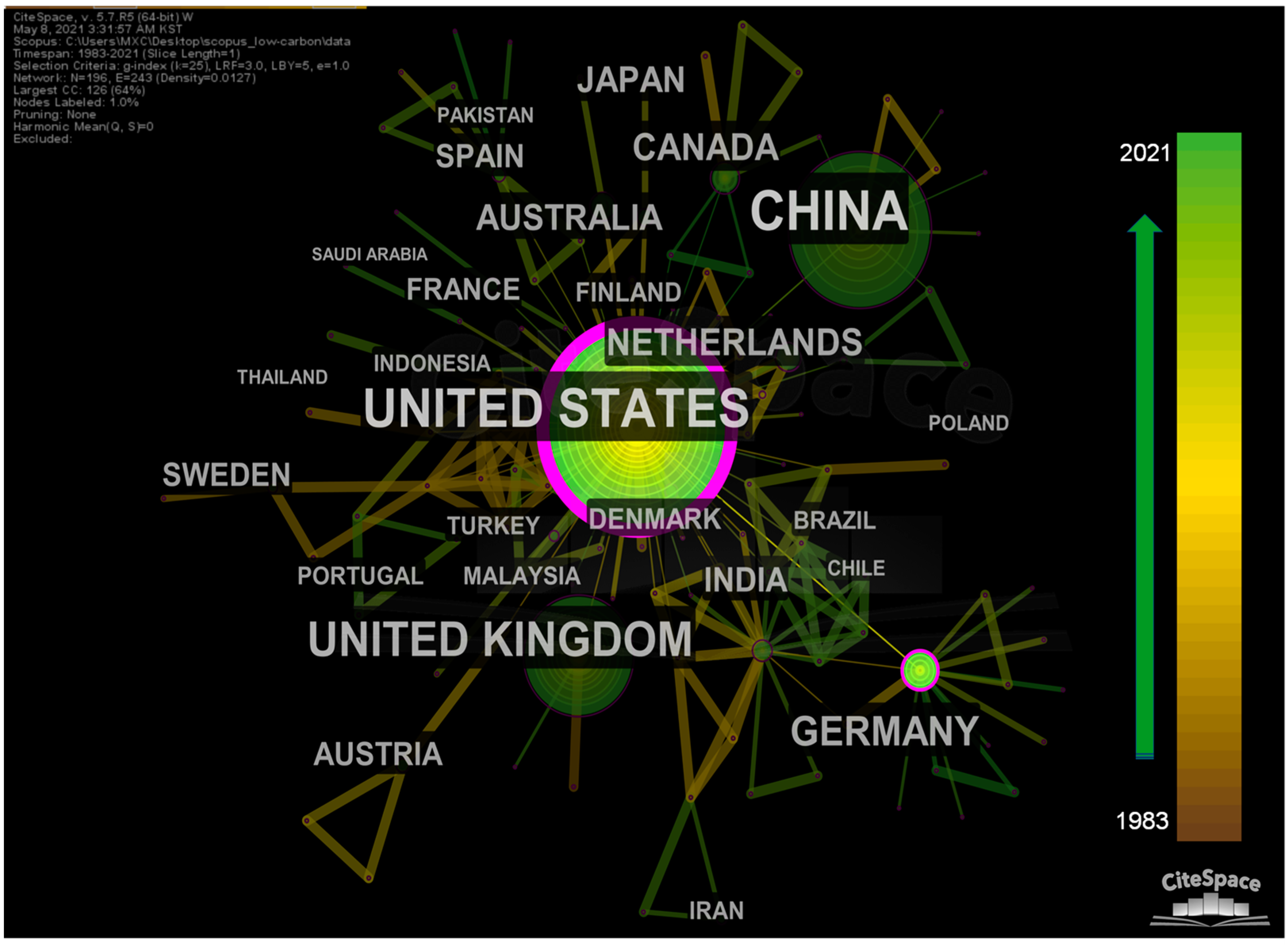
- Who are the influential contributors to the field? (With regard to countries, journals, and authors);
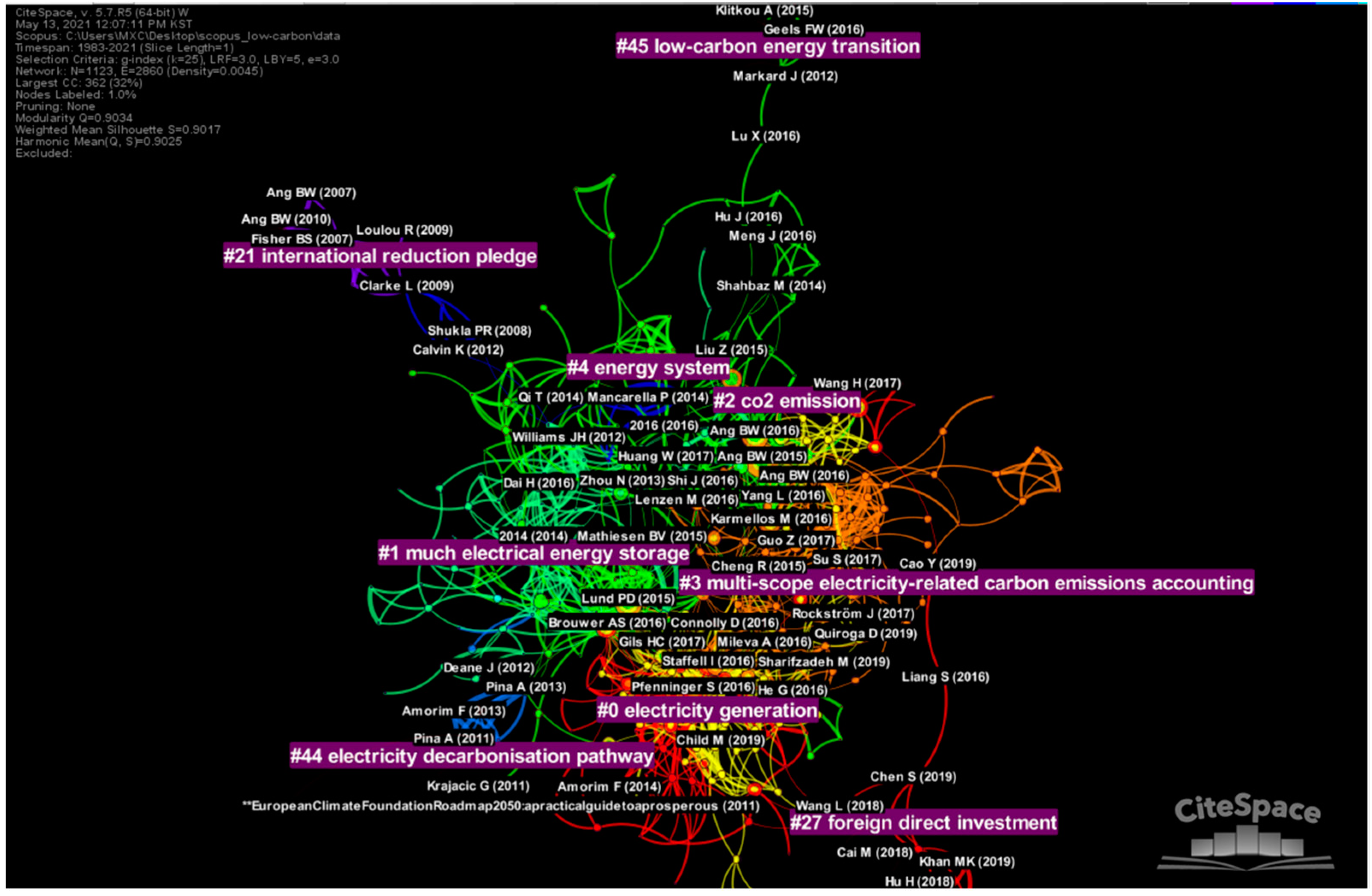
- What are the hot spots and research frontiers of power system decarbonization research?
- What is the knowledge clustering of low-carbon energy production research based on keyword co-occurrence?
- What are the implications for the development of global low-carbon power?
2.2. H-Index and SJR Factors
- The quality of the citation is considered using the PageRank algorithm; that is, each citation is weighted according to the reputation of the citation journal;
- The coverage of the Scopus database is wider than that of the JCR [24].
2.3. CiteSpace
2.4. Data Sources
3. Results and Discussion
3.1. Literature Quantity Analysis
3.2. Analysis of Country, Cited Journal, and Author
3.2.1. Country Productivity
3.2.2. Author Productivity
3.2.3. Distribution of Journals
4. Research Hotspots and Trends
4.1. Knowledge Base
4.2. Research Hotspots
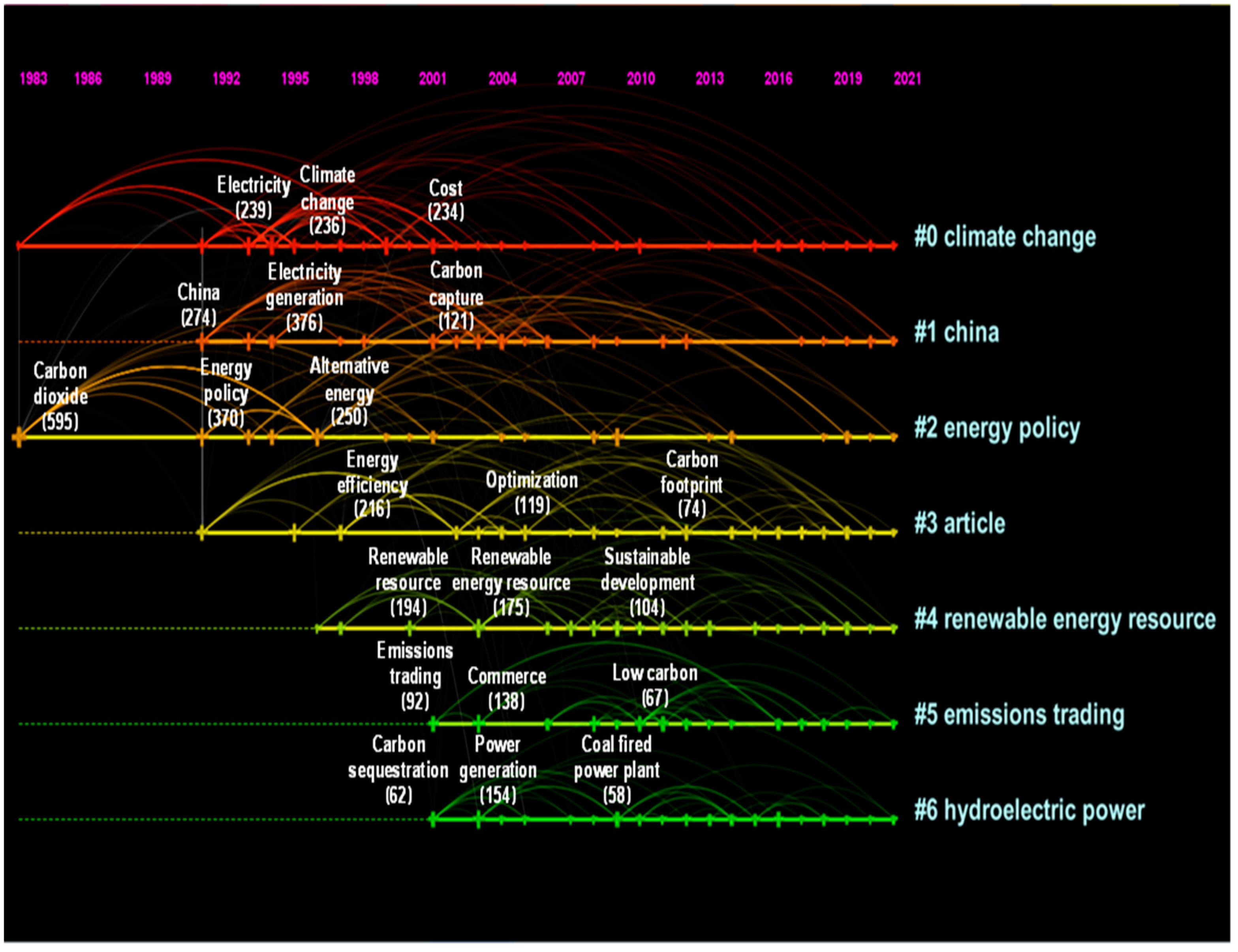
- (#0) Climate change. In this cluster, electricity, climate change, and cost are the three keywords with the highest frequency of occurrence, among which the research topic of electricity appears the earliest. With the deepening of the research, the relationship between power system and climate change gradually begins to increase;
- (#1) China. As a major carbon emitter, the Chinese government recently announced to the world its ambition to achieve a double carbon goal. Currently, 70% of China’s electricity is supplied by thermal power units, which are highly dependent on fossil fuels and a major source of CO2 emissions. Implementing CCS technology is one overall consideration of energy supply security and CO2 emission reduction targets. The phasing out of thermal power units will be completed gradually and the share of RE in the energy supply structure will be increased. There is also a real need for China to establish a sustainable energy supply system [3,12];
- (#2) Energy policy. As different countries pay more and more attention to the environmental impact of CO2 emissions from fossil fuel combustion, RE has become the most promising alternative energy [13], and the transition to sustainable energy systems is a thorny issue for many governments. Effective environmental policies, or a combination of policies and strategies, can contribute to a country’s energy transition. Concerns about energy policy will persist as targets are set for a worldwide shift to low-carbon electricity based on renewables;
- (#3) Energy conservation. According to the LLR algorithm, the # 3 cluster is named “article” according to the LLR score. In order to avoid ambiguity in readers’ understanding of the meaning of the cluster name, we take the “energy conservation” under the cluster LLR score second only to “article” as the cluster name. #3 clustering describes the research hotspots in energy consumption and energy use efficiency. The coupling analysis of carbon emissions, economic growth, and energy consumption shows that they have a common growth trend. Those governments that need to address economic growth and reduce carbon emissions simultaneously need to concentrate on advancing energy utilization efficiency, implementing demand management, and minimizing carbon emissions in the process of energy use [75]. Like carbon emissions accounting, a carbon footprint is also employed to gauge the effect of human efforts on climate change. Quantitative analyses based on a carbon footprint not only explore the concentration and intensity of carbon emissions, but also provide a basis for the adoption of control measures and environmental supervision [76];
- (#4, #6) RE resource. We merged the #4 and #6 clusters, which together describe the topic of RE resource. There is no doubt that the research area of low-carbon energy production is focusing more and more on the utilization of RE. Many countries and regions have set the target of RE with high permeability within the power structure in future. However, due to the consideration of energy supply security and the economy of power supply, further research is still needed on this topic;
- (#5) Emission trading. Under this clustering topic, the highest frequency keyword is “commerce.” Research on the relationship between trade and environmental pollution points out that there is a positive or negative causal relationship between the growth of trade volume and environmental pollution, depending on whether the goods produced by the country belong to the energy-intensive production sector [77]. The carbon emissions trading system, as a policy measure to control CO2 emissions, is of great significance for those production departments that cannot fully achieve low-carbon operation. With the help of the design of the trading mechanism of the carbon market, we can achieve a cross-regional and cross-departmental ecological compensation coordination mechanism, a total quota trading mechanism, and use price means (carbon price) to guide the industrial production sector to carry out technological change and energy structure optimization [78].
5. Conclusions
Author Contributions
Funding
Institutional Review Board Statement
Informed Consent Statement
Data Availability Statement
Conflicts of Interest
References
- IPCC. Global Warming of 1.5 °C. An IPCC Special Report on the Impacts of Global Warming of 1.5 °C above Pre-Industrial Levels and Related Global Greenhouse Gas Emission Pathways, in the Context of Strengthening the Global Response to the Threat of Climate Change, Sustainable Development, and Efforts to Eradicate Poverty; Masson-Delmotte, V.P., Zhai, H.-O., Pörtner, D., Roberts, J., Skea, P.R., Shukla, A., Pirani, W., Moufouma-Okia, C., Péan, R., Pidcock, S., et al., Eds.; IPCC, 2018; in press; Available online: https://www.ipcc.ch/sr15/ (accessed on 7 May 2021).
- IEA (International Energy Association). Power Systems in Transition; IEA, 2020; Available online: https://www.iea.org/reports/power-systems-in-transition (accessed on 7 May 2021).
- Alvik, S.; Bakken, B.E.; Onur, O.; Horschig, H.; Koefoed, A.L.; McConnel, E.; Rinaldo, M.; Shafiei, E.; Zwarts, R.J. Energy Transition Outlook 2020—A Global and Regional Forecast to 2050; DNV GL: Hovik, Norway, 2020. [Google Scholar]
- Reister, D.B.; Laurmann, J.A. Future CO2 emissions from combustion of natural and synthetic gases. Energy 1985, 10, 1043–1049. [Google Scholar] [CrossRef]
- Busch, J.F.; Krause, F.L. Environmental externality surcharges in power system planning: A case study of New England. IEEE Trans. Power Syst. 1993, 8, 789–795. [Google Scholar] [CrossRef]
- Okken, P.A. Storage restrictions and the preference for CO2 removal options. Energy Convers. Manag. 1993, 34, 823–831. [Google Scholar] [CrossRef]
- Tabors, R.D.; Monroe, B.L. Planning for future uncertainties in electric power generation: An analysis of transitional strategies for reduction of carbon and sulfur emissions. IEEE Trans. Power Syst. 1991, 6, 1500–1507. [Google Scholar] [CrossRef]
- Zongxin, W.; Zhihong, W. Policies to promote energy conservation in China. Energy Policy 1991, 19, 934–939. [Google Scholar] [CrossRef]
- Liu, H.; Brown, T.; Andresen, G.B.; Schlachtberger, D.P.; Greiner, M. The role of hydro power, storage and transmission in the decarbonization of the Chinese power system. Appl. Energy 2019, 239, 1308–1321. [Google Scholar] [CrossRef] [Green Version]
- Prasad, M.; Munch, S. State-level renewable electricity policies and reductions in carbon emissions. Energy Policy 2012, 45, 237–242. [Google Scholar] [CrossRef]
- Audoly, R.; Vogt-Schilb, A.; Guivarch, C.; Pfeiffer, A. Pathways toward zero-carbon electricity required for climate stabilization. Appl. Energy 2018, 225, 884–901. [Google Scholar] [CrossRef] [Green Version]
- Hoffmann, B.S.; Szklo, A. Integrated gasification combined cycle and carbon capture: A risky option to mitigate CO2 emissions of coal-fired power plants. Appl. Energy 2011, 88, 3917–3929. [Google Scholar] [CrossRef]
- Liu, T.; Xu, G.; Cai, P.; Tian, L.; Huang, Q. Development forecast of renewable energy power generation in China and its influence on the GHG control strategy of the country. Renew. Energy 2011, 36, 1284–1292. [Google Scholar] [CrossRef]
- UK Becomes First Major Economy to Pass Net Zero Emissions Law [EB/OL]. GOV.UK; 9 July 2021. Available online: https://www.gov.uk/government/news/uk-becomes-first-major-economy-to-pass-net-zero-emissions-law (accessed on 29 July 2021).
- Federal Climate Change Act—BMU-Laws [EB/OL]. bmu.de; 9 July 2021. Available online: https://www.bmu.de/GE838-1 (accessed on 29 July 2021).
- ‘Enhance Solidarity’ to Fight COVID-19, Chinese President Urges, also Pledges Carbon Neutrality by 2060 [EB/OL]. UN News. 22 September 2020. Available online: https://news.un.org/en/story/2020/09/1073052 (accessed on 29 July 2021).
- Dominko, M.; Verbič, M. The economics of subjective well-being: A bibliometric analysis. J. Happiness Stud. 2019, 20, 1973–1994. [Google Scholar] [CrossRef]
- Ellegaard, O.; Wallin, J.A. The bibliometric analysis of scholarly production: How great is the impact? Scientometrics 2015, 105, 1809–1831. [Google Scholar] [CrossRef] [PubMed] [Green Version]
- Primc, K.; Dominko, M.; Slabe-Erker, R. 30 years of energy and fuel poverty research: A retrospective analysis and future trends. J. Clean. Prod. 2021, 301, 127003. [Google Scholar] [CrossRef]
- Wang, L.; Wei, Y.; Brown, M.A. Global transition to low-carbon electricity: A bibliometric analysis. Appl. Energy 2017, 205, 57–68. [Google Scholar] [CrossRef]
- Yu, H.; Wei, Y.; Tang, B.; Mi, Z.; Pan, S. Assessment on the research trend of low-carbon energy technology investment: A bibliometric analysis. Appl. Energy 2016, 184, 960–970. [Google Scholar] [CrossRef]
- Höhne, N.; Kuramochi, T.; Warnecke, C.; Röser, F.; Fekete, H.; Hagemann, M.; Day, T.; Tewari, R.; Kurdziel, M.; Sterl, S. The Paris Agreement: Resolving the inconsistency between global goals and national contributions. Clim. Policy 2017, 17, 16–32. [Google Scholar] [CrossRef]
- Kinney, A.L. National scientific facilities and their science impact on nonbiomedical research. Proc. Natl. Acad. Sci. USA 2007, 104, 17943–17947. [Google Scholar] [CrossRef] [PubMed] [Green Version]
- Falagas, M.E.; Pitsouni, E.I.; Malietzis, G.A.; Pappas, G. Comparison of PubMed, Scopus, web of science, and Google scholar: Strengths and weaknesses. FASEB J. 2008, 22, 338–342. [Google Scholar] [CrossRef]
- Chen, C. A glimpse of the first eight months of the covid-19 literature on microsoft academic graph: Themes, citation contexts, and uncertainties. Front. Res. Metr. Anal. 2020, 5, 24. [Google Scholar] [CrossRef]
- Mirumachi, N.; Sawas, A.; Workman, M. Unveiling the security concerns of low carbon development: Climate security analysis of the undesirable and unintended effects of mitigation and adaptation. Clim. Dev. 2020, 12, 97–109. [Google Scholar] [CrossRef]
- Wang, N.; Chang, Y. The evolution of low-carbon development strategies in China. Energy 2014, 68, 61–70. [Google Scholar] [CrossRef]
- Urban, F.; Nordensvärd, J. Low Carbon Development: Origins, Concepts and Key Issues; Routledge, 2013; pp. 25–44. Available online: https://www.taylorfrancis.com/chapters/edit/10.4324/9780203108628-11/low-carbon-development-origins-concepts-key-issues-frauke-urban-johan-nordensv%C3%A4rd?context=ubx&refId=4020267c-2726-4549-9cc1-952e387071cb (accessed on 17 May 2021).
- Geels, F.W.; Berkhout, F.; van Vuuren, D.P. Bridging analytical approaches for low-carbon transitions. Nat. Clim. Chang. 2016, 6, 576–583. [Google Scholar] [CrossRef] [Green Version]
- Hannon, M.J.; Foxon, T.J.; Gale, W.F. The co-evolutionary relationship between energy service companies and the UK energy system: Implications for a low-carbon transition. Energy Policy 2013, 61, 1031–1045. [Google Scholar] [CrossRef] [Green Version]
- Cheng, Y.; Zhang, N.; Kirschen, D.S.; Huang, W.; Kang, C. Planning multiple energy systems for low-carbon districts with high penetration of renewable energy: An empirical study in China. Appl. Energy 2020, 261, 114390. [Google Scholar] [CrossRef]
- Liang, Q.; Fan, Y.; Wei, Y. The effect of energy end-use efficiency improvement on China’s energy use and CO2 emissions: A CGE model-based analysis. Energy Effic. 2009, 2, 243–262. [Google Scholar] [CrossRef]
- Lin, B.; Jia, Z. Economic, energy and environmental impact of coal-to-electricity policy in China: A dynamic recursive CGE study. Sci. Total Environ. 2020, 698, 134241. [Google Scholar] [CrossRef] [PubMed]
- Xu, Y.; Yang, K.; Yuan, J. China’s power transition under the global 1.5 °C target: Preliminary feasibility study and prospect. Environ. Sci. Pollut. Res. 2020, 1–17. [Google Scholar] [CrossRef] [PubMed]
- Ang, B.W.; Su, B. Carbon emission intensity in electricity production: A global analysis. Energy Policy 2016, 94, 56–63. [Google Scholar] [CrossRef]
- Wang, L.; Chen, W.; Zhang, H.; Ma, D. Dynamic equity carbon permit allocation scheme to limit global warming to two degrees. Mitig. Adapt. Strat. Glob. Chang. 2017, 22, 609–628. [Google Scholar] [CrossRef]
- O’Neill, B.C.; Kriegler, E.; Ebi, K.L.; Kemp-Benedict, E.; Riahi, K.; Rothman, D.S.; van Ruijven, B.J.; van Vuuren, D.P.; Birkmann, J.; Kok, K.; et al. The roads ahead: Narratives for shared socioeconomic pathways describing world futures in the 21st century. Glob. Environ. Chang. 2017, 42, 169–180. [Google Scholar] [CrossRef] [Green Version]
- Riahi, K.; Kriegler, E.; Johnson, N.; Bertram, C.; den Elzen, M.; Eom, J.; Schaeffer, M.; Edmonds, J.; Isaac, M.; Krey, V.; et al. Locked into Copenhagen pledges—Implications of short-term emission targets for the cost and feasibility of long-term climate goals. Technol. Forecast. Soc. Chang. 2015, 90, 8–23. [Google Scholar] [CrossRef]
- Rogelj, J.; Luderer, G.; Pietzcker, R.C.; Kriegler, E.; Schaeffer, M.; Krey, V.; Riahi, K. Energy system transformations for limiting end-of-century warming to below 1.5 C. Nat. Clim. Chang. 2015, 5, 519–527. [Google Scholar] [CrossRef]
- Ren, J.; Sovacool, B.K. Prioritizing low-carbon energy sources to enhance China’s energy security. Energy Convers. Manag. 2015, 92, 129–136. [Google Scholar] [CrossRef]
- Cheng, B.; Dai, H.; Wang, P.; Xie, Y.; Chen, L.; Zhao, D.; Masui, T. Impacts of low-carbon power policy on carbon mitigation in Guangdong Province, China. Energy Policy 2016, 88, 515–527. [Google Scholar] [CrossRef]
- Small, H. Co-citation in the scientific literature: A new measure of the relationship between documents. J. Am. Soc. Inf. Sci. 1973, 42, 676–684. [Google Scholar] [CrossRef]
- Zhang, J.; Jiang, L.; Liu, Z.; Li, Y.; Liu, K.; Fang, R.; Li, H.; Qu, Z.; Liu, C.; Li, F. A bibliometric and visual analysis of indoor occupation environmental health risks: Development, hotspots and trend directions. J. Clean. Prod. 2021, 300, 126824. [Google Scholar] [CrossRef]
- Wang, H.; Ang, B.W.; Su, B. Assessing drivers of economy-wide energy use and emissions: IDA versus SDA. Energy Policy 2017, 107, 585–599. [Google Scholar] [CrossRef]
- Ang, B.W. LMDI decomposition approach: A guide for implementation. Energy Policy 2015, 86, 233–238. [Google Scholar] [CrossRef]
- Karmellos, M.; Kopidou, D.; Diakoulaki, D. A decomposition analysis of the driving factors of CO2 (Carbon dioxide) emissions from the power sector in the European Union countries. Energy 2016, 94, 680–692. [Google Scholar] [CrossRef]
- Yang, L.; Lin, B. Carbon dioxide-emission in China’s power industry: Evidence and policy implications. Renew. Sustain. Energy Rev. 2016, 60, 258–267. [Google Scholar] [CrossRef]
- Liu, Z.; Guan, D.; Wei, W.; Davis, S.J.; Ciais, P.; Bai, J.; Peng, S.; Zhang, Q.; Hubacek, K.; Marland, G. Reduced carbon emission estimates from fossil fuel combustion and cement production in China. Nature 2015, 524, 335–338. [Google Scholar] [CrossRef] [Green Version]
- Lund, P.D.; Lindgren, J.; Mikkola, J.; Salpakari, J. Review of energy system flexibility measures to enable high levels of variable renewable electricity. Renew. Sustain. Energy Rev. 2015, 45, 785–807. [Google Scholar] [CrossRef] [Green Version]
- Ferreira, H.L.; Garde, R.; Fulli, G.; Kling, W.; Lopes, J.P. Characterisation of electrical energy storage technologies. Energy 2013, 53, 288–298. [Google Scholar] [CrossRef] [Green Version]
- Flores-Quiroz, A.; Strunz, K. A distributed computing framework for multi-stage stochastic planning of renewable power systems with energy storage as flexibility option. Appl. Energy 2021, 291, 116736. [Google Scholar] [CrossRef]
- Pimm, A.J.; Palczewski, J.; Barbour, E.R.; Cockerill, T.T. Using electricity storage to reduce greenhouse gas emissions. Appl. Energy 2021, 282, 116199. [Google Scholar] [CrossRef]
- Safaei, H.; Keith, D.W. How much bulk energy storage is needed to decarbonize electricity? Energy Environ. Sci. 2015, 8, 3409–3417. [Google Scholar] [CrossRef] [Green Version]
- Pfenninger, S.; Staffell, I. Long-term patterns of European PV output using 30 years of validated hourly reanalysis and satellite data. Energy 2016, 114, 1251–1265. [Google Scholar] [CrossRef] [Green Version]
- Staffell, I.; Pfenninger, S. Using bias-corrected reanalysis to simulate current and future wind power output. Energy 2016, 114, 1224–1239. [Google Scholar] [CrossRef] [Green Version]
- Brouwer, A.S.; van den Broek, M.; Zappa, W.; Turkenburg, W.C.; Faaij, A. Least-cost options for integrating intermittent renewables in low-carbon power systems. Appl. Energy 2016, 161, 48–74. [Google Scholar] [CrossRef] [Green Version]
- Cheng, R.; Xu, Z.; Liu, P.; Wang, Z.; Li, Z.; Jones, I. A multi-region optimization planning model for China’s power sector. Appl. Energy 2015, 137, 413–426. [Google Scholar] [CrossRef]
- Gerbaulet, C.; von Hirschhausen, C.; Kemfert, C.; Lorenz, C.; Oei, P. European electricity sector decarbonization under different levels of foresight. Renew. Energy 2019, 141, 973–987. [Google Scholar] [CrossRef]
- Louis, J.; Allard, S.; Kotrotsou, F.; Debusschere, V. A multi-objective approach to the prospective development of the European power system by 2050. Energy 2020, 191, 116539. [Google Scholar] [CrossRef]
- Zappa, W.; Junginger, M.; van den Broek, M. Is a 100% renewable European power system feasible by 2050? Appl. Energy 2019, 233–234, 1027–1050. [Google Scholar] [CrossRef]
- Mikulčić, H.; Skov, I.R.; Dominković, D.F.; Alwi, S.R.W.; Manan, Z.A.; Tan, R.; Duić, N.; Mohamad, S.N.H.; Wang, X. Flexible carbon capture and utilization technologies in future energy systems and the utilization pathways of captured CO2. Renew. Sustain. Energy Rev. 2019, 114, 109338. [Google Scholar] [CrossRef]
- Victoria, M.; Zhu, K.; Brown, T.; Andresen, G.B.; Greiner, M. The role of storage technologies throughout the decarbonisation of the sector-coupled European energy system. Energy Convers. Manag. 2019, 201, 111977. [Google Scholar] [CrossRef] [Green Version]
- Capros, P.; Paroussos, L.; Fragkos, P.; Tsani, S.; Boitier, B.; Wagner, F.; Busch, S.; Resch, G.; Blesl, M.; Bollen, J. European decarbonisation pathways under alternative technological and policy choices: A multi-model analysis. Energy Strategy Rev. 2014, 2, 231–245. [Google Scholar] [CrossRef]
- Haas, J.; Cebulla, F.; Cao, K.; Nowak, W.; Palma-Behnke, R.; Rahmann, C.; Mancarella, P. Challenges and trends of energy storage expansion planning for flexibility provision in low-carbon power systems—A review. Renew. Sustain. Energy Rev. 2017, 80, 603–619. [Google Scholar] [CrossRef] [Green Version]
- Brouwer, A.S.; van den Broek, M.; Seebregts, A.; Faaij, A. Operational flexibility and economics of power plants in future low-carbon power systems. Appl. Energy 2015, 156, 107–128. [Google Scholar] [CrossRef] [Green Version]
- Gils, H.C.; Simon, S. Carbon neutral archipelago—100% renewable energy supply for the Canary Islands. Appl. Energy 2017, 188, 342–355. [Google Scholar] [CrossRef] [Green Version]
- Schlachtberger, D.P.; Brown, T.; Schäfer, M.; Schramm, S.; Greiner, M. Cost optimal scenarios of a future highly renewable European electricity system: Exploring the influence of weather data, cost parameters and policy constraints. Energy 2018, 163, 100–114. [Google Scholar] [CrossRef] [Green Version]
- Haas, J.; Cebulla, F.; Nowak, W.; Rahmann, C.; Palma-Behnke, R. A multi-service approach for planning the optimal mix of energy storage technologies in a fully-renewable power supply. Energy Convers. Manag. 2018, 178, 355–368. [Google Scholar] [CrossRef]
- Poletti, S.; Staffell, I. Understanding New Zealand’s wind resources as a route to 100% renewable electricity. Renew. Energy 2021, 170, 449–461. [Google Scholar] [CrossRef]
- Cárdenas, B.; Swinfen-Styles, L.; Rouse, J.; Hoskin, A.; Xu, W.; Garvey, S.D. Energy storage capacity vs. renewable penetration: A study for the UK. Renew. Energy 2021, 171, 849–867. [Google Scholar] [CrossRef]
- Yang, J.; Cai, W.; Ma, M.; Li, L.; Liu, C.; Ma, X.; Li, L.; Chen, X. Driving forces of China’s CO2 emissions from energy consumption based on Kaya-LMDI methods. Sci. Total Environ. 2020, 711, 134569. [Google Scholar] [CrossRef]
- Wei, W.; Zhang, P.; Yao, M.; Xue, M.; Miao, J.; Liu, B.; Wang, F. Multi-scope electricity-related carbon emissions accounting: A case study of Shanghai. J. Clean. Prod. 2020, 252, 119789. [Google Scholar] [CrossRef]
- Mavromatidis, G.; Orehounig, K.; Carmeliet, J. Uncertainty and global sensitivity analysis for the optimal design of distributed energy systems. Appl. Energy 2018, 214, 219–238. [Google Scholar] [CrossRef]
- Gabrielli, P.; Gazzani, M.; Martelli, E.; Mazzotti, M. Optimal design of multi-energy systems with seasonal storage. Appl. Energy 2018, 219, 408–424. [Google Scholar] [CrossRef]
- Wang, S.S.; Zhou, D.Q.; Zhou, P.; Wang, Q.W. CO2 emissions, energy consumption and economic growth in China: A panel data analysis. Energy Policy 2011, 39, 4870–4875. [Google Scholar] [CrossRef]
- Shi, S.; Yin, J. Global research on carbon footprint: A scientometric review. Environ. Impact Assess. Rev. 2021, 89, 106571. [Google Scholar] [CrossRef]
- Dogan, E.; Seker, F. Determinants of CO2 emissions in the European Union: The role of renewable and non-renewable energy. Renew. Energy 2016, 94, 429–439. [Google Scholar] [CrossRef]
- Cao, J.; Ho, M.S.; Jorgenson, D.W.; Nielsen, C.P. China’s emissions trading system and an ETS-carbon tax hybrid. Energy Econ. 2019, 81, 741–753. [Google Scholar] [CrossRef]





| Country | TC | First Year | Betweenness Centrality | H-Index | |
|---|---|---|---|---|---|
| Environmental Science | Energy | ||||
| CHINA | 1054 | 1991 | 0.09 | 368 | 333 |
| UNITED STATES | 989 | 1983 | 0.9 | 691 | 454 |
| UNITED KINGDOM | 733 | 1992 | 0.03 | 480 | 291 |
| GERMANY | 508 | 1997 | 0.19 | 404 | 266 |
| THE NETHERLANDS | 279 | 1991 | 0 | 367 | 214 |
| AUSTRALIA | 264 | 2003 | 0.01 | 367 | 241 |
| ITALY | 262 | 1996 | 0.1 | 298 | 204 |
| JAPAN | 260 | 2002 | 0.01 | 280 | 261 |
| AUSTRIA | 259 | 1991 | 0.06 | 229 | 130 |
| CANADA | 251 | 2001 | 0.05 | 381 | 278 |
| Author | Institution | Country | TC | H-Index | First Year |
|---|---|---|---|---|---|
| Lin, Boqiang | Xiamen University | China | 13 | 62 | 2014 |
| Kang, Chongqing | Tsinghua University | China | 10 | 55 | 2009 |
| Wei, Yiming | Beijing Institute of Technology | China | 9 | 62 | 2009 |
| Yuan, Jiahai | North China Electric Power University | China | 9 | 27 | 2011 |
| Van Vuuren, Detlef P. | PBL Netherlands Environmental Assessment Agency | The Netherlands | 8 | 85 | 2003 |
| Ang, Beng Wah | National University of Singapore | Singapore | 8 | 66 | 2002 |
| Sovacool, Benjamin K. | Aarhus Universitet | Denmark | 8 | 64 | 2015 |
| Luderer, Gunnar | Leibniz-Gemeinschaft | Germany | 8 | 47 | 2011 |
| Chen, Wenying | Tsinghua University | China | 8 | 22 | 2013 |
| Masui, Toshihiko | National Institute of Environmental Studies of Japan | Japan | 7 | 42 | 2012 |
| Journal | NP 1 | CCP 2 | NP/CCP | SJR 3 | H-Index 4 | Country | Publication |
|---|---|---|---|---|---|---|---|
| Nature Energy | 9 | 763 | 84.77 | 19.635 | 92 | United States | Springer Nature |
| Energy and Environmental Science | 5 | 318 | 63.6 | 13.024 | 311 | United Kingdom | Royal Society of Chemistry |
| International Journal of Hydrogen Energy | 11 | 609 | 55.36 | 1.141 | 202 | United Kingdom | Elsevier Ltd. |
| Applied Energy | 166 | 6824 | 41.11 | 3.607 | 189 | United Kingdom | Elsevier BV |
| Energy Policy | 342 | 13,236 | 38.7 | 2.168 | 197 | United Kingdom | Elsevier BV |
| Renewable Energy | 33 | 1124 | 34.06 | 2.052 | 174 | United Kingdom | Elsevier BV |
| Environmental Science and Technology | 16 | 486 | 30.37 | 2.704 | 373 | United States | American Chemical Society |
| Energy Economics | 64 | 1827 | 28.55 | 2.409 | 136 | The Netherlands | Elsevier |
| IEEE Transactions on Power Systems | 10 | 254 | 25.4 | 3.434 | 242 | United States | Institute of Electrical and Electronics Engineers |
| Energy | 145 | 2456 | 22.33 | 2.166 | 173 | United Kingdom | Elsevier Ltd. |
| International Journal of Greenhouse Gas Control | 20 | 426 | 21.3 | 1.131 | 107 | Netherlands | Elsevier |
| Journal of Cleaner Production | 79 | 1296 | 16.4 | 1.886 | 173 | Netherlands | Elsevier Ltd. |
| Science of the Total Environment | 21 | 283 | 13.47 | 1.661 | 224 | Netherlands | Elsevier |
| Renewable and Sustainable Energy Reviews | 21 | 254 | 12.09 | 3.632 | 258 | Netherlands | Elsevier Ltd. |
| Energies | 37 | 286 | 7.72 | 0.635 | 78 | Switzerland | MDPI |
| Cited Frequency | Author | Cited reference | Centrality | Year |
|---|---|---|---|---|
| 24 | Ang, Beng Wah | Carbon emission intensity in electricity production: A global analysis | 0.02 | 2016 |
| 24 | Ang, Beng Wah | LMDI decomposition approach: A guide for implementation | 0.01 | 2015 |
| 19 | Lund, Peter D. | Review of energy system flexibility measures to enable high levels of variable renewable electricity | 0.04 | 2015 |
| 17 | Liu, Zhu | Reduced carbon emission estimates from fossil fuel combustion and cement production in China | 0.02 | 2015 |
| 13 | Brouwer, Anne Sjoerd | Least-cost options for integrating intermittent renewables in low-carbon power systems | 0.04 | 2016 |
| 13 | Pfenninger, Stefan | Long-term patterns of European PV output using 30 years of validated hourly reanalysis and satellite data | 0.01 | 2016 |
| 12 | Wang, H. | Assessing drivers of economy-wide energy use and emissions: IDA versus SDA | 0 | 2017 |
| 11 | Karmellos, Marios | A decomposition analysis of the driving factors of CO2 (Carbon dioxide) emissions from the power sector in European Union countries | 0.02 | 2016 |
| 11 | Staffell, Iain | Using bias-corrected reanalysis to simulate current and future wind power output | 0.01 | 2016 |
| 10 | Cheng, Rui | A multi-region optimization planning model for China’s power sector | 0.02 | 2015 |
Publisher’s Note: MDPI stays neutral with regard to jurisdictional claims in published maps and institutional affiliations. |
© 2021 by the authors. Licensee MDPI, Basel, Switzerland. This article is an open access article distributed under the terms and conditions of the Creative Commons Attribution (CC BY) license (https://creativecommons.org/licenses/by/4.0/).
Share and Cite
Meng, X.-C.; Seong, Y.-H.; Lee, M.-K. Research Characteristics and Development Trend of Global Low-Carbon Power—Based on Bibliometric Analysis of 1983–2021. Energies 2021, 14, 4983. https://doi.org/10.3390/en14164983
Meng X-C, Seong Y-H, Lee M-K. Research Characteristics and Development Trend of Global Low-Carbon Power—Based on Bibliometric Analysis of 1983–2021. Energies. 2021; 14(16):4983. https://doi.org/10.3390/en14164983
Chicago/Turabian StyleMeng, Xin-Cheng, Yeon-Ho Seong, and Min-Kyu Lee. 2021. "Research Characteristics and Development Trend of Global Low-Carbon Power—Based on Bibliometric Analysis of 1983–2021" Energies 14, no. 16: 4983. https://doi.org/10.3390/en14164983
APA StyleMeng, X.-C., Seong, Y.-H., & Lee, M.-K. (2021). Research Characteristics and Development Trend of Global Low-Carbon Power—Based on Bibliometric Analysis of 1983–2021. Energies, 14(16), 4983. https://doi.org/10.3390/en14164983