You are currently viewing a new version of our website. To view the old version click .
Sustainability
  • Review
  • Open Access

24 August 2022

An Assessment of Biodiversity in Tabuk Region of Saudi Arabia: A Comprehensive Review
,
,
,
and
1
Department of Biology, Faculty of Science, University of Tabuk, Tabuk 71491, Saudi Arabia
2
Genomic and Biotechnology Unit, Department of Biology, Faculty of Science, University of Tabuk, Tabuk 71491, Saudi Arabia
*
Author to whom correspondence should be addressed.
This article belongs to the Special Issue Biodiversity Conservation and Environmental Sustainability

Abstract

Biodiversity refers to all the type of species in one geographical region or ecosystem. It consists of plants, animals, bacteria, and other life forms. As an estimate, around 1.7 million species are on record globally and approximately 15,000–18,000 new species are added each year. Global climate change is accelerating species extinction due to habitat destruction. Further, various abiotic and biotic environmental factors are limiting the pattern of biodiversity in a geographical region. A change in species category from endangered to extinction occurs due to their physiological, morphological, and life history pattern, which limits them to a specific niche. Biodiversity is very important for energy production and flow, bioremediation, and biogeochemical cycling of nutrients in terrestrial to aquatic ecosystems and vice versa. It is further required for human existence in the form of food, fibers, medicines, and biological control. Therefore, consistent monitoring, assessment, and conservation of ecological habitats and diversity of flora and fauna of aquatic and terrestrial ecosystems is the need of the hour. In this article, we are presenting an assessment based upon the literature survey on the biodiversity of Tabuk region of Kingdom of Saudi Arabia. A comprehensive study on the biodiversity of plants, animals and microorganisms of the Tabuk region (Tabuk city, Tayma, Haql, Sharma, Duba, Al Wajh and Umluj, Al Zetah, Al Beda’a, etc.) are included in this review. This study will be a landmark as it is conducted at the inception of NEOM project in Tabuk region. It will help the authorities to enhance the native green cover, decrease desertification, regenerate biodiversity in natural environments, and advance the quality of life, to achieve the objectives of the Saudi Green Initiative and VISION 2030. However, studies and investigations on Tabuk biodiversity are still limited and need further exploration. Recently, a joint work between King Salman Royal Natural Reserve (KSRNR) and Department of Biology of University of Tabuk is underway to monitor the baseline data of flora and fauna of this region.

1. Introduction

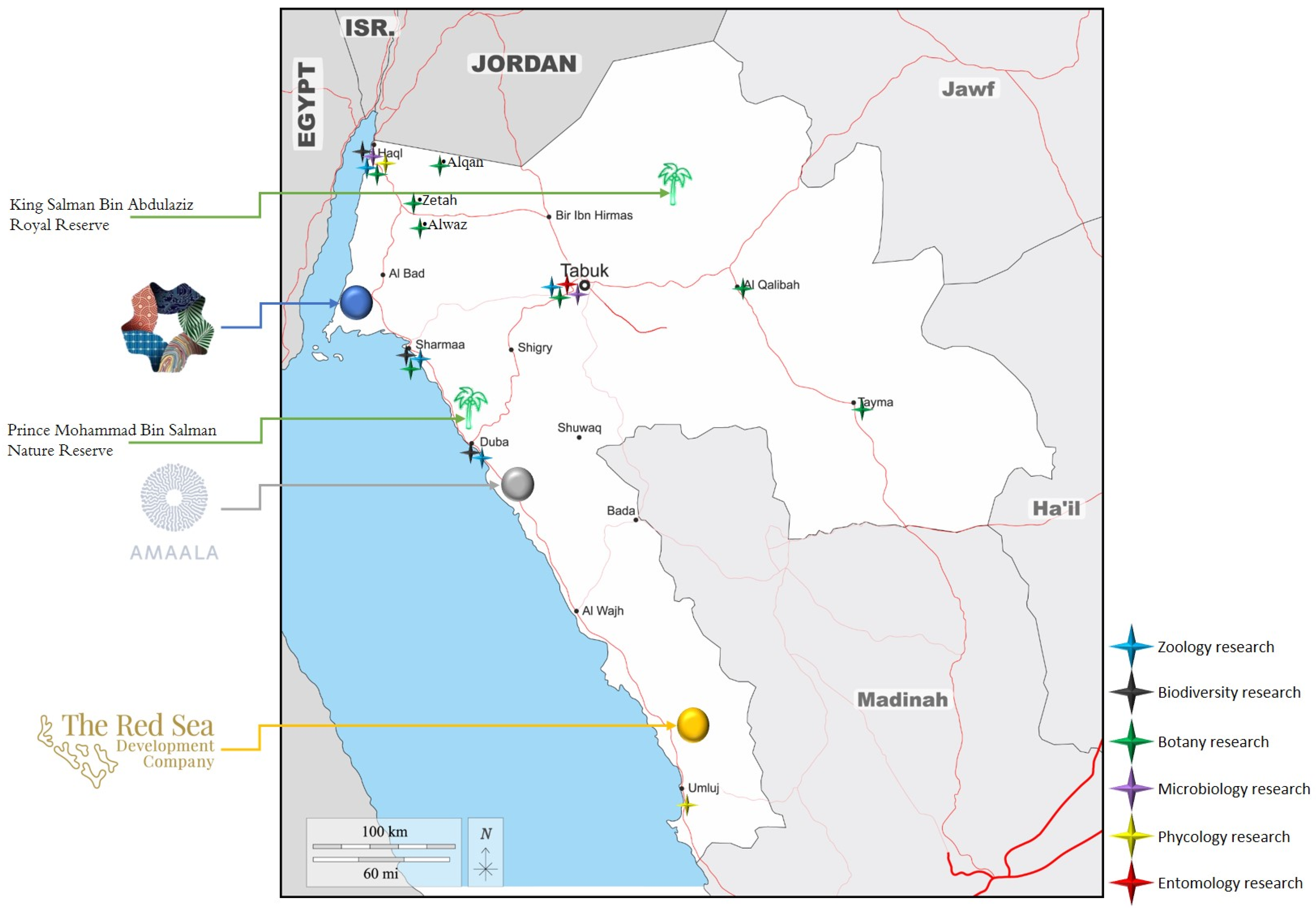
The Northwest region of Saudi Arabia is administratively part of the Tabuk Province and is the current hotspot for agricultural activities in the region. Traditionally, this region is known as Midyan (Midian or Madyan) and has an area of almost 135,000-km2 [1]. It includes diverse terrain such as deserts, valleys, sprawling mountains, coasts of the Red Sea, and natural springs. Long shoreline of Tabuk Province is one of the most important geographical characteristics that contributes about 38% of the western shoreline of Saudi Arabia. It covers coastal cities, such as Haql, Sharma, Duba, Al Wajh and Umluj, with pristine beaches of clear waters (Figure 1).
Figure 1. A map demonstrates locations of Tabuk biodiversity research.
The province of Tabuk contains five major habitats, namely, mountains, coastal and islands, water bodies, plains and valleys with scattered trees, and agricultural and urban environment. The Tabuk region hosts several unique natural attractions occupying considerable natural resources. Tabuk is a desert with relatively little rain, the average temperature is 21.7 °C and precipitation is about 15 mm per year. In 30-year investigations on temperature between 1984 and 2013, trends have shown significant increase in warming of the atmosphere of about 1.93 °C [2]. The unique terrains of the Tabuk region and the distinctive climatic condition from extremely low to extremely high results in diverse terrestrial and aquatic ecosystems, which harbor a remarkable biological diversity [1,3,4,5,6,7,8].
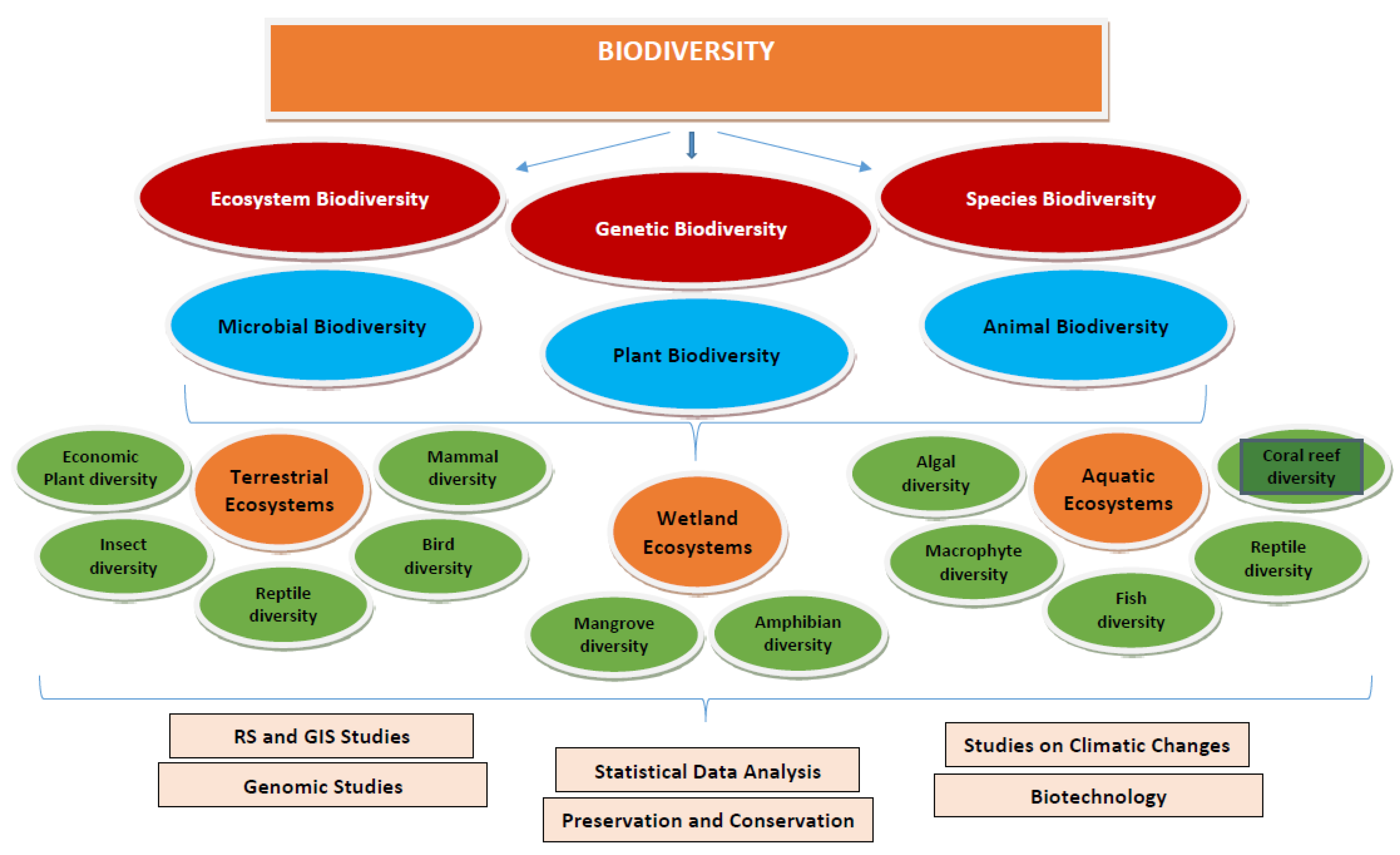
Biodiversity refers to all of the types of species in one geographical region or ecosystem. It consists of plants, animals, bacteria, and other life forms. As per Catalogue of Life-2018 Annual Checklist [9], around 1.7 million species are on record globally and approximately 15,000–18,000 new species are added each year [10]. Broadly, biodiversity can be observed at three levels, namely, ecosystem, species and genetic level (Figure 2). The biodiversity is a crucial and a vital environmental component for a functional ecosystem. It is very important for energy production and flow, bioremediation, and biogeochemical cycling of nutrients in terrestrial to aquatic ecosystems and vice versa [11]. Since the dawn of civilization, it has been very active in offering humanity with food security, medical care, and goods and materials for various industries, and allows humans to live a comfortable life [12]. However, in the modern world, due to increases in various anthropogenic activities, a surge in global climate change is observed. It affected almost all kinds of habitat globally and resulted in a huge decline in plant diversity. The decline in producer community compels a change in the fauna of the affected habitat [13,14,15]. The species extinction across the globe is mainly governed by changing environmental conditions due to habitat destruction. Various abiotic environmental factors, such as nutrients, pH, water availability, soil quality, temperature, and many other climatic changes, and biotic factors, such as primary producers (green plants, consumers (herbivores, carnivores, and omnivores) and decomposers (microorganisms), are limiting to biodiversity patterns. Any species can be shifted to endangered or extinction due to their physiological, morphological, and life history pattern, which limit each species to a specific niche. In order to conserve the biodiversity of Saudi Arabia, legislation was enacted and The Saudi Wildlife Authority (SWA) was established in 1986. Its task was to develop a national network of protected areas and to pursue the restoration of native endangered species. The Wildlife Protected Areas Act was issued in 1995 to facilitate conservation activities and the establishment of protected areas in Saudi Arabia. Since its inception, SWA has identified 16 protected areas covering 86,582.4 km2 and a further 22 areas planned, covering a total area of 208,356 km2, 10.42% of the KSA [16]. In 1996, the Government of Saudi Arabia joined CITES, which regulates international trade in listed species and CITES implementing legislation (The Act on Trade in Endangered Wildlife Species and their Products 2000) was introduced in 2001 in KSA. The fauna was protected from poaching and illegal trades by enacting The Wild Animals and Birds Hunting Act 1999. As per this law, hunting was banned without a license, regulations were defined, and penalties were listed in case of violations. An Environmental Code 2002 was also formulated for the protection of the environment [17,18]. Later, the Government of Saudi Arabia joins the Convention on Biological Diversity [17]. Since joining the Convention, Saudi Arabia has made remarkable and significant progress in addressing biodiversity conservation and its related challenges [19].
Figure 2. Different levels for the biodiversity assessments.
Recently, the hunting regulation for wildlife terrestrial species (2020) [20] was implemented by The Ministry of Environment, Water and Agriculture, represented by the National Center for Wildlife Development. The ministry prohibited the hunting of Arabian oryx, deer, and ibex; predators, such as the Arabian tiger, lynx, wolf, and hyena; and other endangered species of animals and birds, as well as birds of prey. The ministry further laid down the prohibition of hunting of all kinds of animals or birds within the boundaries of cities, villages, towns, farms and rest houses, or any inhabited places, or near cities and military, industrial, and vital installations. Moreover, hunting is not allowed within the boundaries of natural reserves and giant development projects, such as NEOM, the Red Sea, Amaala, Al Qiddiya, the Al-Soudah Reserve, and the Royal Commission for Al-Ula [21]. The approved regulations for trafficking fungal organisms (2020) [22] prohibits hunting wild fungi organisms, endangered species, and overfishing. The law ensures a safe and protected environment without harming the balance of the natural ecosystem [23].
In view of VISION 2030, Royal Commission for Al-Ula was established in 2017 for conservation and sustainable development of Al-Ula, a leading global destination for cultural and natural heritage in Tabuk province. Royal Commission for Al-Ula granted a government membership status by International Union for Conservation of Nature (IUCN). Together, they will conserve nature and wildlife by creating and activating nature reserves. It will protect degraded ecosystems, ecological processes, fragile habitats, biodiversity, and reintroducing native species [24]. Similarly, the KSA government launched Saudi Green Initiative (2022) [25]; its main goals are to reduce annual CO2 emissions by 278 million tonnes by 2030, plant 10 million trees nationwide, and protect 30% of land and sea by developing creative solutions to tackle climate change.
Despite establishment and implementation of various laws and regulations for wildlife protection, there are many reports for the illegal trade and violations from different regions of in Saudi Arabia, particularly from Tabuk region. There is an urgent need to strengthen the law enforcement, as well establishing an awareness campaign to conserve threatened species especially birds, reptiles, and carnivorous animals in Saudi Arabia. In this review, an analysis of published literature is done that can provide a comprehensive data on the biodiversity of Tabuk region of Kingdom of Saudi Arabia. A wide-ranging study on the biodiversity of plants, animals, and microorganisms of the Tabuk region are included in this review. The latest published data of the last decade was collected using Science Direct, Springer, MDPI, Google, Google Scholar, etc. The articles, reviews, short communication, and reports were studied thoroughly and grouped based on plants, animals, and microorganisms. This study will be a landmark as it is done at the inception of mega developmental projects like NEOM, LINE, Red Sea Development Company, AMAALA, etc., in Tabuk region and can be taken as a baseline knowledge of biodiversity of Tabuk region. It will help the authorities to understand the basic diversity of organism of Tabuk and helps in the enhancement of the native green cover. This will decrease desertification, regenerate biodiversity in natural environments, and advance the quality of life, to achieve the objectives of the Saudi Green Initiative and VISION 2030. This article also assesses the gaps in biodiversity research and suggest biodiversity surveys and studies.

2. Plant Biodiversity of Tabuk Region

Tabuk and the surrounding area are composed of metamorphic and igneous rocks. The western part of the region is surrounded by a series of hills and mountains, including Jabal al Lauz, Hijaz mountains. The terrain is similar to that of central Najd and consists of wadi, hills, and plains. Wadi are generally filled with muddy sand and gravel and plain soil sediments range from silt to sand to coarse rocks. Some of the most important agricultural centers are also found on the eastern and southeastern sides of Tabuk City [26]. The pioneer work to identify the plant biodiversity of Saudi Arabia was conducted by [27,28] in the form of an Illustrated Guide to the Flowers of Saudi Arabia and Wild Flowers of Saudi Arabia. Moreover, Migahid (1989) [29] and Chaudhary (2001) [30] completed the Flora of Saudi Arabia. Since then, there is a need to update the Flora of Saudi Arabia in general and Flora of Tabuk in particular due to the inception of megaprojects like NEOM, LINE, Red Sea Development Company, AMAALA etc. Nowadays, a field survey project for the baseline data for vegetation and wildlife life of King Salman Royal Natural Reserve is in its final phase. After the completion of this project, a clear picture will appear regarding the biodiversity of Tabuk region [31]. In the following paragraph, an attempt is made to collect the available information about the plant biodiversity of Tabuk region.

2.1. Algal Biodiversity

Algae is a group of different organisms capable of producing oxygen through photosynthesis. However, though these organisms are not closely related, they share some common features with the major group of photosynthetic organisms, plants. The coastline of Tabuk region along the Red Sea is the harbor for marine algae. As per the literature survey and the published reports in Tabuk region, seasonal dynamics and ecological parameters of marine algae are recorded by various workers [5,32,33,34,35,36]. However, Al Solami (2020) [37] studied the comparative response of red and green algae in relation to the quality of coastal waters of Red Sea at Haql region. Recently, Menaa et al. (2021) [38] reviewed the marine algae derived bioactive compounds as a source of Nanodrugs. Alshehri et al. (2021) [39] worked for the molecular characterization of some algae collected from the Gulf of Aqaba using protein banding pattern and ISSR markers. There are various genera of algae reported from Tabuk region listed in Table 1.
Table 1. List of Algae Reported from Tabuk Region of KSA.
Ibraheem et al. (2014) [40] reported some algal species from Umluj coasts of the Red Sea, namely, Enteromorpha intestinalis, Padina pavonia, Cystoseira myrica, Cystoseira trinodis, Colpomenia sinuosa, Turbinaria ornate, Sargassum latifolium, Laurencia majuscule, Laurencia catarinensis, Laurencia papillosa, Laurencia sp., Laurencia sp., Liagora hawaiiana Butters, Hypnea bryoides Børgesen, Palmaria palmate, Galaxaura rugose, Gracilaria arcuate, Acanthophora spicifera, and Digenia simplex. Ansari et al. (2015) [5] studied eutrophication in coastal waters, and floral and faunal density in relation to the seasonal dynamics of some selected coastal areas at Haql, Sharma and Duba of the Red Sea in Tabuk region. Only few coastal sites showed eutrophic characteristics. Water samples from these sites were more turbid, alkaline, and with higher nutrient and low dissolved oxygen contents compared to other sampling sites. A variation in relative densities of coastal flora and fauna were recorded and correlated with coastal water quality. The authors concluded that the fish markets, boating clubs, and touristic and human settlements at the coastal areas may be the prime reason of run-offs and nutrient loading rains aggravate the problem.
Ansari (2016) [32] studied the relative density of aquatic flora in relation to the seasonal dynamics and concluded that the summer season (April, May, June, and July) of Tabuk can be considered as the most suitable period for the collection of aquatic plants for medicinal purpose and ecological studies. Ansari and Ghanem (2017) [33] studied seasonal variation in growth responses and antioxidant activities of Ulva lactuca, Enteromorpha flexuoca, Cladophora prolifera, Chaetomorpha linum).
In July and October, significantly higher accumulation of NPK, carbohydrates, total protein, photosynthetic, and accessory pigments was recorded; however, a significant decrease in January was observed for the same parameters (Ansari and Ghanem 2017). Significant antioxidant activities in all the species were observed in January, which may be due to low temperature stress as compared to the other months. Various Biotic factors (plants, animals, and microorganisms) and abiotic factors (nutrients, soil quality, water, temperature, pH, salinity, and light) are the limiting factors for the production of primary and secondary metabolites. Ansari and Ghanem (2019) [34] also studied the growth attributes and biochemical composition of a brown alga Padina pavonica (L.) from the Red Sea at Haql in different seasons. The carbohydrate, protein and lipids, mineral ashes, macronutrients, and dietary fibers were high in July. The antioxidant enzymatic activities and proline accumulation showed a response to abiotic stress (low temperature) in January. A quantitative analysis on the diversity of algal flora revealed that the frequency, density, and abundance of Sargassum sp. was highest whereas of Ulva sp. was least at the six different study sites of Haql [35]. Five common algal species, namely, Padina, Sargassum, Dictyota, Polysiphonia, and Ulva were reported in their study. Mazen & Solami (2020) [37] compared the responses of Red algae (Gracilaria salicornia and Digenea simplex) and Green Algae (Enteromorpha compressa and Sargassum muticum) to the water quality at the coast of Red Sea. A significant variation in physiological and biochemical parameters of algae was observed. Green algae showed higher concentration of Chl a, b, total chlorophyll Chl a:b ratio, and carbohydrates content compared to red algae; whereas, red algae accumulated more carotenoids, phycocyanin, phycoerythrin, and protein compared to green algae. Moreover, low levels of hydrogen peroxide and TBARS were exhibited in red algae G. salicornia and D. simplex, however, proline, glycine betaine, and activities of antioxidant enzymes were high, showing strong defense system than the green algae.
Menaa et al. (2021) [38] investigated the bioactive compounds for nanodrugs derived from marine algae. The main compounds from algae are the nutraceuticals, which can be extracted and purified for nanotheranostic purposes. Algal extracts can be utilized for stabilizing/capping and reducing the synthesis of thermodynamically stable nanoparticles (NPs). Varieties of nanotherapeutics have been synthesized through physical, chemical, and biological processing. Marine algae are a promising source of lead theranostics compounds and are important for the development of nanotheranostics, which enhance the drug efficacy and safety [38]. Marine algae are considered as biofactories for the nanomaterials as they are easy to handle, capable to absorb and accumulate inorganic metallic ions, cost-effective, and eco-friendly for rapid, healthier synthesis of nanoparticles for various therapies.
DNA fingerprinting is a promising tool for species identification and can be solution for many errors occurred during morphological taxonomy as it requires only a small amount of tissue. To conserve the biodiversity, DNA fingerprinting could also be used for the identification of various invasive and endangered species. DNA fingerprinting is also used for the recognition of high-yielding agar strains of algae as well as for the identification of cryptic species. Alshehri et al. (2021) [39] performed the molecular characterization of some selected algal species (collected from the Gulf of Aqaba) through protein banding pattern and ISSR markers and identified eight algae, namely, Padina pavonica, Turbinaria gracilis, Carpomitra costata, Pterocladiella capillacea, Cladostephus spongiosus, Ulva lactuca, Sporochnus comosus, and Sargassum muticum. The study showed that ISSR marker is more effective than protein banding pattern to measure algal diversity at genetic level. The complied data reflect that the algal biodiversity work is highly reported at Haql shore, whereas the Umluj shore is least explored. The maximum work is about the seasonal dynamics and its floral or faunal density relationship. In all studies, Padina pavonia was the common algal species reported at Tabuk shoreline. The list of algae reported from Tabuk region is summarized in Table 1. Algae are very popular for their high ecological and commercial demand. The most important role of algae to our atmosphere and well-being is the generation of oxygen through photosynthesis and as a food for the marine organisms. They are the producer in the aquatic environment. According to an estimate, the worldwide turnover of the seaweed industry is about USD 10 billion per year. Seaweeds have a number of human applications; the principal use of seaweeds as a source of human food and as a source of gums (phycocollides). Phycocolloides like agar agar, alginic acid and carrageenan are primarily constituents of brown and red algal cell walls and are widely used in food industry to thicken a variety of foods (soy milk, chocolate milk, ice cream, yogurt, soups, salad dressings, jellies, etc.) and in molecular biology lab. Marine macroalgae have been used as foods, especially in China and Japan, and crude drugs for treatment of many diseases such as iodine deficiency (goiter, Basedow’s disease, and hyperthyroidism). Marine algae are the richest source of bioactive nutraceuticals such as antioxidants, pigments, carbohydrates, proteins, minerals, and fatty acids. Moreover, it can be used as a source of fodder, in fish farming, and as a fertilizer [36,41].

2.2. Floral Biodiversity (Angiosperms)

The available literature on floristic diversity of Tabuk region from the last decades (Table 2) mainly focused on their ecological and environmental parameters [1,3,8,18,42,43,44,45,46,47,48]. In the past two decades, Rajasab (2011) [49] carried out the pioneering work in Tabuk region flora. He presented a pictorial guide to the plant diversity of Tabuk region with the description on their traditional uses. The book comprised of three different sections. The first section was on species description, ethno-botanical, and Medicinal uses; the second on plant communities; and the third on plant biodiversity of Tabuk region. In Section I, the author has provided photographs of 115 plant species along with the information on their traditional uses as medicine, food, fodder, agriculture, and horticulture. In Section II, the plant communities in different areas of Tabuk region were described with the help of images of 109 species. Section III contains a list of 198 plant species of 52 families from eight diverse habitats of Tabuk region.
Table 2. List of Angiosperms Reported from Tabuk Region of KSA.
Many authors [45,47,50] conducted the study of biodiversity in relation to the regimes of Tabuk environment. The Tabuk region is known for its extremely variable environment where the temperature varies from extreme low to extreme high. These temperature regimes have a profound effect on growth, morphology, physiology, and biochemistry of the plants. Ansari et al. (2014) [51] studied the growth of Lavandula pubescens in relation to the temperature variations, and observed active role of CAT, POD, and SOD in plants to cope with this abiotic stress. Abbas et al. (2017) [50] also observed the ecological variations and an active role of heat shock protein in Artemisia judaica L. to the same abiotic stress. The investigations of Ansari et al. (2014) [51] and Abbas et al. (2017) [50] suggest that April and October are favorable for growth, development, and medicinal uses of plants reported from this region. Recently, Ansari et al. (2021) [52] reported five common sea grass species, namely, Cymodocea rotundata, Halodule pinifolia, Thalassodendron ciliatum, Halophila stipulacea, and Thalassia hemprichii, from the Red Sea coast at Haql in Tabuk province. A quantitative analysis, in terms of frequency, density, abundance, and dominance of sea grass diversity was measured. The authors reported a marked difference in the quantitative parameters of sea grass diversity within the species, as well as on different study sites.
However, Mutairi et al. (2017) [45] focused on the influence of environmental factors on the taxonomic diversity of plant species in the arid region of Tabuk, which are characterized by a particular floristic composition, and their diversity. Average taxonomic distinctness (Δ+) and variation in taxonomic distinctness (Λ+) were the two diversity indices used to calculate the effect of the environment and limiting environmental factors. Anthropogenic factors (woodcutting, pasture, and urbanization) are some of the important factors which significantly affect the floristic diversity [45]. In another study, Al-Mutairi et al. (2016) [4] discussed the floristic diversity and phytogeographical distribution of plant species along the four Red Sea coastal sites at Sharma, Alqan, Al-Lwaz Mountains, and Alzetah of Tabuk province. The author reported 96 plant species belonging to 75 genera and 38 families, out of which, there were 34 dicots and 4 monocots. Most of the species were from the family Asteraceae (12.5%), followed by Fabaceae (10.42%), Zygophyllaceae (6.25%), and Lamiaceae (5.21%). In terms of life form spectrum, most of the species were theorphytes (37%), followed by chamaephytes (32%), geeophytes (13%), hemicryptophytes (10%), and Phanerophytes (8%). The chorological analysis of the recorded species indicated the predominance of monoregional taxa in this region. Recently, Al Mutairi (2022) [1] studied the plant diversity in five places of Tabuk region along with spatial variables, soil physical and chemical variables. The author reported 163 species of plants belonging to 124 genera of 41 families. The Aldesah site recorded the highest value of beta diversity followed by Sharma. There was no pronounced influence of spatial variables was observed on the plant diversity. However, the soil variables (pH, potassium. organic matter and sodium) show a solid possibility in constructing the plant communities.
Moawed and Ansari (2015) [8] studied the wild plant diversity at the coastal areas of Red Sea in Tabuk province. They reported 30 families, 66 genera, and 82 plant species from this region. Family Asteraceae showed highest abundance (9 species), followed by Fabaceae (8 species), Brassicaceae and Zygophyllaceae (7 species), Amaranthaceae (Chenopodiaceae) and Poacea (6 species), Resedaceae (5 species), Boraginaceae (4 species), and Asclepediaceae and Caryophyllaceae (3 species). The chamaephytes and therophytes are the dominating plant life forms, indicating vegetation of typical desert spectrum. There were 32.92% chamaephytes, and 29.27% therophytes; 57.32% were perennial and 42.68% annual species [8]. Al-Qahtani (2018) [46] reported the diversity of weeds species in Citrus farms of Taymma of Tabuk province to find out the invasive species of weeds, which are the critical problem of agroecosystem and a major cause of huge economic losses. They have identified 36 weed species belonging to 20 families from the citrus farms of Taymma. Out of all the reported invasive species, Izoon canariense, Artemisia seiberi, Morettia parviflora, Oxalis corniculata, Setaria viridis, and Salsola imbricata were dominant over these citrus farmlands belonging to the dominant families Poacea, Asteraceae, Brassicaceae, and Amaranthaceae (Chenopodiaceae) [46]. The Harrat ArRahah is located in the southern area of Tabuk, which is a solidified lava area. Fakhry and Al-Kenany (2019) [48] reported 135 species belonging to 99 genera and 34 families from the study area. Families Asteraceae, Brassicaceae, and Fabaceae contributed about 38% of total species. Fourteen species (10%) were recognized as endangered, Iris postii and Tulipa biflora were reported as rare endangered species. Although Rheum palaestinum in the flora of Saudi Arabia is recorded as an extinct species, three individuals were recorded in the study area. Astragalus collenettiae was the only endemic species recorded from this area [48].
The floristic diversity and perennial vegetation analysis was undertaken by Al-Ghanem et al. (2020) focused on Wadi AL-Akhder the. The author reported 30 species belonging to 23 genera and 15 families form the study sites. Amaranthaceae (Chenopodiaceae) contributed 20%, followed by Asteraceae and Fabaceae (16.76%), Lamiaceae (10%), and Cistaceae and Asclepiedaceae (6.76%). There was prevalence of chamaephytes (56.67%), followed by Therophytes (20%), Phanerophytes (16.67%), and Hemicryptophyte (6.76%) [43]. Alharbi (2017) reported 81 traditional and medicinal plant species belong to 30 families which are commonly used for treatment of digestive tract diseases and parasites. Nine species were reported from the family Febaceae, eight species each from Asteraceae and Plantagiaceae, and six species from Zygophyllaceae [44].
Among the studied literature, we found 227 species of 157 genus were identified that belongs to 45 families of angiosperms. On comparing the above data with the endangered list of Flora of KSA (2022) [53], we recorded 12 endangered species of plants from Tabuk region, namely, Allium sinaiticum, Astragalus collenettiae, Cerastium dichotomum, Cymbolaena griffithii, Glaucium arabicum, Leopoldia tenuiflorum, Minuartia picta, Salsola lachnantha, Salvia palaestina, Tulipa biflora, Valerianella szovitsiana, and Veronica beccabunga.

3. Animal Biodiversity of Tabuk Region

The presence of different kinds of animals in a geographical region is very important for a balanced environment and a functional ecosystem. In the Tabuk region, studies are conducted to identify the biodiversity of insects, snails, fishes, amphibians, reptiles, birds, and mammals in different seasons and year [18,54,55,56,57,58]. In the following passage, a comprehensive account is presented to draw a baseline data from the published reports.

3.1. Biodiversity of Terrestrial Animals including Amphibians

Mohammed (2012) [57] reported the animal diversity on agricultural and non-agricultural land areas in different seasons of a year. The author selected a 500 m × 500 m land for this study and collected data using various traps. Several animal species were trapped, identified, and described, and their biodiversity was measured using diversity indices. Relative abundance and species richness was also determined for animal species belonging to different classes. Further, the effect of temperature on animal diversity was studied and animal community was studied using diversity index H =− ΣPi (LnPi). The study showed that H of all classes was 2.02; diversity rate for birds (72 species) H = 3.05, mammals (10 species) H = 1.5, reptiles (18 species) H = 2.3, amphibians (7 species) H =1.4, and freshwater fish (3 species) H = 0.92. Among the invertebrates, eight species of scorpions and five species of spiders, H = 1.78 and H = 0.9, respectively, and insects (93 species) H = 3.86 were recorded [57].
Among all the animal species, insect diversity was dominant throughout the year. However, it showed its maximum in the summer and minimum in the winter. Some reptile species Stenodactylus arabicus and Stenodactylus grandiceps, were highly abundant [57]. Among the mammal species, Gerbillus nanus was most abundant, whereas Spalax leucodon was rarely found. A convergent abundance of spiders was recorded, except the Pholcus phalangioide. Scorpions also showed convergent abundance, except Leiurus quinquestraitus and Compsobuthus arabicus. There were 21% amphibians, 25% fishes, 3% insects, and 1% birds among all the species studied. The study recommends that more work has to be conducted to measure the biodiversity and abundance of different animal species in various regions of the Kingdom of Saudi Arabia in general and Tabuk region in particular [57].
The National Commission for Wildlife Conservation and Development, Riyadh, Saudi Arabia NCWCD (2000) [59] reported 35 species of mammal, 37 species of reptiles, and 167 species of bird (82 resident and 85 migratory birds) from Tabuk region (Table 3 and Table 4). They surveyed the local animal markets in the Tabuk region to investigate the trade of wildlife species. The study reported the illegal trade of various animal species in Tabuk region which reveals the violation of conservation of biodiversity [18]. In their study, it was recorded that most of the traded animals were bird species (97%) followed by reptiles and mammals (2% and 1%, respectively). Some stuffed animals were also available in the market; however, the majority of specimens (98%) were living. There were 22 bird species that belongs to 12 families were recorded in the market. The highest traded species (65%) among the birds was Quail Coturnix coturnix, as it is easy to capture. Only one specimen each of Turquoise-fronted Amazon (Amazona aestiva), Yellow-crowned Amazon (A. ochrocephala), Blue-and-yellow Macaw (Ara ararauna), Greater Rhea (Rhea americana), and the native Griffon Vulture (Gyps fulvus) and Osprey (Pandion haliaetus) were also found in the animal market surveyed [18].
Table 3. Avians (birds) reported from the Tabuk region.
Table 4. Mammals reported from the Tabuk region.
The Rock Hyrax (Procavia capensis) and Spur-thighed Tortoise (Testudo graeca) were the most prevalent mammal and reptilian species in Tabuk market, respectively. Among the surveyed animals, as per the International Union for Conservation of Nature (IUCN), seven species were identified as threatened with extinction and few were Red Listed animal species, critically endangered reptile species, endangered bird species and vulnerable species. There were also 20 CITES-listed species recorded form the area of the study [18].
In another study, Aloufi, et al. (2016) reported 10 bat species (Table 5) based on their echolocation calls. One new species (Barbastella leucomelas) was identified and added to the list of bat species of Saudi Arabia and Arabian Peninsula. Moreover, occurrence of R. aegyptiacus was observed expanding the distribution range of bat species in northwestern part of Saudi Arabia [55]. The diversity and distribution of bats in Saudi Arabia is still unexplored. Further GIS studies can provide more authentic data [63,64,65].
Table 5. Bats reported from the Tabuk region.
Aloufi and Amr (2018) studied the diversity of carnivores from Tabuk Province from 2010 to 2017. Information was collected using camera traps and live traps, and through direct observations. Seven carnivore species representing four families were recorded. There were three felines, Felis margarita and Panthera pardus nimr; a hyaenid, Hyaena hyaena; a mustelid, Mellivora capensis; and three canids, Canis lupus, Vulpes cana, and Vulpes vulpes. For each species, a list of location was given for its current distribution. Unfortunately, poachers or the local community killed many of the reported species. Killing and hanging of various animal species is common practice in this region [54]. Carnivores are facing many types of threats, such as shooting, trapping, and poisoning [62]. The animal killing shows the level of aggression of poachers or villagers for the carnivores (wolves and hyenas) just as a sign of pride [66]. However, the conflict between humans and wildlife and their coexistence is a global issue [42]. The diversity of carnivores in Saudi Arabia is very poor and requires an immediate action from Ministry of Environment, Water, and Agriculture for their conservation and sustainability of the region [54]. Apart from carnivores, one amphibian and thirty-three reptile species belonging to twelve families (Cheloniidae, Gekkonidae, Agamidae, Chamaeleonidae, Lacertidae, Scincidae, Varanidae, Trogonophidae, Boidae, colubridae, Viperidae, and Elapidae) are also reported form Tabuk region (Table 6). The important part is there were three new species of reptiles (Hemidactylus mendiae, Pseudotrapelus aqabensis, and Phoenicolacerta kulzeri) [67]. The reporting of new species is a good indicator of a functional ecosystem.
Table 6. Amphibian and Reptiles reported from Tabuk region.

3.2. Biodiversity of Aquatic Animals

The aquatic ecosystem is very rich in fauna at various sites of Tabuk region, namely, Haql, Duba, Sharma, Alwajh, Umluj, etc. The relative densities of aquatic fauna in different seasons of Tabuk were determined and correlated with coastal water quality [56]. Lottia limulata, Nerita fulgurans Puncturella longifissa Istiblennius dussumieri and Gerres sp were identified from the coastal sites of the Red Sea. Among all, Lottia limulata was abundant and densely populated at the studied coastal sites in Haql in October 2013, whereas Boleophthalmus was at Duba April 2014 [56]. Coastal eutrophication due to anthropogenic inputs of nutrients showed a direct influence on phytoplankton, zooplanktons, macrophytes, and fish diversity. Dominating algal species is the major characteristic of eutrophic ecosystems which affects the diversity of consumers [68,69].
The Red Sea is rich in biodiversity with large varieties of fish and other marine animals that can be identified through DNA barcoding. DNA barcoding is an effective tool for the species identification and assessment of biodiversity. Several studies have been conducted for the sequence diversity in a ~ 650 bp region near the 5′ region of COI gene (cytochrome c oxidase) which provides strong species level resolution for verification of animal groups, such as birds, springtails, spiders, and fishes [58]. Six fish species, namely, Epinephelus bleekeri, Siganus sutor, Carangoides sp., Scomberomorus commerson, Lutjanus ehrenbergii, and Pristipomoides filamentosus, reported from Red Sea using COI barcode sequence [58]. Further, Rock skipper’s diversity was studied in the coastal waters of the Red Sea [47,70]. The impact of different environmental factors on coastal biodiversity can be measured by determining the density, frequency, and abundance of rock skippers. The reproduction, life cycle, and some specific physiological and behavioral patterns make them important as ecological indicator for coastal biodiversity [56].
In a study by Amr and Alshammari (2012) [71], 29 species of snails were recorded form Arabian Peninsula. One species, Bulinus beccari, was reported from the Hail region. In the Tabuk region, 75 freshwater aquatic habitats (springs, artificial lakes, swamps, streams, ponds, and irrigation canals) were studied in between 2012 and 2014. Eten smarts Global Position System was used; two freshwater snail species (Melanoides tuberculata and Melanopsis buccinoidea) belonging to families Thiaridae and Melanopsidae, respectively, were reported for the first time from six localities of Tabuk region [72]. Moreover, characteristics and distribution of larval habitats of Culex pipiens complex in Tabuk was studied. In total, 116 aquatic habitats were surveyed, 48 were positive for larvae of Culex pipiens L. (76.3%) and Cx. quinquefasciatus (23.7%). Shallow water, mud bottom, and absence of grasses, algae, and predators were the common characteristics of habitats positive for Culex larvae (p < 0.05) [73].

4. Microbial Biodiversity of Tabuk Region

Soil microorganisms are associated soil quality and productivity. The soil microorganisms are very important for the functionality of the ecosystem of a geographical region. The soil fauna and flora are responsible for the decomposition of organic matter and recycling of nutrients. In the Tabuk region, microbial diversity reports are very few and published in past couple of years. The proper mapping still has a long way to go. We are providing a comprehensive account based on available literature. Ghobashy and Helal (2018) [74] studied wild microbial communities, especially in the un-explored areas and reported Bacillus sp. as the most abundant genus. It contributed about 70.4% of the total isolates of soil microbiota. In another study, microbial (fungi and bacteria) diversity and abundance was investigated by Alotaibi et al. (2020) [75] in Sabkha and desert areas of Saudi Arabia. Soil samples from Al-Aushazia lake, AlQasab, AlKasar, Tabuk, Al-Kharj, Al-Madina, Jubail, Taif, and Abqaiq were analyzed for microbial isolation using molecular techniques (PCR and sequencing). On the basis of 18SrDNA sequencing, 203 fungal species belonging to 33 genera were identified [75]. The most common fungi were Fusarium, Alternaria, Chaetomium, Aspergillus, Cochliobolus, and Pencillium. Further, 16S rDNA sequencing revealed 22 bacterial species of two genera, Bacillus and Lactobacillus. The most common bacterial species were Bacillus subtilis and Lactobacillus murinus. Some fungal species, Actinomyces elegans, Fusarium proliferatum, Gymnoascus reesii, and Myzostoma spp., were also isolated, but only from the soil of Al-Aushazia. AlQasab soil had the highest microbial diversity among other areas with abundances of 23.5% and 4.4% of total fungi and bacteria, respectively. The findings of this study reveal that fungal diversity is greater than that of bacteria [75]. In another report, 33 marine bacterial species [76] and Enterobacter sp. [77] were isolated and identified from the coastal environment of Haql. These studies are very significant and help us to understand the microbial habitat ecology and diversity. Further, these studies can be linked to the presence of other organisms in a functional ecosystem and developing a model.

5. Conclusions

Biodiversity defines the variations in living organisms at genetic, species, and ecosystem level at a particular time. Monitoring, assessment, and conservation of biodiversity is the need of the hour and is one of the important global environmental concerns. There are some published reports on the diversity of plants, animal, and microorganisms in the Tabuk Region, but there is still gap in the biodiversity of region and its mapping. In order to create a baseline data this review is compiled that can facilitate the researchers to carry out further studies and investigations on biodiversity of Tabuk region. In our study, 227 species of 157 genus were identified that belongs to 45 families of angiosperms. On comparing the above data with the endangered list of Floa of KSA (2022), we recorded 12 endangered species of plants from Tabuk region, namely, Allium sinaiticum, Astragalus collenettiae, Cerastium dichotomum, Cymbolaena griffithii, Glaucium arabicum, Leopoldia tenuiflorum, Minuartia picta, Salsola lachnantha, Salvia palaestina, Tulipa biflora, Valerianella szovitsiana, and Veronica beccabunga.. The biodiversity plays a very significant role in energy production, energy flow, pollutants removal, and biogeochemical cycling of nutrients between aquatic and terrestrial ecosystems, and for a comfortable human life existence. In the interest of protection of the wild flora and fauna from poaching and illegal trades, the Government of Saudi Arabia established several laws and regulations. Moreover, there are reports of human–wildlife conflict that need to be addressed by the Tabuk authority for the conservation of the wildlife. Public awareness, education and law enforcement could be the effective practices that should be adopted and promoted. There are many plant species reported from Tabuk region that are well known for their exceptional medicinal and traditional uses, and are considered as an important natural resources for pharmaceutical products. These plants are widely distributed in Saudi Arabia in general and Tabuk in particular, and need more investigation. Further, in Tabuk, despite rich floristic diversity, there are reports of woodcutting activities and mega developmental projects like NEOM, LINE, Red Sea Development Company, and AMALA etc. The ongoing projects requires a more comprehensive baseline data of the biodiversity of Tabuk region for a long-term sustainability.

Author Contributions

Conceptualization Z.H.S. and A.A.A.; data collection A.A.A., Z.H.S. and B.M.A.; writing—original draft preparation, A.A.A., Z.H.S. and B.M.A.; writing—review, A.A.A. and Z.H.S.; editing, A.A.A., Z.H.S., F.A.A. and A.S.A. All authors have read and agreed to the published version of the manuscript.

Funding

This research received no external funding.

Institutional Review Board Statement

Not applicable.

Data Availability Statement

Not applicable.

Conflicts of Interest

The authors declare that there is no conflict of interest.

References

  1. Al-Mutairi, K.A. Do Spatially Structured Soil Variables Influence the Plant Diversity in Tabuk Arid Region, Saudi Arabia? Sustainability 2022, 14, 2611. [Google Scholar] [CrossRef]
  2. Krishna, L. Long term temperature trends in four different climatic zones of Saudi Arabia. Int. J. Appl. Sci. Technol. 2014, 4, 10. [Google Scholar]
  3. Alharbi, N.A. Survey of Plant Species of Medical Importance to Treat Digestive Tract Diseases in Tabuk Region, Saudi Arabia. J. King Abdulaziz Univ. Sci. 2017, 29, 51–61. [Google Scholar] [CrossRef]
  4. Al-Mutairi, K.; Al-Shami, S.; Khorshid, Z.; Moawed, M. Floristic diversity of Tabuk province, north Saudi Arabia. J. Anim. Plant Sci. 2016, 26, 1019–1025. [Google Scholar]
  5. Ansari, A.A.; Ghanim, S.A.; Trivedi, S.; Rehman, H.; Abbas, Z.K.; Saggu, S. Seasonal dynamics in trophic status of water, floral and faunal density along some selected coastal areas of the Red Sea, Tabuk, Saudi Arabia. Int. Aquat. Res. 2015, 7, 337–348. [Google Scholar] [CrossRef]
  6. Basahi, R. Plant diversity of the coastal regions of Gulf of Aqaba, Saudi Arabia. Annu. Res. Rev. Biol. 2018, 26, 1–11. [Google Scholar] [CrossRef]
  7. Dhar, B. Molecular Identification of Reptiles from Tabuk Region of Saudi Arabia Through DNA Barcoding: A Case Study. In DNA Barcoding and Molecular Phylogeny; Springer: Cham, Switzerland, 2020; pp. 253–264. [Google Scholar]
  8. Moawed, M.M.; Ansari, A. Wild plants diversity of Red Sea coastal region, Tabuk, Saudi Arabia. J. Chem. Pharm. Res. 2015, 7, 220–227. [Google Scholar]
  9. Catalogue of Life. 2018. Available online: http://www.catalogueoflife.org/annual-checklist/2018/info/ac (accessed on 19 July 2022).
  10. Nosowitz, D. Why Thousands of New Animal Species Are Still Discovered Each Year. 2015. Available online: https://www.atlasobscura.com/articles/new-animal-species (accessed on 19 July 2022).
  11. Smith, P.; Cotrufo, M.F.; Rumpel, C.; Paustian, K.; Kuikman, P.J.; Elliott, J.A.; McDowell, R.; Griffiths, R.I.; Asakawa, S.; Bustamante, M.; et al. Biogeochemical cycles and biodiversity as key drivers of ecosystem services. SOIL 2015, 1, 665–685. Available online: www.soil-journal.net/1/665/2015/ (accessed on 20 July 2022). [CrossRef]
  12. Schlaepfer, M.A. On the importance of monitoring and valuing all forms of biodiversity. PLoS Biol. 2018, 16, e3000039. [Google Scholar] [CrossRef]
  13. Hautier, Y.; Isbell, F.; Borer, E.T.; Seabloom, E.W.; Harpole, W.S.; Lind, E.M.; MacDougall, A.S.; Stevens, C.; Adler, P.B.; Alberti, J.; et al. Local loss and spatial homogenization of plant diversity reduce ecosystem multifunctionality. Nat. Ecol. Evol. 2018, 2, 50–56. [Google Scholar] [CrossRef]
  14. Kougioumoutzis, K.; Kokkoris, I.P.; Panitsa, M.; Trigas, P.; Strid, A.; Dimopoulos, P. Plant Diversity Patterns and Conservation Implications under Climate-Change Scenarios in the Mediterranean: The Case of Crete (Aegean, Greece). Diversity 2020, 12, 270. [Google Scholar] [CrossRef]
  15. Schuldt, A.; Ebeling, A.; Kunz, M.; Staab, M.; Guimarães-Steinicke, C.; Bachmann, D.; Buchmann, N.; Durka, W.; Fichtner, A.; Fornoff, F.; et al. Multiple plant diversity components drive consumer communities across ecosystems. Nat. Commun. 2019, 10, 1460. [Google Scholar] [CrossRef] [PubMed]
  16. Barichievy, C.; Sheldon, R.; Wacher, T.; Llewellyn, O.; Al-Mutairy, M.; Alagaili, A. Conservation in Saudi Arabia; moving from strategy to practice. Saudi J. Biol. Sci. 2018, 25, 290–292. [Google Scholar] [CrossRef] [PubMed]
  17. AbuZinada, A.H.; Robinson, E.R.; Nader, I.A.; Al Wetaid, Y.I. First Saudi Arabian National Report on the Convention on Biological Diversity; The National Commission for Wildlife Conservation and Development: Riyadh, Saudi Arabia, 2004.
  18. Aloufi, A.; Eid, E. Conservation Perspectives of Illegal Animal Trade at Markets in Tabuk, Saudi Arabia. Traffic Bull. 2014, 26, 77–80. [Google Scholar]
  19. Alatawi, A.S. Conservation action in Saudi Arabia: Challenges and opportunities. Saudi J. Biol. Sci. 2022, 29, 3466–3472. [Google Scholar] [CrossRef]
  20. The Hunting Regulation for Wildlife Terrestrial Species. 2020. Available online: https://www.ncw.gov.sa/Resources/Starways.Libraries/Items/GetFile.ashx?ListName=Regulations&SiteName=DataLists&File=6cd350ab-d226-4ec2-9797-afe5a161a907&SiteCollectionUrl=https://www.ncw.gov.sa&UpdateCounter=true (accessed on 20 July 2022).
  21. Saudi Gazette. Hunting Allowed for Two and Half Months Amid Strict Rules. 2022. Available online: https://saudigazette.com.sa/article/599605/SAUDI-ARABIA/Hunting-allowed-for-two-and-half-months-amid-strict-rules (accessed on 19 July 2022).
  22. The Approved Regulations for Trafficking Fungal Organisms. 2020. Available online: https://www.ncw.gov.sa/Resources/Starways.Libraries/Items/GetFile.ashx?ListName=Regulations&SiteName=DataLists&File=53d74437-db38-4745-a958-60dc54c36ace&SiteCollectionUrl=https://www.ncw.gov.sa&UpdateCounter=true (accessed on 20 July 2022).
  23. Arab News. 2021. Available online: https://www.arabnews.com/node/1809986/saudi-arabia (accessed on 19 July 2022).
  24. IUCN. Royal Commission for AlUla Accorded Government Membership Status by International Union for Conservation of Nature. 2022. Available online: https://www.iucn.org/news/west-asia/202202/royal-commission-alula-accorded-government-membership-status-international-union-conservation-nature (accessed on 19 July 2022).
  25. Saudi Green Initiative Developing Creative Solution to Tackle Climate Change. 2022. Available online: https://www.arabnews.com/node/2068216/business-economy (accessed on 19 July 2022).
  26. Plant Diversity of KSA. Topography and vegetation of Tabuk Region. 2022. Available online: http://www.plantdiversityofsaudiarabia.info/Biodiversity-Saudi-Arabia/Vegetation/Northern%20Province.htm (accessed on 19 July 2022).
  27. Collenette, S. An Illustrated Guide to the Flowers of Saudi Arabia; Scorpion Publishing Ltd.: London, UK, 1985. [Google Scholar]
  28. Collenette, S. Wild Flowers of Saudi Arabia; National Commission for Wildlife Conservation and Development (NCWCD): Riyadh, Saudi Arabia, 1999.
  29. Migahid, A.M. Flora of Saudi Arabia, 2nd ed.; King Saud University Libraries Publication: Riyadh, Saudi Arabia, 1989; Volume 2. [Google Scholar]
  30. Chaudhary, S.A. Flora of the Kingdom of Saudi Arabia; Ministry of Agriculture & Water National Herbarium, National Agriculture and Water Research Center: Riyadh, Saudi Arabia, 2001; Volume 3. [Google Scholar]
  31. KSRNR. Launching the Final Phase of the King Salman Royal Reserve Field Survey Project. 2022. Available online: http://ksrnr.gov.sa/en/post/59 (accessed on 19 July 2022).
  32. Ansari, A.A. Seasonal dynamics in the relative density of aquatic flora along some coastal areas of the Red Sea, Tabuk, Saudi Arabia. Egypt. J. Aquat. Res. 2016, 42, 273–280. [Google Scholar] [CrossRef]
  33. Ansari, A.A.; Ghanem, S.M. Seasonal variation in the growth responses of some chlorophytic algal flora of the Red Sea. Egypt. J. Aquat. Res. 2017, 43, 129–134. [Google Scholar] [CrossRef]
  34. Ansari, A.A.; Ghanem, S.M. Growth attributes and biochemical composition of Padina pavonica (L.) from the Red Sea, in response to seasonal alterations of Tabuk. Egypt. J. Aquat. Res. 2019, 45, 139–144. [Google Scholar] [CrossRef]
  35. Ansari, A.A.; Alnashib, A.H.A.; Albalwi, A.A.; Alenazi, W.A.; Aldahash, K.S.K. Quantitative analysis on the diversity of algal flora along some selected coastal sites of the Red Sea at Haql, Tabuk, Saudi Arabia. Int. J. Bot. Stud. 2020, 5, 97–101. [Google Scholar]
  36. Siddiqui, Z.H.; Abbas, Z.K.; Rehman, K.R.; Khan, M.A.; Ilah, M.A. A molecular Assessment of Red Algae with Reference to the Utility of DNA barcoding. In DNA Barcoding and Molecular Phylogeny; Trivedi, S., Rehman, H., Saggu, S., Panneerselvam, C., Ghosh, S.K., Eds.; Springer: Cham, Switzerland, 2020; pp. 103–118. [Google Scholar]
  37. Al Solami, M.A. Comparative Response of Red and Green Algae to the Quality of Coastal Water of Red Sea, Haql, Saudi Arabia. J. Environ. Prot. 2020, 11, 793–806. [Google Scholar] [CrossRef]
  38. Menaa, F.; Wijesinghe, U.; Thiripuranathar, G.; Althobaiti, N.A.; Albalawi, A.E.; Khan, B.A.; Menaa, B. Marine Algae-Derived Bioactive Compounds: A New Wave of Nanodrugs? Mar. Drugs 2021, 19, 484. [Google Scholar] [CrossRef] [PubMed]
  39. AlShehri, M.A.; Aziz, A.T.; Alzahrani, O.; Osman, G.; Alasmari, A. Molecular characterization of some algae by protein banding pattern and issr markers collected from the Gulf of Aqaba, Saudi Arabia. Pak. J. Bot. 2021, 53, 707–713. [Google Scholar] [CrossRef]
  40. Ibraheem, I.B.M.; Alharbi, R.M.; Abdel-Raouf, N.; Al-Enazi, N.M. Contributions to the study of the marine algae inhabiting Umluj Seashore, Red Sea. Beni-Suef Univ. J. Basic Appl. Sci. 2014, 3, 278–285. [Google Scholar] [CrossRef]
  41. El Gamal, A.A. Biological importance of marine algae. Saudi Pharm. J. 2010, 18, 1–25. [Google Scholar] [CrossRef] [PubMed]
  42. Abbas, F.I.; Bhatti, Z.I.; Haider, J.; Mian, A. Bears in Pakistan: Distribution, population biology and human conflicts. J. Bioresour. Manag. 2015, 2, 1. [Google Scholar] [CrossRef]
  43. Al-Ghanem, S.A.; Al-Atwi, H.Q.; Al-Saiari, M.O.; Al-Balawi, A.K.M.; Al-Zahrani, S.A.; Al-Sayed, A.M. Floristic Diversity and Perennial Vegetation Analysis of Al-Wadi Al-akhder, Tabuk Region, Saudi Arabia. Int. J. Plant Sci. Ecol. 2020, 6, 31–38. [Google Scholar]
  44. Alharbi, N.A. Ecology of Indigenous Plants in Abandoned Agricultural Areas in Tabuk Region, Saudi Arabia. Open J. Ecol. 2022, 12, 162–174. [Google Scholar] [CrossRef]
  45. Al-Mutairi, K.A. Effect of environmental conditions on the taxonomic diversity of plant species in the arid region of Tabuk. Arid Ecosyst. 2017, 7, 271–276. [Google Scholar] [CrossRef]
  46. Al-Qahtani, S.M. Diversity of Weeds Species in Citrus Farms of Taymma (Tabuk, Saudi Arabia): Implication for Invasive Species Ecology. Biosci. Biotech. Res. Asia 2018, 15, 619–625. [Google Scholar] [CrossRef]
  47. Ansari, A.A.; Trivedi, S.; Saggu, S.; Rehman, H. Mudskipper: A biological indicator for environmental monitoring and assessment of coastal waters. J. Entomol. Zool. Stud. 2014, 2, 22–33. [Google Scholar]
  48. Fakhry, A.M.; El -Kenany, E.T. Floristic diversi ty and endangered species in Harrat ArRahah solidi fied lava area, southern Tabuk, Saudi Arabia. Egypt. J. Exp. Biol. 2019, 15, 217–226. [Google Scholar]
  49. Rajasab, A.H. A Pictorial Guide to the Plants of Tabuk Region, Saudi Arabia: And their Traditional Uses; LAP LAMBERT Academic Publishing: Sunnyvale, CA, USA, 2011; pp. 1–316. [Google Scholar]
  50. Abbas, Z.K.; Saggu, S.; Rehman, H.; Al Thbiani, A.; Ansari, A.A. Ecological variations and role of heat shock protein in Artemisia judaica L. in response to temperature regimes of Tabuk, Saudi Arabia. Saudi J. Biol. Sci. 2017, 24, 1268–1273. [Google Scholar] [CrossRef]
  51. Ansari, A.A.; Abbas, Z.K.; Saggu, S.; Rehman, H.; Moawed, M.M. Growth responses of Lavandula pubescens to temperature regimes of Tabuk, Saudi Arabia. J. Med. Plants 2014, 2, 38–41. [Google Scholar]
  52. Ansari, A.A.; Alnashi, A.H.A.; Albalwi, A.A.; Alenazi, W.A.; Alatawi, A.M.E.A. Quantitative assessment of sea grass diversity along some selected coastal sites of the Red Sea at Haql, Tabuk, Saudi Arabia. Res. Mar. Sci. 2021, 6, 1005–1013. [Google Scholar]
  53. Flora of KSA. 2022. Available online: http://www.plantdiversityofsaudiarabia.info/Biodiversity-Saudi-Arabia/Flora/Endangered%20plants.htm (accessed on 19 July 2022).
  54. Aloufi, A.A.; Amr, Z.S. Carnivores of the Tabuk Province, Saudi Arabia (Carnivora: Canidae, Felidae, Hyaenidae, Mustelidae). Lynx New Ser. 2018, 49, 77–90. [Google Scholar] [CrossRef]
  55. Aloufi, A.; Amr, Z.; Hussein Nassarat, H. Bats (Mammalia: Chiroptera) from Tabuk Province, Saudi Arabia. Vertebr. Zool. 2016, 66, 207–215. [Google Scholar]
  56. Ansari, A.A. Relative density of Istiblennius dussumieri along some selected coastal sites of the Red Sea, Tabuk, Saudi Arabia. J. Entomol. Zool. Stud. 2015, 3, 255–257. [Google Scholar]
  57. Mohammed, B.A. Study of Animal Diversity in Tabuk region, Saudi Arabia. Master’s Thesis, King Saud University, Riyadh, Saudi Arabia, 2012. [Google Scholar]
  58. Trivedi, S.; Affan, R.; Alessa, A.; Ansari, A.A.; Dhar, B.; Mahadani, P.; GhoshSankar, K. DNA Barcoding of Red Sea Fishes from Saudi Arabia-The First Approach. DNA Barcodes 2014, 2, 17–20. [Google Scholar] [CrossRef]
  59. NCWCD. The Study on Coastal Marine Habitat and Biological Inventories in the Northern Part of the Red Sea Coast in Saudi Arabia, Final Report; National Connission for Wildlife Conservation and Development (NCWCD): Riyadh, Saudi Arabia, 2000.
  60. Wilson, V. Birds of Saudi Arabia, Bird Records. 2015. Available online: https://www.birdsofsaudiarabia.com/2015/10/black-stork-in-tabuk-bird-records-by.html (accessed on 20 July 2022).
  61. Shobrak, M.Y.; Aloufi, A.A. Status of breeding seabirds on the Northern Islands of the Red Sea, Saudi Arabia. Saudi J. Biol. Sci. 2014, 21, 238–249. [Google Scholar] [CrossRef]
  62. Mallon, D.; Budd, K. Regional Red List Status of Carnivores in the Arabian Peninsula; IUCN, Gland & Environment and Protected Areas Authority: Sharjah, United Arab Emirates, 2011; pp. 1–49. [Google Scholar]
  63. Alagaili, A.N.; James, D.A.; Mohammed, O.B. Timing and pattern of molt in Kuhl’s bat, Pipistrellus kuhlii, in Saudi Arabia. Acta Chiropterologica 2011, 13, 465–470. [Google Scholar] [CrossRef]
  64. Memish, Z.A.; Mishra, N.; Olival, K.J.; Fagbo, S.F.; Kapoor, V.; Epstein, J.H.; AlHakeem, R.; Durosinloun, A.; Al Asmari, M.; Islam, A.; et al. Middle East Respiratory Syndrome Coronavirus in Bats, Saudi Arabia. Emerg. Infect. Dis. 2013, 19, 1819–1823. [Google Scholar] [CrossRef] [PubMed]
  65. Nader, I.A. Bats of the Kingdom of Saudi Arabia: An up-date. J. Saudi Arab. Nat. Hist. Soc. 2000, 4, 1–15. [Google Scholar]
  66. Cunningham, P.L.; Wronski, T.; Al Ageel, K. Predators persecuted in the Asir Region, western Saudi Arabia. Wildl. Middle East News 2009, 4. Available online: https://researchonline.ljmu.ac.uk/id/eprint/6893/1/C%3A%5CUsers%5CNSPTWRON%5CDesktop%5CBackups%5CWronski%20Back%20Up%5CKKWRC%5CCanids%5Cwolf%20status%5CWME_predators%20persectuted%20in%20Asir.pdf (accessed on 28 May 2022).
  67. Aloufi, A.A.; Amr, Z.S. On the herpetofauna of the Province of Tabuk, northwest Saudi Arabia (Amphibia, Reptilia). Herpetozoa 2015, 27, 147–158. [Google Scholar]
  68. Hecky, R.E. Eutrophication: More nitrogen data needed. Science 2009, 324, 721–772. [Google Scholar]
  69. Smits, E.P. Phytoremediation. Annu. Rev. Plant Biol. 2015, 56, 15–39. [Google Scholar] [CrossRef]
  70. Aligaen, J.C.; Mangao, D.D. Climate Change Integrated Education: A Model for Lifelong Learning System SEAMEO RECSAM Penang, Malaysia, A Report; 2011; Volume 20, Available online: https://www.academia.edu/2937128/Climate_Change_Integrated_Education_A_Model_for_Lifelong_Learning_System (accessed on 28 May 2022).
  71. Amr, Z.M.; Alshammari, M.A. First record of the freshwater snail Bulinus beccari (Paladilhe 1872) the intermediate host of the parasite Schistosoma haematobiumin Ha’il province Saudi Arabia. Int. J. Curr. Res. 2012, 4, 48–49. [Google Scholar]
  72. Aloufi, A.A.; Amr, Z.S. Freshwater Snails of Tabuk Region, Northern Saudi Arabia. Jordan J. Biol. Sci. 2015, 8, 243–246. [Google Scholar]
  73. Hassan, N.D.M.M.; Al-Atawi, A.A.S.; Kaabi, M.A.M.M.; Alatawi, S.S.E.; Haider, N.A.H.; Al-Atawi, A.A.M. Characterization and distribution of Larval Habitats of Culex pipiens Complex (Diptera: Culicidae) Vectors of West Nile Virus in Tabuk town, Saudi Arabia. Int. J. Mosq. Res. 2020, 7, 60–68. [Google Scholar]
  74. Ghobashy, M.O.I.; Helal, M.M.I. Monitoring and studying the microbial biodiversity and its exopolysaccharides production of some natural environments of Tabuk region KSA. Asian J. Microbiol. Biotechnol. Environ. Sci. Pap. 2018, 20, 1106–1114. [Google Scholar]
  75. Alotaibi, M.O.; Sonbol, H.S.; Alwakeel, S.S.; Suliman, R.S.; Fodah, R.A.; Jaffal, A.S.A.; AlOthman, N.I.; Mohammed, A.E. Microbial Diversity of Some Sabkha and Desert Sites in Saudi Arabia. Saudi J. Biol. Sci. 2020, 27, 2778–2789. [Google Scholar] [CrossRef]
  76. Almutairi, M.H.; Helal, M.M.I. Exopolysaccharide production from isolated Enterobacter sp. strain ACD2 from the northwest of Saudi Arabia. J. King Saud Univ. Sci. 2021, 33, 101318. [Google Scholar] [CrossRef]
  77. Almutairi, M.H.; Helal, M.M.I. Biological and microbiological activities of isolated Enterobacter sp. ACD2 exopolysaccharides from Tabuk region of Saudi Arabia. J. King Saud Univ. Sci. 2021, 33, 101328. [Google Scholar] [CrossRef]
Publisher’s Note: MDPI stays neutral with regard to jurisdictional claims in published maps and institutional affiliations.

Article Metrics

Citations

Article Access Statistics

Multiple requests from the same IP address are counted as one view.