Predictors of Response and Mechanisms of Resistance to Antibody Drug Conjugates in Urothelial Carcinoma


Simple Summary
Abstract
1. Introduction
2. Antibody Drug Conjugates
3. ADCs in Urothelial Carcinoma
3.1. Targets
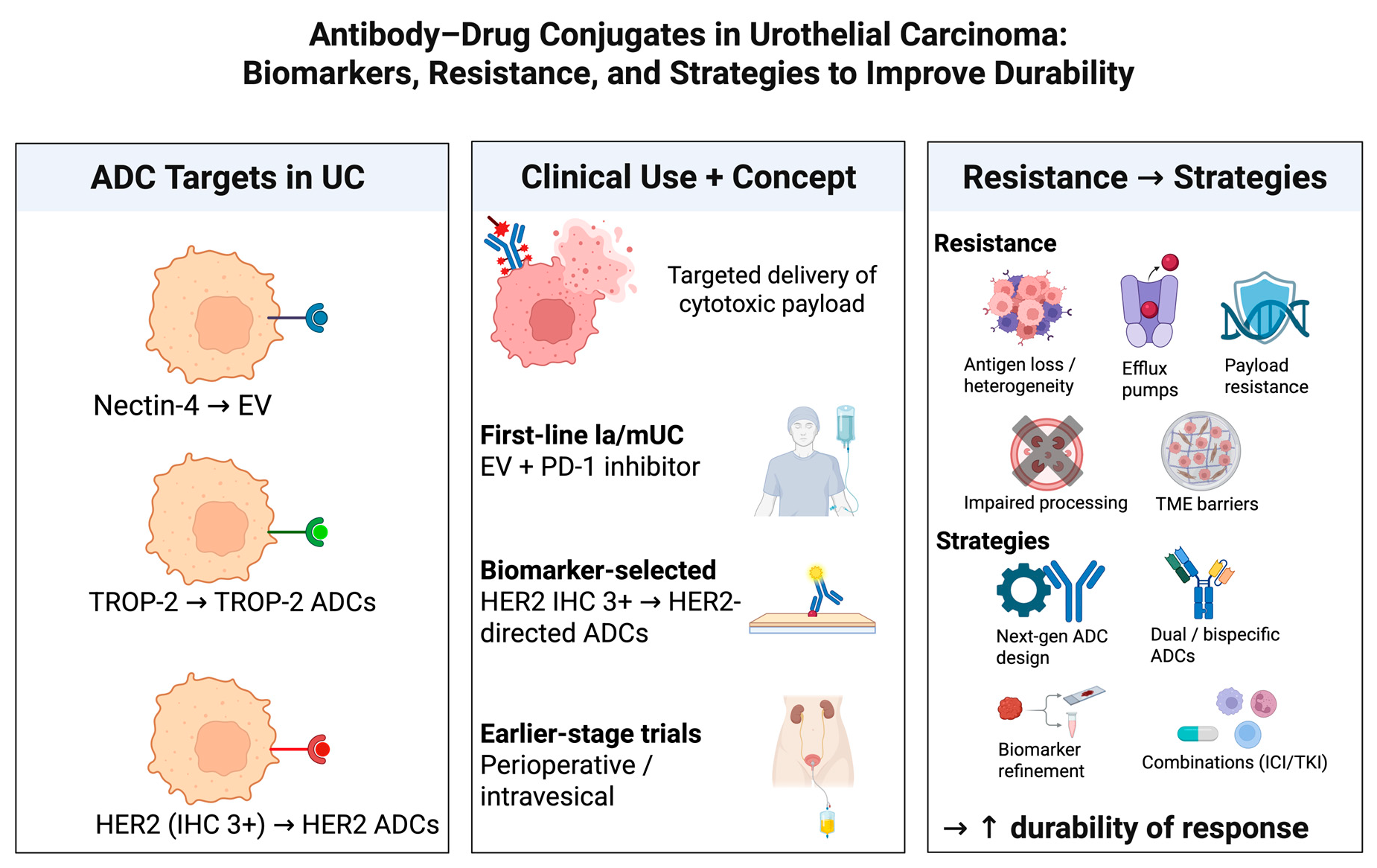
- Nectin-4 (nectin cell adhesion molecule 4) is expressed in up to 87% of bladder cancer specimens, while remaining minimally detectable in normal adult tissues [15]. This tumor-selective expression makes Nectin-4 an appealing therapeutic target. It contributes to cell adhesion and tumor growth through PI3K–AKT signaling and undergoes rapid internalization upon antibody binding [13,15]. Enfortumab vedotin (EV), a Nectin-4-directed antibody–drug conjugate carrying monomethyl auristatin E (MMAE), leverages these properties and has become a key therapy in UC [18,19].
- TROP-2 (trophoblast cell-surface antigen 2), the target of sacituzumab govitecan (SG), is a transmembrane glycoprotein broadly overexpressed in epithelial malignancies, including UC, with minimal expression in normal tissues [17]. Its overexpression correlates with tumor growth and migration [17,20]. SG links an anti-TROP-2 antibody to SN-38, the active metabolite of irinotecan, which induces DNA strand breaks [17]. Although SG’s accelerated approval in metastatic UC was withdrawn after the phase III TROPiCS-04 trial failed to meet its primary overall-survival endpoint, the drug demonstrated antitumor activity, showing higher response rates than chemotherapy in TROPiCS-04 and comparable responses in TROPHY-U-01 study cohort 1, supporting continued interest in TROP-2 as a therapeutic target [20,21].
- HER2 (human epidermal growth factor receptor 2) is overexpressed in a subset of UC tumors, and higher expression has been associated with more aggressive biology and cisplatin resistance [17,20]. The advent of ADCs has renewed interest in HER2 targeting, as coupling HER2 binding with delivery of potent, membrane-permeable cytotoxic payloads has shown clinically meaningful activity in metastatic UC, including in the HER2-expressing cohort of the DESTINY-PanTumor02 trial, where response rates were higher in strongly HER2-positive tumors (IHC 3+) [18,20]. ADCs have also demonstrated activity in tumors with heterogeneous or low HER2 expression, as reported in a phase II study by Xu et al. (2022), whereas prior HER2-directed antibodies and tyrosine kinase inhibitors were largely ineffective [22].
3.2. FDA-Approved ADCs
3.3. Perioperative and Intravesical Investigations
3.4. Ongoing Combination Trials
3.5. Overall Landscape
4. Predictors of Response to ADCs in Urothelial Cancers
4.1. Enfortumab Vedotin
4.2. Sacituzumab Govitecan
5. Mechanisms of Resistance to Enfortumab Vedotin and Sacituzumab Govitecan
6. Overcoming Resistance to ADCs
7. Future Directions and Conclusions
Author Contributions
Funding
Institutional Review Board Statement
Informed Consent Statement
Data Availability Statement
Acknowledgments
Conflicts of Interest
Abbreviations
| ABCB1 | ATP-binding cassette subfamily B member 1 (P-glycoprotein/MDR1) |
| ADCs | Antibody–drug conjugates |
| AKT | Protein kinase B |
| aUC | Advanced urothelial carcinoma |
| BCG | Bacillus Calmette–Guérin |
| BTC | Bicycle toxin conjugate |
| CPI | Checkpoint inhibitor |
| CR | Complete response |
| DAD | Dual antibody–drug conjugate |
| DAR | Drug-to-antibody ratio |
| DCR | Disease control rate |
| Dato-DXd | Datopotamab deruxtecan |
| DESTINY-PanTumor02 | Study name (trastuzumab deruxtecan tumor-agnostic trial) |
| DNA | Deoxyribonucleic acid |
| DV | Disitamab vedotin |
| EMT | Epithelial–mesenchymal transition |
| EpCAM | Epithelial cell adhesion molecule |
| ERBB2 | Gene encoding HER2 |
| ESMO | European Society for Medical Oncology |
| EV | Enfortumab vedotin |
| EV+P | Enfortumab vedotin plus pembrolizumab |
| FGFR | Fibroblast growth factor receptor |
| FGFR2/3 | Fibroblast growth factor receptor 2/3 |
| G-CSF | Granulocyte colony-stimulating factor |
| HER2 | Human epidermal growth factor receptor 2 |
| HER3 | Human epidermal growth factor receptor 3 |
| ICI | Immune checkpoint inhibitor |
| IHC | Immunohistochemistry |
| ILD | Interstitial lung disease |
| la/mUC | Locally advanced or metastatic urothelial carcinoma |
| MDR1 | Multidrug resistance protein 1 (P-glycoprotein) |
| MIBC | Muscle-invasive bladder cancer |
| MMAE | Monomethyl auristatin E |
| MTAP | Methylthioadenosine phosphorylase |
| mUC | Metastatic urothelial carcinoma |
| NCCN | National Comprehensive Cancer Network |
| NMIBC | Non-muscle-invasive bladder cancer |
| ORR | Objective response rate |
| OS | Overall survival |
| pCR | Pathologic complete response |
| PD-1 | Programmed cell death protein 1 |
| PD-L1 | Programmed death-ligand 1 |
| PFS | Progression-free survival |
| PI3K | Phosphoinositide 3-kinase |
| PK | Pharmacokinetics |
| RNA | Ribonucleic acid |
| RP2D | Recommended phase II dose |
| SG | Sacituzumab govitecan |
| SN-38 | Active metabolite of irinotecan |
| SOC | Standard of care |
| T-DXd | Trastuzumab deruxtecan |
| TF | Tissue factor |
| TKI | Tyrosine kinase inhibitor |
| TME | Tumor microenvironment |
| Topo-I | Topoisomerase I |
| TROP-2 | Trophoblast cell-surface antigen 2 |
| UC | Urothelial carcinoma |
References
- Al-Ahmadie, H.; Netto, G.J. Molecular Pathology of Urothelial Carcinoma. Surg. Pathol. Clin. 2021, 14, 403–414. [Google Scholar] [CrossRef]
- Al-Ahmadie, H.; Netto, G.J. Molecular Pathology of Urothelial Carcinoma. Clin. Lab. Med. 2024, 44, 181–198. [Google Scholar] [CrossRef]
- Kwon, W.-A.; Seo, H.K.; Song, G.; Lee, M.-K.; Park, W.S. Advances in Therapy for Urothelial and Non-Urothelial Subtype Histologies of Advanced Bladder Cancer: From Etiology to Current Development. Biomedicines 2025, 13, 86. [Google Scholar] [CrossRef]
- Zarrabi, K.K.; Saxena, A.; Mouw, K.W.; Koshkin, V.S.; Friedlander, T. Unmet Potential of Antibody-Drug Conjugates: An Evaluation of the Past, Present, and Future of Antibody-Drug Conjugate Development in Advanced Urothelial Carcinoma. Am. Soc. Clin. Oncol. Educ. Book 2025, 45, e471924. [Google Scholar] [CrossRef]
- Kobayashi, T. Understanding the Biology of Urothelial Cancer Metastasis. Asian J. Urol. 2016, 3, 211–222. [Google Scholar] [CrossRef] [PubMed]
- Fu, Z.; Li, S.; Han, S.; Shi, C.; Zhang, Y. Antibody Drug Conjugate: The “Biological Missile” for Targeted Cancer Therapy. Signal Transduct. Target. Ther. 2022, 7, 93. [Google Scholar] [CrossRef] [PubMed]
- Saginala, K.; Barsouk, A.; Aluru, J.S.; Rawla, P.; Padala, S.A.; Barsouk, A. Epidemiology of Bladder Cancer. Med. Sci. 2020, 8, 15. [Google Scholar] [CrossRef] [PubMed]
- Kinde, I.; Munari, E.; Faraj, S.F.; Hruban, R.H.; Schoenberg, M.; Bivalacqua, T.; Allaf, M.; Springer, S.; Wang, Y.; Diaz, L.A.; et al. TERT Promoter Mutations Occur Early in Urothelial Neoplasia and Are Biomarkers of Early Disease and Disease Recurrence in Urine. Cancer Res. 2013, 73, 7162–7167. [Google Scholar] [CrossRef]
- Kwon, W.-A. FGFR Inhibitors in Urothelial Cancer: From Scientific Rationale to Clinical Development. J. Korean Med. Sci. 2024, 39, e320. [Google Scholar] [CrossRef]
- Zhang, S.; Xiao, X.; Yi, Y.; Wang, X.; Zhu, L.; Shen, Y.; Lin, D.; Wu, C. Tumor Initiation and Early Tumorigenesis: Molecular Mechanisms and Interventional Targets. Signal Transduct. Target. Ther. 2024, 9, 149. [Google Scholar] [CrossRef]
- Moschini, M.; D’Andrea, D.; Korn, S.; Irmak, Y.; Soria, F.; Compérat, E.; Shariat, S.F. Characteristics and Clinical Significance of Histological Variants of Bladder Cancer. Nat. Rev. Urol. 2017, 14, 651–668. [Google Scholar] [CrossRef] [PubMed]
- Sabit, H.; Arneth, B.; Abdel-Ghany, S.; Madyan, E.F.; Ghaleb, A.H.; Selvaraj, P.; Shin, D.M.; Bommireddy, R.; Elhashash, A. Beyond Cancer Cells: How the Tumor Microenvironment Drives Cancer Progression. Cells 2024, 13, 1666. [Google Scholar] [CrossRef] [PubMed]
- Goodson, D.A.; Friedlander, T.W. The Future of Antibody–Drug Conjugates in Urothelial Cancer. Adv. Oncol. 2023, 3, 137–159. [Google Scholar] [CrossRef]
- Wang, R.; Hu, B.; Pan, Z.; Mo, C.; Zhao, X.; Liu, G.; Hou, P.; Cui, Q.; Xu, Z.; Wang, W.; et al. Antibody–Drug Conjugates (ADCs): Current and Future Biopharmaceuticals. J. Hematol. Oncol. 2025, 18, 51. [Google Scholar] [CrossRef]
- Khosravanian, M.J.; Mirzaei, Y.; Mer, A.H.; Keyhani-Khankahdani, M.; Abdinia, F.S.; Misamogooe, F.; Amirkhani, Z.; Bagheri, N.; Meyfour, A.; Jahandideh, S.; et al. Nectin-4-Directed Antibody-Drug Conjugates (ADCs): Spotlight on Preclinical and Clinical Evidence. Life Sci. 2024, 352, 122910. [Google Scholar] [CrossRef]
- Zhang, F.; Li, S. Antibody-Drug Conjugates as Game Changers in Bladder Cancer: Current Progress and Future Directions. Front. Immunol. 2025, 16, 1591191. [Google Scholar] [CrossRef] [PubMed]
- Thomas, J.; Sun, M.; Getz, T.; Ho, B.; Nauseef, J.T.; Tagawa, S.T. Antibody-Drug Conjugates for Urothelial Carcinoma. Urol. Oncol. 2023, 41, 420–428. [Google Scholar] [CrossRef]
- Vlachou, E.; Johnson, B.A.; Hoffman-Censits, J. The Role of Antibody-Drug Conjugates in Urothelial Cancer: A Review of Recent Advances in the Treatment of Locally Advanced and Metastatic Urothelial Cancer. Clin. Med. Insights Oncol. 2024, 18, 11795549241290787. [Google Scholar] [CrossRef]
- Wei, J.; Tang, B.; Yan, X.; Li, J.; Zhou, L.; Li, S.; Xu, H.; Sheng, X. Advances in Antibody-Drug Conjugates for Urothelial Carcinoma Treatment. Cancer Biol. Med. 2025, 22, 1132–1142. [Google Scholar] [CrossRef]
- Kwon, W.-A.; Lee, S.-Y.; Jeong, T.Y.; Kim, H.H.; Lee, M.-K. Antibody-Drug Conjugates in Urothelial Cancer: From Scientific Rationale to Clinical Development. Cancers 2024, 16, 2420. [Google Scholar] [CrossRef] [PubMed]
- Loriot, Y.; Petrylak, D.P.; Kalebasty, A.R.; Fléchon, A.; Jain, R.K.; Gupta, S.; Bupathi, M.; Beuzeboc, P.; Palmbos, P.; Balar, A.V.; et al. TROPHY-U-01, a Phase II Open-Label Study of Sacituzumab Govitecan in Patients with Metastatic Urothelial Carcinoma Progressing after Platinum-Based Chemotherapy and Checkpoint Inhibitors: Updated Safety and Efficacy Outcomes. Ann. Oncol. 2024, 35, 392–401. [Google Scholar] [CrossRef]
- Xu, H.; Sheng, X.; Zhou, L.; Yan, X.; Li, S.; Chi, Z.; Cui, C.; Si, L.; Tang, B.; Mao, L.; et al. A Phase II Study of RC48-ADC in HER2-Negative Patients with Locally Advanced or Metastatic Urothelial Carcinoma. J. Clin. Oncol. 2022, 40, 4519. [Google Scholar] [CrossRef]
- Balar, A.V.; McGregor, B.A.; Rosenberg, J.E.; Van Der Heijden, M.S.; Park, S.H.; Lee, J.-L.; Harrison, M.R.; Heath, E.I.; Stein, M.N.; Loriot, Y.; et al. EV-201 Cohort 2: Enfortumab Vedotin in Cisplatin-Ineligible Patients with Locally Advanced or Metastatic Urothelial Cancer Who Received Prior PD-1/PD-L1 Inhibitors. J. Clin. Oncol. 2021, 39, 394. [Google Scholar] [CrossRef]
- Powles, T.; Rosenberg, J.E.; Sonpavde, G.P.; Loriot, Y.; Durán, I.; Lee, J.-L.; Matsubara, N.; Vulsteke, C.; Castellano, D.; Wu, C.; et al. Enfortumab Vedotin in Previously Treated Advanced Urothelial Carcinoma. N. Engl. J. Med. 2021, 384, 1125–1135. [Google Scholar] [CrossRef] [PubMed]
- Powles, T.; Valderrama, B.P.; Gupta, S.; Bedke, J.; Kikuchi, E.; Hoffman-Censits, J.; Iyer, G.; Vulsteke, C.; Park, S.H.; Shin, S.J.; et al. Enfortumab Vedotin and Pembrolizumab in Untreated Advanced Urothelial Cancer. N. Engl. J. Med. 2024, 390, 875–888. [Google Scholar] [CrossRef]
- Powles, T.; Csőszi, T.; Özgüroğlu, M.; Matsubara, N.; Géczi, L.; Cheng, S.Y.-S.; Fradet, Y.; Oudard, S.; Vulsteke, C.; Morales Barrera, R.; et al. Pembrolizumab Alone or Combined with Chemotherapy versus Chemotherapy as First-Line Therapy for Advanced Urothelial Carcinoma (KEYNOTE-361): A Randomised, Open-Label, Phase 3 Trial. Lancet Oncol. 2021, 22, 931–945. [Google Scholar] [CrossRef] [PubMed]
- Galsky, M.D.; Arija, J.Á.A.; Bamias, A.; Davis, I.D.; De Santis, M.; Kikuchi, E.; Garcia-del-Muro, X.; De Giorgi, U.; Mencinger, M.; Izumi, K.; et al. Atezolizumab with or without Chemotherapy in Metastatic Urothelial Cancer (IMvigor130): A Multicentre, Randomised, Placebo-Controlled Phase 3 Trial. Lancet 2020, 395, 1547–1557. [Google Scholar] [CrossRef]
- Powles, T.; Tagawa, S.; Vulsteke, C.; Gross-Goupil, M.; Park, S.H.; Necchi, A.; Santis, M.D.; Duran, I.; Morales-Barrera, R.; Guo, J.; et al. Sacituzumab Govitecan in Advanced Urothelial Carcinoma: TROPiCS-04, a Phase III Randomized Trial. Ann. Oncol. 2025, 36, 561–571. [Google Scholar] [CrossRef]
- Meric-Bernstam, F.; Makker, V.; Oaknin, A.; Oh, D.-Y.; Banerjee, S.; González-Martín, A.; Jung, K.H.; Ługowska, I.; Manso, L.; Manzano, A.; et al. Efficacy and Safety of Trastuzumab Deruxtecan in Patients with HER2-Expressing Solid Tumors: Primary Results From the DESTINY-PanTumor02 Phase II Trial. J. Clin. Oncol. Off. J. Am. Soc. Clin. Oncol. 2023, 42, 47–58. [Google Scholar] [CrossRef]
- Jain, R.K.; Heiligh, J.; Kim, Y.; Piekarz, R.; Pelosof, L.C.; Yang, Y.; D’souza, A.; Wong, R.L.; Graham, L.; Gupta, S.; et al. Phase Ib Trial of Erdafitinib (E) Combined with Enfortumab Vedotin (EV) Following Platinum and PD-1/L1 Inhibitors for Metastatic Urothelial Carcinoma (mUC) with FGFR2/3 Genetic Alterations (GAs). J. Clin. Oncol. 2024, 42, 625. [Google Scholar] [CrossRef]
- Kamat, A.M.; Lotan, Y.; Roupret, M.; Steinberg, G.D.; Inman, B.A.; Powles, T.; Redorta, J.P.; Porten, S.P.; Kulkarni, G.S.; Uchio, E.M.; et al. A First-in-Human Trial of Intravesical Enfortumab Vedotin (EV), an Antibody-Drug Conjugate (ADC), in Patients with Non-Muscle Invasive Bladder Cancer (NMIBC): Interim Results of a Phase 1 Study (EV-104). J. Clin. Oncol. 2023, 41, 4596. [Google Scholar] [CrossRef]
- Vulsteke, C. ESMO 2025: Perioperative Enfortumab Vedotin (EV) Plus Pembrolizumab (Pembro) in Participants with Muscle-Invasive Bladder Cancer (MIBC) Who Are Cisplatin-Ineligible: The Phase 3 KEYNOTE-905 Study. Available online: https://www.urotoday.com/conference-highlights/esmo-2025/esmo-2025-bladder-cancer/164060-esmo-2025-perioperative-enfortumab-vedotin-ev-plus-pembrolizumab-pembro-in-participants-with-muscle-invasive-bladder-cancer-mibc-who-are-cisplatin-ineligible-the-phase-3-keynote-905-study.html (accessed on 2 January 2025).
- Brown, J.T.; Nazha, B.; Liu, Y.; Lozada, K.; Smith, J.D.; Hartman, C.; McClintock, G.R.; Kucuk, O.; Carthon, B.C.; Harvey, R.D.; et al. Updated Interim Analysis of a Phase I/Ib Study of Enfortumab Vedotin plus Cabozantinib in Patients with Metastatic Urothelial Carcinoma. J. Clin. Oncol. 2024, 42, 4586. [Google Scholar] [CrossRef]
- Maiorano, B.A.; Catalano, M.; Maiello, E.; Roviello, G. Enfortumab Vedotin in Metastatic Urothelial Carcinoma: The Solution EVentually? Front. Oncol. 2023, 13, 1254906. [Google Scholar] [CrossRef]
- Friedlander, T. ESMO 2025: EV-103 Cohort K: Efficacy and Safety of Enfortumab Vedotin with or without Pembrolizumab in Cisplatin-Ineligible Patients with Previously Untreated Locally Advanced or Metastatic Urothelial Cancer with a Median Follow-up of ~3.5 Years. Ann. Oncol. 2025, 36, S1487–S1488. [Google Scholar] [CrossRef]
- Yu, J.; Wu, S.; Li, R.; Jiang, Y.; Zheng, J.; Li, Z.; Li, M.; Xin, K.; Guan, X.; Li, S.; et al. Novel ADCs and Combination Therapy in Urothelial Carcinoma: Latest Updates from the 2023 ASCO-GU Cancers Symposium. J. Hematol. Oncol. 2023, 16, 85. [Google Scholar] [CrossRef] [PubMed]
- Galsky, M.D.; Witjes, J.A.; Gschwend, J.E.; Milowsky, M.I.; Schenker, M.; Valderrama, B.P.; Tomita, Y.; Bamias, A.; Lebret, T.; Shariat, S.F.; et al. Adjuvant Nivolumab in High-Risk Muscle-Invasive Urothelial Carcinoma: Expanded Efficacy from CheckMate 274. J. Clin. Oncol. 2024, 43, 15–21. [Google Scholar] [CrossRef]
- Klümper, N.; Tran, N.K.; Zschäbitz, S.; Hahn, O.; Büttner, T.; Roghmann, F.; Bolenz, C.; Zengerling, F.; Schwab, C.; Nagy, D.; et al. NECTIN4 Amplification Is Frequent in Solid Tumors and Predicts Enfortumab Vedotin Response in Metastatic Urothelial Cancer. J. Clin. Oncol. 2024, 42, 2446–2455. [Google Scholar] [CrossRef]
- Powles, T.B.; Van Der Heijden, M.S.; Gupta, S.; Perez Valderrama, B.; Galsky, M.D.; Bedke, J.; Kikuchi, E.; Hoffman-Censits, J.; Maroto Rey, J.P.; Vulsteke, C.; et al. 1966MO EV-302: Exploratory Analysis of Nectin-4 Expression and Response to 1L Enfortumab Vedotin (EV) + Pembrolizumab (P) in Previously Untreated Locally Advanced or Metastatic Urothelial Cancer (La/mUC). Ann. Oncol. 2024, 35, S1137–S1138. [Google Scholar] [CrossRef]
- Chu, C.E.; Sjöström, M.; Egusa, E.A.; Gibb, E.A.; Badura, M.L.; Zhu, J.; Koshkin, V.S.; Stohr, B.A.; Meng, M.V.; Pruthi, R.S.; et al. Heterogeneity in NECTIN4 Expression Across Molecular Subtypes of Urothelial Cancer Mediates Sensitivity to Enfortumab Vedotin. Clin. Cancer Res. 2021, 27, 5123–5130. [Google Scholar] [CrossRef]
- Powles, T.; Van, S.; Loriot, Y.; Bedke, J.; Valderrama, B.P.; Iyer, G.; Kikuchi, E.; Hoffman-Censits, J.; Vulsteke, C.; Drakaki, A.; et al. EV-302: Updated Analysis from the Phase 3 Global Study of Enfortumab Vedotin in Combination with Pembrolizumab (EV + P) vs Chemotherapy (Chemo) in Previously Untreated Locally Advanced or Metastatic Urothelial Carcinoma (La/mUC). J. Clin. Oncol. 2025, 43, 664. [Google Scholar] [CrossRef]
- Jang, A.; Brown, J.R. Strategies to Overcome Resistance to Enfortumab Vedotin and Pembrolizumab for Patients with Urothelial Carcinoma: Harnessing Present Knowledge for Future Advances. Explor. Target. Anti-Tumor Ther. 2025, 6, 1002307. [Google Scholar] [CrossRef] [PubMed]
- Jindal, T.; Jiang, C.Y.; Alhalabi, O.; Nguyen, C.B.; Oh, E.; Tsung, I.; Bakaloudi, D.R.; Talukder, R.; Davidsohn, M.; Freeman, D.; et al. Outcomes with Enfortumab Vedotin in Patients with Histologic Subtypes of Advanced Urothelial Carcinoma: Analysis of the UNITE Study. Eur. Urol. 2025, in press. [Google Scholar] [CrossRef] [PubMed]
- You, X.; Zhu, C.; Yu, P.; Wang, X.; Wang, Y.; Wang, J.; Yu, J.; Wang, K. Emerging Strategy for the Treatment of Urothelial Carcinoma: Advances in Antibody-Drug Conjugates Combination Therapy. Biomed. Pharmacother. 2024, 171, 116152. [Google Scholar] [CrossRef]
- Jindal, T.; Jiang, C.; Alhalabi, O.; Rafailia Bakaloudi, D.; Talukder, R.; Davidsohn, M.; Nizam, A.; Taylor, A.K.; Nguyen, C.B.; Kilari, D.; et al. Biomarkers of Response to Sacituzumab Govitecan (SG) and Efficacy after Treatment with Enfortumab Vedotin (EV) in Advanced Urothelial Carcinoma (aUC): Analysis of the UNITE Study. J. Clin. Oncol. 2023, 41, 4572. [Google Scholar] [CrossRef]
- Jindal, T.; Jiang, C.Y.; Alhalabi, O.; Tsung, I.; Jang, A.; Bakaloudi, D.R.; Sidhom, F.; Taylor, A.K.; Hoimes, C.J.; Bellmunt, J.; et al. 1988P Enfortumab Vedotin (EV) + Pembrolizumab (P) Outcomes Outside Clinical Trials and Biomarkers of Benefit in Patients (Pts) with Advanced Urothelial Carcinoma: Analysis of the UNITE Study. Ann. Oncol. 2024, 35, S1149–S1150. [Google Scholar] [CrossRef]
- Jindal, T.; Zhang, L.; Jiang, C.; Kilari, D.; Alhalabi, O.; Nizam, A.; Basu, A.; Bilen, M.A.; Zakharia, Y.; Milowsky, M.I.; et al. Independent Biomarkers Predictive of Outcomes with Enfortumab Vedotin (EV) in Patients (Pts) with Advanced Urothelial Carcinoma (aUC): Analysis of the UNITE Study. J. Clin. Oncol. 2023, 41, 4573. [Google Scholar] [CrossRef]
- Sternschuss, M.; Toumbacaris, N.; Das, J.P.; Powles, T.; Kotecha, R.R.; Laccetti, A.L.; Xiao, H.; Feld, E.; McHugh, D.J.; Keegan, N.M.; et al. Real-World Clinical Outcomes of Sacituzumab Govitecan after Prior Exposure to Enfortumab Vedotin in Patients with Metastatic Urothelial Carcinoma. ESMO Open 2025, 10, 105305. [Google Scholar] [CrossRef]
- Khoury, R.; Saleh, K.; Khalife, N.; Saleh, M.; Chahine, C.; Ibrahim, R.; Lecesne, A. Mechanisms of Resistance to Antibody-Drug Conjugates. Int. J. Mol. Sci. 2023, 24, 9674. [Google Scholar] [CrossRef]
- Chang, K.; Lodha, R.; Delavan, H.M.; Winebaum, J.; Porten, S.P.; Feng, F.Y.; Chu, C.E.; Chou, J. Mechanisms and Strategies to Overcome Resistance to Enfortumab Vedotin in Bladder Cancer. J. Clin. Oncol. 2024, 42, 690. [Google Scholar] [CrossRef]
- Crompot, E.; Finetti, P.; Guille, A.; Chaffanet, M.; Gonçalves, A.; Charafe-Jauffret, E.; Mamessier, E.; Birmbaum, D.; Bertucci, F.; Lopez, M. Overcoming Resistance to Anti–Nectin-4 Antibody-Drug Conjugate. Mol. Cancer Ther. 2022, 21, 1227–1235. [Google Scholar] [CrossRef]
- Kotono, M.; Kijima, T.; Takada-Owada, A.; Okubo, N.; Kurashina, R.; Kokubun, H.; Uematsu, T.; Takei, K.; Ishida, K.; Kamai, T. Increased Expression of ATP-Binding Cassette Transporters in Enfortumab Vedotin-Resistant Urothelial Cancer. IJU Case Rep. 2024, 7, 173–176. [Google Scholar] [CrossRef]
- ASCO 2025: EV-103 Cohort H: Neoadjuvant Treatment with Enfortumab Vedotin Monotherapy in Cisplatin-Ineligible Patients with Muscle Invasive Bladder Cancer—3-Year Efficacy Results. Available online: https://www.urotoday.com/conference-highlights/asco-2025/asco-2025-bladder-cancer/161036-asco-2025-ev-103-cohort-h-neoadjuvant-treatment-with-enfortumab-vedotin-monotherapy-in-cisplatin-ineligible-patients-with-muscle-invasive-bladder-cancer-3-year-efficacy-results.html (accessed on 2 January 2025).
- Kulukian, A.; Lee, P.; Taylor, J.; Rosler, R.; De Vries, P.; Watson, D.; Forero-Torres, A.; Peterson, S. Preclinical Activity of HER2-Selective Tyrosine Kinase Inhibitor Tucatinib as a Single Agent or in Combination with Trastuzumab or Docetaxel in Solid Tumor Models. Mol. Cancer Ther. 2020, 19, 976–987. [Google Scholar] [CrossRef]
- Fujii, T.; Matsuda, Y.; Seki, T.; Shikida, N.; Iwai, Y.; Ooba, Y.; Takahashi, K.; Isokawa, M.; Kawaguchi, S.; Hatada, N.; et al. AJICAP Second Generation: Improved Chemical Site-Specific Conjugation Technology for Antibody–Drug Conjugate Production. Bioconjug. Chem. 2023, 34, 728–738. [Google Scholar] [CrossRef] [PubMed]
- Tsuchikama, K.; Anami, Y.; Ha, S.Y.Y.; Yamazaki, C.M. Exploring the next Generation of Antibody–Drug Conjugates. Nat. Rev. Clin. Oncol. 2024, 21, 203–223. [Google Scholar] [CrossRef] [PubMed]
- Majumder, A. HER3: Toward the Prognostic Significance, Therapeutic Potential, Current Challenges, and Future Therapeutics in Different Types of Cancer. Cells 2023, 12, 2517. [Google Scholar] [CrossRef] [PubMed]
- Bian, X.; Yang, T.; Yin, H.; Hu, B.; Yao, K.; Jiang, S.; Chen, Y.; Lin, J.; Cao, M.; Liu, N.; et al. Efficacy and Safety of BL-B01D1 in Patients with Locally Advanced or Metastatic Urothelial Carcinoma: A Phase II Clinical Trial. J. Clin. Oncol. 2025, 43, 3505–3515. [Google Scholar] [CrossRef]
- Kamoun, A.; de Reyniès, A.; Allory, Y.; Sjödahl, G.; Robertson, A.G.; Seiler, R.; Hoadley, K.A.; Groeneveld, C.S.; Al-Ahmadie, H.; Choi, W.; et al. A Consensus Molecular Classification of Muscle-Invasive Bladder Cancer. Eur. Urol. 2020, 77, 420–433. [Google Scholar] [CrossRef]
- Yang, Y.; Wang, S.; Ma, P.; Jiang, Y.; Cheng, K.; Yu, Y.; Jiang, N.; Miao, H.; Tang, Q.; Liu, F.; et al. Drug Conjugate-Based Anticancer Therapy—Current Status and Perspectives. Cancer Lett. 2022, 552, 215969. [Google Scholar] [CrossRef]
- Rigby, M.; Bennett, G.; Chen, L.; Mudd, G.E.; Harrison, H.; Beswick, P.J.; Van Rietschoten, K.; Watcham, S.M.; Scott, H.S.; Brown, A.N.; et al. BT8009; A Nectin-4 Targeting Bicycle Toxin Conjugate for Treatment of Solid Tumors. Mol. Cancer Ther. 2022, 21, 1747–1756. [Google Scholar] [CrossRef]
- Rosenberg, J.; Sabatier, R.; Viceneux, A.; Rouge, T.D.L.M.; Champiat, S.; Lebellec, L.; Barthélémy, P.; Sonpavde, G.; Gao, X.; Niglio, S.; et al. Abstract CT084: A Phase 1 Study of LY4101174 (ETx-22), an Antibody-Drug Conjugate Targeting Nectin-4, in Patients with Advanced or Metastatic Urothelial Cancer and Other Solid Tumors (Trial in Progress). Cancer Res. 2024, 84, CT084. [Google Scholar] [CrossRef]
- Perez, C.A.; Gandhi, N.J.; Mosalpuria, K.; Cowey, C.L.; Hodgson, I.; Smethurst, D.; Pinato, D.J. Phase I Dose-Escalation Study of the next-Generation Nectin-4 Targeting Antibody–Drug Conjugate CRB-701 (SYS6002) in US and UK Patients with Urothelial Cancer and Other Solid Tumors. J. Clin. Oncol. 2025, 43, 807. [Google Scholar] [CrossRef]
- Zhang, J.; Liu, R.; Gao, S.; Yang, H.; Chen, J.; Yuan, F.; Liu, J.; Guo, H.; Zhang, S.; Li, X.; et al. 9MW2821, a Nectin-4 Antibody-Drug Conjugate (ADC), in Patients with Advanced Solid Tumor: Results from a Phase 1/2a Study. J. Clin. Oncol. 2024, 42, 3013. [Google Scholar] [CrossRef]
- Ye, D.; Jiang, S.; Yuan, F.; Zhou, F.; Jiang, K.; Zhang, X.; Li, X.; Seneviratne, L.C.; Yu, G.; Zhang, M.; et al. Efficacy and Safety of Sacituzumab Tirumotecan Monotherapy in Patients with Advanced Urothelial Carcinoma Who Progressed on or after Prior Anti-Cancer Therapies: Report from the Phase 1/2 MK-2870-001 Study. J. Clin. Oncol. 2025, 43, 796. [Google Scholar] [CrossRef]
- Janjigian, Y.Y.; Oaknin, A.; Lang, J.M.; Ciombor, K.K.; Ray-Coquard, I.L.; Oza, A.M.; Yonemori, K.; Xu, R.-H.; Zhao, J.; Gajavelli, S.; et al. TROPION-PanTumor03: Phase 2, Multicenter Study of Datopotamab Deruxtecan (Dato-DXd) as Monotherapy and in Combination with Anticancer Agents in Patients (Pts) with Advanced/Metastatic Solid Tumors. J. Clin. Oncol. 2023, 41, TPS3153. [Google Scholar] [CrossRef]
- Rha, S.Y.; Lim, S.H.; Zhou, F.; Jung, K.H.; Wysocki, P.J.; Drosik-Rutowicz, K.; Chen, J.-S.; Taniguchi, H.; Urun, Y.; Harano, K.; et al. 3072MO Datopotamab Deruxtecan (Dato-DXd) + Rilvegostomig (Rilve) in Patients (Pts) with Locally Advanced or Metastatic Urothelial Cancer (a/mUC): Results from the Phase II TROPION-PanTumor03 Study. Ann. Oncol. 2025, 36, S1590–S1591. [Google Scholar] [CrossRef]
- Zhao, J.; Dinglin, X.-X.; Ji, Y.; Song, Z.; Li, Y.; Wen, Q.; Sun, M.; Ma, J.; Yi, T.; Zhao, Y.; et al. BAT8008, a TROP-2 Antibody-Drug Conjugate (ADC), in Patients with Advanced Solid Tumor: Results from a Phase 1 Study. J. Clin. Oncol. 2025, 43, 3024. [Google Scholar] [CrossRef]
- Li, W.-F.; Chiang, M.-F.; Weng, H.-C.; Yang, J.-J.; Wu, H.-S.; Wu, S.-Y.; Chen, Y.-J.; Lu, C.-H.; Tu, J.-S.; Hsu, R.-Y.; et al. OBI-992, a Novel TROP2-Targeted Antibody–Drug Conjugate, Demonstrates Antitumor Activity in Multiple Cancer Models. Mol. Cancer Ther. 2024, 24, 163–175. [Google Scholar] [CrossRef] [PubMed]
- Shia, C.-S.; Wen, S.-N.; Hsu, R.-Y.; Tu, J.-S.; Chang, H.-W.; Li, W.-F.; Lai, M.-T. Abstract 7179: OBI-992, a Novel TROP2 Targeting Antibody Drug Conjugate Demonstrates Superior in Vivo PK/PD Properties and a Favorable Safety Profile. Cancer Res. 2024, 84, 7179. [Google Scholar] [CrossRef]
- Petrylak, D.P.; Eigl, B.J.; George, S.; Heath, E.I.; Hotte, S.J.; Chism, D.D.; Nabell, L.M.; Picus, J.; Cheng, S.Y.; Appleman, L.J.; et al. Phase I Dose-Escalation Study of the Safety and Pharmacokinetics of AGS15E Monotherapy in Patients with Metastatic Urothelial Carcinoma. Clin. Cancer Res. 2024, 30, 63–73. [Google Scholar] [CrossRef] [PubMed]
- Kogawa, T.; Mitani, S.; Berz, D.; Reis, D.; Li, C.; Ishida, T.C.; Wang, K.; Schmidt, K.; Koganemaru, S. IDeate-PanTumor02: A Phase 1b/2 Study to Evaluate the Efficacy and Safety of Ifinatamab Deruxtecan (I-DXd) in Patients (Pts) with Recurrent or Metastatic Solid Tumors. J. Clin. Oncol. 2025, 43, TPS3157. [Google Scholar] [CrossRef]
- Qu, W.; Fu, C.; Han, W.; Luo, H.; Quan, J.; Chen, L.; Liao, Y.; Hu, C.; Hu, H.; Niu, Y.; et al. A Single-Arm, Multicenter, Phase 2 Clinical Study of Recombinant Humanized Anti-HER2 Monoclonal Antibody-MMAE Conjugate (MRG002) in HER2-Positive Unresectable Locally Advanced or Metastatic Urothelial Carcinoma. Eur. J. Cancer 2024, 205, 114096. [Google Scholar] [CrossRef] [PubMed]



| Drug | Target | Payload | Trial/Phase | Key Outcomes |
|---|---|---|---|---|
| Enfortumab vedotin | Nectin-4 | MMAE | EV-301 (III) | Improved OS, ORR ~40% |
| Enfortumab vedotin + Pembrolizumab | Nectin-4 | MMAE | EV-302 (III) | Established first-line SOC |
| Sacituzumab govitecan | TROP-2 | SN-38 | TROPHY-U-01 (II) | ORR ~27% |
| Sacituzumab govitecan | TROP-2 | SN-38 | TROPiCS-04 (III) | Confirmatory phase III outcomes |
| Trastuzumab deruxtecan | HER2 | Deruxtecan | Early-phase cohorts | Early efficacy signals |
| ADC/Agent | Study/Trial | Setting/Population | Regimen | Key Outcomes or Notes |
|---|---|---|---|---|
| Enfortumab vedotin (EV) | EV-103 Cohort H, L (NCT03288545) | Neoadjuvant/perioperative cisplatin-ineligible MIBC | EV monotherapy | Feasibility, pathologic response, and safety of EV as perioperative therapy in cisplatin-ineligible MIBC 1 |
| EV-302 (phase III) (NCT04223856) | Previously untreated locally advanced/metastatic UC (la/mUC) | EV ± pembrolizumab vs. platinum-based chemotherapy | Confirmatory first-line trial; EV + pembrolizumab now a guideline-endorsed standard 2 | |
| EV-104 (NCT05014139) | Non-muscle-invasive bladder cancer (NMIBC) | Intravesical EV | First-in-human intravesical EV; evaluates local delivery, safety, PK 3 | |
| NCT04878029 | Advanced/metastatic UC | EV + cabozantinib | Combines EV with a multi-TKI; explores synergy via anti-angiogenic modulation 4 | |
| NCT04963153 | Advanced/metastatic UC | EV + erdafitinib | Targets a genomically defined subgroup (FGFR3); dual-target strategy 5 | |
| EV-103 Cohorts A, B, J, K (NCT03288545) | Locally advanced/metastatic UC | EV + pembrolizumab | High objective response rates (ORR); ongoing durability and safety evaluation 6 | |
| EV-103 Cohort D (NCT03288545) | Locally advanced/metastatic UC | EV + cisplatin | Tests whether adding EV to standard cisplatin improves response vs. chemotherapy alone 7 | |
| EV-103 Cohort E (NCT03288545) | Locally advanced/metastatic UC | EV + carboplatin | Analogous to Cohort D for carboplatin-eligible patients 7 | |
| EV-103 Cohort G (NCT03288545) | Locally advanced/metastatic UC | EV + platinum + pembrolizumab | Triplet regimen designed to maximize first-line efficacy; safety/feasibility being defined 7 | |
| Nectin-4/HER2-directed combos | VOLGA trial (NCT04960709) | Neoadjuvant/perioperative MIBC, cisplatin-ineligible | EV + durvalumab (±tremelimumab) | Perioperative chemo-free immunotherapy/ADC strategy 8 |
| Sacituzumab govitecan (SG) | TROPHY-U-01 Cohorts 3–6 (NCT03547973) | Advanced/metastatic UC (platinum-refractory, cisplatin-ineligible, maintenance, first-line ICI) | SG ± pembrolizumab, cisplatin, or maintenance ICI | Multi-cohort program evaluating SG alone and in combinations across treatment lines 9 |
| DAD trial (NCT04724018) | Heavily pretreated advanced/metastatic UC | Dual SG + EV | Early ORR ≈ 70% in expansion cohorts; explores dual-ADC strategy in a high-unmet-need setting 10 | |
| NCT04863885 | Cisplatin-ineligible UC | SG + ipilimumab/nivolumab | Dual checkpoint-inhibitor + ADC; early ORR ≈ 66.6% 11 | |
| HER2-directed ADCs | RC48-C014 (DV + toripalimab) (NCT04264936) | HER2-positive UC | DV + toripalimab (anti-PD-1) | ORR 71.8–100% in early cohorts; strong activity even in HER2-low tumors 12 |
| RC48-C016 (NCT05302284), DV-001 (NCT05911295) | HER2-positive UC | DV ± pembrolizumab vs. chemotherapy | Ongoing randomized trials to define DV-based regimens against standard chemotherapy 13 |
| Target/ Pathway | Agent | Platform/ Payload | Trial (Phase) | Key Clinical or Translational Features |
|---|---|---|---|---|
| Nectin-4 | LY4101174 (ETx-22) [62] | ADC | NCT06238479 (Early phase) | Next-generation Nectin-4-directed ADC designed as a potential alternative to enfortumab vedotin; early clinical evaluation ongoing |
| CRB-701 (SYS6002) [63] | ADC | NCT06265727 (Phase I) | No dose-limiting toxicities observed; partial responses across multiple dose levels; engineered with optimized linker–payload to improve safety | |
| 9MW2821 [64] | ADC | NCT05216965 (Phase I/IIa) | Investigational Nectin-4 ADC evaluated across advanced solid tumors including UC; UC-specific efficacy data pending | |
| BT8009 [61] | Bicycle toxin conjugate (BTC; MMAE) | NCT04561362 (Phase II/III) | Small bicyclic peptide scaffold enabling rapid tumor penetration and renal clearance; ORR 50% and DCR 75% in early la/mUC cohorts | |
| TROP-2 | Sacituzumab tirumotecan (sac-TMT; MK-2870/SKB264) [65] | ADC (Topo-I inhibitor) | KEYMAKER-U04/NCT04152499 (Phase I/II) | Confirmed ORR 45.5% (2L) and 26.3% (≥3L); median OS 11.5 months in later-line UC; grade ≥3 AEs in ~59%, mainly hematologic |
| Datopotamab deruxtecan (Dato-DXd) [66,67] | ADC (DXd payload) | TROPION-PanTumor03/NCT05489211 (Phase II) | Combination with rilvegostomig yielded ORR 68.2% (1L) and 33.3% (2L); high disease control rates | |
| BAT8008 [68] | ADC (Topo-I inhibitor) | NCT05620017 (Phase I) | Demonstrated tolerable safety; proof-of-concept activity in non-UC cohorts supports further UC exploration | |
| OBI-992 [69,70] | ADC (Exatecan-based) | NCT06480240 (Phase I) | Retained activity in P-gp/BCRP-overexpressing models, suggesting reduced susceptibility to multidrug resistance | |
| BHV-1510 | ADC | NCT06384807 (Phase I) | Early-phase TROP-2 ADC under clinical evaluation; efficacy data not yet reported | |
| FDA018-ADC | ADC | NCT05174637 (Phase I) | Early-phase TROP-2 ADC reflecting continued diversification of linker–payload strategies | |
| HER2/Related Pathways | Sirtratumab vedotin (AGS15E) [71] | ADC (MMAE; SLITRK6 target) | NCT01963052 (Phase I) | ORR 18.3% overall (35.7% at RP2D); ORR 27.3% in CPI-exposed patients; median PFS 16 weeks |
| Ifinatamab deruxtecan [72] | ADC (DXd; B7-H3 target) | IDeate-PanTumor02/NCT0633006 (Early phase) | High-DAR, cleavable linker DXd ADC; UC-specific outcomes pending | |
| MRG002 [73] | ADC (MMAE; HER2) | NCT04839510 (Phase II) | ORR 65% (9% CR) and DCR 91% in HER2-positive la/mUC, indicating strong HER2-directed activity | |
| Other Emerging Targets | BL-B01D1 [58] | Bispecific ADC (EGFR/HER3; Topo-I payload) | NCT05785039 (Early phase) | First-in-class bispecific ADC; high response rates in EGFR-mutant NSCLC; UC cohorts ongoing |
Disclaimer/Publisher’s Note: The statements, opinions and data contained in all publications are solely those of the individual author(s) and contributor(s) and not of MDPI and/or the editor(s). MDPI and/or the editor(s) disclaim responsibility for any injury to people or property resulting from any ideas, methods, instructions or products referred to in the content. |
© 2026 by the authors. Licensee MDPI, Basel, Switzerland. This article is an open access article distributed under the terms and conditions of the Creative Commons Attribution (CC BY) license.
Share and Cite
Huang, J.; Ojo, A.; Liaw, B. Predictors of Response and Mechanisms of Resistance to Antibody Drug Conjugates in Urothelial Carcinoma. Curr. Oncol. 2026, 33, 103. https://doi.org/10.3390/curroncol33020103
Huang J, Ojo A, Liaw B. Predictors of Response and Mechanisms of Resistance to Antibody Drug Conjugates in Urothelial Carcinoma. Current Oncology. 2026; 33(2):103. https://doi.org/10.3390/curroncol33020103
Chicago/Turabian StyleHuang, Jing, Ademola Ojo, and Bobby Liaw. 2026. "Predictors of Response and Mechanisms of Resistance to Antibody Drug Conjugates in Urothelial Carcinoma" Current Oncology 33, no. 2: 103. https://doi.org/10.3390/curroncol33020103
APA StyleHuang, J., Ojo, A., & Liaw, B. (2026). Predictors of Response and Mechanisms of Resistance to Antibody Drug Conjugates in Urothelial Carcinoma. Current Oncology, 33(2), 103. https://doi.org/10.3390/curroncol33020103