Urothelial Bladder Carcinomas with High Tumor Mutation Burden Have a Better Prognosis and Targetable Molecular Defects beyond Immunotherapies


Abstract
1. Introduction
2. Methods
3. Results
4. Discussion
Funding
Institutional Review Board Statement
Informed Consent Statement
Data Availability Statement
Conflicts of Interest
References
- Siegel, R.L.; Miller, K.D.; Fuchs, H.E.; Jemal, A. Cancer Statistics, 2021. CA Cancer J. Clin. 2021, 71, 7–33. [Google Scholar] [CrossRef] [Scilit] [PubMed]
- Bajorin, D.F.; Witjes, J.A.; Gschwend, J.E.; Schenker, M.; Valderrama, B.P.; Tomita, Y.; Bamias, A.; Lebret, T.; Shariat, S.F.; Park, S.H.; et al. Adjuvant Nivolumab versus Placebo in Muscle-Invasive Urothelial Carcinoma. N. Engl. J. Med. 2021, 384, 2102–2114. [Google Scholar] [CrossRef] [Scilit] [PubMed]
- Bellmunt, J.; Hussain, M.; Gschwend, J.E.; Albers, P.; Oudard, S.; Castellano, D.; Daneshmand, S.; Nishiyama, H.; Majchrowicz, M.; Degaonkar, V.; et al. Adjuvant atezolizumab versus observation in muscle-invasive urothelial carcinoma (IMvigor010): A multicentre, open-label, randomised, phase 3 trial. Lancet Oncol. 2021, 22, 525–537. [Google Scholar] [CrossRef] [Scilit]
- von der Maase, H.; Sengelov, L.; Roberts, J.T.; Ricci, S.; Dogliotti, L.; Oliver, T.; Moore, M.J.; Zimmermann, A.; Arning, M. Long-term survival results of a randomized trial comparing gemcitabine plus cisplatin, with methotrexate, vinblastine, doxorubicin, plus cisplatin in patients with bladder cancer. J. Clin. Oncol. 2005, 23, 4602–4608. [Google Scholar] [CrossRef] [Scilit] [PubMed]
- Fradet, Y.; Bellmunt, J.; Vaughn, D.J.; Lee, J.L.; Fong, L.; Vogelzang, N.J.; Climent, M.A.; Petrylak, D.P.; Choueiri, T.K.; Necchi, A.; et al. Randomized phase III KEYNOTE-045 trial of pembrolizumab versus paclitaxel, docetaxel, or vinflunine in recurrent advanced urothelial cancer: Results of >2 years of follow-up. Ann. Oncol. 2019, 30, 970–976. [Google Scholar] [CrossRef] [Scilit] [PubMed]
- Loriot, Y.; Necchi, A.; Park, S.H.; Garcia-Donas, J.; Huddart, R.; Burgess, E.; Fleming, M.; Rezazadeh, A.; Mellado, B.; Varlamov, S.; et al. Erdafitinib in Locally Advanced or Metastatic Urothelial Carcinoma. N. Engl. J. Med. 2019, 381, 338–348. [Google Scholar] [CrossRef] [Scilit]
- Rosenberg, J.E.; O’Donnell, P.H.; Balar, A.V.; McGregor, B.A.; Heath, E.I.; Yu, E.Y.; Galsky, M.D.; Hahn, N.M.; Gartner, E.M.; Pinelli, J.M.; et al. Pivotal Trial of Enfortumab Vedotin in Urothelial Carcinoma After Platinum and Anti-Programmed Death 1/Programmed Death Ligand 1 Therapy. J. Clin. Oncol. 2019, 37, 2592–2600. [Google Scholar] [CrossRef] [Scilit]
- Sharma, P.; Callahan, M.K.; Bono, P.; Kim, J.; Spiliopoulou, P.; Calvo, E.; Pillai, R.N.; Ott, P.A.; de Braud, F.; Morse, M.; et al. Nivolumab monotherapy in recurrent metastatic urothelial carcinoma (CheckMate 032): A multicentre, open-label, two-stage, multi-arm, phase 1/2 trial. Lancet Oncol. 2016, 17, 1590–1598. [Google Scholar] [CrossRef] [Scilit]
- Klempner, S.J.; Fabrizio, D.; Bane, S.; Reinhart, M.; Peoples, T.; Ali, S.M.; Sokol, E.S.; Frampton, G.; Schrock, A.B.; Anhorn, R.; et al. Tumor Mutational Burden as a Predictive Biomarker for Response to Immune Checkpoint Inhibitors: A Review of Current Evidence. Oncologist 2020, 25, e147–e159. [Google Scholar] [CrossRef] [Scilit]
- Marcus, L.; Fashoyin-Aje, L.A.; Donoghue, M.; Yuan, M.; Rodriguez, L.; Gallagher, P.S.; Philip, R.; Ghosh, S.; Theoret, M.R.; Beaver, J.A.; et al. FDA Approval Summary: Pembrolizumab for the Treatment of Tumor Mutational Burden-High Solid Tumors. Clin. Cancer Res. 2021, 27, 4685–4689. [Google Scholar] [CrossRef] [Scilit]
- Cancer Genome Atlas Research Network. Comprehensive molecular characterization of urothelial bladder carcinoma. Nature 2014, 507, 315–322. [Google Scholar] [CrossRef] [Scilit] [PubMed]
- Cerami, E.; Gao, J.; Dogrusoz, U.; Gross, B.E.; Sumer, S.O.; Aksoy, B.A.; Jacobsen, A.; Byrne, C.J.; Heuer, M.L.; Larsson, E.; et al. The cBio cancer genomics portal: An open platform for exploring multidimensional cancer genomics data. Cancer Discov. 2012, 2, 401–404. [Google Scholar] [CrossRef] [Scilit] [PubMed]
- Gao, J.; Aksoy, B.A.; Dogrusoz, U.; Dresdner, G.; Gross, B.; Sumer, S.O.; Sun, Y.; Jacobsen, A.; Sinha, R.; Larsson, E.; et al. Integrative analysis of complex cancer genomics and clinical profiles using the cBioPortal. Sci. Signal. 2013, 6, pl1. [Google Scholar] [CrossRef] [Scilit] [PubMed]
- Mermel, C.H.; Schumacher, S.E.; Hill, B.; Meyerson, M.L.; Beroukhim, R.; Getz, G. GISTIC2.0 facilitates sensitive and confident localization of the targets of focal somatic copy-number alteration in human cancers. Genome Biol. 2011, 12, R41. [Google Scholar] [CrossRef] [Scilit]
- Carter, S.L.; Cibulskis, K.; Helman, E.; McKenna, A.; Shen, H.; Zack, T.; Laird, P.W.; Onofrio, R.C.; Winckler, W.; Weir, B.A.; et al. Absolute quantification of somatic DNA alterations in human cancer. Nat. Biotechnol. 2012, 30, 413–421. [Google Scholar] [CrossRef] [Scilit]
- Chakravarty, D.; Gao, J.; Phillips, S.M.; Kundra, R.; Zhang, H.; Wang, J.; Rudolph, J.E.; Yaeger, R.; Soumerai, T.; Nissan, M.H.; et al. OncoKB: A Precision Oncology Knowledge Base. JCO Precis. Oncol. 2017, 2017, PO.17.00011. [Google Scholar] [CrossRef] [Scilit]
- Cormedi, M.C.V.; Van Allen, E.M.; Colli, L.M. Predicting immunotherapy response through genomics. Curr. Opin. Genet. Dev. 2021, 66, 1–9. [Google Scholar] [CrossRef] [Scilit]
- Matsushita, H.; Vesely, M.D.; Koboldt, D.C.; Rickert, C.G.; Uppaluri, R.; Magrini, V.J.; Arthur, C.D.; White, J.M.; Chen, Y.S.; Shea, L.K.; et al. Cancer exome analysis reveals a T-cell-dependent mechanism of cancer immunoediting. Nature 2012, 482, 400–404. [Google Scholar] [CrossRef] [Scilit]
- Marabelle, A.; Fakih, M.; Lopez, J.; Shah, M.; Shapira-Frommer, R.; Nakagawa, K.; Chung, H.C.; Kindler, H.L.; Lopez-Martin, J.A.; Miller, W.H., Jr.; et al. Association of tumour mutational burden with outcomes in patients with advanced solid tumours treated with pembrolizumab: Prospective biomarker analysis of the multicohort, open-label, phase 2 KEYNOTE-158 study. Lancet Oncol. 2020, 21, 1353–1365. [Google Scholar] [CrossRef] [Scilit]
- Rizvi, N.A.; Hellmann, M.D.; Snyder, A.; Kvistborg, P.; Makarov, V.; Havel, J.J.; Lee, W.; Yuan, J.; Wong, P.; Ho, T.S.; et al. Cancer immunology. Mutational landscape determines sensitivity to PD-1 blockade in non-small cell lung cancer. Science 2015, 348, 124–128. [Google Scholar] [CrossRef] [Scilit]
- Wolchok, J.D.; Chiarion-Sileni, V.; Gonzalez, R.; Rutkowski, P.; Grob, J.J.; Cowey, C.L.; Lao, C.D.; Wagstaff, J.; Schadendorf, D.; Ferrucci, P.F.; et al. Overall Survival with Combined Nivolumab and Ipilimumab in Advanced Melanoma. N. Engl. J. Med. 2017, 377, 1345–1356. [Google Scholar] [CrossRef] [Scilit]
- Rebuzzi, S.E.; Banna, G.L.; Murianni, V.; Damassi, A.; Giunta, E.F.; Fraggetta, F.; De Giorgi, U.; Cathomas, R.; Rescigno, P.; Brunelli, M.; et al. Prognostic and Predictive Factors in Advanced Urothelial Carcinoma Treated with Immune Checkpoint Inhibitors: A Review of the Current Evidence. Cancers 2021, 13, 5517. [Google Scholar] [CrossRef] [Scilit] [PubMed]
- Zheng, M. Tumor mutation burden for predicting immune checkpoint blockade response: The more, the better. J. Immunother. Cancer 2022, 10, e003087. [Google Scholar] [CrossRef] [Scilit] [PubMed]
- McGrail, D.J.; Pilié, P.G.; Rashid, N.U.; Voorwerk, L.; Slagter, M.; Kok, M.; Jonasch, E.; Khasraw, M.; Heimberger, A.B.; Lim, B.; et al. High tumor mutation burden fails to predict immune checkpoint blockade response across all cancer types. Ann. Oncol. 2021, 32, 661–672. [Google Scholar] [CrossRef] [Scilit] [PubMed]
- Cristescu, R.; Mogg, R.; Ayers, M.; Albright, A.; Murphy, E.; Yearley, J.; Sher, X.; Liu, X.Q.; Lu, H.; Nebozhyn, M.; et al. Pan-tumor genomic biomarkers for PD-1 checkpoint blockade-based immunotherapy. Science 2018, 362, eaar3593. [Google Scholar] [CrossRef] [Scilit] [PubMed]
- Schlauch, D.; Fu, X.; Jones, S.F.; Burris, H.A., 3rd; Spigel, D.R.; Reeves, J.; McKenzie, A.J. Tumor-Specific and Tumor-Agnostic Molecular Signatures Associated With Response to Immune Checkpoint Inhibitors. JCO Precis. Oncol. 2021, 5, 1625–1638. [Google Scholar] [CrossRef] [Scilit] [PubMed]
- Snyder, A.; Makarov, V.; Hellmann, M.; Rizvi, N.; Merghoub, T.; Wolchok, J.D.; Chan, T.A. Genetics and immunology: Reinvigorated. OncoImmunology 2015, 4, e1029705. [Google Scholar] [CrossRef] [Scilit]
- Thomsen, M.B.; Nordentoft, I.; Lamy, P.; Høyer, S.; Vang, S.; Hedegaard, J.; Borre, M.; Jensen, J.B.; Ørntoft, T.F.; Dyrskjøt, L. Spatial and temporal clonal evolution during development of metastatic urothelial carcinoma. Mol. Oncol. 2016, 10, 1450–1460. [Google Scholar] [CrossRef] [Scilit]
- Lamy, P.; Nordentoft, I.; Birkenkamp-Demtröder, K.; Thomsen, M.B.; Villesen, P.; Vang, S.; Hedegaard, J.; Borre, M.; Jensen, J.B.; Høyer, S.; et al. Paired Exome Analysis Reveals Clonal Evolution and Potential Therapeutic Targets in Urothelial Carcinoma. Cancer Res. 2016, 76, 5894–5906. [Google Scholar] [CrossRef] [Scilit]
- Voutsadakis, I.A. The Landscape of PIK3CA Mutations in Colorectal Cancer. Clin. Colorectal Cancer 2021, 20, 201–215. [Google Scholar] [CrossRef] [Scilit]
- Voutsadakis, I.A. PIK3CA Mutations in Uterine Cervix Carcinoma. J. Clin. Med. 2021, 10, 220. [Google Scholar] [CrossRef] [Scilit] [PubMed]
- Chandrasekaran, S.; Sasaki, M.; Scharer, C.D.; Kissick, H.T.; Patterson, D.G.; Magliocca, K.R.; Seykora, J.T.; Sapkota, B.; Gutman, D.A.; Cooper, L.A.; et al. Phosphoinositide 3-Kinase Signaling Can Modulate MHC Class I and II Expression. Mol. Cancer Res. 2019, 17, 2395–2409. [Google Scholar] [CrossRef] [Scilit] [PubMed]
- Snyder, A.; Makarov, V.; Merghoub, T.; Yuan, J.; Zaretsky, J.M.; Desrichard, A.; Walsh, L.A.; Postow, M.A.; Wong, P.; Ho, T.S.; et al. Genetic basis for clinical response to CTLA-4 blockade in melanoma. N. Engl. J. Med. 2014, 371, 2189–2199. [Google Scholar] [CrossRef] [Scilit] [PubMed]
- Mardis, E.R. Neoantigens and genome instability: Impact on immunogenomic phenotypes and immunotherapy response. Genome Med. 2019, 11, 71. [Google Scholar] [CrossRef] [Scilit]
- Alexandrov, L.B.; Nik-Zainal, S.; Wedge, D.C.; Aparicio, S.A.; Behjati, S.; Biankin, A.V.; Bignell, G.R.; Bolli, N.; Borg, A.; Børresen-Dale, A.L.; et al. Signatures of mutational processes in human cancer. Nature 2013, 500, 415–421. [Google Scholar] [CrossRef] [Scilit]
- Glaser, A.P.; Fantini, D.; Wang, Y.; Yu, Y.; Rimar, K.J.; Podojil, J.R.; Miller, S.D.; Meeks, J.J. APOBEC-mediated mutagenesis in urothelial carcinoma is associated with improved survival, mutations in DNA damage response genes, and immune response. Oncotarget 2017, 9, 4537–4548. [Google Scholar] [CrossRef] [Scilit]
- Vlachostergios, P.J.; Faltas, B.M. Treatment resistance in urothelial carcinoma: An evolutionary perspective. Nat. Rev. Clin. Oncol. 2018, 15, 495–509. [Google Scholar] [CrossRef] [Scilit]
- Henderson, S.; Chakravarthy, A.; Su, X.; Boshoff, C.; Fenton, T.R. APOBEC-mediated cytosine deamination links PIK3CA helical domain mutations to human papillomavirus-driven tumor development. Cell Rep. 2014, 7, 1833–1841. [Google Scholar] [CrossRef] [Scilit]
- Kraya, A.A.; Maxwell, K.N.; Wubbenhorst, B.; Wenz, B.M.; Pluta, J.; Rech, A.J.; Dorfman, L.M.; Lunceford, N.; Barrett, A.; Mitra, N.; et al. Genomic Signatures Predict the Immunogenicity of BRCA-Deficient Breast Cancer. Clin. Cancer Res. 2019, 25, 4363–4374. [Google Scholar] [CrossRef] [Scilit]
- Yeon Yeon, S.; Jung, S.H.; Jo, Y.S.; Choi, E.J.; Kim, M.S.; Chung, Y.J.; Lee, S.H. Immune checkpoint blockade resistance-related B2M hotspot mutations in microsatellite-unstable colorectal carcinoma. Pathol. Res. Pract. 2019, 215, 209–214. [Google Scholar] [CrossRef] [Scilit]
- Voutsadakis, I.A. Polymerase epsilon mutations and concomitant β2-microglobulin mutations in cancer. Gene 2018, 647, 31–38. [Google Scholar] [CrossRef] [Scilit]
- Koutros, S.; Rao, N.; Moore, L.E.; Nickerson, M.L.; Lee, D.; Zhu, B.; Pardo, L.A.; Baris, D.; Schwenn, M.; Johnson, A.; et al. Targeted Deep Sequencing of Bladder Tumors Reveals Novel Associations between Cancer Gene Mutations and Mutational Signatures with Major Risk Factors. Clin. Cancer Res. 2021, 27, 3725–3733. [Google Scholar] [CrossRef] [Scilit] [PubMed]
- Momen, S.; Fassihi, H.; Davies, H.R.; Nikolaou, C.; Degasperi, A.; Stefanato, C.M.; Dias, J.M.L.; Dasgupta, D.; Craythorne, E.; Sarkany, R.; et al. Dramatic response of metastatic cutaneous angiosarcoma to an immune checkpoint inhibitor in a patient with xeroderma pigmentosum: Whole-genome sequencing aids treatment decision in end-stage disease. Cold Spring Harb. Mol. Case Stud. 2019, 5, a004408. [Google Scholar] [CrossRef] [Scilit] [PubMed]
- Duex, J.E.; Swain, K.E.; Dancik, G.M.; Paucek, R.D.; Owens, C.; Churchill, M.E.A.; Theodorescu, D. Functional Impact of Chromatin Remodeling Gene Mutations and Predictive Signature for Therapeutic Response in Bladder Cancer. Mol. Cancer Res. 2018, 16, 69–77. [Google Scholar] [CrossRef] [Scilit]
- Gui, Y.; Guo, G.; Huang, Y.; Hu, X.; Tang, A.; Gao, S.; Wu, R.; Chen, C.; Li, X.; Zhou, L.; et al. Frequent mutations of chromatin remodeling genes in transitional cell carcinoma of the bladder. Nat. Genet. 2011, 43, 875–878. [Google Scholar] [CrossRef] [Scilit]
- Kumar, M.; Molkentine, D.; Molkentine, J.; Bridges, K.; Xie, T.; Yang, L.; Hefner, A.; Gao, M.; Bahri, R.; Dhawan, A.; et al. Inhibition of histone acetyltransferase function radiosensitizes CREBBP/EP300 mutants via repression of homologous recombination, potentially targeting a gain of function. Nat. Commun. 2021, 12, 6340. [Google Scholar] [CrossRef] [Scilit] [PubMed]
- Thy, S.; Hommel, A.; Meneceur, S.; Bartkowiak, A.L.; Schulz, W.A.; Niegisch, G.; Hoffmann, M.J. Epigenetic Treatment of Urothelial Carcinoma Cells Sensitizes to Cisplatin Chemotherapy and PARP Inhibitor Treatment. Cancers 2021, 13, 1376. [Google Scholar] [CrossRef] [Scilit]
- Doroshow, D.B.; Eder, J.P.; LoRusso, P.M. BET inhibitors: A novel epigenetic approach. Ann. Oncol. 2017, 28, 1776–1787. [Google Scholar] [CrossRef] [Scilit]
- Hölscher, A.S.; Schulz, W.A.; Pinkerneil, M.; Niegisch, G.; Hoffmann, M.J. Combined inhibition of BET proteins and class I HDACs synergistically induces apoptosis in urothelial carcinoma cell lines. Clin. Epigenet. 2018, 10, 1. [Google Scholar] [CrossRef] [Scilit]
- Cooley, L.F.; Glaser, A.P.; Meeks, J.J. Mutation signatures to Pan-Cancer Atlas: Investigation of the genomic landscape of muscle-invasive bladder cancer. Urol. Oncol. 2020, in press. [Google Scholar] [CrossRef] [Scilit]
- Brady, S.W.; Gout, A.M.; Zhang, J. Therapeutic and prognostic insights from the analysis of cancer mutational signatures. Trends Genet. 2022, 38, 194–208. [Google Scholar] [CrossRef] [Scilit] [PubMed]
- Liu, S.T.; Hui, G.; Mathis, C.; Chamie, K.; Pantuck, A.J.; Drakaki, A. The Current Status and Future Role of the Phosphoinositide 3 Kinase/AKT Signaling Pathway in Urothelial Cancer: An Old Pathway in the New Immunotherapy Era. Clin. Genitourin. Cancer 2018, 16, e269–e276. [Google Scholar] [CrossRef] [Scilit] [PubMed]
- Mollica, V.; Maggio, I.; Lopez-Beltran, A.; Montironi, R.; Cimadamore, A.; Cheng, L.; Rizzo, A.; Giunchi, F.; Schiavina, R.; Fiorentino, M.; et al. Combination therapy in advanced urothelial cancer: The role of PARP, HER-2 and mTOR inhibitors. Expert Rev. Anticancer Ther. 2020, 20, 755–763. [Google Scholar] [CrossRef] [Scilit] [PubMed]



| Characteristic | Entire Group (n = 411) (%) | TMB >10 (n = 107) | TMB ≤ 10 (n = 304) | p |
|---|---|---|---|---|
| Age (mean ± SD) | 68.1 ± 10.6 | 67.7 ± 9.6 | 68.3 ± 10.9 | 0.6 |
| Age | ||||
| ≤65 years-old | 161 (39.2) | 42 (39.3) | 119 (39.1) | 1.0 |
| >65 years-old | 250 (60.8) | 65 (60.7) | 185 (60.9) | |
| Sex | ||||
| Male | 303 (73.7) | 85 (79.4) | 218 (71.7) | 0.12 |
| Female | 108 (26.3) | 22 (20.6) | 86 (28.3) | |
| stage | ||||
| I | 2 (0.5) | 0 | 2 (0.7) | 0.5 |
| II | 130 (31.6) | 38 (35.5) | 92 (30.3) | |
| III | 141 (34.3) | 37 (34.6) | 104 (34.2) | |
| IV | 136 (33.1) | 32 (29.9) | 104 (34.2) | |
| NA | 2 (0.5) | 2 (0.7) |
| Gene | Entire Group (%) | TMB > 10 (%) | TMB ≤ 10 (%) | p |
|---|---|---|---|---|
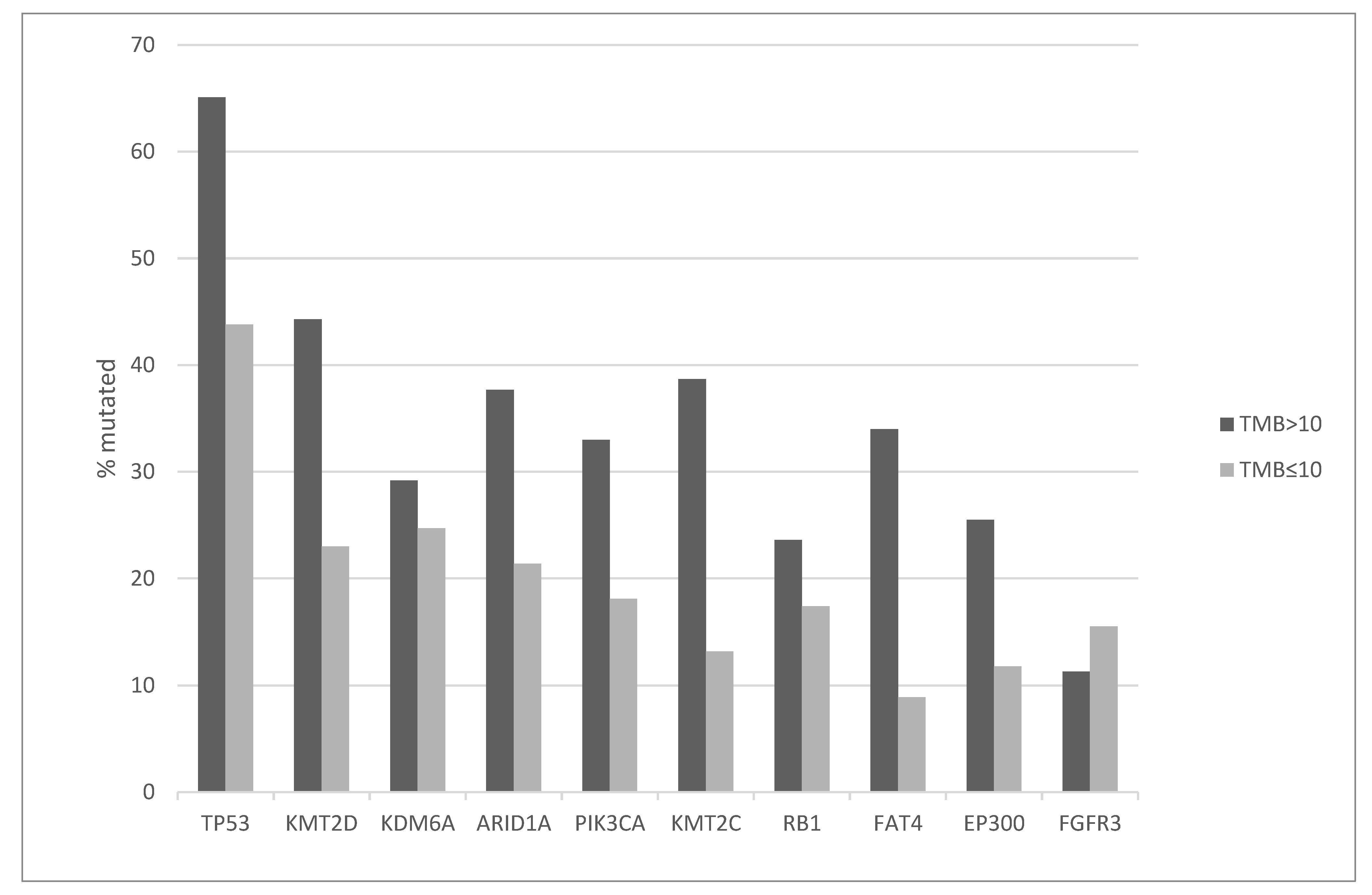
| TP53 | 235/237 (99.2%) | 77/79 (97.5%) | 158/158 (100%) | - |
| KMT2D | 106/163 (65%) | 39/69 (56.5%) | 67/94 (71.3%) | 0.07 |
| ARID1A | 92/134 (68.7%) | 33/49 (67.3%) | 59/85 (69.4%) | 0.84 |
| PIK3CA | 77/99 (77.8%) | 26/35 (74.3%) | 51/64 (79.7%) | 0.61 |
| KMT2C | 51/110 (48.2%) | 25/64 (39.1%) | 26/46 (56.5%) | 0.08 |
| EP300 | 36/81 (44.4%) | 14/41 (34.1%) | 22/40 (55%) | 0.08 |
| Gene | Entire Group (%) | TMB > 10 (%) | TMB ≤ 10 (%) | p |
|---|---|---|---|---|
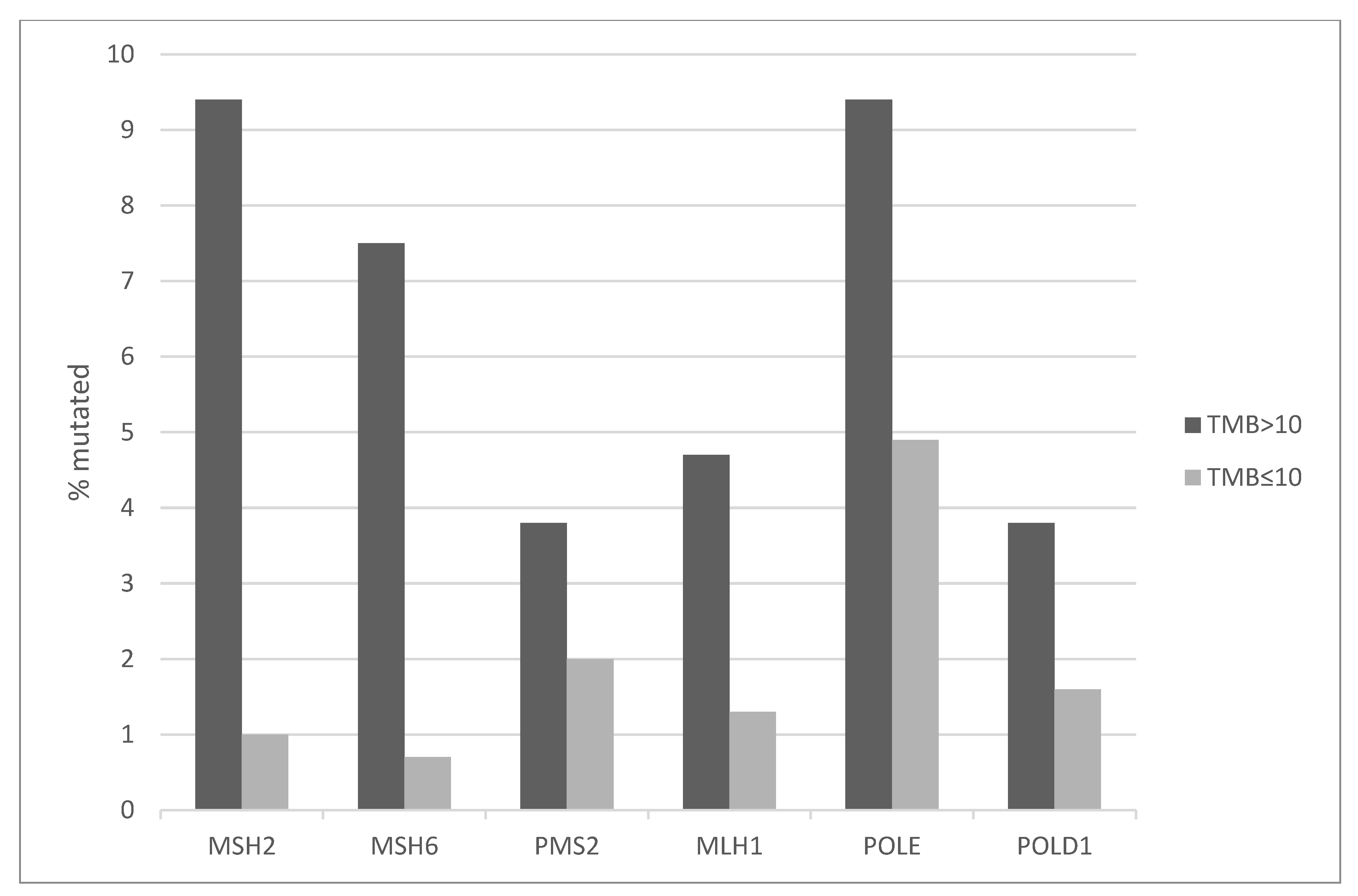
| MSH2 | 4/13 (30.8%) | 4/10 (40%) | 0/3 | - |
| MSH6 | 2/10 (20%) | 2/8 (25%) | 0/2 | - |
| PMS2 | 1/10 (10%) | 0/4 | 1/6 (16.7%) | - |
| MLH1 | 3/9 (33.3%) | 1/5 (20%) | 2/4 (50%) | - |
| POLE | 1/26 (3.8%) | 1/10 (10%) | 0/16 | - |
| POLD1 | 0/10 | 0/4 | 0/6 | - |
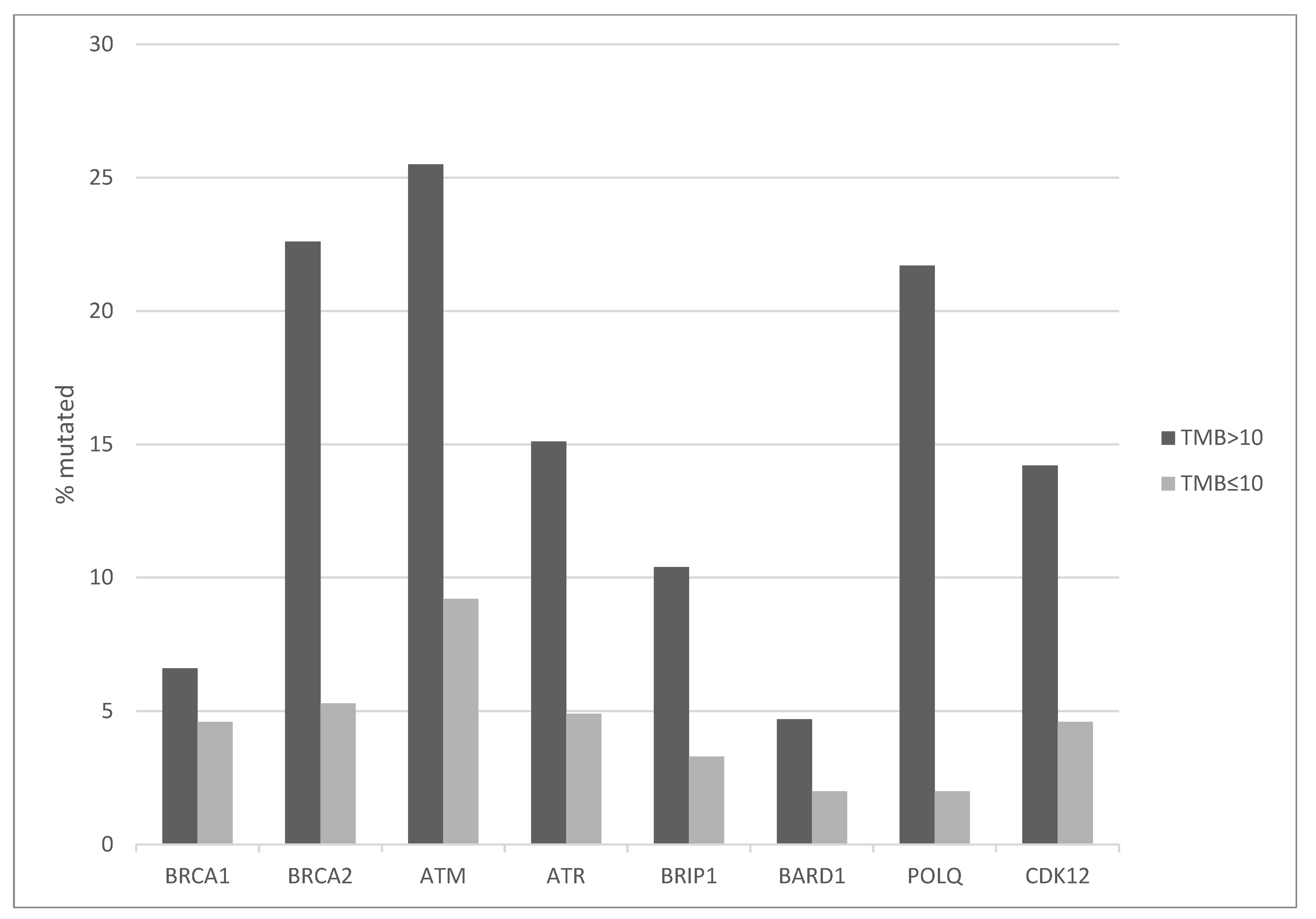
| BRCA1 | 7/24 (29.2%) | 2/7 (28.6%) | 5/17 (29.4%) | 1 |
| BRCA2 | 10/53 (18.9%) | 5/37 (13.5%) | 5/16 (31.2%) | 0.14 |
| ATM | 24/69 (34.8%) | 11/39 (28.2%) | 13/30 (43.3%) | 0.21 |
| ATR | 3/36 (8.3%) | 2/19 (10.5%) | 1/17 (5.9%) | 1 |
| BRIP1 | 6/23 (26.1%) | 1/11 (9.1%) | 5/12 (41.7%) | 0.15 |
| BARD1 | 1/11 (9.1%) | 0/5 | 1/6 (16.7%) | - |
| POLQ | 0/31 | 0/25 | 0/6 | - |
| CDK12 | 6/32 (18.7%) | 3/15 (20%) | 3/17 (17.6%) | 1 |
| Patient ID | TMB (Mutations/MB) | Total Likely Oncogenic in OncoKB | Mutations |
|---|---|---|---|
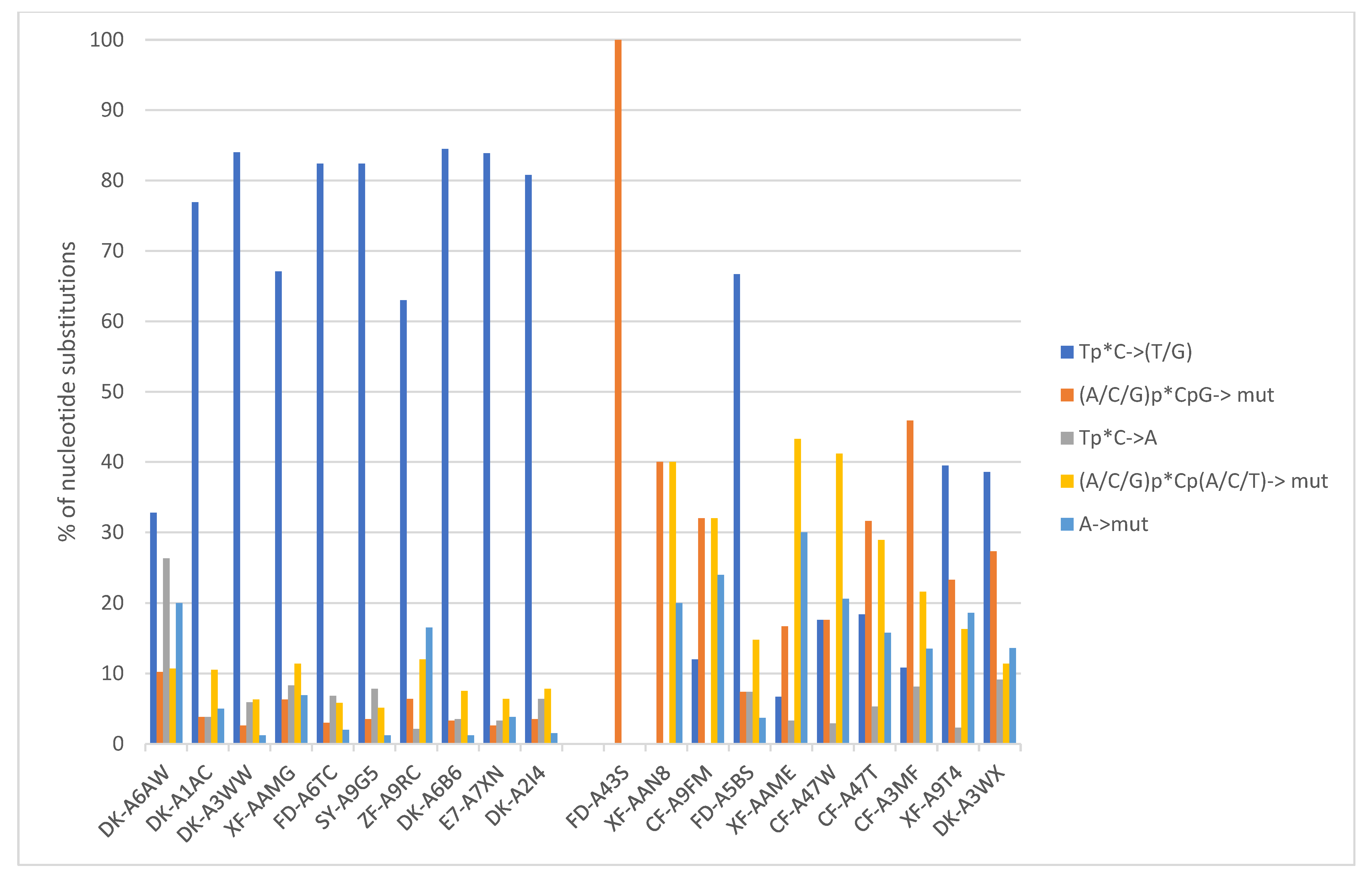
| TCGA-DK-A6AW | 118.6 | 29 | POLE, MSH2, CTCF, ARID1A, KMT2C, KMT2D, STAG2, ATM |
| TCGA-KQ-A41N | 84.6 | 33 | ATM, ATR, CTCF, ERCC2, FAT1, ARID1A |
| TCGA-K4-A54R | 55.8 | 12 | PIK3CA, FAT1, ARID1A |
| TCGA-MV-A51V | 47.6 | 6 | ARID1A, KMT2C, STAG2 |
| TCGA-YC-A89H | 45.7 | 18 | ERCC2, ARID1A, PIK3CA, KMT2C, KMT2D, APC |
| TCGA-DK-A1AC | 43.2 | 13 | ERCC2, PIK3CA, FANCD2 |
| TCGA-DK-A3WW | 36.1 | 16 | PIK3CA, ATM, KMT2C, KMT2D |
| TCGA-BT-A2LB | 34.4 | 9 | APC, KMT2A, ARID2 |
| TCGA-SY-A9G5 | 31 | 12 | PIK3CA, ARID1A, KMT2A, ARID2 |
| TCGA-XF-AAMG | 30 | 11 | PIK3CA, ATM, KDM6A, KMT2D |
| Co-Occurring Genes | Number of Cases with Co-Occurrence (%) | q |
|---|---|---|
| BRCA2 ATM | 14 (3.4%) | 0.02 |
| POLQ MSH2 | 5 (1.2%) | 0.03 |
| POLQ BRCA2 | 9 (2.2%) | 0.03 |
| POLQ CDK12 | 7 (1.7%) | 0.03 |
Publisher’s Note: MDPI stays neutral with regard to jurisdictional claims in published maps and institutional affiliations. |
© 2022 by the author. Licensee MDPI, Basel, Switzerland. This article is an open access article distributed under the terms and conditions of the Creative Commons Attribution (CC BY) license (https://creativecommons.org/licenses/by/4.0/).
Share and Cite
Voutsadakis, I.A. Urothelial Bladder Carcinomas with High Tumor Mutation Burden Have a Better Prognosis and Targetable Molecular Defects beyond Immunotherapies. Curr. Oncol. 2022, 29, 1390-1407. https://doi.org/10.3390/curroncol29030117
Voutsadakis IA. Urothelial Bladder Carcinomas with High Tumor Mutation Burden Have a Better Prognosis and Targetable Molecular Defects beyond Immunotherapies. Current Oncology. 2022; 29(3):1390-1407. https://doi.org/10.3390/curroncol29030117
Chicago/Turabian StyleVoutsadakis, Ioannis A. 2022. "Urothelial Bladder Carcinomas with High Tumor Mutation Burden Have a Better Prognosis and Targetable Molecular Defects beyond Immunotherapies" Current Oncology 29, no. 3: 1390-1407. https://doi.org/10.3390/curroncol29030117
APA StyleVoutsadakis, I. A. (2022). Urothelial Bladder Carcinomas with High Tumor Mutation Burden Have a Better Prognosis and Targetable Molecular Defects beyond Immunotherapies. Current Oncology, 29(3), 1390-1407. https://doi.org/10.3390/curroncol29030117