

You are currently viewing a new version of our website. To view the old version click .
Cardiovascular Medicine
  • Cardiovascular Medicine is published by MDPI from Volume 28 Issue 1 (2025). Previous articles were published by another publisher in Open Access under a CC-BY (or CC-BY-NC-ND) licence, and they are hosted by MDPI on mdpi.com as a courtesy and upon agreement with Editores Medicorum Helveticorum (EMH).
  • Interesting Images
  • Open Access

18 January 2017

Gunshot Reversed the Tako-Tsubo

,
,
and
Cardiology Division of the University and Hospital of Fribourg, Fribourg, Switzerland
*
Author to whom correspondence should be addressed.
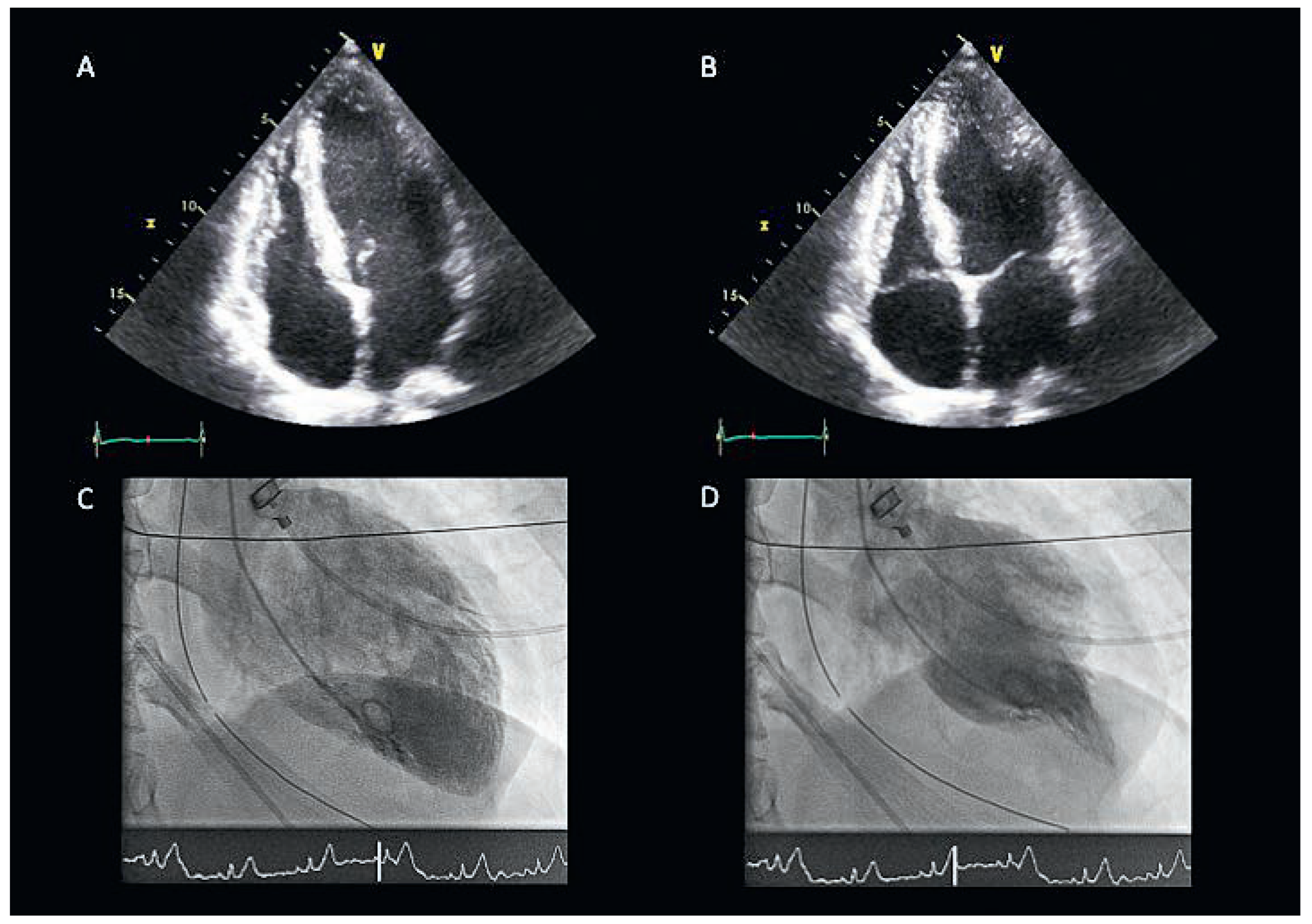
A 53-year-old man without any past medical history was shot with a gun in the legs and underwent an urgent haemostatic surgical procedure without complications. Two weeks later, he was readmitted for surgical wound revision under general anaesthesia. During the intervention, he developed severe refractory hypotension requiring noradrenaline administration. Blood pressure recovery was slow. No significant blood loss was reported. A little lateral ST-segment depression was highlighted on the 12-lead electrocardiogram, suggesting acute coronary syndrome. Transthoracic echocardiography showed severe basal akinesia with apicolateral segmental hyperkinesis (Figure 1A,B). Aher haemodynamic stabilisation, cardiac catheterisation was performed and showed normal coronary arteries. A left ventricular angiogram confirmed basal hypokinesia with preserved mid-ventricular and apical contractility (Figure 1C,D). This pattern is typical of the rare reverse stress cardiomyopathy (basal type of tako-tsubo disease). After 3 weeks of medical treatment, left ventricular function returned to normal and the patient fully recovered.
Figure 1. Four-cavity echocardiographic view in diastole (A) and systole (B) with severe basal akinesia and apicolateral segmental hyperkinesis. Left ventricular angiogram in diastole (C) and systole (D) showing basal hypokinesia with preserved mid-ventricular and apical contractility.
Clinicians should consider tako-tsubo cardiomyopathy in patients with prior major stress who develop acute coronary syndrome or haemodynamic instability [1]. Although middle-aged females are more likely to develop stress cardiomyopathy, this case reminds us that it can occur in men, even with a very atypical mode of presentation [2,3].

Disclosure statement

No financial support and no other potential conflict of interest relevant to this article was reported.

References

  1. Dote, K.; Sato, H.; Tateishi, H.; Uchida, T.; Ishihara, M. Myocardial stunning due to simultaneous multivessel coronary spasms: a review of 5 cases. J Cardiol. Article in Japanese. 1991, 21, 203–214. [Google Scholar] [PubMed]
  2. Kurowski, V.; Kaiser, A.; von Hof, K.; Killermann, D.P.; Mayer, B.; Hartmann, F.; et al. Apical and midventricular transient left ventricular dysfunction syndrome (tako-tsubo cardiomyopathy): frequency, mechanisms, and prognosis. Chest. 2007, 132, 809–816. [Google Scholar] [CrossRef] [PubMed]
  3. Sharkey, S.W.; Lesser, J.R.; Zenovich, A.G.; Maron, M.S.; Lindberg, J.; Longe, T.F.; et al. Acute and reversible cardiomyopathy provoked by stress in women from the United States. Circulation. 2005, 111, 472–479. [Google Scholar] [CrossRef] [PubMed]
Publisher’s Note: MDPI stays neutral with regard to jurisdictional claims in published maps and institutional affiliations.

Article Metrics

Citations

Article Access Statistics

Multiple requests from the same IP address are counted as one view.
