
Case report
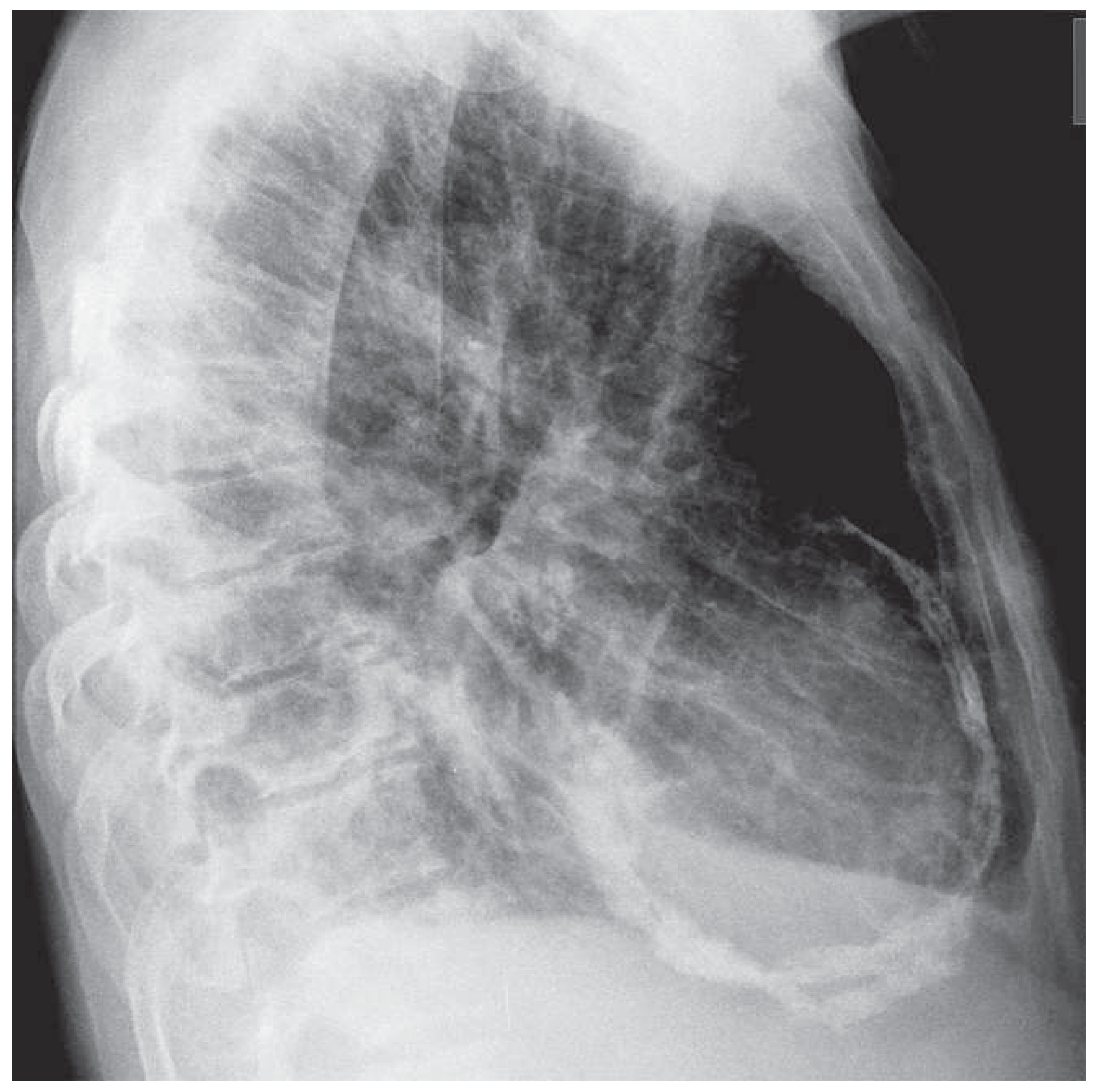
A 56-year-old man was admitted with massive signs of right heart failure, which had evolved over weeks. Chest X-ray revealed extensive pericardial calcifications in the lateral view (
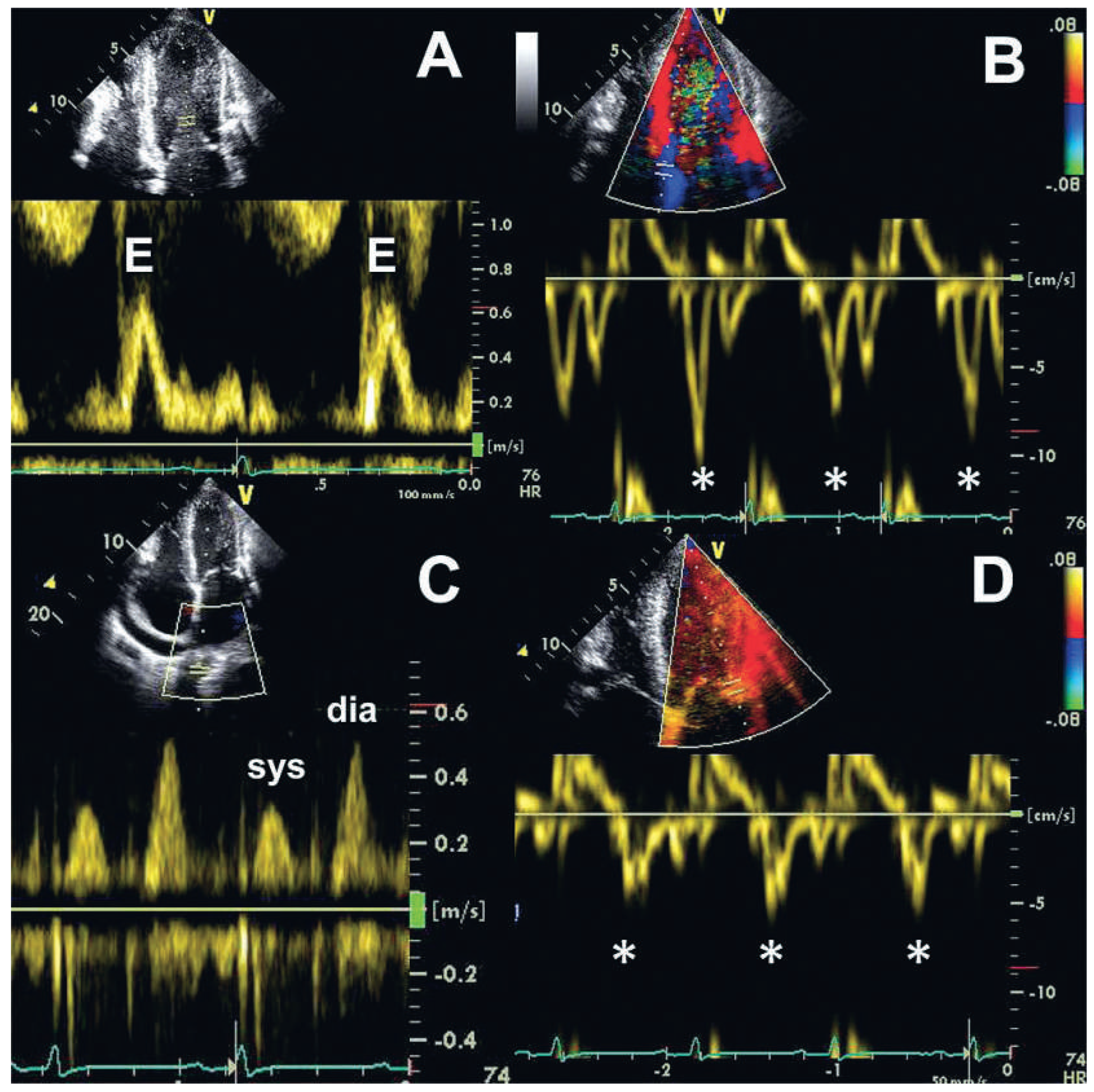
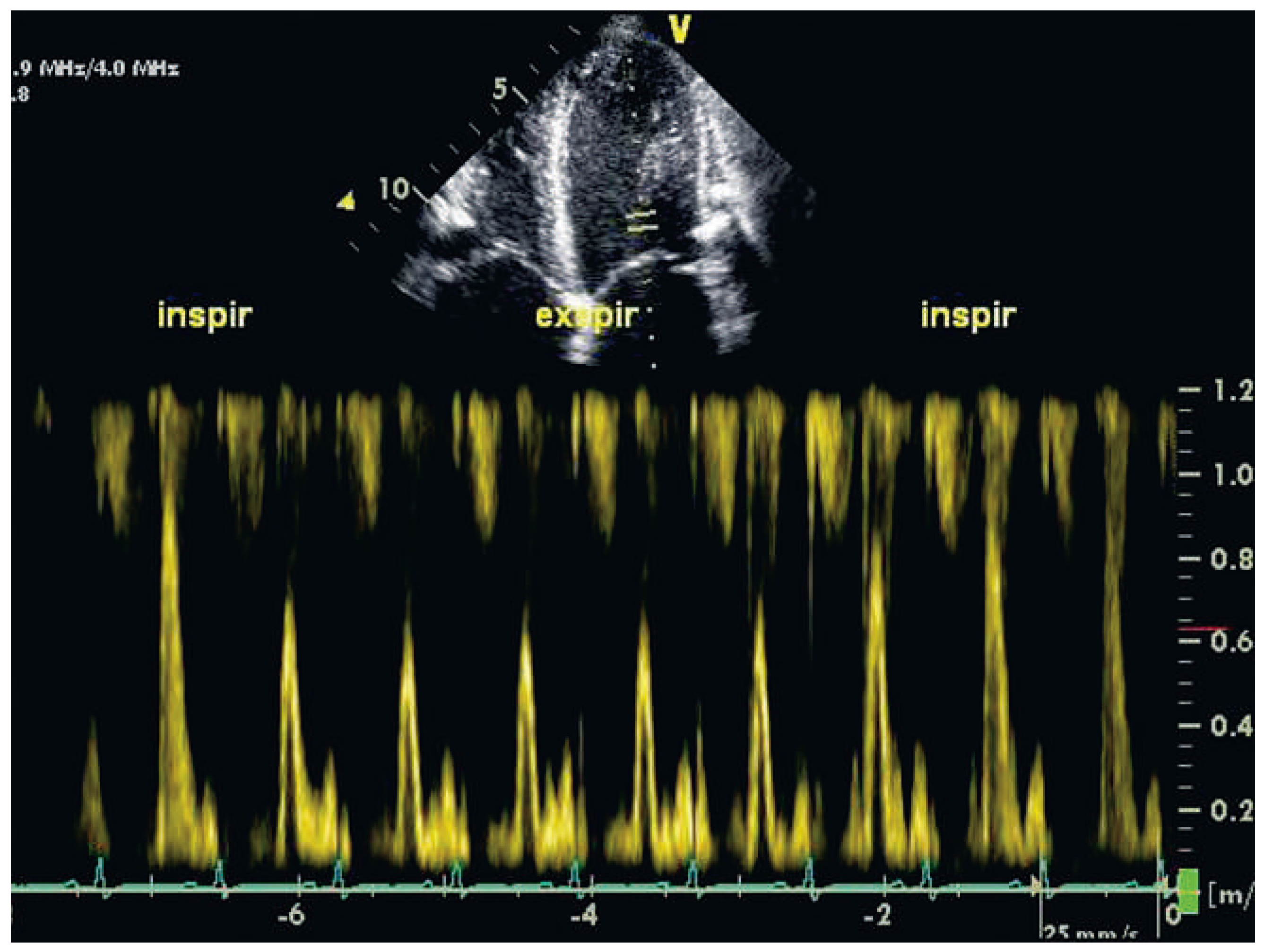
Figure 1). Transthoracic echocardiography showed only mildly impaired biventricular systolic function but a dilated inferior vena cava without respiratory variability. The peak early mitral annular velocities (e’) assessed by pulsed wave tissue Doppler at the septal and lateral mitral annulus were 8 and 6 cm/s, and the ratio of the peak early transmitral velocity (E) to e’ (E/e’), based on an average e’ of 7 cm/s, was only 10 (Figure 2A,B,D). The pulmonary venous flow was clearly abnormal however (Figure 2C). There was an exaggerated respiratory variability of mitral in-flow (Figure 3).
Figure 1.
Chest X-ray (lateral view) showing extensive pericardial calcifications.
Figure 2.
Transthoracic Doppler echocardiography. (A) Transmitral inflow assessed by pulsed wave Doppler (peak early transmitral velocity [E], 0.7 m/s). (B,D) Pulsed wave tissue Doppler at the septal (B) and lateral (D) mitral annulus revealing preserved peak early mitral annular velocities (e’, asterisks; septal 8 cm/s, lateral 6 cm/s). (C) Pulmonary venous flow assessed by pulsed wave Doppler showing prominent diastolic flow. dia = diastolic; sys = systolic.
Figure 3.
Transthoracic Doppler echocardiography demonstrating the exaggerated respiratory variability of mitral inflow. Mitral inflow is reduced during inspiration, but increases during expiration.
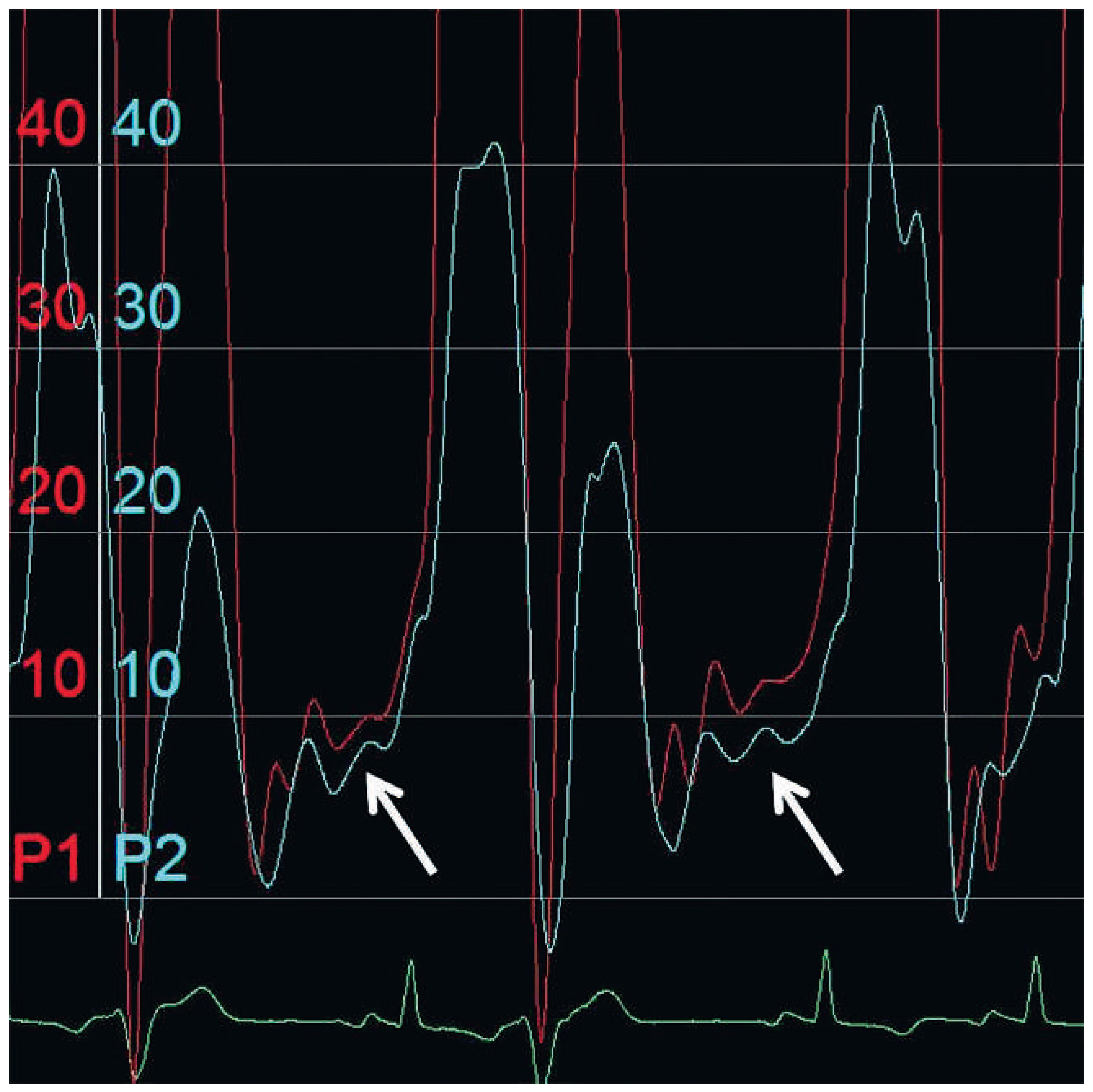
Following diuretic therapy the patient lost 6 kg within a few days, and the oedema were significantly reduced. Cardiac catheterisation performed in a clinically euvolaemic condition showed normal coronary arteries and confirmed the presence of a constrictive physiology by demonstrating an increase in right atrial pressure during inspiration, end-diastolic equalisation of left and right heart pressures, the “square root sign” (Figure 4), and respiration-dependent discordance of ventricular pressures. The patient successfully underwent pericardectomy.
Figure 4.
Cardiac catheterisation confirming the presence of a constrictive physiology, amongst other parameters, by demonstration of the “square root sign”, most evident in the post-extrasystolic diastole (arrows; left/right ventricular pressure in red and blue, respectively).
Comment
Tissue Doppler echocardiography is an important clinical tool for the non-invasive assessment of haemodynamics. The e’ is a measure of left ventricular relaxation that is relatively independent of filling pressures, and correction of E by e’ (i.e., the E/e’ ratio) has been shown to be related to left ventricular filling pressures [1]. An E/e’ ratio <8 is usually associated with low left ventricular filling pressure, whereas a high E/e’ ratio (>15 if based on the septal e’, >12 if based on the lateral e’, and >13 if based on the averaged e’) indicates elevated filling pressures [2]. The present patient had a very modestly elevated E/e’ of 10, which would not have allowed a diagnosis of elevated left-sided filling pressures although clinically the patient was in overt heart failure. From the size and respiratory variability of the inferior vena cava and pulmonary venous flow it can be assumed that right-sided and left-sided filling pressures were high at that time, although at the time of catheterisation filling pressures were not significantly elevated following aggressive diuretic therapy. Despite this a constrictive physiology could be demonstrated. Tissue Doppler measurements were misleading in this case because in constrictive pericarditis filling pressures are not determined by myocardial properties but by external pericardial constraint. In constrictive pericarditis, there is an “annulus paradoxus”, which refers to two phenomena: firstly, despite a relatively high e’ and low E/e’ ratio left ventricular filling pressures are elevated [3]; and secondly, unlike in the normal situation, e’ is higher at the septal than at the lateral annulus because the lateral excursion is limited by the abnormal pericardium whereas septal movement is not [2].
This image highlights that a proper non-invasive haemodynamic assessment must not rely on single parameters but a combination of 2D, M mode and Doppler measurements.
Funding/Potential Competing Interests
No financial support and no other potential conflict of interest relevant to this article were reported.
References
- Ommen, S.R.; Nishimura, R.A.; Appleton, C.P.; Miller, F.A.; Oh, J.K.; Redfield, M.M.; et al. Clinical utility of Doppler echocardiography and tissue Doppler imaging in the estimation of left ventricular filling pressures: A comparative simultaneous Doppler-catheterization study. Circulation. 2000, 102, 1788–1794. [Google Scholar] [CrossRef] [PubMed]
- Nagueh, S.F.; Appleton, C.P.; Gillebert, T.C.; Marino, P.N.; Oh, J.K.; Simiseth, O.A.; et al. Recommendations for the evaluation of left ventricular diastolic function by echocardiography. J Am Soc Echocard. 2009, 22, 107–133. [Google Scholar] [CrossRef] [PubMed]
- Ha, J.; Oh, J.K.; Ling, L.H.; Nishimura, R.A.; Seward, J.B.; Tajik, A.J. Annulus paradoxus—Transmitral flow velocity to mitral annular velocity ratio is inversely proportional to pulmonary capillary wedge pressure in patients with constrictive pericarditis. Circulation. 2001, 104, 976–978. [Google Scholar] [CrossRef] [PubMed]
© 2012 by the author. Attribution Non-Commercial NoDerivatives 4.0.