A Pilot Study on the Feasibility and Usability of a Midwife-Led Visual Educational Tool for Sex Education

Abstract
1. Introduction
2. Materials and Methods
2.1. Study Design
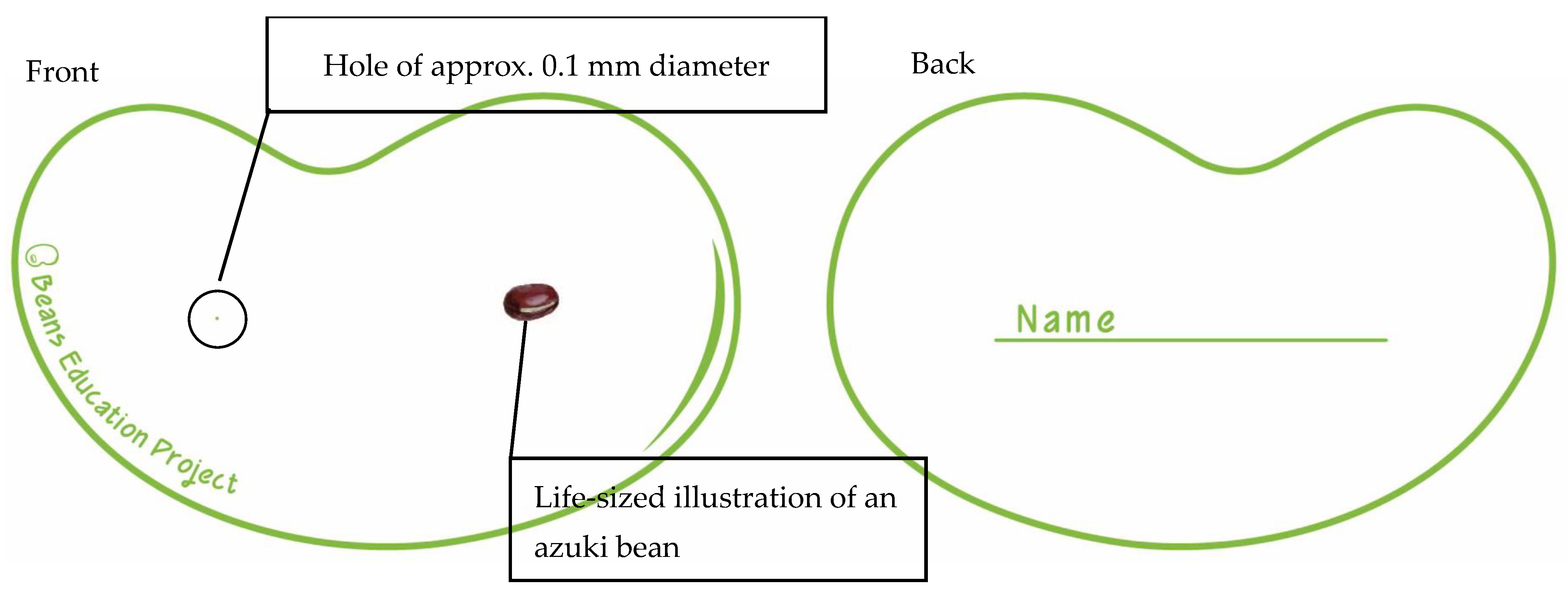
2.2. Description of the BEPC
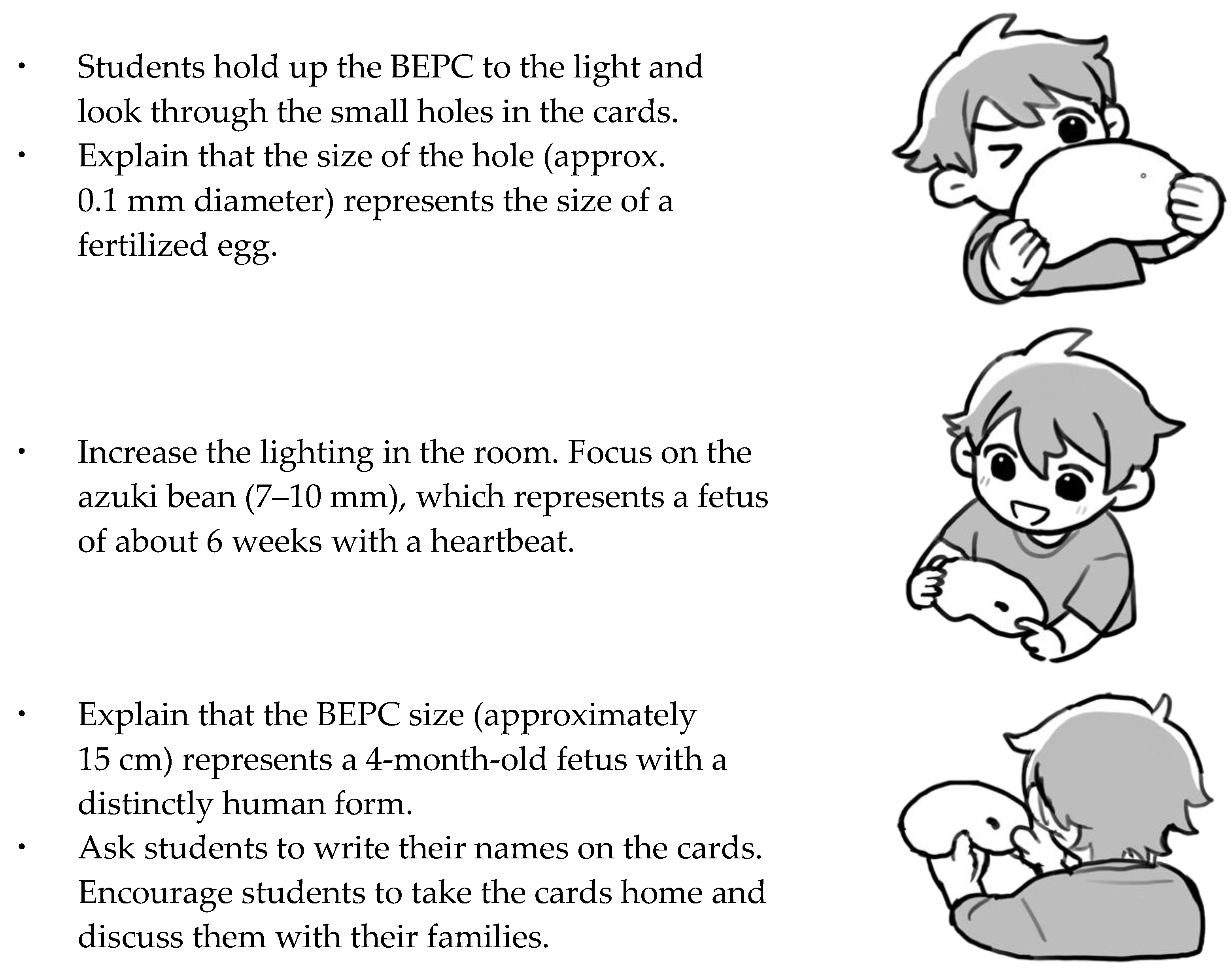
2.3. Procedures for Implementing Sex Education Using the BEPC
- Tell the students that you will provide a brief explanation of the beginning of life, including fertilization, and then distribute the BEPC to the students.
- Please dim the lights in the classroom. Then, ask the students to hold up the BEP to the fluorescent lights or the window and look through the holes in the cards.
- After the students have visually experienced the size of the holes, explain that the approximate size of the holes is 0.1 mm, which is roughly the size of a fertilized egg.
- After increasing the light in the room, please tell the students to shift their gaze to the illustration of the azuki bean next to the hole. Tell students that these beans are approximately 7.0 to 10.0 mm in length and represent a fetus at approximately 6 weeks of pregnancy. This is when a tiny heartbeat can first be detected.
- Next, discuss with the students the size of the BEPC itself, which is shaped like a broad bean. The card is approximately 15 cm long, and represents the crown-to-rump length of a fetus at approximately 19–20 weeks (4 months) of pregnancy. At this stage, the fetus has a distinctly human form, and many mothers begin to feel fetal movements.
- Finally, please ask the students to write their names on the back of the BEPC. Encourage them to take the cards home at the end of the day and discuss what they have learned with their families.
2.4. Data Collection
2.5. Survey Items for Group Interviews
2.5.1. Evaluation and Improvement of the BEPC
2.5.2. Usability
2.5.3. Other Issues
2.5.4. Analytic Methods
2.6. Ethical Considerations
3. Results
3.1. Demographic Characteristics of the Participants
3.2. Key Themes for Group Interviews
3.3. Evaluation of BEPC Design and Usability
3.3.1. Visual Design and Appeal
3.3.2. Clarity and Information Design
3.3.3. Ease of Use
3.3.4. Perceived Educational Effects
3.3.5. Suggestions for Improvement
4. Discussion
4.1. Design of the BEPC
4.2. Usability of the BEPC
4.3. Challenges Facing the Implementation of the BEPC
4.4. Limitations of the Study
5. Conclusions
Author Contributions
Funding
Institutional Review Board Statement
Informed Consent Statement
Data Availability Statement
Acknowledgments
Conflicts of Interest
Abbreviations
| BEPC | Beans Education Project Card |
Appendix A
Appendix A.1. Interview Guide
Appendix A.1.1. Evaluation and Improvement of the BEPC
- (1)
- Impression of the BEPC (including its potential to capture the interest of students and their families):
- (2)
- Feasibility of implementing the BEPC:
- (3)
- Challenges and areas for improvement:
Appendix A.1.2. Usability
- (1)
- Ease of Use:
- (2)
- Information quantity:
- (3)
- Visual design:
Appendix A.1.3. Other Issues
Appendix B. Matrix of Themes, Subthemes, and Illustrative Quotes
| Theme | Subtheme | Illustrative Quotes (Anonymized) |
| Section 3.3.1 Visual Design and Appeal | “The broad bean shape is nice; it resembles what you see on an ultrasound.”—Midwife A “When I placed it in my palm, it really felt like a fetus, like a baby.”—Midwife B | |
| Section 3.3.2 Clarity and Information Design | “It’s simple, but there’s so much meaning packed inside. I think the simplicity actually encourages students to think more and imagine different things.”—Midwife C “I think the Beans Education Project text would be better on the back. The shape itself looks like a baby, and I felt the text was a distraction.”—Midwife D | |
| Section 3.3.3 Ease of Use | “The fact that the paper is thick is good. Unlike thin paper, it feels like something to be treasured and handled with care.”—Midwife A “I think its biggest merit is the time it saves on preparation [compared with handmade materials].”—Midwife B | |
| Section 3.3.4 Perceived Educational Effects | Sparking Interest | “The students, who had been listening in silence, suddenly got a little excited and lively when they received the cards.”—Midwife C “Even the second-year high school boys, the type who pretend to be asleep in class, were looking at the BEPC together with their friends.”—Midwife D |
| Facilitating Understanding | “You can show a fertilized egg magnified on a PowerPoint slide, but I don’t think students can imagine its actual size. With this card, they see the real size, and I think they are surprised by that gap.”—Midwife E “I saw them directly engaging with the object—holding it up to the light and really looking at it, which is different from just listening to a lecture.”—Midwife A | |
| Promoting Communication | “I think the best thing is that students can take it home and it becomes a usable conversation starter within the family.”—Midwife A “Some students mentioned that they were going to show it to their parents.”—Midwife B | |
| Applicability Across Age Group | I saw elementary school students having a lot of fun with it, but I was impressed that even middle and high school students were moved and looked at it with deep interest.”—Midwife C “Even high school students have a genuine reaction of surprise, like, Whoa, that’s amazing.”—Midwife D | |
| Section 3.3.5 Suggestions for Improvement | Expansion of Information | “I supplement the card by also bringing a fetal doll to show them, “This is the actual size,” and “This is about the weight”“—Midwife E “I thought it would be even easier for them to imagine the scale if information about weight was also included.”—Midwife A |
| Enhancing Support for Parents | “What if we had parents come to the sex education class and experience this together with their children?”—Midwife B “The parents’ generation often hasn’t received much sex education themselves, so I think many of them would also be very surprised and realize things they never knew.”—Midwife C |
Appendix C. Intervention Fidelity Checklist
| Component No. | Essential Component | Minimum Materials | Non-Negotiable Step | Allowable Variation |
| 1 | Introduce the BEPC and distribute cards. | BEPC per student | Distribute BEPC to all students. | Exact timing of distribution in the lecture. |
| 2 | Students look through the 0.1 mm hole. | BEPC per student | Students must hold the card to the light and look through the hole. | Instructor’s specific instructions for holding the card. |
| 3 | Explain that the 0.1 mm hole represents a fertilized egg. | BEPC | Explain the approximate size (0.1 mm) and what it represents. | The exact wording of the explanation. |
| 4 | Explain that the azuki bean represents a 6-week-old fetus. | BEPC | Explain the size of the azuki bean (7–10 mm) and what it represents (6-week-old fetus with heartbeat). | The exact wording of the explanation. |
| 5 | Explain that the BEPC card size represents a 4-month-old fetus. | BEPC | Explain the size of the card (15 cm) and what it represents (19–20-week-old fetus with human form). | The exact wording of the explanation. |
| 6 | Ask students to write down their names and encourage family discussion. | BEPC, pen | Students must write their names on the card. Encourage them to take the cards home and discuss them with their family. | The exact wording of the encouragement. |
Appendix D. COREQ Map
| COREQ Domain | Description in This Study |
| The research team consisted of three researchers. The online group interview was conducted by one author, T.M., who has a background in maternal care and midwifery. |
| Data were collected via a single online group interview, lasting approx. 90 min. |
| A hybrid inductive/deductive approach was used. Discrepancies were resolved by consensus discussion. The final consensus was documented in internal research memos. |
Appendix E. Audit Trail for Topic Modeling (LLM-Assisted Thematic Exploration)
Appendix E.1. Generic Prompt Used
Appendix E.2. Example of Raw LLM Output (Non-Sensitive Sample)
Appendix E.3. Disposition of LLM Output
Appendix F. Example of Process and Implementation Metrics for Future Studies
| Metric | Description |
| Number of Sessions | Total number of educational sessions conducted per school level. |
| Class Size | Average number of students per session. |
| Actual Duration | Average time (in minutes) required to deliver the BEPC component. |
| Incidents/Adaptations | Record of any unexpected events or required modifications. |
| Consumables per Student | Cost and quantity of materials (e.g., one BEPC card) per student. |
| Estimated Unit Cost | Estimated cost per card based on a larger production run. |
| Adherence Rate (%) | Self-reported percentage of adherence to the 5-step procedure. |
References
- Chandra-Mouli, V.; Svanemyr, J.; Amin, A.; Fogstad, H.; Say, L.; Girard, F.; Temmerman, M. Twenty Years After International Conference on Population and Development: Where Are We with Adolescent Sexual and Reproductive Health and Rights? J. Adolesc. Health 2015, 56, S1–S6. [Google Scholar] [CrossRef] [PubMed]
- United Nations Population Fund (UNFPA). International Conference on Population and Development. Available online: https://www.unfpa.org/icpd (accessed on 19 December 2024).
- Sari, A.K.; Zahri, T.N.; Triswandari, R.T. Religious Value-Based Sex Education to Optimize Child Development in the Digital Era. BICC Proc. 2023, 1, 53–58. [Google Scholar] [CrossRef]
- Power, J.; Moor, L.; Anderson, J.; Waling, A.; James, A.; Shackleton, N.; Farrell, A.-M.; Agnew, E.; Dowsett, G.W. Traversing TechSex: Benefits and Risks in Digitally Mediated Sex and Relationships. Sex Health 2022, 19, 55–69. [Google Scholar] [CrossRef]
- Jain, S.; Kaur, K. Evaluating the Content of AI-Recommended YouTube Webisodes: A Focus on Sex Education in India. Available online: https://ieeexplore.ieee.org/document/10307416 (accessed on 20 December 2024).
- Power, J.; James, A.; Waling, A.; Pym, T.; Lim, G. Digital Sexual Literacy: The Potential for Online Spaces to Support Sexual Literacy among Young People. Front. Educ. 2024, 9, 1401252. [Google Scholar] [CrossRef]
- Lirios, A.; Mullens, A.B.; Daken, K.; Moran, C.; Gu, Z.; Assefa, Y.; Dean, J.A. Sexual and Reproductive Health Literacy of Culturally and Linguistically Diverse Young People in Australia: A Systematic Review. Cult. Health Sex. 2024, 26, 790–807. [Google Scholar] [CrossRef]
- Goldfarb, E.S.; Lieberman, L.D. Three Decades of Research: The Case for Comprehensive Sex Education. J. Adolesc. Health 2021, 68, 13–27. [Google Scholar] [CrossRef]
- Qodariah, S.; Yanuvianti, M.; Coralia, F.; Damayanti, T.; K, A.N. Psychoeducation About Sexual Life Literacy in Adolescents. KnE Soc. Sci. 2024, 9, 125–130. [Google Scholar] [CrossRef]
- Cohen, S.; Halpern, M.; Stonbraker, S. Mixed Method Evaluation of a Clinic Waiting Room–Based Health Education Program in the Dominican Republic. Health Educ. Res. 2023, 38, 177–191. [Google Scholar] [CrossRef] [PubMed]
- UNESCO. International Technical Guidance on Sexuality Education: An Evidence-Informed Approach—UNESCO Digital Library. Available online: https://unesdoc.unesco.org/ark:/48223/pf0000260770 (accessed on 20 March 2025).
- World Health Organization. Adolescent Pregnancy. Available online: https://www.who.int/news-room/fact-sheets/detail/adolescent-pregnancy (accessed on 22 December 2024).
- Jakubowski, A.; Roos, L.L.; Wall-Wieler, E. Unwinding the Tangle of Adolescent Pregnancy and Socio-Economic Functioning: Leveraging Administrative Data from Manitoba, Canada. BMC Pregnancy Childbirth 2023, 23, 140. [Google Scholar] [CrossRef] [PubMed]
- Youth.gov. The Adverse Effects of Teen Pregnancy. Available online: https://youth.gov/youth-topics/pregnancy-prevention/adverse-effects-teen-pregnancy (accessed on 22 December 2024).
- Walker, R.; Guitera, J.; Leahy, D.; Boyle, J. Sexual and Reproductive Health Education in Australia: A Qualitative Study of Health Professionals’ Views. Sex Educ. 2023, 23, 647–661. [Google Scholar] [CrossRef]
- Mueller, T.; Tevendale, H.D.; Fuller, T.R.; House, L.D.; Romero, L.M.; Brittain, A.; Varanasi, B. Teen Pregnancy Prevention: Implementation of a Multicomponent, Community-Wide Approach. J. Adolesc. Health 2017, 60, S9–S17. [Google Scholar] [CrossRef] [PubMed]
- Sedgh, G.; Finer, L.B.; Bankole, A.; Eilers, M.A.; Singh, S. Adolescent Pregnancy, Birth, and Abortion Rates Across Countries: Levels and Recent Trends. J. Adolesc. Health 2015, 56, 223–230. [Google Scholar] [CrossRef] [PubMed]
- Ministry of Health, Labour and Welfare. Overview of FY2023 Health Administration Report Examples. Available online: https://www.mhlw.go.jp/toukei/saikin/hw/eisei_houkoku/23/ (accessed on 26 December 2024).
- Japan Association of Obstetrics and Gynecologists. Why Sex Education Is Necessary. Available online: https://www.jaog.or.jp/note/%EF%BC%881%EF%BC%89%E6%80%A7%E6%84%9F%E6%9F%93%E7%97%87%E3%81%AE%E7%B7%8F%E8%AB%96/ (accessed on 23 December 2024). (In Japanese)
- Harel, S.; Yamamoto, B.A. Comprehensive Horizons: Examining Japan’s National and Regional Sexuality Education Curricula. Sex Educ. 2025, 25, 290–307. [Google Scholar] [CrossRef]
- Ministry of Education, Culture, Sports, Science and Technology. Sex Education and Related Initiatives in Schools. 2022. Available online: https://www.mhlw.go.jp/content/11121000/000910047.pdf (accessed on 25 September 2024). (In Japanese)
- Kurosawa, Y. Evaluation of and Issues in Sex Education Seminars for 10th-Grade High School Students: Sex Education in Cooperation with Health and Physical Education Classes. Bull. Kiryu Univ. 2022, 33, 43–49. (In Japanese) [Google Scholar] [CrossRef]
- Nagamatsu, M.; Hamada, Y.; Sato, T. Adolescent Health, Development, and the Public Health Response in Japan. In International Handbook on Adolescent Health and Development: The Public Health Response; Cherry, A.L., Baltag, V., Dillon, M.E., Eds.; Springer International Publishing: Cham, Switzerland, 2017; pp. 45–67. ISBN 978-3-319-40743-2. [Google Scholar]
- Mitsutake, T. Junior High School Students’ Learning in Life Classes on the Birth of People. J. Stud. Educ. Pract. 2022, 25, 24–30. (In Japanese) [Google Scholar] [CrossRef]
- Matsuda, T.; Takehana, Y. Evaluation of Instruction Aimed at Recognizing the Link of Life for 5 and 6 Grade Elementary School Students. Jpn. J. Pract. Sch. Nurs. Health 2024, 6, 5–16. (In Japanese) [Google Scholar] [CrossRef]
- Nakamura, T.; Saga, Y.; Hosokawa, N.; Haba, C.; Kuroda, Y.; Miyajima, T.; Kitō, H. A Literature Review on the State of High School Sex Education Implemented by School Nurses. Health 2022, 14, 1227–1243. [Google Scholar] [CrossRef]
- Nishioka, E. Trends in Research on Adolescent Sexuality Education, Fertility Awareness, and the Possibility of Life Planning Based on Reproductive Health Education. Jpn. J. Hyg. 2018, 73, 185–199. (In Japanese) [Google Scholar] [CrossRef][Green Version]
- Osadolor, U.E.; Amoo, E.O.; Azuh, D.E.; Mfonido-Abasi, I.; Washington, C.P.; Ugbenu, O. Exposure to Sex Education and Its Effects on Adolescent Sexual Behavior in Nigeria. J. Environ. Public Health 2022, 2022, 3962011. [Google Scholar] [CrossRef]
- Birgisson, N.E.; Zhao, Q.; Secura, G.M.; Madden, T.; Peipert, J.F. Preventing Unintended Pregnancy: The Contraceptive CHOICE Project in Review. J. Womens Health 2015, 24, 349–353. [Google Scholar] [CrossRef]
- Mollaei, B.; Ahmadi, K.; Yousefi, E. Risk and Protective Factors of High-Risk Sexual Behaviors in Young People: A Systematic Review. Int. J. High Risk Behav. Addict. 2023, 12, e131119. [Google Scholar] [CrossRef]
- Seiler-Ramadas, R.; Grabovac, I.; Winkler, R.; Dorner, T.E. Applying Emotional Literacy in Comprehensive Sex Education for Young People. Am. J. Sex. Educ. 2021, 16, 480–500. [Google Scholar] [CrossRef]
- Sürmeli, Y.; Yıldırım, C.; Yüzbaşıoğlu, Ü.; Güldağ, Ö. The Effect of Sexual Health Education on Sexual Myths and Sexual Health Literacy among University Students. Afr. J. Reprod. Health 2024, 28, 112–121. [Google Scholar] [CrossRef]
- Japan Association of Obstetrics and Gynecologists. Adolescent Care: 2. Sex Education Initiatives in Schools across the Country. Available online: https://www.jaog.or.jp/note/%ef%bc%882%ef%bc%89%e5%90%84%e5%9c%b0%e3%81%a7%e3%81%ae%e5%ad%a6%e6%a0%a1%e3%81%a7%e3%81%ae%e6%80%a7%e6%95%99%e8%82%b2%e3%81%ae%e5%8f%96%e3%82%8a%e7%b5%84%e3%81%bf/ (accessed on 24 December 2024). (In Japanese)
- Ikeda, M. A Study of Picture Books for Sex Education (2): Experimental Approach to Female Student’s Responses. Bull. Yamanashi Women’s Jr. Coll. 1983, 16, 45–58. (In Japanese) [Google Scholar]
- Liang, J.Y.; Bowcher, W.L. Legitimating Sex Education through Children’s Picture Books in China. Sex Educ. 2019, 19, 329–345. [Google Scholar] [CrossRef]
- Kimura, S.; Fujii, A.; Ito, K.; Tanaka, Y. Development of Haptics Mutual Communication System Connecting Pregnancy Experience and Fetal Experience: Touch Love. Available online: http://conference.vrsj.org/ac2020/program/doc/1D2-1_PR0054.pdf (accessed on 20 March 2025). (In Japanese)
- Nielsen, A.; Bågenholm, A.; Costa, A.D. Development of a Mobile Phone App to Promote Safe Sex Practice Among Youth in Stockholm, Sweden: Qualitative Study. JMIR Form. Res. 2020, 4, e12917. [Google Scholar] [CrossRef]
- Supriyadi, S.; Sodikin, S.; Rahman, A.N.F.; Wijaya, E.S. Development of Comprehensive Sexual Education Applications to Improve Adolescent Reproductive Health. MEDISIANS 2024, 22, 104. [Google Scholar] [CrossRef]
- April, G.A.G. Conventional and Pragmatic Approaches in Teaching Science in Bulan III. Int. J. Sci. Res. 2023, 12, 1806–1809. [Google Scholar] [CrossRef]
- Ramlah, R.; Riana, N.; Abadi, A.P. Fun Math Learning for Elementary School Students Through Interactive Puzzle Media. SJME (Supremum J. Math. Educ.) 2022, 6, 25–34. [Google Scholar] [CrossRef]
- Chaudhuri, A.; Paul, S.; Goswami, A. A Comparative Study to Evaluate the Role of Interactive Lecture Classes and Self-Directed Learning Sessions among First MBBS Students in the Department of Physiology during Implementation of Competency Based Medical Education. J. Evid. Based Med. Healthc. 2020, 7, 1038–1041. [Google Scholar] [CrossRef]
- Lee, C.-T.; Wang, J.-Y. Interactive Audio Human Organ Model Combined with Team-Based Learning Improves the Motivation and Performance of Nursing Students in Learning Anatomy and Physiology. Anat. Sci. Educ. 2024, 17, 307–318. [Google Scholar] [CrossRef] [PubMed]
- Yılmaz, M.; Karataş, B. Opinions of Student Nurses on Sexual Myths; A Phenomenological Study. Sex Disabil. 2018, 36, 277–289. [Google Scholar] [CrossRef]
- Achen, S.; Rwabukwali, C.B.; Atekyereza, P. Socio-Cultural Perceptions of Sexuality Influencing the Sexual and Reproductive Health of Pastoral Adolescent Girls in Karamoja Sub-Region in Uganda. Soc. Sci. Humanit. Open 2021, 4, 100191. [Google Scholar] [CrossRef]
- Agu, I.C.; Mbachu, C.O.; Ezenwaka, U.; Eze, I.; Ezumah, N.; Onwujekwe, O. Gender Norms and Ideologies about Adolescent Sexuality: A Mixed-Method Study of Adolescents in Communities, South-Eastern, Nigeria. Front. Sociol. 2022, 7, 810411. [Google Scholar] [CrossRef]
- Fekih-Romdhane, F.; Nefzi, H.; Cheour, M. Relationship between Religiosity and Sexuality among Unmarried Male Medical Students. Sexologies 2022, 31, 90–98. [Google Scholar] [CrossRef]
- Tomita, K. Does the Visual Appeal of Instructional Media Affect Learners’ Motivation Toward Learning? TechTrends 2018, 62, 103–112. [Google Scholar] [CrossRef]
- Mitani, H.; Kondo, N.; Amemiya, A.; Tabuchi, T. Promotive and Protective Effects of Community-Related Positive Childhood Experiences on Adult Health Outcomes in the Context of Adverse Childhood Experiences: A Nationwide Cross-Sectional Survey in Japan. BMJ Open 2024, 14, e082134. [Google Scholar] [CrossRef]
- Nguyen, T.N.M.; Disabato, D.J.; Gunstad, J.; Delahanty, D.L.; George, R.; Muakkassa, F.; Mallat, A.F.; Coifman, K.G. Can the Positive Buffer the Negative? Testing the Impact of Protective Childhood Experiences on Adjustment in Adults Following Trauma Exposure. Anxiety Stress Coping 2024, 37, 60–76. [Google Scholar] [CrossRef] [PubMed]
- Turnbull, T.; van Wersch, A.; van Schaik, P. A Review of Parental Involvement in Sex Education: The Role for Effective Communication in British Families. Health Educ. J. 2008, 67, 182–195. [Google Scholar] [CrossRef]
- Edwards, T.; Mkwanazi, N.; Mitchell, J.; Bland, R.M.; Rochat, T.J. Empowering Parents for Human Immunodeficiency Virus Prevention: Health and Sex Education at Home. South Afr. J. HIV Med. 2020, 21, 970. [Google Scholar] [CrossRef]
- Nagaraj, A.; Gattu, H.; Shetty, P.K. Research Study on Importance of Usability Testing/ User Experience (UX) Testing. Int. J. Comput. Sci. Mob. Comput. 2014, 3, 78–85. [Google Scholar]
- Wen, J.; Qi, L.; He, S. Construction of a Virtual Learning Environment for English Teaching and Learning in a China-UK Joint Educational Program. In Proceedings of the 2024 13th International Conference on Educational and Information Technology (ICEIT), Chengdu, China, 22–24 March 2024; pp. 235–239. [Google Scholar]
- Eltalhi, S.; Kutrani, H.; Imsallim, R.; Elrefady, M. The Usability of BenKids Mobile Learning App in Vocabulary Teaching for Preschool. Int. J. Interact. Mob. Technol. 2021, 15, 4–18. [Google Scholar] [CrossRef]
- Abdel Meguid, E.M.; Holland, J.C.; Keenan, I.D.; Mishall, P. Exploring Visualisation for Embryology Education: A Twenty-First-Century Perspective. In Biomedical Visualisation: Volume 11; Rea, P.M., Ed.; Springer International Publishing: Cham, Switzerland, 2022; pp. 173–193. ISBN 978-3-030-87779-8. [Google Scholar]
- Dawood, Y.; Buijtendijk, M.F.J.; Shah, H.; Smit, J.A.; Jacobs, K.; Hagoort, J.; Oostra, R.-J.; Bourne, T.; van den Hoff, M.J.B.; de Bakker, B.S. Imaging Fetal Anatomy. Semin. Cell Dev. Biol. 2022, 131, 78–92. [Google Scholar] [CrossRef] [PubMed]
- Yustika, E.; Isnaeni, W.; Indriyanti, D.R.; Marianti, A. Development of Sex Education Model as An Extracurricular Activity in High School to Improve Understanding and Attitude of Care for Reproductive Health. J. Innov. Sci. Educ. 2023, 12, 229–236. [Google Scholar] [CrossRef]
- Sejati, P.E.; Natalia, S.; Wulandari, A. Development of Communication Models Mother-Daughter-Dyads about Sex Education in Prevention of Teenage Pregnancy Research and Development (R&D). J. Nurs. Pract. 2023, 7, 226–232. [Google Scholar] [CrossRef]



| Category | Description |
|---|---|
| What BEPC Covers | The biological process of fertilization and fetal development (The Beginning of Life). |
| What BEPC Does Not Cover | Broader sexuality education topics, such as contraception, consent, gender identity, or interpersonal relationships. |
| Rationale | The BEPC is designed to be a supplementary, single-topic tool, not a comprehensive curriculum. Its purpose is to increase understanding of one specific biological process through a tangible experience. |
Disclaimer/Publisher’s Note: The statements, opinions and data contained in all publications are solely those of the individual author(s) and contributor(s) and not of MDPI and/or the editor(s). MDPI and/or the editor(s) disclaim responsibility for any injury to people or property resulting from any ideas, methods, instructions or products referred to in the content. |
© 2025 by the authors. Licensee MDPI, Basel, Switzerland. This article is an open access article distributed under the terms and conditions of the Creative Commons Attribution (CC BY) license.
Share and Cite
Tokuoka, M.; Nakai, H.; Shimaoka, N. A Pilot Study on the Feasibility and Usability of a Midwife-Led Visual Educational Tool for Sex Education. Int. J. Environ. Res. Public Health 2026, 23, 24. https://doi.org/10.3390/ijerph23010024
Tokuoka M, Nakai H, Shimaoka N. A Pilot Study on the Feasibility and Usability of a Midwife-Led Visual Educational Tool for Sex Education. International Journal of Environmental Research and Public Health. 2026; 23(1):24. https://doi.org/10.3390/ijerph23010024
Chicago/Turabian StyleTokuoka, Mayu, Hisao Nakai, and Nobuki Shimaoka. 2026. "A Pilot Study on the Feasibility and Usability of a Midwife-Led Visual Educational Tool for Sex Education" International Journal of Environmental Research and Public Health 23, no. 1: 24. https://doi.org/10.3390/ijerph23010024
APA StyleTokuoka, M., Nakai, H., & Shimaoka, N. (2026). A Pilot Study on the Feasibility and Usability of a Midwife-Led Visual Educational Tool for Sex Education. International Journal of Environmental Research and Public Health, 23(1), 24. https://doi.org/10.3390/ijerph23010024