


Evacuation and Transportation Barriers Among Vulnerable Populations in Natural Hazard-Related Disasters: A Scoping Review



Abstract
1. Introduction
2. Methods
2.1. Search Strategy
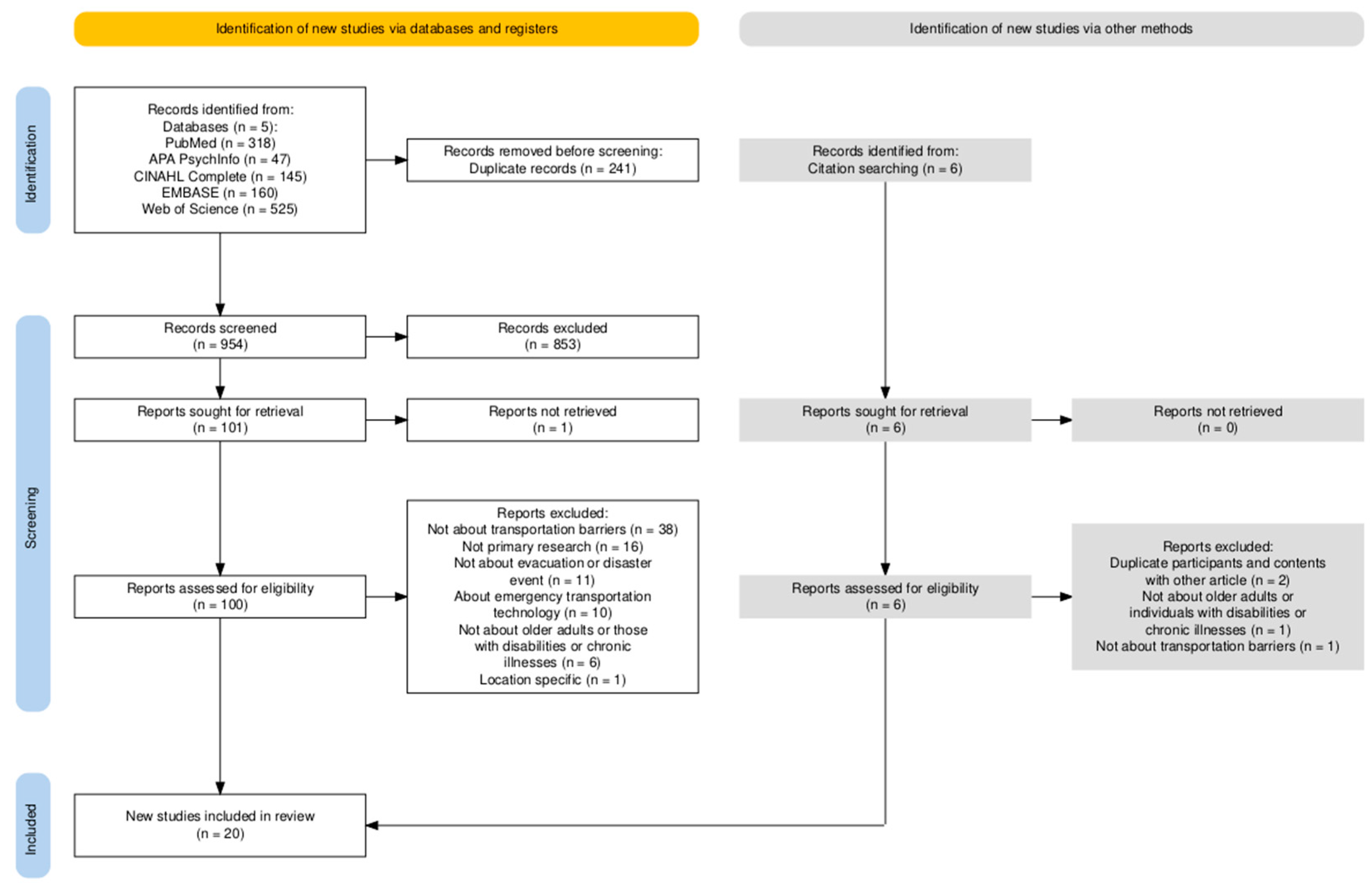
2.2. Eligibility Criteria and Search Results
2.3. Study Selection and Data Extraction
2.4. Theoretical Framework
3. Results
3.1. Characteristics of Identified Studies
3.2. Identified Key Issues
3.2.1. Immediate Transportation Barriers During Evacuation (STEPS Dimensions: Spatial, Temporal, Economic, Physiological, Social)
- Spatial Barriers
- Temporal Barriers
- Physiological Barriers
- Social Barriers
3.2.2. Prolonged Transportation Disruptions Post-Disaster
Impact on Daily Life and Independence (STEPS Dimensions: Spatial, Temporal, Economic, Social)
Impact on Health (STEPS Dimensions: Spatial, Temporal, Social)
3.2.3. Anticipated Logistical Challenges in Future Evacuation Planning (STEPS Dimensions: Spatial, Temporal, Economic, Physiological, Social)
- Spatial and Economic Barriers
- Temporal and Social Considerations
- Physiological Needs and Suggested Interventions
3.2.4. Inconsistent and Inaccessible Communication of Transportation-Related Information During Emergencies (STEPS Dimensions: Spatial, Temporal, Economic, Physiological, Social)
- Spatial and Temporal Relevance of Information
- Physiological and Sensory Accessibility
- Social and Economic Considerations in Technology Use
4. Discussion
4.1. Policy Implications
4.1.1. Improve Emergency Transportation Access for Vulnerable Populations
- Develop formal evacuation transportation plans for individuals with medical equipment needs (e.g., ventilators).
- Partner with paratransit and medical transport providers to ensure vehicle and staff availability.
- Enforce transportation contracts and evacuation drills for long-term care facilities.
- Establish public subsidies for ride-share or accessible transportation options for low-income evacuees. These steps would directly address the spatial, physiological, and economic barriers documented in this review.
4.1.2. Mandate Baseline Data Collection and Transportation Mapping
- Conduct needs assessments for at-risk groups using local demographic data.
- Map evacuation routes and identify chokepoints using GIS tools (e.g., narrow roads, single-exit neighborhoods).
4.1.3. Enhance Post-Evacuation Transportation Support
- Include post-disaster transportation recovery into national and regional disaster risk management strategies.
- Allocate funding for temporary transport services (e.g., shuttle routes to healthcare, pharmacies, or grocery stores).
- Expand support for displaced populations who no longer have access to familiar transit systems.
4.1.4. Developing Multimodal and Accessible Emergency Communication Systems
4.1.5. Train and Mobilize Transportation Personnel for Disaster Response
4.1.6. Incentivize Community-Based Transportation Solutions
- Fund neighborhood-based transportation networks, including volunteer ride registries.
- Incentivize local governments and nonprofits to maintain community transportation response plans using local assets (e.g., churches, school buses).
- Establish legal and insurance protections for volunteer drivers during declared emergencies.
4.2. Limitations
4.3. Future Research Directions
5. Conclusions
Author Contributions
Funding
Institutional Review Board Statement
Informed Consent Statement
Data Availability Statement
Conflicts of Interest
Abbreviations
| EDRM | Emergency and Disaster Risk Management |
| GIS | Geographic Information System |
| GPS | Global Positioning System |
| PRISMA-ScR | Preferred Reporting Items for Systematic Reviews and Meta-Analyses extension for Scoping Reviews |
| STEPS | Social, Temporal, Economic, Physiological, and Social |
| UN | United Nations |
| USA | United States |
| WHO | World Health Organization |
Appendix A

| Search Engine | Controlled Vocabulary and Boolean Logic | Number of Articles |
|---|---|---|
| PubMed | ((“Emergencies”[Mesh] OR “Disaster Planning”[Mesh] OR Evacuat*[Title/Abstract] OR Escape[Title/Abstract] OR preparedness[Title/Abstract] OR emergency[Title/Abstract] OR “evacuation planning”[Title/Abstract] OR “forced displacement”[Title/Abstract]) OR (“Transportation”[Mesh] OR “Ambulances”[Mesh] OR transport*[Title/Abstract] OR transit[Title/Abstract] OR ambulance[Title/Abstract] OR “wheelchair van”[Title/Abstract] OR “litter van”[Title/Abstract] OR “non-emergency medical transport”[Title/Abstract] OR “paratransit service*”[Title/Abstract] OR “accessible transport*”[Title/Abstract])) AND ((“Aged”[Mesh] OR “Vulnerable Populations”[Mesh] OR “older people”[Title/Abstract] OR “older adult*”[Title/Abstract] OR elderly[Title/Abstract] OR vulnerab*[Title/Abstract]) (“Persons with Visual Disabilities”[Mesh] OR “Persons with Hearing Disabilities”[Mesh] OR “Persons with Intellectual Disabilities”[Mesh] OR “Persons with Disabilities”[Mesh] OR “Vision Disorders”[Mesh] OR “Developmental Disabilities”[Mesh] OR “Cognitive Dysfunction”[Mesh] OR “Hearing Loss”[Mesh] OR “Somatosensory Disorders”[Mesh] OR “Psychomotor Disorders”[Mesh] OR “Olfaction Disorders”[Mesh] OR “Motor Skills Disorders”[Mesh] OR “Developmental Disabilities”[Mesh] OR “disabilit”[Title/Abstract] OR disabled[Title/Abstract] OR impaired*[Title/Abstract] OR impairment*[Title/Abstract])) AND (“Natural Disasters”[Mesh] OR “Wildfires”[Mesh] OR “Extreme Weather”[Mesh] OR “natural disaster”[Title/Abstract] OR “wildfire”[Title/Abstract] OR fire[Title/Abstract] OR “climate-related disaster”[Title/Abstract] OR “extreme weather”[Title/Abstract]) AND (“Attitude”[Mesh] OR “Perception”[Mesh] OR “life experience*”[Title/Abstract] OR experience*[Title/Abstract] OR perception*[Title/Abstract] OR view*[Title/Abstract] OR attitude*[Title/Abstract]) | 318 |
| PsycInfo | (MAINSUBJECT.EXACT(“Emergency Preparedness”) OR MAINSUBJECT.EXACT(“Emergency Services”) OR MAINSUBJECT.EXACT(“Emergency Management”) OR tiab(Evacuat* OR Escape OR preparedness OR emergency OR “evacuation planning” OR “forced displacement”) OR (MAINSUBJECT.EXACT(“Transportation”) OR tiab(transport* OR transit OR ambulance OR “wheelchair van” OR “litter van” OR “non-emergency medical transport” OR “paratransit service*” OR “accessible transport*”)) AND (MAINSUBJECT.EXACT(“Older Adulthood”) OR MAINSUBJECT.EXACT(“Disabilities”) OR MAINSUBJECT.EXACT(“Cognitive Impairment”) OR MAINSUBJECT.EXACT(“Health Impairments”) OR tiab(“older people” OR “older adult*” OR elderly OR “disabilit” OR disabled OR impaired* OR impairment* OR vulnerab*)) AND (MAINSUBJECT.EXACT(“Natural Disasters”) OR “Wildfires”[Mesh] OR OR MAINSUBJECT.EXACT(“Extreme Weather”) OR tiab(“natural disaster” OR “wildfire” OR fire OR “climate-related disaster” OR “extreme weather”)) AND (tiab(“life experience” OR “life experienced” OR “life experiences” OR experience* OR perception* OR view* OR attitude*) OR MAINSUBJECT.EXACT(“Life Experiences”) OR MAINSUBJECT.EXACT(“Perception”) OR MAINSUBJECT.EXACT(“Attitudes”)) | 47 |
| CINAHL | (MH “Emergency Evacuation”) OR (MH “Disaster Planning”) OR TI (Evacuat* OR Escape OR preparedness OR emergency OR “evacuation planning” OR “forced displacement”) OR AB (Evacuat* OR Escape OR preparedness OR emergency OR “evacuation planning” OR “forced displacement”) OR (MH “Transportation”) OR (MH “Ambulances”) OR TI (transport* OR transit OR ambulance OR “wheelchair van” OR “litter van” OR “non-emergency medical transport” OR “paratransit service*” OR “accessible transport*”) OR AB (transport* OR transit OR ambulance OR “wheelchair van” OR “litter van” OR “non-emergency medical transport” OR “paratransit service*” OR “accessible transport*”) AND (MH “Aged”) OR (MH “Intellectual Disability”) OR (MH “Developmental Disabilities”) OR (MH “Persons with Visual Disabilities”) OR (MH “Mild Cognitive Impairment”) OR (MH “Physical Mobility Impairment (Saba CCC)”) OR (MH “Memory Impairment (Saba CCC)”) OR (MH “Verbal Impairment (Saba CCC)”) OR (MH “Communication Impairment (Saba CCC)”) OR (MH “Vulnerability”) OR TI (“older people” OR “older adult*” OR elderly OR “disabilit” OR disabled OR impaired* OR impairment* OR vulnerab*) OR AB (“older people” OR “older adult*” OR elderly OR “disabilit” OR disabled OR impaired* OR impairment* OR vulnerab*) AND (MH “Natural Disasters”) OR (MH “Wildfires”) OR (MH “Fires”) OR (MH “Extreme Weather”) OR TI (“natural disaster” OR “wildfire” OR fire OR “climate-related disaster” OR “extreme weather event*”) OR AB (“natural disaster” OR “wildfire” OR fire OR “climate-related disaster” OR “extreme weather”) AND (MH “Life Experiences”) OR TI (“life experience*” OR experience* OR perception OR view) OR AB (“life experience*” OR experience* OR perception OR view) | 145 |
| EMBASE | (emergency’/exp OR ‘forced migration’/exp OR Evacuat*:ti,ab OR Escape:ti,ab OR preparedness:ti,ab OR emergency:ti,ab OR ‘evacuation planning’:ti,ab OR ‘forced displacement’:ti,ab) OR (‘traffic and transport’/exp OR ‘patient transport’/exp OR ‘ambulance’/exp OR ‘emergency transport’/exp OR transport*:ti,ab OR transit:ti,ab OR ambulance:ti,ab OR ‘wheelchair van’:ti,ab OR ‘litter van’:ti,ab OR ‘non-emergency medical transport’:ti,ab OR ‘paratransit service*’:ti,ab OR ‘accessible transport*’:ti,ab) AND (‘aged’/exp OR ‘disabled person’/exp OR ‘disability’/exp OR ‘intellectual impairment’/exp OR ‘sensory processing disorder’/exp OR ‘motor dysfunction’/exp OR ‘physical disability’/exp OR ‘older people’:ti,ab OR ‘older adult*’:ti,ab OR elderly:ti,ab OR disabilit*:ti,ab OR disabled:ti,ab OR impaired:ti,ab OR impairment:ti,ab OR vulnerab*:ti,ab) AND (‘natural disaster’/exp OR ‘fire’/exp OR ‘extreme weather’/exp OR ‘natural disaster’:ti,ab OR wildfire:ti,ab OR fire:ti,ab OR ‘climate-related disaster’:ti,ab OR ‘extreme weather”:ti,ab) AND (‘personal experience’/exp OR ‘attitude’/exp OR ‘life experience*’:ti,ab OR experience*:ti,ab OR perception:ti,ab OR view*:ti,ab OR attitude*:ti,ab) | 160 |
| Web of Science | (Evacuat* OR Escape OR preparedness OR emergency OR “evacuation planning” OR “forced displacement” (Title) OR Evacuat* OR Escape OR preparedness OR emergency OR “evacuation planning” OR “forced displacement” (Abstract)Evacuat* OR Escape OR preparedness OR emergency OR “evacuation planning” OR “forced displacement” (Title) OR Evacuat* OR Escape OR preparedness OR emergency OR “evacuation planning” OR “forced displacement” (Abstract)) OR (transport* OR transit OR ambulance OR “wheelchair van” OR “litter van” OR “non-emergency medical transport” OR “paratransit service*” OR “accessible transport*” (Title) OR transport* OR transit OR ambulance OR “wheelchair van” OR “litter van” OR “non-emergency medical transport” OR “paratransit service*” OR “accessible transport*” (Abstract)) AND (“older people” OR “older adult*” OR elderly OR “disabilit” OR disabled OR impaired* OR impairment* OR vulnerab* (Title) OR “older people” OR “older adult*” OR elderly OR “disabilit” OR disabled OR impaired* OR impairment* OR vulnerab* (Abstract)) AND (“natural disaster” OR “wildfire” OR fire OR “climate-related disaster” OR “extreme weather” (Title) OR “natural disaster” OR “wildfire” OR fire OR “climate-related disaster” OR “extreme weather” (Abstract)) AND (“life experience*” OR experience* OR perception* OR view* OR attitude* (Title) or “life experience*” OR experience* OR perception* OR view* OR attitude* (Abstract)) | 525 |
| Total Number | 1195 |
Appendix B
| Authors | Title | Purpose of the Study | Study Participants | Study Method (Data Collection Method) | Key Findings Related to Transportation | Disaster Details |
|---|---|---|---|---|---|---|
| Stough et al., 2016, [20] | Barriers to the long-term recovery of individuals with disabilities following a disaster. | To investigate the impact of pre-existing disabilities on the recovery process of Hurricane Katrina survivors | Individuals with disabilities (n = 31) | Qualitative inquiry (focus groups) | Participants encountered difficulties in obtaining medical treatment, employment, housing, and social assistance due to the lack of accessible transportation choices. Several participants relied on others for transportation. Services frequently failed to meet their needs. | Hurricane Katrina, 2005, New Orleans, Louisiana, USA |
| Andrade et al., 2021, [30] | The impact of Hurricane Maria on individuals living with non-communicable disease in Puerto Rico: the experience of 10 communities | To investigate the effects of Hurricane Maria on vulnerable groups in Puerto Rico and understand their experiences during the post-hurricane period. | Stakeholders for patients with chronic illness (n = 40) | Qualitative Inquiry (interviews) | Patients with chronic diseases experienced barriers to accessing healthcare due to inaccessible roadways caused by debris, landslides, and flooding. Fuel shortages and telecommunication outages further exacerbated barriers to receiving and requesting medical transport. | Hurricane Maria, 2017, Puerto Rico, USA |
| Claver et al., 2013, [21] | Comprehensive care for vulnerable elderly veterans during disasters | To understand the experiences of nursing home residents and the healthcare community’s response during hurricane evacuation. | VA nursing home staff (n = 13) | Qualitative inquiry (interviews) | Participants experienced challenges in obtaining transportation for medically vulnerable residents, and insufficient availability of vehicles equipped with needed medical apparatus (e.g., ventilators). | Hurricane Katrina and Rita, 2005, New Orleans, Louisiana; Biloxi, Mississippi; Houston, Texas, USA |
| Rosenkoetter et al., 2007, [22] | Perceptions of older adults regarding evacuation in the event of a natural disaster | To investigate the evacuation needs, beliefs, and to identify health risk factors of older people in Georgia | Older adults (age 60–100 yo) (n = 115) | Cross-sectional (descriptive survey) | 14.4% indicated their hesitancy to evacuate in future hurricanes due to a lack of transportation. A total of 46% of participants reported they would need assistance with transportation in case of evacuation. A total of 43% of participants did not drive, and 50% of participants indicated a lack of access to public transportation. | Hurricane Katrina and Rita, 2005, Columbia and Richmond Counties, Georgia, USA |
| Dargin & Mostafavi, 2020, [24] | Human-centric infrastructure resilience: Uncovering well-being risk disparity due to infrastructure disruptions in disasters | To examine the impacts of infrastructure service disruptions on the well-being of vulnerable populations during disasters. | Residents of Harris County, Texas who experienced Hurricane Harvey (n = 837). 31% Older adults, 17% households with disability, 28% with a chronic illness | Cross-sectional (web-based survey) | Transportation disruptions resulted in a negative impact on well-being. Helplessness is correlated with transportation services among older adults. In families with individuals with disabilities, well-being is most associated with feelings of isolation; moderate coefficients were identified with transportation disruptions. | Hurricane Harvey, 2017, Harris County, Texas, USA |
| Wong et al., 2020, [19] | Can sharing economy platforms increase social equity for vulnerable populations in disaster response and Relief? A Case Study of the 2017 and 2018 California wildfires | To investigate the potential of sharing economy platforms (such as transportation network companies and home-sharing services) to enhance equity in disaster response and relief, with a focus on evacuations during the California wildfires of 2017 and 2018. | Older adults (≥65 yo), (n = 20), Individuals with disability and family member with a disability (n = 10). | Qualitative inquiry (focus groups) | Older adults had a negative attitude toward ride sharing because they were concerned about drivers’ availability and reliability. Some older people expressed support for mobility platforms. Individuals with disabilities were concerned about the reliability of ridesharing after experiencing canceled rides. They also hoped that disability and service animal needs may be noted for evacuation rides. All focus groups were concerned about vehicles’ capacity to reach evacuation zones. | Wildfire, 2017, Northern California, USA |
| Brockie & Evonne, 2017, [31] | Understanding older adults’ resilience during the Brisbane floods: Social capital, life experience, and optimism | To investigate how social capital and prior disaster experiences contributed to resilience in older persons affected by the 2011 and 2013 floods in Brisbane, Australia. | Older adults (≥65 yo), (n = 10) | Qualitative study (interviews) | Several participants reported feelings of isolation stemming from disconnection with loved ones due to transportation challenges, such as road closures. | Brisbane Floods, 2011 and 2013, Ipswich, Queensland (Brisbane area), Australia |
| Blanchard & Dosa, 2009, [23] | A Comparison of the nursing home evacuation experience between hurricanes Katrina (2005) and Gustav (2008) | To investigate the perception of nursing home administrators on improvements of federal, state, and local emergency preparedness over the three years following Katrina. | Nursing Home administrative directors (n = 20) | Qualitative study (telephone interviews) | Participants indicated improvement between two hurricanes as they experienced more hurricanes. However, the problem continues to persist. Administrative directors observed persistent issues in obtaining appropriate transportation and accommodation for their residents. | Hurricane Katrina, 2005, New Gulf of Mexico, Louisiana USA |
| Wilson et al., 2021, [32] | Using a smartphone application (App) to assist older adults to navigate their local area during extreme weather events and changing environmental conditions: A qualitative study. | To investigate the perceptions of older individuals regarding the utility of a smartphone application designed to aid navigation of the external environment, especially during severe weather and local environmental disturbances. | Older Adults (≥55 yo) (n = 7) | Qualitative inquiry (focus groups) | Most participants utilized an application to acquire generic transportation-related information, which they thought accurate. They recognized the app’s perceived utility in providing current and accurate data during evacuations or disasters, including road closures, public transportation schedules, and walking routes and durations, accounting for obstructions caused by the event. | Unspecified extreme weather event, Sydney, Australia |
| Güzel et al., 2025, [37] | “Let the kids go, I die”: The experiences of older adults who survived the earthquakes in Türkiye through an intersectional perspective | to investigate the frequently neglected experiences of older people earthquake survivors in Türkiye from an intersectional viewpoint, subsequent to the events of 6 February 2023 | Older people (≥65 yo), (n = 22) | Qualitative study (interviews) | The participants encountered transportation difficulties following evacuation, including accessing healthcare services and visiting family and friends. | Earthquakes, 2023, Turkey |
| Good et al., 2016, [33] | Disoriented and immobile: The experiences of people with visual Impairments during and after the Christchurch, New Zealand, 2010 and 2011 earthquakes | To investigate the experiences of individuals with visual impairment in Christchurch who endured over 12,000 aftershocks throughout 2010 and 2011. | Middle-aged adults with visual impairment (n = 12) | Qualitative study (interviews) | The participants recognized GPS on mobile devices as an advantageous resource for navigating walking paths and public transit routes. | Earthquakes, 2010 and 2011, Christchurch, New Zealand |
| Phibbs et al., 2015, [34] | Emergency preparedness and perceptions of vulnerability among disabled people following the Christchurch earthquakes: Applying lessons learnt to the Hyogo Framework for Action | to explore how the Christchurch earthquakes impacted disabled people, relating to emergency preparedness and perceptions of vulnerability among disabled people who were living in Christchurch over the extended period in which the earthquakes occurred | Adults with disabilities (n = 23), 12 vision impaired, 11 with unspecified disability | Qualitative study (interviews) | Disruption to infrastructure interrupted access to service workers. The participants had difficulty obtaining information related to changes in transportation after the earthquake. Individuals with hearing impairment found text on the phone useful to obtain information. | Earthquakes, 2010, Christchurch, New Zealand |
| Langan & Christopher, 2012, [29] | Factors influencing the decision to evacuate or shelter in place: follow-up of Hurricane Katrina | to identify obstacles hindering older adult home evacuation during natural disasters, and to ascertain the factors that most significantly encourage older adults to evacuate during such events | Older adults (≥60 yo), who evacuated, (n = 125), and sheltered in place (n = 99) | Cross-sectional (survey) | Forty-one percent of interviewees cited insufficient transportation as a hindrance to evacuation. | Hurricane Katrina, 2005, Biloxi and Ocean Springs, Mississippi, USA |
| Langan & Palmer, 2012, [25] | Listening to and learning from older adult Hurricane Katrina survivors. | To explore the influence of Hurricane Katrina on older adults. | Older adults (≥65 yo), (n = 100) | Qualitative inquiry (open-ended survey questions) | The participants recommended improved transportation approaches, namely employing a large vehicle, such as a school bus, to evacuate vulnerable populations. 8% identified a lack of transportation as a barrier to evacuation. | Hurricane Katrina, 2005, Biloxi and Ocean Springs, Mississippi, USA |
| Lichter et al., 2024, [26] | Effects of Wildfire Events on California Radiation Oncology Clinics and Patients | To assess the impact of California wildfires on the administration of radiation therapy treatments, as well as the patterns of California wildfires and the presence of disaster contingency strategies in radiation oncology clinics | Radiation oncologists in California (n = 51) | Cross-sectional (survey) | Approximately 40% of oncologists viewed transportation disruption as an issue for both their patients and staff, while only 10% reported it as a concern for themselves during wildfire occurrences. | Wildfires, 2017–2022, California, USA |
| Silverman et al., 1995, [27] | Lessons learned from Hurricane Andrew—recommendations for care of the elderly in long-term-care facilities | To elucidate the long-term care facility’s experience during Hurricane Andrew | Administration, nursing, dietary services, the section of medicine and the department of social work in a 500-bed, long-term care facility for older people | Qualitative inquiry (reviewing documents by the service providers) | The staff members encountered challenges in commuting to the site owing to the road restrictions. | Hurricane Andrew (1992), Miami, Florida, USA |
| Thomas et al., 2023, [35] | People’s response to disaster: A population-based study of the victims of the 2018 flood in Kerala, South India | To investigate the immediate responses and experiences of the 2018 flood victims when the flood waters reached their doorsteps | n = 1594 (364 households), majority male, (70% with vulnerable such as elderly) | Cross-sectional (survey) | A large family encountered challenges in securing transportation to relocate all members. The road restriction led to the need of other evacuation methods, such as fishing boats, resulting in an extended duration for reaching safe locations. | Flood, 2018, Kerala, South India |
| Gunarathna & Premaratne, 2024, [36] | Sensitization of disaster relief operations towards persons with disabilities | To delineate the vulnerabilities of persons with disabilities during and post-disasters, ascertain the obstacles faced by service providers in disaster preparedness and relief initiatives, and evaluate the influence of socio-cultural elements in fostering sensitization and the establishment of an inclusive framework. | Individuals with disabilities, service workers, and caregivers (n = 10) | Qualitative study (Interviews) | The facility administrator recognized the deficiency of accessible vehicles for any future emergencies. | Unspecified natural disasters, 2022–2023, Kandy and Kegalle, Sri Lanka |
| Wong, SD; Walker, JL; Shaheen, SA, 2021, [5] | Trust and compassion in willingness to share mobility and shelter resources in evacuations: A case study of the 2017 and 2018 California Wildfires | To assess whether trust and compassion affect the propensity to share during an evacuation within the sharing economy (including shared transportation and accommodation). | Wildfire survivors (Southern California n = 226, Carr n = 284). 22.9% were ≥65 yo, 142% and 18.7% had an individual with a disability in households | Cross-sectional (survey) | Households with older people are prepared to provide transportation to other evacuees before the official evacuation process begins. | Wildfires, 2017, Southern California, Carr Wildfire, 2018, California, USA |
| Wong, SD; Shaheen, SA, Walker, J, 2018, [28] | Understanding evacuee behavior: A case study of Hurricane Irma | To analyze the decision-making processes during evacuations, the factors that impact on these decisions, pre-hurricane perceptions, the utilization of technology during the evacuation, and the insights and recommendations for agencies moving forward. | Hurricane survivors (n = 645), 6.5% ≥65 yo, 16.4% household with disabled, 15% household with elderly | Cross-sectional (survey) | Nearly half of the individuals who did not evacuate cited reluctance to endure prolonged travel congestion. The older adults exhibited a lower likelihood of evacuation, although the difference was not statistically significant. Individuals who were apprehensive about traffic typically departed earlier, at nighttime, and utilized primary thoroughfares (i.e., highways), whereas those worried about gas supply opted for local streets. | Hurricane Irma, 2017, Florida, USA |
| Authors | Title | STEPS Framework (Spatial, Temporal, Economic, Physiological, Social) |
|---|---|---|
| Stough et al., 2016, [20] | Barriers to the long-term recovery of individuals with disabilities following a disaster. | Spatial: Many individuals with disabilities were compelled to relocate to other cities following Katrina, making it more difficult to navigate unfamiliar transportation systems. They encountered difficulties navigating the new location due to inadequate or less accessible transit resulting from the deterioration of city infrastructure. This created significant barriers to accessing employment, healthcare, and appropriate housing. Physiological: Individuals with cognitive or physical disabilities often rely on public transit as they may be unable to drive independently. After the hurricane, reduced public transit services severely limited their mobility, leading to a loss of independence. Social: Individuals with disabilities frequently depend on family members for transportation support; however, those family members were often also affected by the same disaster and may have been unable to provide assistance. |
| Andrade et al., 2021, [30] | The impact of Hurricane Maria on individuals living with non-communicable disease in Puerto Rico: the experience of 10 communities | Spatial: Obstructed roadways following the disaster limited access to healthcare services for individuals with chronic illnesses. Social: Fuel shortages and disruptions in telecommunication hindered stakeholders from coordinating medical transportation for patients with chronic conditions. |
| Claver et al., 2013, [21] | Comprehensive care for vulnerable elderly veterans during disasters | Physiological: Medically fragile older adults required specialized transportation, which was difficult to coordinate during the hurricane. When transportation was available, the need for specialized medical equipment created spatial limitations. |
| Rosenkoetter et al., 2007, [22] | Perceptions of older adults regarding evacuation in the event of a natural disaster | Temporal and Social: Among older adults, the lack of transportation was a major barrier to evacuation. Nearly half reported needing assistance to access or use transportation. |
| Dargin & Mostafavi, 2020, [24] | Human-centric infrastructure resilience: Uncovering well-being risk disparity due to infrastructure disruptions in disasters | Spatial and social: Older adults showed a correlation between transportation disruptions and increased feelings of helplessness. Households with individuals with disabilities reported that their sense of well-being was affected by perceived distance and moderately linked to transportation disruptions. Black households demonstrated a stronger association between their well-being and disruptions in transportation services. |
| Wong et al., 2020, [19] | Can sharing economy platforms increase social equity for vulnerable populations in disaster response and Relief? A Case Study of the 2017 and 2018 California wildfires | Spatial: All focus groups expressed concerns about whether vehicles could access designated evacuation zones. Economic: Older adults were more open to using shared rides when costs were reduced. Individuals with disabilities cited cost as a major barrier to utilizing shared ride services. Physiological: Individuals with disabilities expressed negative perceptions of shared ride services due to inadequate accessibility, including issues related to traveling with assistance animals. Social: Older adults held unfavorable views of shared rides, citing concerns about the availability and reliability of drivers. They also feared that drivers might be unwilling or unable to enter evacuation areas due to wildfire risks, potentially leading to confusion and delays. Similarly, individuals with disabilities reported concerns over driver reliability, often based on previous experiences with transport cancelations. |
| Brockie & Evonne, 2017, [31] | Understanding older adults’ resilience during the Brisbane floods: Social capital, life experience, and optimism | Spatial and Social: Transportation challenges during evacuation due to flooding caused mental distress among older adults. Many experienced feelings of isolation and lack of support after being separated from family members. |
| Blanchard & Dosa, 2009, [23] | A Comparison of the nursing home evacuation experience between hurricanes Katrina (2005) and Gustav (2008) | Temporal: During Hurricane Katrina, nursing home administrators were unable to secure services from contracted transportation providers due to overwhelming demand that exceeded capacity. While more than half reported improvement during Hurricane Gustav, nearly half continued to face significant challenges. |
| Wilson et al., 2021, [32] | Using a smartphone application (App) to assist older adults to navigate their local area during extreme weather events and changing environmental conditions: A qualitative study. | Spatial and Temporal: The majority of older persons in the study reviewed smartphone application as essential tools for accessing transportation schedules, road closure updates, and public transit timetables. |
| Güzel et al., 2025, [37] | “Let the kids go, I die”: The experiences of older adults who survived the earthquakes in Türkiye through an intersectional perspective | Temporal and physiological: Rapid decision-making and independent mobility are critical in the aftermath of an earthquake. Older adults, however, often experience greater challenges in making quick decisions and moving freely. |
| Good et al., 2016, [33] | Disoriented and immobile: The experiences of people with visual impairments during and after the Christchurch, New Zealand, 2010 and 2011 earthquakes | Physiological and Social: Effective communication posed significant challenges for individuals with disabilities. For example, people with vision impairments were advised to keep transistor radios in working order; however, many reported that the quality of radio broadcast information was poor. Accessing information was especially difficult for individuals who were deafblind. While cellular phones and Global Positioning System (GPS) could be useful—since text messages may go through even when calls cannot—GPS proved unreliable in the aftermath of the earthquake. Still, GPS can help people with visual impairments navigate walking routes and public transportation systems. Many individual expressed frustrations about the lack of timely information on the conditions of local walkways and the disruption of bus routes for many months after the earthquakes. To strengthen future evacuation planning, a database of vulnerable groups, such as older adults, people living alone and individuals with disabilities (e.g., vision impairment), should be developed. |
| Phibbs et al., 2015, [34] | Emergency preparedness and perceptions of vulnerability among disabled people following the Christchurch earthquakes: Applying lessons learnt to the Hyogo Framework for Action | Economic: Many individuals with disabilities faced financial challenges during the disaster recovery phase, including increased transportation costs. Physiological and Social: Public emergency information was often not disability accessible. For example, people who were deaf relied heavily on text messaging, while those with vision impairments needed timely access to verbal updates. Fear of using public transportation—due to the risk of being stranded during aftershocks—combined with the closure of local services, led many individuals with disabilities to rely on taxis for appointments and grocery shopping. |
| Langan & Christopher, 2012, [29] | Factors influencing the decision to evacuate or shelter in place: follow-up of Hurricane Katrina | Social: During Hurricane Katrina, the main reason older adults did not evacuate was due to driving difficulties, traffic congestion, and lack of transportation. Many also reported that public transportation during the evacuation was inadequate. |
| Langan & Palmer, 2012, [25] | Listening to and learning from older adult Hurricane Katrina survivors. | Social: Communication channels during evacuation could be improved, for example, using digital signs along evacuation routes to provide real-time updates on travel times to low-risk destinations and hotels/motels vacancy rates. Lack of transportation was identified as a major deterrent to evacuation. Suggested strategies for disaster preparedness planners include positioning school buses at neighborhood schools to transport older adults and other vulnerable populations to safer areas. |
| Lichter et al., 2024, [26] | Effects of Wildfire Events on California Radiation Oncology Clinics and Patients | Spatial and Temporal: Transportation interruptions were reported, though no further details were provided. Social: Only half of the oncology staff indicated that their workplace had a wildfire emergency preparedness plan, and among these, half included provisions for transferring patients for treatment if necessary. |
| Silverman et al., 1995, [27] | Lessons learned from Hurricane Andrew—recommendations for care of the elderly in long-term-care facilities | Temporal: Impassable roads disrupted staffing at a long-term care facility. Social: Post-disaster conditions led to shortages of staff and medical care for frail, older residents in the facility. |
| Thomas et al., 2023, [35] | People’s response to disaster: A population-based study of the victims of the 2018 flood in Kerala, South India | Physiological: Individuals with disabilities are particularly vulnerable during and after disasters (i.e., floods) due to limited communication access (such as the absence of sign language interpreters) and restricted access to essential medications. |
| Gunarathna & Premaratne, 2024, [36] | Sensitization of disaster relief operations towards persons with disabilities | Social: Challenges included limited access to timely and relevant information, evacuation messages delivered only through text or image, low trust in government, and insufficient accessible transportation for timely evacuation. |
| Wong, SD; Walker, JL; Shaheen, SA, 2021, [5] | Trust and compassion in willingness to share mobility and shelter resources in evacuations: A case study of the 2017 and 2018 California Wildfires | Spatial: About half of the survey respondents expressed concern about having to deviate from the designated evacuation route when sharing transportation. Temporal: About half of the respondents were also concerned that sharing transportation would add extra time to the evacuation process. Economic: A concern related to transporting evacuees was the possibility of not having enough fuel. Social: Factors such as high trust in neighbors and strangers, strong compassion, visible police presence along evacuation route, and being a member of a local community organization or having prior volunteer experience in disasters significantly increased willingness to share transportation. |
| Wong, SD; Shaheen, SA, Walker, J, 2018, [28] | Understanding evacuee behavior: A case study of Hurricane Irma | Temporal: Traffic congestion was a critical issue during the evacuation period. Contributing factors included (1) 46.4% of those who did not receive a mandatory order still evacuated (“shadow evacuations”), (2) long-distance evacuations, (3) most evacuees traveling during daylight hours, and (4) reentry or evacuees. The main reason cited for not evacuating was reluctance to sit in traffic. Some individuals attempted to evacuate but ultimately returned home due to congestion. In addition, most shared transportation options were available only during the day. Economic: A key challenge was limited access to gas stations. Social: Other reasons for not evacuating included lack of financial resources and absence of friends or family with whom to shelter. Carpooling individuals were sometimes constrained by the schedules of other passengers. Both lower-income and high-income respondents were more likely to use a shared mode (e.g., carpool, bus, aircraft) as well as alternative personal modes of transportation (e.g., rental car, RV, walking, biking). |
References
- Toledo, T.; Marom, I.; Grimberg, E.; Bekhor, S. Analysis of evacuation behavior in a wildfire event. Int. J. Disaster Risk Reduct. 2018, 31, 1366–1373. [Google Scholar] [CrossRef] [Scilit]
- Wong, S.D.; Broader, J.C.; Walker, J.L.; Shaheen, S.A. Understanding California wildfire evacuee behavior and joint choice making. Transportation 2023, 50, 1165–1211. [Google Scholar] [CrossRef] [Scilit]
- Melton, C.C.; De Fries, C.M.; Smith, R.M.; Mason, L.R. Wildfires and Older Adults: A Scoping Review of Impacts, Risks, and Interventions. Int. J. Environ. Res. Public Health 2023, 20, 6252. [Google Scholar] [CrossRef] [Scilit]
- De Fries, C.; Melton, C.; Smith, R.; Mason, L.R. The Impacts of Wildfires on Older Adults: A Scoping Review. Innov. Aging 2022, 6, 620–621. [Google Scholar] [CrossRef] [Scilit]
- Wong, S.D.; Walker, J.L.; Shaheen, S.A. Trust and compassion in willingness to share mobility and sheltering resources in evacuations: A case study of the 2017 and 2018 California Wildfires. Int. J. Disaster Risk Reduct. 2021, 52, 101900. [Google Scholar] [CrossRef] [Scilit]
- Kuligowski, E. Evacuation decision-making and behavior in wildfires: Past research, current challenges and a future research agenda. Fire Saf. J. 2021, 120, 103129. [Google Scholar] [CrossRef] [Scilit]
- Wu, A.; Yan, X.; Kuligowski, E.; Lovreglio, R.; Nilsson, D.; Cova, T.J.; Xu, Y.; Zhao, X. Wildfire evacuation decision modeling using GPS data. Int. J. Disaster Risk Reduct. 2022, 83, 103373. [Google Scholar] [CrossRef] [Scilit]
- Jiménez, J.L.A. Fires Death Toll Rises to 30 After Remains Are Found. The New York Times, 3 April 2025.
- Brunkard, J.; Namulanda, G.; Ratard, R. Hurricane Katrina deaths, Louisiana, 2005. Disaster Med. Public Health Prep. 2008, 2, 215–223. [Google Scholar] [CrossRef] [Scilit]
- Otte, K. No One Left Behind: Including Older Adults and People with Disabilities in Emergency Planning; U.S. Department of Health and Human Services, Administration for Community Living: Washington, DC, USA, 2015. [Google Scholar]
- Lindsay, S.; Hsu, S.; Ragunathan, S.; Lindsay, J. The impact of climate change related extreme weather events on people with pre-existing disabilities and chronic conditions: A scoping review. Disabil. Rehabil. 2023, 45, 4338–4358. [Google Scholar] [CrossRef] [Scilit] [PubMed]
- Thompson, R.R.; Garfin, D.R.; Silver, R.C. Evacuation from Natural Disasters: A Systematic Review of the Literature. Risk Anal. 2017, 37, 812–839. [Google Scholar] [CrossRef] [Scilit] [PubMed]
- Tricco, A.C.; Lillie, E.; Zarin, W.; O’Brien, K.K.; Colquhoun, H.; Levac, D.; Moher, D.; Peters, M.D.J.; Horsley, T.; Weeks, L.; et al. PRISMA Extension for Scoping Reviews (PRISMA-ScR): Checklist and Explanation. Ann. Intern. Med. 2018, 169, 467–473. [Google Scholar] [CrossRef] [Scilit]
- Irwin, M.R.; Cole, J.C.; Nicassio, P.M. Comparative meta-analysis of behavioral interventions for insomnia and their efficacy in middle-aged adults and in older adults 55+ years of age. Health Psychol. 2006, 25, 3–14. [Google Scholar] [CrossRef] [Scilit]
- Stathokostas, L.; McDonald, M.W.; Little, R.M.; Paterson, D.H. Flexibility of older adults aged 55-86 years and the influence of physical activity. J. Aging Res. 2013, 2013, 743843. [Google Scholar] [CrossRef] [Scilit]
- Schoenborn, C.A.; Heyman, K.M. Health characteristics of adults aged 55 years and over: United States, 2004–2007. Natl. Health Stat. Rep. 2009, 19, 1–31. [Google Scholar]
- Haddaway, N.R.; Page, M.J.; Pritchard, C.C.; McGuinness, L.A. PRISMA2020: An R package and Shiny app for producing PRISMA 2020-compliant flow diagrams, with interactivity for optimised digital transparency and Open Synthesis. Campbell Syst. Rev. 2022, 18, e1230. [Google Scholar] [CrossRef] [Scilit]
- Shaheen, S.; Bell, C.; Cohen, A.; Yelchuru, B. Travel Behavior: Shared Mobility and Transportation Equity; Department of Transportation, Federal Highway Administration, Office of Policy & Governmental Affairs: Washington, DC, USA, 2017. [Google Scholar]
- Wong, S.D.; Broader, J.C.; Shaheen, S.A. Can Sharing Economy Platforms Increase Social Equity for Vulnerable Populations in Disaster Response and Relief? A Case Study of the 2017 and 2018 California Wildfires. Transp. Res. Interdiscip. Perspect. 2020, 5, 100131. [Google Scholar] [CrossRef] [Scilit]
- Stough, L.M.; Sharp, A.N.; Resch, J.A.; Decker, C.; Wilker, N. Barriers to the long-term recovery of individuals with disabilities following a disaster. Disasters 2016, 40, 387–410. [Google Scholar] [CrossRef] [Scilit]
- Claver, M.; Dobalian, A.; Fickel, J.J.; Ricci, K.A.; Mallers, M.H. Comprehensive care for vulnerable elderly veterans during disasters. Arch. Gerontol. Geriatr. 2013, 56, 205–213. [Google Scholar] [CrossRef] [Scilit] [PubMed]
- Rosenkoetter, M.M.; Covan, E.K.; Cobb, B.K.; Bunting, S.; Weinrich, M. Perceptions of older adults regarding evacuation in the event of a natural disaster. Public Health Nurs. 2007, 24, 160–168. [Google Scholar] [CrossRef] [Scilit] [PubMed]
- Blanchard, G.; Dosa, D. A comparison of the nursing home evacuation experience between hurricanes katrina (2005) and gustav (2008). J. Am. Med. Dir. Assoc. 2009, 10, 639–643. [Google Scholar] [CrossRef] [Scilit]
- Dargin, J.S.; Mostafavi, A. Human-centric infrastructure resilience: Uncovering well-being risk disparity due to infrastructure disruptions in disasters. PLoS ONE 2020, 15, e0234381. [Google Scholar] [CrossRef] [Scilit]
- Langan, J.C.; Palmer, J.L. Listening to and learning from older adult Hurricane Katrina survivors. Public Health Nurs. 2012, 29, 126–135. [Google Scholar] [CrossRef] [Scilit] [PubMed]
- Lichter, K.E.; Baniel, C.C.; Do, I.; Medhat, Y.; Avula, V.; Nogueira, L.M.; Bates, J.E.; Paulsson, A.; Malik, N.; Hiatt, R.A.; et al. Effects of Wildfire Events on California Radiation Oncology Clinics and Patients. Adv. Radiat. Oncol. 2024, 9, 101395. [Google Scholar] [CrossRef] [Scilit] [PubMed]
- Silverman, M.A.; Weston, M.; Llorente, M.; Beber, C.; Tam, R. Lessons learned from Hurricane Andrew: Recommendations for care of the elderly in long-term care facilities. South Med. J. 1995, 88, 603–608. [Google Scholar] [CrossRef] [Scilit] [PubMed]
- Wong, S.; Shaheen, S.; Walker, J. Understanding Evacuee Behavior: A Case Study of Hurricane Irma; Transportation Sustainability Research Center: Berkeley, CA, USA, 2018. [Google Scholar]
- Langan, J.C.; Christopher, K.M. Factors influencing the decision to evacuate or shelter in place: Follow-up of Hurricane Katrina. J. Emerg. Manag. 2012, 10, 185–195. [Google Scholar] [CrossRef] [Scilit]
- Andrade, E.L.; Jula, M.; Rodriguez-Diaz, C.E.; Lapointe, L.; Edberg, M.C.; Rivera, M.I.; Santos-Burgoa, C. The Impact of Natural Hazards on Older Adult Health: Lessons Learned from Hurricane Maria in Puerto Rico. Disaster Med. Public Health Prep. 2021, 17, e52. [Google Scholar] [CrossRef] [Scilit]
- Brockie, L.; Miller, E. Understanding Older Adults’ Resilience During the Brisbane Floods: Social Capital, Life Experience, and Optimism. Disaster Med. Public Health Prep. 2017, 11, 72–79. [Google Scholar] [CrossRef] [Scilit]
- Wilson, L.A.; O’Loughlin, K.; Hector, R.; Ann Black, D. Using a smartphone application (App) to assist older adults to navigate their local area during extreme weather events and changing environmental conditions: A qualitative study. Australas. J. Ageing 2021, 40, e95–e99. [Google Scholar] [CrossRef] [Scilit]
- Good, G.A.; Phibbs, S.; Williamson, K. Disoriented and Immobile: The Experiences of People with Visual Impairments During and After the Christchurch, New Zealand, 2010 and 2011 Earthquakes. J. Vis. Impair. Blind. 2016, 110, 425–435. [Google Scholar] [CrossRef] [Scilit]
- Phibbs, S.; Good, G.; Severinsen, C.; Woodbury, E.; Williamson, K. Emergency preparedness and perceptions of vulnerability among disabled people following the Christchurch earthquakes: Applying lessons learnt to the Hyogo Framework for Action. Australas. J. Disaster Trauma Stud. 2015, 19, 37–46. [Google Scholar]
- Thomas, P.; Varghese, S.M.; Benjamin, A.I. People’s Response to Disaster: A Population Based Study of the Victims of 2018 Flood in Kerala, South India. Indian J. Community Med. 2023, 48, 310–315. [Google Scholar] [CrossRef] [Scilit] [PubMed]
- Gunarathna, I.; Premarathne, P. Sensitisation of Disaster Relief Operations Towards Persons with Disabilities. In Climate-Related Human Mobility in Asia and the Pacific: Interdisciplinary Rights-Based Approaches; Jolly, S., Ahmad, N., Scott, M., Eds.; Springer Nature: Singapore, 2024; pp. 51–68. [Google Scholar]
- Güzel, B.; Ozan, S.; Funda, A.M.; and Akçay, S. “Let the Kids Go, I Die”: The Experiences of Older Adults Who Survived the Earthquakes in Türkiye Through Intersectional Perspective. J. Soc. Serv. Res. 2025, 51, 102–119. [Google Scholar] [CrossRef] [Scilit]
- Kwan, C.; Walsh, C.A. Seniors’ disaster resilience: A scoping review of the literature. Int. J. Disaster Risk Reduct. 2017, 25, 259–273. [Google Scholar] [CrossRef] [Scilit]
- Rojek, A.; Little, M. Review article: Evacuating hospitals in Australia: What lessons can we learn from the world literature? Emerg. Med. Australas. 2013, 25, 496–502. [Google Scholar] [CrossRef] [Scilit]
- Adams, V.; Kaufman, S.R.; van Hattum, T.; Moody, S. Aging disaster: Mortality, vulnerability, and long-term recovery among Katrina survivors. Med. Anthropol. 2011, 30, 247–270. [Google Scholar] [CrossRef] [Scilit]
- Fujii, K. The Great East Japan Earthquake and Disabled Persons-Background to Their High Mortality Rate; Information Center, Japanese Society for Rehabilitation of Persons with Disabilities: Tokyo, Japan, 2012. [Google Scholar]
- Sandoval-Díaz, J.; Navarrete-Valladares, C.; Vega-Ortega, J.; Suazo-Muñoz, C.; Gallegos Riquelme, J.P.; Sandoval-Obando, E.; Valenzuela, C.R. Community resilience to wildfires: A systematic review of impacts, coping strategies, indicators, and governance challenges. Prog. Disaster Sci. 2025, 27, 100447. [Google Scholar] [CrossRef] [Scilit]
- Nations, U. Sendai Framework for Disaster Risk Reduction 2015–2030; United Nations Office for Disaster Risk Reduction (UNDRR): Geneva, Switzerland, 2015. [Google Scholar]
- Nations, U. Political Declaration and Madrid International Plan of Action on Ageing; United Nation: Madrid, Spain, 2002. [Google Scholar]
- Organization, W.H. Health: Emergency and Disaster Risk Management Framework; World Health Organization (WHO): Geneva, Switzerland, 2019. [Google Scholar]
- California Governor’s Office of Emergency Services. Integrated Evacuation Planning for Jurisdictions and Individuals with Access and Functional Needs; California Governor’s Office of Emergency Services: Sacramento, CA, USA, 2023. [Google Scholar]
| Characteristics | # of Studies | % of Studies | References |
|---|---|---|---|
| Study location | |||
| USA | 13 | 65% | [5,19,20,21,22,23,24,25,26,27,28,29,30] |
| Australia | 2 | 10% | [31,32] |
| New Zealand | 2 | 10% | [33,34] |
| India | 1 | 5% | [35] |
| Sri Lanka | 1 | 5% | [36] |
| Turkey | 1 | 5% | [37] |
| Study methodology | |||
| Qualitative | 13 | 65% | [19,20,21,23,25,27,30,31,32,33,34,36,37] |
| Quantitative | 7 | 35% | [5,22,24,26,28,29,35] |
| Data type | |||
| Interview | 8 | 40% | [21,23,30,31,33,34,36,37] |
| Survey | 7 | 35% | [5,22,24,26,28,29,35] |
| Focus Group | 3 | 15% | [19,20,32] |
| Document Review | 1 | 5% | [27] |
| Open-ended Survey questions | 1 | 5% | [25] |
| Participant size | |||
| <10 | 1 | 5% | [32] |
| <20 | 4 | 20% | [21,31,33,36] |
| <30 | 4 | 20% | [19,23,34,37] |
| >30 | 10 | 50% | [5,20,22,24,25,26,28,29,30,35] |
| N/A (document review) | 1 | 5% | [27] |
| Type of vulnerable groups | |||
| Older adults | 10 | 50% | [21,22,23,25,27,29,31,32,35,37] |
| Individuals with disabilities | 4 | 20% | [20,33,34,36] |
| Individuals with chronic illnesses | 2 | 10% | [26,30] |
| Older adults and individuals with disabilities | 3 | 15% | [5,19,28] |
| Older adults, individuals with disabilities, and those with chronic illnesses | 1 | 5% | [24] |
| Types of participants | |||
| Self | 11 | 55% | [20,22,24,25,28,29,31,32,33,34,37] |
| Self and family caregivers | 3 | 15% | [5,19,35] |
| Formal care providers | 5 | 25% | [21,23,26,27,30] |
| Self- and formal care providers | 1 | 5% | [36] |
| Types of events | |||
| Wildfires | 3 | 15% | [5,19,26] |
| Hurricanes | 10 | 50% | [20,21,22,23,24,25,27,28,29,30] |
| Earthquakes | 3 | 15% | [33,34,37] |
| Floods | 2 | 10% | [31,35] |
| Unspecified | 2 | 10% | [32,36] |
Disclaimer/Publisher’s Note: The statements, opinions and data contained in all publications are solely those of the individual author(s) and contributor(s) and not of MDPI and/or the editor(s). MDPI and/or the editor(s) disclaim responsibility for any injury to people or property resulting from any ideas, methods, instructions or products referred to in the content. |
© 2025 by the authors. Licensee MDPI, Basel, Switzerland. This article is an open access article distributed under the terms and conditions of the Creative Commons Attribution (CC BY) license (https://creativecommons.org/licenses/by/4.0/).
Share and Cite
Matsuo, Y.; Kietzman, K.; Hays, R.D.; Song, Y. Evacuation and Transportation Barriers Among Vulnerable Populations in Natural Hazard-Related Disasters: A Scoping Review. Int. J. Environ. Res. Public Health 2025, 22, 1680. https://doi.org/10.3390/ijerph22111680
Matsuo Y, Kietzman K, Hays RD, Song Y. Evacuation and Transportation Barriers Among Vulnerable Populations in Natural Hazard-Related Disasters: A Scoping Review. International Journal of Environmental Research and Public Health. 2025; 22(11):1680. https://doi.org/10.3390/ijerph22111680
Chicago/Turabian StyleMatsuo, Yuriko, Kathryn Kietzman, Ron D. Hays, and Yeonsu Song. 2025. "Evacuation and Transportation Barriers Among Vulnerable Populations in Natural Hazard-Related Disasters: A Scoping Review" International Journal of Environmental Research and Public Health 22, no. 11: 1680. https://doi.org/10.3390/ijerph22111680
APA StyleMatsuo, Y., Kietzman, K., Hays, R. D., & Song, Y. (2025). Evacuation and Transportation Barriers Among Vulnerable Populations in Natural Hazard-Related Disasters: A Scoping Review. International Journal of Environmental Research and Public Health, 22(11), 1680. https://doi.org/10.3390/ijerph22111680

