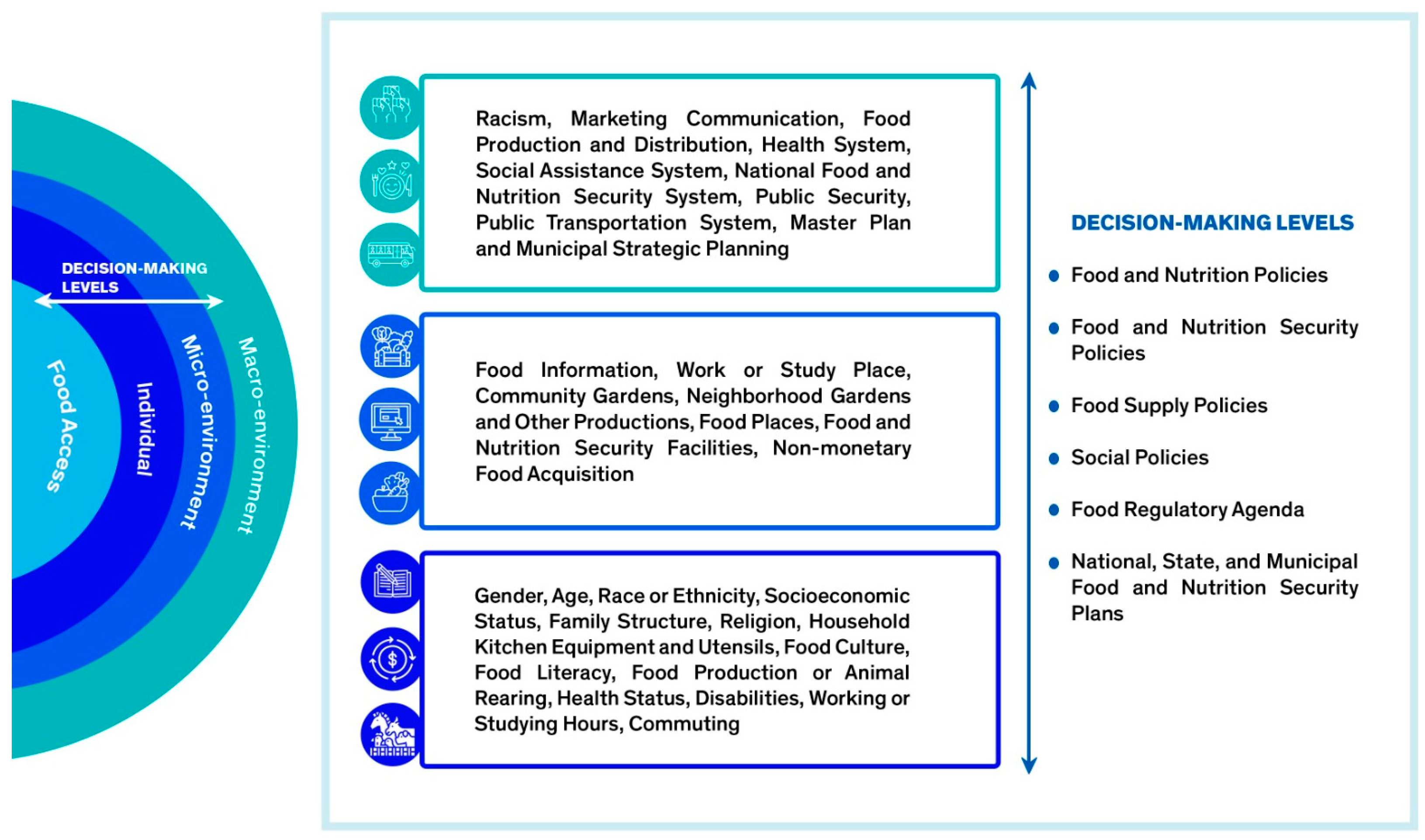
Conceptual Model on Access to Food in the Favela Food Environment

 ,
,  , , , and
Abstract
1. Introduction
2. Materials and Methods
Ethical Aspects
3. Results
Percentage of Agreement
4. Discussion
5. Conclusions
Supplementary Materials
Author Contributions
Funding
Institutional Review Board Statement
Informed Consent Statement
Data Availability Statement
Acknowledgments
Conflicts of Interest
References
- Instituto Brasileiro de Geografia e Estatística (IBGE). Favelas e Comunidades Urbanas. Notas metodológicas n. 01: Sobre a mudança de Aglomerados Subnormais para Favelas e Comunidades Urbanas. Rio de Janeiro. 2024. Available online: https://biblioteca.ibge.gov.br/visualizacao/livros/liv102062.pdf (accessed on 24 June 2024).
- Cambridge University Press. Cambridge Advanced Learner’s Dictionary & Thesaurus: Slum. 2024. Available online: https://dictionary.cambridge.org/pt/dicionario/ingles/slum#google_vignette (accessed on 24 June 2024).
- Fernandes, T.M.; Costa, R.G. Cidades e Favelas: Territórios em Disputa. X Encontro Nacional de História Oral, Testemunhos: História e Política. 2010. Available online: https://www.encontro2010.historiaoral.org.br/resources/anais/2/1270343233_ARQUIVO_EncontroHO2010TaniaFernandes%5B1%5D.pdf (accessed on 24 June 2024).
- Gonçalves, R.S.; Amoroso, M.; Brum, M. Serviço Social, habitação e direito à cidade: Favelas, subúrbios, periferias e assentamentos informais. Rev. Lib. 2015, 15, 1–4. [Google Scholar]
- Ribas, C.L.; Oliveira, R.C.; Lima, J.C.P. Regras não-ditas no processo de construção das favelas. Rev. Da Seção Judiciária Do Rio De Jan. 2018, 22, 110–127. [Google Scholar] [CrossRef]
- Rocha, L.L.; Friche, A.A.L.; Jardim, M.Z.; Junior, P.C.P.C.; Oliveira, E.P.; Cardoso, L.O.; Mendes, L.L. Perception of the food environment by Brazilian slum residents: A qualitative study. Cad. Saúde Pública 2024, 40, e00128423. [Google Scholar] [CrossRef] [PubMed]
- Swinburn, B.; Vandevijvere, S.; Kraak, V.; Sacks, G.; Snowdon, W.; Hawkes, C.; Barquera, S.; Friel, S.; Kelly, B.; Kumanyika, S.; et al. Monitoring and benchmarking government policies and actions to improve the healthiness of food environments: A proposed Government Healthy Food Environment Policy Index. Obes Rev. 2013, 14 (Suppl. 1), 24–37. [Google Scholar] [CrossRef]
- Rocha, L.L.; Friche, A.A.L.; Melo, G.B.V.; Cordeiro, N.G.; Honório, O.S.; Cardoso, L.O.; Mendes, L.L. Food retail in favelas of a Brazilian metropolis. Food Secur. 2024, 16, 277–292. [Google Scholar] [CrossRef]
- Rocha, D.G. Imagens Cristalizadas: A construção dos estereótipos sobre as favelas. Rev. Mídia Cotid. 2017, 11, 6–24. [Google Scholar] [CrossRef]
- Downs, S.M.; Ahmed, S.; Fanzo, J.; Herforth, A. Food Environment Typology: Advancing an Expanded Definition, Framework, and Methodological Approach for Improved Characterization of Wild, Cultivated, and Built Food Environments toward Sustainable Diets. Foods 2020, 9, 532. [Google Scholar] [CrossRef]
- Turner, C.; Aggarwal, A.; Walls, H.; Herforth, A.; Drewnowski, A.; Coates, J.; Kalamatianou, S.; Kadiyala, S. Concepts and critical perspectives for food environment research: A global framework with implications for action in low- and middle-income countries. Glob. Food Secur. 2018, 18, 93–101. [Google Scholar] [CrossRef]
- Mendes, L.L.; Rocha, L.L.; Botelho, L.V.; Menezes, M.C.; Júnior, P.C.P.C.; Camara, A.O.; Cardoso, L.O.; Castro, I.R.R.; Horta, P.M.; Pessoa, M.C.; et al. Scientific research on food environments in Brazil: A scoping review. Public Health Nutr. 2023, 26, 2056–2065. [Google Scholar] [CrossRef]
- Souza Filho, B.A.B.; Struchiner, C.J. Uma proposta teórico-metodológica para elaboração de modelos teóricos. Cad. Saúde Coletiva 2021, 29, 86–97. [Google Scholar] [CrossRef]
- Lynn, M.R. Determination and quantification of content validity. Nurs. Res. 1986, 35, 382–385. [Google Scholar] [CrossRef] [PubMed]
- Haynes, B.; Haines, A. Barriers and bridges to evidence based clinical practice. Br. Med. J. 1998, 317, 273–276. [Google Scholar] [CrossRef] [PubMed]
- Alexandre, N.M.C.; Coluci, M.Z.O. Validade de conteúdo nos processos de construção e adaptação de instrumentos de medidas. Ciênc. Saúde Coletiva 2011, 16, 3061–3068. [Google Scholar] [CrossRef] [PubMed]
- Penchansky, R.; Thomas, J.W. The concept of access: Definition and relationship to consumer satisfaction. Med. Care 1981, 19, 127–140. [Google Scholar] [CrossRef]
- Caspi, C.E.; Sorensen, G.; Subramanian, S.V.; Kawachi, I. The local food environment and diet: A systematic review. Health Place 2012, 18, 1172–1187. [Google Scholar] [CrossRef]
- Story, M.; Kaphingst, K.M.; Robinson-O’Brien, R.; Glanz, K. Creating healthy food and eating environments: Policy and environmental approaches. Annu. Rev. Public Health 2008, 29, 253–272. [Google Scholar] [CrossRef]
- Swinburn, B.; Egger, G.; Raza, F. Dissecting obesogenic environments: The development and application of a framework for identifying and prioritizing environmental interventions for obesity. Prev. Med. 1999, 29, 563–570. [Google Scholar] [CrossRef]
- Castro, I.R.R.; Canella, D.S. Organizational Food Environments: Advancing Their Conceptual Model. Foods 2022, 11, 993. [Google Scholar] [CrossRef]
- World Health Organization (WHO). Social Determinants of Health. 2021. Available online: https://www.who.int/health-topics/social-determinants-of-health#tab=tab_1 (accessed on 5 March 2023).
- Solar, O.; Irwin, A. A Conceptual Framework for Action on Social Determinants of Health. Social Determinants of Health Discussion Paper 2; World Health Organization: Geneva, Switzerland, 2010. [Google Scholar]
- Gálvez-Espinoza, P.; Egaña, D.; Masferrer, D.; Cerda, R. Propuesta de un modelo conceptual para el estudio de los ambientes alimentarios en Chile. Rev. Panam. Salud Publica 2017, 41, e169. [Google Scholar] [CrossRef]
- Diez-Roux, A.; Mair, C. Neighborhoods and health. Ann. N. Y. Acad. Sci. 2010, 1186, 125–145. [Google Scholar] [CrossRef]
- Diez-Roux, A. Investigating neighborhood and area effects on health. Am. J. Public Health 2001, 91, 1783–1789. [Google Scholar] [CrossRef] [PubMed]
- Gondim, G.M.M. Espaço e Saúde: Uma (inetr)ação provável nos processos de adoecimento e morte em populações. In Território Ambiente e Saúde; Miranda, A.C., Barcellos, C., Moreira, J.C., Monken, M., Eds.; Editora Fiocruz: Rio de Janeiro, Brazil, 2008. [Google Scholar]
- Mendes, R.; Donato, A.F. Território: Espaço Social de Construção de Identidades e de Políticas. SANARE 2003, 1, 39–42. [Google Scholar]
- Mook, K.; Laraia, B.A.; Oddo, V.M.; Jones-Smith, J.C. Food security status and barriers to fruit and vegetable consumption in two economically deprived communities of Oakland, California, 2013–2014. Prev. Chronic Dis. 2016, 13, e21. [Google Scholar] [CrossRef] [PubMed]
- Filomena, S.; Scanlin, K.; Morland, K.B. Brooklyn, New York foodscape 2007–2011: A five-year analysis of stability in food retail environments. Int. J. Behav. Nutr. Phys. Act. 2013, 10, 46. [Google Scholar] [CrossRef]
- Glanz, K.; Sallis, J.F.; Saelens, B.E.; Frank, L.D. Healthy nutrition environments: Concepts and measures. Am. J. Health Promot. 2005, 19, 330–333. [Google Scholar] [CrossRef]
- Swinburn, B.; Sacks, G.; Vandevijvere, S.; Kumanyika, S.; Lobstein, T.; Neal, B.; Barquera, S.; Friel, S.; Hawkes, C.; Kelly, B.I.; et al. INFORMAS (International Network for Food and Obesity/non-communicable diseases Research, Monitoring and Action Support): Overview and key principles. Obes. Rev. 2013, 14, 1–12. [Google Scholar] [CrossRef]
- High Level Panel of Experts on Food Security and Nutrition (HLPE). Nutrition and Food Systems. A Report by the High Level Panel of Experts on Food Security and Nutrition of the Committee on World Food Security; HLPE: Rome, Italy, 2017. [Google Scholar]
- Food and Agriculture Organization (FAO). Promessas e Desafios do Setor Informal de Alimentos em Países em Desenvolvimento; FAO: Roma, Italy, 2011. [Google Scholar]
- Ambikapathi, R.; Shively, G.; Leyna, G.; Mosha, D.; Mangara, A.; Patil, C.L.; Boncyk, M.; Froese, S.L.; Verissimo, C.K.; Kazonda, P.; et al. Informal food environment is associated with household vegetable purchase patterns and dietary intake in the DECIDE study: Empirical evidence from food vendor mapping in peri-urban Dar es Salaam, Tanzania. Glob. Food Secur. 2021, 28, 100474. [Google Scholar] [CrossRef]


| Dimension | Elements | Definition |
|---|---|---|
| Individual | Gender | Characteristics, roles, behaviors, expectations, and socially constructed identities associated with gender, being a man, being a woman, or other gender identities such as transgender, non-binary, or agender [1]. Gender identity also relates to power relationships between its different forms of expression. Examples: cisgender woman, transgender woman, cisgender man, transgender man, and agender. |
| Age | Stage of life in which an individual is measured from the time of birth. Examples include childhood, adolescence, and senescence. | |
| Socioeconomic status | The amount of money a person receives periodically as remuneration for work or services (e.g., salary, pension, allowance) and other government benefits and considers the individual’s education level. | |
| Race or ethnicity | Race is the social construction and categorization of people based on perceived physical traits that maintain a socio-political hierarchy [2]. Ethnicity refers to the characterization of people based on shared culture, ancestry, and history [3]. | |
| Family structure | The number of individuals living together and the composition of the household (e.g., a family composed only of women or men, the presence of children and adolescents, and other family compositions). | |
| Religion | A set of beliefs and social practices related to the notion of the sacred, uniting all adherents into the same moral community [4]. Some practices involve temporarily or permanently consuming or banning certain foods, or the community can help by donating and sharing food. | |
| Food culture | A set of ideas, beliefs, knowledge, and practices related to food and shared between and within groups over time [5]. | |
| Working or studying hours | The daily period when the dweller is available for work or study. It includes commuting time for in-person activities. | |
| Individual | Health status | Dwellers’ health conditions that can affect access to food due to restrictions, e.g., comorbidities that affect mobility or daily activities (obesity, chronic non-communicable diseases). |
| Disabilities | The presence of disabilities that can affect access to food due to restrictions, such as congenital or acquired physical or mental incapacities. | |
| Food production or animal rearing | Producing food or raising animals for personal consumption, with the possibility of selling or exchanging surplus locally. Examples include backyard or balcony vegetable gardens (vertical or horizontal) and raising animals for consumption and sale, like milk, honey, and eggs. | |
| Food literacy | The dweller’s ability to read, understand, and judge the quality of nutritional information; to seek and exchange knowledge about food and nutrition; to buy and prepare food; to reflect critically on the factors involved in personal food choices; and to understand the impact of these choices on society [6]. | |
| Household kitchen equipment and utensils | It considers the materials, equipment, and utensils available in the household to store and prepare food. | |
| Commute | Time spent and distance traveled between different physical points using any means of transport (own, alternative, or public). It reflects the individual’s routine of commuting around the city. | |
| Micro-environment | Food Information | Food information available in the environment, such as nutritional tables and ingredient lists, food advertising, or nutritional claims. |
| Community and neighborhood vegetable gardens and other local food production sites | Presence of community or neighborhood gardens, productive backyard farming, or other forms of food production or animal rearing for free distribution, exchange, and sale within the community. Examples include private vertical or horizontal backyard or balcony gardens and community gardens initiated either by the population or the government in public spaces. | |
| Food fairs | Physical spaces for selling food in permanent locations using tents and collapsible equipment to provide fresh or minimally processed food, and culinary preparations, among other types of food. | |
| Micro-environment | Non-monetary food acquisition | The exchange of food items without using currency, or small or large food donation by a single person, a group of volunteers, or organizations and institutions, which may be mediated by non-profit organizations or community leaders. This food can be donated by churches, non-governmental organizations, government institutions, or other associations or individuals. |
| Formal food stores | Formal fixed-location food stores that pay taxes and are inspected and registered by government bodies. These stores are regulated through state, national, or other local registrations, such as unions. | |
| Informal food stores | Informal fixed-location food stores that may or may not undergo inspection by health authorities but that pay no taxes. These stores are characterized by a lack of specialization, low capital investment, lack of accountability, non-payment of some or all taxes, and limited social innovations, such as new forms of payment (barter system), or selling in unconventional places [7]. The food stores are not regulated by state, national, or other registrations. Examples include selling food in garages or doorsteps or having a sign indicating they sell various culinary preparations. | |
| Food and nutrition security facilities | Physical structures or spaces that provide public services aimed at promoting access to quality food, adequate nutrition, and food and nutritional security for the population. Examples include popular restaurants, food markets, food banks, community kitchens, and solidarity kitchens. | |
| Street vending | Street vending can take place in open or closed spaces, whether with a fixed location or not. Street vendors may or may not be registered with government bodies and pay taxes, but they are subject to inspection (e.g., municipal street vendor registers). Examples include food vendors who have a sales space that can be moved around (carts, mobile stands, cars, bicycles, etc.). | |
| Food e-commerce | Selling food through online stores, with the entire product purchase being online: product selection, determination of an address for delivery or pick-up, payment, and purchase. | |
| Micro-environment | Online food delivery platforms | Applications that host one or more companies that sell both ready-to-eat or non-ready-to-eat food items with a delivery service. These business platforms provide order, delivery, and payment services to food stores. |
| Local non-profit organizations and institutions | Non-profit organizations that provide free support and services to favela dwellers. Examples include social movements, dwellers’ associations, and the Central Única de Favelas in Brazil [8]. | |
| Other organizations | For-profit organizations that are open to working in the favelas or have some kind of influence there. Examples include good industries (which can promote food produced in favelas) and criminal organizations (criminal factions and militias). | |
| Social services | These include any type of public or private social assistance service or unit that has direct contact with the individual (e.g., Social Assistance Reference Center, Coexistence and Bond Strengthening Service). | |
| Health services | These include any type of public or private health service or unit that has direct contact with the individual (e.g., basic health units, private practices). | |
| Internet access | Availability of broadband connection or internet access points through private of free wireless networks. | |
| Security and violence | Perception of security and violence experienced by dwellers and food vendors influenced by the presence of drug trafficking, police violence, confrontations, assaults, criminal factions, militias, and other types of criminal organizations that can influence their sense of security or insecurity. | |
| Alternative transportation | Unregulated collective or individual means of transportation for commuting within the favela. Examples include motorcycle taxis and vans. | |
| Public transportation | Accessible public transportation that accesses favelas, travel within this territory, and connect it to other points in the city. | |
| Work or study place | Food sold and/or provided free of charge for immediate consumption in educational institutions and workplaces located in favelas or frequented by favela dwellers. | |
| Micro-environment | Basic sanitation | Access to basic services such as drinking water distribution, sewage collection and treatment, urban drainage, and solid waste collection. |
| Walkability | The physical structure of the urban space that allows and favors walking [9]. Examples include street elevation level; presence, quality, and size of sidewalks; obstructions; street lighting; presence of trees; crosswalks; presence and access to bus stops; and size of blocks. | |
| Social cohesion | The sense of unity and level of interaction among community members for a common purpose [10]. | |
| Social capital | The network of social relations, norms, trust, and cooperation within the community. It includes elements of social organization and civic engagement and networks of associations aimed at achieving a common good or purpose [11]. | |
| Macro-environment | Racism | Racism is a form of discrimination that considers race or ethnicity as the basis for practices that result in advantages or disadvantages for individuals based on their group affiliation [12]. In Brazil, racism manifests through the accumulation of privileges by White individuals at the expense of Black individuals. It is expressed through actions, beliefs, and political systems operating across different levels, from internalized to interpersonal, structural, and systemic. |
| Marketing communication | The set of marketing strategies, messages, and practices used by companies and organizations in the food industry to promote and advertise their food products. These strategies aim to influence consumer perception, increase brand awareness, and stimulate the purchase of food products, being mostly used by the ultra-processed food industry. Examples include television and social media advertising, attractive labels with health claims, reward programs, value combinations, and discounts. | |
| Master plan and municipal strategic planning | Urban planning and management tools used by cities and authorities to guide urban development and planning. | |
| Macro-environment | Food production and distribution | Interconnected processes, activities, and infrastructures involved in food production and distribution. They encompass food cultivation, the transformation of raw materials into food products, and the physical movement of food from production to points of sale or consumers. Examples include the ultra-processed food industry, the grain processing industry, and family farmers’ cooperatives. |
| Health system | Considers the infrastructure and the set of health services organizing activities in the territory. | |
| Social assistance system | Considers social protection services for individuals. | |
| National food and nutrition security system | A structure that puts the goals of the food and nutrition security policy into practice. | |
| Public security | Strategies, guidelines, actions, and measures implemented by governments and public institutions to promote security, prevent crime, protect citizens, and ensure compliance with the law in each district. These actions are designed to address security-related challenges ranging from crime prevention to emergency and disaster response. | |
| Public transportation system | Infrastructure and services organized to provide efficient and accessible movement of people within a city, metropolitan region, or urban area. It is designed to meet the mobility needs of urban populations. | |
| Decision-making | Food and nutrition policies | Strategies, plans, programs, and actions implemented by governments and organizations to promote healthy eating and ensure adequate and sufficient access to healthy food. |
| Food and nutrition security policies | Strategies, plans, programs, and actions implemented by governments and organizations to promote food and nutrition security. These policies are designed to address issues related to nutrition and access to healthy and sustainable food. | |
| Social policies | Actions, programs, measures, and strategies implemented by the state or other governmental and non-governmental institutions to address social issues and promote the population’s well-being. These policies aim to meet basic needs and ensure the fundamental rights of people, especially those in situations of vulnerability or social disadvantage. | |
| Decision-making | Food supply policies | Strategies, regulations, government actions, and programs aimed at ensuring adequate and sustainable food supply for the population of a country, region, or community. The main aim of these policies is to ensure access to safe, nutritious, and sufficient food to meet the basic dietary needs of the population. |
| Food regulatory agenda | Projects and normative tools aiming to regulate food-related activities, such as labeling rules, food advertising, food tax rules, and other regulatory provisions on food items. | |
| National, state, and municipal food and nutrition security plans | Actions implemented by food production and distribution structures to improve access to healthy food in sufficient quantity and quality in the territories. |
| Aspect Analyzed | Percentage of General Agreement | Percentage of Agreement Among Members of Civil Society | Percentage of Agreement Among Researchers and Professors |
|---|---|---|---|
| All constituent elements included are relevant to the favela food environment | 100% | 100% | 100% |
| The construction blocks included in the model cover all the components relevant to the favela food environment | 96% | 90% | 100% |
| The conceptual model is clear | 96% | 90% | 100% |
| The graphical representation of the conceptual model is clear | 96% | 90% | 100% |
| The terms naming the constituent elements of the graphical representation of the conceptual model are clear | 96% | 90% | 100% |
| The description of access to food is easy to understand | 100% | 100% | 100% |
| All the dimensions included are relevant to the favela food environment | 100% | 100% | 100% |
| All the dimensions that should be included in a model for the favela food environment are included in the table | 92% | 80% | 100% |
| The dimensions are easy to understand | 100% | 100% | 100% |
| The description of the dimensions is easy to understand | 100% | 100% | 100% |
| All the parameters included are relevant to the favela food environment | 100% | 100% | 100% |
| All the parameters that should be included in a model for the favela food environment are included in the table | 96% | 100% | 93.33% |
| The variables are easy to understand | 96% | 90% | 100% |
| The description of the variables is easy to understand | 96% | 90% | 100% |
Disclaimer/Publisher’s Note: The statements, opinions and data contained in all publications are solely those of the individual author(s) and contributor(s) and not of MDPI and/or the editor(s). MDPI and/or the editor(s) disclaim responsibility for any injury to people or property resulting from any ideas, methods, instructions or products referred to in the content. |
© 2024 by the authors. Licensee MDPI, Basel, Switzerland. This article is an open access article distributed under the terms and conditions of the Creative Commons Attribution (CC BY) license (https://creativecommons.org/licenses/by/4.0/).
Share and Cite
Rocha, L.; Canella, D.; Canuto, R.; Jardim, M.; Cardoso, L.; Friche, A.; Mendes, L. Conceptual Model on Access to Food in the Favela Food Environment. Int. J. Environ. Res. Public Health 2024, 21, 1422. https://doi.org/10.3390/ijerph21111422
Rocha L, Canella D, Canuto R, Jardim M, Cardoso L, Friche A, Mendes L. Conceptual Model on Access to Food in the Favela Food Environment. International Journal of Environmental Research and Public Health. 2024; 21(11):1422. https://doi.org/10.3390/ijerph21111422
Chicago/Turabian StyleRocha, Luana, Daniela Canella, Raquel Canuto, Mariana Jardim, Letícia Cardoso, Amelia Friche, and Larissa Mendes. 2024. "Conceptual Model on Access to Food in the Favela Food Environment" International Journal of Environmental Research and Public Health 21, no. 11: 1422. https://doi.org/10.3390/ijerph21111422
APA StyleRocha, L., Canella, D., Canuto, R., Jardim, M., Cardoso, L., Friche, A., & Mendes, L. (2024). Conceptual Model on Access to Food in the Favela Food Environment. International Journal of Environmental Research and Public Health, 21(11), 1422. https://doi.org/10.3390/ijerph21111422