Association of Low Back Pain with Shift Work: A Meta-Analysis


 , , and
Abstract
1. Introduction
2. Materials and Methods
2.1. Protocol and Registration
2.2. Data Sources and Search Terms
2.3. Eligibility Criteria
2.4. Study Selection Process
2.5. Data Collection
2.6. Study Characteristics
2.7. Shift Work
2.8. Low Back Pain
2.9. Statistical Analysis
3. Results
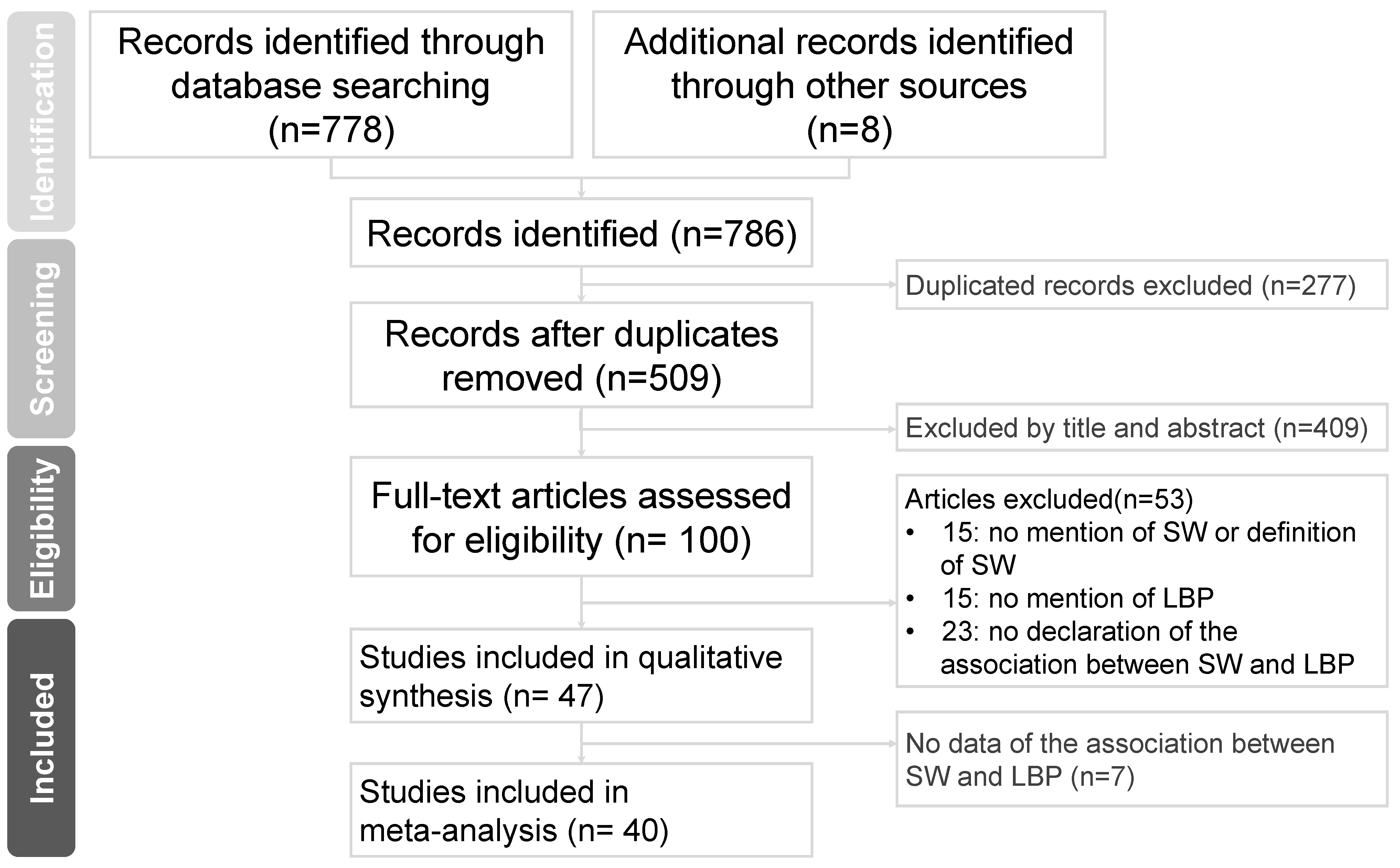
3.1. Selected Studies
3.2. Study Characteristics
3.3. Results of Individual Studies
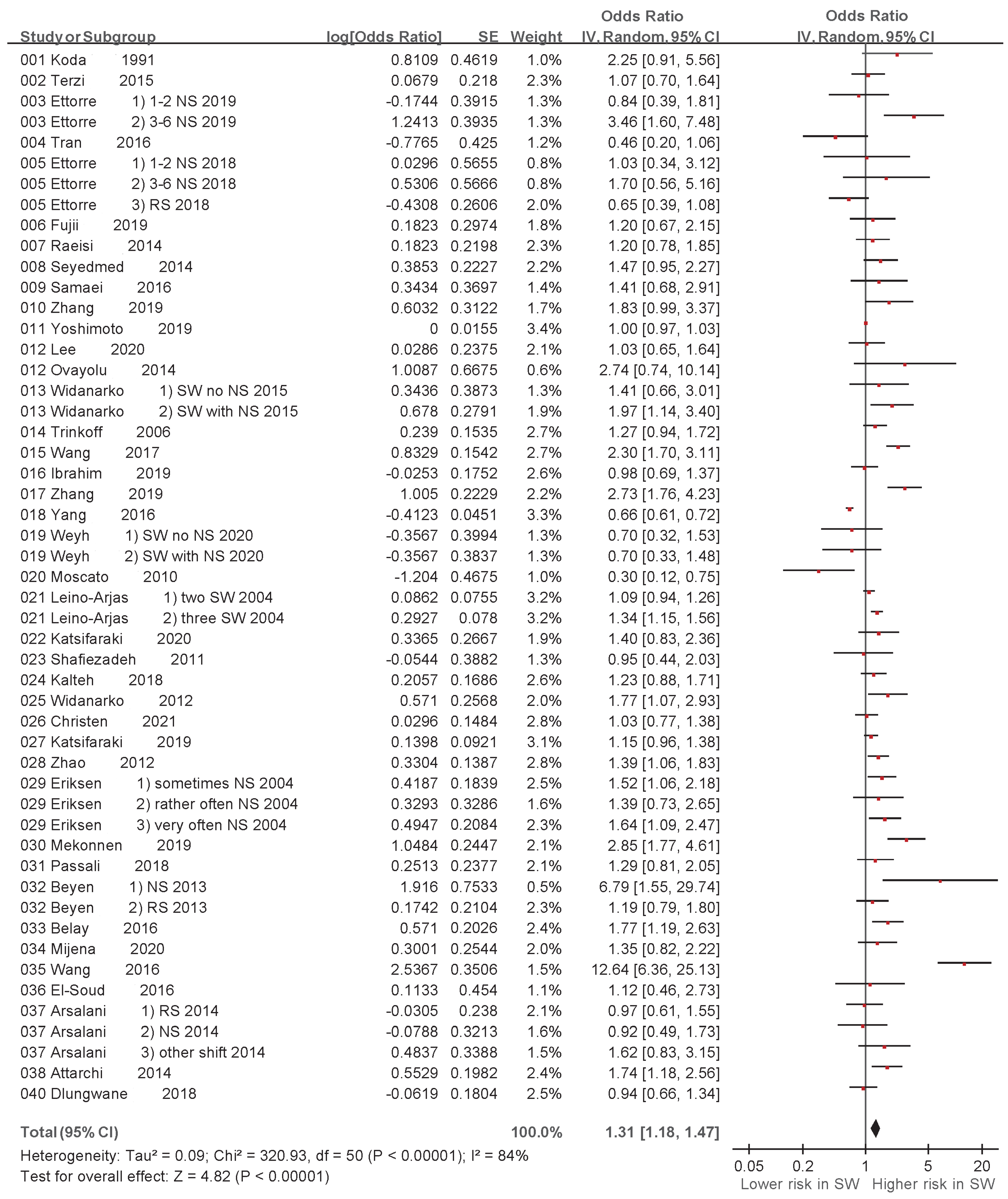
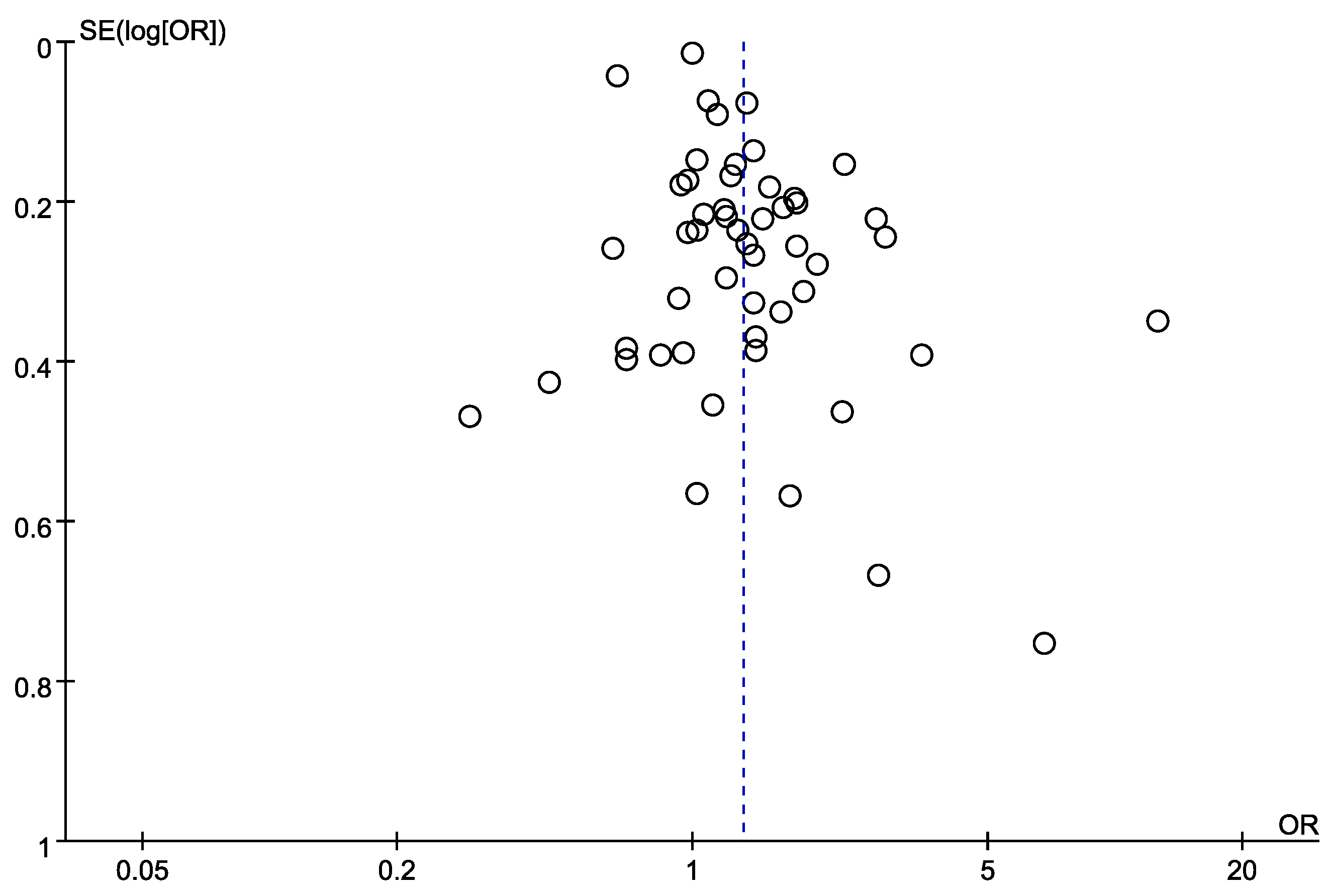
3.4. Meta-Analysis
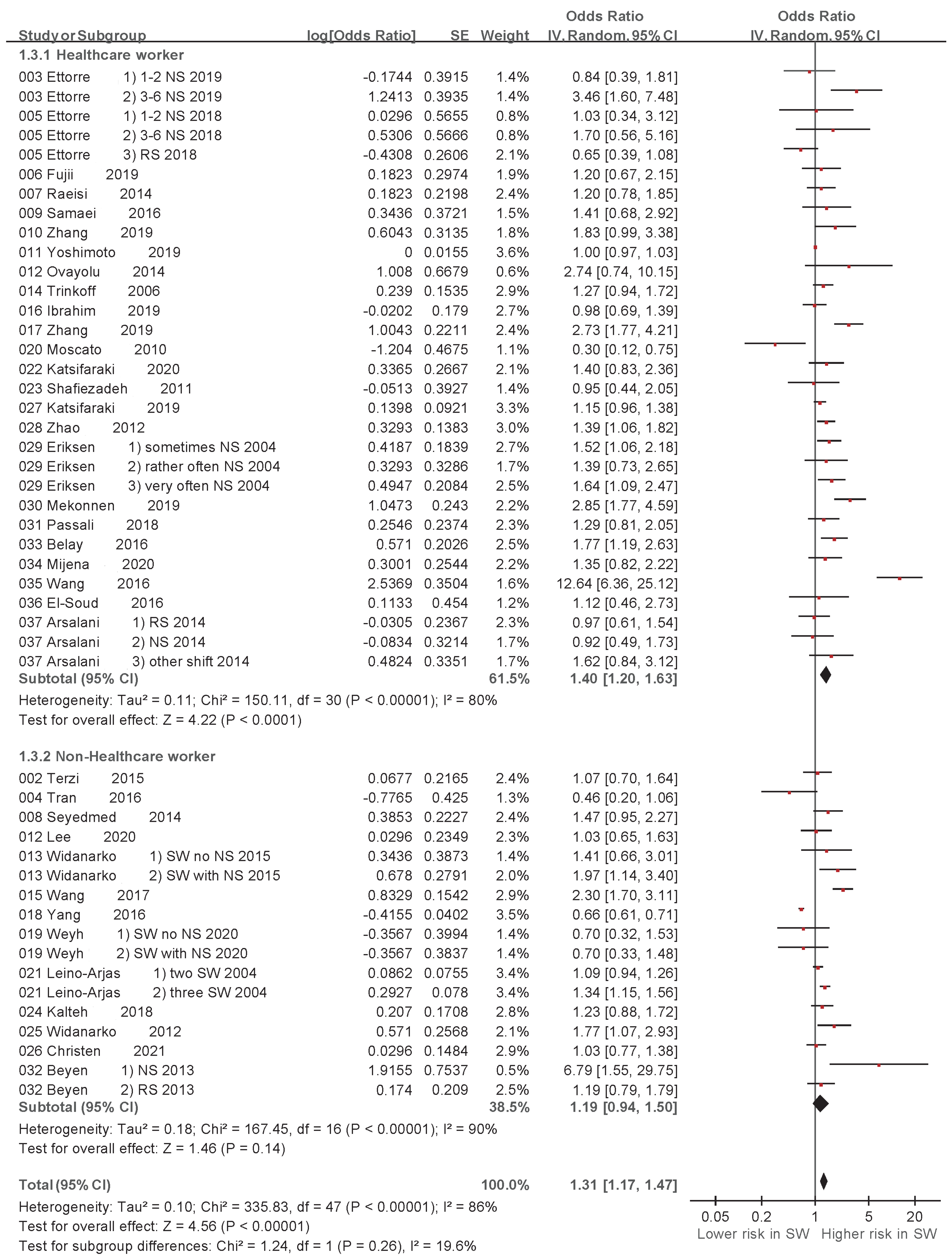
3.5. Subgroup Analysis
4. Discussion
5. Conclusions
Author Contributions
Funding
Institutional Review Board Statement
Informed Consent Statement
Data Availability Statement
Conflicts of Interest
References
- Ministry of Labor Republic of China (Taiwan). Population and Labor Force. Available online: https://english.mol.gov.tw/21004/21107/21113/lpsimplelist (accessed on 22 October 2022).
- Alterman, T.; Luckhaupt, S.E.; Dahlhamer, J.M.; Ward, B.W.; Calvert, G.M. Prevalence rates of work organization characteristics among workers in the U.S.: Data from the 2010 national health interview survey. Am. J. Ind. Med. 2013, 56, 647–659. [Google Scholar] [CrossRef] [PubMed]
- Torquati, L.; Mielke, G.I.; Brown, W.J.; Burton, N.W.; Kolbe-Alexander, T.L. Shift work and poor mental health: A meta-analysis of longitudinal studies. Am. J. Public Health 2019, 109, e13–e20. [Google Scholar] [CrossRef] [PubMed]
- Richter, K.; Acker, J.; Adam, S.; Niklewski, G. Prevention of fatigue and insomnia in shift workers-a review of non-pharmacological measures. EPMA J. 2016, 7, 16. [Google Scholar] [CrossRef] [PubMed]
- Vetter, C.; Dashti, H.S.; Lane, J.M.; Anderson, S.G.; Schernhammer, E.S.; Rutter, M.K.; Saxena, R.; Scheer, F. Night shift work, genetic risk, and type 2 diabetes in the uk biobank. Diabetes Care 2018, 41, 762–769. [Google Scholar] [CrossRef]
- Brown, D.L.; Feskanich, D.; Sánchez, B.N.; Rexrode, K.M.; Schernhammer, E.S.; Lisabeth, L.D. Rotating night shift work and the risk of ischemic stroke. Am. J. Epidemiol. 2009, 169, 1370–1377. [Google Scholar] [CrossRef]
- Wei, F.; Chen, W.; Lin, X. Night-shift work, breast cancer incidence, and all-cause mortality: An updated meta-analysis of prospective cohort studies. In Sleep & Breathing Schlaf & Atmung; Springer: Berlin/Heidelberg, Germany, 2021. [Google Scholar]
- Zhang, S.; Wang, Y.; Wang, Z.; Wang, H.; Xue, C.; Li, Q.; Guan, W.; Yuan, J. Rotating night shift work and non-alcoholic fatty liver disease among steelworkers in china: A cross-sectional survey. Occup. Environ. Med. 2020, 77, 333–339. [Google Scholar] [CrossRef]
- Tian, F.; Li, H.; Tian, S.; Shao, J.; Tian, C. Effect of shift work on cognitive function in chinese coal mine workers: A resting-state fnirs study. Int. J. Environ. Res. Public Health 2022, 19, 4217. [Google Scholar] [CrossRef]
- Grundy, A.; Cotterchio, M.; Kirsh, V.A.; Nadalin, V.; Lightfoot, N.; Kreiger, N. Rotating shift work associated with obesity in men from northeastern ontario. Health Promot. Chronic Dis. Prev. Can. Res. Policy Pract. 2017, 37, 238–247. [Google Scholar] [CrossRef]
- Wang, N.; Sun, Y.; Zhang, H.; Wang, B.; Chen, C.; Wang, Y.; Chen, J.; Tan, X.; Zhang, J.; Xia, F.; et al. Long-term night shift work is associated with the risk of atrial fibrillation and coronary heart disease. Eur. Heart J. 2021, 42, 4180–4188. [Google Scholar] [CrossRef]
- Yang, C.C.; Lee, K.W.; Watanabe, K.; Kawakami, N. The association between shift work and possible obstructive sleep apnea: A systematic review and meta-analysis. Int. Arch. Occup. Environ. Health 2021, 94, 1763–1772. [Google Scholar] [CrossRef]
- Vetter, C.; Devore, E.E.; Wegrzyn, L.R.; Massa, J.; Speizer, F.E.; Kawachi, I.; Rosner, B.; Stampfer, M.J.; Schernhammer, E.S. Association between rotating night shift work and risk of coronary heart disease among women. JAMA 2016, 315, 1726–1734. [Google Scholar] [CrossRef]
- Wu, A.; March, L.; Zheng, X.; Huang, J.; Wang, X.; Zhao, J.; Blyth, F.M.; Smith, E.; Buchbinder, R.; Hoy, D. Global low back pain prevalence and years lived with disability from 1990 to 2017: Estimates from the global burden of disease study 2017. Ann. Transl. Med. 2020, 8, 299. [Google Scholar] [CrossRef] [PubMed]
- Parreira, P.; Maher, C.G.; Steffens, D.; Hancock, M.J.; Ferreira, M.L. Risk factors for low back pain and sciatica: An umbrella review. Spine J. Off. J. N. Am. Spine Soc. 2018, 18, 1715–1721. [Google Scholar] [CrossRef] [PubMed]
- Takahashi, M.; Matsudaira, K.; Shimazu, A. Disabling low back pain associated with night shift duration: Sleep problems as a potentiator. Am. J. Ind. Med. 2015, 58, 1300–1310. [Google Scholar] [CrossRef] [PubMed]
- Samaei, S.E.; Mostafaee, M.; Jafarpoor, H.; Hosseinabadi, M.B. Effects of patient-handling and individual factors on the prevalence of low back pain among nursing personnel. Work 2017, 56, 551–561. [Google Scholar] [CrossRef]
- Wickwire, E.M.; Geiger-Brown, J.; Scharf, S.M.; Drake, C.L. Shift work and shift work sleep disorder: Clinical and organizational perspectives. Chest 2017, 151, 1156–1172. [Google Scholar] [CrossRef]
- Gehlert, S.; Clanton, M.; on behalf of the Shift Work and Breast Cancer Strategic Advisory Group. Shift Work and Breast Cancer. Int. J. Environ. Res. Public Health 2020, 17, 9544. [Google Scholar] [CrossRef]
- Kawaguchi, M.; Matsudaira, K.; Sawada, T.; Koga, T.; Ishizuka, A.; Isomura, T.; Coggon, D. Assessment of potential risk factors for new onset disabling low back pain in japanese workers: Findings from the cupid (cultural and psychosocial influences on disability) study. BMC Musculoskelet. Disord. 2017, 18, 334. [Google Scholar] [CrossRef]
- Dembe, A.E.; Delbos, R.; Erickson, J.B. Estimates of injury risks for healthcare personnel working night shifts and long hours. Qual. Saf. Health Care 2009, 18, 336–340. [Google Scholar] [CrossRef]
- Costa, G. Shift work and occupational medicine: An overview. Occup. Med. 2003, 53, 83–88. [Google Scholar] [CrossRef]
- Leso, V.; Vetrani, I.; Sicignano, A.; Romano, R.; Iavicoli, I. The impact of shift-work and night shift-work on thyroid: A systematic review. Int. J. Environ. Res. Public Health 2020, 17, 1527. [Google Scholar] [CrossRef] [PubMed]
- Rosa, R.R. Plain Language About Shiftwork; NIOSH: Washington, DC, USA, 1997; pp. 97–145. [Google Scholar]
- Straif, K.; Baan, R.; Grosse, Y.; Secretan, B.; El Ghissassi, F.; Bouvard, V.; Altieri, A.; Benbrahim-Tallaa, L.; Cogliano, V. Carcinogenicity of shift-work, painting, and fire-fighting. Lancet Oncol. 2007, 8, 1065–1066. [Google Scholar] [CrossRef] [PubMed]
- Hunter, J.E. Fixed effects vs. Random effects meta-analysis models: Implications for cumulative research knowledge. Int. J. Sel. Assess. 2000, 8, 275–292. [Google Scholar] [CrossRef]
- Wang, X.L.; Ren, J.Q.; Liu, J. The status and influencing factors of low back pain of 909 nurses in three tertiary grade a hospitals. Chin. Nurs. Manag. 2016, 16, 61–64. [Google Scholar] [CrossRef]
- Arsalani, N.; Fallahi-Khoshknab, M.; Josephson, M.; Lagerström, M. Musculoskeletal disorders and working conditions among iranian nursing personnel. Int. J. Occup. Saf. Ergon. JOSE 2014, 20, 671–680. [Google Scholar] [CrossRef]
- Attarchi, M.; Raeisi, S.; Namvar, M.; Golabadi, M. Association between shift working and musculoskeletal symptoms among nursing personnel. Iran. J. Nurs. Midwifery Res. 2014, 19, 309–314. [Google Scholar]
- Belay, M.; Worku, A.; Gebrie, S.; Wamisho, B.L. Epidemiology of low back pain among nurses working in public hospitals of addis ababa, ethiopia. East Cent. Afr. J. Surg 2016, 21, 113–131. [Google Scholar] [CrossRef]
- Beyen, T.K.; Mengestu, M.Y.; Zele, Y.T.J.O.m.; Affairs, H. Low back pain and associated factors among teachers in gondar town, north gondar, amhara region, ethiopia. Occup. Med. Health Aff. 2013, 2013, 1–8. [Google Scholar]
- Christensen, J.O.; Nilsen, K.B.; Hopstock, L.A.; Steingrímsdóttir, Ó.A.; Nielsen, C.S.; Zwart, J.A.; Matre, D. Shift work, low-grade inflammation, and chronic pain: A 7-year prospective study. Int. Arch. Occup. Environ. Health 2021, 94, 1013–1022. [Google Scholar] [CrossRef]
- D’Ettorre, G.; Vullo, A.; Pellicani, V. Assessing and preventing low back pain in nurses. Implications for practice management. Acta Bio-Med. Atenei Parm. 2019, 90, 53–59. [Google Scholar]
- d’Ettorre, G.; Vullo, A.; Pellicani, V.; Ceccarelli, G. Acute low back pain among registered nurses. Organizational implications for practice management. Ann. Ig. Med. Prev. Comunita 2018, 30, 482–489. [Google Scholar]
- Dlungwane, T.; Voce, A.; Knight, S. Prevalence and factors associated with low back pain among nurses at a regional hospital in kwazulu-natal, south africa. Health SA SA Gesondheid 2018, 23, 1082. [Google Scholar] [CrossRef] [PubMed]
- El-Soud, A.; El-Najjar, A.; El-Fattah, N.; Hassan, A. Prevalence of low back pain in working nurses in zagazig university hospitals: An epidemiological study. Egypt. Rheumatol. Rehabil. 2014, 41, 109–115. [Google Scholar] [CrossRef]
- Eriksen, W.; Bruusgaard, D.; Knardahl, S. Work factors as predictors of intense or disabling low back pain; a prospective study of nurses’ aides. Occup. Environ. Med. 2004, 61, 398–404. [Google Scholar] [CrossRef]
- Fujii, T.; Oka, H.; Takano, K.; Asada, F.; Nomura, T.; Kawamata, K.; Okazaki, H.; Tanaka, S.; Matsudaira, K. Association between high fear-avoidance beliefs about physical activity and chronic disabling low back pain in nurses in japan. BMC Musculoskelet. Disord. 2019, 20, 572. [Google Scholar] [CrossRef] [PubMed]
- Kalteh, H.O.; Khoshakhlagh, A.H.; Rahmani, N. Prevalence of musculoskeletal pains and effect of work-related factors among employees on offshore oil and gas installations in iran. Work 2018, 61, 347–355. [Google Scholar] [CrossRef] [PubMed]
- Katsifaraki, M.; Nilsen, K.B.; Christensen, J.O.; Wærsted, M.; Knardahl, S.; Bjorvatn, B.; Härmä, M.; Matre, D. Sleep duration mediates abdominal and lower-extremity pain after night work in nurses. Int. Arch. Occup. Environ. Health 2019, 92, 415–422. [Google Scholar] [CrossRef]
- Katsifaraki, M.; Nilsen, K.B.; Christensen, J.O.; Wærsted, M.; Knardahl, S.; Bjorvatn, B.; Härmä, M.; Matre, D. Pain complaints after consecutive nights and quick returns in norwegian nurses working three-shift rotation: An observational study. BMJ Open 2020, 10, e035533. [Google Scholar] [CrossRef]
- Koda, S.; Hisashige, A.; Ogawa, T.; Kurumatani, N.; Dejima, M.; Miyakita, T.; Kodera, R.; Hamada, H.; Nakagiri, S.; Aoyama, H. An epidemiological study on low back pain and occupational risk factors among clinical nurses. Sangyo Igaku. Jpn. J. Ind. Health 1991, 33, 410–422. [Google Scholar] [CrossRef] [PubMed][Green Version]
- Lee, H.E.; Choi, M.; Kim, H.R.; Kawachi, I. Impact of decreased night work on workers’ musculoskeletal symptoms: A quasi-experimental intervention study. Int. J. Environ. Res. Public Health 2020, 17, 9092. [Google Scholar] [CrossRef]
- Leino-Arjas, P.; Kaila-Kangas, L.; Kauppinen, T.; Notkola, V.; Keskimäki, I.; Mutanen, P. Occupational exposures and inpatient hospital care for lumbar intervertebral disc disorders among finns. Am. J. Ind. Med. 2004, 46, 513–520. [Google Scholar] [CrossRef] [PubMed]
- Mekonnen, T.H. Work-related factors associated with low back pain among nurse professionals in east and west wollega zones, western ethiopia, 2017: A cross-sectional study. Pain Ther. 2019, 8, 239–247. [Google Scholar] [CrossRef]
- Mijena, G.F.; Geda, B.; Dheresa, M.; Fage, S.G. Low back pain among nurses working at public hospitals in eastern ethiopia. J. Pain Res. 2020, 13, 1349–1357. [Google Scholar] [CrossRef] [PubMed]
- Moscato, U.; Trinca, D.; Rega, M.L.; Mannocci, A.; Chiaradia, G.; Grieco, G.; Ricciardi, W.; La Torre, G. Musculoskeletal injuries among operating room nurses: Results from a multicenter survey in Rome, Italy. J. Public Health 2010, 18, 453–459. [Google Scholar] [CrossRef]
- Ovayolu, O.; Ovayolu, N.; Genc, M.; Col-Araz, N. Frequency and severity of low back pain in nurses working in intensive care units and influential factors. Pak. J. Med. Sci. 2014, 30, 70–76. [Google Scholar] [CrossRef] [PubMed]
- Passali, C.; Maniopoulou, D.; Apostolakis, I.; Varlamis, I. Work-related musculoskeletal disorders among greek hospital nursing professionals: A cross-sectional observational study. Work 2018, 61, 489–498. [Google Scholar] [CrossRef] [PubMed]
- Raeisi, S.; Namvar, M.; Golabadi, M.; Attarchi, M. Combined effects of physical demands and shift working on low back disorders among nursing personnel. Int. J. Occup. Saf. Ergon. JOSE 2014, 20, 159–166. [Google Scholar] [CrossRef]
- Seyedmehdi, S.M.; Dehghan, F.; Ghaffari, M.; Attarchi, M.; Khansari, B.; Heidari, B.; Yazdanparast, T.; Norouzi Javidan, A.; Emami Razavi, S.H. Effect of general health status on chronicity of low back pain in industrial workers. Acta Med. Iran. 2016, 54, 211–217. [Google Scholar]
- Shafizadeh, K.R. Prevalence of musculoskeletal disorders among paramedics working in a large hospital in ahwaz, southwestern iran in 2010. Int. J. Occup. Environ. Med. 2011, 2, 157–165. [Google Scholar]
- Terzi, R.; Altın, F. The prevalence of low back pain in hospital staff and its relationship with chronic fatigue syndrome and occupational factors. Agri Agri (Algoloji) Dern. Yayin. Organidir J. Turk. Soc. Algol. 2015, 27, 149–154. [Google Scholar]
- Tran, T.T.T.; Phan, C.T.T.; Pham, T.C.; Nguyen, Q.T. After-shift musculoskeletal disorder symptoms in female workers and work-related factors: A cross-sectional study in a seafood processing factory in vietnam. AIMS Public Health 2016, 3, 733–749. [Google Scholar] [CrossRef] [PubMed]
- Trinkoff, A.M.; Le, R.; Geiger-Brown, J.; Lipscomb, J.; Lang, G. Longitudinal relationship of work hours, mandatory overtime, and on-call to musculoskeletal problems in nurses. Am. J. Ind. Med. 2006, 49, 964–971. [Google Scholar] [CrossRef] [PubMed]
- Wang, M.; Yu, J.; Liu, N.; Liu, Z.; Wei, X.; Yan, F.; Yu, S. Low back pain among taxi drivers: A cross-sectional study. Occup. Med. 2017, 67, 290–295. [Google Scholar] [CrossRef]
- Weyh, C.; Pilat, C.; Krüger, K. Musculoskeletal disorders and level of physical activity in welders. Occup. Med. 2020, 70, 586–592. [Google Scholar] [CrossRef] [PubMed]
- Widanarko, B.; Legg, S.; Devereux, J.; Stevenson, M. Raising awareness of psychosocial factors in the occurrence of low back symptoms in developing countries. Work 2012, 41 (Suppl. 1), 5734–5736. [Google Scholar] [CrossRef] [PubMed]
- Widanarko, B.; Legg, S.; Devereux, J.; Stevenson, M. Interaction between physical and psychosocial work risk factors for low back symptoms and its consequences amongst indonesian coal mining workers. Appl. Ergon. 2015, 46, 158–167. [Google Scholar] [CrossRef] [PubMed]
- Yang, H.; Haldeman, S.; Lu, M.L.; Baker, D. Low back pain prevalence and related workplace psychosocial risk factors: A study using data from the 2010 national health interview survey. J. Manip. Physiol. Ther. 2016, 39, 459–472. [Google Scholar] [CrossRef]
- Yoshimoto, T.; Oka, H.; Ishikawa, S.; Kokaze, A.; Muranaga, S.; Matsudaira, K. Factors associated with disabling low back pain among nursing personnel at a medical centre in japan: A comparative cross-sectional survey. BMJ Open 2019, 9, e032297. [Google Scholar] [CrossRef]
- Zhang, D.; Yan, M.; Lin, H.; Xu, G.; Yan, H.; He, Z. Evaluation of work-related musculoskeletal disorders among sonographers in general hospitals in guangdong province, china. Int. J. Occup. Saf. Ergon. JOSE 2020, 26, 802–810. [Google Scholar] [CrossRef]
- Zhang, Q.; Dong, H.; Zhu, C.; Liu, G. Low back pain in emergency ambulance workers in tertiary hospitals in china and its risk factors among ambulance nurses: A cross-sectional study. BMJ Open 2019, 9, e029264. [Google Scholar] [CrossRef]
- Zhao, I.; Bogossian, F.; Turner, C. The effects of shift work and interaction between shift work and overweight/obesity on low back pain in nurses: Results from a longitudinal study. J. Occup. Environ. Med. 2012, 54, 820–825. [Google Scholar] [CrossRef] [PubMed]
- Ibrahim, M.I.; Zubair, I.U.; Yaacob, N.M.; Ahmad, M.I.; Shafei, M.N. Low back pain and its associated factors among nurses in public hospitals of penang, malaysia. Int. J. Environ. Res. Public Health 2019, 16, 4254. [Google Scholar] [CrossRef]
- Gohar, B.; Larivière, M.; Lightfoot, N.; Wenghofer, E.; Larivière, C.; Nowrouzi-Kia, B. Meta-analysis of nursing-related organizational and psychosocial predictors of sickness absence. Occup. Med. 2020, 70, 593–601. [Google Scholar] [CrossRef] [PubMed]
- Sun, W.; Zhang, H.; Tang, L.; He, Y.; Tian, S. The factors of non-specific chronic low back pain in nurses: A meta-analysis. J. Back Musculoskelet. Rehabil. 2021, 34, 343–353. [Google Scholar] [CrossRef] [PubMed]
- Jegnie, M.; Afework, M. Prevalence of self-reported work-related lower back pain and its associated factors in ethiopia: A systematic review and meta-analysis. J. Environ. Public Health 2021, 2021, 6633271. [Google Scholar] [CrossRef]
- Ritchie, H.; Rosado, P.; Roser, M. Obesity; Our World in Data: Oxford, UK, 2017. [Google Scholar]
- Gyemi, D.L.; van Wyk, P.M.; Statham, M.; Casey, J.; Andrews, D.M. 3d peak and cumulative low back and shoulder loads and postures during greenhouse pepper harvesting using a video-based approach. Work 2016, 55, 817–829. [Google Scholar] [CrossRef] [PubMed]
- Boivin, D.B.; Boudreau, P.; Kosmadopoulos, A. Disturbance of the circadian system in shift work and its health impact. J. Biol. Rhythm. 2022, 37, 3–28. [Google Scholar] [CrossRef] [PubMed]
- Akerstedt, T.; Wright, K.P., Jr. Sleep loss and fatigue in shift work and shift work disorder. Sleep Med. Clin. 2009, 4, 257–271. [Google Scholar] [CrossRef]
- Morris, H.; Gonçalves, C.F.; Dudek, M.; Hoyland, J.; Meng, Q.J. Tissue physiology revolving around the clock: Circadian rhythms as exemplified by the intervertebral disc. Ann. Rheum. Dis. 2021, 80, 828–839. [Google Scholar] [CrossRef]
- Dudek, M.; Yang, N.; Ruckshanthi, J.P.; Williams, J.; Borysiewicz, E.; Wang, P.; Adamson, A.; Li, J.; Bateman, J.F.; White, M.R.; et al. The intervertebral disc contains intrinsic circadian clocks that are regulated by age and cytokines and linked to degeneration. Ann. Rheum. Dis. 2017, 76, 576–584. [Google Scholar] [CrossRef]
- Griep, R.H.; Bastos, L.S.; Fonseca Mde, J.; Silva-Costa, A.; Portela, L.F.; Toivanen, S.; Rotenberg, L. Years worked at night and body mass index among registered nurses from eighteen public hospitals in rio de janeiro, brazil. BMC Health Serv. Res. 2014, 14, 603. [Google Scholar] [CrossRef] [PubMed]
- Häuser, W.; Schmutzer, G.; Brähler, E.; Schiltenwolf, M.; Hilbert, A. The impact of body weight and depression on low back pain in a representative population sample. Pain Med. 2014, 15, 1316–1327. [Google Scholar] [CrossRef] [PubMed]
- Feskanich, D.; Hankinson, S.E.; Schernhammer, E.S. Nightshift work and fracture risk: The nurses’ health study. Osteoporos. Int. 2009, 20, 537–542. [Google Scholar] [CrossRef] [PubMed]
- Bukowska-Damska, A.; Skowrońska-Jóźwiak, E.; Peplonska, B. Night shift work and osteoporosis: Evidence and hypothesis. Chronobiol. Int. 2018, 36, 171–180. [Google Scholar] [CrossRef]
- Quevedo, I.; Zuniga, A.M. Low bone mineral density in rotating-shift workers. Journal of clinical densitometry. Off. J. Int. Soc. Clin. Densitom. 2010, 13, 467–469. [Google Scholar] [CrossRef]
- Kyle, R.G.; Neall, R.A.; Atherton, I.M. Prevalence of overweight and obesity among nurses in scotland: A cross-sectional study using the scottish health survey. Int. J. Nurs. Stud. 2016, 53, 126–133. [Google Scholar] [CrossRef]
- Yeung, S.S.; Yuan, J. Low back pain among personal care workers in an old age home: Work-related and individual factors. AAOHN J. Off. J. Am. Assoc. Occup. Health Nurses 2011, 59, 345–353. [Google Scholar] [CrossRef]




| First Author (Year/Journal), Country | Study Design | Participants (Number) | Population | Sex | Exposure Variable | Outcome Measures | Number of Outcome Events/Cases | Comparison | OR (95% CI) | Source |
|---|---|---|---|---|---|---|---|---|---|---|
| Koda (1991) [42], Japan | Case-control study | Clinical nurse (947) and clerical worker (300) | Community population in Japan | Women only | SW (three shifts) | LBP | SW: 129; non-SW: 142 | Questionnaire: LBP yes/no | 2.25 (0.91–2.59) | Table 5 p. 416 |
| Terzi (2015) [53], Turkey | Case-control study | Supermarket employee (365) | Community population in Çankaya, Turkey | Men and women combined | SW | LBP | SW: 87; non-SW: 135 | Questionnaire: LBP yes/no | 1.07 (0.6981–1.6407) | Table 2 calculation |
| Ettorre (2019) [34], Italy | Case-control study | Female nurse (1530) | Female rotating shift registered nurses | Women only | NS | WRLBP | Number of NS: 0: 10 1–2: 84 3–6: 110 | Clinical diagnosis LBP | 1–2 NS: 0.84 (0.39–1.81) 3–6 NS: 3.46 (1.6–7.47) | Table 2 p. 485 |
| Tran (2016) [54], Vietnam | Case-control study | Female workers of the industrial zone in Vietnam | Female worker of 10 factories in Vietnam | Women only | SW | After-shift MSD syndrome in low back | SW: 95; non-SW: 23 | Self-administrated instruments | 0.46 (0.2–1.1) | Table 2 p. 742 |
| Ettorre (2018) [33], Italy | Case-control study | Female rotating shift-registered nurse (671) | Female rotating shift-registered nurse in Italy | Women only | NS number in 7 days; RS | WRALBP | Number of NS 0: 5 1–2: 42 3–6: 46 RS: 31 Control: 81 | Occupational Prevention and Protection Service database for safe reports and Human Resources information | 1–2 NS: 1.03 (0.34–3.1) 3–6 NS: 1.7 (0.56–5.18) RS: 0.65 (0.39–1.1) | Table 2 p. 55, Table 5 p. 57 |
| Fujii (2019) [38], Japan | Case-control study | Female nurse (3066) | Female nurse from 12 hospitals in Japan | Women only | NS | LBP | NS: 155; non-SW: 33 | Questionnaire: LBP yes/no | 1.2 (0.67–2.13) | Table 2 p. 6 |
| Raeisi (2014) [50], Iran | Cross-sectional study | Nursing personnel in a large general hospital in Tehran, Iran (650) | Nursing personnel with at least 1 year experience | Men and women combined | SW | Low back disorder | SW: 219; non-SW: 98 | Questionnaire: LBP yes/no | 1.2 (0.78–1.94) | Table 2 p. 161 calculation |
| Seyedmed (2014) [51], Iran | Case-control study | Industrial worker (511) | Rubber factory worker in 2011–2013 in the city of Yazd, Iran | Men and women combined | SW | LBP | SW: 239; non-SW: 52 | General Health Questionnaire score | 1.47 (0.95–2.26) | Table 2 p. 214 |
| Samaei (2016) [17], Iran | Cross-sectional study | Randomly selected nursing personnel (243) | Randomly selected nursing personnel, Iran | Men and women combined | SW | LBP | SW: 145; non-SW: 24 | NMQ | 1.41 (0.68–2.91) | Table 2 p. 5 calculation |
| Zhang (2019) [63], China | Cross-sectional study | Sonographers (248) | Sonographers in General Hospital Guangdong province | Men and women combined | NS | LBP | NS: 118; non-SW: 24 | Questionnaire: LBP yes/no | 1.83 (0.99–3.37) | Table 5 calculation |
| Yoshimoto (2019) [61], Japan | Cross-sectional study | Nursing personnel (1075) | Nursing personnel in Kameda Medical Centre at Chinba, Japan | Men and women combined | NS | LBP | NR | Questionnaire: LBP yes/no | 1.00 (0.97–1.04) | Table 2 p. 5 |
| Ovayolu (2014) [48], Turkey | Cross-sectional study | Nurse in intensive care units (114) | Nurse in intensive care units in the province of Gaziantep, Turkey | Men and women combined | SW | LBP | SW: 34; non-SW: 62 | Questionnaire: LBP + Visual Analogue Scale | 2.74 (0.74–10.14) | Table 1 p. 72 calculation |
| Lee (2020) [43], China | Case-control study | Manual worker (406) | Workers in Henan, Hubei, Guangdong province, China | Men only | SW | LBP | SW: 59; non-SW: 81 | Difference-in-difference analysis | 1.03 (0.65–1.64) | Table 2 p. 5 calculation |
| Widanarko (2015) [59], Indonesian | Cross-sectional study | Indonesian coal mining workers (1565) | Coal mining workers, Indonesian | Men and woman combined | SW without NS; SW with NS | LBP | SW no NS: 13; SW with NS: 218; non-SW: 28 | NMQ | SW without NS: 1.41 (0.66–3.02) SW with NS: 1.97 (1.14–3.43) | Table 3 p. 164 |
| Trinkoff (2006) [55], US | Three-wave longitudinal survey | Registered nurse (2617) | Registered nurse, US | Men and women combined | SW | LBP | NR | NMQ | 1.27 (0.94–1.72) | Table 2 p. 968 |
| Wang (2017) [56], China | Cross-sectional study | Taxi-driver of three major taxi companies in Jinan, China (719) | Taxi-driver of three major taxi companies in Jinan, China | Men and women combined | NS | LBP | NR | NMQ | 2.3 (1.7–3.2) | Table 2 p. 3 |
| Ibrahim (2019) [65], Malaysia | Cross-sectional study | Nurse aged 25–60 years working for six public hospitals of Penang, Malaysia (1292) | Nurse aged 25–60 years working for six public hospitals, Malaysia | Men and women combined | SW | LBP | SW: 819; non-SW: 170 | The BACKS Tool questionnaire (self-administered) | 0.98 (0.69–1.37) | Table 5 p. 7 of 12 calculation |
| Zhang (2019) [63], China | Cross-sectional study | Ambulance workers including doctors, nurses, and drivers (1560) | Ambulance workers in 38 tertiary hospitals in Shandong, China | Men and women combined | SW | Chronic LBP | SW: 60; non-SW: 45 | NMQ | 2.73 (1.77–4.23) | Table 4 p. 6 |
| Yang (2016) [60], US | Cross-sectional study | 2010 National Health Interview Survey in US (13924) | Database, US | Men and women combined | SW | LBP | SW: 873; non-SW: 2175 | NHIS core questionnaire | 0.66 (0.61–0.72) | Table 3 p. 7 calculation |
| Weyh (2020) [57], German | Cross-sectional study | Welders from 34 companies in German steel industry (145) | Steel industrial welders, German | Men and women combined | SW no NS; SW with NS | LBP | SW no NS: 28; SW with NS: 27; non-SW: 46 | NMQ | SW without NS: 0.7 (0.32–1.47) SW with NS: 0.7 (0.33–1.57) | Table 1 p. 5 |
| Moscato (2010) [47], Italy | Cross-sectional study | Operating room nurse in nine hospitals in Room (225) | Operating room nurse in nine hospitals in Room, Italy | Men and women combined | NS diurnals/nocturnals | Intensity of LBP | NS: 64; Non-SW: 89 | Questionnaire: LBP yes/no NMQ | 0.3 (0.12–0.78) | Table 2 p. 457 |
| Leino-Arjas (2004) [44], Finland | Cross-sectional study | Patients hospitalized due to severe lumbar intervertebral disc disorders from the Finland Hospital Discharge Register (1783616) | Database, Finland | Men and women combined | Two SW; three SW | LBP | NR | Diagnosis (ICD-10: M51.1–51.9) | 2 SW: 1.09 (0.94–1.26) 3 SW: 1.34 (1.15–1.56) | Table 3 p. 519 |
| Katsifaraki (2020) [41], Norway | Cross-sectional study | Nurse with three-shift rotation, Norway (679) | Nurse with three-shift rotation, Norway | Men and women combined | NS | LBP | NR | Questionnaire: LBP yes/no | 1.4 (0.83–2.34) | Table 3 p. 6 |
| Shafiezadeh (2011) [52], Iran | Cross-sectional study | Nurses in a large hospital in Ahwaz, southwestern Iran (195) | Nurses in a large hospital in Ahwaz, southwestern Iran | Men and women combined | RS | LBP | RS: 46; non-SW: 15 | NMQ | 0.95 (0.44–2.03) | Table 3 p. 162 calculation |
| Kalteh (2018) [39], Iran | Cross-sectional study | Employee on offshore oil and gas installations, South Iran (1157) | Employee on offshore oil and gas installations, Iran | Men and women combined | SW | LBP | SW: 61; non-SW: 207 | NMQ | 1.23 (0.88–1.71) | Table 3 p. 4 calculation |
| Widanarko (2012) [58], Indonesian | Cross-sectional study | Coal mining industry workers, Indonesian (1294) | Coal mining industry workers, Indonesian | Men and women combined | NS | LBP | NR | Questionnaire: LBP yes/no NMQ | 1.77 (1.07–2.93) | p. 5735 right column, result section, line10 |
| Christen (2021) [32], Norway | Cross-sectional study | Data from the Troms Study, Norway (2332) | Data from Troms Study, a longitudinal population-based cohort study, Norway | Men and women combined | SW | LBP | NR | Questionnaire: LBP yes/no | 1.03 (0.77–1.37) | Table 2 |
| Katsifaraki (2019) [40], Norway | Cross-sectional study | Shift work nurses working in public hospitals in Norway (679) | Public hospitals, Norway | Men and women combined | NS | LBP | NR | Questionnaire: pain site: low back | 1.15 (0.96–1.38) | Table 1 |
| Zhao (2012) [64], Australia, NZ, and UK | Cross-sectional study | Nurses (5280) | Nurses and Midwives’ e-cohort Study (NMeS) | Men and women combined | SW | LBP | SW: 174; non-SW: 145 | NMQ | 1.39 (1.06–1.83) | Table 1 calculation |
| Eriksen (2004) [37], Norway | Cross-sectional study | Randomly selected Norwegion nurses’ aides (4266) | Norwegion nurses’ aides, Norway | Men and women combined | NS: sometimes/ rather often/ very often | LBP | NR | Questionnaire: LBP yes/no | Sometimes:1.52 (1.06–2.19) Rather often: 1.39 (0.73–2.63) Very often: 1.64 (1.09–2.49) | Table 4 p. 402 |
| Mekonnen (2019) [45], Ethiopia | Cross-sectional study | Nurses (422) | Selected by random sampling technique, Ethiopia | Men and women combined | SW | LBP | SW: 227; non-SW: 39 | NMQ | 2.85 (1.77–4.61) | Table 2 |
| Passali (2018) [49], Greece | Cross-sectional study | Nurses (394) | Nurses in the capital of Greece | Men and women combined | SW | LBP | SW: 198; non-SW: 78 | NMQ | 1.29 (0.81–2.05) | Table 3 p. 4 calculation |
| Beyen (2013) [31], Ethiopia | Cross-sectional study | Primary, secondary, or higher institution (college or university) teacher in Gondar town, Ethiopia (662) | Primary, secondary, or higher institution (college or university) teacher in Gondar town, Ethiopia | Men and women combined | NS, RS | LBP | NS: 17; RS: 70; non-SW: 259 | NMQ | NS: 6.79 (1.55- 29.74) RS: 1.19 (0.79- 1.80) | Table 6 calculation |
| Belay (2016) [30], Ethiopia | Cross-sectional study | Nurses working in public hospitals of Addis Ababa, Ethiopia (395) | Nurses working in public hospitals of Addis Ababa, Ethiopia | Men and women combined | NS | LBP | NS: 94; non-NS: 86 | self-administered questionnaire | 1.77 (1.19–2.65) | Table 6a |
| Mijena (2020) [46], Ethiopia | Cross-sectional study | Nurses working in public hospitals of Harari region and Dire Dawa city administration, Ethiopia (404) | Nurses working in public hospitals of Harari region and Dire Dawa city administration, Ethiopia | Men and women combined | NS | LBP | NS: 126; non-NS: 28 | self-administered questionnaire | 1.35 (0.82–2.25) | Table 6 |
| Wang (2016) [27], China | Cross-sectional study | Nurses working in three class-A hospitals, China (909) | Nurses working in hospitals, China | Men and women combined | NS | LBP | NS: 582; non-SW: 25 | self-administered questionnaire | 12.64 (6.36–25.12) | Table 3 calculation |
| El-Soud (2016) [36], Egypt | Cross-sectional study | Nurse working in Zagazig University Hospitals, Egypt (150) | Nurse working in Zagazig University Hospitals, Egypt | Women only | RS | LBP | RS: 76; non-SW: 43 | self-administered questionnaire | 1.12 (0.46–2.7) | Table 5 p. 112 |
| Arsalani (2014) [28], Iran | Cross-sectional study | Nurses working in public hospitals in Tehran, Iran (606) | Nurses working in public hospitals in Tehran, Iran | Men and women combined | RS; NS; other | LBP | DS: 39 RS: 111 NS: 26 Other: 28 | self-administered questionnaire | RS: 0.97 (0.61–1.55) NS: 0.92 (0.49–1.73) Other: 1.62 (0.84–3.15) | Table 1 calculation |
| Attarchi (2014) [29], Iran | Cross-sectional study | Health care workers in Tehran, Iran (454) | Nurses working in public hospitals in Tehran, Iran | Men and women combined | SW | LBP | SW: 182; non-SW: 79 | NMQ | 1.74 (1.18–2.56) | Table 1 calculation |
| Dlungwane (2018) [35], South Africa | Cross-sectional study | Nurse at a regional hospital, South Africa (373) | Nurse at a regional hospital, South Africa | Men and women combined | NS | LBP | NR | self-administered questionnaire | 0.94 (0.66–1.34) | Table 4 |
| Subgroup | Pooled Odds Ratio | 95% CI |
|---|---|---|
| Study Participants | ||
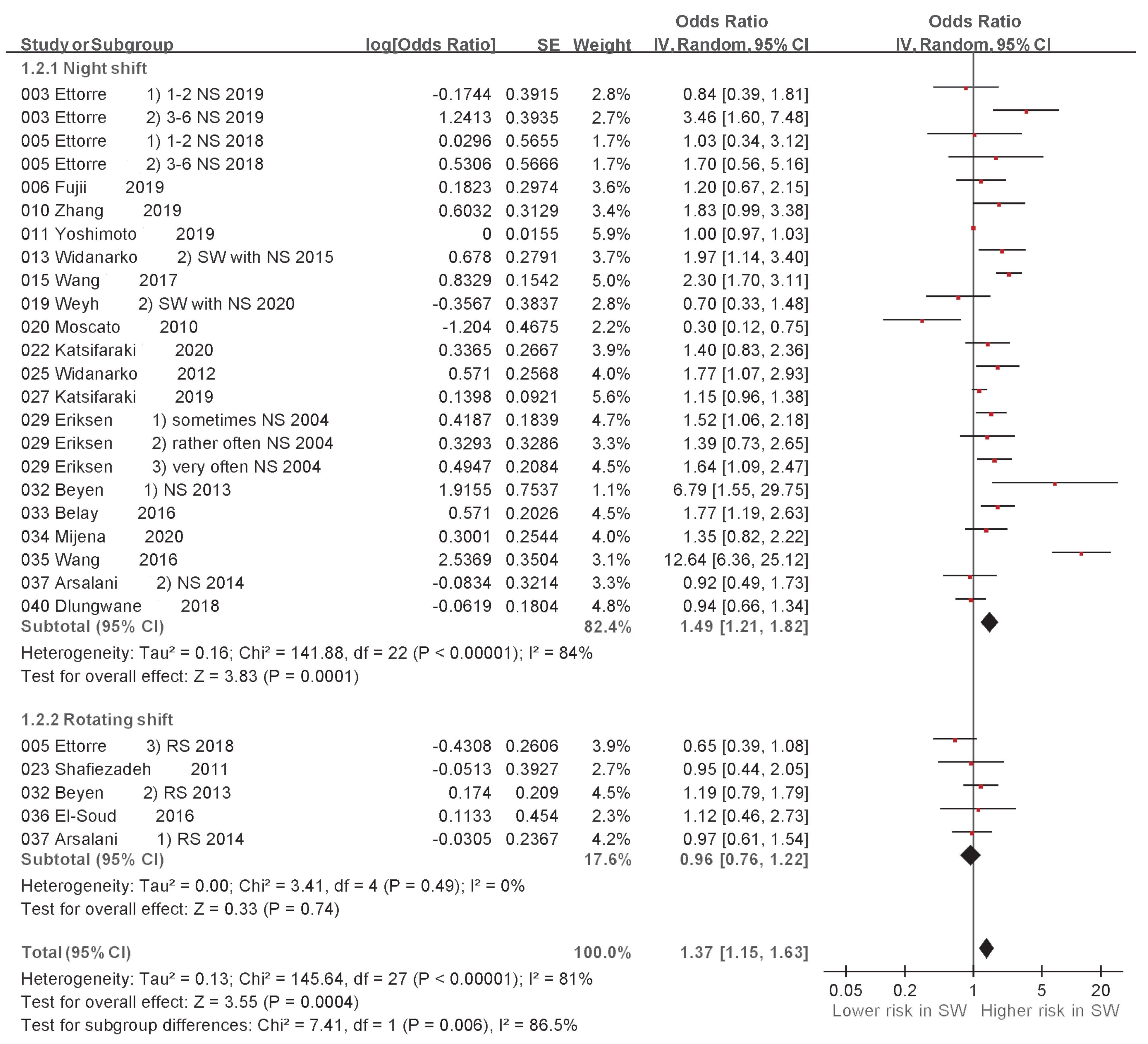
| Night shift | ||
| Ettorre (2019) [34], Italy, Number of NS 1–2 | 0.84 | 0.39–1.81 |
| Ettorre (2019) [34], Italy, Number of NS 3–6 | 3.46 | 1.6–7.47 |
| Ettorre (2018) [33], Italy, Number of NS 1–2 | 1.03 | 0.34–3.1 |
| Ettorre (2018) [33], Italy, Number of NS 3–6 | 1.7 | 0.56–5.18 |
| Fujii (2019) [38], Japan | 1.2 | 0.67–2.13 |
| Zhang (2020) [62], China | 1.8280 | 0.9914–3.3704 |
| Yoshimoto (2019) [61], Japan | 1.00 | 0.97–1.04 |
| Widanarko (2015) [59], Indonesian, SW with NS | 1.97 | 1.14–3.43 |
| Wang (2017) [56], China | 2.3 | 1.7–3.2 |
| Weyh (2020) [57], German, SW with NS | 0.7 | 0.33–1.57 |
| Moscato (2010) [47], Italy | 0.3 | 0.12–0.78 |
| Katsifaraki (2020) [40], Norway | 1.4 | 0.83–2.34 |
| Widanarko (2012) [58], Indonesian | 1.77 | 1.07–2.93 |
| Katsifaraki (2019) [40], Norway | 1.15 | 0.96–1.38 |
| Eriksen (2004) [37], Norway, sometimes | 1.52 | 1.06–2.19 |
| Eriksen (2004) [37], Norway, rather often | 1.39 | 0.73–2.63 |
| Eriksen (2004) [37], Norway, very often | 1.64 | 1.09–2.49 |
| Beyen (2013) [31], Ethiopia, NS | 6.7934 | 1.5518–29.7393 |
| Belay (2016) [30], Ethiopia | 1.77 | 1.19–2.65 |
| Mijena (2020) [46], Ethiopia | 1.35 | 0.82–2.25 |
| Wang (2016) [27], China | 12.6377 | 6.3568–25.1247 |
| Arsalani (2014) [28], Iran, NS | 0.9242 | 0.4924–1.7349 |
| Dlungwane (2018) [35], South Africa | 0.94 | 0.66–1.34 |
| Subtotal | 1.49 | 1.21–1.82 |
| Rotating shift | ||
| 57. Ettorre (2018) [33], Italy, RS | 0.65 | 0.39–1.1 |
| 342. Shafiezadeh (2011) [52], Iran | 0.9471 | 0.4425–2.0270 |
| 504. Beyen (2013) [31], Ethiopia, RS | 1.1903 | 0.7881–1.7978 |
| 508. El-Soud (2016) [36], Egypt | 1.12 | 0.46–2.7 |
| 509. Arsalani (2014) [28], Iran, RS | 0.9700 | 0.6084–1.5465 |
| Subtotal | 0.96 | 0.76–1.22 |
| Subgroup | Pooled Odds Ratio | 95% CI |
|---|---|---|
| Study Participants | ||
| Healthcare worker | ||
| 38. Ettorre (2019) [34], Italy, number of NS 1–2 | 0.84 | 0.39–1.81 |
| 38. Ettorre (2019) [34], Italy, number of NS 3–6 | 3.46 | 1.6–7.47 |
| 57. Ettorre (2018) [33], Italy, number of NS 1–2 | 1.03 | 0.34–3.1 |
| 57. Ettorre (2018) [33], Italy, number of NS 3–6 | 1.7 | 0.56–5.18 |
| 57. Ettorre (2018) [33], Italy, RS | 0.65 | 0.39–1.1 |
| 67. Fujii (2019) [38], Japan | 1.2 | 0.67–2.13 |
| 110. Raeisi (2014) [50], Iran | 1.2 | 0.78–1.94 |
| 160. Samaei (2016) [17], Iran | 1.4097 | 0.6831–2.9094 |
| 176. Zhang (2019) [62], China | 1.8280 | 0.9914–3.3704 |
| 189. Yoshimoto (2019) [61], Japan | 1.00 | 0.97–1.04 |
| 195. Ovayolu (2014) [48], Turkey | 2.7419 | 0.7411–10.1444 |
| 241. Trinkoff (2006) [55], US | 1.27 | 0.94–1.72 |
| 248. Ibrahim (2019) [65], Malaysia | 0.9750 | 0.6917–1.3743 |
| 250. Zhang (2019) [63], China | 2.732 | 1.765–4.229 |
| 278. Moscato (2010) [47], Italy | 0.3 | 0.12–0.78 |
| 312. Katsifaraki (2020) [41], Norway | 1.4 | 0.83–2.34 |
| 342. Shafiezadeh (2011) [52], Iran | 0.9471 | 0.4425–2.0270 |
| 406. Katsifaraki (2019) [40], Norway | 1.15 | 0.96–1.38 |
| 438. Zhao (2012) [64], Australia, NZ, and UK | 1.3915 | 1.0602–1.8263 |
| 481. Eriksen (2004) [37], Norway, sometimes | 1.52 | 1.06–2.19 |
| 481. Eriksen (2004) [37], Norway, rather often | 1.39 | 0.73–2.63 |
| 481. Eriksen (2004) [37], Norway, very often | 1.64 | 1.09–2.49 |
| 493. Mekonnen (2019) [45], Ethiopia | 2.853 | 1.766–4.609 |
| 496. Passali (2018) [49], Greece | 1.2857 | 0.8069–2.0487 |
| 505. Belay (2016) [30], Ethiopia | 1.77 | 1.19–2.65 |
| 506. Mijena (2020) [46], Ethiopia | 1.35 | 0.82–2.25 |
| 507. Wang (2016) [27], China | 12.6377 | 6.3568–25.1247 |
| 508. El-Soud (2016) [36], Egypt | 1.12 | 0.46–2.7 |
| 509. Arsalani (2014) [28], Iran, RS | 0.9700 | 0.6084–1.5465 |
| 509. Arsalani (2014) [28], Iran, NS | 0.9242 | 0.4924–1.7349 |
| 509. Arsalani (2014) [28], Iran, other shift | 1.62 | 0.84–3.15 |
| Subtotal | 1.40 | 1.20–1.63 |
| Non-healthcare worker | ||
| 12. Terzi (2015) [53], Turkey | 1.0702 | 0.6981–1.6407 |
| 41. Tran (2016) [54], Vietnam | 0.46 | 0.2–1.1 |
| 150. Seyedmed (2014) [51], Iran | 1.47 | 0.95–2.26 |
| 218. Lee (2020) [43], China | 1.0290 | 0.6460–1.6390 |
| 232. Widanarko (2015) [59], Indonesian, SW no NS | 1.41 | 0.66–3.02 |
| 232. Widanarko (2015) [59], Indonesian, SW with NS | 1.97 | 1.14–3.43 |
| 247. Wang (2017) [56], China | 2.3 | 1.7–3.2 |
| 253. Yang (2016) [60], US | 0.6621 | 0.6061–0.7233 |
| 276. Weyh (2020) [57], German, SW no NS | 0.7 | 0.32–1.47 |
| 276. Weyh (2020) [57], German, SW with NS | 0.7 | 0.33–1.57 |
| 300. Leino-Arjas (2004) [44], Finland, two SW | 1.09 | 0.94–1.26 |
| 300. Leino-Arjas (2004) [44], Finland, three SW | 1.34 | 1.15–1.56 |
| 344. Kalteh (2018) [39], Iran | 1.2284 | 0.8827–1.7095 |
| 367. Widanarko (2012) [58], Indonesian | 1.77 | 1.07–2.93 |
| 399. Christen (2021) [32], Norway | 1.03 | 0.77–1.37 |
| 504. Beyen (2013) [31], Ethiopia, NS | 6.7934 | 1.5518–29.7393 |
| 504. Beyen (2013) [31], Ethiopia, RS | 1.1903 | 0.7881–1.7978 |
| Subtotal | 1.09 | 0.94–1.50 |
Disclaimer/Publisher’s Note: The statements, opinions and data contained in all publications are solely those of the individual author(s) and contributor(s) and not of MDPI and/or the editor(s). MDPI and/or the editor(s) disclaim responsibility for any injury to people or property resulting from any ideas, methods, instructions or products referred to in the content. |
© 2023 by the authors. Licensee MDPI, Basel, Switzerland. This article is an open access article distributed under the terms and conditions of the Creative Commons Attribution (CC BY) license (https://creativecommons.org/licenses/by/4.0/).
Share and Cite
Chen, H.-M.; Huang, P.-Y.; Chuang, H.-Y.; Wang, C.-L.; Yang, C.-C.; Huang, P.-J.; Ho, C.-K. Association of Low Back Pain with Shift Work: A Meta-Analysis. Int. J. Environ. Res. Public Health 2023, 20, 918. https://doi.org/10.3390/ijerph20020918
Chen H-M, Huang P-Y, Chuang H-Y, Wang C-L, Yang C-C, Huang P-J, Ho C-K. Association of Low Back Pain with Shift Work: A Meta-Analysis. International Journal of Environmental Research and Public Health. 2023; 20(2):918. https://doi.org/10.3390/ijerph20020918
Chicago/Turabian StyleChen, Ho-Ming, Po-Yao Huang, Hung-Yi Chuang, Chao-Ling Wang, Chen-Cheng Yang, Peng-Ju Huang, and Chi-Kung Ho. 2023. "Association of Low Back Pain with Shift Work: A Meta-Analysis" International Journal of Environmental Research and Public Health 20, no. 2: 918. https://doi.org/10.3390/ijerph20020918
APA StyleChen, H.-M., Huang, P.-Y., Chuang, H.-Y., Wang, C.-L., Yang, C.-C., Huang, P.-J., & Ho, C.-K. (2023). Association of Low Back Pain with Shift Work: A Meta-Analysis. International Journal of Environmental Research and Public Health, 20(2), 918. https://doi.org/10.3390/ijerph20020918