


Abstract
Aggressive behavior in romantic relationship has serious effects, including both intra- and inter-personal issues. Aggressive behaviors in romantic relationships have been linked to underlying familial problems. While there have been previous reviews that studied on many interpersonal and dyadic implications of aggressive behavior in romantic relationships, there is nonetheless a lack of studies on the various components of familial factors for aggressive behavior in romantic relationships. The databases Scopus, MEDLINE, Google Scholar, and SAGE Journals were used to search for terms that are related to familial factors (family factor, family support, family relationship) as well as terms related to aggressive behavior in romantic relationships (aggression in romantic relationship, violence in intimate relationship). The articles considered for this review were original studies, samples, or subsamples of males or females who reported any underlying familial factors in childhood or adulthood that contributed to aggressive behavior in romantic relationship, and the studies must be written in English. This review has 27 papers that met the inclusion criteria. The findings from this review revealed the presence of inconsistent conclusions between familial factors and aggressive behavior in romantic relationships, with some studies failing to establish such links. These findings are reviewed with regards to the existing gaps in the literature as well as potential research options.
1. Introduction
Romantic relationship has a different meaning for each individual and is said to have an impact on people’s lives [1]. Romantic relationship issues have attracted the interest of many deep researchers into the field of social sciences, and the topic has even attracted the attention of politicians and local communities. Romantic relationships are often seen as one of the social problems that need to be addressed [2]. Aggressive behavior in romantic relationships is a serious public health issue that affects a large number of teenagers and adults. According to recent meta-analytic findings on the incidence of dating abuse by Wincentak, Connolly, and Card (2017) [3], 20% of 13- to 18-year-olds had been physically abused, with 14% of girls and 8% of boys reporting sexual violence. Aggression behavior in a romantic relationship is commonly referred to as dating violence (DV) or intimate partner violence (IPV) [3]. The Center for Disease Control and Prevention (2016) [4] defined psychological abuse as threats or injury to a partner’s sense of self-worth, such as name-calling, bullying, insulting, or seeking to isolate him or her from friends and family. Physical hostility might include pinching, striking, shoving, slapping, punching, or kicking. When a partner is pushed, coerced, or bullied into engaging in inappropriate sexual practices, this is known as sexual violence. Emotional abuse is also one of the most common forms of abuse in romantic relationships [5].
Aggressive behavior in romantic relationship is defined as aggression within a current or former intimate relationship with any physical violence, such as slapping, punching, and kicking; psychological aggression, such as yelling, embarrassing, and name-calling; sexual violence, such as rape, sexual assault, unwanted sexual attention, and sexual coercion; stalking, such as unwanted attention that causes fear or concern for one’s safety; or any combination of one or more aggression in a romantic relationship.
Physical, sexual, psychological, or emotional aggression as well as stalking are all examples of dating violence [4]. In addition, Rahim et al. (2016) [6] stated that aggressive behavior is a criminogenic trait, which is often associated with various violent crimes including dating violence. The online dating scam is also another example of dating violence, which is also alarming because it has effects on individuals such as financial loss and loss of a relationship, which involve severe emotional and psychological suffering [7]. Besides that, another type of aggressive behavior in romantic relationships is called relational aggression. Kokkinos (2015) [8] defined the term “romantic relational aggression” as the practice of injuring, using rumors to manipulate romantic partners’ social ties, love withdrawal, and jealousy induction. Depressive disorders, alcohol-related difficulties, and physical health difficulties were all linked to perpetrating or being a victim of romantic relationship aggression [9].
Romantic relationship violence is a particularly dangerous form of aggression because of its high prevalence and covert nature. Although most studies on relational violence focus on peer interactions, it can also be aimed towards a romantic partner [10]. Aggressive behavior in romantic relationship is not a new phenomenon. Many studies have been performed by researchers. Furthermore, many models and theories have been formed to understand the concept of aggressive behavior in romantic relationships. For example, O’Keefe’s (1995) [11] model looked at behavioral aspects where aggressive behavior more comprehensively encompassed the individual and the environment, namely personality, sociological, and psychological. Theory of Tension (Strain Theory) by Agnew (1992) [12] also says an individual will experience negative emotions, such as frustration and being aggressive, when he or she is not able to achieve goals through proper and conventional means. This causes individuals to choose an alternative path by violating the norms of life.
A study conducted by Tussey, Tyler, and Simons (2018) [13] on parents’ attachment style and dating violence shows that parenting style is linked to perpetration in intimate relationships and that this normalizing of violence is linked to future dating situations, including violence. Familial factors can be defined as a term that is used to indicate a component or condition that is seen in a family and accounts for a variety of diseases, ailments, or features that can have a variety of consequences on individuals. Many researchers have attempted to explore the risk factors involved with aggression behavior in romantic relationships in order to anticipate individuals who are most at risk of aggression behavior in romantic relationships and, as a result, to design ways to prevent aggression behavior in romantic relationships or minimize its consequences.
The environment is a critical aspect in one’s development, and families are the most frequently considered environmental influences [14,15]. In addition, to explore how familial factors are linked to young adults’ aggressive behavior in romantic relationships, researchers have used a variety of theoretical perspectives, including social learning theory, the background situational model of dating violence, and the antisocial orientation perspective. According to social learning theory, aggression directed towards others is taught through observational learning from one’s social context [16]. Furthermore, early exposure to specific types of family violence and abuse is linked to the development of specific forms of aggression later in life [17,18].
Several reviews of various kinds have been conducted over the years to investigate the link between the two conceptions. In a review of risk variables for dating victimization in young people, Vezina and Hebert (2007) [19] discovered that watching or personally experiencing familial violence is associated to victimization in dating relationships. Bonding and closeness with parents create a sense of belonging and self-worth, making a young person less likely to engage in criminal behavior or tolerate abusive spouses [20]. Successful discipline, setting of boundaries, open communication, conflict resolution, and understanding of the youth’s activities have all been linked to reduced risks of dating abuse [21]. Participation of parents and their comprehension towards young adults in an abusive relationship may help them feel less isolated through assistance and support. Furthermore, few reviews on dating violence and risk factors were conducted [22,23,24].
According to this review, individual risk factors, family risk factors, and other factors, such as cognitive factors and interactional partners, were significantly associated with dating violence. While previous studies have linked family factors to dating violence among young adults [14,25,26], little effort has been made to simultaneously recognize the significantly influence empirically linked to aggressive behavior in romantic relationships. Thus far, very few reviews have attempted to investigate aggression behavior in romantic relationships while simultaneously situating their findings on family factors. Similarly, past research has failed to investigate the interplay between these factors that may reinforce or protect this demographic from dating violence.
We found a gap in the research after exploring existing reviews discussing the relationship between familial factors and aggression behavior in romantic relationships. There are very few reviews that have examined studies that explored the relationship between familial factors and aggression behavior in romantic relationships in all its manifestations, adopted a systematic approach, or it considered studies conducted among male and female samples. As a result, the goal of this systematic review is to compile and synthesize findings from several studies that have looked into the relationship between underlying familial factors and aggression behavior in romantic relationships, taking into account both male and female samples and not only couples.
It is critical for therapists and researchers to have a better understanding of the relationships between the two domains in order to develop particular programs as well as to prevent and intervene appropriately for both perpetrators and victims. Overall, the data imply that adolescents with positive familial factors are more competent and less aggressive in adult romantic life. However, it is unclear how familial factors are linked to specific aggressive behaviors in romantic relationship functioning. This research will help to disperse some light on the conflicting findings across research, covering aspects regarding underlying familial factors and aggressive behavior in romantic relationship functioning.
2. Materials and Methods
This systematic review uses the PRISMA (Preferred Reporting Items for Systematic reviews and Meta-Analyzes) criteria, and the PRSIMA flowchart was utilized to summarize the search procedure [27]. PRISMA is an upgraded version of the QUAROM guideline, which comprises a checklist and flowchart with 27 components. According to Sierra-Correa and Cantera Kintz (2015) [27], PRISMA has three distinct advantages: defining precise research questions in order to undertake systematic highlights, selecting inclusive and exclusive criteria, and reviewing a large database in a timely manner. PRISMA was used to discover previous studies on the association between underlying familial factors for aggressive behavior in romantic relationships in this systematic review. Scopus, Google Scholar, MEDLINE, and SAGE Journals were the four databases used in our search. Three steps are involved in systematic review process. The first step is identification. Next is screening, and the last part is the inclusion process (refer to Figure 1).
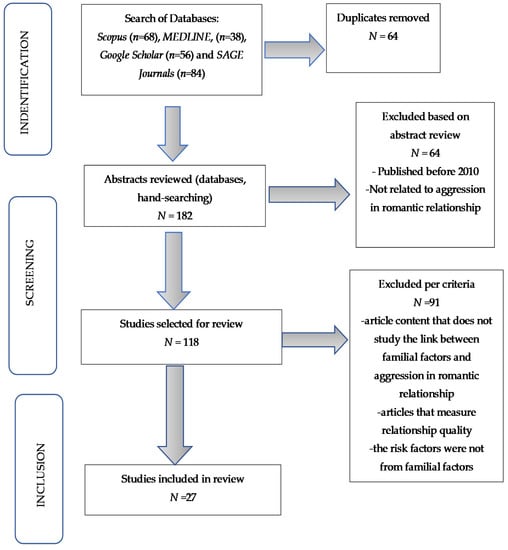
Figure 1.
Flowchart of article identification, screening, and inclusion.
The first phase involves identifying the keywords to be used for search strategy process. Depending on past studies, similar keywords and keywords related to underlying familial factors and aggressive behavior in romantic relationships were used. The keyword list was reviewed and corrected, for example, the addition of different spelling variations. Table 1 presents the final version of the keyword search list. The primary focus of this systematic review is to identify empirical quantitative studies that explored the connection between underlying familial factors with aggressive behavior in romantic relationships. Several criteria were taken into account as a means for finding criteria, and we have presented these criteria in Table 2. In this research, we searched the publication dates limited to 2010 and 2021 (articles that were published in the past eleven years) so that our review could be based on the most recent literature on information retrieval and synthesis in the digital age.

Table 1.
Keyword Search List.
Table 2.
Article-Finding Criteria.
The Scopus, MEDLINE, Google Scholar, and SAGE Journals databases were searched for studies from 4 May 2021 to 30 May 2021. Figure 1 shows the total number of articles that were discovered, the number of remaining articles after removing duplicates, the number of articles that did not meet the inclusion requirements, as well as the articles that were chosen for further study. Initially, there were 246 papers. However, upon screening the reference list, which was performed by one independent reviewer (the first author), 182 articles were discovered using the search criteria across all four databases. The title and abstract of each paper were evaluated for relevance during the first screening step, and 118 titles were removed. The complete text of the studies that were judged acceptable was next assessed for eligibility according to their methodology and findings. Several manuscripts were eliminated for various reasons after reading the entire article. Manuscripts that did not specify the term familial variables, manuscripts that were review manuscripts as secondary sources, and manuscripts that merely measured the relationship quality were among those eliminated. There were 27 manuscripts that were included and found eligible for examination. The PRISMA flow diagram is shown in Figure 1.
3. Results
See Figure 1 for the flow diagram of study selection.
3.1. Measurement of Aggressive Behavior in Romantic Relationship
Common measures used in samples that involved adolescents include the Conflict Tactic Scale, Conflict in Relationships Scale, and the Conflict in Adolescent Dating Relationships Inventory. A plethora of studies combined physical and dating violence as common measures. However, aggression among adolescents as rarely addressed in the majority of research. Studies on aggressive behavior in romantic relationships relied primarily on the Conflict Tactics Scale (CTS) [18] in some form, or selected questions from the measure were used to measure aggressive behavior in romantic relationship [14,28,29,30,31,32,33,34,35,36,37]. Among the studies, the most frequent measures used after the CTS were the Conflict in Relationship Scale [28,37,38,39,40,41], the Aggression Questionnaire (AQ) [42,43,44], Aggression and Social Behavior Measure (SRASMB) [44,45], and Partner-Directed Cyber Aggression [46]. Relational aggression and victimization in romantic relationships were rarely addressed in a significant amount of research [47,48].
3.2. Synthesized Findings
A total of twenty-seven studies were selected for review. All the manuscripts that were reviewed studied different types of relationships. Five manuscripts studied the relationship between attachment with parents and aggressive behavior in romantic relationships; five out of twenty-nine manuscripts measured attachment style with parents as part of their study, accounting for 17.24% of the total manuscripts [34,36,39,41,44]. Six out of twenty-seven (20.68%) explored the relationship between family violence and aggressive behavior in romantic relationships. Three studies (10.3%) reviewed the association between aggressive behavior and parental divorce in romantic relationships [36,49,50]. Two studies (6.9%) of the found manuscripts reviewed the association between aggressive behavior and parental style in romantic relationship [45,51]. One study defined family social structure as the social position or status of the home within the prevailing societal stratification [33].
The Exposure of Intimate Partner Violence in Family of Origin. Social learning theory states that exposure towards violence in the origin family or witnessing violence conducted by parents as a child is an extensively studied risk factor for aggressive behavior in romantic relationships. A significantly long research time is necessary in order to conduct such a method, which also is fortunately true for other related familial risk factors. Sadly, this issue is rarely solved by utilizing a fully prospective design. Vezina, Hebert, Poulin, Lavoie, Vitaro, and Tremblay (2015) [36] discovered that past related parental violence was linked with a higher likeliness of girls being victimized psychologically, sexually, or physically in their romantic life regardless of the phase, including adolescence, early adulthood, or both developmental phases. Similarly, Laporte et al. (2011) [30] discovered that, depending on gender and risk levels, teenagers carry negative childhood memories of family violence into their romantic relationships in diverse ways. Female adolescents who had been abused by either of their parents are more prone to experience re-victimization rather than aggression in their love relationships. High-risk adolescent boys who were victimized as a child are more likely to be aggressive toward their girlfriends, especially if their father had chastised them forcefully. Overall, there is a low to moderately significant association between seeing parental violence or family aggression and subsequent aggressive behavior perpetration or victimization in romantic relationships. Nonetheless, the evidence obtained is based on retrospective reporting, and some data imply that other proximal characteristics, such as the individual’s aggressive behavior and adult adjustment, may mitigate the relationship [14,26,29,38,40].
Parenting. Parental surveillance was shown to prevent children from a range of problem behaviors during adolescence, and has been studied in relation to aggressive behavior in romantic relationships. One family component that has long-term effects on young adult love connections is effective parenting qualities, such as inductive reasoning and consistent and moderate limit setting [52,53]. According to Xia et al. (2018) [37], young adults that grew up with a positive family ambience and efficient parenting approaches had better decision-making skills and were less prone to participate in interpersonal violence among young adult relationships. Furthermore, contrary to what was expected, Kokkinos (2019) [54] discovered that warm parental engagement was not connected with adolescents’ relational hostile behavior and instead gave birth to hollow and weak linkages between these variables. Authoritarian parenting oftentimes does not consider and anticipate relational aggression in romantic relationships. According to Richards and Branch (2012) [55], parental social support was noted to be not directly correlated with female or male dating violence victimization. In contrast, Tyler et al. (2011) [56] reported that low parental warmth has always corresponded with dating violence perpetration and victimization, which are consistent with a social learning theory interpretation.
Attachment Styles with Parents. Early attachment is the foundation of self-worth and relationships. It has a substantial impact on adolescent bonds with friends, instructors, and romantic partners later in life Bowlby (1969) [20]. According to Miga et al. (2010) [41], four years later, those who had more dismissive attachment were more likely to be victimized by verbal hostility from their romantic partners. Similarly, Wright (2015) [46] discovered that separation from the young adult’s mother was associated with partner-targeted online violence. The results from this study add to our comprehension of attachment styles and their impact on adolescent romantic relationships. Fritz (2014) [39] discovered that women who were more nervously attached to their parents are more prone to be victims of online dating abuse. Furthermore, according to Simons et al. (2012) [34], children who grew up with parents who are involved in aggression are highlighted to be at the highest risk level of committing perpetration as well as being victimized. According to Santona et al. (2019) [44], father–child insecurity attachment style appears to be connected with higher levels of anxiety and avoidance in romantic relationships, followed by aggressiveness in males. On the other hand, mother–child insecurity attachment pattern appears to be associated towards higher levels of aggression within females.
Parental Divorce. Parental divorce is common because it is preceded by marital strife and has a negative impact on parent–child relationships; because many children may grow up in intact households with high levels of marital dispute, the effects of parents’ marital conflict in addition to parental divorce should be a primary topic of exploration [57]. Interparental conflict was found to be substantially associated with young adults’ disagreements with their partners, which were then associated with lower relationship quality. In a similar study, Bernstein et al. (2012) [49] found that parental marital status is not entirely linked with poor wellness in young adults, including unhappiness, low self-esteem, aggressiveness in romantic relationships, and romantic attachment insecurity, in a comparable study [48].
Nonviolent Aspects of Interparental Conflict. According to Tyler et al. (2011) [56], when parents fought more frequently, were verbally hostile during disagreements, or had poor conflict resolution, then their children were more likely to be victims of dating violence. Interparental violence was also associated with teenage perpetration and victimization of relationship violence.
Aggressive behavior in romantic relationships was identified from all the manuscripts reviewed included relational aggression [8,45], dating violence [30,31,34,43,58,59], dating aggression [29,35,36,40,41], dating violence victimization [56,60], cyber aggression within adolescents’ romantic relationships [46], and physical aggression in dating relationships [26,33]. Table 3 shows general description of study.
Table 3.
General Description of Study.
4. Discussion
The objective of this study was to conduct a systematic evaluation of the literature on familial factors linked to aggression behavior in romantic relationships. Despite having well-established, family-level risk markers for aggressive behavior in romantic relationships, the related underlying familial variables are very much not known. Hence, we systematically evaluated various studies on familial factors in aggressive behavior in romantic relationships. Based on our research, we identified 27 eligible publications, which are diverse with regards to family characteristics, research designs, and populations examined. There were six articles that studied family violence, eight that investigated attachment styles with parents, five articles on parenting, two addressing parental divorce, four addressing interparental conflict, one addressing nonviolent aspects of interparental conflict, and one on cyber aggression in intimate relationships.
One area where there was a lack of variance in aggression was the types of aggressive behaviors examined in romantic relationships. Little research has looked at aggressive behavior in romantic relationships that is not violent or overt. Other reviews have picked up on this tendency [32,47,48]; addressing relational aggression in romantic relationships and [46] cyber aggression in romantic relationships reflects the field’s inclination to focus on non-physical partner violence. More research is required in order to draw conclusions about how familial factors are associated with nonphysical types of aggressive behavior in romantic relationship.
Based on the current review, it was known that females were noted to be more likely than males to report aggression in romantic relationships, whereas these findings could be ambiguous as a result of gender differences. According to the gender sociocultural theory, women are socialized from a very young age to think about moral concerns differently than males [44,45]. Women are also regarded to have a higher level of ethical awareness and understanding than men [46,47]. The term “aggression” was defined differently in various research. As a result, the incidence and prevalence data in the studied literature differed because of personal views and attitudes and because the level of violent behavior in love relationships varies among individuals. For researchers to acquire valid epidemiological data, they need a standardized, operational definition of aggression behavior in romantic relationships.
According to Simons et al. (2012) [34], the rate of sexual violence was underreported as a result of the broad definition of what constitutes sexual violence. Sexual coercion, for example, is considered a kind of sexual assault and occurs when the offender attempts “to get a date intoxicated or high” and can constitute “the attempt to turn a date on via caressing” although it is frequently undisclosed since the victim may not perceive it as aggressive [34]. In addition, assaulting a partner may be considered tolerable physical assault by some individuals but severe physical assault by the others. Females are more likely than males to report physical violence although males were more likely to report severe types of violence.
Attachment styles with parents are still a much-researched factor among underlying familial factors. Overall, evidence is preset to show a low to moderately significant link between these two factors and later aggression in romantic relationships. However, retrospective reporting forms the foundation of most of the evidence, and some findings imply that other proximal characteristics, such as the individual’s antisocial conduct and adult adjustment, may mitigate the relationship. As an example, the evaluation also includes studies on protecting parenting factors. Parental influences can be a positive engagement in an adolescent’s life, such as giving support and encouragement, and monitoring can help to reduce nonviolent behavior and was found to be a significantly low-to-moderate predictor of aggression in romantic relationships.
Family is the most essential socializing agent in a person’s life since it is the initial context in which the individual’s identity is formed and in which the individual interacts with others as well as the first hub between the individual and the society in which he or she lives. According to studies, parents transmit a behavioral style to their children by modelling and reinforcing certain behaviors, such as type of communication, violent behaviors, physical punishment, and parental control, that adolescents often imitate in their affective relationships, where they learn to imitate violent behaviors and attitudes already present in the family [43]. Furthermore, these parental practices have been connected to substantial behavioral and psychosocial adjustment issues in teenagers, both of which are intimately linked to couple violence. The actions and attitudes that characterize healthy family functioning are cohesion, support, and positive communication, where, on the other hand, are linked to improvement in children’s psychological and emotional development.
Family violence is still one of the most-studied familial factors. Overall, there is evidence of a low to moderately significant relationship between family violence and aggression behavior in romantic relationships. However, much of the evidence was based on retrospective reporting, and limited findings suggested that more proximal factors, such as antisocial behavior and adult adjustment, may mediate the association. According to the Lee et al. (2013) [43] study, the effects of family violence, like other early risk factors, appear to be mediated by subsequent problematic development, such as antisocial behavior and substance-use problems. There is no evidence of significant gender differences in these associations.
Across studies, the methods employed to retrieve data on aggression behavior were generally the same. The CTS2, on the other hand, was not introduced to gather data in regards to how such assault happens [18]. The CTS2 examines about both mild and major kinds of physical violence. However, it fails to take into account about the commencement, intent, or background of partner violence [18]. As a result of vast concentration on the amount of aggression behavior acts without accounting for the features of aggressive behavior between couples, the rate of perpetration reported may be deceptive [18].
In the last eleven years, significant strides were made in studies investigating the familial influences and aggressive behavior in romantic relationships, with a greater emphasis on aggressive behavior in romantic relationships or dating violence in adolescents and adults. A large number of the studies were longitudinal, which is a significantly better strategy for identifying familial influences than cross-sectional studies. Overall, the findings on familial factors for aggressive behavior in romantic relationships were strikingly similar to those for risk factors for other adolescent and adult problems involving risky behavior, such as crime, substance use, and sexual risk behavior, implying that aggressive behavior in romantic relationships is theoretically similar to this behavior. This has significant implications for research, particularly in the creation of treatments or prevention strategies to reduce aggressive behavior in romantic relationships. Table 4 refers to the findings of studies.
Table 4.
Findings of Studies.
5. Limitations and Future Directions
Despite its many positive features, this review has several shortcomings that can be addressed in order to further the study into underlying familial characteristics and aggressive behavior in romantic relationships. Several pieces of the reviewed research relied on the self-reporting of parental attachment, partner attachment, relational victimization, and also digital violence in romantic relationships. As a result of this, self-report biases were identified as a concern in this review. Hence, in order to overcome this concern, follow-up studies should include reports from both parents and partners. Partner-based reports may be extremely useful in comprehending partner-directed aggression because youth in romantic relationships may have under-reported these behaviors to maintain a good self-image. Peer nominations appear to be a better predictor of aggressiveness in romantic relationships among early young adults in comparison to self-reports; therefore, this is a field that should be further explored [63]. Extensive research is also needed to provide a complete grasp of how various and multiple familial circumstances contribute to aggressive behavior in romantic relationships.
Furthermore, overcoming self-report biases will aid in comprehending partner-directed aggression in romantic relationships when it is reciprocated as well as offering more information on the nature and scope of these behaviors. Both couples should report romantic relationship attachment. People typically choose partners who have comparable attachment styles to themselves [64]. Individuals with similar parenting styles or attachment styles with parents might demonstrate different associations with aggressive behavior in romantic relationships than partners with different parenting styles or attachment styles.
Parental attachment is steady across time though it might improve or deteriorate depending on the parent–adolescent relationship’s current situation. Therefore, follow-up research is necessary to evaluate parental attachment at several parts of a linear time horizon in order to gain a better grasp of the relationship between this type of attachment and aggressive behavior in romantic relationships. Further, it is also likely that this review left out some important studies on the subject. Only peer-reviewed works published between 2010 and 2021 met the review requirements. We focused on papers published after 2010 to capture current family factors and aggression behavior in romantic relationships; however, some pertinent studies may have been missed. In addition, as a result of excluding gray literature in our search technique, we note that the review may not have been totally thorough within the 11-year timeframe.
The cross-sectional character of the data, which prevents judgments about causal correlations, is another weakness seen in all of the investigations. Furthermore, given that the majority of the participants in the peer-reviewed publications are a homogeneous group of college students, caution should be practiced when extrapolating the findings to young men and women outside of institutional establishments. The current study’s findings are further hampered by the use of the most often-used instrument (Conflict Tactic scale: CTS2) to measure violent perpetration and victimization because it does not examine the contextual nature of violence.
In particular, the CTS2 lacks markers that would indicate if reported acts of aggressiveness are reactive behaviors used in self-defense. Moreover, one of the limitations in this study is the inclusion of all forms of familial factors rather than focusing on a specific familial factor, and it is possible that some key papers on the issue were overlooked in this review because we used a broad search term in this review. Hence, future research should focus on a specific familial factor that would allow researchers to provide a better and more meaningful conclusion. Finally, while this study contends no generalizability to dating couples in general, the findings from our review, which shed light on the familial factors that underpin aggressive behavior in romantic relationships in this emerging adult population, can be used to guide the development of more effective prevention interventions for aggressive behavior in romantic relationship and promotion of healthier intimate relationships in later life.
6. Conclusions
According to our systematic review analysis, there is no evidence that specific familial factors are linked to aggressive behavior in romantic relationships among adolescents and emerging adults. The level of methodological rigor and modeling methodologies limit our conclusions. Familial factors contributing to aggressive behavior in romantic relationships should be identified in order to formulate effective aggressive-behavior-prevention measures in romantic relationships. It was known that approximately two-thirds of marriages ending in divorce; hence, it is no surprise that experts are focusing their efforts on figuring out what makes a relationship healthy [65]. Regarding the relevance to relationship functioning, aggressive behavior in romantic relationships has gained widespread attention, and it has many consequences for clinical therapy for victims. As evidence suggests, familial factors have a negative impact on aggressive behavior in romantic relationship functioning, and a thorough assessment of past victimization experiences and related suffering among clients, particularly in couples therapy settings, will be beneficial. Furthermore, depending on the nature of the client’s presenting issues, clinicians may or may not be focused on the aggressive behaviors in which clients may engage within their romantic relationships as well as their relationship functioning concerns. However, many people, particularly those with a history of family violence, may find these issues to be significant. As a result, clinicians may assess for family violence and relationship issues and if necessary, incorporating these targets into treatment planning. Effective parenting skills and family social support have been related to a lower risk of aggressive behavior in romantic partnerships, and efforts to improve collective effectiveness may help to reduce aggressive behavior in romantic relationships. As a result, focusing on current relationship experiences offers a one-of-a-kind and crucial opportunity for people who have been victimized in the past to change implicitly and potentially destructive relationship expectations. Our research has thus far emphasized the importance of instilling knowledge about fostering positive pair interaction for those may be more vulnerable to aggressive behavior in their existing romantic relationships, and we believe that the findings of this study give excellent evidence for designing a variety of prevention programs aimed at aggressive behavior in romantic relationships.
Author Contributions
S.M. and M.R.K. contributed the overall design of the review’s frame, as well as the selection of the papers, the search for the articles addressed in the review, and the writing of the first draft of the article; I.N.M. and J.K.M. performed thorough examination and review of the manuscript; S.J., S.T.C. and H.A. supervised the entire work. All authors have read and agreed to the published version of the manuscript.
Funding
This research received no external funding.
Institutional Review Board Statement
Not applicable.
Informed Consent Statement
Not applicable.
Conflicts of Interest
The authors declare no conflict of interest.
References
- Muhamad, I.; Normahwati, M.; Ahsani, A.; Suzana, M.H.; Shahrazad, W.S. Narcissistic personality, love styles and love satisfaction as predictors to infidelity. J. E-Bangi 2019, 16, 1–9. [Google Scholar]
- Salamatussaadah, A.; Ghadur, N.; Ba’yah, A.K. Romantic Relationships and Unwed Pregnancy of Adolescence Residing at Rehabilitation Center. J. E-Bangi 2009, 4, 106–113. [Google Scholar]
- Wincentak, K.; Connolly, J.; Card, N. Teen dating violence: A meta-analytic review of prevalence rates. Psychol. Violence 2017, 7, 224–241. [Google Scholar] [CrossRef]
- Center for Disease Control and Prevention. Understanding Teen Dating Violence. 2016. Available online: http://www.cdc.gov/violenceprevention/intimatepartnerviolence/teendating_violence.html (accessed on 28 February 2022).
- Wen Huey, C.; Abdul Aziz, A.A.; Mohd Hoesni, S.; Abd Razak, M.A.; Kamaluddin, M.R. Effects of Psychosocial Factors towards Emotional Abuse among University Students Who Have Been in Romantic Relationships. EDUCATUM J. Soc. Sci. 2021, 7, 107–120. [Google Scholar] [CrossRef]
- Kamaluddin, M.R.; Shariff, N.S.M.; Othman, A.; Ismail, K.H.; Saat, G.A.M. Associations between low self-control and aggression among malaysian male prisoners. ASEAN J. Psychiatry 2016, 17, 1–8. [Google Scholar]
- Shaari, A.H.; Kamaluddin, M.R.; Paizi, W.F.; Mohd, M. Online-Dating Romance Scam in Malaysia: An Analysis of Online Conversations between Scammers and Victims. Gema Online J. Lang. Stud. 2019, 19, 97–115. [Google Scholar] [CrossRef]
- Voulgaridou, I.; Kokkinos, C.M. Relational aggression in adolescents: A review of theoretical and empirical research. Aggress. Violent Behav. 2015, 23, 87–97. [Google Scholar] [CrossRef]
- Dibello, A.M.; Rodriguez, L.M.; Hadden, B.W.; Neighbors, C. The green-eyed monster in the bottle: Relationship contingent self-esteem, romantic jealousy, and alcohol-related problems. Addict. Behav. 2015, 49, 52–58. [Google Scholar] [CrossRef]
- Cutbush, S.; Williams, J. Teen dating violence, sexual harassment, and bullying among middle school youth: Examining measurement invariance by gender. J. Res. Adolesc. 2016, 26, 918–926. [Google Scholar] [CrossRef]
- O’Keefe, M. Predictors of Childs Abuse in Maritally Violent Family. Interpers. Violence 1995, 10, 3–21. [Google Scholar] [CrossRef]
- Agnew, R. Foundation for a General Strain Theory of Crime and Delinquency. Criminology 1992, 30, 47–87. [Google Scholar] [CrossRef]
- Tussey, B.E.; Tyler, K.A.; Simons, L.G. Poor Parenting, Attachment Style, and Dating Violence Perpetration among College Students. J. Interpers. Violence 2018, 36, 2097–2116. [Google Scholar] [CrossRef] [PubMed]
- Gover, A.R.; Kaukinen, C.; Fox, K.A. The relationship between violence in the family of origin and dating violence among college students. J. Interpers. Violence 2008, 23, 1667–1693. [Google Scholar] [CrossRef] [PubMed]
- Madruga, M.C.; Viana, R.R.; Abdalla, R.; Caetano, R.; Laranjeira, R. Pathways from witnessing parental violence during childhood to involvement in intimate partner violence in adult life: The roles of depression and substance use. Drug Alcohol Rev. 2017, 36, 107–114. [Google Scholar] [CrossRef] [PubMed]
- Bandura, A. Social Learning Theory; Prentice Hall: Englewood Cliffs, NJ, USA, 1977. [Google Scholar]
- Bevan, E.; Higgins, D.J. Is domestic violence learned? The contribution of five forms of child maltreatment to men’s violence and adjustment. J. Fam. Violence 2002, 17, 223–245. [Google Scholar] [CrossRef]
- Straus, M.; Hamby, S.L.; Boney-McMocy, S.; Sugarman, D.B. The Revised conflict tactics scale (CTS2): Development and preliminary psychometric data. J. Fam. Issues 1996, 17, 283–316. [Google Scholar] [CrossRef]
- Vézina, J.; Hébert, M. Risk Factors for Victimization in Romantic Relationships of Young Women A Review of Empirical Studies and Implications for Prevention. Trauma Violence Abus. 2007, 8, 33–66. [Google Scholar] [CrossRef]
- Bowlby, J. Attachment and Loss; Attachment; Basic Books: New York, NY, USA, 1969; Volume 1. [Google Scholar]
- Vivolo-Kantor, A.M.; Olsen, E.O.; Bacon, S. Associations of Teen Dating Violence Victimization with School Violence and Bullying among US High School Students. J. Sch. Health 2016, 86, 620–627. [Google Scholar] [CrossRef]
- Capaldi, D.M.; Knoble, N.B.; Shortt, J.W.; Kim, H.K. A Systematic Review of Risk Factors for Intimate Partner Violence. Partn. Abus. 2012, 3, 231–280. [Google Scholar] [CrossRef]
- Duval, A.; Lanning, B.A.; Patterson, M.S. A Systematic Review of Dating Violence Risk Factors among Undergraduate College Students. Trauma Violence Abus. 2018, 21, 567–585. [Google Scholar] [CrossRef]
- Velotti, P.; Beomonte Zobel, S.; Rogier, G.; Tambelli, R. Exploring Relationships: A Systematic Review on Intimate Partner Violence and Attachment. Front. Psychol. 2018, 9, 1166. [Google Scholar] [CrossRef] [PubMed]
- Kaukinen, C. Dating violence among college students: The risk and protective factors. Trauma Violence Abus. 2014, 15, 283–296. [Google Scholar] [CrossRef] [PubMed]
- Milletich, R.J.; Kelley, M.L.; Doane, A.N.; Pearson, M.R. Exposure to interparental violence and childhood physical and emotional abuse as related to physical aggression in undergraduate dating relationships. J. Fam. Violence 2010, 25, 627–637. [Google Scholar] [CrossRef]
- Sierra-Correa, J.R. Cantera Kintz, Ecosystem-based adaptation for improving coastal planning for sea-level rise: A systematic review for mangrove coasts. Mar. Policy 2015, 51, 385–393. [Google Scholar] [CrossRef]
- Fosco, G.M.; Van Ryzin, M.J.; Xia, M.; Feinberg, M.E. Trajectories of adolescent hostile-aggressive behavior and family climate: Longitudinal implications for young adult romantic relationship competence. Dev. Psychol. 2016, 52, 1139–1150. [Google Scholar] [CrossRef]
- Karakurt, G.; Keiley, M.; Posada, G. Intimate Relationship Aggression in College Couples: Family-of-Origin Violence, Egalitarian Attitude, Attachment Security. J. Fam. Violence 2013, 28, 561–575. [Google Scholar] [CrossRef]
- Laporte, L.; Jiang, D.; Pepler, D.J.; Chamberland, C. The relationship between adolescents’ experience of family violence and dating violence. Youth Soc. 2011, 43, 3–27. [Google Scholar] [CrossRef]
- Makin-Byrd, K.; Bierman, K.L.; Coie, J.D.; Dodge, K.A.; Greenberg, M.T.; Lochman, J.E.; McMahon, R.J.; Pinderhughes, E.E. Individual and Family Predictors of the Perpetration of Dating Violence and Victimization in Late Adolescence. J. Youth Adolesc. 2013, 42, 536–550. [Google Scholar] [CrossRef]
- Oka, M.; Brown, C.C.; Miller, R.B. Attachment and Relational Aggression: Power as a Mediating Variable. Am. J. Fam. Ther. 2016, 44, 24–35. [Google Scholar] [CrossRef]
- Paat, Y.F.; Markham, C. The Roles of Family Factors and Relationship Dynamics on Dating Violence Victimization and Perpetration among College Men and Women in Emerging Adulthood. J. Interpers. Violence 2019, 34, 81–114. [Google Scholar] [CrossRef]
- Simons, L.G.; Simons, R.L.; Lei, M.K.; Hancock, D.L.; Fincham, F.D. Parental Warmth Amplifies the Negative Effect of Parental Hostility on Dating Violence. J. Interpers. Violence 2012, 27, 2603–2626. [Google Scholar] [CrossRef] [PubMed]
- Tschann, J.M.; Pasch, L.A.; Flores, E.; VanOss Marin, B.; Marco Baisch, E.; Wibbelsman, C.J. Nonviolent aspects of interparental conflict and dating violence among adolescents. J. Fam. Issues 2010, 30, 295–319. [Google Scholar] [CrossRef]
- Vézina, J.; Hébert, M.; Poulin, F.; Lavoie, F.; Vitaro, F.; Tremblay, R.E.; Cui, M.; Fincham, F.D.; Pasley, B.K.; Wright, M.F. History of Family Violence, Childhood Behavior Problems, and Adolescent High-Risk Behaviors as Predictors of Girls’ Repeated Patterns of Dating Victimization in Two Developmental Periods. J. Youth Adolesc. 2015, 44, 37–47. [Google Scholar] [CrossRef]
- Xia, M.; Fosco, G.M.; Lippold, M.A.; Feinberg, M.E. A Developmental Perspective on Young Adult Romantic Relationships: Examining Family and Individual Factors in Adolescence. J. Youth Adolesc. 2018, 47, 1499–1516. [Google Scholar] [CrossRef] [PubMed]
- Clarey, A.; Hokoda, A.; Ulloa, E.C. Anger control and acceptance of violence as mediators in the relationship between exposure to interparental conflict and dating violence perpetration in Mexican adolescents. J. Fam. Violence 2010, 25, 619–625. [Google Scholar] [CrossRef]
- Fritz, P.A.T. Attachment style, early sexual intercourse, and dating aggression victimization. J. Interpers. Violence 2014, 29, 279–298. [Google Scholar] [CrossRef]
- Grych, J.H.; Kinsfogel, K.M. Exploring the role of attachment style in the relation between family aggression and abuse in adolescent dating relationships. J. Aggress. Maltreat. Trauma 2010, 19, 624–640. [Google Scholar] [CrossRef]
- Miga, E.M.; Hare, A.; Allen, J.P.; Manning, N. The relation of insecure attachment states of mind and romantic attachment styles to adolescent aggression in romantic relationships. Attach. Hum. Dev. 2010, 12, 463–481. [Google Scholar] [CrossRef]
- Buss, A.H.; Perry, M. The Aggression Questionnaire. J. Personal. Soc. Psychol. 1992, 63, 452–459. [Google Scholar] [CrossRef]
- Lee, R.D.; Walters, M.L.; Hall, J.E.; Basile, K.C. Behavioral and Attitudinal Factors Differentiating Male Intimate Partner Violence Perpetrators with and without a History of Childhood Family Violence. J. Fam. Violence 2013, 28, 85–94. [Google Scholar] [CrossRef]
- Santona, A.; De Cesare, P.; Tognasso, G.; De Franceschi, M.; Sciandra, A. The mediating role of romantic attachment in the relationship between attachment to parents and aggression. Front. Psychol. 2019, 10, 1824. [Google Scholar] [CrossRef] [PubMed]
- Clark, C.M.; Dahlen, E.R.; Nicholson, B.C. The role of parenting in relational aggression and prosocial behavior among emerging adults. J. Aggress. Maltreat. Trauma 2015, 24, 185–202. [Google Scholar] [CrossRef]
- Wright, M.F. Cyber Aggression within Adolescents’ Romantic Relationships: Linkages to Parental and Partner Attachment. J. Youth Adolesc. 2015, 44, 37–47. [Google Scholar] [CrossRef]
- Kokkinos, C.M.; Voulgaridou, I. Links between relational aggression, parenting and personality among adolescents. Eur. J. Dev. Psychol. 2017, 14, 249–264. [Google Scholar] [CrossRef]
- Prather, E.; Dahlen, E.R.; Nicholson, B.C.; Bullock-Yowell, E. Relational aggression in college students’ dating relationships. J. Aggress. Maltreat. Trauma 2012, 21, 705–720. [Google Scholar] [CrossRef]
- Bernstein, R.; Keltner, D.; Laurent, H. Parental Divorce and Romantic Attachment in Young Adulthood: Important Role of Problematic Beliefs. Marriage Fam. Rev. 2012, 48, 711–731. [Google Scholar] [CrossRef]
- Heifetz, M.; Connolly, J.; Pepler, D.; Craig, W. Family divorce and romantic relationships in early adolescence. J. Divorce Remarriage 2010, 51, 366–378. [Google Scholar] [CrossRef]
- Cleveland, E.S. Digit ratio, emotional intelligence and parenting styles predict female aggression. Personal. Individ. Differ. 2014, 58, 9–14. [Google Scholar] [CrossRef]
- Parade, S.H.; Supple, A.J.; Helms, H.M. Parenting during childhood predicts relationship satisfaction in young adulthood: A prospective longitudinal perspective. Marriage Fam. Rev. 2012, 48, 150–169. [Google Scholar] [CrossRef]
- Surjadi, F.F.; Lorenz, F.O.; Conger, R.D.; Wickrama, K.A.S. Harsh, inconsistent parental discipline and romantic relationships: Mediating processes of behavioral problems and ambivalence. J. Fam. Psychol. 2013, 27, 762–772. [Google Scholar] [CrossRef]
- Voulgaridou, I.; Kokkinos, C.M. Measuring relational aggression in children and adolescents: A systematic review of the available instruments. Aggress. Violent Behav. 2019, 46, 82–97. [Google Scholar] [CrossRef]
- Richards, T.N.; Branch, K.A. The Relationship between Social Support and Adolescent Dating Violence: A Comparison across Genders. J. Interpers. Violence 2012, 27, 1540–1561. [Google Scholar] [CrossRef] [PubMed]
- Tyler, K.A.; Brownridge, D.A.; Melander, L.A. The effect of poor parenting on male and female dating violence perpetration and victimization. Violence Vict. 2011, 26, 218–230. [Google Scholar] [CrossRef] [PubMed][Green Version]
- Cui, M.; Fincham, F.D.; Pasley, B.K. Young adult romantic relationships: The role of parents’ marital problems and relationship efficacy. Personal. Soc. Psychol. Bull. 2008, 34, 1226–1235. [Google Scholar] [CrossRef] [PubMed]
- Leadbeater, B.J.; Sukhawathanakul, P.; Holfeld, B.; Temple, J.R. The Effects of Continuities in Parent and Peer Aggression on Relational Intimate Partner Violence in the Transition to Young Adulthood. Prev. Sci. 2017, 18, 350–360. [Google Scholar] [CrossRef]
- McNaughton Reyes, H.L.; Foshee, V.A.; Chen, M.S.; Ennett, S.T. Patterns of Adolescent Aggression and Victimization: Sex Differences and Correlates. J. Aggress. Maltreat. Trauma 2019, 28, 1130–1150. [Google Scholar] [CrossRef]
- Leadbeater, B.J.; Banister, E.M.; Ellis, W.E.; Yeung, R. Victimization and relational aggression in adolescent romantic relationships: The influence of parental and peer behaviors, and individual adjustment. J. Youth Adolesc. 2008, 37, 359–372. [Google Scholar] [CrossRef]
- Berzenski, S.R.; Yates, T.M. Research on intimate partner violence: A 481 developmental process analysis of the contribution of childhood emotional abuse to relationship violence. J. Aggress. Maltreat. Trauma 2010, 19, 180–203. [Google Scholar] [CrossRef]
- Lohman, B.J.; Neppl, T.K.; Senia, J.M.; Schofield, T.J. Understanding Adolescent and Family Influences on Intimate Partner Psychological Violence during Emerging Adulthood and Adulthood. J. Youth Adolesc. 2013, 42, 500–517. [Google Scholar] [CrossRef]
- Harris, M.A.; Orth, U. The link between self-esteem and social relationships: A meta-analysis of longitudinal studies. J. Personal. Soc. Psychol. 2020, 119, 1459–1477. [Google Scholar] [CrossRef]
- Holmes, B.M.; Johnson, K.R. Adult attachment and romantic partner preference: A review. J. Soc. Pers. Relatsh. 2009, 26, 833–852. [Google Scholar] [CrossRef]
- Kansky, J. What’s Love Got to Do with it? Romantic Relationships and Well-Being. In Handbook of Well-Being; Diener, E., Oishi, S., Tay, L., Eds.; DEF Publishers: Salt Lake City, UT, USA, 2018; Available online: nobascholar.com (accessed on 29 December 2018).
Publisher’s Note: MDPI stays neutral with regard to jurisdictional claims in published maps and institutional affiliations. |
© 2022 by the authors. Licensee MDPI, Basel, Switzerland. This article is an open access article distributed under the terms and conditions of the Creative Commons Attribution (CC BY) license (https://creativecommons.org/licenses/by/4.0/).