You are currently on the new version of our website. Access the old version .
  • Review
  • Open Access

3 November 2022

Drinking Water Supply in the Region of Antofagasta (Chile): A Challenge between Past, Present and Future


,
,
,
and
1
DIATI–Department of Environment, Land and Infrastructure Engineering, Politecnico di Torino, 10129 Torino, Italy
2
CleanWaterCenter@PoliTO, Politecnico di Torino, 10129 Torino, Italy
3
Faculty of Engineering and Sciences, Universidad Adolfo Ibáñez, Santiago 7941169, Chile
4
Departamento de Ingeniería en Minas, Universidad de Antofagasta, Antofagasta 1240000, Chile
This article belongs to the Special Issue Environmental Health in Latin America and the Caribbean

Abstract

Since the mid-nineteen century, when the first mining companies were established in the region of Antofagasta to extract saltpeter, mining managers and civil authorities have always had to face a number of problems to secure a water supply sufficient for the development of industrial activities and society. The unique features of the region, namely the scarcity of rainfall, the high concentration of arsenic in freshwaters and the increasing pressure of the mining sector, have made the supply of drinking water for local communities a challenge. In the 1950s, the town of Antofagasta experienced a serious drinking water crisis. The 300 km long aqueduct starting from the Toconce catchment, opened in 1958, temporarily ended this shortage of drinking water but created an even more dramatic problem. The concentration of arsenic in the water consumed by the population had grown by approx. ten times, reaching the value of 0.860 mg/L and seriously affecting people’s health. The water treatment plants (WTPs) which were installed starting from the 1970s in the region (namely the Old and New Salar del Carmen in Antofagasta and Cerro Topater in Calama, plus the two recent desalination plants in Antofagasta and Tocopilla), have ensured, since 2014, that the drinking water coverage in the urban areas was practically universal (>99.9%). However, the rural areas have continued to experience significant shortcomings regarding their capacity to ensure the quality and continuity of the water supply service in the long run. Presently, approx. 42% of the rural population of the region of Antofagasta does not have a formal supply of drinking water. The recent amendments to the Chilean Water Code (March 2022) and the interventions carried out in the framework of the Agua Potable Rural (APR) program were intended to reduce the socio-ecological inequalities due to the lack of drinking water in the semi-concentrated and isolated rural population.

1. Introduction

The development of society and industry all over the world is closely connected with the availability of water. The region of Antofagasta (Chile) has some unique characteristics that have always made the supply of water for local communities and industries a challenge. First of all, the region holds the driest desert area in the world, namely the Atacama Desert. In the region, the rainfall is very scarce, with only 1.7 mm/year in Antofagasta, the main town of the region. The historical shortage of freshwater is currently worsened by the effects of climate change [1]. Secondly, the superficial streams of the region are not only scarce, but are also of poor quality, due to high salinity and arsenic content. The main Chilean river, namely the Río Loa, contains concentrations of arsenic from 0.1 to 1 mg/L, with peaks as high as 50 mg/L in some springs located in the volcanic area where the river originates [2]. Finally, the Atacama Desert holds a major reserve of copper, lithium, molybdenum and natural nitrates [3]. In this context, the continuous growth of the extraction of minerals and metals has generated a significant economic benefit for the country, but, at the same time, it has increased the pressure on water resources. This problem causes a conflict between the mining sector, the other manufacturing sectors and local communities [4,5,6].
This paper presents and discusses the main problems related to the drinking water supply that have arisen in the region of Antofagasta in the past and in present days, and reviews the solutions that the government and civil authorities have found to cope with such issues. To the best of our knowledge, there are no other papers that comprehensively address the issues related to the drinking water supply—from the mid-nineteen century to present day—in the region of Antofagasta from the viewpoint of environmental sanitary engineering.
After a description of the geographical and hydrological context of the region of Antofagasta (Section 2) and the consequent availability of water resources (Section 3), the paper presents a historical excursus of the criticalities related to the water supply in the area (Section 4). Section 5 and Section 6 review the developed solutions, with a special focus on sanitary issues, that is, the water treatment plants (WTPs), at the service of large (urban) (Section 5) or small (rural) communities (Section 6), which have been installed in the area. The performances of those WTPs are essential to ensure quality and continuity of the water supply service to the population in the long run.
The results of the literature review reported in this paper are part of the activities carried out in the framework of the research project H2020-MSCA-RISE-2018–REMIND—Renewable Energies for Water Treatment and Reuse in Mining Industries, of which Politecnico di Torino (Turin, Italy), Universidad Adolfo Ibañez (Santiago de Chile, Chile) and Universidad de Antofagasta (Antofagasta, Chile) are partners.

2. The Geographical and Hydrological Context

The region of Antofagasta, namely Region II, is the second-largest region of Chile, comprising the three provinces of Antofagasta, El Loa and Tocopilla. It is bordered by the region of Tarapacá to the north, by the region of Atacama to the south and by Bolivia and Argentina to the east. The region of Antofagasta is located approximately between latitudes 21° and 26° south, being crossed by the Tropic of Capricorn, and between 71° and 67° west. The region covers an area of 127,221 km2, 85.2% of which is devoid of vegetation, while 14.3% are grasslands and shrubs, and 0.4% are wetlands [7].
The region has ten hydrographic basins, of which the Río Loa and the Salar de Atacama provide almost 90% of the surface water supply [8,9]. The Río Loa, located in the north of the region, with its 440 km, is the longest river in Chile and the only one in the region that flows into the sea. It has a contribution area of approx. 33,000 km2, with three sub-basins, namely Upper Río Loa, Middle Río Loa and Lower Río Loa, and a number of tributaries: Blanco, Chela, San Pedro de Inacaliri, Salado, San Salvador and Quebrada Amarga rivers. Similar to other rivers of the region, the Río Loa is not the product of the thaw, but it originates from the surfacing of underground water in the upper part of the basin. It receives contributions from groundwater through Palpan, San Pedro and San Pablo volcanoes in the Andes, at around 4000 m above sea level (a.s.l.) [10]. The Río Loa has an annual average flow of 0.55 m3/s in the fluviometric station “Río Loa before Represa Lequena”, located in the upper part of the basin (3315 m a.s.l.), that increases up to 1.4 m3/s in Yalquincha. At the river mouth, the flow averages 0.3 m3/s as a consequence of freshwater extraction and high evaporation [8,9].
The Salar de Atacama basin, located in the northeast of the region, is of the endorheic type, with a contribution area of approx. 16,000 km2. The water input is by snow and rain, and this water is then transported as surface water or groundwater. The major water supplies to the Salar de Atacama basin are from the Río San Pedro and Río Vilama, with a total estimated input of 1130 L/s. The Río San Pedro comprises the majority of the input, with a flow that varies from 679 to 900 L/s [10]. The Río Vilama is formed by the junction of the Puritana and Puripica thermal springs and has an independent network running parallel to the Río San Pedro. Both rivers have salty water. Water leaves the basin of the Salar as a result of evaporation, evapotranspiration or human activity. The annual average water recharge in the Salar is approximately 5 m3/s [10].
Other than the Río Loa and Salar de Atacama basins, there are other salt flats in the Andean zone of the region, with a predominance of small endorheic basins with small outcrops of groundwater that quickly infiltrate into alluvial deposits.

3. Water Demand and Water Availability in the Region of Antofagasta

Overall, Chile is a water-rich country, but water is unevenly distributed. The parameter “water runoff availability” relates the total freshwater resources with the total population in an area and indicates the pressure that a population puts on water resources. Chenoweth (2008) [11], basing his research on a sectorial and a development efficiency approach, individuated a minimum of 135 L per capita per day (equivalent to 49.3 m3/cap/year) for social and economic activities, which would permit the achievement of high human development. In the region of Antofagasta, the value of water runoff availability, equal to 52 m3/cap/year, is very close to the threshold compared, for example, to 190 m3/cap/year in the region of Atacama, 444 m3/cap/year in the Metropolitana Region or 169.500 m3/cap/year in the region of Los Ríos [12,13].
The water runoff availability only considers the availability of superficial or underground waters, but it does not consider the presence of dry periods or the quality of the water. Regarding the first point, rainfall in the northern regions of Chile is very scarce, with an annual mean precipitation of 1.7 mm in Antofagasta and 5.7 mm in Calama [9]. On the coast, precipitations occur in the winter months, unlike the upper part of the region (Altiplano), where the greater contribution to superficial waters and groundwater by precipitation is between December and March. The aquifers from which the main rivers originate have a very low recharge rate, which leaves them highly vulnerable to over-exploitation if the extraction rates are higher than recharge rates [14,15].
For a correct quantification of the water runoff availability, the quality of water is of capital importance, especially for the areas (such as Antofagasta and the regions located in the northern part of the country, namely Arica–Parinacota, Tarapacá and Coquimbo) where waters have very high values of electrical conductivity (EC). In these regions, the EC values range from approximately 1.5 to 7.5 mS/cm, which makes waters detrimental for crops and human consumption [12]. The water in the Río Loa is not only scarce, but also of poor quality due to high salinity. A recent study (2020), carried out by the Centro de Ecología Aplicada with the financial support of the regional government of Antofagasta, demonstrated that the salinity of the water has been gradually increasing along the river course, reaching the highest salinity levels in the lower areas [16]. The high salinity is related to both the origin of the river, that is the surfacing of shallow groundwater, and the intense evaporation that occurs in the Atacama Desert. Seasonal variations in salinity are also associated with irrigation in the Calama area, which causes leaching of saline soils [16]. The integrated diagnosis of the current environmental status of the Río Loa basin and its tributaries, with respect to the Integrated Vulnerability Index (which is composed of sub-indices of biota, water quality, river habitat and stressors), indicated a medium–high overall vulnerability [16].
Because of the facts described above, the region of Antofagasta is suffering a severe water scarcity, with a water demand that exceeds water supply by 22.1 m3/s [13]. This situation is emphasized by the effects of climate change. Chile has been in drought for 13 years and a recent OECD report (Water Risk Hotspots for Agriculture) ranks the country as 10th out of 142 subjected to more severe water risk [1]. The Directorate of Meteorology of Chile (DMC) estimates that, in 2050, the minimum temperature in northern Chile will increase by 2 °C and the rainfall will be reduced by 5–15% [1].
The water demand is expected to rise in the coming decades. In the region of Antofagasta, mining accounts for more than 65% of the gross domestic product (GDP) and has a very high impact on water demand (64%), being the main driver that causes the extremely high water-stress [15]. Mining uses more than 1 m3/s of water and, according to the Chilean Copper Commission, the region of Antofagasta will experience an extreme deficit in drinking water by 2025 unless urgent strategies are applied to reduce water requirements at mine sites and increase the awareness of the value of water [17]. In fact, although the riverbed of the Río Loa can recover if water consumption were drastically reduced, so far there are no measures in that direction, and mining companies have permits to extract more water than the little that is already flowing [16].

4. A Historical Excursus on the Water Demand in the Region of Antofagasta

Since the establishment of the first companies to extract saltpeter in the region of Antofagasta, around 1860, the continuous growth of mining activities has generated a significant economic benefit for the country, but it has inevitably increased the pressure on water resources. The first historical notes concerning the demand of water in the region of Antofagasta, for civil and industrial activities, date back to 1866. In that year, José Santos Ossa established a company to extract saltpeter from the mining site of Salar del Carmen. The water for mining activities was obtained from the Cerro Moreno [18]. Later on, the massive arrival of workers to the growing saltpeter office forced the company to obtain greater volumes of water. The first attempt at a solution was the construction of a condensing machine in 1868, namely Planta de destilación/desalación solar de Las Salinas. The characteristics and operating process of the machine were firstly described in 1883 in the Minutes of the Proceedings of the Institution of Civil Engineers [19,20]. The machine, which was quickly installed to supply the company’s tasks, was capable of delivering 270 m3 of water per day [21]. At the time, the population in Antofagasta was around 400 people, but it rapidly increased to 3000 in the beginning of 1872 with the discovery of the silver deposit of Caracoles. Water began to lack and its production became a good business [18]. In a few years (1870–1880), the number of condensing machines increased to 10 and they were mainly utilized to secure water for mining operations. To consume water, people had to go to the condensing machine, which were located close on the coast. The service was not immediate, with lines forming as people waited their turn. The distribution of water to the town was done in barrels transported in carts, or simply in barrels pulled by mules. However, despite the quality of the service provided by the plants, the town continued growing; the installed smelters were more and more productive and the demand for water increased, making the supply more difficult every day. The water available for household activities became expensive and of poor quality, thus determining the diffusion of infections and health diseases [22].
The situation continued until 1892, when a 340 km long pipeline, which withdrew water from the Río San Pedro, was opened. The pipe was originally drawn to feed the locomotives running along the railway line between Calama and Antofagasta. The Chilean State reached an agreement with the owner of the railroad, namely the Antofagasta and Bolivia Railway Company (FCAB), that obtained the concession to supply the town of Antofagasta and the intermediate points with water. However, the distribution network could not reach the whole community, which, that year, amounted to 13,500 inhabitants; for this reason, resellers of piped water soon emerged [21].
With the expansion of the mining sector and the consequent growth in the population, from the late nineteen century to the 1940s, the availability of water for civil uses progressively decreased [22]. In 1947, Antofagasta had a daily water deficit of 2000 m3 [23]. Until 1957, the town was supplied only with the water from the FCAB, which was sufficient for no more than two hours a day of service [18]. This lack of water, which negatively affected the life and the economy of the town, occurred for two main reasons: on the one hand, because population had increased, and on the other hand, because the resources obtained from the sale of water were not sufficient to improve the catchment and distribution network. In those years the FCAB had offered the government to increase the water capacity of the hydraulic infrastructure, thus securing a continuous supply for 30 years, in exchange for increasing the sale price. However, the government’s answer was negative, because an increase in the water sale price would have been very badly received by the population [23]. In such circumstances, the population began to present their complaints to the authorities of the central government of Gabriel González Videla, which agreed to open a new adduction on the Río Toconce [18].
By order of the government, the Directorate of Hydraulic Works (Dirección de Obras Hidráulicas, DOH) of the Ministry of Public Works (Ministerio de Obras Públicas, MOP) began the study for the positioning of the new adduction. The technicians from Santiago estimated that it was cheaper and more convenient to use centrifuged cement tubes, instead of those made of cast iron. However, the authorities of the Center for Progress and the Municipality of Antofagasta considered such a choice not suitable for a desert area. After a long and tedious controversy between the two parties, the construction of cement tubes was decided because, in this way, the work would have been cheaper by $800,000,000 [18]. From 1950 to 1952, four factories of reinforced cement pipes were installed but several problems started arising during the construction of the pipes, namely a cement shortage first, and subsequently, the way to join the pipes in order to build an aqueduct. Different glues were used, but none of them managed to bond tightly. Under pressure, they burst where the joint had been made. A field test demonstrated that the best glue was capable of offering resistance up to 80% of the pressure, but, when the pressure was increased to 100%, the suture broke. The test showed that centrifuged tubes were ineffective in an area where water dropped from more than 3000 m a.s.l. to sea level. When Don Carlos Ibáñez del Campo assumed the Presidency of Chile, he decided to reject the system based on cement pipes and to build the adduction with cast iron pipes [18].
In 1958, the works of the aqueduct ended and the waters of the Toconce catchment arrived in Antofagasta. The new aqueduct temporarily ended the shortage of drinking water but created an even more serious problem. Don Antonio Rendic was the first doctor who denounced what was happening. His patients exhibited nascent symptoms of cancer and the appearance of the skin indicated the presence of arsenic in the body. At first, the complaint of Dr. Rendic was dismissed by his colleagues but, some years later, the excess of arsenic in the drinking water was finally confirmed by the Medical Society. In 1968, President Eduardo Frei Montalva decided to establish arsenic abatement plants [18,23]. The first of them was built in the Salar del Carmen, just outside the town of Antofagasta, in 1970. That year, the maximum concentration of arsenic allowed in the water regulated through rule NCh409-1970 [24] was 0.120 mg/L.

5. The Problem of Arsenic and the Plants for Its Removal for Urban Areas

5.1. Origin and Concerns for the Arsenic Presence in the Region of Antofagasta

In the region of Antofagasta, water streams are characterized by concentrations of arsenic in the range of 0.1–1 mg/L, which is mainly due to natural causes, namely Neogene volcanic rocks and present-day geothermal activity in the Andes Cordillera [2]. The high concentration of arsenic in the volcanic rocks of the Neogene can be explained, given that the uplift and thickening of the continental crust in the Andes was associated with an enrichment of the lightest elements, namely arsenic, boron, potassium and lithium. The closure of the plateau and consequent generation of the endorheic basins starting in the Neogene, as well as the scarce precipitation, favored arsenic hyper-concentration [25].
The two areas with the highest concentration of arsenic in the basin of the Río Loa are (i) the confluence with the Río Salado, where the occurrence of arsenic is associated with chlorine, sodium and boron and (ii) the area of the river underneath the town of Calama, where arsenic is associated with sulfate and copper [10]. The chemical composition of water in the Río Loa is strongly influenced by the inflow of the Río Salado tributary, which originates from the geothermal field of El Tatio. The enrichment is observed downstream even at considerable distances from the confluence, through the important mining area of Chuquicamata, to the mouth [26]. The El Tatio geysers have one of the highest arsenic concentrations measured in hot springs worldwide, reaching values of 50 mg/L [25]. In this area, arsenic is mostly linked to carbonate. The mobility of arsenic might be due to multiple geochemical processes, including the chemical weathering of the mineral phases that incorporate sodium and bicarbonate ions into solution, with a consequent increase in pH and alkalinity [25].
Industrial processes associated with copper mining are another factor related to the presence of arsenic in the waters of the region of Antofagasta. In the last few decades, mining has been a driving force for the implementation of monitoring plants and mitigation strategies that contributed to coping with the problem of arsenic. Arsenic is a natural constituent in lead, zinc, gold and copper sulfide ores and can be released during the smelting process. The flue gases and particulates from smelters can contaminate nearby ecosystems downwind from the mining operation. However, it is difficult to assess the potential impact of mining activities on the arsenic content in the rivers of the region, because an arsenic baseline prior to mining activities has not been determined [10].
In the 1950s (1952–1957), the concentration of arsenic in the water supplied to the town of Antofagasta from the Siloli catchment, in the order of 90 μg/L, was not a concern [27]. In those years, no complaints or health problems were registered, neither in Antofagasta nor in the province of El Loa, where the inhabitants of Calama and other smaller towns (Quinchamale, Lequena, Concha, Lasana, Chiu Chiu) were supplied with water with an arsenic concentration of 0.21–0.23 mg/L [28]. In 1958, the Toconce catchment was opened and a more abundant water supply reached the town of Antofagasta through a 300 km long network of pipes. This new catchment determined an increase in the arsenic concentration in the water consumed by the population by approx. eight times, reaching a value of 0.860 mg/L [29,30]. The effects over time of such an arsenic concentration in water on people’s health were harmful, especially in children, who suffered from respiratory and cardiovascular diseases and dermal lacerations. Although, before 1960, the population of Antofagasta was concerned about other types of diseases, such as diarrhea, due to the shortage or poor quality of water, at the end of the 1960s, strong campaigns called attention to the danger of arsenic and the overexposure of the population. In 1970, the WTP of the Old Salar del Carmen was installed and the arsenic concentration in the water supplied to the population dropped sharply to approx. 0.110 mg/L [30,31].
Even though remediation processes had taken in place since 1970, carcinogenic effects followed arsenic exposure with long latency intervals, and the increased risks of As-related cancer (lung and bladder) remained for almost 40 years after the cessation of high exposure [32]. The lung and bladder cancer incidence rates in the population from Antofagasta, who had last been highly exposed in 1970, an average of 38 years before their cancers were diagnosed, were approx. from 4 to 7 times higher than those in people with low exposure [32]. Quite surprisingly, at the same time, a reduction in breast cancer mortality in the region of Antofagasta was observed after the exposure commenced and the trend reversed soon after the exposure was reduced in 1970 [28]. In fact, arsenic has been shown to cause induction of functional re-expression of the estrogen receptor in estrogen-negative breast cancer cells, which could make them less aggressive.

5.2. Water Treatment Plants for Arsenic Removal Serving Urban Areas

The first WTP installed in the region of Antofagasta was the Old plant of Salar del Carmen in Antofagasta, after which other WTPs were constructed [31,33]. At present, the Aguas Antofagasta Group runs seven WTPs, operating in the region of Antofagasta, that serve urban areas and the largest towns (such as Antofagasta, approx. 350,000 inhabitants; Calama, approx. 140,000 inhabitants; Tocopilla, approx. 25,000 inhabitants; and Mejillones, approx. 10,000 inhabitants):
  • Three WTPs, namely the Old (1970–year of starting operations) and the New (1989) plants of Salar del Carmen, located in Antofagasta, and the Planta de Filtros Cerro Topater (1978), located in Calama; all three WTPs are fed with river water that comes from the Alta Cordillera;
  • One WTP in Taltal (namely O’Higgins, 1998) that treats the groundwater collected from the Agua Verde well field, located 70 km NE from Taltal;
  • Two desalination plants located in Antofagasta, namely Desaladora Norte (previously called La Chimba, 2003) and in Taltal (2008);
  • A new desalination plant located in Tocopilla that has recently (October 2020) started its operation.
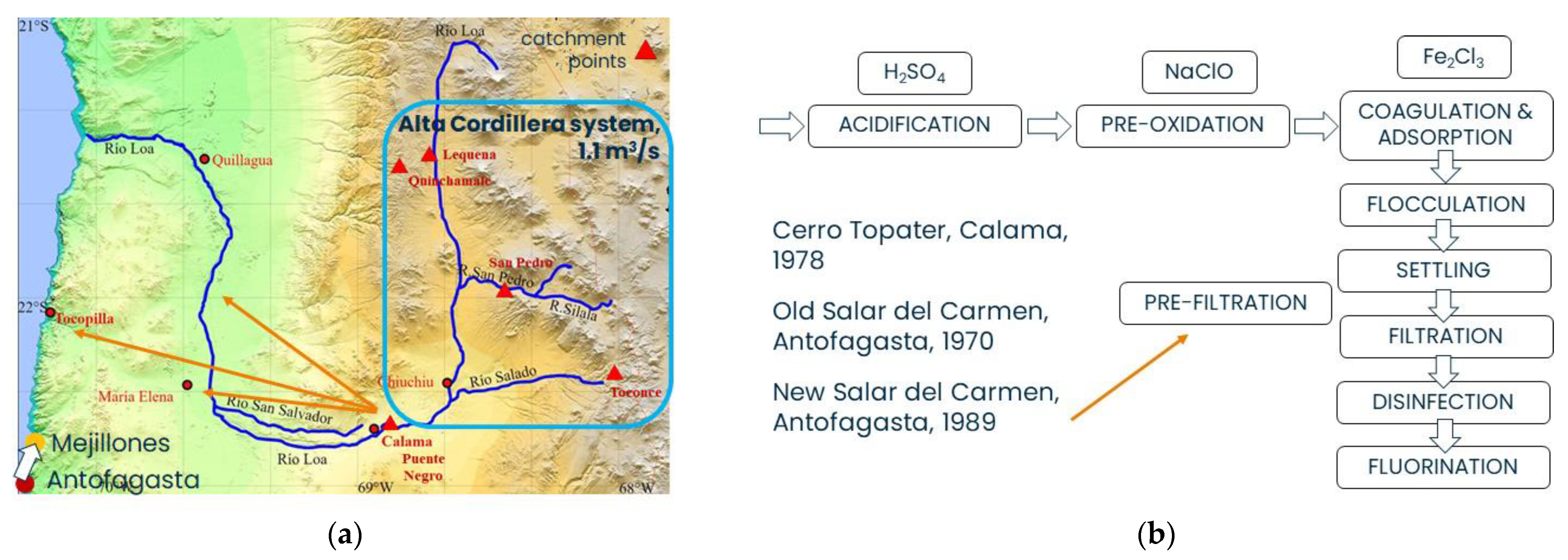
The Old and New WTPs of Salar del Carmen and the Cerro Topater WTP treat the same water, which comes from a mixing basin (“estanque de mezcla”) that receives the waters from five catchment points (see Figure 1a):
Figure 1. (a) Catchments points that feed the three WTPs located in Antofagasta (Old and New Salar del Carmen) and Calama (Cerro Topater); (b) Scheme of the treatment train of the three WTPs.
  • Three of these (namely Lequena, Quinchamale and San Pedro) are on the Río Loa (Quinchamale and San Pedro are located on small influents/secondary rivers of the Río Loa, namely Quebrada Quinchamale and Río San Pedro, respectively);
  • A fourth extraction point, named Toconce, is located on the Río Toconce, which is an influent of the Río Salado that is, in turn, an influent of the Río Loa. Together with the three previous catchment points, they form the Alta Cordillera system;
  • The fifth extraction point is located just outside the town of Calama (namely Puente Negro), where the waters coming from the other four extraction points are mixed and then sent to the three WTPs. The last water source is of lower quality with respect to the waters coming from the Alta Cordillera and it is used only in case of emergency [34,35].
The Alta Cordillera system, through its four water sources, provides an average flow rate of 1.1 m3/s.
Table 1 displays the quality of the waters coming from the five catchment points [34,35].
Table 1. Quality of the waters collected from the five catchment points that feed the Calama (Cerro Topater) and Antofagasta (Old and New Salar del Carmen) WTPs.
As can be seen from Table 1, waters from all five sources have arsenic concentrations far higher than the threshold value of 0.010 mg/L fixed by the in-force Chilean regulation (NCh 409-2005). Moreover, all waters have, on average, an alkali pH value not favorable for arsenic removal [30,31,33]. Turbidity in the waters coming from the sources located in the Alta Cordillera is generally low, but very high values can be found during the so-called “invierno altiplánico”, that is, the period from January to March. Table 1 reports the average maximum values of turbidity found in the waters collected from the three extraction points located in the Alta Cordillera during the “invierno altiplánico”.
The three WTPs located in Calama and Antofagasta that are fed with river water make water suitable to be used for human consumption by using a series of treatments for solids, arsenic and pathogen removal. The three WTPs have a common treatment train that includes the phases of acidification and pre-oxidation, coagulation and adsorption, flocculation, sedimentation, filtration and final disinfection and fluorination (see Figure 1b) [34,35,36].
Acidification, conducted with sulfuric acid, is aimed at correcting the natural alkali pH of the raw water in order to improve the efficiency of the subsequent coagulation/adsorption phases, thus reducing the coagulant dose. The pre-oxidation is obtained by the addition of gas chlorine, which increases the oxidation state of arsenic from +3 to +5, thus making its removal easier [31]. Iron chloride (FeCl3) is used as a coagulant agent; it enhances the agglomeration of particles and generates iron hydroxide flocs that adsorb arsenic and determine its removal from water. Flocs are removed in a decanter/clarifier through a sedimentation process and a subsequent filtration with rapid filters [36]. The New WTP of Salar del Carmen can also count on a system of eight pre-filters. The pre-filters contain activated carbon and sand and are similar to the traditional filters used to remove turbidity. Finally, the filters contain high-density anthracite and sand, distributed above a gravel bed, and are characterized by filtration rates in the order of 130–150 m3/m2∙d [35]. These values are approximately one third–one half of the typical values used in rapid filters for the removal of suspended solids. In fact, arsenic is immobilized onto iron hydroxide flocs and a proper removal of arsenic, with the consequent achievement of the concentration value fixed by the legislation, can be obtained only when flocs are not perturbed or destroyed [35].
The combination of the afore-mentioned processes and their correct management allow the WTPs to achieve residual concentrations of arsenic in the order of 0.005 mg/L, well below the threshold value fixed by the Chilean regulation revised in 2005 (0.010 mg/L). In order to comply with the threshold concentration of arsenic, over the years, the Antofagasta and Calama WTPs have increased the dose of coagulant, namely FeCl3, used for the process up to values of 60 mg/L [37]. After the increase in the coagulant dose, an increased production of sludge in the decanters was observed and, at the same time, a better use of filters was observed, which resulted in requiring less frequent backwashing operations. In order to limit the working concentrations of coagulant and, consequently, its consumption, an acidification through the addition of sulfuric acid at the very beginning of the water treatment train in the three WTPs was introduced. In fact, arsenic removal through adsorption onto iron hydroxide flocs is enhanced by acidic pH values [36,37].
The water produced in the two WTPs of Antofagasta is distributed to the towns of Antofagasta and Mejillones. Conversely, the water produced in the WTP of Calama is distributed to Calama, Tocopilla and to the small centers located in the Pampa Salitrera (i.e., María Elena and the industrial centers of Coya Sur and Pedro de Valdivia) [34].
The O’Higgins WTP located in Taltal treats the waters collected from five wells from the well site of Agua Verde, with a treatment capacity of 32 L/s [37]. This WTP uses a direct filtration scheme to remove arsenic (approx. 0.070 mg/L, [33]) from the waters. The water extracted from the wells undergoes an oxidation by means of gas chlorine and an injection of coagulant, FeCl3, that generates iron hydroxide flocs able to adsorb arsenic; finally, flocs are entrapped in a rapid filter that contains sand and activated carbon [33]. The water treatment ends with a final disinfection with gas chlorine. In order to improve the efficiency in arsenic removal, several changes have been made to the WTP over the years [37]. The iron chloride used as a coagulant agent was supplemented with a polyelectrolyte and calcium hydroxide. The sand bed in the rapid filter was substituted with a resin and the number of filters was duplicated (from two to four). The Taltal WTP has a very limited capacity and supplies water to the town of Taltal only.
The towns of Antofagasta and Taltal are supplied with drinking waters that also come from two desalination plants. The two plants, namely the Planta Desaladora Norte in Antofagasta and the plant located in Taltal, have a treatment capacity of approx. 1000 L/s and 5 L/s, respectively. In these two plants, seawater undergoes a preliminary treatment of filtration and conditioning with chemicals to reduce phenomena of fouling and scaling and, subsequently, the main treatment of reverse osmosis (RO). The treated waters receive the final treatments of remineralization, disinfection and fluorination. The rejected water is disposed into the sea.
The Planta Desaladora Norte, the largest drinking water desalination plant in Latin America, was installed in Antofagasta with the goal of providing 100% of the drinking water required by the town [13]. The plant currently produces 91.24 ML/day (650 + 200 + 100 L/s) and supplies water to over 83% of the urban population [38]. The initial section of the Planta Desaladora Norte, with a capacity of 52,000 m3/d (650 L/s), was constructed in four phases, the first of which was put in operation in 2003 [39]. These four phases, with a capacity of 13,000 m3/day each, were delivered by the companies GS Inima (first three phases) and Atacama Water Technologies (final phase). The plant utilizes 8 + 1 intake pumps, delivering seawater from 350 m offshore and from a depth of 22 m. The pretreatment consists of 20 sand filters and 8 cartridge filters. Water is also conditioned with chemicals in order to reduce fouling and scaling before RO. The RO section has 8 racks of 90 pressure vessels with 7 elements per vessel. Each rack has one high-pressure pump and a Pelton turbine provides energy recovery. Twenty-four calcite chip filters provide permeate post-treatment [39]. To increase the plant treatment capacity, Atacama Water Technologies installed three new ROs skids (provided through Xylem), each producing 1000 m3/day. These new trains utilize the existing plant intake and the pre-treatment system. Each new train consists of 10 pressure vessels with 6 elements each and use Energy Recovery Inc. PX work exchangers [39].
Until 2020, the town of Tocopilla had been receiving water only from the WTP of Calama. In the case of problems to the water sources in the Alta Cordillera, to the Cerro Topater WTP or to the aqueduct from Calama to Tocopilla, the town could be deprived of water distribution. In October 2020 a new desalination plant started its operations in Tocopilla. It has a treatment capacity of 75 L/s that can be increased to 100 L/s. It can supply the town (>20,000 inhabitants) with 100% desalinized water.
Desalination plants can guarantee a continuity of the drinking water service from an infinite source, thus generating a benefit for end-users. However, desalination faces three recurring issues, namely (i) water quality perception; (ii) environmental pollution due to the rejected water and (iii) high costs. An amount of 70% to 80% of citizens of Antofagasta are not satisfied with the quality of the drinking water, believing that consuming desalinated water is harmful to their health and definitely prefer bottled water [38]. The discharge of brine, that is, the desalination-rejected water, into stagnant environments can substantially increase the salinity and temperature of the receiving waters and, consequently, it can have an adverse effect on benthic organisms and seagrass beds. There is insufficient consensus regarding the influence of the Desaladora Norte plant on the marine biota. In fact, fishermen argue that marine life has decreased because of the desalination plant’s activities; conversely, the plant operators state that it has no impact [38]. Finally, a RO process has an energy demand between 0.5 and 4.0 kWh/m3, which varies depending on input salinity, temperature and employed technology [13]. This corresponds to approx. five times as much energy as traditional drinking water processes. The Desaladora Norte plant lacks an independent energy source; consequently, it must be supplied with energy from the national energy system, which is 63% based on fossil fuels [13,38].

7. Conclusions

This study highlighted three main issues concerning the criticality in the supply of drinking water in the region of Antofagasta:
  • Even if Chile has quite a large availability of water, it is not evenly distributed over the country. Specifically, the region of Antofagasta is suffering a severe water crisis due to the unique characteristics of the area, namely the natural dryness, bad quality of freshwater and pressure of the mining industry. The water crisis is even expected to be worsened by the effects of climate change. The Río Loa is the most important water source in the region and in the Atacama Desert area. However, the environmental flow of the Río Loa, that is, the flow that allows the sustenance the ecosystem, as well as the means of subsistence and welfare of the people who depend on that ecosystem, is not sufficient to meet the demand for all uses with its current water flows and pressures. According to a recent diagnosis, a portfolio of projects that should be implemented to reduce the pressure on the Río Loa includes (i) the definition of water supply alternatives (ii) the recovery of sites of environmental relevance and (iii) the development of a more effective management of the territory [16];
  • Since the end of the nineteen century, large efforts have been made to construct water distribution networks and, in more recent years, WTPs to supply the large towns (such as Antofagasta, Calama, Tocopilla and Mejillones) and small centers with drinking water that complies with NCh409-2005. Further to these interventions, the drinking water coverage in urban areas in 2014 was practically universal, serving 99.9% of the population [40]. Especially in the urban area of the town of Antofagasta, the result was made possible after the installation of the Desaladora Norte desalination plant, the largest in the Latin America, with a treatment capacity of approx. 1000 L/s [13,39]. It can guarantee a continuity in the drinking water service from an infinite source, thus generating a benefit for the town. However, surveys carried out among the citizens have revealed that a large part of the population, between 70% and 80%, was not satisfied with the quality of the drinking water because of organoleptic issues related to taste, color and odor, or because they distrusted its direct consumption because of the strong communal memory of past diseases due to arsenic contamination [38]. Furthermore, some authors argue that the gradual introduction of desalinated water into the town’s metabolisms has exacerbated the existing socio-ecological inequalities, thus maintaining the perception of a situation of water scarcity, especially for low-income citizens [71]. Other criticalities concern the impact of the desalination plant on the marine biota, because of the discharge of the RO rejected waters into the ocean, and the lack of an independent energy source, which presently compels the plant to be run with the national energy system, which is 63% based on fossil fuels [38];
  • Supplying drinking water and sanitation to the population of rural areas remains a challenge and 42% of the rural population of the region of Antofagasta still does not have a formal supply of drinking water [42]. The APR program, created in the mid-1960s, contributed to providing rural water service infrastructures. In the region of Antofagasta, there are 12 operating installations and 3 systems under construction or in a trial phase [48]. The beneficiaries of the APRs are responsible for managing, operating and maintaining the system through the APR cooperatives and the support of the DOH. The problems attributed to the APRs in recent years are related to a number of factors, namely (i) the lack of a systematic and comprehensive monitoring of the operations carried out at the installations, (ii) the inadequacy of the chosen technology to the specific installation site, and (iii) low managerial skills and technical knowledge of the committees that are responsible for operating, maintaining and financing the APR systems [40,67].

Author Contributions

Conceptualization, B.R. and G.C.; methodology, B.R.; formal analysis, B.R. and G.C.; resources, D.C., A.R. and M.Z.; data curation, B.R.; writing—original draft preparation, B.R.; writing—review and editing, G.C., D.C., A.R. and M.Z.; visualization, B.R.; project administration, B.R. and M.Z.; funding acquisition, M.Z. All authors have read and agreed to the published version of the manuscript.

Funding

This research was funded by the European Commission under H2020-MSCA-RISE-2018 program, grant number 823948, through the project “REMIND—Renewable Energies for Water Treatment and Reuse in Mining Industries”.

Institutional Review Board Statement

Not applicable.

Acknowledgments

The review paper was prepared in the framework of the project “REMIND—Renewable Energies for Water Treatment and Reuse in Mining Industries”. The authors are grateful to the Facultad de Ingeniería y Ciencias, Universidad Adolfo Ibáñez, Santiago de Chile (Chile); to the Departamento de Ingeniería en Minas, Universidad de Antofagasta, Antofagasta (Chile); and to the DIATI—Department of Environment, Land and Infrastructure Engineering, Politecnico di Torino, Torino (Italy), for providing the research facilities. Fabio Blengino is acknowledged for his support in the literature survey.

Conflicts of Interest

The authors declare no conflict of interest. The funders had no role in the design of the study; in the collection, analyses, or interpretation of data; in the writing of the manuscript; or in the decision to publish the results.

References

  1. OECD. The governance of water infrastructure in Chile. In Gaps and Governance Standards of Public Infrastructure in Chile: Infrastructure Governance Review; OECD Publishing: Paris, France, 2017. [Google Scholar] [CrossRef]
  2. Romero, L.; Alonso, H.; Campano, P.; Fanfani, L.; Cidu, R.; Dadea, C.; Keegan, T.; Thornton, I.; Farago, M. Arsenic enrichment in waters and sediments of the Rio Loa (Second Region, Chile). Appl. Geochem. 2003, 18, 1399–1416. [Google Scholar] [CrossRef]
  3. Cisternas, L.A.; Gálvez, E.D. Chile’s mining and chemicals industries. Chem. Eng. Prog. 2014, 110, 46–51. [Google Scholar]
  4. Donoso, G. Integrated water management in Chile. In Integrated Water Resources Management in the 21st Century: Revisiting the Paradigm; Martínez-Santos, P., Aldaya, M.M., Llamas, R., Eds.; CRC Press: Boca Raton, FL, USA; Taylor and Francis Group: Oxfordshire, UK, 2014; pp. 217–234. [Google Scholar] [CrossRef]
  5. Meißner, S. The Impact of Metal Mining on Global Water Stress and Regional Carrying Capacities—A GIS-Based Water Impact Assessment. Resources 2021, 10, 120. [Google Scholar] [CrossRef]
  6. Tiwari, A.K.; Suozzi, E.; Silva, C.; De Maio, M.; Zanetti, M. Role of Integrated Approaches in Water Resources Management: Antofagasta Region, Chile. Sustainability 2021, 13, 1297. [Google Scholar] [CrossRef]
  7. Arrau Ingenieria E.I.R.L. Diagnóstico Plan Estratégico Para la Gestión de Los Recursos Hídricos, Región de Antofagasta. 2012; p. 68. Available online: https://snia.mop.gob.cl/repositoriodga/handle/20.500.13000/5409 (accessed on 29 September 2022).
  8. Arcadis. Plan Estratégico Para La Gestión De Los Recursos Hídricos, Región De Antofagasta, Resumen Ejecutivo. 2016; p. 143. Available online: https://snia.mop.gob.cl/repositoriodga/handle/20.500.13000/4382 (accessed on 29 September 2022).
  9. Arcadis. Plan Estratégico Para La Gestión De Los Recursos Hídricos, Región De Antofagasta, Informe Final. 2016; p. 356. Available online: https://snia.mop.gob.cl/sad/ADM5702.pdf (accessed on 29 September 2022).
  10. Pérez-Carrera, A.; Cirelli, A.F. Arsenic and water quality challenges in South America. In Water and Sustainability in Arid Regions; Schneier-Madanes, G., Courel, M.F., Eds.; Springer: Dordrecht, The Netherlands, 2010. [Google Scholar] [CrossRef]
  11. Chenoweth, J. Minimum water requirement for social and economic development. Desalination 2008, 229, 245–256. [Google Scholar] [CrossRef]
  12. Burdiles, P.; Carrasco, F.; Platzer, W. Estudio De Factibilidad De Tecnología Osmosis Inversa Con Energía Solar, INFORME CSET-2017-PU-006-ES. 2017, p. 41. Available online: https://www.fraunhofer.cl/en/cset/publicaciones (accessed on 28 October 2022).
  13. Herrera-León, S.; Cruz, C.; Kraslawski, A.; Cisternas, L.A. Current situation and major challenges of desalination in Chile. Desalin. Water Treat. 2019, 171, 93–104. [Google Scholar] [CrossRef]
  14. Nester, P.L.; Gayo, E.; Latorre, C.; Jordan, T.E.; Blanco, N. Perennial stream discharge in the hyperarid Atacama Desert of northern Chile during the latest Pleistocene. Proc. Natl. Acad. Sci. USA 2007, 104, 19724–19729. [Google Scholar] [CrossRef]
  15. Aitken, D.; Rivera, D.; Godoy-Faúndez, A.; Holzapfel, E. Water Scarcity and the Impact of the Mining and Agricultural Sectors in Chile. Sustainability 2016, 8, 128. [Google Scholar] [CrossRef]
  16. Centro de Ecología Aplicada. Diagnóstico Del Caudal Ambiental Del Río Loa, Región De Antofagasta. Informe Final. 2020; p. 919. Available online: https://mma.gob.cl/antofa-doc/2020_07_GOA002_INF_V1_InfFinal.pdf (accessed on 28 October 2022).
  17. Ghorbani, Y.; Kuan, S.H. A review of sustainable development in the Chilean mining sector: Past, present and future. Int. J. Min. Reclam. Environ. 2017, 31, 137–165. [Google Scholar] [CrossRef]
  18. Maino Prado, V.; Recabarren Rojas, F. Historia del Agua en el desierto más árido del mundo. 2011. Available online: https://historiadelagua.wordpress.com/ (accessed on 29 September 2022).
  19. Harding, J. Apparatus for solar distillation. Minutes Proc. Inst. Civ. Eng. 1883, 73, 284–288. [Google Scholar] [CrossRef]
  20. Hirschmann, J.R. Solar distillation in Chile. Desalination 1975, 17, 31–67. [Google Scholar] [CrossRef]
  21. Arellano Escudero, N. La planta solar de desalación de agua de Las Salinas (1872). Quad. D’historia L’enginyeria 2011, 12, 229–251. [Google Scholar]
  22. Godoy Orellana, M.; Méndez, M. “Apenas tenemos el agua suficiente para nuestras máquinas”: Estado, minería y tecnologías hídricas en el desierto de Atacama Taltal, 1870–1930. Caravelle 2018, 111, 25–40. [Google Scholar]
  23. Arriaza, B.; Galaz-Mandakovic, D. Expansión minera, déficit hídrico y crisis sanitaria. La potabilización del Río Toconce y el impacto del arsenicismo en la población de la provincia de Antofagasta (1915–1971). Historia 396 2020, 10, 71–112. [Google Scholar]
  24. Insitituto Nacional De Normalización (INN). Drinking Water Quality Standard NCh409 of 78; Ministerio de Obras Públicas: Santiago, Chile, 2005.
  25. Tapia, J.; Murray, J.; Ormachea, M.; Tirado, N.; Nordstromf, D.K. Origin, distribution, and geochemistry of arsenic in the Altiplano-Puna plateau of Argentina, Bolivia, Chile, and Perú. Sci. Total Environ. 2019, 678, 309–325. [Google Scholar] [CrossRef]
  26. Cortecci, G.; Boschetti, T.; Mussi, M.; Lameli, C.H.; Mucchino, C.; Barbieri, M. New chemical and original isotopic data on waters from El Tatio geothermal field, northern Chile. Geochem. J. 2005, 39, 547–571. [Google Scholar] [CrossRef]
  27. Cáceres Valencia, A. Arsénio, normativas y efectos en la salud. In Proceedings of the XIII Congreso De Ingenieria Sanitaria Y Ambiental, AIDIS Chile, Antofagasta, Chile, 10 August 1999; p. 13. [Google Scholar]
  28. Smith, A.H.; Marshall, G.; Yuan, Y.; Steinmaus, C.; Liaw, J.; Smith, M.T.; Wood, L.; Heirich, M.; Fritzemeier, R.M.; Pegramd, M.D.; et al. Rapid Reduction in Breast Cancer Mortality with Inorganic Arsenic in Drinking Water. EBioMedicine 2014, 1, 58–63. [Google Scholar] [CrossRef]
  29. Marshall, G.; Ferreccio, C.; Yuan, Y.; Bates, M.N.; Steinmaus, C.; Selvin, S.; Liaw, J.; Smith, A.H. Fifty-year study of lung and bladder cancer mortality in Chile related to arsenic in drinking water. J. Natl. Cancer Inst. 2007, 99, 920–928. [Google Scholar] [CrossRef]
  30. Sancha, A.M.; O’Ryan, R.; Perez, O. The removal of arsenic from drinking water and associated costs: The Chilean case. In Interdisciplinary Perspectives on Drinking Water Risk Assessment and Management; IAHS Publication: Oxfordshire, UK, 2000; Volume 260, pp. 17–25. [Google Scholar]
  31. Cortina, J.L.; Litter, M.I.; Gibert, O.; Valderrama, C.; Sancha, A.M.; Garrido, S.; Ciminelli, V.S.T. Latin American experiences in arsenic removal from drinking water and mining effluents. In Innovative Materials and Methods for Water Treatment-Separation of Cr and As; CRC Press: Boca Raton, FL, USA; Taylor and Francis Group: Oxfordshire, UK, 2016; Chapter 22; pp. 391–416. [Google Scholar]
  32. Steinmaus, C.M.; Ferreccio, C.; Acevedo Romo, J.; Yuan, Y.; Cortes, S.; Marshall, G.; Moore, L.E.; Balmes, J.R.; Liaw, J.; Golden, T.; et al. Drinking Water Arsenic in Northern Chile: High Cancer Risks 40 Years after Exposure Cessation. Cancer Epidemiol Biomark. Prev. 2013, 22, 623–630. [Google Scholar] [CrossRef]
  33. Sancha, A.M. Review of coagulation technology for removal of arsenic: Case of Chile. J. Health Popul. Nutr. 2006, 24, 267–272. [Google Scholar]
  34. SiSS Superintendencia de Servicios Sanitarios. Estudio Tarifario Intercambio Empresas de Servicios Sanitarios II Región: Aguas Antofagasta S.A., Tratacal S.A. Y Econssa Chile S.A., Periodo 2016–2021; SiSS Superintendencia de Servicios Sanitarios: Santiago, Chile, 2016; p. 58.
  35. CAUSSE. Modelamiento sistema de producción de agua potable Gran Sistema Norte ADASA. Planta Tratamiento PFCT (Cerro Topater); CAUSSE: Santiago, Chile, 2016; p. 34. [Google Scholar]
  36. Sancha, A.M.; O’Ryan, R. Managing Hazardous Pollutants in Chile: Arsenic. In Reviews of Environmental Contamination and Toxicology; Whitacre, D.M., Ed.; Springer Science + Business Media: Berlin/Heidelberg, Germany, 2008; Volume 196, p. 123. [Google Scholar] [CrossRef]
  37. Granada, J.; Godoy, D.; Cerda, W. Conversión de procesos en plantas de filtros abatidoras de arsénico para lograr residuales menores a 0.01 mg/L. In Proceedings of the XV Congreso de Ingeniería Sanitaria y Ambiental, AIDIS Chile, Concepción, Chile, 1–3 October 2003; p. 17. [Google Scholar]
  38. Šteflová, M.; Koop, S.H.A.; Fragkou, M.C.; Mees, H. Desalinated drinking-water provision in water-stressed regions: Challenges of consumer-perception and environmental impact lessons from Antofagasta, Chile. Int. J. Water Resour. Dev. 2021, 38, 742–765. [Google Scholar] [CrossRef]
  39. Burk, R.L.; Dixon, M.B.; Kim-Hak, D.; Martiz Vega, P. A comparison of three reverse osmosis membranes at La Chimba desalination plant, Antofagasta, Chile. In Proceedings of the International Desalination Association World Congress on Desalination and Water Reuse, Tianjin, China, 20–25 October 2013; p. 6. [Google Scholar]
  40. Blanco, E.; Donoso, G. Agua potable rural: Desafíos para la provisión sustentable del recurso. Actas de Derecho de Aguas 2016, 6, 63–79. [Google Scholar]
  41. Correa-Parra, J.; Vergara-Perucich, J.F.; Aguirre-Nuñez, C. Water Privatization and Inequality: Gini Coefficient for Water Resources in Chile. Water 2020, 12, 3369. [Google Scholar] [CrossRef]
  42. Amulén, la Fundación del Agua. Pobres De Agua. Radiografía Del Agua Rural De Chile: Visualización De Un Problema Oculto. 2019, p. 104. Available online: http://derechoygestionaguas.uc.cl/es/publicaciones/libros/451-pobres-de-agua-radiografia-del-agua-potable-rural-en-chile-visualizacion-de-un-problema-oculto (accessed on 29 September 2022).
  43. Villarroel Novoa, C. Asociaciones Comunitarias De Agua Potable Rural En Chile: Diagnóstico Y Desafíos; Grafica Andes Ltd.: Santiago, Chile, 2012; p. 24. ISBN 978-956-8299-01-9. [Google Scholar]
  44. Suarez Delucchi, A.A. “At-home ethnography”: Insider, outsider and social relations in rural drinking water management in Chile. J. Organ. Ethnogr. 2018, 7, 199–211. [Google Scholar] [CrossRef]
  45. Budds, J. Securing the market: Water security and the internal contradictions of Chile’s Water Code. Geoforum 2020, 113, 165–175. [Google Scholar] [CrossRef]
  46. Prieto, M. Bringing water markets down to Chile’s Atacama Desert. Water Int. 2016, 41, 191–212. [Google Scholar] [CrossRef]
  47. Donoso, G.; Calderón, C.; Silva, M. Informe Final De Evaluación. Infraestructura Hidráulica De Agua Potable Rural (APR); Ministerio de Obras Públicas: Santiago, Chile; Dirección de Obras Hidráulicas: Talca, Chile, 2015; p. 152.
  48. Andess, A.G. Sistemas de Agua Potable Rural (APR). 2018, p. 105. Available online: http://www.andess.cl/wp-content/uploads/2017/12/Andess-Chile-Informe-APR-web.pdf (accessed on 28 September 2022).
  49. Calama: Finaliza La Instalación Del Sistema De Agua Potable Rural En Chunchuri. Available online: https://www.soychile.cl/Calama/Sociedad/2014/02/07/229956/Calama-finaliza-la-instalacion-del-sistema-de-Agua-Potable-Rural-en-Chunchuri.aspx (accessed on 29 September 2022).
  50. Noticias De La Región-MOP Ejecuta Más De $680 Millones En Proyectos De Agua Potable Rural. Available online: http://antofagasta.mop.cl/noticias/Paginas/DetalledeNoticias.aspx?item=415 (accessed on 29 September 2022).
  51. MOP Inició Construcción De Nuevo Sistema De Agua Potable Rural En Sector Verdes Campiñas. Available online: https://www.timeline.cl/mop-inicio-construccion-de-nuevo-sistema-de-agua-potable-rural-en-sector-verdes-campinas/ (accessed on 29 September 2022).
  52. Aprueban Estudio Para Concretar Captación Y Tratamiento De Agua Potable En La Localidad De CA.spana. Available online: https://elamerica.cl/2020/11/10/aprueban-estudio-para-concretar-captacion-y-tratamiento-de-agua-potable-en-la-localidad-de-caspana/ (accessed on 29 September 2022).
  53. Garrido-Márquez, A. Experiencia en Arsénico en Sistemas de Agua Potable Rural, Ministerio de Obras Públicas. 2014. Available online: https://docplayer.es/51511853-Experiencia-en-arsenico-en-sistemas-de-agua-potable-rural.html (accessed on 28 September 2022).
  54. Aguas Antofagasta Grupo EPM Apoya Con Suministro Adicional a Ayquina Para El Desarrollo De Su Festividad Religiosa. Available online: http://www.region2.cl/aguas-antofagasta-grupo-epm-apoya-con-suministro-adicional-a-ayquina-para-el-desarrollo-de-su-festividad-religiosa/ (accessed on 29 September 2022).
  55. Comunidades De Ayquina Y Cupo Reciben Aporte De Agua Potable De Minera El Abra. Available online: https://elamerica.cl/2020/08/05/comunidades-de-ayquina-y-cupo-reciben-aporte-de-agua-potable-de-minera-el-abra/ (accessed on 29 September 2022).
  56. Codelco Y Dirección De Obras Hidráulicas Firman Convenio Para Proyectos De Agua Potable Y Servicios. Available online: https://www.guiaminera.cl/codelco-y-direccion-de-obras-hidraulicas-firman-convenio-para-proyectos-de-agua-potable-y-servicios/ (accessed on 29 September 2022).
  57. Mejorarán El Sistema De Agua Potable En Chiu Chiu Y Lasana. Available online: http://www.chilesustentable.net/2017/07/mejoraran-el-sistema-de-agua-potable-en-chiu-chiu-y-lasana/ (accessed on 29 September 2022).
  58. Region2.cl, Gobierno Dotará De Dos Nuevas Plantas De Agua Potable En Lasana Y Chiu Chiu. Available online: http://www.region2.cl/gobierno-dotara-de-dos-nuevas-plantas-de-agua-potable-en-lasana-y-chiu-chiu/ (accessed on 29 September 2022).
  59. CAPRA, Comité de Agua Potable Rural de San Pedro de Atacama. Memoria y Balance, año 2016. 2016, p. 33. Available online: https://www.chululo.cl/incs/docs/download.php?f=memoria_capra_2016.pdf (accessed on 28 September 2022).
  60. 85% De Avance Muestra Obra De Agua Potable Para San Pedro De Atacama. Available online: https://elamerica.cl/2022/07/21/85-de-avance-muestra-obra-de-agua-potable-para-san-pedro-de-atacama/ (accessed on 29 September 2022).
  61. Chululo, La Localdad De Río Grande Contará Con Una Planta De Agua Potable. Available online: http://www.chululo.cl/pages/recortes2.php?id=25072015_055135 (accessed on 29 September 2022).
  62. Chululo, Toconao Inauguró Su Nueva Planta De Tratamiento De Arsénico. Available online: https://www.chululo.cl/pages/recortes2.php?id=04092014_205303 (accessed on 29 September 2022).
  63. Chululo, El Agua Potable Rural De Socaire. Un Proceso Menos Claro Que El Agua. Available online: http://www.chululo.cl/pages/reportajes2.php?id=31082011_030731 (accessed on 29 September 2022).
  64. MOP Inspeccionó Obras De Conservación a Red De Suministro De Agua En Peine Y Socaire. Available online: https://elamerica.cl/2021/02/03/mop-inspecciono-obras-de-conservacion-a-red-de-suministro-de-agua-en-peine-y-socaire (accessed on 29 September 2022).
  65. Municipio De San Pedro Identifica Mejoras Que Se Ejecutarán En Planta De Agua Potable DE Socaire. Available online: https://www.municipiosanpedrodeatacama.cl/municipio-de-san-pedro-identifica-mejoras-que-se-ejecutaran-en-planta-de-agua-potable-de-socaire/ (accessed on 29 September 2022).
  66. Gobierno Entregó Bono De Agua Potable Rural a Localidad De Peine. Available online: https://goreantofagasta.cl/gobierno-entrego-bono-de-agua-potable-rural-a-localidad-de-peine/goreantofagasta/2020-08-12/183525.html (accessed on 29 September 2022).
  67. Acuña, V.; Tironi, M. Extractivist droughts: Indigenous hydrosocial endurance in Quillagua, Chile. Extr. Ind. Soc. 2022, 9, 101027. [Google Scholar] [CrossRef]
  68. Region2.cl, Gobierno Coordina Con Comunidad Puesta En Marcha De Nuevo Sistema De Agua Potable Rural. Available online: http://www.region2.cl/gobierno-coordina-con-comunidad-puesta-en-marcha-de-nuevo-sistema-de-agua-potable-rural/ (accessed on 29 September 2022).
  69. Gobierno Licita Proyecto Para Instalar Planta De Tratamiento De Agua Potable En Quillagua. Available online: http://www.intendenciaantofagasta.gov.cl/noticias/gobierno-licita-proyecto-para-instalar-planta-de-tratamiento-de-agua-potable-en-quillagua/ (accessed on 29 September 2022).
  70. Region2.cl, Construcción Del Sistema De Agua Potable Rural De Paposo Está En Su Etapa Final. Available online: http://www.region2.cl/construccion-del-sistema-de-agua-potable-rural-de-paposo-esta-en-su-etapa-final/ (accessed on 29 September 2022).
  71. Campero, C.; Harris, L.M. The Legal Geographies of Water Claims: Seawater Desalination in Mining Regions in Chile. Water 2019, 11, 886. [Google Scholar] [CrossRef]
Publisher’s Note: MDPI stays neutral with regard to jurisdictional claims in published maps and institutional affiliations.

Article Metrics

Citations

Article Access Statistics

Multiple requests from the same IP address are counted as one view.