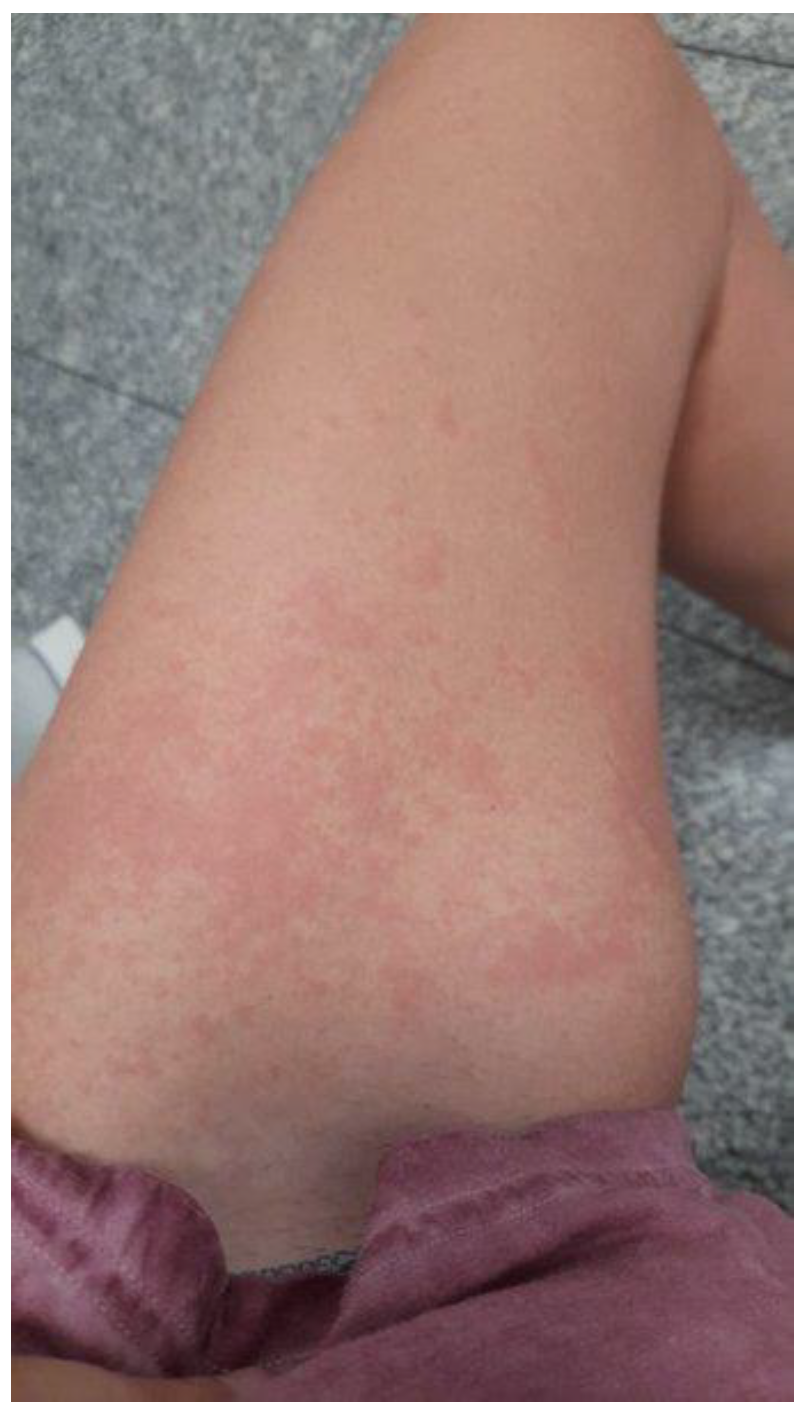
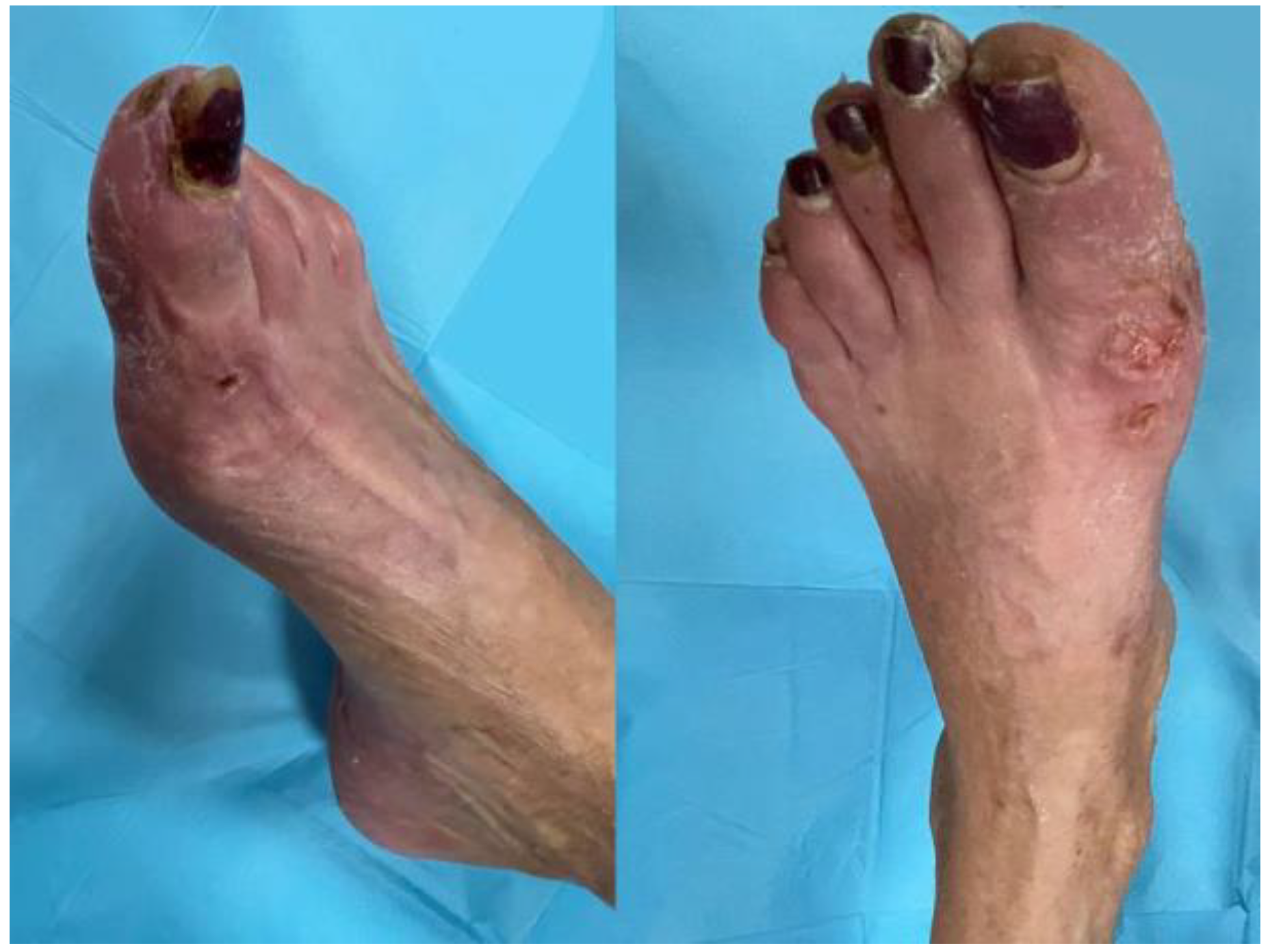
Cutaneous Manifestations of COVID-19 in the Lower Limbs: A Narrative Review
 , and
, and 
Abstract
1. Introduction
2. Materials and Methods
3. Results
4. Discussion
5. Conclusions
Author Contributions
Funding
Institutional Review Board Statement
Informed Consent Statement
Data Availability Statement
Conflicts of Interest
References
- World Health Organization. Severe Acute Respiratory Syndrome (SARS). Available online: https://www.who.int/health-topics/severe-acute-respiratory-syndrome#tab=tab_1 (accessed on 3 December 2021).
- Greenberg, S.B. Update on Human Rhinovirus and Coronavirus Infections. Semin. Respir. Crit. Care Med. 2016, 37, 555–571. [Google Scholar] [CrossRef] [Scilit]
- Yang, Y.; Peng, F.; Wang, R.; Guan, K.; Jiang, T.; Xu, G.; Sun, J.; Chang, C. The deadly coronaviruses: The 2003 SARS pandemic and the 2020 novel coronavirus epidemic in China. J. Autoimmun. 2020, 109, 102434. [Google Scholar] [CrossRef] [Scilit]
- Martín-Sánchez, V.; Barquilla-García, A.; Vitelli-Storelli, F.; Segura-Fragoso, A.; Ruiz-García, A.; Serrano-Cumplido, A.; Olmo-Quintana, V.; Calderón-Montero, A. Analysis of fatality rates case of SARS-CoV-2 infection in the Autonomous Communities of Spain. Semergen 2020, 46, 12–19. [Google Scholar] [CrossRef] [Scilit]
- Chen, Y.; Peng, H.; Wang, L.; Zhao, Y.; Zeng, L.; Gao, H.; Liu, Y. Infants Born to Mothers With a New Coronavirus (COVID-19). Front. Pediatr. 2020, 8, 104. [Google Scholar] [CrossRef] [Scilit]
- Yesudhas, D.; Srivastava, A.; Gromiha, M.M. COVID-19 outbreak: History, mechanism, transmission, structural studies and therapeutics. Infection 2021, 49, 199–213. [Google Scholar] [CrossRef] [Scilit]
- Suchonwanit, P.; Leerunyakul, K.; Kositkuljorn, C. Cutaneous manifestations in COVID-19: Lessons learned from current evidence. J. Am. Acad. Dermatol. 2020, 83, e57–e60. [Google Scholar] [CrossRef] [Scilit]
- Gül, Ü. COVID-19 and dermatology. Turk. J. Med. Sci. 2020, 50, 1751–1759. [Google Scholar] [CrossRef] [Scilit]
- Jimenez-Cebrian, A.M.; Castro-Mendez, A.; García-Podadera, B.; Romero-Galisteo, R.; Medina-Alcántara, M.; Garcia-Paya, I.; Páez-Moguer, J.; Córdoba-Fernández, A. Clinical manifestations of covid-19 in the feet: A review of reviews. J. Clin. Med. 2021, 10, 2201. [Google Scholar] [CrossRef] [Scilit]
- Vilar-Palomo, S.; Pabón-Carrasco, M.; Gonzalez-Elena, M.L.; Ramírez-Baena, L.; Rodríguez-Gallego, I.; Castro-Méndez, A. Assessment of the anxiety level of andalusian podiatrists during the covid-19 pandemic: The increase phase. Healthcare 2020, 8, 432. [Google Scholar] [CrossRef] [Scilit]
- Rahimi, H.; Tehranchinia, Z. A Comprehensive Review of Cutaneous Manifestations Associated with COVID-19. BioMed Res. Int. 2020, 2020, 1236520. [Google Scholar] [CrossRef] [Scilit]
- Tao, J.; Song, Z.; Yang, L.; Huang, C.; Feng, A.; Man, X. Emergency management for preventing and controlling nosocomial infection of the 2019 novel coronavirus: Implications for the dermatology department. Br. J. Dermatol. 2020, 182, 1477–1478. [Google Scholar] [CrossRef] [Scilit] [PubMed]
- Lu, S.; Lin, J.; Zhang, Z.; Xiao, L.; Jiang, Z.; Chen, J.; Hu, C.; Luo, S. Alert for non-respiratory symptoms of coronavirus disease 2019 patients in epidemic period: A case report of familial cluster with three asymptomatic COVID-19 patients. J. Med. Virol. 2021, 93, 518–521. [Google Scholar] [CrossRef] [Scilit] [PubMed]
- Manalo, I.F.; Smith, M.K.; Cheeley, J.; Jacobs, R. A dermatologic manifestation of COVID-19: Transient livedo reticularis. J. Am. Acad. Dermatol. 2020, 83, 700. [Google Scholar] [CrossRef] [Scilit] [PubMed]
- Galván Casas, C.; Català, A.; Carretero Hernández, G.; Rodríguez-Jiménez, P.; Fernández-Nieto, D.; Rodríguez-Villa Lario, A.; Navarro Fernández, I.; Ruiz-Villaverde, R.; Falkenhain-López, D.; Llamas Velasco, M.; et al. Classification of the cutaneous manifestations of COVID-19: A rapid prospective nationwide consensus study in Spain with 375 cases. Br. J. Dermatol. 2020, 183, 71–77. [Google Scholar] [CrossRef] [Scilit]
- Carrascosa, J.M.; Morillas, V.; Bielsa, I.; Munera-Campos, M. Cutaneous Manifestations in the Context of SARS-CoV-2 Infection (COVID-19). Actas Dermosifiliogr. 2020, 111, 734–742. [Google Scholar] [CrossRef] [Scilit]
- Guan, W.; Ni, Z.; Hu, Y.; Liang, W.; Ou, C.; He, J.; Liu, L.; Shan, H.; Lei, C.; Hui, D.S.C.; et al. Clinical Characteristics of Coronavirus Disease 2019 in China. N. Engl. J. Med. 2020, 382, 1708–1720. [Google Scholar] [CrossRef] [Scilit]
- Recalcati, S.; Barbagallo, T.; Frasin, L.A.; Prestinari, F.; Cogliardi, A.; Provero, M.C.; Dainese, E.; Vanzati, A.; Fantini, F. Acral cutaneous lesions in the time of COVID-19. J. Eur. Acad. Dermatol. Venereol. 2020, 34, e346–e347. [Google Scholar] [CrossRef] [Scilit]
- Estébanez, A.; Pérez-Santiago, L.; Silva, E.; Guillen-Climent, S.; García-Vázquez, A.; Ramón, M.D. Cutaneous manifestations in COVID-19: A new contribution. J. Eur. Acad. Dermatol. Venereol. 2020, 34, e250–e251. [Google Scholar] [CrossRef] [Scilit]
- Henry, D.; Ackerman, M.; Sancelme, E.; Finon, A.; Esteve, E. Urticarial eruption in COVID-19 infection. J. Eur. Acad. Dermatol. Venereol. 2020, 34, e244–e245. [Google Scholar] [CrossRef] [Scilit]
- De Masson, A.; Bouaziz, J.D.; Sulimovic, L.; Cassius, C.; Jachiet, M.; Ionescu, M.A.; Rybojad, M.; Bagot, M.; Duong, T.A.; Denjean, D.; et al. Chilblains is a common cutaneous finding during the COVID-19 pandemic: A retrospective nationwide study from France. J. Am. Acad. Dermatol. 2020, 83, 667–670. [Google Scholar] [CrossRef] [Scilit]
- Duong, T.A.; Velter, C.; Rybojad, M.; Comte, C.; Bagot, M.; Sulimovic, L.; Bouaziz, J.D. Did Whatsapp® reveal a new cutaneous COVID-19 manifestation? J. Eur. Acad. Dermatol. Venereol. 2020, 34, e348–e350. [Google Scholar] [CrossRef] [Scilit] [PubMed]
- Roca-Ginés, J.; Torres-Navarro, I.; Sánchez-Arráez, J.; Abril-Pérez, C.; Sabalza-Baztán, O.; Pardo-Granell, S.; Martínez I Cózar, V.; Botella-Estrada, R.; Évole-Buselli, M. Assessment of Acute Acral Lesions in a Case Series of Children and Adolescents during the COVID-19 Pandemic. JAMA Dermatol. 2020, 156, 992–997. [Google Scholar] [CrossRef] [Scilit] [PubMed]
- Marzano, A.V.; Genovese, G.; Fabbrocini, G.; Pigatto, P.; Monfrecola, G.; Piraccini, B.M.; Veraldi, S.; Rubegni, P.; Cusini, M.; Caputo, V.; et al. Varicella-like exanthem as a specific COVID-19–associated skin manifestation: Multicenter case series of 22 patients. J. Am. Acad. Dermatol. 2020, 83, 280–285. [Google Scholar] [CrossRef] [Scilit] [PubMed]
- Zhang, Y.; Cao, W.; Xiao, M.; Li, Y.J.; Yang, Y.; Zhao, J.; Zhou, X.; Jiang, W.; Zhao, Y.Q.; Zhang, S.Y.; et al. Clinical and coagulation characteristics of 7 patients with critical COVID-2019 pneumonia and acro-ischemia. Zhonghua Xue Ye Xue Za Zhi 2020, 41, E006. [Google Scholar] [PubMed]
- Piccolo, V.; Neri, I.; Filippeschi, C.; Oranges, T.; Argenziano, G.; Battarra, V.C.; Berti, S.; Manunza, F.; Fortina, A.B.; Di Lernia, V.; et al. Chilblain-like lesions during COVID-19 epidemic: A preliminary study on 63 patients. J. Eur. Acad. Dermatol. Venereol. 2020, 34, e291–e293. [Google Scholar] [CrossRef] [Scilit] [PubMed]
- Massey, P.R.; Jones, K.M. Going viral: A brief history of Chilblain-like skin lesions («COVID toes») amidst the COVID-19 pandemic. Semin. Oncol. 2020, 47, 330–334. [Google Scholar] [CrossRef] [Scilit] [PubMed]
- Jamshidi, P.; Hajikhani, B.; Mirsaeidi, M.; Vahidnezhad, H.; Dadashi, M.; Nasiri, M.J. Skin Manifestations in COVID-19 Patients: Are They Indicators for Disease Severity? A Systematic Review. Front. Med. 2021, 8, 634208. [Google Scholar] [CrossRef] [Scilit]
- Fernandez-Nieto, D.; Jimenez-Cauhe, J.; Suarez-Valle, A.; Moreno-Arrones, O.M.; Saceda-Corralo, D.; Arana-Raja, A.; Ortega-Quijano, D. Characterization of acute acral skin lesions in nonhospitalized patients: A case series of 132 patients during the COVID-19 outbreak. J. Am. Acad. Dermatol. 2020, 83, e61–e63. [Google Scholar] [CrossRef] [Scilit]
- Mazzotta, F.; Troccoli, T. Acute acro-ischemia in the child at the time of COVID-19. Eur. J. Pediatr. Dermatol. 2020, 30, 71–74. [Google Scholar]


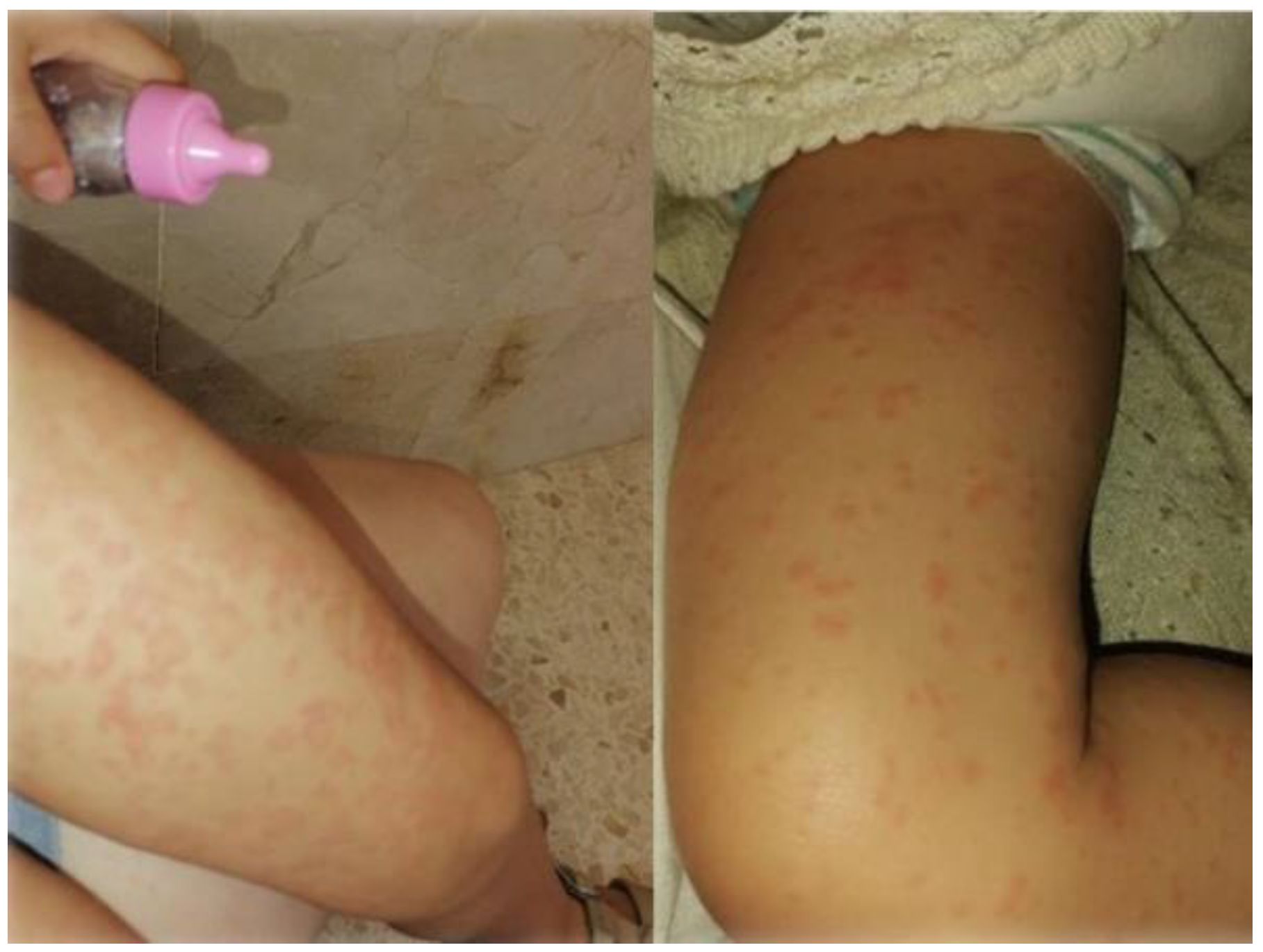
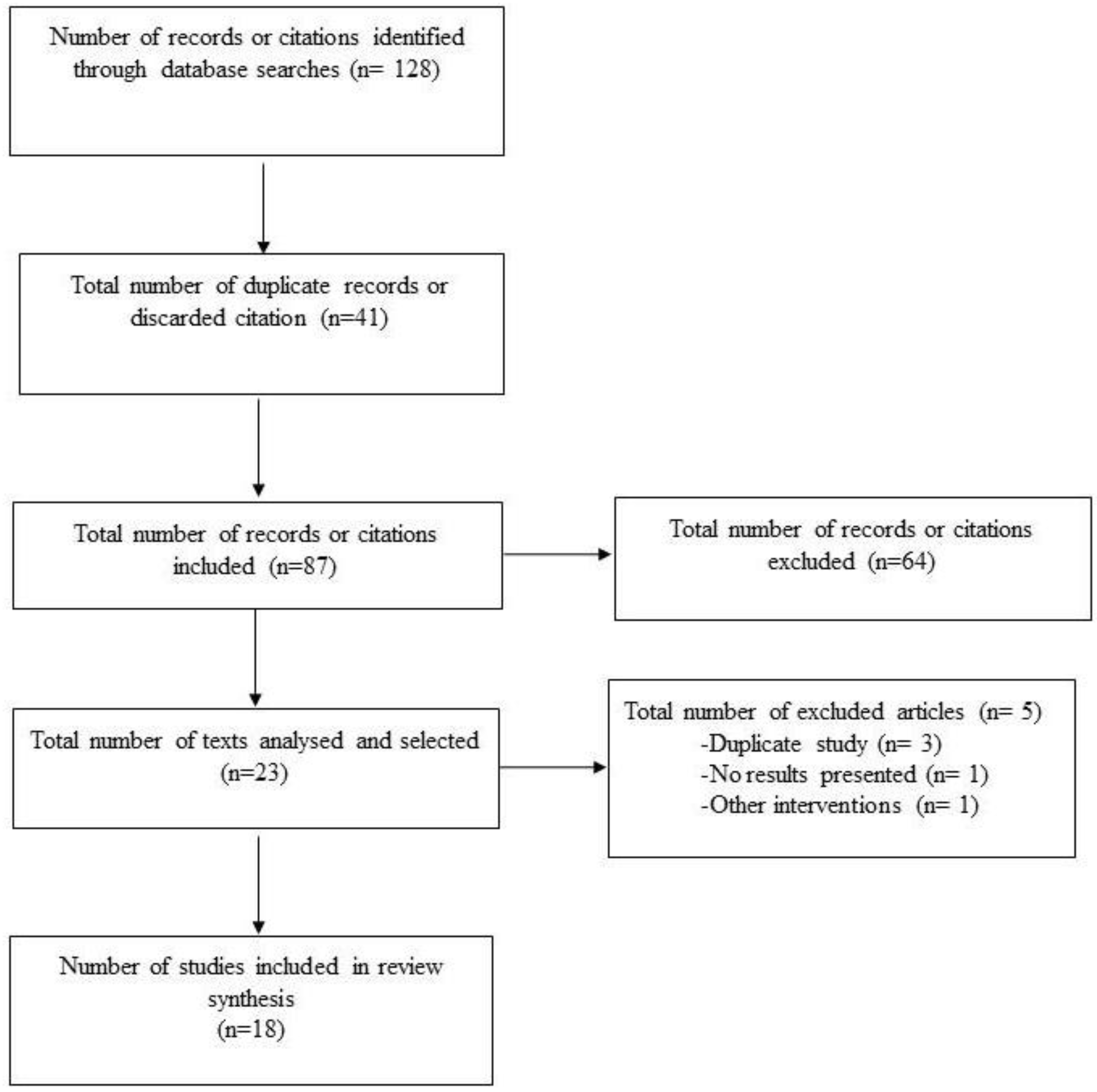

| Type of Study Participants (n) | Average Age (Years) Men Women | Aim | Types of Skin Manifestations on the Foot | |
|---|---|---|---|---|
| Guan 2020 [17] | Cross-sectional study (n = 1099) | 47 M = 637 W = 462 | To describe the clinical characteristics of patients with COVID-19 | Not specified. Skin findings were missed on initial COVID-19. |
| Recalcati 2020 [18] | Case series study (n = 107) | 72 M = 58 W = 49 | To summarise perniosis-like dermatological lesions in young patients with COVID-19. | Acrocyanosis due to respiratory failure. Foot thrombosis. Maculo-papular lesions on feet and hands. 90% of the lesions were located on the fingers and toes and 81.8% were located on the feet. |
| Estébanez 2020 [19] | Report case (n = 1) | 28 M = 0 W = 1 | To describe a new skin manifestation on the heel of the foot caused by COVID-19. | Dermatological sign of confluent erythematous-yellowish papules on the heels. (COVID-19 positive). |
| Carrascosa 2020 [16] | - | - | To summarise the prevalence of dermatological manifestations associated with COVID-19. | Acral lesions, vesicular rashes, urticarial rashes, maculopapular rashes, and livedoid/necrotic lesions. |
| Lu 2020 [13] | Case series study (n = 3) | M = 2 W = 1 | To report clinical features on the foot in a quasi-symptomatic patient. | Urticaria on the lower extremities, with no other symptoms associated with COVID-19. |
| Henry 2020 [20] | Report case (n = 1) | 27 M = 0 W = 1 | To report a case of onset of urticarial rash before the onset of fever or respiratory symptom after diagnosis of COVID-19. | Pruritic rash of disseminated erythematous plaques with facial and acral involvement. |
| Masson 2020 [21] | Retrospective cross-sectional study (n = 277) | 27 M = 114 W = 113 | To analyse the dermatological manifestations associated with COVID-19. | Urticaria (n = 26); vesicular lesion (n = 41); acral lesion (n = 142); morbilliform lesion (n = 25); petechiae (n = 7); livedo. Reticularis (n= 4); and other types of dermatological lesions (n = 41); acral lesions in 28%. |
| Fernández-Nieto 2020 [15] | Narrative review (n = 132) | - | To analyse and observe the predominance of dermatological lesions on the foot and hand. | Two different patterns of acral lesions; chilblains (72%) and erythema multiforme-like pattern. Acral lesions are predominantly on the toes and are rarely seen in other areas of the body. |
| Galván-Casas 2020 [15] | Prospective study (N = 375) | M = 153 W = 222 | To describe the cutaneous manifestations of COVID-19 disease and relate them to other clinical findings. | Chilblains = 19%, urticarial lesions = 19% and maculopapular lesions = 47%, necrosis = 6%. |
| Duong 2020 [22] | Retrospective study (N = 219) | - | To establish the prevalence of dermatological lesions on the foot. | Chilblains are predominant as a dermatological sign in patients diagnosed with COVID-19. |
| Roca-Gines 2020 [23] | Case series study (N = 20) | 1–18 M = 13 W = 7 | To report skin lesions as possible symptoms of COVID-19 infection. | Dermatological lesions on hands and feet, being more predominant on the foot. Acral erythema = 30%, dactylitis = 20% maculopapular lesions = 35% and mixed pattern = 15%. |
| Marzano 2020 [24] | Multicentre case series study (n = 22) | 60 M = 16 W = 6 | To define the cutaneous manifestations of COVID-19. | Scattered papulovesicular lesions, with different symptoms and not predominantly on the foot but present on the trunk. |
| Zhang 2020 [25] | Case series study (N = 7) | 59 M = 4 W = 3 | To investigate the clinical and coagulation characteristics of patients with coronavirus critical illness 2019 (COVID-19) with acroischemia in the intensive care unit. | Acroischemia accompanied by cyanosis of the toes. |
| Piccolo 2020 [26] | Case series study (N = 63) | 14 M = 27 W = 36 | To report preliminary results on dermatological lesions in children. | Lesions on feet = 85.7%, and on feet and hands together = 7%. Foot lesions are predominant in children with suspected SARS-CoV-2 infection. |
| Massey 2020 [27] | Narrative review (n = 566) | - | To review the literature on chilblain-like skin lesions in the early stages of the global COVID-19 pandemic. | A multitude of chilblain-like skin manifestations on the foot by COVID-19. |
| Jamshidi 2021 [28] | Narrative review (n= 1847) | - | To assess the temporal relationship between different types of skin lesions and the severity of COVID-19. | Cutaneous manifestations = 5.95%. Patients with vascular lesions had the highest mortality rate. |
| Jiménez-Cebrian 2021 [9] | Review of reviews (n = 10) | - | To review the literature on the clinical manifestations of COVID-19 in the foot. | The most relevant manifestations were Kawasaki disease, acral perniosis lesions, pernio erythema and ischaemia, and necrosis. |
Publisher’s Note: MDPI stays neutral with regard to jurisdictional claims in published maps and institutional affiliations. |
© 2022 by the authors. Licensee MDPI, Basel, Switzerland. This article is an open access article distributed under the terms and conditions of the Creative Commons Attribution (CC BY) license (https://creativecommons.org/licenses/by/4.0/).
Share and Cite
Palomo-Toucedo, I.C.; López-Sánchez, M.J.; Reina-Bueno, M.; Coheña-Jiménez, M. Cutaneous Manifestations of COVID-19 in the Lower Limbs: A Narrative Review. Int. J. Environ. Res. Public Health 2022, 19, 8861. https://doi.org/10.3390/ijerph19148861
Palomo-Toucedo IC, López-Sánchez MJ, Reina-Bueno M, Coheña-Jiménez M. Cutaneous Manifestations of COVID-19 in the Lower Limbs: A Narrative Review. International Journal of Environmental Research and Public Health. 2022; 19(14):8861. https://doi.org/10.3390/ijerph19148861
Chicago/Turabian StylePalomo-Toucedo, Inmaculada C., Manuel Jesús López-Sánchez, María Reina-Bueno, and Manuel Coheña-Jiménez. 2022. "Cutaneous Manifestations of COVID-19 in the Lower Limbs: A Narrative Review" International Journal of Environmental Research and Public Health 19, no. 14: 8861. https://doi.org/10.3390/ijerph19148861
APA StylePalomo-Toucedo, I. C., López-Sánchez, M. J., Reina-Bueno, M., & Coheña-Jiménez, M. (2022). Cutaneous Manifestations of COVID-19 in the Lower Limbs: A Narrative Review. International Journal of Environmental Research and Public Health, 19(14), 8861. https://doi.org/10.3390/ijerph19148861