

Understanding the Green Development Behavior and Performance of Industrial Enterprises (GDBP-IE): Scale Development and Validation




Abstract
1. Introduction
2. Literature Review
2.1. Internal Factors (IFs)
2.2. External Factors (EFs)
2.3. Green Development Behavior of Industrial Enterprises (GDB-IE)
2.4. Green Development Performance of Industrial Enterprises (GDP-IE)
3. Materials and Methods
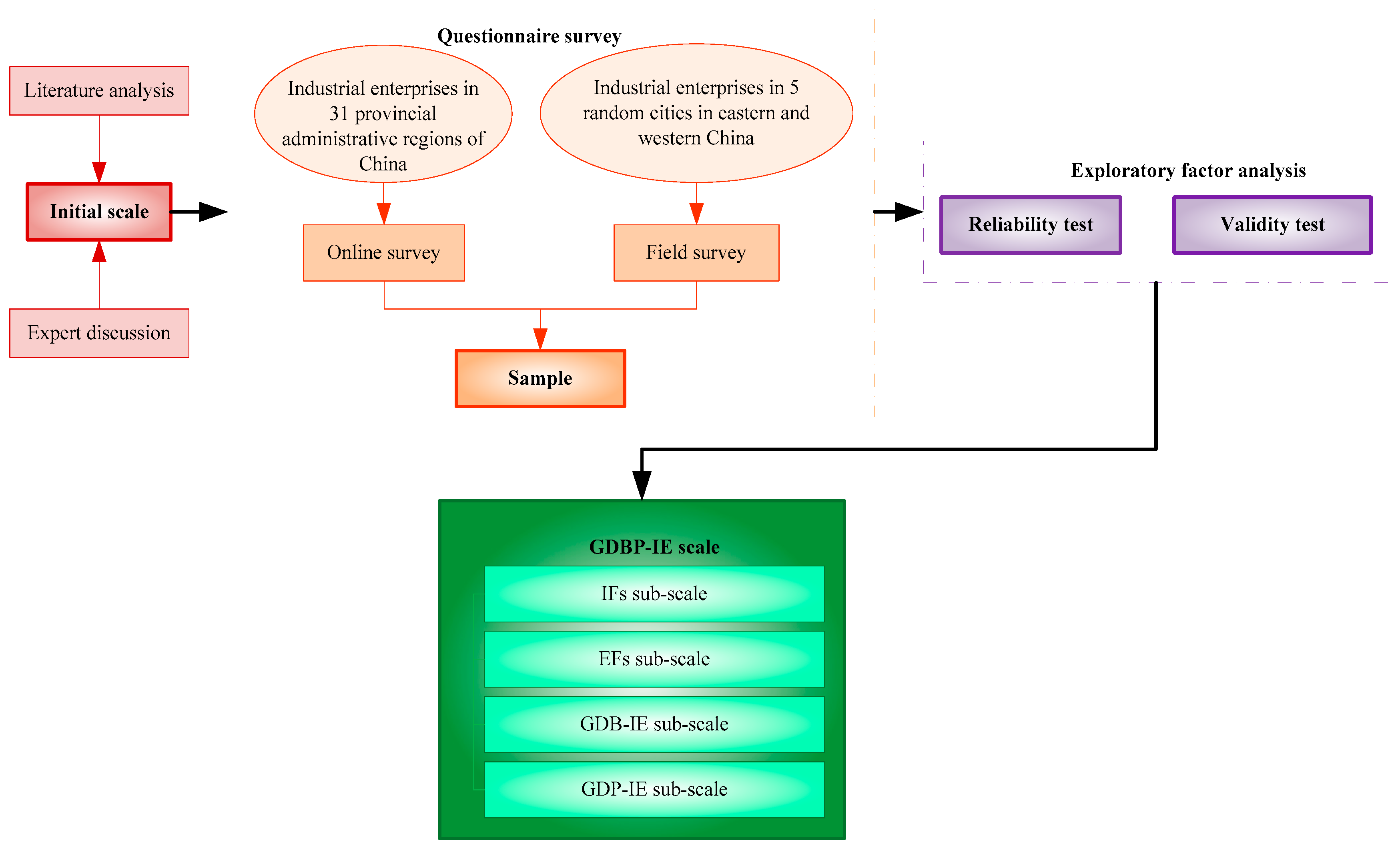
3.1. Data Sources
3.2. Exploratory Factor Analysis
4. Results
4.1. Development and Verification of IFs sub-Scale
4.1.1. Principal Component Analysis (PCA)
4.1.2. Reliability Analysis
4.2. Development and Verification of EFs Sub-Scale
4.2.1. PCA
4.2.2. Reliability Analysis
4.3. Development and Verification of GDB-IE Sub-Scale
4.3.1. PCA
4.3.2. Reliability Analysis
4.4. Development and Verification of GDP-IE Sub-Scale
4.4.1. PCA
4.4.2. Reliability Analysis
5. Discussion
6. Conclusions and Implications
6.1. Conclusions
6.2. Implications
Author Contributions
Funding
Conflicts of Interest
Appendix A

| Sub-Scale | Dimensions | Codes | Items |
|---|---|---|---|
| Internal Factors (IFs) | Corporate tangible resources (CTR) | IFs1 | Our enterprise is an organization with a high awareness and mission of green production. |
| IFs2 | Our enterprise has a leadership that values green production. | ||
| IFs3 | Our enterprise has a department or organization in charge of environmental work. | ||
| IFs4 | Our enterprise has a special budget for green production. | ||
| IFs5 | Our enterprise has a leadership that is committed to green production. | ||
| IFs6 | The sufficient capital level of our enterprise can support green production. | ||
| IFs7 | Our enterprise regularly trains employees in green production-related skills. | ||
| IFs8 | Our enterprise has sufficient talent reserves related to green production. | ||
| IFs9 | Our enterprise has production equipment that fully meets the needs of green production. | ||
| Corporate intangible resources (CIR) | IFs10 | Our enterprise can easily design green ecological products. | |
| IFs11 | Our corporate products have the ability to register the green logo. | ||
| IFs12 | Our enterprise has the ability to market green products. | ||
| IFs13 | In the field of green production, our enterprise has stocked related advanced technologies. | ||
| External Factors (EFs) | Market environment (ME) | EFs1 | The enforcement of green production-related regulations in the market is strict. |
| EFs2 | The implementation of green production-related systems in the market is strict. | ||
| EFs3 | Consumers trust green products. | ||
| EFs4 | Green production helps to enhance corporate image and brand value. | ||
| EFs5 | Consumers tend to buy green products. | ||
| EFs6 | In the market, enterprises are heavily regulated. | ||
| EFs7 | In the market, the green production of enterprises has been actively supported. | ||
| EFs8 | In the market, enterprises’ participation in the construction of ecological industrial parks has been actively supported. | ||
| EFs9 | The customer (enterprise) has high requirements for the environment of our enterprise. | ||
| EFs10 | Investors place high demands on the environmental protection of our enterprise. | ||
| EFs11 | In the market, green production-related regulations and systems are highly practical. | ||
| Public supervision (PS) | EFs12 | Community residents are required to participate in the environmental impact approval process of surrounding enterprises. | |
| EFs13 | The public and the community will make petition letters or complaints about environmental violations of surrounding enterprises. | ||
| EFs14 | Residents of the community require surrounding enterprises to build public environmental protection infrastructure. | ||
| EFs15 | Social environmental organizations are very concerned about corporate environmental violations. | ||
| EFs16 | News media will report on corporate environmental violations. | ||
| EFs17 | Peers are very concerned about the enterprise’s green production capabilities. | ||
| EFs18 | Consumers pay great attention to the environmental violations of enterprises. | ||
| EFs19 | Green products have passed strict certification. | ||
| Policy and institutional environment (PIE) | EFs20 | The government has developed preferential land policies for enterprises adopting clean technologies. | |
| EFs21 | The government has developed investment and financing policies for enterprises adopting clean technologies. | ||
| EFs22 | The government has developed fiscal and tax incentives for enterprises adopting clean technologies. | ||
| EFs23 | The government actively implements preferential policies for cleaner production of enterprises. | ||
| Green Development Behavior of Industrial Enterprises (GDB-IE) | Clean production behavior (CPB) | GDB-IE1 | The production process of our enterprise strictly adheres to the requirements of cleaner production. |
| GDB-IE2 | Our enterprise is selecting and improving pro-environmental processes or equipment. | ||
| GDB-IE3 | Our enterprise purchases environmentally friendly processes and equipment. | ||
| GDB-IE4 | Our enterprise considers the need for cleaner production when designing products. | ||
| GDB-IE5 | Our enterprise actively builds a cleaner production brand. | ||
| GDB-IE6 | Our enterprise has promoted the image of cleaner production. | ||
| GDB-IE7 | Our enterprise cascades use energy between enterprises. | ||
| GDB-IE8 | Our enterprise recycles water between enterprises. | ||
| GDB-IE9 | Our enterprise is actively looking for partners to jointly achieve the goals of energy conservation and emission reduction. | ||
| GDB-IE10 | Our enterprise actively recycles and disposes of waste products. | ||
| Green supply chain management practices (GSCMP) | GDB-IE11 | Our enterprise conducts environmental and energy audits on the internal management of suppliers. | |
| GDB-IE12 | Our enterprise requires suppliers to provide design specifications for the environmentally friendly requirements of the products they purchase. | ||
| GDB-IE13 | Our enterprise evaluates suppliers’ environmentally friendly practices. | ||
| GDB-IE14 | In the supply chain, our enterprise is very concerned about the green technologies of other enterprises. | ||
| GDB-IE15 | Our enterprise purchases new energy-saving and low-carbon materials and new energy. | ||
| GDB-IE16 | In the supply chain, our enterprise actively shares energy-saving and emission-reduction technologies among enterprises. | ||
| GDB-IE17 | Our company chooses suppliers that have passed third-party environmental management system certification (e.g., ISO 14001). | ||
| GDB-IE18 | In the supply chain, our enterprise actively communicates information about byproducts between enterprises. | ||
| Green Development Performance of Industrial Enterprises (GDP-IE) | Corporate social performance (CSP) | GDP-IE1 | Customers increasingly trust our products. |
| GDP-IE2 | Our enterprise’s image and brand value have been enhanced. | ||
| GDP-IE3 | Our enterprise has improved product quality. | ||
| GDP-IE4 | Stakeholders have a high opinion of our enterprise. | ||
| GDP-IE5 | Our enterprise has improved relationships with the people in our communities. | ||
| GDP-IE6 | Our enterprise reduces the possibility of environmental accidents. | ||
| Corporate financial performance (CFP) | GDP-IE7 | Our enterprise has reduced material costs. | |
| GDP-IE8 | Our enterprise has reduced operating costs. | ||
| GDP-IE9 | Our enterprise has reduced energy costs. | ||
| GDP-IE10 | Our enterprise has reduced the cost of environmental governance (e.g., emissions, penalties). | ||
| GDP-IE11 | Our enterprise has improved long-term financial performance. | ||
| GDP-IE12 | Our enterprise has reduced procurement costs through material recycling. | ||
| Corporate environmental performance (CEP) | GDP-IE13 | Wastewater emissions from our enterprise have decreased. | |
| GDP-IE14 | The emissions of exhaust gas produced by our enterprise have decreased. | ||
| GDP-IE15 | The amount of solid waste produced by our enterprise has decreased. | ||
| GDP-IE16 | Our enterprise has reduced the consumption of dangerous, toxic, and harmful substances. |
References
- Brundtland, G.H.; Khalid, M.; Agnelli, S.; Al-Athel, S.; Chidzero, B. Our Common Future; Oxford University Press: New York, NY, USA, 1987. [Google Scholar]
- United Nations Development Programme. Sustainable Development Goals. Available online: https://www.undp.org/content/undp/en/home/sustainable-development-goals.html (accessed on 20 February 2020).
- Li, X.; Du, J.; Long, H. Theoretical framework and formation mechanism of the green development system model in China. Environ. Dev. 2019, 32, 100465. [Google Scholar] [CrossRef]
- Koutsoyiannis, D. Scale of water resources development and sustainability: Small is beautiful, large is great. Hydrol. Sci. J. 2011, 56, 553–575. [Google Scholar] [CrossRef]
- Sargentis, G.; Ioannidis, R.; Karakatsanis, G.; Sigourou, S.; Lagaros, N.D.; Koutsoyiannis, D. The development of the Athens water supply system and inferences for optimizing the scale of water infrastructures. Sustainability 2019, 11, 2657. [Google Scholar] [CrossRef]
- National Bureau of Statistics of China. National Data. Available online: http://data.stats.gov.cn/easyquery.htm?cn=C01 (accessed on 5 January 2020).
- Islam, M.; Managi, S. Green growth and pro-environmental behavior: Sustainable resource management using natural capital accounting in India. Resour. Conserv. Recycl. 2019, 145, 126–138. [Google Scholar] [CrossRef]
- Yusof, N.A.; Abidin, N.Z.; Zailani, S.H.M.; Govindan, K.; Iranmanesh, M. Linking the environmental practice of construction firms and the environmental behaviour of practitioners in construction projects. J. Clean. Prod. 2016, 121, 64–71. [Google Scholar] [CrossRef]
- National Bureau of Statistics of China. China Statistical Yearbook 2019. Available online: http://www.stats.gov.cn/tjsj/ndsj/2019/indexch.htm (accessed on 5 January 2020).
- Liu, H.; Long, H.; Li, X. Identification of critical factors in construction and demolition waste recycling by the grey-DEMATEL approach: A Chinese perspective. Environ. Sci. Pollut. Res. 2020, 27, 8507–8525. [Google Scholar] [CrossRef]
- Li, X.; Du, J.; Long, H. A Comparative Study of Chinese and Foreign Green Development from the Perspective of Mapping Knowledge Domains. Sustainability 2018, 10, 4357. [Google Scholar] [CrossRef]
- Yuan, Q.; Yang, D.; Yang, F.; Luken, R.; Saieed, A.; Wang, K. Green industry development in China: An index based assessment from perspectives of both current performance and historical effort. J. Clean. Prod. 2019, 250, 119457. [Google Scholar] [CrossRef]
- Jiahuey, Y.; Liu, Y.; Yu, Y. Measuring green growth performance of China’s chemical industry. Resour. Conserv. Recycl. 2019, 149, 160–167. [Google Scholar] [CrossRef]
- Feng, C.; Wang, M. Journey for green development transformation of China’s metal industry: A spatial econometric analysis. J. Clean. Prod. 2019, 225, 1105–1117. [Google Scholar] [CrossRef]
- Wang, W.; Yu, B.; Yan, X.; Yao, X.; Liu, Y. Estimation of innovation’s green performance: A range-adjusted measure approach to assess the unified efficiency of China’s manufacturing industry. J. Clean. Prod. 2017, 149, 919–924. [Google Scholar] [CrossRef]
- Chen, Y.S.; Lai, S.B.; Wen, C.T. The influence of green innovation performance on corporate advantage in Taiwan. J. Bus. Ethics 2006, 67, 331–339. [Google Scholar] [CrossRef]
- Obeidat, S.M.; Al Bakri, A.A.; Elbanna, S. Leveraging “Green” Human Resource Practices to Enable Environmental and Organizational Performance: Evidence from the Qatari Oil and Gas Industry. J. Bus. Ethics 2018, 1–18. [Google Scholar] [CrossRef]
- Diabat, A.; Khodaverdi, R.; Olfat, L. An exploration of green supply chain practices and performances in an automotive industry. Int. J. Adv. Manuf. Technol. 2013, 68, 949–961. [Google Scholar] [CrossRef]
- Namagembe, S.; Ryan, S.; Sridharan, R. Green supply chain practice adoption and firm performance: Manufacturing SMEs in Uganda. Manag. Environ. Qual. 2019, 30, 5–35. [Google Scholar] [CrossRef]
- Chang, T.-W.; Chen, F.-F.; Luan, H.-D.; Chen, Y.-S. Effect of Green Organizational Identity, Green Shared Vision, and Organizational Citizenship Behavior for the Environment on Green Product Development Performance. Sustainability 2019, 11, 617. [Google Scholar] [CrossRef]
- Steyrer, J.; Schiffinger, M.; Lang, R. Organizational commitment—A missing link between leadership behavior and organizational performance? Scand. J. Manag. 2008, 24, 364–374. [Google Scholar] [CrossRef]
- Chiang, C.-F.; Hsieh, T.-S. The impacts of perceived organizational support and psychological empowerment on job performance: The mediating effects of organizational citizenship behavior. Int. J. Hosp. Manag. 2012, 31, 180–190. [Google Scholar] [CrossRef]
- Li, X.; Du, J.; Long, H. Green Development Behavior and Performance of Industrial Enterprises Based on Grounded Theory Study: Evidence from China. Sustainability 2019, 11, 4133. [Google Scholar] [CrossRef]
- Armento, M.E.; Hopko, D.R. The environmental reward observation scale (EROS): Development, validity, and reliability. Behav. Ther. 2007, 38, 107–119. [Google Scholar] [CrossRef]
- Robin, M.; Matheau-Police, A.; Couty, C. Development of a scale of perceived environmental annoyances in urban settings. J. Environ. Psychol. 2007, 27, 55–68. [Google Scholar] [CrossRef]
- Pluess, M.; Assary, E.; Lionetti, F.; Lester, K.J.; Krapohl, E.; Aron, E.N.; Aron, A. Environmental sensitivity in children: Development of the Highly Sensitive Child Scale and identification of sensitivity groups. Dev. Psychol. 2018, 54, 51–70. [Google Scholar] [CrossRef] [PubMed]
- Markle, G.L. Pro-environmental behavior: Does it matter how it’s measured? Development and validation of the pro-environmental behavior scale (PEBS). Hum. Ecol. 2013, 41, 905–914. [Google Scholar] [CrossRef]
- Homburg, A.; Stolberg, A.; Wagner, U. Coping with global environmental problems: Development and first validation of scales. Environ. Behav. 2007, 39, 754–778. [Google Scholar] [CrossRef]
- Powell, R.B.; Stern, M.J.; Krohn, B.D.; Ardoin, N. Development and validation of scales to measure environmental responsibility, character development, and attitudes toward school. Environ. Educ. Res. 2011, 17, 91–111. [Google Scholar] [CrossRef]
- Alisat, S.; Riemer, M. The environmental action scale: Development and psychometric evaluation. J. Environ. Psychol. 2015, 43, 13–23. [Google Scholar] [CrossRef]
- Ewert, A.; Galloway, G. Socially desirable responding in an environmental context: Development of a domain specific scale. Environ. Educ. Res. 2009, 15, 55–70. [Google Scholar] [CrossRef]
- Wernerfelt, B. A Resource-Based View of the Firm. Strateg. Manag. J. 1984, 5, 171–180. [Google Scholar] [CrossRef]
- Newbert, S.L. Emprical Research on the Resource-based View of the Firm: An Assessment and Suggestions for Future Research. Strateg. Manag. J. 2007, 28, 121–146. [Google Scholar] [CrossRef]
- Pohjola, M. The new economy in growth and development. Oxf. Rev. Econ. Policy 2002, 18, 380–396. [Google Scholar] [CrossRef]
- Carmeli, A.; Tishler, A. The Relationships between Intangible Organizational Elements and Organizational Performance. Strateg. Manag. J. 2004, 25, 1257–1278. [Google Scholar] [CrossRef]
- Zhao, Y.; Fan, B. Exploring open government data capacity of government agency: Based on the resource-based theory. Gov. Inf. Q. 2018, 35, 1–12. [Google Scholar] [CrossRef]
- Hitt, M.A.; Xu, K.; Carnes, C.M. Resource based theory in operations management research. J. Oper. Manag. 2016, 41, 77–94. [Google Scholar] [CrossRef]
- Yang, C.L. Model Establishment and Analysis of Enterprise Value Creation System. Stat. Decis. 2007, 9, 44–45. (In Chinese) [Google Scholar] [CrossRef]
- Orth, R.; Scheumann, R.; Galeitzke, M.; Wolf, K.; Kohl, H.; Finkbeiner, M. Sustainable Corporate Development Measured by Intangible and Tangible Resources as Well as Targeted by Safeguard Subjects. Procedia CIRP 2015, 26, 630–634. [Google Scholar] [CrossRef]
- Newbert, S.L. Value, Rareness, Competitive Advantage, and Performance: A Conceptual-level Empirical Investigation of the Resource-based View of the Firm. Strateg. Manag. J. 2008, 29, 745–768. [Google Scholar] [CrossRef]
- Muller, A.; Kolk, A. Extrinsic and Intrinsic Drivers of Corporate Social Performance: Evidence from Foreign and Domestic Firm in Mexico. J. Manag. Stud. 2010, 47, 1–26. [Google Scholar] [CrossRef]
- Abeysekera, I. How Best to Communicate Intangible Resources on Websites to Inform Corporate-Growth Reputation of Small Entrepreneurial Businesses. J. Small Bus. Manag. 2019, 57, 738–756. [Google Scholar] [CrossRef]
- Surroca, J.; Tribó, J.A.; Waddock, S. Corporate responsibility and financial performance: The role of intangible resources. Strateg. Manag. J. 2010, 31, 463–490. [Google Scholar] [CrossRef]
- Helfat, C.E.; Peteraf, M.A. The Dynamic Resource-based View: Capability Lifecycles. Strateg. Manag. J. 2003, 24, 997–1010. [Google Scholar] [CrossRef]
- Dong, X.; Wang, T.; Zhao, C. Utility and Matching Measure Model of Firm Resources. Manag. Rev. 2016, 28, 107–121. [Google Scholar] [CrossRef]
- North, D.C. Institutions. J. Econ. Perspect. 1991, 5, 97–112. [Google Scholar] [CrossRef]
- Li, S.; Zhang, Y. Institutional Environment, Transaction Rule and Efficiency of Corporate Control Transfer. Econ. Res. J. 2009, 44, 92–105. (In Chinese) [Google Scholar]
- Bain, J.S. Barriers to New Competition; Harvard University Press: New York, NY, USA, 1956. [Google Scholar]
- Bain, J.S. Industrial Organization; Harvard University Press: New York, NY, USA, 1959. [Google Scholar]
- Stigler, G. The Organization of Industry; University of Chicago Press: Chicago, IL, USA, 1968. [Google Scholar]
- Jaiswal, D.; Kant, R. Green purchasing behaviour: A conceptual framework and empirical investigation of Indian consumers. J. Retail. Consum. Serv. 2018, 41, 60–69. [Google Scholar] [CrossRef]
- Zhu, H. Policy Support, Supervision Response and Green Entrepreneurship of Leading Agricultural Enterprises. J. Northwest A&F Univ. Soc. Sci. Ed. 2018, 18, 121–128. (In Chinese) [Google Scholar] [CrossRef]
- Wang, J. Research on the Correlation among Environmental Information Disclosure, Industry Differences and Supervisory System. Account. Res. 2008, 248, 54–62. (In Chinese) [Google Scholar] [CrossRef]
- Wu, D. Corporate Governance, Media Coverage and Coporate Social Responsibility. J. Zhongnan Univ. Econ. Law 2016, 218, 110–117. (In Chinese) [Google Scholar] [CrossRef]
- Porter, M.E.; Kramer, M.R. Strategy and Society: The Link Between Competitive Advantage and Corporate Social Responsibility. Harv. Bus. Rev. 2006, 84, 78–92. [Google Scholar]
- Dyck, A.; Zingales, L. Private Benefits of Control: An International Comparison. J. Financ. 2004, 59, 537–600. [Google Scholar] [CrossRef]
- Dyck, A.; Luigi, Z. The Corporate Governace Role of the Media: Evidence From Russia. J. Financ. 2008, 63, 1093–1135. [Google Scholar] [CrossRef]
- Shiel, C.; Paço, A.D.; Alves, H. Generativity, sustainable development and green consumer behaviour. J. Clean. Prod. 2020, 245, 118865. [Google Scholar] [CrossRef]
- Zhu, N.; Bu, Y.; Jin, M.; Mbroh, N. Green Financial Behavior and Green Development Strategy of Chinese Power Companies in the Context of Carbon Tax. J. Clean. Prod. 2020, 245, 118908. [Google Scholar] [CrossRef]
- Silva, D.A.L.; Delai, I.; de Castro, M.A.S.; Ometto, A.R. Quality tools applied to Cleaner Production programs: A first approach toward a new methodology. J. Clean. Prod. 2013, 47, 174–187. [Google Scholar] [CrossRef]
- Vieira, L.C.; Amaral, F.G. Barriers and strategies applying Cleaner Production: A systematic review. J. Clean. Prod. 2016, 113, 5–16. [Google Scholar] [CrossRef]
- Jazairy, A.; von Haartman, R. Analysing the institutional pressures on shippers and logistics service providers to implement green supply chain management practices. Int. J. Logist. Res. Appl. 2020, 23, 44–84. [Google Scholar] [CrossRef]
- Cousins, P.D.; Lawson, B.; Petersen, K.J.; Fugate, B. Investigating green supply chain management practices and performance. Int. J. Oper. Prod. Manag. 2019, 39, 767–786. [Google Scholar] [CrossRef]
- Qin, P.; Zhao, L.; Wan, J. The Impact of Cleaner Production Technology on Corporate Economic and Environmental Performance: An Empirical Study Based on the 2009 China Metal Products Industry Survey. Ecol. Econ. 2014, 30, 49–55. (In Chinese) [Google Scholar]
- Mantovani, A.; Tarola, O.; Vergari, C. End-of-pipe or cleaner production? How to go green in presence of income inequality and pro-environmental behavior. J. Clean. Prod. 2017, 160, 71–82. [Google Scholar] [CrossRef]
- Crum, M.; Carter, C.R.; Liane Easton, P. Sustainable supply chain management: Evolution and future directions. Int. J. Phys. Distrib. Logist. Manag. 2011, 41, 46–62. [Google Scholar] [CrossRef]
- Ahi, P.; Searcy, C. A comparative literature analysis of definitions for green and sustainable supply chain management. J. Clean. Prod. 2013, 52, 329–341. [Google Scholar] [CrossRef]
- Rostamzadeh, R.; Govindan, K.; Esmaeili, A.; Sabaghi, M. Application of fuzzy VIKOR for evaluation of green supply chain management practices. Ecol. Indic. 2015, 49, 188–203. [Google Scholar] [CrossRef]
- Beamon, B.M. Designing the green supply chain. Logist. Inf. Manag. 1999, 12, 332–342. [Google Scholar] [CrossRef]
- Eltayeb, T.K.; Zailani, S.; Ramayah, T. Green supply chain initiatives among certified companies in Malaysia and environmental sustainability: Investigating the outcomes. Resour. Conserv. Recycl. 2011, 55, 495–506. [Google Scholar] [CrossRef]
- Rao, P.; Holt, D. Do green supply chains lead to competitiveness and economic performance? Int. J. Oper. Prod. Manag. 2005, 25, 898–916. [Google Scholar] [CrossRef]
- Elkington, J. Towards the Sustainable Corporation: Win-Win-Win Business Strategies for Sustainable Development. Calif. Manag. Rev. 1994, 36, 90–100. [Google Scholar] [CrossRef]
- Shou, Y.; Shao, J.; Lai, K.; Kang, M.; Park, Y. The impact of sustainability and operations orientations on sustainable supply management and the triple bottom line. J. Clean. Prod. 2019, 240, 118280. [Google Scholar] [CrossRef]
- Zafrilla, J.-E.; Arce, G.; Cadarso, M.-Á.; Córcoles, C.; Gómez, N.; López, L.-A.; Monsalve, F.; Tobarra, M.-Á. Triple bottom line analysis of the Spanish solar photovoltaic sector: A footprint assessment. Renew. Sustain. Energy Rev. 2019, 114, 109311. [Google Scholar] [CrossRef]
- Biswas, I.; Raj, A.; Srivastava, S.K. Supply chain channel coordination with triple bottom line approach. Transp. Res. Part E Logist. Transp. Rev. 2018, 115, 213–226. [Google Scholar] [CrossRef]
- Ahmed, W.; Sarkar, B. Management of next-generation energy using a triple bottom line approach under a supply chain framework. Resour. Conserv. Recycl. 2019, 150, 104431. [Google Scholar] [CrossRef]
- Zhu, Q.; Sarkis, J.; Lai, K. Green supply chain management: pressures, practices and performance within the Chinese automobile industry. J. Clean. Prod. 2007, 15, 1041–1052. [Google Scholar] [CrossRef]
- Zhu, Q. A Resource-based View on Realization Mechanism of Regulations for Promoting Green Purchasing Practices among Manufacturers. Manag. Rev. 2012, 10, 143–149. (In Chinese) [Google Scholar] [CrossRef]
- Zhu, Q.; Yang, Q. An Empirical Study on Enterprises’ Environmental Behaviors and Their Influencing Factors through Eco-industrial Parks Development in China. Manag. Rev. 2013, 25, 843–844. (In Chinese) [Google Scholar]
- Zhu, Q.; Geng, Y. Statistics Analysis on Types of Chinese Manufacturers Based on Practice of Green Supply Chain management and Their Performance. Appl. Stat. Manag. 2006, 25, 392–399. (In Chinese) [Google Scholar] [CrossRef]
- Xie, X.B.; Wu, Y.; Feng, Z.L.; Hao, Z.T. Investigation of Green Behavior of Resource-based Enterprise in China. China Popul. Resour. Environ. 2015, 5–11. (In Chinese) [Google Scholar] [CrossRef]
- Zhou, S. Research on the Influencing Factors of Corporate Environmental Behavior. Stat. Decis. 2011, 22, 181–183. (In Chinese) [Google Scholar] [CrossRef]
- Zhu, Q. An Empirical Study on Barriers for Implementing Green Supply Chain Management in Manufacturers. China Popul. Resour. Environ. 2009, 19, 83–87. (In Chinese) [Google Scholar]
- Zhu, Q.; Feng, Y.; Choi, S.B. The role of customer relational governance in environmental and economic performance improvement through green supply chain management. J. Clean. Prod. 2017, 155, 46–53. [Google Scholar] [CrossRef]
- Cui, H.; Shi, J. The Relationship between Open Innovation, Government Support and the Performance of Leading Agricultural Enterprises. Issues Agric. Econ. 2013, 9, 84–91. (In Chinese) [Google Scholar]
- Kaiser, H.F. An index of factorial simplicity. Psychometrika 1974, 39, 31–36. [Google Scholar] [CrossRef]
- Li, X.; Du, J.; Long, H. Dynamic analysis of international green behavior from the perspective of the mapping knowledge domain. Environ. Sci. Pollut. Res. 2019, 26, 6087–6098. [Google Scholar] [CrossRef]
| Fields | Theoretical Basis | Main Points | References |
|---|---|---|---|
| Internal factors (IFs) | Resource-based view of the firm [32,33,34,35,36,37]; resource-based theory of the firm [38,39,40,41]; competence-based theory of the firm [42,43,44,45] | Corporate tangible resources | [38,39,40,41] |
| Corporate intangible resources | [42,43,44,45] | ||
| External factors (EFs) | Theory of industrial organization [46,47,48,49,50,51,52,53,54,55,56,57] | Policy and institutional environment | [46,47] |
| Market environment | [48,49,50,51] | ||
| Public supervision | [52,53,54,55,56,57] | ||
| Green development behavior of industrial enterprises (GDB-IE) | Theory of green development behavior and performance of industrial enterprises (GDBP-IE) [23,58,59,60,61,62,63,64,65,66,67,68,69,70,71] | Clean production behavior | [23,58,59,60,61,62,63,64,65] |
| Green supply chain management practice | [23,66,67,68,69,70,71] | ||
| Green development performance of industrial enterprises (GDP-IE) | Triple bottom line [72,73,74,75,76] | Corporate financial performance | [23,72,73,74,75,76] |
| Corporate environmental performance | [23,72,73,74,75,76] | ||
| Corporate social performance | [23,72,73,74,75,76] |
| Socio-Demographic Factors | No. of Participants | Proportion |
|---|---|---|
| Sex | ||
| Male | 572 | 67.06% |
| Female | 281 | 32.94% |
| Age | ||
| <30 | 250 | 29.31% |
| 30–39 | 366 | 42.91% |
| 40–49 | 177 | 20.75% |
| >50 | 60 | 7.03% |
| Position | ||
| Worker | 364 | 42.67% |
| Manager | 489 | 57.33% |
| Level of education | ||
| Bachelor’s degrees | 494 | 57.91% |
| Other | 359 | 42.09% |
| Number of employees in the enterprise | ||
| <300 | 309 | 36.23% |
| 301–1000 | 310 | 36.34% |
| >1000 | 234 | 27.43% |
| Index | IFs Sub-Scale | EFs Sub-Scale | GDB-IE Sub-Scale | GDP-IE Sub-Scale | |
|---|---|---|---|---|---|
| KMO measure of sampling adequacy | 0.938 | 0.930 | 0.948 | 0.935 | |
| Bartlett’s test of sphericity | Approx. Chi-Square | 4988.514 | 8120.811 | 7093.649 | 6217.588 |
| df | 78 | 253 | 153 | 120 | |
| Sig. | 0.000 | 0.000 | 0.000 | 0.000 | |
| Item | Component | Communality | |
|---|---|---|---|
| Corporate Tangible Resources | Corporate Intangible Resources | ||
| Our enterprise is an organization with a high awareness and mission of green production. | 0.779 | 0.632 | |
| Our enterprise has a leadership that values green production. | 0.740 | 0.600 | |
| Our enterprise has a department or organization in charge of environmental work. | 0.704 | 0.507 | |
| Our enterprise has a special budget for green production. | 0.667 | 0.546 | |
| Our enterprise has a leadership that is committed to green production. | 0.665 | 0.498 | |
| The sufficient capital level of our enterprise can support green production. | 0.659 | 0.492 | |
| Our enterprise regularly trains employees in green production-related skills. | 0.654 | 0.568 | |
| Our enterprise has sufficient talent reserves related to green production. | 0.581 | 0.585 | |
| Our enterprise has production equipment that fully meets the needs of green production. | 0.559 | 0.488 | |
| Our enterprise can easily design green ecological products. | 0.795 | 0.681 | |
| Our corporate products have the ability to register the green logo. | 0.790 | 0.654 | |
| Our enterprise has the ability to market green products. | 0.771 | 0.642 | |
| In the field of green production, our enterprise has stocked related advanced technologies. | 0.594 | 0.586 | |
| Eigenvalue | 6.257 | 1.221 | |
| Cumulative % of explanatory variance | 48.130 | 57.522 | |
| Factor | Item | Corrected Item and Total Correlation | Number of Items | Cronbach’s α |
|---|---|---|---|---|
| IFs sub-scale | 13 | 0. 908 | ||
| Corporate tangible resources | 9 | 0.888 | ||
| Our enterprise is an organization with a high awareness and mission of green production. | 0.645 | |||
| Our enterprise has a leadership that values green production. | 0.660 | |||
| Our enterprise has a department or organization in charge of environmental work. | 0.548 | |||
| Our enterprise has a special budget for green production. | 0.658 | |||
| Our enterprise has a leadership that is committed to green production. | 0.601 | |||
| The sufficient capital level of our enterprise can support green production. | 0.597 | |||
| Our enterprise regularly trains employees in green production-related skills. | 0.685 | |||
| Our enterprise has sufficient talent reserves related to green production. | 0.704 | |||
| Our enterprise has production equipment that fully meets the needs of green production. | 0.633 | |||
| Corporate intangible resources | 4 | 0.808 | ||
| Our enterprise can easily design green ecological products. | 0.582 | |||
| Our corporate products have the ability to register the green logo. | 0.599 | |||
| Our enterprise has the ability to market green products. | 0.555 | |||
| In the field of green production, our enterprise has stocked related advanced technologies. | 0.686 | |||
| Item | Component | Communality | ||
|---|---|---|---|---|
| Market Environment | Public Supervision | Policy and Institutional Environment | ||
| The enforcement of green production-related regulations in the market is strict. | 0.700 | 0.586 | ||
| The implementation of green production-related systems in the market is strict. | 0.677 | 0.556 | ||
| Consumers trust green products. | 0.651 | 0.540 | ||
| Green production helps to enhance corporate image and brand value. | 0.632 | 0.507 | ||
| Consumers tend to buy green products. | 0.595 | 0.463 | ||
| In the market, enterprises are heavily regulated. | 0.593 | 0.440 | ||
| In the market, the green production of enterprises has been actively supported. | 0.550 | 0.443 | ||
| In the market, enterprises’ participation in the construction of ecological industrial parks has been actively supported. | 0.543 | 0.395 | ||
| The customer (enterprise) has high requirements for the environment of our enterprise. | 0.496 | 0.456 | ||
| Investors place high demands on the environmental protection of our enterprise. | 0.495 | 0.405 | ||
| In the market, green production-related regulations and systems are highly practical. | 0.487 | 0.465 | ||
| Community residents are required to participate in the environmental impact approval process of surrounding enterprises. | 0.712 | 0.578 | ||
| The public and the community will make petition letters or complaints about environmental violations of surrounding enterprises. | 0.701 | 0.525 | ||
| Residents of the community require surrounding enterprises to build public environmental protection infrastructure. | 0.687 | 0.533 | ||
| Social environmental organizations are very concerned about corporate environmental violations. | 0.684 | 0.547 | ||
| News media will report on corporate environmental violations. | 0.620 | 0.461 | ||
| Peers are very concerned about enterprise green production capabilities. | 0.540 | 0.367 | ||
| Consumers pay great attention to the environmental violations of enterprises. | 0.515 | 0.471 | ||
| Green products have passed strict certification. | 0.466 | 0.412 | ||
| The government has developed preferential land policies for enterprises adopting clean technologies. | 0.759 | 0.659 | ||
| The government has developed investment and financing policies for enterprises adopting clean technologies. | 0.741 | 0.656 | ||
| The government has developed fiscal and tax incentives for enterprises adopting clean technologies. | 0.710 | 0.599 | ||
| The government actively implements preferential policies for cleaner production of enterprises. | 0.700 | 0.581 | ||
| Eigenvalue | 8.389 | 1.707 | 1.548 | |
| Cumulative % of explanatory variance | 36.472 | 43.895 | 50.625 | |
| Factor | Item | Corrected Item and Total Correlation | Number of Items | Cronbach’s α |
|---|---|---|---|---|
| EFs sub-scale | 23 | 0. 920 | ||
| Market environment | 11 | 0.869 | ||
| The enforcement of green production-related regulations in the market is strict. | 0.533 | |||
| The implementation of green production-related systems in the market is strict. | 0.506 | |||
| Consumers trust green products. | 0.557 | |||
| Green production helps to enhance corporate image and brand value. | 0.559 | |||
| Consumers tend to buy green products. | 0.525 | |||
| In the market, enterprises are heavily regulated. | 0.534 | |||
| In the market, the green production of enterprises has been actively supported. | 0.560 | |||
| In the market, enterprises’ participation in the construction of ecological industrial parks has been actively supported. | 0.534 | |||
| The customer (enterprise) has high requirements for the environment of our enterprise. | 0.583 | |||
| Investors place high demands on the environmental protection of our enterprise. | 0.566 | |||
| In the market, green production-related regulations and systems are highly practical. | 0.587 | |||
| Public supervision | 8 | 0.845 | ||
| Community residents are required to participate in the environmental impact approval process of surrounding enterprises. | 0.542 | |||
| The public and the community will make petition letters or complaints about environmental violations of surrounding enterprises. | 0.523 | |||
| Residents of the community require surrounding enterprises to build public environmental protection infrastructure. | 0.570 | |||
| Social environmental organizations are very concerned about corporate environmental violations. | 0.593 | |||
| News media will report on corporate environmental violations. | 0.546 | |||
| Peers are very concerned about the enterprise’s green production capabilities. | 0.495 | |||
| Consumers pay great attention to the environmental violations of enterprises. | 0.615 | |||
| Green products have passed strict certification. | 0.576 | |||
| Policy and institutional environment | 4 | 0.827 | ||
| The government has developed preferential land policies for enterprises adopting clean technologies. | 0.544 | |||
| The government has developed investment and financing policies for enterprises adopting clean technologies. | 0.588 | |||
| The government has developed fiscal and tax incentives for enterprises adopting clean technologies. | 0.559 | |||
| The government actively implements preferential policies for cleaner production of enterprises. | 0.548 | |||
| Item | Component | Communality | |
|---|---|---|---|
| Clean Production Behavior | Green Supply Chain Management Practices | ||
| The production process of our enterprise strictly adheres to the requirements of cleaner production. | 0.753 | 0.609 | |
| Our enterprise is selecting and improving pro-environmental processes or equipment. | 0.745 | 0.583 | |
| Our enterprise purchases environmentally friendly processes and equipment. | 0.735 | 0.570 | |
| Our enterprise considers the need for cleaner production when designing products. | 0.724 | 0.576 | |
| Our enterprise actively builds a cleaner production brand. | 0.642 | 0.499 | |
| Our enterprise has promoted the image of cleaner production. | 0.610 | 0.467 | |
| Our enterprise cascades use energy between enterprises. | 0.573 | 0.497 | |
| Our enterprise recycles water between enterprises. | 0.534 | 0.440 | |
| Our enterprise is actively looking for partners to jointly achieve the goals of energy conservation and emission reduction. | 0.529 | 0.465 | |
| Our enterprise actively recycles and disposes of waste products. | 0.409 | 0.266 | |
| Our enterprise conducts environmental and energy audits on the internal management of suppliers. | 0.812 | 0.672 | |
| Our enterprise requires suppliers to provide design specifications for the environmentally friendly requirements of the products they purchase. | 0.770 | 0.634 | |
| Our enterprise evaluates suppliers’ environmentally friendly practices. | 0.761 | 0.651 | |
| In the supply chain, our enterprise is very concerned about the green technologies of other enterprises. | 0.613 | 0.599 | |
| Our enterprise purchases new energy-saving and low-carbon materials and new energy. | 0.524 | 0.505 | |
| In the supply chain, our enterprise share energy-saving and emission-reduction technologies among enterprises actively. | s | 0.518 | 0.490 |
| Our enterprise chooses suppliers that have passed third-party environmental management system certification (e.g., ISO 14001). | 0.509 | 0.312 | |
| In the supply chain, our enterprise communicates information about byproducts between enterprises actively. | 0.500 | 0.447 | |
| Eigenvalue | 7.996 | 1.287 | |
| Cumulative % of explanatory variance | 44.424 | 51.575 | |
| Factor | Item | Corrected Item and Total Correlation | Number of Items | Cronbach’s α |
|---|---|---|---|---|
| GDB-IE sub-scale | 18 | 0.925 | ||
| Clean production behavior | 10 | 0.880 | ||
| The production process of our enterprise strictly adheres to the requirements of cleaner production. | 0.648 | |||
| Our enterprise is selecting and improving pro-environmental processes or equipment. | 0.614 | |||
| Our enterprise purchases environmentally friendly processes and equipment. | 0.611 | |||
| Our enterprise considers the need for cleaner production when designing products. | 0.638 | |||
| Our enterprise actively builds a cleaner production brand. | 0.623 | |||
| Our enterprise has promoted the image of cleaner production. | 0.605 | |||
| Our enterprise cascades use energy between enterprises. | 0.651 | |||
| Our enterprise recycles water between enterprises. | 0.610 | |||
| Our enterprise is actively looking for partners to jointly achieve the goals of energy conservation and emission reduction. | 0.630 | |||
| Our enterprise actively recycles and disposes of waste products. | 0.465 | |||
| Green supply chain management practices | 8 | 0.866 | ||
| Our enterprise conducts environmental and energy audits on the internal management of suppliers. | 0.575 | |||
| Our enterprise requires suppliers to provide design specifications for the environmentally friendly requirements of the products they purchase. | 0.615 | |||
| Our enterprise evaluates suppliers’ environmentally friendly practices. | 0.659 | |||
| In the supply chain, our enterprise is very concerned about the green technologies of other enterprises. | 0.715 | |||
| Our enterprise purchases new energy-saving and low-carbon materials and new energy. | 0.659 | |||
| In the supply chain, our enterprise actively shares energy-saving and emission-reduction technologies among enterprises. | 0.646 | |||
| Our company chooses suppliers that have passed third-party environmental management system certification (e.g., ISO 14001). | 0.462 | |||
| In the supply chain, our enterprise actively communicates information about byproducts between enterprises. | 0.613 | |||
| Item | Component | Communality | ||
|---|---|---|---|---|
| Corporate Social Performance | Corporate Financial Performance | Corporate Environmental Performance | ||
| Customers increasingly trust our products. | 0.776 | 0.681 | ||
| Our enterprise’s image and brand value have been enhanced. | 0.755 | 0.64 | ||
| Our enterprise has improved product quality. | 0.638 | 0.532 | ||
| Stakeholders have a high opinion of our enterprise. | 0.636 | 0.563 | ||
| Our enterprise has improved relationships with the people in our communities. | 0.607 | 0.512 | ||
| Our enterprise reduces the possibility of environmental accidents. | 0.580 | 0.480 | ||
| Our enterprise has reduced material costs. | 0.824 | 0.716 | ||
| Our enterprise has reduced operating costs. | 0.799 | 0.703 | ||
| Our enterprise has reduced energy costs. | 0.746 | 0.647 | ||
| Our enterprise has reduced the cost of environmental governance (e.g., emissions, penalties). | 0.597 | 0.450 | ||
| Our enterprise has improved long-term financial performance. | 0.559 | 0.539 | ||
| Our enterprise has reduced procurement costs through material recycling. | 0.543 | 0.463 | ||
| Wastewater emissions from our enterprise have decreased. | 0.810 | 0.752 | ||
| The emissions of exhaust gas produced by our enterprise have decreased. | 0.779 | 0.719 | ||
| The amount of solid waste produced by our enterprise has decreased. | 0.702 | 0.652 | ||
| Our enterprise has reduced the consumption of dangerous, toxic, and harmful substances. | 0.547 | 0.537 | ||
| Eigenvalue | 7.007 | 1.614 | 0.964 | |
| Cumulative % of explanatory variance | 43.794 | 53.882 | 59.908 | |
| Factor | Item | Corrected Item and Total Correlation | Number of Items | Cronbach’s α |
|---|---|---|---|---|
| GDP-IE sub-scale | 16 | 0. 909 | ||
| Corporate social performance | 6 | 0.845 | ||
| Customers increasingly trust our products. | 0.639 | |||
| Our enterprise’s image and brand value have been enhanced. | 0.618 | |||
| Our enterprise has improved product quality. | 0.610 | |||
| Stakeholders have a high opinion of our enterprise. | 0.648 | |||
| Our enterprise has improved relationships with the people in our communities. | 0.589 | |||
| Our enterprise reduces the possibility of environmental accidents. | 0.551 | |||
| Corporate financial performance | ||||
| Our enterprise has reduced material costs. | 0.583 | 6 | 0.833 | |
| Our enterprise has reduced operating costs. | 0.590 | |||
| Our enterprise has reduced energy costs. | 0.626 | |||
| Our enterprise has reduced the cost of environmental governance (e.g., emissions, penalties). | 0.445 | |||
| Our enterprise has improved long-term financial performance. | 0.637 | |||
| Our enterprise has reduced procurement costs through material recycling. | 0.593 | |||
| Corporate environmental performance | 4 | 0.834 | ||
| Wastewater emissions from our enterprise have decreased. | 0.611 | |||
| The emissions of exhaust gas produced by our enterprise have decreased. | 0.617 | |||
| The amount of solid waste produced by our enterprise has decreased. | 0.632 | |||
| Our enterprise has reduced the consumption of dangerous, toxic, and harmful substances. | 0.596 | |||
© 2020 by the authors. Licensee MDPI, Basel, Switzerland. This article is an open access article distributed under the terms and conditions of the Creative Commons Attribution (CC BY) license (http://creativecommons.org/licenses/by/4.0/).
Share and Cite
Li, X.; Du, J.; Long, H. Understanding the Green Development Behavior and Performance of Industrial Enterprises (GDBP-IE): Scale Development and Validation. Int. J. Environ. Res. Public Health 2020, 17, 1716. https://doi.org/10.3390/ijerph17051716
Li X, Du J, Long H. Understanding the Green Development Behavior and Performance of Industrial Enterprises (GDBP-IE): Scale Development and Validation. International Journal of Environmental Research and Public Health. 2020; 17(5):1716. https://doi.org/10.3390/ijerph17051716
Chicago/Turabian StyleLi, Xingwei, Jianguo Du, and Hongyu Long. 2020. "Understanding the Green Development Behavior and Performance of Industrial Enterprises (GDBP-IE): Scale Development and Validation" International Journal of Environmental Research and Public Health 17, no. 5: 1716. https://doi.org/10.3390/ijerph17051716
APA StyleLi, X., Du, J., & Long, H. (2020). Understanding the Green Development Behavior and Performance of Industrial Enterprises (GDBP-IE): Scale Development and Validation. International Journal of Environmental Research and Public Health, 17(5), 1716. https://doi.org/10.3390/ijerph17051716

