

Relationship between Land Use/Land-Use Change and Human Health in Australia: A Scoping Study


Abstract
1. Introduction
2. Methods
2.1. Identifying the Research Question
2.2. Identification of Relevant Articles
2.2.1. Sources of Literature
2.2.2. Search Terms
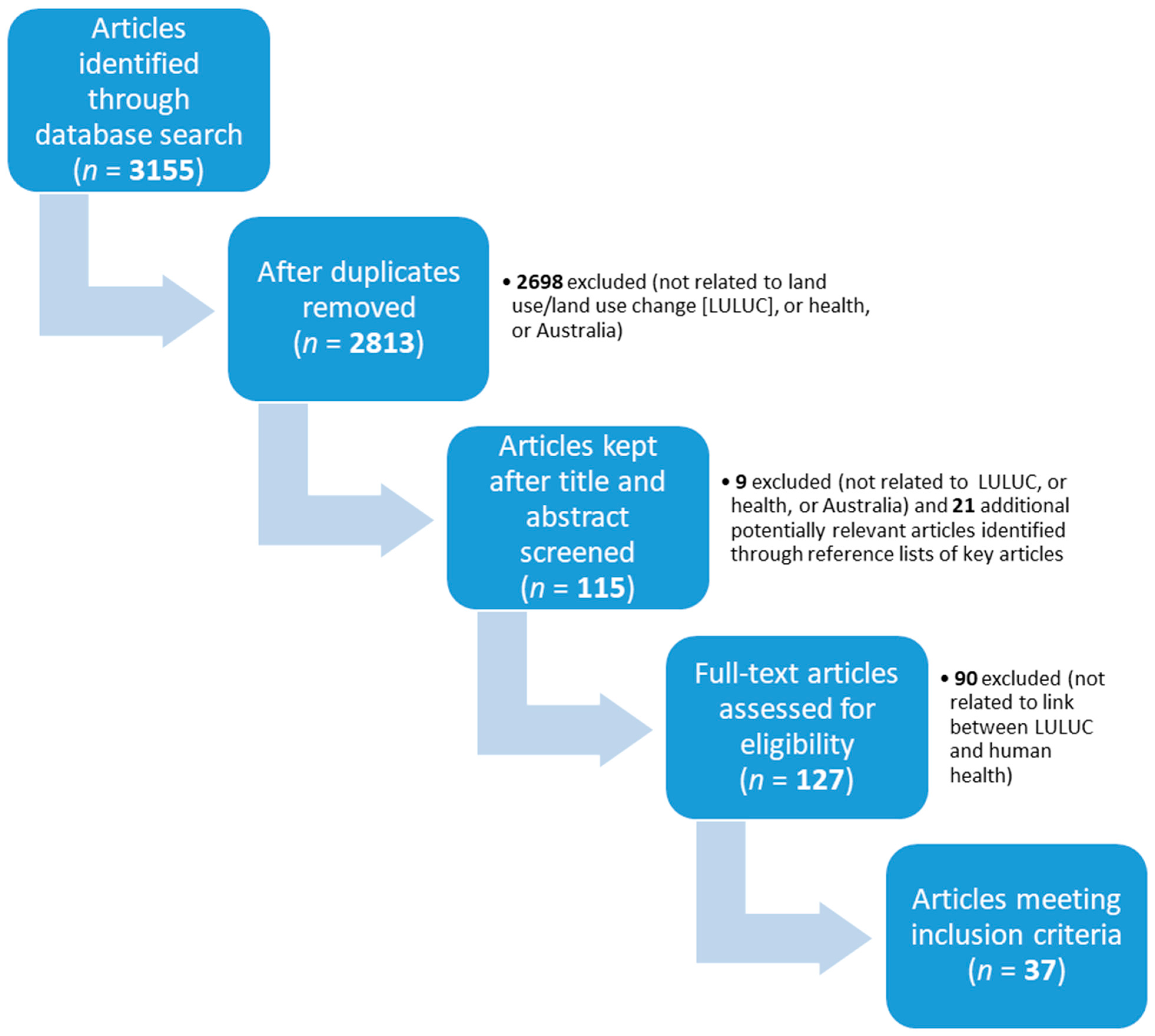
2.2.3. Search Process
2.3. Article Selection (Inclusion/Exclusion Criteria)
2.4. Data Management and Characterization/Charting
3. Analysing, Summarizing, and Reporting the Results
Results
4. Summary of the Literature: Relationship between Land Use Change and Health in Australia
4.1. Agriculture/Grazing
4.2. Dryland Salinity
4.3. Anthropogenic Land Change—General
4.4. Urbanisation
4.5. Contaminated Sites
4.6. Mining
4.7. Traditionally Owned/Ancestral Indigenous Land Managed by Indigenous Communities
5. Discussion
5.1. Land Use/Land-Use Change and Human Health in Australia
5.2. Limitations of the Scoping Study Methods
5.3. Limitations of the Literature Reviewed
5.4. Gaps and Implications for Research, Practice, and Policy
6. Conclusions
Author Contributions
Funding
Conflicts of Interest
References
- Myers, S.S.; Gaffikin, L.; Golden, C.D.; Ostfeld, R.S.; Redford, K.H.; Ricketts, T.H.; Turner, W.R.; Osofsky, S.A. Human health impacts of ecosystem alteration. Proc. Natl. Acad. Sci. USA 2013, 110, 18753–18760. [Google Scholar] [CrossRef]
- Whitmee, S.; Haines, A.; Beyrer, C.; Boltz, F.; Capon, A.G.; Dias, B.F.D.S.; Ezeh, A.; Frumkin, H.; Gong, P.; Head, P.; et al. Safeguarding human health in the Anthropocene epoch: Report of The Rockefeller Foundation–Lancet Commission on planetary health. Lancet 2015, 386, 1973–2028. [Google Scholar] [CrossRef]
- Intergovernmental Panel on Climate Change. Summary for Policymakers. In Climate Change and Land: IPCC Special Report on Climate Change, Desertification, Land Degradation, Sustainable Land Management, Food Security, and Greenhouse Gas Fluxes in Terrestrial Ecosystems; IPCC: Geneva, Switzerland, 2019. [Google Scholar]
- IPBES. Summary for Policymakers of the Global Assessment Report on Biodiversity and Ecosystem Services of the Intergovernmental Science-Policy Platform on Biodiversity and Ecosystem Services; IPBES secretariat: Bonn, Germany, 2019; Available online: https://www.ipbes.net/system/tdf/ipbes_7_10_add-1-_advance_0.pdf?file=1&type=node&id=35245 (accessed on 1 December 2020).
- Australian Goverment Department of Agriculture. Land Use Mapping: Commonwealth of Australia. 2019. Available online: https://www.agriculture.gov.au/abares/aclump/land-use/land-use-mapping (accessed on 1 December 2020).
- Lesslie, R.; Thackway, R.; Smith, J. A National-Level Vegetation Assets, States and Transitions (VAST) Dataset for Australia (version 2.0); Bureau of Rural Sciences: Canberra, Australia, 2010. [Google Scholar]
- Metcalfe, D.J.; Bui, E.N. Australia State of the Environment 2016: Land, Independent Report to the Australian Government Minister for the Environment and Energy; Australian Government Department of the Environment and Energy: Canberra, Australia, 2017. [Google Scholar]
- Bryan, B.A.; Nolan, M.; McKellar, L.; Connor, J.D.; Newth, D.; Harwood, T.; King, D.; Navarro, J.; Cai, Y.; Gao, L.; et al. Land-use and sustainability under intersecting global change and domestic policy scenarios: Trajectories for Australia to 2050. Glob. Environ. Chang. 2016, 38, 130–152. [Google Scholar] [CrossRef]
- Bradshaw, C.J.A. Little left to lose: Deforestation and forest degradation in Australia since European colonization. J. Plant Ecol. 2012, 5, 109–120. [Google Scholar] [CrossRef]
- McFarlane, R.A.; Sleigh, A.C.; McMichael, A.J. Land-use change and emerging infectious disease on an island continent. Int. J. Environ. Res. Public Health 2013, 10, 2699–2719. [Google Scholar] [CrossRef]
- Kessler, M.K.; Becker, D.J.; Peel, A.J.; Justice, N.V.; Lunn, T.; Crowley, D.E.; Jones, D.N.; Eby, P.; Sánchez, C.A.; Plowright, R.K. Changing resource landscapes and spillover of Henipa viruses. Ann. N. Y. Acad. Sci. 2018, 1429, 78–99. [Google Scholar] [CrossRef]
- Páez, D.J.; Restif, O.; Eby, P.; Plowright, R.K. Optimal foraging in seasonal environments: Implications for residency of Australian flying foxes in food-subsidized urban landscapes. Philos. Trans. R. Soc. B Biol. Sci. 2018, 373, 20170097. [Google Scholar] [CrossRef]
- Levac, D.; Colquhoun, H.; Nixon, S.A.; Levac, D.; Colquhoun, H.; Nixon, S.A. Scoping studies: Advancing the methodology. Implement. Sci. 2010, 5, 69. [Google Scholar] [CrossRef]
- Mastel, M.; Bussalleu, A.; Paz-Soldan, V.A.; Salmón-Mulanovich, G.; Valdés-Velásquez, A.; Hartinger-Peña, S.M. Critical linkages between land use change and human health in the Amazon region: A scoping review. PLoS ONE 2018, 13, e0196414. [Google Scholar] [CrossRef]
- Arksey, H.; O’Malley, L. Scoping studies: Towards a methodological framework. Int. J. Soc. Res. Methodol. 2005, 8, 19–32. [Google Scholar] [CrossRef]
- Coutts, C.; Hahn, M. Green infrastructure, ecosystem services, and human health. Int. J. Environ. Res. Public Health 2015, 12, 9768–9798. [Google Scholar] [CrossRef]
- Corvalan, C.; Hales, S.; McMichael, A.J. Ecosystems and human wellbeing: Health synthesis. In Millennium Ecosystem Assessment; WHO: Geneva, Switzerland, 2005; Available online: https://apps.who.int/iris/bitstream/handle/10665/43354/9241563095.pdf (accessed on 1 December 2020).
- Australian Government Department of Health. Australian National Notifiable Diseases by Disease Type 2019. Available online: https://www1.health.gov.au/internet/main/publishing.nsf/Content/cda-surveil-nndss-casedefs-distype.htm (accessed on 1 December 2020).
- Watson, R.T.; Noble, I.R.; Bolin, B.; Ravindranath, N.H.; Verardo, D.J.; Dokken, D.J. (Eds.) Land Use, Land-Use Change and Forestry: A Special Report of the Intergovernmental Panel on Climate Change; Cambridge University Press: Cambridge, UK, 2000. [Google Scholar]
- Jardine, A.; Lindsay, M.; Heyworth, J.; Weinstein, P. Dry-season mosquito breeding associated with irrigation in the Northeast Kimberley Region of Western Australia: Potential impact on mosquito-borne disease transmission. EcoHealth 2004, 1, 387–398. [Google Scholar] [CrossRef]
- Albrecht, G.; Sartore, G.-M.; Connor, L.; Higginbotham, N.; Freeman, S.; Kelly, B.; Stain, H.; Tonna, A.; Pollard, G. Solastalgia: The distress caused by environmental change. Australas. Psychiatry 2007, 15, S95–S98. [Google Scholar] [CrossRef]
- Johnston, F.H.; Jacups, S.P.; Vickery, A.J.; Bowman, D.M.J.S. Ecohealth and aboriginal testimony of the nexus between human health and place. EcoHealth 2007, 4, 489–499. [Google Scholar] [CrossRef]
- Jardine, A.; Lindsay, M.D.; Johansen, C.A.; Cook, A.; Weinstein, P. Impact of dryland salinity on population dynamics of vector mosquitoes (Diptera: Culicidae) of Ross River virus in inland areas of southwestern Western Australia. J. Med. Entomol. 2008, 45, 1011–1022. [Google Scholar] [CrossRef]
- Carver, S.; Spafford, H.; Storey, A.; Weinstein, P. Dryland salinity and the ecology of Ross River virus: The ecological underpinnings of the potential for transmission. Vector-Borne Zoonotic Dis. 2009, 9, 611–622. [Google Scholar] [CrossRef]
- Kaestli, M.; Mayo, M.; Harrington, G.; Ward, L.; Watt, F.; Hill, J.V.; Cheng, A.C.; Currie, B.J. Landscape changes influence the occurrence of the melioidosis bacterium Burkholderia pseudomallei in soil in Northern Australia. PLoS Negl. Trop. Dis. 2009, 3, e364. [Google Scholar] [CrossRef]
- Speldewinde, P.; Cook, A.; Davies, P.; Weinstein, P. A relationship between environmental degradation and mental health in rural Western Australia. Health Place 2009, 15, 880–887. [Google Scholar] [CrossRef]
- Kingsley, J.Y.; Townsend, M.; Phillips, R.; Aldous, D. “If the land is healthy … it makes the people healthy”: The relationship between caring for Country and health for the Yorta Yorta Nation, Boonwurrung and Bangerang Tribes. Health Place 2009, 15, 291–299. [Google Scholar] [CrossRef]
- Carver, S.; Goater, S.; Allen, G.R.; Rowbottom, R.M.; Fearnley, E.; Weinstein, P. Relationships of the Ross River virus (Togoviridae: Alphavirus) vector, Aedes camptorhynchus (Thomson) (Diptera: Culicidae), to biotic and abiotic factors in saltmarshes of south-eastern Tasmania, Australia: A preliminary study. Aust. J. Èntomol. 2011, 50, 344–355. [Google Scholar] [CrossRef]
- Luck, G.W.; Davidson, P.; Boxall, D.; Smallbone, L. Relations between urban bird and plant communities and human well-being and connection to nature. Conserv. Biol. 2011, 25, 816–826. [Google Scholar] [CrossRef]
- Plowright, R.K.; Foley, P.; Field, H.E.; Dobson, A.P.; Foley, J.E.; Eby, P.; Daszak, P. Urban habituation, ecological connectivity and epidemic dampening: The emergence of Hendra virus from flying foxes (Pteropus spp.). Proc. R. Soc. B Boil. Sci. 2011, 278, 3703–3712. [Google Scholar] [CrossRef]
- Speldewinde, P.; Cook, A.; Davies, P.; Weinstein, P. The hidden health burden of environmental degradation: Disease comorbidities and dryland salinity. EcoHealth 2011, 8, 82–92. [Google Scholar] [CrossRef]
- Gillespie, R.; Bennett, J. Valuing the environmental, cultural and social impacts of open-cut coal mining in the Hunter Valley of New South Wales, Australia. J. Environ. Econ. Policy 2012, 1, 276–288. [Google Scholar] [CrossRef]
- Kaestli, M.; Schmid, M.; Mayo, M.; Rothballer, M.; Harrington, G.; Richardson, L.; Hill, A.; Hill, J.; Tuanyok, A.; Keim, P.; et al. Out of the ground: Aerial and exotic habitats of the melioidosis bacterium Burkholderia pseudomallei in grasses in Australia. Environ. Microbiol. 2012, 14, 2058–2070. [Google Scholar] [CrossRef] [PubMed]
- Steiger, D.M.; Johnson, P.; Hilbert, D.W.; Ritchie, S.; Jones, D.; Laurance, S.G. Effects of landscape disturbance on mosquito community composition in tropical Australia. J. Vector Ecol. 2012, 37, 69–76. [Google Scholar] [CrossRef]
- Baral, H.; Keenan, R.J.; Fox, J.C.; Stork, N.E.; Kasel, S. Spatial assessment of ecosystem goods and services in complex production landscapes: A case study from south-eastern Australia. Ecol. Complex. 2013, 13, 35–45. [Google Scholar] [CrossRef]
- McCarron, G. Symptomatology of a Gas Field: An Independent Health Survey in the Tara Rural Residential Estates and Environs. Available online: https://www.gabpg.org.au/wp-content/uploads/2013/11/2013-04-symptomatology_of_a_gas_field_Geralyn_McCarron.pdf (accessed on 2 December 2020).
- Moffatt, J.; Baker, P. Farmers, mining and mental health: The impact on a farming community when a mine is proposed. Rural Soc. 2013, 23, 60–74. [Google Scholar] [CrossRef]
- Queensland Health. Coal Seam Gas in the Tara Region: Summary Risk Assessment of Health Complaints and Environmental Monitoring Data. Available online: https://www.parliament.qld.gov.au/documents/tableoffice/tabledpapers/2013/5413t2306.pdf (accessed on 1 December 2020).
- Stoeckl, N.; Jackson, S.; Pantus, F.; Finn, M.; Kennard, M.J.; Pusey, B.J. An integrated assessment of financial, hydrological, ecological and social impacts of ‘development’ on Indigenous and non-indigenous people in northern Australia. Biol. Conserv. 2013, 159, 214–221. [Google Scholar] [CrossRef]
- Adams, V.M.; Pressey, R.L.; Stoeckl, N. Navigating trade-offs in land-use planning: Integrating human well-being into objective setting. Ecol. Soc. 2014, 19. [Google Scholar] [CrossRef]
- Fearnley, E.J.; Magalhães, R.J.S.; Speldewinde, P.; Weinstein, P.; Dobson, A. Environmental correlates of mental health measures for women in western Australia. EcoHealth 2014, 11, 502–511. [Google Scholar] [CrossRef]
- Haberle, S.G.; Bowman, D.M.J.S.; Newnham, R.M.; Johnston, F.H.; Beggs, P.J.; Buters, J.; Campbell, B.; Erbas, B.; Godwin, I.; Green, B.J.; et al. The macroecology of airborne pollen in Australian and New Zealand urban areas. PLoS ONE 2014, 9, e97925. [Google Scholar] [CrossRef]
- Smith, C.; Skelly, C.; Kung, N.; Roberts, B.; Field, H. Flying-fox species density-A spatial risk factor for Hendra virus infection in horses in Eastern Australia. PLoS ONE 2014, 9, e99965. [Google Scholar] [CrossRef]
- Walton, A.; McCrea, R.; Leonard, R. CSIRO Survey of Community Wellbeing and Responding to Change: CSIRO: Western Downs Region in Queensland, Australia. 2014. Available online: https://www.researchgate.net/profile/Rod_Mccrea/publication/312043695_CSIRO_survey_of_Community_Wellbeing_and_responding_to_change_Western_Downs_region_in_Queensland/links/586c769008ae8fce4919e776.pdf (accessed on 1 December 2020).
- Field, H.E.; Smith, C.S.; De Jong, C.E.; Melville, D.; Broos, A.; Kung, N.; Thompson, J.; Dechmann, D.K.N. Landscape utilisation, animal behaviour and Hendra virus risk. EcoHealth 2016, 13, 26–38. [Google Scholar] [CrossRef]
- Morgan, M.I.; Hine, D.W.; Bhullar, N.; Dunstan, D.A.; Bartik, W. Fracked: Coal seam gas extraction and farmers’ mental health. J. Environ. Psychol. 2016, 47, 22–32. [Google Scholar] [CrossRef]
- Steiger, D.B.M.; Ritchie, S.A.; Laurance, S.G.W. Mosquito communities and disease risk influenced by land use change and seasonality in the Australian tropics. Parasites Vectors 2016, 9, 1–13. [Google Scholar] [CrossRef]
- Werner, A.K.; Watt, K.; Cameron, C.M.; Vink, S.; Page, A.; Jagals, P. All-age hospitalization rates in coal seam gas areas in Queensland, Australia, 1995–2011. BMC Public Health 2015, 16, 125. [Google Scholar] [CrossRef]
- Claflin, S.B.; Webb, C.E. Surrounding land use significantly influences adult mosquito abundance and species richness in urban mangroves. Wetl. Ecol. Manag. 2017, 25, 331–344. [Google Scholar] [CrossRef]
- Vandandorj, S.; Eldridge, D.J.; Travers, S.K.; Delgado-Baquerizo, M. Contrasting effects of aridity and grazing intensity on multiple ecosystem functions and services in Australian woodlands. Land Degrad Dev. 2017, 28, 2098–2108. [Google Scholar] [CrossRef]
- Walsh, M.G.; Wiethoelter, A.; Haseeb, M.A. The impact of human population pressure on flying fox niches and the potential consequences for Hendra virus spillover. Sci. Rep. 2017, 7, 1–13. [Google Scholar] [CrossRef]
- Faust, C.L.; McCallum, H.I.; Bloomfield, L.S.P.; Gottdenker, N.L.; Gillespie, T.R.; Torney, C.J.; Dobson, A.P.; Plowright, R.K. Pathogen spillover during land conversion. Ecol. Lett. 2018, 21, 471–483. [Google Scholar] [CrossRef]
- Liddicoat, C.; Bi, P.; Waycott, M.; Glover, J.; Lowe, A.J.; Weinstein, P. Landscape biodiversity correlates with respiratory health in Australia. J. Environ. Manag. 2018, 206, 113–122. [Google Scholar] [CrossRef]
- Walsh, M.G.; Webb, C. Hydrological features and the ecological niches of mammalian hosts delineate elevated risk for Ross River virus epidemics in anthropogenic landscapes in Australia. Parasites Vectors 2018, 11, 1–11. [Google Scholar] [CrossRef]
- Wijesiri, B.; Deilami, K.; Goonetilleke, A. Evaluating the relationship between temporal changes in land use and resulting water quality. Environ. Pollut. 2018, 234, 480–486. [Google Scholar] [CrossRef]
- Prior, J.H.; Gorman-Murray, A.; McIntyre, E.; Connon, I.; Adams, J.; Madden, B. A geography of residents’ worry about the disruptive effects of contaminated sites. Geogr. Res. 2019, 57, 52–66. [Google Scholar] [CrossRef]
- Plowright, R.K.; Parrish, C.R.; McCallum, H.; Hudson, P.J.; Ko, A.I.; Graham, A.L.; Lloyd-Smith, J.O. Pathways to zoonotic spillover. Nat. Rev. Genet. 2017, 15, 502–510. [Google Scholar] [CrossRef]
- Haswell-Elkins, M.; Bethmont, A. Health concerns associated with unconventional gas mining in rural Australia. Rural. Remote. Health. 2016, 16, 3825. [Google Scholar]
- Maher, P. A review of ’traditional’ aboriginal health beliefs. Aust. J. Rural. Health 1999, 7, 229–236. [Google Scholar] [CrossRef]
- Australian Government Attorney-General’s Department. Native Title: Australian Government. 2019. Available online: https://www.ag.gov.au/nativetitle (accessed on 1 December 2020).
- Garnett, S.; Sithole, B.; Whitehead, P.J.; Burgess, C.P.; Johnston, F.H.; Lea, T. Healthy country, healthy people: Policy implications of links between indigenous human health and environmental condition in tropical Australia. Aust. J. Public Adm. 2009, 68, 53–66. [Google Scholar] [CrossRef]
- Lutschini, M. Engaging with holism in Australian Aboriginal health policy-A review. Aust. N. Z. Health Policy 2005, 2, 15. [Google Scholar] [CrossRef][Green Version]
- Adame, F.; Arthington, A.H.; Waltham, N.J.; Hasan, S.; Selles, A.; Ronan, M. Managing threats and restoring wetlands within catchments of the Great Barrier Reef, Australia. Aquat. Conserv. Mar. Freshw. Ecosyst. 2019, 29, 829–839. [Google Scholar] [CrossRef]
- Gell, P.; Reid, M.; Wilby, R.L. Management pathways for the floodplain wetlands of the southern Murray-Darling basin: Lessons from history. River Res. Appl. 2019, 35. [Google Scholar] [CrossRef]
- Bryan, B.A.; Kandulu, J.M. Cost-Effective Alternatives for Mitigating Cryptosporidium Risk in Drinking Water and Enhancing Ecosystem Services. Available online: https://agupubs.onlinelibrary.wiley.com/doi/full/10.1029/2008WR007606 (accessed on 1 December 2020).
- Hooper, J.; Marx, S. A global doubling of dust emissions during the Anthropocene? Glob. Planet. Chang. 2018, 169, 70–91. [Google Scholar] [CrossRef]
- Marx, S.K.; Kamber, B.S.; McGowan, H.; Denholm, J. Holocene dust deposition rates in Australia’s Murray-Darling Basin record the interplay between aridity and the position of the mid-latitude westerlies. Quat. Sci. Rev. 2011, 30, 3290–3305. [Google Scholar] [CrossRef]
- Marx, S.K.; McGowani, H.; Kamber, B.S.; Knight, J.M.; Denholm, J.; Zawadzki, A. Unprecedented wind erosion and perturbation of surface geochemistry marks the Anthropocene in Australia. J. Geophys. Res. Earth Surf. 2014, 119, 45–61. [Google Scholar] [CrossRef]

| #1 Place Term | #2 Land Use/Land-Use Change Terms | #3 Human Health Terms | Combined Search |
|---|---|---|---|
| Australia | “land use change” OR “land cover change” OR “land clear*” OR “land use” OR “vegetation clear*” OR “land* change*” OR “land degrad*” OR “environment* OR degrad*” OR “eco* degrad*” OR “forest degrad*” OR “forest loss*” OR deforest* OR “environment* change” OR mine OR mining OR agriculture* OR farm OR road OR dam OR urban* OR “natur* environment*” OR “eco* services” OR eco* OR livestock OR irrigation OR desert* | disease OR health OR health status OR respiratory tract diseases OR allerg* OR immun* OR zoono* OR *virus* OR leptospirosis OR ornithosis OR dengue OR malaria OR encephalitis OR melioidosis OR ulcer OR *gattii OR “photorabdus asymbotica” OR *fever OR typhus OR *granulosus OR parasite OR anthrax OR brucellosis OR tularaemia OR mental OR health OR well-being OR “mental illness” OR “mental disorders” OR “nutritional status” | #1 AND #2 AND 3 |
| Article Characteristics | Number (n = 37) of Included Articles, n (%) | Article Number in References |
|---|---|---|
| Publication year | ||
| 2004–2007 | 3 (8.1) | [20,21,22] |
| 2008–2011 | 9 (24.3) | [23,24,25,26,27,28,29,30,31] |
| 2012–2015 | 13 (35.1) | [32,33,34,35,36,37,38,39,40,41,42,43,44] |
| 2016–2020 | 12 (32.4) | [45,46,47,48,49,50,51,52,53,54,55,56] |
| Study Type | ||
| Mixed | 1 (2.7) | [40] |
| Qualitative | 5 (13.5) | [21,22,27,37,38] |
| Quantitative | 31 (83.8) | [20,23,24,25,26,28,29,30,31,32,33,34,35,36,39,41,42,43,44,45,46,47,48,49,50,51,52,53,54,55,56] |
| Location in Australia | ||
| Australia-wide | 3 (8.1) | [46,53,54] |
| Australia-wide urban specific | 2 (5.4) | [42,56] |
| Eastern Australia (area (multi-State)) | 3 (8.1) | [30,43,51] |
| New South Wales | 3 (8.1) | [21,32,49] |
| Northern Territory | 5 (13.5) | [22,25,33,39,40] |
| Queensland | 9 (24.3) | [34,36,37,38,44,45,47,48,55] |
| Southeastern Australia (area (multi-State)) | 2 (5.4) | [29,50] |
| Tasmania | 1 (2.7) | [28] |
| Victoria | 2 (5.4) | [27,35] |
| Western Australian (State) | 6 (16.2) | [20,23,24,26,31,41] |
| No location (model) | 1 (2.7) | [52] |
| Health topic | ||
| Ecosystem goods and services | 3 (8.1) | [35,50,55] |
| Health and wellbeing—general (not disease specific) or multiple health conditions | 12 (32.4) | [21,22,27,29,31,32,36,38,39,40,44,48] |
| Hendra virus | 4 (10.8) | [30,43,45,51] |
| Melioidosis | 2 (5.4) | [25,33] |
| Mental health-specific | 5 (13.5) | [26,37,41,46,56] |
| Mosquito-borne disease—general | 4 (10.8) | [20,34,47,49] |
| Pathogen spillover—general | 1 (2.7) | [52] |
| Pollen counts | 1 (2.7) | [42] |
| Respiratory disease | 1 (2.7) | [53] |
| Ross River virus | 4 (10.8) | [23,24,28,54] |
| LULUC topic | ||
| Agriculture-specific | 2 (5.4) | [20,40] |
| Anthropogenic land change—general | 1 (2.7) | [52] |
| Coal seam gas extraction | 5 (13.5) | [36,38,44,46,48] |
| Contaminated sites | 1 (2.7) | [56] |
| Dryland salinity | 5 (13.5) | [23,24,26,31,41] |
| Multiple land use/change types | 17 (45.9) | [25,28,29,33,34,35,39,42,43,45,47,49,50,51,53,54,55] |
| Open cut coal mine | 3 (8.1) | [21,32,37] |
| Traditionally owned Indigenous land | 2 (5.4) | [22,27] |
| Urbanisation | 1 (2.7) | [30] |
| Citation | Location | LULUC Type and Measure | Health Outcome and Measure | Findings Summary |
|---|---|---|---|---|
| Agriculture/Grazing | ||||
| Impact on Ecosystem Goods and Services, Including Water and Soil Health | ||||
| Baral et al. 2013 [35] | 300 km2 sub-catchment of the Lower Glenelg Basin, southwestern Victoria, Australia | Multiple; based on Land Use and Management classification data, and vegetation classes | Various ecosystem goods and services (EGSs)—timber production, carbon stock, provision of water, water regulation, biodiversity, and forage production; via various existing data | Changes of pasture to managed plantation since the 1970s increased provision of most EGSs. However, compared with pre European condition of intact native vegetation (significantly reduced after conversion to pasture from 1850s) there has been significant loss in total provision of EGSs, coupled with increased demand. |
| Vandandorj et al. 2017 [50] | Southeastern Australia | Multiple; via a Geographical Information System | Soil health and plant production; via soil health index, observation, and field measures | Effects of grazing on ecosystem services were herbivore specific and varied. Critical functions associated with decomposition and nutrients cycling declined with increasing aridity, and these effects were of a greater magnitude than any effects due to grazing. Livestock grazing resulted in reductions in plant biomass, but was associated with greater nitrogen availability (sheep, and to a lesser extent cattle) and decomposition. There was an overall neutral effect of grazing on carbon storage. Phosphorus cycling was one of the ecosystem services less affected by grazing intensity. |
| Wijesiri et al. 2018 [55] | Ningi Creek catchment, North Brisbane Statistical Division, Queensland, Australia | Multiple; data from ‘Queensland Spatial Catalogue’ | Water quality; via surface water samples | Majority of pollutants released into catchment waters came from ‘Water environment’ land use type (marsh, wetland, and other water bodies ecosystems). Concentrations of iron and nitrates in downstream water environment may have been due to agricultural activity upstream—there was an expansion in agriculture land and decreases in water environments over study period. |
| Mosquito Abundance | ||||
| Jardine et al. 2004 [20] | Kununurra, northeast of Kimberley region, Western Australia | Irrigated and non-irrigated land use; measurement unspecified | Adult and larval mosquito abundance; via biological sampling survey | Results indicate mosquito breeding associated with the irrigation area may be responsible for an increased health risk of mosquito-borne disease transmission, at the end of the dry season—a time period not hitherto a risk of mosquito-borne disease transmission. |
| Carver et al. 2011 [28] | Saltmarshes east and northeast of Hobart, Tasmania, Australia | Multiple; via approximation in the field, verified with aerial photographs | Aedes camptorhynchus (Ross River virus vector) abundance; measured via mosquito dipper samples | Mosquito abundance indirectly linked to land use via changes in abiotic and biotic predictors, for e.g., greater abundance of mosquitoes recorded in saltmarshes fringed by agricultural land (compared to natural vegetation-fringed saltmarshes) because of reduced ostracods (mosquito predators) and increases cover of samphire (positively related to mosquito abundance). |
| Other Infectious Disease | ||||
| Kaestli et al. 2009 [25] | Rural area within 50 km radius of Darwin, Northern Territory, Australia | Undisturbed sites and environmentally manipulated areas; via GIS | Presence of soil-dwelling saprophyte bacterium Burkholderia pseudomallei (as risk of melioidosis); via soil DNA extraction and targeting | While not a statistically significance difference between occurrence of B. pseudomallei in disturbed versus undisturbed sites, B. pseudomallei occurrence was significantly associated with different elements in the environment. B. pseudomallei was significantly associated with areas rich in grasses, whereas at environmentally disturbed sites, B. pseudomallei was associated with presence of livestock animals, lower soil pH (from fertilizers), and different combinations of soil texture and colour (associated with anthropogenic disturbance). |
| Kaestli et al. 2012 [33] | Rural Darwin, tropical Top End, Northern Territory, Australia | Native and exotic grasses; measurement unspecified | B. pseudomallei occurrence in plants and soil (as risk of melioidosis); via observational longitudinal field studies and laboratory-based grass inoculation experiments | B. pseudomallei occurs significantly more often in areas with exotic grasses (vs native) |
| Wellbeing | ||||
| Adams et al. 2014 [40] | Daly River catchment; Northern Territory, Australia | Proposed agricultural development in an area of multiple land use types | Perceived wellbeing; via focus groups and cross-sectional questionnaire survey | On average residents placed low importance on economic factors relative to other aspects of wellbeing (biodiversity, socio-cultural, and recreational), and were dissatisfied with proposed development and associated environmental impacts. Differences noted in preferences between Indigenous respondents and those in agriculture who would benefit more in short term from development. |
| Stoeckl et al. 2013 [39] | The Daly River catchment, Northern Territory, Australia | Proposed 110,400 hectares of agricultural development with additional dry season water extraction from surface water systems and groundwater projected | Wellbeing in Indigenous and non-Indigenous people; via simulated financial and socio-cultural impact | Different types of economic growth, with different levels of government sector and agricultural development, and different quantities of water used, were modelled. The high-water use agricultural development scenario has the most detrimental effect on the environment, with relatively modest financial returns. Financial returns for Indigenous people are less than those to Industry and to non-Indigenous people (up to five times as much). Indigenous people not only have more to lose from agricultural ‘development’ (which erodes natural capital) than do non-Indigenous people, but they also have significantly less to gain. |
| Dryland Salinity | ||||
| Mental Health | ||||
| Speldewinde et al. 2009 [26] | Rural south-western corner of Western Australia | Dryland salinity; from landscape mapping databases | Hospital admission for depression; from Western Australian Record Linkage Project | Elevated risk of hospitalisations for depression was associated with residence in areas proportionately more affected by dryland salinity. The spatial analysis also indicated the important role of socio-economic factors, and Aboriginal or Torres Strait Islander identification status as factors predictive of hospitalisation for depression. |
| Fearnley et al. 2014 [41] | Rural southwestern, Western Australia | Dryland salinity data; from existing landscape mapping database | Mental health; via Component Score of Short Form-36 health survey (mailed, self-reported), as part of longitudinal study | No associations found between mental health scores for women, and salinity. Area level measurements of aspects of physical environment may be poor indicators for individual health outcome analyses. At lower spatial scales, any effect of soil salinisation on human health may be difficult to determine independently of socioeconomic factors. |
| Mosquito Abundance | ||||
| Jardine et al. 2008 [23] | Southwestern Western Australia | Dryland salinity; via field surveys and observations | Abundance of Ross River Virus vector Ae. Camptorhynchus; via Encephalitis Vector Surveillance light traps baited with CO2. | Dryland salinity has strong influence on mosquito community structure and is significantly associated with the abundance of mosquitoes. While interaction between salinity and season is also significant, the influence of salinity remained substantial even when seasonal variation taken into account. |
| Carver et al. 2009 [24] | Wheat belt, Western Australian | Dryland salinity; existing categorisation, modified and supplemented by field observations | Abundance of Ae. Camptorhynchus (Ross River virus vector); via larvae counts from pond net samples | Increasing salinity positively related to abundance of mosquitoes. Accordingly, dryland salinity increases the zoonotic potential for Ross River virus transmission primarily by facilitating abundance of Ae. camptorhynchus. |
| Other Chronic Disease | ||||
| Speldewinde et al. 2011 [31] | Rural southwest, Western Australia | Dryland salinity; data from soil and landscape mapping database | Asthma, suicide, ischaemic heart disease, and depression; data from Western Australia’s Data Linkage Unit database | Presence of depression was consistently linked to residence in areas with high salinity and the association of asthma, suicide, and heart disease with salinity was likely attributable to the co-morbidity of the conditions with depression. |
| Anthropogenic Land Change—General | ||||
| Mosquito Abundance | ||||
| Claflin et al. 2017 [49] | Urban mangrove forest sites along the Parramatta River, Sydney, Australia | Multiple; via aerial photographs from Google Maps imagery | Mosquito abundance; via carbon dioxide-baited surveillance traps | The size of the mangrove stand itself had a significant positive effect on mosquito abundance—explained by resource concentration. Also positive (but not significant) relationship between percentage of industrial land and mosquito abundance. Percentage of parkland and open water had no effect on mosquito abundance and percentage of residential land and bushland in surrounding area had strong negative effect on mosquito abundance in urban mangroves—likely through changes in surface water flow in general but also due to below average rainfall preceding surveys. |
| Steiger et al. 2016 [47] | Wet Tropics bioregion of northeastern Australia | Multiple; via field data | Mosquito community structure; collected using Center for Disease Control and Prevention light traps | Results indicated a diverse mosquito community in tropical Australia, and community composition varies considerably between forests and disturbed habitats. Most disease transmitting species predominantly occur in grasslands created by humans, with potential implications for pathogen transmission to humans and wildlife. |
| Steiger et al. 2012 [34] | Tropical lowlands of north Queensland, Australia | Multiple; via field data | Mosquito community structure; collected using Center for Disease Control and Prevention light traps | Mosquito species richness was elevated in anthropogenic grasslands relative to rainforest habitats; the creation of anthropogenic grasslands adjacent to rainforests may increase the susceptibility of species in both habitats to the transmission of novel diseases via observable changes to and mixing of the vector community on rainforest edges. |
| Pollen Counts | ||||
| Haberle et al. 2014 [42] | 11 urban centres across Australia and New Zealand | Multiple—as exist within a 100 km radius of each city’s aerobiology recording station; measurement unspecified | Pollen counts and taxa; from aerobiology recording stations across Australia and New Zealand | While urban areas from similar climate zones have similar pollen spectra but with differences due to surrounding land use and establishment of non-native plants, the only statistically significant factor explaining the difference between airborne pollen in each site, was minimum temperature and mean annual precipitation |
| Respiratory Disease | ||||
| Liddicoat et al. 2018 [53] | Australia-wide | Multiple; via exhaustive Australia-wide gridded mapping datasets | Respiratory disease public hospital admissions; from Social Health Atlas of Australia | Beneficial respiratory health outcomes associated with diversity of major vegetation groups, species richness, proportion of eucalypt forests proportion of open trees, diversity of land use, and proportion of nature conservation. Possible driver for this relationship is protective immunomodulatory influence from microbial diversity and other bioactive agents associated with biodiverse environments. |
| Vector-Borne and Infectious Disease | ||||
| Walsh et al. 2018 [54] | Australia-wide | Multiple: corresponding to geographical coordinates for the location of each Ross River virus epidemic; Google Maps Open Street Map | Epidemics of Ross River virus in humans across Australia; surveillance data | In anthropogenically impacted environments features mediating the movement of water through the landscape and the ecological niche of wildlife hosts promoted landscapes suitable to Ross River virus epidemics. Moderate soil-water balance and proximity to controlled water reservoirs were the two most influential features of Ross River virus landscape suitability. |
| Smith et al. 2014 [43] | Queensland and New South Wales, Australia | Normalised difference vegetation index; via meteorology data | Reported Hendra virus infection in horses; from government authorities | Variation in vegetation index did not significantly explain risk for Hendra virus infection in horses |
| Field et al. 2016 [45] | Boonah, 80 km southwest of Brisbane, Australia | Preferred foraging landscape-type of black flying fox; via GPS data logger | Equine exposure to Hendra virus risk; via GPS data logger of landscape utilisation of black flying-foxes and horses | Flying foxes frequently foraged in degraded remnant native vegetation and/or introduced environmental weed and garden ornamental species—consistent with increased likelihood of flying foxes around rural houses and out-buildings and directly relevant to Hendra virus spillover risk. In addition, seasonally fruiting Ficus—typically planted for stock shade and shelter, but also a favoured flying fox food resource—were present at a third of recurring foraging locations. |
| Walsh et al. 2017 [51] | Eastern Australia | Multiple; via moderate-resolution imaging spectroradiometer | Flying fox habitat suitability and Hendra virus spillovers to horses; from biodiversity, veterinary and government databases | Hendra virus spillovers associated with net increases in human population (human footprint) and resulting changing habitat (land cover) suitable to flying foxes |
| Faust et al. 2018 [52] | - | Anthropogenic land conversion; simulated (mathematical model)—not parameterised for specific locations | Pathogen spillover from wildlife to domestic animals and humans; simulated (mathematical model)—not parameterised for specific diseases | Models highlight changing host population densities and edge effects as mechanisms driving disease emergence in converted landscapes. Time since initial habitat loss, in addition to rate and scale of land conversion, drive changes in infectious disease transmission. A hump-shaped relationship of pathogen transmission between two species occurs across a gradient of land conversion, with highest disease risk at intermediate levels of habitat loss. Largest, but rarest, epidemics occur at extremes of land conversion. |
| Wellbeing | ||||
| Luck et al. 2011 [29] | Nine towns and cities across Victoria and New South Wales, southeastern Australia | Multiple; via field studies and satellite imagery (Advanced Land Observation Satellite) data. | Personal wellbeing, neighbourhood wellbeing, connection to nature, neighbourhood activity level, general activity level; via questionnaire survey using Wellbeing Group 2006 index and modified version of the Connectedness to Nature Scale | Measures of neighbourhood environment weakly related to residents’ personal wellbeing and level of connection to nature. Some evidence that increases in vegetation density associated with increases in personal wellbeing for certain types of residents. Conversely, many environmental variables strongly related to variation in neighbourhood wellbeing across a range of demographic categories, and residents’ satisfaction with their local neighbourhood increased with greater number of bird species, higher proportion of vegetation cover, and lower level of urban development. Nevertheless, demographic variables always the variables most strongly associated with wellbeing or connection to nature. |
| Urbanisation | ||||
| Risk of Zoonotic Disease | ||||
| Plowright et al. 2011 [30] | Eastern Australia | Urbanisation | Birth rate, death rate, seasonality, incidence and distribution of disease parameters, and population and meta-population characteristics of grey-headed and black flying foxes; estimated from experimental, captive and field studies | Loss to various anthropogenic land use changes of 75% of once contiguous forest cover on east coast of Australia—natural food resource of grey-headed and black flying foxes—provides plausible scenario for recent apparent increased frequency of Hendra virus outbreaks. Year-round alternative food in expanding urban and peri-urban areas increases number of flying foxes in contact with human and domestic animal populations and decreases bat migratory behaviour, which could lead to decline in bat population immunity, giving rise to more intense outbreaks after local viral reintroduction. |
| Contaminated Sites | ||||
| Wellbeing | ||||
| Prior et al. 2019 [56] | 13 contaminated sites across urban areas in Australia | Contaminated sites; identified via relevant authorities. | Residents’ worry about disruptive effect of environmental contamination on health and well-being; via telephone questionnaire survey | Female participants, people living with disability or long-term illness, and those living close to contaminated sites were significantly more likely to worry about contamination. Presence of hydrocarbon, metal, and chlorinated solvent were significantly more likely to cause worry about contamination than asbestos. Worries were focused more on how contaminants might disrupt physical health, mental health, and lifestyle, than they were on the effect of the contaminant on flora, fauna, and broader ecosystem. |
| Mining | ||||
| General Health | ||||
| Werner et al. 2016 [48] | Queensland, Australia | Coal seam gas extraction, coal mining, rural/agricultural | Hospitalization rates as measured by ICD-10-AM codes; from Queensland Hospital Admitted Patient Data Collection | Coal seam gas area showed increases in hospitalization rates (compared to rural area, not to coal mining area) for neoplasms and blood/immune diseases. This descriptive-analytic study provided preliminary assessment of hospitalization rates only and did not assess causality. |
| McCarron 2013 [36] | Western Downs Region, Queensland, Australia | Coal seam gas mining | Self-reported or proxy self-report (for children) health; via questionnaire survey | Residents who had previously reported health concerns related to coal seam gas exposure, as well as their near neighbours, were surveyed. One third of people over 6 years reported spontaneous nose bleeds, and almost three quarters reported skin irritation. Eye irritation was reported in over half of children. One third of all children to age 18 were reported to experience paraesthesia. Almost all children aged 6-18 reported suffering from headaches and for over half of these the headaches were severe. Of people aged 6 years and over, severe fatigue and difficulty concentrating was reported for over half. |
| Queensland Health 2013 [38] | Western Downs Region, Queensland, Australia | Coal seam gas extraction; data from various environmental health monitoring reports—odour, fugitive emissions, and noise | Community health complaints relating to coal seam gas activity from residents; data from clinical health reports | On the basis of the clinical and environmental monitoring data included in this summary risk assessment it was concluded by authors that a clear link could not be drawn between health complaints by some residents and impacts of local coal seam gas industry on air, water or soil. |
| Mental Health | ||||
| Morgan et al. 2016 [46]) | Australia-wide | Coal seam gas extraction | Global stress burden and mental health using adapted version of the Edinburgh Farming Stress Inventory, and Depression Anxiety Stress Scales; via questionnaire survey | For farmers recruited via agri-political organizations—New South Wales Farmers Association, Ag Force, and Lock the Gate—concern about coal seam gas impacts on human health, community, and environment (constituting ‘off-farm’), was rated, along with weather and economic viability, as most stressful factor for farmers, and explained significant amount of unique variance in farmers’ depression and stress reactivity (after controlling for more traditional agricultural stressors). Coal seam gas impacts ‘on-farm’—operations, profitability, and personal privacy—were less of a concern to farmers. |
| Wellbeing | ||||
| Walton et al. 2014 [44] | Western Downs Region, southern Queensland, Australia | Coal seam gas extraction | Community wellbeing, community resilience, and expected level of future wellbeing; via questionnaire survey | Overall perceptions of community wellbeing were positive notwithstanding three unsatisfactory aspects—roads, community participation in decision making, and management of environment over long term. There was dissatisfaction with planning for the future, access to relevant information, and leadership within the community (community resilience factors). Residents were not optimistic about the future and expected decline in wellbeing. |
| Albrecht et al. 2007 [21] | Upper Hunter region of New South Wales, Australia | Open-cut coal mining and power industries | Perceived threats to wellbeing and actual lived experience; via key informant, community member, and focus group interviews | Transformation of the regional landscape challenged many participants’ sense of place, identity, physical and mental health, and general wellbeing. Participants also felt powerless to influence the change process. These responses resonate with the dominant components of ‘solastalgia’, which was experienced even by some who worked in the relevant mining and power industries. |
| Moffatt et al. 2013 [37] | Clarence–Moreton coal basin, Queensland, Australia | Mining development proposal: large open-cut coal mine | Perceived psychological impacts for individuals and community; via semi-structured interviews | Semi-structured interviews with range of individuals representing various roles and service industries within the community indicated that the proposed mineral development was source of psychological stress, in farmers in particular. Impacts at individual and family level included a sense of powerlessness; unknown future; interrupted succession plans for young and old; threat of disruption to relationship with the land and landscape; and changed financial circumstances. The proposal also created tensions within the community regarding differential impacts, with some seeing opportunity and others perceiving threat. |
| Gillespie et al. 2012 [32] | Hunter Valley Coalfields, New South Wales, Australia | Proposed extension of open-cut coal mine | Wellbeing; via choice modelling questionnaire | Community well-being declined with increased clearing of endangered ecological communities, loss of highly significant Aboriginal sites, and displacement of rural families from affected villages, but increased with length of time that mine provides employment and with planting or protection of endangered ecological communities as offsets. |
| Traditionally-Owned Ancestral Lands | ||||
| General Health and Wellbeing | ||||
| Johnston et al. 2007 [22] | Arnhem land, northeast corner of Northern Territory, Australia | Traditionally owned Indigenous ancestral lands | Perspectives of health and wellbeing; via observation and unstructured and semi-structured interviews | Major themes which emerged from the observations and interviews with Aboriginal community members, included: the need that both land and people have for each other, for the well-being of both; that traditional lands provided access to traditional food and medicines (and physical activity to get them); a way of escaping from stresses; a means to educating young people; and deeper connection to the past and therefore to Aboriginal identity via traditional stories and beliefs. |
| ‘Yotti’ Kingsley et al. 2009 [27] | Victoria, Australia | Traditional lands of three Australian Aboriginal language groups | Health and wellbeing; via semi-structured interviews | Semi-structured interviews identified that Caring for Country builds self-esteem, fosters self-identity, maintains cultural connection, and enables relaxation and enjoyment through contact with the natural environment. Caring for Country—a traditional practice of over 50,000 years—constitutes a key determinant of the health and wellbeing of Indigenous people in Australia. |
Publisher’s Note: MDPI stays neutral with regard to jurisdictional claims in published maps and institutional affiliations. |
© 2020 by the authors. Licensee MDPI, Basel, Switzerland. This article is an open access article distributed under the terms and conditions of the Creative Commons Attribution (CC BY) license (http://creativecommons.org/licenses/by/4.0/).
Share and Cite
Davey, T.M.; Selvey, L.A. Relationship between Land Use/Land-Use Change and Human Health in Australia: A Scoping Study. Int. J. Environ. Res. Public Health 2020, 17, 8992. https://doi.org/10.3390/ijerph17238992
Davey TM, Selvey LA. Relationship between Land Use/Land-Use Change and Human Health in Australia: A Scoping Study. International Journal of Environmental Research and Public Health. 2020; 17(23):8992. https://doi.org/10.3390/ijerph17238992
Chicago/Turabian StyleDavey, Tamzyn M, and Linda A Selvey. 2020. "Relationship between Land Use/Land-Use Change and Human Health in Australia: A Scoping Study" International Journal of Environmental Research and Public Health 17, no. 23: 8992. https://doi.org/10.3390/ijerph17238992
APA StyleDavey, T. M., & Selvey, L. A. (2020). Relationship between Land Use/Land-Use Change and Human Health in Australia: A Scoping Study. International Journal of Environmental Research and Public Health, 17(23), 8992. https://doi.org/10.3390/ijerph17238992

