


Abstract
Background: There have been few studies reporting the association between health-related quality of life (HRQoL) and osteoarthritis (OA) in female subjects performing aerobic exercise or not. The aim of this study is to compare HRQoL between OA patients and non-OA subjects in middle aged Korean women (40–59 years) with/without aerobic physical activity, and also to identify an association between EQ-5D instrument based HRQoL and OA controlling for aerobic exercise. Methods: This study used the cross-sectional data, the Korea National Health and Nutrition Examination Survey (KNANES) from 2016 to 2017. We only selected those who had completed the evaluations of aerobic physical activity and osteoarthritis diagnosis. In total, 2445 middle aged women were finally selected for this study. The European quality of life-5 dimensions (EQ-5D) was used for the evaluation of HRQoL as a dependent variable. In socio-demographic factors, age, sex, income level, education level, marital status, economic activity, type of insurance and private insurance and behaviour-related factors were included. One-way analysis of variance was conducted to compare the EQ-5D index and multiple linear regression analysis was employed to identify associated factors with the EQ-5D index. Results: In total, 2445 middle aged women were included in this study, in which 2209 participants were normal (90.0%) with aerobic physical activity (no: 55.0%, yes: 45.0%) and 246 participants were diagnosed with osteoarthritis (10.0%) with aerobic physical activity (no: 56.1%, yes: 43.9%). In group 2-2 (OA with aerobic), the moderate level of muscle exercise (less than 5 days per week) showed the highest HRQoL (p < 0.05) and high level exercise showed the lowest HRQoL (p < 0.05). In menopause status, the participants under menopause status showed lower HRQoL (p < 0.05) than those not under menopause status in group 2-2 (OA with aerobic) only. Conclusions: The HRQoL of OA patients was significantly lower than that of normal participants in middle aged Korean women (40–59 years). Especially, OA patients with maintained aerobic physical activity showed significantly higher HRQoL than those without that under controlling covariates such as age, income level, education level, marital status, economic activity, type of insurance, etc.
1. Introduction
Osteoarthritis (OA), causing pain and physical disabilitiy is known as the most common joint disease in the global elderly population due to late-onset degeneration and inflammation of the articular cartilage, which is one of the leading causes of long-term disability with activity limitation and pain, causing low quality of life [1,2,3]. Furthermore, the prevalence of OA dramatically increases with age, as do rates of hospitalization [4]. Moreover, it has been reported that the costs for treatment of OA have come to more than 2000 billion won every year in Korea with increasing social burden [5].
Aerobic physical activities such as walking, jogging, running, and cycling are recommended for health promotion and the prevention of various diseases. Salacinski AJ et al. reported that aerobic exercise showed improved results in gait and pain in individuals with mild-to-moderate knee OA [6]. However, there are also some reports that weight bearing exercise or mechanical loading activity such as treadmill walking or cycling is a possible factor in accelerating the symptoms of OA patients [7,8,9]. Until now, however, there have been few studies determining an optimal aerobic exercise protocol which can enhance health conditions without causing any kind of joint problems or OA symptoms. For this reason, it is not recommended for a patient to engage in weight bearing aerobic activities.
Health-related quality of life (HRQoL) shows physical, cognitive, emotional, and social aspects measured by questionnaires, and evaluates the effect of a disease, disability, or disorder on individual’s life quality [10]. Until now, a lot of HRQoL questionnaires have been developed and are used to evaluate life quality in patients with various diseases or disabilities [11,12,13,14], in which there are two types of instruments—specific instruments and generic instruments. As a generic measure, European quality of life-5 dimensions (EQ-5D) was developed by the EuroQol Group to evaluate [15].
Until now, there have been few studies reporting the association between HRQoL and OA in female subjects performing aerobic exercise or not. The aim of this study is to compare HRQoL between OA patients and non-OA subjects in middle aged Korean women (40–59 years) with/without aerobic physical activity, and also to identify an association between EQ-5D instrument based HRQoL and OA controlling for aerobic exercise.
2. Methods
2.1. Study Population and Data Collection
This study used cross-sectional data from the Korea National Health and Nutrition Examination Survey (KNANES) from 2016 to 2017, which was acquired by the Korea Centers for Disease Control and Prevention (KCDC); the details of this study design and data resource profiles were described by Kweon et al. in 2014 [16]. Detailed descriptions of the methods followed the Guidelines for Use of KNHANES Raw Data and the Final Report of KNHANES sampling frame [16]. Multistage stratified cluster sampling was performed for the household unit selection, and the Institutional Review Board of the Korea Centers for Disease Control and Prevention approved the protocols of this study (11702), obtaining written informed consent forms from all participants. KNHANES data (2016–2017) was used in this study, which included the survey results from a health-related interview, medical examination, and various nutritional assessments. All analytical procedures followed the guidelines for the use of data from KCDC.
We included middle-aged (range: 40–59 years) female participants who completed the following assessments: aerobic physical activity (yes or no) and osteoarthritis diagnosis (yes or no). Participants who were previously diagnosed with OA and/or treated by a physician were included in the OA group; participants who were not diagnosed with OA by physicians via health survey questionnaires in KNHANES were included in the non-OA group (control group). The participants who did not provide an answer, responded to the questionnaire as non-applicable, and were not middle-aged (40–59 years) were excluded from the study (Figure 1). In total, 2445 middle aged women were finally selected in this study.
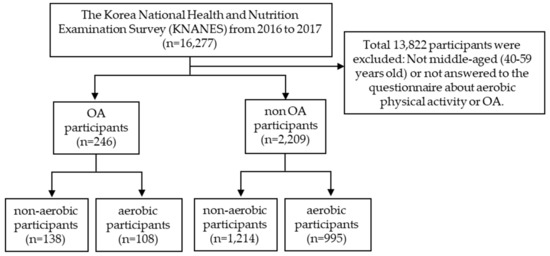
Figure 1.
Flowchart describing the selection criteria for the participants.
The European quality of life-5 dimensions (EQ-5D) was used for the evaluation of HRQoL in this study as a dependent variable. EQ-5D was designed to measure and assess health. It includes the five dimensions of health, such as mobility, self-care, routine activities, pain-discomfort, and anxiety/depression. Each dimension has 3 response categories corresponding to no problems, some problems, and extreme problems. Nam et al. estimated the weight for a quality of life survey using EQ-5D in 2007 [17]. A score of 1, the highest in the EQ-5D index, is considered to be the best health condition, but lower scores indicate a lower HRQoL. The EQ-5D has been widely tested and used in both the general population and patient samples and has been translated into more than 130 different languages. EQ-5D has already been validated as an HRQoL assessment tool in OA patients in 2010 [18]. In OA patients, EQ-5D has already been validated as an HRQoL assessment tool in 2010.
Regarding socio-demographic factors, age (range: 40~59), sex (female only), income (level 1, level 2, level 3, or level 4) education (elementary, middle, high school, or above university), marital status (single, married, or divorced), economic activity (yes or no), type of insurance (local government, company, or national health insurance), and private insurance (yes or no) were included. Health behavior-related factors such as self-related health status (good, fair, or bad), sleeping time (<7, 7+, or 8+ hours per day), drinking (never experience, no drink for 1 year, less than 4 times per month, or more 4 times per month), smoking (non-smoker, past-smoker, or present-smoker), and muscle exercise (no-muscle exercise, less than 5 days per week, or more than 5 days per week) were included as an independent variables. Menopause status (menopause or no-menopause) and obesity (low, normal, or obesity) were also included as independent variables for analysis.
2.2. Statistics
For describing the general characteristics of the participants, the frequency in each group, OA with/without aerobic physical activity and non-OA with/without aerobic physical activity, was compared by the chi-square test. One-way analysis of variance (one-way ANOVA) was conducted to compare the EQ-5D index, and multiple linear regression analysis was employed to identify factors associated with the EQ-5D index. The statistical significance was set at 5% in this study.
3. Results
In total, 2445 middle aged women were included in this study (Table 1), in which 2209 participants were normal (90.0%) with aerobic physical activity (no = 55.0% and yes = 45.0%) and 246 participants were diagnosed with osteoarthritis (10.0%) with aerobic physical activity (no = 56.1% and yes = 43.9%). All variables in the non-OA group showed a statistically significant difference between the aerobic and non-aerobic physical activity groups (p < 0.05). In the OA group, level of income, education, drinking, smoking, sleep time, and muscle exercise showed statistically significant differences between the aerobic and non-aerobic physical activity groups (p < 0.05).

Table 1.
Characteristics of subjects included study.
In group 1-1 (non-OA with non-aerobic activity), there were significant differences in age, income level, education level, marital status, economic activity, type of insurance, self-related health status, menopause status, and obesity (p < 0.05), and most variables in group 1-2 (non-OA with aerobic) showed significant differences (p < 0.05) (Table 2). In group 2-1 (OA with non-aerobic), there were significant differences in income level, marital status, economic activity, type of insurance, self-related health status, and muscle exercise (p < 0.05), and only type of insurance and self-related health status were significantly different in group 2-2 (OA with aerobic) (p < 0.05) (Table 2).
Table 2.
Relationship between aerobic activity and subject characteristics in osteoarthritis and non-osteoarthritis.
Table 3 showed results of multiple linear regression for the EQ-5D. In group 1-1 and 1-2, normal participants in the lowest education level (elementary school) showed lower HRQoL (p < 0.05) than did those in the highest education level (university) and the participants with no economic activity reported lower HRQoL (p < 0.05). In self-related health status, the participants with responding “good” showed the highest HRQoL (p < 0.05) in both group 1-1 and 1-2. In type of insurance, the participants with company insurance showed the highest HRQoL in both group 1-1 and 1-2 (p < 0.05), and group 1-2 showed the lowest HRQoL in no drinking for 1 year (p < 0.05). In sleeping time, more than 8 h sleep showed the highest HRQoL (p < 0.05) than less than 7 h sleep in group 1-1 only. In group 2, the lowest income level showed the lowest HRQoL (p < 0.05) in group 2-1 only and then in type of insurance, the participants with local government insurance showed the highest HRQoL (p < 0.05) in group 2-1 only. In self-related health status, the participants with responding “good” showed the highest HRQoL (p < 0.05) in both group 1-1 and 1-2 as group 1 showed. The participants sleeping more than 8 h per day showed the significant highest HRQoL in group 2-2 only and in muscle exercise, the moderate level (less than 5 days per week) showed the highest HRQoL (p < 0.05) and high level exercise showed the lowest HRQoL (p < 0.05). In menopause status, the participants under menopause status showed lower HRQoL (p < 0.05) than those not under menopause status in group 2-2 only.
Table 3.
Multiple linear regression analysis between osteoarthritis and aerobic activity.
4. Discussion
This research was performed to compare HRQoL between OA patients and non-OA subjects in middle aged Korean women (aged from 40 to 59 years old) controlling for aerobic physical activity, and also to identify an association between EQ-5D instrument based HRQoL and OA, considering aerobic exercise, by using KNHANES data (2016–2017 year).
OA is known as a relatively common musculoskeletal disorder with a high prevalence, increasing with age [19], and there are also gender specific differences which mean that OA is more prevalent in female individuals than male [20,21,22,23]. In previous researches, pain, physical disabilities, decreased mobility (function), and mental health status due to OA have been proven to decrease HRQol of OA patients [24,25,26]. Especially, Yang et al. reported that HRQoL, evaluated with the EQ-5D index, could be affected more negatively by OA in Korean elderly participants in 2017 [27]. In this research, it was demonstrated that OA could affect HRQoL using EQ-5D in middle aged female participants controlling for socio-economic factors and health behaviour-related factors.
Until now, it has been demonstrated that aerobic physical exercise such as walking, jogging, running, and cycling are recommended to improve health conditions and prevent various diseases. Moreover, high or low-intensity aerobic physical exercise was proven to have both short and long-term advantages in improving functional status, gait, pain, and aerobic capacity in patients with knee OA [28]. On the other hand, there have been few articles that have been suggested an optimal aerobic physical activity protocol which can enhance health-related conditions while decreasing the possibility of any kind of joint problems or OA symptoms. However, practicing aerobic physical activity was proven to be effective in improving HRQoL in this study.
In 2015, Fransen et al. reported that land-based therapeutic exercise is beneficial for people with knee OA in terms of reducing joint pain or improving physical function and quality of life.
Several studies have shown that Vitamin D deficiency is associated with reduced articular cartilage thickness, the risk of cartilage degeneration, and the onset of OA. In addition, Szychlinska MA et al. (2019) reported vitamin D supplements as a non-pharmacological treatment in early OA patients with a non-established diagnosis [29].
Moreover, high and low intensity aerobic exercises are equally possible to affect the improvement of physical function, walking, and pain [28,30,31,32]. As several previous studies have reported, there is a consensus that the key process to improve HRQoL of the patients with OA is to release pain and to cover physical function [33,34,35,36,37,38], for which various types of exercises would be recommendable. Especially, several systematic reviews showed that exercises including muscle strengthening or aerobic exercises could be effective for patients with OA [28,30,32]. In our research, keeping aerobic physical activity was identified to affect HRQoL in the patient with OA, which means that a low HRQoL could be raised by aerobic physical activity.
This study has several limitations in interpreting the results. First of all, we could not demonstrate any causal relationship between change in HRQoL and aerobic physical activity in OA patients aged from 40 to 59 years old because the data are not appropriate for the study of causality. Second, it was not possible to adjust whether OA patients were undergoing treatment by any intervention or medication, because the data used in this study did not include those survey categories. Finally, there was no consideration of types of aerobic physical exercise. In the future, it is necessary to overcome those limitations. Further prospective studies with a long follow-up period can be conducted to evaluate the causal effect of aerobic physical activity on HRQoL in middle aged Korean women with OA.
5. Conclusions
This study demonstrated that HRQoL of OA patients was significantly lower than that of normal participants in middle aged Korean women (40–59 y). Especially, OA patients who maintained aerobic physical activity showed significantly higher HRQoL than those who did not, controlling for covariates such as age, income level, education level, marital status, economic activity, type of insurance, etc.
Author Contributions
Conceptualization, M.R.; Methodology, M.R.; Software, S.L.; Validation, M.R.; Formal Analysis, S.L.; Investigation, W.-C.B.; Writing—Original Draft Preparation, H.K. (Ho Kim); Writing—Review & Editing, H.K. (Heejin Kimm); Supervision, H.K. (Heejin Kimm); Project Administration, S.L. All authors have read and agreed to the published version of the manuscript.
Funding
This research received no external funding.
Conflicts of Interest
The authors declare no conflict of interest.
References
- Arden, N.; Nevitt, M.C. Osteoarthritis: Epidemiology. Best Pract. Res. Clin. Rheumatol. 2006, 20, 3–25. [Google Scholar] [CrossRef] [PubMed]
- Shane, A.A.; Loeser, R.F. Why is osteoarthritis an age-related disease? Best Pract. Res. Clin. Rheumatol. 2010, 24, 15–26. [Google Scholar] [CrossRef] [PubMed]
- Bedson, J.; Jordan, K.; Croft, P. The prevalence and history of knee osteoarthritis in general practice: A case-control study. Fam. Pract. 2005, 22, 103–108. [Google Scholar] [CrossRef] [PubMed]
- Murphy, L.; Helmick, C.G. The impact of osteoarthritis in the United States: A population-health perspective. Am. J. Nurs. 2012, 112 (Suppl. 1), S13–S19. [Google Scholar] [CrossRef]
- Health Insurance Review and Assessment Service, National Health Insurance Service. National Health Insurance Statistical Yearbook; Health Insurance Review and Assessment Service, National Health Insurance Service: Wonju, Korea, 2014. [Google Scholar]
- Salacinski, A.J.; Krohn, K.; Lewis, S.F.; Holland, M.L.; Ireland, K.; Marchetti, G. The effects of group cycling on gait and pain-related disability in individuals with mild-to-moderate knee osteoarthritis: A randomized controlled trial. J. Orthop. Sports Phys. Ther. 2012, 42, 985–995. [Google Scholar] [CrossRef] [PubMed]
- Lund, H.; Weile, U.; Christensen, R.; Rostock, B.; Downey, A.; Bartels, E.M.; Danneskiold-Samsøe, B.; Bliddal, H. A randomized controlled trial of aquatic and land-based exercise in patients with knee osteoarthritis. J. Rehabil. Med. 2008, 40, 137–144. [Google Scholar] [CrossRef]
- Miyazaki, T.; Wada, M.; Kawahara, H.; Sato, M.; Baba, H.; Shimada, S. Dynamic load at baseline can predict radiographic disease progression in medial compartment knee osteoarthritis. Ann. Rheum. Dis. 2002, 61, 617–622. [Google Scholar] [CrossRef]
- Mündermann, A.; Dyrby, C.O.; Hurwitz, D.E.; Sharma, L.; Andriacchi, T.P. Potential strategies to reduce medial compartment loading in patients with knee osteoarthritis of varying severity: Reduced walking speed. Arthritis Rheum. 2004, 50, 1172–1178. [Google Scholar] [CrossRef]
- Fayers, P.; Machin, D. Quality of Life: The Assessment, Analysis and Interpretation of Patient-Reported Outcomes, 2nd ed.; John Wiley & Sons Ltd.: Chichester, UK, 2007. [Google Scholar]
- Fishwick, D.; Lewis, L.; Darby, A.; Young, C.; Wiggans, R.; Waterhouse, J.; Wight, J.; Blanc, P.D. Determinants of health-related quality of life among residents with and without COPD in a historically industrialised area. Int. Arch. Occup. Environ. Health 2015, 88, 799–805. [Google Scholar] [CrossRef][Green Version]
- Tan, Z.; Liang, Y.; Liu, S.; Cao, W.; Tu, H.; Guo, L.; Xu, Y. Health-related quality of life as measured with EQ-5D among populations with and without specific chronic conditions: A population-based survey in Shaanxi Province, China. PLoS ONE 2013, 8, e65958. [Google Scholar] [CrossRef]
- Jang, E.S.; Kim, Y.S.; Kim, K.A.; Lee, Y.J.; Chung, W.J.; Kim, I.H.; Lee, B.S.; Jeong, S.H. Factors Associated with Health-Related Quality of Life in Korean Patients with Chronic Hepatitis C Infection Using the SF-36 and EQ-5D. Gut Liver 2018, 12, 440–448. [Google Scholar] [CrossRef]
- Liu, L.; Li, S.; Wang, M.; Chen, G. Comparison of EQ-5D-5L health state utilities using four country-specific tariffs on a breast cancer patient sample in mainland China. Patient Prefer. Adherence 2017, 23, 1049–1056. [Google Scholar] [CrossRef] [PubMed]
- Rabin, R.; de Charro, F. EQ-5D: A measure of health status from the EuroQol Group. Ann. Med. 2001, 33, 337–343. [Google Scholar] [CrossRef] [PubMed]
- Kweon, S.; Kim, Y.; Jang, M.J.; Kim, Y.; Kim, K.; Choi, S.; Chun, C.; Khang, Y.H.; Oh, K. Data resource profile: The Korea National Health and Nutrition Examination Survey (KNHANES). Int. J. Epidemiol. 2014, 43, 69–77. [Google Scholar] [CrossRef] [PubMed]
- Korea Centers for Disease Control and Prevention. 2007 National Health Statistics; Korea Centers for Disease Control and Prevention: Cheongju, Korea, 2007. [Google Scholar]
- Herdman, M.; Gudex, C.; Lloyd, A.; Janssen, M.; Kind, P.; Parkin, D.; Bonsel, G.; Badia, X. Development and preliminary testing of the new five-level version of EQ-5D (EQ-5D-5L). Qual. Life Res. 2011, 20, 1727–1736. [Google Scholar] [CrossRef]
- Pisters, M.F.; Veenhof, C.; van Meeteren, N.L.; Ostelo, R.W.; de Bakker, D.H.; Schellevis, F.G.; Dekker, J. Long-term effectiveness of exercise therapy in patients with osteoarthritis of the hip or knee: A systematic review. Arthritis Rheum. 2007, 57, 1245–1253. [Google Scholar] [CrossRef] [PubMed]
- Van Saase, J.L.; van Romunde, L.K.; Cats, A.; Vandenbroucke, J.P.; Valkenburg, H.A. Epidemiology of osteoarthritis: Zoetermeer survey. Comparison of radiological osteoarthritis in a Dutch population with that in 10 other populations. Ann. Rheum. Dis. 1989, 48, 271–280. [Google Scholar] [CrossRef]
- Mikkelsen, W.M.; Dodge, H.J.; Duff, I.F.; Kato, H. Estimates of the prevalence of rheumatic diseases in the population of Tecumseh, Michigan, 1959–1960. J. Chronic Dis. 1967, 20, 351–369. [Google Scholar] [CrossRef]
- Cunningham, L.S.; Kelsey, J.L. Epidemiology of musculoskeletal impairments and associated disability. Am. J. Public Health 1984, 74, 574–579. [Google Scholar] [CrossRef]
- Felson, D.T.; Naimark, A.; Anderson, J.; Kazis, L.; Castelli, W.; Meenan, R.F. The prevalence of knee osteoarthritis in the elderly. The Framingham Osteoarthritis Study. Arthritis Rheum. 1987, 30, 914–918. [Google Scholar] [CrossRef]
- Cella, D.F.; Tulsky, D.S. Measuring quality of life today: Methodological aspects. Oncology (Williston Park) 1990, 4, 29–38. [Google Scholar]
- Lee, S.; Kim, S.J. Prevalence of knee osteoarthritis, risk factors, and quality of life: The Fifth Korean National Health and Nutrition Examination Survey. Int. J. Rheum. Dis. 2017, 20, 809–817. [Google Scholar] [CrossRef]
- Parker, L.; Moran, G.M.; Roberts, L.M.; Calvert, M.; McCahon, D. The burden of common chronic disease on health-related quality of life in an elderly community-dwelling population in the UK. Fam. Pract. 2014, 31, 557–563. [Google Scholar] [CrossRef] [PubMed]
- Yang, J.H.; Lee, K.; Jung, S.Y.; Bae, W.K.; Ju, H.J.; Cho, I.Y.; Song, J.K.; Park, H.Y.; Han, J.S.; Lee, G.H.; et al. Osteoarthritis Affects Health-Related Quality of Life in Korean Adults with Chronic Diseases: The Korea National Health and Nutritional Examination Surveys 2009–2013. Korean J. Fam. Med. 2017, 38, 358–364. [Google Scholar] [CrossRef] [PubMed]
- Fransen, M.; McConnell, S. Exercise for osteoarthritis of the knee. Cochrane Database Syst. Rev. 2008, 8, CD004376. [Google Scholar]
- Szychlinska, M.A.; Imbesi, R.; Castrogiovanni, P.; Guglielmino, C.; Ravalli, S.; Di Rosa, M.; Musumeci, G. Assessment of Vitamin D Supplementation on Articular Cartilage Morphology in a Young Healthy Sedentary Rat Model. Nutrients 2019, 11, 1260. [Google Scholar] [CrossRef] [PubMed]
- Fransen, M.; McConnell, S.; Bell, M. Therapeutic exercise for people with osteoarthritis of the hip or knee. A systematic review. J. Rheumatol. 2002, 29, 1737–1745. [Google Scholar]
- Van Baar, M.E.; Assendelft, W.J.; Dekker, J.; Oostendorp, R.A.; Bijlsma, J.W. Effectiveness of exercise therapy in patients with osteoarthritis of the hip or knee: A systematic review of randomized clinical trials. Arthritis Rheum. 1999, 42, 1361–1369. [Google Scholar] [CrossRef]
- Smidt, N.; de Vet, H.C.; Bouter, L.M.; Dekker, J.; Arendzen, J.H.; de Bie, R.A.; Bierma-Zeinstra, S.M.; Helders, P.J.; Keus, S.H.; Kwakkel, G.; et al. Effectiveness of exercise therapy: A best-evidence summary of systematic reviews. Aust. J. Physiother. 2005, 51, 71–85. [Google Scholar] [CrossRef]
- Fransen, M.; McConnell, S.; Harmer, A.R.; Van der Esch, M.; Simic, M.; Bennell, K.L. Exercise for osteoarthritis of the knee: A Cochrane systematic review. Br. J. Sports Med. 2015, 49, 1554–1557. [Google Scholar] [CrossRef]
- Roddy, E.; Zhang, W.; Doherty, M. Aerobic walking or strengthening exercise for osteoarthritis of the knee? A systematic review. Ann. Rheum. Dis. 2005, 64, 544–548. [Google Scholar] [CrossRef]
- Nguyen, C.; Lefèvre-Colau, M.M.; Poiraudeau, S.; Rannou, F. Rehabilitation (exercise and strength training) and osteoarthritis: A critical narrative review. Ann. Phys. Rehabil. Med. 2016, 59, 190–195. [Google Scholar] [CrossRef] [PubMed]
- O’Reilly, S.C.; Muir, K.R.; Doherty, M. Effectiveness of home exercise on pain and disability from osteoarthritis of the knee: A randomised controlled trial. Ann. Rheum. Dis. 1999, 58, 15–19. [Google Scholar] [CrossRef] [PubMed]
- Juhl, C.; Christensen, R.; Roos, E.M.; Zhang, W.; Lund, H. Impact of exercise type and dose on pain and disability in knee osteoarthritis: A systematic review and meta-regression analysis of randomized controlled trials. Arthritis Rheumatol. 2014, 66, 622–636. [Google Scholar] [CrossRef] [PubMed]
- Roddy, E.; Zhang, W.; Doherty, M.; Arden, N.K.; Barlow, J.; Birrell, F.; Carr, A.; Chakravarty, K.; Dickson, J.; Hay, E.; et al. Evidence-based recommendations for the role of exercise in the management of osteoarthritis of the hip or knee—The MOVE consensus. Rheumatology 2005, 44, 67–73. [Google Scholar] [CrossRef] [PubMed]
© 2020 by the authors. Licensee MDPI, Basel, Switzerland. This article is an open access article distributed under the terms and conditions of the Creative Commons Attribution (CC BY) license (http://creativecommons.org/licenses/by/4.0/).