


A Profile of Injuries Sustained by Law Enforcement Officers: A Critical Review


Abstract
:1. Introduction
2. Methods
3. Results
4. Discussion
4.1. Musculoskeletal Injury Incidence
4.2. Affected/Injured Body Site
4.3. Nature of Injury
4.4. Mechanism of Injury
4.5. Risk Factors for Injury
4.6. Limitations and Future Research
5. Conclusions
Acknowledgments
Author Contributions
Conflicts of Interest
Appendix A

| Study (n = 16) | Scores Assigned, by Item Number from the Downs and Black Checklist * | |||||||||||||||||||||||||||
|---|---|---|---|---|---|---|---|---|---|---|---|---|---|---|---|---|---|---|---|---|---|---|---|---|---|---|---|---|
| 1 | 2 | 3 | 4 | 5 | 6 | 7 | 8 | 9 | 10 | 11 | 12 | 13 | 14 | 15 | 16 | 17 | 18 | 19 | 20 | 21 | 22 | 23 | 24 | 25 | 26 | 27 | Raw Score | |
| Knapik et al., (2011) [12] | 1 | 1 | 1 | 0 | 1 | 1 | 1 | 1 | 1 | 1 | 1 | 0 | 1 | 1 | 0 | 0 | 0 | 1 | 0 | 13/20 | ||||||||
| Violanti et al., (2013) [7] | 1 | 1 | 1 | 0 | 1 | 1 | 0 | 1 | 1 | 1 | 0 | 0 | 1 | 1 | 0 | 0 | 0 | 0 | 0 | 10/20 | ||||||||
| Cho et al., (2014) [13] | 1 | 1 | 1 | 0 | 1 | 1 | 1 | 1 | 1 | 0 | 0 | 0 | 1 | 1 | 0 | 0 | 0 | 0 | 0 | 10/20 | ||||||||
| Boyce et al., (1992) [4] | 1 | 1 | 1 | 0 | 1 | 1 | 0 | 1 | 1 | 1 | 0 | 0 | 1 | 1 | 0 | 0 | 0 | 0 | 0 | 10/20 | ||||||||
| Superko et al., (1988) [17] | 1 | 1 | 0 | 0 | 1 | 1 | 0 | 0 | 1 | 0 | 0 | 1 | 1 | 1 | 1 | 0 | 0 | 0 | 0 | 9/20 | ||||||||
| Gyi et al., (1998) [15] | 1 | 0 | 1 | 1 | 1 | 1 | 0 | 0 | 1 | 0 | 0 | 0 | 1 | 1 | 0 | 1 | 0 | 0 | 0 | 9/20 | ||||||||
| Burton et al., (1996) [16] | 1 | 1 | 1 | 0 | 1 | 1 | 0 | 0 | 1 | 1 | 0 | 0 | 1 | 1 | 0 | 0 | 0 | 0 | 0 | 9/20 | ||||||||
| Sullivan et al., (1988) [22] | 1 | 1 | 1 | 0 | 1 | 1 | 0 | 0 | 1 | 0 | 1 | 0 | 1 | 1 | 0 | 0 | 0 | 0 | 0 | 9/20 | ||||||||
| Jahani et al., (2002) [11] | 1 | 1 | 1 | 0 | 1 | 1 | 0 | 0 | 1 | 0 | 0 | 0 | 1 | 1 | 0 | 0 | 0 | 0 | 0 | 8/20 | ||||||||
| Holloway-Beth et al., (2016) [5] | 1 | 1 | 1 | 0 | 1 | 1 | 0 | 1 | 0 | 0 | 0 | 0 | 1 | 1 | 0 | 0 | 0 | 0 | 0 | 8/20 | ||||||||
| Nabeel et al., (2007) [20] | 1 | 1 | 0 | 0 | 1 | 1 | 0 | 1 | 0 | 0 | 0 | 0 | 1 | 1 | 0 | 0 | 0 | 0 | 0 | 7/20 | ||||||||
| Reichard et al., (2010) [19] | 1 | 1 | 0 | 0 | 1 | 1 | 0 | 0 | 1 | 0 | 0 | 0 | 1 | 1 | 0 | 0 | 0 | 0 | 0 | 7/20 | ||||||||
| Brandl et al., (2012) [18] | 1 | 1 | 0 | 0 | 1 | 0 | 0 | 0 | 1 | 1 | 0 | 0 | 1 | 1 | 0 | 0 | 0 | 0 | 0 | 7/20 | ||||||||
| Brandl et al., (2003) [21] | 1 | 1 | 0 | 0 | 1 | 0 | 0 | 0 | 1 | 1 | 0 | 0 | 0 | 1 | 0 | 0 | 0 | 0 | 0 | 6/20 | ||||||||
| Larsen et al., (2016) [6] | 1 | 1 | 0 | 0 | 1 | 0 | 0 | 0 | 1 | 0 | 0 | 0 | 0 | 1 | 0 | 0 | 0 | 0 | 0 | 5/20 | ||||||||
| Rhee et al., (2015) [14] | 1 | 1 | 0 | 0 | 1 | 0 | 0 | 0 | 1 | 0 | 0 | 0 | 0 | 1 | 0 | 0 | 0 | 0 | 0 | 5/20 | ||||||||
References
- Bonneau, J.; Brown, J. Physical ability, fitness and police work. J. Clin. For. Med. 1995, 2, 157–164. [Google Scholar] [CrossRef]
- Pryor, R.R.; Colburn, D.; Crill, M.T.; Hostler, D.P.; Suyama, J. Fitness Characteristics of a Suburban Special Weapons and Tactics Team. J. Strength Cond. Res. 2012, 26, 752–757. [Google Scholar] [CrossRef] [PubMed]
- Achterstraat, P. Managing Injured Police: NSW Police Force; Auditor-General, Ed.; Audit Office of New South Wales: Sydney, Australia, 2008. [Google Scholar]
- Boyce, R.W.; Hiatt, A.R.; Jones, G.R. Workers’ compensation claims and physical fitness capacity of police officers. Health Values J. Health Behav. Educ. Promot. 1992, 16, 22–29. [Google Scholar]
- Holloway-Beth, A.; Forst, L.; Freels, S.; Brandt-Rauf, S.; Friedman, L. Occupational Injury Surveillance Among Law Enforcement Officers Using Workers’ Compensation Data, Illinois 1980 to 2008. J. Occup. Environ. Med. 2016, 58, 594–600. [Google Scholar] [CrossRef] [PubMed]
- Larsen, B.; Aisbett, B.; Silk, A. The Injury Profile of an Australian Specialist Policing Unit. Int. J. Environ. Res. Public Health 2016, 13, 370. [Google Scholar] [CrossRef] [PubMed]
- Violanti, J.M.; Fekedulegn, D.; Andrew, M.E.; Charles, L.E.; Hartley, T.A.; Vila, B.; Burchfiel, C.M. Shift work and long-term injury among police officers. Scand. J. Work Environ. Health 2013, 39, 361–368. [Google Scholar] [CrossRef] [PubMed]
- Pope, R.P. Prevention of pelvic stress fractures in female army recruits. Mil. Med. 1999, 164, 370–373. [Google Scholar] [PubMed]
- Pope, R.P. Injury surveillance and systematic investigation identify a rubber matting hazard for anterior cruciate ligament rupture on an obstacle course. Mil. Med. 2002, 167, 359–362. [Google Scholar] [PubMed]
- Drew, M.K.; Cook, J.; Finch, C.F. Sports-related workload and injury risk: Simply knowing the risks will not prevent injuries. Br. J. Sports Med. 2016. [Google Scholar] [CrossRef] [PubMed]
- Jahani, M.R.; Motevalian, S.A.; Asgari, A.R. Musculoskeletal disabilities among police force personnel of the Islamic Republic of Iran. Mil. Med. 2002, 167, 850–852. [Google Scholar] [PubMed]
- Knapik, J.J.; Grier, T.; Spiess, A.; Swedler, D.I.; Hauret, K.G.; Graham, B.; Yoder, J.; Jones, B.H. Injury rates and injury risk factors among federal bureau of investigation new agent trainees. BMC Public Health 2011, 11, 1–16. [Google Scholar] [CrossRef] [PubMed]
- Cho, T.-S.; Jeon, W.-J.; Lee, J.-G.; Seok, J.-M.; Cho, J.-H. Factors Affecting the Musculoskeletal Symptoms of Korean Police Officers. J. Phys. Therapy Sci. 2014, 26, 925–930. [Google Scholar] [CrossRef] [PubMed]
- Rhee, H.Y.; Cho, J.H.; Seok, J.M.; Cho, T.S.; Jeon, W.J.; Lee, J.G.; Kim, S.K. Prevalence of Musculoskeletal Disorders Among Korean Police Personnel. Arch. Environ. Occup. Health 2015, 70, 177–188. [Google Scholar] [CrossRef] [PubMed]
- Gyi, D.E.; Porter, J.M. Musculoskeletal problems and driving in police officers. Occup. Med. (Oxf. Engl.) 1998, 48, 153–160. [Google Scholar] [CrossRef]
- Burton, A.K.; Tillotson, K.M.; Symonds, T.L.; Burke, C.; Mathewson, T. Occupational risk factors for the first-onset and subsequent course of low back trouble: A study of serving police officers. Spine (03622436) 1996, 21, 2612–2620. [Google Scholar] [CrossRef]
- Superko, H.R.; Bernauer, E.; Voss, J. Effects of a Mandatory Health Screening and Physical Maintenance Program for Law Enforcement Officers. Phys. Sportsmed. 1988, 16, 99–109. [Google Scholar] [CrossRef] [PubMed]
- Brandl, S.G.; Stroshine, M.S. The Physical Hazards of Police Work Revisited. Police Quart. 2012, 15, 262–282. [Google Scholar] [CrossRef]
- Reichard, A.A.; Jackson, L.L. Occupational injuries among emergency responders. Am. J. Ind. Med. 2010, 53, 1–11. [Google Scholar] [CrossRef] [PubMed]
- Nabeel, I.; Baker, B.A.; McGrail, M.P., Jr.; Flottemesch, T.J. Correlation between physical activity, fitness, and musculoskeletal injuries in police officers. Minn. Med. 2007, 90, 40–43. [Google Scholar] [PubMed]
- Brandl, S.G.; Stroshine, M.S. Toward an Understanding of the Physical Hazards of Police Work. Police Quart. 2003, 6, 172–191. [Google Scholar] [CrossRef]
- Sullivan, C.S.B.; Shimizu, K.T. Epidemiological studies of work-related injuries among law enforcement personnel. J. Soc. Occup. Med. 1988, 38, 33–40. [Google Scholar] [CrossRef] [PubMed]
- Tricco, A.C.; Tetzlaff, J.; Sampson, M.; Fergusson, D.; Cogo, E.; Horsley, T.; Moher, D. Few systematic reviews exist documenting the extent of bias: A systematic review. J. Clin. Epidemiol. 2008, 61, 422–434. [Google Scholar] [CrossRef] [PubMed]
- Downs, S.H.; Black, N. The feasibility of creating a checklist for the assessment of the methodological quality both of randomised and non-randomised studies of health care interventions. J. Epidemiol. Community Health 1998, 52, 377–384. [Google Scholar] [CrossRef] [PubMed]
- Eng, J.J.; Teasell, R.; Miller, W.C.; Wolfe, D.L.; Townson, A.F.; Aubut, J.A.; Abramson, C.; Hsieh, J.T.; Connolly, S.; Konnyu, K. Spinal Cord Injury Rehabilitation Evidence: Methods of the SCIRE Systematic Review. Top. Spinal Cord. Inj. Rehabil. 2007, 13, 1–10. [Google Scholar] [CrossRef] [PubMed]
- Carlton, S.D.; Orr, R.M. The impact of occupational load carriage on carrier mobility: A critical review of the literature. Int. J. Occup. Saf. Ergon. 2014, 20, 33–41. [Google Scholar] [CrossRef] [PubMed]
- Cocke, C.; Orr, R. The impact of physical training programs on the fitness of tactical populations: A critical review. J. Strength Cond. 2015, 23, 39–46. [Google Scholar]
- MacDonald, D.; Pope, R.; Orr, R. Differences in physical characteristics and performance measures of part-time and full-time tactical personnel: A critical narrative review. J. Mil. Vet. Health 2016, 24, 45–55. [Google Scholar]
- Walker, A.; Pope, R.; Orr, R.M. The impact of fire suppression tasks on firefighter hydration: A critical review with consideration of the utility of reported hydration measures. Ann. Occup. Environ. Med. 2016, 28, 63. [Google Scholar] [CrossRef] [PubMed]
- Viera, A.J.; Garrett, J.M. Understanding interobserver agreement: The kappa statistic. Fam. Med. 2005, 37, 360–363. [Google Scholar] [PubMed]
- Kennelly, J. Reducing Racial/Ethnic Disparities in Reproductive and Perinatal Outcomes, 1st ed.; Springer: New York, NY, USA, 2011. [Google Scholar]
- NHMRC, NHMRC Additional Levels of Evidence and Grades for Recommendations for Developers of Guidelines. Australian Government NHMRC: Canberra, 2009. Available online: https://www.nhmrc.gov.au/_files_nhmrc/file/guidelines/developers/nhmrc_levels_grades_evidence_120423.pdf (accessed on 14 December 2016).
- Moher, D.; Liberati, A.; Tetzlaff, J.; Altman, D.G.; Group, P. Preferred reporting items for systematic reviews and meta-analyses: The PRISMA statement. Int. J. Surg. 2010, 8, 336–341. [Google Scholar] [CrossRef] [PubMed]
- Orr, R.M.; Johnston, V.; Coyle, J.; Pope, R. Reported load carriage injuries of the Australian army soldier. J. Occup. Rehabil. 2015, 25, 316–322. [Google Scholar] [CrossRef] [PubMed]
- Tacconelli, E. Systematic reviews: CRD’s guidance for undertaking reviews in health care. Lancet Infect. Dis. 2010, 10, 226. [Google Scholar] [CrossRef]
- Thiese, M.S. Observational and interventional study design types; an overview. Biochem. Med. 2014, 24, 199–210. [Google Scholar] [CrossRef] [PubMed]
- Junge, A.; Dvorak, J. Influence of Definition and Data Collection on the Incidence of Injuries in Football. Am. J. Sports Med. 2000, 28 (Suppl. 5), S40–S46. [Google Scholar] [CrossRef] [PubMed]
- Andersen, K.A.; Grimshaw, P.N.; Kelso, R.M.; Bentley, D.J. Musculoskeletal Lower Limb Injury Risk in Army Populations. Sports Med. Open 2016, 2, 22. [Google Scholar] [CrossRef] [PubMed]
- Pope, R.; MacDonald, D.; Orr, R. Incidence Rates of Reported Work Health & Safety Incidents & Injuries in Parttime & Full-Time Australian Army Personnel; Bond Institute of Health and Sport: Robina, Australia, 2017. [Google Scholar]
- Poplin, G.S.; Harris, R.B.; Pollack, K.M.; Peate, W.F.; Burgess, J.L. Beyond the fireground: Injuries in the fire service. Inj. Prev. 2012, 18, 228–233. [Google Scholar] [CrossRef] [PubMed]
- Taylor, N.A.S.; Dodd, M.J.; Taylor, E.A.; Donohoe, A.M. A Retrospective Evaluation of Injuries to Australian Urban Firefighters (2003 to 2012): Injury Types, Locations, and Causal Mechanisms. J. Occup. Environ. Med. 2015, 57, 757–764. [Google Scholar] [CrossRef] [PubMed]
- Smith, L.; Westrick, R.; Sauers, S.; Cooper, A.; Scofield, D.; Claro, P.; Warr, B. Underreporting of Musculoskeletal Injuries in the US Army: Findings From an Infantry Brigade Combat Team Survey Study. Sports Health 2016, 8, 507–513. [Google Scholar] [CrossRef] [PubMed]
- Orr, R.M.; Pope, R.; Johnston, V.; Coyle, J. Soldier occupational load carriage: A narrative review of associated injuries. Int. J. Inj. Control Saf. Promot. 2014, 21, 388–396. [Google Scholar] [CrossRef] [PubMed]
- Feuerstein, M.; Berkowitz, S.M.; Peck, C.A., Jr. Musculoskeletal-related disability in US Army personnel: Prevalence, gender, and military occupational specialties. J. Occup. Environ. Med. 1997, 39, 68–78. [Google Scholar] [CrossRef] [PubMed]
- Hauret, K.G.; Jones, B.H.; Bullock, S.H.; Canham-Chervak, M.; Canada, S. Musculoskeletal Injuries. Am. J. Prev. Med. 2010, 38, S61–S70. [Google Scholar] [CrossRef] [PubMed]
- Jones, B.H.; Cowan, D.N.; Tomlinson, J.P.; Robinson, J.R.; Polly, D.W.; Frykman, P.N. Epidemiology of injuries associated with physical training among young men in the army. Med. Sci. Sports Exerc. 1993, 25, 197–203. [Google Scholar] [CrossRef] [PubMed]
- Knapik, J.; Ang, P.; Reynolds, K.; Jones, B. Physical Fitness, Age, and Injury Incidence in Infantry Soldiers. J. Occup. Environ. Med 1993, 35, 598–603. [Google Scholar] [CrossRef]
- Rauh, M.J.; Macera, C.A.; Trone, D.W.; Shaffer, R.A.; Brodine, S.K. Epidemiology of stress fracture and lower-extremity overuse injury in female recruits. Med. Sci. Sports Exerc. 2006, 38, 1571–1577. [Google Scholar] [CrossRef] [PubMed]
- Davidson, P.L.; Chalmers, D.J.; Wilson, B.D.; McBride, D. Lower limb injuries in New Zealand Defence Force personnel: Descriptive epidemiology. Aust. N. Z. J. Public Health 2008, 32, 167–173. [Google Scholar] [CrossRef] [PubMed]
- Jahnke, S.A.; Poston, W.S.C.; Haddock, C.K.; Jitnarin, N. Injury among a population based sample of career firefighters in the central USA. Inj. Prev. 2013, 19, 393–398. [Google Scholar] [CrossRef] [PubMed]
- MacDonald, D.; Pope, R.; Orr, R. Profiling the Incidents and Injuries of Part-Time and Full-Time Soldiers in the Australian Army; Bond Institute of Health and Sport: Robina, Australia, 2017. [Google Scholar]
- James, N. Body Armor for Law Enforcement Officers; Policy, C., Ed.; Congressional Research Service: Washington, DC, USA, 2016. [Google Scholar]
- Cowan, D.N.; Bedno, S.A.; Urban, N.; Yi, B.; Niebuhr, D.W. Musculoskeletal injuries among overweight army trainees: Incidence and health care utilization. Occup. Med. 2011, 61, 247–252. [Google Scholar] [CrossRef] [PubMed]
- Jahnke, S.A.; Poston, W.S.C.; Haddock, C.K.; Jitnarin, N. Obesity and incident injury among career firefighters in the central United States. Obesity 2013, 21, 1505–1508. [Google Scholar] [CrossRef] [PubMed]
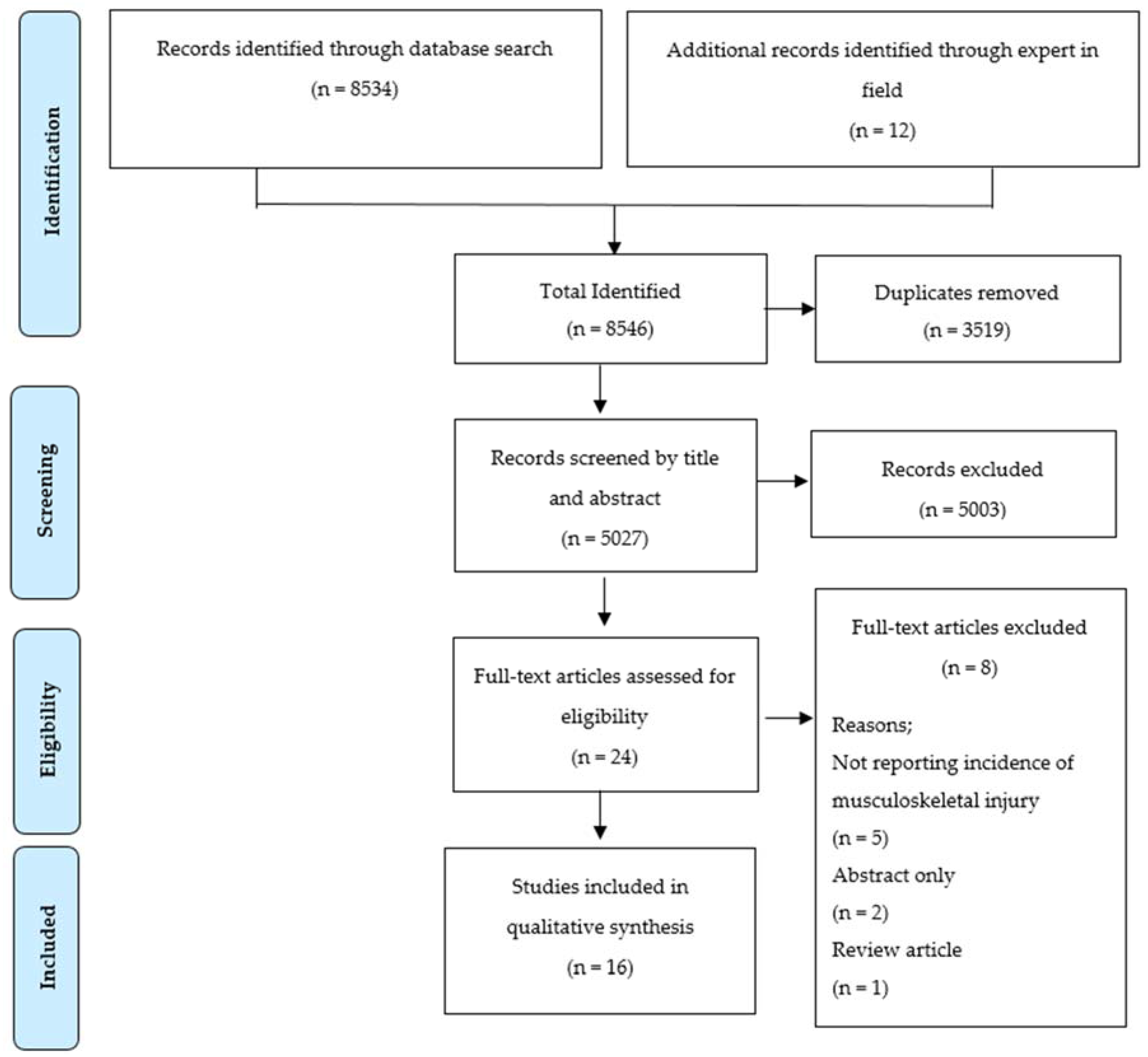
| Database | Search Terms |
|---|---|
| PUBMED | (police OR law enforcement) AND (injury OR injuries) |
| CINAHL | (police OR law enforcement) AND (injury OR injuries) |
| EMBASE | (‘police’/exp OR police OR ‘law’/exp OR law AND enforcement) AND (‘injury’/exp OR injury OR injuries) |
| Ovid MEDLINE (®1946 to September Week 1 2016) | (police OR law enforcement) AND (injury OR injuries) |
| Inclusion Criteria | Example/s |
| Study was focused on law enforcement officers | Studies involving police officers, a police department, or a police force |
| Study examined injuries occurring to, or in, a law enforcement population | Studies examining musculoskeletal injuries, musculoskeletal disability, injury epidemiology, injury rates, injury incidence |
| Exclusion Criteria | Example/s |
| Study involved participants who were not general Law Enforcement officers | Studies involving military police |
| Study examined injuries caused by police officers | Studies reporting police brutality, Taser injuries, excessive use of force by police |
| Study included only injuries that were not musculoskeletal injuries | Studies which only examined fatalities, chemical hazards, HIV, HEP B, Mortality, Homicide, Suicide, mental illness |
| Study reported as an abstract only |
| Database | Identified Studies (n) |
|---|---|
| PUBMED | 3845 |
| CINAHL | 634 |
| EMBASE | 1714 |
| Ovid MEDLINE (®1946 to September Week 1 2016) | 2341 |
| Authors (Year) and [Reference] | Title | Aim/Objective/Hypothesis | Study Design | Data Collection Method | Downs & Black Score | Level of Evidence * |
|---|---|---|---|---|---|---|
| Knapik et al. (2011) [12] | Injury rates and injury risk factors among federal bureau of investigation new agent trainees | To prospectively examine potential risk factors and injury rates in a cohort of FBI new agents. | Prospective Cohort Study | Database | 65.00% | II |
| Violanti et al. (2013) [7] | Shift work and long-term injury among police officers | To determine whether the incidence of long-term injury leave varies across shifts. | Cross-sectional Study | Point of care | 50.00% | IV |
| Cho et al. (2014) [13] | Factors Affecting the Musculoskeletal Symptoms of Korean Police Officers | To investigate efficient, systematic management of the Korean police and to examine the status and prevention of musculoskeletal disorders in Korean police officers. | Cross-sectional Questionnaire Study | Self-report | 50.00% | IV |
| Boyce et al. (1992) [4] | Workers’ compensation claims and physical fitness capacity of police officers | To compare level of physical fitness with workers’ compensation claims among 514 police officers. | Cross-sectional Study | Point of care | 50.00% | IV |
| Superko et al. (1988) [17] | Effects of a Mandatory Health Screening and Physical Maintenance Program for Law Enforcement Officers | To present findings regarding the effects of a mandatory health assessment, physical performance testing, and disease prevention program used by the California Highway Patrol. | Retrospective Cohort Study (Pre-Post Intervention Study using two retrospective cohorts) | Database | 45.00% | IV |
| Gyi et al. (1998) [15] | Musculoskeletal problems and driving in police officers | To examine the effect of driving on sickness absence and prevalence data for musculoskeletal troubles of police officers. | Cross-sectional Questionnaire Study | Self-report | 45.00% | IV |
| Burton et al. (1996) [16] | Occupational risk factors for the first-onset and subsequent course of low back trouble: a study of serving police officers | To determine the hazard for first-onset and subsequent course of low back trouble associated with occupational physical and psychosocial stressors. | Cross-sectional Questionnaire Study | Self-report | 45.00% | IV |
| Sullivan et al. (1988) [22] | Epidemiological studies of work-related injuries among law enforcement personnel | To calculate the work-related injury only rates for employees working in different assignments; to see if there were sex or age differences in injury rates for workers performing similar assignments; to learn how the injuries occurred; and to examine the impact of these injuries in terms of days lost from work and claim costs. | (1) Cross-sectional descriptive study with ‘nested’/linked: (2) retrospective cohort study; and (3) prospective cohort study components | Database | 45.00% | (1) IV (2) III-2 (3) II |
| Jahani et al. (2002) [11] | Musculoskeletal disabilities among police force personnel of the Islamic Republic of Iran | To assess the frequency of musculoskeletal disabilities in police force personnel and to determine the association between disabilities and age, rank, and different job types. | Retrospective Cohort Study | Database | 40.00% | III-2 |
| Holloway-Beth et al. (2016) [5] | Occupational Injury Surveillance Among Law Enforcement Officers Using Workers’ Compensation Data, Illinois 1980 to 2008 | To use Illinois Workers’ Compensation Commission data to (1) determine the annual and cumulative claim rates for injuries suffered by law enforcement personnel; (2) describe the causes and nature of occupational injuries suffered by the four major groups of law enforcement officers; and (3) evaluate three important workers’ compensation outcomes related to long-term impacts of on-the-job injury or illness. | Retrospective Cohort Study | Database | 40.00% | III-2 |
| Nabeel et al. (2007) [20] | Correlation between physical activity, fitness, and musculoskeletal injuries in police officers | To explore whether Minneapolis police officers who had higher levels of fitness and physical activity has fewer musculoskeletal injuries than those who were not as active or fit. | Cross-sectional Questionnaire Study | Self-report | 35.00% | IV |
| Reichard et al. (2010) [19] | Occupational injuries among emergency responders | To address the limited availability of nonfatal injury information for Emergency Medical Services personnel, fire fighters, and police (herein grouped as emergency responders) and the lack of comparable data, the authors analysed occupational injuries and illnesses among these workers which were treated in U.S. hospital emergency departments 2000–2001. | Retrospective Cohort Study | Database | 35.00% | III-2 |
| Brandl et al. (2012) [18] | The Physical Hazards of Police Work Revisited | To examine the extent to which injuries to police officers have changed from 1996–1998 to 2006–2008. | Retrospective Cohort Study | Database | 35.00% | III-2 |
| Brandl et al. (2003) [21] | Toward an Understanding of the Physical Hazards of Police Work | To analyze the nature and frequency of police injuries sustained either by accident or assault for police officers and comparing these to injuries sustained by fire fighters to develop a more complete appreciation of the relative hazards of police work. | Retrospective Cohort Study | Database | 30.00% | III-2 |
| Larsen et al. (2016) [6] | The Injury Profile of an Australian Specialist Policing Unit | To quantify the number of isolated versus multiple injuries in the force and to investigate the associated costs and time away from work following work-related injury. | Retrospective Cohort Study | Database | 25.00% | III-2 |
| Rhee et al. (2015) [14] | Prevalence of Musculoskeletal Disorders Among Korean Police Personnel | To investigate efficient, systematic management of the Korean police and to examine the status and prevention of musculoskeletal disorders in Korean police officers. | Retrospective Cohort Study | Database | 25.00% | III-2 |
| Authors (Year) and [Reference] | Title | Injury Definition | Participant Details | Main Findings |
|---|---|---|---|---|
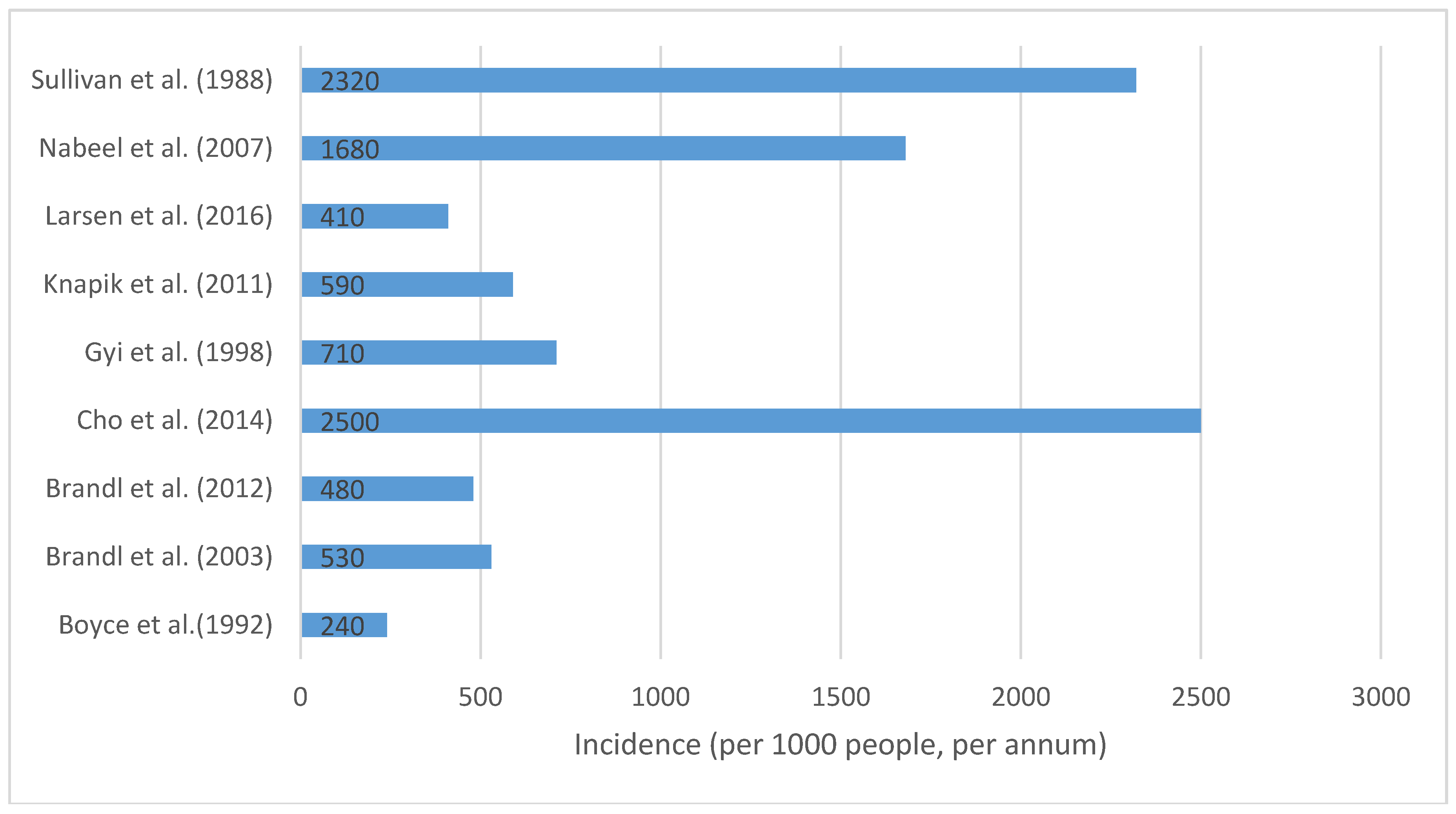
| Knapik et al. (2011) [12] | Injury rates and injury risk factors among federal bureau of investigation new agent trainees | An injury case was defined as a new agent who sustained physical damage to the body and sought medical care or medical compensation one or more times during the Federal Bureau of Investigation (FBI) new agent training course. | FBI new agents (n = 531) Males (n = 426) 24.4–29.9 years (n = 188) 30.0–38.6 years (n = 238) Females (n = 105) 24.1–29.9 years (n = 60) 30.0–37.0 years (n = 45) | One or more injuries during FBI academy training was recorded for 35% of men and 42% of women. Defensive tactics training accounted for the highest number of total injuries at 58%. For both male and female injury risk was increased with slower 300 m sprint, 1.5 mile run, and lower points on the physical fitness test. In males, increased age was also a significant risk factor for injury. 590 injuries per 1000 personnel, per year. |
| Violanti et al. (2013) [7] | Shift work and long-term injury among police officers | No Injury definition | Police officers from the Buffalo Police Department (n = 419) Males (n = 312) Females (n = 107) Average age 43 years old | Night shift had the highest incidence of long-term injuries >90 days compared to afternoon and day shifts. Officers on night shift also had a greater risk of long-term injury compared to short-term. Incidence rate per 100,000 person hours: Day shift: 0.48 Afternoon shift: 0.59 Night shift: 1.33 |
| Cho et al. (2014) [13] | Factors Affecting the Musculoskeletal Symptoms of Korean Police Officers | Definition of musculoskeletal disorders is damage to nerves/muscles in the neck, shoulder, waist, arm/leg, and surrounding body tissues caused by repetitive motion, inappropriate position, use of excessive force, physical contact with sharp surfaces, vibration, temperature, etc. | Police officers (n = 353) All male (100%) Mean age (Standard Deviation [SD]) = 52.92 (8.71) years old | Area of injury and prevalence: Shoulder (44.2%) Waist (41.4%) Neck/head (31.2%) Legs/foot (26.1%) Hand/wrist/finger (16.7%) Arm/elbow (14.7%) 2500 injuries, per 1000 personnel, per year. |
| Boyce et al. (1992) [4] | Workers’ compensation claims and physical fitness capacity of police officers | No Injury definition | Police officers (n = 514): Collected workers compensation (n = 124) Males (n = 96) Mean age (SD) = 33 (7.3) years old Females (n = 30) Mean age (SD) = 30.3 (5.3) years old Didn’t collect workers compensation (n = 390) Males (n = 340) Mean age (SD) = 36.3 (8.4) years old Females (n = 48) Mean age (SD) = 30.2 (5.9) years old | Significantly more females collected workers’ compensation payments than males (p < 0.002) Officers with the rank of sergeant or higher had significantly lower rates of claims for workers’ compensation (p < 0.001) Of the males that did collect workers compensation they were significantly younger (p < 0.001) The lowest workers compensation claims came from those who were either in the highest or lowest fitness level. 240 injuries, per 1000 personnel, per year. |
| Superko et al. (1988) [17] | Effects of a Mandatory Health Screening and Physical Maintenance Program for Law Enforcement Officers | No Injury definition | California Highway Patrol Officers Baseline testing (n = 4480) 98.2% male 1.8% female | Medical referrals and Job actions Significant decreases in annual sick days, job-related injuries and cost of injuries (p < 0.001) Body fat and Injuries Uninjured officers had a significantly lower percentage of body fat than those injured (p < 0.001) Injury rates not reported. |
| Gyi et al. (1998) [15] | Musculoskeletal problems and driving in police officers | No Injury definition | Study Group (n = 80) Traffic control officers Males (n = 79) Females (n = 1) Mean age (SD) = 37.65 (7.7) years old Control Group (n = 91) General duty officers Males (n = 87) Females (n = 4) Mean age (SD) = 36.76 (9.11) years old | Lower back was the most frequently reported area of discomfort for traffic control officers driving cars at 35% of all injuries. The mean prevalence of lower back conditions was 28% for the study and control groups. Over 12 months, traffic control officers had a higher incidence of >8 days missed due to lower back trouble when compared with the control. 710 injuries, per 1000 personnel, per year. |
| Burton et al. (1996) [16] | Occupational risk factors for the first-onset and subsequent course of low back trouble: a study of serving police officers | No Injury definition | Police officers (n = 1885) Royal Ulster Constabulary (exposed to heavy body armour) officers (n = 1508) Male (92%) Female (8%) Mean age (SD) = 38.3 (8.8) years old Greater Manchester Police officers (n = 377) Male (87%) Female (13%) Mean age (SD) = 37.5 (7.2) years old | Those who were exposed to either vibration or increased time wearing heavy body armour had an increased injury incidence rate. However no injury rates were reported. |
| Sullivan et al. (1988) [22] | Epidemiological studies of work-related injuries among law enforcement personnel | No Injury definition | Los Angeles County Sheriff’s Department Employees Descriptive Injury claims (n = 2167) RetrospectiveWorkers’ compensation claims (n = 417) Prospective Claims followed until close or up to 2 years (n = 261) | Descriptive No difference in injury rates between gender 30–34 age group showed the highest incidence of injury 27 injuries, per 100 employees, per year Retrospective Wrist/hand (n = 61), back (n = 42) and knee (n = 27) were the three most common areas of injury 38% of back injuries were repeat injuries Overexertion was significantly linked with new back injuries (p < 0.005) Prospective Back injuries caused the most days off full duty and cost more than all other injuries 2380 injuries, per 1000 personnel, per year |
| Jahani at al. (2002) [11] | Musculoskeletal disabilities among police force personnel of the Islamic Republic of Iran | Musculoskeletal disease cases were defined as any case of disabilities in which the diagnosis was in domain of musculoskeletal diseases, including skeletal/joint impairments or limitation of motion, muscle injuries, peripheral nerve neuritis or neuralgia in upper and lower extremities, neck and trunk. | Police force personnel musculoskeletal disability cases (n = 669) Mean age (SD) = 38.7 (7.5) years old | Musculoskeletal disorders accounted for 25.7% of all physical disability in the police force personnel. Back disorders accounted for 43.6% of total musculoskeletal disorders. Commissioned officers had the highest number of back disorders compared to non-commissioned officers (p < 0.0001) Non-commissioned officers had higher numbers of dislocations and fractures compared to commissioned (p < 0.001) |
| Holloway-Beth et al. (2016) [5] | Occupational Injury Surveillance Among Law Enforcement Officers Using Workers‘ Compensation Data, Illinois 1980 to 2008 | No Injury definition | Law enforcement personnel claims (n = 18,892) 45% Correctional institutions Mean age (SD) = 37.5 (10) 26% Municipal police Mean age (SD) = 37.2 (8.9) 22% Sheriff’s department Mean age (SD) = 39.7 (10.3) 7% State police Mean age (SD) = 38.9 (8.9) | Upper extremity was the most common body part affected (>26% in all law enforcement) Correctional officers had the highest number of injuries, but the lowest severity |
| Nabeel et al. (2007) [20] | Correlation between physical activity, fitness, and musculoskeletal injuries in police officers | No Injury definition | Active duty police officers from the Minneapolis Police Department (n = 322) Patrol officers (n = 198) Administration (n = 63) Special assignment (n = 61) Mean age 38 years old | Body Mass Index (BMI) >35 kg/m2 = 3 times more likely to report back pain (95% Confidence Interval [CI] 1.17–9.66) Fair or poor rating of health = 8 times more likely to report chronic pain (95% CI 1.94–37.12) 1680 injuries per 1000 personnel, per year. |
| Reichard et al. (2010) [19] | Occupational injuries among emergency responders | No Injury definition | Emergency responders work-related injuries (n = 123,900) Of this 52% was Law enforcement officer work-related injuries (n = 64,800) Male (87%) Female (13%) <25 years old (n = 3000) 25–34 years old (n = 34,200) 35–44 years old (n = 18,100) >44 years old (n = 9500) | 34% of law enforcement injuries were sprains/strains Law enforcement injuries, top 4 injury areas; 26% were to the leg and foot 19% were to the hand 17% were to the neck & back 17% were to the arm |
| Brandl et al. (2012) [18] | The Physical Hazards of Police Work Revisited | No Injury definition | Milwaukee Police Department officer 1996–1998 officers (n = 1713) Total injuries (n = 2867) 2006–2208 officers (n = 1604) Total injuries (n = 2112) | 1996–1998 Sprain/strain (17.1%) Other muscle pain (17.2%) Occurred controlling/arresting subject (42.9%) 2006–2008 Sprain/strain (22.7%) Other muscle pain (20.2%) Occurred controlling/arresting subject (38.5%) 480 injuries, per 1000 personnel, per year. |
| Brandl et al. (2003) [21] | Toward an Understanding of the Physical Hazards of Police Work | No Injury definition | Patrol officers/detectives (n = 1700) Police injury reports (n = 1054) | Sprain/strain (18.9%) Other muscle pain (15.6%) Occurred controlling/arresting subject (43.8%) Medical attention sought (50.8%) Time off work (13.3%) Rate of injury incidents per officer = 0.610 530 injuries, per 1000 personnel, per year. |
| Larsen et al. (2016) [6] | The Injury Profile of an Australian Specialist Policing Unit | Injury was defined as any mild physical harm (e.g., bruises), or any major physical harm involving outpatient or inpatient treatment | Police officers (n = 170) | Injured officers (n = 138) Total injuries (n = 229) Injuries per employee (n = 2.57) Isolated injuries (34.9%) Multiple injuries (65.1%) Occurred during operational policing duty (48.9%) Attributed to non-compliant offender (31.4%) Sprain/Strain (61.1%) Top 3 injury areas; Hand/wrist (21%) Back (16.6%) Head/neck (16.2%) 410 injuries, per 1000 personnel, per year. |
| Rhee et al. (2015) [14] | Prevalence of Musculoskeletal Disorders Among Korean Police Personnel | Health disorders that occur in the neck, shoulder, waist, and upper and lower extremities, and adjacent tissues by hazardous factors such as repetitive motion. | Police officers who visited the Seoul police hospital 2009 (n = 40,963) 2010 (n = 48,184) | X-ray, Computed Tomography (CT) and MRI scans were most common for lower extremity and spine disorders (p < 0.05) Knee and lumbar examinations were the most frequent (p < 0.05) |
© 2017 by the authors. Licensee MDPI, Basel, Switzerland. This article is an open access article distributed under the terms and conditions of the Creative Commons Attribution (CC BY) license ( http://creativecommons.org/licenses/by/4.0/).
Share and Cite
Lyons, K.; Radburn, C.; Orr, R.; Pope, R. A Profile of Injuries Sustained by Law Enforcement Officers: A Critical Review. Int. J. Environ. Res. Public Health 2017, 14, 142. https://doi.org/10.3390/ijerph14020142
Lyons K, Radburn C, Orr R, Pope R. A Profile of Injuries Sustained by Law Enforcement Officers: A Critical Review. International Journal of Environmental Research and Public Health. 2017; 14(2):142. https://doi.org/10.3390/ijerph14020142
Chicago/Turabian StyleLyons, Kate, Cameron Radburn, Robin Orr, and Rodney Pope. 2017. "A Profile of Injuries Sustained by Law Enforcement Officers: A Critical Review" International Journal of Environmental Research and Public Health 14, no. 2: 142. https://doi.org/10.3390/ijerph14020142
APA StyleLyons, K., Radburn, C., Orr, R., & Pope, R. (2017). A Profile of Injuries Sustained by Law Enforcement Officers: A Critical Review. International Journal of Environmental Research and Public Health, 14(2), 142. https://doi.org/10.3390/ijerph14020142

