Abstract
The exposure to tobacco smoke during pregnancy is considered to be amongst the most harmful avoidable risk factors. In this scientometric and gender study scientific data on smoking and pregnancy was analyzed using a variety of objective scientometric methods like the number of scientific contributions, the number of citations and the modified h-index in combination with gender-specific investigations. Covering a time period from 1900 to 2012, publishing activities of 27,955 authors, institutions and countries, reception within the international scientific community and its reactions were analyzed and interpreted. Out of 10,043 publications the highest number of scientific works were published in the USA (35.5%), followed by the UK (9.9%) and Canada (5.3%). These nations also achieve the highest modified h-indices of 128, 79 and 62 and the highest citation rates of 41.4%, 8.6% and 5.3%, respectively. Out of 12,596 scientists 6,935 are female (55.1%), however they account for no more than 49.7% of publications (12,470) and 42.8% of citations (172,733). The highest percentage of female experts about smoking and pregnancy is found in Australasia (60.7%), while the lowest is found in Asia (41.9%). The findings of the study indicate an increase in gender equality as well as in quantity and quality of international scientific research about smoking and pregnancy in the future.
1. Introduction
It has been proven in many studies that smoking tobacco throughout pregnancy is one of the single most important avoidable causes of adverse pregnancy outcomes, resulting in severe short and long-term negative effects for the mother and the unborn child [1,2,3,4]. However, a detailed gender-specific scientometric investigation about smoking and pregnancy has not been published. The aim of this study is to close this gap by analyzing and evaluating scientific data on smoking and pregnancy. Additionally, the investigation of the gender of the authors in connection with their productivity and reception within the international scientific community is in the focus of the study, since there has been repeatedly stated an under-representation of female authors in scientific works [5,6,7].
If compared with other risk factors in the perinatal period, exposure to tobacco smoke is considered to be amongst the most harmful [4]. The byproducts of combustion are believed to inflict more damage on the fetus than the nicotine itself, but due to the complexity and number of dangerous substances it is unknown which toxic effect is caused by exactly which product [8]. This is especially significant as the majority of the smoking-induced harm for the unborn fetus is permanent. Even today, modern medicine offers very little or no therapeutic treatments for the long-term negative consequences of being exposed to smoke in-utero [9]. The complete cessation of smoking during pregnancy includes numerous health benefits for both the future mother and her offspring [10]. In recent years smoking and pregnancy and its different negative effects on the health of mother and child have become the focus of numerous scientific works. This illustrates the current importance of this topic as a research area.
Scientometry (literally: measurement of science) is a scientific field examining the development, structure, productivity and interconnectivity of scientific work. Quantitative and qualitative analyses are performed by means of scientometric instruments [11]. Today bibliometric analyses grow in significance, as funding for many scientific projects is connected to their respective bibliometric achievement. The significance of scientometric analyses of scientific activity and productivity is undeniable, as funding and therefore indirectly the very existence of institutions are often linked to their scientific output and performance. Important financial support for costly scientific projects is often only provided to those institutions which manage to return the most scientific value for the invested funding [12].
2. Experimental Section
A collective volume of 10,043 entries about smoking and pregnancy and the corresponding bibliographic data covering a time period from 1900 to December 2012 was obtained from the Thomson Reuters Web of Science (WoS) data base, which is the only multidisciplinary database in the field of medical science which provides bibliographic data in combination with citations.
In order to arrive as closely as possible at capturing all of the available scientometric data the combination of the termini tobac* and pregnanc* or cigar* and pregnanc* or smok* and pregnanc* was used in the search field. The asterisk (*) was used as a wildcard and enabled the search of any letters in its place. All types of publications were retrieved, since the aim was to provide a survey of the entire scientific output.
The scientific works about smoking and pregnancy were analyzed according to year of publication, number of citations per year, language and form of publication. The bibliography and its development over time as well as the average citation rate per publication was calculated and assessed. The countries of origin were identified and assigned to the respective publications. National modified h-indices as well as national citation rates were calculated for each country.
The authors contributing publications about smoking and pregnancy were investigated to determine the most productive and most cited scientists. The average citation rate and modified h-indices of the most productive specialists were calculated and compared. A modified h-index based on the original h-index was used in this work to exclusively evaluate their scientific importance about smoking and pregnancy. The data was further analyzed to evaluate the different types of authorships and the authors’ gender. Out of the investigated 27,955 authors 12,596 scientists (45.1%) were manually assigned a gender according to their first names. Incomplete scientometric information prevented gender investigations of 14,945 authors (53.5%) as their first names were only available as initials. In 703 cases (<0.1%) names did not permit the drawing of definite conclusions about gender. These 15,359 authors (54.9%) therefore had to be excluded. The obtained data was then combined with the results from the country specific analyses and further investigated. The institutions contributing scientific research to this field were analyzed, evaluated and compared according to their publications and citations. Similarly, subject areas as defined in the original WoS classification as well as scientific journals were analyzed. The volume of scientific cooperation between 1935 and December 2012 was assessed and analyzed. Anamorphous Density Equalizing Map Projections (DEMPs) were used for better visualization and understanding of the data [13,14].
3. Results and Discussion
3.1. Results
3.1.1. Scientific Performance
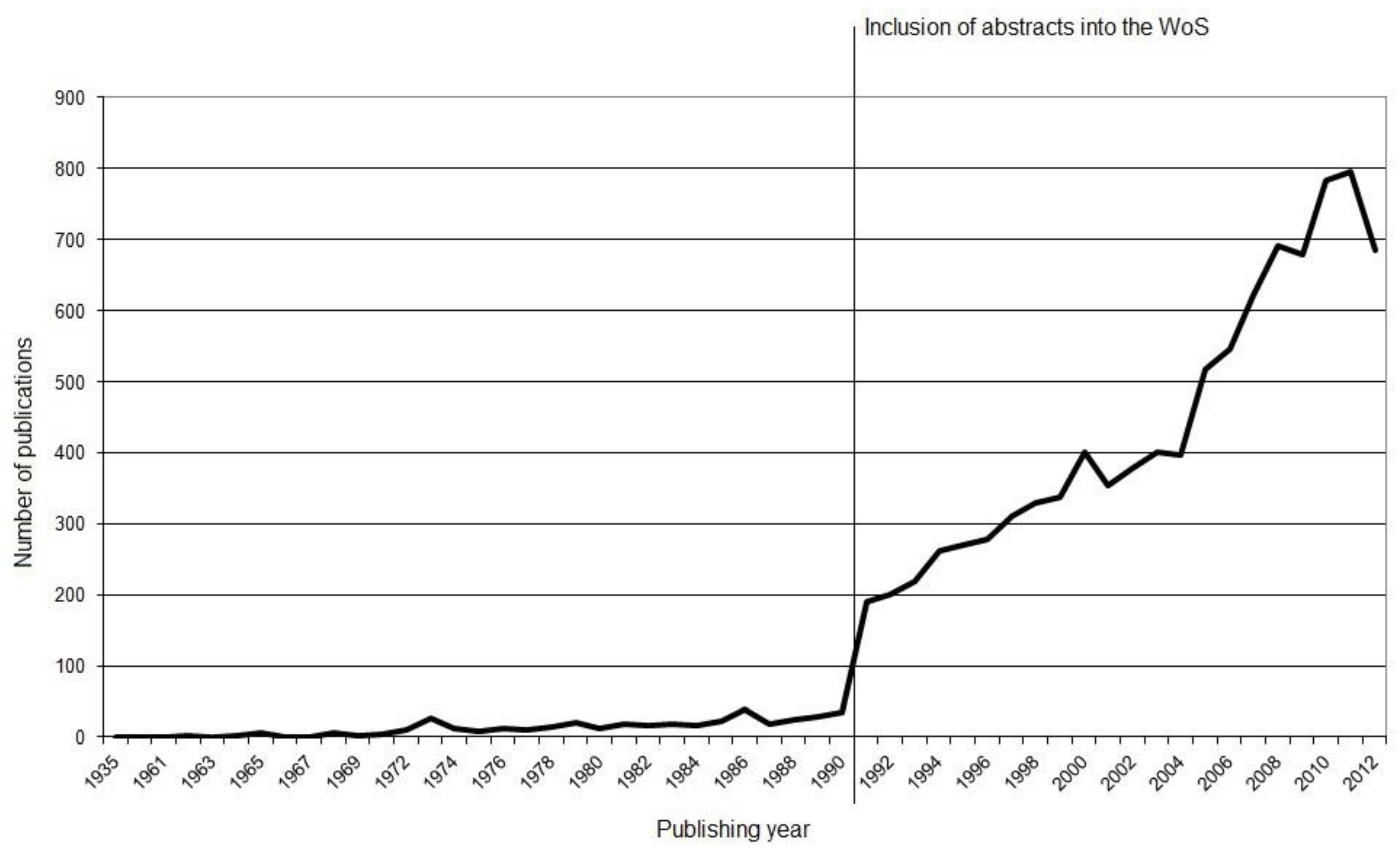
The analysis of 10,043 publications reveals an overall increase in scientific productivity within the field of smoking and pregnancy. Over a time period of 60 years the scientific development remains stable on a low level of not more than 40 annual publications, but sharply increases from 35 to 190 at the beginning of the 1990s with the inclusion of abstracts and key words into the WoS and continues to increase in the present time [15]. The highest number of publications in the investigated time period is achieved in the year 2011 with 795 publications, accounting for 12.6% of the entire scientific production about smoking and pregnancy. A similar development is seen with the annual citation rates, which increase at the beginning of the 1990s from only up to 1,000 citations to 7,640 citations. A predominantly continuous growth of the mean bibliography is observed from 15.6 sources in 1985 to 41.8 sources in the present (Figure 1).
Figure 1.
Number of publications.
3.1.2. National Analysis
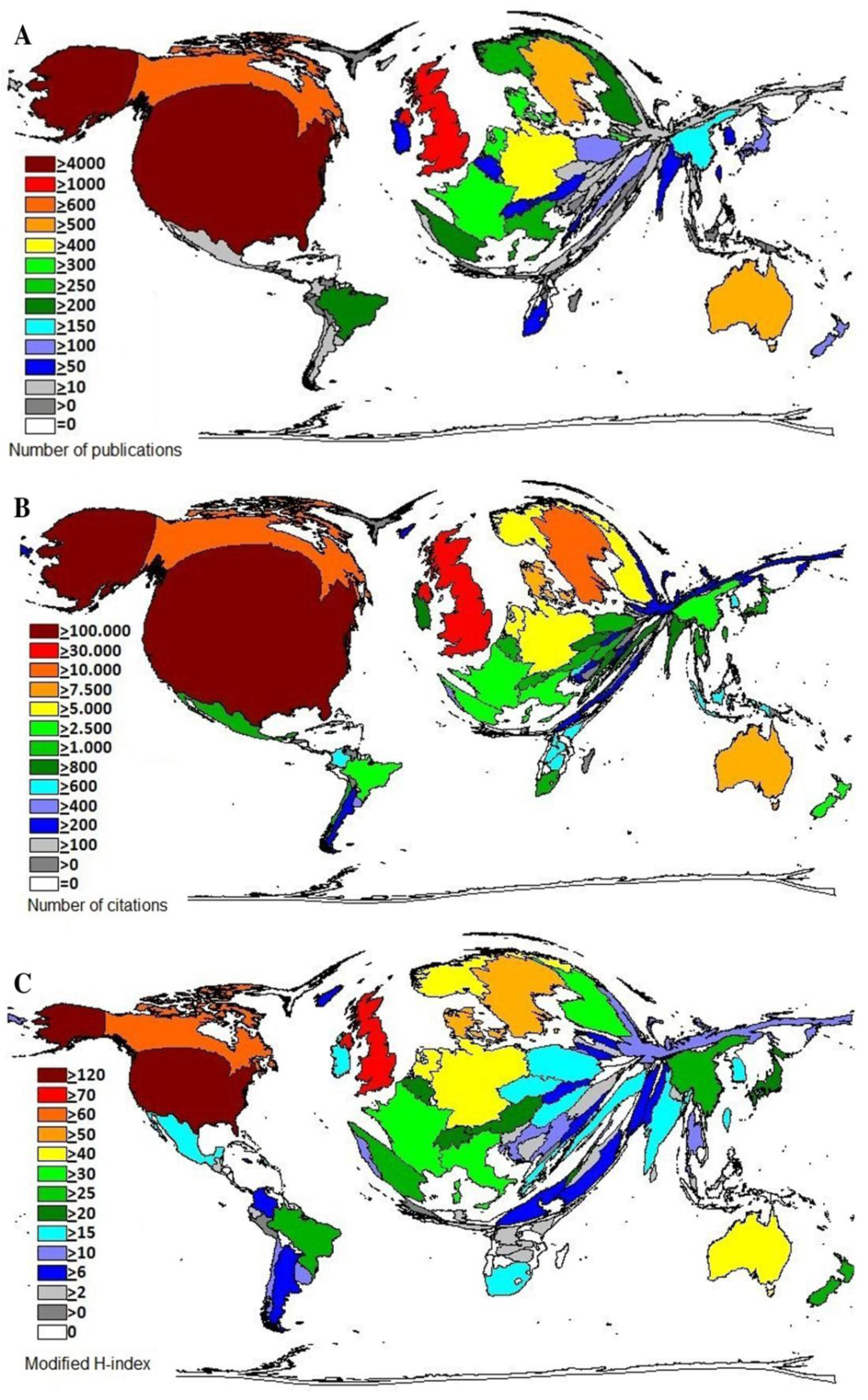
The largest number of scientific works about smoking and pregnancy is published by the USA with 4,284 (35.5%). The USA is the only nation with more than 4,000 publications (Figure 2A). The nation with the second most published works and the single other country with a four-digit number is the UK with 1,203 works (9.9%). The nation of Canada achieves 634 publications (5.3%). Analyses of national citation volumes and modified h-indices show similar results, as the USA achieves the highest total national citation volume with 112,136 citations (41.4%) and a modified h-index of 128. At a considerable distance the UK is placed second with a citation volume of 31,651 (8.6%) and a modified h-index of 79. The countries Canada (14,427 citations; modified h-index 62) and Sweden (13,334 citations, modified h‑index 59) on the 3rd and 4th place achieve a citation volume between 10,000 and 30,000 (Figure 2B,C).
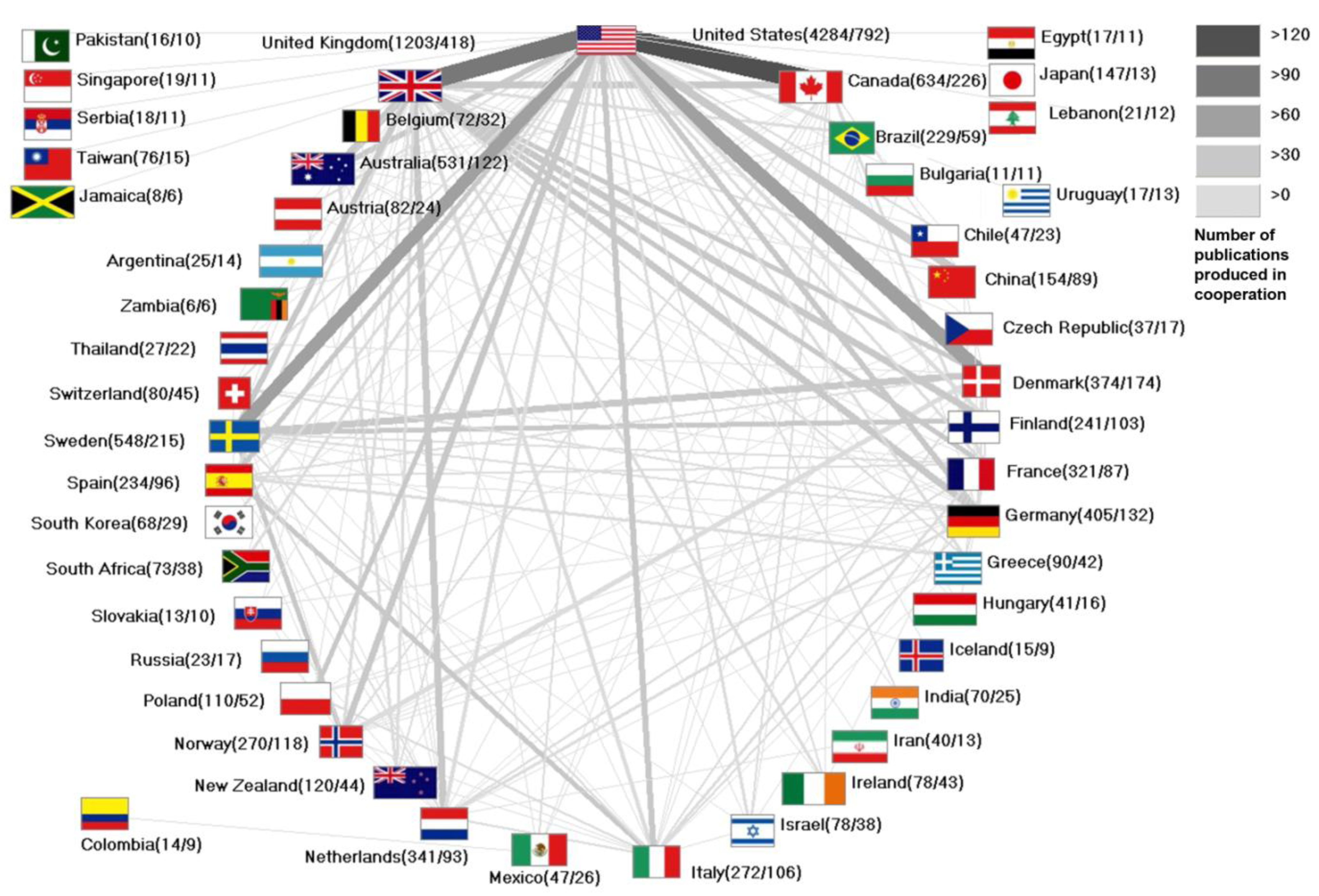
The international cooperation on smoking and pregnancy is investigated and analyzed (Figure 3). The USA achieves the highest amount of overall international cooperation, as it produces 126 publications together with Canada, 111 scientific works in cooperation with the UK, 85 works with Denmark and 81 publications in cooperation with Sweden.
Figure 2.
Density equilizing map projections. (A) National publication volumes;(B) National citation volumes; (C) National modified h-indices.
Figure 3.
Cooperations of nations.
3.1.3. Author Analysis
The analysis of the overall publication volume and overall citations reveals that Jorn Olsen and Sven Cnattingius are the most productive scientists within the field of smoking and pregnancy. Olsen is the most productive author, with 106 publications and the second most cited scientist with 3,164 citations. He is first-author of 10 scientific works (9.4%) and has the second largest number of senior-authorships with 48 publications. Cnattingius is the second most productive author with 73 publications and the most cited author with 3,321 citations. In the investigated scientific field the achieves the highest absolute number of first-authorships with 18 publications (24.6%). Additionally, he is the senior-author of further 25 works. Gideon Koren has the third most publications about smoking and pregnancy and is the 5th most cited researcher with 1,837 citations. He is first-author of 10 publications (14.7%) as well as senior-author of 45 scientific publications. Gary Shaw with 33.3% has the highest relative percentage of first-authorships (13 publications). He is listed as senior-author of a further six publications. The scientist Kypros Nicolaides is listed as senior-author of 49 scientific works (98%). He is the specialist with the highest relative and absolute number of senior-authorships in this field of scientific publishing.
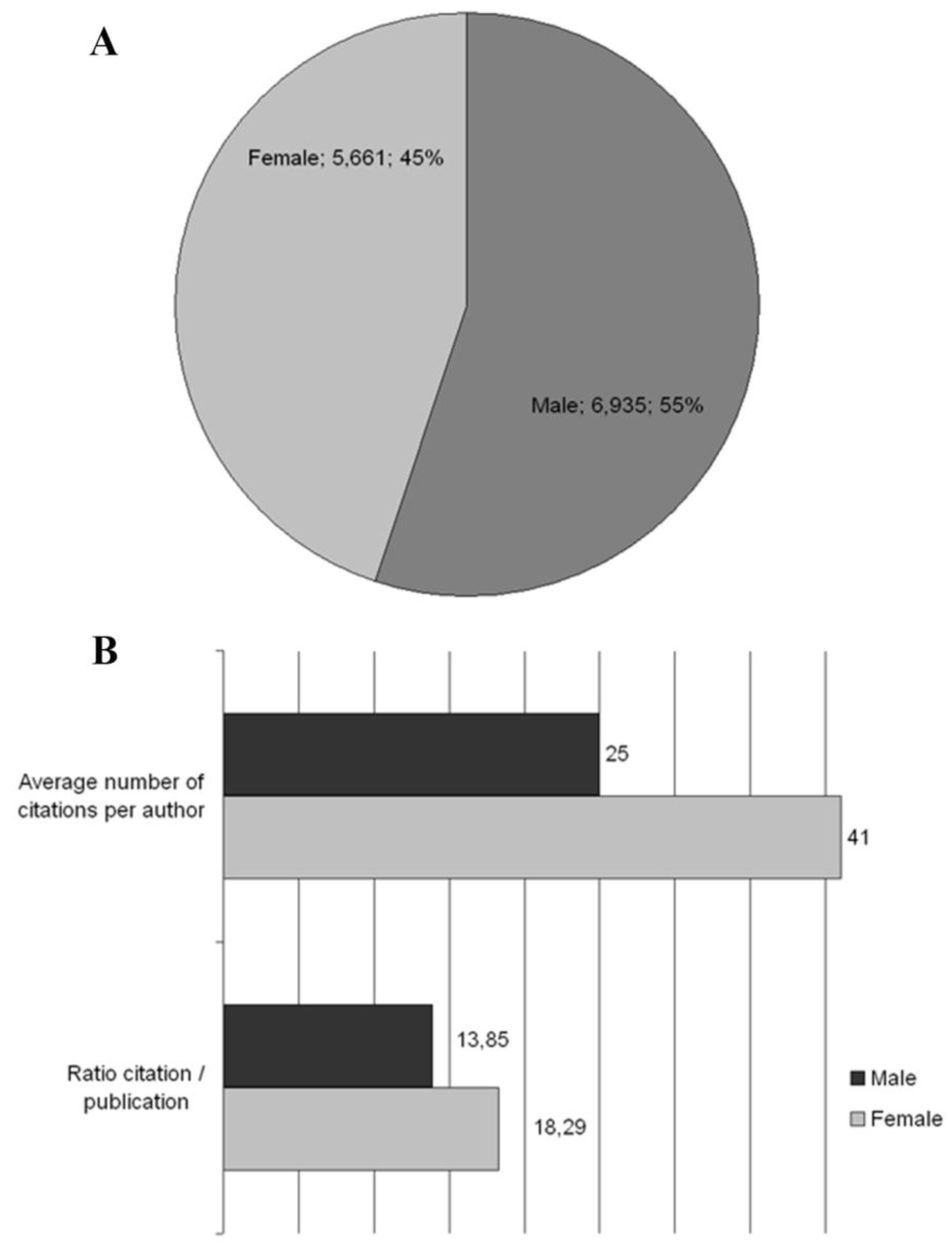
The gender analysis includes 12,596 authors contributing to the topic of smoking and pregnancy; it reveals that 6,935 scientists (55.1%) are female and 5,661 researchers (44.9%) are male (Figure 4A). Female scientists contribute a total of 12,470 publications (49.7%), which are cited 172,733 times (42.8%). The male scientists reach a publication output of 12,600 works (50.3%) and a citation volume of 230,480 (57.2%). A citation/publication ratio of 18.29 for male authors and a ratio of 13.85 for female authors is calculated. Each female scientist achieves on average 1.8 publications and 25 citations, while her male colleague arrives at an average of 2.2 works and 41 citations (Figure 4B).
Figure 4.
Gender analyses. (A) Proportional distribution of the gender of authors; (B) Average number of citations per author and ratio citation/publication of the gender of the authors.
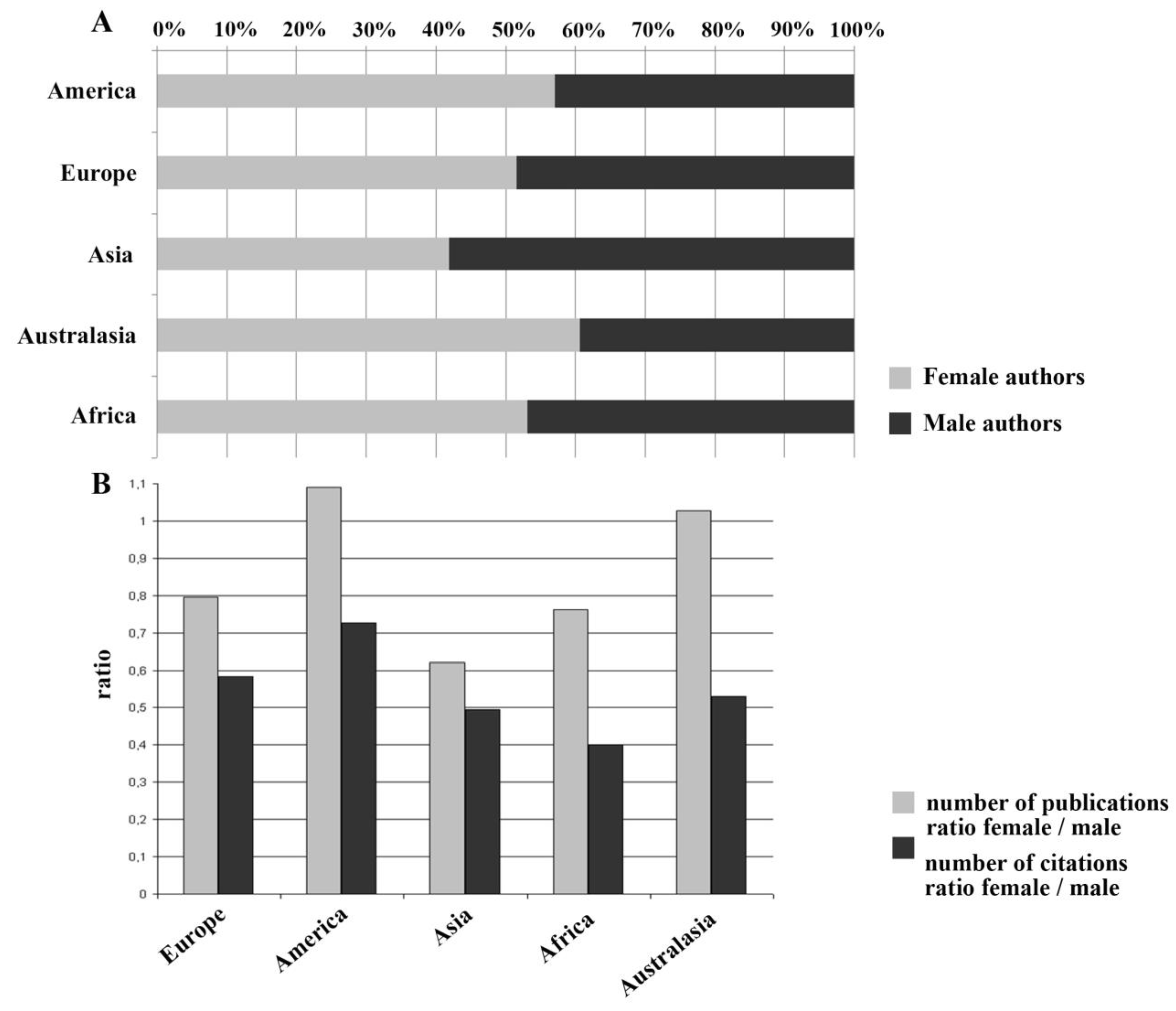
The gender analysis by continents reveals for the continent of America a total of 1,587 female researchers (57.1%) about smoking and pregnancy and 1,194 male scientists (42.9%). In Europe 1,266 female authors (51.6%) work together with 1,187 male experts (48.4%). The lowest percentage of female experts is found in Asia, where female authors account for only 41.9%. These 165 female scientists conduct research with 229 male scientists (58.1%). The continent of Australasia enjoys the highest female author percentage with 60.7%. These 213 female researchers work with 138 male scientists (39.3%). In Africa 33 female scientists researching about smoking and pregnancy account for 53.2%, while their 29 male colleagues arrive at 46.8% (Figure 5A).
Figure 5.
Regional gender analyses. (A) Proportion of the number of female and male authors according to continents; (B) Female/male publication ratios and female/male citation ratios.
In America female authors have the highest absolute and relative publication volume of 3,881 (52.1%), while their male colleagues produced 3,561 publications (47.9%). In Europe female authors had2,691 publications (44.3%) and male scientists contributed 3,380 publications (55.7%). The lowest relative publication output is found in Asia, where with 447 works female scientists account for only 38.3% of the total publications about smoking and pregnancy. Accordingly, male authors in Asia produced 773 works (61.7%). In Australasia female authors achieved a publication output of 459 scientific works (50.7%), while their male colleagues had 447 works (49.3%). In Africa 48 publications (43.2%) were produced by female authors, whereas male scientists contributed 63 publications (56.8%). Female authors in America are cited 59,687 times (42.1%). Their male co-workers enjoy a citation rate of 82,207 (57.9%). In Europe female scientists have 31,705 citations (36.8%), whereas male authors are cited 54,392 times (63.2%).
Female experts about smoking and pregnancy have 2,130 citations (33.1%) in Asia. Correspondingly, their male colleagues received 4,303 citations (66.9%). In Australasia female scientists enjoy 4,830 citations (34.6%), while male authors are cited 9,123 times (65.4%).
In Africa female authors achieve the lowest relative and absolute citation rate with only 414 citations (28.6%), while male scientists in Africa are cited 1,033 times (71.4%). Continent-specific female/male publication ratios as well as female/male citation ratios are shown in Figure 4B; a distinct dominance of male authors is seen, with the only exceptions of the American (1.09) and the Australasian (1.03) female/male publication ratios (Figure 5B).
3.1.4. Institution Analysis
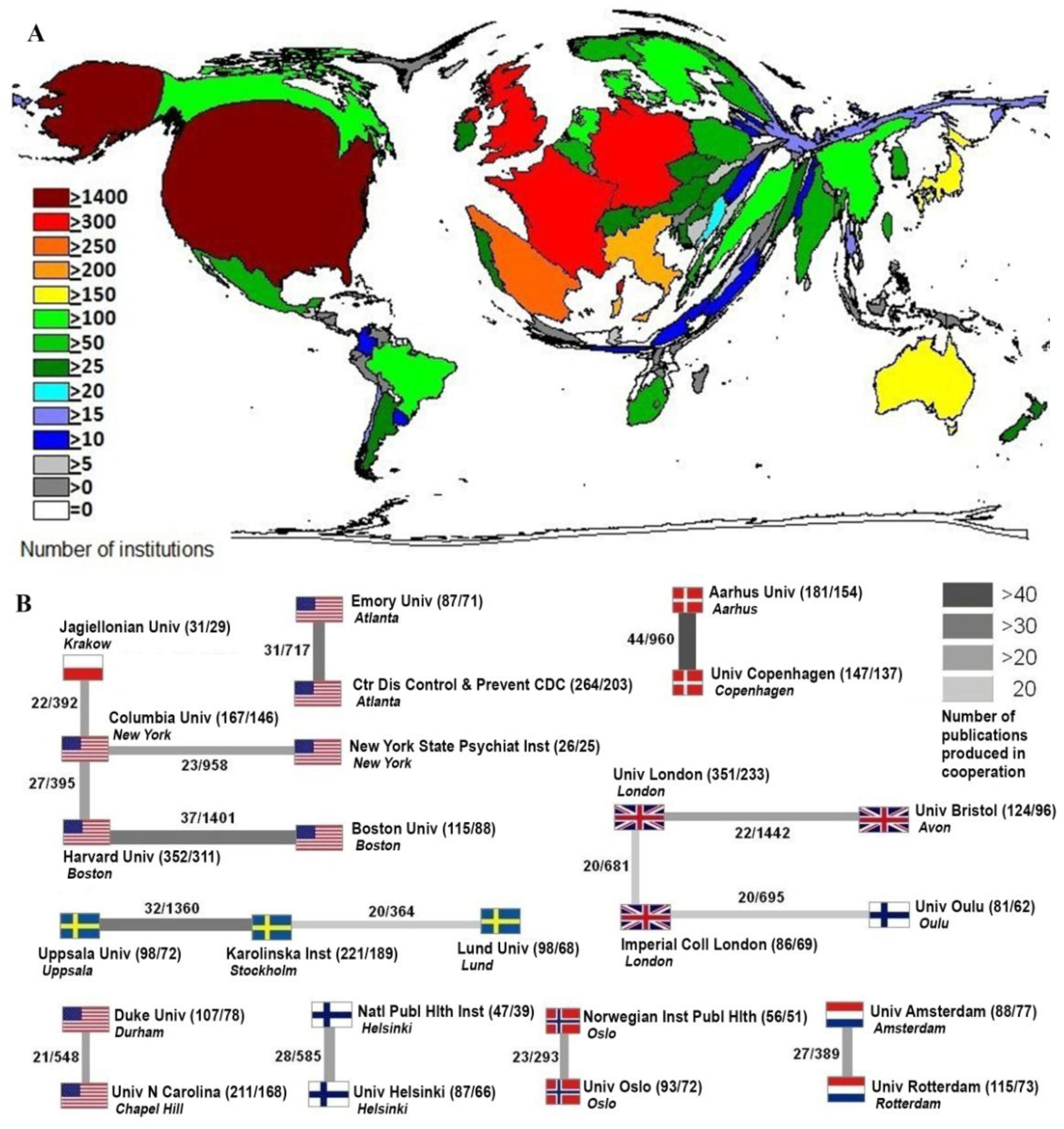
The institutions contributing scientific works to the field of smoking and pregnancy are analyzed according to their country of origin (Figure 6A). The highest number of 1,479 institutions is found in the USA. The USA is the only nation with more than 1,400 institutions. The UK possesses the second highest number; 341 British institutions contribute to the worldwide research about smoking and pregnancy. Together with France (326) and Germany (301), Spain (255) is the only other country with more than 250 institutions. The analyzed publications about smoking and pregnancy are assigned to their respective institutions. The two institutions with the highest scientific output are the Harvard University in Boston, USA with 352 publications and the University of London, UK with 351 publications. They are followed by the Centers for Disease Control and Prevention (CDC) from Atlanta, USA with 264 scientific works.
Additionally, the cooperation between different institutions is analyzed (Figure 6B). The highest number of cooperation publications on smoking and pregnancy is achieved by two Danish institutions, the University of Copenhagen and Aarhus University with 44 publications and 960 citations. Harvard University and Boston University published 37 scientific works about smoking and pregnancy and thus achieved the second highest citation rate with 1,401 citations. Two cooperating Swedish institutions, the Uppsala University and the Karolinska Institute produced 32 publications and 1,360 citations.
3.1.5. Journal Analysis
The American Journal of Obstetrics & Gynecology and The American Journal of Epidemiology are the most productive scientific journals about the topic of smoking and pregnancy. The American Journal of Obstetrics & Gynecology publishes 284 works and is cited 9,166 times. This citation rate is exceeded only by the second most productive journal, The American Journal of Epidemiology, which publishes 274 works and obtains the highest citation rate of the investigated journals with 9,928 citations. The American Journal of Epidemiology achieves a larger average citation index (36.23) in comparison to the more productive American Journal of Obstetrics & Gynecology, which possesses an average citation index of 32.27. In addition to being the third most industrious journal with 230 publications, Obstetrics and Gynecology maintains the third largest number of citations (8,513) and possesses the 4th largest average citation index (37.01).
Figure 6.
Institution analyses. (A) National institution volume; (B) Cooperation of institutions.
3.2. Discussion
3.2.1. Methodical Discussion
Smoking and pregnancy is a wide field which is not only limited by the nine months of pregnancy and the smoking of tobacco, but combines a variety of influences and covers topics such as socio-economic questions, different intercultural factors, globalization and shifting paradigms as well as long-term effects over more than one generation [9,16]. The basis for the data used in this investigation is the WoS, which is one of the largest indexed interdisciplinary scientific online databases [15].
The scientometric analyses used in this study were aimed at investigating two important aspects of science: quality and quantity of the global available data on the field of smoking and pregnancy. The scientific value can be broken down into the two main elements of quantity (i.e., productivity) and quality (i.e., citation rate), both of which can be measured to a large degree by the help of scientometric tools. Even if the following discussion identifies the strong and weak points of the used scientometric techniques, the numerous benefits of an objective scientometric investigation about smoking and pregnancy cannot be denied.
In this study a connection is established between the quality of a scientific publication and the quantity of its citation based on data obtained using the WoS function citation report, generally assuming that a large citation rate and therefore a large scientific resonance is an indicator of scientific quality. The obtained number of citations was interpreted as a criterion for the amount of publicity and resonance a publication obtained. This functioned as a marker for the usefulness and importance of a publication in its respective field of science. As a general rule, the higher a publication’s citation rate, the higher its importance for science; however, the phenomenon of self-citation can suggest an inaccurately elevated level of significance [17]. Furthermore, the scientific importance of authors and journals of different scientific fields cannot be directly compared to each other.
4. Conclusions
In the future medicine and scientific research will become increasingly specialized while the quality of scientific work in a global community will increase further. As a result research will become even more expensive, requiring more international communication and cooperation. The combination of these facts leads to a prognosis of an increase in international communication about smoking and pregnancy in the future. More than half of the scientists contributing to this field are female, nevertheless they achieve less than half of the publications. Additionally, only 42.8% of the citations are accomplished by female authors. The highest percentage of these female experts is found in Australasia, while the lowest percentage of female scientists is positioned in Asia. A slow improvement towards more gender equality within this scientific field is to be expected in the future. Furthermore, the continuous increase in quality and quantity of scientific research about smoking and pregnancy is a reliable indicator for the increasing dynamics of this subject, proving the growing development of research and a higher public interest. This scientometric and gender analysis presents an interim assessment of the scientific development and provides a contribution to the ongoing mission to understand, prevent and fight smoking and pregnancy.
Author Contributions
Mathias Mund, Beatrix Kloft, Matthias Bundschuh, Doris Klingelhoefer, David A. Groneberg and Alexander Gerber have made substantial contributions to the conception and design of the review, acquisition of the review data and have been involved in drafting and revising the manuscript. All authors have read and approved the final manuscript.
Conflicts of Interest
The authors declare no conflict of interest.
References
- Higgins, S.T.; Washio, Y.; Heil, S.H.; Solomon, L.J.; Gaalema, D.E.; Higgins, T.M.; Bernstein, I.M. Financial incentives for smoking cessation among pregnant and newly postpartum women. Prev. Med. 2012, 55, S33–S40. [Google Scholar] [CrossRef]
- Bickerstaff, M.; Beckmann, M.; Gibbons, K.; Flenady, V. Recent cessation of smoking and its effect on pregnancy outcomes. Aust. N. Z. J. Obstet. Gynaecol. 2012, 52, 54–58. [Google Scholar] [CrossRef]
- El-Mohandes, A.A.; El-Khorazaty, M.N.; Kiely, M.; Gantz, M.G. Smoking cessation and relapse among pregnant African-American smokers in Washington, DC. Matern. Child Health J. 2011, 15, S96–S105. [Google Scholar] [CrossRef]
- Dudenhausen, J.W. Rauchen in der Schwangerschaft—Häufigkeit, Folgen und Prävention; (in German). Urban and Vogel: Munich, Germany, 2009. [Google Scholar]
- Amering, M.; Schrank, B.; Sibitz, I. The gender gap in high-impact psychiatry journals. Acad. Med. 2011, 86, 946–952. [Google Scholar] [CrossRef]
- Metaxa, V. Is this (still) a man’s world? Crit. Care 2012, 17. [Google Scholar] [CrossRef]
- Schrager, S.; Bouwkamp, C.; Mundt, M. Gender and first authorship of papers in family medicine journals 2006–2008. Fam. Med. 2011, 43, 155–159. [Google Scholar]
- Haustein, K.-O.; Groneberg, D. Tabakabhängigkeit—Gesundheitliche Schäden durch das Rauchen; (in German). Springer Verlag: Berlin, Germany, 2008. [Google Scholar]
- Thale, V.; Schlitt, A. Effects of alcohol and smoking in pregnancy. Internist 2011, 52, 1185–1190. [Google Scholar] [CrossRef]
- Simmons, V.N.; Cruz, L.M.; Brandon, T.H.; Quinn, G.P. Translation and adaptation of smoking relapse-prevention materials for pregnant and postpartum Hispanic women. J. Health Commun. 2011, 16, 90–107. [Google Scholar]
- Jokic, M.; Ball, R. Qualität und Quantität Wissenschaftlicher Veröffentlichungen; (in German). Schriften des Forschungszentrums Jülich: Jülich, Germany, 2006. [Google Scholar]
- Riese, K. Kriterien zur Ressourcensteuerung an Hochschulen; (in German). Deutscher Universitätsverlag: Wiesbaden, Germany, 2007. [Google Scholar]
- Pleger, N. Bakterielle Meningitis: Eine Szientometrische Analyse. PhD Thesis, Goethe University, Frankfurt, Germany, 18 November 2011. [Google Scholar]
- Uibel, S. Clostridium Botulinum und Seine Toxine—Szientometrische Analyse zur Relevanz als Bakterium, Therapeutikum und Biowaffe. PhD Thesis, Goethe University, Frankfurt, Germany, 19 November 2010. [Google Scholar]
- Thomson Reuters Web of Science—Description. Available online: http://thomsonreuters.com/products_services/science/science_products/a-z/web_of_science/ (accessed on 22 May 2014).
- Report on the Global Tobacco Endemic; WHO: Geneva, Switzerland, 2009.
- Hyland, K. Self-citation and self-reference: Credibility and promotion in academic publication. J. Am. Soc. Inf. Sci. Technol. 2003, 54, 251–259. [Google Scholar] [CrossRef]
- Central Intelligence Agency. The World Factbook. Available online: http://www.cia.gov/library/publications/the-world-factbook/ (accessed on 8 April 2013).
- Merton, R. The Matthew Effect in Science: The reward and communication systems of science are considered. Science 1968, 159, 56–63. [Google Scholar]
- Lowe, H.J.; Lomax, E.C.; Polonkey, S.E. The World Wide Web: A review of an emerging internet-based technology for the distribution of biomedical information. J. Amer. Med. Inform. Assoc. 1996, 3, 1–14. [Google Scholar] [CrossRef]
- Gibis, B.; Heinz, A.; Jacob, R.; Müller, C.-H. Berufserwartungen von medizinstudierenden—Ergebnisse einer bundesweiten Befragung. Deutsches Ärzteblatt 2012. (in German). [Google Scholar] [CrossRef]
- Gofin, Y.; Afek, A.; Derazne, E.; Toker, A.; Shamiss, A. A model for assessing the gap between physician residency demand and present status. Israel Med. Assoc. J. 2012, 14, 275–280. [Google Scholar]
- Ceci, S.J.; Williams, W.M. Understanding current causes of women’s underrepresentation in science. Proc. Nat. Acad. Sci. USA 2011, 108, 3157–3162. [Google Scholar] [CrossRef]
- Chertok, I.R.; Luo, J.; Anderson, R.H. Association between changes in smoking habits in subsequent pregnancy and infant birth weight in west Virginia. Matern. Child Health J. 2011, 15, 249–254. [Google Scholar] [CrossRef]
- Moyer, M.W. The motherhood gap. Sci. Amer. 2012, 306. [Google Scholar] [CrossRef]
- Zakaib, G.D. Science gender gap probed. Nature 2011, 470. [Google Scholar] [CrossRef]
- Dettmer, S.; Kaczmarczyk, G.; Bühren, A. Karriereplanung für Ärztinnen; (in German). Springer: Heidelberg, Germany, 2006. [Google Scholar]
- Hentilä, M.; Schug, A. Von Heute an für Alle! Hundert Jahre Frauenwahlrecht; (in German). Finnland-Institut Deutschland: Berlin, Germany, 2006. [Google Scholar]
- Centers for Disease Control and Prevention Agency. Mission. Available online: http://www.cdc.gov/about/organization/mission.htm (accessed on 22 May 2014).
© 2014 by the authors; licensee MDPI, Basel, Switzerland. This article is an open access article distributed under the terms and conditions of the Creative Commons Attribution license (http://creativecommons.org/licenses/by/3.0/).