Clonal Diversity and Resistome Dynamics of Acinetobacter baumannii Isolates from Lithuanian National Cancer Center

 , , and
Abstract
1. Introduction
2. Materials and Methods
2.1. Bacterial Isolates
2.2. DNA Extraction
2.3. Antimicrobial Susceptibility Testing
2.4. Identification of Antibiotic Resistance Genes
2.5. Tri-Locus Sequence Typing (3-LST)
2.6. Molecular Typing by Pulsed-Field Gel-Electrophoresis (PFGE)
2.7. Multi-Locus Sequence Typing
2.8. Biofilm Formation Assay
2.9. Statistical Analysis
3. Results
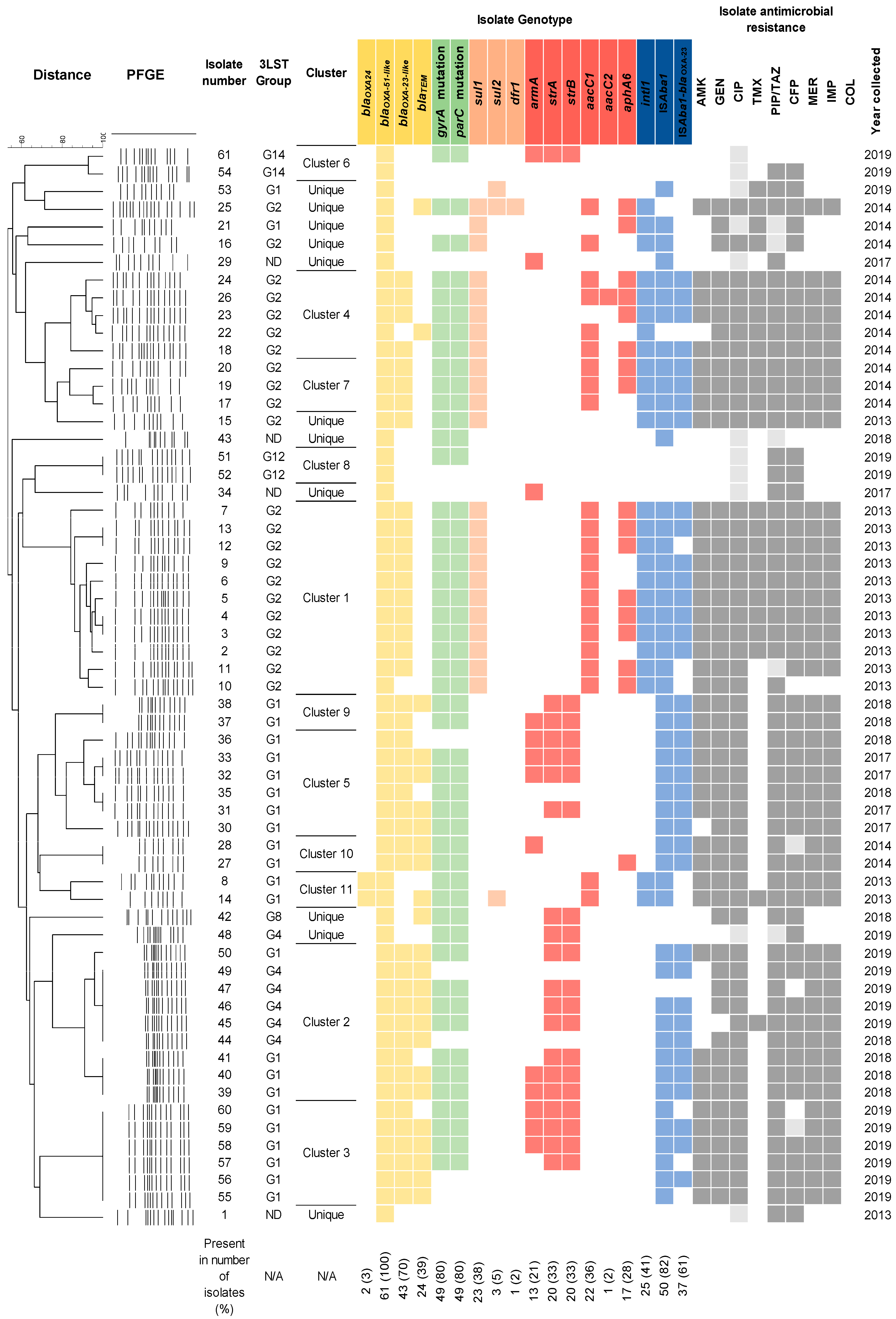
3.1. Isolate Genotyping
3.2. Antibiotic Susceptibility Profile
3.3. Antibiotic Resistance Genes
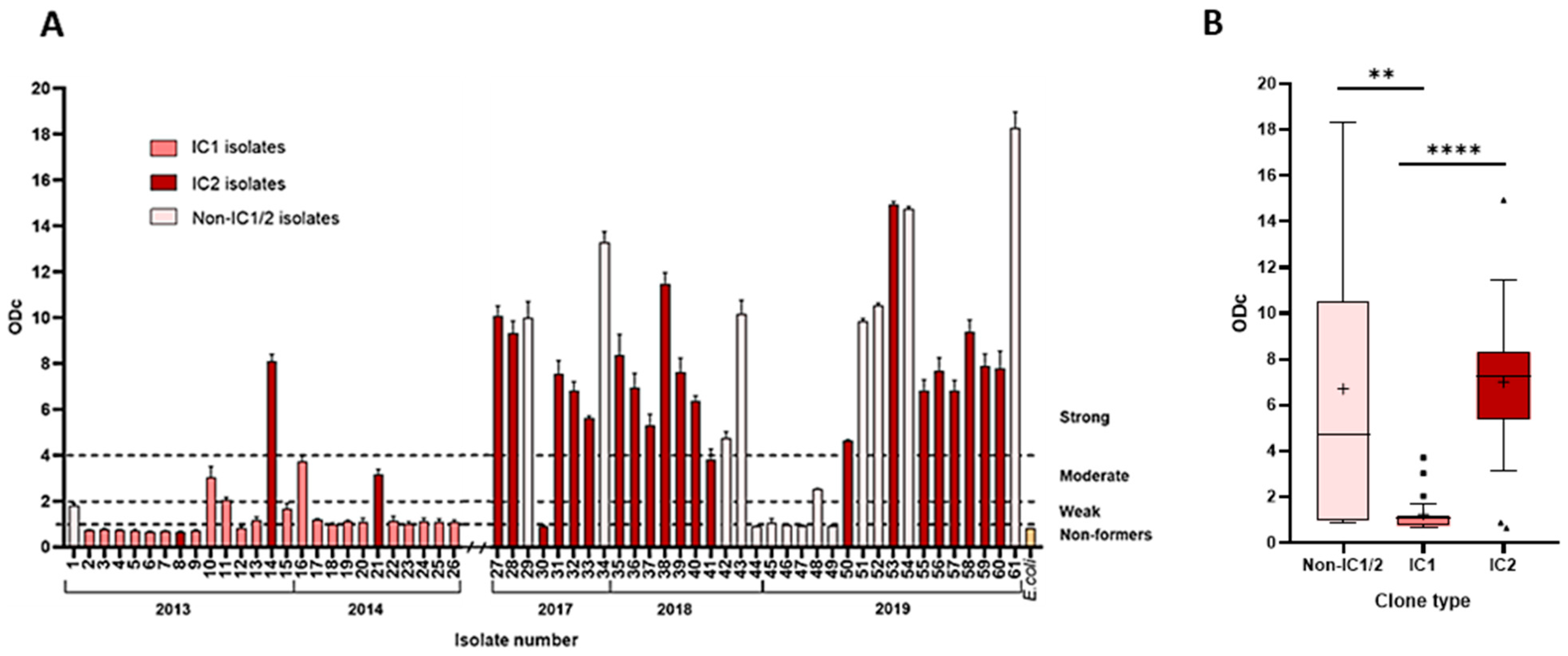
3.4. Biofilm-Forming Capability of A. baumannii Isolates
4. Discussion
5. Conclusions
Supplementary Materials
Author Contributions
Funding
Institutional Review Board Statement
Data Availability Statement
Acknowledgments
Conflicts of Interest
Abbreviations
| CLSI | Clinical & Laboratory Standards Institute |
| CRAB | Carbapenem-resistant Acinetobacter baumannii |
| ECDC | European Centre for Disease Prevention and Control |
| EUCAST | European Committee on Antimicrobial Susceptibility Testing |
| IC | International Clone |
| MDR | Multi-drug resistance |
| MLST | Muti-locus sequence typing |
| PFGE | Pulsed-field gel electrophoresis |
| ST | Sequence type |
| XDR | Extensive drug resistance |
| 3-LST | Tri-locus sequence typing |
References
- Morris, F.C.; Dexter, C.; Kostoulias, X.; Uddin, M.I.; Peleg, A.Y. The Mechanisms of Disease Caused by Acinetobacter baumannii. Front. Microbiol. 2019, 10, 1601. [Google Scholar] [CrossRef] [PubMed]
- Sharma, R.; Lakhanpal, D. Acinetobacter baumannii: A Comprehensive Review of Global Epidemiology, Clinical Implications, Host Interactions, Mechanisms of Antimicrobial Resistance and Mitigation Strategies. Microb. Pathog. 2025, 204, 107605. [Google Scholar] [CrossRef] [PubMed]
- Freire, M.P.; de Oliveira Garcia, D.; Garcia, C.P.; Campagnari Bueno, M.F.; Camargo, C.H.; Kono Magri, A.S.G.; Francisco, G.R.; Reghini, R.; Vieira, M.F.; Ibrahim, K.Y.; et al. Bloodstream Infection Caused by Extensively Drug-Resistant Acinetobacter baumannii in Cancer Patients: High Mortality Associated with Delayed Treatment Rather than with the Degree of Neutropenia. Clin. Microbiol. Infect. 2016, 22, 352–358. [Google Scholar] [CrossRef]
- Ntim, O.K.; Awere-Duodu, A.; Osman, A.-H.; Donkor, E.S. Antimicrobial Resistance of Bacterial Pathogens Isolated from Cancer Patients: A Systematic Review and Meta-Analysis. BMC Infect. Dis. 2025, 25, 296. [Google Scholar] [CrossRef] [PubMed]
- Gedefie, A.; Demsis, W.; Ashagrie, M.; Kassa, Y.; Tesfaye, M.; Tilahun, M.; Bisetegn, H.; Sahle, Z. Acinetobacter baumannii Biofilm Formation and Its Role in Disease Pathogenesis: A Review. Infect. Drug Resist. 2021, 14, 3711–3719. [Google Scholar] [CrossRef]
- Donlan, R.M. Biofilms: Microbial Life on Surfaces. Emerg. Infect. Dis. 2002, 8, 881–890. [Google Scholar] [CrossRef]
- ECDC Antimicrobial Resistance in the EU/EEA (EARS-Net)—Annual Epidemiological Report 2023. Available online: https://www.ecdc.europa.eu/en/publications-data/antimicrobial-resistance-eueea-ears-net-annual-epidemiological-report-2023 (accessed on 31 July 2025).
- ECDC Antimicrobial Resistance Surveillance in Europe 2014. Available online: https://www.ecdc.europa.eu/en/publications-data/antimicrobial-resistance-surveillance-europe-2014 (accessed on 10 June 2024).
- Magiorakos, A.-P.; Srinivasan, A.; Carey, R.B.; Carmeli, Y.; Falagas, M.E.; Giske, C.G.; Harbarth, S.; Hindler, J.F.; Kahlmeter, G.; Olsson-Liljequist, B.; et al. Multidrug-Resistant, Extensively Drug-Resistant and Pandrug-Resistant Bacteria: An International Expert Proposal for Interim Standard Definitions for Acquired Resistance. Clin. Microbiol. Infect. 2012, 18, 268–281. [Google Scholar] [CrossRef]
- Povilonis, J.; Šeputienė, V.; Krasauskas, R.; Juškaitė, R.; Miškinytė, M.; Sužiedėlis, K.; Sužiedėlienė, E. Spread of Carbapenem-Resistant Acinetobacter baumannii Carrying a Plasmid with Two Genes Encoding OXA-72 Carbapenemase in Lithuanian Hospitals. J. Antimicrob. Chemother. 2013, 68, 1000–1006. [Google Scholar] [CrossRef]
- Černiauskienė, K.; Dambrauskienė, A.; Vitkauskienė, A. Associations between β-Lactamase Types of Acinetobacter baumannii and Antimicrobial Resistance. Medicina 2023, 59, 1386. [Google Scholar] [CrossRef]
- Turton, J.F.; Woodford, N.; Glover, J.; Yarde, S.; Kaufmann, M.E.; Pitt, T.L. Identification of Acinetobacter baumannii by Detection of the blaOXA-51-like Carbapenemase Gene Intrinsic to This Species. J. Clin. Microbiol. 2006, 44, 2974–2976. [Google Scholar] [CrossRef]
- EUCAST. The European Committee on Antimicrobial Susceptibility Testing. Breakpoint Tables for Interpretation of MICs and Zone Diameters. 2024. Available online: https://www.eucast.org/bacteria/clinical-breakpoints-and-interpretation/clinical-breakpoint-tables/ (accessed on 26 October 2025).
- M100-S27; Performance CLSI Standards for Antimicrobial Susceptibility Testing. Supplement M 100; Clinical and Laboratory Standards Institute (CLSI): Wayne, PA, USA, 2017; p. 29.
- Vila, J.; Ruiz, J.; Goñi, P.; Jimenez de Anta, T. Quinolone-Resistance Mutations in the Topoisomerase IV parC Gene of Acinetobacter baumannii. J. Antimicrob. Chemother. 1997, 39, 757–762. [Google Scholar] [CrossRef]
- Turton, J.F.; Gabriel, S.N.; Valderrey, C.; Kaufmann, M.E.; Pitt, T.L. Use of Sequence-Based Typing and Multiplex PCR to Identify Clonal Lineages of Outbreak Strains of Acinetobacter baumannii. Clin. Microbiol. Infect. 2007, 13, 807–815. [Google Scholar] [CrossRef]
- Karah, N.; Sundsfjord, A.; Towner, K.; Samuelsen, Ø. Insights into the Global Molecular Epidemiology of Carbapenem Non-Susceptible Clones of Acinetobacter baumannii. Drug Resist. Updates 2012, 15, 237–247. [Google Scholar] [CrossRef] [PubMed]
- Diancourt, L.; Passet, V.; Nemec, A.; Dijkshoorn, L.; Brisse, S. The Population Structure of Acinetobacter baumannii: Expanding Multiresistant Clones from an Ancestral Susceptible Genetic Pool. PLoS ONE 2010, 5, e10034. [Google Scholar] [CrossRef]
- Jolley, K.A.; Bray, J.E.; Maiden, M.C.J. Open-Access Bacterial Population Genomics: BIGSdb Software, the PubMLST.Org Website and Their Applications. Wellcome Open Res. 2018, 3, 124. [Google Scholar] [CrossRef] [PubMed]
- Yang, F.; Liu, C.; Ji, J.; Cao, W.; Ding, B.; Xu, X. Molecular Characteristics, Antimicrobial Resistance, and Biofilm Formation of Pseudomonas Aeruginosa Isolated from Patients with Aural Infections in Shanghai, China. Infect. Drug Resist. 2021, 14, 3637–3645. [Google Scholar] [CrossRef]
- Chmielarczyk, A.; Pilarczyk-Żurek, M.; Kamińska, W.; Pobiega, M.; Romaniszyn, D.; Ziółkowski, G.; Wójkowska-Mach, J.; Bulanda, M. Molecular Epidemiology and Drug Resistance of Acinetobacter baumannii Isolated from Hospitals in Southern Poland: ICU as a Risk Factor for XDR Strains. Microb. Drug Resist. 2016, 22, 328–335. [Google Scholar] [CrossRef]
- Kasperski, T.; Romaniszyn, D.; Jachowicz-Matczak, E.; Pomorska-Wesołowska, M.; Wójkowska-Mach, J.; Chmielarczyk, A. Extensive Drug Resistance of Strong Biofilm-Producing Acinetobacter baumannii Strains Isolated from Infections and Colonization Hospitalized Patients in Southern Poland. Pathogens 2023, 12, 975. [Google Scholar] [CrossRef] [PubMed]
- Jain, N.; Jansone, I.; Obidenova, T.; Simanis, R.; Meisters, J.; Straupmane, D.; Reinis, A. Antimicrobial Resistance in Nosocomial Isolates of Gram-Negative Bacteria: Public Health Implications in the Latvian Context. Antibiotics 2021, 10, 791. [Google Scholar] [CrossRef]
- MacPhail, A.; Dendle, C.; Slavin, M.; McQuilten, Z. Hospital-Acquired Bloodstream Infections in Patients with Cancer: Current Knowledge and Future Directions. J. Hosp. Infect. 2024, 148, 39–50. [Google Scholar] [CrossRef]
- Grewal, K.; Sutradhar, R.; Krzyzanowska, M.K.; Redelmeier, D.A.; Atzema, C.L. The Association of Continuity of Care and Cancer Centre Affiliation with Outcomes among Patients with Cancer Who Require Emergency Department Care. CMAJ 2019, 191, E436–E445. [Google Scholar] [CrossRef] [PubMed]
- Müller, C.; Reuter, S.; Wille, J.; Xanthopoulou, K.; Stefanik, D.; Grundmann, H.; Higgins, P.G.; Seifert, H. A Global View on Carbapenem-Resistant Acinetobacter baumannii. mBio 2023, 14, e02260-23. [Google Scholar] [CrossRef] [PubMed]
- Higgins, P.G.; Hagen, R.M.; Podbielski, A.; Frickmann, H.; Warnke, P. Molecular Epidemiology of Carbapenem-Resistant Acinetobacter baumannii Isolated from War-Injured Patients from the Eastern Ukraine. Antibiotics 2020, 9, 579. [Google Scholar] [CrossRef]
- Mammina, C.; Bonura, C.; Aleo, A.; Calà, C.; Caputo, G.; Cataldo, M.C.; Benedetto, A.D.; Distefano, S.; Fasciana, T.; Labisi, M.; et al. Characterization of Acinetobacter baumannii from Intensive Care Units and Home Care Patients in Palermo, Italy. Clin. Microbiol. Infect. 2011, 17, E12–E15. [Google Scholar] [CrossRef][Green Version]
- Ha, V.N.; Huy, H.T.; Đac, T.N.; Nguyen, P.A.; Cuong, L.D. Genomic Epidemiology and Resistant Genes of Acinetobacter baumannii Clinical Strains in Vietnamese Hospitals. J. Med. Microbiol. 2024, 73, 001922. [Google Scholar] [CrossRef] [PubMed]
- Zhang, P.; Hao, J.; Zhang, Y.; Su, J.; Sun, G.; Xie, J.; Hu, J.; Li, G. Understanding the Clinical and Molecular Epidemiological Characteristics of Carbapenem-Resistant Acinetobacter baumannii Infections within Intensive Care Units of Three Teaching Hospitals. Ann. Clin. Microbiol. Antimicrob. 2025, 24, 2. [Google Scholar] [CrossRef]
- Muzahid, N.H.; Hussain, M.H.; Huët, M.A.L.; Dwiyanto, J.; Su, T.T.; Reidpath, D.; Mustapha, F.; Ayub, Q.; Tan, H.S.; Rahman, S. Molecular Characterization and Comparative Genomic Analysis of Acinetobacter baumannii Isolated from the Community and the Hospital: An Epidemiological Study in Segamat, Malaysia. Microb. Genom. 2023, 9, mgen000977. [Google Scholar] [CrossRef]
- Nasser-Ali, M.; Aja-Macaya, P.; Conde-Pérez, K.; Trigo-Tasende, N.; Rumbo-Feal, S.; Fernández-González, A.; Bou, G.; Poza, M.; Vallejo, J.A. Emergence of Carbapenemase Genes in Gram-Negative Bacteria Isolated from the Wastewater Treatment Plant in A Coruña, Spain. Antibiotics 2024, 13, 194. [Google Scholar] [CrossRef]
- Yusuf, I.; Idris, H.B.; Skiebe, E.; Wilharm, G. Local Genomic Epidemiology of Acinetobacter baumannii Circulating in Hospital and Non-Hospital Environments in Kano, Northwest Nigeria. Curr. Microbiol. 2025, 82, 329. [Google Scholar] [CrossRef]
- Lopes, B.S.; Amyes, S.G.B. Role of ISAba1 and ISAba125 in Governing the Expression of blaADC in Clinically Relevant Acinetobacter baumannii Strains Resistant to Cephalosporins. J. Med. Microbiol. 2012, 61, 1103–1108. [Google Scholar] [CrossRef]
- Domingues, R.; Oliveira, R.; Silva, S.; Araújo, D.; Almeida, C.; Cho, G.-S.; Franz, C.M.A.P.; Saavedra, M.J.; Azeredo, J.; Oliveira, H. Molecular Detection of Carbapenemases in Acinetobacter baumannii Strains of Portugal and Association with Sequence Types, Capsular Types, and Virulence. Clin. Ther. 2024, 46, e9–e15. [Google Scholar] [CrossRef]
- Abbaszadeh, F.; Hasani, A.; Rezaee, M.A.; Sadeghi, J.; Hasani, A.; Oskouee, M.A.; Vahhabi, A. Genetic Characterization of Extensive Drug Resistant Acinetobacter baumannii: An Appalling Impediment. Folia Medica 2021, 63, 726–737. [Google Scholar] [CrossRef] [PubMed]
- Jachowicz-Matczak, E.; Wołkowicz, T.; Kujawska, A.; Pałka, A.; Gajda, M.; Żółtowska, B.; Zacharczuk, K.; Piekarska, K.; Kasprzyk, J.; Wieczorek, N.; et al. Epidemiological and Genomic Characterization of Carbapenem-Resistant Acinetobacter baumannii ST600 Harbouring the blaNDM-1 Gene, First Report in Poland. J. Glob. Antimicrob. Resist. 2025, 41, 280–286. [Google Scholar] [CrossRef]
- Kuo, S.-C.; Huang, W.-C.; Huang, T.-W.; Wang, H.-Y.; Lai, J.-F.; Chen, T.-L.; Lauderdale, T.-L. Molecular Epidemiology of Emerging blaOXA-23-Like- and blaOXA-24-Like-Carrying Acinetobacter baumannii in Taiwan. Antimicrob. Agents Chemother. 2018, 62, e01215-17. [Google Scholar] [CrossRef]
- Lee, H.-Y.; Chang, R.-C.; Su, L.-H.; Liu, S.-Y.; Wu, S.-R.; Chuang, C.-H.; Chen, C.-L.; Chiu, C.-H. Wide Spread of Tn2006 in an AbaR4-Type Resistance Island among Carbapenem-Resistant Acinetobacter baumannii Clinical Isolates in Taiwan. Int. J. Antimicrob. Agents 2012, 40, 163–167. [Google Scholar] [CrossRef]
- Findlay, J.; Nordmann, P.; Bouvier, M.; Kerbol, A.; Poirel, L. Dissemination of ArmA- and OXA-23-Co-Producing Acinetobacter baumannii Global Clone 2 in Switzerland, 2020–2021. Eur. J. Clin. Microbiol. Infect. Dis. 2023. [Google Scholar] [CrossRef]
- Strateva, T.; Markova, B.; Marteva-Proevska, Y.; Ivanova, D.; Mitov, I. Widespread Dissemination of Multidrug-Resistant Acinetobacter baumannii Producing OXA-23 Carbapenemase and ArmA 16S Ribosomal RNA Methylase in a Bulgarian University Hospital. Braz. J. Infect. Dis. 2012, 16, 307–310. [Google Scholar] [CrossRef] [PubMed]
- Sánchez-Urtaza, S.; Ocampo-Sosa, A.; Rodríguez-Grande, J.; El-Kholy, M.A.; Shawky, S.M.; Alkorta, I.; Gallego, L. Plasmid Content of Carbapenem Resistant Acinetobacter baumannii Isolates Belonging to Five International Clones Collected from Hospitals of Alexandria, Egypt. Front. Cell. Infect. Microbiol. 2024, 13, 1332736. [Google Scholar] [CrossRef] [PubMed]
- Falagas, M.E.; Vardakas, K.Z.; Roussos, N.S. Trimethoprim/Sulfamethoxazole for Acinetobacter Spp.: A Review of Current Microbiological and Clinical Evidence. Int. J. Antimicrob. Agents 2015, 46, 231–241. [Google Scholar] [CrossRef]
- Pană, A.-G.; Șchiopu, P.; Țoc, D.A.; Neculicioiu, V.S.; Butiuc-Keul, A.; Farkas, A.; Dobrescu, M.-Ștefan; Flonta, M.; Costache, C.; Szász, I.É.; et al. Clonality and the Phenotype–Genotype Correlation of Antimicrobial Resistance in Acinetobacter baumannii Isolates: A Multi-center Study of Clinical Isolates from Romania. Microorganisms 2025, 13, 176. [Google Scholar] [CrossRef]
- Castanheira, M.; Mendes, R.E.; Gales, A.C. Global Epidemiology and Mechanisms of Resistance of Acinetobacter baumannii-Calcoaceticus Complex. Clin. Infect. Dis. 2023, 76, S166–S178. [Google Scholar] [CrossRef]
- Yu, K.; Zeng, W.; Xu, Y.; Liao, W.; Xu, W.; Zhou, T.; Cao, J.; Chen, L. Bloodstream Infections Caused by ST2 Acinetobacter baumannii: Risk Factors, Antibiotic Regimens, and Virulence over 6 Years Period in China. Antimicrob. Resist. Infect. Control. 2021, 10, 16. [Google Scholar] [CrossRef]
- Woodford, N.; Ellington, M.J.; Coelho, J.M.; Turton, J.F.; Ward, M.E.; Brown, S.; Amyes, S.G.B.; Livermore, D.M. Multiplex PCR for Genes Encoding Prevalent OXA Carbapenemases in Acinetobacter Spp. Int. J. Antimicrob. Agents 2006, 27, 351–353. [Google Scholar] [CrossRef] [PubMed]
- Yousfi, K.; Touati, A.; Lefebvre, B.; Garneau, P.; Brahmi, S.; Gharout-Sait, A.; Harel, J.; Bekal, S. Characterization of Multidrug-Resistant Gram-Negative Bacilli Isolated from Hospitals Effluents: First Report of a blaOXA-48-like in Klebsiella oxytoca, Algeria. Braz. J. Microbiol. 2019, 50, 175–183. [Google Scholar] [CrossRef]
- Dallenne, C.; Da Costa, A.; Decré, D.; Favier, C.; Arlet, G. Development of a Set of Multiplex PCR Assays for the Detection of Genes Encoding Important β-Lactamases in Enterobacteriaceae. J. Antimicrob. Chemother. 2010, 65, 490–495. [Google Scholar] [CrossRef]
- Poirel, L.; Walsh, T.R.; Cuvillier, V.; Nordmann, P. Multiplex PCR for Detection of Acquired Carbapenemase Genes. Diagn. Microbiol. Infect. Dis. 2011, 70, 119–123. [Google Scholar] [CrossRef]
- Garza-Ramos, U.; Morfin-Otero, R.; Sader, H.S.; Jones, R.N.; Hernández, E.; Rodriguez-Noriega, E.; Sanchez, A.; Carrillo, B.; Esparza-Ahumada, S.; Silva-Sanchez, J. Metallo-β-Lactamase Gene blaIMP-15 in a Class 1 Integron, In95, from Pseudomonas aeruginosa Clinical Isolates from a Hospital in Mexico. Antimicrob. Agents Chemother. 2008, 52, 2943–2946. [Google Scholar] [CrossRef]
- Maleki, N.; Tahanasab, Z.; Mobasherizadeh, S.; Rezaei, A.; Faghri, J. Prevalence of CTX-M and TEM β-Lactamases in Klebsiella pneumoniae Isolates from Patients with Urinary Tract Infection, Al-Zahra Hospital, Isfahan, Iran. Adv. Biomed. Res. 2018, 7, 10. [Google Scholar] [CrossRef]
- Hujer, K.M.; Hujer, A.M.; Hulten, E.A.; Bajaksouzian, S.; Adams, J.M.; Donskey, C.J.; Ecker, D.J.; Massire, C.; Eshoo, M.W.; Sampath, R.; et al. Analysis of Antibiotic Resistance Genes in Multidrug-Resistant Acinetobacter Sp. Isolates from Military and Civilian Patients Treated at the Walter Reed Army Medical Center. Antimicrob. Agents Chemother. 2006, 50, 4114–4123. [Google Scholar] [CrossRef] [PubMed]
- Wang, A.; Yang, Y.; Lu, Q.; Wang, Y.; Chen, Y.; Deng, L.; Ding, H.; Deng, Q.; Zhang, H.; Wang, C.; et al. Presence of qnr Gene in Escherichia coli and Klebsiella pneumoniae Resistant to Ciprofloxacin Isolated from Pediatric Patients in China. BMC Infect. Dis. 2008, 8, 68. [Google Scholar] [CrossRef] [PubMed]
- Doi, Y.; Arakawa, Y. 16S Ribosomal RNA Methylation: Emerging Resistance Mechanism against Aminoglycosides. Clin. Infect. Dis. 2007, 45, 88–94. [Google Scholar] [CrossRef]
- Wen, J.-T.; Zhou, Y.; Yang, L.; Xu, Y. Multidrug-Resistant Genes of Aminoglycoside-Modifying Enzymes and 16S rRNA Methylases in Acinetobacter Baumannii Strains. Genet. Mol. Res. 2014, 13, 3842–3849. [Google Scholar] [CrossRef] [PubMed]
- Gebreyes, W.A.; Altier, C. Molecular Characterization of Multidrug-Resistant Salmonella enterica Subsp. Enterica Serovar Typhimurium Isolates from Swine. J. Clin. Microbiol. 2002, 40, 2813–2822. [Google Scholar] [CrossRef]
- Aliakbarzade, K.; Farajnia, S.; Karimi Nik, A.; Zarei, F.; Tanomand, A. Prevalence of Aminoglycoside Resistance Genes in Acinetobacter baumannii Isolates. Jundishapur J. Microbiol. 2014, 7, e11924. [Google Scholar] [CrossRef]
- Ramirez, M.S.; Tolmasky, M.E. Aminoglycoside Modifying Enzymes. Drug Resist. Updat. 2010, 13, 151–171. [Google Scholar] [CrossRef] [PubMed]
- Chen, S.; Zhao, S.; McDermott, P.F.; Schroeder, C.M.; White, D.G.; Meng, J. A DNA Microarray for Identification of Virulence and Antimicrobial Resistance Genes in Salmonella Serovars and Escherichia coli. Mol. Cell. Probes 2005, 19, 195–201. [Google Scholar] [CrossRef]
- Vakulenko, S.B.; Donabedian, S.M.; Voskresenskiy, A.M.; Zervos, M.J.; Lerner, S.A.; Chow, J.W. Multiplex PCR for Detection of Aminoglycoside Resistance Genes in Enterococci. Antimicrob. Agents Chemother. 2003, 47, 1423–1426. [Google Scholar] [CrossRef]
- Randall, L.P.; Cooles, S.W.; Osborn, M.K.; Piddock, L.J.V.; Woodward, M.J. Antibiotic Resistance Genes, Integrons and Multiple Antibiotic Resistance in Thirty-Five Serotypes of Salmonella enterica Isolated from Humans and Animals in the UK. J. Antimicrob. Chemother. 2004, 53, 208–216. [Google Scholar] [CrossRef]
- Mak, J.K.; Kim, M.-J.; Pham, J.; Tapsall, J.; White, P.A. Antibiotic Resistance Determinants in Nosocomial Strains of Multidrug-Resistant Acinetobacter Baumannii. J. Antimicrob. Chemother. 2009, 63, 47–54. [Google Scholar] [CrossRef] [PubMed][Green Version]
- Grape, M.; Motakefi, A.; Pavuluri, S.; Kahlmeter, G. Standard and Real-Time Multiplex PCR Methods for Detection of Trimethoprim Resistance Dfr Genes in Large Collections of Bacteria. Clin. Microbiol. Infect. 2007, 13, 1112–1118. [Google Scholar] [CrossRef] [PubMed]
- Koeleman, J.G.; Stoof, J.; Van Der Bijl, M.W.; Vandenbroucke-Grauls, C.M.; Savelkoul, P.H. Identification of Epidemic Strains of Acinetobacter baumannii by Integrase Gene PCR. J. Clin. Microbiol. 2001, 39, 8–13. [Google Scholar] [CrossRef] [PubMed]



| Antimicrobial Agent | Resistant, n (%) | Intermediate, n (%) | Susceptible, n (%) |
|---|---|---|---|
| Amikacin | 41 (67) | 0 (0) | 20 (33) |
| Gentamicin | 50 (82) | 0 (0) | 11 (18) |
| Trimethoprim/Sulfamethoxazole | 24 (39) | 0 (0) | 37 (61) |
| Ciprofloxacin | 50 (82) | 11 (18) | 0 (0) |
| Meropenem | 47 (77) | 0 (0) | 14 (23) |
| Imipenem | 47 (77) | 0 (0) | 14 (23) |
| Piperacillin/tazobactam * | 55 (90) | 5 (8) | 1 (2) |
| Cefepime * | 53 (87) | 2 (3) | 6 (10) |
| Colistin | 0 (0) | 0 (0) | 61 (100) |
Disclaimer/Publisher’s Note: The statements, opinions and data contained in all publications are solely those of the individual author(s) and contributor(s) and not of MDPI and/or the editor(s). MDPI and/or the editor(s) disclaim responsibility for any injury to people or property resulting from any ideas, methods, instructions or products referred to in the content. |
© 2025 by the authors. Published by MDPI on behalf of the Lithuanian University of Health Sciences. Licensee MDPI, Basel, Switzerland. This article is an open access article distributed under the terms and conditions of the Creative Commons Attribution (CC BY) license (https://creativecommons.org/licenses/by/4.0/).
Share and Cite
Liveikis, T.; Labeikytė, D.; Armalytė, J.; Sužiedėlis, K.; Kirkliauskienė, A.; Sužiedėlienė, E. Clonal Diversity and Resistome Dynamics of Acinetobacter baumannii Isolates from Lithuanian National Cancer Center. Medicina 2025, 61, 2151. https://doi.org/10.3390/medicina61122151
Liveikis T, Labeikytė D, Armalytė J, Sužiedėlis K, Kirkliauskienė A, Sužiedėlienė E. Clonal Diversity and Resistome Dynamics of Acinetobacter baumannii Isolates from Lithuanian National Cancer Center. Medicina. 2025; 61(12):2151. https://doi.org/10.3390/medicina61122151
Chicago/Turabian StyleLiveikis, Tomas, Danutė Labeikytė, Julija Armalytė, Kęstutis Sužiedėlis, Agnė Kirkliauskienė, and Edita Sužiedėlienė. 2025. "Clonal Diversity and Resistome Dynamics of Acinetobacter baumannii Isolates from Lithuanian National Cancer Center" Medicina 61, no. 12: 2151. https://doi.org/10.3390/medicina61122151
APA StyleLiveikis, T., Labeikytė, D., Armalytė, J., Sužiedėlis, K., Kirkliauskienė, A., & Sužiedėlienė, E. (2025). Clonal Diversity and Resistome Dynamics of Acinetobacter baumannii Isolates from Lithuanian National Cancer Center. Medicina, 61(12), 2151. https://doi.org/10.3390/medicina61122151