


Navigating the Proteomic Landscape of Menopause: A Review
 , , , ,
  , ,
, ,
Abstract
1. Introduction
2. Materials and Methods
2.1. Protocol and Search Strategy
2.2. Eligibility Criteria
2.3. Screening and Data Extraction
3. Results
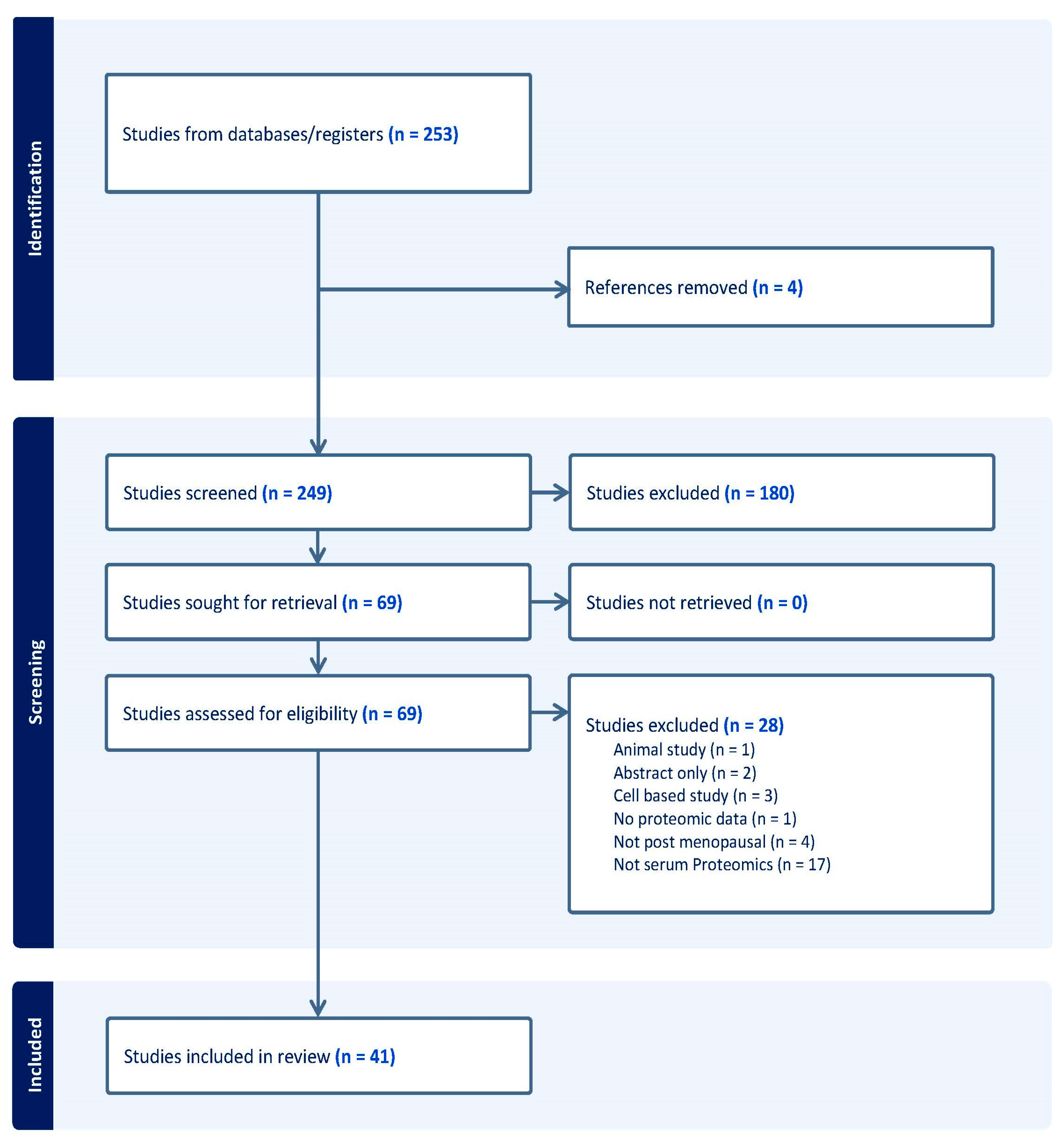
3.1. Study Identification, Screening, and Inclusion
3.2. Characteristics of Included Studies
3.3. Proteomics in Cardiovascular Health
3.4. Proteomics in Oncology
3.5. Proteomics in Bone Health
3.6. Proteomics in Other Disease States
4. Discussion
5. Conclusions
6. Future Directions
Author Contributions
Funding
Data Availability Statement
Conflicts of Interest
References
- Santoro, N.; Roeca, C.; Peters, B.A.; Neal-Perry, G. The Menopause Transition: Signs, Symptoms, and Management Options. J. Clin. Endocrinol. Metab. 2020, 106, 1–15. [Google Scholar] [CrossRef] [PubMed]
- Pillay, O.C.; Manyonda, I. The surgical menopause. Best Pract. Res. Clin. Obstet. Gynaecol. 2022, 81, 111–118. [Google Scholar] [CrossRef] [PubMed]
- Paramsothy, P.; Harlow, S.D.; Nan, B.; Greendale, G.A.; Santoro, N.; Crawford, S.L.; Gold, E.B.; Tepper, P.G.; Randolph, J.F.J. Duration of the menopausal transition is longer in women with young age at onset: The multiethnic Study of Women’s Health Across the Nation. Menopause 2017, 24, 142–149. [Google Scholar] [CrossRef]
- Garg, A.; Robinson, L. Surgical menopause: A toolkit for healthcare professionals. Post Reprod. Health 2021, 27, 222–225. [Google Scholar] [CrossRef] [PubMed]
- Appiah, D.; Schreiner, P.J.; Pankow, J.S.; Brock, G.; Tang, W.; Norby, F.L.; Michos, E.D.M.; Ballantyne, C.M.; Folsom, A.R. Long-term changes in plasma proteomic profiles in premenopausal and postmenopausal Black and White women: The Atherosclerosis Risk in Communities study. Menopause 2022, 29, 1150–1160. [Google Scholar] [CrossRef]
- Zeng, Y.; Zhang, L.; Zhu, W.; Xu, C.; He, H.; Zhou, Y.; Liu, Y.-Z.; Tian, Q.; Zhang, J.-G.; Deng, F.-Y.; et al. Quantitative proteomics and integrative network analysis identified novel genes and pathways related to osteoporosis. J. Proteom. 2016, 142, 45–52. [Google Scholar] [CrossRef]
- Tepper, P.G.; Randolph, J.F.; McConnell, D.S.; Crawford, S.L.; El Khoudary, S.R.; Joffe, H.; Gold, E.B.; Zheng, H.; Bromberger, J.T.; Sutton-Tyrrell, K. Trajectory Clustering of Estradiol and Follicle-Stimulating Hormone during the Menopausal Transition among Women in the Study of Women’s Health across the Nation (SWAN). J. Clin. Endocrinol. Metab. 2012, 97, 2872–2880. [Google Scholar] [CrossRef]
- El Khoudary, S.R.; Aggarwal, B.; Beckie, T.M.; Hodis, H.N.; Johnson, A.E.; Langer, R.D.; Limacher, M.C.; Manson, J.E.; Stefanick, M.L.; Allison, M.A.; et al. Menopause Transition and Cardiovascular Disease Risk: Implications for Timing of Early Prevention: A Scientific Statement From the American Heart Association. Circulation 2020, 142, 506–532. [Google Scholar] [CrossRef]
- Freeman, E.W.; Sammel, M.D. Methods in a longitudinal cohort study of late reproductive age women: The Penn Ovarian Aging Study (POAS). Women’s Midlife Health 2016, 2, 1. [Google Scholar] [CrossRef]
- Gurka, M.J.; Vishnu, A.; Santen, R.J.; DeBoer, M.D. Progression of Metabolic Syndrome Severity During the Menopausal Transition. J. Am. Heart Assoc. 2016, 5, e003609. [Google Scholar] [CrossRef]
- Janssen, I.; Powell, L.H.; Crawford, S.; Lasley, B.; Sutton-Tyrrell, K. Menopause and the Metabolic SyndromeThe Study of Women’s Health Across the Nation. Arch. Intern. Med. 2008, 168, 1568–1575. [Google Scholar] [CrossRef]
- Blake, J.; Cosman, F.A.; Lewiecki, E.M.; McClung, M.R.; Pinkerton, J.; Shapiro, M. Management of osteoporosis in postmenopausal women: The 2021 position statement of The North American Menopause Society. Menopause 2021, 28, 973–997. [Google Scholar] [CrossRef]
- Kim, S.W.; Choi, J.-W.; Yun, J.W.; Chung, I.-S.; Cho, H.C.; Song, S.-E.; Im, S.-S.; Song, D.-K. Proteomics approach to identify serum biomarkers associated with the progression of diabetes in Korean patients with abdominal obesity. PLoS ONE 2019, 14, e0222032. [Google Scholar] [CrossRef]
- Pant, A.; Anjankar, A.P.; Shende, S.; Dhok, A.; Jha, R.K.; Manglaram, A.V. Early detection of breast cancer through the diagnosis of Nipple Aspirate Fluid (NAF). Clin. Proteom. 2024, 21, 45. [Google Scholar] [CrossRef]
- Williams, S.A.; Kivimaki, M.; Langenberg, C.; Hingorani, A.D.; Casas, J.P.; Bouchard, C.; Jonasson, C.; Sarzynski, M.A.; Shipley, M.J.; Alexander, L.; et al. Plasma protein patterns as comprehensive indicators of health. Nat. Med. 2019, 25, 1851–1857. [Google Scholar] [CrossRef] [PubMed]
- Harsha, H.C.; Pinto, S.M.; Pandey, A. Proteomic Strategies to Characterize Signaling Pathways. Methods Mol. Biol. 2013, 1007, 359–377. [Google Scholar] [CrossRef] [PubMed]
- Paul, J.; Veenstra, T.D. Separation of Serum and Plasma Proteins for In-Depth Proteomic Analysis. Separations 2022, 9, 89. [Google Scholar] [CrossRef]
- Yates, J.R.; Ruse, C.I.; Nakorchevsky, A. Proteomics by Mass Spectrometry: Approaches, Advances, and Applications. Annu. Rev. Biomed. Eng. 2009, 11, 49–79. [Google Scholar] [CrossRef]
- Kanduc, D. The role of proteomics in defining autoimmunity. Expert Rev. Proteom. 2021, 18, 177–184. [Google Scholar] [CrossRef]
- McArdle, A.J.; Menikou, S. What is proteomics? Arch. Dis. Child.—Educ. Pract. Ed. 2020, 106, 178–181. [Google Scholar] [CrossRef]
- Ramirez, M.F.; Honigberg, M.; Wang, D.; Parekh, J.K.; Bielawski, K.; Courchesne, P.; Larson, M.D.; Levy, D.; Murabito, J.M.; Ho, J.E.; et al. Protein Biomarkers of Early Menopause and Incident Cardiovascular Disease. J. Am. Heart Assoc. 2023, 12, e028849. [Google Scholar] [CrossRef]
- Huang, D.; Wang, Y.; Lv, J.; Yan, Y.; Hu, Y.; Liu, C.; Zhang, F.; Wang, J.; Hao, D. Proteomic profiling analysis of postmenopausal osteoporosis and osteopenia identifies potential proteins associated with low bone mineral density. PeerJ 2020, 8, e9009. [Google Scholar] [CrossRef] [PubMed]
- Covidence. Covidence Systematic Review Software. Available online: www.covidence.org (accessed on 22 July 2024).
- Bellei, E.; Rustichelli, C.; Bergamini, S.; Monari, E.; Baraldi, C.; Castro, F.L.; Tomasi, A.; Ferrari, A. Proteomic serum profile in menstrual-related and post menopause migraine. J. Pharm. Biomed. Anal. 2020, 184, 113165. [Google Scholar] [CrossRef] [PubMed]
- Bergen, H.R.; Vasmatzis, G.; Cliby, W.A.; Johnson, K.L.; Oberg, A.L.; Muddiman, D.C. Discovery of Ovarian Cancer Biomarkers in Serum Using NanoLC Electrospray Ionization TOF and FT-ICR Mass Spectrometry. Dis. Markers 2004, 19, 239–249. [Google Scholar] [CrossRef]
- Cai, H.; Lu, S.; Chen, Y.; Mrcog, S.D.M.; Niu, Z.; Zhuo, G.; Lai, L.; Zhang, Z. Serum retinol binding protein 4 and galectin-3 binding protein as novel markers for postmenopausal nonalcoholic fatty liver disease. Clin. Biochem. 2018, 56, 95–101. [Google Scholar] [CrossRef] [PubMed]
- Carlsson, A.; Wingren, C.; Ingvarsson, J.; Ellmark, P.; Baldertorp, B.; Fernö, M.; Olsson, H.; Borrebaeck, C.A. Serum proteome profiling of metastatic breast cancer using recombinant antibody microarrays. Eur. J. Cancer 2008, 44, 472–480. [Google Scholar] [CrossRef]
- Celsi, F.; Monasta, L.; Arrigoni, G.; Battisti, I.; Licastro, D.; Aloisio, M.; Di Lorenzo, G.; Romano, F.; Ricci, G.; Ura, B. Gel-Based Proteomic Identification of Suprabasin as a Potential New Candidate Biomarker in Endometrial Cancer. Int. J. Mol. Sci. 2022, 23, 2076. [Google Scholar] [CrossRef]
- Chao, T.; Ladd, J.J.; Qiu, J.; Johnson, M.M.; Israel, R.; Chin, A.; Wang, H.; Prentice, R.L.; Feng, Z.; Disis, M.L.; et al. Proteomic profiling of the autoimmune response to breast cancer antigens uncovers a suppressive effect of hormone therapy. Proteom.—Clin. Appl. 2013, 7, 327–336. [Google Scholar] [CrossRef]
- Dalenc, F.; Doisneau-Sixou, S.F.; Allal, B.C.; Marsili, S.; Lauwers-Cances, V.; Chaoui, K.; Schiltz, O.; Monsarrat, B.; Filleron, T.; Renée, N.; et al. Tipifarnib Plus Tamoxifen in Tamoxifen-Resistant Metastatic Breast Cancer: A Negative Phase II and Screening of Potential Therapeutic Markers by Proteomic Analysis. Clin. Cancer Res. 2010, 16, 1264–1271. [Google Scholar] [CrossRef]
- Daswani, B.; Gupta, M.K.; Gavali, S.; Desai, M.; Sathe, G.J.; Patil, A.; Parte, P.; Sirdeshmukh, R.; Khatkhatay, M.I. Monocyte Proteomics Reveals Involvement of Phosphorylated HSP27 in the Pathogenesis of Osteoporosis. Dis. Markers 2015, 2015, 196589. [Google Scholar] [CrossRef]
- Delmonico, L.; Bravo, M.; Silvestre, R.T.; Ornellas, M.H.F.; De Azevedo, C.M.; Alves, G. Proteomic profile of saliva and plasma from women with impalpable breast lesions. Oncol. Lett. 2016, 12, 2145–2152. [Google Scholar] [CrossRef] [PubMed][Green Version]
- Fabian, C.J.; Kimler, B.F.; Phillips, T.A.; Nydegger, J.L.; Kreutzjans, A.L.; Carlson, S.E.; Hidaka, B.H.; Metheny, T.; Zalles, C.M.; Mills, G.B.; et al. Modulation of Breast Cancer Risk Biomarkers by High-Dose Omega-3 Fatty Acids: Phase II Pilot Study in Postmenopausal Women. Cancer Prev. Res. 2015, 8, 922–931. [Google Scholar] [CrossRef] [PubMed]
- Fuchs, D.; Vafeiadou, K.; Hall, W.L.; Daniel, H.; Williams, C.M.; Schroot, J.H.; Wenzel, U. Proteomic biomarkers of peripheral blood mononuclear cells obtained from postmenopausal women undergoing an intervention with soy isoflavones. Am. J. Clin. Nutr. 2007, 86, 1369–1375. [Google Scholar] [CrossRef]
- Garrison, C.B.; Lastwika, K.J.; Zhang, Y.; Li, C.I.; Lampe, P.D. Proteomic Analysis, Immune Dysregulation, and Pathway Interconnections with Obesity. J. Proteome Res. 2016, 16, 274–287. [Google Scholar] [CrossRef] [PubMed]
- Gericke, B.; Koebnick, C.; Reimann, M.; Forterre, S.; Zunft, H.F.; Schweigert, F.J. Influence of hormone replacement therapy on proteomic pattern in serum of postmenopausal women. Maturitas 2005, 51, 334–342. [Google Scholar] [CrossRef]
- He, W.-T.; Liang, B.-C.; Shi, Z.-Y.; Li, X.-Y.; Li, C.-W.; Shi, X.-L. Weak cation exchange magnetic beads coupled with matrix-assisted laser desorption ionization-time of flight-mass spectrometry in screening serum protein markers in osteopenia. SpringerPlus 2016, 5, 679. [Google Scholar] [CrossRef]
- Jin, Z.; Collier, T.S.; Dai, D.L.; Chen, V.; Hollander, Z.; Ng, R.T.; McManus, B.M.; Balshaw, R.; Apostolidou, S.; Penn, M.S.; et al. Development and Validation of Apolipoprotein AI-Associated Lipoprotein Proteome Panel for the Prediction of Cholesterol Efflux Capacity and Coronary Artery Disease. Clin. Chem. 2019, 65, 282–290. [Google Scholar] [CrossRef]
- Katayama, H.; Tsou, P.; Kobayashi, M.; Capello, M.; Wang, H.; Esteva, F.; Disis, M.L.; Hanash, S. A plasma protein derived TGFβ signature is a prognostic indicator in triple negative breast cancer. NPJ Precis. Oncol. 2019, 3, 10. [Google Scholar] [CrossRef]
- Lal, C.; Hardiman, G.; Kumbhare, S.; Strange, C. Proteomic biomarkers of cognitive impairment in obstructive sleep apnea syndrome. Sleep Breath. 2018, 23, 251–257. [Google Scholar] [CrossRef]
- Lau, E.S.; Paniagua, S.M.; Guseh, J.S.; Bhambhani, V.; Zanni, M.V.; Courchesne, P.; Lyass, A.; Larson, M.G.; Levy, D.; Ho, J.E. Sex Differences in Circulating Biomarkers of Cardiovascular Disease. J. Am. Coll. Cardiol. 2019, 74, 1543–1553. [Google Scholar] [CrossRef]
- Lee, D.-H.; Pei, C.-Z.; Song, J.-Y.; Lee, K.-J.; Yun, B.-S.; Kwack, K.-B.; Lee, E.-I.; Baek, K.-H. Identification of serum biomarkers for premature ovarian failure. Biochim. Biophys. Acta (BBA)—Proteins Proteom. 2018, 1867, 219–226. [Google Scholar] [CrossRef]
- Li, C.I. Discovery and Validation of Breast Cancer Early Detection Biomarkers in Preclinical Samples. Horm. Cancer 2010, 2, 125–131. [Google Scholar] [CrossRef] [PubMed][Green Version]
- Li, W.; Liu, C.; Wang, H. Screening for specific biomarkers in the serum of postmenopausal osteoporosis patients using proteomic fingerprint techniques. Biomed. Rep. 2012, 1, 129–133. [Google Scholar] [CrossRef]
- Henderson, M.C.; Silver, M.; Tran, Q.; Letsios, E.E.; Mulpuri, R.; Reese, D.E.; Lourenco, A.P.; LaBaer, J.; Anderson, K.S.; Alpers, J.; et al. A Noninvasive Blood-based Combinatorial Proteomic Biomarker Assay to Detect Breast Cancer in Women over age 50 with BI-RADS 3, 4, or 5 Assessment. Clin. Cancer Res. 2019, 25, 142–149. [Google Scholar] [CrossRef] [PubMed]
- Martínez-Aguilar, M.M.; Aparicio-Bautista, D.I.; Ramírez-Salazar, E.G.; Reyes-Grajeda, J.P.; De La Cruz-Montoya, A.H.; Antuna-Puente, B.; Hidalgo-Bravo, A.; Rivera-Paredez, B.; Ramírez-Palacios, P.; Quiterio, M.; et al. Serum Proteomic Analysis Reveals Vitamin D-Binding Protein (VDBP) as a Potential Biomarker for Low Bone Mineral Density in Mexican Postmenopausal Women. Nutrients 2019, 11, 2853. [Google Scholar] [CrossRef] [PubMed]
- Pepe, J.; Rossi, M.; Battafarano, G.; Vernocchi, P.; Conte, F.; Marzano, V.; Mariani, E.; Mortera, S.L.; Cipriani, C.; Rana, I.; et al. Characterization of Extracellular Vesicles in Osteoporotic Patients Compared to Osteopenic and Healthy Controls. J. Bone Miner. Res. 2020, 37, 2186–2200. [Google Scholar] [CrossRef]
- Pitteri, S.J.; Amon, L.M.; Buson, T.B.; Zhang, Y.; Johnson, M.M.; Chin, A.; Kennedy, J.; Wong, C.-H.; Zhang, Q.; Wang, H.; et al. Detection of Elevated Plasma Levels of Epidermal Growth Factor Receptor Before Breast Cancer Diagnosis among Hormone Therapy Users. Cancer Res. 2010, 70, 8598–8606. [Google Scholar] [CrossRef]
- Pitteri, S.J.; Hanash, S.M.; Aragaki, A.; Amon, L.M.; Chen, L.; Buson, T.B.; Paczesny, S.; Katayama, H.; Wang, H.; Johnson, M.M.; et al. Postmenopausal estrogen and progestin effects on the serum proteome. Genome Med. 2009, 1, 121. [Google Scholar] [CrossRef]
- Prentice, R.L.; Paczesny, S.; Aragaki, A.; Amon, L.M.; Chen, L.; Pitteri, S.J.; McIntosh, M.; Wang, P.; Busald, T.B.; Hsia, J.; et al. Novel proteins associated with risk for coronary heart disease or stroke among postmenopausal women identified by in-depth plasma proteome profiling. Genome Med. 2010, 2, 48. [Google Scholar] [CrossRef]
- Prentice, R.L.; Zhao, S.; Johnson, M.; Aragaki, A.; Hsia, J.; Jackson, R.D.; Rossouw, J.E.; E Manson, J.; Hanash, S.M. Proteomic risk markers for coronary heart disease and stroke: Validation and mediation of randomized trial hormone therapy effects on these diseases. Genome Med. 2013, 5, 112. [Google Scholar] [CrossRef]
- Shi, X.-L.; Liang, B.-c.; Shi, Z.-Y.; Wang, B.; Wu, P.; Kong, L.-C.; Yao, J.-l.; Li, C.-w. Discovery and identification of serum biomarkers for postmenopausal osteoporosis based on TMT labeling and HPLC-MS/MS technology. Int. J. Clin. Exp. Med. 2017, 10, 334–346. [Google Scholar]
- Shi, X.; Li, C.; Liang, B.; He, K.; Li, X. Weak cation magnetic separation technology and MALDI-TOF-MS in screening serum protein markers in primary type I osteoporosis. Evolution 2015, 14, 15285–15294. [Google Scholar] [CrossRef] [PubMed]
- Shin, J.-W.; Lee, E.; Han, S.; Choe, S.-A.; Jeon, O.H. Plasma Proteomic Signature of Cellular Senescence and Markers of Biological Aging Among Postmenopausal Women. Rejuvenation Res. 2022, 25, 141–148. [Google Scholar] [CrossRef] [PubMed]
- Soh, G.T.; Mohammad, A.H.; Isa, S.N.L.S.; Chin, K.-Y.; Mohamed, N. Comparison of Cytokine Profile between Postmenopausal Women with and Without Osteoporosis—A Case-Control Study. Endocrine Metab. Immune Disord.—Drug Targets 2023, 23, 811–817. [Google Scholar] [CrossRef]
- Sun, Y.-W.; Xu, H.; Benitez, G.; Chen, K.-M.; Stanley, A.; Stanley, B.; Zhu, J.; Thompson, H.; Manni, A.; El-Bayoumy, K. Omega-3 Fatty Acids Responsive Proteins and Reduction in Breast Density in Obese Postmenopausal Women. J. Proteome Res. 2019, 18, 3461–3469. [Google Scholar] [CrossRef]
- Tarney, C.M.; Wang, G.; Bateman, N.W.; Conrads, K.A.; Zhou, M.; Hood, B.L.; Loffredo, J.; Tian, C.; Darcy, K.M.; Hamilton, C.A.; et al. Biomarker panel for early detection of endometrial cancer in the Prostate, Lung, Colorectal, and Ovarian cancer screening trial. Am. J. Obstet. Gynecol. 2019, 221, 472.e1–472.e10. [Google Scholar] [CrossRef]
- Thomas, C.E.; Dahl, L.; Byström, S.; Chen, Y.; Uhlén, M.; Mälarstig, A.; Czene, K.; Hall, P.; Schwenk, J.M.; Gabrielson, M. Circulating proteins reveal prior use of menopausal hormonal therapy and increased risk of breast cancer. Transl. Oncol. 2022, 17, 101339. [Google Scholar] [CrossRef] [PubMed]
- Tworoger, S.S.; Spentzos, D.; Grall, F.T.; Liebermann, T.A.; Hankinson, S.E. Reproducibility of Proteomic Profiles Over 3 Years in Postmenopausal Women Not Taking Postmenopausal Hormones. Cancer Epidemiol. Biomark. Prev. 2008, 17, 1480–1485. [Google Scholar] [CrossRef]
- Watrowski, R.; Obermayr, E.; Wallisch, C.; Aust, S.; Concin, N.; Braicu, E.I.; Van Gorp, T.; Hasenburg, A.; Sehouli, J.; Vergote, I.; et al. Biomarker-Based Models for Preoperative Assessment of Adnexal Mass: A Multicenter Validation Study. Cancers 2022, 14, 1780. [Google Scholar] [CrossRef]
- Wong, E.; Freiberg, M.; Tracy, R.; Kuller, L. Epidemiology of Cytokines. Am. J. Epidemiol. 2008, 168, 443–453. [Google Scholar] [CrossRef]
- Zhang, L.; Liu, Y.; Zeng, Y.; Zhu, W.; Zhao, Y.; Zhang, J.; Zhu, J.; He, H.; Shen, H.; Tian, Q.; et al. Network-based proteomic analysis for postmenopausal osteoporosis in Caucasian females. Proteomics 2015, 16, 12–28. [Google Scholar] [CrossRef] [PubMed]
- CDC. Heart Disease Facts. Available online: https://www.cdc.gov/heart-disease/data-research/facts-stats/index.html#cdc_facts_stats_curr_actions-what-cdc-is-doing (accessed on 22 July 2024).
- Anderson, B.; World Health Organisation. Breast Cancer. Available online: https://www.who.int/news-room/fact-sheets/detail/breast-cancer (accessed on 22 July 2024).

| Author, Year, Country | Disease Studied | - Study Design - Sample Size (n) - Sample Tested (i.e., Blood, Plasma, Serum) | Inclusion Criteria | Significant Findings Reported by Study Authors | Narrative Synthesis |
|---|---|---|---|---|---|
| Prentice 2010 [50] United States | Stroke and CHD | - Case-control - n = 1600 - Blood | Postmenopausal women with CHD or stroke | Identified 37 significant proteins (p < 0.05) for CHD. Beta-2 microglobulin (B2M), alpha-1-acid glycoprotein 1 (ORM1), and insulin-like growth factor binding protein acid labile subunit (IGFALS) had a false discovery rate < 0.05. Identified 47 significant proteins (p < 0.05) for stroke. Apolipoprotein A-II precursor (APOA2), peptidyl-prolyl isomerase A (PPIA), and insulin-like growth factor binding protein 4 (IGFBP4) had a false discovery rate < 0.05. | Proteomics may be potentially beneficial for the detection of CHD and stroke in postmenopausal women. |
| Prentice 2013 [51] United States | - Case-control - n = 710 - Blood | Identified 3 significant proteins (p < 0.05) for CHD: beta-2 microglobulin (B2M), thrombospondin-1 (THBS1), and complement factor D pre-protein (CFD). A one-year increase in insulin-like growth factor binding protein 1 (IGFBP1) can suggest CHD risk in women initiating oral hormone therapy. Identified 3 significant proteins (p < 0.05) for stroke: beta-2 microglobulin (B2M), insulin-like growth factor binding protein 2 (IGFBP2), and insulin-like growth factor binding protein 4 (IGFBP4). | |||
| Jin 2019 [38] UK, Canada, and United States | CEC | - Case-control - n = 137 - Serum | Postmenopausal women with a history of CAD | Identified five apolipoproteins (Apo AI, CI, CII, CIII, and CIV) as estimators of predicted CEC and cardiovascular disease in postmenopausal women with a history of CAD. | Proteomics may be potentially beneficial for the prediction of CAD in postmenopausal women. |
| Lau 2019 [41] United States | CVD | - Cohort - n = 7184 - Blood | Men and women with no prevalent CVD at the time of enrollment | Identified several biomarkers differentially associated with incident CVD events in women compared to men, including apolipoprotein B, CD14, and pro-basic platelet protein (PPBP). Found that adipokines and inflammatory markers, such as leptin and C-reactive protein, were higher in women than men. | Proteomics may be potentially beneficial as predictive disease markers for CVD in women and men. Proteins and pathways associated with CVD are differentially expressed in men and women. |
| Appiah 2022 [5] United States | Atherosclerosis | - Cohort - n = 4508 - Blood | Peri- and postmenopausal women aged 45–64 years | Identified 38 proteins that were significantly altered between pre- and postmenopausal women at baseline. Identified 29 proteins that significantly changed between the pre- and postmenopausal groups during follow-up, with notable changes in putative hydrolase retinoblastoma-binding protein 9 (RBBP9), collagen αlpha 2(XI) chain, chondroadherin, ferritin light chain, guanylate-binding protein 1, R-spondin-1, secreted frizzled-related protein 4, WD repeat-containing protein 5, LH, and FSH. | Proteomics may be potentially beneficial for the prediction of CAD in peri- and postmenopausal women. |
| Bergen 2003 [25] United States | Ovarian cancer | - Case-control - n = 18 - Serum | Women with stage III/IV ovarian cancer or age-matched controls | Identified over 15 molecular entities that differed between ovarian cancer patients and controls. Found that Fibrinopeptide-A concentrations were significantly correlated with ovarian cancer stage and notably higher in patients compared to controls. | Proteomics may be potentially beneficial for the early detection of ovarian cancer. |
| Tarney 2019 [57] United States | Endometrial cancer | - Case-control - n = 224 - Blood | Postmenopausal women aged 55–74 years with and without endometrial cancer | Identified 47 proteins that were significantly altered between cases and controls diagnosed with endometrial cancer. Found that complement factor B, serotransferrin, catalase, proteasome subunit beta type-6, beta-2-microglobulin, and protocadherin-18 exhibited high diagnostic potential. | Proteomics may be potentially beneficial as a diagnostic study of endometrial cancer in postmenopausal women. |
| Celsi 2022 [28] Italy | - Cohort - n = 103 - Serum | Postmenopausal women with endometrial cancer and controls | Identified 24 biomarkers that differed between postmenopausal women with and without endometrial cancer. Identified suprabasin as a potential marker for poor prognosis in endometrial cancer, with Isoform 1 upregulated and Isoform 2 downregulated. | Proteomics may be potentially beneficial to predict the risk of endometrial cancer in postmenopausal women. | |
| Watrowski 2022 [60] Germany, Austria, and Belgium | Adnexal mass | - Cohort - n = 77 - Plasma | Pre- and postmenopausal women with benign or malignant ovarian tumors | Identified cancer antigen 125 (CA125) and osteopontin as having the best discriminating power as single markers of adnexal mass. CA125, osteopontin, prolactin, macrophage migration inhibitory factor, and, optionally, Human Epididymis Protein 4 (HE4) and leptin, when combined, are promising for diagnosing adnexal mass. | Proteomics may be potentially beneficial to predict the risk of malignancy in adnexal masses in pre- and postmenopausal women. |
| Delmonico 2016 [32] Brazil | Impalpable breast lesions (fibroadenoma and infiltrative ductal carcinoma) | - Case-control - n = 28 - Blood and plasma | Pre- and postmenopausal women with impalpable breast lesions BI-RADS grade 3 or 4 and healthy controls | Identified 6 proteins significantly altered in fibroadenoma and 3 proteins significantly altered in infiltrative ductal carcinoma. Found that αlpha 2-macroglobulin, ceruloplasmin, haptoglobin, hemopexin, and vitamin D binding protein were the most significantly altered proteins in both diseases. | Proteomics may be potentially beneficial for the diagnosis of fibroadenomas and infiltrative ductal carcinomas in pre- and postmenopausal women. |
| Katayama 2019 [39] United States | Triple-negative breast cancer | - Cohort - n = 48 - Blood | Pre- and postmenopausal women with triple-negative breast cancer (stage II and III) | Identified 43 proteins associated with tumor regression in triple-negative breast cancer. Determined that the genes chloride intracellular channel 1 (CLIC1), limbic system-associated membrane protein (LSAMP), and microtubule-associated protein RP/EB family member 1 (MAPRE1) were significant regardless of tumor stage, grade, size, or menopausal status. | Genes may be potentially beneficial prognostic indicators for triple-negative breast cancer in pre- and postmenopausal women. |
| Pitteri 2010 [48] United States | Breast cancer amongst hormone-therapy users | - Case-control - n = 490 patients - n = 490 controls - Blood | Estrogen-receptor-positive (ER+) breast cancer patients and matched non-cancer patients | Identified 57 proteins with significant changes (p < 0.05) between ER+ breast cancer patients and matched non-cancer controls. Identified epidermal growth factor receptor (EGFR) as a potential predictor of ER+ breast cancer. | Proteomics may be potentially beneficial in predicting cancer amongst hormone-therapy users. |
| Henderson 2019 [45] United States | Breast cancer (invasive breast cancer and ductal carcinoma in situ) | - Cohort - n = 469 in the training set - n = 194 in the validation set - Blood | Postmenopausal women aged ≥50 years with a BI-RADS category of 3, 4, or 5 | Researched and validated a combinational proteomic biomarker assay for women aged ≥50 years, demonstrating a negative predictive value of 98% and a sensitivity of 93% when combined with clinical data. | Proteomics may be potentially beneficial for the diagnosis of breast cancer in postmenopausal women with invasive breast cancer or ductal carcinoma in situ. |
| Li 2011 [43] United States | Breast cancer | - Case-control - n = 396 validation participants n = 980 discovery - Blood | Breast cancer and matched healthy individuals | Identified 57 proteins that differentiate between cancer patients and controls. Found that epidermal growth factor receptor (EGFR) was elevated in breast cancer patients. | Proteomics may be potentially beneficial for early detection of breast cancer. |
| Carlsson 2008 [27] Sweden | Metastatic breast cancer | - Case-control - n = 40 - Blood | Postmenopausal women with metastatic breast cancer and healthy matched controls | Identified 11 biomarker signatures with significant changes between metastatic breast cancer patients and healthy controls, comprising 9 non-redundant proteins. Found that 5 proteins were upregulated (sialyl Lewisx, C3, C4, C5, and IL-8) while 4 were downregulated (transmembrane peptide, IL-5, IL-7, and MCP-3) in cancer patients. | |
| Soh 2022 [55] Malaysia | Osteoporosis | - Case-control - n = 40 - Blood | Postmenopausal women with and without osteoporosis | Identified platelet-derived growth factor-BB, IL-6 receptor, and tissue inhibitor of metallopeptidase-2 as differentiating between postmenopausal women with osteoporosis and those without. Found that IL-6 receptor was significantly lower in postmenopausal women with osteoporosis than those with normal bone health after adjusting for body mass index. | Proteomics may be potentially beneficial as a diagnostic tool for osteoporosis in postmenopausal women. |
| Li 2013 [44] China | - Case-control - n = 180 - Blood | Postmenopausal women aged 50–68 years with and without osteoporosis | Identified 138 different protein peaks, with 3167.4, 4071.1, 7771.7, and 8140.5 m/z showing the highest discriminatory power between postmenopausal women with and without osteoporosis. | ||
| Zhang 2016 [62] United States | - Case-control - n = 42 - Blood | Postmenopausal women with extremely low or high bone mass density (BMD) | Identified four genes—Peptidylprolyl isomerase A, similar to Peptidylprolyl isomerase A isoform 1, Transgelin 2, and Isoform Long of 14-3-3 protein beta/alpha—that were significantly downregulated in postmenopausal women with extremely low BMD. Found that three genes—Lamin B1, Annexin A2-like protein, and Annexin A—were significantly upregulated in postmenopausal women with extremely low BMD. | ||
| Daswani 2015 [31] India | - Case-control - n = 200 - Blood | Premenopausal women aged 30–40 years and postmenopausal women aged 50–60 years with and without osteoporosis | Identified 45 proteins significantly differentiating low from high bone mass density. Found that Heat Shock Protein 27 (HSP27) and phosphorylated Heat Shock Protein 27 (pHSP27) were significantly upregulated in low BMD in both pre- and postmenopausal women. | Proteomics may be potentially beneficial as a diagnostic tool for osteoporosis and osteopenia in pre- and postmenopausal women. | |
| Shi 2015 [53] China | Primary type I osteoporosis | - Diagnostic test accuracy study - n = 25 - Blood | Postmenopausal women aged 50–70 years with and without osteoporosis | Identified 16 peaks differentiating postmenopausal women with osteoporosis from those without, with 8909.047, 8690.658, 13,745.48, and 15,114.52 m/z being significant. | Proteomics may be potentially beneficial as a diagnostic tool for osteoporosis in postmenopausal women. |
| Shi 2017 China [52] | Primary osteoporosis | - Case-control - n = 20 - Blood | Postmenopausal women with and without osteoporosis | Identified 87 proteins significantly differentiating postmenopausal women with osteoporosis from controls. Found that Ras-related protein Rab-7a (RAB7A), Thrombospondin-1 (TSP1), Growth arrest-specific protein 6 (GAS6), and Secreted phosphoprotein 24 (SPP24) were upregulated in postmenopausal osteoporosis. | |
| He 2016 [37] China | Osteopenia | - Case-control - n = 20 - Blood | Postmenopausal women with and without osteopenia | Identified 10 different peaks differentiating postmenopausal women with osteopenia from those without, from which peaks of 1699 and 3038 (Secretin) Da were the most significant. | Proteomics may be a potentially beneficial as a diagnostic tool for osteopenia in postmenopausal women. |
| Martinez-Aguilar 2019 [46] Mexico | Low bone mineral density | - Case-control - n = 30 - Blood | Postmenopausal women with normal BMD, osteoporosis, or osteopenia | Identified 27 proteins significantly differentiating low from high bone mass density. Found that low serum vitamin D-binding protein (VDBP) levels correlate with low BMD (osteopenic and osteoporotic) and osteoporotic fractures. Determined that ceruloplasmin showed significance in osteoporosis. | Proteomics may be potentially beneficial as a diagnostic tool for osteoporosis and osteopenia in postmenopausal women. |
| Huang 2020 [22] China | Osteoporosis and osteopenia | - Case-control - n = 54 - Plasma | Postmenopausal women, 18 with primary osteoporosis, 18 with osteopenia, and 18 with normal bone mass | Identified 8 significant proteins in osteopenia, 127 in osteoporosis, and 3 distinguishing osteoporosis from osteopenia. Found that Lysozyme C was negatively associated with BMD, while glucosidase and protein disulfide isomerase A5 were positively associated with BMD values. | |
| Pepe 2022 [47] Italy | - Case-control - n = 102 - Blood | Postmenopausal women aged ≥45 years with normal BMD, osteoporosis, or osteopenia | Identified patterns in extracellular vesicle (EV) content from patients with varying bone mass, with 63 miRNAs expressed; miR-1246 and miR-1224-5p were regulated in the osteoporotic group. Found decreased levels of fibrinogen, vitronectin, and clusterin and increased levels of coagulation factors and apolipoprotein in the osteoporotic group. | ||
| Gericke 2005 [36] Germany | Hormone replacement therapy in cardiovascular disease | - Case-control - n = 40 - Serum | Postmenopausal women aged >45 years | Identified endothelin I/II and endothelin-converting enzyme as marker proteins with differing concentrations between hormone-therapy users and non-users. Found a significant difference in intensity for a protein with a molecular weight of 20,787 Da between hormone-therapy users and non-users. Reported that many of the identified markers are key participants in inflammation and cardiovascular disease development, including haptoglobulin, haptoglobulin-1-chain, apolipoprotein A, IL-6, tumor necrosis factor, endothelin I/II, endothelin-converting enzyme, and acute-phase reactants, such as C-reactive protein (CRP). | Proteomics may be potentially beneficial in evaluating inflammatory responses associated with cardiovascular disease in postmenopausal women on hormone therapy. |
| Thomas 2022 [58] Sweden | Hormone therapy and breast cancer risk | - Case-control - n = 549 - Plasma | Pre- and postmenopausal women, breast cancer patients, and age-matched controls | Identified a unique and persistent proteomic signature, including 54 significant proteins (p < 0.05), associated with prior hormone-replacement-therapy use. Among the 25 most significant proteins, 16 were upregulated and 15 were downregulated in patients more likely to have used hormone therapy. | Proteomics may be potentially beneficial in predicting the risk of breast cancer in pre- and postmenopausal women with a history of prior hormone therapy. |
| Tworoger 2008 [59] United States | Reproducibility of proteomics in non-hormone users | - Cohort - n = 60 - Blood | Postmenopausal women not taking HRT over 3 years | Identified protein peaks that were reproducible over time, suggesting that a single sample is sufficient. | Proteomic profiles are reproducible longitudinally. |
| Pitteri 2009 [49] United States | Hormone replacement therapy (estrogen vs. estrogen-plus-progestin) | - Cohort - n = 100 - Blood | Healthy postmenopausal women aged 50–79 years with a minimum of a 3-month hormone therapy washout period | Identified 98 proteins exhibiting a false discovery rate < 0.05 associated with changes under estrogen plus progestin therapy compared to 94 proteins for estrogen alone. | Proteomics profiles differ based on the type of hormone therapy, i.e., estrogen versus estrogen plus progesterone. |
| Fuchs 2007 [34] United Kingdom | Soy isoflavones intervention in cardiovascular diseases | - Randomized clinical trial - n = 10 - Blood | Postmenopausal women aged 45–70 years | Identified 29 proteins significantly different between postmenopausal women consuming soy isoflavones and those not consuming soy isoflavones. Found an increase in Heat Shock Protein 70, lymphocyte-specific protein phosphatase, and alpha-enolase, while galectin-1 decreased after soy extract consumption. | Proteomic profiles of postmenopausal women who consumed soy isoflavones were observed to be different from those who did not. |
| Cai 2018 [26] China | Nonalcoholic fatty liver disease | - Cohort - n = 153 - Blood | Pre- and postmenopausal women aged 34–56 years diagnosed with nonalcoholic fatty liver disease (NAFLD) | Identified 167 proteins significantly differentiating women with NAFLD from controls, with 65 upregulated and 102 downregulated in NAFLD. Determined that Retinol Binding Protein 4 (RBP4), galectin-3 binding protein (LGALS3BP), Histidine-rich Glycoprotein, and Peroxiredoxin-6 were associated with liver steatosis in postmenopausal women. | Proteomics may be potentially beneficial as a diagnostic tool for the detection of nonalcoholic fatty liver disease in pre- and postmenopausal women. |
| Lal 2019 [40] United States | Cognitive impairment in obstructive sleep apnea | - Case-control - n = 12 - Blood | Postmenopausal women aged 45–60 years with obstructive sleep apnea with or without cognitive impairment | Identified 22 proteins significantly up- or downregulated in obstructive sleep apnea. Found that increased insulin, prostasin, angiopoietin-1, plasminogen activator inhibitor 1, and interleukin-1 beta were associated with obstructive sleep apnea with cognitive impairment. Observed under-expression of Cathepsin B, ceruloplasmin, and adiponectin in cognitive impairment. | Proteomics may be potentially beneficial as a diagnostic tool for the detection of obstructive sleep apnea and associated cognitive impairment in postmenopausal women. |
| Lee 2019 [42] Korea | Premature ovarian failure | - Case-control - n = 171 - Blood | Women diagnosed with premature ovarian failure, those at risk, and healthy controls | Identified 11 proteins significantly differentiating cases of premature ovarian failure from controls. Found that Ceruloplasmin, Complement C3, Fibrinogen α, Fibrinogen β, and Sex-Hormone-Binding Globulin (SHBG) increased in patients with premature ovarian failure compared to controls. | Proteomics may be potentially beneficial as a diagnostic tool for the detection of premature ovarian failure. |
| Shin 2022 [54] Korea | Aging | - Cohort - n = 76 - Plasma | Postmenopausal women aged 46–82 years | Identified Growth-Differentiation Factor 15 (GDF15), insulin-like growth factor binding protein-2 (IGFBP-2), and tumor necrosis factor-alpha (TNF-alpha) as positively associated with chronological age. Found that IL-8 and monocyte chemoattractant protein-1 were associated with menopausal age and years since menopause. Identified 10 proteins associated with both chronological age and menopausal state: GDF15, interferon-gamma, IGFBP-2, IGFBP-7, IL-15, IL-1beta, IL-17A, IL-8, MCP-1, tissue inhibitors of metalloproteinase-2 (TIMP-2), TNF-alpha, vascular endothelial growth factor-A (VEGF-A), and interferon-inducible protein 10 (IP-10). | Proteomic profiles may provide insight into how menopause relates to proteomic indicators of aging. |
| Bellei 2020 [24] Italy | Migraine | - Non-randomized clinical trial - n = 45 - Serum | Peri- and postmenopausal women with primary or secondary headaches | Identified 12 proteins correlating with migraine patients. Found that Prothrombin, serum amyloid P-component, Ig kappa chain C region, apolipoprotein A-I, and serum amyloid A-4 protein were present in both menstrual-related migraine and migraine in postmenopause groups. Observed significant upregulation of 2 proteins and downregulation of apolipoprotein A-I (most significant) in perimenopausal women with headaches. Detected significant dysregulation of 4 proteins (tetranectin, alpha-1 antitrypsin, haptoglobin, and apolipoprotein A-IV) in postmenopausal women with headaches, with transthyretin being the most significant. | Proteomics may be potentially beneficial as a diagnostic tool for migraines in peri- and postmenopausal women. |
| Wong 2008 [61] United States | Weight loss | - Cohort - n = 290 - Blood | Postmenopausal women aged 52–62 years with a recent history of HRT use | Identified 57 cytokines differing between baseline and follow-up. Found that sustained weight loss was associated with a decrease in levels of IL-1 receptor antagonist, IL-6, and C-reactive protein. | Proteomic profiles associated with weight loss were observed to demonstrate biological variability over time. |
| Garrison 2017 [35] United States | Obesity | - Cohort - n = 924 - Plasma | Postmenopausal women with normal (<24.5 kg/m2) or high BMI (>25.0 kg/m2) | Identified JAK-STAT and NF-κB pathways as important regulators of obesity. | Proteomics may be potentially beneficial as a diagnostic tool for obesity in postmenopausal women. |
| Sun 2019 [56] United States | Effect of Lovaza (n-3FA) on breast density in obese and non-obese women | - Randomized clinical trial - n = 10 - Plasma | Lean (BMI ≤ 25) and obese (BMI ≥ 30) postmenopausal women with a breast density ≥25% | Detected 173 proteins differentially expressed between lean and obese postmenopausal women. Found that hemopexin precursor, vitamin D binding protein isoform 1 precursor, fibronectin isoform 10 precursor, and α-2 macroglobulin precursor were altered in a tumor-protective manner by an omega-3-rich diet in obese women. Identified gelsolin, vitamin D binding protein isoform 1 precursor, and fibronectin isoform 10 precursor as protective against breast densities and reduced by an omega-3-rich diet. | Proteomic profiles of lean and obese postmenopausal women who consumed Lovaza were observed to be different from those who did not. |
| Fabian 2015 [33] United States | High-dose omega-3 fatty acids and breast cancer risk | - Non-randomized clinical trial - n = 34 - Blood | Postmenopausal women <65 years old with increased risk of breast cancer | Observed favorable modulation in serum adiponectin, TNF-alpha, HOMA 2B (pancreatic beta cell function), and bioavailable estradiol, potentially reducing the risk of estrogen-driven breast cancer. | Proteomic profiles of postmenopausal women with increased risk of breast cancer who consumed high-dose omega-3 fatty acids were observed to be different from those who did not. |
| Dalenc 2010 [30] France | Tipifarnib plus Tamoxifen in Tamoxifen-resistant metastatic breast cancer | - Non-randomized clinical trial - n = 20 - Blood | Postmenopausal women with at least one measurable breast lesion | Found that fibrinogen α could discriminate between Tipifarnib and Tamoxifen treatment responders and non-responders. Identified p5900, a degradation product, as being potentially associated with invasion and/or inflammation. | Proteomics could potentially distinguish between responders and non-responders to the combination of Tamoxifen and Tipifarnib in postmenopausal women with metastatic breast cancer resistant to Tamoxifen. |
| Chao 2013 [29] United States | Impact of hormone therapy on the immune response towards breast cancer antigens | - Case-control - n = 380 - Plasma | Postmenopausal women with ER+ breast cancer and healthy controls | Identified multiple biomarkers associated with an immune response to breast cancer antigens. Found that IL-6 and other cytokines were reduced in hormone-therapy users. | Proteomic profiles may be potentially beneficial in the detection of immune response to breast cancer antigens in postmenopausal women with ER+ breast cancer. |
Disclaimer/Publisher’s Note: The statements, opinions and data contained in all publications are solely those of the individual author(s) and contributor(s) and not of MDPI and/or the editor(s). MDPI and/or the editor(s) disclaim responsibility for any injury to people or property resulting from any ideas, methods, instructions or products referred to in the content. |
© 2024 by the authors. Published by MDPI on behalf of the Lithuanian University of Health Sciences. Licensee MDPI, Basel, Switzerland. This article is an open access article distributed under the terms and conditions of the Creative Commons Attribution (CC BY) license (https://creativecommons.org/licenses/by/4.0/).
Share and Cite
Katamesh, B.E.; Futela, P.; Vincent, A.; Thilagar, B.; Whipple, M.; Hassan, A.R.; Abuelazm, M.; Nanda, S.; Anstine, C.; Singla, A. Navigating the Proteomic Landscape of Menopause: A Review. Medicina 2024, 60, 1473. https://doi.org/10.3390/medicina60091473
Katamesh BE, Futela P, Vincent A, Thilagar B, Whipple M, Hassan AR, Abuelazm M, Nanda S, Anstine C, Singla A. Navigating the Proteomic Landscape of Menopause: A Review. Medicina. 2024; 60(9):1473. https://doi.org/10.3390/medicina60091473
Chicago/Turabian StyleKatamesh, Basant E., Pragyat Futela, Ann Vincent, Bright Thilagar, Mary Whipple, Abdul Rhman Hassan, Mohamed Abuelazm, Sanjeev Nanda, Christopher Anstine, and Abhinav Singla. 2024. "Navigating the Proteomic Landscape of Menopause: A Review" Medicina 60, no. 9: 1473. https://doi.org/10.3390/medicina60091473
APA StyleKatamesh, B. E., Futela, P., Vincent, A., Thilagar, B., Whipple, M., Hassan, A. R., Abuelazm, M., Nanda, S., Anstine, C., & Singla, A. (2024). Navigating the Proteomic Landscape of Menopause: A Review. Medicina, 60(9), 1473. https://doi.org/10.3390/medicina60091473

