


Is There a Relationship between Psychotic Disorders and the Radicalization Process? A Systematic Review

 , ,
, , 
Abstract
1. Introduction
2. Materials and Methods
2.1. Search Strategy
2.2. Selection Criteria
2.3. Selection Process
2.4. Population Sample Identification
2.5. Risk of Bias Assessment
3. Results
4. Discussion
5. Conclusions
Supplementary Materials
Author Contributions
Funding
Institutional Review Board Statement
Informed Consent Statement
Data Availability Statement
Conflicts of Interest
References
- Doosje, B.; Moghaddam, F.M.; Kruglanski, A.W.; De Wolf, A.; Mann, L.; Feddes, A.R. Terrorism, Radicalization and de-Radicalization. Curr. Opin. Psychol. 2016, 11, 79–84. [Google Scholar] [CrossRef]
- Fusar-Poli, P.; Sunkel, C.; Larrauri, C.A.; Keri, P.; McGorry, P.D.; Thornicroft, G.; Patel, V. Violence and Schizophrenia: The Role of Social Determinants of Health and the Need for Early Intervention. World Psychiatry 2023, 22, 230–231. [Google Scholar] [CrossRef] [PubMed]
- Tumminelli, G. Radicalizzazione. In Migrazioni in Sicilia 2019; Mimesis Edizioni: Milano, Italy, 2020; pp. 306–314. [Google Scholar]
- D’Souza, D.C. Cannabis, Cannabinoids and Psychosis: A Balanced View. World Psychiatry 2023, 22, 231–232. [Google Scholar] [CrossRef] [PubMed]
- Misiak, B.; Samochowiec, J.; Bhui, K.; Schouler-Ocak, M.; Demunter, H.; Kuey, L.; Raballo, A.; Gorwood, P.; Frydecka, D.; Dom, G. A Systematic Review on the Relationship between Mental Health, Radicalization and Mass Violence. Eur. Psychiatry 2019, 56, 51–59. [Google Scholar] [CrossRef] [PubMed]
- Schmid, A. Radicalisation, De-Radicalisation, Counter-Radicalisation: A Conceptual Discussion and Literature Review. Terror. Count.-Terror. Stud. 2013, 4. [Google Scholar] [CrossRef]
- Communication from the Commission to the Council, the European Parliament, the European Economic and Social Committee and the Committee of the Regions—A New Framework Strategy for Multilingualism. 2005. Available online: https://eur-lex.europa.eu/legal-content/EN/TXT/?uri=celex:52005DC0596 (accessed on 11 March 2024).
- McGilloway, A.; Ghosh, P.; Bhui, K. A systematic review of pathways to and processes associated with radicalization and extremism amongst Muslims in Western societies. Int. Rev. Psychiatry 2015, 27, 39–50. [Google Scholar] [CrossRef]
- Borum, R. Understanding the Terrorist Mind-Set. FBI Law Enforc. Bull. 2003, 72, 7. [Google Scholar]
- Moghaddam, F.M. The Staircase to Terrorism: A Psychological Exploration. Am. Psychol. 2005, 60, 161–169. [Google Scholar] [CrossRef]
- Borum, R.; Fein, R. The Psychology of Foreign Fighters. Stud. Confl. Terror. 2017, 40, 248–266. [Google Scholar] [CrossRef]
- McCauley, C.; Moskalenko, S. Mechanisms of Political Radicalization: Pathways Toward Terrorism. Terror. Political Violence 2008, 20, 415–433. [Google Scholar] [CrossRef]
- McCauley, C.; Moskalenko, S. Understanding Political Radicalization: The Two-Pyramids Model. Am. Psychol. 2017, 72, 205–216. [Google Scholar] [CrossRef] [PubMed]
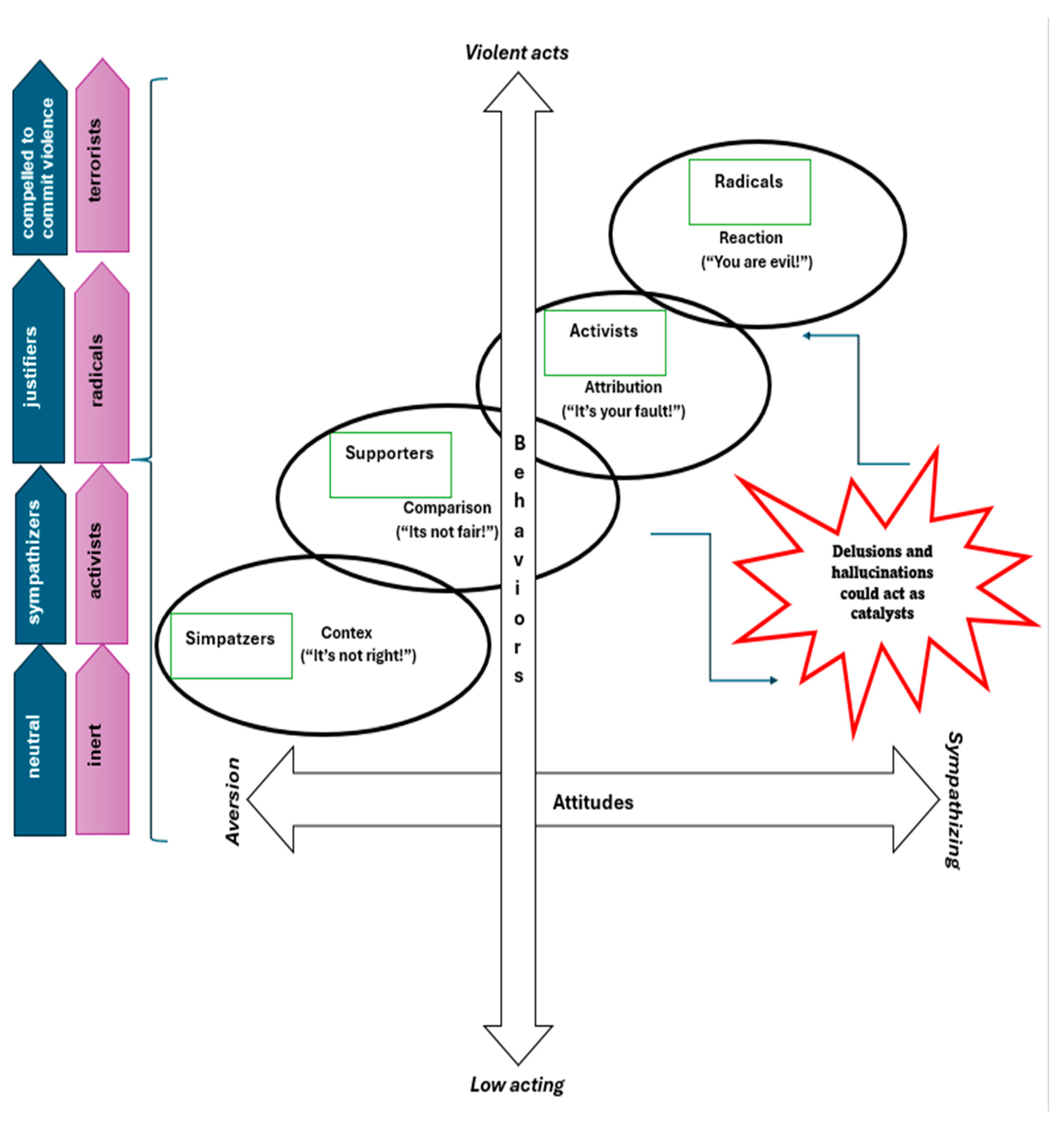
- Khalil, J.; Horgan, J.; Zeuthen, M. The Attitudes-Behaviors Corrective (ABC) Model of Violent Extremism. Terror. Political Violence 2022, 34, 425–450. [Google Scholar] [CrossRef]
- Abi-Dargham, A.; Moeller, S.J.; Ali, F.; DeLorenzo, C.; Domschke, K.; Horga, G.; Jutla, A.; Kotov, R.; Paulus, M.P.; Rubio, J.M.; et al. Candidate Biomarkers in Psychiatric Disorders: State of the Field. World Psychiatry 2023, 22, 236–262. [Google Scholar] [CrossRef] [PubMed]
- Yatham, L.N. Biomarkers for Clinical Use in Psychiatry: Where Are We and Will We Ever Get There? World Psychiatry 2023, 22, 263–264. [Google Scholar] [CrossRef] [PubMed]
- Crouse, J.J.; Ho, N.; Scott, J.; Parker, R.; Park, S.H.; Couvy-Duchesne, B.; Mitchell, B.L.; Byrne, E.M.; Hermens, D.F.; Medland, S.E.; et al. Dynamic Networks of Psychological Symptoms, Impairment, Substance Use, and Social Support: The Evolution of Psychopathology among Emerging Adults. Eur. Psychiatry 2022, 65, e32. [Google Scholar] [CrossRef] [PubMed]
- Department of Health & Human Services. Mental Illness and Violence. Available online: http://www.betterhealth.vic.gov.au/health/conditionsandtreatments/mental-illness-and-violence (accessed on 15 March 2024).
- Voineskos, A. The Time Is Now to Start Evaluating Biomarkers in the Clinic. World Psychiatry 2023, 22, 267–268. [Google Scholar] [CrossRef] [PubMed]
- Unützer, J. Psychiatry in the 21st Century: The Glass Is Half Full. World Psychiatry 2022, 21, 422–423. [Google Scholar] [CrossRef] [PubMed]
- Meyer-Lindenberg, A. The Non-Ergodic Nature of Mental Health and Psychiatric Disorders: Implications for Biomarker and Diagnostic Research. World Psychiatry 2023, 22, 272–274. [Google Scholar] [CrossRef] [PubMed]
- Isayeva, U.; Manchia, M.; Collu, R.; Primavera, D.; Deriu, L.; Caboni, E.; Iaselli, N.; Sundas, D.; Tusconi, M.; Pinna, F.; et al. Exploring the Association between Brain-Derived Neurotrophic Factor Levels and Longitudinal Psychopathological and Cognitive Changes in Sardinian Psychotic Patients. Eur. Psychiatry 2022, 65, e71. [Google Scholar] [CrossRef]
- Rejek, M.; Misiak, B. Dimensions of Psychopathology Associated with Psychotic-like Experiences: Findings from the Network Analysis in a Nonclinical Sample. Eur. Psychiatry 2023, 66, e56. [Google Scholar] [CrossRef]
- Kestel, D. Transforming Mental Health for All: A Critical Role for Specialists. World Psychiatry 2022, 21, 333–334. [Google Scholar] [CrossRef]
- Dom, G.; Schouler-Ocak, M.; Bhui, K.; Demunter, H.; Kuey, L.; Raballo, A.; Frydecka, D.; Misiak, B.; Gorwood, P.; Samochowiec, J. Mass Violence, Radicalization and Terrorism: A Role for Psychiatric Profession? Eur. Psychiatry 2018, 49, 78–80. [Google Scholar] [CrossRef]
- Steger, M.F. Meaning in Life Is a Fundamental Protective Factor in the Context of Psychopathology. World Psychiatry 2022, 21, 389–390. [Google Scholar] [CrossRef]
- Mason, A.M.; Cardell, R.; Armstrong, M. Malingering Psychosis: Guidelines for Assessment and Management: Malingering Psychosis: Guidelines for Assessment and Management. Perspect. Psychiatr. Care 2014, 50, 51–57. [Google Scholar] [CrossRef]
- Freeman, M. The World Mental Health Report: Transforming Mental Health for All. World Psychiatry 2022, 21, 391–392. [Google Scholar] [CrossRef]
- Verdejo-Garcia, A. Searching for Biomarkers in the Fluidity of Mental Ill-Health. World Psychiatry 2023, 22, 268–270. [Google Scholar] [CrossRef]
- Grimbergen, C.; Fassaert, T. Occurrence of Psychiatric Disorders, Self-Sufficiency Problems and Adverse Childhood Experiences in a Population Suspected of Violent Extremism. Front. Psychiatry 2022, 13, 779714. [Google Scholar] [CrossRef]
- Heinz, A.; Liu, S. Challenges and Chances for Mental Health Care in the 21st Century. World Psychiatry 2022, 21, 423–424. [Google Scholar] [CrossRef]
- Fiorillo, A.; Giordano, A. The Biopsychosocial Model of Schizophrenia and Cancer: Unraveling the Etiopathogenesis of Complex Diseases. Eur. Psychiatry 2022, 65, e86. [Google Scholar] [CrossRef]
- Sass, L. Subjectivity, Psychosis and the Science of Psychiatry. World Psychiatry 2022, 21, 165–166. [Google Scholar] [CrossRef]
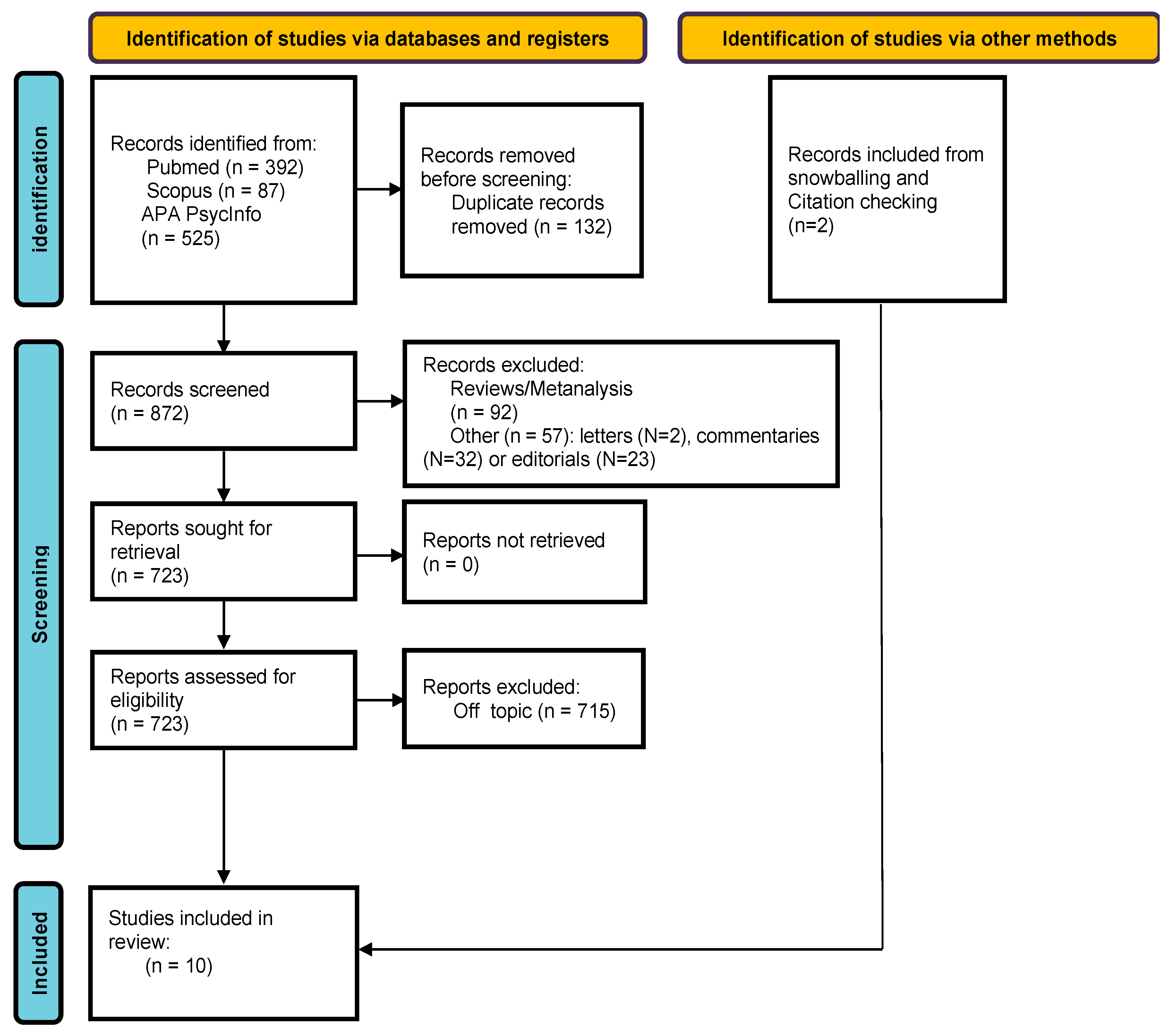
- Page, M.J.; McKenzie, J.E.; Bossuyt, P.M.; Boutron, I.; Hoffmann, T.C.; Mulrow, C.D.; Shamseer, L.; Tetzlaff, J.M.; Akl, E.A.; Brennan, S.E.; et al. The PRISMA 2020 Statement: An Updated Guideline for Reporting Systematic Reviews. BMJ 2021, 372, n71. [Google Scholar] [CrossRef]
- Diagnostic and Statistical Manual of Mental Disorders: DSM-5, 5th ed.; American Psychiatric Association: Washington, DC, USA, 2013; ISBN 978-0-89042-555-8.
- Higgins, J.; Morgan, R.; Rooney, A.; Taylor, K.; Thayer, K.; Silva, R.; Lemeris, C.; Akl, A.; Arroyave, W.; Bateson, T.; et al. Risk of Bias in Non-Randomized Studies—of Exposure (ROBINS-E). Available online: https://www.riskofbias.info/welcome/robins-e-tool (accessed on 3 March 2024).
- Bronsard, G.; Cohen, D.; Diallo, I.; Pellerin, H.; Varnoux, A.; Podlipski, M.-A.; Gerardin, P.; Boyer, L.; Campelo, N. Adolescents Engaged in Radicalisation and Terrorism: A Dimensional and Categorical Assessment. Front. Psychiatry 2022, 12, 774063. [Google Scholar] [CrossRef]
- Appendix 7.4 Critical Appraisal Checklist for Case Reports—JBI Manual for Evidence Synthesis—JBI Global Wiki. Available online: https://jbi-global-wiki.refined.site/space/MANUAL/4689072/Appendix+7.4+Critical+appraisal+checklist+for+case+reports (accessed on 3 March 2024).
- Gagnier, J.J.; Kienle, G.; Altman, D.G.; Moher, D.; Sox, H.; Riley, D.; CARE Group. The CARE Guidelines: Consensus-Based Clinical Case Reporting Guideline Development. Headache J. Head Face Pain 2013, 53, 1541–1547. [Google Scholar] [CrossRef]
- Appendix 7.3 Critical Appraisal Checklists for Case Series—JBI Manual for Evidence Synthesis—JBI Global Wiki. Available online: https://jbi-global-wiki.refined.site/space/MANUAL/4689063/Appendix+7.3+Critical+appraisal+checklists+for+case+series (accessed on 3 March 2024).
- Glick, I.D.; Cerfolio, N.E.; Kamis, D.; Laurence, M. Domestic Mass Shooters: The Association with Unmedicated and Untreated Psychiatric Illness. J. Clin. Psychopharmacol. 2021, 41, 366–369. [Google Scholar] [CrossRef]
- Cotti, P.; Meloy, J.R. The Tamerlan Tsarnaev Case: The Nexus of Psychopathology and Ideology in a Lone Actor Terrorist. J. Threat Assess. Manag. 2019, 6, 138–158. [Google Scholar] [CrossRef]
- Cotti, P. On the Path of Election and Martyrdom: Some Psychic Mechanisms Involved in the Anders Behring Breivik’s Determination as a Terrorist. Psychoanal. Rev. 2015, 102, 551–579. [Google Scholar] [CrossRef]
- Amador, X.F.; Paul-Odouard, R. Defending the Unabomber: Anosognosia in Schizophrenia. Psychiatr. Q. 2000, 71, 363–371. [Google Scholar] [CrossRef]
- Kupper, J.; Cotti, P.; Meloy, J.R. The Hanau Terror Attack: Unraveling the Dynamics of Mental Disorder and Extremist Beliefs. J. Threat Assess. Manag. 2023. [Google Scholar] [CrossRef]
- Spaaij, R. The Enigma of Lone Wolf Terrorism: An Assessment. Stud. Confl. Terror. 2010, 33, 854–870. [Google Scholar] [CrossRef]
- Cerfolio, N.E.; Glick, I.; Kamis, D.; Laurence, M. A Retrospective Observational Study of Psychosocial Determinants and Psychiatric Diagnoses of Mass Shooters in the United States. Psychodyn. Psychiatry 2022, 50, 1–16. [Google Scholar] [CrossRef]
- Morris, A.; Meloy, J.R. A Preliminary Report of Psychiatric Diagnoses in a Scottish County Sample of Persons of National Security Concern. J. Forensic Sci. 2020, 65, 1638–1645. [Google Scholar] [CrossRef]
- Garcet, S. Understanding the Psychological Aspects of the Radicalisation Process: A Sociocognitive Approach. Forensic Sci. Res. 2021, 6, 115–123. [Google Scholar] [CrossRef]
- Douglas, K.S.; Hart, S.D.; Webster, C.D.; Belfrage, H.; Guy, L.S.; Wilson, C.M. Historical-Clinical-Risk Management-20, Version 3 (HCR-20 V3): Development and Overview. Int. J. Forensic Ment. Health 2014, 13, 93–108. [Google Scholar] [CrossRef]
- Fazel, S.; Gulati, G.; Linsell, L.; Geddes, J.R.; Grann, M. Schizophrenia and Violence: Systematic Review and Meta-Analysis. PLoS Med. 2009, 6, e1000120. [Google Scholar] [CrossRef]
- Hachtel, H.; Nixon, M.; Bennett, D.; Mullen, P.; Ogloff, J. Motives, Offending Behavior, and Gender Differences in Murder Perpetrators with or Without Psychosis. J. Interpers. Violence 2021, 36, 3168–3190. [Google Scholar] [CrossRef]
- Swinson, N.; Flynn, S.M.; While, D.; Roscoe, A.; Kapur, N.; Appleby, L.; Shaw, J. Trends in Rates of Mental Illness in Homicide Perpetrators. Br. J. Psychiatry 2011, 198, 485–489. [Google Scholar] [CrossRef]
- Whiting, D.; Gulati, G.; Geddes, J.R.; Fazel, S. Association of Schizophrenia Spectrum Disorders and Violence Perpetration in Adults and Adolescents From 15 Countries: A Systematic Review and Meta-Analysis. JAMA Psychiatry 2022, 79, 120. [Google Scholar] [CrossRef]
- Sartorius, N. Community Care for People with Mental Illness: Challenges Emerging in the 2020s and Consequent Recommendations. World Psychiatry 2023, 22, 388–389. [Google Scholar] [CrossRef]
- Madigan, S.; Deneault, A.-A.; Racine, N.; Park, J.; Thiemann, R.; Zhu, J.; Dimitropoulos, G.; Williamson, T.; Fearon, P.; Cénat, J.M.; et al. Adverse Childhood Experiences: A Meta-Analysis of Prevalence and Moderators among Half a Million Adults in 206 Studies. World Psychiatry 2023, 22, 463–471. [Google Scholar] [CrossRef]
- Bénézech, M.; Estano, N. À la recherche d’une âme: Psychopathologie de la radicalisation et du terrorisme. Ann. Méd.-Psychol. Rev. Psychiatr. 2016, 174, 235–249. [Google Scholar] [CrossRef]
- Besta, T.; Szulc, M.; Jaśkiewicz, M. Political Extremism, Group Membership and Personality Traits: Who Accepts Violence?/Extremismo Político, Pertenencia al Grupo y Rasgos de Personalidad: ¿Quién Acepta La Violencia? Rev. Psicol. Soc. 2015, 30, 563–585. [Google Scholar] [CrossRef]
- Bhui, K.; James, A.; Wessely, S. Mental Illness and Terrorism. BMJ 2016, 354, i4869. [Google Scholar] [CrossRef] [PubMed]
- Al-Attar, D.Z.; Calcedo, A.; Bialek, K.; Botbol, M.; Grimbergen, C.; Peresin, A. Extremism, Radicalisation & Mental Health: Handbook for Practitioners. 2019. Available online: https://home-affairs.ec.europa.eu/system/files/2019-11/ran_h-sc_handbook-for-practitioners_extremism-radicalisation-mental-health_112019_en.pdf (accessed on 12 March 2024).
- Corner, E.; Gill, P. A False Dichotomy? Mental Illness and Lone-Actor Terrorism. Law Hum. Behav. 2015, 39, 23–34. [Google Scholar] [CrossRef] [PubMed]
- Bhui, K.; Everitt, B.; Jones, E. Might Depression, Psychosocial Adversity, and Limited Social Assets Explain Vulnerability to and Resistance against Violent Radicalisation? PLoS ONE 2014, 9, e105918. [Google Scholar] [CrossRef] [PubMed]
- Mehdi, S.S.; Jaber, G.; Armindokht, A.; Saideh, M.; Omid, R. An Investigation on Behavioral Pattern of Homicide in People with Psychotic Disorders, People with Personality Disorders and People without Any Mental Disorders. Int. Res. J. Biol. Sci. 2014, 3, 10–14. [Google Scholar]
- Motillon-Toudic, C.; Walter, M.; Séguin, M.; Carrier, J.-D.; Berrouiguet, S.; Lemey, C. Social Isolation and Suicide Risk: Literature Review and Perspectives. Eur. Psychiatry. 2022, 65, e65. [Google Scholar] [CrossRef]
- Elliott, I.A.; Randhawa-Horne, K.; Hambly, O. The Extremism Risk Guidance 22+ An Exploratory Psychometric Analysis. 2023. Available online: https://assets.publishing.service.gov.uk/media/641c2b8f32a8e0000cfa9288/extremism-risk-guidance-22+.pdf (accessed on 4 March 2024).
- Brandt, V.; Zhang, Y.; Carr, H.; Golm, D.; Correll, C.U.; Arrondo, G.; Firth, J.; Hassan, L.; Solmi, M.; Cortese, S. First evidence of a general disease (“d”) factor, a common factor underlying physical and mental illness. World Psychiatry 2023, 22, 335–337. [Google Scholar] [CrossRef] [PubMed]
- Radicalisation Awareness Network. RAN MANUAL—Responses to Returnees: Foreign Terrorist Fighters and Their Families 2017. Available online: https://home-affairs.ec.europa.eu/system/files_en?file=2020-09/ran_br_a4_m10_en.pdf (accessed on 1 March 2024).
- Ranstorp, M.; Ahmed, U. RAN Policy Paper: Developing a Local Prevent Framework and Guiding Principles—Part 2. 2018. Available online: https://home-affairs.ec.europa.eu/system/files/2019-02/policy_paper_developing_local_prevent_framework_guiding_principles_part2_112018_en.pdf (accessed on 24 February 2024).
- Karmini, N. Study: Extremists Still Flourishing in Indonesia’s Prisons. Available online: https://apnews.com/general-news-b1d8e7bf7c9f49448410f6ac0b7919ee (accessed on 9 March 2024).
- Ingram, H.J.; Coleman, J.; Doctor, A.C.; Margolin, D. The Repatriation & Reintegration Dilemma: How States Manage the Return of Foreign Terrorist Fighters & Their Families. J. Deradicalization 2022, 31, 119–163. [Google Scholar]
- Fiorillo, A.; Javed, A.; Azeem, M.W.; Basu, D.; Lam, L.C.W.; Murthy, P.; Ndetei, D.; Okasha, T.; Stein, D.J.; Bhui, K.S. Education, Policy and Clinical Care in Mental Health: An Update on the Activities of WPA Collaborating Centres. World Psychiatry 2023, 22, 495–496. [Google Scholar] [CrossRef]
- van Ommeren, M.; Lewis, S.; Van’t Hof, E.; Carswell, K. Putting Psychological Interventions First in Primary Health Care. World Psychiatry 2023, 22, 390–391. [Google Scholar] [CrossRef]
- Henderson, C. Challenges in Improving Mental Health Literacy at Population Level. World Psychiatry 2023, 22, 392–393. [Google Scholar] [CrossRef] [PubMed]
- Davidson, L.; Tondora, J. Person-Centred Care Planning as Foundational to Clinical Practice. World Psychiatry 2022, 21, 1–2. [Google Scholar] [CrossRef] [PubMed]

| Author, Country (Year of Publication) | Type of Study | Sample | Psychiatric Assessment | Main Results | Conclusions |
|---|---|---|---|---|---|
| Bronsard G., France (2022) [37] | Case–control study | N = 15 adolescents involved in terrorist activities vs. N = 101 teenagers convicted for non-terrorist delinquency who were placed in CEC. | Ab-DIB; ACE questionnaire; ADRS; BHS; C-SSRS; MINI-KID 2 (modified with the subscale of the MINI for adults for psychotic disorders); Semistructured interviews. | In the radicalized group: the psychiatric examinations did not show axis 1 disorders for most of them (N = 10, 66.7%). For the other five adolescents, comorbid associations with the following diagnoses were found: BPD, GAD, CD, and Depression. Psychotic lifetime episodes were found in 2 cases (13.3%). | Among adolescents involved in terrorist activities, only two of them reported psychotic lifetime episodes. |
| Cerfolio N., United States (2022) [47] | Retrospective Observational study | N = 55 persons identified as committing a mass shooting in the USA between January 1982 and September 2019 Participants were grouped in those surviving after the crime (N = 35) and those dead (N = 20) | A 62-item questionnaire to compile the data collection from multiple sources and record the psychiatric assessments using DSM-5 criteria; MINI | In the subgroup of the 35 assailants who survived, 28 had a primary DSM-5 diagnosis: 18 (56%) had SCZ; 3 had BD-I; 2 had delusional disorder (persecutory); 2 had personality disorders (1 PPD, 1 BPD with current psychotic disorder); 2 had SRD, and 1 had PTSD. In addition, in 4 cases with no primary diagnosis, 1 case was found with a current psychotic disorder. In the subgroup of 20 criminals who died after the event, authors were able to provide a diagnosis only in 8 cases (SCZ). | Many perpetrators did not seek psychiatric care due to the stigma against mental illness. Even when they did engage with a healthcare provider prior to their violence, they were often misdiagnosed. |
| Garcet S., Belgium (2021) [49] | Cross-sectional Observational study | N = 27 radicalized individuals, Aged 17–31 years (mean: 24.6 years). | MINI; Rorschach’s psychodiagnostic projective tests; SCL-R90; TAT; WAIS III for Adult; YSQ-L2/SQ2. | Schizoid personality (N = 1), SCZ (N = 1), and delusional disorder (N = 1) were observed. Most subjects had a comorbidity with personality disorders. | A model of cognitive and affective transformation of self-definition and sense construction in violent radical engagement has been created to study how radicalized individuals process and integrate information at different societal levels into their own belief systems, thereby improving the comprehension of these cognitive integration mechanisms. |
| Glick I., United States (2021) [41] | Retrospective Observational study | N = 55 persons identified as committing a mass shooting in the USA between January 1982 and September 2019 Participants were grouped in those surviving after the crime (N = 35) and those dead (N = 20) | A 62-item questionnaire to compile the data collection from multiple sources and record the psychiatric assessments using DSM-5 criteria; MINI | In the subgroup of the 35 assailants who survived, 28 had a primary DSM-5 diagnosis: 18 (56%) had SCZ; 3 had BD-I; 2 had delusional disorder (persecutory); 2 had personality disorders (1 PPD, 1 BPD with current psychotic disorder); 2 had SRD, and 1 had PTSD. In addition, in 4 cases with no primary diagnosis, 1 case was found with a current psychotic disorder. In the subgroup of 20 criminals who died after the event, authors were able to provide a diagnosis only in 8 cases (SCZ). | A significant proportion of mass shooters experienced unmedicated and untreated psychiatric disorders. |
| Morris A., United Kingdom (2020) [48] | Prospective observational study | N = 23 individuals referred to prevent elements of U.K. national counterterrorism strategy | Analysis of records about criminal and psychiatric history; HCR-20. | N = 2 participants had a diagnosis of psychotic disorder (22%). In many cases, participants received more than one diagnosis. | Those flagged as vulnerable to involvement in terrorist activities have a high prevalence of mental disorders. It does not indicate that individuals with mental disorders are at higher risk of terrorist violence. |
| First Author, Country (Year of Publication) | Type of Study | Sample Characteristics | Main Diagnosis | Psychiatric Assessment | Conclusions and Results |
|---|---|---|---|---|---|
| Amador X., United States (2000) [44] | Case report | Lone wolf terrorist Theodore Kaczynski | Schizophrenia | Analysis of T. Kacztnski’s psychiatric history | This case report is in agreement with recent research that has indicated that the etiology of poor insight is not only due to defense mechanisms but also linked to neurological deficits such as anosognosia. |
| Cotti P., France (2015) [43] | Case report | Mass shooter Anders Breivik | Not specified psychotic disorder | Analysis of Breivik’s words and writings | It would seem that the sociocultural and political determinants of ideological discourses can lead individuals who do not have a marked psychopathological character to topple over into martyrdom. |
| Cotti P. and Meloy J.R., United States (2019) [42] | Case report | Lone actor terrorist Tamerlan Tsarnaev | Not specified psychotic disorder | Analysis of various sources about Tamerlan Tsarnaev's history | The Tsarnaev case allowed researchers to give a specific example of the dynamic of the nexus of psychopathology and ideology, a key dynamic in the mentally disordered lone actor’s radicalization process. |
| Kupper J., United States (2023) [45] | Case report | Lone wolf terrorist Tobias Rathjen | Schizophrenia | Qualitative analysis of primary and secondary sources. TRAP-18 was also used. | The complex interplay of his delusions, obsessions, and extremely overvalued beliefs that drove his fixation reveal the difficulty of clinically understanding such a case, and also the necessity of doing so, to attempt to risk mitigate these types of subjects by threat assessment teams. |
| Spaaij R., Australia (2010) [46] | Case-series | 5 cases of lone wolves: David Copeland, Franz Fuchs, Theodore Kaczynski, Volkert Van der Graaf, and Yigal Amir | Only for David Copeland symptoms and history of not specified psychotic disorder are reported. | Documentary analysis of media reports, literature, documents and letters written by the perpetrators, police and court transcripts, and psychological and/or psychiatric evaluations. | The likelihood of lone wolf terrorists suffering from psychological disturbances is relatively high. |
| Clinical Studies | Case Report | Case Series | |||||||||
|---|---|---|---|---|---|---|---|---|---|---|---|
| Bronsard G. (2022) [37] | Cerfolio N. (2022) [47] | Garcet S. (2021) [49] | Glick I., (2021) [41] | Morris A. (2020) [48] | Amador X. (2000) [44] | Cotti P. (2015) [43] | Cotti P. and Meloy J.R. (2019) [42] | Kupper J. (2023) [45] | Spaaij R. (2010) [46] | ||
| Clinical Assessment | |||||||||||
| Main Diagnosis | Ad hoc semi-structured interview | + | |||||||||
| Ad hoc 62-item questionnaire based on DSM V criteria | + | + | |||||||||
| Clinical judgment based on the analysis of various anamnesis sources | + | + | + | + | + | + | |||||
| Mini International Neuropsychiatric Interview (MINI) | + | + | + | ||||||||
| Mini International Neuropsychiatric Interview (MINI- KID 2) * | + | ||||||||||
| Symptom Checklist 90 (SCL-R90) | + | ||||||||||
| Depression | Adolescent Depression Rating Scale (ADRS) | + | |||||||||
| Beck Hopelessness Scale (BHS) | + | ||||||||||
| Columbia evaluation scale for suicidal risk gravity (C-SSRS) | + | ||||||||||
| Personality | Abbreviated Diagnostic Interview for Borderline (Ab-DIB) | + | |||||||||
| Adverse Childhood Experience (ACE) Questionnaire | + | ||||||||||
| Thematic Apperception Test (TAT) | + | ||||||||||
| Rorschach’s psychodiagnostic projective tests | + | ||||||||||
| Young Schema Questionnaire (YSQ-L2/SQ2) | + | ||||||||||
| IQ | Wechsler Adult Intelligence Scale (WAIS III) | + | |||||||||
| Terroristic assessment | |||||||||||
| Radical ideas | Terrorist Radicalization Assessment (TRAP-18) | + | |||||||||
| Risk of violence | Historical Clinical Risk-20 (HCR-20) | + | |||||||||
Disclaimer/Publisher’s Note: The statements, opinions and data contained in all publications are solely those of the individual author(s) and contributor(s) and not of MDPI and/or the editor(s). MDPI and/or the editor(s) disclaim responsibility for any injury to people or property resulting from any ideas, methods, instructions or products referred to in the content. |
© 2024 by the authors. Licensee MDPI, Basel, Switzerland. This article is an open access article distributed under the terms and conditions of the Creative Commons Attribution (CC BY) license (https://creativecommons.org/licenses/by/4.0/).
Share and Cite
Catapano, P.; Cipolla, S.; De Rosa, C.; Milano, S.; Vozza, D.; Guadagno, D.; Perris, F.; Sampogna, G.; Fiorillo, A. Is There a Relationship between Psychotic Disorders and the Radicalization Process? A Systematic Review. Medicina 2024, 60, 926. https://doi.org/10.3390/medicina60060926
Catapano P, Cipolla S, De Rosa C, Milano S, Vozza D, Guadagno D, Perris F, Sampogna G, Fiorillo A. Is There a Relationship between Psychotic Disorders and the Radicalization Process? A Systematic Review. Medicina. 2024; 60(6):926. https://doi.org/10.3390/medicina60060926
Chicago/Turabian StyleCatapano, Pierluigi, Salvatore Cipolla, Corrado De Rosa, Stefania Milano, Daniela Vozza, Davide Guadagno, Francesco Perris, Gaia Sampogna, and Andrea Fiorillo. 2024. "Is There a Relationship between Psychotic Disorders and the Radicalization Process? A Systematic Review" Medicina 60, no. 6: 926. https://doi.org/10.3390/medicina60060926
APA StyleCatapano, P., Cipolla, S., De Rosa, C., Milano, S., Vozza, D., Guadagno, D., Perris, F., Sampogna, G., & Fiorillo, A. (2024). Is There a Relationship between Psychotic Disorders and the Radicalization Process? A Systematic Review. Medicina, 60(6), 926. https://doi.org/10.3390/medicina60060926

