The Challenges of Local Intra-Articular Therapy

 ,
, 
 ,
,
Abstract
1. Introduction
2. Materials and Methods
3. Local Treatment of Arthritis
3.1. Monoarthritis: Treatment Challenges
3.2. Recent Developments of Intra-Articular Medication
3.3. Fibroblast-like Synoviocytes as Potential Targets for Early Local Therapy
3.3.1. Cell Surface Targets
3.3.2. Intracellular Signaling Molecules
3.3.3. Non-Coding Ribonucleic Acids
3.3.4. Oxidative Stress Molecules
4. Conclusions and Future Directions
Supplementary Materials
Author Contributions
Funding
Institutional Review Board Statement
Informed Consent Statement
Data Availability Statement
Conflicts of Interest
References
- Lane, N.E.; Brandt, K.; Hawker, G.; Peeva, E.; Schreyer, E.; Tsuji, W.; Hochberg, M.C. OARSI-FDA Initiative: Defining the Disease State of Osteoarthritis. Osteoarthr. Cartil. 2011, 19, 478–482. [Google Scholar] [CrossRef] [Scilit] [PubMed]
- Smolen, J.S.; Breedveld, F.C.; Burmester, G.R.; Bykerk, V.; Dougados, M.; Emery, P.; Kvien, T.K.; Navarro-Compán, M.V.; Oliver, S.; Schoels, M.; et al. Treating Rheumatoid Arthritis to Target: 2014 Update of the Recommendations of an International Task Force. Ann. Rheum. Dis. 2016, 75, 3–15. [Google Scholar] [CrossRef] [Scilit] [PubMed]
- Stoffer, M.A.; Schoels, M.M.; Smolen, J.S.; Aletaha, D.; Breedveld, F.C.; Burmester, G.; Bykerk, V.; Dougados, M.; Emery, P.; Haraoui, B.; et al. Evidence for Treating Rheumatoid Arthritis to Target: Results of a Systematic Literature Search Update. Ann. Rheum. Dis. 2016, 75, 16–22. [Google Scholar] [CrossRef] [Scilit]
- Combe, B.; Landewe, R.; Lukas, C.; Bolosiu, H.D.; Breedveld, F.; Dougados, M.; Emery, P.; Ferraccioli, G.; Hazes, J.M.W.; Klareskog, L.; et al. EULAR Recommendations for the Management of Early Arthritis: Report of a Task Force of the European Standing Committee for International Clinical Studies Including Therapeutics (ESCISIT). Ann. Rheum. Dis. 2007, 66, 34–45. [Google Scholar] [CrossRef] [Scilit]
- Combe, B.; Landewe, R.; Daien, C.I.; Hua, C.; Aletaha, D.; Álvaro-Gracia, J.M.; Bakkers, M.; Brodin, N.; Burmester, G.R.; Codreanu, C.; et al. 2016 Update of the EULAR Recommendations for the Management of Early Arthritis. Ann. Rheum. Dis. 2017, 76, 948–959. [Google Scholar] [CrossRef] [Scilit]
- Ellis, J.M. Acute Monoarthritis. JAAPA Off. J. Am. Acad. Physician Assist. 2019, 32, 25–31. [Google Scholar] [CrossRef] [Scilit]
- Siva, C.; Velazquez, C.; Mody, A.; Brasington, R. Diagnosing Acute Monoarthritis in Adults: A Practical Approach for the Family Physician. Am. Fam. Physician 2003, 68, 83–90. [Google Scholar] [PubMed]
- Becker, J.A.; Daily, J.P.; Pohlgeers, K.M. Acute Monoarthritis: Diagnosis in Adults. Am. Fam. Physician 2016, 94, 810–816. [Google Scholar]
- Cincinelli, G.; Di Taranto, R.; Orsini, F.; Rindone, A.; Murgo, A.; Caporali, R. A Case Report of Monoarthritis in a COVID-19 Patient and Literature Review: Simple Actions for Complex Times. Medicine 2021, 100, e26089. [Google Scholar] [CrossRef] [Scilit]
- Ding, Q.; Hu, W.; Wang, R.; Yang, Q.; Zhu, M.; Li, M.; Cai, J.; Rose, P.; Mao, J.; Zhu, Y.Z. Signaling Pathways in Rheumatoid Arthritis: Implications for Targeted Therapy. Signal Transduct. Target. Ther. 2023, 8, 68. [Google Scholar] [CrossRef] [Scilit]
- Nygaard, G.; Firestein, G.S. Restoring Synovial Homeostasis in Rheumatoid Arthritis by Targeting Fibroblast-like Synoviocytes. Nat. Rev. Rheumatol. 2020, 16, 316–333. [Google Scholar] [CrossRef] [Scilit] [PubMed]
- Mathiessen, A.; Conaghan, P.G. Synovitis in Osteoarthritis: Current Understanding with Therapeutic Implications. Arthritis Res. Ther. 2017, 19, 18. [Google Scholar] [CrossRef] [Scilit] [PubMed]
- Han, D.; Fang, Y.; Tan, X.; Jiang, H.; Gong, X.; Wang, X.; Hong, W.; Tu, J.; Wei, W. The Emerging Role of Fibroblast-like Synoviocytes-Mediated Synovitis in Osteoarthritis: An Update. J. Cell. Mol. Med. 2020, 24, 9518–9532. [Google Scholar] [CrossRef] [Scilit] [PubMed]
- Van Spil, W.E.; Kubassova, O.; Boesen, M.; Bay-Jensen, A.-C.; Mobasheri, A. Osteoarthritis Phenotypes and Novel Therapeutic Targets. Biochem. Pharmacol. 2019, 165, 41–48. [Google Scholar] [CrossRef] [Scilit]
- de Rooy, D.P.C.; van der Linden, M.P.M.; Knevel, R.; Huizinga, T.W.J.; van der Helm-van Mil, A.H.M. Predicting Arthritis Outcomes—What Can Be Learned from the Leiden Early Arthritis Clinic? Rheumatol. Oxf. Engl. 2011, 50, 93–100. [Google Scholar] [CrossRef] [Scilit]
- Combe, B.; Benessiano, J.; Berenbaum, F.; Cantagrel, A.; Daurès, J.-P.; Dougados, M.; Fardellone, P.; Fautrel, B.; Flipo, R.-M.; Goupille, P.; et al. The ESPOIR Cohort: A Ten-Year Follow-up of Early Arthritis in France: Methodology and Baseline Characteristics of the 813 Included Patients. Joint Bone Spine 2007, 74, 440–445. [Google Scholar] [CrossRef] [Scilit]
- Quinn, M.A.; Green, M.J.; Marzo-Ortega, H.; Proudman, S.; Karim, Z.; Wakefield, R.J.; Conaghan, P.G.; Emery, P. Prognostic Factors in a Large Cohort of Patients with Early Undifferentiated Inflammatory Arthritis after Application of a Structured Management Protocol. Arthritis Rheum. 2003, 48, 3039–3045. [Google Scholar] [CrossRef] [Scilit]
- Orr, C.; Vieira-Sousa, E.; Boyle, D.L.; Buch, M.H.; Buckley, C.D.; Cañete, J.D.; Catrina, A.I.; Choy, E.H.S.; Emery, P.; Fearon, U.; et al. Synovial Tissue Research: A State-of-the-Art Review. Nat. Rev. Rheumatol. 2017, 13, 463–475. [Google Scholar] [CrossRef] [Scilit]
- de Hair, M.J.H.; Harty, L.C.; Gerlag, D.M.; Pitzalis, C.; Veale, D.J.; Tak, P.P. Synovial Tissue Analysis for the Discovery of Diagnostic and Prognostic Biomarkers in Patients with Early Arthritis. J. Rheumatol. 2011, 38, 2068–2072. [Google Scholar] [CrossRef] [Scilit]
- Soroosh, S.G.; Ghatfan, A.; Farbod, A.; Meftah, E. Synovial Biopsy for Establishing a Definite Diagnosis in Undifferentiated Chronic Knee Monoarthritis. BMC Musculoskelet. Disord. 2023, 24, 23. [Google Scholar] [CrossRef] [Scilit]
- Ike, R.W.; Kalunian, K.C. Will Rheumatologists Ever Pick up the Arthroscope Again? Int. J. Rheum. Dis. 2021, 24, 1235–1246. [Google Scholar] [CrossRef] [Scilit]
- Andreozzi, V.; Monaco, E.; Garufi, C.; Spinelli, F.R.; Rossi, G.; Dagget, M.; Conti, F.; Ferretti, A. In-Office Needle Arthroscopic Synovial Biopsy Is an Effective Diagnostic Tool in Patients With Inflammatory Arthritis. Arthrosc. Sports Med. Rehabil. 2022, 4, e2099–e2106. [Google Scholar] [CrossRef] [Scilit]
- Bernotiene, E.; Bagdonas, E.; Kirdaite, G.; Bernotas, P.; Kalvaityte, U.; Uzieliene, I.; Thudium, C.S.; Hannula, H.; Lorite, G.S.; Dvir-Ginzberg, M.; et al. Emerging Technologies and Platforms for the Immunodetection of Multiple Biochemical Markers in Osteoarthritis Research and Therapy. Front. Med. 2020, 7, 572977. [Google Scholar] [CrossRef] [Scilit]
- Momohara, S.; Tanaka, S.; Nakamura, H.; Mibe, J.; Iwamoto, T.; Ikari, K.; Nishino, J.; Kadono, Y.; Yasui, T.; Takahashi, K.; et al. Recent Trends in Orthopedic Surgery Performed in Japan for Rheumatoid Arthritis. Mod. Rheumatol. 2011, 21, 337–342. [Google Scholar] [CrossRef] [PubMed]
- Jämsen, E.; Virta, L.J.; Hakala, M.; Kauppi, M.J.; Malmivaara, A.; Lehto, M.U.K. The Decline in Joint Replacement Surgery in Rheumatoid Arthritis Is Associated with a Concomitant Increase in the Intensity of Anti-Rheumatic Therapy: A Nationwide Register-Based Study from 1995 through 2010. Acta Orthop. 2013, 84, 331–337. [Google Scholar] [CrossRef] [Scilit] [PubMed]
- Uson, J.; Rodriguez-García, S.C.; Castellanos-Moreira, R.; O’Neill, T.W.; Doherty, M.; Boesen, M.; Pandit, H.; Möller Parera, I.; Vardanyan, V.; Terslev, L.; et al. EULAR Recommendations for Intra-Articular Therapies. Ann. Rheum. Dis. 2021, 80, 1299–1305. [Google Scholar] [CrossRef] [Scilit] [PubMed]
- Wernecke, C.; Braun, H.J.; Dragoo, J.L. The Effect of Intra-Articular Corticosteroids on Articular Cartilage: A Systematic Review. Orthop. J. Sports Med. 2015, 3, 2325967115581163. [Google Scholar] [CrossRef] [Scilit]
- Maricar, N.; Callaghan, M.J.; Felson, D.T.; O’Neill, T.W. Predictors of Response to Intra-Articular Steroid Injections in Knee Osteoarthritis—A Systematic Review. Rheumatol. Oxf. Engl. 2013, 52, 1022–1032. [Google Scholar] [CrossRef] [Scilit]
- Hirsch, G.; O’Neill, T.W.; Kitas, G.; Sinha, A.; Klocke, R. Accuracy of Injection and Short-Term Pain Relief Following Intra-Articular Corticosteroid Injection in Knee Osteoarthritis - an Observational Study. BMC Musculoskelet. Disord. 2017, 18, 44. [Google Scholar] [CrossRef] [Scilit]
- Paik, J.; Duggan, S.T.; Keam, S.J. Triamcinolone Acetonide Extended-Release: A Review in Osteoarthritis Pain of the Knee. Drugs 2019, 79, 455–462. [Google Scholar] [CrossRef] [Scilit]
- Bodick, N.; Lufkin, J.; Willwerth, C.; Kumar, A.; Bolognese, J.; Schoonmaker, C.; Ballal, R.; Hunter, D.; Clayman, M. An Intra-Articular, Extended-Release Formulation of Triamcinolone Acetonide Prolongs and Amplifies Analgesic Effect in Patients with Osteoarthritis of the Knee: A Randomized Clinical Trial. J. Bone Jt. Surg. 2015, 97, 877–888. [Google Scholar] [CrossRef] [Scilit] [PubMed]
- Conaghan, P.G.; Cohen, S.B.; Berenbaum, F.; Lufkin, J.; Johnson, J.R.; Bodick, N. Brief Report: A Phase IIb Trial of a Novel Extended-Release Microsphere Formulation of Triamcinolone Acetonide for Intraarticular Injection in Knee Osteoarthritis. Arthritis Rheumatol. 2018, 70, 204–211. [Google Scholar] [CrossRef] [Scilit] [PubMed]
- Spitzer, A.I.; Richmond, J.C.; Kraus, V.B.; Gomoll, A.; Jones, D.G.; Huffman, K.M.; Peterfy, C.; Cinar, A.; Lufkin, J.; Kelley, S.D. Safety and Efficacy of Repeat Administration of Triamcinolone Acetonide Extended-Release in Osteoarthritis of the Knee: A Phase 3b, Open-Label Study. Rheumatol. Ther. 2019, 6, 109–124. [Google Scholar] [CrossRef] [Scilit]
- Kivitz, A.; Mehra, P.; Hanson, P.; Kwong, L.; Cinar, A.; Lufkin, J.; Kelley, S. A Randomized, Open-Label, Single-Dose Study to Assess Safety and Systemic Exposure of Triamcinolone Acetonide Extended-Release in Patients With Hip Osteoarthritis. Rheumatol. Ther. 2022, 9, 679–691. [Google Scholar] [CrossRef] [Scilit] [PubMed]
- Hanson, P.; Kivitz, A.; Mehra, P.; Kwong, L.; Cinar, A.; Lufkin, J.; Kelley, S.D. Safety and Systemic Exposure of Triamcinolone Acetonide Following Ultrasound-Guided Intra-Articular Injection of Triamcinolone Extended-Release or Standard Triamcinolone Acetonide in Patients with Shoulder Osteoarthritis: An Open-Label, Randomized Study. Drugs RD 2021, 21, 285–293. [Google Scholar] [CrossRef] [Scilit]
- Kraus, V.B.; Conaghan, P.G.; Aazami, H.A.; Mehra, P.; Kivitz, A.J.; Lufkin, J.; Hauben, J.; Johnson, J.R.; Bodick, N. Synovial and Systemic Pharmacokinetics (PK) of Triamcinolone Acetonide (TA) Following Intra-Articular (IA) Injection of an Extended-Release Microsphere-Based Formulation (FX006) or Standard Crystalline Suspension in Patients with Knee Osteoarthritis (OA). Osteoarthr. Cartil. 2018, 26, 34–42. [Google Scholar] [CrossRef] [Scilit]
- Hunter, D.J.; Chang, C.-C.; Wei, J.C.-C.; Lin, H.-Y.; Brown, C.; Tai, T.-T.; Wu, C.-F.; Chuang, W.C.-M.; Shih, S.-F. TLC599 in Patients with Osteoarthritis of the Knee: A Phase IIa, Randomized, Placebo-Controlled, Dose-Finding Study. Arthritis Res. Ther. 2022, 24, 52. [Google Scholar] [CrossRef] [Scilit]
- Hangody, L.; Szody, R.; Lukasik, P.; Zgadzaj, W.; Lénárt, E.; Dokoupilova, E.; Bichovsk, D.; Berta, A.; Vasarhelyi, G.; Ficzere, A.; et al. Intraarticular Injection of a Cross-Linked Sodium Hyaluronate Combined with Triamcinolone Hexacetonide (Cingal) to Provide Symptomatic Relief of Osteoarthritis of the Knee: A Randomized, Double-Blind, Placebo-Controlled Multicenter Clinical Trial. Cartilage 2018, 9, 276–283. [Google Scholar] [CrossRef] [Scilit]
- Yazici, Y.; McAlindon, T.E.; Gibofsky, A.; Lane, N.E.; Lattermann, C.; Skrepnik, N.; Swearingen, C.J.; Simsek, I.; Ghandehari, H.; DiFrancesco, A.; et al. A Phase 2b Randomized Trial of Lorecivivint, a Novel Intra-Articular CLK2/DYRK1A Inhibitor and Wnt Pathway Modulator for Knee Osteoarthritis. Osteoarthr. Cartil. 2021, 29, 654–666. [Google Scholar] [CrossRef] [Scilit]
- Tambiah, J.R.S.; Kennedy, S.; Swearingen, C.J.; Simsek, I.; Yazici, Y.; Farr, J.; Conaghan, P.G. Individual Participant Symptom Responses to Intra-Articular Lorecivivint in Knee Osteoarthritis: Post Hoc Analysis of a Phase 2B Trial. Rheumatol. Ther. 2021, 8, 973–985. [Google Scholar] [CrossRef] [Scilit]
- Tambiah, J.R.S.; Simsek, I.; Swearingen, C.J.; Kennedy, S.; Cole, B.J.; McAlindon, T.E.; Yazici, Y. Comparing Patient-Reported Outcomes From Sham and Saline-Based Placebo Injections for Knee Osteoarthritis: Data From a Randomized Clinical Trial of Lorecivivint. Am. J. Sports Med. 2022, 50, 630–636. [Google Scholar] [CrossRef] [Scilit] [PubMed]
- Stevens, R.M.; Ervin, J.; Nezzer, J.; Nieves, Y.; Guedes, K.; Burges, R.; Hanson, P.D.; Campbell, J.N. Randomized, Double-Blind, Placebo-Controlled Trial of Intraarticular Trans-Capsaicin for Pain Associated With Osteoarthritis of the Knee. Arthritis Rheumatol. 2019, 71, 1524–1533. [Google Scholar] [CrossRef] [Scilit] [PubMed]
- Lozada, C.J.; Del Rio, E.; Reitberg, D.P.; Smith, R.A.; Kahn, C.B.; Moskowitz, R.W. A Double-Blind, Randomized, Saline-Controlled Study of the Efficacy and Safety of Co-Administered Intra-Articular Injections of Tr14 and Ze14 for Treatment of Painful Osteoarthritis of the Knee: The MOZArT Trial. Eur. J. Integr. Med. 2017, 13, 54–63. [Google Scholar] [CrossRef] [Scilit]
- Kulkarni, M.; Mallesh, M.; Wakankar, H.; Prajapati, R.; Pandit, H. Effect of Methylprednisolone in Periarticular Infiltration for Primary Total Knee Arthroplasty on Pain and Rehabilitation. J. Arthroplast. 2019, 34, 1646–1649. [Google Scholar] [CrossRef] [Scilit]
- McAlindon, T.E.; Schmidt, U.; Bugarin, D.; Abrams, S.; Geib, T.; DeGryse, R.E.; Kim, K.; Schnitzer, T.J. Efficacy and Safety of Single-Dose onabotulinumtoxinA in the Treatment of Symptoms of Osteoarthritis of the Knee: Results of a Placebo-Controlled, Double-Blind Study. Osteoarthritis Cartilage 2018, 26, 1291–1299. [Google Scholar] [CrossRef] [Scilit]
- Nishida, Y.; Kano, K.; Osato, T.; Seo, T. Open-Label Phase 3 Study of Diclofenac Conjugated to Hyaluronate (Diclofenac Etalhyaluronate: ONO-5704/SI-613) for Treatment of Osteoarthritis: 1-Year Follow-Up. BMC Musculoskelet. Disord. 2021, 22, 233. [Google Scholar] [CrossRef] [Scilit]
- Nishida, Y.; Kano, K.; Nobuoka, Y.; Seo, T. Efficacy and Safety of Diclofenac-Hyaluronate Conjugate (Diclofenac Etalhyaluronate) for Knee Osteoarthritis: A Randomized Phase III Trial in Japan. Arthritis Rheumatol. 2021, 73, 1646–1655. [Google Scholar] [CrossRef] [Scilit] [PubMed]
- Müller-Ladner, U.; Kriegsmann, J.; Franklin, B.N.; Matsumoto, S.; Geiler, T.; Gay, R.E.; Gay, S. Synovial Fibroblasts of Patients with Rheumatoid Arthritis Attach to and Invade Normal Human Cartilage When Engrafted into SCID Mice. Am. J. Pathol. 1996, 149, 1607–1615. [Google Scholar]
- Bottini, N.; Firestein, G.S. Duality of Fibroblast-like Synoviocytes in RA: Passive Responders and Imprinted Aggressors. Nat. Rev. Rheumatol. 2013, 9, 24–33. [Google Scholar] [CrossRef] [Scilit]
- Choy, E.H.; Kavanaugh, A.F.; Jones, S.A. The Problem of Choice: Current Biologic Agents and Future Prospects in RA. Nat. Rev. Rheumatol. 2013, 9, 154–163. [Google Scholar] [CrossRef] [Scilit]
- McGarry, T.; Orr, C.; Wade, S.; Biniecka, M.; Wade, S.; Gallagher, L.; Low, C.; Veale, D.J.; Fearon, U. JAK/STAT Blockade Alters Synovial Bioenergetics, Mitochondrial Function, and Proinflammatory Mediators in Rheumatoid Arthritis. Arthritis Rheumatol. 2018, 70, 1959–1970. [Google Scholar] [CrossRef] [Scilit] [PubMed]
- Sanchez-Lopez, E.; Cheng, A.; Guma, M. Can Metabolic Pathways Be Therapeutic Targets in Rheumatoid Arthritis? J. Clin. Med. 2019, 8, 753. [Google Scholar] [CrossRef] [Scilit] [PubMed]
- Croft, A.P.; Naylor, A.J.; Marshall, J.L.; Hardie, D.L.; Zimmermann, B.; Turner, J.; Desanti, G.; Adams, H.; Yemm, A.I.; Müller-Ladner, U.; et al. Rheumatoid Synovial Fibroblasts Differentiate into Distinct Subsets in the Presence of Cytokines and Cartilage. Arthritis Res. Ther. 2016, 18, 270. [Google Scholar] [CrossRef] [Scilit]
- Denkovskij, J.; Rudys, R.; Bernotiene, E.; Minderis, M.; Bagdonas, S.; Kirdaite, G. Cell Surface Markers and Exogenously Induced PpIX in Synovial Mesenchymal Stem Cells. Cytom. Part J. Int. Soc. Anal. Cytol. 2015, 87, 1001–1011. [Google Scholar] [CrossRef] [Scilit]
- Mizoguchi, F.; Slowikowski, K.; Wei, K.; Marshall, J.L.; Rao, D.A.; Chang, S.K.; Nguyen, H.N.; Noss, E.H.; Turner, J.D.; Earp, B.E.; et al. Functionally Distinct Disease-Associated Fibroblast Subsets in Rheumatoid Arthritis. Nat. Commun. 2018, 9, 789. [Google Scholar] [CrossRef] [Scilit]
- Stephenson, W.; Donlin, L.T.; Butler, A.; Rozo, C.; Bracken, B.; Rashidfarrokhi, A.; Goodman, S.M.; Ivashkiv, L.B.; Bykerk, V.P.; Orange, D.E.; et al. Single-Cell RNA-Seq of Rheumatoid Arthritis Synovial Tissue Using Low-Cost Microfluidic Instrumentation. Nat. Commun. 2018, 9, 791. [Google Scholar] [CrossRef] [Scilit]
- Chang, S.K.; Gu, Z.; Brenner, M.B. Fibroblast-like Synoviocytes in Inflammatory Arthritis Pathology: The Emerging Role of Cadherin-11. Immunol. Rev. 2010, 233, 256–266. [Google Scholar] [CrossRef] [Scilit]
- Lee, D.M.; Kiener, H.P.; Agarwal, S.K.; Noss, E.H.; Watts, G.F.M.; Chisaka, O.; Takeichi, M.; Brenner, M.B. Cadherin-11 in Synovial Lining Formation and Pathology in Arthritis. Science 2007, 315, 1006–1010. [Google Scholar] [CrossRef] [Scilit] [PubMed]
- Ebid, R.; Lichtnekert, J.; Anders, H.-J. Hyaluronan Is Not a Ligand but a Regulator of Toll-like Receptor Signaling in Mesangial Cells: Role of Extracellular Matrix in Innate Immunity. ISRN Nephrol. 2014, 2014, 714081. [Google Scholar] [CrossRef] [Scilit]
- Sohn, D.H.; Rhodes, C.; Onuma, K.; Zhao, X.; Sharpe, O.; Gazitt, T.; Shiao, R.; Fert-Bober, J.; Cheng, D.; Lahey, L.J.; et al. Local Joint Inflammation and Histone Citrullination in a Murine Model of the Transition from Preclinical Autoimmunity to Inflammatory Arthritis. Arthritis Rheumatol. 2015, 67, 2877–2887. [Google Scholar] [CrossRef] [Scilit]
- Sanchez-Pernaute, O.; Filkova, M.; Gabucio, A.; Klein, M.; Maciejewska-Rodrigues, H.; Ospelt, C.; Brentano, F.; Michel, B.A.; Gay, R.E.; Herrero-Beaumont, G.; et al. Citrullination Enhances the Pro-Inflammatory Response to Fibrin in Rheumatoid Arthritis Synovial Fibroblasts. Ann. Rheum. Dis. 2013, 72, 1400–1406. [Google Scholar] [CrossRef] [Scilit] [PubMed]
- Hatterer, E.; Shang, L.; Simonet, P.; Herren, S.; Daubeuf, B.; Teixeira, S.; Reilly, J.; Elson, G.; Nelson, R.; Gabay, C.; et al. A Specific Anti-Citrullinated Protein Antibody Profile Identifies a Group of Rheumatoid Arthritis Patients with a Toll-like Receptor 4-Mediated Disease. Arthritis Res. Ther. 2016, 18, 224. [Google Scholar] [CrossRef] [Scilit] [PubMed]
- Farrugia, M.; Baron, B. The Role of Toll-Like Receptors in Autoimmune Diseases through Failure of the Self-Recognition Mechanism. Int. J. Inflamm. 2017, 2017, 8391230. [Google Scholar] [CrossRef] [Scilit] [PubMed]
- Chamberlain, N.D.; Vila, O.M.; Volin, M.V.; Volkov, S.; Pope, R.M.; Swedler, W.; Mandelin, A.M.; Shahrara, S. TLR5, a Novel and Unidentified Inflammatory Mediator in Rheumatoid Arthritis That Correlates with Disease Activity Score and Joint TNF-α Levels. J. Immunol. 2012, 189, 475–483. [Google Scholar] [CrossRef] [Scilit]
- Huang, Q.; Ma, Y.; Adebayo, A.; Pope, R.M. Increased Macrophage Activation Mediated through Toll-like Receptors in Rheumatoid Arthritis. Arthritis Rheum. 2007, 56, 2192–2201. [Google Scholar] [CrossRef] [Scilit]
- Kim, K.-W.; Cho, M.-L.; Lee, S.-H.; Oh, H.-J.; Kang, C.-M.; Ju, J.H.; Min, S.-Y.; Cho, Y.-G.; Park, S.-H.; Kim, H.-Y. Human Rheumatoid Synovial Fibroblasts Promote Osteoclastogenic Activity by Activating RANKL via TLR-2 and TLR-4 Activation. Immunol. Lett. 2007, 110, 54–64. [Google Scholar] [CrossRef] [Scilit] [PubMed]
- Brentano, F.; Schorr, O.; Gay, R.E.; Gay, S.; Kyburz, D. RNA Released from Necrotic Synovial Fluid Cells Activates Rheumatoid Arthritis Synovial Fibroblasts via Toll-like Receptor 3. Arthritis Rheum. 2005, 52, 2656–2665. [Google Scholar] [CrossRef] [Scilit]
- Tsuchiya, K.; Hosojima, S.; Hara, H.; Kushiyama, H.; Mahib, M.R.; Kinoshita, T.; Suda, T. Gasdermin D Mediates the Maturation and Release of IL-1α Downstream of Inflammasomes. Cell Rep. 2021, 34, 108887. [Google Scholar] [CrossRef] [Scilit]
- Li, Z.; Guo, J.; Bi, L. Role of the NLRP3 Inflammasome in Autoimmune Diseases. Biomed. Pharmacother. 2020, 130, 110542. [Google Scholar] [CrossRef] [Scilit]
- Sakalyte, R.; Denkovskij, J.; Bernotiene, E.; Stropuviene, S.; Mikulenaite, S.O.; Kvederas, G.; Porvaneckas, N.; Tutkus, V.; Venalis, A.; Butrimiene, I. The Expression of Inflammasomes NLRP1 and NLRP3, Toll-Like Receptors, and Vitamin D Receptor in Synovial Fibroblasts From Patients With Different Types of Knee Arthritis. Front. Immunol. 2021, 12, 767512. [Google Scholar] [CrossRef] [Scilit]
- Pazár, B.; Ea, H.-K.; Narayan, S.; Kolly, L.; Bagnoud, N.; Chobaz, V.; Roger, T.; Lioté, F.; So, A.; Busso, N. Basic Calcium Phosphate Crystals Induce Monocyte/Macrophage IL-1β Secretion through the NLRP3 Inflammasome in Vitro. J. Immunol. 2011, 186, 2495–2502. [Google Scholar] [CrossRef] [Scilit] [PubMed]
- Yi, Y.-S. Role of Inflammasomes in Inflammatory Autoimmune Rheumatic Diseases. Korean J. Physiol. Pharmacol. Off. J. Korean Physiol. Soc. Korean Soc. Pharmacol. 2018, 22, 1–15. [Google Scholar] [CrossRef] [Scilit]
- Jin, C.; Frayssinet, P.; Pelker, R.; Cwirka, D.; Hu, B.; Vignery, A.; Eisenbarth, S.C.; Flavell, R.A. NLRP3 Inflammasome Plays a Critical Role in the Pathogenesis of Hydroxyapatite-Associated Arthropathy. Proc. Natl. Acad. Sci. USA 2011, 108, 14867–14872. [Google Scholar] [CrossRef] [Scilit] [PubMed]
- Liu, S.; Ma, H.; Zhang, H.; Deng, C.; Xin, P. Recent Advances on Signaling Pathways and Their Inhibitors in Rheumatoid Arthritis. Clin. Immunol. 2021, 230, 108793. [Google Scholar] [CrossRef] [Scilit] [PubMed]
- Lu, N.; Malemud, C.J. Extracellular Signal-Regulated Kinase: A Regulator of Cell Growth, Inflammation, Chondrocyte and Bone Cell Receptor-Mediated Gene Expression. Int. J. Mol. Sci. 2019, 20, 3792. [Google Scholar] [CrossRef] [Scilit]
- McGeachy, M.J.; Cua, D.J.; Gaffen, S.L. The IL-17 Family of Cytokines in Health and Disease. Immunity 2019, 50, 892–906. [Google Scholar] [CrossRef] [Scilit]
- Damjanov, N.; Kauffman, R.S.; Spencer-Green, G.T. Efficacy, Pharmacodynamics, and Safety of VX-702, a Novel P38 MAPK Inhibitor, in Rheumatoid Arthritis: Results of Two Randomized, Double-Blind, Placebo-Controlled Clinical Studies. Arthritis Rheum. 2009, 60, 1232–1241. [Google Scholar] [CrossRef] [Scilit] [PubMed]
- Genovese, M.C.; Cohen, S.B.; Wofsy, D.; Weinblatt, M.E.; Firestein, G.S.; Brahn, E.; Strand, V.; Baker, D.G.; Tong, S.E. A 24-Week, Randomized, Double-Blind, Placebo-Controlled, Parallel Group Study of the Efficacy of Oral SCIO-469, a P38 Mitogen-Activated Protein Kinase Inhibitor, in Patients with Active Rheumatoid Arthritis. J. Rheumatol. 2011, 38, 846–854. [Google Scholar] [CrossRef] [Scilit]
- Yoshizawa, T.; Hammaker, D.; Boyle, D.L.; Corr, M.; Flavell, R.; Davis, R.; Schett, G.; Firestein, G.S. Role of MAPK Kinase 6 in Arthritis: Distinct Mechanism of Action in Inflammation and Cytokine Expression. J. Immunol. 2009, 183, 1360–1367. [Google Scholar] [CrossRef] [Scilit]
- Han, Z.; Boyle, D.L.; Chang, L.; Bennett, B.; Karin, M.; Yang, L.; Manning, A.M.; Firestein, G.S. C-Jun N-Terminal Kinase Is Required for Metalloproteinase Expression and Joint Destruction in Inflammatory Arthritis. J. Clin. Investig. 2001, 108, 73–81. [Google Scholar] [CrossRef]
- Guma, M.; Ronacher, L.M.; Firestein, G.S.; Karin, M.; Corr, M. JNK-1 Deficiency Limits Macrophage-Mediated Antigen-Induced Arthritis. Arthritis Rheum. 2011, 63, 1603–1612. [Google Scholar] [CrossRef] [Scilit] [PubMed]
- Vickers, N.J. Animal Communication: When I’m Calling You, Will You Answer Too? Curr. Biol. 2017, 27, R713–R715. [Google Scholar] [CrossRef] [Scilit] [PubMed]
- Gaillard, P.; Jeanclaude-Etter, I.; Ardissone, V.; Arkinstall, S.; Cambet, Y.; Camps, M.; Chabert, C.; Church, D.; Cirillo, R.; Gretener, D.; et al. Design and Synthesis of the First Generation of Novel Potent, Selective, and in Vivo Active (Benzothiazol-2-Yl)Acetonitrile Inhibitors of the c-Jun N-Terminal Kinase. J. Med. Chem. 2005, 48, 4596–4607. [Google Scholar] [CrossRef] [Scilit]
- Sun, S.-C. The Non-Canonical NF-κB Pathway in Immunity and Inflammation. Nat. Rev. Immunol. 2017, 17, 545–558. [Google Scholar] [CrossRef] [Scilit]
- Yu, J.; Zhou, P. The Advances of Methotrexate Resistance in Rheumatoid Arthritis. Inflammopharmacology 2020, 28, 1183–1193. [Google Scholar] [CrossRef] [Scilit]
- Ferreira, J.F.; Ahmed Mohamed, A.A.; Emery, P. Glucocorticoids and Rheumatoid Arthritis. Rheum. Dis. Clin. N. Am. 2016, 42, 33–46, vii. [Google Scholar] [CrossRef] [Scilit]
- Xie, S.; Li, S.; Tian, J.; Li, F. Iguratimod as a New Drug for Rheumatoid Arthritis: Current Landscape. Front. Pharmacol. 2020, 11, 73. [Google Scholar] [CrossRef] [Scilit] [PubMed]
- Dong, H.; Liu, F.; Ma, F.; Xu, L.; Pang, L.; Li, X.; Liu, B.; Wang, L. Montelukast Inhibits Inflammatory Response in Rheumatoid Arthritis Fibroblast-like Synoviocytes. Int. Immunopharmacol. 2018, 61, 215–221. [Google Scholar] [CrossRef] [Scilit]
- Venugopal, N.; Acharya, P.; Zarei, M.; Talahalli, R.R. Cysteinyl Leukotriene Receptor Antagonism: A Promising Pharmacological Strategy for Lowering the Severity of Arthritis. Inflammopharmacology 2019, 27, 923–931. [Google Scholar] [CrossRef] [Scilit]
- Imas, J.J.; Ruiz Zamarreño, C.; Zubiate, P.; Sanchez-Martín, L.; Campión, J.; Matías, I.R. Optical Biosensors for the Detection of Rheumatoid Arthritis (RA) Biomarkers: A Comprehensive Review. Sensors 2020, 20, 6289. [Google Scholar] [CrossRef] [Scilit]
- Zhao, S.S.; Moots, R.J. Biomarkers for Treatment Response in Rheumatoid Arthritis: Where Are They? Rheumatol. Immunol. Res. 2020, 1, 1–3. [Google Scholar] [CrossRef] [Scilit] [PubMed]
- Huang, J.; Fu, X.; Chen, X.; Li, Z.; Huang, Y.; Liang, C. Promising Therapeutic Targets for Treatment of Rheumatoid Arthritis. Front. Immunol. 2021, 12, 686155. [Google Scholar] [CrossRef] [Scilit] [PubMed]
- Zhang, C.; Fang, L.; Liu, X.; Nie, T.; Li, R.; Cui, L.; Wang, J.; Ji, Y. miR-22 Inhibits Synovial Fibroblasts Proliferation and Proinflammatory Cytokine Production in RASF via Targeting SIRT1. Gene 2020, 724, 144144. [Google Scholar] [CrossRef] [Scilit] [PubMed]
- Huang, Z.; Xing, S.; Liu, M.; Deng, W.; Wang, Y.; Huang, Z.; Huang, Y.; Huang, X.; Wu, C.; Guo, X.; et al. MiR-26a-5p Enhances Cells Proliferation, Invasion, and Apoptosis Resistance of Fibroblast-like Synoviocytes in Rheumatoid Arthritis by Regulating PTEN/PI3K/AKT Pathway. Biosci. Rep. 2019, 39, BSR20182192. [Google Scholar] [CrossRef] [Scilit] [PubMed]
- Wang, Y.; Hou, L.; Yuan, X.; Xu, N.; Zhao, S.; Yang, L.; Zhang, N. miR-483-3p Promotes Cell Proliferation and Suppresses Apoptosis in Rheumatoid Arthritis Fibroblast-like Synoviocytes by Targeting IGF-1. Biomed. Pharmacother. 2020, 130, 110519. [Google Scholar] [CrossRef] [Scilit]
- Hou, C.; Wang, D.; Zhang, L. MicroRNA-34a-3p Inhibits Proliferation of Rheumatoid Arthritis Fibroblast-like Synoviocytes. Mol. Med. Rep. 2019, 20, 2563–2570. [Google Scholar] [CrossRef] [Scilit]
- Zhang, Y.; Yan, N.; Wang, X.; Chang, Y.; Wang, Y. MiR-129-5p Regulates Cell Proliferation and Apoptosis via IGF-1R/Src/ERK/Egr-1 Pathway in RA-Fibroblast-like Synoviocytes. Biosci. Rep. 2019, 39, BSR20192009. [Google Scholar] [CrossRef] [Scilit]
- Stanczyk, J.; Ospelt, C.; Karouzakis, E.; Filer, A.; Raza, K.; Kolling, C.; Gay, R.; Buckley, C.D.; Tak, P.P.; Gay, S.; et al. Altered Expression of microRNA-203 in Rheumatoid Arthritis Synovial Fibroblasts and Its Role in Fibroblast Activation. Arthritis Rheum. 2011, 63, 373–381. [Google Scholar] [CrossRef] [Scilit]
- Wang, Y.; Xu, N.; Zhao, S.; Jiao, T.; Fu, W.; Yang, L.; Zhang, N. miR-410-3p Suppresses Cytokine Release from Fibroblast-Like Synoviocytes by Regulating NF-κB Signaling in Rheumatoid Arthritis. Inflammation 2019, 42, 331–341. [Google Scholar] [CrossRef] [Scilit]
- Shao, L.; Hou, C. miR-138 Activates NF-κB Signaling and PGRN to Promote Rheumatoid Arthritis via Regulating HDAC4. Biochem. Biophys. Res. Commun. 2019, 519, 166–171. [Google Scholar] [CrossRef] [Scilit]
- Li, Z.; Chen, H.; Wang, F.; Wang, Z.; Zhao, Q.; Liu, S.; Huang, B.; Lou, S.; Zuo, J. Down-Regulation of microRNA-98 Promoted Apoptosis of TNF-α Stimulated Human Fibroblast-like Synoviocytes via up-Regulating IL-10. Gene 2019, 706, 124–130. [Google Scholar] [CrossRef] [Scilit] [PubMed]
- Chen, J.; Liu, M.; Luo, X.; Peng, L.; Zhao, Z.; He, C.; He, Y. Exosomal miRNA-486-5p Derived from Rheumatoid Arthritis Fibroblast-like Synoviocytes Induces Osteoblast Differentiation through the Tob1/BMP/Smad Pathway. Biomater. Sci. 2020, 8, 3430–3442. [Google Scholar] [CrossRef] [Scilit] [PubMed]
- Sun, L.; Tu, J.; Liu, C.; Pan, A.; Xia, X.; Chen, X. Analysis of lncRNA Expression Profiles by Sequencing Reveals That Lnc-AL928768.3 and Lnc-AC091493.1 Are Novel Biomarkers for Disease Risk and Activity of Rheumatoid Arthritis. Inflammopharmacology 2020, 28, 437–450. [Google Scholar] [CrossRef] [Scilit]
- Liu, Y.-R.; Yang, L.; Xu, Q.-Q.; Lu, X.-Y.; Ma, T.-T.; Huang, C.; Li, J. Long Noncoding RNA MEG3 Regulates Rheumatoid Arthritis by Targeting NLRC5. J. Cell. Physiol. 2019, 234, 14270–14284. [Google Scholar] [CrossRef] [Scilit]
- Yu, H.; Ding, C.; Dai, S.; Sun, J.; Wang, S.; Zhang, Z. Long Noncoding RNA FER1L4 Regulates Rheumatoid Arthritis via Targeting NLRC5. Clin. Exp. Rheumatol. 2020, 38, 713–723. [Google Scholar] [PubMed]
- Li, G.; Liu, Y.; Meng, F.; Xia, Z.; Wu, X.; Fang, Y.; Zhang, C.; Zhang, Y.; Liu, D. LncRNA MEG3 Inhibits Rheumatoid Arthritis through miR-141 and Inactivation of AKT/mTOR Signalling Pathway. J. Cell. Mol. Med. 2019, 23, 7116–7120. [Google Scholar] [CrossRef] [Scilit]
- Bi, X.; Guo, X.H.; Mo, B.Y.; Wang, M.L.; Luo, X.Q.; Chen, Y.X.; Liu, F.; Olsen, N.; Pan, Y.F.; Zheng, S.G. LncRNA PICSAR Promotes Cell Proliferation, Migration and Invasion of Fibroblast-like Synoviocytes by Sponging miRNA-4701-5p in Rheumatoid Arthritis. EBioMedicine 2019, 50, 408–420. [Google Scholar] [CrossRef] [Scilit]
- Yang, Z.; Lin, S.-D.; Zhan, F.; Liu, Y.; Zhan, Y.-W. LncRNA GAS5 Alleviates Rheumatoid Arthritis through Regulating miR-222-3p/Sirt1 Signalling Axis. Autoimmunity 2021, 54, 13–22. [Google Scholar] [CrossRef] [Scilit]
- Zheng, J.; Zeng, P.; Zhang, H.; Zhou, Y.; Liao, J.; Zhu, W.; Jia, N.; Lin, L. Long Noncoding RNA ZFAS1 Silencing Alleviates Rheumatoid Arthritis via Blocking miR-296-5p-Mediated down-Regulation of MMP-15. Int. Immunopharmacol. 2021, 90, 107061. [Google Scholar] [CrossRef] [Scilit]
- Fu, X.; Song, G.; Ni, R.; Liu, H.; Xu, Z.; Zhang, D.; He, F.; Huang, G. LncRNA-H19 Silencing Suppresses Synoviocytes Proliferation and Attenuates Collagen-Induced Arthritis Progression by Modulating miR-124a. Rheumatol. Oxf. Engl. 2021, 60, 430–440. [Google Scholar] [CrossRef] [Scilit]
- Xia, X.; Tang, X.; Wang, S. Roles of CircRNAs in Autoimmune Diseases. Front. Immunol. 2019, 10, 639. [Google Scholar] [CrossRef] [Scilit] [PubMed]
- Zhong, S.; Ouyang, Q.; Zhu, D.; Huang, Q.; Zhao, J.; Fan, M.; Cai, Y.; Yang, M. Hsa_circ_0088036 Promotes the Proliferation and Migration of Fibroblast-like Synoviocytes by Sponging miR-140-3p and Upregulating SIRT 1 Expression in Rheumatoid Arthritis. Mol. Immunol. 2020, 125, 131–139. [Google Scholar] [CrossRef] [Scilit] [PubMed]
- Li, G.; Tan, W.; Fang, Y.; Wu, X.; Zhou, W.; Zhang, C.; Zhang, Y.; Liu, Y.; Jiu, G.; Liu, D. circFADS2 Protects LPS-Treated Chondrocytes from Apoptosis Acting as an Interceptor of miR-498/mTOR Cross-Talking. Aging 2019, 11, 3348–3361. [Google Scholar] [CrossRef] [Scilit]
- Yang, J.; Cheng, M.; Gu, B.; Wang, J.; Yan, S.; Xu, D. CircRNA_09505 Aggravates Inflammation and Joint Damage in Collagen-Induced Arthritis Mice via miR-6089/AKT1/NF-κB Axis. Cell Death Dis. 2020, 11, 833. [Google Scholar] [CrossRef] [Scilit] [PubMed]
- Winkle, M.; El-Daly, S.M.; Fabbri, M.; Calin, G.A. Noncoding RNA Therapeutics - Challenges and Potential Solutions. Nat. Rev. Drug Discov. 2021, 20, 629–651. [Google Scholar] [CrossRef] [Scilit]
- Hueso, M.; Mallén, A.; Suñé-Pou, M.; Aran, J.M.; Suñé-Negre, J.M.; Navarro, E. ncRNAs in Therapeutics: Challenges and Limitations in Nucleic Acid-Based Drug Delivery. Int. J. Mol. Sci. 2021, 22, 11596. [Google Scholar] [CrossRef] [Scilit]
- Rocca, R.; Grillone, K.; Citriniti, E.L.; Gualtieri, G.; Artese, A.; Tagliaferri, P.; Tassone, P.; Alcaro, S. Targeting Non-Coding RNAs: Perspectives and Challenges of in-Silico Approaches. Eur. J. Med. Chem. 2023, 261, 115850. [Google Scholar] [CrossRef] [Scilit]
- Smallwood, M.J.; Nissim, A.; Knight, A.R.; Whiteman, M.; Haigh, R.; Winyard, P.G. Oxidative Stress in Autoimmune Rheumatic Diseases. Free Radic. Biol. Med. 2018, 125, 3–14. [Google Scholar] [CrossRef] [Scilit]
- Filippin, L.I.; Vercelino, R.; Marroni, N.P.; Xavier, R.M. Redox Signalling and the Inflammatory Response in Rheumatoid Arthritis. Clin. Exp. Immunol. 2008, 152, 415–422. [Google Scholar] [CrossRef] [Scilit]
- Quiñonez-Flores, C.M.; González-Chávez, S.A.; Del Río Nájera, D.; Pacheco-Tena, C. Oxidative Stress Relevance in the Pathogenesis of the Rheumatoid Arthritis: A Systematic Review. BioMed Res. Int. 2016, 2016, 6097417. [Google Scholar] [CrossRef] [Scilit]
- Takatani, Y.; Ono, K.; Suzuki, H.; Inaba, M.; Sawada, M.; Matsuda, N. Inducible Nitric Oxide Synthase during the Late Phase of Sepsis Is Associated with Hypothermia and Immune Cell Migration. Lab. Investig. J. Tech. Methods Pathol. 2018, 98, 629–639. [Google Scholar] [CrossRef] [Scilit] [PubMed]
- Liu, Y.; Wei, W.; Hong, C.; Wang, Y.; Sun, X.; Ma, J.; Zheng, F. Calreticulin Induced Endothelial ICAM-1 up-Regulation Associated with Tristetraprolin Expression Alteration through PI3K/Akt/eNOS/P38 MAPK Signaling Pathway in Rheumatoid Arthritis. Mol. Immunol. 2019, 107, 10–20. [Google Scholar] [CrossRef] [Scilit] [PubMed]
- Dey, S.; Bishayi, B. Effect of iNOS Inhibitor LNMMA along with Antibiotics Chloramphenicol or Ofloxacin in Murine Peritoneal Macrophages Regulates S.Aureus Infection as Well as Inflammation: An in Vitro Study. Microb. Pathog. 2017, 105, 307–320. [Google Scholar] [CrossRef] [Scilit]
- Seymour, M.; Pétavy, F.; Chiesa, F.; Perry, H.; Lukey, P.T.; Binks, M.; Donatien, P.D.; Freidin, A.J.; Eckersley, R.J.; McClinton, C.; et al. Ultrasonographic Measures of Synovitis in an Early Phase Clinical Trial: A Double-Blind, Randomised, Placebo and Comparator Controlled Phase IIa Trial of GW274150 (a Selective Inducible Nitric Oxide Synthase Inhibitor) in Rheumatoid Arthritis. Clin. Exp. Rheumatol. 2012, 30, 254–261. [Google Scholar] [PubMed]
- Attia, A.M.M.; Ibrahim, F.A.A.; Abd El-Latif, N.A.; Aziz, S.W.; Elwan, A.M.; Abdel Aziz, A.A.A.; Elgendy, A.; Elgengehy, F.T. Therapeutic Antioxidant and Anti-Inflammatory Effects of Laser Acupuncture on Patients with Rheumatoid Arthritis. Lasers Surg. Med. 2016, 48, 490–497. [Google Scholar] [CrossRef] [Scilit]
- Mateen, S.; Moin, S.; Khan, A.Q.; Zafar, A.; Fatima, N. Increased Reactive Oxygen Species Formation and Oxidative Stress in Rheumatoid Arthritis. PloS ONE 2016, 11, e0152925. [Google Scholar] [CrossRef] [Scilit]
- Phull, A.-R.; Nasir, B.; Haq, I.U.; Kim, S.J. Oxidative Stress, Consequences and ROS Mediated Cellular Signaling in Rheumatoid Arthritis. Chem. Biol. Interact. 2018, 281, 121–136. [Google Scholar] [CrossRef] [Scilit]
- Helli, B.; Mowla, K.; Mohammadshahi, M.; Jalali, M.T. Effect of Sesamin Supplementation on Cardiovascular Risk Factors in Women with Rheumatoid Arthritis. J. Am. Coll. Nutr. 2016, 35, 300–307. [Google Scholar] [CrossRef] [Scilit]
- Vaghef-Mehrabany, E.; Homayouni-Rad, A.; Alipour, B.; Sharif, S.-K.; Vaghef-Mehrabany, L.; Alipour-Ajiry, S. Effects of Probiotic Supplementation on Oxidative Stress Indices in Women with Rheumatoid Arthritis: A Randomized Double-Blind Clinical Trial. J. Am. Coll. Nutr. 2016, 35, 291–299. [Google Scholar] [CrossRef] [Scilit]
- Nakajima, A.; Aoki, Y.; Shibata, Y.; Sonobe, M.; Terajima, F.; Takahashi, H.; Saito, M.; Taniguchi, S.; Yamada, M.; Nakagawa, K. Identification of Clinical Parameters Associated with Serum Oxidative Stress in Patients with Rheumatoid Arthritis. Mod. Rheumatol. 2014, 24, 926–930. [Google Scholar] [CrossRef] [Scilit]
- da Fonseca, L.J.S.; Nunes-Souza, V.; Goulart, M.O.F.; Rabelo, L.A. Oxidative Stress in Rheumatoid Arthritis: What the Future Might Hold Regarding Novel Biomarkers and Add-On Therapies. Oxid. Med. Cell. Longev. 2019, 2019, 7536805. [Google Scholar] [CrossRef] [Scilit]
- Abdollahzad, H.; Aghdashi, M.A.; Asghari Jafarabadi, M.; Alipour, B. Effects of Coenzyme Q10 Supplementation on Inflammatory Cytokines (TNF-α, IL-6) and Oxidative Stress in Rheumatoid Arthritis Patients: A Randomized Controlled Trial. Arch. Med. Res. 2015, 46, 527–533. [Google Scholar] [CrossRef] [Scilit] [PubMed]
- DeBerardinis, R.J.; Chandel, N.S. We Need to Talk about the Warburg Effect. Nat. Metab. 2020, 2, 127–129. [Google Scholar] [CrossRef] [Scilit] [PubMed]
- López-Armada, M.J.; Fernández-Rodríguez, J.A.; Blanco, F.J. Mitochondrial Dysfunction and Oxidative Stress in Rheumatoid Arthritis. Antioxidants 2022, 11, 1151. [Google Scholar] [CrossRef] [Scilit] [PubMed]
- Zuo, J.; Tang, J.; Lu, M.; Zhou, Z.; Li, Y.; Tian, H.; Liu, E.; Gao, B.; Liu, T.; Shao, P. Glycolysis Rate-Limiting Enzymes: Novel Potential Regulators of Rheumatoid Arthritis Pathogenesis. Front. Immunol. 2021, 12, 779787. [Google Scholar] [CrossRef] [Scilit]
- Westra, J.; Molema, G.; Kallenberg, C.G.M. Hypoxia-Inducible Factor-1 as Regulator of Angiogenesis in Rheumatoid Arthritis-Therapeutic Implications. Curr. Med. Chem. 2010, 17, 254–263. [Google Scholar] [CrossRef] [Scilit]
- Szekanecz, Z.; Koch, A.E. Targeting Angiogenesis in Rheumatoid Arthritis. Curr. Rheumatol. Rev. 2008, 4, 298–303. [Google Scholar] [CrossRef] [Scilit]
- Chen, J.; Cheng, W.; Li, J.; Wang, Y.; Chen, J.; Shen, X.; Su, A.; Gan, D.; Ke, L.; Liu, G.; et al. Notch-1 and Notch-3 Mediate Hypoxia-Induced Activation of Synovial Fibroblasts in Rheumatoid Arthritis. Arthritis Rheumatol. 2021, 73, 1810–1819. [Google Scholar] [CrossRef] [Scilit]



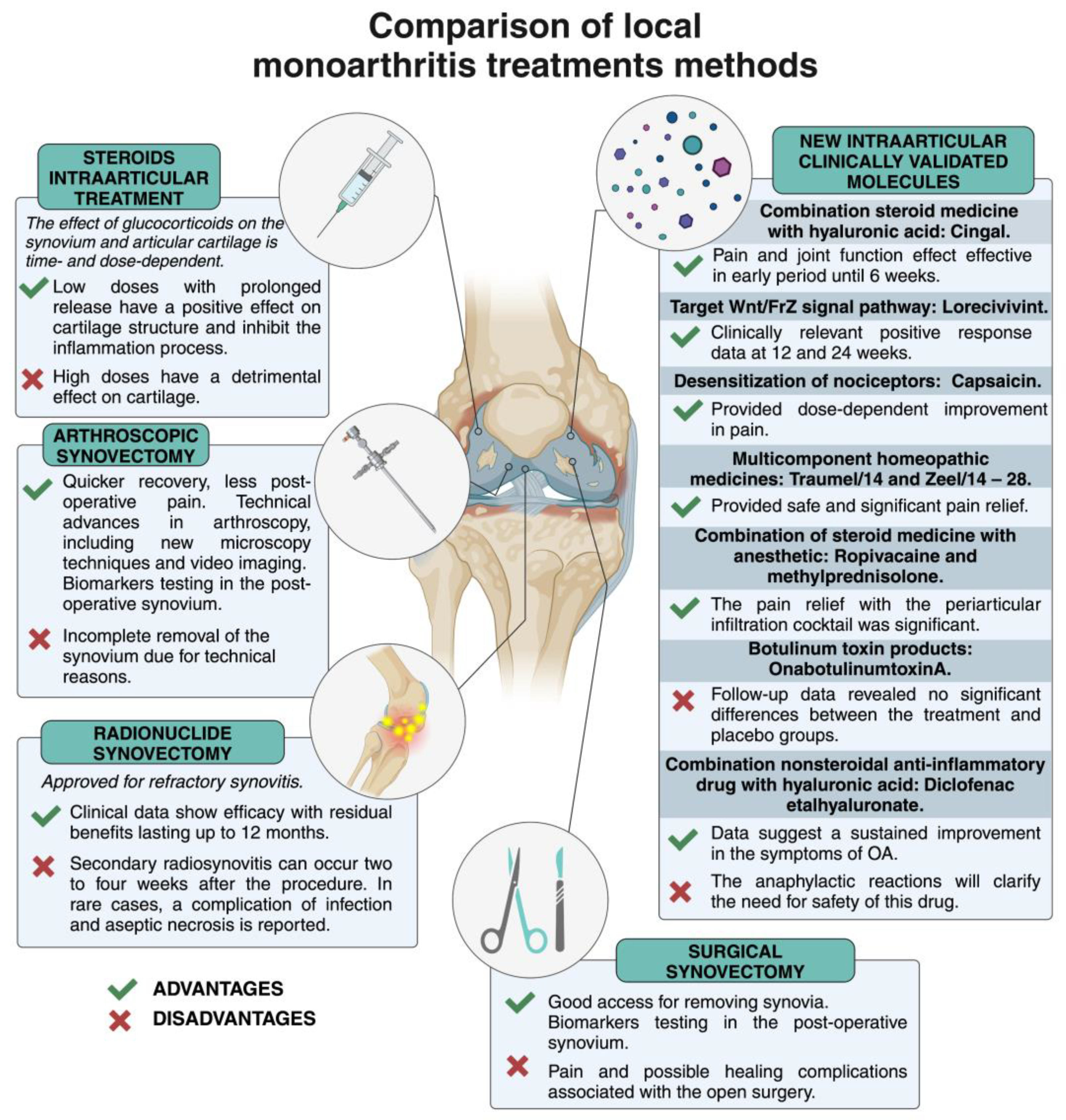
| Clinical Studies Showing Positive Local Intra-Articular Anti-Inflammatory and Analgesic Effects | ||
|---|---|---|
| STEROIDS | ||
| 1. Triamcinolone acetonide extended-release. Product name and description: FX006 (Zilreta), a microsphere-based extended-release triamcinolone acetonide. | ||
| Phase | Design (n = patients), tested medication doses, follow-up duration. | Outcomes |
| Phase 2 | Double-blind, multicenter study (228 patients); Dose FX006 (containing 10, 40, or 60 mg of triamcinolone acetonide) or 40 mg of immediate-release triamcinolone acetonide (TA). Follow-up 12 weeks. | FX006 40 mg dose provided pain relief from 2 to 12 weeks. This medication was significantly superior to TA at five to ten weeks. Adverse events were mild and similar in the treatment groups [31]. |
| Phase 2b | 306 participants were randomized (1:1:1) to receive single i.a. injections of FX006 32 mg (n = 104) or 16 mg (n = 102) or saline placebo (n = 100). | FX006 32 mg versus 16 mg produced a dose-dependent analgesic response, the treatment was well tolerated, and the safety profile was similar to that of saline placebo [32]. |
| Follow-up 12 weeks. | ||
| Phase 3b | Single-arm, open-label study, participants (n = 208). All patients received the first (day 1) intra-articular triamcinolone acetonide extended-release (TA-ER) injection. The second-injection patients received a flexible (at either week 12, 16, 20, or 24) schedule, which depends on the first-injection response duration. Patients who received two injections were evaluated for 52 weeks. | TA-ER administration with a flexible dosing schedule repeated twice according to patient response was well tolerated, with no radiographic evidence of knee joint cartilage effects [33]. |
| Phase 2 | Randomized, multicenter, open-label, single-dose study, 30 patients with hip OA were randomly assigned 1:1 to receive single i.a. injections in the hip joint of TA-ER 32 mg or triamcinolone acetonide TA crystalline suspension (TAcs) 40 mg. Pharmacokinetic (PK) analysis of this medication concentration was performed up to day 85. | The systemic plasma concentration exposure was substantially lower for TA-ER versus TAcs during follow-up. Thus, TA-ER was generally well tolerated, with a safety profile comparable to that of Tacs [34]. |
| Phase 2 | Randomized, open-label, single-dose study 25 patients randomly received a single ultrasound-guided i.a. injection in the shoulder joint of TA-ER 32 mg or TAcs 40 mg. PK analysis of these medication concentration was performed up to day 85. | The pharmacokinetic results showed that TA-ER was well tolerated with the systemic safe profile compared to TAcs crystalline suspension [35]. |
| Phase 2 | Open-label study sequentially enrolled 81 patients. After SF aspiration, the i.a. injection of 32 mg FX006 or 40 mg TAcs was given to each patient at baseline and during follow-up visits (FX006: weeks 1–6–12–16–20; TAcs: week 6). | After injection of FX006 microspheres, the SF and plasma PK observations are consistent with slow release of TA relative to TAcs in patients with knee OA. The slow release of FX006 microspheres reduced systemic TA exposure relative to TAcs [36]. |
| 2. Liposome formulation of dexamethasone sodium phosphate. Product name and description: TLC599 is a water-soluble corticosteroid, dexamethasone sodium phosphate (DSP), produced using new BioSeizer® technology, which encapsulates therapeutically active molecules in multilayer lipid membranes to ensure an extremely long drug release time. | ||
| Phase 2a | Randomized, placebo-controlled, dose-finding study, n = 75 patients. Two single injections of TLC599 (12 mg and 18 mg DSP) and placebo (normal saline) were given, and pain relief was observed in clinical data up to week 24. | The 12 mg dose level of TLC599 showed effective pain relief and improvement in physical function. Treatment was safe and without side effects [37]. |
| 3. Combination steroid medicine with hyaluronic acid (HA). Product name and description: Triamcinolone hexacetonide with a commercial cross-linked HA viscosupplement (Cingal). | ||
| Multicenter, double-blind, saline-controlled clinical trial randomized 368 subjects. A single injection of Cingal (4 mL, 88 mg HA plus 18 mg triamcinolone hexacetonide (TH)), Monovisc (4 mL, 88 mg HA), or saline solution (4 mL, 0.9%). The pain score monitoring was assessed at 12 weeks and 26 weeks. | The pain and function were significantly better in Cingal group compared to saline groups. Cingal had a better effect in the early period, but after 6 weeks and beyond, the effect was similar compared to Monovisc alone [38]. | |
| WNT INHIBITORS | ||
| 4. Target Wnt/FrZ signal pathway. Product name and description: SM04690 (Lorecivivint (LOR)), which acts as an inhibitor of the Wnt signaling pathway, is thought to play an important role in cartilage degeneration by affecting the differentiation of chondrocytes, osteoblasts, and synovial cells. | ||
| Phase 2b | Multicenter, randomized, double-blind, placebo-controlled trial, n = 695 patients. This study’s objective was to identify effective LOR doses: 0.03, 0.07, 0.15, or 0.23 mg. Follow-up 24 weeks. | The optimal dose was identified as 0.07 mg LOR [39]. |
| Post hoc analysis of this clinical trial identified the proportions of LOR responders. | Patient-reported outcomes (PROs) provide clinically relevant positive response data on measures of pain, function, and patient global assessment compared with placebo, with benefits that persisted at 24 weeks [40]. | |
| Post hoc analysis of this clinical trial identified the proportions of LOR responders. | The PRO comparison of control groups, dry needle sham, and saline-based placebo injections for the treatment of knee OA showed equivalent patient-reported outcomes at all time points up to week 24, with no physiological impact [41]. | |
| Summary: The results of the clinical study suggested that the optimal dose for future studies was 0.07 mg LOR [39]. A post hoc analysis yielded clinically relevant positive response data at 12 and 24 weeks in participants with moderate and severe knee OA [40,41]. | ||
| PAIN MANAGEMENT | ||
| 5. Molecule induces desensitization of nociceptors. Product name and description: The Capsaicin (CNTX-4975) molecule is involved in the long-term desensitization of nociceptors associated with calcium influx into nociceptive nerve endings. | ||
| Phase 2 | Multicenter double-blind study, n = 172 patients. Randomization: placebo group, CNTX-4975 0.5 mg and 1.0 mg groups. Follow-up 24 weeks. | CNTX-4975 1.0 mg at 24 weeks significantly reduced OA knee pain; CNTX-4975 0.5 mg significantly reduced pain at 12 weeks, but no effect on pain effect was evident at 24 weeks. Adverse events were mild and similar in the treatment groups [42]. |
| 6. Multicomponent homeopathic medicines. Product name and description: Traumel/14 and Zeel/14–28 ingredients are of vegetable, mineral, and other organic origin, diluted to so-called “low strength” because they contain measurable molecular concentrations of potential active substances with anti-inflammatory, antioxidant, and chondroprotective properties. | ||
| The double-blind, multicenter, randomized, saline-controlled trial, n = 232 patients. The investigational medicinal product is 4.2 mL (2.0 mL for Zeel/14 and 2.2 mL for Traumel/14 on days 1, 8, and 15 of treatment). Follow-up 29, 71, 85 days. | In this study, intra-articular Traumel14/Zeel14 provided safe and significant pain relief [43]. | |
| 7. Combination of steroid medicine with anesthetic. Product name and description: Ropivacaine and methylprednisolone were infiltrated with the periarticular infiltration of this cocktail for the reduction in pain. | ||
| The prospective non-randomized pilot 9-month period study, n = 50 patients. After total knee arthroplasty (TKA), the solution contained a cocktail of ropivacaine, clonidine, epinephrine, and ketorolac with 1 mL of methylprednisolone (40 mg), which was infiltrated in the periarticular tissues, control group was second knee with the infiltration the same solutions mixture except for methylprednisolone. Patients’ follow-ups for pain evaluation were the first three days after surgery. | The reduction in pain with the periarticular infiltration ropivacaine and methylprednisolone cocktail was significant [44]. | |
| 8. Botulinum toxin products. Product name and description: OnabotulinumtoxinA—the regulation of response to nociception in various diseases. | ||
| The multicenter, double-blind, randomized, placebo-controlled study enrolled 176 patients, and 158 completed the study. Randomization: i.a. onabotulinumtoxinA 400 U or 200 U and placebo (saline), followed up for 24 weeks. | Follow-up data revealed no significant differences between the treatment and placebo groups in the reduction in WOMAC mean pain score. Treatment was safe and without serious effects [45]. | |
| 9. Combination nonsteroidal anti-inflammatory drug with HA. Product name and description: Diclofenac etalhyaluronate (DF) molecule covalently bonded to HA has a long-lasting anti-inflammatory effect. | ||
| Phase 3 | The multicenter, open-label, noncomparative study, n = 166 patients. Treatment regimen was i.a. 30 mg DF-HA every 4 weeks for 1 year (13 times in total). Follow-up 52 weeks. | The results showed that DF-HA was well tolerated and the data suggest a sustained improvement in the symptoms of OA [46]. |
| Phase 3 | Multicenter, randomized, double-blind, placebo-controlled trial, n = 440 patients. DF-HA 30 mg or placebo once every 4 weeks for 20 weeks (a total of 6 injections). Follow-up for 24 weeks. | The significant improvement in the WOMAC pain subscale score compared to placebo was over 12 weeks. The observed anaphylactic reactions will clarify the need for the safety of this drug [47]. |
Disclaimer/Publisher’s Note: The statements, opinions and data contained in all publications are solely those of the individual author(s) and contributor(s) and not of MDPI and/or the editor(s). MDPI and/or the editor(s) disclaim responsibility for any injury to people or property resulting from any ideas, methods, instructions or products referred to in the content. |
© 2024 by the authors. Published by MDPI on behalf of the Lithuanian University of Health Sciences. Licensee MDPI, Basel, Switzerland. This article is an open access article distributed under the terms and conditions of the Creative Commons Attribution (CC BY) license (https://creativecommons.org/licenses/by/4.0/).
Share and Cite
Kirdaite, G.; Denkovskij, J.; Mieliauskaite, D.; Pachaleva, J.; Bernotiene, E. The Challenges of Local Intra-Articular Therapy. Medicina 2024, 60, 1819. https://doi.org/10.3390/medicina60111819
Kirdaite G, Denkovskij J, Mieliauskaite D, Pachaleva J, Bernotiene E. The Challenges of Local Intra-Articular Therapy. Medicina. 2024; 60(11):1819. https://doi.org/10.3390/medicina60111819
Chicago/Turabian StyleKirdaite, Gailute, Jaroslav Denkovskij, Diana Mieliauskaite, Jolita Pachaleva, and Eiva Bernotiene. 2024. "The Challenges of Local Intra-Articular Therapy" Medicina 60, no. 11: 1819. https://doi.org/10.3390/medicina60111819
APA StyleKirdaite, G., Denkovskij, J., Mieliauskaite, D., Pachaleva, J., & Bernotiene, E. (2024). The Challenges of Local Intra-Articular Therapy. Medicina, 60(11), 1819. https://doi.org/10.3390/medicina60111819