


Advances in Kiwifruit Postharvest Management: Convergence of Physiological Insights, Omics, and Nondestructive Technologies

 , ,
, ,
Abstract
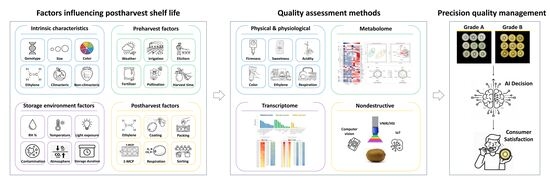
1. Introduction
2. Postharvest Physiology and Technology
2.1. Key Postharvest Challenges
2.2. Preharvest to Postharvest Continuum
2.3. Conventional and Innovative Postharvest Approaches
3. Progress in Transcriptomics of Kiwifruit
3.1. Transcriptome Responses to Species and Cultivar
3.2. Transcriptome Responses to Ripening Stages
3.3. Transcriptome Responses to Postharvest Treatments
3.4. Transcriptome Responses to Storage
3.5. Functional Genes Regulating Physicochemical Properties
3.6. Functional Genes Regulating Antioxidant Properties
4. Advances in Metabolomics of Kiwifruit
4.1. Metabolite Profiling Across Species and Cultivars
4.2. Metabolite Profiling Across Development and Ripening Stages
4.3. Metabolomic Shifts During Postharvest Storage
4.4. Metabolomic Shifts During Pre- and Postharvest Treatments
5. Integrated Omics Approaches in Kiwifruit
5.1. Conceptual Foundations and Genomic Resources
5.2. Fruit Development, Maturity, Ripening, and Biomarkers Across Cultivars
5.3. Omics-Informed Stress and Postharvest Responses
5.4. Omics-Driven Postharvest Quality Management
6. Nondestructive Quality Estimation in Kiwifruit
6.1. Target Quality Traits
6.2. Integration with Omics and Data Fusion Across Instruments
7. Summary and Future Perspectives
Author Contributions
Funding
Institutional Review Board Statement
Informed Consent Statement
Data Availability Statement
Conflicts of Interest
References
- Nazir, M.F.; Lou, J.; Wang, Y.; Zou, S.; Huang, H. Kiwifruit in the Omics Age: Advances in Genomics, Breeding, and Beyond. Plants 2024, 13, 2156. [Google Scholar] [CrossRef]
- Hu, X.; Li, L.; Wang, X.; Xiao, H.; Zhu, X.; Zhu, J.; Zhao, J.; Sun, X.; Qian, Y.; Liu, C. Transcriptional and Metabolomic Analysis Reveal Different Aromatic Amino Acid Production and Potential Regulatory Mechanisms for Two Kiwifruit Species. Fruit Res. 2025, 5, e023. [Google Scholar] [CrossRef]
- Xia, Y.; Wu, D.T.; Ali, M.; Liu, Y.; Zhuang, Q.G.; Wadood, S.A.; Liao, Q.H.; Liu, H.Y.; Gan, R.Y. Innovative Postharvest Strategies for Maintaining the Quality of Kiwifruit during Storage: An Updated Review. Food Front. 2024, 5, 1933–1950. [Google Scholar] [CrossRef]
- Kumarihami, H.M.P.C.; Kim, J.G.; Kim, Y.H.; Lee, M.; Lee, Y.S.; Kwack, Y.B.; Kim, J. Preharvest Application of Chitosan Improves the Postharvest Life of ‘Garmrok’ Kiwifruit through the Modulation of Genes Related to Ethylene Biosynthesis, Cell Wall Modification and Lignin Metabolism. Foods 2021, 10, 373. [Google Scholar] [CrossRef]
- Choi, H.R.; Tilahun, S.; Park, D.S.; Lee, Y.M.; Choi, J.H.; Baek, M.W.; Jeong, C.S. Harvest Time Affects Quality and Storability of Kiwifruit (Actinidia spp.): Cultivars during Long-Term Cool Storage. Sci. Hortic. 2019, 256, 108523. [Google Scholar] [CrossRef]
- Wang, F.; Yang, Q.; Zhao, Q.; Zhang, X. Roles of Antioxidant Capacity and Energy Metabolism in the Maturity-Dependent Chilling Tolerance of Postharvest Kiwifruit. Postharvest Biol. Technol. 2020, 168, 111281. [Google Scholar] [CrossRef]
- Ozturk, B.; Korkmaz, M.; Aglar, E. Changes in Fruit Quality Properties and Phytochemical Substances of Kiwifruit (Actinidia deliciosa) Grown in Different Agro-Ecological Conditions during Cold Storage. BMC Plant Biol. 2024, 24, 795. [Google Scholar] [CrossRef]
- Burdon, J.; Pidakala, P.; Martin, P.; Billing, D.; Boldingh, H. Fruit Maturation and the Soluble Solids Harvest Index for ‘Hayward’ Kiwifruit. Sci. Hortic. 2016, 213, 193–198. [Google Scholar] [CrossRef]
- Peng, J.; Zhu, S.; Lin, X.; Wan, X.; Zhang, Q.; Njie, A.; Luo, D.; Long, Y.; Fan, R.; Dong, X. Evaluation of Preharvest Melatonin on Soft Rot and Quality of Kiwifruit Based on Principal Component Analysis. Foods 2023, 12, 1414. [Google Scholar] [CrossRef]
- Huang, H.; Guo, L.; Wang, L.; Wang, H.; Ma, S.; Jiang, Y.; Qu, H. 1-Methylcyclopropene (1-MCP) Slows Ripening of Kiwifruit and Affects Energy Status, Membrane Fatty Acid Contents and Cell Membrane Integrity. Postharvest Biol. Technol. 2019, 156, 110941. [Google Scholar] [CrossRef]
- Ma, H.; Liu, N.; Xie, G.; Tan, S.; Xu, Y.; Luo, Z. Postharvest Ripening Combined with 1-MCP Keeps the Shelf Quality of Kiwifruit after Cold Storage by Regulating the Antioxidant System and Defense Enzymes. Postharvest Biol. Technol. 2025, 222, 113370. [Google Scholar] [CrossRef]
- Li, S.; Xiao, L.; Chen, M.; Cao, Q.; Luo, Z.; Kang, N.; Jia, M.; Chen, J.; Xiang, M. The Involvement of the Phenylpropanoid and Jasmonate Pathways in Methyl Jasmonate-Induced Soft Rot Resistance in Kiwifruit (Actinidia chinensis). Front. Plant Sci. 2022, 13, 1097733. [Google Scholar] [CrossRef]
- Belay, Z.A.; James Caleb, O. Role of Integrated Omics in Unravelling Fruit Stress and Defence Responses during Postharvest: A Review. Food Chem. Mol. Sci. 2022, 5, 100118. [Google Scholar] [CrossRef]
- Habibi, F.; Boakye, D.A.; Chang, Y.; Casorzo, G.; Hallman, L.M.; Madison, M.; Clavijo-Herrera, J.; Sarkhosh, A.; Liu, T. Molecular Mechanisms Underlying Postharvest Physiology and Metabolism of Fruit and Vegetables through Multi-Omics Technologies. Sci. Hortic. 2024, 324, 112562. [Google Scholar] [CrossRef]
- Sun, S.; Lin, M.; Qi, X.; Chen, J.; Gu, H.; Zhong, Y.; Sun, L.; Muhammad, A.; Bai, D.; Hu, C.; et al. Full-Length Transcriptome Profiling Reveals Insight into the Cold Response of Two Kiwifruit Genotypes (A. arguta) with Contrasting Freezing Tolerances. BMC Plant Biol. 2021, 21, 365. [Google Scholar] [CrossRef]
- Shu, P.; Zhang, Z.; Wu, Y.; Chen, Y.; Li, K.; Deng, H.; Zhang, J.; Zhang, X.; Wang, J.; Liu, Z.; et al. A Comprehensive Metabolic Map Reveals Major Quality Regulations in Red-Flesh Kiwifruit (Actinidia chinensis). New Phytol. 2023, 238, 2064–2079. [Google Scholar] [CrossRef]
- Liu, Q.; Li, Y.; Liao, G.; Xu, X.; Jia, D.; Zhong, M.; Wang, H.; Ye, B. Transcriptome and Metabolome Reveal AsA Regulatory Network between Metabolites and Genes after Fruit Shading by Bagging in Kiwifruit (Actinidia eriantha). Sci. Hortic. 2022, 302, 111184. [Google Scholar] [CrossRef]
- Ye, L.; Bai, F.; Zhang, L.; Luo, M.; Gao, L.; Wang, Z.; Peng, J.; Chen, Q.; Luo, X. Transcriptome and Metabolome Analyses of Anthocyanin Biosynthesis in Post-Harvest Fruits of a Full Red-Type Kiwifruit (Actinidia arguta) ‘Jinhongguan’. Front. Plant Sci. 2023, 14, 1280970. [Google Scholar] [CrossRef]
- Yu, M.; Man, Y.; Lei, R.; Lu, X.; Wang, Y. Metabolomics Study of Flavonoids and Anthocyanin-Related Gene Analysis in Kiwifruit (Actinidia chinensis) and Kiwiberry (Actinidia arguta). Plant Mol. Biol. Rep. 2020, 38, 353–369. [Google Scholar] [CrossRef]
- Jia, H.; Tao, J.; Zhong, W.; Jiao, X.; Chen, S.; Wu, M.; Gao, Z.; Huang, C. Nutritional Component Analyses in Different Varieties of Actinidia eriantha Kiwifruit by Transcriptomic and Metabolomic Approaches. Int. J. Mol. Sci. 2022, 23, 10217. [Google Scholar] [CrossRef]
- Mao, J.; Gao, Z.; Wang, X.; Yao, D.; Lin, M.; Chen, L. Integrated Transcriptome and Targeted Metabolome Analyses Provide Insights into Flavonoid Biosynthesis in Kiwifruit (Actinidia chinensis). Sci. Rep. 2024, 14, 19417. [Google Scholar] [CrossRef]
- Liang, D.; Deng, H.; Deng, Q.; Lin, L.; Lv, X.; Wang, J.; Wang, Z.; Xiong, B.; Zhao, X.; Xia, H. Dynamic Changes of Phenolic Compounds and Their Associated Gene Expression Profiles Occurring during Fruit Development and Ripening of the Donghong Kiwifruit. J. Agric. Food Chem. 2020, 68, 11421–11433. [Google Scholar] [CrossRef]
- Xiong, S.; Sun, X.; Tian, M.; Xu, D.; Jiang, A. 1-Methylcyclopropene Treatment Delays the Softening of Actinidia arguta Fruit by Reducing Cell Wall Degradation and Modulating Carbohydrate Metabolism. Food Chem. 2023, 411, 135485. [Google Scholar] [CrossRef]
- Tian, X.; Zhu, L.; Yang, N.; Song, J.; Zhao, H.; Zhang, J.; Ma, F.; Li, M. Proteomics and Metabolomics Reveal the Regulatory Pathways of Ripening and Quality in Post-Harvest Kiwifruits. J. Agric. Food Chem. 2021, 69, 824–835. [Google Scholar] [CrossRef]
- Jue, D.-W.; Sang, X.-L.; Li, Z.-X.; Zhang, W.-L.; Liao, Q.-H.; Tang, J. Determination of the Effects of Pre-Harvest Bagging Treatment on Kiwifruit Appearance and Quality via Transcriptome and Metabolome Analyses. Food Res. Int. 2023, 173, 113276. [Google Scholar] [CrossRef]
- Li, Z.-Y.; Ji, J.-C.; Mao, X.-Y.; Yang, Z.-F.; Wu, W. Multi-Omics Integration Analysis Revealed the Regulatory Network of Ethylene and 1-MCP Treatments on Kiwifruit Shelf Life Quality. Sci. Hortic. 2024, 338, 113811. [Google Scholar] [CrossRef]
- Xu, Y.; Yang, C.; Zhang, Y.; Cao, Q.; Wan, C.; Chen, C.; Chen, J.; Huang, Z.; Gan, Z. Blue Light Treatment Delays Postharvest Ripening of Kiwifruit by Suppressing Ethylene Biosynthesis, Starch Degradation, and Cell Wall Metabolism. LWT 2024, 199, 116105. [Google Scholar] [CrossRef]
- Yang, H.; Zhang, X.; Wu, R.; Tang, X.; Yang, Y.; Fan, X.; Gong, H.; Grierson, D.; Yin, X.; Li, J.; et al. Integrated Metabolomic and Transcriptomic Analyses Provide Comprehensive New Insights into the Mechanism of Chitosan Delay of Kiwifruit Postharvest Ripening. Postharvest Biol. Technol. 2024, 210, 112746. [Google Scholar] [CrossRef]
- Ding, K.; Xie, Y.; Yang, H.; Xu, S.; Li, H.; Wang, Z.; Qiao, X.; Tang, Q.; Wang, R.; Shan, Y.; et al. Visible Light-Responsive Chitosan-Based Active Packaging Delays Kiwifruit Quality Deterioration by Regulating Membrane Lipid Metabolism. Postharvest Biol. Technol. 2025, 226, 113533. [Google Scholar] [CrossRef]
- Wang, Y.; Niu, Y.; Ye, L.; Shi, Y.; Luo, A. Transcriptomic Analysis Reveals Ozone Treatment Delays Kiwifruit Postharvest Softening by Modulating Cell Wall Metabolism. J. Food Sci. 2024, 89, 2001–2016. [Google Scholar] [CrossRef]
- Niu, Y.; Ye, L.; Wang, Y.; Shi, Y.; Luo, A. Role of Methyl Jasmonate in Alleviating Chilling Injury in “Xuxiang” Kiwifruit: Insights from Transcriptomic Evidence. Postharvest Biol. Technol. 2024, 216, 113065. [Google Scholar] [CrossRef]
- Yang, H.; Li, Y.; Zhang, S.; Ding, K.; Wang, R.; Shan, Y.; Ding, S. Transcriptomic and Metabolomic Analyses Reveal the Mechanism of Cold Chain Breaks Accelerate Postharvest Kiwifruit Ripening and Flavonoid Loss. Sci. Hortic. 2025, 341, 113958. [Google Scholar] [CrossRef]
- Ying, L.; Bian, J.; Zhao, F.; Chen, X.; Tang, J.; Jiang, F.; Sun, B. Short-Term Anaerobic Treatment Maintained the Quality of Actinidia arguta by Activating the Antioxidant Defense System. J. Sci. Food Agric. 2024, 104, 4320–4330. [Google Scholar] [CrossRef]
- Zhang, J.; Du, K.; Xie, Y.; Zhang, X.; Jiang, W.; Li, M.; Shu, P.; Wang, J.; Zhuang, Q.; Wang, H.; et al. Integration of Transcriptomic and Metabolomic Data Reveals New Tetraploid Kiwifruit Hybrids with Enhanced Nutrients. LWT 2022, 170, 114012. [Google Scholar] [CrossRef]
- Mao, J.; Gao, Z.; Wang, X.; Lin, M.; Chen, L.; Ning, X. Combined Widely Targeted Metabolomic, Transcriptomic, and Spatial Metabolomic Analysis Reveals the Potential Mechanism of Coloration and Fruit Quality Formation in Actinidia chinensis Cv. Hongyang. Foods 2024, 13, 233. [Google Scholar] [CrossRef]
- Wang, Y.; Zhang, M.; Dong, K.; Yin, X.; Hao, C.; Zhang, W.; Irfan, M.; Chen, L.; Wang, Y. Metabolomic and Transcriptomic Exploration of the Uric Acid-Reducing Flavonoids Biosynthetic Pathways in the Fruit of Actinidia arguta Sieb. Zucc. Front. Plant Sci. 2022, 13, 1025317. [Google Scholar] [CrossRef]
- Polychroniadou, C.; Michailidis, M.; Samiotaki, M.; Adamakis, I.D.S.; Giannoutsou, E.; Skodra, C.; Karagiannis, E.; Bazakos, C.; Molassiotis, A.; Tanou, G. Understanding the Effect of Calcium in Kiwifruit Ripening and Establishment of Early and Late Response Mechanisms through a Cross-Omics Approach. Postharvest Biol. Technol. 2024, 211, 112803. [Google Scholar] [CrossRef]
- Xiong, S.; Zhou, F.; Jiang, A.; Yang, L.; Hu, W. Ethanol Vapor Ameliorates Chilling Injury and Maintains Postharvest Quality by Increasing Antioxidant Capacity of Hardy Kiwifruit (Actinidia arguta). Sci. Hortic. 2024, 327, 112796. [Google Scholar] [CrossRef]
- Long, Y.; Sun, Y.; Zhou, B.; Zhu, G.; Chen, X.; Qi, Y.; Wang, K. Photosensitization of Riboflavin Reduces the Susceptibility to Gray Mold in Postharvest Kiwifruit. Postharvest Biol. Technol. 2024, 212, 112836. [Google Scholar] [CrossRef]
- Yang, X.; Liu, N.; Tan, S.; Xu, Y.; Luo, Z.; Xie, G. Preharvest Methyl Jasmonate Maintain the Shelf Quality of Kiwifruit after Cold Storage by Regulating the Antioxidant System. Postharvest Biol. Technol. 2025, 221, 113335. [Google Scholar] [CrossRef]
- Favre, L.; Hunter, D.A.; O’Donoghue, E.M.; Erridge, Z.A.; Napier, N.J.; Cho, J.; Nangul, A.; O’Donnell, K.; Pidakala, P.; Martin, P.; et al. Maturity Biomarkers Predicting Storage Performance of Early-Harvested Yellow-Fleshed Kiwifruit Identified Using Integrated Multi-Omics Analysis. Postharvest Biol. Technol. 2023, 203, 112400. [Google Scholar] [CrossRef]
- Li, B.; Li, X.; Wang, Y.; Liu, X.; Li, K.; Li, R.; Faiz, M.U.; Darlington, U.T.; Rao, Z.; Wu, Q.; et al. KPGD: A Kiwifruit Pangenome Database for Comprehensive Mining of Genetic Diversity in the Genus Actinidia. Plant Commun. 2025, 6, 101373. [Google Scholar] [CrossRef]
- Yang, B.; Guo, W.; Huang, X.; Du, R.; Liu, Z. A Portable, Low-Cost and Sensor-Based Detector on Sweetness and Firmness Grades of Kiwifruit. Comput. Electron. Agric. 2020, 179, 105831. [Google Scholar] [CrossRef]
- Li, H.; Cao, S.; Liu, Z.; Li, N.; Xu, D.; Yang, Y.; Mo, H.; Hu, L. Rapid Assessment of Ready-to-Eat Xuxiang Kiwifruit Quality Based on Chroma Recognition and GC-MS Analysis. LWT 2023, 182, 114796. [Google Scholar] [CrossRef]
- Wang, F.; Lv, C.; Pan, Y.; Zhou, L.; Zhao, B. Efficient Non-Destructive Detection for External Defects of Kiwifruit. Appl. Sci. 2023, 13, 11971. [Google Scholar] [CrossRef]
- Wang, F.; Lv, C.; Dong, L.; Li, X.; Guo, P.; Zhao, B. Development of Effective Model for Non-Destructive Detection of Defective Kiwifruit Based on Graded Lines. Front. Plant Sci. 2023, 14, 1170221. [Google Scholar] [CrossRef]
- Yang, Y.; Peng, J.; Fan, P. A Non-Destructive Dropped Fruit Impact Signal Imaging-Based Deep Learning Approach for Smart Sorting of Kiwifruit. Comput. Electron. Agric. 2022, 202, 107380. [Google Scholar] [CrossRef]
- Cevoli, C.; Iaccheri, E.; Fabbri, A.; Ragni, L. Data Fusion of FT-NIR Spectroscopy and Vis/NIR Hyperspectral Imaging to Predict Quality Parameters of Yellow Flesh “Jintao” Kiwifruit. Biosyst. Eng. 2024, 237, 157–169. [Google Scholar] [CrossRef]
- Zou, Z.; Wang, Q.; Wu, Q.; Li, M.; Zhen, J.; Yuan, D.; Xiao, Y.; Xu, C.; Yin, S.; Zhou, M.; et al. Fluorescence Hyperspectral Imaging Technology Combined with Chemometrics for Kiwifruit Quality Attribute Assessment and Non-Destructive Judgment of Maturity. Talanta 2024, 280, 126793. [Google Scholar] [CrossRef]
- Bakhshipour, A. A Data Fusion Approach for Nondestructive Tracking of the Ripening Process and Quality Attributes of Green Hayward Kiwifruit Using Artificial Olfaction and Proximal Hyperspectral Imaging Techniques. Food Sci. Nutr. 2023, 11, 6116–6132. [Google Scholar] [CrossRef]
- Li, H.; Suo, J.; Han, Y.; Liang, C.; Jin, M.; Zhang, Z.; Rao, J. The Effect of 1-Methylcyclopropene, Methyl Jasmonate and Methyl Salicylate on Lignin Accumulation and Gene Expression in Postharvest ‘Xuxiang’ Kiwifruit during Cold Storage. Postharvest Biol. Technol. 2017, 124, 107–118. [Google Scholar] [CrossRef]
- Xie, G.; Liu, N.; Zhang, Y.; Tan, S.; Xu, Y.; Luo, Z. Postharvest MeJA Maintains the Shelf Quality of Kiwifruit after Cold Storage by Regulating Antioxidant Capacity and Activating the Disease Resistance. Postharvest Biol. Technol. 2024, 211, 112827. [Google Scholar] [CrossRef]
- Cheng, J.; Zheng, A.; Li, H.; Huan, C.; Jiang, T.; Shen, S.; Zheng, X. Effects of Melatonin Treatment on Ethanol Fermenation and ERF Expression in Kiwifruit Cv. Bruno during Postharvest. Sci. Hortic. 2022, 293, 110696. [Google Scholar] [CrossRef]
- Chai, J.; Yang, B.; Xu, N.; Jiang, Q.; Gao, Z.; Ren, X.; Liu, Z. Effects of Low Temperature on Postharvest Ripening and Starchiness in ‘Cuixiang’ Kiwifruit. LWT 2024, 209, 116795. [Google Scholar] [CrossRef]
- Polychroniadou, C.; Michailidis, M.; Adamakis, I.D.S.; Karagiannis, E.; Ganopoulos, I.; Tanou, G.; Bazakos, C.; Molassiotis, A. Mechanical Stress Elicits Kiwifruit Ripening Changes in Gene Expression and Metabolic Status. Postharvest Biol. Technol. 2022, 194, 112102. [Google Scholar] [CrossRef]
- Chen, H.; Jin, L.; Fang, C.; Liu, L.; Kačániová, M.; Wang, J.; Lu, J.; Ban, Z. Integration of Puncture Loading and Finite Element Simulations to Predict the Mechanical Responses for Kiwifruit. Postharvest Biol. Technol. 2024, 217, 113102. [Google Scholar] [CrossRef]
- Lembo, M.; Eramo, V.; Riggi, R.; Forniti, R.; Bellincontro, A.; Botondi, R. Destructive and Non-Destructive Evaluation of Anthocyanin Content and Quality Attributes in Red Kiwifruit Subjected to Plant Spray Treatment with Cis-3-Hexenyl Butyrate. Foods 2025, 14, 480. [Google Scholar] [CrossRef]
- Zhang, J.; Teng, J.; Liang, J.; Gibson, B.W.; Zhang, W.; Li, A.; Cheng, Y.; Zeng, Y. Effect of Different Pre-Cooling Strategies on the Storage Quality of Kiwifruit. Sci. Hortic. 2025, 344, 114105. [Google Scholar] [CrossRef]
- Chai, J.; Wang, Y.; Liu, Y.; Gu, Z.; Liu, Z. High O2/N2 Controlled Atmosphere Accelerates Postharvest Ripening of ‘Hayward’ Kiwifruit. Sci. Hortic. 2022, 300, 111073. [Google Scholar] [CrossRef]
- Zhao, Y.; Yan, M.; Zhang, K.; Wu, X.; Wang, Z.; Shao, T.; Lei, J.; Chen, X.; Liu, H. Effects of 1-Methylcyclopropene Treatment on Postharvest Quality and Metabolism of Different Kiwifruit Varieties. Foods 2024, 13, 3632. [Google Scholar] [CrossRef]
- Yan, H.; Huang, L.; Liao, Q.; Xia, M.; Yao, T.; LIU, H.; Chen, H.; Li, W. Tenuazonic Acid Delays Postharvest Kiwifruit Softening by Inhibiting Starch and Cell Wall Degradation, and Maintaining ROS Homeostasis during Ambient Storage. Int. J. Biol. Macromol. 2025, 318, 144780. [Google Scholar] [CrossRef]
- Yan, H.; Chen, H.; Zhao, J.; Yao, T.; Ding, X. Postharvest H2O2 Treatment Affects Flavor Quality, Texture Quality and ROS Metabolism of ‘Hongshi’ Kiwifruit Fruit Kept at Ambient Conditions. Food Chem. 2023, 405, 134908. [Google Scholar] [CrossRef]
- Zheng, X.; Hu, B.; Song, L.; Pan, J.; Liu, M. Changes in Quality and Defense Resistance of Kiwifruit in Response to Nitric Oxide Treatment during Storage at Room Temperature. Sci. Hortic. 2017, 222, 187–192. [Google Scholar] [CrossRef]
- Hao, Y.; Pang, H.; Lv, H.; Wu, G.; Zhang, J.; Luo, X.; Zhang, M.; Duan, Y.; Hou, Y.; Wang, Y.; et al. Treatment of Kiwifruit with Lactiplantibacillus Pentosus CW5 Cell-Free Supernatant Maintains Postharvest Quality and Alters the Surface Microbiome. Postharvest Biol. Technol. 2025, 224, 113478. [Google Scholar] [CrossRef]
- Xia, H.; Wang, X.; Su, W.; Jiang, L.; Lin, L.; Deng, Q.; Wang, J.; Deng, H.; Hu, R.; Liao, M.; et al. Changes in the Carotenoids Profile of Two Yellow-Fleshed Kiwifruit Cultivars during Storage. Postharvest Biol. Technol. 2020, 164, 111162. [Google Scholar] [CrossRef]
- Luo, Z.; Zhang, J.; Xiang, M.; Zeng, J.; Chen, J.; Chen, M. Exogenous Melatonin Treatment Affects Ascorbic Acid Metabolism in Postharvest ‘Jinyan’ Kiwifruit. Front. Nutr. 2022, 9, 1081476. [Google Scholar] [CrossRef]
- Yan, W.; Cao, M.; Shi, L.; Wu, W.; Xu, F.; Chen, W.; Yang, Z. γ-Aminobutyric Acid Delays Fruit Softening in Postharvest Kiwifruit by Inhibiting Starch and Cell Wall Degradation. Postharvest Biol. Technol. 2024, 213, 112916. [Google Scholar] [CrossRef]
- He, X.; Qin, W.; He, Q.; Liu, Y.; Wang, Y.; Wang, R.; Shi, H. Optimization of the Optimal Hormone Formula for Kiwifruit and Analysis of Its Storage Characteristics. Front. Plant Sci. 2025, 16, 1567183. [Google Scholar] [CrossRef]
- Qi, X.; Qiao, C.; Han, L.; Zhuang, M.; Cao, M.; Wang, C.; Guo, L. Comparative Analysis of Storage Temperatures and Forchlorfenuron Treatment Concentrations on Physiological Quality and Primary Metabolites in Kiwifruit during Storage. Postharvest Biol. Technol. 2025, 228, 113665. [Google Scholar] [CrossRef]
- Mitalo, O.W.; Asiche, W.O.; Kasahara, Y.; Tosa, Y.; Tokiwa, S.; Ushijima, K.; Nakano, R.; Kubo, Y. Comparative Analysis of Fruit Ripening and Associated Genes in Two Kiwifruit Cultivars (‘Sanuki Gold’ and ‘Hayward’) at Various Storage Temperatures. Postharvest Biol. Technol. 2019, 147, 20–28. [Google Scholar] [CrossRef]
- Choi, H.R.; Baek, M.W.; Jeong, C.S.; Tilahun, S. Comparative Transcriptome Analysis of Softening and Ripening-Related Genes in Kiwifruit Cultivars Treated with Ethylene. Curr. Issues Mol. Biol. 2022, 44, 2593–2613. [Google Scholar] [CrossRef]
- Xia, H.; Wang, X.; Zhou, Y.; Su, W.; Jiang, L.; Deng, H.; Li, M.; Zhuang, Q.; Xie, Y.; Liang, D. Biochemical and Molecular Factors Governing Flesh-Color Development in Two Yellow-Fleshed Kiwifruit Cultivars. Sci. Hortic. 2021, 280, 109929. [Google Scholar] [CrossRef]
- Zhang, J.; Cao, S.; Li, N.; Li, H.; Liu, Z.; Xu, D.; Mo, H. Transcriptome Analysis Unveils the Molecular Mechanisms of Ethylene-Induced Ready-to-Eat Kiwifruit-Picking Ripening. Foods 2025, 14, 2026. [Google Scholar] [CrossRef]
- Lin, M.; Gao, Z.; Wang, X.; Mao, J.; Pan, L.; Gong, X.; Yao, D.; Zhong, H.; Huo, H. Identification of Two Postharvest Ripening Regulatory Models in Kiwifruit: Based on Plant Hormones, Physiology, and Transcriptome Analysis. BMC Plant Biol. 2024, 24, 1121. [Google Scholar] [CrossRef]
- Gan, Z.; Yuan, X.; Shan, N.; Wan, C.; Chen, C.; Zhu, L.; Xu, Y.; Kai, W.; Zhai, X.; Chen, J. AcERF1B and AcERF073 Positively Regulate Indole-3-Acetic Acid Degradation by Activating AcGH3.1 Transcription during Postharvest Kiwifruit Ripening. J. Agric. Food Chem. 2021, 69, 13859–13870. [Google Scholar] [CrossRef]
- Yang, R.; Lin, X.; Dou, Y.; Zhang, W.; Du, H.; Wan, C.; Chen, J.; Zhang, L.; Zhu, L. Transcriptome Profiling of Postharvest Kiwifruit in Response to Exogenous Nitric Oxide. Sci. Hortic. 2021, 277, 109788. [Google Scholar] [CrossRef]
- Huan, C.; Du, X.; Wang, L.; Kebbeh, M.; Li, H.; Yang, X.; Shen, S.; Zheng, X. Transcriptome Analysis Reveals the Metabolisms of Starch Degradation and Ethanol Fermentation Involved in Alcoholic Off-Flavour Development in Kiwifruit during Ambient Storage. Postharvest Biol. Technol. 2021, 180, 111621. [Google Scholar] [CrossRef]
- Gambi, F.; Pilkington, S.M.; McAtee, P.A.; Donati, I.; Schaffer, R.J.; Montefiori, M.; Spinelli, F.; Burdon, J. Fruit of Three Kiwifruit (Actinidia chinensis) Cultivars Differ in Their Degreening Response to Temperature after Harvest. Postharvest Biol. Technol. 2018, 141, 16–23. [Google Scholar] [CrossRef]
- Gong, X.; Lin, M.; Song, J.; Mao, J.; Yao, D.; Gao, Z.; Wang, X. Genome-Wide Identification of the AcBAM Family in Kiwifruit (Actinidia chinensis Cv. Hongyang) and the Expression Profiling Analysis of AcBAMs Reveal Their Role in Starch Metabolism. BMC Plant Biol. 2025, 25, 415. [Google Scholar] [CrossRef]
- Qiang, X.; Ren, T.; Zhang, Y.; Jia, Y. Genome-Wide Identification and Expression Profiling of the Invertase Genes Involved in Sugar Metabolism and Accumulation in Actinidia arguta. Int. J. Mol. Sci. 2025, 26, 2150. [Google Scholar] [CrossRef]
- Shan, N.; Zhang, Y.; Xu, Y.; Yuan, X.; Wan, C.; Chen, C.; Chen, J.; Gan, Z. Ethylene-Induced Potassium Transporter AcKUP2 Gene Is Involved in Kiwifruit Postharvest Ripening. BMC Plant Biol. 2022, 22, 108. [Google Scholar] [CrossRef]
- Zhang, A.; Zhang, Q.; Li, J.; Gong, H.; Fan, X.; Yang, Y.; Liu, X.; Yin, X. Transcriptome Co-Expression Network Analysis Identifies Key Genes and Regulators of Ripening Kiwifruit Ester Biosynthesis. BMC Plant Biol. 2020, 20, 103. [Google Scholar] [CrossRef]
- Leontowicz, H.; Leontowicz, M.; Latocha, P.; Jesion, I.; Park, Y.S.; Katrich, E.; Barasch, D.; Nemirovski, A.; Gorinstein, S. Bioactivity and Nutritional Properties of Hardy Kiwi Fruit Actinidia arguta in Comparison with Actinidia deliciosa ‘Hayward’ and Actinidia eriantha ‘Bidan’. Food Chem. 2016, 196, 281–291. [Google Scholar] [CrossRef]
- Huang, C.H.; Tao, J.J.; Liao, G.L.; Xie, M.; Qu, X.Y.; Chen, L.; Xu, X.B. Dynamic Changes of Phenol and Antioxidant Capacity during Fruit Development of Three Actinidia Species (Kiwifruit). Sci. Hortic. 2020, 273, 109571. [Google Scholar] [CrossRef]
- Li, Y.F.; Jiang, W.; Liu, C.; Fu, Y.; Wang, Z.; Wang, M.; Chen, C.; Guo, L.; Zhuang, Q.G.; Liu, Z.B. Comparison of Fruit Morphology and Nutrition Metabolism in Different Cultivars of Kiwifruit across Developmental Stages. PeerJ 2021, 9, e11538. [Google Scholar] [CrossRef]
- Rowan, D.; Boldingh, H.; Cordiner, S.; Cooney, J.; Hedderley, D.; Hewitt, K.; Jensen, D.; Pereira, T.; Trower, T.; McGhie, T. Kiwifruit Metabolomics—An Investigation of within Orchard Metabolite Variability of Two Cultivars of Actinidia chinensis. Metabolites 2021, 11, 603. [Google Scholar] [CrossRef]
- Xiong, Y.; Yan, P.; Du, K.; Li, M.; Xie, Y.; Gao, P. Nutritional Component Analyses of Kiwifruit in Different Development Stages by Metabolomic and Transcriptomic Approaches. J. Sci. Food Agric. 2020, 100, 2399–2409. [Google Scholar] [CrossRef]
- Xiong, Y.; He, J.; Li, M.; Du, K.; Lang, H.; Gao, P.; Xie, Y. Integrative Analysis of Metabolome and Transcriptome Reveals the Mechanism of Color Formation in Yellow-Fleshed Kiwifruit. Int. J. Mol. Sci. 2023, 24, 1573. [Google Scholar] [CrossRef]
- Wang, R.; Shu, P.; Zhang, C.; Zhang, J.; Chen, Y.; Zhang, Y.; Du, K.; Xie, Y.; Li, M.; Ma, T.; et al. Integrative Analyses of Metabolome and Genome-Wide Transcriptome Reveal the Regulatory Network Governing Flavor Formation in Kiwifruit (Actinidia chinensis). New Phytol. 2022, 233, 373–389. [Google Scholar] [CrossRef]
- Choi, H.R.; Baek, M.W.; Tilahun, S.; Jeong, C.S. Long-Term Cold Storage Affects Metabolites, Antioxidant Activities, and Ripening and Stress-Related Genes of Kiwifruit Cultivars. Postharvest Biol. Technol. 2022, 189, 111912. [Google Scholar] [CrossRef]
- Mao, J.; Gao, Z.; Lin, M.; Zhang, X.; Ning, X.; Gong, X.; Lu, Y.; Chen, L.; Wang, X. Targeted Multi-Platform Metabolome Analysis and Enzyme Activity Analysis of Kiwifruit during Postharvest Ripening. Front. Plant Sci. 2023, 14, 1120166. [Google Scholar] [CrossRef]
- Yuan, J.; Li, H.; Cao, S.; Liu, Z.; Li, N.; Xu, D.; Mo, H.; Hu, L. Monitoring of Volatile Compounds of Ready-to-Eat Kiwifruit Using GC-IMS. Foods 2023, 12, 4394. [Google Scholar] [CrossRef]
- Medic, A.; Kunc, P.; Veberič, R. How Storage Temperatures Shape the Metabolic Content of Selected Red and Green Kiwiberry Cultivars. Food Chem. 2025, 488, 144864. [Google Scholar] [CrossRef]
- Cao, M.; Qiao, C.; Han, L.; Zhuang, M.; Wang, S.; Pang, R.; Guo, L.; Yang, M.; Gui, M. Volatile Profile of Postharvest Hardy Kiwifruits Treated with Chitosan-Silica Nanocomposite Coatings. Food Res. Int. 2025, 205, 115981. [Google Scholar] [CrossRef]
- Shin, M.H.; Muneer, S.; Kim, Y.H.; Lee, J.J.; Bae, D.W.; Kwack, Y.B.; Kumarihami, H.M.P.C.; Kim, J.G. Proteomic Analysis Reveals Dynamic Regulation of Fruit Ripening in Response to Exogenous Ethylene in Kiwifruit Cultivars. Hortic. Environ. Biotechnol. 2020, 61, 93–114. [Google Scholar] [CrossRef]
- Piechowiak, T.; Grzelak-Błaszczyk, K.; Sójka, M.; Balawejder, M. One-Time Ozone Treatment Improves the Postharvest Quality and Antioxidant Activity of Actinidia arguta Fruit. Phytochemistry 2022, 203, 113393. [Google Scholar] [CrossRef]
- Liao, G.; Liu, Q.; Xu, X.; He, Y.; Li, Y.; Wang, H.; Ye, B.; Huang, C.; Zhong, M.; Jia, D. Metabolome and Transcriptome Reveal Novel Formation Mechanism of Early Mature Trait in Kiwifruit (Actinidia eriantha). Front. Plant Sci. 2021, 12, 760496. [Google Scholar] [CrossRef] [PubMed]
- Nturambirwe, J.F.I.; Opara, U.L. Machine Learning Applications to Non-Destructive Defect Detection in Horticultural Products. Biosyst. Eng. 2020, 189, 60–83. [Google Scholar] [CrossRef]
- Lu, Y.; Saeys, W.; Kim, M.; Peng, Y.; Lu, R. Hyperspectral Imaging Technology for Quality and Safety Evaluation of Horticultural Products: A Review and Celebration of the Past 20-Year Progress. Postharvest Biol. Technol. 2020, 170, 111318. [Google Scholar] [CrossRef]
- Li, J.; Huang, B.; Wu, C.; Sun, Z.; Xue, L.; Liu, M.; Chen, J. Nondestructive Detection of Kiwifruit Textural Characteristic Based on near Infrared Hyperspectral Imaging Technology. Int. J. Food Prop. 2022, 25, 1697–1713. [Google Scholar] [CrossRef]
- Shang, J.; Tan, T.; Feng, S.; Li, Q.; Huang, R.; Meng, Q. Quality Attributes Prediction and Maturity Discrimination of Kiwifruits by Hyperspectral Imaging and Chemometric Algorithms. J. Food Process Eng. 2023, 46, e14348. [Google Scholar] [CrossRef]
- Wang, X.; Xu, L.; Chen, H.; Zou, Z.; Huang, P.; Xin, B. Non-Destructive Detection of PH Value of Kiwifruit Based on Hyperspectral Fluorescence Imaging Technology. Agriculture 2022, 12, 208. [Google Scholar] [CrossRef]
- Tian, S.; Tian, H.; Yang, Q.; Xu, H. Internal Quality Assessment of Kiwifruit by Bulk Optical Properties and Online Transmission Spectra. Food Control 2022, 141, 109191. [Google Scholar] [CrossRef]
- Berardinelli, A.; Iaccheri, E.; Franceschelli, L.; Tartagni, M.; Ragni, L. Non-Destructive Assessment of Kiwifruit Flesh Firmness by a Contactless Waveguide Device and Multivariate Regression Analyses. IEEE J. Emerg. Sel. Top. Circuits Syst. 2021, 11, 515–522. [Google Scholar] [CrossRef]
- Zhang, W.; Wang, A.; Lv, Z.; Gao, Z. Nondestructive Measurement of Kiwifruit Firmness, Soluble Solid Content (SSC), Titratable Acidity (TA), and Sensory Quality by Vibration Spectrum. Food Sci. Nutr. 2020, 8, 1058–1066. [Google Scholar] [CrossRef]
- Zhang, W.; Lv, Z.; Shi, B.; Xu, Z.; Zhang, L. Evaluation of Quality Changes and Elasticity Index of Kiwifruit in Shelf Life by a Nondestructive Acoustic Vibration Method. Postharvest Biol. Technol. 2021, 173, 111398. [Google Scholar] [CrossRef]
- Nouri, S.F.; Abdanan Mehdizadeh, S. Design, Construction and Evaluation of a Device for Non-Destructive Measurement of Firmness in Fruits Using Vibration Analysis (Case Study: Kiwifruit). Sci. Hortic. 2024, 328, 112965. [Google Scholar] [CrossRef]
- Sneddon, T.; Rivera, S.; Li, M.; Heyes, J.; East, A. Non-Destructive Firmness Assessment of ‘SunGold’ Kiwifruit a Three-Year Study. N. Z. J. Crop Hortic. Sci. 2024, 52, 195–209. [Google Scholar] [CrossRef]
- Benelli, A.; Cevoli, C.; Fabbri, A.; Ragni, L. Ripeness Evaluation of Kiwifruit by Hyperspectral Imaging. Biosyst. Eng. 2022, 223, 42–52. [Google Scholar] [CrossRef]
- Ma, T.; Xia, Y.; Inagaki, T.; Tsuchikawa, S. Non-Destructive and Fast Method of Mapping the Distribution of the Soluble Solids Content and PH in Kiwifruit Using Object Rotation near-Infrared Hyperspectral Imaging Approach. Postharvest Biol. Technol. 2021, 174, 111440. [Google Scholar] [CrossRef]
- Meng, Q.; Tan, T.; Feng, S.; Wen, Q.; Shang, J. Prediction and Visualization Map for Physicochemical Indices of Kiwifruits by Hyperspectral Imaging. Front. Nutr. 2024, 11, 1364274. [Google Scholar] [CrossRef]
- Ebrahimi, S.; Pourdarbani, R.; Sabzi, S.; Rohban, M.H.; Arribas, J.I. From Harvest to Market: Non-Destructive Bruise Detection in Kiwifruit Using Convolutional Neural Networks and Hyperspectral Imaging. Horticulturae 2023, 9, 936. [Google Scholar] [CrossRef]
- Liang, D.; Yin, H.; Cui, J.; Zhou, D.; Yu, M.; Hu, Y.; Sun, Y. Detection and Mechanism Verification of Early Bruised Kiwifruit Based on Structured Hyperspectral Imaging. Food Control 2025, 178, 111488. [Google Scholar] [CrossRef]
- Haghbin, N.; Bakhshipour, A.; Zareiforoush, H.; Mousanejad, S. Non-Destructive Pre-Symptomatic Detection of Gray Mold Infection in Kiwifruit Using Hyperspectral Data and Chemometrics. Plant Methods 2023, 19, 53. [Google Scholar] [CrossRef]
- Wang, Z.; Künnemeyer, R.; McGlone, A.; Burdon, J. Potential of Vis-NIR Spectroscopy for Detection of Chilling Injury in Kiwifruit. Postharvest Biol. Technol. 2020, 164, 111160. [Google Scholar] [CrossRef]
- Wang, Z.; Künnemeyer, R.; McGlone, A.; Sun, J.; Burdon, J. Comparison of a Dual-Laser and a Vis-NIR Spectroscopy System for Detection of Chilling Injury in Kiwifruit. Postharvest Biol. Technol. 2021, 175, 111418. [Google Scholar] [CrossRef]
- Yang, Z.; Li, M.; East, A.R.; Zude-Sasse, M. Application of Absorption and Scattering Properties Obtained through Image Pre-Classification Method Using a Laser Backscattering Imaging System to Detect Kiwifruit Chilling Injury. Foods 2021, 10, 1446. [Google Scholar] [CrossRef]
- Wang, J.; Lin, Y.; Li, Q.; Lu, Z.; Qian, J.; Dai, H.; Pi, F.; Liu, X.; He, Y. Non-Destructive Detection and Grading of Chilling Injury-Induced Lignification of Kiwifruit Using X-Ray Computer Tomography and Machine Learning. Comput. Electron. Agric. 2024, 218, 108658. [Google Scholar] [CrossRef]
- Guo, L.; Chu, S.; Li, Y.; Huang, W.; Wang, X. Flexible Wearable Chemoresistive Ethylene Gas-Monitoring Device Utilizing Pd/Ti3C2Tx Nanocomposites for In Situ Nondestructive Monitoring of Kiwifruit Ripeness. ACS Appl. Mater. Interfaces 2024, 16, 49508–49519. [Google Scholar] [CrossRef]
- Li, M.; Pullanagari, R.; Yule, I.; East, A. Segregation of ‘Hayward’ Kiwifruit for Storage Potential Using Vis-NIR Spectroscopy. Postharvest Biol. Technol. 2022, 189, 111893. [Google Scholar] [CrossRef]
- Ding, G.; Jin, K.; Chen, X.; Li, A.; Guo, Z.; Zeng, Y. Non-Destructive Prediction of Ready-to-Eat Kiwifruit Firmness Based on Fourier Transform near-Infrared Spectroscopy. Postharvest Biol. Technol. 2024, 212, 112908. [Google Scholar] [CrossRef]
- Niu, Y.; Ye, L.; Shi, Y.; Gu, H.; Luo, A. Development of Shelf-Life Prediction Models and Programs for “Xuxiang” Kiwifruit Stored at Different Temperatures. Postharvest Biol. Technol. 2025, 223, 113428. [Google Scholar] [CrossRef]
- Xiao, X.; Li, M. Fusion of Data-Driven Model and Mechanistic Model for Kiwifruit Flesh Firmness Prediction. Comput. Electron. Agric. 2022, 193, 106651. [Google Scholar] [CrossRef]
- Valasiadis, D.; Kollaros, M.G.; Michailidis, M.; Polychroniadou, C.; Tanou, G.; Bazakos, C.; Molassiotis, A. Wide-Characterization of High and Low Dry Matter Kiwifruit through Spatiotemporal Multi-Omic Approach. Postharvest Biol. Technol. 2024, 209, 112727. [Google Scholar] [CrossRef]
- Xu, L.; Chen, Y.; Wang, X.; Chen, H.; Tang, Z.; Shi, X.; Chen, X.; Wang, Y.; Kang, Z.; Zou, Z.; et al. Non-Destructive Detection of Kiwifruit Soluble Solid Content Based on Hyperspectral and Fluorescence Spectral Imaging. Front. Plant Sci. 2023, 13, 1075929. [Google Scholar] [CrossRef] [PubMed]
- Lee, J.E.; Kim, M.J.; Lee, B.Y.; Hwan, L.J.; Yang, H.E.; Kim, M.S.; Hwang, I.G.; Jeong, C.S.; Mo, C. Evaluating Ripeness in Post-Harvest Stored Kiwifruit Using VIS-NIR Hyperspectral Imaging. Postharvest Biol. Technol. 2025, 225, 113496. [Google Scholar] [CrossRef]

| Factor/Treatment | Cultivar(s) | Key Findings | Mechanistic Insights | Reference(s) |
|---|---|---|---|---|
| Agro-ecology from 5 Turkish regions | ‘Hayward’ | Clear regional differences: Yalova fruits had highest Vit C and antioxidant activity; Giresun fruits maintained firmness | Environment influences antioxidant properties, phenolics, and firmness | Ozturk et al. [7] |
| Preharvest chitosan | ‘Garmrok’ | Increased storability, delayed softening, and reduced ethylene/respiration | Downregulation of ACS/ACO and cell-wall genes; upregulation of lignin metabolism | Kumarihami et al. [4] |
| Preharvest ML | ‘Guichang’ | Enhanced soft rot resistance, improved firmness and antioxidants | Suppressed respiration and moderated sugar accumulation; antifungal effect against B. dothidea | Peng et al. [9] |
| Preharvest MeJA | ‘Guichang’ | More effective than postharvest: maintained firmness, suppressed soft rot, preserved volatiles | Enhanced ROS balance, AsA-GSH cycle, defense enzyme activity | Yang et al. [32] |
| Harvest stage based on days after full blossom (DAFB)(160–180) | ‘Hayward’, ‘Haegeum’, ‘Hongyang’ | Early harvest (160 DAFB) optimized storability, but cultivar differences in ripening quality | Firmness loss linked to PG activity and pectin solubilization; respiration/ethylene drive faster softening | Choi et al. [5] |
| Harvest stage based on SSC (4.5–9.5%) | ‘Hongyang’ | Stage II (6.5–7.5% SSC) gave best chilling tolerance and balance of storability/decay | Higher antioxidant and energy metabolism enzymes sustain ATP and ROS homeostasis | Wang et al. [6] |
| Reappraisal of SSC index | ‘Hayward’ | 6.2% SSC is not universal; physiological maturity varies with orchard, climate, and starch phase | Carbohydrate import and starch degradation drives SSC | Burdon et al. [8] |
| Mechanical stress (compression) | ‘Hayward’ | Compression accelerated ripening; altered cell wall components and metabolites | AP2/ERF, WRKY, bZIP TFs regulate stress-induced pathways; sucrose metabolism and TCA intermediates shift | Polychroniadou et al. [55] |
| Mechanical damage (puncture) | ‘Jinli’ | Equator region most vulnerable; damage accelerated respiration and ripening | Stress concentrated at equator; cell ultrastructure differences explain variation | Chen et al. [56] |
| Pre-cooling methods | ‘Hongyang’ | Forced-air cooling best preserved firmness and flavor balance; reduced oxidative stress | Forced-air cooling minimized water loss and MDA; maintained CAT activity; predictive firmness modeling validated | Zhang et al. [58] |
| Carotenoid dynamics at 20 and 4 °C storage | ‘Jinshi 1’, ‘Jinyan’ | Carotenoid levels differ by cultivar and storage temperature | PSY, LCYB, NCED regulation of carotenoid biosynthesis/degradation | Xia et al. [65] |
| Storage at 10 °C | ‘Cuixiang’ | Caused starchy taste unless transferred at 110 N firmness to room temperature (RT) | Incomplete starch-to-sugar conversion at 10 °C; transfer improves SSC | Chai et al. [54] |
| MeJA postharvest | ‘Hongyang’ | Reduced soft rot; maintained firmness, Vit C, and phenolics | Enhanced APX/SOD/CAT, phenylpropanoid pathway; activated defense-related genes | Xie et al. [52] |
| 1-MCP | ‘Miliang No. 1’, ‘Xuxiang’, ‘Hayward’, ‘Huayou’ | Slowed ripening, reduced softening, cultivar- and concentration-dependent effects | Maintained ATP/energy charge; altered carbohydrate, amino acid, fatty acid metabolism | Huang et al. [10] Zhao et al. [60] |
| 1-MCP and MeJA/MeSA | ‘Xuxiang’ | 1-MCP preserved texture but aggravated lignification; MeJA/MeSA reduced lignin | PAL, CAD, POD upregulated by 1-MCP; suppressed by MeJA/MeSA | Li et al. [51] |
| 1-MCP | ‘Longcheng No. 2’ | Delayed softening, preserved TA, Vit C, phenolics, flavonoids | Suppressed PE, PG, β-Gal, AMY, SPS, SS; maintained sucrose | Xiong et al. [23] |
| 1-MCP and ripening | ‘Guichang’ | Preserved firmness, sugars, acids, antioxidants; reduced soft rot | Delayed starch degradation, stabilized antioxidant and defense enzymes | Ma et al. [11] |
| NO | ‘Bruno’ | Reduced decay, maintained Vit C, and delayed ripening | Upregulated PAL, POD, β-1,3-glucanase; increased phenolics, flavonoids, lignin | Zheng et al. [63] |
| MT postharvest | ‘Bruno’, ‘Jinyan’ | Reduced ethanol fermentation, delayed ripening; maintained AsA | Suppressed PDC/ADH; enhanced AsA biosynthesis/recycling genes | Cheng et al. [53] Luo et al. [66] |
| Cis-3-hexenyl butyrate | ‘BAG1’ | Accelerated ripening, enhanced anthocyanins and SSC | NIR spectroscopy tracked anthocyanins; but HB shortened storage life | Lembo et al. [57] |
| TeA | ‘Hongyang’ | Delayed softening and oxidative stress under ambient storage | Suppressed β-amylase, PL, cellulase; enhanced SOD/POD/AsA | Yan et al. [61] |
| H2O2 | ‘Hongshi’ | Accelerated softening and flavor development but reduced storability | Activated starch/pectin enzymes; elevated ROS, oxidative stress | Yan et al. [62] |
| High O2/N2 CA | ‘Hayward’ | Accelerated ripening to edible firmness without quality loss | Enhanced respiration, ethylene, ATP, volatiles; upregulated ripening genes | Chai et al. [59] |
| Ethanol vapor | ‘Huan Optimal No. 1’ | Reduced chilling injury, decay, extended consumption window | Enhanced antioxidant enzymes (CAT, SOD, GR); preserved firmness and color | Xiong et al. [38] |
| Short-term anaerobic | ‘Bingo’ | 24 h N2 treatment delayed ripening, reduced decay, enhanced antioxidants | Increased SOD, CAT, APX, phenolics, flavonoids, AsA; reduced ROS | Ying et al. [33] |
| Riboflavin and light | ‘Hongyang’ | Enhanced defense vs. gray mold; delayed softening | JA induction, sucrose/glucose balance, ROS scavenging | Long et al. [39] |
| Blue light | ‘Jinyan’ | Delayed ripening, starch degradation, and cell wall metabolism | Suppressed ACS/ACO, BAMs, PG/PME/PL; and shifts MYB and bHLH | Xu et al. [27] |
| GABA | ‘Hongyang’ | Maintained firmness, delayed starch breakdown and softening | Downregulation of BAMs, PG, PE, XTH; preserved cell wall polysaccharides | Yan et al. [67] |
| Phytohormone synergistic treatment | ‘Yan Nong 3’ | Combined Brassinolide, melatonin, methyl jasmonate and salicylic acid reduced decay, weight loss, and preserved nutrients | Suppressed ethylene biosynthesis genes; sustained acids/amino acids | He et al. [68] |
| CPPU and storage temperature | ‘Xuxiang’ | Dose- and temp-dependent: improved size, but high concentration reduced storability | Modified sugar/acid metabolism, antioxidants, pigments | Qi et al. [69] |
| AOS | ‘Longcheng No. 2’ | Improved firmness, antioxidants, suppressed chilling injury | Enhanced antioxidant enzymes; lowered respiration, MDA | Xiong et al. [38] |
| Lactiplantibacillus pentosus CW5 | ‘Jinyang’ | Slowed softening, reduced decay, preserved Vit C | Sustained SOD, POD, APX; shifted microbiome toward beneficial bacteria | Hao et al. [64] |
| Theme | Trait/Focus | Key Genes/Regulators | Cultivars | Key Findings | References |
|---|---|---|---|---|---|
| Cultivar responses | Temperature and ethylene-driven ripening | AcACO3, AcXET2, AcPG, AcEXP1, AcPMEi, AcMADS2, AcNAC5, AcbZIP2 | ‘Sanuki Gold’ ‘Hayward’ | ‘Sanuki Gold’ ripens faster at mild temperature (15 °C); ‘Hayward’ requires colder storage; transcriptomic induction differs by cultivar. | Mitalo et al. [70] |
| Ethylene treatment | Cell wall genes, ACS, ACOs, ERFs; defense-related genes | ‘Hayward’ ‘Haegeum’ | Ethylene induces overlapping DEGs but with cultivar-specific stress/defense activation. | Choi et al. [71] | |
| Pigmentation differences | CHYB1, NCED1, CCD1, CCD4 | ‘Jinshi 1’, ‘Hort16A’ | ‘Jinshi 1’ brighter yellow due to β-cryptoxanthin; ‘Hort16A’ shows higher carotenoid degradation. | Xia et al. [72] | |
| Anthocyanin regulation | AcLDOX2, Ac5GGT1, Ac5AT2; AcbHLH74-2 (activator), AcMYB4-1 (repressor) | ‘Donghong’ | Stage-specific anthocyanin accumulation regulated by MYB and bHLH TFs. | Liang et al. [22] | |
| Storage off-flavor | β-amylases, sucrose synthases, PDC, ADH | ‘Bruno’, ‘White’ | ‘Bruno’ accumulates ethanol via strong fermentation-related induction; ‘White’ avoids off-flavor. | Huan et al. [77] | |
| Ripening stages | Anthocyanins/phenolics | AcLDOX2, Ac5GGT1, Ac5AT2; MYB & bHLH regulators | ‘Donghong’ | Dynamic decline of phenolics, stage-specific anthocyanin peaks. | Liang et al. [22] |
| Firmness & metabolic shifts | Cell wall genes (PE, CEL, EXP), organic acid/sugar metabolism genes | ‘Xuxiang’ | ~2000 DEGs induced by ethylene; firmness is dominant driver of transcriptome shifts. | Zhang et al. [73] | |
| Hormonal reprogramming | ABA, CK, ethylene-related genes; PG, PME, XTH, EXP | ‘Jinyan’ | Dual model: T6P–SnRK1–TOR for starch metabolism; ABA–CK–ethylene for cell wall disassembly. | Lin et al. [74] | |
| Postharvest treatments | Ethylene–auxin crosstalk | AcGH3.1; AcERF1B, AcERF073 | ‘Hayward’ | Ethylene accelerates auxin degradation via ERF activation of AcGH3.1. | Gan et al. [75] |
| Ethylene-induced ripening | Cell wall & sugar genes, ACS, ACO, ERFs | ‘Hayward’, ‘Haegeum’, ‘Xuxiang’ | Ethylene broadly induces DEGs for softening, sugar metabolism, and stress responses. | Choi et al. [71] Zhang et al. [73] | |
| NO | PG, PL, PE, β-GAL, ACO, ERFs; CESA1/3/6/9 | ‘Jinkui’ | NO suppresses ethylene & cell wall genes, delays softening, and upregulates cellulose synthases. | Yang et al. [76] | |
| Storage responses | Alcoholic off-flavor | β-amylases, SS, PDC, ADH | ‘Bruno’ vs. ‘White’ | ‘Bruno’ prone to ethanol accumulation; ‘White’ resistant. | Huan et al. [77] |
| Degreening/color loss | SGR2, PAO1 | ‘Zesy003’, ‘Zesh004’, ‘Hayward’ | Faster de-greening in yellow cultivars, low temperatures suppress chlorophyll breakdown. | Gambi et al. [78] | |
| Cold tolerance | TPS5, BAM3.1, CBF3, MYC2, MYB44 | ‘KL’, ‘RB’ | Tolerant genotype activates sugar metabolism and stress TFs; sensitivity does not. | Sun et al. [15] | |
| Starch-to-sugar conversion | AcBAM5, AcBAM13 | ‘Hongyang’ | β-amylases regulate starch degradation; silencing increases starch. | Gong et al. [79] | |
| Sucrose metabolism | 102 INV genes; ERF & bHLH regulators | ‘Kukuwa’, ‘Qinhuang’, ‘Xianziguang’ | INV family controls sugar accumulation; strong TF regulation identified. | Qiang et al. [80] | |
| Physicochemical traits related genes | Softening/firmness | AcKUP2 (K+ transporter, ERF-regulated) | ‘Hongyang’ | Links K+ uptake to sugar metabolism and softening. | Shan et al. [81] |
| Starch degradation | AcBAM5, AcBAM13 | ‘Hongyang’ | ABA/cold-induced; regulate sweetness and softening. | Gong et al. [79] | |
| Sugar accumulation | 102 INV genes; ERFs, bHLHs | A. arguta | INV activity controls ripening-stage sugar profiles. | Qiang et al. [80] | |
| Antioxidant traits related genes | Ester biosynthesis (aroma) | AdFAD1, AdALDH2, AdAT17; AdNAC5 (activator), AdDof4 (repressor) | ‘Hayward’ | Ethylene promotes ester production; ERFs regulate aroma genes. | Zhang et al. [82] |
| Anthocyanin biosynthesis | AcLDOX2, Ac5GGT1, Ac5AT2; AcbHLH74-2 (activator), AcMYB4-1 (repressor) | ‘Donghong’ | Stage-specific anthocyanin accumulation driven by TFs. | Liang et al. [22] | |
| Carotenoid biosynthesis | CHYB1; CCD1, CCD4 | ‘Jinshi 1’, ‘Hort16A’ | β-cryptoxanthin in ‘Jinshi 1’ drives bright yellow color; higher carotenoid degradation in ‘Hort16A’. | Xia et al. [72] |
| Theme | Focus/Trait | Key Metabolites | Cultivars | Main Findings | References |
|---|---|---|---|---|---|
| Cultivar comparisons | Nutritional and bioactive composition | Polyphenols, flavonoids, tannins, vitamin C, lutein, zeaxanthin, fiber | ‘M1’, ‘Hayward’, ‘Bidan’ | A. arguta richer in phenolics and vitamin C than ‘Hayward’, though lower than ‘Bidan’; stronger antioxidant activity in hardy kiwi and A. eriantha. | Leontowicz et al. [83] |
| Growth and nutritional metabolism | Sucrose, glucose, fructose, vitamin C, antioxidant enzymes | ‘Kuilv’, ‘Hongyang’, ‘Hayward’ | ‘Kuilv’ shortest development, highest sucrose and vitamin C; ‘Hayward’ largest fruit, higher glucose/fructose; ‘Hongyang’ intermediate with favorable sugar–acid ratio and SOD activity. | Li et al. [85] | |
| Orchard metabolite variability | Soluble sugars, phytohormones | ‘Hayward’, ‘Zesy002’ | Within-vine metabolite variability exceeded between-vine variability; influenced by infection, rootstock, environment; careful replication critical. | Rowan et al. [86] | |
| Development and ripening | Phenolic dynamics | Gallic acid, catechin, epicatechin, rutin, caffeic acid, ferulic acid, quercetin | ‘Ganmi No. 6’, ‘Hongyang’, ‘Jinkui’ | Total phenolics declined during development; A. eriantha retained highest levels, especially gallic acid, conferring superior antioxidant capacity. | Huang et al. [84] |
| Sugar–acid balance, vitamin C | Sucrose, glucose, fructose, quinic acid, vitamin C | ‘Kuilv’, ‘Hongyang’, ‘Hayward’ | Developmental differences shaped nutritional and flavor traits; ‘Kuilv’ high vitamin C, ‘Hongyang’ favorable sugar/acid ratio, ‘Hayward’ higher glucose/fructose. | Li et al. [85] | |
| Postharvest storage | Cold storage metabolomics | Amino acids, fatty acids, organic acids, sugars, vitamin C, phenolics | ‘Hayward’, ‘Haegeum’ | Cold storage maintained or enhanced antioxidants; cultivar-specific accumulation patterns; metabolic and transcriptomic evidence for slow ripening. | Choi et al. [90] |
| VOC dynamics in ready-to-eat fruit | Alcohols, aldehydes, esters, ketones (e.g., ethyl acetate, ethyl butyrate) | ‘Xuxiang’ | VOCs shifted from aldehydes/alcohols (early) to esters/acids (late); esters linked to sweetness and flavor, aldehydes to firmness loss; optimal consumption at 72–84 h. | Yuan et al. [92] | |
| Biochemical reprogramming during ripening | Soluble sugars, organic acids, energy metabolites, hormones | ‘Jinyan’ | Sucrose, glucose, fructose rose; citric acid declined; respiratory intermediates depleted, amino acids accumulated; cytokinin surge in late ripening; enzyme activities correlated with starch breakdown. | Mao et al. [91] | |
| Temperature effects in kiwiberries | Anthocyanins, flavor-related metabolites | ‘Jumbo’, ‘Bingo’, ‘Purpurna Sadowa’ | 1 °C storage preserved firmness in green cultivars; 6 °C enhanced anthocyanins and flavor compounds in red-fleshed kiwiberries. | Medič et al. [93] | |
| Postharvest treatments | Coating effects on volatiles and quality | 78 VOCs (esters, aldehydes, alcohols, methyl salicylate), terpenoids | A. arguta (hardy kiwi) | Chitosan and chitosan–silica nanoparticle coatings delayed ripening and preserved quality; CTS-SiNPs shifted aroma toward herbal notes by altering volatile and terpenoid biosynthesis. | Cao et al. [94] |
| Theme | Species/Cultivar | Omics Approach | Focus/Trait | Key Findings and Implications | Reference |
|---|---|---|---|---|---|
| Reviews & Concept | Fruits including kiwifruit | multi-omics | Postharvest quality, disease defense | Multi-omics can decode ripening, senescence, and stress mechanisms, yet integration remains basic; calls for robust application under real supply-chain conditions and predictive modeling. | Belay and James Caleb [13] |
| Actinidia spp. | genomics, transcriptomics, proteomics, metabolomics | Breeding & omics integration | Summarizes genomic resources, QTLs, MAS/GS, CRISPR, and omics applications for quality and stress tolerance; provides a roadmap for omics-guided breeding while noting regulatory and adoption barriers. | Nazir et al. [1] | |
| Fruits including kiwifruit | multi-omics | Postharvest physiology | Identifies biomarkers and molecular networks for chilling, ripening, and treatment responses (Ca, 1-MCP, melatonin); situates kiwifruit within broader postharvest omics advances. | Habibi et al. [14] | |
| Cold/Storage Stress | A. arguta (‘KL’, ‘RB’) | Transcriptomics + Metabolomics | Freezing tolerance | Tolerant genotype upregulates flavonoids and trehalose while accumulating lipid degradation markers (LPC/LPE); defines pathways and biomarkers for breeding cold-tolerant lines. | Sun et al. [15] |
| A. chinensis ‘Hongyang’ | Transcriptomics + Metabolomics | Cold-chain breaks | Temperature fluctuations induce ethylene and starch genes but suppress flavonoids; AcHsfA3a identified as a key regulator; offers biomarkers for cold-chain management. | Yang et al. [32] | |
| A. chinensis ‘Zesy002’ | Multi-omics | Maturity biomarkers for storage | Transcript markers (e.g., MYB10, BAM3.2, PMEi, α-terpineol synthase) with SSC predict storability; enables biomarker-driven harvest and storage decisions. | Favre et al. [41] | |
| Kiwiberries (A. arguta cvs.) | Metabolomics + Physiology | Storage temperature effects | 1 °C storage preserves firmness in green cultivars, while 6 °C enhances anthocyanins and flavor compounds in red types; supports cultivar-specific storage strategies. | Medič et al. [93] | |
| Postharvest Treatments | A. deliciosa ‘Hayward’ | Multi-omics | Calcium dip | Calcium delays ripening by modulating cell-wall, ethylene, and stress pathways (AP2/ERF, NAC); functions as both a structural and signaling modulator. | Polychroniadou et al. [55] |
| A. chinensis ‘Jinyan’ | Transcriptomics + Metabolomics | Chitosan coating | Chitosan slowed softening via suppression of PG, BAM, and ethylene genes, preserving phenolics and flavonoids; demonstrates CTS as a dual physical and molecular shelf life regulator. | Yang et al. [28] | |
| A. arguta | Transcriptomics + Metabolomics | CTS–SiNP coating | Reduced decay and shifted volatiles toward herbal notes at the cost of sweet/floral aromas; highlights the shelf life vs. aroma trade-off. | Cao et al. [94] | |
| A. chinensis ‘Hongyang’ | Transcriptomics + Metabolomics | Ethylene vs. 1-MCP | Ethylene increased sugars and phenolics; 1-MCP preserved acids and slowed ripening; both enhanced polyphenols; supports tuning of ripening and nutritional traits. | Li et al. [26] | |
| Development, Ripening & Pigmentation | A. chinensis ‘Hongyang’ | Transcriptomics + Metabolomics | Development & ripening (sugars, flavonoids, Vit. C) | Identified 693 metabolites and 47k genes; AcMYB123-2 and AcERF192 regulate proanthocyanidins and ascorbate turnover; offers high-resolution gene–metabolite maps for breeding. | Shu et al. [16] |
| A. chinensis ‘Hongyang’ | Transcriptomics + Metabolomics + MALDI-MSI | Color & quality formation | Over 1000 metabolites localized by tissue; anthocyanins in red flesh linked with MYB/bHLH/WD40; demonstrates spatial omics for tissue-specific regulation. | Mao et al. [35] | |
| A. chinensis ‘Hongyang’, ‘Jintao’; A. arguta ‘Mini Amethyst’, ‘Kuilv’ | Transcriptomics + Metabolomics | Flavonoid/anthocyanin diversity | Pigmented cultivars accumulate more anthocyanins regulated by MYB/bHLH; informs selection for nutritionally enriched types. | Yu et al. [19] | |
| A. chinensis (tetraploid hybrids) | Transcriptomics + Metabolomics | Hybrid nutrition | Tetraploid hybrids show elevated anthocyanins, carotenoids, and vitamin C via upregulation of CHS, DFR, ANS; supports polyploid breeding for nutrition. | Zhang et al. [34] | |
| A. chinensis ‘Hongyang’ | Transcriptomics + Metabolomics | Flavor regulation | Identified 34 flavor metabolites associated with ERF182 and NAC4; reveals targets for improving sugars and aroma. | Wang et al. [89] | |
| A. chinensis ‘Jinyan’ (tissues) | Transcriptomics + Metabolomics | Flavonoid biosynthesis | 301 flavonoids and >2300 TFs (bHLH74, MYB1R1, WRKY33) regulate tissue-specific profiles; roots and leaves identified as potential nutraceutical sources. | Mao et al. [21] | |
| A. chinensis ‘Jinshi 1’ | Transcriptomics + Metabolomics | Color transitions | Early pink coloration from anthocyanins and late yellow from carotenoids via MYB/bHLH regulation; defines color breeding mechanisms. | Xiong et al. [88] | |
| A. chinensis ‘Jinshi 1’ | Transcriptomics + Metabolomics | Flavor & nutrients | Coordinated control of sugar, acid, and AsA metabolism; AaSPS key for ripening sugars; suggests targets for sweetness and AsA enhancement. | Xiong et al. [87] | |
| Nutritional & Stress Traits | A. eriantha (‘Ganlv 1’, ‘Ganlv 2’) | Multi-omics + Resequencing | Early maturity | Faster starch–sugar conversion and lower hormone levels; SNPs in candidate genes; provides markers for early-maturity breeding. | Liao et al. [97] |
| A. eriantha (MM-11/13/16) | Transcriptomics + Metabolomics | Sugar/acid/phenolics/AsA | Cultivar-specific gene–metabolite links (e.g., GMP, MDHAR, PAL, FLS); aids breeding for enhanced nutrition. | Jia et al. [20] | |
| A. chinensis vs. A. eriantha | Transcriptomics + Metabolomics | Aromatic amino acids | A. eriantha enriched in Phe/Trp, while A. chinensis higher in serotonin/tryptamine; TFs implicated; clarifies interspecies flavor–nutrition variation. | Hu et al. [2] | |
| A. arguta (‘Qssg’, ‘Lc’) | Transcriptomics + Metabolomics + Bioassay | Flavonoids & hypouricemia | Chrysin, rutin, and daidzein reduce uricemia in mice; biosynthetic genes mapped; supports functional food applications. | Wang et al. [36] | |
| Proteomics & Ripening | A. deliciosa ‘Hayward’ | Proteomics + Metabolomics | Postharvest ripening | Over 4000 proteins identified; BAMs regulate starch breakdown, ASP3 drives amino acid conversion; defines proteo-metabolomic ripening map. | Tian et al. [24] |
| A. deliciosa (‘Hayward’, ‘Garmrok’) | Proteomics | Ethylene-regulated ripening | Ethylene alters defense and photosynthetic proteins with cultivar-specific responses; proteomic validation of ethylene-driven ripening. | Shin et al. [95] | |
| Breeding Resources | Actinidia spp. (33 accessions; 55 assemblies) | Pan-genomics + Integrated transcriptomes | KPGD platform | Graph pan-genome containing 2.37 M genes (85,940 families) with integrated SNPs/indels/SVs and 1071 RNA-seq datasets; establishes a landmark resource for comparative genomics and precision breeding. | Li et al. [42] |
| Technology | Cultivar(s) | Target Parameters | Key Findings and Practical Notes | Reference |
|---|---|---|---|---|
| NIR-HSI (1000–2500 nm) + PLS | ‘Fenghuang-1’ | Textural properties | Achieved r > 0.9 for hardness, chewiness, and resilience; shear-related traits less reliable due to testing variability | Li et al. [100] |
| VNIR-HSI + chemometrics | ‘Guichang’ | SSC, firmness, maturity | R2p = 0.896 (SSC), 0.871 (firmness) with 98% maturity accuracy; color prediction is less robust, needs cross-season validation | Shang et al. [101] |
| FSI vs. HSI + ML | ‘Hongyang’ | SSC | FSI outperformed HSI (R2p = 0.889, RPD = 2.88); small dataset (n = 90) limits model generalization | Xu et al. [125] |
| VNIR-HSI + SVMR | ‘Hayward’ | SSC, firmness, ripeness | R2p = 0.94 (SSC), 0.878 (firmness); ripeness classification > 91%; validated only on cold-stored fruit | Lee et al. [126] |
| HSI (400–1000 nm) + PLS | ‘Hayward’ | SSC, firmness, ripeness class | R2 = 0.94 (SSC), 0.92 (firmness); >90% classification accuracy; lab-based only | Benelli et al. [109] |
| HSI (390–1030 nm) + visualization | ‘Guichang’ | SSC, firmness, color | RPD = 2.3–3.1 with ripening visualization maps; single-cultivar validation | Meng et al. [111] |
| Rotational NIR-HSI | Golden kiwifruit | SSC, pH gradients | Mapped SSC variation (R2cv = 0.74) and pH gradients; slow and costly system | Ma et al. [110] |
| Fluorescence-HSI + ML | ‘Hongyang’ | DM, SSC, firmness, maturity | SSC R2 = 0.80; maturity ≈ 92%; single-cultivar test with fluorescence variability | Zou et al. [49] |
| Bulk optical properties | ‘Hongyang’ | SSC, firmness | Rp2 = 0.97; strong absorption-SSC and scattering-firmness correlations; requires destructive calibration | Tian et al. [103] |
| Microwave waveguide | ‘Hayward’ | Firmness | Low-cost, contactless measurement; prototype stage, limited validation | Berardinelli et al. [104] |
| Impact vibration + ML | ‘Hayward’ | Firmness, SSC, TA, sensory | ≈92% maturity classification; weak SSC/TA prediction | Zhang et al. [105] |
| Acoustic elasticity + kinetic model | ‘Hongyang’ | Firmness, shelf life | R2 > 0.99 with accurate shelf life prediction; limited dataset | Zhang et al. [106] |
| Acoustic stiffness + compression | ‘SunGold’ | Firmness | R2 > 0.89 within a season; reduced cross-season consistency | Sneddon et al. [108] |
| Vibration + RF regression | ‘Hayward’ | Firmness | R2 = 0.96 (RMSE = 0.0125); single-season small dataset | Nouri and Mehdizadeh [107] |
| Portable LED–photodiode | ‘Xuxiang’, ‘Huayou’ | Sweetness, firmness | 85–91% accuracy within short time (3 s); accuracy lower in ‘Xuxiang’, requires recalibration | Yang et al. [43] |
| Smartphone RGB + volatiles | ‘Xuxiang’ | Freshness, SSC, firmness | RGB-GC-MS integration identified 5-day freshness window; tested at room temperature, single cultivar | Li et al. [44] |
| E-nose + HSI fusion | ‘Hayward’ | SSC, firmness, TA, ripeness | 94% accuracy; fusion improved robustness; validated only in lab | Bakhshipour [50] |
| Flexible ethylene sensor + RF | ‘Hongyang’ | Ripeness | 97.5% accuracy with wireless sensing; short-term stability test only | Guo et al. [119] |
| HSI + CNN | ‘Hayward’ | Bruise detection | 98–100% accuracy (unripe); performance declines after ripening | Ebrahimi et al. [112] |
| Structured HSI + ANN | ‘Zespri’ | Early bruising | 100% accuracy (0–4 days post-impact); tested under controlled conditions | Liang et al. [113] |
| HSI + LDA/PLSR | ‘Hayward’ | Gray mold, SSC, firmness | ~96% accuracy for Botrytis cinerea detection; lab-only validation | Haghbin et al. [114] |
| VNIR interactance spectroscopy | ‘Zesy002’ | Chilling injury | Clear separation of sound vs. CI fruit; broader validation required | Wang et al. [6] |
| Dual-laser VNIR system | ‘Zesy002’ | Chilling injury severity | 85–94% classification accuracy; less sensitive to mild CI | Wang et al. [116] |
| Laser backscattering imaging | ‘SunGold’, ‘Hayward’ | Chilling injury | 92% accuracy in ‘SunGold’; trichomes reduce accuracy in ‘Hayward’ | Yang et al. [117] |
| X-ray CT + ML | ‘Jinyan’ | CI, bruising, lignification | AUC > 0.9 for internal defect classification; expensive, low throughput | Wang et al. [118] |
| VNIR + ML | ‘Hayward’ | Storability | Reduced soft fruit by 30% after storage; moderate accuracy for mid-class fruit | Li et al. [120] |
| FT-NIR vs. Kiwifirm | ‘Yunhai No. 1’ | Firmness | R2p = 0.918; outperformed Kiwifirm™; dataset limited to lab samples | Ding et al. [121] |
| Kinetic + microbial models | ‘Xuxiang’ | Shelf life | Predicted ≤ 100 days at 0 °C; lower accuracy for microbial growth | Niu et al. [122] |
| YOLOv5 object detection | ‘Xu Xiang’, ‘Cui Xiang’ | Surface defects | 97.7% real-time detection; restricted to automated lines | Wang et al. [46] |
| ResNet34 + CBAM | ‘Xu Xiang’, ‘Cui Xiang’ | External defects | 99.6% accuracy; needs large-scale industrial datasets | Wang et al. [45] |
| CNN + vibration | Multiple | Hardness classes | 98.9–100% accuracy; possible overfitting from limited training | Yang et al. [47] |
| Physics-data fusion model | ‘Hayward’ | Flesh firmness | Improved interpretability over PLSR/SVR; assumes static storage | Xiao and Li [123] |
| Multi-omics framework | ‘Hayward’ | DM, ripening, phenolics | Identified DEGs linked to starch and phenolic metabolism; no sensor integration | Valasiadis et al. [124] |
| Data fusion (VNIR-HSI + FT-NIR) | ‘Jintao’ | SSC, firmness, DM, hue | R2 = 0.84–0.91 with 16% error reduction vs. single models; moderate dataset, needs cross-season validation | Cevoli et al. [48] |
Disclaimer/Publisher’s Note: The statements, opinions and data contained in all publications are solely those of the individual author(s) and contributor(s) and not of MDPI and/or the editor(s). MDPI and/or the editor(s) disclaim responsibility for any injury to people or property resulting from any ideas, methods, instructions or products referred to in the content. |
© 2025 by the authors. Licensee MDPI, Basel, Switzerland. This article is an open access article distributed under the terms and conditions of the Creative Commons Attribution (CC BY) license.
Share and Cite
Tilahun, S.; Baek, M.W.; Baek, J.M.; Choi, H.R.; Park, D.; Jeong, C.S. Advances in Kiwifruit Postharvest Management: Convergence of Physiological Insights, Omics, and Nondestructive Technologies. Curr. Issues Mol. Biol. 2026, 48, 9. https://doi.org/10.3390/cimb48010009
Tilahun S, Baek MW, Baek JM, Choi HR, Park D, Jeong CS. Advances in Kiwifruit Postharvest Management: Convergence of Physiological Insights, Omics, and Nondestructive Technologies. Current Issues in Molecular Biology. 2026; 48(1):9. https://doi.org/10.3390/cimb48010009
Chicago/Turabian StyleTilahun, Shimeles, Min Woo Baek, Jung Min Baek, Han Ryul Choi, DoSu Park, and Cheon Soon Jeong. 2026. "Advances in Kiwifruit Postharvest Management: Convergence of Physiological Insights, Omics, and Nondestructive Technologies" Current Issues in Molecular Biology 48, no. 1: 9. https://doi.org/10.3390/cimb48010009
APA StyleTilahun, S., Baek, M. W., Baek, J. M., Choi, H. R., Park, D., & Jeong, C. S. (2026). Advances in Kiwifruit Postharvest Management: Convergence of Physiological Insights, Omics, and Nondestructive Technologies. Current Issues in Molecular Biology, 48(1), 9. https://doi.org/10.3390/cimb48010009

