


Abstract
Apical periodontitis (AP) is a chronic immunoinflammatory disease influenced by complex interactions between microbial factors and host immune response. Although genetic susceptibility has been implicated in AP, evidence is limited, particularly in admixed populations. This exploratory study aimed to assess whether functional polymorphisms in MMP1 (rs1799750), IL10 (rs1800872), and IL17A (rs7747909) are associated with susceptibility to radiographically defined AP in a Colombian population. A case–control design was employed, including individuals with radiographic evidence of AP and controls without periapical lesions. Genotyping was performed using TaqMan® assay. The association between single-nucleotide polymorphisms and AP was evaluated using a dominant inheritance model. Effect sizes were estimated as odds ratios (ORs) with 95% confidence intervals (CIs), and p-values were adjusted using the Benjamini–Hochberg false discovery rate (FDR) procedure. The MMP1 rs1799750 polymorphism was associated with increased susceptibility to AP (OR = 3.47, 95% CI = 1.40–8.58; FDR = 0.013). Similarly, the IL10 rs1800872 variant was significantly associated with AP risk (OR = 3.00, 95% CI = 1.52–5.91; FDR = 0.007). The strongest association was observed for IL17A rs7747909 (OR = 8.95, 95% CI = 3.61–22.15; FDR < 0.001). This exploratory candidate-gene study provides preliminary evidence suggesting that genetic variations in MMP1, IL10, and IL17A may contribute to susceptibility to AP in the Colombian population. Given the exploratory design, modest sample size, and absence of ancestry adjustment or functional validation, these findings should be interpreted cautiously and confirmed in larger ancestry-informed cohorts integrating host genetic and microbial data.
1. Introduction
Apical periodontitis (AP) is a chronic immunoinflammatory disease of the periapical tissues that develops as a consequence of persistent microbial infection within the root canal system of teeth with necrotic pulp [1]. While bacterial biofilms constitute the primary etiological factor, increasing evidence indicates that the host immune response critically modulates disease susceptibility, lesion persistence, and tissue destruction [2,3]. Notably, individuals exposed to comparable microbial challenges may exhibit markedly different periapical outcomes, suggesting an important contribution of host-related factors beyond the microbial burden.
AP involves a dynamic interplay between innate and adaptive immune responses, including cytokine signaling, immune cell recruitment, and extracellular matrix remodeling [4]. These processes determine whether inflammation is effectively contained or progresses toward chronic bone resorption and lesion expansion. From this perspective, AP can be conceptualized as an immunoinflammatory condition influenced by interindividual variability in immune regulation and tissue remodeling capacity [5,6].
Recent advances in periodontal genomics have demonstrated that susceptibility to oral inflammatory diseases follows a polygenic architecture, with multiple genetic variants exerting modest effects that interact with environmental and behavioral factors [7,8,9]. Genome-wide association studies (GWAS) of periodontitis have consistently implicated loci related to cytokine signaling, innate immune recognition, and extracellular matrix degradation [10,11,12,13,14]. However, AP remains comparatively understudied at the genomic level, and the extent to which immune-regulatory genetic variants contribute to AP susceptibility has not been fully elucidated [6]. Most available studies rely on candidate-gene approaches, often with limited sample sizes and heterogeneous populations, underscoring the need for population-specific investigations [15].
Among the biologically plausible candidate genes, MMP1, IL10, and IL17A represent complementary components of inflammatory regulation and tissue remodeling pathways implicated in AP. MMP1 encodes a collagen-degrading enzyme involved in extracellular matrix turnover and periapical bone remodeling, and its promoter polymorphism rs1799750 (−1607 1G/2G) has been associated with increased transcriptional activity [16,17]. In contrast, IL17A encodes a pro-inflammatory cytokine central to Th17-mediated immune responses, and regulatory variants such as rs7747909 have been linked to enhanced inflammatory signaling in oral and systemic inflammatory conditions [18,19,20]. IL10 functions as a key anti-inflammatory mediator, and promoter variants including rs1800872 (−592 C>A) influence cytokine expression and the resolution of inflammation [15,21,22].
Importantly, genetic susceptibility to inflammatory diseases is strongly influenced by the ancestry of the population. Colombian populations exhibit a complex admixture of Native American, European, and African ancestries, resulting in allele frequency distributions and linkage patterns that differ from those observed in European and Asian populations [23,24]. This genetic heterogeneity highlights the importance of conducting population-specific studies to contextualize immunogenetic associations in AP.
Although direct genetic evidence linking specific polymorphisms to AP remains limited, systematic reviews and integrative analyses of periodontal and periapical diseases consistently highlight the central role of immune regulation and extracellular matrix remodeling in disease pathogenesis. In particular, dysregulation of matrix metalloproteinases, imbalance between pro- and anti-inflammatory cytokines, and activation of Th17-related pathways have been repeatedly implicated in periapical inflammation and bone destruction. These convergent lines of evidence provide a biologically grounded rationale for evaluating functional variants in MMP1, IL10, and IL17A as candidate susceptibility genes in AP, despite the current paucity of disease-specific genetic association studies.
Therefore, this study aimed to assess whether functional polymorphisms in MMP1 (rs1799750), IL10 (rs1800872), and IL17A (rs7747909) are associated with susceptibility to radiographically defined AP in a Colombian population. AP was conceptualized as a binary disease phenotype based on radiographic and clinical evidence of periapical pathology, irrespective of symptom presentation, as the study was not designed to stratify cases according to the symptomatic status.
Based on existing evidence implicating inflammatory regulation and extracellular matrix remodeling in periapical tissue pathology, we hypothesized that genetic variants associated with enhanced pro-inflammatory signaling (IL17A), reduced anti-inflammatory regulation (IL10), and increased extracellular matrix degradation (MMP1) may contribute to interindividual differences in susceptibility to apical periodontitis by reflecting an imbalance between inflammatory activation and resolution mechanisms. Given the candidate gene design, this hypothesis is biologically motivated but exploratory in nature and does not imply causality.
2. Materials and Methods
2.1. Study Design
This research employed a case–control study aimed to determine the association between selected genetic polymorphisms and susceptibility to AP. The scope of the study was correlational and explanatory, seeking to establish associations between independent variables (genetic variants in MMP1, IL10, and IL17A) and the dependent variable (presence or absence of AP), while controlling for demographic and clinical factors.
2.2. Ethical Considerations
This study was conducted in strict accordance with the ethical principles outlined in the Declaration of Helsinki and the national regulations for health research established by the Colombian Ministry of Health (Resolution No. 8430, 1993). The research protocol was reviewed and approved by the Institutional Ethics Committee of the institución de Educación Superior-Unidad Central del Valle del Cauca (UCEVA) (approval code: 10122021). Prior to enrollment, all participants (or their legal guardians, where applicable) received a comprehensive explanation of the study’s objectives, procedures, potential risks, and anticipated benefits and provided written informed consent. Participant privacy and data confidentiality were rigorously safeguarded through the use of anonymized identifiers and secure, password-protected databases accessible exclusively to authorized research team members.
2.3. Inclusion and Exclusion Criteria
Strict quality control procedures were implemented to ensure the methodological rigor and internal validity of this study. The clinical classification of the cases and controls was performed by calibrated examiners specializing in endodontic diagnosis to minimize inter-observer variability. Inter-examiner reliability was verified in a random subset of radiographic assessments, yielding a Cohen’s kappa coefficient of >0.85, which is indicative of excellent agreement. AP was diagnosed based on the presence of radiographically detectable periapical radiolucency and compatible clinical findings. For genetic association analysis, cases were classified as having AP regardless of symptom status (symptomatic or asymptomatic). Systematic stratification according to pain, swelling, or acute clinical presentation was not performed, and symptom-based subgroups were not analyzed separately.
The control group comprised individuals with vital teeth, no caries or periodontal disease, and no periapical pathology. Participants were excluded if they had systemic inflammatory or autoimmune conditions, metabolic disorders, recent (within the last three months) use of antibiotics or corticosteroids, pregnancy, or incomplete clinical or demographic data. These exclusion criteria were designed to reduce the confounding effects related to systemic inflammation and ensure homogeneity of the study population. Eligible participants were subsequently classified as cases or controls according to the diagnostic criteria described in Section 2.4.
2.4. Diagnostic Criteria and Case–Control Classification
Apical periodontitis (AP) was defined based on combined radiographic and clinical criteria. Radiographic evaluation was performed using periapical radiographs obtained as part of a routine dental assessment. Cases were defined as individuals presenting with at least one tooth with a periapical radiolucent lesion consistent with apical periodontitis, as determined by an experienced clinician. Radiolucent areas in the periapical region, indicative of the loss of normal periapical bone structure, were considered diagnostic of AP.
AP classification was based on radiographic evidence, irrespective of clinical symptoms. The presence or absence of pain was not used as a defining criterion, and no stratification was performed between symptomatic and asymptomatic lesions. Similarly, this study did not distinguish between acute and chronic forms of apical periodontitis, as the design was not intended to capture temporal or clinical progression but rather susceptibility to radiographically defined disease.
Control individuals were defined as participants without radiographic evidence of periapical pathology in the examined teeth at the time of the evaluation. Teeth in the control group exhibited normal periapical bone architecture and absence of periapical radiolucency. Although the absence of a lifetime AP history could not be confirmed, the controls were classified as disease-free based on cross-sectional clinical and radiographic assessments.
2.5. Obtaining Genomic DNA
The study included 194 participants, comprising 60 cases clinically and radiographically diagnosed with AP and 134 controls with healthy periapical tissues and no history of endodontic pathology. AP was diagnosed based on clinical parameters (pain, tenderness, swelling, or sinus tract) and radiographic evidence of periapical radiolucency. Peripheral blood samples (5 mL) were collected by venipuncture in EDTA-containing tubes (Becton Dickinson, Franklin Lakes, NJ, USA). Genomic DNA was extracted using a silica-based spin column method (QIAamp DNA Mini Kit; Qiagen, Hilden, Germany) following the manufacturer’s instructions. DNA concentration and purity were assessed using spectrophotometry with a NanoDrop™ 2000 device (Thermo Fisher Scientific, Waltham, MA, USA), operated with NanoDrop™ 2000 software (v1.6).
2.6. Genotypic Analysis
Genotyping was performed using real-time polymerase chain reaction (qPCR) with TaqMan® SNP Genotyping Assays (Applied Biosystems, Thermo Fisher Scientific, Foster City, CA, USA) for three variants: MMP1 rs1799750 (−1607 1G/2G), IL10 rs1800872 (−592 C>A), and IL17A rs7747909. Amplification and allelic discrimination were performed using a Rotor-Gene Q real-time PCR system (Qiagen, Hilden, Germany). The context sequences for each assay [VIC/FAM] are provided in Table 1; in these sequences, the first allele indicated within brackets corresponds to the VIC-labeled probe and the second to the FAM-labeled probe, according to the standard Thermo Fisher convention.

Table 1.
TaqMan® genotyping assays and context sequences for immune-related SNPs were analyzed.
Each 10 µL reaction mixture contained 5.0 µL of TaqMan™ Genotyping Master Mix (Thermo Fisher Scientific, Waltham, MA, USA), 0.5 µL of the corresponding 20× SNP Genotyping Assay, 2.0 µL of genomic DNA (10–20 ng), and 2.5 µL of nuclease-free water (Thermo Fisher Scientific, Waltham, MA, USA). The thermal cycling conditions consisted of an initial denaturation step at 95 °C for 10 min, followed by 40 cycles of denaturation at 95 °C for 15 s and annealing/extension at 60 °C for 60 s. Allelic discrimination was performed using endpoint fluorescence cluster analysis with Rotor-Gene Q software (v2.3.5, Qiagen, Hilden, Germany).
2.7. Selection of Functional Polymorphisms
Three single-nucleotide polymorphisms (SNPs) from three genes involved in immune and inflammatory pathways were selected based on previous evidence of functional relevance and their reported associations with inflammatory regulation and host responses (Table 2). The selected markers included MMP1 rs1799750 (−1607 1G/2G insertion/deletion), IL10 rs1800872 (−592 C>A), and IL17A rs7747909. These variants were selected because they modulate key mechanisms related to cytokine production, signal transduction, and transcriptional regulation of pro- and anti-inflammatory genes.
Table 2.
Molecular characteristics and predicted functional effects of immune-related SNPs analyzed in this study.
2.8. Replication and Functional Validation
Replication in an independent cohort and functional assays were not performed in this study. The investigation was conducted within the scope of a single-center dataset and was limited by the availability of biological material and ethical approval, which did not permit additional genotyping or laboratory testing. Therefore, this study is positioned as exploratory, and the identified associations should not be interpreted as definitive evidence of biological effects or clinical applicability. Future studies will require independent replication, ancestry-adjusted analyses, and functional assays (e.g., gene expression, cytokine quantification, and promoter characterization) to substantiate the preliminary findings reported in this study.
2.9. Statistical Analysis
All statistical analyses were conducted to evaluate the association between genetic variants and susceptibility to apical periodontitis (AP). Demographic and behavioral variables, including age, sex, oral hygiene practices, smoking status, and socioeconomic indicators, were not included as covariates in the genetic association models because these data were not systematically or consistently available for all participants in the original study protocol. Consequently, their inclusion in multivariate analyses would have introduced bias due to missing or heterogeneous data. Therefore, the analyses were restricted to unadjusted single-locus models, consistent with the exploratory nature of this candidate-gene study.
Data quality control procedures included verification of genotype call rates, assessment of Hardy–Weinberg equilibrium (HWE) in the control group, and comparison of minor allele frequencies (MAF) with reference data from the 1000 Genomes Project Admixed American (AMR) panel, including Colombians from Medellín (CLM) as a representative subpopulation. Genotype and allele frequencies were calculated by direct counting methods. HWE was evaluated using the chi-square (χ2) test with one degree of freedom (df). Descriptive statistics are presented as mean ± standard deviation (SD) or absolute and relative frequencies (%), as appropriate.
Genetic associations between single-nucleotide polymorphisms (SNPs) and AP were evaluated using a dominant inheritance model. This model was selected a priori based on biological plausibility, observed allele frequency distributions, and the need to ensure model stability, given the modest sample size. Recessive and additive genetic models were not evaluated because the number of minor allele homozygotes was insufficient to generate reliable estimates without increasing the risk of model instability or spurious associations. Effect sizes were expressed as odds ratios (ORs) with 95% confidence intervals (CIs). To account for multiple testing, p-values were adjusted using the Benjamini–Hochberg false discovery rate (FDR) procedure, with an adjusted p-value of <0.05 considered statistically significant. Odds ratios (ORs) and 95% confidence intervals (CIs) were estimated using unadjusted logistic regression models, according to the following equation:
where AP denotes apical periodontitis status (coded as 1 for cases and 0 for controls), represents the probability of apical periodontitis, is the intercept of the model, is the regression coefficient corresponding to the genotype effect, and Genotype is coded as 1 for carriers of at least one copy of the minor allele and 0 for homozygotes of the major allele.
No additional covariates were included in the model because demographic and behavioral variables were not consistently available for all participants.
Given the exploratory nature of this candidate gene-study, a post hoc power analysis was performed to estimate the ability of the study to detect genetic associations under the dominant inheritance model. Power calculations were based on standard assumptions for case–control genetic association studies, incorporating the observed sample size, minor allele frequencies, and a two-sided significance threshold of α = 0.05. Under these conditions, the study had adequate statistical power (>80%) to detect moderate-to-large effect sizes (odds ratio ≥ 2.5–3.0), whereas smaller genetic effects would not be reliably detected. Accordingly, the absence of an association for some variants should not be interpreted as evidence of no biological effect, but rather as a limitation of the statistical power inherent to the sample size. This analysis supports the interpretation of the present findings as exploratory and hypothesis-generating.
All analyses were conducted using R software (v4.3.1; R Foundation for Statistical Computing, Vienna, Austria) and SNPStats (https://www.snpstats.net/ accessed on 15 November 2025). Statistical significance was set at p < 0.05, unless otherwise specified.
3. Results
3.1. Study Population
A total of 194 participants were included, comprising 60 cases with AP and 134 controls without radiographic evidence of AP at the time of examination. Demographic variables such as age, sex, smoking status, oral hygiene habits, and socioeconomic factors were not consistently available and, therefore, were not included in the analysis.
Participants were genotyped for three single-nucleotide polymorphisms (SNPs) in immune-related genes: MMP1 (rs1799750), IL10 (rs1800872), and IL17A (rs7747909). The study population consisted of clinically confirmed cases of AP and controls without radiographic evidence of disease, with a mean age of 34.9 ± 12.6 years and a predominance of females (62%). Genotyping quality assessment demonstrated high technical performance, with no missing genotype calls across loci and an overall call rate of 100. Following a detailed evaluation of allelic discrimination plots and allele frequency plausibility, MMP1 rs1799750, IL10 rs1800872, and IL17A rs7747909 fulfilled all quality criteria and were retained for downstream association analyses.
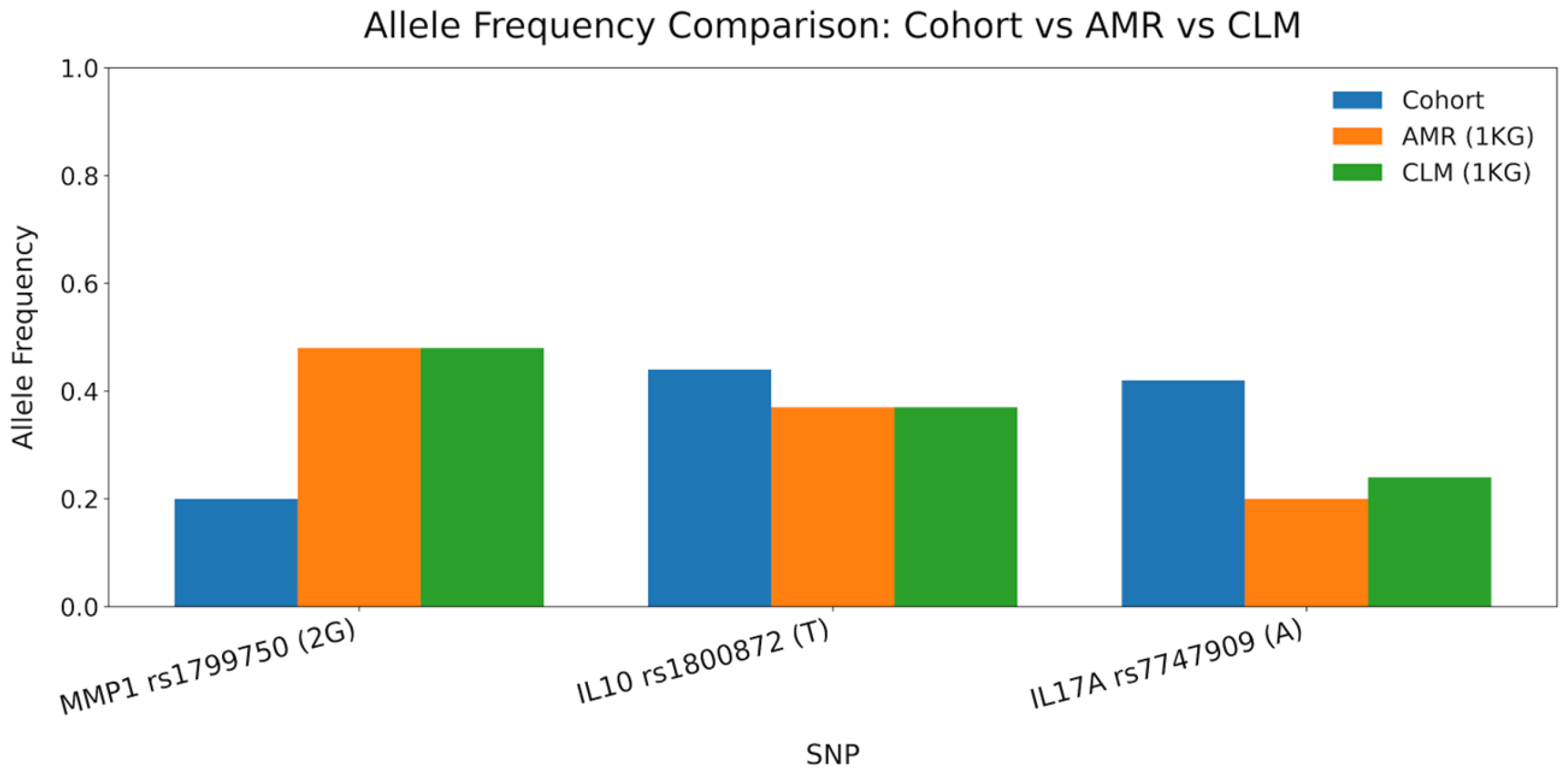
The allele frequencies observed in the cohort for MMP1 rs1799750, IL10 rs1800872, and IL17A rs7747909 were compared with the reference values from the AMR and CLM populations of the 1000 Genomes Project. As shown in Figure 1, the frequencies of all three loci fell within the biologically plausible ranges for admixed Latin American populations, supporting the validity of the retained SNPs after QC. Allele frequencies in the overall cohort do not directly reflect the magnitude of the odds ratios, which depend on the relative distribution between cases and controls; therefore, AF differences by phenotype (not overall AF) account for the stronger association observed for IL17A rs7747909.
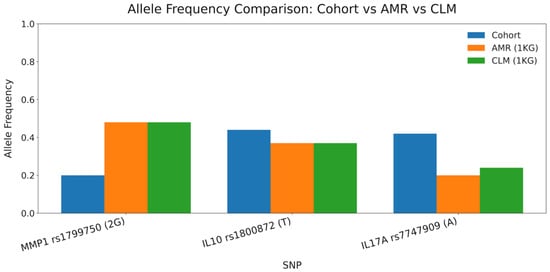
Figure 1.
Allele frequency comparison between the cohort and 1000 Genomes AMR/CLM populations. Bar plot displaying allele frequencies for MMP1 rs1799750 (2G), IL10 rs1800872 (T), and IL17A rs7747909 (A). Values from the study cohort are shown along with reference frequencies from the Admixed American (AMR) and Colombian (CLM) populations of the 1000 Genomes Project. This comparison contextualizes the plausibility of allele distribution following genotyping QC.
3.2. Genotyping and Hardy–Weinberg Equilibrium
All loci were genotyped using TaqMan® allelic discrimination assays (Applied Biosystems, Foster City, CA, USA) on a Rotor-Gene Q Real-Time PCR System according to the manufacturer’s protocols. Genotyping success was 100% across all samples, with no missing data or ambiguous results. The Hardy–Weinberg equilibrium (HWE) was assessed in the control group for each variant using the χ2 test with one degree of freedom, and all loci conformed to the HWE expectations (p > 0.05). The observed minor allele frequencies (MAF) were consistent with those reported for the Admixed American (AMR) population from the 1000 Genomes Project, including Colombians from Medellín (CLM), confirming the representativeness of the study cohort within the regional genetic background.
3.3. Association Analysis of Genetic Polymorphisms
The genotype and allele frequencies of the three SNPs analyzed are summarized in Table 3. All loci were successfully genotyped with a 100% call rate, and the genotype distributions in the control group conformed to the HWE (p > 0.05). Only the inheritance models showing the most robust and statistically significant associations after FDR correction were retained for presentation.
Table 3.
Association between candidate gene polymorphisms and susceptibility to apical periodontitis under a dominant genetic model.
Genotype and allele distribution analyses revealed strong and consistent associations between immune-related polymorphisms and AP susceptibility. All loci were successfully genotyped (100% call rate), and the genotype frequencies in the control group were in HWE (p > 0.05). Significant differences in genotype frequencies between cases and controls were identified for variants in MMP1, IL10, and IL17A, which remained statistically significant after Benjamini–Hochberg false discovery rate (FDR) correction.
Under the dominant genetic model, all three validated polymorphisms were significantly associated with AP risk. For MMP1 rs1799750, carriers of at least one 2G allele demonstrated higher odds of disease relative to individuals with the 1G/1G genotype (OR = 3.47, 95% CI 1.40–8.58; p < 0.01; FDR-adjusted p = 0.013). Similarly, for IL10 rs1800872, the presence of the T allele (CT + TT) was associated with increased susceptibility compared with the CC genotype (OR = 3.00, 95% CI 1.52–5.91; p < 0.001; FDR-adjusted p = 0.007). The strongest association was observed for IL17A rs7747909, where individuals carrying at least one A allele exhibited markedly greater odds of AP compared with GG homozygotes (OR = 8.95, 95% CI 3.61–22.15; p < 0.0001; FDR-adjusted p < 0.001). Collectively, these findings indicate that variations in inflammatory and matrix-remodeling pathways may influence susceptibility to disease, although these results remain exploratory, given the methodological constraints of the study.
4. Discussion
This study evaluated the association between three immune-related polymorphisms—IL10 rs1800872, MMP1 rs1799750, and IL17A rs7747909—and susceptibility to AP in a Colombian cohort, following rigorous quality control of genotyping. Although these variants represent biologically plausible candidates, the interpretation of these findings must be situated within the broader context of contemporary host genetic research on oral inflammatory diseases.
Over the last decade, large-scale genome-wide association studies (GWASs) have substantially reshaped our understanding of the genetic susceptibility to oral inflammation. Rather than identifying single variants with large effects, GWASs have consistently demonstrated a highly polygenic architecture, in which multiple loci exert modest effects and interact with environmental and behavioral exposures [10,11,12,13].
Genes involved in innate immune responses and extracellular matrix remodeling, such as SIGLEC5, GLT6D1, DEFA1A3, VDR, and the IL1 cytokine cluster, have been repeatedly implicated in multi-cohort analyses, underscoring the central role of immune modulation in periodontal and periapical pathology [14]. In this context, the present findings support the concept of AP as a complex immunoinflammatory condition influenced by multiple genetic and non-genetic factors, rather than single variant effects.
The association observed for the MMP1 promoter polymorphism rs1799750 (−1607 1G/2G) under a dominant model (OR = 3.47, 95% CI = 1.40–8.58; FDR = 0.013) is consistent with previous evidence linking this variant to increased transcriptional activity and enhanced collagenase-1 expression [25,26]. Elevated MMP1 expression has been reported in periapical lesions and chronic periodontitis, and similar associations have been described in other inflammatory and degenerative conditions, including rheumatoid arthritis and osteoarthritis, where excessive matrix degradation contributes to tissue destruction [27,28]. Within the context of AP, this finding supports the role of extracellular matrix remodeling in lesion persistence and bone resorption.
Similarly, the IL10 promoter variant rs1800872 (−592 C>T) was associated with an increased risk of AP (OR = 3.00, 95% CI = 1.52–5.91; FDR = 0.007). This variant has been linked to reduced promoter activity and lower IL-10 production through altered transcription factor binding [29,30]. Reduced IL10–mediated regulation may favor prolonged inflammatory responses, as suggested by studies on periodontitis and periapical lesions that reported associations between low-producer IL10 genotypes and increased tissue breakdown [31]. These observations align with the role of IL10 as a key regulator of inflammatory resolution in the oral tissues.
The strongest association in the present study was observed for IL17A rs7747909 (OR = 8.95, 95% CI = 3.61–22.15; FDR < 0.001). This intronic variant may influence IL17A regulation through post-transcriptional mechanisms or enhancer activity. Previous studies have shown that variants within the IL17A locus are associated with elevated cytokine levels and increased severity of chronic periodontitis and autoimmune diseases [32,33]. Consistently, elevated IL17A expression has been detected in periapical granulomas and cysts, promoting neutrophil recruitment and osteoclast-mediated bone resorption [34]. Although the magnitude of the observed effect should be interpreted cautiously, this association reinforces the relevance of Th17-related inflammatory pathways in AP susceptibility.
Despite these biologically plausible associations, several methodological considerations limit the causal inference. The present study did not include functional assays, such as gene expression analysis, cytokine profiling, or protein-level measurements, and therefore, cannot directly link the identified variants to altered biological activity in periapical tissues. The proposed mechanisms were inferred from the literature rather than experimentally demonstrated in this cohort, and the statistical associations do not imply causality.
From a broader perspective, the immunogenetic architecture of apical periodontitis is likely shaped not by isolated genetic variants but by the interactions among multiple genes involved in inflammatory signaling and tissue remodeling. In this context, epistatic interactions between MMP1, IL10, and IL17A are biologically plausible, as excessive extracellular matrix degradation, impaired anti-inflammatory regulation, and enhanced Th17-driven responses may act synergistically to promote chronic periapical inflammation. Although the present study was not powered to formally evaluate gene–gene interactions, this integrative framework underscores the need for future investigations using larger cohorts and systems-level approaches to disentangle epistatic effects on AP susceptibility.
Population ancestry is an important consideration. Latin American populations are characterized by complex three-way admixture involving Indigenous, European, and African ancestries, with marked regional heterogeneity [35,36]. Although the allele frequencies observed in this cohort were compatible with reference AMR populations, the absence of ancestry-informative markers or principal component adjustment precluded formal control of population stratification. Consequently, some of the observed associations may partially reflect the underlying population structure rather than disease-specific genetic effects.
Furthermore, evidence from meta-analyses indicates that associations identified in early candidate-gene studies frequently fail to replicate in larger, well-controlled cohorts due to limited sample sizes, population stratification, publication bias, and instability of effect size estimates [37]. These limitations are particularly relevant for immunogenetic traits influenced by multiple loci or environmental exposures. In line with this evidence, the present findings should be regarded as exploratory and hypothesis-generating, rather than confirmatory.
Finally, environmental and behavioral factors, including smoking, oral hygiene practices, dysbiosis, and socioeconomic conditions, are well-established modulators of the risk of oral inflammatory disease [38,39]. As these variables were not systematically collected, they could not be incorporated into the analytical models, further reinforcing the exploratory nature of these associations.
In summary, this study provides preliminary evidence suggesting that genetic variations in IL10, IL17A, and MMP1 may contribute to susceptibility to AP in the Colombian population. However, these findings must be interpreted cautiously in light of the candidate-gene design, modest sample size, lack of ancestry adjustment, and absence of replication or functional validation. Future studies employing genome-wide approaches, polygenic analyses, ancestry-informed modeling, and mechanistic investigations are necessary to clarify the contribution of host genetics to apical periodontitis.
Limitations and Future Directions
This study had several limitations that should be considered when interpreting the findings. First, the candidate gene design and modest sample size limit the statistical robustness of the analyses and increase the uncertainty of effect size estimates. The modest sample size limits the statistical power, particularly for detecting small genetic effects, and may contribute to unstable effect size estimates. Therefore, the associations reported herein should be interpreted as exploratory and hypothesis-generating rather than confirmatory.
Second, demographic, behavioral, and environmental variables, including age, sex, oral hygiene practices, smoking status, and socioeconomic factors, were not systematically or consistently available for all participants; therefore, they could not be incorporated into the adjusted genetic models. These variables are known to influence susceptibility to oral inflammatory diseases and may interact with the host genetic factors. Therefore, the reported associations should be interpreted as unadjusted and exploratory.
Third, AP was analyzed as a binary phenotype without stratification according to symptomatic status. Although symptomatic and asymptomatic forms of apical periodontitis may differ in terms of inflammatory burden, immune activation, and lesion dynamics, the available dataset did not provide sufficient statistical power to evaluate symptom-specific genetic associations. Consequently, it is possible that distinct genetic determinants contribute to disease susceptibility, lesion persistence, and symptom expression.
Additionally, controls were defined cross-sectionally and lacked information on lifetime periapical history, which may have introduced nondifferential misclassification and biased effect estimates toward the null hypothesis. No independent replication cohort was available, and no functional assays, such as gene expression analysis, cytokine quantification, promoter activity assessment, or protein-level studies, were performed. Therefore, the associations identified in this study cannot establish a biological causality. In addition, genetic associations were evaluated exclusively under a dominant inheritance model; alternative genetic models could not be robustly assessed because of limited genotype counts.
An additional important limitation of the present study is the absence of microbiological characterization. AP is fundamentally a host–microbiota disease in which the composition, functional potential, and ecological organization of the root canal and periapical microbiome play critical roles in disease initiation, persistence, and treatment response [40]. In this context, host genetic susceptibility is likely to modulate immune responses to specific microbial communities, rather than acting independently. Because microbial sampling and sequencing were not included in the original study design, it was not possible to evaluate host–microbiome interactions or determine whether the observed genetic associations were contingent on specific microbial profiles. Recent evidence emphasizes that AP is associated with distinct microbial signatures in primary and post-treatment lesions, as well as functional shifts in microbial communities that influence the inflammatory burden and tissue destruction. Consequently, the absence of microbiome data limits the biological resolution of the present findings and precludes an integrative interpretation at the host–microbial interface.
Future studies should adopt integrative, multi-layered approaches combining host genetic data with high-resolution microbial profiling, such as 16S rRNA gene sequencing, shotgun metagenomics, or metatranscriptomics, to elucidate how host immunogenetic variation shapes microbial community structure and function in AP. Such approaches, as recently proposed in conceptual and systematic frameworks for AP research, are essential to move beyond single-layer association studies toward a systems-level understanding of disease pathogenesis.
Taken together, these limitations indicate that the present findings should be considered strictly exploratory and hypothesis-generating. Future studies incorporating larger ancestry-characterized cohorts, comprehensive phenotypic and environmental data, longitudinal clinical characterization, and functional validation are required to clarify the immunogenetic mechanisms underlying susceptibility to AP.
Author Contributions
Conceptualization, C.A.N.-G.; methodology, C.A.N.-G., I.G.-Q., N.A.T.-C., A.F.A.-J., C.G., S.C.G.-C., B.G.-O., N.E.V.-M. and C.M.B.-D.; validation, C.A.N.-G., S.C.G.-C. and B.G.-O.; formal analysis, C.A.N.-G., S.C.G.-C., B.G.-O. and N.E.V.-M.; investigation, C.A.N.-G., I.G.-Q., N.A.T.-C., A.F.A.-J., C.G., S.C.G.-C. and B.G.-O.; data curation, C.A.N.-G., S.C.G.-C., B.G.-O. and N.E.V.-M.; writing—original draft preparation, C.A.N.-G.; writing—review and editing, C.A.N.-G., S.C.G.-C. and I.A.L.-C.; supervision, C.A.N.-G.; project administration, B.G.-O., N.E.V.-M. and S.C.G.-C.; funding acquisition, B.G.-O., N.E.V.-M. and S.C.G.-C. All authors have read and agreed to the published version of the manuscript.
Funding
This research was funded by the Unidad Central del Valle del Cauca, Tuluá (project code PI-1300-50.2-2022-10) and by the Institución Universitaria Visión de las Américas, Pereira, Colombia (project code P196-2022).
Institutional Review Board Statement
The study was conducted in accordance with the Declaration of Helsinki and approved by the Institutional Ethics Committee of the institución de Educación Superior-Unidad Central del Valle del Cauca (UCEVA) (approval code: 10122021, approved on 10 December 2021).
Informed Consent Statement
Informed consent was obtained from all participants involved in the study.
Data Availability Statement
The data presented in this study are contained within this article. Further inquiries can be directed to the corresponding author.
Acknowledgments
The authors thank all the patients included in this study for their participation.
Conflicts of Interest
The authors declare no conflicts of interest.
Abbreviations
| AP | Apical periodontitis |
| AMR | Admixed American |
| CI | Confidence interval |
| CLM | Colombians from Medellín |
| FDR | False discovery rate |
| GWAS | Genome-wide association study |
| HWE | Hardy–Weinberg equilibrium |
| IL | Interleukin |
| MAF | Minor allele frequency |
| MMP | Matrix metalloproteinase |
| OR | Odds ratio |
| PCA | Principal component analysis |
| qPCR | Quantitative polymerase chain reaction |
| SNP | Single-nucleotide polymorphism |
References
- Siqueira, J.F.; Rôças, I.N. Microbiology and Treatment of Acute Apical Abscesses. Clin. Microbiol. Rev. 2013, 26, 255. [Google Scholar] [CrossRef]
- Queiroz, G.E.R.; Castilho, T.; Guimarães, L.S.; Moraes, V.G.; da Silva, E.A.B.; Küchler, E.C.; Silva-Sousa, A.C.; Sousa-Neto, M.D.; Antunes, L.A.A.; Antunes, L.S. Influence of genetic polymorphisms on oral health-related quality of life after root canal treatment. Braz. Dent. J. 2024, 35, e24-5678. [Google Scholar] [CrossRef] [PubMed]
- Olano-Dextre, T.L.; Mateo-Castillo, J.F.; Nishiyama, C.K.; Santos, C.F.; Garlet, G.P.; Silva, R.M.; Letra, A.; das Neves, L.T. Genetic Analysis of MMP-2 and MMP-3 Polymorphisms Reveals the Association of MMP-3 rs522616 with Susceptibility to Persistent Apical Periodontitis. Genes 2025, 16, 758. [Google Scholar] [CrossRef] [PubMed]
- Nair, P.N.R. Pathogenesis of apical periodontitis and the causes of endodontic failures. Crit. Rev. Oral Biol. Med. 2004, 15, 348–381. [Google Scholar] [CrossRef] [PubMed]
- Arias, Z.; Nizami, M.Z.I.; Chen, X.; Chai, X.; Xu, B.; Kuang, C.; Omori, K.; Takashiba, S. Recent Advances in Apical Periodontitis Treatment: A Narrative Review. Bioengineering 2023, 10, 488. [Google Scholar] [CrossRef]
- Küchler, E.C.; Mazzi-Chaves, J.F.; Antunes, L.S.; Kirschneck, C.; Baratto-Filho, F.; Sousa-Neto, M.D. Current trends of genetics in apical periodontitis research. Braz. Oral Res. 2018, 32, 126–132. [Google Scholar] [CrossRef]
- Kikuchi, T.; Hayashi, J.I.; Mitani, A. Next-Generation Examination, Diagnosis, and Personalized Medicine in Periodontal Disease. J. Pers. Med. 2022, 12, 1743. [Google Scholar] [CrossRef]
- Munz, M.; Richter, G.M.; Loos, B.G.; Jepsen, S.; Divaris, K.; Offenbacher, S.; Teumer, A.; Holtfreter, B.; Kocher, T.; Bruckmann, C.; et al. Meta-analysis of genome-wide association studies of aggressive and chronic periodontitis identifies two novel risk loci. Eur. J. Hum. Genet. 2019, 27, 102–113. [Google Scholar] [CrossRef]
- Yang, T.; Cheng, B.; Noble, J.M.; Reitz, C.; Papapanou, P.N. Replication of Gene Polymorphisms Associated with Periodontitis-Related Traits in an Elderly Cohort: The WHICAP Ancillary Study of Oral Health. J. Clin. Periodontol. 2022, 49, 414. [Google Scholar] [CrossRef]
- Shungin, D.; Haworth, S.; Divaris, K.; Agler, C.S.; Kamatani, Y.; Lee, M.K.; Grinde, K.; Hindy, G.; Alaraudanjoki, V.; Pesonen, P.; et al. Genome-wide analysis of dental caries and periodontitis combining clinical and self-reported data. Nat. Commun. 2019, 10, 2773. [Google Scholar] [CrossRef]
- Modafferi, C.; Grippaudo, C.; Corvaglia, A.; Cristi, V.; Amato, M.; Rigotti, P.; Polizzi, A.; Isola, G. Genetic Testing in Periodontitis: A Narrative Review on Current Applications, Limitations, and Future Perspectives. Genes 2025, 16, 1308. [Google Scholar] [CrossRef]
- Richter, G.M.; Schaefer, A.S. Genetic Susceptibility to Periodontitis. J. Periodontal Res. 2025, 0, 1–15. [Google Scholar] [CrossRef] [PubMed]
- Sakaue, S.; Kanai, M.; Tanigawa, Y.; Karjalainen, J.; Kurki, M.; Koshiba, S.; Narita, A.; Konuma, T.; Yamamoto, K.; Akiyama, M.; et al. A cross-population atlas of genetic associations for 220 human phenotypes. Nat. Genet. 2021, 53, 1415–1424. [Google Scholar] [CrossRef] [PubMed]
- Santos, R.; Santos, B.; Júnior, L.D.; Almeida, H.; Silveira, M.; Sobral, A. Influence of interleukin genetic polymorphism on apical periodontitis in human patients: A comprehensive review. Genet. Mol. Res. 2023, 22, 10-4238. [Google Scholar] [CrossRef]
- Zhong, Q.; Ding, C.; Wang, M.; Sun, Y.; Xu, Y. Interleukin-10 gene polymorphisms and chronic/aggressive periodontitis susceptibility: A meta-analysis based on 14 case-control studies. Cytokine 2012, 60, 47–54. [Google Scholar] [CrossRef]
- Li, H.; Liang, X.; Qin, X.; Cai, S.; Yu, S. Association of matrix metalloproteinase family gene polymorphisms with lung cancer risk: Logistic regression and generalized odds of published data. Sci. Rep. 2015, 5, 10056. [Google Scholar] [CrossRef]
- Nascimento dos Santos, R.T.; Oliveira de Lima, L.P.; Muniz, M.T.C.; Álvares, P.R.; Fonseca da Silveira, M.M.; Sobral, A.P.V. Genetic polymorphism of interleukins 6 and 17 correlated with apical periodontitis: A Cross-sectional study. Braz. Dent. J. 2023, 34, 22–28. [Google Scholar] [CrossRef]
- Rodríguez-Montaño, R.; Alarcón-Sánchez, M.A.; Lomelí-Martínez, S.M.; Martínez-Bugarin, C.H.; Heboyan, A. Genetic Variants of the IL-23/IL-17 Axis and Its Association With Periodontal Disease: A Systematic Review. Immun. Inflamm. Dis. 2025, 13, e70147. [Google Scholar] [CrossRef]
- Malvandi, M.; Jazi, M.S.; Fakhari, E. Association of interleukin-17A gene promoter polymorphism with the susceptibility to generalized chronic periodontitis in an Iranian population. Dent. Res. J. 2022, 19, 85. [Google Scholar] [CrossRef]
- Tazawa, K.; Azuma Presse, M.M.; Furusho, H.; Stashenko, P.; Sasaki, H. Revisiting the role of IL-1 signaling in the development of apical periodontitis. Front. Dent. Med. 2022, 3, 985558. [Google Scholar] [CrossRef]
- Zhang, Q.; Chen, B.; Yan, F.; Guo, J.; Zhu, X.; Ma, S.; Yang, W. Interleukin-10 inhibits bone resorption: A potential therapeutic strategy in periodontitis and other bone loss diseases. Biomed. Res. Int. 2014, 2014, 284836. [Google Scholar] [CrossRef]
- Norris, E.T.; Wang, L.; Conley, A.B.; Rishishwar, L.; Mariño-Ramírez, L.; Valderrama-Aguirre, A.; Jordan, I.K. Genetic ancestry, admixture and health determinants in Latin America. BMC Genom. 2018, 19, 75–87. [Google Scholar] [CrossRef] [PubMed]
- Chacón-Duque, J.-C.; Adhikari, K.; Fuentes-Guajardo, M.; Mendoza-Revilla, J.; Acuña-Alonzo, V.; Barquera, R.; Quinto-Sánchez, M.; Gómez-Valdés, J.; Martínez, P.E.; Villamil-Ramírez, H.; et al. Latin Americans show wide-spread Converso ancestry and imprint of local Native ancestry on physical appearance. Nat. Commun. 2018, 9, 5388. [Google Scholar] [CrossRef] [PubMed]
- Wan, C.-Y.; Yin, Y.; Li, X.; Liu, M.M.; Goldman, G.; Wu, L.-A.; Wang, F.; Luo, D.-S.; Chen, Z.; Xu, W.-A.; et al. MMP-9 deficiency accelerates the progress of periodontitis. Genes. Dis. 2024, 11, 101231. [Google Scholar] [CrossRef] [PubMed]
- Hazzaa, H.H.; Abo Hager, E.A. Expression of Mmp-1 and Mmp-9 in Localized Aggressive Periodontitis Patients Before and after Treatment: A Clinical and Immunohistochemical Study. Egypt. Dent. J. 2017, 63, 667–684. [Google Scholar] [CrossRef]
- Ahmed, M.A.; Anwar, M.F.; Ahmed, K.; Aftab, M.; Nazim, F.; Bari, M.F.; Mustafa, M.; Vohra, F.; Alrahlah, A.; Mughal, N.; et al. Baseline MMP expression in periapical granuloma and its relationship with periapical wound healing after surgical endodontic treatment. BMC Oral Health 2021, 21, 562. [Google Scholar] [CrossRef]
- Altaie, A.M.; Venkatachalam, T.; Patil, K.; Al-Marzooq, F.; Rawat, S.S.; Al Qabbani, A.; Alsaegh, M.A.; Samaranayake, L.P.; Soliman, S.S.; Hamoudi, R. Integrated metagenomics and transcriptomics analysis reveals pathways associated with oral periapical lesions formation and progression. Curr. Res. Microb. Sci. 2025, 9, 100443. [Google Scholar] [CrossRef]
- Larsson, L.; Johansso, P.; Jansson, A.; Donati, M.; Rymo, L.; Berglundh, T. The Sp1 transcription factor binds to the G-allele of the -1087 IL-10 gene polymorphism and enhances transcriptional activation. Genes. Immun. 2009, 10, 280–284. [Google Scholar] [CrossRef]
- Steinke, J.W.; Barekzi, E.; Hagman, J.; Borish, L. Functional analysis of -571 IL-10 promoter polymorphism reveals a repressor element controlled by sp1. J. Immunol. 2004, 173, 3215–3222. [Google Scholar] [CrossRef]
- Scarel-Caminaga, R.M.; Trevilatto, P.C.; Souza, A.P.; Brito, R.B.; Camargo, L.E.A.; Line, S.R.P. Interleukin 10 gene promoter polymorphisms are associated with chronic periodontitis. J. Clin. Periodontol. 2004, 31, 443–448. [Google Scholar] [CrossRef]
- Sasikumar, P.K.; Varghese, S.S.; Kumaran, T.; Devi, S.S. Meta-Analysis of Risk Association between Interleukin-17A Gene Polymorphism and Chronic Periodontitis. Contemp. Clin. Dent. 2020, 11, 3–9. [Google Scholar] [CrossRef]
- Popp, N.A.; Yu, D.; Green, B.; Chew, E.Y.; Ning, B.; Chan, C.; Tuo, J. Functional single nucleotide polymorphism in IL-17A 3’ untranslated region is targeted by miR-4480 in vitro and may be associated with age-related macular degeneration. Environ. Mol. Mutagen. 2016, 57, 58–64. [Google Scholar] [CrossRef]
- Ferreira, L.G.V.; Rosin, F.C.P.; Corrêa, L. Analysis of Interleukin 17A in periapical abscess and granuloma lesions. Braz. Oral Res. 2016, 30, e34. [Google Scholar] [CrossRef]
- Gouveia, M.H.; Borda, V.; Leal, T.P.; Moreira, R.G.; Bergen, A.W.; Kehdy, F.S.G.; Alvim, I.; Aquino, M.M.; Araujo, G.S.; Araujo, N.M.; et al. Origins, Admixture Dynamics, and Homogenization of the African Gene Pool in the Americas. Mol. Biol. Evol. 2020, 37, 1647–1656. [Google Scholar] [CrossRef]
- Borda, V.; Loesch, D.P.; Guo, B.; Laboulaye, R.; Veliz-Otani, D.; French, J.N.; Leal, T.P.; Gogarten, S.M.; Ikpe, S.; Gouveia, M.H.; et al. Genetics of Latin American Diversity Project: Insights into population genetics and association studies in admixed groups in the Americas. Cell Genom. 2024, 4, 100692. [Google Scholar] [CrossRef] [PubMed]
- Tam, V.; Patel, N.; Turcotte, M.; Bossé, Y.; Paré, G.; Meyre, D. Benefits and limitations of genome-wide association studies. Nat. Rev. Genet. 2019, 20, 467–484. [Google Scholar] [CrossRef] [PubMed]
- Hegde, R.; Awan, K.H. Effects of periodontal disease on systemic health. Dis.-A-Mon. 2019, 65, 185–192. [Google Scholar] [CrossRef] [PubMed]
- Kinane, D.F.; Stathopoulou, P.G.; Papapanou, P.N. Periodontal diseases. Nat. Rev. Dis. Primers 2017, 3, 17038. [Google Scholar] [CrossRef]
- Georgiou, A.C.; Brandt, B.W.; van der Waal, S.V. Next steps in studying host-microbiome interactions in apical periodontitis. Front. Oral Health 2023, 4, 1309170. [Google Scholar] [CrossRef]
- Siqueira, J.F.; Silva, W.O.; Romeiro, K.; Gominho, L.F.; Alves, F.R.F.; Rôças, I.N. Apical root canal microbiome associated with primary and posttreatment apical periodontitis: A systematic review. Int. Endod. J. 2024, 57, 1043–1058. [Google Scholar] [CrossRef]
Disclaimer/Publisher’s Note: The statements, opinions and data contained in all publications are solely those of the individual author(s) and contributor(s) and not of MDPI and/or the editor(s). MDPI and/or the editor(s) disclaim responsibility for any injury to people or property resulting from any ideas, methods, instructions or products referred to in the content. |
© 2026 by the authors. Licensee MDPI, Basel, Switzerland. This article is an open access article distributed under the terms and conditions of the Creative Commons Attribution (CC BY) license.