Abstract
Type 2 diabetes mellitus (T2D) is a chronic metabolic disorder in which inflammation plays a central role in its onset, progression, and complications. Identifying reliable biomarkers is essential to improve risk prediction, disease monitoring, and early intervention. A total of 169 Ecuadorian participants were stratified into four clinical groups: non-diabetic controls (NDC), controlled T2D (C-T2D), uncontrolled T2D (NC-T2D), and diabetic kidney disease (DKD). Circulating levels of cytokines (IL-6, IL-8, TNF-α), adipokines (leptin, adiponectin), and PBMC-derived microRNAs (miR-146a, miR-155) were quantified. Associations with disease stage were evaluated using ROC curve analysis and logistic regression. Leptin showed the strongest association with T2D (OR = 13.76, 95% CI: 6.47–29.26), followed by IL-8 (OR = 6.73, 95% CI: 3.30–13.70) and IL-6 (OR = 4.43, 95% CI: 2.26–8.97). Adiponectin distinguished NC-T2D from DKD (OR = 4.15, 95% CI: 1.77–9.71), underscoring its potential as an indicator of renal complications. Interestingly, TNF-α levels declined across disease stages, possibly reflecting subclinical inflammation in Ecuadorian NDC with high rates of obesity and dyslipidemia. PBMC-derived miR-146a was upregulated in T2D patients, contrasting with prior serum-based studies and emphasizing the importance of compartment-specific analysis. miR-155 was elevated in C-T2D, suggesting a compensatory immune-regulatory mechanism that diminishes with poor glycemic control and advanced disease. Inflammatory cytokines, adipokines, and microRNAs act in distinct yet complementary ways in T2D. Leptin, IL-6, and IL-8 emerge as strong predictors of disease, while miR-146a and miR-155 provide additional insight into immune-inflammatory regulation. Integrated biomarker panels may enhance patient stratification and support personalized monitoring of T2D progression.
1. Introduction
Type 2 diabetes (T2D) affects more than 530 million individuals worldwide, with a global prevalence of approximately 10.5% [1]. Four out of every five people with diabetes live in low- and middle-income countries [2]. In Ecuador, T2D ranked as the second leading cause of mortality in 2021, affecting 4.7% of adults aged 20–79 years [3]. Individuals with T2D are at high risk of developing complications such as retinopathy, neuropathy, nephropathy, and cardiovascular disease, which substantially reduce quality of life and increase long-term healthcare demands [4]. Among these, diabetic kidney disease (DKD)—which affects about 40% of individuals with diabetes—is the most common cause of end-stage renal disease (ESRD) and a major determinant of mortality [5,6]. Although kidney biopsy remains the diagnostic gold standard, its invasive nature underscores the need for reliable, non-invasive biomarkers to monitor DKD progression [7,8].
Inflammation plays a central role in the pathogenesis of T2D and its complications [6,9]. Persistent hyperglycemia and the accumulation of advanced glycation end products (AGEs) promote cellular stress and the release of damage-associated molecular patterns (DAMPs). These molecules activate pattern-recognition receptors such as Toll-like receptors (TLRs), thereby triggering innate immune responses [10]. Activation of the TLR–NF-κB pathway enhances the production of pro-inflammatory cytokines, including interleukin (IL)-6, IL-1β, IL-18, and tumor necrosis factor-α (TNF-α), and stimulates transforming growth factor-β1 (TGF-β1), a key mediator of renal fibrosis [11,12,13]. Elevated serum IL-8 concentrations have been associated with disease severity and may serve as prognostic indicators in kidney disease [14,15].
Several microRNAs (miRNAs) have been identified as critical modulators of inflammation in metabolic disorders. In particular, miR-146a negatively regulates the production of cytokines such as TNF-α, IL-6, and IL-1β, thereby maintaining immune balance [16,17]. Conversely, miR-155 acts as a pro-inflammatory effector by inhibiting suppressor of cytokine signaling 1 (SOCS1), a pivotal negative regulator of the JAK/STAT and NF-κB pathways [18,19]. Dysregulation of these miRNAs has been reported in both tissues and systemic circulation of diabetic individuals, suggesting their potential as biomarkers of disease progression and targets for therapeutic modulation.
In parallel, alterations in adipokine profiles are commonly observed in diabetic nephropathy and may exacerbate inflammation, appetite dysregulation, and atherosclerosis [20]. Hyperleptinemia frequently appears early in T2D and worsens with disease duration [21]. Conversely, adiponectin—an anti-inflammatory adipokine that enhances insulin sensitivity—is often reduced in chronic kidney disease (CKD) [22]. Thus, the leptin-to-adiponectin ratio has been proposed as a surrogate indicator of adipose tissue dysfunction and renal inflammation [20].
Given these observations, the present study aimed to evaluate inflammatory cytokines (TNF-α, IL-6, IL-8), adipokines (adiponectin, leptin), and microRNAs (miR-155, miR-146a) as candidate biomarkers for disease stage and progression in T2D.
2. Materials and Methods
2.1. Patients
A cross-sectional observational study was conducted, involving 598 fasting patients aged 40 years or older who were diagnosed with type 2 diabetes mellitus (T2DM). The diagnosis of T2DM was performed according to the criteria established by the Committee of Experts for the identification and categorization of the disease, at a type C public health center (Chimbacalle) located in Quito, Ecuador [23]. From this group, 169 patients were selected based on the inclusion criteria and divided into four categories: (1) controlled diabetic patients (T2DM-C), defined as those with an HbA1c value ≤ 6%; (2) uncontrolled diabetic patients (T2DM-NC), with HbA1c values > 7% but <8% and without kidney disease (defined as a glomerular filtration rate [GFR] > 60 mL/min/1.73 m2); (3) diabetic patients with kidney disease (DKD), characterized by an HbA1c value > 7% and a GFR < 60 mL/min/1.73 m2; and (4) non-diabetic controls (NDC), consisting of non-diabetic patients without kidney disease and with fasting glucose < 100 mg/dL for biomarker evaluation. In addition, patients with high blood pressure were included as a non-excluding condition in this study.
2.2. Biochemical Parameters and Cytokines
All participants fasted before blood sample collection. Peripheral venous blood (10 mL) was collected into tubes without anticoagulant and transported to the laboratory under cold chain conditions (4 °C). Samples were processed within two hours post-collection. Serum was aliquoted and stored at −20 °C until analysis. Biochemical parameters—including glucose, HbA1c, lipid profile (total cholesterol, triglycerides, HDL, LDL), SGOT, SGPT, urea, and creatinine—were quantified using validated protocols of the Biomedical Research Institute, Central University of Ecuador. IL-6, IL-8, TNF-α, leptin, and adiponectin were determined by ELISA, using the commercial R&D system (Minneapolis, MN, USA), following the manufacturer’s instructions.
2.3. MicroRNA RT qPCR Assays
Peripheral venous blood (4 mL) was collected in heparin tubes from fasting patients. Peripheral blood mononuclear cells (PBMCs) were isolated from low-density gradient centrifugation using Ficoll [24]. Total RNA was isolated from PBMCs using the Mirvana kit Ambion (a Thermo Fisher Scientific brand) (Waltham, MA, USA). The endogenous gene RNU-44 (cat no. 4427975, assay ID 1094) was used to normalize the cycle threshold (CT) values of RNA. Primers hsa-miR-146a (cat no. 4427975, assay ID 000468) and hsa-miR-155 (cat no. 4427975, assay ID 002623) for stem-looped reverse transcription were used to obtain cDNA for mature microRNAs. RNA was transcribed using the TaqMan microRNA reverse transcription kit (Applied Biosystems, Thermo Fisher Scientific Inc.) (Waltham, MA, USA). qPCR was performed using predesigned TaqMan microRNA assays and the TaqMan Universal Master Mix, No AmpEraseUNG. The qPCR was performed under the following conditions: 2 min at 50 °C, 10 min at 95 °C, followed by 40 cycles of 15 s at 95 °C, and finally 1 min at 60 °C in the Quant Studio 5 Real-Time PCR System (Applied Biosystems), (Waltham, MA, USA). Outliers were identified and removed using the interquartile range (IQR) method. For normalization, the cycle threshold (Ct) value of the endogenous control gene (RNU44) was subtracted from the Ct value of the target microRNA in each sample, generating ΔCt (dCt) values. The mean ΔCt of the control group was then used as the reference to compute ΔΔCt (ddCt) values, from which relative expression (fold change) was derived using the 2^−ΔΔCt method.
2.4. Statistical Analysis
The Kolmogorov–Smirnov test was used to determine the normality of the variables. The demographic, clinical, and molecular variables of the four groups were compared using ANOVA and Kruskal–Wallis with the Bonferroni post hoc test. We conducted ROC curves to identify the cut-off points that enable the identification of microRNAs and interleukins as potential biomarkers; logistic regression analysis was used to determine the predictive factors in the studied groups. Bivariate models were used for binary variables in the logistic regression analysis, whereas multivariate models were used for variables with more than two categories, controlling for age, sex, BMI, smoking status, and exercise. Statistical significance was defined as values of p < 0.005. IBM’s SPSS v25 software was used for statistical analysis. GraphPad Prism software (version 5.02) was used to create figures.
2.5. Ethical Declaration
All patients who were recruited at the type C Public Health Center in Quito, Ecuador (Chimbacalle) signed an informed consent form that was previously authorized by the Human Research Ethics Committee of Central University of Ecuador under approval number 0007-FCM-DD-2018.
3. Results
A total of 598 individuals were initially screened for participation. After applying inclusion and exclusion criteria, 169 participants were included for analysis of circulating cytokines, adipokines, and microRNAs. Participants were stratified into four clinical groups according to disease status: non-diabetic controls (NDC), patients with controlled type 2 diabetes (C-T2D), patients with uncontrolled type 2 diabetes (NC-T2D), and individuals with diabetic kidney disease (DKD) characterized by glomerular injury.
Demographic analysis showed no significant differences in sex distribution among the groups. However, participants with DKD were significantly older than all other groups (p < 0.001). Clinical and biochemical parameters followed expected patterns of disease progression. Fasting glucose and glycated hemoglobin (HbA1c) levels were markedly higher in NC-T2D and DKD groups compared with NDC and C-T2D (p < 0.001), reflecting poor glycemic control. Interestingly, body mass index (BMI) was highest in C-T2D and declined in NC-T2D and DKD groups (p < 0.05), possibly indicating metabolic deterioration or disease-related catabolism. Diastolic blood pressure was significantly elevated in DKD compared to NDC (p = 0.036). Indicators of renal function, including serum creatinine, urea, and estimated glomerular filtration rate (MDRD equation), were significantly altered in the DKD group (p < 0.001), confirming the presence of kidney impairment (Table 1).
Table 1.
Clinical characteristics of study groups: Non-diabetic Controls (NDC), Controlled-diabetics (C-T2D), non-controlled diabetics (NC-T2D), and Diabetics with glomerular alteration (DKD) groups.
3.1. Inflammatory Cytokines and Adipokines
Circulating cytokine and adipokine levels varied according to disease severity. IL-6, IL-8, leptin, and adiponectin concentrations increased progressively from NDC to C-T2D, NC-T2D, and DKD (IL-6, p ≤ 0.001; IL-8, p < 0.001; leptin, p < 0.001; adiponectin, p ≤ 0.006). In contrast, TNF-α concentrations declined significantly as disease severity advanced (C-T2D, p = 0.011; NC-T2D, p = 0.011; DKD, p = 0.002), suggesting a complex inflammatory modulation across the diabetic spectrum (Table 2).
Table 2.
Inflammatory biomarkers of Non-diabetic Controls (NDC), controlled diabetics (C-T2D), non-controlled diabetics (NC-T2D), and diabetics with glomerular alteration (DKD).
3.2. MicroRNA Expression Profiles
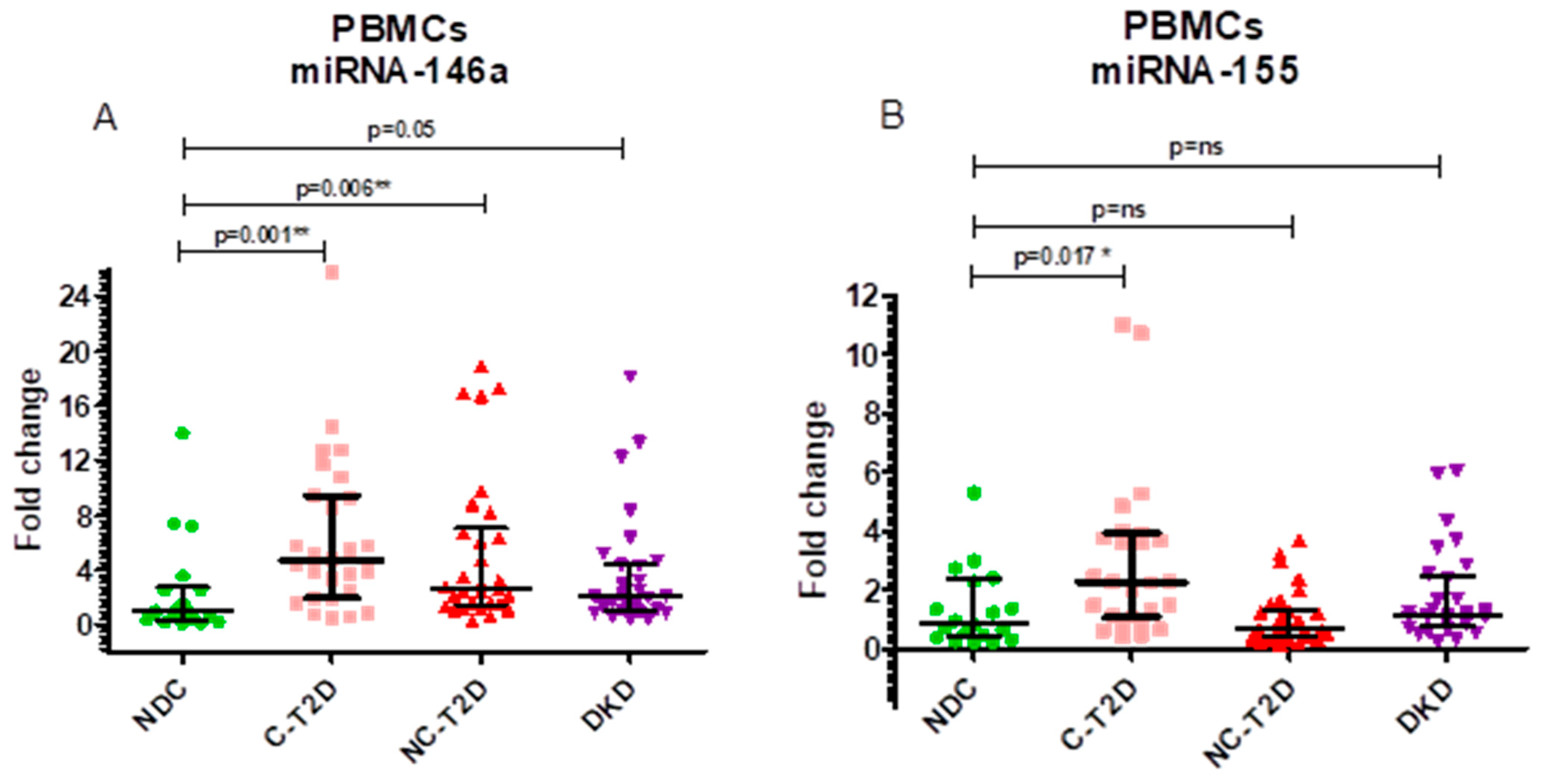
The relative expression of miR-146a (fold change, 2^−ΔΔCt) differed significantly between groups (Kruskal–Wallis, p = 0.0033). Median ± IQR values were 1.04 ± 2.45 in NDC, 4.75 ± 7.51 in C-T2D, 2.68 ± 5.65 in NC-T2D, and 2.07 ± 3.43 in DKD. Post hoc comparisons revealed significant upregulation in C-T2D (p = 0.0016) and NC-T2D (p = 0.0068) versus NDC, while DKD exhibited a borderline increase (p = 0.0502). These findings indicate enhanced miR-146a expression during the early and intermediate stages of T2D, with attenuation in advanced renal disease (Figure 1A).
Figure 1.
Fold-change values with interquartile ranges (IQR). (A). miR-146a, normalized to the endogenous reference gene RNU-44, in PBMCs. (B). miR-155, normalized to the endogenous reference gene RNU-44, in PBMCs. Group comparisons were performed using the Mann–Whitney U test against the NDC group. Study groups include non-diabetic controls (NDC), controlled T2D (C-T2D), uncontrolled T2D (NC-T2D), and T2D with diabetic kidney disease (DKD). Statistical significance: p < 0.05 (*), p < 0.01 (**); ns = not significant.
Similarly, miR-155 expression varied across groups (Kruskal–Wallis, p = 0.007). Median ± IQR values were 0.89 ± 1.99 (NDC), 2.28 ± 2.87 (C-T2D), 0.65 ± 0.94 (NC-T2D), and 1.15 ± 1.66 (DKD). Pairwise analyses showed significant upregulation in C-T2D compared to NDC (p = 0.0174), while no significant differences were found between NDC and NC-T2D or DKD (p > 0.25) (Figure 1B).
3.3. Diagnostic Performance of Biomarkers
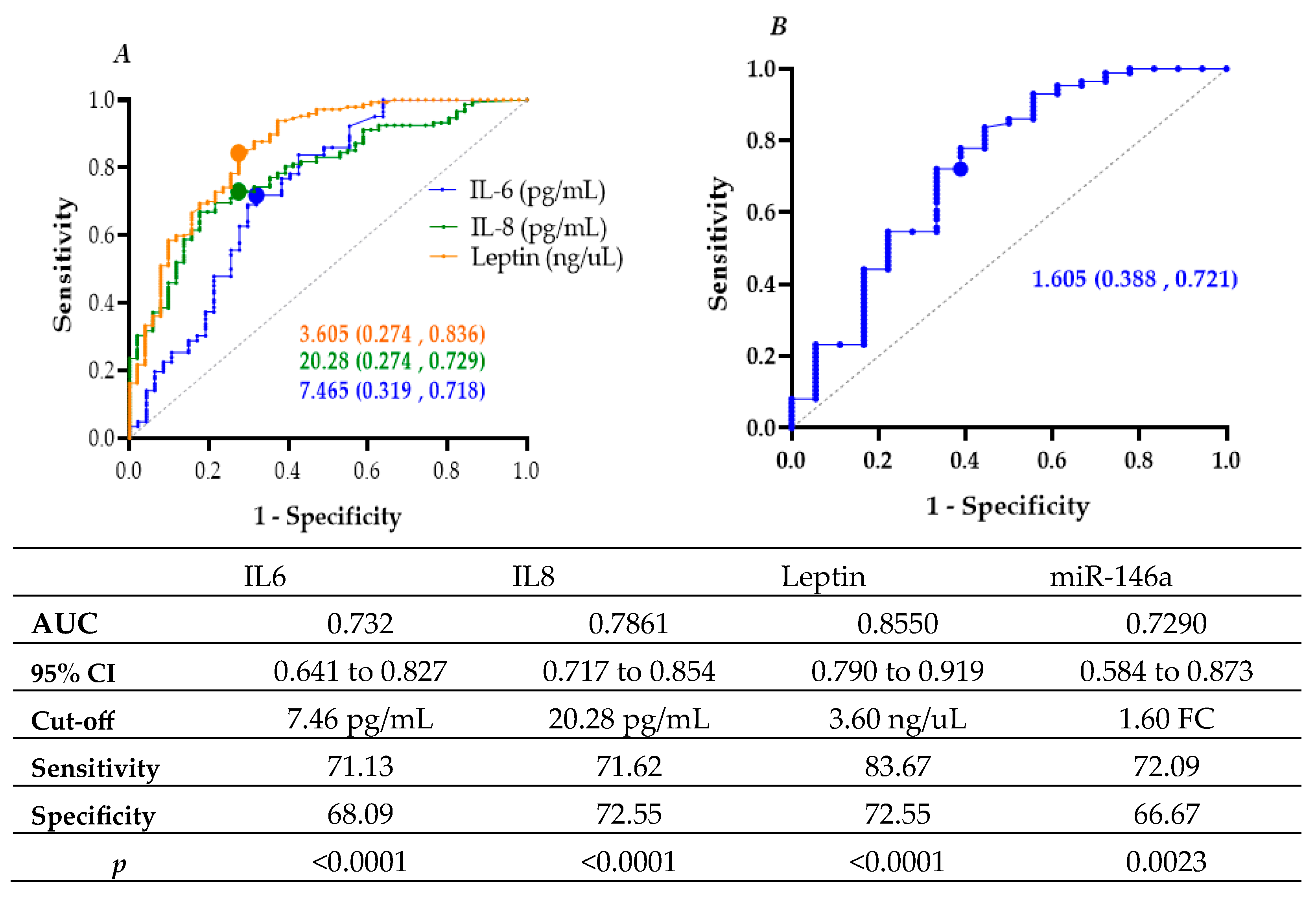
Receiver operating characteristic (ROC) curve analysis assessed the discriminatory capacity of circulating biomarkers for distinguishing T2D from non-diabetic controls. Leptin demonstrated the strongest performance (AUC = 0.8550; 95% CI: 0.7907–0.9193; p < 0.0001) at a cut-off of 3.605 ng/µL, yielding 83.7% sensitivity and 72.6% specificity. IL-8 (AUC = 0.7861; 95% CI: 0.7179–0.8543; p < 0.0001) and IL-6 (AUC = 0.732; 95% CI: 0.6411–0.8271; p < 0.0001) also exhibited good discriminatory capacity. Among microRNAs, miR-146a achieved an AUC of 0.7290 (95% CI: 0.5846–0.8734; p = 0.0023) with a 1.6-fold-change threshold, providing 72.1% sensitivity and 66.7% specificity (Figure 2).
Figure 2.
ROC curves with AUC and optimal cut-off points for (A) IL-6, IL-8, and leptin, and (B) miR-146a (fold change) associated with type 2 diabetes (T2D).
Binary logistic regression further supported these associations. Elevated IL-8 (≥20.28 pg/mL) increased the odds of T2D 6.7-fold (OR = 6.733; 95% CI: 3.307–13.709; p < 0.001), while IL-6 (≥7.465 pg/mL) and leptin (≥3.605 ng/mL) were also significant predictors (OR = 4.436 and 13.765, respectively; p < 0.001). Similarly, miR-146a (≥1.605-fold change) conferred a 4.9-fold increase in T2D odds (OR = 4.857; 95% CI: 1.714–13.767; p = 0.003) (Table 3).
Table 3.
Binary logistic regression analysis of biomarkers and microRNAs for the prediction of type 2 diabetes (T2D), expressed as odds ratios (ORs) with 95% confidence intervals (CIs).
3.4. Biomarkers Associated with Diabetic Kidney Disease
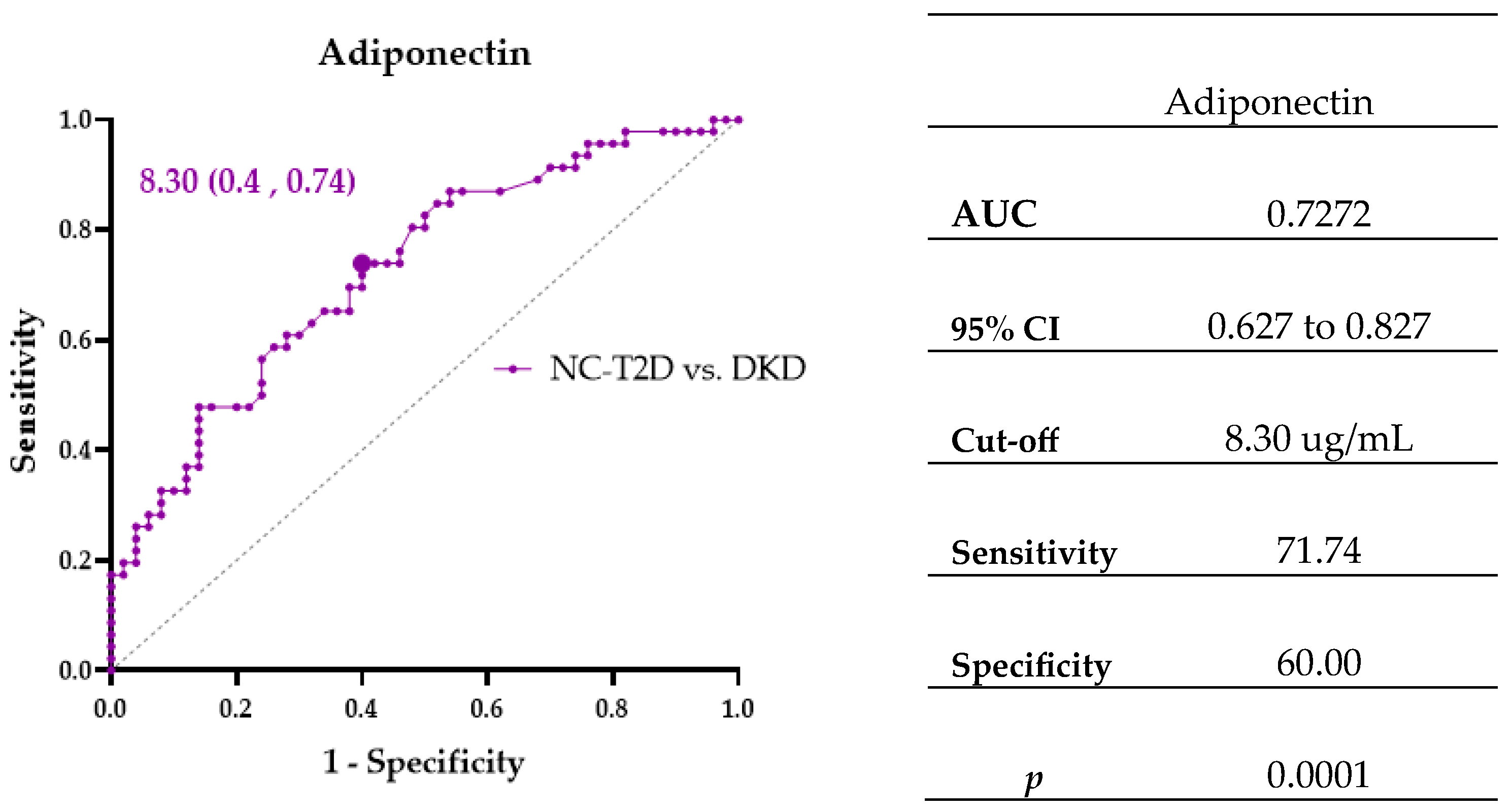
To identify biomarkers linked to diabetic kidney injury, ROC and logistic regression analyses were performed comparing NC-T2D and DKD groups. Adiponectin emerged as a significant discriminator, with concentrations ≥ 8.30 µg/mL conferring 4.15-fold higher odds of DKD (OR = 4.154; 95% CI: 1.776–9.718; p = 0.001) (Figure 3, Table 4).
Figure 3.
ROC curve showing the area under the curve (AUC) and cut-off points for biomarker Adiponectin associated with diabetes and kidney disease.
Table 4.
Multivariate logistic regression analysis for Biomarkers and microRNAs to determine a patient’s risk of diabetes and kidney disease.
4. Discussion
One of the primary triggers of T2D onset, progression, and complications is inflammation, and our research supports earlier findings that the disease’s primary hallmark is dysregulated cytokine activity. Our finding that TNF-α declined with T2D progression is unexpected, as this cytokine is typically considered a central driver of insulin resistance and metabolic inflammation. Prior studies, such as those by Eswar et al., have consistently reported elevated TNF-α in individuals with metabolic syndrome and T2D [25]. In contrast, our cohort did not exhibit this pattern, suggesting that population context may strongly influence inflammatory profiles. A notable explanation lies in the characteristics of our control group. Far from representing a metabolically “healthy” baseline, many participants displayed dyslipidemia (74% with high cholesterol, 90% elevated LDL, and 34% with hypertriglyceridemia) and excess body weight (BMI > 25 in most cases). In Ecuador, obesity and overweight are highly prevalent (22.3% and 39.5%, respectively) [26]. Obesity is now widely recognized as a chronic inflammatory state, with adipose tissue and free fatty acids fueling the production of TNF-α and related cytokines [27,28]. Thus, elevated TNF-α in our “normal” group may already exhibit subclinical inflammation, diminishing the relative differences detectable across the T2D spectrum.
IL-8 is synthesized and secreted by endothelial and epithelial cells, macrophages, and fibroblasts. Its pro-inflammatory action includes the recruitment and activation of neutrophils, T lymphocytes, and basophils, with the consequent cell apoptosis, fibrosis, and defective angiogenesis [29]. Farhan Mohammed et al. showed higher serum levels of IL-8 in T2D patients compared to healthy controls [29]. Another cross-sectional study showed increasing amounts of IL-8 as the patients’ renal function declined [14]. A study conducted by Loretelli et al. shows that targeting the IL-8 and C-X-C chemokine receptor types 1 and 2 (CXCR1/2) axis may reduce the burden of diabetic kidney disease [30]. These findings are consistent with our findings that individuals with uncontrolled diabetes and kidney disease had considerably higher levels of IL-8 with an OR = 6.733 (95% CI 3.307–13.709), indicating that chronic inflammation plays a crucial role in the development and advancement of microvascular damage in diabetic patients.
Importantly, several studies indicate that worsening of glucose control is positively and linearly associated with high levels of IL-6 [31]. Current evidence indicates a crucial role of IL-6 in podocyte injury [32]. Podocyte hypertrophy observed in diabetic nephropathy (DN) may be related to IL-6 signaling through the activation of Janus kinase 2/signal transducer and activator of transcription 3 signaling pathway (JAK2/STAT3) [33]. Interestingly, treatment with IL-6 antibody reduced apoptosis of these cells [34]. Our work supports previous researchers’ findings, which indicate that the length and severity of the diabetes condition are correlated with a linear upward expression of IL-6.
Many studies have been carried out regarding the relationship between leptin and diabetic complications. For example, a risk factor for the decrease in renal function has been identified to be the serum leptin levels [35]. On the other hand, some studies have demonstrated that there was no variation in leptin levels between diabetic individuals with and without nephropathy [36]. In our research, leptin was the biomarker that showed the strongest association, OR = 13.765 (95% CI 6.474–29.267), with T2D progression. Leptin is therefore an attractive option as a biomarker for the onset of diabetic complications.
Diabetic nephropathy (DN) is one of the long-term consequences of inadequate glycemic management in individuals with T2D [5]. Multiple studies have demonstrated a link between prolonged immune system activation and higher susceptibility to renal disease development. Adiponectin has anti-inflammatory, anti-apoptotic, and anti-fibrotic effects on the kidneys, reducing oxidative stress [37]. Jia et al. showed that CKD patients had higher circulating levels of adiponectin, which was associated with a higher risk of death [38]. As a potential defense against damage driven by inflammation and chronic oxidative stress, we also discovered in our study that the group of diabetic patients with kidney disease had much greater levels of adiponectin than the non-diabetic controls.
MicroRNAs regulate gene transcription and diverse biological functions, including inflammation, apoptosis, and proliferation [39]. In type 2 diabetes (T2D), miR-146a acts as a molecular switch of insulin signaling and inflammation, and its dysregulation promotes insulin resistance and complications such as nephropathy, neuropathy, cardiovascular disease, and retinopathy [40,41,42]. Experimental models show worsened renal injury in miR-146a−/− mice [43]. Mechanistically, miR-146a targets TRAF6, IRAK1, and IRAK2, modulating NF-κB signaling and dampening inflammation [44,45]. It also may impair insulin signaling via IRS-1 downregulation [46]. This study demonstrates that individuals with type 2 diabetes (T2D) exhibit increased expression of miR-146a in peripheral blood mononuclear cells (PBMCs), linking this microRNA to the inflammatory and metabolic processes that shape the disease. Compared with non-diabetic controls, both controlled (C-T2D) and non-controlled (NC-T2D) diabetic groups showed higher levels of miR-146a, while the diabetic kidney disease (DKD) group displayed only a borderline increase, possibly reflecting the heterogeneity of advanced disease stages where multiple pathophysiological mechanisms interact.
These findings stand in contrast with earlier studies reporting downregulation of circulating miR-146a in serum, underscoring the importance of biological context [40]. PBMC-derived miRNAs reflect intracellular immune-inflammatory activity and may capture closer links to metabolic dysregulation, while serum miRNAs are shaped by extracellular release and systemic circulation. This means that biomarkers measured in different biological compartments, such as blood serum versus immune cells, each provide unique but non-substitutable information about disease processes [47]. Functionally, miR-146a acts as an inflammatory regulator involved in insulin resistance and chronic low-grade inflammation [48]. Its upregulation in C-T2D may represent a compensatory mechanism to counteract immune activation, whereas variability in DKD could arise from altered renal processing or clearance of microRNAs. Thus, miR-146a emerges as a potential biomarker of metabolic control and progression in T2D, though confirmation in larger and longitudinal cohorts remains essential. Similarly, miR-155 expression was elevated in C-T2D but not in NC-T2D or DKD, suggesting a role in metabolic regulation that diminishes in uncontrolled diabetes or advanced complications. This points toward a possible immune-compensatory mechanism linked to glycemic stability.
The statistical findings obtained in this study reinforce the biological significance of the analyzed biomarkers. The ROC analysis revealed that leptin, IL-8, and IL-6 exhibited strong discriminatory capacity for distinguishing individuals with T2D from non-diabetic controls, with AUC values exceeding 0.73. These results highlight the clinical potential of inflammatory and adipokine markers as complementary diagnostic tools in metabolic disease. Likewise, miR-146a showed a moderate but meaningful discriminatory performance (AUC = 0.729), suggesting that circulating microRNAs may capture early immunometabolic alterations not reflected by conventional biochemical indices. The fold-change expression patterns of miR-146a and miR-155 further support this interpretation: miR-146a upregulation was most evident in controlled diabetes, reflecting a compensatory anti-inflammatory response, while its attenuation in DKD may indicate loss of regulatory capacity with chronic inflammation. Conversely, the transient rise in miR-155 in controlled disease and its subsequent decline in advanced stages could mirror the dynamic modulation of pro-inflammatory signaling. Together, these integrated statistical and biological findings suggest that a panel combining cytokines, adipokines, and microRNAs may provide enhanced sensitivity for monitoring disease progression and identifying early renal involvement in T2D.
Our results also highlight the predictive power of classical inflammatory markers. Leptin showed the highest accuracy for identifying T2D, consistent with its dual role in adiposity and inflammatory activation of adipose tissue. Elevated IL-6 and IL-8 further reinforced the contribution of chronic inflammation, with IL-6 impairing insulin signaling and IL-8 promoting vascular inflammation. While miR-146a showed only moderate predictive value, its integration with cytokine profiles may improve disease classification. Notably, adiponectin distinguished NC-T2D from DKD, indicating that its dysregulation may reflect progression toward renal complications. This highlights its value not only as a marker of metabolic imbalance but also as a potential predictor of vascular and renal risk [49].
Taken together, these findings emphasize that no single biomarker fully explains T2D pathophysiology. Instead, combining cytokines, adipokines, and microRNAs offers a more comprehensive picture of metabolic–inflammatory interactions. Future studies in larger and more diverse cohorts are needed to validate these results and assess the translational potential of multi-marker panels for early detection, patient stratification, and monitoring of disease progression.
5. Conclusions
This study reinforces the central role of inflammation in type 2 diabetes, revealing that cytokines, adipokines, and microRNAs act in complementary ways during disease progression. Leptin emerged as the strongest predictor of T2D, while IL-6 and IL-8 reflected persistent inflammation. Adiponectin distinguished advanced kidney disease, suggesting a protective yet complex role. PBMC-derived miR-146a was upregulated in T2D, contrasting with serum-based studies and emphasizing the influence of biological compartment on biomarker interpretation. Although the cross-sectional design, modest control group, and possible medication effects limit causal inference, the findings remain robust and hypothesis-generating. Overall, multimarker panels integrating cytokines, adipokines, and microRNAs may improve risk prediction, patient stratification, and personalized monitoring in T2D.
Author Contributions
Conceptualization, L.B.-R., V.A. and J.P.-G.; methodology, D.A.-V. and C.C.-H.; validation, F.B.-G., R.B.-G. and F.P.-T.; formal analysis, V.A. and L.B.-R.; investigation, L.B.-R.; resources, L.B.-R.; writing—original draft preparation, V.A., D.A.-V. and C.C.-H.; writing—review and editing, L.B.-R., J.P.-G., F.B.-G., R.B.-G. and F.P.-T.; supervision, J.P.-G. All authors have read and agreed to the published version of the manuscript.
Funding
This research was supported by funding from project 0007-FCM-DD-2018.
Institutional Review Board Statement
The study was conducted following the Declaration of Helsinki and approved by the Human Research Ethics Committee of Central University of Ecuador (approval number 0007-FCM-DD-2018 and the approval date 14 December 2018).
Informed Consent Statement
Informed consent was obtained from all subjects involved in the study.
Data Availability Statement
The data presented in this study are available on request from the corresponding author.
Acknowledgments
We sincerely thank UTE for providing financial support to cover the publication fees for this research.
Conflicts of Interest
The authors declare no conflicts of interest.
References
- Magliano, D.J.; Boyko, E.J.; IDF Diabetes Atlas 10th Edition Scientific Committee. IDF DIABETES ATLAS [Internet], 10th ed.; International Diabetes Federation: Brussels, Belgium, 2021. [Google Scholar] [PubMed]
- O’Hearn, M.; Lara-Castor, L.; Cudhea, F.; Miller, V.; Reedy, J.; Shi, P.; Zhang, J.; Wong, J.B.; Economos, C.D.; Micha, R.; et al. Global Dietary Database. Incident type 2 diabetes attributable to suboptimal diet in 184 countries. Nat. Med. 2023, 29, 982–995. [Google Scholar] [CrossRef]
- Instituto Nacional de Estadísticas y Censos (INEC). Boletín Técnico Registro Estadístico de Defunciones Generales. Available online: https://www.ecuadorencifras.gob.ec/documentos/web-inec/Poblacion_y_Demografia/Defunciones_Generales/2023/Boletin_EDG_2023.pdf (accessed on 1 September 2025).
- World Health Organization (WHO). Definition, Diagnosis, and Classification of Diabetes Mellitus and Its Complications; World Health Organization (WHO), Department of Noncommunicable Disease Surveillance: Geneva, Switzerland, 1999; pp. 1–66. [Google Scholar]
- Alicic, R.Z.; Rooney, M.T.; Tuttle, K.R. Diabetic Kidney Disease: Challenges, Progress, and Possibilities. Clin. J. Am. Soc. Nephrol. CJASN 2017, 12, 2032–2045. [Google Scholar] [CrossRef] [PubMed]
- Reidy, K.; Kang, H.M.; Hostetter, T.; Susztak, K. Molecular mechanisms of diabetic kidney disease. J. Clin. Investig. 2014, 124, 2333–2340. [Google Scholar] [CrossRef] [PubMed]
- Pérez-Pevida, B.; Llavero, M.; Gargallo, J.; Escalada, J. Complicaciones microvasculares de la diabetes. Med—Programa Form. Médica Contin. Acreditado 2016, 12, 958–970. [Google Scholar] [CrossRef]
- Ritz, E.; Rychlík, I.; Locatelli, F.; Halimi, S. End-stage renal failure in type 2 diabetes: A medical catastrophe of worldwide dimensions. Am. J. Kidney Dis. Off. J. Natl. Kidney Found. 1999, 34, 795–808. [Google Scholar] [CrossRef]
- Wada, J.; Makino, H. Inflammation and the pathogenesis of diabetic nephropathy. Clin. Sci. Lond. Engl. 2013, 124, 139–152. [Google Scholar] [CrossRef]
- Tang, S.C.W.; Yiu, W.H. Innate immunity in diabetic kidney disease. Nat. Rev. Nephrol. 2020, 16, 206–222. [Google Scholar] [CrossRef]
- Donate-Correa, J.; Ferri, C.M.; Sánchez-Quintana, F.; Pérez-Castro, A.; González-Luis, A.; Martín-Núñez, E.; Mora-Fernández, C.; Navarro-González, J.F. Inflammatory Cytokines in Diabetic Kidney Disease: Pathophysiologic and Therapeutic Implications. Front. Med. 2020, 7, 628289. [Google Scholar] [CrossRef]
- Zhao, L.; Zou, Y.; Liu, F. Transforming Growth Factor-Beta1 in Diabetic Kidney Disease. Front. Cell Dev. Biol. 2020, 8, 187. [Google Scholar] [CrossRef]
- Hildebrandt, X.; Ibrahim, M.; Peltzer, N. Cell death and inflammation during obesity: “Know my methods, WAT(son)”. Cell Death Differ. 2023, 30, 279–292. [Google Scholar] [CrossRef]
- Liu, S.Y.; Chen, J.; Li, Y.F. Clinical significance of serum interleukin-8 and soluble tumor necrosis factor-like weak inducer of apoptosis levels in patients with diabetic nephropathy. J. Diabetes Investig. 2018, 9, 1182–1188. [Google Scholar] [CrossRef]
- Hung, P.H.; Hsu, Y.C.; Chen, T.H.; Lin, C.L. Recent Advances in Diabetic Kidney Diseases: From Kidney Injury to Kidney Fibrosis. Int. J. Mol. Sci. 2021, 22, 11857. [Google Scholar] [CrossRef]
- Boldin, M.P.; Taganov, K.D.; Rao, D.S.; Yang, L.; Zhao, J.L.; Kalwani, M.; Garcia-Flores, Y.; Luong, M.; Devrekanli, A.; Xu, J.; et al. miR-146a is a significant brake on autoimmunity, myeloproliferation, and cancer in mice. J. Exp. Med. 2011, 208, 1189. [Google Scholar] [CrossRef] [PubMed]
- Chen, S.; Feng, B.; Thomas, A.A.; Chakrabarti, S. miR-146a regulates glucose induced upregulation of inflammatory cytokines extracellular matrix proteins in the retina and kidney in diabetes. PLoS ONE 2017, 12, e0173918. [Google Scholar] [CrossRef] [PubMed]
- O’Connell, R.M.; Kahn, D.; Gibson, W.S.J.; Round, J.L.; Scholz, R.L.; Chaudhuri, A.A.; Kahn, M.E.; Rao, D.S.; Baltimore, D. MicroRNA-155 promotes autoimmune inflammation by enhancing inflammatory T cell development. Immunity 2010, 33, 607–619. [Google Scholar] [CrossRef] [PubMed]
- Prieto, I.; Kavanagh, M.; Jimenez-Castilla, L.; Pardines, M.; Lazaro, I.; Herrero del Real, I.; Flores-Muñoz, M.; Egido, J.; Lopez-Franco, O.; Gomez-Guerrero, C. A mutual regulatory loop between miR-155 and SOCS1 influences renal inflammation and diabetic kidney disease. Mol. Ther. Nucleic Acids 2023, 34, 102041. [Google Scholar] [CrossRef]
- D’Marco, L.; Puchades, M.J.; Gorriz, J.L.; Romero-Parra, M.; Lima-Martínez, M.; Soto, C.; Bermudez, V.; Raggi, P. Epicardial Adipose Tissue, Adiponectin and Leptin: A Potential Source of Cardiovascular Risk in Chronic Kidney Disease. Int. J. Mol. Sci. 2020, 21, 978. [Google Scholar] [CrossRef]
- Korczynska, J.; Czumaj, A.; Chmielewski, M.; Swierczynski, J.; Sledzinski, T. The Causes and Potential Injurious Effects of Elevated Serum Leptin Levels in Chronic Kidney Disease Patients. Int. J. Mol. Sci. 2021, 22, 4685. [Google Scholar] [CrossRef]
- Zorena, K.; Jachimowicz-Duda, O.; Ślęzak, D.; Robakowska, M.; Mrugacz, M. Adipokines and Obesity. Potential Link to Metabolic Disorders and Chronic Complications. Int. J. Mol. Sci. 2020, 21, 3570. [Google Scholar] [CrossRef]
- American Diabetes Association. Diagnosis and Classification of Diabetes Mellitus. Diabetes Care 2011, 34, S62. [Google Scholar] [CrossRef]
- Knijff, E.M.; Breunis, M.N.; van Geest, M.C.; Kupka, R.W.; Ruwhof, C.; de Wit, H.J.; Nolen, W.; Drexhage, H.A. A relative resistance of T cells to dexamethasone in bipolar disorder. Bipolar Disord. 2006, 8, 740–750. [Google Scholar] [CrossRef]
- Eswar, S.; Rajagopalan, B.; Ete, K.; Nageswara Rao Gattem, S. Serum Tumor Necrosis Factor Alpha (TNF-α) Levels in Obese and Overweight Adults: Correlations With Metabolic Syndrome and Inflammatory Markers. Cureus 2024, 16, e64619. [Google Scholar] [CrossRef]
- Pérez-Galarza, J.; Baldeón, L.; Franco, O.H.; Muka, T.; Drexhage, H.A.; Voortman, T.; Freire, W.B. Prevalence of overweight and metabolic syndrome, and associated sociodemographic factors among adult Ecuadorian populations: The ENSANUT-ECU study. J. Endocrinol. Investig. 2021, 44, 63–74. [Google Scholar] [CrossRef]
- Hotamisligil, G.S.; Shargill, N.S.; Spiegelman, B.M. Adipose expression of tumor necrosis factor-alpha: Direct role in obesity-linked insulin resistance. Science 1993, 259, 87–91. [Google Scholar] [CrossRef] [PubMed]
- Boden, G. Obesity, insulin resistance and free fatty acids. Curr. Opin. Endocrinol. Diabetes Obes. 2011, 18, 139–143. [Google Scholar] [CrossRef] [PubMed]
- Ene, C.D.; Anghel, A.E.; Neagu, M.; Nicolae, I. Interleukin 8 and diabetic nephropathy. HVM Bioflux 2015, 7, 370–374. [Google Scholar]
- Loretelli, C.; Rocchio, F.; D’Addio, F.; Ben Nasr, M.; Castillo-Leon, E.; Dellepiane, S.; Vergani, A.; Abdelsalam, A.; Assi, E.; Maestroni, A.; et al. The IL-8-CXCR1/2 axis contributes to diabetic kidney disease. Metabolism 2021, 121, 154804. [Google Scholar] [CrossRef]
- Mirza, S.; Hossain, M.; Mathews, C.; Martinez, P.; Pino, P.; Gay, J.L.; Rentfro, A.; McCormick, J.B.; Fisher-Hoch, S.P. Type 2-diabetes is associated with elevated levels of TNF-alpha, IL-6 and adiponectin and low levels of leptin in a population of Mexican Americans: A cross-sectional study. Cytokine 2012, 57, 136–142. [Google Scholar] [CrossRef]
- Feigerlová, E.; Battaglia-Hsu, S.F. IL-6 signaling in diabetic nephropathy: From pathophysiology to therapeutic perspectives. Cytokine Growth Factor. Rev. 2017, 37, 57–65. [Google Scholar] [CrossRef]
- Jo, H.A.; Kim, J.Y.; Yang, S.H.; Han, S.S.; Joo, K.W.; Kim, Y.S.; Kim, D.K. The role of local IL6/JAK2/STAT3 signaling in high glucose-induced podocyte hypertrophy. Kidney Res. Clin. Pract. 2016, 35, 212–218. [Google Scholar] [CrossRef]
- Kim, D.I.; Park, S.H. Sequential signaling cascade of IL-6 and PGC-1α is involved in high glucose-induced podocyte loss and growth arrest. Biochem. Biophys. Res. Commun. 2013, 435, 702–707. [Google Scholar] [CrossRef] [PubMed]
- Hanai, K.; Babazono, T.; Mugishima, M.; Yoshida, N.; Nyumura, I.; Toya, K.; Bouchi, R.; Tanaka, N.; Uchigata, Y. Association of serum leptin levels with progression of diabetic kidney disease in patients with type 2 diabetes. Diabetes Care 2011, 34, 2557–2559. [Google Scholar] [CrossRef] [PubMed]
- Wilson, C.; Nelson, R.; Nicolson, M.; Pratley, R. Plasma leptin concentrations: No difference between diabetic Pima Indians with and without nephropathy. Diabetologia 1998, 41, 861–862. [Google Scholar] [CrossRef] [PubMed]
- Lee, J.Y.; Yang, J.W.; Han, B.G.; Choi, S.O.; Kim, J.S. Adiponectin for the treatment of diabetic nephropathy. Korean J. Intern. Med. 2019, 34, 480–491. [Google Scholar] [CrossRef]
- Jia, T.; Carrero, J.J.; Lindholm, B.; Stenvinkel, P. The complex role of adiponectin in chronic kidney disease. Biochimie 2012, 94, 2150–2156. [Google Scholar] [CrossRef]
- Szostak, J.; Gorący, A.; Durys, D.; Dec, P.; Modrzejewski, A.; Pawlik, A. The Role of MicroRNA in the Pathogenesis of Diabetic Nephropathy. Int. J. Mol. Sci. 2023, 24, 6214. [Google Scholar] [CrossRef]
- Baldeón-Rojas, L.; Weigelt, K.; de Wit, H.; Ozcan, B.; van Oudenaren, A.; Sempértegui, F.; Sijbrands, E.; Grosse, L.; Freire, W.; Drexhage, H.A.; et al. Decreased serum level of miR-146a as sign of chronic inflammation in type 2 diabetic patients. PLoS ONE 2014, 9, e115209. [Google Scholar] [CrossRef]
- Xie, Y.; Chu, A.; Feng, Y.; Chen, L.; Shao, Y.; Luo, Q.; Deng, X.; Wu, M.; Shi, X.; Chen, Y. MicroRNA-146a: A Comprehensive Indicator of Inflammation and Oxidative Stress Status Induced in the Brain of Chronic T2DM Rats. Front. Pharmacol. 2018, 9, 478. [Google Scholar] [CrossRef]
- Ghaffari, M.; Razi, S.; Zalpoor, H.; Nabi-Afjadi, M.; Mohebichamkhorami, F.; Zali, H. Association of MicroRNA-146a with Type 1 and 2 Diabetes and their Related Complications. J. Diabetes Res. 2023, 2023, 2587104. [Google Scholar] [CrossRef]
- Bhatt, K.; Lanting, L.L.; Jia, Y.; Yadav, S.; Reddy, M.A.; Magilnick, N.; Boldin, M.; Natarajan, R. Anti-Inflammatory Role of MicroRNA-146a in the Pathogenesis of Diabetic Nephropathy. J. Am. Soc. Nephrol. JASN 2016, 27, 2277–2288. [Google Scholar] [CrossRef]
- Gilyazova, I.; Asadullina, D.; Kagirova, E.; Sikka, R.; Mustafin, A.; Ivanova, E.; Bakhtiyarova, K.; Gilyazova, G.; Gupta, S.; Khusnutdinova, E.; et al. MiRNA-146a—A Key Player in Immunity and Diseases. Int. J. Mol. Sci. 2023, 24, 12767. [Google Scholar] [CrossRef] [PubMed]
- Rottiers, V.; Näär, A.M. MicroRNAs in Metabolism and Metabolic Disorders. Nat. Rev. Mol. Cell Biol. 2012, 13, 239–250. [Google Scholar] [CrossRef]
- Wu, D.; Xi, Q.Y.; Cheng, X.; Dong, T.; Zhu, X.T.; Shu, G.; Wan, L.N.; Jiang, Q.Y.; Zhang, Y.L. miR-146a-5p inhibits TNF-α-induced adipogenesis via targeting insulin receptor in primary porcine adipocytes. J. Lipid Res. 2016, 57, 1360–1372. [Google Scholar] [CrossRef]
- Baldeón-Rojas, L.; Weigelt, K.; de Wit, H.; Ozcan, B.; van Oudenaren, A.; Sempértegui, F.; Sijbrands, E.; Grosse, L.; van Zonneveld, A.J.; Drexhage, H.A.; et al. Study on inflammation-related genes and microRNAs, with special emphasis on the vascular repair factor HGF and miR-574–3p, in monocytes and serum of patients with T2D. Diabetol. Metab. Syndr. 2016, 8, 6. [Google Scholar] [CrossRef]
- Maratni, N.P.T.; Saraswati, M.R.; Ayu Dewi, N.N.; Suastika, K. MIRNA146a And Diabetes-Related Complications: A Review. Curr. Diabetes Rev. 2023, 19, e141022209958. [Google Scholar] [CrossRef]
- Ren, Y.; Zhao, H.; Yin, C.; Lan, X.; Wu, L.; Du, X.; Griffiths, H.R.; Gao, D. Adipokines, Hepatokines and Myokines: Focus on Their Role and Molecular Mechanisms in Adipose Tissue Inflammation. Front. Endocrinol. 2022, 13, 873699. [Google Scholar] [CrossRef]
Disclaimer/Publisher’s Note: The statements, opinions and data contained in all publications are solely those of the individual author(s) and contributor(s) and not of MDPI and/or the editor(s). MDPI and/or the editor(s) disclaim responsibility for any injury to people or property resulting from any ideas, methods, instructions or products referred to in the content. |
© 2025 by the authors. Licensee MDPI, Basel, Switzerland. This article is an open access article distributed under the terms and conditions of the Creative Commons Attribution (CC BY) license (https://creativecommons.org/licenses/by/4.0/).