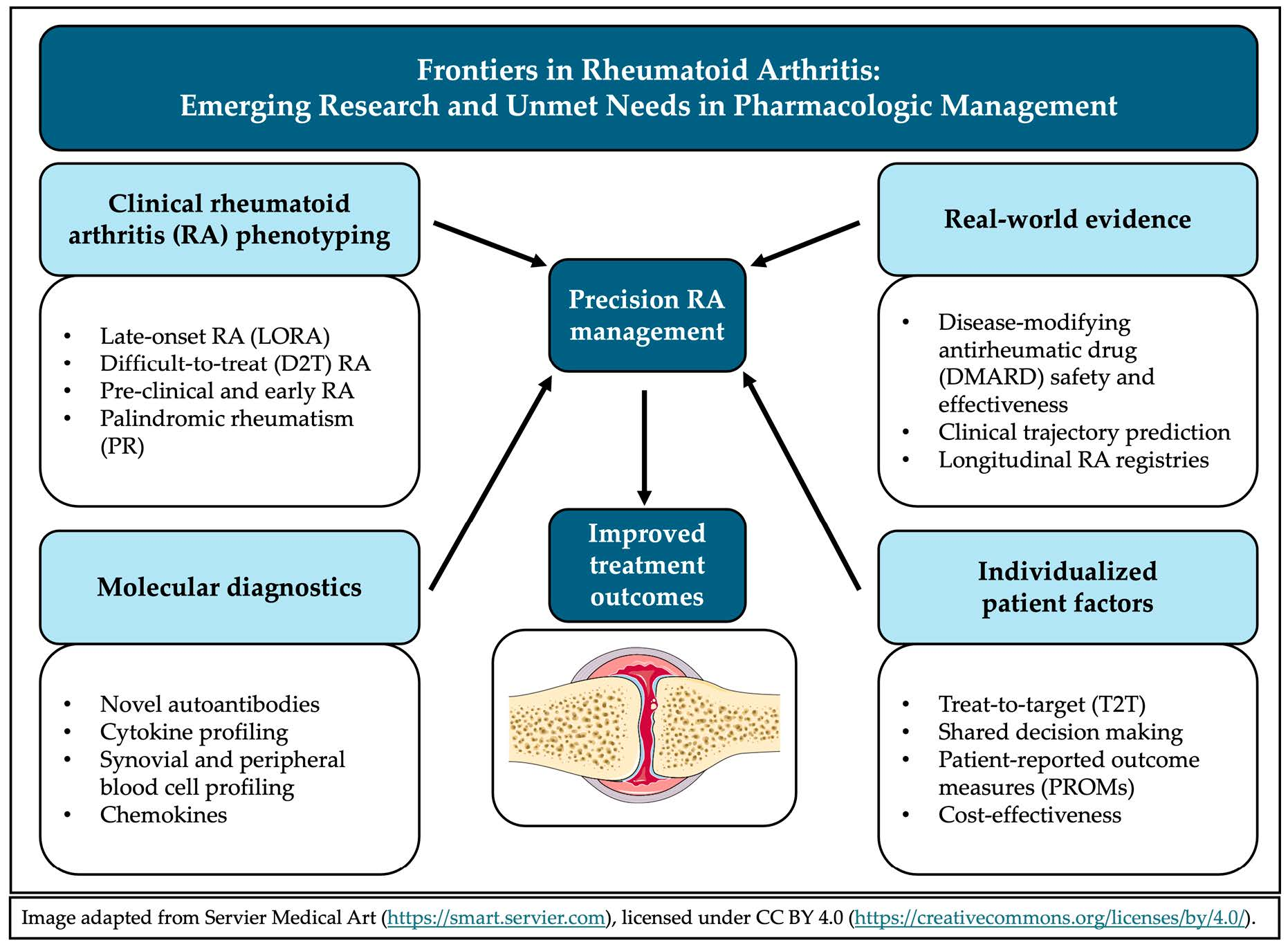
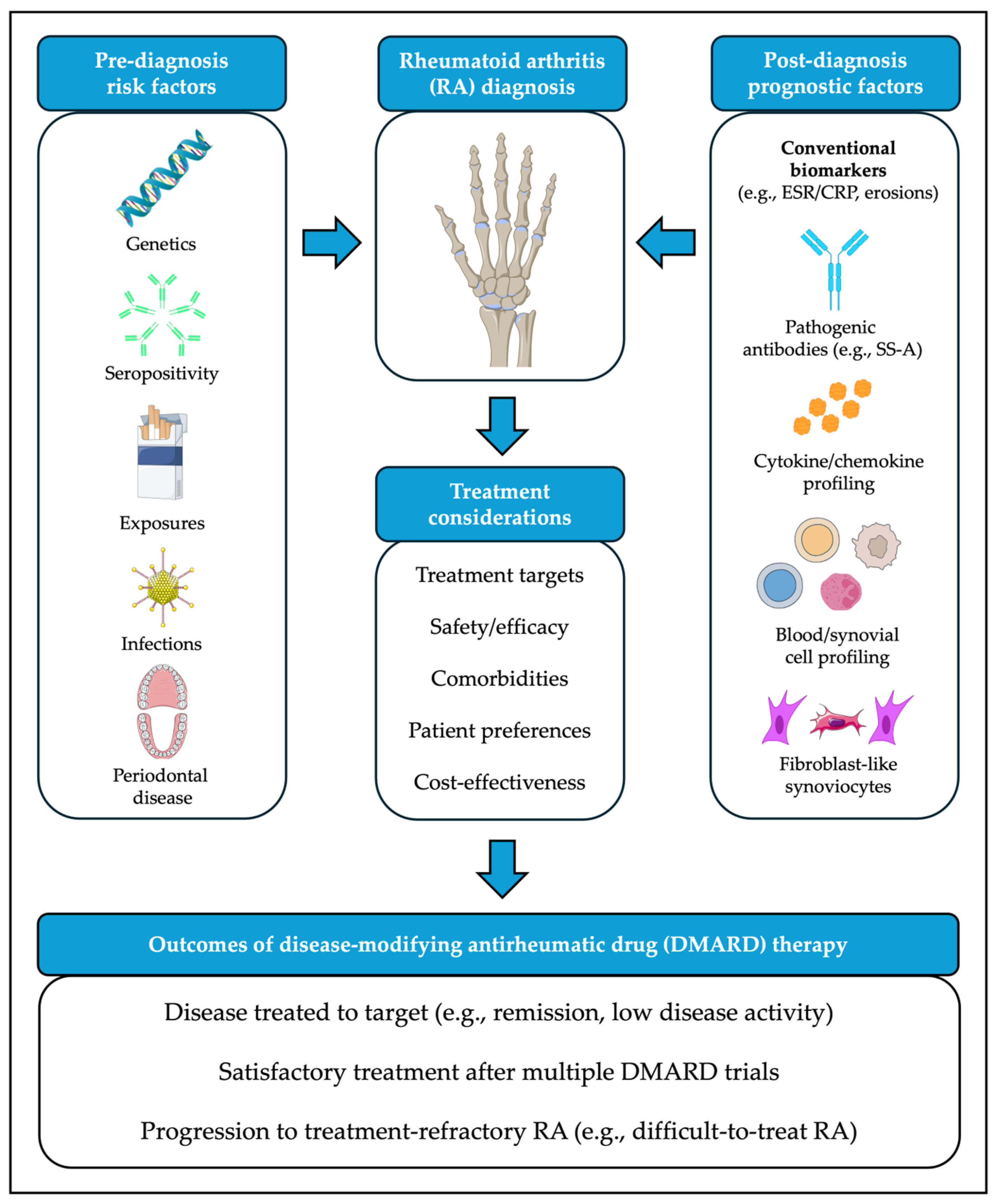
Frontiers in Rheumatoid Arthritis: Emerging Research and Unmet Needs in Pharmacologic Management

Abstract
1. Introduction
2. Current Treatment Paradigms in RA
2.1. Guideline-Directed Treatment
2.2. Treat-to-Target
3. Identifying Unmet Needs in the Management of RA
3.1. Treatment-Resistant RA
3.2. Late-Onset RA
3.3. Preclinical and Early RA
4. RA Research Frontiers
4.1. Biomarkers
4.1.1. Autoantibodies
4.1.2. Cytokine Profiles
4.2. Cellular Profiling
4.2.1. Synovium
4.2.2. Peripheral Blood
4.2.3. Chemokines and Other Proteins
4.3. Personalized DMARD Selection
4.3.1. Real-World Safety of Biologic and Targeted Synthetic DMARDs
4.3.2. Anticipating Clinical Trajectories for Patients Treated with b/tsDMARDs
4.3.3. Outcome Measures
4.3.4. Cost-Effectiveness
4.3.5. Shared Decision Making
5. Conclusions
Author Contributions
Funding
Institutional Review Board Statement
Informed Consent Statement
Data Availability Statement
Conflicts of Interest
Abbreviations
| RA | Rheumatoid arthritis |
| DMARD | Disease-modifying antirheumatic drug |
| ACR | American College of Rheumatology |
| TNF-a | Tumor necrosis factor-alpha |
| IL | Interleukin |
| CD20 | Cluster of differentiation 20 |
| JAK | Janus kinase |
| FDA | (United States) Food and Drug Administration |
| EULAR | European Association of Alliances for Rheumatology (formerly European League Against Rheumatism) |
| APLAR | Asia-Pacific League of Associations for Rheumatology |
| T2T | Treat-to-target |
| D2T | Difficult-to-treat |
| PIRRA | Persistent inflammatory refractory rheumatoid arthritis |
| NIRRA | Non-inflammatory refractory rheumatoid arthritis |
| LORA | Late-onset rheumatoid arthritis |
| RS3PE | Remitting seronegative symmetrical synovitis with pitting edema |
| RF | Rheumatoid factor |
| ACPA | Anti-citrullinated protein antibody |
| HLA | Human leukocyte antigen |
| PR | Palindromic rheumatism |
| PTX3 | Pentraxin 3 |
| DUSP11 | Dual specificity phosphatase 11 |
| PAD4 | Peptidyl arginine deiminase type 4 |
| SS-A | Sjögren syndrome-related antigen A |
| CRP | C-reactive protein |
| ESR | Erythrocyte sedimentation rate |
| IFN | Interferon |
| LYVE1 | Lymphatic vessel endothelial hyaluronan receptor 1 |
| FLS | Fibroblast-like synoviocyte |
| NK | Natural killer |
| DNMT3 | DNA methyltransferase 3 |
| TET2 | Tet methylcytosine dioxygenase 2 |
| CXCL13 | C-X-C motif chemokine ligand 13 |
| ANGPTL4 | Angiopoietin-like 4 |
| CCR5 | C-C chemokine receptor type 5 |
| CTLA4 | Cytotoxic T-lymphocyte-associated protein 4 |
| GI | Gastrointestinal |
| COPD | Chronic obstructive pulmonary disease |
| MACE | Major adverse cardiovascular events |
| VTE | Venous thromboembolism |
| ReALSA | Rheumatoid Arthritis Real-world Cohort Study in China |
| KURAMA | Kyoto University Rheumatoid Arthritis Management Alliance |
| ICHOM | International Consortium for Health Outcomes Measurement |
| OMERACT | Outcome Measures in Rheumatology |
| CDAI | Clinical Disease Activity Index |
| SDAI | Simplified Disease Activity Index |
| DAS28 | Disease Activity Score-28 |
| HAQ | Health Assessment Questionnaire |
| PROMIS | Patient-Reported Outcomes Measurement Information System |
| SDM | Shared decision-making |
References
- Almutairi, K.B.; Nossent, J.C.; Preen, D.B.; Keen, H.I.; Inderjeeth, C.A. The Prevalence of Rheumatoid Arthritis: A Systematic Review of Population-Based Studies. J. Rheumatol. 2021, 48, 669–676. [Google Scholar] [CrossRef]
- Weinblatt, M.E. Methotrexate in Rheumatoid Arthritis: A Quarter Century of Development. Trans. Am. Clin. Clim. Assoc. 2013, 124, 16–25. [Google Scholar]
- Fraenkel, L.; Bathon, J.M.; England, B.R.; St Clair, E.W.; Arayssi, T.; Carandang, K.; Deane, K.D.; Genovese, M.; Huston, K.K.; Kerr, G.; et al. 2021 American College of Rheumatology Guideline for the Treatment of Rheumatoid Arthritis. Arthritis Rheumatol. 2021, 73, 1108–1123. [Google Scholar] [CrossRef] [PubMed]
- Smolen, J.S.; Aletaha, D. Rheumatoid Arthritis Therapy Reappraisal: Strategies, Opportunities and Challenges. Nat. Rev. Rheumatol. 2015, 11, 276–289. [Google Scholar] [CrossRef] [PubMed]
- Konzett, V.; Aletaha, D. Management Strategies in Rheumatoid Arthritis. Nat. Rev. Rheumatol. 2024, 20, 760–769. [Google Scholar] [CrossRef]
- Konzett, V.; Kerschbaumer, A.; Smolen, J.S.; Aletaha, D. Determination of the Most Appropriate ACR Response Definition for Contemporary Drug Approval Trials in Rheumatoid Arthritis. Ann. Rheum. Dis. 2024, 83, 58–64. [Google Scholar] [CrossRef]
- O’Dell, J.R.; Mikuls, T.R.; Taylor, T.H.; Ahluwalia, V.; Brophy, M.; Warren, S.R.; Lew, R.A.; Cannella, A.C.; Kunkel, G.; Phibbs, C.S.; et al. Therapies for Active Rheumatoid Arthritis after Methotrexate Failure. N. Engl. J. Med. 2013, 369, 307–318. [Google Scholar] [CrossRef]
- Sparks, J.A.; Krumme, A.A.; Shrank, W.H.; Matlin, O.S.; Brill, G.; Pezalla, E.J.; Choudhry, N.K.; Solomon, D.H. Intensification to Triple Therapy Non-Biologic Disease-Modifying Antirheumatic Drugs for Rheumatoid Arthritis in the United States from 2009 to 2014. Arthritis Rheumatol. 2016, 68, 1588–1595. [Google Scholar] [CrossRef]
- Cubberley, C.; Maharaj, A. Global RA Treatment Recommendations: An Update from the Various International Societies. Best Pract. Res. Clin. Rheumatol. 2025, 39, 102019. [Google Scholar] [CrossRef]
- Smolen, J.S.; Aletaha, D.; Bijlsma, J.W.J.; Breedveld, F.C.; Boumpas, D.; Burmester, G.; Combe, B.; Cutolo, M.; Wit, M.D.; Dougados, M.; et al. Treating Rheumatoid Arthritis to Target: Recommendations of an International Task Force. Ann. Rheum. Dis. 2010, 69, 631–637. [Google Scholar] [CrossRef]
- Felson, D.T.; Smolen, J.S.; Wells, G.; Zhang, B.; van Tuyl, L.H.D.; Funovits, J.; Aletaha, D.; Allaart, R.; Bathon, J.; Bombardieri, S.; et al. American College of Rheumatology/European League against Rheumatism Preliminary Definition of Remission in Rheumatoid Arthritis for Clinical Trials. Arthritis Rheum. 2011, 63, 573–586. [Google Scholar] [CrossRef]
- Hao, Y.; Oon, S.; Nikpour, M. Efficacy and Safety of Treat-to-Target Strategy Studies in Rheumatic Diseases: A Systematic Review and Meta-Analysis. Semin. Arthritis Rheum. 2024, 67, 152465. [Google Scholar] [CrossRef]
- Ramiro, S.; Landewé, R.B.; van der Heijde, D.; Sepriano, A.; FitzGerald, O.; Ostergaard, M.; Homik, J.; Elkayam, O.; Thorne, J.C.; Larche, M.; et al. Is Treat-to-Target Really Working in Rheumatoid Arthritis? A Longitudinal Analysis of a Cohort of Patients Treated in Daily Practice (RA BIODAM). Ann. Rheum. Dis. 2020, 79, 453–459. [Google Scholar] [CrossRef]
- Gossec, L.; Bessette, L.; Xavier, R.M.; Favalli, E.G.; Östör, A.; Buch, M.H. Barriers to, Facilitators of, and Interventions to Support Treat-to-Target Implementation in Rheumatoid Arthritis: A Systematic Review. Arthritis Care Res. 2024, 76, 1626–1636. [Google Scholar] [CrossRef]
- van Vollenhoven, R. Treat-to-Target in Rheumatoid Arthritis—Are We There Yet? Nat. Rev. Rheumatol. 2019, 15, 180–186. [Google Scholar] [CrossRef] [PubMed]
- Kakehasi, A.M.; Duarte, A.L.B.P.; Brenol, C.V.; Domiciano, D.S.; Laurindo, I.M.M.; Bonfiglioli, K.R.; da Mota, L.M.H.; Buch, M.H.; de Almeida Macêdo, E.; Xavier, R.M. Challenges in Implementing Treat-to-Target in Rheumatoid Arthritis: A Perspective from Brazilian Rheumatologists. Adv. Rheumatol. 2024, 64, 63. [Google Scholar] [CrossRef] [PubMed]
- Ford, J.A.; Solomon, D.H. Challenges in Implementing Treat-to-Target Strategies in Rheumatology. Rheum. Dis. Clin. N. Am. 2019, 45, 101–112. [Google Scholar] [CrossRef]
- Messelink, M.A.; den Broeder, A.A.; Marinelli, F.E.; Michgels, E.; Verschueren, P.; Aletaha, D.; Tekstra, J.; Welsing, P.M.J. What Is the Best Target in a Treat-to-Target Strategy in Rheumatoid Arthritis? Results from a Systematic Review and Meta-Regression Analysis. RMD Open 2023, 9, e003196. [Google Scholar] [CrossRef] [PubMed]
- Mierau, M.; Schoels, M.; Gonda, G.; Fuchs, J.; Aletaha, D.; Smolen, J.S. Assessing Remission in Clinical Practice. Rheumatology 2007, 46, 975–979. [Google Scholar] [CrossRef][Green Version]
- Thomas, K.; Lazarini, A.; Kaltsonoudis, E.; Drosos, A.; Papalopoulos, I.; Sidiropoulos, P.; Tsatsani, P.; Gazi, S.; Pantazi, L.; Boki, K.A.; et al. Treatment Patterns and Achievement of the Treat-to-Target Goals in a Real-Life Rheumatoid Arthritis Patient Cohort: Data from 1317 Patients. Ther. Adv. Musculoskelet. Dis. 2020, 12, 1759720X20937132. [Google Scholar] [CrossRef]
- Scott, I.C.; Ibrahim, F.; Panayi, G.; Cope, A.P.; Garrood, T.; Vincent, A.; Scott, D.L.; Kirkham, B.; TITRATE Programme Investigators. The Frequency of Remission and Low Disease Activity in Patients with Rheumatoid Arthritis, and Their Ability to Identify People with Low Disability and Normal Quality of Life. Semin. Arthritis Rheum. 2019, 49, 20–26. [Google Scholar] [CrossRef] [PubMed]
- Takanashi, S.; Kaneko, Y. Unmet Needs and Current Challenges of Rheumatoid Arthritis: Difficult-to-Treat Rheumatoid Arthritis and Late-Onset Rheumatoid Arthritis. J. Clin. Med. 2024, 13, 7594. [Google Scholar] [CrossRef]
- Buch, M.H.; Eyre, S.; McGonagle, D. Persistent Inflammatory and Non-Inflammatory Mechanisms in Refractory Rheumatoid Arthritis. Nat. Rev. Rheumatol. 2021, 17, 17–33. [Google Scholar] [CrossRef]
- Nagy, G.; Roodenrijs, N.M.; Welsing, P.M.; Kedves, M.; Hamar, A.; van der Goes, M.C.; Kent, A.; Bakkers, M.; Blaas, E.; Senolt, L.; et al. EULAR Definition of Difficult-to-Treat Rheumatoid Arthritis. Ann. Rheum. Dis. 2021, 80, 31–35. [Google Scholar] [CrossRef]
- Hofman, Z.L.M.; Roodenrijs, N.M.T.; Nikiphorou, E.; Kent, A.L.; Nagy, G.; Welsing, P.M.J.; van Laar, J.M. Difficult-to-Treat Rheumatoid Arthritis: What Have We Learned and What Do We Still Need to Learn? Rheumatology 2025, 64, 65–73. [Google Scholar] [CrossRef]
- Natalucci, F.; Triaille, C.; Sapart, E.; Dierckx, S.; Van Mullem, C.; De Montjoye, S.; Sokolova, T.; Avramovska, A.; Durez, P. Evolution from Early to Difficult-to-Treat Rheumatoid Arthritis: Incidence and Risk Factors in the ERA Uclouvain Brussels Cohort. Arthritis Res. Ther. 2025, 27, 182. [Google Scholar] [CrossRef]
- Garcia-Salinas, R.; Sanchez-Prado, E.; Mareco, J.; Ronald, P.; Ruta, S.; Gomez, R.; Magri, S. Difficult to Treat Rheumatoid Arthritis in a Comprehensive Evaluation Program: Frequency According to Different Objective Evaluations. Rheumatol. Int. 2023, 43, 1821–1828. [Google Scholar] [CrossRef]
- Dey, M.; Nagy, G.; Nikiphorou, E. Comorbidities and Extra-Articular Manifestations in Difficult-to-Treat Rheumatoid Arthritis: Different Sides of the Same Coin? Rheumatology 2023, 62, 1773–1779. [Google Scholar] [CrossRef]
- Roodenrijs, N.M.T.; van der Goes, M.C.; Welsing, P.M.J.; Tekstra, J.; Lafeber, F.P.J.G.; Jacobs, J.W.G.; van Laar, J.M. Difficult-to-Treat Rheumatoid Arthritis: Contributing Factors and Burden of Disease. Rheumatology 2021, 60, 3778–3788. [Google Scholar] [CrossRef] [PubMed]
- Roodenrijs, N.M.T.; Welsing, P.M.J.; van Roon, J.; Schoneveld, J.L.M.; van der Goes, M.C.; Nagy, G.; Townsend, M.J.; van Laar, J.M. Mechanisms Underlying DMARD Inefficacy in Difficult-to-Treat Rheumatoid Arthritis: A Narrative Review with Systematic Literature Search. Rheumatology 2022, 61, 3552–3566. [Google Scholar] [CrossRef] [PubMed]
- David, P.; Di Matteo, A.; Hen, O.; Dass, S.; Marzo-Ortega, H.; Wakefield, R.J.; Bissell, L.-A.; Nam, J.; Mankia, K.; Emery, P.; et al. Poly-Refractory Rheumatoid Arthritis: An Uncommon Subset of Difficult to Treat Disease With Distinct Inflammatory and Noninflammatory Phenotypes. Arthritis Rheumatol. 2024, 76, 510–521. [Google Scholar] [CrossRef]
- Zimba, O.; Baimukhamedov, C.; Kocyigit, B.F. Late-Onset Rheumatoid Arthritis: Clinical Features, Diagnostic Challenges, and Treatment Approaches. Rheumatol. Int. 2025, 45, 152. [Google Scholar] [CrossRef]
- Pavlov-Dolijanovic, S.; Bogojevic, M.; Nozica-Radulovic, T.; Radunovic, G.; Mujovic, N. Elderly-Onset Rheumatoid Arthritis: Characteristics and Treatment Options. Medicina 2023, 59, 1878. [Google Scholar] [CrossRef]
- Kobak, S.; Bes, C. An Autumn Tale: Geriatric Rheumatoid Arthritis. Ther. Adv. Musculoskelet. Dis. 2018, 10, 3–11. [Google Scholar] [CrossRef] [PubMed]
- Li, X.; Cesta, A.; Movahedi, M.; Bombardier, C. Late-Onset Rheumatoid Arthritis Has a Similar Time to Remission as Younger-Onset Rheumatoid Arthritis: Results from the Ontario Best Practices Research Initiative. Arthritis Res. Ther. 2022, 24, 255. [Google Scholar] [CrossRef] [PubMed]
- Sugitani, N.; Tanaka, E.; Inoue, E.; Abe, M.; Sugano, E.; Saka, K.; Ochiai, M.; Yamaguchi, R.; Ikari, K.; Yamanaka, H.; et al. Higher Risk of Poor Functional Outcome and Unfavourable Clinical Events for Late-Onset Rheumatoid Arthritis: Results from the IORRA Cohort. Rheumatology 2025, 64, 2541–2549. [Google Scholar] [CrossRef] [PubMed]
- Harigai, M.; Sugihara, T. Management of Late-Onset Rheumatoid Arthritis with Treat-to-Target Strategy. Drugs Aging 2025, 42, 413–433. [Google Scholar] [CrossRef]
- Deane, K.D.; Holers, V.M. Rheumatoid Arthritis: Pathogenesis, Prediction and Prevention—An Emerging Paradigm Shift. Arthritis Rheumatol. 2021, 73, 181–193. [Google Scholar] [CrossRef]
- Kelmenson, L.B.; Wagner, B.D.; McNair, B.K.; Frazer-Abel, A.; Demoruelle, M.K.; Bergstedt, D.T.; Feser, M.L.; Moss, L.K.; Parish, M.C.; Mewshaw, E.A.; et al. Timing of Elevations of Autoantibody Isotypes Prior to Diagnosis of Rheumatoid Arthritis. Arthritis Rheumatol. 2020, 72, 251–261. [Google Scholar] [CrossRef]
- Maisha, J.A.; El-Gabalawy, H.S.; O’Neil, L.J. Modifiable Risk Factors Linked to the Development of Rheumatoid Arthritis: Evidence, Immunological Mechanisms and Prevention. Front. Immunol. 2023, 14, 1221125. [Google Scholar] [CrossRef]
- Cheng, Z.; Do, T.; Mankia, K.; Meade, J.; Hunt, L.; Clerehugh, V.; Speirs, A.; Tugnait, A.; Emery, P.; Devine, D. Dysbiosis in the Oral Microbiomes of Anti-CCP Positive Individuals at Risk of Developing Rheumatoid Arthritis. Ann. Rheum. Dis. 2021, 80, 162–168. [Google Scholar] [CrossRef]
- Mankia, K.; Cheng, Z.; Do, T.; Hunt, L.; Meade, J.; Kang, J.; Clerehugh, V.; Speirs, A.; Tugnait, A.; Hensor, E.M.A.; et al. Prevalence of Periodontal Disease and Periodontopathic Bacteria in Anti-Cyclic Citrullinated Protein Antibody-Positive At-Risk Adults Without Arthritis. JAMA Netw. Open 2019, 2, e195394. [Google Scholar] [CrossRef]
- Seymour, B.J.; Allen, B.E.; Kuhn, K.A. Microbial Mechanisms of Rheumatoid Arthritis Pathogenesis. Curr. Rheumatol. Rep. 2024, 26, 124–132. [Google Scholar] [CrossRef]
- Jiang, X.; Askling, J.; Saevarsdottir, S.; Padyukov, L.; Alfredsson, L.; Viatte, S.; Frisell, T. A Genetic Risk Score Composed of Rheumatoid Arthritis Risk Alleles, HLA-DRB1 Haplotypes, and Response to TNFi Therapy—Results from a Swedish Cohort Study. Arthritis Res. Ther. 2016, 18, 288. [Google Scholar] [CrossRef] [PubMed]
- Sieberts, S.K.; Zhu, F.; García-García, J.; Stahl, E.; Pratap, A.; Pandey, G.; Pappas, D.; Aguilar, D.; Anton, B.; Bonet, J.; et al. Crowdsourced Assessment of Common Genetic Contribution to Predicting Anti-TNF Treatment Response in Rheumatoid Arthritis. Nat. Commun. 2016, 7, 12460. [Google Scholar] [CrossRef] [PubMed]
- Chen, L.; Zhao, J.; Meng, Q. From Genetic Variants to Therapeutic Targets: Insights into Understanding Rheumatoid Arthritis. Front. Immunol. 2025, 16, 1556971. [Google Scholar] [CrossRef]
- Mankia, K.; Emery, P. Palindromic Rheumatism as Part of the Rheumatoid Arthritis Continuum. Nat. Rev. Rheumatol. 2019, 15, 687–695. [Google Scholar] [CrossRef]
- Mankia, K.; D’Agostino, M.-A.; Wakefield, R.J.; Nam, J.L.; Mahmood, W.; Grainger, A.J.; Emery, P. Identification of a Distinct Imaging Phenotype May Improve the Management of Palindromic Rheumatism. Ann. Rheum. Dis. 2019, 78, 43–50. [Google Scholar] [CrossRef] [PubMed]
- Frazzei, G.; Musters, A.; de Vries, N.; Tas, S.W.; van Vollenhoven, R.F. Prevention of Rheumatoid Arthritis: A Systematic Literature Review of Preventive Strategies in at-Risk Individuals. Autoimmun. Rev. 2023, 22, 103217. [Google Scholar] [CrossRef]
- Krijbolder, D.I.; Verstappen, M.; van Dijk, B.T.; Dakkak, Y.J.; Burgers, L.E.; Boer, A.C.; Park, Y.J.; de Witt-Luth, M.E.; Visser, K.; Kok, M.R.; et al. Intervention with Methotrexate in Patients with Arthralgia at Risk of Rheumatoid Arthritis to Reduce the Development of Persistent Arthritis and Its Disease Burden (TREAT EARLIER): A Randomised, Double-Blind, Placebo-Controlled, Proof-of-Concept Trial. Lancet 2022, 400, 283–294. [Google Scholar] [CrossRef]
- Deane, K.D.; Holers, V.M.; Emery, P.; Mankia, K.; El-Gabalawy, H.; Sparks, J.A.; Costenbader, K.H.; Schett, G.; van der Helm-van Mil, A.; van Schaardenburg, D.; et al. Therapeutic Interception in Individuals at Risk of Rheumatoid Arthritis to Prevent Clinically Impactful Disease. Ann. Rheum. Dis. 2025, 84, 14–28. [Google Scholar] [CrossRef]
- Schäfer, C.; Keyßer, G. Lifestyle Factors and Their Influence on Rheumatoid Arthritis: A Narrative Review. J. Clin. Med. 2022, 11, 7179. [Google Scholar] [CrossRef]
- Iyengar, K.P.; Vaish, A.; Nune, A. Anti-Cyclic Citrullinated Peptide Antibody (ACPA) and Rheumatoid Arthritis: Clinical Relevance. J. Clin. Orthop. Trauma. 2021, 24, 101729. [Google Scholar] [CrossRef]
- Aletaha, D. Precision Medicine and Management of Rheumatoid Arthritis. J. Autoimmun. 2020, 110, 102405. [Google Scholar] [CrossRef] [PubMed]
- Nijjar, J.S.; Morton, F.R.; Bang, H.; Buckley, C.D.; van der Heijde, D.; Gilmour, A.; Paterson, C.; McInnes, I.B.; Porter, D.; Raza, K.; et al. The Impact of Autoantibodies against Citrullinated, Carbamylated, and Acetylated Peptides on Radiographic Progression in Patients with New-Onset Rheumatoid Arthritis: An Observational Cohort Study. Lancet Rheumatol. 2021, 3, e284–e293. [Google Scholar] [CrossRef]
- Sokolova, M.V.; Schett, G.; Steffen, U. Autoantibodies in Rheumatoid Arthritis: Historical Background and Novel Findings. Clin. Rev. Allergy Immunol. 2022, 63, 138–151. [Google Scholar] [CrossRef]
- Horai, Y.; Kurushima, S.; Shimizu, T.; Nakamura, H.; Kawakami, A. A Review of the Impact of Sjögren’s Syndrome and/or the Presence of Anti-Ro/SS-A Antibodies on Therapeutic Strategies for Rheumatoid Arthritis. J. Clin. Med. 2025, 14, 568. [Google Scholar] [CrossRef]
- Christ, L.; Kissling, S.; Finckh, A.; Fisher, B.A.; Adler, S.; Maurer, B.; Möller, B.; Kollert, F. Concomitant Sjögren’s Disease as a Biomarker for Treatment Effectiveness in Rheumatoid Arthritis—Results from the Swiss Clinical Quality Management Cohort. Arthritis Res. Ther. 2024, 26, 68. [Google Scholar] [CrossRef] [PubMed]
- Laroche, M.; Degboe, Y.; Constantin, A. Sjögren’s Syndrome Associated with Erosive Rheumatoid Arthritis Alters Its Prognosis and Long-Term Therapeutic Response: A Case-Control Study. Rheumatol. Int. 2023, 43, 363–366. [Google Scholar] [CrossRef] [PubMed]
- Tomizawa, T.; Cox, T.; Kollert, F.; Bowman, S.J.; Ito, H.; Matsuda, S.; Fisher, B.A. The Impact of Concomitant Sjögren’s Disease on Rheumatoid Arthritis Disease Activity: A Systematic Review and Meta-Analysis. Clin. Exp. Rheumatol. 2023, 41, 2484–2492. [Google Scholar] [CrossRef]
- Alp, G.; Cinakli, H.; Kurut Aysin, İ.; Solmaz, D.; Akar, S. Challenges and Insights in Managing Difficult-to-Treat Rheumatoid Arthritis: Real-World Clinical Perspectives. Clin. Exp. Rheumatol. 2024, 42, 1398–1406. [Google Scholar] [CrossRef]
- Matsudaira, R.; Tamura, N.; Sekiya, F.; Ogasawara, M.; Yamanaka, K.; Takasaki, Y. Anti-Ro/SSA Antibodies Are an Independent Factor Associated with an Insufficient Response to Tumor Necrosis Factor Inhibitors in Patients with Rheumatoid Arthritis. J. Rheumatol. 2011, 38, 2346–2354. [Google Scholar] [CrossRef]
- Waki, D.; Tamai, H.; Yokochi, R.; Kido, T.; Yagyu, Y.; Yanai, R.; Sada, K.-E. Effects of Anti-SSA Antibodies on the Response to Methotrexate in Rheumatoid Arthritis: A Retrospective Multicenter Observational Study. PLoS ONE 2022, 17, e0271921. [Google Scholar] [CrossRef]
- Hagiwara, S.; Tsuboi, H.; Honda, F.; Takahashi, H.; Kurata, I.; Ohyama, A.; Yagishita, M.; Abe, S.; Kurashima, Y.; Kaneko, S.; et al. Association of Anti-Ro/SSA Antibody with Response to Biologics in Patients with Rheumatoid Arthritis. Mod. Rheumatol. 2016, 26, 857–862. [Google Scholar] [CrossRef]
- Tsuboi, H.; Toko, H.; Honda, F.; Abe, S.; Takahashi, H.; Yagishita, M.; Hagiwara, S.; Ohyama, A.; Kondo, Y.; Nakano, K.; et al. Abatacept Ameliorates Both Glandular and Extraglandular Involvements in Patients with Sjögren’s Syndrome Associated with Rheumatoid Arthritis: Findings from an Open-Label, Multicentre, 1-Year, Prospective Study: The ROSE (Rheumatoid Arthritis with Orencia Trial Toward Sjögren’s Syndrome Endocrinopathy) and ROSE II Trials. Mod. Rheumatol. 2023, 33, 160–168. [Google Scholar] [CrossRef] [PubMed]
- Mariette, X.; Chen, C.; Biswas, P.; Kwok, K.; Boy, M.G. Lymphoma in the Tofacitinib Rheumatoid Arthritis Clinical Development Program. Arthritis Care Res. 2018, 70, 685–694. [Google Scholar] [CrossRef] [PubMed]
- Ding, Q.; Hu, W.; Wang, R.; Yang, Q.; Zhu, M.; Li, M.; Cai, J.; Rose, P.; Mao, J.; Zhu, Y.Z. Signaling Pathways in Rheumatoid Arthritis: Implications for Targeted Therapy. Sig. Transduct. Target. Ther. 2023, 8, 68. [Google Scholar] [CrossRef]
- Avouac, J.; Kay, J.; Choy, E. Personalised Treatment of Rheumatoid Arthritis Based on Cytokine Profiles and Synovial Tissue Signatures: Potentials and Challenges. Semin. Arthritis Rheum. 2025, 73, 152740. [Google Scholar] [CrossRef] [PubMed]
- Lama, M.; Sarkar, R.; Ghosh, B. Serum Cytokine Profiles in Patients with Rheumatoid Arthritis Before and After Treatment with Methotrexate. J. Interferon Cytokine Res. 2023, 43, 344–350. [Google Scholar] [CrossRef]
- Zhang, Z.; Zhou, B.-H.; Hu, L.; Li, M.-C.; Chang, D.; Dou, X. Relationship between Biologic Therapy and Cytokine Levels in Patients with Inflammatory Arthritis. Medicine 2025, 104, e42953. [Google Scholar] [CrossRef]
- Furer, V.; Elkayam, O. Dual Biologic Therapy in Patients with Rheumatoid Arthritis and Psoriatic Arthritis. Rambam Maimonides Med. J. 2023, 14, e0007. [Google Scholar] [CrossRef]
- De Lima, J.; Boutet, M.-A.; Bortolotti, O.; Chépeaux, L.-A.; Glasson, Y.; Dumé, A.-S.; Lau, R.; Humbert, P.; Allain, S.; Le Pluart, A.; et al. Spatial Mapping of Rheumatoid Arthritis Synovial Niches Reveals a LYVE1+ Macrophage Network Associated with Response to Therapy. Ann. Rheum. Dis. 2025, 84, 1955–1967. [Google Scholar] [CrossRef]
- Weisenfeld, D.; Zhang, F.; Donlin, L.; Jonsson, A.H.; Apruzzese, W.; Campbell, D.; Accelerating Medicines Partnership Program: RA/SLE Network; Rao, D.A.; Wei, K.; Holers, V.M.; et al. Associations Between Rheumatoid Arthritis Clinical Factors and Synovial Cell Types and States. Arthritis Rheumatol. 2024, 76, 356–362. [Google Scholar] [CrossRef]
- Humby, F.; Durez, P.; Buch, M.H.; Lewis, M.J.; Rizvi, H.; Rivellese, F.; Nerviani, A.; Giorli, G.; Mahto, A.; Montecucco, C.; et al. Rituximab versus Tocilizumab in Anti-TNF Inadequate Responder Patients with Rheumatoid Arthritis (R4RA): 16-Week Outcomes of a Stratified, Biopsy-Driven, Multicentre, Open-Label, Phase 4 Randomised Controlled Trial. Lancet 2021, 397, 305–317. [Google Scholar] [CrossRef] [PubMed]
- Dennis, G.; Holweg, C.T.J.; Kummerfeld, S.K.; Choy, D.F.; Setiadi, A.F.; Hackney, J.A.; Haverty, P.M.; Gilbert, H.; Lin, W.Y.; Diehl, L.; et al. Synovial Phenotypes in Rheumatoid Arthritis Correlate with Response to Biologic Therapeutics. Arthritis Res. Ther. 2014, 16, R90. [Google Scholar] [CrossRef]
- Winthrop, K.L.; Mease, P.; Kerschbaumer, A.; Voll, R.E.; Breedveld, F.C.; Smolen, J.S.; Gottenberg, J.-E.; Baraliakos, X.; Kiener, H.P.; Aletaha, D.; et al. Unmet Need in Rheumatology: Reports from the Advances in Targeted Therapies Meeting, 2023. Ann. Rheum. Dis. 2024, 83, 409–416. [Google Scholar] [CrossRef] [PubMed]
- Kubo, S.; Miyazaki, Y.; Nishino, T.; Fujita, Y.; Kono, M.; Kawashima, T.; Ishigaki, K.; Kusaka, K.; Tanaka, H.; Ueno, M.; et al. Peripheral Blood Immunophenotypic Diversity in Patients with Rheumatoid Arthritis and Its Impact on Therapeutic Responsiveness. Ann. Rheum. Dis. 2025, 84, 210–220. [Google Scholar] [CrossRef] [PubMed]
- Li, B.; Su, R.; Guo, Q.; Su, R.; Gao, C.; Li, X.; Wang, C. Differential Immunological Profiles in Seronegative versus Seropositive Rheumatoid Arthritis: Th17/Treg Dysregulation and IL-4. Front. Immunol. 2024, 15, 1447213. [Google Scholar] [CrossRef]
- Nakayamada, S.; Kubo, S.; Yoshikawa, M.; Miyazaki, Y.; Yunoue, N.; Iwata, S.; Miyagawa, I.; Hirata, S.; Nakano, K.; Saito, K.; et al. Differential Effects of Biological DMARDs on Peripheral Immune Cell Phenotypes in Patients with Rheumatoid Arthritis. Rheumatology 2018, 57, 164–174. [Google Scholar] [CrossRef]
- Blomberg, N.J.; Kristyanto, H.; Verstappen, M.; Neppelenbroek, S.; van der Helm-van Mil, A.H.M.; Toes, R.E.M.; Scherer, H.U. Autoreactive B Cells in Extremes of Rheumatoid Arthritis Disease Phenotypes. Ann. Rheum. Dis. 2025. [Google Scholar] [CrossRef]
- Neppelenbroek, S.; Blomberg, N.J.; Kampstra, A.S.B.; van der Hem, J.G.K.; Huizinga, T.W.J.; Toes, R.E.M.; Scherer, H.U. Autoreactive B Cells Remain Active despite Clinical Disease Control in Rheumatoid Arthritis. J. Autoimmun. 2024, 149, 103320. [Google Scholar] [CrossRef]
- Coyle, C.; Ma, M.; Abraham, Y.; Mahony, C.B.; Steel, K.; Simpson, C.; Guerra, N.; Croft, A.P.; Rapecki, S.; Cope, A.; et al. NK Cell Subsets Define Sustained Remission in Rheumatoid Arthritis. JCI Insight 2024, 9, e182390. [Google Scholar] [CrossRef] [PubMed]
- de Maleprade, B.; Gérard, B.; Brevet, P.; Riou, G.; Candon, S.; Boyer, O.; Vittecoq, O.; Lequerré, T.; Fréret, M. Macrophage Requirements for Abatacept Response in Rheumatoid Arthritis. Clin. Exp. Rheumatol. 2025, 43, 874–879. [Google Scholar] [CrossRef] [PubMed]
- Hiitola, E.; Korhonen, J.; Kokkonen, H.; Koskela, J.; Kankainen, M.; Alakuijala, M.; Liu, A.; Lundgren, S.; Häppölä, P.; Almusa, H.; et al. Clonal Hematopoiesis Is Associated with Distinct Rheumatoid Arthritis Phenotypes. Sci. Adv. 2025, 11, eadt9846. [Google Scholar] [CrossRef]
- De Stefano, L.; Bozzalla Cassione, E.; Sammali, Y.; Luvaro, T.; Montecucco, C.; Manzo, A.; Bugatti, S. High Serum Levels of CXCL13 Predict Lower Response to csDMARDs in Both ACPA-Positive and ACPA-Negative Early Rheumatoid Arthritis. Rheumatology 2025, 64, 2461–2468. [Google Scholar] [CrossRef] [PubMed]
- Ke, L.; He, Q.; Qu, J.; Wang, X.; Li, K.; Gong, X.; Li, L.; Xu, J.; Yu, Q.; Yu, H.; et al. Bone-Protective Effects of Neutralizing Angiopoietin-like Protein 4 Monoclonal Antibody in Rheumatoid Arthritis. Mol. Ther. 2024, 32, 4497–4513. [Google Scholar] [CrossRef]
- Miao, J.; Zhang, B.; Sun, H.; Zhang, P.; Shen, H.; Wang, J.; Jia, J.; Zhang, K.; Zheng, Z.; Zhu, P. CCR5 Mediates Rheumatoid Arthritis Progression by Promoting the Activation and Proliferation of Non-Classical Th1 Cells. Int. J. Rheum. Dis. 2024, 27, e15370. [Google Scholar] [CrossRef]
- Takeuchi, T.; Kameda, H. What Is the Future of CCR5 Antagonists in Rheumatoid Arthritis? Arthritis Res. Ther. 2012, 14, 114. [Google Scholar] [CrossRef][Green Version]
- Bay-Jensen, A.C.; Siebuhr, A.S.; Damgaard, D.; Drobinski, P.; Thudium, C.; Mortensen, J.; Nielsen, C.H. Objective and Noninvasive Biochemical Markers in Rheumatoid Arthritis: Where Are We and Where Are We Going? Expert Rev. Proteom. 2021, 18, 159–175. [Google Scholar] [CrossRef]
- Strand, V.; Miller, P.; Williams, S.A.; Saunders, K.; Grant, S.; Kremer, J. Discontinuation of Biologic Therapy in Rheumatoid Arthritis: Analysis from the Corrona RA Registry. Rheumatol. Ther. 2017, 4, 489–502. [Google Scholar] [CrossRef]
- Agarwal, S.; Zaman, T.; Handa, R. Retention Rates of Disease-Modifying Anti-Rheumatic Drugs in Patients with Rheumatoid Arthritis. Singap. Med. J. 2009, 50, 686–692. [Google Scholar]
- Westerlind, H.; Glintborg, B.; Hammer, H.B.; Saevarsdottir, S.; Krogh, N.S.; Hetland, M.L.; Hauge, E.-M.; Martinez Tejada, I.; Sexton, J.; Askling, J. Remission, Response, Retention and Persistence to Treatment with Disease-Modifying Agents in Patients with Rheumatoid Arthritis: A Study of Harmonised Swedish, Danish and Norwegian Cohorts. RMD Open 2023, 9, e003027. [Google Scholar] [CrossRef]
- Ebina, K.; Hashimoto, M.; Yamamoto, W.; Ohnishi, A.; Kabata, D.; Hirano, T.; Hara, R.; Katayama, M.; Yoshida, S.; Nagai, K.; et al. Drug Retention and Discontinuation Reasons between Seven Biologics in Patients with Rheumatoid Arthritis—The ANSWER Cohort Study. PLoS ONE 2018, 13, e0194130. [Google Scholar] [CrossRef]
- United States Food and Drug Administration (FDA). Drugs@FDA: FDA Approved Drug Products. Available online: https://www.accessdata.fda.gov/scripts/cder/daf/ (accessed on 12 January 2026).
- Thomas, K.; Vassilopoulos, D. Infections in Patients with Rheumatoid Arthritis in the Era of Targeted Synthetic Therapies. Mediterr. J. Rheumatol. 2020, 31, 129–136. [Google Scholar] [CrossRef]
- Rutherford, A.I.; Subesinghe, S.; Hyrich, K.L.; Galloway, J.B. Serious Infection across Biologic-Treated Patients with Rheumatoid Arthritis: Results from the British Society for Rheumatology Biologics Register for Rheumatoid Arthritis. Ann. Rheum. Dis. 2018, 77, 905–910. [Google Scholar] [CrossRef]
- Askling, J.; Fored, C.M.; Brandt, L.; Baecklund, E.; Bertilsson, L.; Feltelius, N.; Cöster, L.; Geborek, P.; Jacobsson, L.T.; Lindblad, S.; et al. Time-Dependent Increase in Risk of Hospitalisation with Infection among Swedish RA Patients Treated with TNF Antagonists. Ann. Rheum. Dis. 2007, 66, 1339–1344. [Google Scholar] [CrossRef]
- Galloway, J.B.; Hyrich, K.L.; Mercer, L.K.; Dixon, W.G.; Fu, B.; Ustianowski, A.P.; Watson, K.D.; Lunt, M.; Symmons, D.P.M.; BSRBR Control Centre Consortium; et al. Anti-TNF Therapy Is Associated with an Increased Risk of Serious Infections in Patients with Rheumatoid Arthritis Especially in the First 6 Months of Treatment: Updated Results from the British Society for Rheumatology Biologics Register with Special Emphasis on Risks in the Elderly. Rheumatology 2011, 50, 124–131. [Google Scholar] [CrossRef] [PubMed]
- Silva-Fernández, L.; De Cock, D.; Lunt, M.; Low, A.S.; Watson, K.D.; Symmons, D.P.M.; Hyrich, K.L. Serious Infection Risk after 1 Year between Patients with Rheumatoid Arthritis Treated with Rituximab or with a Second TNFi after Initial TNFi Failure: Results from The British Society for Rheumatology Biologics Register for Rheumatoid Arthritis. Rheumatology 2018, 57, 1533–1540. [Google Scholar] [CrossRef] [PubMed]
- Huss, V.; Bower, H.; Wadström, H.; Frisell, T.; Askling, J. Short-and Longer-Term Cancer Risks with Biologic and Targeted Synthetic Disease-Modifying Antirheumatic Drugs as Used against Rheumatoid Arthritis in Clinical Practice. Rheumatology 2021, 61, 1810–1818. [Google Scholar] [CrossRef]
- Zuckerman, B.P.; Gibson, M.; Roy, R.; Hughes, M.; Mehta, D.; Yang, Z.; Adas, M.; Ng, K.; Russell, M.D.; Cope, A.; et al. Abatacept and the Risk of Malignancy: A Meta-Analysis across Disease Indications. Rheumatology 2025, 64, 3280–3287. [Google Scholar] [CrossRef]
- Simon, T.A.; Suissa, S.; Boers, M.; Hochberg, M.C.; Skovron, M.L.; Askling, J.; Michaud, K.; Strangfeld, A.; Pedro, S.; Frisell, T.; et al. Malignancy Outcomes in Patients with Rheumatoid Arthritis Treated with Abatacept and Other Disease-Modifying Antirheumatic Drugs: Results from a 10-Year International Post-Marketing Study. Semin. Arthritis Rheum. 2024, 64, 152240. [Google Scholar] [CrossRef] [PubMed]
- Schaefer, M.; Purschke, A.; Zietemann, V.; Rudi, T.; Meissner, Y.; Richter, A.; Berger, S.; Rockwitz, K.; Krüger, K.; Schneider, K.M.; et al. Comparative Risk of Incident Malignancies in Rheumatoid Arthritis Patients Treated with Janus Kinase Inhibitors or bDMARDs: Observational Data from the German RABBIT Register. Ann. Rheum. Dis. 2025, 84, 1779–1790. [Google Scholar] [CrossRef]
- Westermann, R.; Cordtz, R.L.; Duch, K.; Mellemkjaer, L.; Hetland, M.L.; Burden, A.M.; Dreyer, L. Cancer Risk in Patients with Rheumatoid Arthritis Treated with Janus Kinase Inhibitors: A Nationwide Danish Register-Based Cohort Study. Rheumatology 2024, 63, 93–102. [Google Scholar] [CrossRef]
- Xu, C.; Wang, S.-I.; Leung, Y.Y.; Wei, J.C.-C. Comparative Cancer Incidence by Organ Site in Rheumatoid Arthritis Treated with Janus Kinase Inhibitors versus Tumor Necrosis Factor Inhibitors: A Retrospective Real-World Cohort Analysis. Biologics 2025, 19, 525–538. [Google Scholar] [CrossRef]
- Avouac, J.; Ait-Oufella, H.; Habauzit, C.; Benkhalifa, S.; Combe, B. The Cardiovascular Safety of Tumour Necrosis Factor Inhibitors in Arthritic Conditions: A Structured Review with Recommendations. Rheumatol. Ther. 2025, 12, 211–236. [Google Scholar] [CrossRef] [PubMed]
- Li, L.; Aviña-Zubieta, J.A.; Bernstein, C.N.; Kaplan, G.G.; Tremlett, H.; Xie, H.; Peña-Sánchez, J.-N.; Marrie, R.A.; Etminan, M. Risk of Multiple Sclerosis Among Users of Antitumor Necrosis Factor α in 4 Canadian Provinces. Neurology 2023, 100, e558–e567. [Google Scholar] [CrossRef]
- Delcoigne, B.; Kopp, T.I.; Arkema, E.V.; Hellgren, K.; Provan, S.A.; Relas, H.; Aaltonen, K.; Trokovic, N.; Gudbjornsson, B.; Grondal, G.; et al. Exposure to Specific Tumour Necrosis Factor Inhibitors and Risk of Demyelinating and Inflammatory Neuropathy in Cohorts of Patients with Inflammatory Arthritis: A Collaborative Observational Study across Five Nordic Rheumatology Registers. RMD Open 2023, 9, e002924. [Google Scholar] [CrossRef]
- Xiao, R.; Tang, P.; Zhou, J.; Zheng, W.; Cao, Y.; Zhu, Y.; Xiao, W.; Tan, H.; Wen, T.; Abdirahman, A.; et al. Safety of TNF-α Inhibitors Therapy in Patients with Rheumatoid Arthritis: An Umbrella Review. eClinicalMedicine 2025, 88, 103488–103496. [Google Scholar] [CrossRef]
- Suissa, S.; Hudson, M.; Dell’Aniello, S.; Shen, S.; Simon, T.A.; Ernst, P. Comparative Safety of Abatacept in Rheumatoid Arthritis with COPD: A Real-World Population-Based Observational Study. Semin. Arthritis Rheum. 2019, 49, 366–372. [Google Scholar] [CrossRef] [PubMed]
- Xie, F.; Yun, H.; Levitan, E.B.; Muntner, P.; Curtis, J.R. Tocilizumab and the Risk of Cardiovascular Disease: Direct Comparison Among Biologic Disease-Modifying Antirheumatic Drugs for Rheumatoid Arthritis Patients. Arthritis Care Res. 2019, 71, 1004–1018. [Google Scholar] [CrossRef]
- Castagné, B.; Viprey, M.; Martin, J.; Schott, A.-M.; Cucherat, M.; Soubrier, M. Cardiovascular Safety of Tocilizumab: A Systematic Review and Network Meta-Analysis. PLoS ONE 2019, 14, e0220178. [Google Scholar] [CrossRef]
- Strangfeld, A.; Richter, A.; Siegmund, B.; Herzer, P.; Rockwitz, K.; Demary, W.; Aringer, M.; Meißner, Y.; Zink, A.; Listing, J. Risk for Lower Intestinal Perforations in Patients with Rheumatoid Arthritis Treated with Tocilizumab in Comparison to Treatment with Other Biologic or Conventional Synthetic DMARDs. Ann. Rheum. Dis. 2017, 76, 504–510. [Google Scholar] [CrossRef]
- Ytterberg, S.R.; Bhatt, D.L.; Mikuls, T.R.; Koch, G.G.; Fleischmann, R.; Rivas, J.L.; Germino, R.; Menon, S.; Sun, Y.; Wang, C.; et al. Cardiovascular and Cancer Risk with Tofacitinib in Rheumatoid Arthritis. N. Engl. J. Med. 2022, 386, 316–326. [Google Scholar] [CrossRef]
- Solitano, V.; Ahuja, D.; Lee, H.H.; Gaikwad, R.; Yeh, K.-H.; Facciorusso, A.; Singh, A.G.; Ma, C.; Ananthakrishnan, A.N.; Yuan, Y.; et al. Comparative Safety of JAK Inhibitors vs TNF Antagonists in Immune-Mediated Inflammatory Diseases: A Systematic Review and Meta-Analysis. JAMA Netw. Open 2025, 8, e2531204. [Google Scholar] [CrossRef]
- Aymon, R.; Mongin, D.; Guemara, R.; Salis, Z.; Askling, J.; Choquette, D.; Codreanu, C.; Di Giuseppe, D.; Flouri, I.; Huschek, D.; et al. Incidence of Major Adverse Cardiovascular Events in Patients with Rheumatoid Arthritis Treated with JAK Inhibitors Compared with Biologic Disease-Modifying Antirheumatic Drugs: Data from an International Collaboration of Registries. Arthritis Rheumatol. 2025, 77, 1194–1204. [Google Scholar] [CrossRef]
- Mok, C.C.; So, H.; Yim, C.W.; To, C.H.; Lao, W.N.; Wong, S.P.Y.; Ng, H.Y.; Lee, J.M.Y.; Lee, P.M.L.; Ying, S.K.Y.; et al. Safety of the JAK and TNF Inhibitors in Rheumatoid Arthritis: Real World Data from the Hong Kong Biologics Registry. Rheumatology 2024, 63, 358–365. [Google Scholar] [CrossRef] [PubMed]
- You, S.-H.; Cho, S.-K.; Kim, J.-Y.; Song, Y.-J.; Jung, S.-Y.; Sung, Y.-K. Risk of Major Adverse Cardiovascular Events Following Targeted Therapy in Patients with Rheumatoid Arthritis: A Real-World Analysis Stratified by Cardiovascular Risk. Semin. Arthritis Rheum. 2025, 73, 152721. [Google Scholar] [CrossRef] [PubMed]
- Berger, J.R.; Malik, V.; Lacey, S.; Brunetta, P.; Lehane, P.B. Progressive Multifocal Leukoencephalopathy in Rituximab-Treated Rheumatic Diseases: A Rare Event. J. Neurovirol. 2018, 24, 323–331. [Google Scholar] [CrossRef] [PubMed]
- Winthrop, K.L.; Saag, K.; Cascino, M.D.; Pei, J.; John, A.; Jahreis, A.; Haselkorn, T.; Furst, D.E.; Abdulky, M.; Abeles, M.; et al. Long-Term Safety of Rituximab in Patients With Rheumatoid Arthritis: Results of a Five-Year Observational Study. Arthritis Care Res. 2019, 71, 993–1003. [Google Scholar] [CrossRef]
- van Vollenhoven, R.F.; Fleischmann, R.M.; Furst, D.E.; Lacey, S.; Lehane, P.B. Longterm Safety of Rituximab: Final Report of the Rheumatoid Arthritis Global Clinical Trial Program over 11 Years. J. Rheumatol. 2015, 42, 1761–1766. [Google Scholar] [CrossRef]
- Lee, J.; Martindale, J.; Makris, U.E.; Singh, N.; Yung, R.; Bynum, J.P.W. Initiation of Disease-Modifying Antirheumatic Drugs in Older Medicare Beneficiaries With New Diagnosis of Late-Onset Rheumatoid Arthritis. ACR Open Rheumatol. 2023, 5, 694–700. [Google Scholar] [CrossRef]
- Lahaye, C.; Tatar, Z.; Dubost, J.-J.; Tournadre, A.; Soubrier, M. Management of Inflammatory Rheumatic Conditions in the Elderly. Rheumatology 2019, 58, 748–764. [Google Scholar] [CrossRef]
- Lehoczki, A.; Ungvari, Z.; Szappanos, Á.; Fekete, M.; Gunkl-Tóth, L.; Nagy, G. Geroscience Insights into Difficult-to-Treat Rheumatoid Arthritis: The Role of Unhealthy Aging, Comorbidity, and Therapeutic Complexity. GeroScience 2025, 1–25. [Google Scholar] [CrossRef]
- van Onna, M.; Öztürk, B.; Starmans, M.; Peeters, R.; Boonen, A. Disease and Management Beliefs of Elderly Patients with Rheumatoid Arthritis and Comorbidity: A Qualitative Study. Clin. Rheumatol. 2018, 37, 2367–2372. [Google Scholar] [CrossRef] [PubMed]
- Ishchenko, A.; Lories, R.J. Safety and Efficacy of Biological Disease-Modifying Antirheumatic Drugs in Older Rheumatoid Arthritis Patients: Staying the Distance. Drugs Aging 2016, 33, 387–398. [Google Scholar] [CrossRef]
- Nooh, N.; Lwin, M.N.; Edwards, C. Considerations for the Use of Biological Therapies in Elderly Patients with Rheumatoid Arthritis. Expert Opin. Biol. Ther. 2024, 24, 1109–1117. [Google Scholar] [CrossRef]
- Studenic, P.; Meissner, Y.; Kearsley-Fleet, L.; De Cock, D. Role of Rheumatoid Arthritis Registries Worldwide: What Have They Taught Us? Best Pract. Res. Clin. Rheumatol. 2025, 39, 102017. [Google Scholar] [CrossRef] [PubMed]
- Lauper, K.; Iudici, M.; Mongin, D.; Bergstra, S.A.; Choquette, D.; Codreanu, C.; Cordtz, R.; De Cock, D.; Dreyer, L.; Elkayam, O.; et al. Effectiveness of TNF-Inhibitors, Abatacept, IL6-Inhibitors and JAK-Inhibitors in 31 846 Patients with Rheumatoid Arthritis in 19 Registers from the “JAK-Pot” Collaboration. Ann. Rheum. Dis. 2022, 81, 1358–1366. [Google Scholar] [CrossRef] [PubMed]
- Aymon, R.; Mongin, D.; Bergstra, S.A.; Choquette, D.; Codreanu, C.; De Cock, D.; Dreyer, L.; Elkayam, O.; Huschek, D.; Hyrich, K.L.; et al. Evaluation of Discontinuation for Adverse Events of JAK Inhibitors and bDMARDs in an International Collaboration of Rheumatoid Arthritis Registers (the ‘JAK-Pot’ Study). Ann. Rheum. Dis. 2024, 83, 421–428. [Google Scholar] [CrossRef]
- Pope, J.E.; Fleischmann, R.M. Jack Pot! What Can We Learn about Registries with Respect to Treatment Cycling in Rheumatoid Arthritis? Ann. Rheum. Dis. 2023, 82, 161–163. [Google Scholar] [CrossRef]
- De Cock, D.; Myasoedova, E.; Aletaha, D.; Studenic, P. Big Data Analyses and Individual Health Profiling in the Arena of Rheumatic and Musculoskeletal Diseases (RMDs). Ther. Adv. Musculoskelet. Dis. 2022, 14, 1759720X221105978. [Google Scholar] [CrossRef]
- Lin, J.-Z.; Zhu, Y.; Li, Q.-H.; Ouyang, Z.-M.; Liu, H.-J.; Zou, Y.-W.; Yang, Y.; Yang, K.-M.; Yang, L.-J.; Yang, Z.-H.; et al. Rheumatoid Arthritis Real-World Cohort Study in China (ReALSA): Protocol for a Multicentre Prospective, Longitudinal Cohort Study. BMJ Open 2025, 15, e092583. [Google Scholar] [CrossRef]
- Larid, G.; Vix, J.; Garlantezec, R.; Loppin, E.; Gervais, E. Increased Remission with Fewer Corticosteroids and More Biologics in Rheumatoid Arthritis at 7-Year Follow-up in Real-Life Conditions. Sci. Rep. 2022, 12, 2563. [Google Scholar] [CrossRef]
- Sparks, J.A.; Harrold, L.R.; Simon, T.A.; Wittstock, K.; Kelly, S.; Lozenski, K.; Khaychuk, V.; Michaud, K. Comparative Effectiveness of Treatments for Rheumatoid Arthritis in Clinical Practice: A Systematic Review. Semin. Arthritis Rheum. 2023, 62, 152249. [Google Scholar] [CrossRef]
- Fujii, T.; Murata, K.; Onizawa, H.; Onishi, A.; Tanaka, M.; Murakami, K.; Nishitani, K.; Furu, M.; Watanabe, R.; Hashimoto, M.; et al. Management and Treatment Outcomes of Rheumatoid Arthritis in the Era of Biologic and Targeted Synthetic Therapies: Evaluation of 10-Year Data from the KURAMA Cohort. Arthritis Res. Ther. 2024, 26, 16. [Google Scholar] [CrossRef] [PubMed]
- Fang, X.-Y.; Zhang, J.; Qian, T.-T.; Gao, P.; Wu, Q.; Fang, Q.; Ke, S.-S.; Huang, R.-G.; Zhang, H.-C.; Qiao, N.-N.; et al. Metabolomic Profiles, Polygenic Risk Scores and Risk of Rheumatoid Arthritis: A Population-Based Cohort Study in the UK Biobank. RMD Open 2023, 9, e003560. [Google Scholar] [CrossRef] [PubMed]
- England, B.R.; Tiong, B.K.; Bergman, M.J.; Curtis, J.R.; Kazi, S.; Mikuls, T.R.; O’Dell, J.R.; Ranganath, V.K.; Limanni, A.; Suter, L.G.; et al. 2019 Update of the American College of Rheumatology Recommended Rheumatoid Arthritis Disease Activity Measures. Arthritis Care Res. 2019, 71, 1540–1555. [Google Scholar] [CrossRef] [PubMed]
- Oude Voshaar, M.A.H.; Das Gupta, Z.; Bijlsma, J.W.J.; Boonen, A.; Chau, J.; Courvoisier, D.S.; Curtis, J.R.; Ellis, B.; Ernestam, S.; Gossec, L.; et al. International Consortium for Health Outcome Measurement Set of Outcomes That Matter to People Living With Inflammatory Arthritis: Consensus From an International Working Group. Arthritis Care Res. 2019, 71, 1556–1565. [Google Scholar] [CrossRef]
- Lopez-Olivo, M.A.; Zogala, R.J.; des Bordes, J.; Zamora, N.V.; Christensen, R.; Rai, D.; Goel, N.; Carmona, L.; Pratt, G.; Strand, V.; et al. Outcomes Reported in Prospective Long-Term Observational Studies and Registries of Patients With Rheumatoid Arthritis Worldwide: An Outcome Measures in Rheumatology Systematic Review. Arthritis Care Res. 2021, 73, 649–657. [Google Scholar] [CrossRef]
- Joensuu, J.T.; Huoponen, S.; Aaltonen, K.J.; Konttinen, Y.T.; Nordström, D.; Blom, M. The Cost-Effectiveness of Biologics for the Treatment of Rheumatoid Arthritis: A Systematic Review. PLoS ONE 2015, 10, e0119683. [Google Scholar] [CrossRef]
- Gharaibeh, M.; Bonafede, M.; McMorrow, D.; Hernandez, E.J.M.; Stolshek, B.S. Effectiveness and Costs Among Rheumatoid Arthritis Patients Treated with Targeted Immunomodulators Using Real-World U.S. Data. J. Manag. Care Spec. Pharm. 2020, 26, 1039–1049. [Google Scholar] [CrossRef]
- Tanaka, E.; Inoue, E.; Yamaguchi, R.; Shimizu, Y.; Kobayashi, A.; Sugimoto, N.; Hoshi, D.; Shidara, K.; Sato, E.; Seto, Y.; et al. Pharmacoeconomic Analysis of Biological Disease Modifying Antirheumatic Drugs in Patients with Rheumatoid Arthritis Based on Real-World Data from the IORRA Observational Cohort Study in Japan. Mod. Rheumatol. 2017, 27, 227–236. [Google Scholar] [CrossRef]
- Cárdenas, M.; de la Fuente, S.; Font, P.; Castro-Villegas, M.C.; Romero-Gómez, M.; Ruiz-Vílchez, D.; Calvo-Gutiérez, J.; Escudero-Contreras, A.; Casado, M.A.; Del Prado, J.R.; et al. Real-World Cost-Effectiveness of Infliximab, Etanercept and Adalimumab in Rheumatoid Arthritis Patients: Results of the CREATE Registry. Rheumatol. Int. 2016, 36, 231–241. [Google Scholar] [CrossRef] [PubMed]
- Joensuu, J.T.; Aaltonen, K.J.; Aronen, P.; Sokka, T.; Puolakka, K.; Tuompo, R.; Korpela, M.; Vasala, M.; Ilva, K.; Nordström, D.; et al. Cost-Effectiveness of Biologic Compared with Conventional Synthetic Disease-Modifying Anti-Rheumatic Drugs in Patients with Rheumatoid Arthritis: A Register Study. Rheumatology 2016, 55, 1803–1811. [Google Scholar] [CrossRef] [PubMed]
- Gholami, A.; Azizpoor, J.; Aflaki, E.; Rezaee, M.; Keshavarz, K. Cost-Effectiveness Analysis of Biopharmaceuticals for Treating Rheumatoid Arthritis: Infliximab, Adalimumab, and Etanercept. Biomed. Res. Int. 2021, 2021, 4450162. [Google Scholar] [CrossRef]
- Jansen, J.P.; Incerti, D.; Mutebi, A.; Peneva, D.; MacEwan, J.P.; Stolshek, B.; Kaur, P.; Gharaibeh, M.; Strand, V. Cost-Effectiveness of Sequenced Treatment of Rheumatoid Arthritis with Targeted Immune Modulators. J. Med. Econ. 2017, 20, 703–714. [Google Scholar] [CrossRef] [PubMed]
- Chastek, B.; Chen, C.-I.; Proudfoot, C.; Shinde, S.; Kuznik, A.; Wei, W. Treatment Persistence and Healthcare Costs Among Patients with Rheumatoid Arthritis Changing Biologics in the USA. Adv. Ther. 2017, 34, 2422–2435. [Google Scholar] [CrossRef]
- Claxton, L.; Taylor, M.; Soonasra, A.; Bourret, J.A.; Gerber, R.A. An Economic Evaluation of Tofacitinib Treatment in Rheumatoid Arthritis After Methotrexate or After 1 or 2 TNF Inhibitors from a U.S. Payer Perspective. J. Manag. Care Spec. Pharm. 2018, 24, 1010–1017. [Google Scholar] [CrossRef]
- Chaplin, S.; van Stiphout, J.; Chen, A.; Li, E. Budget Impact Analysis of Including Biosimilar Adalimumab on Formulary: A United States Payer Perspective. J. Manag. Care Spec. Pharm. 2024, 30, 1226–1238. [Google Scholar] [CrossRef]
- Müskens, W.D.; Dartel, S.A.A.R.; van Riel, P.L.C.M.; Adang, E.M.M. Does Etanercept Biosimilar Prescription in a Rheumatology Center Bend the Medication Cost Curve? J. Rheumatol. 2021, 48, 1803–1809. [Google Scholar] [CrossRef]
- Jiang, T.E.; Ramachandran, R.; Skydel, J.J. Regulatory Change Could Improve Biosimilar Access in the US. BMJ 2025, 390, e084860. [Google Scholar] [CrossRef]
- Barton, J.L.; Décary, S. New Galaxies in the Universe of Shared Decision Making and Rheumatoid Arthritis. Curr. Opin. Rheumatol. 2020, 32, 273–278. [Google Scholar] [CrossRef] [PubMed]
- Barton, J.L.; Trupin, L.; Tonner, C.; Imboden, J.; Katz, P.; Schillinger, D.; Yelin, E. English Language Proficiency, Health Literacy, and Trust in Physician Are Associated with Shared Decision Making in Rheumatoid Arthritis. J. Rheumatol. 2014, 41, 1290–1297. [Google Scholar] [CrossRef] [PubMed]
- Toupin-April, K.; Barton, J.; Fraenkel, L.; Li, L.C.; Brooks, P.; De Wit, M.; Stacey, D.; Légaré, F.; Meara, A.; Shea, B.; et al. Toward the Development of a Core Set of Outcome Domains to Assess Shared Decision-Making Interventions in Rheumatology: Results from an OMERACT Delphi Survey and Consensus Meeting. J. Rheumatol. 2017, 44, 1544–1550. [Google Scholar] [CrossRef] [PubMed]
- Morrison, T.; Foster, E.; Dougherty, J.; Barton, J. Shared Decision Making in Rheumatology: A Scoping Review. Semin. Arthritis Rheum. 2022, 56, 152041. [Google Scholar] [CrossRef]
- Aref, H.A.T.; Turk, T.; Dhanani, R.; Xiao, A.; Olson, J.; Paul, P.; Dennett, L.; Yacyshyn, E.; Sadowski, C.A. Development and Evaluation of Shared Decision-Making Tools in Rheumatology: A Scoping Review. Semin. Arthritis Rheum. 2024, 66, 152432. [Google Scholar] [CrossRef]
- Barton, J.L.; Niederhausen, M.; Tuepker, A.; Schmajuk, G.; Baker, J.; Lovejoy, T.I.; Morasco, B.J.; Kunneman, M.; Scholl, I. Implementation of Shared Decision Making in Rheumatoid Arthritis: Study Protocol for RAiSeD (Rheumatoid Arthritis Shared Decision Making) Stepped Wedge, Cluster-Randomized Trial. Trials 2025, 26, 381. [Google Scholar] [CrossRef]
- Home—ClinicalTrials.Gov. Available online: https://clinicaltrials.gov/ct2/home (accessed on 13 June 2021).


| Guideline Organization | Guideline Year | Preferred Pharmacologic Management | Suggested Role of Systemic Glucocorticoids | ||
|---|---|---|---|---|---|
| First-Line | Second-Line | Third- and Subsequent Lines | |||
| American College of Rheumatology (ACR) | 2021 | MTX preferred over SSZ, LEF, or HCQ | bDMARD (+/− MTX) or tsDMARD preferred over “triple therapy” (MTX, HCQ, SSZ) | Alternate bDMARD or tsDMARD | Avoid for most patients |
| Asia-Pacific League of Associations for Rheumatology (APLAR) | 2018 | MTX preferred over LEF or SSZ | Alternate csDMARD per local availability | Combination csDMARD therapy, bDMARD, or tsDMARD | Up to 3 months |
| European Alliance of Associations for Rheumatology (EULAR) | 2022 | MTX preferred over LEF or SSZ | Combination csDMARD therapy or bDMARD | Alternate bDMARD or tsDMARD | Up to 6 months |
| Difficult-to-treat (D2T) RA [22] | |
| Definition |
|
| Clinical considerations |
|
| Treatment considerations |
|
| Refractory RA [23] | |
| Definitions |
|
| Clinical considerations |
|
| Treatment considerations |
|
| Therapeutics | Mechanism of Action | Type | Route of Administration | Approved for Use in RA [94] |
|---|---|---|---|---|
| Included in the 2021 ACR management guidelines | ||||
| Methotrexate | Dihydrofolate reductase inhibition | csDMARD | PO, SC | Yes |
| Sulfasalazine | Anti-inflammatory; broad immunosuppressive effects | csDMARD | PO | Yes |
| Hydroxychloroquine | Lysosome stabilization; inhibits antigen presentation | csDMARD | PO | Yes |
| Leflunomide | Dihydroorotate dehydrogenase inhibition | csDMARD | PO | Yes |
| Adalimumab, certolizumab, etanercept, golimumab, and infliximab | TNF-alpha inhibition | bDMARD | SC, IV | Yes |
| Sarilumab, tocilizumab | IL-6 inhibition | bDMARD | SC, IV | Yes |
| Abatacept | CTLA-4 costimulation inhibition | bDMARD | SC, IV | Yes |
| Bariticinib, tofacitinib, upadacitinib | JAK inhibition | tsDMARD | PO | Yes |
| Rituximab | Anti-CD20 antibody | bDMARD | IV | Yes |
| Not included in the 2021 ACR management guidelines, but used in clinical practice | ||||
| Steroids (e.g., prednisone, dexamethasone) 1 | NF-κB inhibition; broad anti-inflammatory and immunosuppressive effects | Glucocorticoids | PO, IA, IV | Many |
| Anakinra | IL-1 inhibition | bDMARD | SC | Yes |
| Azathioprine | Antimetabolite (purine synthesis inhibition) | csDMARD | PO | Yes |
| Tacrolimus | Calcineurin inhibition | csDMARD | PO | No |
| Cyclosporine | Calcineurin inhibition | csDMARD | PO | Yes |
| Historical or rarely used therapies | ||||
| Salicylates (e.g., aspirin) | COX inhibition | NSAID | PO | Many |
| Penicillamine | Reduces T-cell activation | csDMARD | PO | Yes |
| Gold salts (e.g., auranofin, thiomalate, aurothioglucose) | Reduces T-cell activation; broad anti-inflammatory and immunosuppressive effects | csDMARD | PO, IM | Yes |
| NSAIDs (e.g., naproxen, ibuprofen) 2 | COX inhibition | NSAID | PO | Many |
| Mycophenolate 3 | Inosine monophosphate dehydrogenase inhibition | csDMARD | PO | No |
| Minocycline | MMP inhibition; broad anti-inflammatory effects | Antibiotic | PO | No |
| Type of SDM Tool | Description | Number of Publications Describing Use in RA | Reported Use in Relation to Clinical Care | Example(s) |
|---|---|---|---|---|
| Patient education | Provide information (e.g., about disease or medications) without eliciting patient preferences. | 4 | Before, during, after |
|
| Decision aid | Provide information with additional resources to clarify patient preferences. | 9 | Before, during, after |
|
| Discrete choice experiment | Identify patient preferences by selecting between choices (e.g., medications). | 1 | During |
|
| Conjoint analysis | Identify patient preferences by eliciting the most important values (e.g., medication safety and cost, etc.) | 1 | During |
|
Disclaimer/Publisher’s Note: The statements, opinions and data contained in all publications are solely those of the individual author(s) and contributor(s) and not of MDPI and/or the editor(s). MDPI and/or the editor(s) disclaim responsibility for any injury to people or property resulting from any ideas, methods, instructions or products referred to in the content. |
© 2026 by the authors. Licensee MDPI, Basel, Switzerland. This article is an open access article distributed under the terms and conditions of the Creative Commons Attribution (CC BY) license.
Share and Cite
Skydel, J.J.; Hsiao, B. Frontiers in Rheumatoid Arthritis: Emerging Research and Unmet Needs in Pharmacologic Management. Pharmaceuticals 2026, 19, 218. https://doi.org/10.3390/ph19020218
Skydel JJ, Hsiao B. Frontiers in Rheumatoid Arthritis: Emerging Research and Unmet Needs in Pharmacologic Management. Pharmaceuticals. 2026; 19(2):218. https://doi.org/10.3390/ph19020218
Chicago/Turabian StyleSkydel, Joshua J., and Betty Hsiao. 2026. "Frontiers in Rheumatoid Arthritis: Emerging Research and Unmet Needs in Pharmacologic Management" Pharmaceuticals 19, no. 2: 218. https://doi.org/10.3390/ph19020218
APA StyleSkydel, J. J., & Hsiao, B. (2026). Frontiers in Rheumatoid Arthritis: Emerging Research and Unmet Needs in Pharmacologic Management. Pharmaceuticals, 19(2), 218. https://doi.org/10.3390/ph19020218