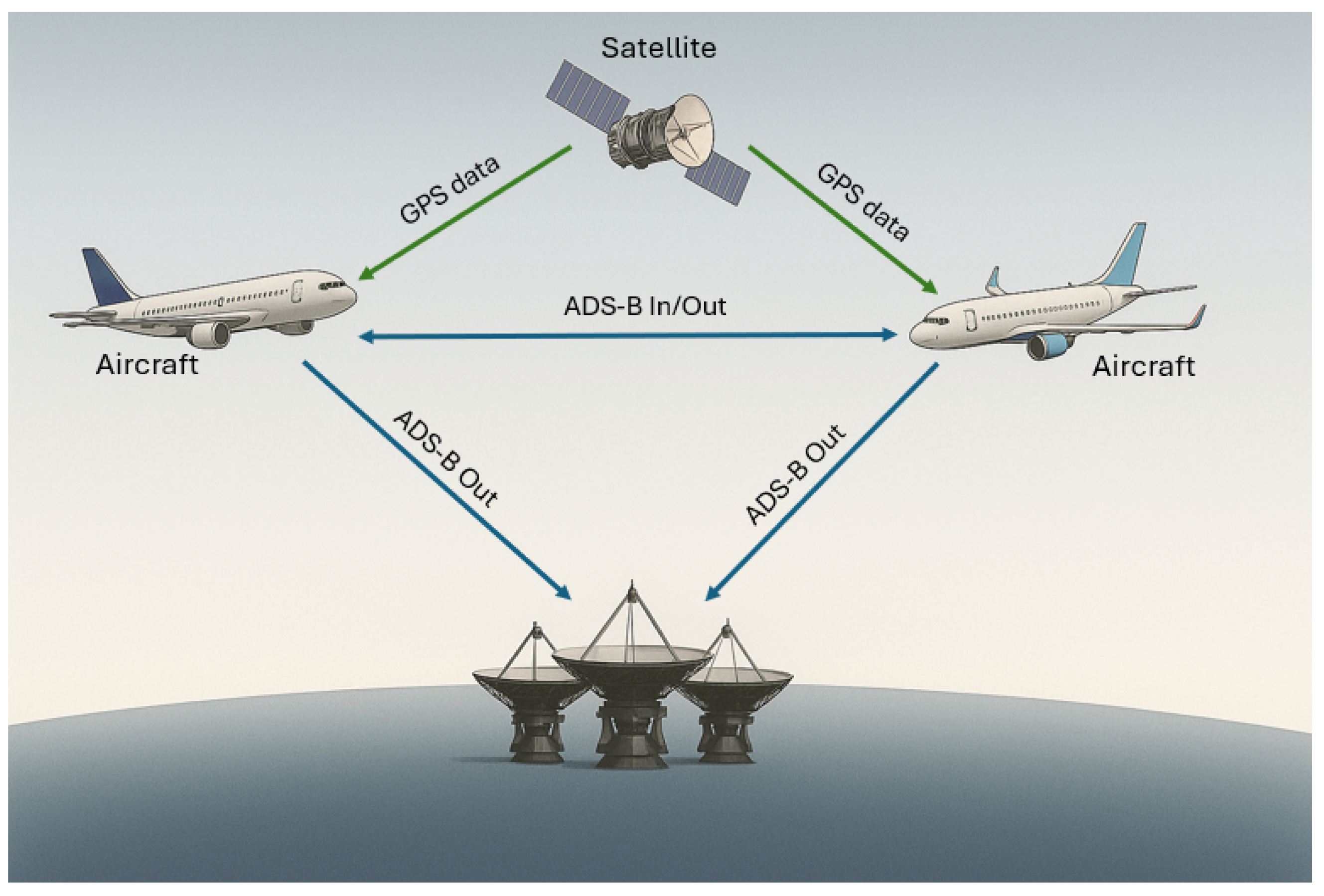
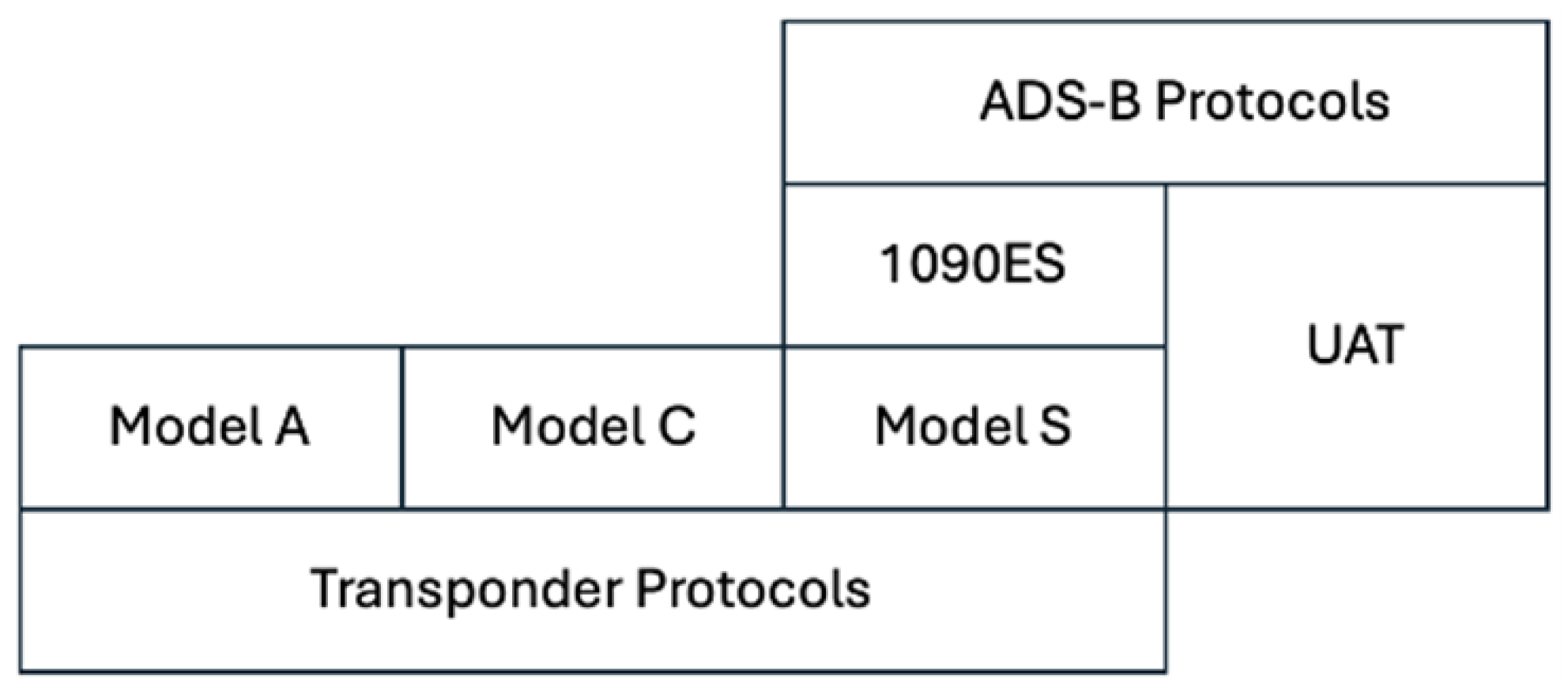
Security of ADS-B and Remote ID Systems: Cyberattacks, Detection Techniques, and Countermeasures



Abstract
1. Introduction
- It fills a gap in the literature by providing the first consolidated survey that comprehensively analyzes the security landscapes of both ADS-B and RID systems side by side.
- It presents a detailed categorization of cybersecurity threats applicable to both protocols, including an in-depth analysis of emerging attack vectors such as AML against AI-based detection systems, and a detailed analysis of RID-specific spoofing attacks that leverage low-cost, off-the-shelf hardware.
- It delivers a thorough review of modern attack detection techniques, comparing non-ML, traditional ML, and advanced deep learning (DL) methods.
- It analyzes countermeasures, including practical and protocol-agnostic methods, such as fingerprinting, multilateration, and data fusion, that can enhance the security of both systems without requiring fundamental changes to their existing architecture.
- It provides a valuable resource for the research community by compiling and discussing available simulation tools and public datasets for developing and validating new security solutions for ADS-B and RID, and analyzing the specific gaps in available RID attack datasets for validating new security solutions.
2. Fundamentals of ADS-B and RID
2.1. ADS-B
2.2. Remote Identification
3. Related Work
4. Cybersecurity Threats
5. Attack Detection Techniques
5.1. Non-AI Based Methods
5.2. AI-Based Methods
5.2.1. Traditional Machine Learning Methods
5.2.2. Deep Learning Methods
6. Countermeasures and Mitigations
6.1. Fingerprinting
6.2. Anti-Jamming
6.3. Anti-Spoofing
6.4. Physical Layer Authentication (PLA) and Physical Layer Security (PLS)
6.5. AI-Based Mitigation
7. Existing Datasets and Tools
7.1. Tools
7.2. Datasets
8. Challenges, and Future Research Directions
Author Contributions
Funding
Data Availability Statement
Conflicts of Interest
References
- ICAO. Future of Aviation. 2025. Available online: https://www2023.icao.int/Meetings/FutureOfAviation/Pages/default.aspx (accessed on 10 October 2025).
- Federal Aviation Administration. FAA Aerospace Forecast FY 2022–2042. 2025. Available online: https://www.faa.gov/dataresearch/aviation/faa-aerospace-forecast-fy-2022-2042 (accessed on 10 October 2025).
- Howell, D.; King, J. Measured impact of ADS-B in applications on general aviation and air taxi accident rates. In Proceedings of the 2019 IEEE/AIAA 38th Digital Avionics Systems Conference (DASC), San Diego, CA, USA, 8–12 September 2019; pp. 1–9. [Google Scholar]
- McCallie, D.; Butts, J.; Mills, R. Security analysis of the ADS-B implementation in the next generation air transportation system. Int. J. Crit. Infrastruct. Prot. 2011, 4, 78–87. [Google Scholar] [CrossRef] [Scilit]
- Viveros, C.A.P. Analysis of the Cyber Attacks Against ADS-B Perspective of Aviation Experts. Master’s Thesis, University of Tartu, Tartu, Estonia, 2016. [Google Scholar]
- Lieb, T.J.; Sievers, T.F. A comparative analysis of the European U-space framework and the US-American UAS Traffic Management (UTM) system. In Proceedings of the 2024 AIAA DATC/IEEE 43rd Digital Avionics Systems Conference (DASC), San Diego, CA, USA, 29 September–3 October 2024; pp. 1–9. [Google Scholar]
- Tedeschi, P.; Sciancalepore, S.; Di Pietro, R. ARID: Anonymous remote identification of unmanned aerial vehicles. In Proceedings of the 37th Annual Computer Security Applications Conference, Austin, TX, USA, 6–10 December 2021; pp. 207–218. [Google Scholar]
- Ahmed, W.; Masood, A.; Manzoor, J.; Akleylek, S. Automatic dependent surveillance-broadcast (ADS-B) anomalous messages and attack type detection: Deep learning-based architecture. PeerJ Comput. Sci. 2025, 11, e2886. [Google Scholar] [CrossRef] [Scilit] [PubMed]
- Ahmed, H.; Khan, H.; Khan, M.A. A survey on security and privacy of automatic dependent surveillance-broadcast (ads-b) protocol: Challenges, potential solutions and future directions. TechRxiv 2023. [Google Scholar] [CrossRef]
- Lubbe, H.; Serfontein, R.; Coetzee, M. Assessing the effectiveness of ADS-B mitigations. In Proceedings of the International Conference on Cyber Warfare and Security; Academic Conferences International Limited: Reading, UK, 2024; pp. 535–544. [Google Scholar]
- Belwafi, K.; Alkadi, R.; Alameri, S.A.; Al Hamadi, H.; Shoufan, A. Unmanned aerial vehicles’ remote identification: A tutorial and survey. IEEE Access 2022, 10, 87577–87601. [Google Scholar] [CrossRef] [Scilit]
- Li, T.; Wang, B. Sequential collaborative detection strategy on ADS-B data attack. Int. J. Crit. Infrastruct. Prot. 2019, 24, 78–99. [Google Scholar] [CrossRef] [Scilit]
- Costin, A.; Francillon, A. Ghost in the Air (Traffic): On insecurity of ADS-B protocol and practical attacks on ADS-B devices. Black Hat USA 2012, 1, 1–12. [Google Scholar]
- Aissaoui, R.; Deneuville, J.C.; Guerber, C.; Pirovano, A. Uav traffic management: A survey on communication security. arXiv 2022, arXiv:2211.05640. [Google Scholar] [CrossRef] [Scilit]
- Hamissi, A.; Dhraief, A. A survey on the unmanned aircraft system traffic management. ACM Comput. Surv. 2023, 56, 1–37. [Google Scholar] [CrossRef] [Scilit]
- Purton, L.; Abbass, H.; Alam, S. Identification of ADS-B system vulnerabilities and threats. In Proceedings of the Australian Transport Research Forum, Canberra, ACT, Australia, 29 September–1 October 2010; pp. 1–16. [Google Scholar]
- Ferrara, A. ADS-B in context: A Comprehensive threat analysis. 2023. Available online: https://www.politesi.polimi.it/handle/10589/222642 (accessed on 20 June 2025).
- Manesh, M.R.; Kaabouch, N. Analysis of vulnerabilities, attacks, countermeasures and overall risk of the Automatic Dependent Surveillance-Broadcast (ADS-B) system. Int. J. Crit. Infrastruct. Prot. 2017, 19, 16–31. [Google Scholar] [CrossRef] [Scilit]
- Schäfer, M.; Lenders, V.; Martinovic, I. Experimental analysis of attacks on next generation air traffic communication. In Proceedings of the International Conference on Applied Cryptography and Network Security; Springer: Berlin/Heidelberg, Germany, 2013; pp. 253–271. [Google Scholar]
- Ruseno, N.; Lin, C.Y.; Chang, S.C. UAS traffic management communications: The legacy of ADS-B, new establishment of remote ID, or leverage of ADS-B-like systems? Drones 2022, 6, 57. [Google Scholar] [CrossRef] [Scilit]
- Strohmeier, M.; Lenders, V.; Martinovic, I. On the security of the automatic dependent surveillance-broadcast protocol. IEEE Commun. Surv. Tutor. 2014, 17, 1066–1087. [Google Scholar] [CrossRef] [Scilit]
- ASTM. Standard Specification for Remote ID and Tracking. 2025. Available online: https://compass.astm.org/content-access?contentCode=ASTM%7CF3411-22A%7Cen-US (accessed on 10 October 2025).
- Huang, H.; Mazotti, B.; Kim, J.; Li, M.Z. Remote identification trajectory coverage in urban air mobility applications. arXiv 2023, arXiv:2302.09653. [Google Scholar] [CrossRef] [Scilit]
- Yu, A.; Kolotylo, I.; Hashim, H.A.; Eltoukhy, A.E. Electronic Warfare Cyberattacks, Countermeasures and Modern Defensive Strategies of UAV Avionics: A Survey. IEEE Access 2025, 13, 68660–68681. [Google Scholar] [CrossRef] [Scilit]
- Card, S.; Wiethuechter, A.; Moskowitz, R.; Gurtov, A. RFC 9434: Drone Remote Identification Protocol (DRIP) Architecture. 2023. Available online: https://www.rfc-editor.org/info/rfc9434 (accessed on 16 December 2025).
- Wisse, E.; Tedeschi, P.; Sciancalepore, S.; Di Pietro, R. A 2 RID—Anonymous Direct Authentication and Remote Identification of Commercial Drones. IEEE Internet Things J. 2023, 10, 10587–10604. [Google Scholar] [CrossRef] [Scilit]
- Alkadi, R.; Shoufan, A. Unmanned aerial vehicles traffic management solution using crowd-sensing and blockchain. IEEE Trans. Netw. Serv. Manag. 2022, 20, 201–215. [Google Scholar] [CrossRef] [Scilit]
- Tedeschi, P.; Al Nuaimi, F.A.; Awad, A.I.; Natalizio, E. Privacy-aware remote identification for unmanned aerial vehicles: Current solutions, potential threats, and future directions. IEEE Trans. Ind. Inform. 2023, 20, 1069–1080. [Google Scholar] [CrossRef] [Scilit]
- Federal Aviation Administration. UTM Concept of Operations Version 2.0 (UTM ConOps v2.0). 2025. Available online: https://www.faa.gov/researchdevelopment/trafficmanagement/utm-concept-operations-version-20-utm-conops-v20 (accessed on 10 October 2025).
- Mirzaei, K.F.; de Carvalho, B.P.; Pschorn, P. EasyChair Preprint No 851 Security of ADS-B: Attack Scenarios. Available online: https://api.semanticscholar.org/CorpusID:201040797 (accessed on 10 July 2025).
- Wu, Z.; Shang, T.; Guo, A. Security issues in automatic dependent surveillance-broadcast (ADS-B): A survey. IEEE Access 2020, 8, 122147–122167. [Google Scholar] [CrossRef] [Scilit]
- Li, T.; Wang, B.; Shang, F.; Tian, J.; Cao, K. Threat model and construction strategy on ADS-B attack data. IET Inf. Secur. 2020, 14, 542–552. [Google Scholar] [CrossRef] [Scilit]
- Kacem, T.; Kaya, A.; Keceli, A.S.; Catal, C.; Wijsekera, D.; Costa, P. ADS-B attack classification using machine learning techniques. In Proceedings of the 2021 IEEE Intelligent Vehicles Symposium Workshops (IV Workshops), Nagoya, Japan, 11–17 July 2021; pp. 7–12. [Google Scholar]
- Kožović, D.V.; Đurđević, D.Ž.; Dinulović, M.R.; Milić, S.; Rašuo, B.P. Air Traffic Modernization and Control: ADS-B System Implementation Update 2022—A Review. Fme Trans. 2023, 51, 117–130. [Google Scholar] [CrossRef] [Scilit]
- Habler, E.; Bitton, R.; Shabtai, A. Assessing aircraft security: A comprehensive survey and methodology for evaluation. ACM Comput. Surv. 2023, 56, 1–40. [Google Scholar] [CrossRef] [Scilit]
- Khan, H.A.; Khan, H.; Ghafoor, S.; Khan, M.A. A survey on security of automatic dependent surveillance-broadcast (ADS-B) protocol: Challenges, potential solutions and future directions. IEEE Commun. Surv. Tutor. 2024, 27, 3199–3226. [Google Scholar] [CrossRef] [Scilit]
- Ahmed, W. Advancements in ADS-B Security: A Comprehensive Survey of Vulnerabilities, Mitigation Strategies, System Requirements, and Emerging Research Trends. 2024. Available online: https://www.preprints.org/manuscript/202405.0586 (accessed on 13 June 2025).
- Ali, H.; Leblanc, S.P. Vulnerabilities of automatic dependent surveillance-broadcast on aircraft: Survey. In Proceedings of the 2024 International Conference on Computing, Internet of Things and Microwave Systems (ICCIMS), Gatineau, QC, Canada, 29–31 July 2024; pp. 1–5. [Google Scholar]
- Morrow, A.; Vaidyan, V.M. Automatic dependent surveillance: Attacks, challenges and countermeasures. J. Transp. Secur. 2025, 18, 5. [Google Scholar] [CrossRef] [Scilit]
- Altawy, R.; Youssef, A.M. Security, privacy, and safety aspects of civilian drones: A survey. ACM Trans. Cyber-Phys. Syst. 2016, 1, 1–25. [Google Scholar] [CrossRef] [Scilit]
- Leccadito, M.; Bakker, T.; Klenke, R.; Elks, C. A survey on securing UAS cyber physical systems. IEEE Aerosp. Electron. Syst. Mag. 2018, 33, 22–32. [Google Scholar] [CrossRef] [Scilit]
- Yaacoub, J.P.; Noura, H.; Salman, O.; Chehab, A. Security analysis of drones systems: Attacks, limitations, and recommendations. Internet Things 2020, 11, 100218. [Google Scholar] [CrossRef] [Scilit]
- Xie, Y.; Gardi, A.; Sabatini, R. Cybersecurity trends in low-altitude air traffic management. In Proceedings of the 2022 IEEE/AIAA 41st Digital Avionics Systems Conference (DASC), Portsmouth, VA, USA, 18–22 September 2022; pp. 1–9. [Google Scholar]
- Mielke, D.M.; Gräupl, T. On the vulnerability of random access channels in aeronautical communications. In Proceedings of the 2020 AIAA/IEEE 39th Digital Avionics Systems Conference (DASC), Virtual, 11–15 October 2020; pp. 1–7. [Google Scholar]
- Wei, X.; Ma, J.; Sun, C. A survey on security of unmanned aerial vehicle systems: Attacks and countermeasures. IEEE Internet Things J. 2024, 11, 34826–34847. [Google Scholar] [CrossRef] [Scilit]
- Zhang, Q.; Wang, Z.; Wu, B.; Gui, G. A robust and practical solution to ADS-B security against denial-of-service attacks. IEEE Internet Things J. 2023, 11, 13647–13659. [Google Scholar] [CrossRef] [Scilit]
- Svaigen, A.R.; Boukerche, A.; Ruiz, L.B.; Loureiro, A.A. Is the remote ID a threat to the drone’s location privacy on the internet of drones? In Proceedings of the 20th ACM International Symposium on Mobility Management and Wireless Access, Montreal, QC, Canada, 24–28 October 2022; pp. 81–88. [Google Scholar]
- Kamaruzzaman, M.R.; Hossain, M.D.; Taenaka, Y.; Kadobayashi, Y. Mitigation of ADS-B spoofing attack impact on departure sequencing through modulated synchronous taxiing approach. IEEE Open J. Intell. Transp. Syst. 2023, 4, 720–739. [Google Scholar] [CrossRef] [Scilit]
- Kožović, D.V.; Đurđević, D.Ž. Spoofing in aviation: Security threats on GPS and ADS-B systems. Vojnoteh. Glas. Tech. Cour. 2021, 69, 461–485. [Google Scholar] [CrossRef] [Scilit]
- Rudys, S.; Aleksandravicius, J.; Aleksiejunas, R.; Konovaltsev, A.; Zhu, C.; Greda, L. Physical layer protection for ADS-B against spoofing and jamming. Int. J. Crit. Infrastruct. Prot. 2022, 38, 100555. [Google Scholar] [CrossRef] [Scilit]
- Zhong, L.; Yang, H.; Zhang, L.; Zhong, Q.; Huang, J.; Hu, F. Spoofing attack detection in ADS-B data through frequency enhanced patch attention mechanism. In Proceedings of the 2024 6th International Conference on Electronic Engineering and Informatics (EEI), Chongqing, China, 28–30 June 2024; pp. 999–1003. [Google Scholar]
- Guo, R.-X.; Tian, J.-W.; Wang, B.-H.; Shang, F.-T. Cyber-physical attack threats analysis for UAVs from CPS perspective. In Proceedings of the 2020 International Conference on Computer Engineering and Application (ICCEA), Online, 27 March 2020; pp. 259–263. [Google Scholar]
- Shaikh, F.; Rahouti, M.; Ghani, N.; Xiong, K.; Bou-Harb, E.; Haque, J. A review of recent advances and security challenges in emerging E-enabled aircraft systems. IEEE Access 2019, 7, 63164–63180. [Google Scholar] [CrossRef] [Scilit]
- Talaei Khoei, T.; Ismail, S.; Kaabouch, N. Dynamic selection techniques for detecting GPS spoofing attacks on UAVs. Sensors 2022, 22, 662. [Google Scholar] [CrossRef] [Scilit] [PubMed]
- Altaweel, A.; Mukkath, H.; Kamel, I. GPS spoofing attacks in fanets: A systematic literature review. IEEE Access 2023, 11, 55233–55280. [Google Scholar] [CrossRef] [Scilit]
- Bada, M.; Boubiche, D.E.; Lagraa, N.; Kerrache, C.A.; Imran, M.; Shoaib, M. A policy-based solution for the detection of colluding GPS-Spoofing attacks in FANETs. Transp. Res. Part A Policy Pract. 2021, 149, 300–318. [Google Scholar] [CrossRef] [Scilit]
- Ly, B.; Ly, R. Cybersecurity in unmanned aerial vehicles (UAVs). J. Cyber Secur. Technol. 2021, 5, 120–137. [Google Scholar] [CrossRef] [Scilit]
- Brighente, A.; Conti, M.; Schotsman, M.; Sciancalepore, S. Obfuscated Location Disclosure for Remote ID Enabled Drones. arXiv 2024, arXiv:2407.14256. [Google Scholar] [CrossRef] [Scilit]
- Manesh, M.R.; Mullins, M.; Foerster, K.; Kaabouch, N. A preliminary effort toward investigating the impacts of ADS-B message injection attack. In Proceedings of the 2018 IEEE Aerospace Conference, Big Sky, MT, USA, 3–10 March 2018; pp. 1–6. [Google Scholar]
- Haddad, Y.; Orye, E.; Maennel, O. Ghost injection attack on automatic dependent surveillance–broadcast equipped drones impact on human behaviour. In Proceedings of the 2021 IEEE Conference on Cognitive and Computational Aspects of Situation Management (CogSIMA), Tallinn, Estonia, 14–22 May 2021; pp. 161–166. [Google Scholar]
- Khandker, S.; Turtiainen, H.; Costin, A.; Hämäläinen, T. Cybersecurity attacks on software logic and error handling within ADS-B implementations: Systematic testing of resilience and countermeasures. IEEE Trans. Aerosp. Electron. Syst. 2021, 58, 2702–2719. [Google Scholar] [CrossRef] [Scilit]
- Jafary, B.; Bhattacharya, S.; Nafreen, M.; Yuan, S.; Zhou, J.; Wu, L.; Manjunath, P.; Chigan, T.; Fiondella, L. The Application of Unmanned Aerial Systems in Surface Transportation—Volume II-F: Drone Cyber Security: Assurance Methods and Standards; Technical Report; University of Massachusetts Dartmouth: Dartmouth, MA, USA, 2019. [Google Scholar]
- Tlili, F.; Fourati, L.C.; Ayed, S.; Ouni, B. Investigation on vulnerabilities, threats and attacks prohibiting UAVs charging and depleting UAVs batteries: Assessments & countermeasures. Ad Hoc Netw. 2022, 129, 102805. [Google Scholar]
- Yahuza, M.; Idris, M.Y.I.; Ahmedy, I.B.; Wahab, A.W.A.; Nandy, T.; Noor, N.M.; Bala, A. Internet of drones security and privacy issues: Taxonomy and open challenges. IEEE Access 2021, 9, 57243–57270. [Google Scholar] [CrossRef] [Scilit]
- Yu, Y.; Liu, X.; Liu, Z.; Durrani, T.S. Joint trajectory and resource optimization for RIS assisted UAV cognitive radio. IEEE Trans. Veh. Technol. 2023, 72, 13643–13648. [Google Scholar] [CrossRef] [Scilit]
- Madan, B.B.; Banik, M.; Bein, D. Securing unmanned autonomous systems from cyber threats. J. Def. Model. Simul. 2019, 16, 119–136. [Google Scholar] [CrossRef] [Scilit]
- Rugo, A.; Ardagna, C.A.; Ioini, N.E. A security review in the UAVNet era: Threats, countermeasures, and gap analysis. ACM Comput. Surv. (CSUR) 2022, 55, 1–35. [Google Scholar] [CrossRef] [Scilit]
- Dey, V.; Pudi, V.; Chattopadhyay, A.; Elovici, Y. Security vulnerabilities of unmanned aerial vehicles and countermeasures: An experimental study. In Proceedings of the 2018 31st International Conference on VLSI Design and 2018 17th International Conference on Embedded Systems (VLSID), Pune, India, 6–10 January 2018; pp. 398–403. [Google Scholar]
- Khan, S.; Thorn, J.; Wahlgren, A.; Gurtov, A. Intrusion detection in automatic dependent surveillance-broadcast (ADS-B) with machine learning. In Proceedings of the 2021 IEEE/AIAA 40th Digital Avionics Systems Conference (DASC), San Antonio, TX, USA, 2–7 October 2021; pp. 1–10. [Google Scholar]
- Seo, J.W.; Islam, A.; Masuduzzaman, M.; Shin, S.Y. Blockchain-based secure firmware update using an UAV. Electronics 2023, 12, 2189. [Google Scholar] [CrossRef] [Scilit]
- Telli, K.; Kraa, O.; Himeur, Y.; Ouamane, A.; Boumehraz, M.; Atalla, S.; Mansoor, W. A comprehensive review of recent research trends on unmanned aerial vehicles (UAVs). Systems 2023, 11, 400. [Google Scholar] [CrossRef] [Scilit]
- Kacem, T.; Tossou, S. ADS-B replay attack detection using transformers. In Proceedings of the 2024 International Wireless Communications and Mobile Computing (IWCMC), Ayia Napa, Cyprus, 27–31 May 2024; pp. 144–149. [Google Scholar]
- Chamola, V.; Kotesh, P.; Agarwal, A.; Naren; Gupta, N.; Guizani, M. A comprehensive review of unmanned aerial vehicle attacks and neutralization techniques. Ad Hoc Netw. 2021, 111, 102324. [Google Scholar] [CrossRef] [Scilit]
- Kumar, N.; Chaudhary, A. Surveying cybersecurity vulnerabilities and countermeasures for enhancing UAV security. Comput. Netw. 2024, 252, 110695. [Google Scholar] [CrossRef] [Scilit]
- Sánchez, H.S.; Rotondo, D.; Vidal, M.L.; Quevedo, J. Frequency-based detection of replay attacks: Application to a quadrotor UAV. In Proceedings of the 2019 8th International Conference on Systems and Control (ICSC), Marrakech, Morocco, 23–25 October 2019; pp. 289–294. [Google Scholar]
- Conti, M.; Dragoni, N.; Lesyk, V. A survey of man in the middle attacks. IEEE Commun. Surv. Tutor. 2016, 18, 2027–2051. [Google Scholar] [CrossRef] [Scilit]
- Hassija, V.; Chamola, V.; Agrawal, A.; Goyal, A.; Luong, N.C.; Niyato, D.; Yu, F.R.; Guizani, M. Fast, reliable, and secure drone communication: A comprehensive survey. IEEE Commun. Surv. Tutor. 2021, 23, 2802–2832. [Google Scholar] [CrossRef] [Scilit]
- Rani, C.; Modares, H.; Sriram, R.; Mikulski, D.; Lewis, F.L. Security of unmanned aerial vehicle systems against cyber-physical attacks. J. Def. Model. Simul. 2016, 13, 331–342. [Google Scholar] [CrossRef] [Scilit]
- Shakhatreh, H.; Sawalmeh, A.H.; Al-Fuqaha, A.; Dou, Z.; Almaita, E.; Khalil, I.; Othman, N.S.; Khreishah, A.; Guizani, M. Unmanned aerial vehicles (UAVs): A survey on civil applications and key research challenges. IEEE Access 2019, 7, 48572–48634. [Google Scholar] [CrossRef] [Scilit]
- Tsao, K.Y.; Girdler, T.; Vassilakis, V.G. A survey of cyber security threats and solutions for UAV communications and flying ad-hoc networks. Ad Hoc Netw. 2022, 133, 102894. [Google Scholar] [CrossRef] [Scilit]
- Sobb, T.; Turnbull, B.; Moustafa, N. Supply chain 4.0: A survey of cyber security challenges, solutions and future directions. Electronics 2020, 9, 1864. [Google Scholar] [CrossRef] [Scilit]
- Yeboah-Ofori, A.; Islam, S.; Brimicombe, A. Detecting cyber supply chain attacks on cyber physical systems using bayesian belief network. In Proceedings of the 2019 International Conference on Cyber Security and Internet of Things (ICSIoT), Accra, Ghana, 29–31 May 2019; pp. 37–42. [Google Scholar]
- Anagnostis, I.; Kotzanikolaou, P.; Douligeris, C. Understanding and securing the risks of unmanned aerial vehicle services. IEEE Access 2025, 13, 47955–47995. [Google Scholar] [CrossRef] [Scilit]
- Alhoraibi, L.; Alghazzawi, D.; Alhebshi, R. Detection of GPS spoofing attacks in UAVs based on adversarial machine learning model. Sensors 2024, 24, 6156. [Google Scholar] [CrossRef] [Scilit]
- Luo, P.; Wang, B.; Tian, J.; Liu, C.; Yang, Y. Adversarial attacks against deep-learning-based automatic dependent surveillance-broadcast unsupervised anomaly detection models in the context of air traffic management. Sensors 2024, 24, 3584. [Google Scholar] [CrossRef] [Scilit]
- Tian, J.; Wang, B.; Guo, R.; Wang, Z.; Cao, K.; Wang, X. Adversarial attacks and defenses for deep-learning-based unmanned aerial vehicles. IEEE Internet Things J. 2021, 9, 22399–22409. [Google Scholar] [CrossRef] [Scilit]
- Gaber, T.; Ali, T.; Nicho, M.; Torky, M. Robust Attacks Detection Model for Internet of Flying Things based on Generative Adversarial Network (GAN) and Adversarial Training. IEEE Internet Things J. 2025, 12, 23961–23974. [Google Scholar] [CrossRef] [Scilit]
- Macas, M.; Wu, C.; Fuertes, W. Adversarial examples: A survey of attacks and defenses in deep learning-enabled cybersecurity systems. Expert Syst. Appl. 2024, 238, 122223. [Google Scholar] [CrossRef] [Scilit]
- Adesina, D.; Hsieh, C.C.; Sagduyu, Y.E.; Qian, L. Adversarial machine learning in wireless communications using RF data: A review. IEEE Commun. Surv. Tutor. 2022, 25, 77–100. [Google Scholar] [CrossRef] [Scilit]
- Li, D.; Li, Q. Adversarial deep ensemble: Evasion attacks and defenses for malware detection. IEEE Trans. Inf. Forensics Secur. 2020, 15, 3886–3900. [Google Scholar] [CrossRef] [Scilit]
- Hu, H.; Pang, J. Stealing machine learning models: Attacks and countermeasures for generative adversarial networks. In Proceedings of the 37th Annual Computer Security Applications Conference, Virtual, 6–10 December 2021; pp. 1–16. [Google Scholar]
- Juuti, M.; Szyller, S.; Marchal, S.; Asokan, N. PRADA: Protecting against DNN model stealing attacks. In Proceedings of the 2019 IEEE European Symposium on Security and Privacy (EuroS&P), Stockholm, Sweden, 17–19 June 2019; pp. 512–527. [Google Scholar]
- Fredrikson, M.; Jha, S.; Ristenpart, T. Model inversion attacks that exploit confidence information and basic countermeasures. In Proceedings of the 22nd ACM SIGSAC Conference on Computer and Communications Security, Denver, CO, USA, 12–16 October 2015; pp. 1322–1333. [Google Scholar]
- Zhang, Y.; Jia, R.; Pei, H.; Wang, W.; Li, B.; Song, D. The secret revealer: Generative model-inversion attacks against deep neural networks. In Proceedings of the IEEE/CVF Conference on Computer Vision and Pattern Recognition, Seattle, WA, USA, 13–19 June 2020; pp. 253–261. [Google Scholar]
- Zhao, X.; Zhang, W.; Xiao, X.; Lim, B. Exploiting explanations for model inversion attacks. In Proceedings of the IEEE/CVF International Conference on Computer Vision, Montreal, BC, Canada, 11–17 October 2021; pp. 682–692. [Google Scholar]
- Hu, H.; Salcic, Z.; Sun, L.; Dobbie, G.; Yu, P.S.; Zhang, X. Membership inference attacks on machine learning: A survey. ACM Comput. Surv. (CSUR) 2022, 54, 1–37. [Google Scholar] [CrossRef] [Scilit]
- Niu, J.; Liu, P.; Zhu, X.; Shen, K.; Wang, Y.; Chi, H.; Shen, Y.; Jiang, X.; Ma, J.; Zhang, Y. A survey on membership inference attacks and defenses in machine learning. J. Inf. Intell. 2024, 2, 404–454. [Google Scholar] [CrossRef] [Scilit]
- Yang, Z.; Zhu, Y.; Wan, J.; Xiang, C.; Tang, T.; Wang, Y.; Xu, R.; Wang, L.; Zhang, F.; Xu, J.; et al. Defending Data Inference Attacks Against Machine Learning Models by Mitigating Prediction Distinguishability. IEEE Trans. Dependable Secure Comput. 2024, 22, 2687–2704. [Google Scholar] [CrossRef] [Scilit]
- Leonardi, M.; Sirbu, G. ADS-B crowd-sensor network and two-step Kalman filter for GNSS and ADS-B cyber-attack detection. Sensors 2021, 21, 4992. [Google Scholar] [CrossRef] [Scilit] [PubMed]
- Ray, G.; Ray, J. Detecting ADS-B replay cyberattacks in the national airspace system. Issues Inf. Syst. 2023, 24, 170–185. [Google Scholar]
- Jeffrey, N.; Tan, Q.; Villar, J.R. A review of anomaly detection strategies to detect threats to cyber-physical systems. Electronics 2023, 12, 3283. [Google Scholar] [CrossRef] [Scilit]
- Olive, X.; Sun, J.; Lafage, A.; Basora, L. Detecting events in aircraft trajectories: Rule-based and data-driven approaches. Proceedings 2020, 59, 8. [Google Scholar]
- Manesh, M.R.; Velashani, M.S.; Ghribi, E.; Kaabouch, N. Performance comparison of machine learning algorithms in detecting jamming attacks on ADS-B devices. In Proceedings of the 2019 IEEE International Conference on Electro Information Technology (EIT), Brookings, SD, USA, 20–22 May 2019; pp. 200–206. [Google Scholar]
- Slimane, H.O.; Benouadah, S.; Khoei, T.T.; Kaabouch, N. A light boosting-based ml model for detecting deceptive jamming attacks on UAVs. In Proceedings of the 2022 IEEE 12th Annual Computing and Communication Workshop and Conference (CCWC), Las Vegas, NV, USA, 26–29 January 2022; pp. 0328–0333. [Google Scholar]
- Slimane, H.O.; Benouadah, S.; Al Shamaileh, K.; Devabhaktuni, V.; Kaabouch, N. ADS-B message injection attack on UAVs: Assessment of SVM-based detection techniques. In Proceedings of the 2022 IEEE International Conference on Electro Information Technology (eIT), Mankato, MN, USA, 19–21 May 2022; pp. 405–410. [Google Scholar]
- Price, J.; Slimane, H.O.; Al Shamaileh, K.; Devabhaktuni, V.; Kaabouch, N. A machine learning approach for the detection of injection attacks on ADS-B messaging systems. In Proceedings of the 2023 International Conference on Computing, Networking and Communications (ICNC), Honolulu, HI, USA, 20–22 February 2023; pp. 293–297. [Google Scholar]
- Vajrobol, V.; Saxena, G.J.; Singh, S.; Pundir, A.; Gupta, B.B.; Gaurav, A.; Chui, K.T. Enhancing aviation control security through ADS-B injection detection using ensemble meta-learning models with Explainable AI. Alex. Eng. J. 2025, 112, 63–73. [Google Scholar] [CrossRef] [Scilit]
- Li, T.; Wang, B.; Shang, F.; Tian, J.; Cao, K. Dynamic temporal ADS-B data attack detection based on sHDP-HMM. Comput. Secur. 2020, 93, 101789. [Google Scholar] [CrossRef] [Scilit]
- Jansen, K.; Niu, L.; Xue, N.; Martinovic, I.; Pöpper, C. Trust the Crowd: Wireless Witnessing to Detect Attacks on ADS-B-Based Air-Traffic Surveillance. In Proceedings of the NDSS, Virtual, 21–25 February 2021. [Google Scholar]
- Habler, E.; Shabtai, A. Using LSTM encoder-decoder algorithm for detecting anomalous ADS-B messages. Comput. Secur. 2018, 78, 155–173. [Google Scholar] [CrossRef] [Scilit]
- Wang, J.; Zou, Y.; Ding, J. ADS-B spoofing attack detection method based on LSTM. EURASIP J. Wirel. Commun. Netw. 2020, 2020, 160. [Google Scholar] [CrossRef] [Scilit]
- Khoei, T.T.; Slimane, H.O.; Al Shamaileh, K.; Devabhaktuni, V.K.; Kaabouch, N. Detecting injection attacks in ADS-B devices using RNN-based models. In Proceedings of the 2024 Integrated Communications, Navigation and Surveillance Conference (ICNS), Herndon, VA, USA, 23–25 April 2024; pp. 1–8. [Google Scholar]
- Ying, X.; Mazer, J.; Bernieri, G.; Conti, M.; Bushnell, L.; Poovendran, R. Detecting ADS-B spoofing attacks using deep neural networks. In Proceedings of the 2019 IEEE Conference on Communications and Network Security (CNS), Washington, DC, USA, 10–12 June 2019; pp. 187–195. [Google Scholar]
- Luo, P.; Wang, B.; Li, T.; Tian, J. ADS-B anomaly data detection model based on VAE-SVDD. Comput. Secur. 2021, 104, 102213. [Google Scholar] [CrossRef] [Scilit]
- Yue, M.; Zheng, H.; Cui, H.; Wu, Z. Gan-lstm-based ads-b attack detection in the context of air traffic control. IEEE Internet Things J. 2023, 10, 12651–12665. [Google Scholar] [CrossRef] [Scilit]
- Keizer, M.; Sciancalepore, S.; Oligeri, G. GhostBuster: Detecting Misbehaving Remote ID-Enabled Drones. In Proceedings of the 2024 IEEE 21st Consumer Communications & Networking Conference (CCNC), Las Vegas, NV, USA, 6–9 January 2024; pp. 324–332. [Google Scholar]
- Sciancalepore, S.; Davidovic, F.; Oligeri, G. ORION: Verification of drone trajectories via remote identification messages. Future Gener. Comput. Syst. 2024, 160, 869–878. [Google Scholar] [CrossRef] [Scilit]
- Ghubaish, A.; Salman, T.; Jain, R. Experiments with a LoRaWAN-Based Remote ID System for Locating Unmanned Aerial Vehicles (UAVs). Wirel. Commun. Mob. Comput. 2019, 2019, 9060121. [Google Scholar] [CrossRef] [Scilit]
- Phadke, A.; Boyd, J.; Medrano, F.A.; Starek, M. Navigating the skies: Examining the FAA’s remote identification rule for unmanned aircraft systems. Drone Syst. Appl. 2023, 11, 1–4. [Google Scholar] [CrossRef] [Scilit]
- Zhang, Z.; Li, G.; Shi, J.; Li, H.; Hu, A. Real-world aircraft recognition based on RF fingerprinting with few labeled ADS-B signals. IEEE Trans. Veh. Technol. 2023, 73, 2866–2871. [Google Scholar] [CrossRef] [Scilit]
- Zhou, Y.; Yeoh, P.L.; Kim, K.J.; Ma, Z.; Li, Y.; Vucetic, B. Game theoretic physical layer authentication for spoofing detection in UAV communications. IEEE Trans. Veh. Technol. 2022, 71, 6750–6755. [Google Scholar] [CrossRef] [Scilit]
- Price, J. Artificial Intelligence-Based Solutions for the Detection and Mitigation of Jamming and Message Injection Cyberattacks Against Unmanned Aerial Vehicles. Master’s Thesis, Purdue University, West Lafayette, IN, USA, 2023. [Google Scholar]
- Liu, M.; Chai, Y.; Li, M.; Wang, J.; Zhao, N. Transfer Learning-Based Specific Emitter Identification for ADS-B over Satellite System. Remote Sens. 2024, 16, 2068. [Google Scholar] [CrossRef] [Scilit]
- Zeng, K.; Govindan, K.; Mohapatra, P. Non-cryptographic authentication and identification in wireless networks [security and privacy in emerging wireless networks]. IEEE Wirel. Commun. 2010, 17, 56–62. [Google Scholar] [CrossRef] [Scilit]
- Burbank, J.; Greene, T.; Kaabouch, N. Detecting and mitigating attacks on GPS devices. Sensors 2024, 24, 5529. [Google Scholar] [CrossRef] [Scilit]
- Lu, D.; Wu, R.; Wang, W. Robust widenull anti-jamming algorithm for high dynamic GPS. In Proceedings of the 2012 IEEE 11th International Conference on Signal Processing, Beijing, China, 21–25 October 2012; Volume 1, pp. 378–381. [Google Scholar]
- Obi, V.; Evans, G.; Lim, S. Design of a Miniaturized, High Gain, Anti-Jam Global Positioning System (GPS) Antenna. In Proceedings of the SoutheastCon 2022, Mobile, AL, USA, 26 March–3 April 2022; pp. 73–74. [Google Scholar]
- Rezazadeh, N.; Shafai, L. GPS anti-jamming performance of multimode microstrip antennas. In Proceedings of the 2016 17th International Symposium on Antenna Technology and Applied Electromagnetics (ANTEM), Montreal, QC, Canada, 10–13 July 2016; pp. 1–2. [Google Scholar]
- Zheng, Y.; Huang, Y.; Wang, Y.E. Design of Small GPS Anti-Jam Antenna. In Proceedings of the 2018 IEEE International Symposium on Antennas and Propagation & USNC/URSI National Radio Science Meeting, Boston, MA, USA, 8–13 July 2018; pp. 1289–1290. [Google Scholar] [CrossRef] [Scilit]
- Abbasi, M.; Mosavi, M.R.; Reazei, M.J. GPS continues wave jamming canceller using an ANF combined with an artificial neural network. In Proceedings of the 2020 8th Iranian Joint Congress on Fuzzy and intelligent Systems (CFIS), Mashhad, Iran, 2–4 September 2020; pp. 99–104. [Google Scholar]
- Chien, Y.R. Design of GPS anti-jamming systems using adaptive notch filters. IEEE Syst. J. 2013, 9, 451–460. [Google Scholar] [CrossRef] [Scilit]
- Kim, S.; Park, K.; Seo, J. Mitigation of GPS chirp jammer using a transversal FIR filter and LMS algorithm. In Proceedings of the 2019 34th International Technical Conference on Circuits/Systems, Computers and Communications (ITC-CSCC), JeJu, Republic of Korea, 23–26 June 2019; pp. 1–4. [Google Scholar]
- He, Y.; Huang, F.; Wang, D.; Chen, B.; Zhang, R. Emergency communications in post-disaster scenarios: IoT-enhanced airship and buffer support. IEEE Internet Things J. 2024, 12, 11457–11468. [Google Scholar] [CrossRef] [Scilit]
- Zhou, Y.; Ma, Z.; Liu, H.; Yeoh, P.L.; Li, Y.; Vucetic, B.; Fan, P. A UAV-aided physical layer authentication based on channel characteristics and geographical locations. IEEE Trans. Veh. Technol. 2023, 73, 1053–1064. [Google Scholar] [CrossRef] [Scilit]
- Zhou, Y.; Yeoh, P.L.; Chen, H.; Li, Y.; Schober, R.; Zhuo, L.; Vucetic, B. Improving physical layer security via a UAV friendly jammer for unknown eavesdropper location. IEEE Trans. Veh. Technol. 2018, 67, 11280–11284. [Google Scholar] [CrossRef] [Scilit]
- Arı, N.; Musavian, L.; Thomos, N. Does Semantic Similarity Provide Enhanced Physical Layer Security? IEEE Commun. Lett. 2026, 30, 115–119. [Google Scholar] [CrossRef] [Scilit]
- Chen, S.; Zheng, S.; Yang, L.; Yang, X. Deep learning for large-scale real-world ACARS and ADS-B radio signal classification. IEEE Access 2019, 7, 89256–89264. [Google Scholar] [CrossRef] [Scilit]
- Mhapsekar, R.U.; Umrani, M.I.; Faizan, M.; Ali, O.; Abraham, L. Building trust in AI-driven decision making for cyber-physical Systems (CPS): A comprehensive review. In Proceedings of the 2024 IEEE 29th International Conference on Emerging Technologies and Factory Automation (ETFA), Padova, Italy, 10–13 September 2024; pp. 1–8. [Google Scholar]
- Gill, J.S.; Velashani, M.S.; Wolf, J.; Kenney, J.; Manesh, M.R.; Kaabouch, N. Simulation testbeds and frameworks for UAV performance evaluation. In Proceedings of the 2021 IEEE International Conference on Electro Information Technology (EIT), Mt. Pleasant, MI, USA, 14–15 May 2021; pp. 335–341. [Google Scholar]
- Bakare, B.; Enoch, J. A review of simulation techniques for some wireless communication system. Int. J. Electron. Commun. Comput. Eng. 2019, 10, 60–70. [Google Scholar]
- Chhimwal, P.; Rai, D.S.; Rawat, D. Comparison between different wireless sensor simulation tools. IOSR J. Electron. Commun. Eng. 2013, 5, 54–60. [Google Scholar] [CrossRef] [Scilit]
- Jat, S.; Toma, R.S.; Arayankhedkar, S.N. The Current State of The Art in VANET Simulation Tool Assessment. In Proceedings of the 2024 International Conference on Electrical, Computer and Energy Technologies (ICECET), Sydney, Australia, 25–27 July 2024; pp. 1–5. [Google Scholar]
- Kabir, M.H.; Islam, S.; Hossain, M.J.; Hossain, S. Detail comparison of network simulators. Int. J. Sci. Eng. Res. 2014, 5, 203–218. [Google Scholar]
- Lessmann, J.; Janacik, P.; Lachev, L.; Orfanus, D. Comparative study of wireless network simulators. In Proceedings of the Seventh International Conference on Networking (ICN 2008), Cancun, Mexico, 13–18 April 2008; pp. 517–523. [Google Scholar]
- Weingartner, E.; Vom Lehn, H.; Wehrle, K. A performance comparison of recent network simulators. In Proceedings of the 2009 IEEE International Conference on Communications, Dresden, Germany, 14–18 June 2009; pp. 1–5. [Google Scholar]
- Hentati, A.I.; Krichen, L.; Fourati, M.; Fourati, L.C. Simulation tools, environments and frameworks for UAV systems performance analysis. In Proceedings of the 2018 14th International Wireless Communications & Mobile Computing Conference (IWCMC), Limassol, Cyprus, 25–29 June 2018; pp. 1495–1500. [Google Scholar]
- Ma, C.; Zhou, Y.; Li, Z. A new simulation environment based on AirSim, ROS, and PX4 for quadcopter aircrafts. In Proceedings of the 2020 6th International Conference on Control, Automation and Robotics (ICCAR), Singapore, 20–23 April 2020; pp. 486–490. [Google Scholar]
- Miao, S.; Yang, L.; Quan, P. security analysis of UaV wireless Communication Based on airsim. In Proceedings of the 2023 Smart City Challenges & Outcomes for Urban Transformation (SCOUT), Singapore, 29–30 July 2023; pp. 268–272. [Google Scholar]
- Asper, G.D.; Simmons, B.M. Rapid Flight Control Law Deployment and Testing Framework for Subscale VTOL Aircraft; Technical Report. 2022. Available online: https://ntrs.nasa.gov/citations/20220011570 (accessed on 14 June 2025).
- Baidya, S.; Shaikh, Z.; Levorato, M. Flynetsim: An open source synchronized uav network simulator based on ns-3 and ardupilot. In Proceedings of the 21st ACM International Conference on Modeling, Analysis and Simulation of Wireless and Mobile Systems, Montreal, QC, Canada, 28 October–2 November 2018; pp. 37–45. [Google Scholar]
- Kudelski, M.; Gambardella, L.M.; Di Caro, G.A. RoboNetSim: An integrated framework for multi-robot and network simulation. Robot. Auton. Syst. 2013, 61, 483–496. [Google Scholar] [CrossRef] [Scilit]
- Mairaj, A.; Baba, A.I.; Javaid, A.Y. Application specific drone simulators: Recent advances and challenges. Simul. Model. Pract. Theory 2019, 94, 100–117. [Google Scholar] [CrossRef] [Scilit]
- Zema, N.R.; Trotta, A.; Natalizio, E.; Di Felice, M.; Bononi, L. The CUSCUS simulator for distributed networked control systems: Architecture and use-cases. Ad Hoc Netw. 2018, 68, 33–47. [Google Scholar] [CrossRef] [Scilit]
- Agyapong, R.A.; Nabil, M.; Nuhu, A.R.; Rasul, M.I.; Homaifar, A. Efficient detection of GPS spoofing attacks on unmanned aerial vehicles using deep learning. In Proceedings of the 2021 IEEE Symposium Series on Computational Intelligence (SSCI), Orlando, FL, USA, 5–7 December 2021; pp. 01–08. [Google Scholar]
- Schäfer, M.; Strohmeier, M.; Lenders, V.; Martinovic, I.; Wilhelm, M. Bringing up OpenSky: A large-scale ADS-B sensor network for research. In Proceedings of the IPSN-14 13th International Symposium on Information Processing in Sensor Networks, Berlin, Germany, 15–17 April 2014; pp. 83–94. [Google Scholar]
- Çevik, N.; Akleylek, S. Anomaly detection system for ADS-B data: Attack vectors and machine learning models. Internet Things 2025, 29, 101416. [Google Scholar] [CrossRef] [Scilit]
- Network, O. Trino—Historical Data. 2025. Available online: https://opensky-network.org (accessed on 27 June 2025).
- FlightAware. FlightAware Is Central to Aviation. 2025. Available online: https://www.flightaware.com (accessed on 27 June 2025).
- Exchange, A.B. ADS-B Exchange—Track Aircraft Live. 2025. Available online: https://globe.adsbexchange.com (accessed on 7 June 2025).
- flightradar24. Live Flight Tracker—Real-Time Flight Tracker Map. 2025. Available online: https://www.flightradar24.com (accessed on 27 June 2025).
- ADSBHub. ADS-B Data Sharing and Exchange. 2025. Available online: https://www.adsbhub.org/ (accessed on 27 June 2025).
- Aireon. Aireon—Space-Based ADS-B Global Air Traffic Surveillance and Tracking. 2025. Available online: https://aireon.com/ (accessed on 6 June 2025).
- Hassler, S.; Mughal, U.; Ismail, M. Cyber-physical dataset for UAVs under normal operations and cyber-attacks. IEEE Dataport 2023, 10. [Google Scholar] [CrossRef]
- Ahmed, M.; Cox, D.; Simpson, B.; Aloufi, A. Ecu-ioft: A dataset for analysing cyber-attacks on internet of flying things. Appl. Sci. 2022, 12, 1990. [Google Scholar] [CrossRef] [Scilit]
- Whelan, J.; Sangarapillai, T.; Minawi, O.; Almehmadi, A.; El-Khatib, K. UAV Attack Dataset. 2020. Available online: https://ieee-dataport.org/open-access/uav-attack-dataset (accessed on 25 June 2025).
- Aissou, G.; Benouadah, S.; EL ALAMI, H.; Kaabouch, N. A dataset for gps spoofing detection on autonomous vehicles. IEEE DataPort 2022. [Google Scholar] [CrossRef]
- Mohammad, N.; Khair, A.S. Resources for the GPS Spoofing Detection Project. 2025. Available online: https://github.com/mnayfeh/gps_spoofing_detection/tree/main (accessed on 12 December 2025).
- mehrab abrar. AV-GPS-Dataset: Autonomous Vehicle GPS Dataset. 2025. Available online: https://github.com/mehrab-abrar/AV-GPS-Dataset (accessed on 12 December 2025).


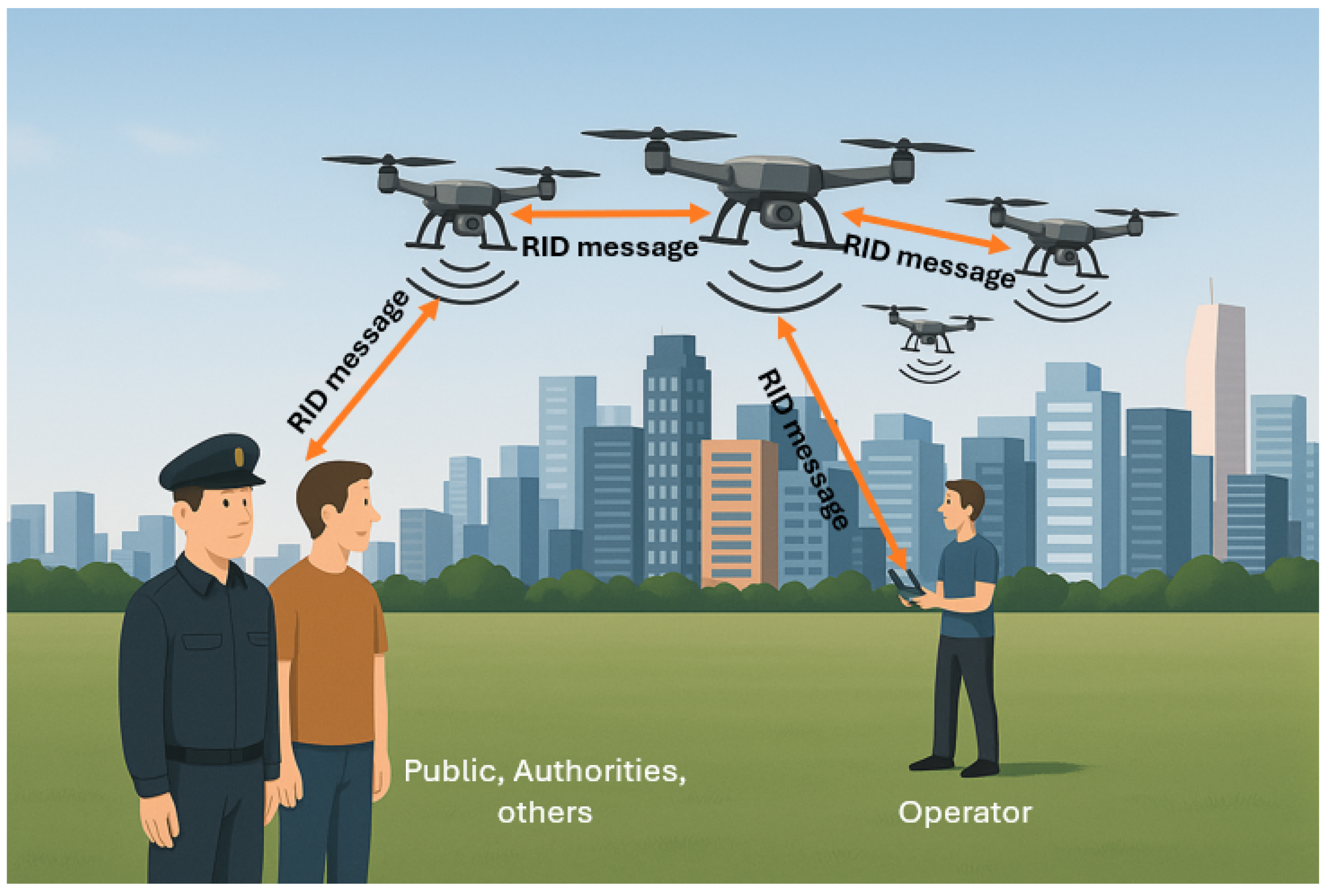

| ADS-B Data Field | Purpose/Description | Periodicity |
|---|---|---|
| Preamble | Used to synchronize the transmitters and receivers | Static (≥1/1 s) |
| Downlink Format (DF) | Indicates the type of message. A value of 17 indicates the extended squitter message format | Static (≥1/1 s) |
| Transponder Capability (CA) | Indicates the communication capability of the Mode S transponder | Static (≥1/1 s) |
| ICAO Address (AA) | The unique 24-bit identifier assigned for the life of the transponder, used for aircraft identification | Static (≥1/1 s) |
| Message Field (ME) | Contains the corresponding surveillance data such as identification, position, velocity, urgency code, and quality level. The first bits are the type code (TC), which describes the type of information contained in the remaining 51 bits of the ME field. | Dynamic (≥1/1 s) |
| Parity Check (PI) | Used by receivers to detect and correct transmission errors | Dynamic (≥1/1 s) |
| RID Data Field | Purpose/Description | Periodicity |
|---|---|---|
| UAV ID | Unique identifier traceable to a unique UAV and its operator (Serial No., Reg. ID, UTM UUID, or Session ID). | Static (≥1/3 s) |
| Latitude/Longitude | Current geographical position of the UA. | Dynamic (≥1/1 s) |
| Timestamp | Time of applicability of the Location Message. | Dynamic (≥1/1 s) |
| Height Type | Height above takeoff location or above ground level (AGL). | Dynamic (≥1/1 s) |
| Operator Location | Location of the remote pilot/GCS, or the aircraft’s takeoff location if dynamic data is unavailable. | Static (≥1/3 s) |
| Velocity/Speed | Direction and speed of the UA. | Dynamic (≥1/1 s) |
| Emergency Flag | Operational status indicating distress or emergency. | Dynamic (≥1/1 s) |
| Horizontal/Vertical Accuracy | Quality/containment measure for positional data. | Dynamic (≥1/1 s) |
| Broadcast Medium | Range | Characteristics |
|---|---|---|
| Bluetooth Legacy (4.x) | ∼400 m | Uses short “advertisement” frames, leading to limited range and requiring messages to be segmented. |
| Bluetooth 5.x Long Range | >1 km | Adds Forward Error Correction, increasing range by a factor of 4; requires use of the Message Pack format (Type 0xF). |
| Wi-Fi Neighbor Awareness Network (NAN)/Wi-Fi Aware | >2 km | Connectionless broadcast, enabling device exchange without infrastructure; payload encoded in Service Discovery Frame; power consumption . |
| Wi-Fi Beacon | >2 km | Encodes RID message pack as a vendor-specific information element payload; power consumption . |
| Feature | ADS-B | RID |
|---|---|---|
| Data Link | Uses the Mode S Extended Squitter (1090ES) transponders and UAT. | Uses Bluetooth, Wi-Fi, or LoRa for BRID. Network RID uses LTE/5G for communication via dedicated servers. |
| Operating Frequencies | Mode S Extended Squitter: 1090 MHz. UAT: 978 MHz. | BRID uses unlicensed radio spectrum such as 2.4 GHz or 5.8 GHz. Net-RID uses the licensed radio spectrum allocated to the commercial cellular provider the UAV is subscribed to. |
| Message Broadcast Periodicity | Position data is broadcasted approximately once per second. | Dynamic messages shall be sent at least every second. Static messages shall be sent every three seconds. |
| Message Length | The Extended squitter messages have 112 bits with the embedded ADS-B data payload constituting 56 bits. UAT transmits dedicated ADS-B messages consisting of 272 bits. | Broadcast messages are designed to be short Block messages. Each broadcast message shall be 25 bytes in length: 1 byte header + 24 bytes data. |
| Key Message Content | Aircraft identification, position, altitude, velocity, and urgency code. | Unique identifier, UAV position, control station/remote pilot location, velocity, timestamp, and emergency flag. |
| Identity Broadcast | Has ICAO Address which is a fixed hardware ID and Call Sign as the flight ID. | Has a UAV ID which constitutes the UAV serial number and Session ID. |
| Range | High range, typically 185 km to 370 km. | BRID has a restricted local range of 200 m to 10 km. Net-RID coverage is limited to areas with network connectivity. |
| Survey Paper | Working Principle | Attacks | Detection | Mitigations | Tools and Datasets | Research Gaps and Future Directions | ||||
|---|---|---|---|---|---|---|---|---|---|---|
| ADS-B | RID | ADS-B | RID | ADS-B | RID | ADS-B | RID | |||
| [18] |  | × | | × | × | × | | × | × | |
| [12] | × | × |  | × | | × | × | × | × | × |
| [30] | | × | | × | × | × | | × | × | × |
| [31] | × | × | | × | | × | | × | × | |
| [32] | | × | | × | × | × | × | × | × | × |
| [33] | | × | | × | × | × | | × | × | × |
| [11] | | | × | × | × | × | × | × | × | × |
| [20] | | | × | × | × | × | × | × | × | × |
| [14] | × | × | | | × | × | × | × | × | × |
| [34] | | × | × | × | × | × | × | × | × | × |
| [35] | | × | | × | × | × | | × | × | |
| [15] | × | × | | | × | × | × | × | × | × |
| [36] | | × | | × | × | × | | × | × | |
| [37] | | × | | × | × | × | | × | × | |
| [38] | | × | | × | × | × | | × | × | × |
| [39] | × | × | × | × | × | × | | × | × | |
| Our Paper | | | | | | | | | | |
fully covered; partially covered; × not covered.| Attack Category | Attack Type | Description | Impact |
|---|---|---|---|
| Injection | ADS-B Injection | Injecting ADS-B messages into a data link, often by creating fake ADS-B signals or crafting messages that conform to the ADS-B protocol to mimic legitimate traffic. | Operational disruptions, Remote hijacking of aircraft, Increased risk of collisions and Mission failures. |
| RID Injection | Injecting fake RID messages with the same unique identifiers. | Operational disruptions, Remote hijacking of aircraft, Increased risk of collisions and Mission failures. | |
| Ghost Injection | Injecting false aircraft or UAV data by broadcasting false ADS-B and RID messages, making it appear that real aircraft exists. | Increased risk of collisions, Inaccurate data collection, and data integrity compromise. | |
| DoS/DDoS | Jamming | Signals are transmitted by the jammers to prevent the reception of ADS-B/RID messages or GPS signals. | Communication loss, loss of UAV control, mission failure, collision risk. |
| Intrusion | Malware Infection | Malicious software is covertly installed on ADS-B/RID module’s processing unit. | Communication loss, loss of UAV control, mission failure, collision risk, data corruption. |
| Firmware flashing/modification | Unauthorized alteration or replacement of embedded firmware residing in ADS-B and RID modules to modifications that bypass integrity checks, disable logging or even forge legitimate broadcasts. | Operational, disruptions, hardware/software malfunction, mission failure, collision. | |
| Fuzzing | Intentionally providing malformed or random inputs targeting communication channels of ADS-B and RID devices with the goal of discovering protocol vulnerabilities in how ground control stations, Command and Control systems or traffic management software parse and process incoming messages. | Operational disruptions, collision risk, mission failure. | |
| Spoofing | GPS Spoofing | Broadcasting fabricated GPS signals to cause the target GPS receiver to calculate an incorrect position, which is then broadcast via ADS-B or RID devices. | Incorrect navigational data, mission failure, risk of collision. |
| RID Spoofing | Broadcast of falsified identification packets intended to impersonate legitimate UAVs to mislead both observers and neighboring UAVs. | Inaccurate broadcast data, compromised UAV identification, risk of collision, mission failure. | |
| ADS-B Spoofing | Broadcasting counterfeit ADS-B signals to impersonate legitimate aircraft and induce incorrect positioning or timing information. | Inaccurate broadcast data, compromised aircraft situational awareness, risk of collision, mission failure. | |
| AitM | Replay | Capturing legitimate messages (ADS-B or RID) and re-transmitting them later with the intent to deceive. | Operational disruptions, data corruption, Collision risk, mission failure. |
| MitM | Intercept, modify, change or even replace messages of either ADS-B or RID, thereby compromising the integrity of their messages. | Data corruption, hijack, collision risk, mission failure. | |
| Supply Chain | Hardware Supply Chain | Malicious modifications are introduced to hardware components of ADS-B or RID modules at any stage of the supply chain; from design to manufacturing and distribution. | Persistent unauthorized access and control of hardware components, prolonged operational disruptions, mission failure, collision risk. |
| Software Supply Chain | Compromising a software that processes ADS-B/RID data by injecting malicious code into the software at any point in its lifecycle, such as during design, development, deployment, or updates. | Persistent backdoor to software, prolonged operational disruptions, mission failure, collision risk. | |
| AML | Poisoning | Corrupts datasets used for training models for anomaly detection in ADS-B or RID or introduces corrupted sensor data. | Data corruption, path deviation, collision risk, mission failure. |
| Evasion | Deceives AI models for anomaly detection into making incorrect classifications by subtly manipulating the input test data. | Data corruption, path deviation, operational disruptions, collision risk, mission failure. | |
| Model Stealing | Duplicates or clones the functionality of the target AI model using input/output behavior to construct a surrogate model that functionally mimics the AI-based detection systems. | Data corruption, path deviation, operational disruptions, collision risk, mission failure. | |
| Model Inversion | Reconstructs sensitive features of training data by exploiting the correlation those features have with the model’s output. | Data corruption, Path deviation, Operational disruptions, Collision, Mission Failure. | |
| Membership Inference | Attempts to infer whether a specific data record was included in the training dataset of a target AI model in order to craft evasion attack to mimic those learned characteristics to avoid detection. | Data corruption, path deviation, operational disruptions, collision risk, mission failure. |
| Category | Typical Targeted Attack Types | Strengths | Limitations |
|---|---|---|---|
| Non-AI | GNSS spoofing and tampering, false position injection, data replay, ghost aircraft, coarse trajectory anomalies. | Low computational overhead; simple to implement; no need for labeled datasets; can be integrated with existing ADS-B/RID infrastructure. | Depend on fixed thresholds and expert rules; limited adaptability to complex or evolving attacks; reduced effectiveness in dense or atypical traffic. |
| AI-based (traditional ML) | Message injection and modification, path changes, ghost aircraft injection, velocity drift, denial-of-service, and jamming detection. | Detect a broader range of attack behaviors than rule-based methods; improved detection efficiency reported in several studies; lightweight variants exist for UAV platforms with feature selection. | Require labeled or carefully prepared datasets and feature engineering; performance may degrade when traffic patterns or attack behavior change. |
| AI-based (DL) | Position and velocity deviation, velocity drift, DoS, flight replacement, and multiple simulated ADS-B attack types. | Learn temporal and distributional characteristics directly from data; effective on diverse attack scenarios in reported simulations. | Require more training data and parameter tuning than non-AI methods; typically higher computational complexity. |
| Category | Typical Objectives/ Attack Types | Strengths | Limitations |
|---|---|---|---|
| Fingerprinting | Authenticate transmitters and distinguish legitimate ADS-B/RID emitters from rogue or spoofed ones; counter identity and location spoofing. | Uses hardware, software, or channel/location features that are difficult to replicate; helps identify rogue transponders and verify that messages originate from the claimed aircraft or UAV. | Often reliable only in short-range or controlled environments; require specialized sensing devices and sufficient SNR; increase manufacturing and hardware cost. |
| Anti-jamming | Mitigate interference and intentional jamming that degrade ADS-B/ RID broadcasts. | Antenna arrays and signal-processing methods (e.g., spatial null steering, notch filtering, waveform suppression) can attenuate interference while preserving the legitimate broadcast; lightweight filtering methods offer low computational and hardware complexity. | Typically tuned to specific interference types; less effective for wideband or sophisticated jamming; some techniques assume advanced antenna architectures not available on all receivers. |
| Anti-spoofing | Suppress or filter spoofed ADS-B/RID transmissions that mimic legitimate broadcasts. | DoA–based null steering can place a spatial null on the spoofing source while preserving desired traffic; many anti-jamming antenna strategies can be reused for spoofing scenarios. | Narrowband filtering does not fully address wideband spoofing that closely imitates legitimate signals; in practice, mitigation often relies on detecting anomalous transmissions and discarding affected data rather than fully cancelling the spoofed signal. |
| PLA & PLS | Mitigate spoofing, message injection, and jamming. | Leverages channel, signal, and location features for authentication; enables receiver-side DoA or ranging checks without ADS-B protocol changes; PLS techniques (e.g., beamforming, artificial noise, and null steering) mitigate interference and leakage. | Depends on channel conditions and receiver capability; limited in long-range/low-cost settings; some PLS assumes directional/control links and is less suited to open broadcast. |
| AI-based mitigation | Support mitigation for spoofing, jamming, message injection, and impersonation; strengthen RID trust and privacy. | ML/DL models can characterize attack patterns, infer adversarial intent, and trigger actions such as adaptive navigation or channel avoidance; AI-based SEI improves identification of individual transmitters; anonymous RID protocols and decentralized enforcement enhance verifiability and compliance while protecting operator privacy. | Require training data, model tuning, and additional processing compared with basic methods; cryptographic and decentralized schemes introduce key-management and communication overhead and must be tailored to UAV hardware and energy constraints. |
| Reference | System | Reported Timing Metric |
|---|---|---|
| [120] | ADS-B | ≈6–9 s prediction time. |
| [121] | ADS-B | GNSS jamming detection time < 15 s. |
| [122] | ADS-B | Not reported. |
| [123] | ADS-B | Not reported. |
| [7] | RID | ARID takes ms to generate a message. |
| [26] | RID | ms to generate anonymous RID messages; ms to generate anonymous RID messages; ms to generate anonymous RID messages. |
| Category | Simulators | Description |
|---|---|---|
| Network Simulators [140,141,142,143,144,145] | NS3 (https://www.nsnam.org/, accessed on 20 June 2025); OMNet++ (https://omnetpp.org/, accessed on 20 June 2025); GloMoSim (https://github.com/ykzeng/glomosim/tree/master, accessed on 20 June 2025); JSim (https://github.com/martimy/JSim, accessed on 20 June 2025); OPNET (https://opnetprojects.com/opnet-network-simulator/, accessed on 20 June 2025); NetSim (https://netsim.boson.com/, accessed on 20 June 2025); QualNet (https://www.keysight.com/us/en/assets/3122-1395/technical-overviews/QualNet-Network-Simulator.pdf, accessed on 20 June 2025). | Tools for analyzing network behavior and communication protocols. |
| Physical Simulators [146,147,148,149] | AirSim (https://airsim-fork.readthedocs.io/en/docs/, accessed 20 June 2025); MATLAB UAV Toolbox (https://www.mathworks.com/products/uav.html, accessed on 20 June 2025); Gazebo (https://gazebosim.org/home, accessed on 20 June 2025); JMAVSim (https://github.com/PX4/jMAVSim, accessed on 20 June 2025); PX4 SITL (https://docs.px4.io/main/en/simulation/, accessed on 20 June 2025); FlightGear (https://www.flightgear.org/, accessed on 20 June 2025); X-Plane (https://www.x-plane.com/, accessed on 20 June 2025). | Platforms for simulating UAV flight dynamics, sensor data, and environmental interactions. |
| Distributed Co-simulators [150,151,152,153] | CUSCUS (https://www.sciencedirect.com/science/article/abs/pii/S1570870517301701, accessed on 20 June 2025); AVENS (https://www.lsec.icmc.usp.br/en/avens, accessed on 20 June 2025); ROS-NetSim (https://github.com/alelab-upenn/ros-net-sim, accessed on 20 June 2025); FlyNetSim (https://github.com/saburhb/FlyNetSim, accessed on 20 June 2025); RoboNetSim (https://www.sciencedirect.com/science/article/pii/S0921889013000080, accessed on 20 June 2025); CORNET (https://ieeexplore.ieee.org/document/9027459, accessed on 20 June 2025); SUMO (https://sumo.dlr.de/docs/index.html, accessed on 20 June 2025). | Combines network and physical simulations. |
| Ground Control Station Software | Mission Planner (https://ardupilot.org/planner/, accessed on 20 June 2025); QGC (https://qgroundcontrol.com/, accessed on 20 June 2025); UGCS (https://www.sphengineering.com/flight-planning/ugcs, accessed on 20 June 2025); MAVProxy (https://ardupilot.org/mavproxy/index.html, accessed on 20 June 2025). | Software for planning, monitoring, and controlling UAV missions. |
| Name/Reference | Target | Year | Data Role | Attack Type | Number of Features | Number of Records | Nature |
|---|---|---|---|---|---|---|---|
| OpenSky [157] | ADS-B | Continuous | Baseline (Normal Traffic) | ADS-B Message Injection/ Modification | 17 | Variable | Real-time |
| FlightAware [158] | ADS-B | Continuous | Baseline (Normal Traffic) | ADS-B Message Injection/ Modification | 20 | Variable | Real-time, Historical |
| ADS-B Exchage [159] | ADS-B | Continuous | Baseline (Normal Traffic) | ADS-B Message Injection/ Modification | To be extracted based on need | Variable | Real-time |
| FlightRadar24 [160] | ADS-B | Continuous | Baseline (Normal Traffic) | ADS-B Message Injection/ Modification | To be extracted based on need | Variable | Real-time |
| ADS-BHub [161] | ADS-B | Continuous | Baseline (Normal Traffic) | ADS-B Message Injection/ Modification | To be extracted based on need | Variable | Real-time |
| Aireon [162] | ADS-B | Continuous | - | ADS-B Message Injection/Modification | To be extracted based on need | - | Real-time |
| UAV Dataset under Normal and Cyber-Attacks [163] | RID | 2023 | Pre-labeled Attack/Legitimate | Wi-Fi Deauth DoS, Replay, FDI, Evil Twin | Physical Dataset: 16, Cyber Dataset: 37 | - | Live (Physical Tesbed) |
| ECU-IoFT [164] | RID | 2022 | Pre-labeled Attack/Legitimate | Wi-Fi Deauth, WPA2-PSK Cracking | - | - | Live (Physical Tesbed) |
| DeepSim [97] | GPS | 2020 | Pre-labeled Attack/Legitimate | GPS Spoofing | Aerial photos, satellite imagery | 967 | Live (Physical Tesbed) |
| UAV Attack Dataset [165] | GPS | 2020 | Pre-labeled Attack/Legitimate | GPS Spoofing, GPS Jamming, Ping DoS | Physical Dataset: 16, Cyber Dataset: 37 | Cyber 53,976, Physical 54,784 | Simulated and live flight data |
| Dataset for GPS Spoofing [166] | GPS | 2022 | Pre-labeled Attack/Legitimate | GPS Spoofing | 13 | 158,170 | Simulated |
| GPS Spoofing Detection Dataset [167] | GPS | 2023 | Pre-labeled Attack/Legitimate | GPS Spoofing | 25 | 37,506 | Simulated |
| [168] | GPS | 2024 | Pre-labeled Attack/Legitimate | GPS Spoofing | 44 | - | Live (Physical Tesstbed) |
Disclaimer/Publisher’s Note: The statements, opinions and data contained in all publications are solely those of the individual author(s) and contributor(s) and not of MDPI and/or the editor(s). MDPI and/or the editor(s) disclaim responsibility for any injury to people or property resulting from any ideas, methods, instructions or products referred to in the content. |
© 2026 by the authors. Licensee MDPI, Basel, Switzerland. This article is an open access article distributed under the terms and conditions of the Creative Commons Attribution (CC BY) license.
Share and Cite
Shi, Q.; Caleb, T.D.; Shao, S.; Kaabouch, N. Security of ADS-B and Remote ID Systems: Cyberattacks, Detection Techniques, and Countermeasures. Sensors 2026, 26, 634. https://doi.org/10.3390/s26020634
Shi Q, Caleb TD, Shao S, Kaabouch N. Security of ADS-B and Remote ID Systems: Cyberattacks, Detection Techniques, and Countermeasures. Sensors. 2026; 26(2):634. https://doi.org/10.3390/s26020634
Chicago/Turabian StyleShi, Qinxuan, Toro Dama Caleb, Sicong Shao, and Naima Kaabouch. 2026. "Security of ADS-B and Remote ID Systems: Cyberattacks, Detection Techniques, and Countermeasures" Sensors 26, no. 2: 634. https://doi.org/10.3390/s26020634
APA StyleShi, Q., Caleb, T. D., Shao, S., & Kaabouch, N. (2026). Security of ADS-B and Remote ID Systems: Cyberattacks, Detection Techniques, and Countermeasures. Sensors, 26(2), 634. https://doi.org/10.3390/s26020634