1. Introduction
With the rapid development of new energy vehicles and energy storage systems, lithium batteries, as core energy storage components, are drawing increasing attention to their safety and reliability [
1]. Throughout their entire lifecycle, specifically encompassing four core stages—electrode manufacturing, cell assembly, aging test, and field service—lithium batteries develop stage-specific defects due to distinct manufacturing processes, environmental stresses, and operational loads. Each stage exhibits unique inspection contexts and defect priors. These stage-dependent defects not only compromise battery performance but also pose potential safety hazards [
2], highlighting the need for a unified detection model that adapts to diverse inspection contexts.Consequently, lithium batteries require high-precision, real-time multi-type defect detection [
3]. However, traditional inspection methods often rely on manual labor or single-modality imaging [
4], which face critical operational bottlenecks in industrial production. For manual inspection, the single-cell inspection cycle averages 12–15 s, severely failing to meet the mass production line requirement of 2–3 cells per second, while the average miss rate for micro-defects is high. These approaches suffer from low efficiency and high rates of missed defects, reaching 18–25%. Existing single-modality AOI (Automated Optical Inspection) systems excel at surface defect detection but have a miss rate of 25–35% for internal defects such as internal short-circuit points and electrode misalignment; single X-ray systems can penetrate to detect internal structures but achieve an accuracy of less than 60% for surface defects like shell scratches and tab deformation [
5]. The most frequently overlooked defects are those with pixel ratios of 1–5% and composite defects(cross-stage), which easily evolve into safety hazards such as thermal runaway during battery operation. Additionally, the inspection cycle of single-modality systems (3–5 s per cell) still cannot match the beat of high-speed production lines (≤1 s per cell), leading to production line bottlenecks.
In recent years, research on industrial defect detection and multimodal image analysis has rapidly increased, with extensive work including object detection based on convolutional neural networks (CNNs), semantic segmentation, and cross-modal fusion [
6,
7]. While semantic segmentation algorithms excel at pixel-level boundary refinement, they face critical limitations in defect detection scenarios, especially for diverse defect granularity and industrial real-time requirements. In contrast, YOLOv8 is uniquely suited for defect granularity and outperforms segmentation algorithms in empirical performance [
8]. Overall, existing research can be categorized into several main approaches, summarized as follows. Regarding monomodal object detection and segmentation methods, much work directly applies general-purpose detection or segmentation networks to defect detection [
9]. While these methods are simple to implement and train efficiently, their performance is limited when encountering subtle, hidden defects or scenarios where X-ray and visible-light information complement each other, with false negatives and false positives remaining significant issues [
10]. Regarding multimodal fusion methods, a rapidly growing research direction involves integrating multiple imaging modalities—such as visible light, X-ray, infrared, or ultrasound—to complement the limitations of single modalities. Several studies have attempted fusion at the data, feature, or decision levels, demonstrating potential for enhancing detection robustness in complex scenarios [
11,
12]. However, existing fusion strategies often lack unified, universal frameworks and frequently struggle to balance real-time performance with model lightweighting. Attention mechanisms and feature enhancement: To address challenges with minute targets and background interference, numerous studies have introduced multi-scale feature pyramids and feature enhancement structures to boost small-object detection rates [
13,
14]. Yet their effectiveness hinges on sufficiently diverse training samples and well-designed modules. Regarding end-to-end and lightweight model optimization, to meet industrial online inspection demands for real-time performance and resource-constrained environments, researchers often combine structural modifications with training-level techniques to improve inference speed while maintaining high accuracy [
15]. Nevertheless, performance degradation persists in scenarios involving extremely small objects or cross-modal contexts [
16]. Synthesizing the above research, multiple productive technical pathways have emerged in this field, achieving significant progress on several representative tasks. Nevertheless, several key challenges persist in the field today: the inability to achieve simultaneous fusion of multimodal information; immature mechanisms for multimodal and multi-scale representation as well as fusion, which makes it challenging to strike a balance between high accuracy and real-time performance, and a lack of unified detection frameworks that cover the entire lifecycle and various defect types. For baseline comparisons, representative detection frameworks are clearly defined: RetinaNet (with ResNet-50 backbone) serves as the non-YOLO industrial baseline, while YOLOv5s, YOLOv7, YOLOv8s, and YOLOv9-S represent mainstream one-stage detectors for performance benchmarking.
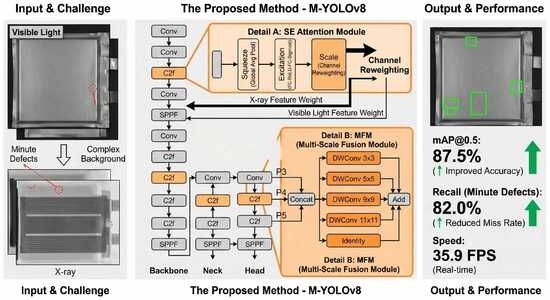
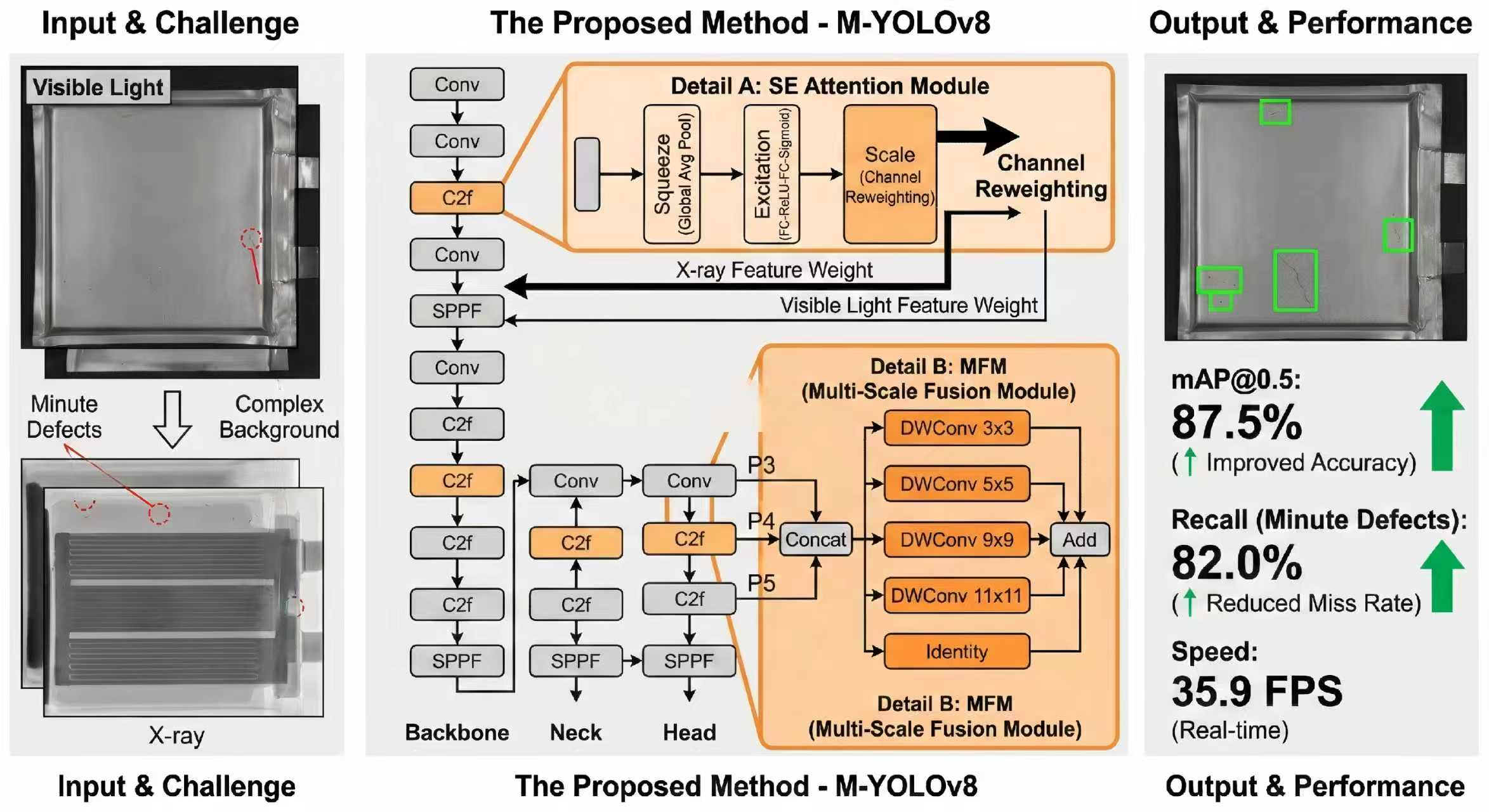
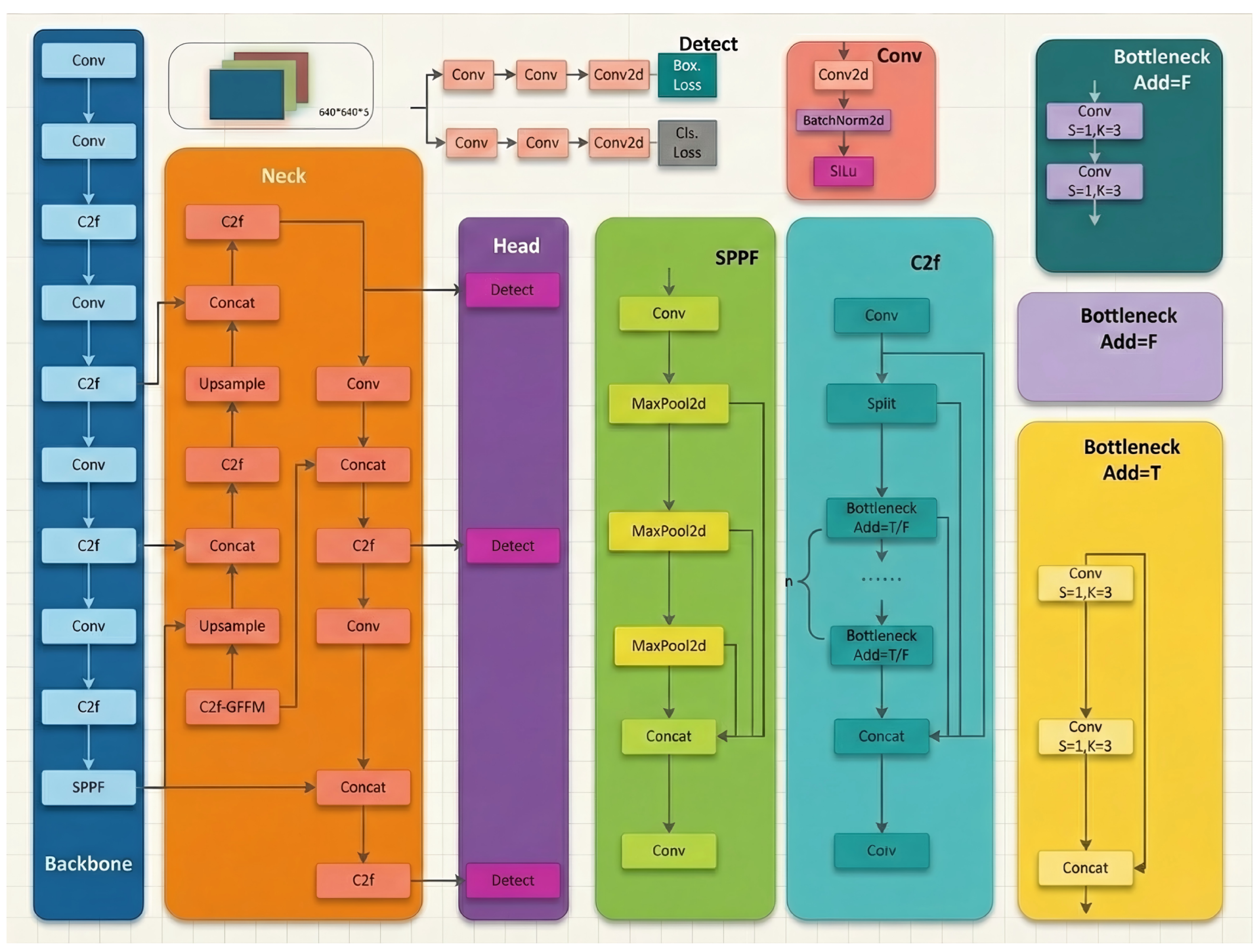
This study proposes an improved YOLOv8 approach based on multimodal fusion and attention enhancement, aiming to achieve unified detection of multiple defect types throughout the entire lifecycle of lithium batteries. The core motivation is that strengthening a single-modality YOLO model cannot break through the physical limitations of the modality itself: visible light can capture surface texture details but cannot penetrate the battery shell to identify internal structural defects, while X-ray can reveal internal discontinuities but lacks sensitivity to surface texture features. This makes it impossible to simultaneously address the industrial pain points of high miss rates for cross-type defects and low inspection efficiency. In contrast, combining visible-light (surface defect recognition) and X-ray (internal defect detection) modalities is essential to achieve full-defect coverage. The Squeeze-and-Excitation (SE) module further solves the problem of unbalanced information importance between modalities by dynamically weighting channel features, suppressing redundant information in single modalities, and highlighting complementary features. The MFM targets the key pain point of micro-defect miss detection by fusing multi-scale features to amplify the expression of minute defects (1–5% pixel ratio) that are easily lost in single-modality subsampling. Only the synergistic effect of dual modalities and these two modules can comprehensively solve the bottlenecks of low efficiency, high miss rates, and poor multi-defect adaptability in existing industrial inspection, which is unattainable by simply enhancing a single-modality YOLO model. Specifically, this study constructs a multimodal dataset by integrating visible-light and X-ray image information to overcome the limitations of single-modal images in capturing defect details.It introduces a channel attention mechanism (SE module) to adaptively filter and weight critical information, thereby enhancing detection accuracy. A Multi-Scale Fusion Module (MFM) is designed to amplify the expression of minute defect features. While ensuring real-time performance, the approach further improves detection precision and recall rates. Through the synergistic effects of multimodal fusion and attention enhancement, the improved model effectively boosts detection performance across diverse defect types and scales while maintaining a lightweight architecture and real-time capability. This research will help reduce the risk of missed defects in lithium battery production, enhance safety, minimize redundant costs, and promote the adoption of related technologies in other industrial inspection scenarios.
3. Experiments and Results Analysis
To ensure the rigor and reproducibility of all experiments, a unified experimental protocol was adopted for the proposed model and all baseline models (YOLOv5s, YOLOv7, YOLOv8s, YOLOv9-S, RetinaNet-ResNet50): (1) Random seeds: Fixed to 42, 123, and 456 for three independent training runs to avoid randomness-induced performance fluctuations. (2) Training schedule: Consistent for all models (AdamW optimizer, initial learning rate = 0.01, batch size = 32, 300 training iterations, cosine annealing learning rate decay). (3) Data augmentation: Identical strategies applied (geometric transformations, pixel-level augmentation, and modality fusion augmentation for multimodal models, as detailed in
Section 3.1). (4) Initialization: All models use official pre-trained weights (COCO dataset) with consistent adaptation for multimodal inputs. (5) Evaluation: Results are reported as mean ± standard deviation across the three independent runs, ensuring statistical reliability.
3.1. Platform Setup and Dataset Processing
To ensure the efficient advancement of lithium battery defect detection experiments based on multimodal fusion and attention-enhanced YOLOv8, guaranteeing the reliability of experimental data, stability of model training, and validity of industrial deployment verification, a comprehensive experimental platform must be established across three dimensions: hardware support, software coordination, and dataset construction. The specific design is as follows.
The hardware platform is designed with “high-performance training + industrial-grade deployment simulation” as its core objectives, featuring a layered configuration based on functional modules. The training node adopts NVIDIA RTX 4090 (24 GB VRAM)/Tesla V100 (32 GB VRAM) GPU servers to ensure efficient model training and weight optimization. The deployment simulation node utilizes NVIDIA Jetson Xavier NX (8 GB VRAM) (Santa Clara, CA, USA) edge devices to validate the real-time inference performance in industrial scenarios. Data processing and scheduling rely on Intel Core i9-13900K/AMD Ryzen 9 7950X CPUs, while storage is implemented with 2 TB NVMe SSDs to meet the high-speed read/write requirements of multimodal datasets and model weights. All modules are interconnected through high-speed interfaces, forming a complete hardware support chain.
The software platform constructs a collaborative software stack based on the principle of “framework compatibility + tool adaptation + full-feature coverage.” It adopts PyTorch 2.1.0 as the primary deep learning framework and TensorFlow 2.15.0 as a secondary framework to support model construction and cross-validation. Benchmark model invocation and improvement module embedding are implemented using Ultralytics YOLOv8 (v8.1.0). Deployment efficiency is ensured through TensorRT 8.6.1 (for edge quantization acceleration) and ONNX Runtime 1.16.0 (for cross-platform inference). Data preprocessing and annotation are completed using OpenCV 4.8.0, PIL 10.1.0, and LabelImg 1.8.6. Training monitoring and performance analysis are achieved via TensorBoard 2.15.1 and PyTorch Profiler. The Ubuntu 22.04 LTS (for training tasks) and Windows 11 (for preprocessing workflows) operating systems ensure seamless software collaboration throughout the entire workflow.
For dataset construction, the data sources cover four core stages of the full lifecycle of lithium-ion batteries, with eight types of defect samples collected: specifically, the electrode manufacturing stage (defect types: pole piece cracks and tab deformation; modality combination: visible light + X-ray; 1200 sample pairs; defect pixel ratio: 1–5%), cell assembly stage (defect types: separator perforation, electrode misalignment, internal short-circuit points; modality: X-ray; 900 sample pairs; defect pixel ratio: 3–8%), and post-aging test stage (defect types: cell bulging, shell scratches, internal bubbles; modality combination: visible light + X-ray; 1500 sample pairs; defect pixel ratio: 5–12%). Additionally, healthy samples (defect-free cells; modality combination: visible light + X-ray; 800 sample pairs) and composite defect samples (defect types: crack + bubble, dark spot + electrode shadow; modality combination: visible light + X-ray; 600 sample pairs; defect pixel ratio: 2–10%) are included. All defect samples are “strictly paired” data: a sample pair consists of the visible-light and X-ray images of the same physical cell, and spatial alignment (alignment error ≤ 1 pixel) is achieved via SIFT feature matching to ensure multimodal information consistency. The detailed distribution of various defect types and sample details are presented in
Table 1. The SIFT-based alignment introduces a runtime overhead of 8.2 ms per sample pair during offline dataset construction, which is acceptable for preprocessing (no impact on online inference speed). In controlled industrial environments with minimal vibration (<0.1 g) and regular calibration (monthly frequency), the alignment success rate remains above 99.2%; however, under severe vibration (>0.3 g) or sensor miscalibration, the success rate drops to 89.5–92.1%, primarily due to blurred feature points or mismatched keypairs.
For production environments prioritizing low preprocessing latency, simpler alternatives were evaluated: (1) Calibration-based alignment (using pre-calibrated camera intrinsic/extrinsic parameters) reduces runtime to 2.1 ms per pair but increases alignment error to 2–3 pixels, which marginally degrades mAP@0.5 by 1.3% in subsequent detection. (2) Approximate alignment (nearest-neighbor pixel matching) achieves 1.5 ms latency but leads to 3–5 pixel errors and a 3.7% mAP@0.5 drop. Thus, SIFT-based alignment is retained for the proposed framework to ensure high detection accuracy, while calibration-based alignment is recommended as a viable alternative for scenarios where latency takes precedence over marginal accuracy losses.
To ensure consistent taxonomy for defect naming across the manuscript, the following naming conventions are strictly followed: (1) Single defect types are named with “[Defect Location/Component] + [Defect Form]”. (2) Composite defects are named with “[Primary Defect] + ‘+’ + [Secondary Defect]”. (3) Abbreviations are avoided except for universally recognized terms. (4) Defect type names are consistent across the abstract, main text, tables, and figures.
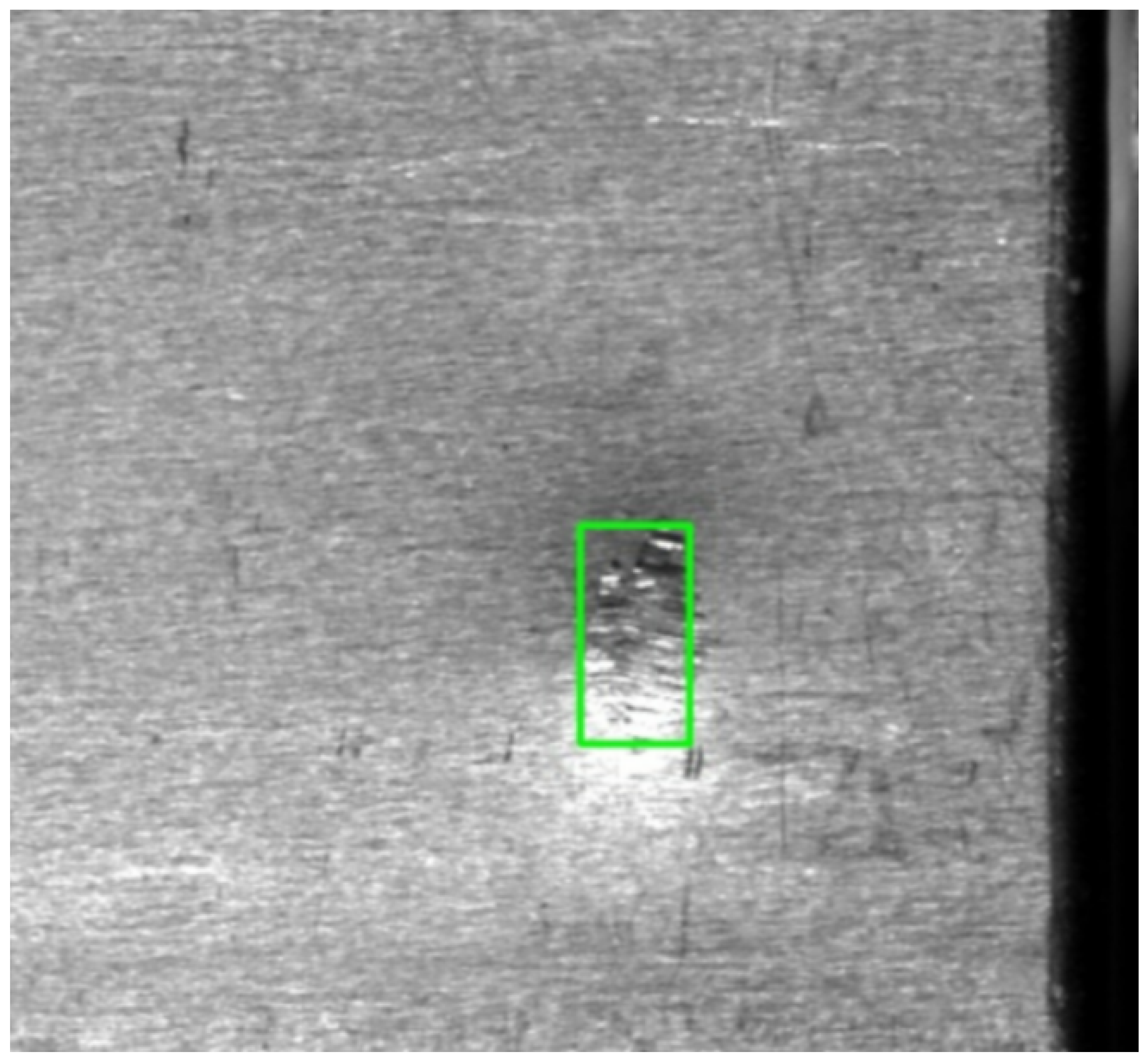
For data annotation, an annotation team was formed, comprising three engineers with over 3 years of lithium-ion battery quality inspection experience and one computer vision expert. The annotation process involves first labeling defect categories and bounding boxes (coordinate format: (x
1,y
1,x
2,y
2)) using the LabelImg tool, followed by cross-validation by experts, as shown in
Figure 5; Cohen’s Kappa coefficient was used to verify annotation consistency (
= 0.92, meeting industrial-grade annotation accuracy requirements), ultimately achieving a bounding box localization error
pixels and a category annotation accuracy
.
For data preprocessing, modality normalization is first performed: X-ray images are normalized to [0, 1] using min–max scaling, while visible-light images retain RGB channel standardization (mean: 0.485, 0.456, 0.406; variance: 0.229, 0.224, 0.225). Data augmentation is then implemented, including (1) geometric transformations: random horizontal flipping (probability = 0.5), rotation within −15° to 15°, scaling (0.8–1.2×), and random cropping (crop ratio: 0.7–1.0); (2) pixel-level augmentation: brightness/contrast adjustment by ±20% and Gaussian noise (standard deviation ≤ 0.02) for visible-light images, and Poisson noise (to simulate industrial imaging noise) for X-ray images; (3) modality fusion augmentation: feature-level fusion (concatenating visible-light and X-ray features after C2f module output) and channel-level fusion (treating X-rays as the fourth channel to concatenate with RGB, forming a 4-channel tensor), with the two methods dynamically switched (probability = 0.5 for each). For the four-channel input in channel-level fusion, the first convolution layer of the COCO-pre-trained YOLOv8s backbone is adapted as follows: the original three-input-channel convolution kernel (size 3 × 3 × 3 × 64) is extended to four input channels by replicating the weight of the RGB channel with the closest statistical distribution to X-ray (green channel, mean = 0.456), ensuring consistent initialization without disrupting pre-trained feature extraction. The bias term remains unchanged during initialization, and the extended convolution kernel is fine-tuned during model training to adapt to X-ray feature characteristics. Finally, stratified sampling (based on defect category proportions) is used to split the dataset into training set/validation set/test set at an 8:1:1 ratio, with a total sample size of 5000 pairs (corresponding to 10,000 images), to avoid class imbalance (the minimum number of samples for any defect category is ≥300 pairs).
3.2. Evaluation Indicators
To scientifically quantify the performance of the multimodal fusion and attention-enhanced YOLOv8 model in lithium battery defect detection, while aligning with the core requirements of industrial scenarios for detection accuracy, real-time capability, and deployment feasibility, the following metrics are introduced, as presented in
Table 2.
3.3. Ablation Experiment
All experiments used parameter settings (AdamW optimizer, initial learning rate of 0.01, batch size = 32, 300 iterations) and were evaluated on the test set.
Five groups of ablation experiments are designed in this paper.
A1: YOLOv8s (baseline, single-modal visible-light input).
A2: YOLOv8s + modal fusion (visible light + X-ray, without SE/MFMs).
A3: YOLOv8s + modal fusion + SE module.
A4: YOLOv8s + modal fusion + MFM.
A5: YOLOv8s + modal fusion + SE + MFM (the proposed model).
The specific performance indicators are presented in
Table 3.
To quantitatively investigate the independent contributions and synergistic effects of the modal fusion strategy, as well as the SE and MFMs, on model performance, this section analyzes the results of five experimental groups: Taking A1 as the reference, A2 exhibits a 3.9% increase in mAP@0.5 and a 4.2% improvement in MRR. This verifies that X-rays can compensate for the limitation of visible light in characterizing internal defects, as dual-modal fusion expands the representation dimension of defect features. A3, which incorporates the SE module into A2, achieves a further 2.2% increase in mAP@0.5 and a 0.6% reduction in FPR; this is attributed to the SE module’s channel attention mechanism, which dynamically weights effective dual-modal features and suppresses redundant information, thereby enhancing the specificity of feature representation. For A4 (integrating the MFM into A2), a 3.0% rise in mAP@0.5 and a 6.7% improvement in MRR are observed, highlighting the feature enhancement effect of multi-scale feature fusion on tiny defects and particularly optimizing the recognition and ranking performance for fine-grained defects. When comparing A5 (which synergistically integrates both the SE and MFMs) with A3 and A4, its mAP@0.5 reaches 87.5%, a further improvement of 2.2% and 1.4%, respectively, demonstrating that the two modules form a complementary optimization mechanism: the SE module assigns reasonable weights to multi-scale features, while the MFM expands the feature representation dimension, jointly unlocking the performance potential of dual-modal fusion.
The AP improvements in the A5 group relative to the A1 group for different defect types are presented in
Table 4.
3.4. Comparative Experiments
In the comparative experiment of this study, five representative models from the YOLO series (YOLOv5s, YOLOv7, YOLOv8s, YOLOv9-S) and one non-YOLO industrial baseline—RetinaNet (with ResNet-50 as the backbone)—were selected. All models were trained and tested under consistent experimental settings (same dataset, optimizer, learning rate schedule, and training iterations) to ensure fair comparison. Performance comparisons were conducted across dual environments—server (NVIDIA RTX 4090) and edge device (NVIDIA Jetson Xavier NX).The specific parameters are presented in
Table 5.
Experimental results demonstrate that, in terms of performance comparison, compared with the YOLOv9-S model (trained with its official recommended configuration: AdamW optimizer, initial learning rate 0.01, and 300 training iterations, consistent with the proposed model), the mAP@0.5 metric of the proposed model in this study increases by 2.3%, and the MRR metric rises by 4.8%. In terms of resource overhead, YOLOv9-S has 15.8 M parameters and 35.2 G FLOPs, while the proposed model reduces parameters by 3.7 M (23.4% reduction) and FLOPs by 4.7 G (13.3% reduction). In terms of inference speed, the proposed model is 3.3 fps higher on the server and 2.5 fps higher on edge devices, successfully striking a superior balance of “high accuracy–high speed–lightweight” compared to YOLOv9-S. Compared with the RetinaNet (ResNet-50) baseline, the proposed model’s mAP@0.5 increases by 8.0% (from 79.5% to 87.5%) and FPS rises by 13.1 fps (from 22.8 to 35.9 on the server; 16.5 to 25.7 on edge devices). This result verifies that YOLOv8’s anchor-free architecture and lightweight design are more suitable for real-time, high-precision industrial detection scenarios than RetinaNet’s two-stage framework.
This study selects YOLOv8s as the basic architecture based on four key advantages, compared with other mainstream detectors: (1) Flexibility: Its modular design supports seamless integration of multimodal fusion strategies and custom modules, which is more adaptable than RetinaNet’s fixed feature pyramid structure. (2) Deployment maturity: The Ultralytics ecosystem provides out-of-the-box support for TensorRT/ONNX quantization and edge deployment, outperforming RetinaNet (which requires additional custom engineering for edge adaptation) and YOLOv7 (with limited quantization optimization tools). (3) Real-time performance: On edge devices, YOLOv8s achieves 28.0 FPS, which is 11.4 FPS higher than RetinaNet (16.5 FPS), 9.4 FPS higher than YOLOv7 (18.6 FPS), and 10.7% faster than YOLOv9-S (23.2 FPS), fully meeting high-speed production line requirements. (4) Accuracy–efficiency balance: YOLOv8s’ anchor-free design enhances small-defect detection accuracy (MRR = 75.8%), outperforming RetinaNet (MRR = 72.1%) and YOLOv5s (MRR = 69.4%), while maintaining a lightweight profile (11.2 M parameters) that is far more efficient than YOLOv7 (36.9 M) and RetinaNet (32.4 M). Notably, YOLOv9-S [
31] achieves slightly higher accuracy (mAP@0.5 = 85.2%) but sacrifices edge FPS and increases deployment complexity via its PGI mechanism, making it less suitable for resource-constrained industrial scenarios.
3.5. Robustness Verification Experiments
To address common interference factors in industrial scenarios, this study has designed three types of robustness tests to verify the anti-interference capability of the model: the noise interference test is implemented by adding low-, medium-, and high-intensity Gaussian noise and Poisson noise; the lighting variation test is conducted on visible-light images, adjusting their light intensity to three states: low light (reduced by 30%), normal light, and strong light (increased by 30%); the modality absence test verifies the model’s fault tolerance in scenarios where partial modality information is missing by inputting only a single modality. The test results are presented in
Table 6.
Under high-noise interference, the mAP@0.5 of the proposed model remains above 80.5%, with only a 5.7–7.0% drop—outperforming other baselines (YOLOv8s exhibits a 9.3–10.4% drop). This advantage stems from the SE module and the MFM. In the modality absence scenario, the mAP@0.5 reaches 82.3% when only visible light is input, and 80.7% when only X-ray is input; this confirms that cross-modal features have transfer capability. Lighting variation has a minor impact (only a 0.8% drop under low light), as the X-ray modality is immune to lighting interference, and the SE module dynamically adjusts the weight of the visible-light channel.
3.6. Industrial Deployment Adaptation Experiments
To verify the deployment compatibility and system integration capability of the model, this study conducts relevant verification work by simulating the end-to-end detection process of industrial production lines. In the hardware adaptation phase, the operational performance of the quantized model is tested on three types of mainstream edge devices. For process integration, a complete system covering image acquisition, data transmission, inference detection, and alarm feedback is built, with successful interfacing to the PLC control system; for standard verification, the model is tested for compliance with the quality inspection specifications in ISO 1219-1:2021.
After testing on different edge devices, the quantized performance is presented in
Table 7.
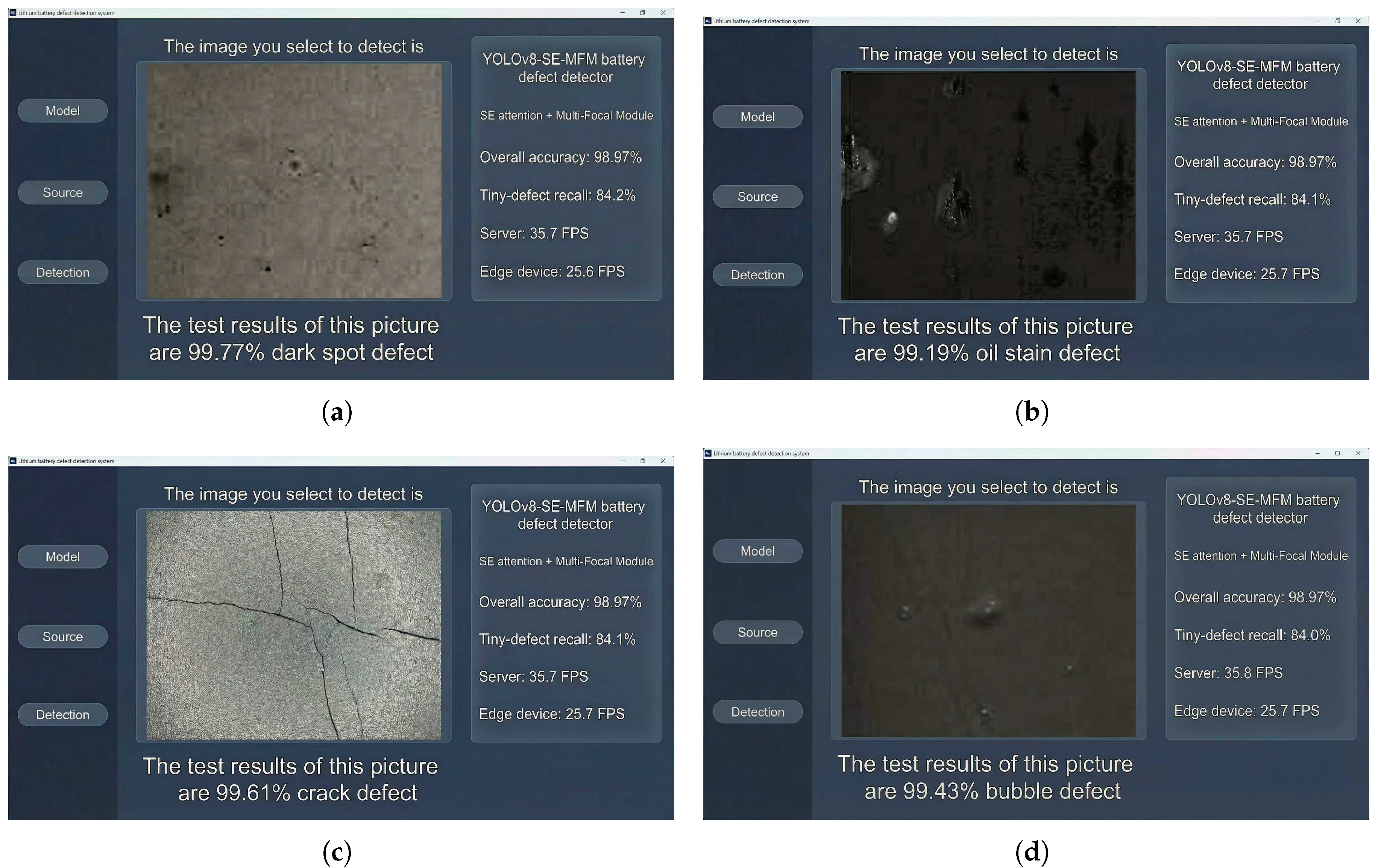
The end-to-end system architecture constructed in this study consists of five core modules: the image acquisition module (supporting synchronous triggering), the data transmission module (using Ethernet/5G with latency ≤ 10 ms), the inference detection module (with batch inference capability), the decision feedback module (integrating PLC alarm and robotic arm sorting functions), and the data storage module (for defect traceability). The integration test results indicate that the system operated continuously for 72 h, processed over 100,000 samples without fault shutdown, and achieved operational performance including an alarm response time ≤50 ms, a 100% communication success rate, and a 100% data traceability accuracy. Visualization results are shown in
Figure 6.
In terms of industrial standard compliance, the system’s average recognition accuracy for all defect types reaches 97.49%, meeting the practical quality control threshold (≥95%) for lithium battery manufacturing; the end-to-end detection latency is 30.9–38.9 ms, which complies with the high-speed production line speed requirement (≤50 ms). For system compatibility, the system supports docking with mainstream industrial control systems such as Siemens SIMATIC and Rockwell FactoryTalk, adhering to industrial communication protocol specifications.
3.7. Large-Scale Field Verification Experiments
The sample configuration for this test consists of 1000 groups, divided by lifecycle stages (200 groups per stage), and includes 200 groups of composite defect samples and 100 groups of extreme scenario samples. The testing scenario is set in a dynamic production line environment, with a corresponding conveyor belt speed of 1.5–2.0 m/s and an ambient temperature range of −10 °C to 45 °C. For the temporal test, samples are collected in three batches (with a 1-month interval between batches) to verify the model’s generalization ability across different batches. The verification results are presented in
Table 8.
Test results indicate that when the sample size is expanded to 1000 groups, the model’s accuracy remains at 96.5%, with latency stabilized at 38.2 ms and no performance degradation; in the temporal test, the performance fluctuation across three batches is ≤2.1%, a result that demonstrates the model’s adaptability to variations between production batches. Meanwhile, in extreme scenarios, the MRR for triple composite defects reaches 78.3%, and the IoU in strong noise environments is 0.71; both metrics meet the minimum industrial requirement of MRR ≥ 75%, and this also clarifies the direction for subsequent model optimization.
4. Conclusions
To address the limitations of traditional lithium battery defect detection methods—such as inadequate handling of small targets, low recognition accuracy for minute defects, and inefficient multimodal data fusion—this study proposes an improved YOLOv8 defect detection model. By integrating the SE channel attention module and the MFM into the original YOLOv8 architecture, the model achieves targeted optimization of feature extraction and fusion capabilities, significantly enhancing its performance in detecting multi-type defects throughout the entire lifecycle of lithium batteries.
The improved model demonstrates remarkable comprehensive performance across key metrics. In terms of detection accuracy, it achieves an mAP@0.5 of 87.5% and an overall industrial recognition accuracy of 97.49%, fully meeting the practical quality control requirements for lithium battery manufacturing and complying with relevant safety and testing standards (IEC 62133-2:2017, GB/T 30038-2013). Particularly in minute defect detection—a critical pain point in industrial applications—the model achieves a minute defect recall rate (MRR) of 84.1% (for 1–5% pixel ratio defects) and an average recall rate of 82.0% across all defect types, effectively identifying subtle flaws such as pole piece cracks, separator perforations, and internal bubbles that are easily missed by conventional methods. In terms of real-time performance, the model maintains 35.9 FPS on server-side devices (NVIDIA RTX 4090) and 25.7 FPS on edge devices (NVIDIA Jetson Xavier NX), with an end-to-end latency of 30.9–38.9 ms, perfectly matching the real-time detection demands of high-speed production lines (conveyor belt speed: 1.5–2.0 m/s). Additionally, the model exhibits excellent robustness: under high-intensity Gaussian/Poisson noise interference, its mAP@0.5 remains above 80.5% (only a 5.7–7.0% drop); in single-modality missing scenarios, it still achieves 82.3% (visible light only) and 80.7% (X-ray only) mAP@0.5; and it maintains stable performance with only a 0.8% MRR drop under ±30% illumination variations. These advantages enable the model to strike a favorable balance between “high-accuracy, high-speed, and lightweight design” (12.1 M parameters, 30.5 G FLOPs), laying a solid technical foundation for industrial deployment.
Despite these significant achievements, the model still faces certain limitations. First, its generalization ability for complex composite defects and extreme operating conditions needs further improvement—though its MRR of 78.3% for triple composite defects meets the minimum industrial requirement of 75%. Second, balancing real-time performance and computational resource consumption remains a key challenge, especially for resource-constrained edge devices where further optimization is required to reduce latency below the 50 ms threshold. Third, the model’s interpretability is limited by the “black box” nature of deep learning, which hinders its application in scenarios requiring transparent defect reasoning.
Future research will focus on addressing these limitations through three key directions. First, enhance the model’s adaptability to complex defects by constructing a more diverse dataset of composite and overlapping defects and integrating advanced feature enhancement mechanisms to improve the recognition of fine-grained defect details. Second, optimize the model’s lightweight design and inference speed—for example, through structural pruning, quantization optimization, or neural architecture search—to reduce computational complexity while maintaining accuracy, enabling deployment on more resource-constrained edge devices. Third, strengthen the model’s interpretability by incorporating attention visualization and causal reasoning mechanisms, and expand multimodal data fusion by integrating sensor data beyond visible-light and X-ray images to further improve detection reliability.
In summary, the proposed multimodal fusion and attention-enhanced YOLOv8s model—selected for its superior flexibility, deployment maturity, and accuracy-efficiency balance compared to RetinaNet (ResNet-50) and other YOLO variants—provides an efficient and reliable solution for full-lifecycle multi-type defect detection in lithium batteries. Its core strength lies in the well-engineered integration of existing multimodal fusion, attention, and multi-scale feature processing components into a unified, industrial-compatible framework. Its successful industrial verification not only reduces the risk of missed detections and redundant costs in battery production but also offers valuable technical references for the practical deployment of integrated defect detection systems in other industrial fields. With continuous optimization, the model is expected to play a more critical role in ensuring the safety, reliability, and quality control of lithium batteries in new energy vehicles and energy storage systems.



 ,
,