

Reconstructing Spatial Localization Error Maps via Physics-Informed Tensor Completion for Passive Sensor Systems

Abstract
1. Introduction
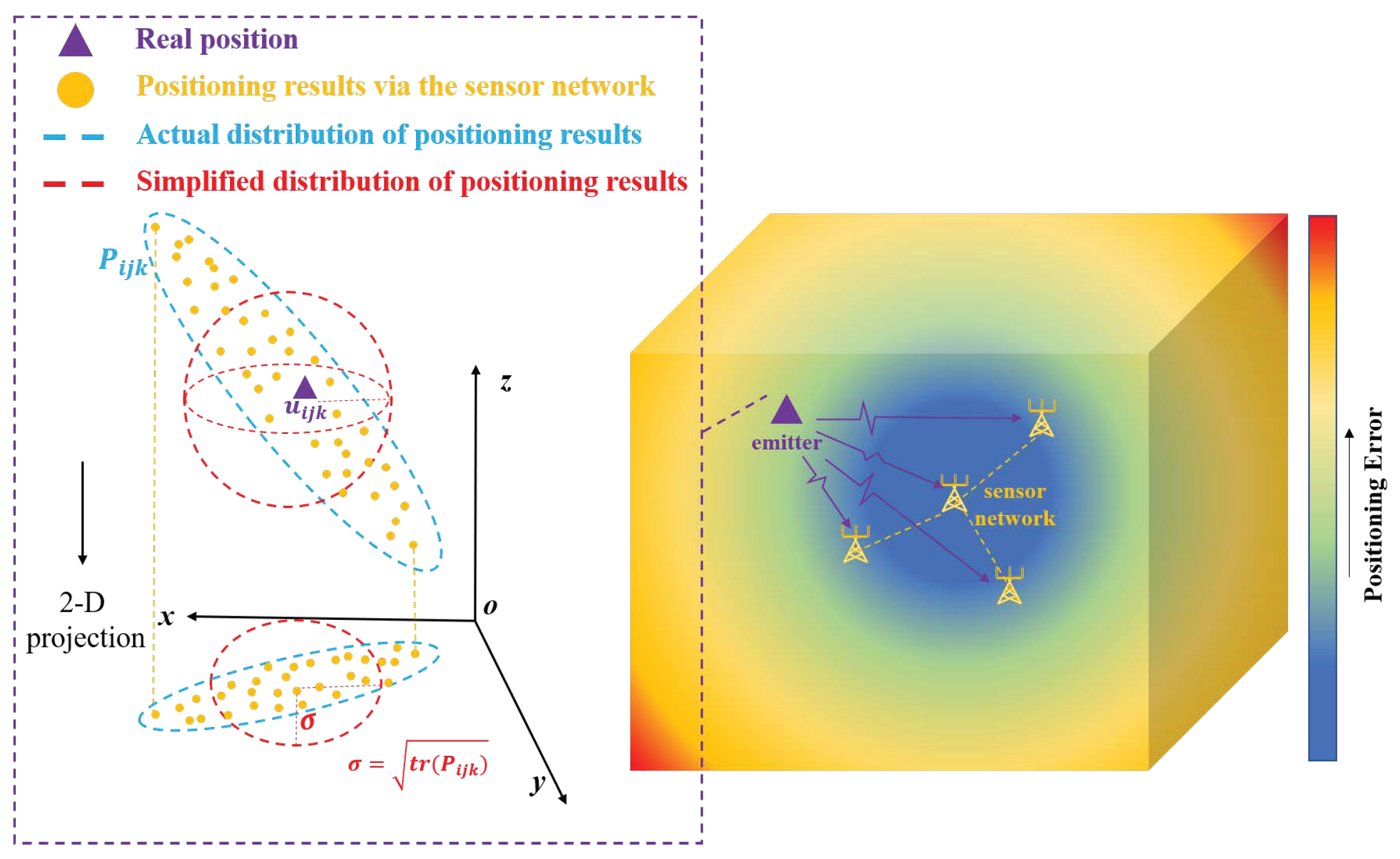
- Tensor-Based Spatial Error Modeling (TGDOP): We propose a novel framework that models the spatial distribution of positioning errors as a third-order tensor. Unlike conventional scalar GDOP metrics, this tensor representation explicitly captures the anisotropic characteristics and complex coupling of error sources in real-world 3-D environments.
- Physics-Informed Sparse Reconstruction Algorithm: We develop a robust tensor completion algorithm tailored for extremely sparse observational data. By deriving spatial properties from the theoretical error covariance matrix, we introduce polynomial constraints to the factor matrices during tensor decomposition.
- Training-Free and Model-Robust Performance: The proposed method operates as a single-shot, data-driven approach that does not require historical training data or idealized channel assumptions, validated on both simulated and real-world datasets.
2. Problem Statement
3. Preliminaries
3.1. Mode-N Unfolding and Mode Product
3.2. Block Tensor Decomposition in Multilinear Rank-(L,M,N) Terms
4. TGDOP and Its Properties
4.1. Tensor Model of Positioning Error Distribution
4.2. The Covariance Matrix of Positioning Error
4.3. Properties of TGDOP Derived from Error Covariance Matrix
4.3.1. Spatial Smoothness
- ;
- .
4.3.2. Non-Negative
- ;
- .
4.3.3. Low Rank
5. Reconstruction Algorithm for TGDOP
5.1. BTD-Based Sparse Reconstruction Algorithm for TGDOP
5.1.1. Designing the Structure of Factor Matrices
5.1.2. Sparse Formulation of the Objective Function
5.1.3. Solving Equation (23) Using Block Coordinate Descent
| Algorithm 1 ALS algorithm for solving (23). |
|
5.2. Solution Approach with Available Directional Measurements
5.3. Lower Bound on Sample Complexity
6. Results with Measurements and Simulations
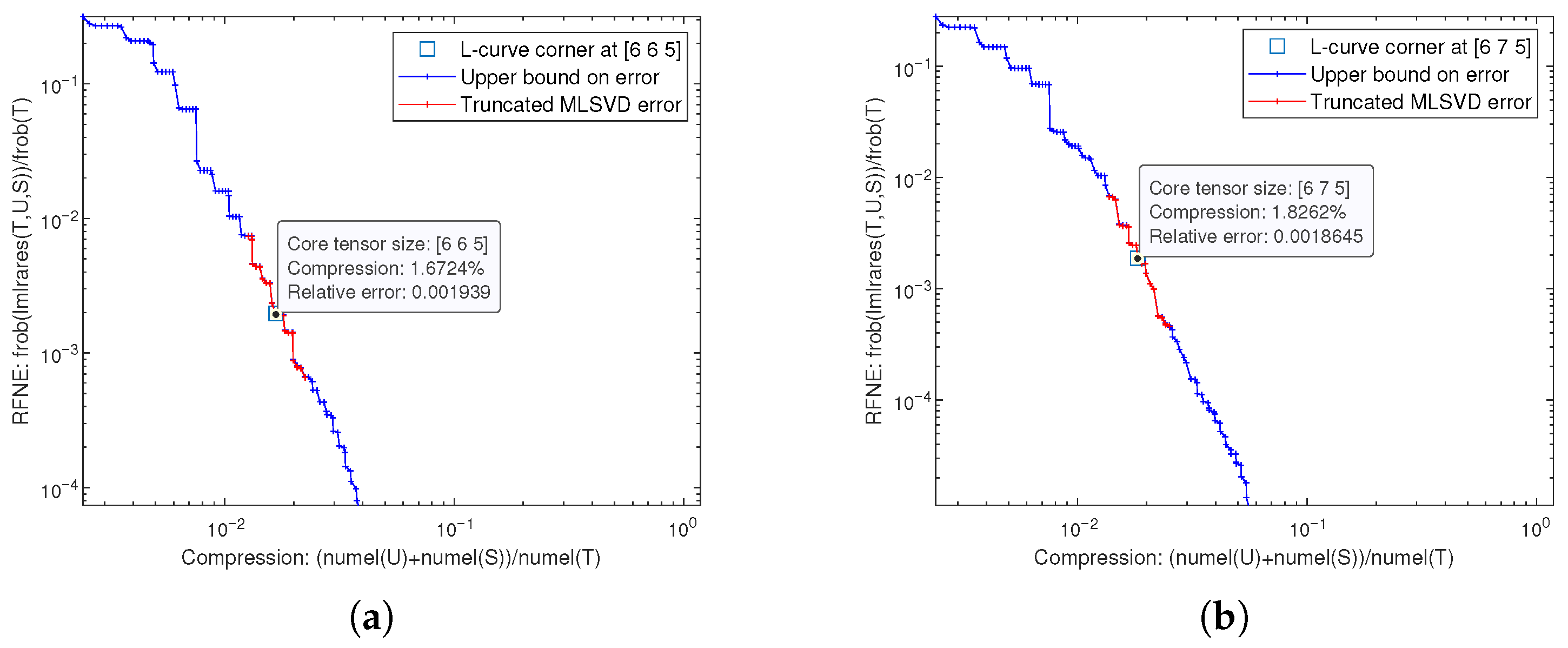
6.1. Multilinear Rank Analysis
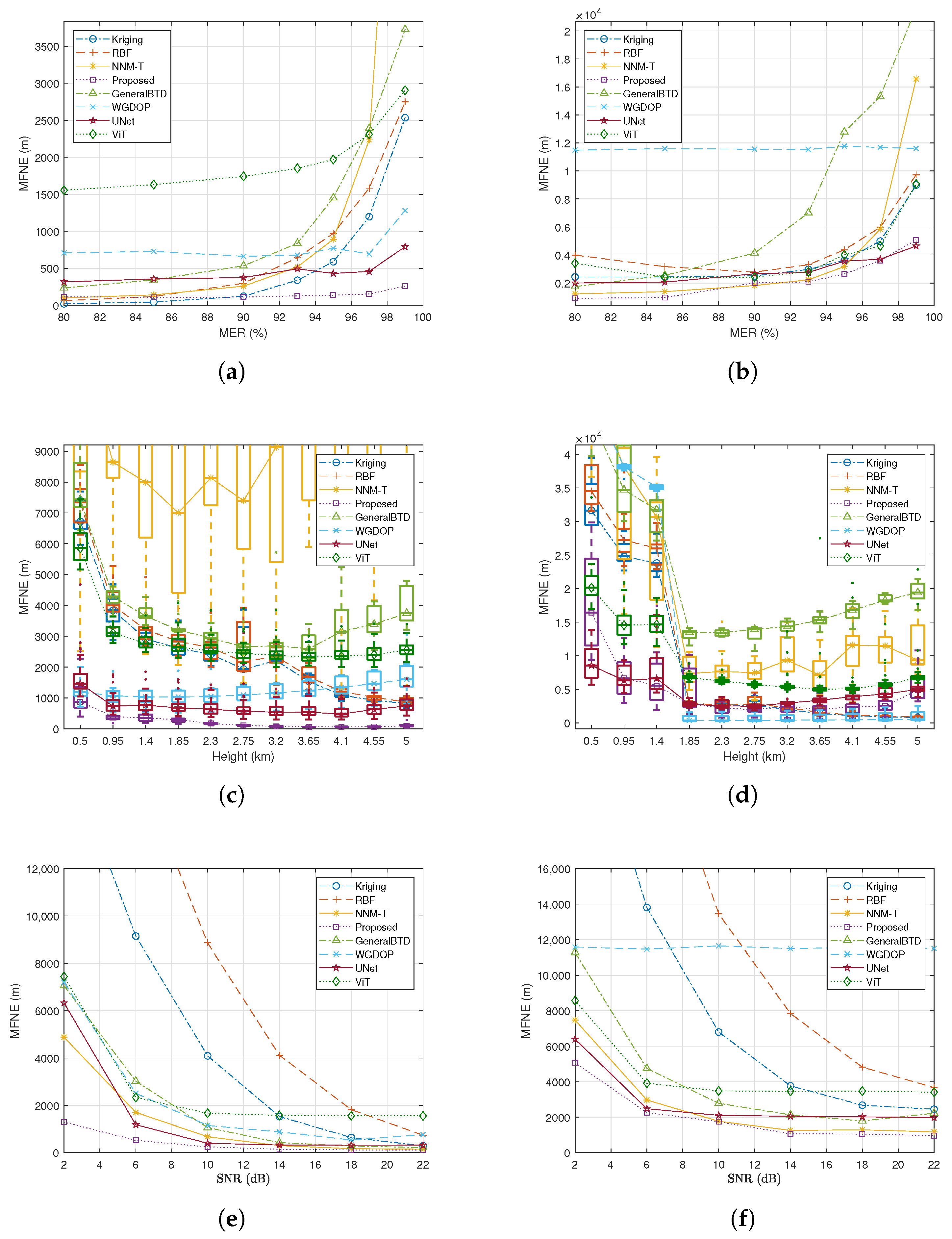
6.2. Performance Under Sparse Measurements
6.3. Performance Under Noise
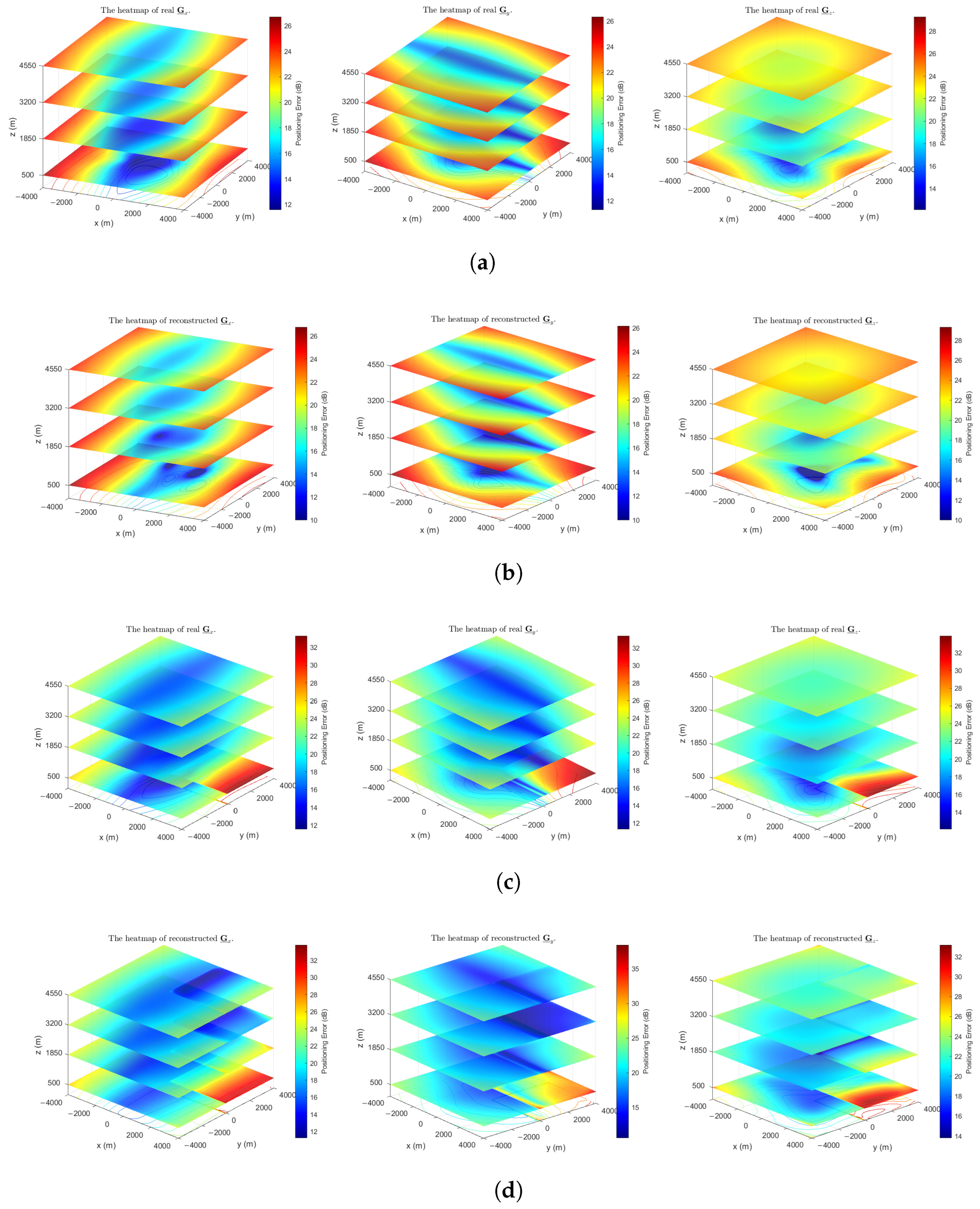
6.4. Performance with Available Directional Measurements
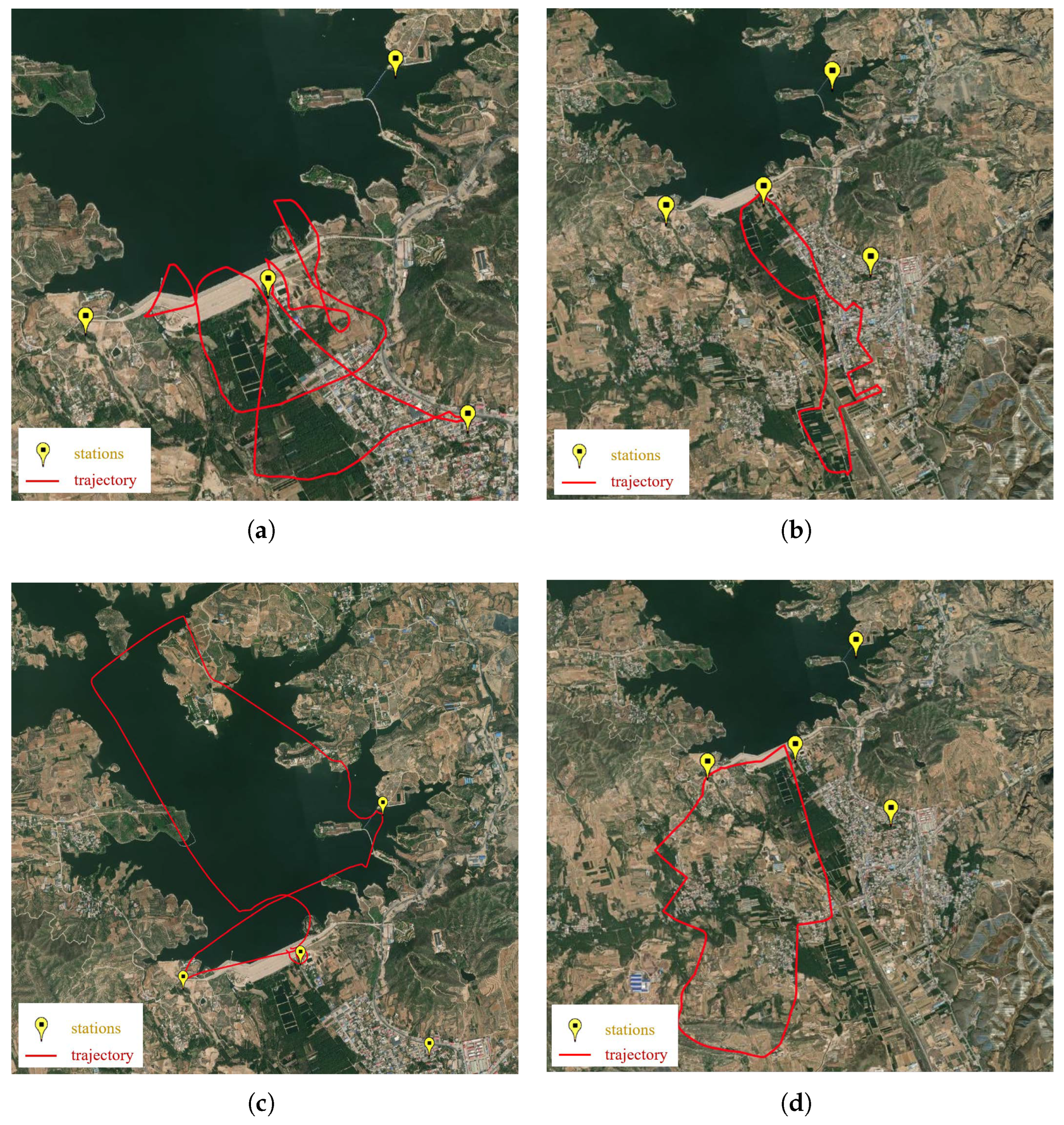
6.5. Real-Data Experiment
7. Conclusions
Author Contributions
Funding
Data Availability Statement
Conflicts of Interest
Appendix A. Proof of Theorem 1
Appendix B. Proof of Theorem 2
- Continuity of : If (i.e., is continuously differentiable on the interval I), then its transpose is also . The product is consequently . The matrix inversion operation, , is a smooth mapping on the set of invertible matrices. Therefore, provided is invertible for all , is also .
- Continuity of product terms and : Since , both and its derivative (and similarly ) are continuous on I (i.e., ). Consequently, their products and are also continuous on I.
- .
- , (where n is the number of columns of , ensuring is invertible).
Appendix C. Definition and Properties of a Tensor Operation
Appendix D. Computational Complexity Analysis
Appendix E. Proof of Theorem 4
References
- Lyu, J.; Song, T.; He, S. Range-Only UWB 6-D Pose Estimator for Micro UAVs: Performance Analysis. IEEE Trans. Aerosp. Electron. Syst. 2025, 61, 5284–5301. [Google Scholar] [CrossRef]
- Jiang, S.; Zhao, C.; Zhu, Y.; Wang, C.; Du, Y. A Practical and Economical Ultra-wideband Base Station Placement Approach for Indoor Autonomous Driving Systems. J. Adv. Transp. 2022, 2022, 3815306. [Google Scholar] [CrossRef]
- Causa, F.; Fasano, G. Improving Navigation in GNSS-Challenging Environments: Multi-UAS Cooperation and Generalized Dilution of Precision. IEEE Trans. Aerosp. Electron. Syst. 2021, 57, 1462–1479. [Google Scholar] [CrossRef]
- Feng, D.; Wang, C.; He, C.; Zhuang, Y.; Xia, X.G. Kalman-Filter-Based Integration of IMU and UWB for High-Accuracy Indoor Positioning and Navigation. IEEE Internet Things J. 2020, 7, 3133–3146. [Google Scholar] [CrossRef]
- Mazuelas, S.; Lorenzo, R.M.; Bahillo, A.; Fernandez, P.; Prieto, J.; Abril, E.J. Topology Assessment Provided by Weighted Barycentric Parameters in Harsh Environment Wireless Location Systems. IEEE Trans. Signal Process. 2010, 58, 3842–3857. [Google Scholar] [CrossRef]
- Wang, D.; Qin, H.; Zhang, Y.; Yang, Y.; Lv, H. Fast Clustering Satellite Selection Based on Doppler Positioning GDOP Lower Bound for LEO Constellation. IEEE Trans. Aerosp. Electron. Syst. 2024, 60, 9401–9410. [Google Scholar] [CrossRef]
- Wang, Y.; Ho, K.C. TDOA Source Localization in the Presence of Synchronization Clock Bias and Sensor Position Errors. IEEE Trans. Signal Process. 2013, 61, 4532–4544. [Google Scholar] [CrossRef]
- Won, D.H.; Ahn, J.; Lee, S.W.; Lee, J.; Sung, S.; Park, H.W.; Park, J.P.; Lee, Y.J. Weighted DOP With Consideration on Elevation-Dependent Range Errors of GNSS Satellites. IEEE Trans. Instrum. Meas. 2012, 61, 3241–3250. [Google Scholar] [CrossRef]
- Chen, C.S. Weighted Geometric Dilution of Precision Calculations with Matrix Multiplication. Sensors 2015, 15, 803–817. [Google Scholar] [CrossRef]
- Won, D.H.; Lee, E.; Heo, M.; Lee, S.W.; Lee, J.; Kim, J.; Sung, S.; Lee, Y.J. Selective Integration of GNSS, Vision Sensor, and INS Using Weighted DOP Under GNSS-Challenged Environments. IEEE Trans. Instrum. Meas. 2014, 63, 2288–2298. [Google Scholar] [CrossRef]
- Wang, M.; Chen, Z.; Zhou, Z.; Fu, J.; Qiu, H. Analysis of the Applicability of Dilution of Precision in the Base Station Configuration Optimization of Ultrawideband Indoor TDOA Positioning System. IEEE Access 2020, 8, 225076–225087. [Google Scholar] [CrossRef]
- Liang, X.; Pan, S.; Du, S.; Yu, B.; Li, S. An Optimization Method for Indoor Pseudolites Anchor Layout Based on MG-MOPSO. Remote Sens. 2025, 17, 1909. [Google Scholar] [CrossRef]
- Hong, W.; Choi, K.; Lee, E.; Im, S.; Heo, M. Analysis of GNSS Performance Index Using Feature Points of Sky-View Image. IEEE Trans. Intell. Transp. Syst. 2014, 15, 889–895. [Google Scholar] [CrossRef]
- Rao, R.M.; Emenonye, D.R. Iterative RNDOP-Optimal Anchor Placement for Beyond Convex Hull ToA-Based Localization: Performance Bounds and Heuristic Algorithms. IEEE Trans. Veh. Technol. 2024, 73, 7287–7303. [Google Scholar] [CrossRef]
- Ding, Y.; Shen, D.; Pham, K.; Chen, G. Measurement Along the Path of Unmanned Aerial Vehicles for Best Horizontal Dilution of Precision and Geometric Dilution of Precision. Sensors 2025, 25, 3901. [Google Scholar] [CrossRef]
- Deng, Z.; Wang, H.; Zheng, X.; Yin, L. Base Station Selection for Hybrid TDOA/RTT/DOA Positioning in Mixed LOS/NLOS Environment. Sensors 2020, 20, 4132. [Google Scholar] [CrossRef] [PubMed]
- Peng, Y.; Niu, X.; Tang, J.; Mao, D.; Qian, C. Fast Signals of Opportunity Fingerprint Database Maintenance with Autonomous Unmanned Ground Vehicle for Indoor Positioning. Sensors 2018, 18, 3419. [Google Scholar] [CrossRef]
- Roger, S.; Botella, C.; Pérez-Solano, J.J.; Perez, J. Application of Radio Environment Map Reconstruction Techniques to Platoon-based Cellular V2X Communications. Sensors 2020, 20, 2440. [Google Scholar] [CrossRef]
- Hong, S.; Chae, J. Active Learning With Multiple Kernels. IEEE Trans. Neural Networks Learn. Syst. 2022, 33, 2980–2994. [Google Scholar] [CrossRef] [PubMed]
- Lyu, S.; Xiang, Y.; Soja, B.; Wang, N.; Yu, W.; Truong, T.K. Uncertainties of Interpolating Satellite-Specific Slant Ionospheric Delays and Impacts on PPP-RTK. IEEE Trans. Aerosp. Electron. Syst. 2024, 60, 490–505. [Google Scholar] [CrossRef]
- Bazerque, J.A.; Giannakis, G.B. Nonparametric Basis Pursuit via Sparse Kernel-Based Learning: A Unifying View with Advances in Blind Methods. IEEE Signal Process. Mag. 2013, 30, 112–125. [Google Scholar] [CrossRef]
- Wang, Q.; Shi, W.; Atkinson, P.M. Sub-pixel mapping of remote sensing images based on radial basis function interpolation. ISPRS J. Photogramm. Remote Sens. 2014, 92, 1–15. [Google Scholar] [CrossRef]
- Golbabaee, M.; Arberet, S.; Vandergheynst, P. Compressive Source Separation: Theory and Methods for Hyperspectral Imaging. IEEE Trans. Image Process. 2013, 22, 5096–5110. [Google Scholar] [CrossRef] [PubMed]
- Li, C.; Xie, H.B.; Fan, X.; Xu, R.Y.D.; Van Huffel, S.; Sisson, S.A.; Mengersen, K. Image Denoising Based on Nonlocal Bayesian Singular Value Thresholding and Stein’s Unbiased Risk Estimator. IEEE Trans. Image Process. 2019, 28, 4899–4911. [Google Scholar] [CrossRef] [PubMed]
- Ye, J.; Xiong, F.; Zhou, J.; Qian, Y. Iterative Low-Rank Network for Hyperspectral Image Denoising. IEEE Trans. Geosci. Remote Sens. 2024, 62, 5528015. [Google Scholar] [CrossRef]
- Candès, E.J.; Sing-Long, C.A.; Trzasko, J.D. Unbiased Risk Estimates for Singular Value Thresholding and Spectral Estimators. IEEE Trans. Signal Process. 2013, 61, 4643–4657. [Google Scholar] [CrossRef]
- De Lathauwer, L. Decompositions of a higher-order tensor in block terms—Part II: Definitions and uniqueness. SIAM J. Matrix Anal. Appl. 2008, 30, 1033–1066. [Google Scholar] [CrossRef]
- Zhang, G.; Fu, X.; Wang, J.; Zhao, X.L.; Hong, M. Spectrum cartography via coupled block-term tensor decomposition. IEEE Trans. Signal Process. 2020, 68, 3660–3675. [Google Scholar] [CrossRef]
- Chen, J.; Zhang, Y.; Yao, C.; Tu, G.; Li, J. Hermitian Toeplitz Covariance Tensor Completion With Missing Slices for Angle Estimation in Bistatic MIMO Radars. IEEE Trans. Aerosp. Electron. Syst. 2024, 60, 8401–8418. [Google Scholar] [CrossRef]
- Sun, H.; Chen, J. Propagation map reconstruction via interpolation assisted matrix completion. IEEE Trans. Signal Process. 2022, 70, 6154–6169. [Google Scholar] [CrossRef]
- Levie, R.; Yapar, Ç.; Kutyniok, G.; Caire, G. RadioUNet: Fast radio map estimation with convolutional neural networks. IEEE Trans. Wirel. Commun. 2021, 20, 4001–4015. [Google Scholar] [CrossRef]
- Teganya, Y.; Romero, D. Deep Completion Autoencoders for Radio Map Estimation. IEEE Trans. Wirel. Commun. 2022, 21, 1710–1724. [Google Scholar] [CrossRef]
- Yu, H.; She, C.; Yue, C.; Hou, Z.; Rogers, P.; Vucetic, B.; Li, Y. Distributed Split Learning for Map-Based Signal Strength Prediction Empowered by Deep Vision Transformer. IEEE Trans. Veh. Technol. 2024, 73, 2358–2373. [Google Scholar] [CrossRef]
- Specht, M. Statistical Distribution Analysis of Navigation Positioning System Errors—Issue of the Empirical Sample Size. Sensors 2020, 20, 7144. [Google Scholar] [CrossRef] [PubMed]
- Specht, M. Consistency analysis of global positioning system position errors with typical statistical distributions. J. Navig. 2021, 74, 1201–1218. [Google Scholar] [CrossRef]
- Paradowski, L. Uncertainty ellipses and their application to interval estimation of emitter position. IEEE Trans. Aerosp. Electron. Syst. 1997, 33, 126–133. [Google Scholar] [CrossRef]
- Lombardi, G.; Crivello, A.; Barsocchi, P.; Chessa, S.; Furfari, F. Reducing Training Data for Indoor Positioning through Physics-Informed Neural Networks. In Proceedings of the 2025 International Conference on Indoor Positioning and Indoor Navigation (IPIN), Tampere, Finland, 15–18 September 2025; pp. 1–6. [Google Scholar]
- Stein, S. Algorithms for ambiguity function processing. IEEE Trans. Acoust. Speech Signal Process. 1981, 29, 588–599. [Google Scholar] [CrossRef]
- Shin, D.H.; Sung, T.K. Comparisons of error characteristics between TOA and TDOA positioning. IEEE Trans. Aerosp. Electron. Syst. 2002, 38, 307–311. [Google Scholar] [CrossRef]
- Urruela, A.; Sala, J.; Riba, J. Average performance analysis of circular and hyperbolic geolocation. IEEE Trans. Veh. Technol. 2006, 55, 52–66. [Google Scholar] [CrossRef]
- Liao, B.; Chan, S.C.; Tsui, K.M. Recursive steering vector estimation and adaptive beamforming under uncertainties. IEEE Trans. Aerosp. Electron. Syst. 2013, 49, 489–501. [Google Scholar] [CrossRef]
- Fan, J.; Ma, G. Characteristics of GPS positioning error with non-uniform pseudorange error. GPS Solut. 2014, 18, 615–623. [Google Scholar] [CrossRef]
- Tomioka, R.; Hayashi, K.; Kashima, H. Estimation of low-rank tensors via convex optimization. arXiv 2010, arXiv:1010.0789. [Google Scholar]
- Mu, C.; Huang, B.; Wright, J.; Goldfarb, D. Square deal: Lower bounds and improved relaxations for tensor recovery. In Proceedings of the International Conference on Machine Learning PMLR, Beijing, China, 22–24 June 2014; pp. 73–81. [Google Scholar]
- Hoyer, P.O. Non-negative matrix factorization with sparseness constraints. J. Mach. Learn. Res. 2004, 5, 1457–1469. [Google Scholar]



| Algorithm | Measure | ||
|---|---|---|---|
| Kriging [18] | 2534.48 | 8995.53 | |
| Uplift (%) | 89.85 | 43.58 | |
| RBF [20] | 2747.93 | 9727.88 | |
| Uplift (%) | 90.64 | 47.83 | |
| NNM-T [30] | 9301.32 | 16,570.32 | |
| Uplift (%) | 97.23 | 69.37 | |
| GeneralBTD [28] | 3728.42 | 21,644.72 | |
| Uplift (%) | 93.10 | 76.55 | |
| WGDOP [16] | 1279.25 | 11,614.96 | |
| Uplift (%) | 79.89 | 56.30 | |
| UNet [31] | 791.38 | 4646.17 | |
| Uplift (%) | 67.50 | −9.24 | |
| ViT [33] | 2905.96 | 9074.46 | |
| Uplift (%) | 91.15 | 44.07 | |
| Proposed | 257.21 | 5075.51 |
| Algorithm | Measure | ||
|---|---|---|---|
| Kriging | 845.03 | 1229.64 | |
| Uplift (%) | 93.03 | 83.30 | |
| RBF | 1325.49 | 2136.86 | |
| Uplift (%) | 95.56 | 90.39 | |
| NNM-T | 236.91 | 318.10 | |
| Uplift (%) | 75.15 | 35.46 | |
| GeneralBTD | 342.55 | 496.45 | |
| Uplift (%) | 82.82 | 58.64 | |
| WGDOP | 344.77 | 29.86 | |
| Uplift (%) | 82.93 | −587.52 | |
| UNet | 301.14 | 221.04 | |
| Uplift (%) | 80.45 | 7.11 | |
| ViT | 294.38 | 259.26 | |
| Uplift (%) | 80.00 | 20.81 | |
| Proposed | 58.87 | 205.32 |
| (%) | Measure | ||
|---|---|---|---|
| 80 | 138.34 | 1204.34 | |
| 161.25 | 933.64 | ||
| 85 | 133.66 | 897.13 | |
| 160.90 | 827.88 | ||
| 90 | 138.68 | 1089.64 | |
| 162.45 | 892.21 | ||
| 95 | 143.59 | 2463.44 | |
| 170.82 | 1744.21 | ||
| 99 | 223.47 | 3818.02 | |
| 226.59 | 2639.67 |
| Algorithm | Trajectories | Training Ratio () | Full Recon. | ||
|---|---|---|---|---|---|
| 40% | 60% | 80% | |||
| WGDOP | 1.02 | 9.70 | 13.37 | Y | |
| −0.57 | −0.88 | 3.19 | |||
| 24.72 | 26.35 | 19.63 | |||
| 27.96 | 39.42 | 30.64 | |||
| GeneralBTD | 15.08 | 23.21 | 26.64 | Y | |
| 19.33 | 22.75 | 21.82 | |||
| 26.94 | 27.23 | 24.68 | |||
| 27.93 | 32.2 | 31.14 | |||
| Kriging | 76.36 | 83.94 | 83.66 | N | |
| 57.65 | 50.11 | 55.77 | |||
| 63.32 | 56.96 | 33.35 | |||
| 62.37 | 72.94 | 67.95 | |||
| RBF | 25.92 | 84.21 | 27.74 | N | |
| 28.69 | 25.54 | 24.56 | |||
| 21.21 | 14.07 | 10.68 | |||
| 28.12 | 32.57 | 33.01 | |||
| Algorithm | Measure | Training Ratio () | Full Recon. | ||
|---|---|---|---|---|---|
| 40% | 60% | 80% | |||
| WGDOP | 968.81 | 888.10 | 493.45 | Y | |
| Time (s) | 9.53 | 9.85 | 9.79 | ||
| GeneralBTD | 968.39 | 793.58 | 497.02 | Y | |
| Time (s) | 80.22 | 83.55 | 83.42 | ||
| Kriging | 1854.52 | 1988.16 | 1067.84 | N | |
| Time (s) | 0.36 | 0.46 | 0.57 | ||
| RBF | 971.00 | 797.94 | 510.87 | N | |
| Time (s) | 0.04 | 0.06 | 0.07 | ||
| Proposed | 697.91 | 538.02 | 342.25 | Y | |
| Time (s) | 86.89 | 91.25 | 90.38 | ||
Disclaimer/Publisher’s Note: The statements, opinions and data contained in all publications are solely those of the individual author(s) and contributor(s) and not of MDPI and/or the editor(s). MDPI and/or the editor(s) disclaim responsibility for any injury to people or property resulting from any ideas, methods, instructions or products referred to in the content. |
© 2026 by the authors. Licensee MDPI, Basel, Switzerland. This article is an open access article distributed under the terms and conditions of the Creative Commons Attribution (CC BY) license.
Share and Cite
Zhang, Z.; Huang, Z.; Wang, C.; Jiang, Q. Reconstructing Spatial Localization Error Maps via Physics-Informed Tensor Completion for Passive Sensor Systems. Sensors 2026, 26, 597. https://doi.org/10.3390/s26020597
Zhang Z, Huang Z, Wang C, Jiang Q. Reconstructing Spatial Localization Error Maps via Physics-Informed Tensor Completion for Passive Sensor Systems. Sensors. 2026; 26(2):597. https://doi.org/10.3390/s26020597
Chicago/Turabian StyleZhang, Zhaohang, Zhen Huang, Chunzhe Wang, and Qiaowen Jiang. 2026. "Reconstructing Spatial Localization Error Maps via Physics-Informed Tensor Completion for Passive Sensor Systems" Sensors 26, no. 2: 597. https://doi.org/10.3390/s26020597
APA StyleZhang, Z., Huang, Z., Wang, C., & Jiang, Q. (2026). Reconstructing Spatial Localization Error Maps via Physics-Informed Tensor Completion for Passive Sensor Systems. Sensors, 26(2), 597. https://doi.org/10.3390/s26020597