Development of Rule-Based Diagnostic Automation Technology for Elevator Fault Diagnosis

Abstract
1. Introduction
2. Elevator Fault Characteristics Analysis
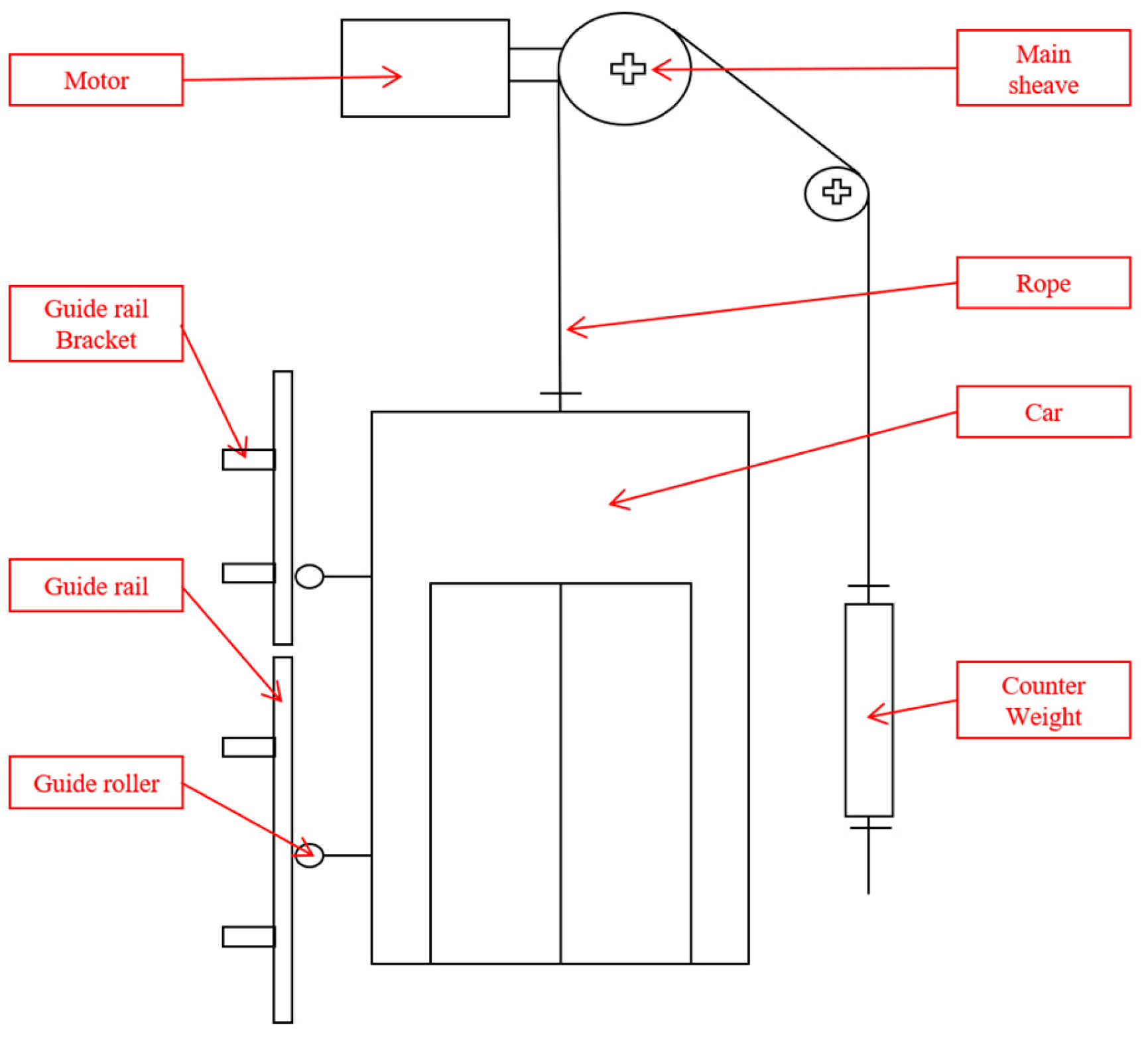
2.1. Structural Characteristics of Gearless Type Elevator
2.2. Fault Diagnosis Using Vibration Signals
2.2.1. Driving Part (Main Sheave)
2.2.2. Motor
2.2.3. Guide Rail
2.2.4. Car
2.2.5. Guide Roller
3. Development of Rule-Based Diagnostic Automation Technology
3.1. Establishing the Target of Recognition
3.2. Development of Recognition Technology
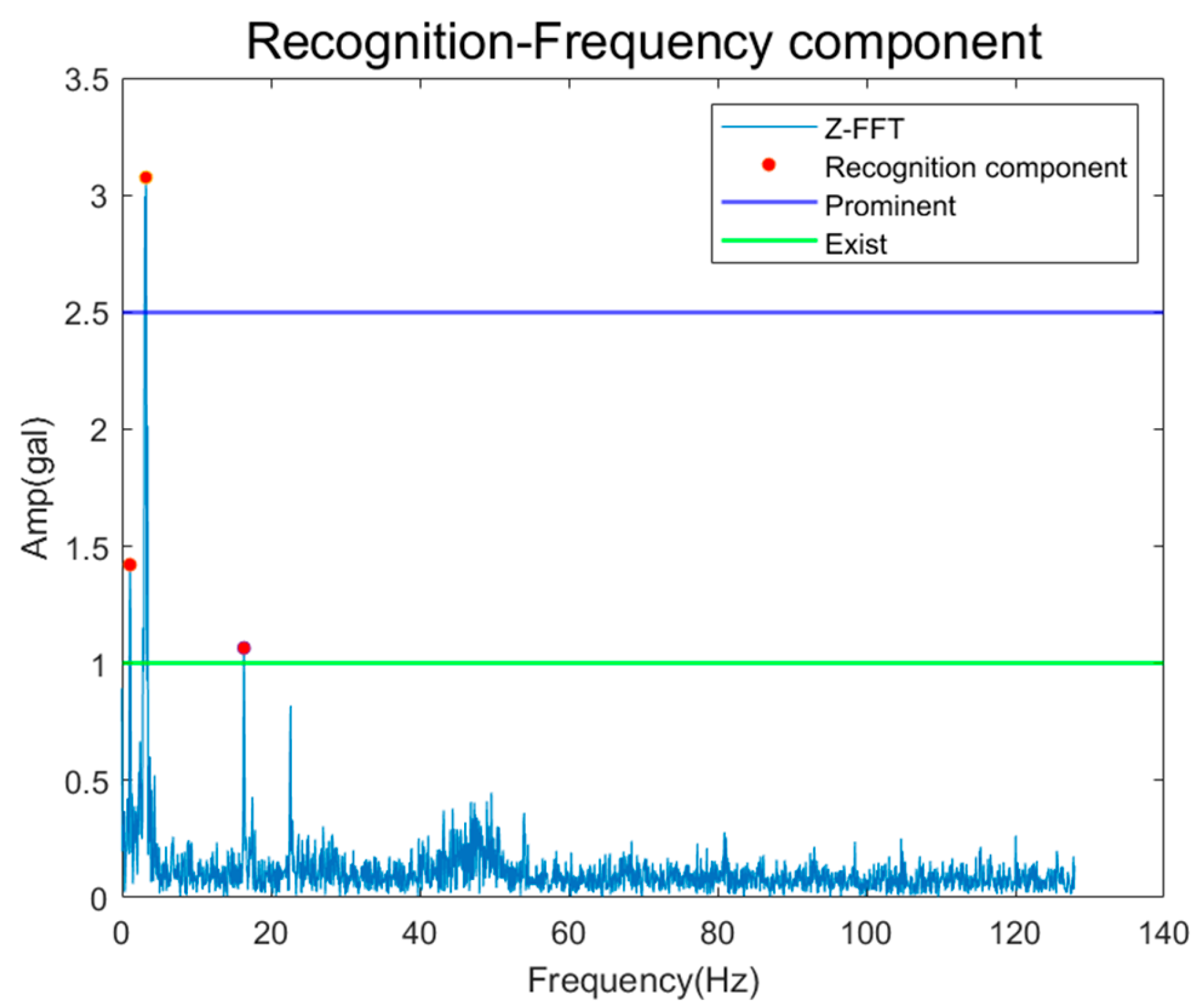
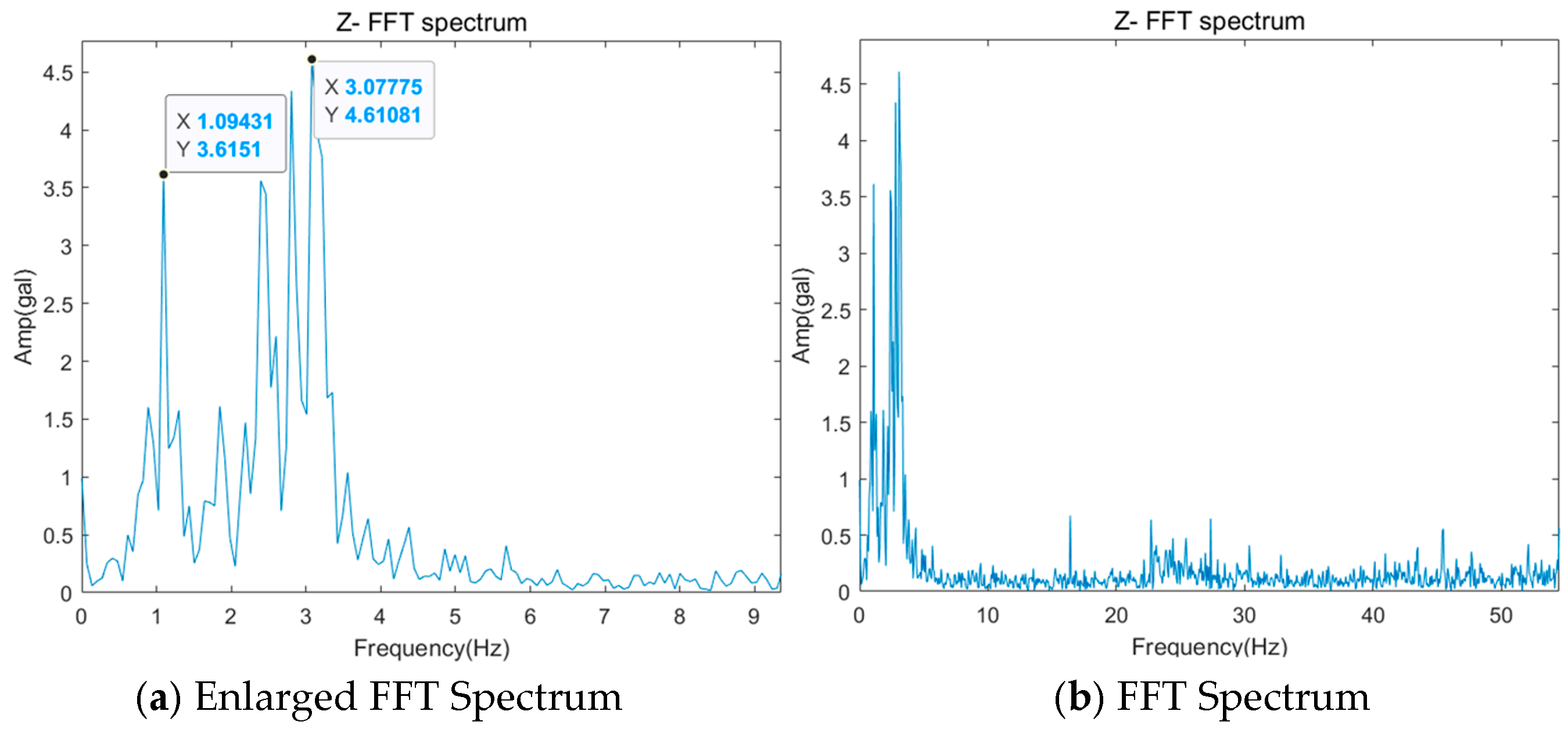
3.2.1. Frequency Component Recognition
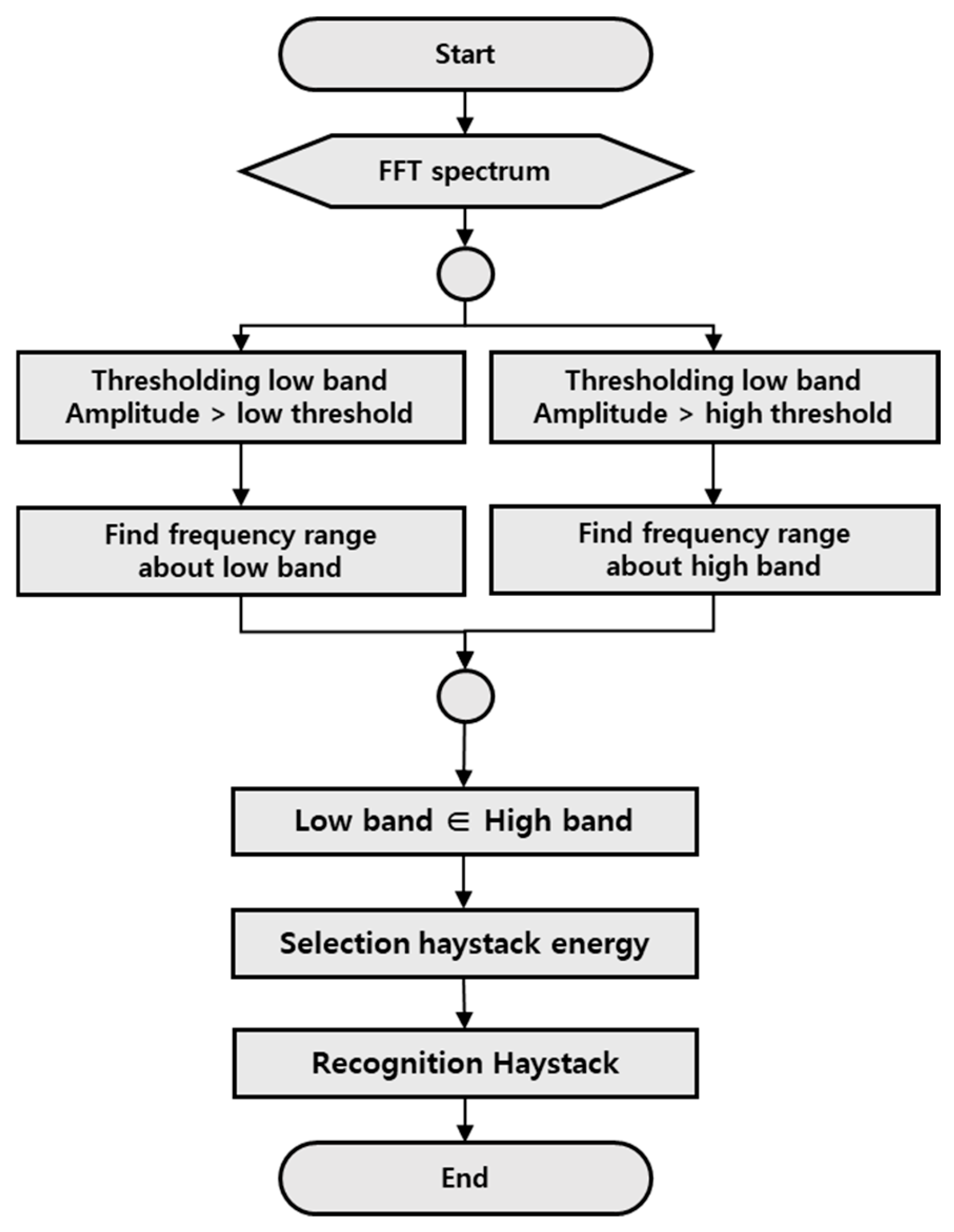
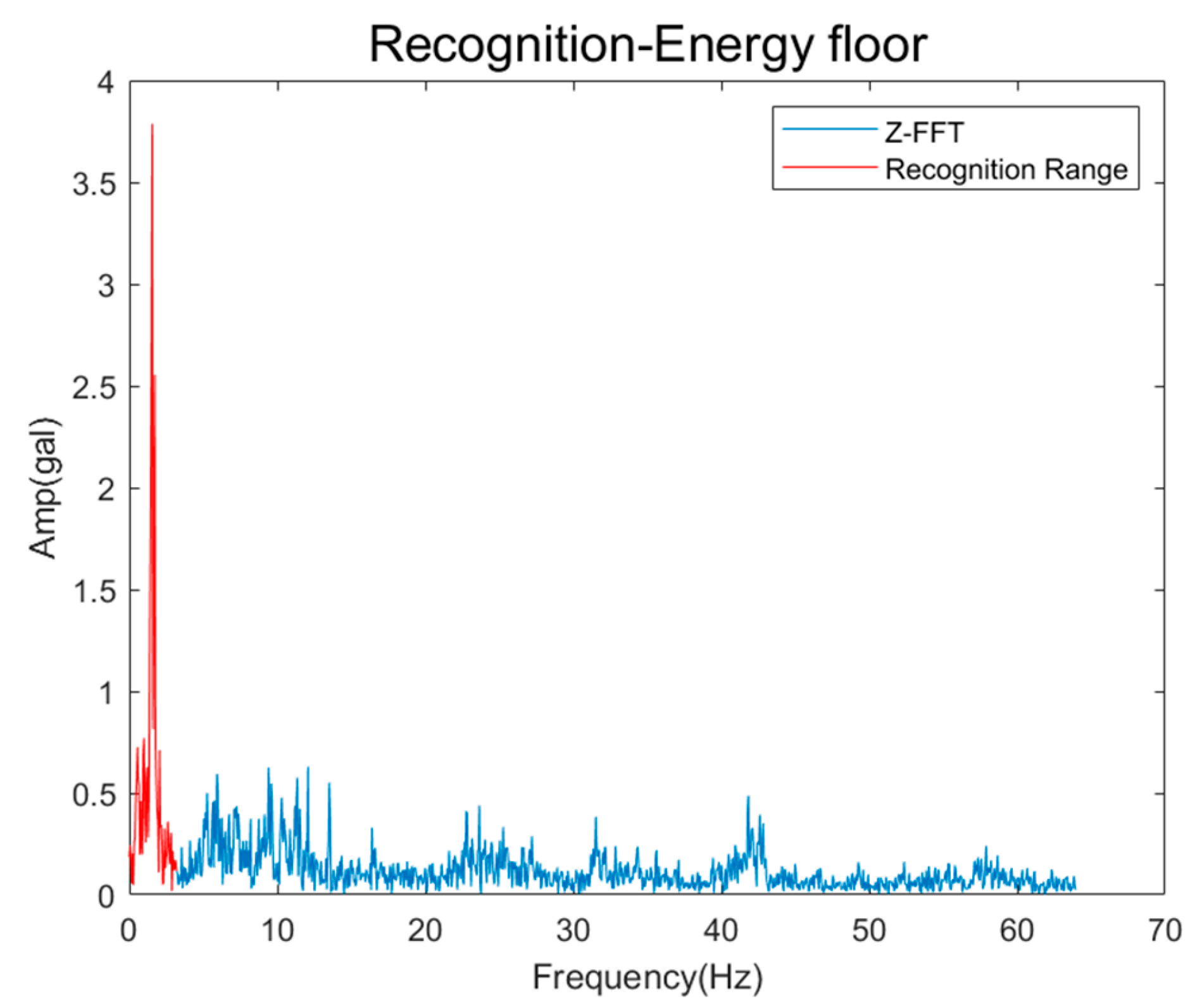
3.2.2. Haystack Energy Recognition
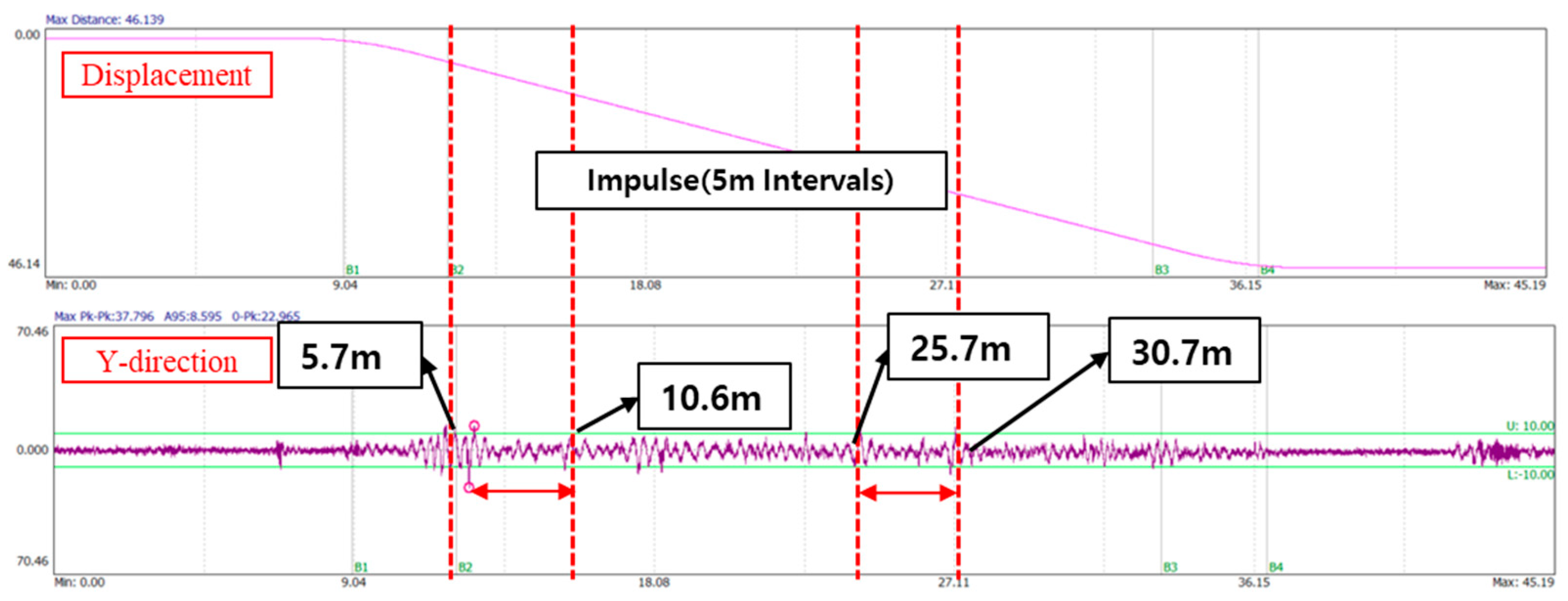
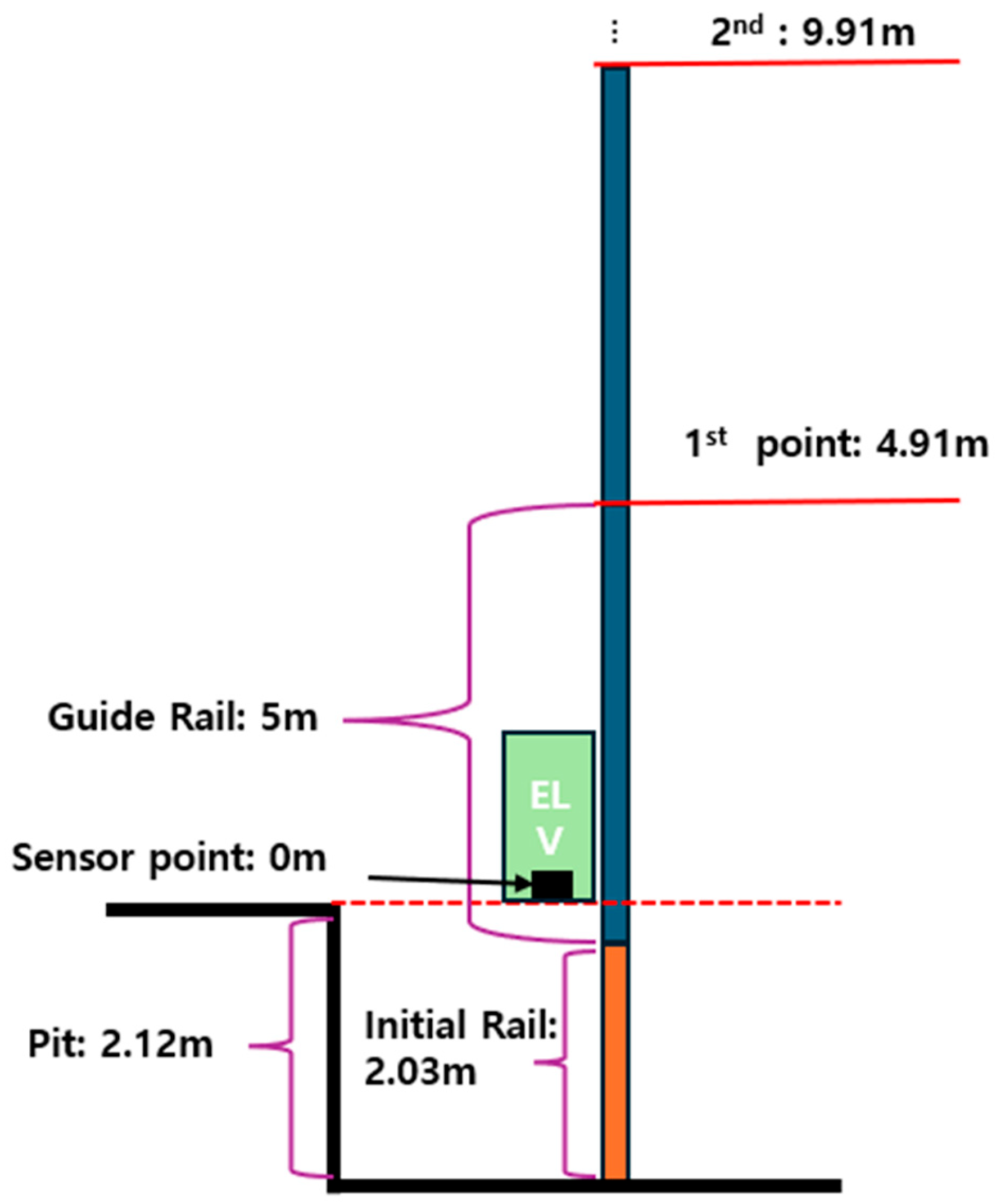
3.2.3. Impulse Component Recognition
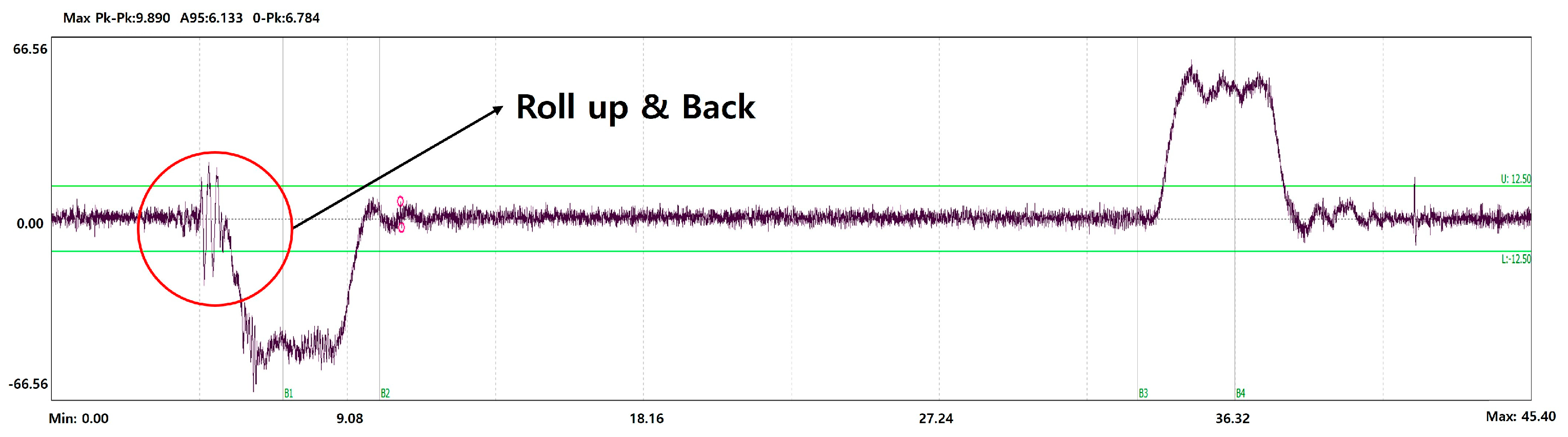
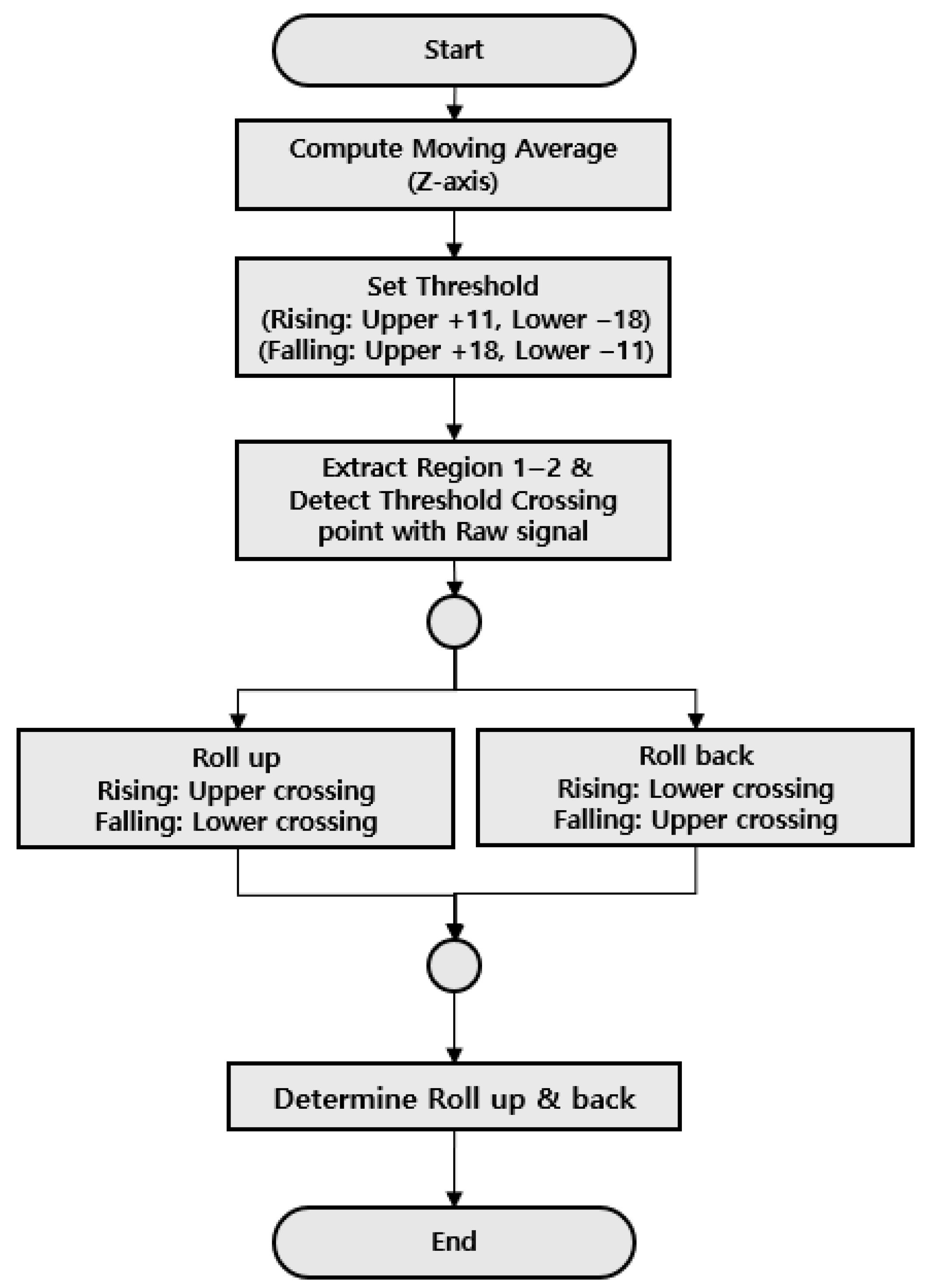
3.2.4. Acceleration Change Recognition
4. Verification of Recognition Technology
5. Verification of Rule-Based Diagnosis
6. Conclusions
Author Contributions
Funding
Institutional Review Board Statement
Informed Consent Statement
Data Availability Statement
Conflicts of Interest
References
- Oh, W.-J.; Cho, C.-Y.; Lee, M.-J. Develop Methodology for Preventive Maintenance of Infrastructure. KAIS 2023, 24, 63–72. [Google Scholar] [CrossRef]
- Man, P.K.; Wong, C.-N.; Chan, W.K.; Lee, H.H.; Huang, J.; Pecht, M. Reliability and safety of elevators and escalators/travelators: Past, present and future. Results Eng. 2025, 25, 104194. [Google Scholar] [CrossRef]
- Elevator Information Center. Annual Statistics on Elevator Faults in Korea (2012–2024); National Elevator Information Center: Seoul, Republic of Korea. Available online: https://home.koelsa.or.kr/ (accessed on 16 April 2025).
- Zhang, G.; Huang, S.; Yuan, Y. The Study of Elevator Fault Diagnosis Based on Multi-Agent System. In Proceedings of the 2009 International Conference on Computational Intelligence and Software Engineering, Wuhan, China, 11–13 December 2009; pp. 1–5. [Google Scholar] [CrossRef]
- Yuan, S.; Ge, M.; Qiu, H.; Lee, J.; Xu, Y. Intelligent diagnosis in electromechanical operation systems. In Proceedings of the IEEE International Conference on Robotics and Automation, 2004 Proceedings ICRA ’04 2004, New Orleans, LA, USA, 26 April–1 May 2004; Volume 3, pp. 2267–2272. [Google Scholar] [CrossRef]
- Chan, W.L.; So, A.T.; Liu, S.K. A cost-effective remote monitoring and communication system. In Elevator Technology 9 Proceedings of Elevcon; International Association of Elevator Engineers Publications (IAEE): London, UK, 1998; Volume 9, pp. 54–63. Available online: https://liftescalatorlibrary.org/paper_indexing/papers/00000391.pdf (accessed on 16 April 2025).
- Ming, Z.; Han, S.; Zhang, Z.; Xia, S. Elevator Safety Monitoring System Based on Internet of Things. Int. J. Onl Eng. 2018, 14, 121–133. [Google Scholar] [CrossRef]
- D’Souza, R. IoT and the Future of Elevator Maintenance Business. Master’s Thesis, Technische Universität Wien, Vienna, Austria, 2022. [Google Scholar] [CrossRef]
- Zhong, M.; Zhou, Y. Virtual-reality system for elevator maintenance education: Design, implementation and evaluation. Eng. Rep. 2024, 6, e12873. [Google Scholar] [CrossRef]
- Zhou, Y.; Wang, K.; Liu, H. An Elevator Monitoring System Based On The Internet Of Things. Procedia Comput. Sci. 2018, 131, 541–544. [Google Scholar] [CrossRef]
- Chen, L.; Lan, S.; Jiang, S. Elevators Fault Diagnosis Based on Artificial Intelligence. J. Phys Conf. Ser. 2019, 1345, 042024. [Google Scholar] [CrossRef]
- Wu, H.; Tang, Q.; Yin, L.; Zhang, W. Fault diagnosis of elevator systems based on multidomain feature extraction and SHAP feature selection. Build. Serv. Eng. Res. Technol. 2024, 46, 419–435. [Google Scholar] [CrossRef]
- Song, Q.; Song, Q.; Xiao, L.; Jiang, H.; Li, L. State Diagnosis of Elevator Control Transformer over Vibration Signal Based on MEA-BP Neural Network. Shock. Vib. 2021, 2021, 9755094. [Google Scholar] [CrossRef]
- Jayasimha, S.; Fahad, M.; Mohan, B.R.; Das, M. Reliability Analysis and predictive maintenance of Elevator System Using Hidden Markov Model. In Proceedings of the 2024 IEEE International Conference on Interdisciplinary Approaches in Technology and Management for Social Innovation (IATMSI), Gwalior, India, 14–16 March 2024; pp. 1–4. [Google Scholar] [CrossRef]
- Halevy, A.; Norvig, P.; Pereira, F. The Unreasonable Effectiveness of Data. IEEE Intell. Syst. 2009, 24, 8–12. [Google Scholar] [CrossRef]
- Zhang, Y.; Sun, X.; Zhao, X.; Su, W. Elevator ride comfort monitoring and evaluation using smartphones. Mech. Syst. Signal Process. 2018, 105, 377–390. [Google Scholar] [CrossRef]
- Wang, M.; Deng, W. Deep visual domain adaptation: A survey. Neurocomputing 2018, 312, 135–153. [Google Scholar] [CrossRef]
- Wang, Q.; Chen, L.; Xiao, G.; Wang, P.; Gu, Y.; Lu, J. Elevator fault diagnosis based on digital twin and PINNs-e-RGCN. Sci. Rep. 2024, 14, 30713. [Google Scholar] [CrossRef]
- Wu, H.; Yin, L.; Chen, Y.; Li, Z.; Tang, Q. Elevator Fault Diagnosis Based on a Graph Attention Recurrent Network. Electronics 2025, 14, 2308. [Google Scholar] [CrossRef]
- Wei, X.; Fan, J.; Wang, H.; Cai, L. Remaining Useful Life Prediction Method for Bearings Based on Pruned Exact Linear Time State Segmentation and Time–Frequency Diagram. Sensors 2025, 25, 1950. [Google Scholar] [CrossRef]
- Xu, X.; Yan, X.; Sheng, C.; Yuan, C.; Xu, D.; Yang, J. A Belief Rule-Based Expert System for Fault Diagnosis of Marine Diesel Engines. IEEE Trans. Syst. Man. Cybern. Syst. 2020, 50, 656–672. [Google Scholar] [CrossRef]
- Yang, B.S.; Park, C.H.; Kim, H.J. An Efficient Method of Vibration Diagnostics for Rotating Machinery Using a Decision Tree. Int. J. Rotating Mach. 1998, 6, 19–27. [Google Scholar] [CrossRef]
- Lee, J.; Park, D.; Kim, H.; Choi, B. Development of Signal Recognition Technology for Automation Rule Based Diagnosis. KSNVE 2022, 32, 361–367. [Google Scholar] [CrossRef]
- Al-Kodmany, K. Smart Elevator Systems. J. Mech. Mater. Mech. Res. 2023, 6, 41–53. [Google Scholar] [CrossRef]
- ISO 18738-1:2012; Measurement of Ride Quality—Part 1: Lifts (Elevators). International Organization for Standardization (ISO): Geneva, Switzerland, 2012.
- ISO 2631-1:1997; Mechanical Vibration and Shock—Evaluation of Human Exposure to Whole-Body Vibration—Part 1: General Requirements. International Organization for Standardization (ISO): Geneva, Switzerland, 1997.
- ISO 8100-34; Lifts for the Transport of Persons and Goods-Part 34: Measurement of Lift Ride Quality. International Organization for Standardization (ISO): Geneva, Switzerland, 2021.
- Kim, J.M.; Park, J.H.; Ahn, S.J.; Jeong, W.B. Evaluation of Human Exposure to Vibration on Domestic High-speed Train using ISO 2631-1. Trans. Korean Soc. Noise Vib. Eng. 2015, 25, 266–274. [Google Scholar] [CrossRef][Green Version]
- Miura, N.; Matsuda, T.; Higashi, Y.; Ono, H.; Nguyen, X.T. Method of estimating the lateral vibration of an elevator rope from the vertical vibration of a compensating sheave. J. Asian Archit. Build. Eng. 2022, 22, 1533–1544. [Google Scholar] [CrossRef]
- Yang, B.S.; Lim, D.S.; Tan, A.C. VIBEX: An expert system for vibration fault diagnosis of rotating machinery using decision tree and decision table. Expert. Syst. Appl. 2005, 28, 735–742. [Google Scholar] [CrossRef]
- Sakthivel, N.R.; Sugumaran, V.; Babudevasenapati, S. Vibration based fault diagnosis of monoblock centrifugal pump using decision tree. Expert Syst. Appl. 2010, 37, 4040–4049. [Google Scholar] [CrossRef]
- Miljković, D. Brief review of vibration based machine condition monitoring. HDKBR INFO Mag. 2015, 5, 14–23. [Google Scholar]



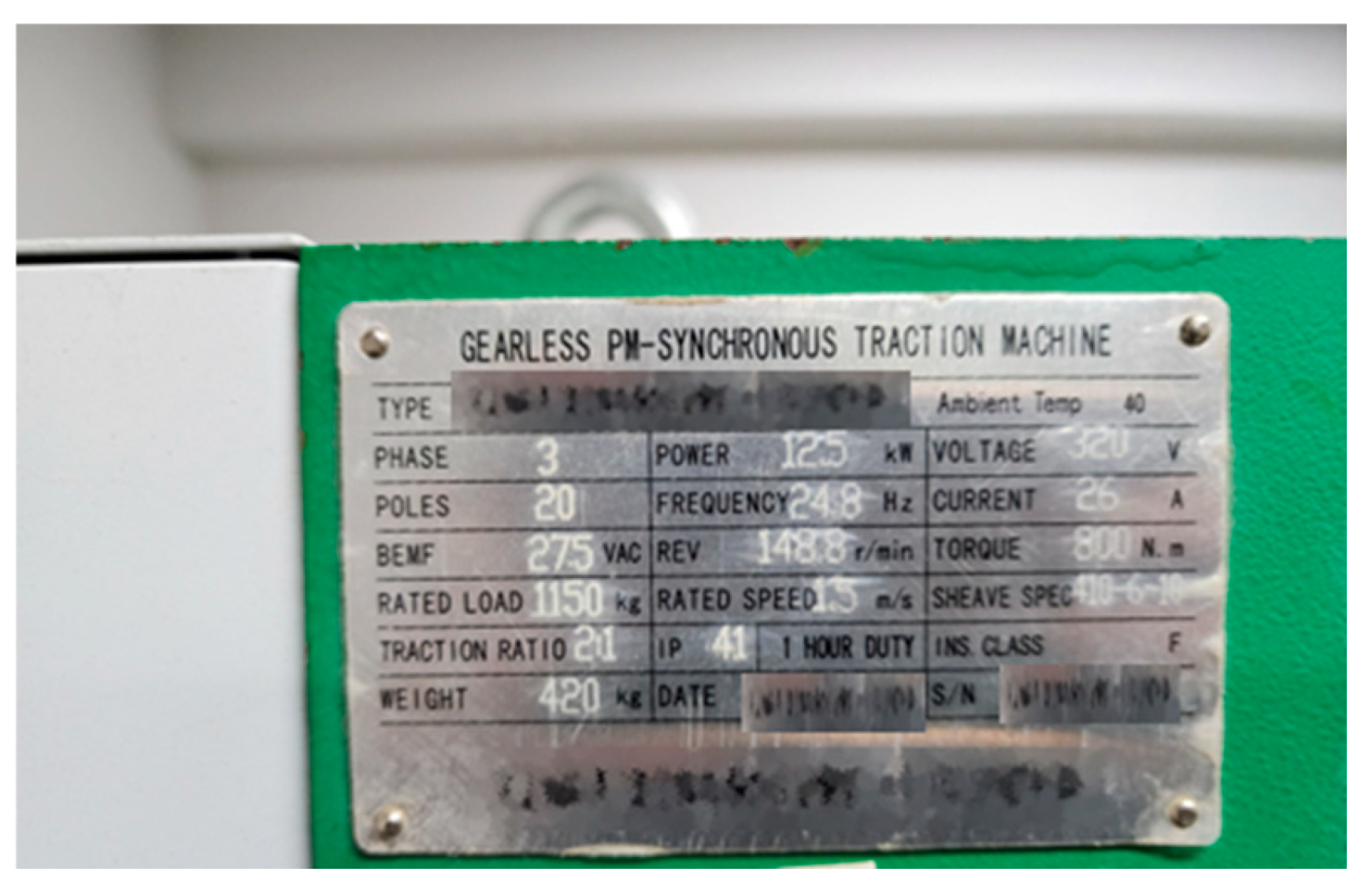
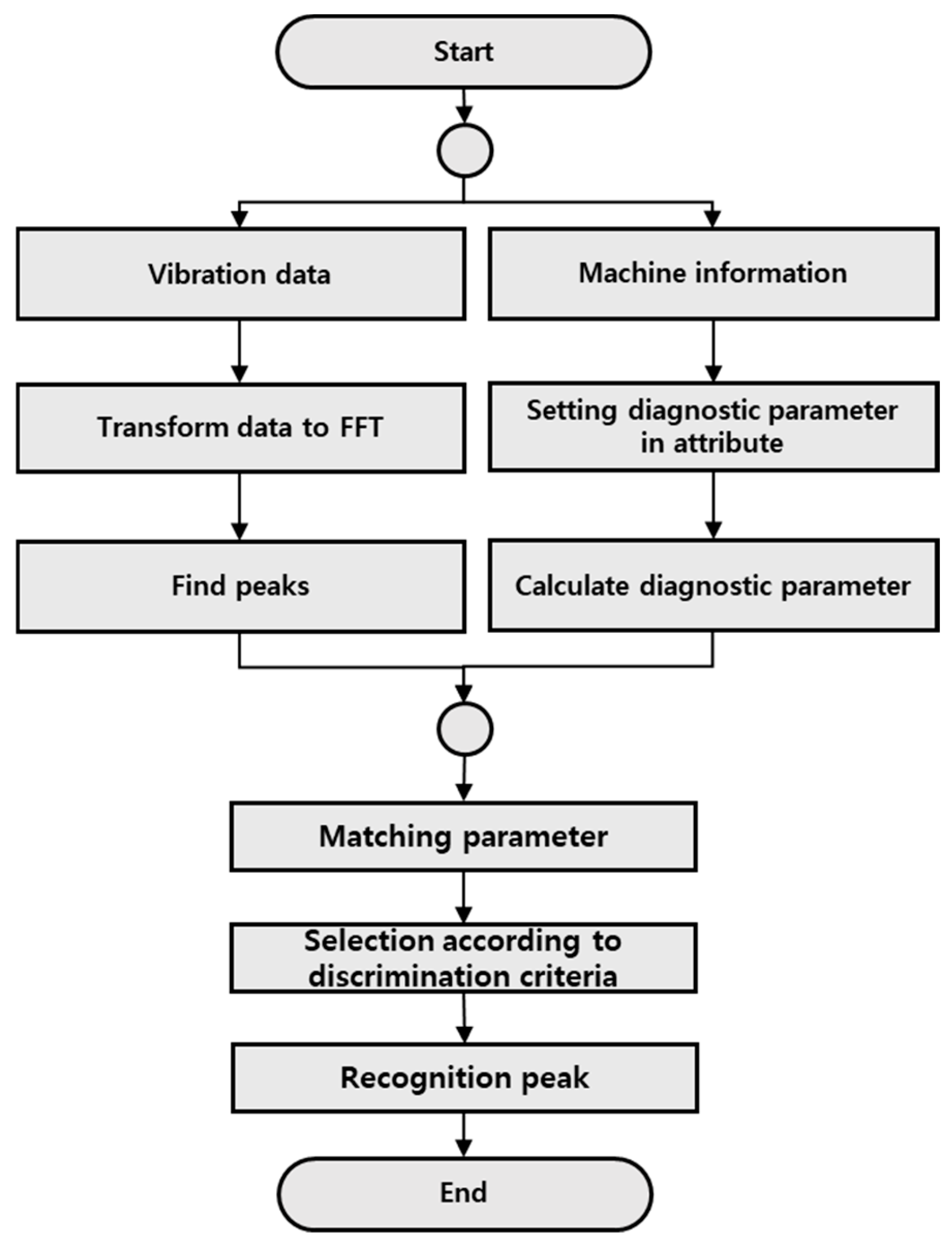
| Motor Information | |
|---|---|
| Poles | 20 |
| Supply frequency | 24.8 Hz |
| Rotating frequency | 2.48 Hz |
| REV | 148.8 r/min |
| Diagnosis Region | Fault Condition | Direction | Domain | Features |
|---|---|---|---|---|
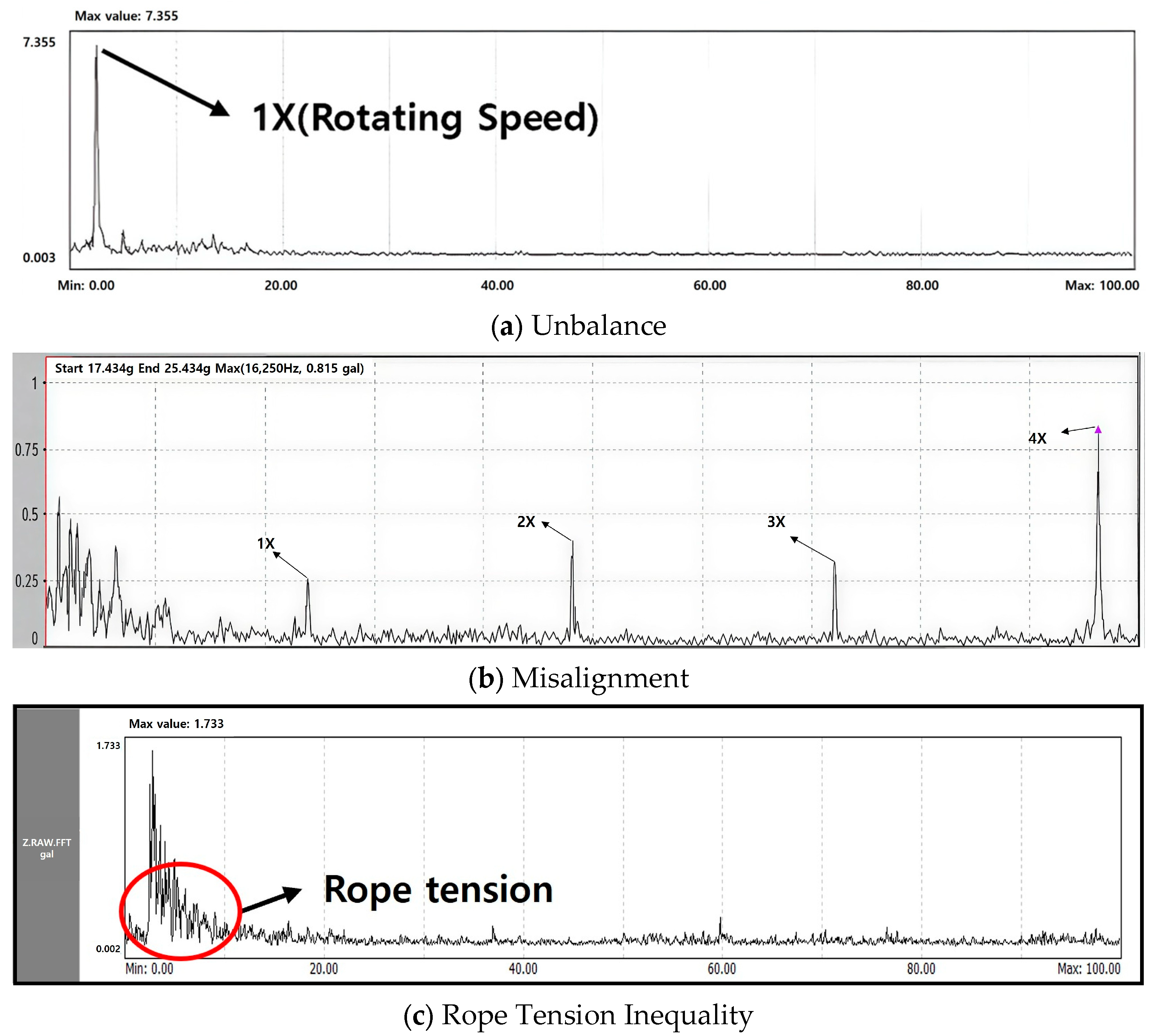
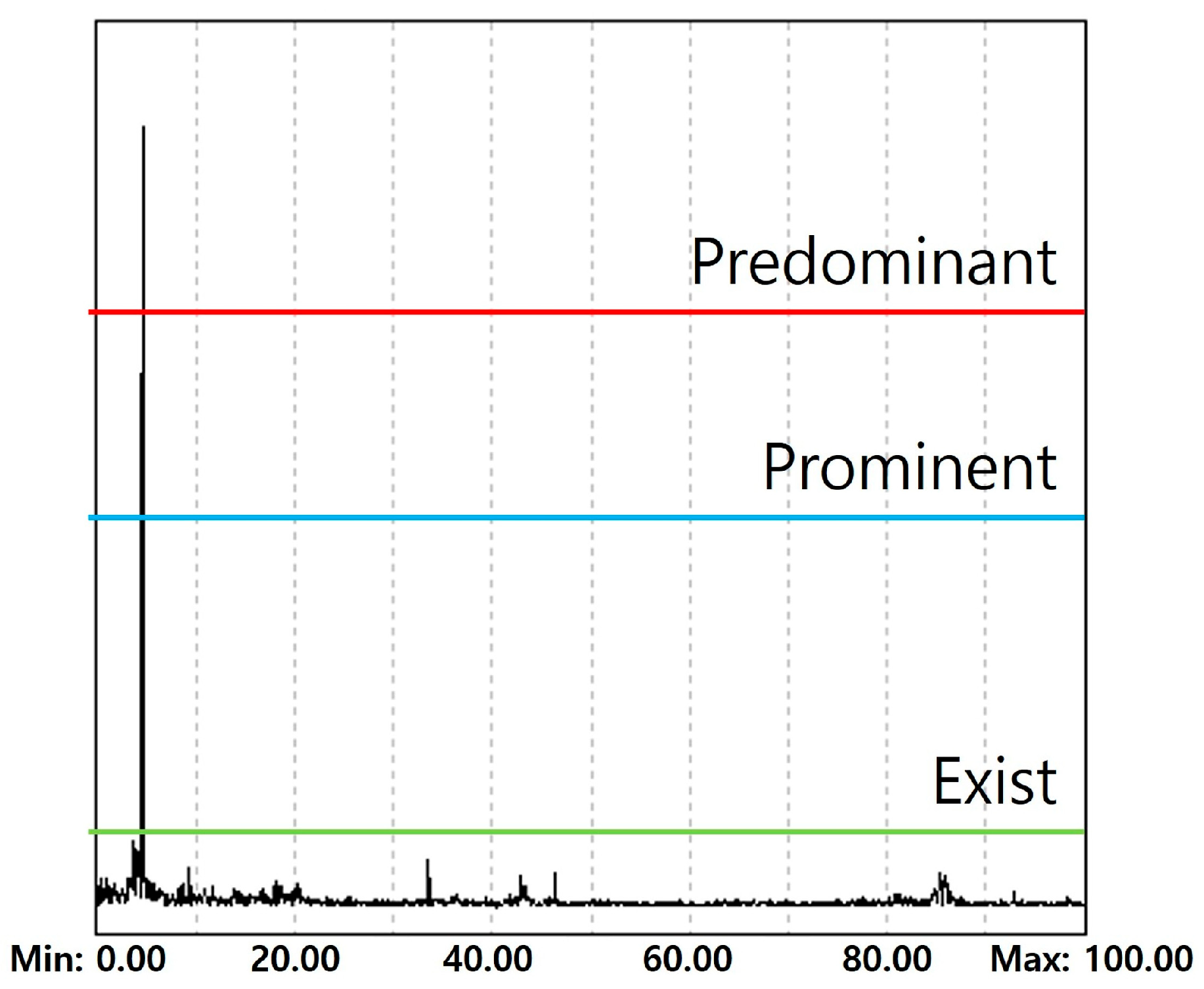
| Driven | Unbalance | Z | FFT spectrum | or (Drive speed) |
| Misalignment | Z | FFT spectrum | 2X or 3X (Rotating speed) | |
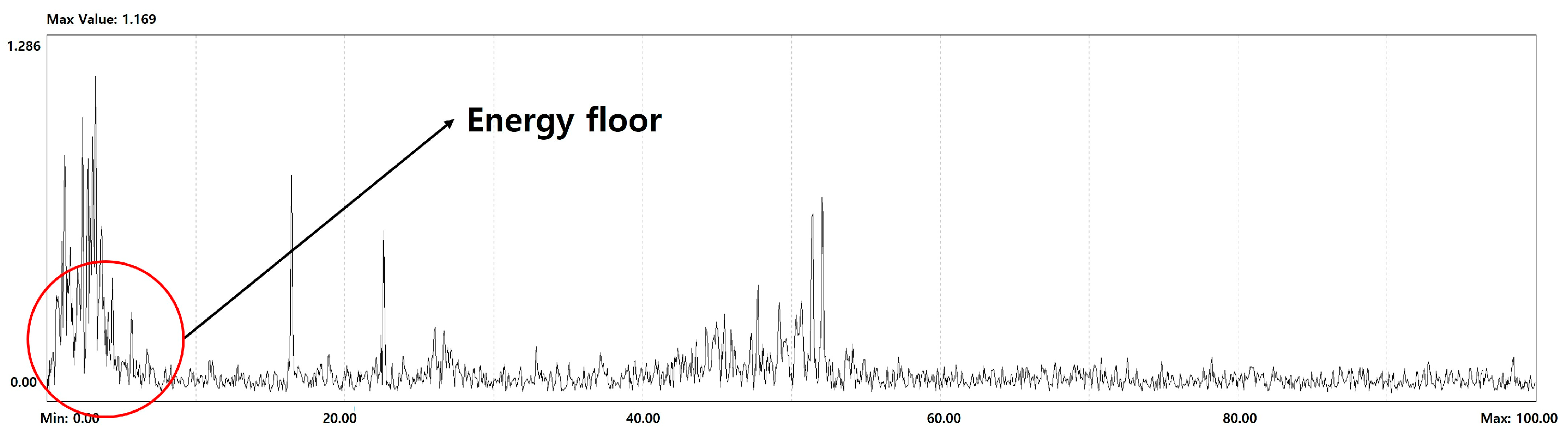
| Rope Tension Inequality | Z | FFT spectrum | Energy floor (1~4 Hz) | |
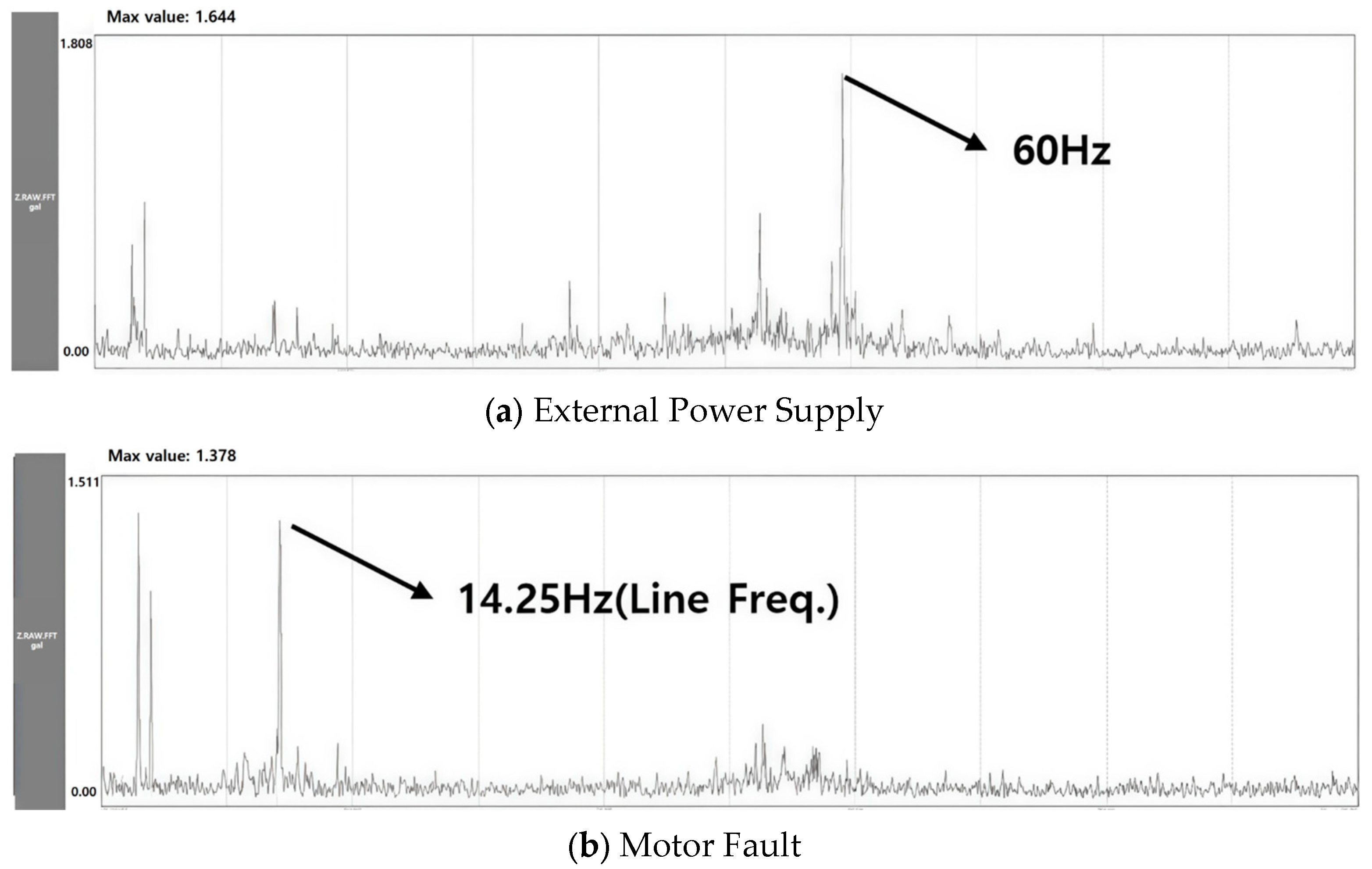
| Motor | Eccentricity Faults | Z | FFT spectrum | |
| Magnetic Faults | Z | FFT spectrum | ||
| Slot Faults | Z | FFT spectrum | ||
| External Electrical Fault | Z | FFT spectrum | ||
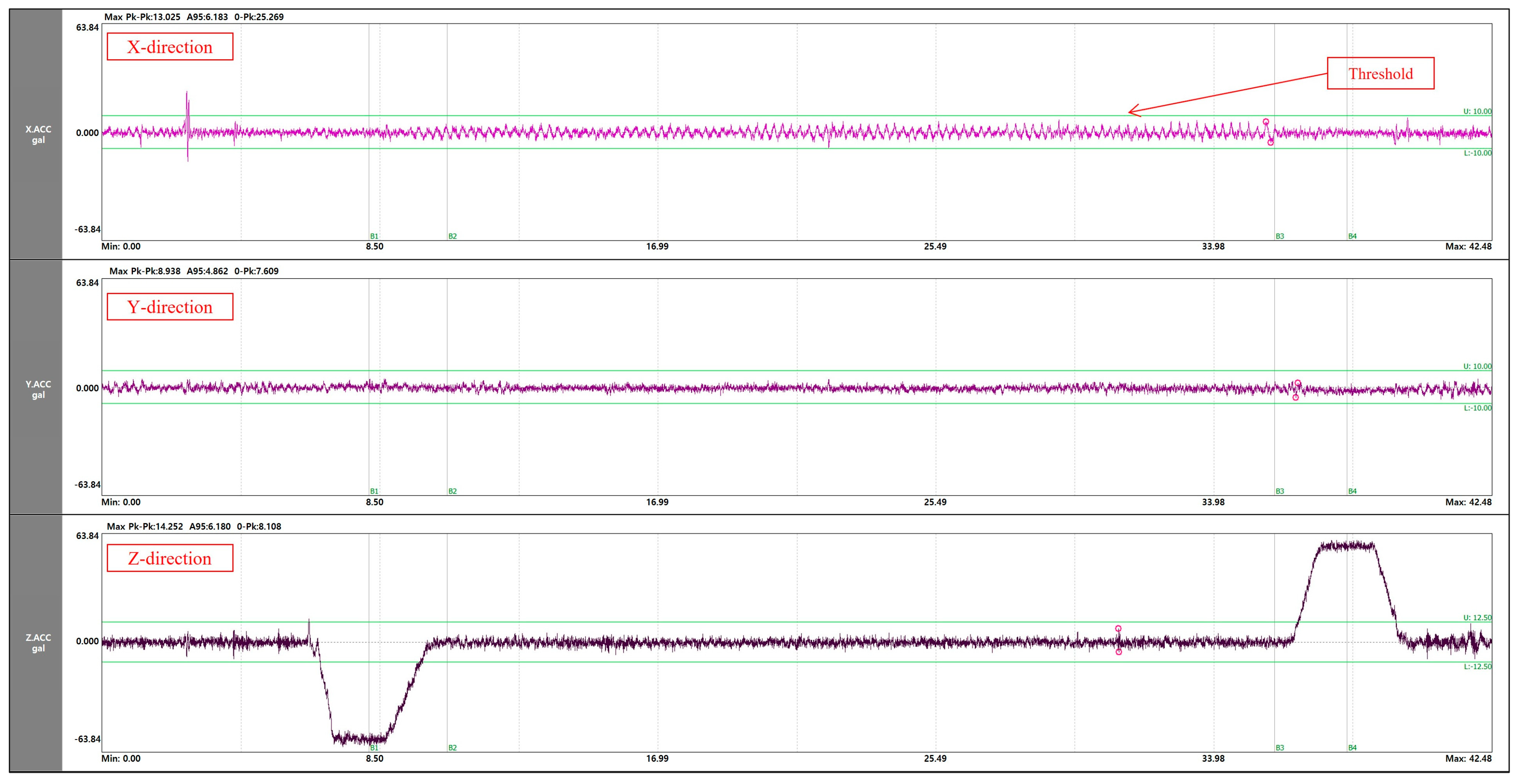
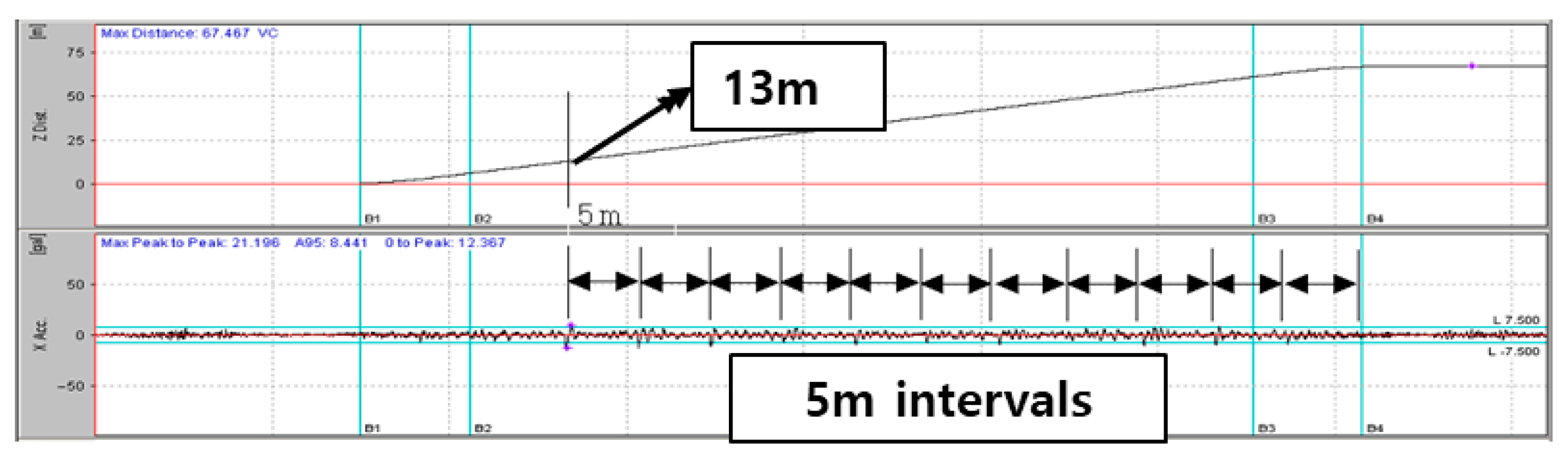
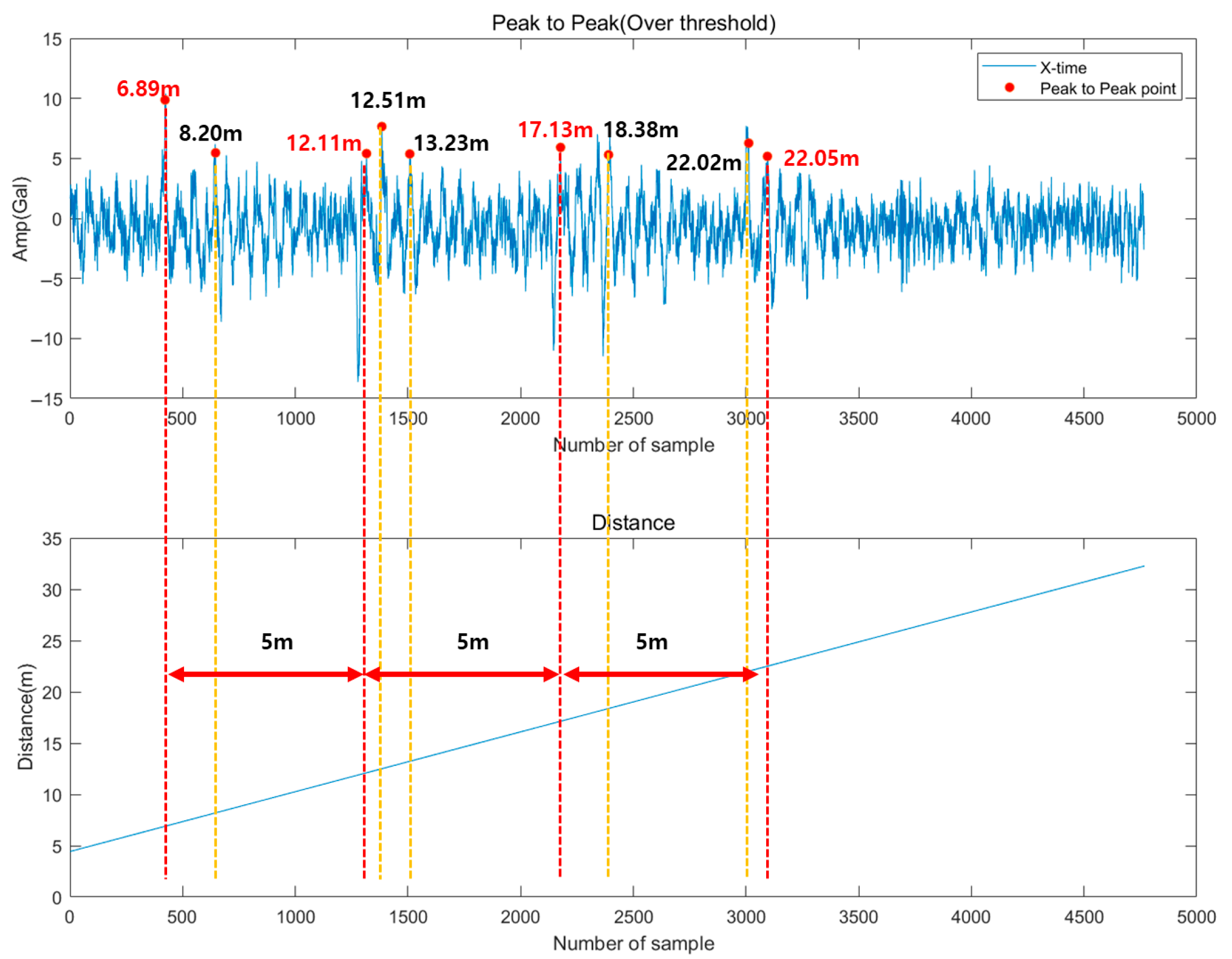
| Guide Rail | Guide Rail Misalignment | X or Y | Time waveform | Shock occurs at 5 m intervals (Guide rail intervals) |
| Guide Rail Support Faults | X or Y | Time waveform | Shock occurs at 2.5 m intervals (Guide rail support intervals) | |
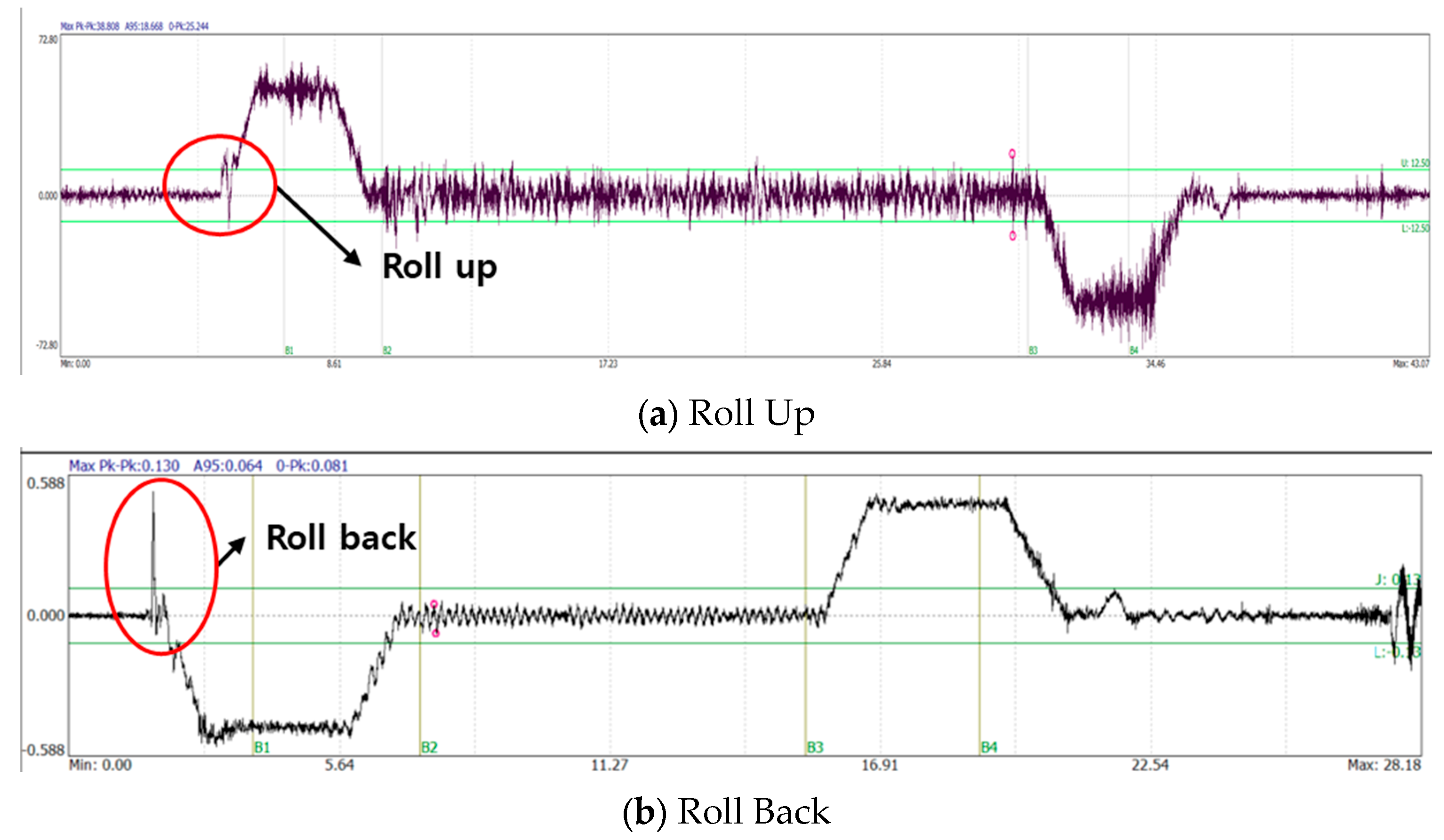
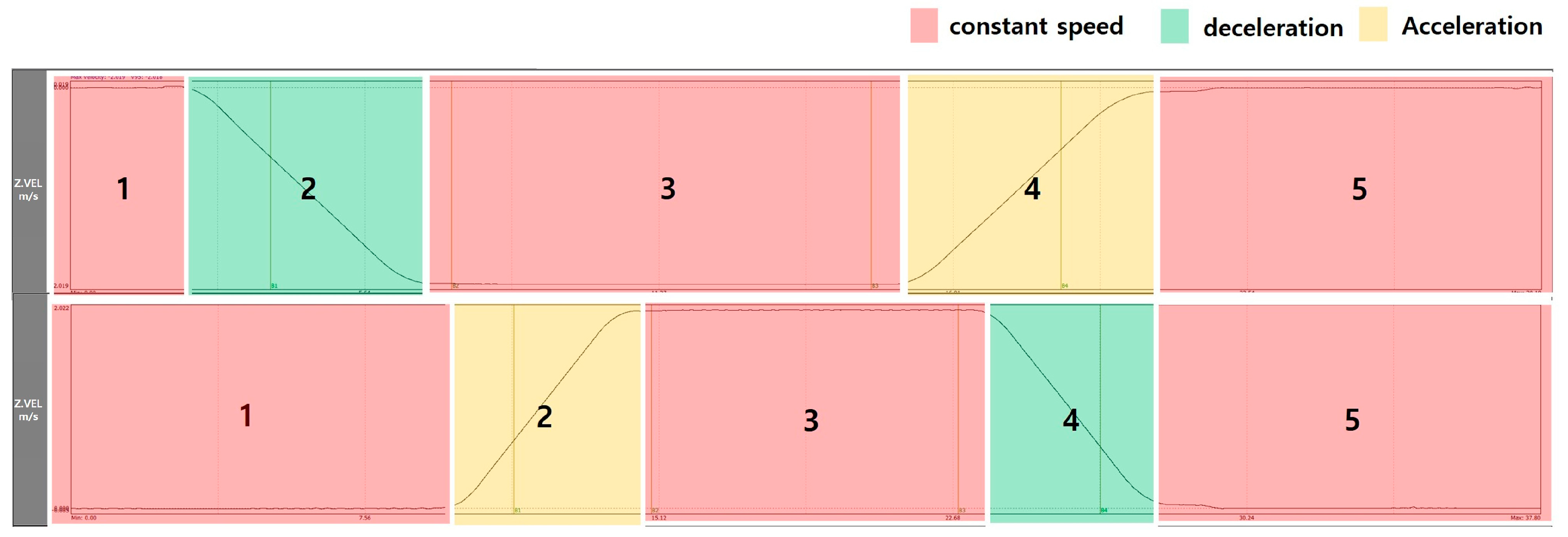
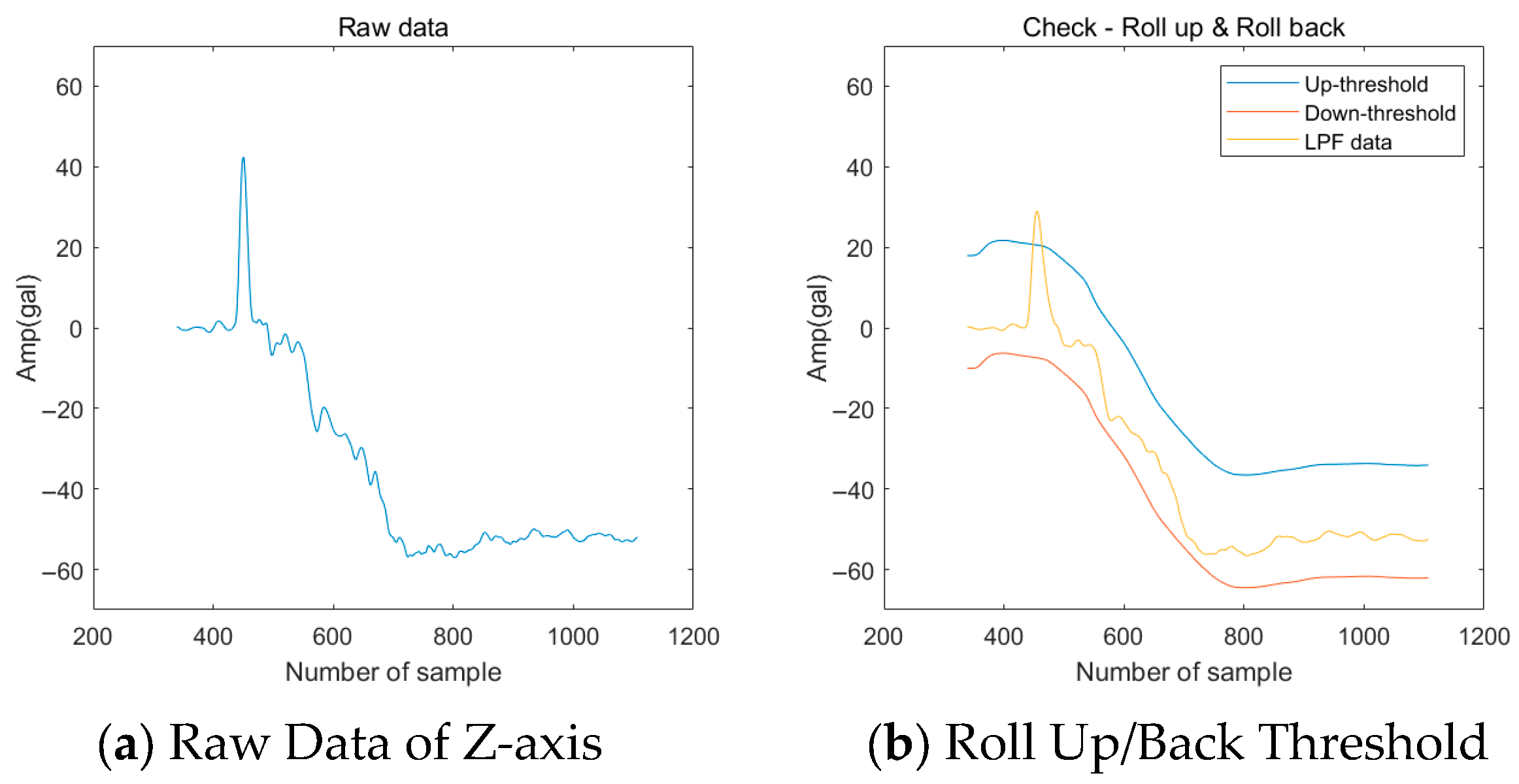
| Drive | Roll Up | Z | Time waveform | Impulse vibration occurs in the same direction as the acceleration section before the acceleration section in the time waveform |
| Roll Back | Z | Time waveform | Impulse vibration occurs in the opposite direction as the acceleration section before the acceleration section in the time waveform | |
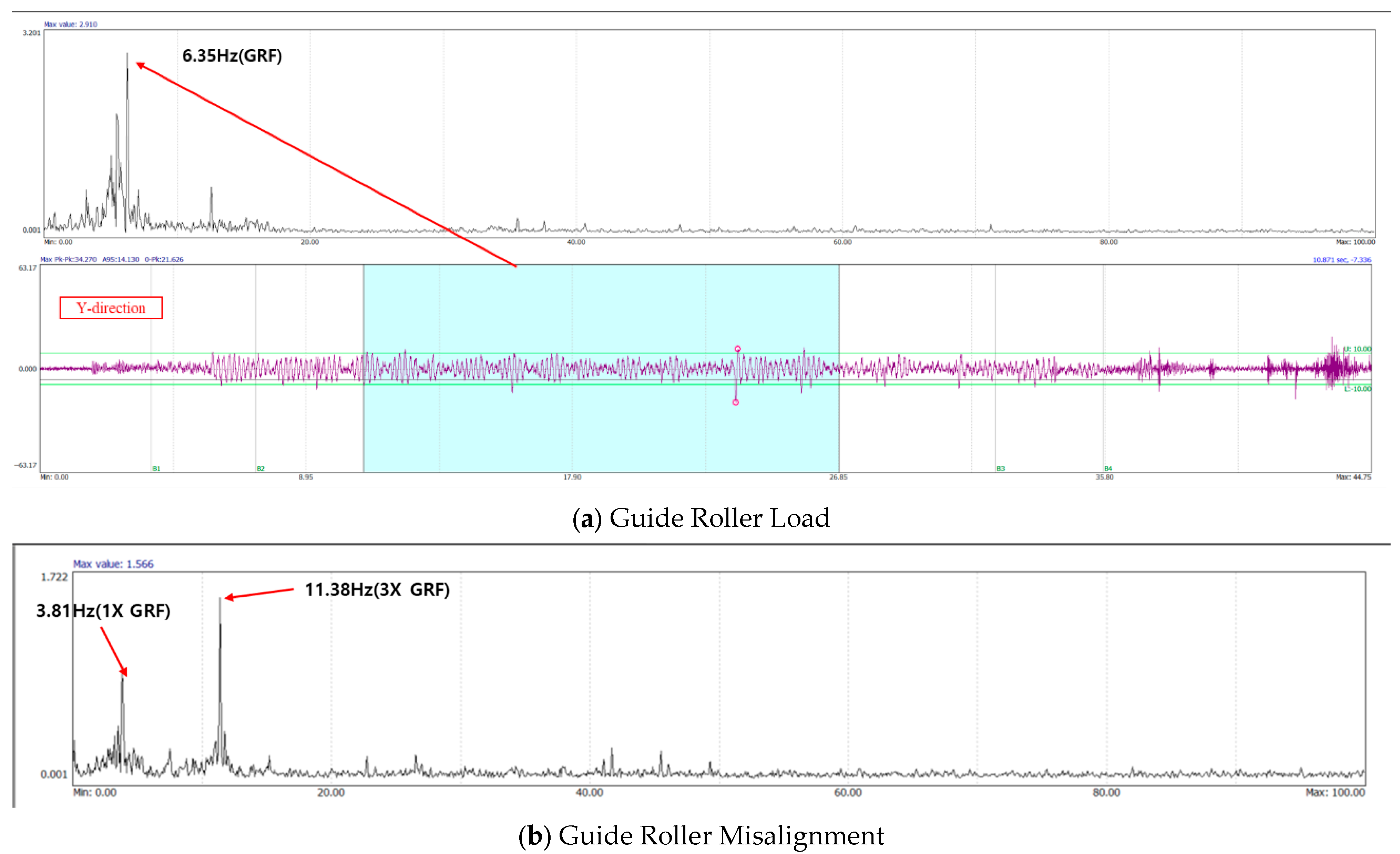
| Guide Roller | Guide Roller Interference | X or Y | FFT spectrum | Guide roller frequency 1X |
| Guide Roller Misalignment | X or Y | FFT spectrum | Guide roller frequency 2X or 3X |
| Elevator Information | |
|---|---|
| Operating speed (RPM, Hz) | 67 (1.11) |
| Car velocity (m/s) | 1.75 |
| Roping ratio | 2:1 |
| Sheave diameter (mm) | 500 |
| Guide roller diameter (mm) | 125 |
| Guide rail initial length (mm) | 2030 |
| Pit depth (mm) | 2120 |
| Supply frequency (Hz) | 16.7 |
| Number of pole (EA) | 30 |
| Information | Value | |
|---|---|---|
| Sensor | Type | Piezo-resistive MEMS |
| Direction | X, Y, Z (3-axis) | |
| Range | 6 g, 8 g, 10 g, 20 g | |
| ADC (Measuring Equipment) | Bandwidth | 70 kHz |
| DC accuracy | 9.8 µV/°C, 1.8 ppm/°C | |
| SNR | 111 dB, 52 kSPS | |
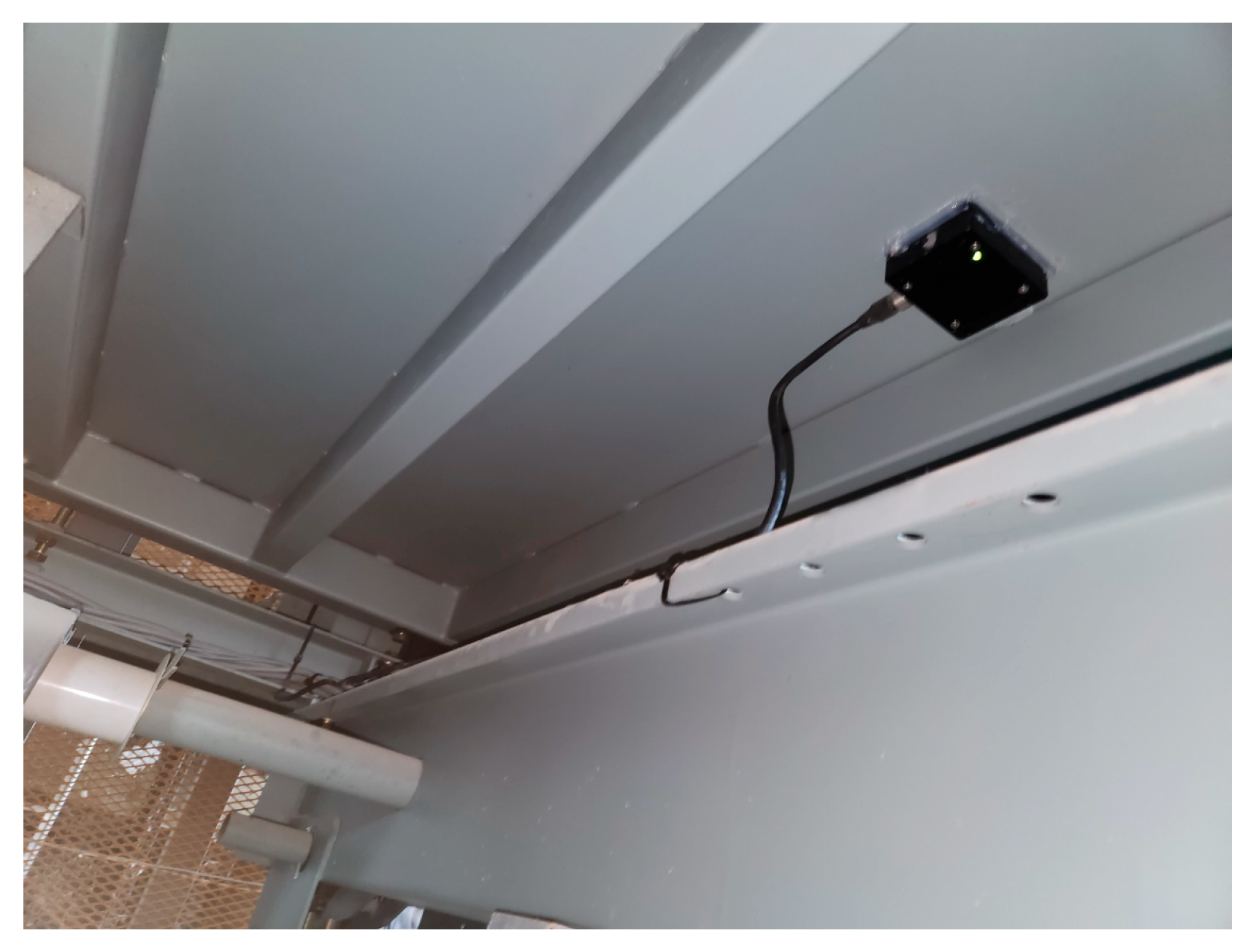
| Measurement | Sampling rate | 256 Hz |
| Duration | 35~50 s |
| Recognized FFT Spectrum Component | Calculated Hz Value | Error Rate | |||
|---|---|---|---|---|---|
| Rank | Criteria | Amplitude (gal) | Frequency (Hz) | Frequency (Hz) | |
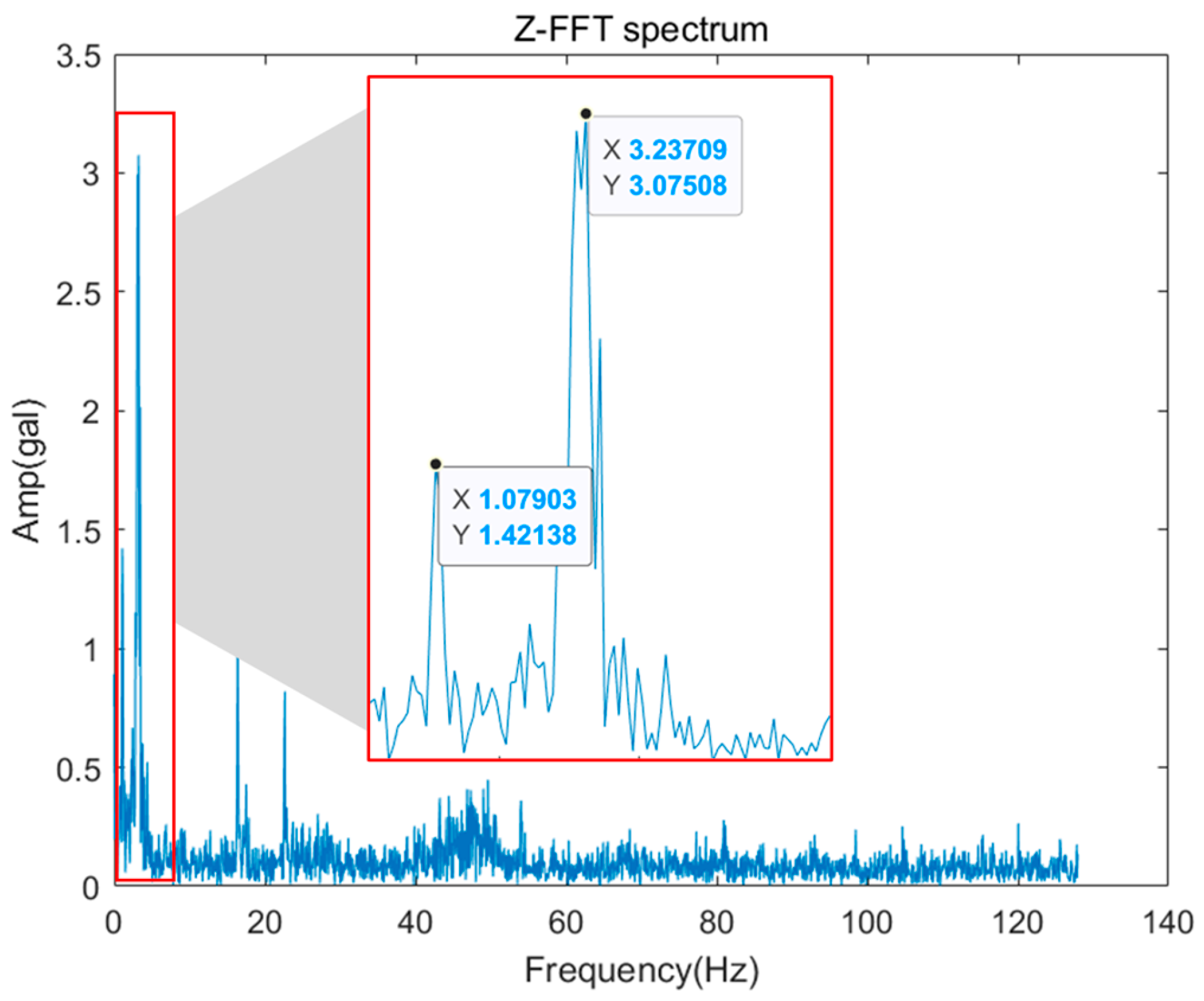
| 1 | Prominent | 3.08 | 3.24 | 3.33 (3X) | 2.7% |
| 2 | Exist | 1.42 | 1.08 | 1.11 (1X) | 2.7% |
| 3 | Exist | 1.07 | 16.38 | 16.7 (Supply freq.) | 2% |
| Frequency (Hz) | Energy Density | |
|---|---|---|
| Energy Floor Region | 0–3.21 | 93.20 |
| Location Number | ||||||||
|---|---|---|---|---|---|---|---|---|
| 1 | 2 | 3 | 4 | 5 | 6 | 7 | 8 | |
| Joint | 2.02 | 7.02 | 12.02 | 17.02 | 22.02 | 27.02 | 32.02 | 37.02 |
| Bracket(1) | 4.19 | 9.19 | 14.19 | 19.19 | 24.19 | 29.19 | 34.19 | 39.19 |
| Bracket(2) | 5.86 | 10.86 | 15.86 | 20.86 | 25.86 | 30.86 | 35.86 | 40.86 |
| Location Number | Expected Location | Recognition Location | Error Ratio |
|---|---|---|---|
| 2 | 7.02 | 6.89 | 1.9% |
| 3 | 12.02 | 12.11 | 0.7% |
| 4 | 17.02 | 17.13 | 0.6% |
| 5 | 22.02 | 22.05 | 0.1% |
| Attribute | Response | |
|---|---|---|
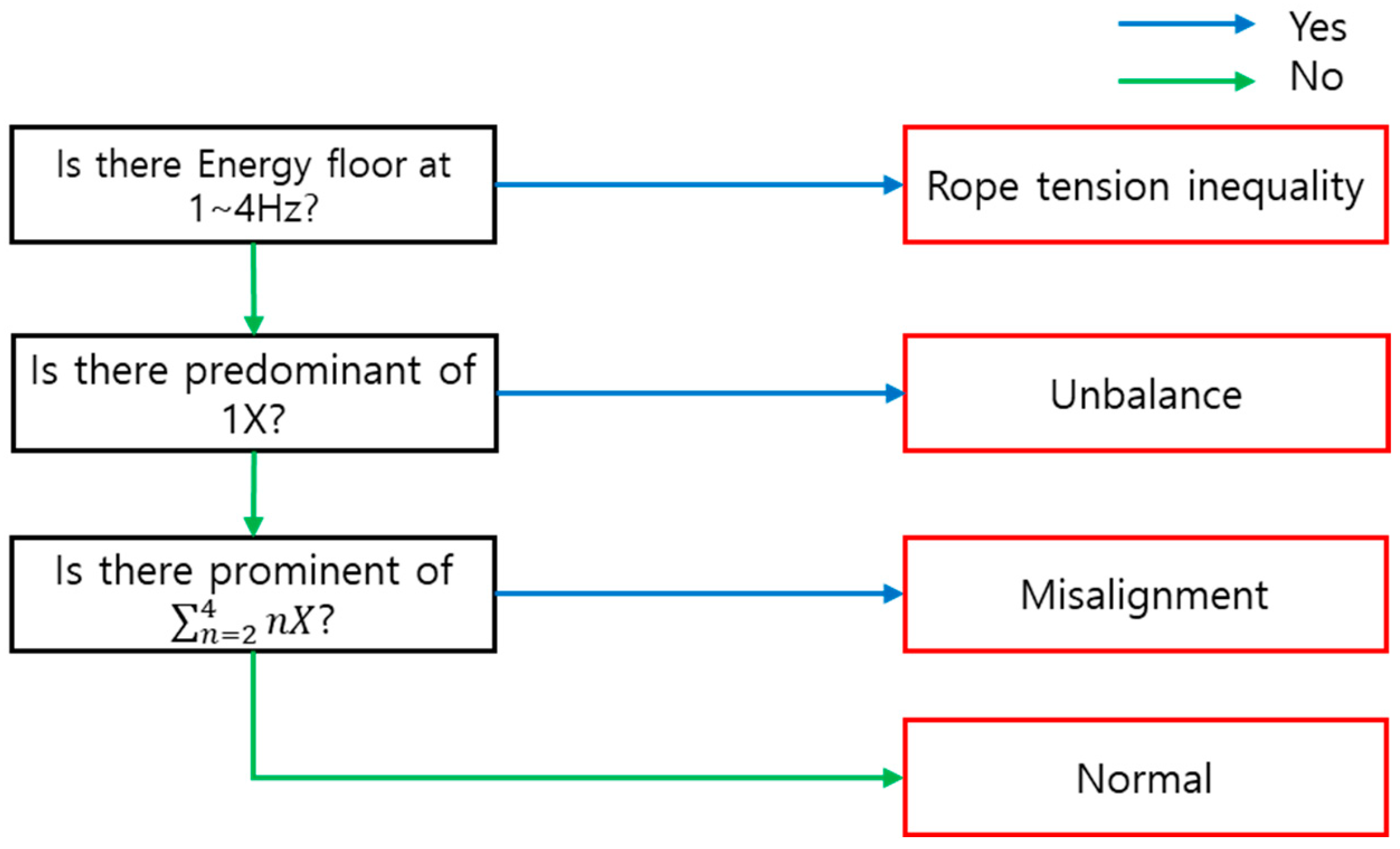
| 1 | Is there predominant of 1X? | N |
| 2 | Is there prominent of ? | Y |
| 3 | Is there Energy floor at 1~4 Hz? | N |
| Data No. | Recognition Result | Analysis Result | ||||||
|---|---|---|---|---|---|---|---|---|
| Traction Machine | Guide Roller | Guide Rail | Driven | Traction Machine | Guide Roller | Guide Rail | Driven | |
| 1 | Normal | Load | Misalign. | Roll up&back | Normal | Load | Misalign. | Roll up&back |
| 2 | Normal | Normal | Normal | Roll up&back | Normal | Normal | Normal | Roll up&back |
| 3 | Normal | Normal | Normal | Roll up&back | Normal | Normal | Normal | Roll up&back |
| 4 | Rope tension | Normal | Normal | Normal | Misalign. | Normal | Normal | Normal |
| 5 | Normal | Normal | Normal | Roll up&back | Normal | Normal | Normal | Roll up&back |
| 6 | Normal | Load | Misalign. | Roll up&back | Normal | Load | Misalign. | Roll up&back |
| 7 | Misalign. | Misalign. | Normal | Normal | Misalign. | Misalign. | Normal | Normal |
| 8 | Normal | Load | Misalign. | Roll up&back | Normal | Load | Misalign. | Roll up&back |
| 9 | Misalign. | Load | Misalign. | Normal | Misalign. | Load | Misalign. | Normal |
| 10 | Normal | Misalign. | Normal | Normal | Normal | Misalign. | Normal | Normal |
Disclaimer/Publisher’s Note: The statements, opinions and data contained in all publications are solely those of the individual author(s) and contributor(s) and not of MDPI and/or the editor(s). MDPI and/or the editor(s) disclaim responsibility for any injury to people or property resulting from any ideas, methods, instructions or products referred to in the content. |
© 2025 by the authors. Licensee MDPI, Basel, Switzerland. This article is an open access article distributed under the terms and conditions of the Creative Commons Attribution (CC BY) license.
Share and Cite
Seo, S.; Lee, J.j.; Park, D.h.; Choi, B.k. Development of Rule-Based Diagnostic Automation Technology for Elevator Fault Diagnosis. Sensors 2026, 26, 223. https://doi.org/10.3390/s26010223
Seo S, Lee Jj, Park Dh, Choi Bk. Development of Rule-Based Diagnostic Automation Technology for Elevator Fault Diagnosis. Sensors. 2026; 26(1):223. https://doi.org/10.3390/s26010223
Chicago/Turabian StyleSeo, Sangyoon, Jeong jun Lee, Dong hee Park, and Byeong keun Choi. 2026. "Development of Rule-Based Diagnostic Automation Technology for Elevator Fault Diagnosis" Sensors 26, no. 1: 223. https://doi.org/10.3390/s26010223
APA StyleSeo, S., Lee, J. j., Park, D. h., & Choi, B. k. (2026). Development of Rule-Based Diagnostic Automation Technology for Elevator Fault Diagnosis. Sensors, 26(1), 223. https://doi.org/10.3390/s26010223